Clinical Characteristics and Complications of
Pediatric Liver Biopsy: A Single Centre Experience
Patricia Almeida,*,**** Richard A. Schreiber,*,***,**** Jennifer Liang,*,**** Quais Mujawar,** Orlee R. Guttman*,***
* Division of Pediatric Gastroenterology, Hepatology and Nutrition, BC Children's Hospital. ** Department of Pediatrics and Child Health, University of Manitoba, Winnipeg, MB, Canada. *** Department of Pediatrics, University of British Columbia, Vancouver, BC, Canada. **** University of British Columbia, Vancouver, BC, Canada.
September-October, Vol. 16 No. 5, 2017: 797-801
INTRODUCTION
Percutaneous liver biopsy (LB) has long been considered the gold standard method for evaluation and management of patients with liver disease.1 First described in Germany
in1883 by Paul Ehrlich2,3 the technique became widely
ac-cepted in adults after Menghini reported, in 1958, a more simplified and safer technique using his needle.4,5 In
pediat-ric practice, percutaneous LB was first reported in the late 1950s and has since been regarded as useful and safe.6,7
Many institutions now choose to perform the percuta-neous LB under real-time sonographic guidance in an ef-fort to decrease the complication rate and to achieve targeted sampling.1,8 A transjugular (TJ) LB is selected for
those patients who have severe coagulopathy, ascites, mas-sive obesity or a vascular lesion,9 but this approach is
tech-nically difficult in small infants. Recently, the European Society for Pediatric Gastroenterology, Hepatology and
Nutrition (ESPGHAN) defined "minor" complications of LB in children to include: pain; subcapsular bleeding that does not require transfusion or prolonged hospitalization, infection, minor bile leak or haemobilia, and arteriov-enous fistula. "Major" LB complications include: bleeding or haemobilia requiring transfusion, need for surgery or intensive care management, pneumothorax or haemotho-rax, and death.10
The purpose of this single centered retrospective study was to characterize pediatric patients undergoing liver bi-opsy at British Columbia Children’s Hospital (BCCH), and to determine the rate and timing of minor and major complications following the procedure.
MATERIAL AND METHODS
The study was conducted on all patients aged 0-18 years old identified by the Anatomical Pathology Department at The Official Journal of the Mexican Association of Hepatology,
the Latin-American Association for Study of the Liver and the Canadian Association for the Study of the Liver
Manuscript received: Manuscript received:Manuscript received:
Manuscript received:Manuscript received: January 10, 2017. Manuscript accepted:Manuscript accepted:Manuscript accepted:Manuscript accepted:Manuscript accepted: February 11, 2017.
DOI:10.5604/01.3001.0010.2809. A B S T R A C T A B S T R A C T A B S T R A C T A B S T R A C T A B S T R A C T
Introduction. Introduction. Introduction. Introduction.
Introduction. Percutaneous liver biopsy (LB) is the gold standard method for evaluation and management of patients with liver dis-ease. The purpose of this study was to characterize pediatric patients undergoing LB at British Columbia Children's Hospital, and to determine the rate and timing of complications following the procedure. Material and methods.Material and methods.Material and methods.Material and methods.Material and methods. The medical records of all pediat-ric patients who underwent LB during a six-year retrospective study were reviewed to collect demographic and procedure-related data. Results.Results.Results.Results.Results. 223 LBs were performed, and 179 of these biopsies were percutaneous or transjugular. Elevated liver enzymes and cholestasis together accounted for almost 70% of the indications for LB, and the histological analysis of liver tissue yielded a specif-ic diagnosis in 89 % of the cases. There were no deaths and no major complspecif-ications related to LB. The most frequent minor compli-cation was pain (59% of LBs) and the other complicompli-cations were bleeding-related and classified as minor. The vast majority of complications (88%) were recognized within 8 h of the LB. Conclusions. Conclusions. Conclusions. Conclusions. LB is a valuable and safe procedure in pediatric patientsConclusions. with a low rate of complications. Pediatric patients can be discharged home safely should no complications occur within the first 8-12 h after the procedure.
Key words. Key words.Key words. Key words.
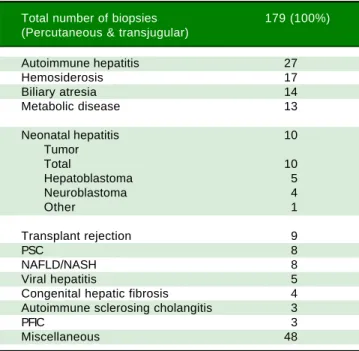
Table 3. Liver biopsy diagnosis.
Total number of biopsies 179 (100%)
(Percutaneous & transjugular)
Autoimmune hepatitis 27
Hemosiderosis 17
Biliary atresia 14
Metabolic disease 13
Neonatal hepatitis 10
Tumor
Total 10
Hepatoblastoma 5
Neuroblastoma 4
Other 1
Transplant rejection 9
PSC 8
NAFLD/NASH 8
Viral hepatitis 5
Congenital hepatic fibrosis 4 Autoimmune sclerosing cholangitis 3
PFIC 3
Miscellaneous 48
PSC: primary sclerosing cholangitis. NAFLD: Non-Alcoholic Fatty Liver Dis-ease. NASH: Non-Alcoholic Steatohepatitis. PFIC: progressive familial int-rahepatic cholestasis.
BCCH who underwent liver biopsy between January 2006 to December 2012. The medical records of the patients were reviewed and demographic data including the date of birth, gender, weight, height and body mass index, were recorded. Procedure-related data that were collected in-cluded patient age at LB, indication for LB, method of LB, division requisitioning the LB, final diagnosis, inpatient/ outpatient status at time of referral for LB, pre-biopsy complete blood count (CBC) and INR, post-biopsy he-moglobin, duration of hospital stay post biopsy, type of complications and their temporal association with the LB. At BCCH the post-LB protocol generally involves an overnight hospital stay with measurement of CBC 4 h post-procedure. Post-biopsy hemorrhage was defined as a drop in hemoglobin (Hb) of more than 20 g/L from the pre-biopsy value. Descriptive statistics and standard stu-dent T tests were applied for data analysis. The study was approved by the University of British Columbia Institu-tional Review Board.
RESULTS
A total of 184 patients (108 males) underwent 223 LB, of which 163 (73.1%) were percutaneous, 16 (7.2%) were transjugular (TJ) and 44 (19.7%) were surgical wedge biop-sies. The surgical wedge biopsies were excluded from all further analysis (Table 1).
The 179 percutaneous and TJ biopsies were performed on 158 patients (91 males) at a median age of 8.5 years (range 0.1 to 18.3 years). Among these patients, 12 under-went the procedure twice, three patients underunder-went three biopsies and one patient had four procedures. Of the 179 LB, 30% were in the 11-15 year old age group and al-most 20% of the cases were less than 6 months of age (Ta-ble 2). The leading indication for the LB was elevated liver enzymes (49%) (Figure 1). All infants less than 6 months of age had LB to assess for neonatal cholestasis. Autoim-mune hepatitis was diagnosed in 27 (15%), and biliary atresia in 14 (8%) of liver biopsies respectively (Table 3). A majority of the LBs were requested by the Gastroenter-ology (151 biopsies, 84%) and HaematGastroenter-ology/OncGastroenter-ology services (24 biopsies, 13%). Of the LBs, 102 (57%) were requested in outpatients, 75 (42%) requested for inpatients
Table 2. Patient age at biopsy.
Total number of biopsies 179 (100%)
(percutaneous & transjugular)
≤ 6 months 34 (19.0%)
7 - 12 months 4 (2.2%)
1 - 5 years 33 (18.4%)
6 - 10 years 33 (18.4%)
11 - 15 years 50 (28.0%)
16 - 18 years 25 (14.0%)
Table 1. Biopsies performed.
Data Numbers Age (years)
Total number of patients 184 0.1-18.3
Male/Female 108/76
Total number of biopsies 223 (100%)
Percutaneous biopsies 163 (73.1%) 0.1-18.3 Wedge biopsies 44 (19.7%) 2.1-18.2 Transjugular biopsies 16 (7.2%) 0.4-14.1
Figure 1. Figure 1. Figure 1. Figure 1.
Figure 1. Indications for biopsy.
Elevated liver enzymes (49%) Other
(11%) Organomegaly
(4%) Iron overload
(7%)
Cholestasis (20%) Suspected malignancy
and 2 (1.1%) for intensive care unit patients. The mean and median duration of hospital stay after LB for the outpa-tient group was 23 h (range 6.5 - 33 hrs) (Table 4).
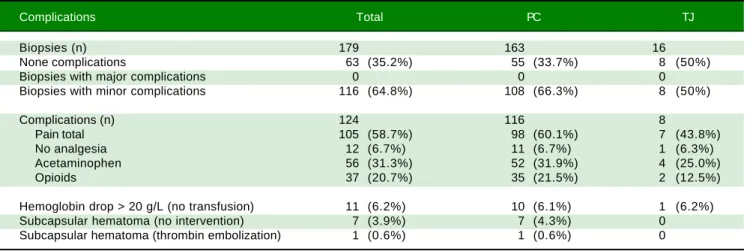
There were no major complications and no mortality. Minor complications occurred in 116 biopsies (65%), with some procedures having more than one complication totaling 124 complications post LB. The most frequent minor complication was pain (59%). Of these, 7% did not require any analgesia. Acetaminophen was administered af-ter 56 LB procedures (31%) and opiate analgesics were re-quired after 37 (21%) biopsies (Table 5). Among children younger than one year of age, pain responsive to oral anal-gesics occurred in 74% of patients. In children 8 years of age or older, pain was reported in 53% of the cases. Eleven patients (6%) had a drop in Hb of more than 20 g/L post-biopsy but none required transfusion. Pre-post-biopsy Hb lev-els for these 11 patients ranged from 107 g/L to 167 g/L, platelet count 69,000/μL to 565,000/μL, and INR 0.93 to 1.24 respectively. In 7 biopsies (4%) a small hematoma de-veloped at the biopsy site immediately post-procedure and local compression was applied. One patient required thrombin embolization of a capsular hematoma by U/S in the immediate post-biopsy period. Among the 8 patients with hematoma, the pre-biopsy Hb level ranged from 100 g/L to 135 g/L, platelets 75,000/μL to 147,000/μL, and INR 0.97 to 1.23.There was no statistical difference in the
mi-nor complications among the percutaneous LB (66%) compared with transjugular LB (50%) groups (Table 5).
The median time from the LB to recognition of any complication was 1.8 h, (mean 3.5 h; range 0-42 h). Eighty-one percent of the complications were recognized within 6 h of biopsy, 88% within 8 h, and 95% within 12 h (Figure 2).
DISCUSSION
LB is a well-established and reliable procedure for the assessment of liver disease in both children and adults.8,10
Several studies in adult patients with abnormal liver func-tion tests have demonstrated the utility of LB for identify-ing a specific diagnosis and for determinidentify-ing the grade of fibrosis.11,12 In this study of pediatric patients, elevated
liv-er enzymes and cholestasis togethliv-er accounted for almost 70% of the indications for LB, and the histological analysis of liver tissue yielded a specific diagnosis in 89% of the cases. In particular, the LB was an especially valuable tool
Table 5: Complications by type of biopsy.
Complications Total PC TJ
Biopsies (n) 179 163 16
None complications 63 (35.2%) 55 (33.7%) 8 (50%)
Biopsies with major complications 0 0 0
Biopsies with minor complications 116 (64.8%) 108 (66.3%) 8 (50%)
Complications (n) 124 116 8
Pain total 105 (58.7%) 98 (60.1%) 7 (43.8%)
No analgesia 12 (6.7%) 11 (6.7%) 1 (6.3%)
Acetaminophen 56 (31.3%) 52 (31.9%) 4 (25.0%)
Opioids 37 (20.7%) 35 (21.5%) 2 (12.5%)
Hemoglobin drop > 20 g/L (no transfusion) 11 (6.2%) 10 (6.1%) 1 (6.2%)
Subcapsular hematoma (no intervention) 7 (3.9%) 7 (4.3%) 0
Subcapsular hematoma (thrombin embolization) 1 (0.6%) 1 (0.6%) 0
PC: percutaneous. TJ: transjugular.
Table 4. Duration of Stay After LB for Outpatients.
Duration of stay Outpatients (n = 102)
< 7 h 1 (1.0%)
7 - 12 h 2 (2.0%)
13 - 24 h 64 (62.7%)
> 24 h 35 (34.3%)
Figure 2. Figure 2. Figure 2. Figure 2.
Figure 2. Complications distribution by time interval post biopsy.
Percentage (%)
100 95 90 85 80 75 70 65 60
to help establish a diagnosis in young infants less than six months of age with conjugated hyperbilirubinemia. Bil-iary atresia accounted for 36% of the diagnoses in these cas-es of neonatal cholcas-estasis. Overall in our sericas-es, autoimmune hepatitis was the leading diagnosis among the 179 LBs.
There were no deaths and no major complications re-lated to LB. Pain accounted for 90% of the complications reported in this pediatric series. This minor complica-tion, recognized in 59% of the patients, was most often managed with acetaminophen alone. Transient pain has been noted in 20-36 % of pediatric patients after LB.1,13
While pain has been recognized in as many as 85% of adults post LB,14 we believe the lower rate of this minor
complication in children may be related to level of an-esthesia delivered to children at the time of LB compared with adults. In very young infants post LB, pain symptoms may be over-reported because of the difficulty in differen-tiating this symptom from the general irritability often seen in hospitalized infants.
Many pediatric LB studies do not consider pain in the analysis of complications. In our study the overall incidence of complications excluding pain was 10.6%, a rate in keep-ing with other reports.15,16 All of these events were
bleed-ing-related and classified as minor. Similar to other series, most of our cases of bleeding were managed conservatively.1
Some studies have suggested that young infants are at slight-ly higher risk for bleeding.15,17,18 Among the eight cases with
hematoma in our study, four were under 4 months of age, but we could not assess age as a risk factor for bleeding complications due to our small sample size.
Among the 16 TJ biopsies (7% of LB) in this series, there were no major complications. Others have reported higher complication rates in both children and adults un-dergoing TJ.19
While ESPGHAN has recommended that the platelet count should be 60 x 109/L or higher, and the INR should be 1.5 or lower prior to a percutaneous LB,10 there is a
lack of correlation between these parameters and bleeding risk.20 Of the patients with bleeding complication in our
study, none had low pre-procedural platelet counts or elevations in the INR beyond the parameters recom-mended by ESPGHAN.
The optimal duration of observation after LB is anoth-er source of controvanoth-ersy. In 1989, the Amanoth-erican Gastroen-terological Association published a consensus statement recommending a 6 h observation post LB in adult patients having no risk factors.21 Recently, Firpi, et al. have found
that adult patients can be safely discharged after a one hour observation period.22,23 Similar to the policies in our
cen-tre, other pediatric centres keep patients in hospital for overnight observation post LB.24 However, the need
for this lengthy duration of monitoring has been
chal-lenged. In a study of 597 children, Govender determined that almost all LB complications could be identified with-in the first 4 h after the procedure, and if no complica-tions were encountered, patients could be discharged home safely.16 In another study, Matos observed children
for at least 6 h post LB and, if there were no complica-tions, the patients could be safely leave the hospital on the day of the procedure.25 Our data, although of limited
sam-ple size and retrospective, support these studies, and dem-onstrate that the vast majority of complications (88%) in pediatric patients can be recognized within 8 h of the LB. These results regarding the timing of discharge post LB have important health care cost implications.
In conclusion, our study confirms that LB has diagnos-tic value in pediatric patients and demonstrates that LB is a safe procedure with a low rate of complications. The ma-jority of complications were minor, with pain being the most common. There were no deaths and no major com-plications post LB in this six-year retrospective single centre pediatric study. Our findings further support the notion that pediatric patients do not require a 24 h over-night hospital observation period post LB and instead can be discharged home safely should no complications occur within the first 8 h and certainly by 12 h after the proce-dure. Current practice guidelines for the monitoring of pediatric patients post LB deserve re-evaluation.
ABBREVIATIONS
• BCCH: BC Children’s Hospital.
• CBC: complete blood count.
• ESPGHAN: European Society for Pediatric
Gastro-enterology, Hepatology and Nutrition.
• Hb: hemoglobin.
• INR: international normalized ratio. • LB: liver biopsy.
• TJ: transjugular.
SUPPORT
Jennifer Liang was supported by a Canadian Liver Foundation summer research studentship.
REFERENCES
1. Ovchinsky N, Moreira RK, Lefkowitch JH, Lavine JE. Liver bi-opsy in modern clinical practice: a pediatric point-of-view.
Adv Anat Pathol 2012; 19: 250-62.
2. Leeuwen DJ. Liver Biopsy. In Tytgat G, Mulder CJ (Eds). Pro-cedures in Hepatogastroenterology. 1st ed. Springer Neth-erlands; 1997, p. 193-210.
3. Terry R. Needle biopsy of the liver; with special reference to a modified Gillman technique. Br Med J 1949; 1: 657-60. 4. Rustagi T, Newton E, Kar P. Percutaneous liver biopsy. Trop
5. Parets AD, Schaffner F, Black H. Percutaneous liver biopsy with the Menghini needle. Am J Dis 1959; 4: 693-9.
6. Bruton OC, Metzger JF, Sprinz H. Experience with needle bi-opsy of the liver in infants and children. Pediatrics 1955; 16: 836-41.
7. Kaye R, Koop CE, Wagner BM, Picou D, Yakovac WC. Nee-dle biopsy of the liver, an AID in the differential diagnosis of prolonged jaundice in infancy. AMA J Dis Child 1959; 98: 699-709.
8. Rockey DC, Caldwell SH, Goodman ZD, Nelson RC, Smith AD. Liver biopsy. Hepatology 2009; 49: 1017-44.
9. Bravo AA, Sheth SG, Chopra S. Liver biopsy. N Engl J Med
2001; 344: 495-500.
10. Dezsöfi A, Baumann U, Dhawan A, Durmaz O, Fischler B, Hadzic N, Hierro L, et al. Liver biopsy in children: Position paper of the ESPGHAN Hepatology Committee. J Pediatr Gastroenterol Nutr 2015; 60: 408-20.
11. Sorbi D, McGill DB, Thistle JL, Therneau TM, Henry J, Lindor KD. An assessment of the role of liver biopsies in asympto-matic patients with chronic liver test abnormalities. Am J Gastroenterol 2000; 95: 3206-10.
12. Skelly MM, James PD, Ryder SD. Findings on liver biopsy to investigate abnormal liver function tests in the absence of di-agnostic serology. J Hepatol 2001; 35: 195-9.
13. Pietrobattista A, Fruwirth R, Natali G, Monti L, Devito R, Nobili V. Is juvenile liver biopsy unsafe? Putting an end to a com-mon misapprenhension. Pediatr Radiol 2009; 39: 959-61. 14. Eisenberg E, Konopniki M, Veitsman E, Kramskay R, Gaitini D,
Baruch Y. Prevalence and characteristics of pain induced by percutaneous liver biopsy. Anesth Anal 2003; 96: 1392-6. 15. Short SS, Papillon S, Hunter CJ, Stanley P, Kerkar N, Wang L, Azen C, et al. Percutaneous liver biopsy: pathologic diagno-sis and complications in children. J Pediatr Gastroenterol Nutr 2013; 57: 644-8.
16. Govender P, Jonas MM, Alomari AI, Padua HM, Dillon BJ, Lan-drigan-Ossar MF, Chaudry G. Sonography-guided percuta-neous liver biopsies in children. AJR Am J Roentgenol 2013; 201: 645-50.
17. Azzam RK, Alonso EM, Emerick KM, Whitington PF. Safety of percutaneous liver biopsy in infants less than three months old. J Pediatr Gastroenterol Nutr 2005; 41: 639-43.
18. Amaral JG, Schwartz J, Chait P, Temple M, John P, Smith C, Taylor G, et al. Sonographically guided percutaneous liver biopsy in infants: a retrospective review. AJR Am J Roent-genol 2006; 187: W644-9.
19. Kalambokis G, Manousou P, Vibhakorn S, Marelli L, Cholongi-tas E, Senzolo M, Patch D, et al. Transjugular liver biopsy--in-dications, adequacy, quality of specimens, and complications--a systematic review. J Hepatol 2007; 47: 284-94.
20. Caldwell SH. Management of coagulopathy in liver disease.
Gastroenterol Hepatol (NY) 2014; 10: 330-2.
21. Jacobs WH, Goldberg SB. Statement on out-patient percuta-neous liver biopsy. Dig Dis Sci 1989; 34: 322-3.
22. Firpi RJ, Soldevila-Pico C, Abdelmalek MF, Morelli G, Judah J, Nelson DR. Short recovery time after percutaneous liver bi-opsy: should we change our current practices? Clin Gas-troenterol Hepatol 2005; 3: 926-9.
23. Beddy P, Lyburn IL, Geoghegan T, Buckley O, Buckley AR, Torreggiani WC. Outpatient liver biopsy: a prospective evalu-ation of 500 cases. Gut 2007; 56: 307.
24. Westheim BH, Østensen AB, Aagenæs I, Sanengen T, Al-maas R. Evaluation of risk factors for bleeding after liver biop-sy in children. J Pediatr Gastroenterol Nutr 2012; 55: 82-7. 25. Matos H, Noruegas MJ, Gonçalves I, Sanches C.
Effective-ness and safety of ultrasound-guided percutaneous liver bi-opsy in children. Pediatr Radiol 2012; 42: 1322-5.
Correspondence and reprint request: Richard A. Schreiber, MDCM, FRCP(C), FAASLD Division of Gastroenterology, Hepatology and Nutrition Rm K4-200. BC Children's Hospital. 4480 Oak St. Vancouver,
British Columbia, Canada. V6H 3V4. Tel.: 1-604-875-2332, ext. 1. Fax: 1-604-875-3244