Effects of Japanese herbal medicine
inchin-ko-to on endotoxin-induced cholestasis in the rat
Juan Pablo Arab,* Carolina Ramírez,* Pablo Muñoz,*
Margarita Pizarro,* Nancy Solís,* Arnoldo Riquelme,* Marco Arrese*
* Departamento de Gastroenterología, Facultad de Medicina, Pontificia Universidad Católica de Chile, Santiago, Chile.
ABSTRACT
Background/Objective. Inchin-ko-to (ICKT) is an herbal medicine used in Japan to treat jaundice and liver fibrosis. We investigated the effect of oral ICKT supplementation on endotoxin-induced cholestasis in the rat. Material and methods. Lipopolysaccharide (LPS) injection (1 mg/kg body weight i.p.) was used as a model of sepsis-induced choles-tasis. Bile flow, biliary bile salt secretion, biliary glutathione secretion and protein expression of the main hepatobilia-ry transporters Na(+)-taurocholate-cotransporting peptide (Ntcp), multidrug resistance protein 2 (Mrp2) and bile salt export pump (Bsep) were analyzed by conventional techniques in ICKT treated and non-treated animals. Results. In-jection of LPS induced a significant decrease of bile flow (-24%), biliary bile salts (-40%) and glutathione excretion (-70%) as well as a significant decrease in Ntcp (-90%) and Mrp2 (-80%) protein levels. ICKT supplementation partially prevented the effects of LPS determining a less intense reduction in bile flow (-10%), a normalization of glutathione ex-cretion as well as a significant increase in Mrp2 protein levels to 60% of the levels observed in control animals. ICKT administration did not modify the effects of LPS on BS secretion or Ntcp protein levels. Conclusion. Our data show that oral supplementation of ICKT partially prevents LPS-induced cholestasis by increasing Mrp2 protein levels and bi-liary glutathione excretion thus increasing bile salt-independent flow.
Key words. Inchin-ko-to. Cholestasis. Endotoxin. Genipin
Correspondence and reprint request: Marco Arrese, MD Departamento de Gastroenterología, Facultad de Medicina Pontificia Universidad Católica de Chile
Marcoleta 367
Postal Code: 833-0024, Santiago, Chile. Pone/Fax: 56-2-6397780;
E-mail: [email protected]
Manuscript received: June 29, 2009. Manuscript accepted: July 26, 2009. INTRODUCTION
Cholestasis is a frequent clinical complication seen in patients with extrahepatic bacterial infection and sepsis.1-3 A cholestatic picture is associated to a
wide variety of infections caused by several organis-ms including aerobic and anaerobic as well as gram-negative and gram-positive bacteria, with gram-negative bacteria being the cause of most ca-ses.2,4 In the critical care setting, cholestasis
fre-quently poses a clinical challenge both in diagnostic evaluation and in management as well as may in-fluence the clinical prognosis of a given patient.5
Significant advances in the understanding of the pathogenesis of sepsis-associated cholestasis have been made in the recent years.6-9 Thus, now it is
known that hepatocellular and ductal bile formation is critically impaired as a result of the effects of inflammatory cytokines on specific transport pro-teins of both hepatocytes and cholangiocytes.1,2
Proinflammatory cytokines (mainly interleukin-1β [IL-1β], interleukin-6, and tumor necrosis factor α [TNFα]) are in turn generated after exposure of Ku-pfer cells to Lipopolysaccharide (LPS) which is deri-ved from gram-negative bacteria wall.10 Data on the
pathophysiology of sepsis-associated cholestasis has been mostly generated challenging the rodent liver with LPS.1,11-19 A single dose of LPS elicits a
pro-found decrease of canalicular excretion of conjuga-ted bile acids, bilirubin glucuronides, and glutathione conjugates.12,14,15,17 Moreover, the
func-tion and expression of the canalicular bile salt ex-porter BSEP (bile salt export pump, [BSEP, ABCB11]) is impaired and both protein and mRNA levels of the multispecific organic anion transporter Mrp2 (multidrug resistant-associated protein 2 [MRP2, ABCC2]) are significantly down-regulated after a single dose of LPS, providing a molecular mechanism for the diminished excretion of several bile and non-bile acid organic anions.1,20 In addition
in sinusoidal transport function, markedly decrea-sing bile acid uptake.12,13,19 This correlates well with
reduced protein and mRNA levels of the main bile acid importer of the hepatocyte Ntcp (Na+
/taurocho-late cotransporting polypeptide [NTCP, SLC10A1]) after hepatic exposure to endotoxin or effector cyto-kines such as TNF-α or IL-1β.1,7,11
The herbal medicine Inchin-ko-to (ICKT) has long been used in Japan and China for the treat-ment of liver diseases,21,22 ICKT is an aqueous
ex-tract from three herbs; Artemisia capillaris spica
(A. capillaris),Gardenia fructus (G. fructus), and
Rhei rhizome (R. rhizome) with a weight ratio of 4:3:1 which is now manufactured under modern scientific quality controls.23 ICKT is considered a
choleretic and hepatoprotective agent with rele-vant effects on bile formation,24 hepatic oxidative
stress, hepatic fibrogenesis and stellate cells apop-tosis.23-26
In this study, we tested the hypothesis that ICKT is able to influence the cholestasis development in the LPS-challenged rat liver through its known cho-leretic activity. Our results show that in fact, oral supplementation of ICKT partially prevents LPS-in-duced cholestasis through its influence on bile salt-independent flow particularly through an increase Mrp2 protein levels and biliary glutathione excre-tion.
MATERIAL AND METHODS
Animals
Male Sprague-Dawley rats (170-190 g body weig-ht) were housed in transparent polycarbonate cages, with wood chip bedding at a 12 h light/ darkness cycle, at a temperature of 21 ºC and a relative humi-dity of 50% throughout the accommodation (at least one week) period and permitted ad libitum con-sumption of water and food. Animal experiments were approved by the Local Ethics Review Commit-tee on Animal Experiments.
Reagents
Lipopolysaccharide from S. typhimurium, sodium pentobarbital, 3-alpha-hydroxysteroid dehydrogena-se and most reagents and organic chemicals were obtained from Sigma Chemical Co. (St. Louis, MO, USA). All inorganic chemicals and organic solvents were obtained from E. Merck (Darmstadt, Ger-many). ICKT extract powder was from Tsumura and Co. (Tokyo, Japan).
ICKT and LPS treatments
Animals were randomized in four groups: two of them were fed ICKT [2% w/w] mixed with control diet for four weeks (ICKT groups). The remnant groups were fed a control diet. At the end of the fee-ding period, a single i.p. injection of LPS (1 mg/kg body weight, dissolved in saline) was given to rats belonging to one of the ICKT groups (ICKT+LPS group) and to one group of rats assigned to be fed a control diet (LPS group). LPS was administered 16 hours before carrying out the experiments. After treatment, rats were anesthetized with a single dose of sodium pentobarbital (50 mg/kg body wt, i.p.) and bile collection was carried out, in two 10 min-period, after cannulation of the proximal common bile duct with a PE-10 polyethylene tube (Clay Adams, Divi-sion of Becton, Dickinson & Co., Parsippany, NJ, USA) just proximal to the bifurcation. The second tube containing 5% 5-sulfosalicylic acid was used to determine GSH bile excretion. Arterial blood sam-ples were taken at the end of bile collection period and the livers were removed, snap-frozen in liquid nitrogen and stored at -70 ºC until analyzed.
Analytical Procedures
Bile flow was measured gravimetrically and total biliary bile acids were quantified by the 3-alpha-hydroxysteroid dehydrogenase method.27
Glutathio-ne in bile was determiGlutathio-ned as described by Anderson ME.28
Expression of hepatic transporter proteins
The protein mass of hepatic transporters in liver tissue from control and treated rats was measured as previously described29 using membrane-rich
mi-crosomal fractions to assess the protein expression of Bsep, Ntcp and Mrp2. Western analysis was performed with standard techniques using the Re-naissance Western blotting kit (New England Nu-clear, Boston, MA). Membranes were probed with: a polyclonal anti-rat Bsep antibody against a C-termin-us 13-amino acid sequence,30anti-Ntcp fusion protein
IgG and monoclonal anti-rat Mrp2.31 Immunoreactive
bands were quantified by laser densitometry.
Statistical Analysis
Kruskal-Wallis test and the Dunn test for pairwise comparisons. Values were considered significantly different when the p value was equal to or less than 0.05.
RESULTS
Effect of ICKT on Bile Flow and
Biliary Secretion in control and LPS-challenged rats
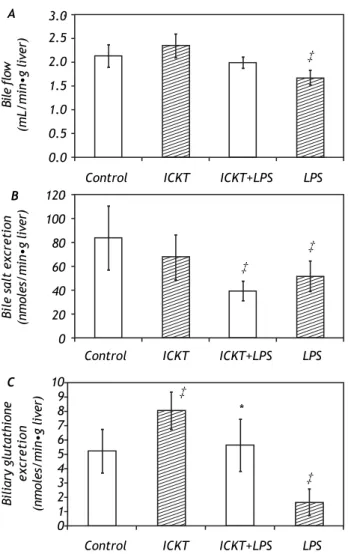
ICKT- supplementation determined a non-signifi-cant increase in basal bile flow (2.35 ± 0.25 vs. 2.13 ± 0.23 µl/g liver wet weight/min in ICKT- supple-mented and control animals respectively). On the other hand, LPS injection determined a significant
reduction of bile flow (1.67 ± 0.15 µl/g liver wet weight/min, 78% of the control value) which was partially prevented by ICKT administration. In fact, the observed reduction in bile flow was smaller than that observed in control animals and did not reach statistical significance (1.99 ± 0.12 µl/g to liver wet weight/min, 93% of the control value) (Figure 1).
The observed biliary bile salt excretion rate in the control group was of 84.1 ± 26.8 nmoles/g of liver per minute. LPS administration induced a signifi-cant reduction in this variable to 51.7 ± 12.8 nmo-les/g of liver per minute (61% of the control value, P < 0.05). ICKT supplementation did not affect the bi-liary bile salt excretion rate in LPS challenged ani-mals (Figure 1).
LPS administration also induced a marked and significant reduction (-69%) in the biliary excretion of reduced glutathione (GSH) (1.6 ± 0.889 nmoles/ g of liver per minute in the LPS group vs. 5.16 ± 1.5 nmoles/g of liver per minute in control group). This was prevented by ICKT administration. In fact, rats belonging to the ICKT-LPS group exhibi-ted biliary glutathione excretion rates similar to that seen in control animals (5.6 ± 1.8 nmoles/g of liver per minute) (Figure 1). Of note, oral ICKT ad-ministration significantly increased the biliary Ex-cretion GSH (8.0 ± 1.28 nmoles/g of liver per minute, 1.5-fold higher than the value observed in control animals).
Immunoblot Analysis of hepatobiliary transporter proteins
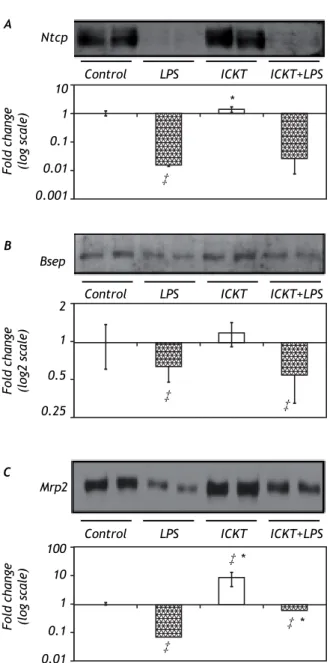
In order to clarify the molecular basis of the pro-tective effect of ICKT on LPS-induced cholestasis the protein expression of critical hepatobiliary transporters Ntcp, Bsep and Mrp2 was assessed in rat liver extracts. Results of these experiments are shown in figure 2. As expected, Ntcp protein expres-sion diminished significantly after LPS administra-tion. ICKT administration did not affect Ntcp reduction after LPS injection. On the other hand, LPS injection reduced hepatic protein expression of Bsep which was not modified by previous adminis-tration of ICKT. Of note, neither Ntcp nor Bsep pro-tein levels were influenced by ICKT administration. Finally, a significant decrease in Mrp2 protein levels was observed in LPS group (14.49-fold lower than control) which was partially reversed by ICKT su-pplementation (1.65-fold lower than control) (Figure 2C). Mrp2 protein expression levels were significant-ly increased in ICKT group compared to the control group (9.22-fold higher) and all other groups.
Figure 1. Effect of Inchin-ko-to (ICKT) administration on bile flow (A), biliary bile salt secretion (B) and biliary gluta-thione secretion (C) in control and lipopolysaccharide (LPS)-treated rats [n = 5-6 animals per group, ‡ p < 0,05 compared with control group, * p < 0.05 compared with LPS group).
A
Bile
flow
(mL/ming
liver)
3.0 2.5 2.0 1.5 1.0 0.5 0.0
Control ICKT ICKT+LPS LPS
B
Bile
salt
excretion
(nmoles/ming
liver)
Control ICKT ICKT+LPS LPS
C
Biliary
glutathione
excretion
(nmoles/ming
liver)
Control ICKT ICKT+LPS LPS
10 9 8 7 6 5 4 3 2 1 0 120 100 80 60 40 20 0
‡ ‡
‡ ‡
DISCUSSION
The herbal medicine ICKT has been extensively used for the treatment of liver disease in Japan. Its use has been mainly based on traditional knowledge with no formal testing in clinical studies. However, in the last decade a number of experimental reports
have shown that ICKT can positively influence seve-ral pathological processes relevant for liver diseases. In fact, ICKT seem to be able to induce hepatic ste-llate cell apoptosis and modulate liver fibrosis,25,26 to
promote hepatic regeneration and exert anti-apopto-tic effects in hepatocytes.32 Clinical experience using
ICKT is limited to several case reports showing a de-creasing effect on serum bilirubin levels after hepa-tectomy or an antifibrogenic action in patients with biliary atresia.33-35 Based on these communications,
ICKT seems to be safe and devoid of adverse effects. In the setting of clinical or experimental cholesta-sis, available information on the potential utility of ICKT administration is scarce. Several reports have shown that genipin, the active compound found in the gardenia fruit extract, has relevant effects on the hepatobiliary secretory function in rodents.23,24
However, no direct testing of the effects of ICKT in cholestatic models had been carried out. Considering that the potent choleretic effects of genipin is main-ly mediated by enhancing Mrp2/MRP2-mediated se-cretory capacities through an increase in Mrp2 expression24 and the fact that Mrp2 down-regulation
is a relevant phenomenon in LPS-induced cholesta-sis,20 we tested the effect of oral administration of
ICKT on hepatobiliary secretory function and LPS-induced cholestasis. Our results showed that indeed ICKT was able to prevent the LPS-induced decrease of bile flow. We also confirmed the choleretic proper-ties of ICKT as well as its ability to increase the Mrp2 protein levels in the liver. The latter was as-sociated to a markedly increase in biliary GSH ex-cretion and probably of the bile salt-independent bile flow. These effects are probably the underlying me-chanisms responsible of the observed attenuation of the cholestatic effects of LPS administration in the rat liver. Also, a colangiocelullar effects might not be excluded. The partial response may be attri-butable to the lack of effects of ICKT on biliary bile salt excretion or the expression of main bile salt transporters Ntcp and Bsep which are also affected by LPS.1,7
In conclusion, the current study showed that oral administration of ICKT has beneficial effects in the LPS-induced model of cholestasis mainly in virtue of its choleretic effects and the ability to up-regulate the main hepatobiliary organic anion transporter Mrp2 and increase the bile salt-independent bile flow. This study provides support for further testing of ICKT in other cholestatic models or human sub-jects. Another relevant aspect to be explored is the potential synergistic effects of the administration of ICKT and other anticholestatic agents such as
ur-Figure 2. Representative Western blot analysis and quanti-tative densitometric analysis of hepatobiliary transport pro-teins. Protein levels of the Na(+)-taurocholate-cotransporting peptide (Ntcp, Panel A), the bile salt export pump (Bsep, Panel B) and the multidrug resistance protein 2 (Mrp2, Panel C) were measured. Values are expressed as fold change (log; mean ± SD) compared with control. p < 0.05 compared with control group, * p < 0.05 compared with LPS group).
B
Control LPS ICKT ICKT+LPS
Fold
change
(log2
scale)
2
1
0.5
0.25 Bsep
A
Control LPS ICKT ICKT+LPS
Fold
change
(log
scale)
10 1 0.1 0.01 0.001 Ntcp
C
Control LPS ICKT ICKT+LPS
Fold
change
(log
scale)
100 10 1 0.1
0.01 Mrp2
aaaaaaa aaaaaaa aaaaaaa aaaaaaa aaaaaaa aaaaaaa aaaaaaa
aaaaaaa aaaaaaa aaaaaaa aaaaaaa aaaaaaa aaaaaaa aaaaaaa
aaaaaaa aaaaaaa aaaaaaa aaaaaaa
aaaaaaa aaaaaaa aaaaaaa aaaaaaa aaaaaaa
aaaaaaa aaaaaaa aaaaaaa aaaaaaa
aaaaaaa aaaaaaa
*
‡
*
‡ ‡
‡
‡
sodeoxycholic acid, a known choleretic bile acid whi-ch also influence Mrp2 levels in the liver.36,37
ACKNOWLEDGEMENT
This work was partially funded by Grants from the Fondo Nacional De Ciencia y Tecnologia de Chi-le (Fondecyt #1050780 and #1080170 to MA).
The authors thank to Tsumura and Co. (Tokyo, Japan) for donating the TJ-135 compound.
REFERENCES
1. Geier A, Fickert P, Trauner M. Mechanisms of disease: me-chanisms and clinical implications of cholestasis in sepsis.
Nat Clin Pract Gastroenterol Hepatol 2006; 3: 574-85. 2. Fuchs M, Sanyal AJ. Sepsis and cholestasis. Clin Liver Dis
2008; 12: 151-172, ix.
3. Trauner M, Fickert P, Stauber RE. Inflammation-induced cholestasis. J Gastroenterol Hepatol 1999; 14: 946-59. 4. Zimmerman HJ, Fang M, Utili R, Seef LB, Hoofnagle J.
Jaun-dice due to bacterial infection. Gastroenterology 1979; 77: 362-74.
5. Grau T, Bonet A, Rubio M, Mateo D, Farre M, Acosta JA, Blesa A, et al. Liver dysfunction associated with artificial nutrition in critically ill patients. Crit Care 2007; 11: R10. 6. Arrese M, Accatino L. From blood to bile: recent advances
in hepatobiliary transport. Ann Hepatol 2002; 1: 64-71. 7. Geier A, Wagner M, Dietrich CG, Trauner M. Principles of
hepatic organic anion transporter regulation during cho-lestasis, inflammation and liver regeneration. Biochim Bio-phys Acta 2007; 1773: 283-308.
8. Trauner M, Boyer JL. Bile salt transporters: molecular characterization, function, and regulation. Physiol Rev
2003; 83: 633-71.
9. Arrese M, Trauner M. Molecular aspects of bile formation and cholestasis. Trends Mol Med 2003; 9: 558-64.
10. Muhlfeld A, Kubitz R, Dransfeld O, Haussinger D, Wettstein M. Taurine supplementation induces multidrug resistance protein 2 and bile salt export pump expression in rats and prevents endotoxin-induced cholestasis. Arch Biochem Biophys 2003; 413: 32-40.
11. Trauner M, Arrese M, Lee H, Boyer JL, Karpen SJ. Endo-toxin downregulates rat hepatic ntcp gene expression via decreased activity of critical transcription factors. J Clin Invest 1998; 101: 2092-100.
12. Bolder U, Ton-Nu HT, Schteingart CD, Frick E, Hofmann AF. Hepatocyte transport of bile acids and organic anions in endotoxemic rats: impaired uptake and secretion. Gas-troenterology 1997; 112: 214-25.
13. Moseley RH, Wang W, Takeda H, Lown K, Shick L, Ananthanarayanan M, Suchy FJ. Effect of endotoxin on bile acid transport in rat liver: a potential model for sepsis-associated cholestasis. Am J Physiol 1996; 271: G137-46.
14. Roelofsen H, Schoemaker B, Bakker C, Ottenhoff R, Jansen PL, Elferink RP. Impaired hepatocanalicular organic anion transport in endotoxemic rats. Am J Physiol 1995; 269: G427-34.
15. Roelofsen H, van der Veere CN, Ottenhoff R, Schoemaker B, Jansen PL, Oude Elferink RP. Decreased bilirubin trans-port in the perfused liver of endotoxemic rats. Gastroen-terology 1994; 107: 1075-84.
16. Rustgi VK, Jones DB, Dinarello CA, Hoofnagle JH. Lympho-kines and bile secretion in the rat. Liver 1987; 7: 149-54. 17. Trauner M, Nathanson MH, Rydberg SA, Koeppel TA, Gartung
C, Sessa WC, Boyer JL. Endotoxin impairs biliary glutathione and HCO3- excretion and blocks the choleretic effect of ni-tric oxide in rat liver. Hepatology 1997; 25: 1184-91. 18. Utili R, Abernathy CO, Zimmerman HJ. Cholestatic effects
of Escherichia coli endotoxin endotoxin on the isolated perfused rat liver. Gastroenterology 1976; 70: 248253. 19. Whiting JF, Green RM, Rosenbluth AB, Gollan JL. Tumor
ne-crosis factor-alpha decreases hepatocyte bile salt uptake and mediates endotoxin-induced cholestasis. Hepatology
1995; 22: 1273-8.
20. Trauner M, Arrese M, Soroka CJ, Ananthanarayanan M, Koeppel TA, Schlosser SF, Suchy FJ, et al. The rat canalicu-lar conjugate export pump (Mrp2) is down-regulated in in-trahepatic and obstructive cholestasis. Gastroenterology
1997; 113: 255-64.
21. Yamamoto M, Miura N, Ohtake N, Amagaya S, Ishige A, Sasaki H, Komatsu Y, et al. Genipin, a metabolite derived from the herbal medicine Inchin-ko-to, and suppression of Fas-induced lethal liver apoptosis in mice. Gastroentero-logy 2000; 118: 380-9.
22. Yamashiki M, Mase A, Arai I, Huang XX, Nobori T, Nishimu-ra A, Sakaguchi S, et al. Effects of the Japanese herbal medicine Inchinko-to (TJ-135) on concanavalin A-induced hepatitis in mice. Clin Sci (Lond) 2000; 99: 421-31. 23. Shoda J, Miura T, Utsunomiya H, Oda K, Yamamoto M, Kano
M, Ikegami T, et al. Genipin enhances Mrp2 (Abcc2)-media-ted bile formation and organic anion transport in rat li-ver. Hepatology 2004; 39: 167-78.
24. Okada K, Shoda J, Kano M, Suzuki S, Ohtake N, Yamamoto M, Takahashi H, et al. Inchinkoto, a herbal medicine, and its ingredients dually exert Mrp2/MRP2-mediated choleresis and Nrf2-mediated antioxidative action in rat livers. Am J Physiol Gastrointest Liver Physiol 2007; 292: G1450-63. 25. Ikeda H, Nagashima K, Yanase M, Tomiya T, Arai M, Inoue
Y, Tejima K, et al. The herbal medicine inchin-ko-to (TJ-135) induces apoptosis in cultured rat hepatic stellate ce-lls. Life Sci 2006; 78: 2226-33.
26. Inao M, Mochida S, Matsui A, Eguchi Y, Yulutuz Y, Wang Y, Naiki K, et al. Japanese herbal medicine Inchin-ko-to as a therapeutic drug for liver fibrosis. J Hepatol 2004; 41: 584-91.
27. Talalay P. Enzymic analysis of steroid hormones. Methods Biochem Anal 1960; 8: 119-43.
28. Anderson ME. Determination of glutathione and glutathio-ne disulfide in biological samples. Methods Enzymol 1985; 113: 548-55.
29. Arrese M, Trauner M, Ananthanarayanan M, Pizarro M, So-lis N, Accatino L, Soroka C, et al. Down-regulation of the Na+/taurocholate cotransporting polypeptide during pregnancy in the rat. J Hepatol 2003; 38: 148-55. 30. Gerloff T, Stieger B, Hagenbuch B, Madon J, Landmann L,
Roth J, Hofmann AF, et al. The sister of P-glycoprotein re-presents the canalicular bile salt export pump of mamma-lian liver. J Biol Chem 1998; 273: 10046-50.
31. Pizarro M, Balasubramaniyan N, Solis N, Solar A, Duarte I, Miquel JF, Suchy FJ, et al. Bile secretory function in the obese Zucker rat: evidence of cholestasis and altered ca-nalicular transport function. Gut 2004; 53: 1837-43. 32. Sakaida I, Tsuchiya M, Kawaguchi K, Kimura T, Terai S,
33. Tamura T, Kobayashi H, Yamataka A, Lane GJ, Koga H, Mi-yano T. Inchin-ko-to prevents medium-term liver fibrosis in postoperative biliary atresia patients. Pediatr Surg Int
2007; 23: 343-7.
34. Kobayashi H, Horikoshi K, Yamataka A, Lane GJ, Yamamo-to M, Miyano T. Beneficial effect of a traditional herbal medicine (inchin-ko-to) in postoperative biliary atresia patients. Pediatr Surg Int 2001; 17: 386-9.
35. Kaiho T, Tsuchiya S, Yanagisawa S, Takeuchi O, Togawa A, Okamoto R, Saigusa N, et al. Effect of the herbal
medicine Inchin-Ko-To for serum bilirubin in hepatecto-mized patients. Hepatogastroenterology 2008; 55: 150-4.
36. Wimmer R, Hohenester S, Pusl T, Denk GU, Rust C, Beuers U. Tauroursodeoxycholic acid exerts anticholestatic effects by a cooperative cPKC alpha-/PKA-dependent me-chanism in rat liver. Gut 2008; 57: 1448-54.