Profile of idiosyncratic drug induced liver injury in
Latin America. An analysis of published reports
Nelia Hernández,* Fernando Bessone,† Adriana Sánchez,* María di Pace,* Javier Brahm,‡ Rodrigo Zapata,§ Ruby A. Chirino,|| Milagros Dávalos,¶ Nahum Méndez-Sánchez,** Marco Arrese,††María Schinoni,‡‡ M. Isabel Lucena,§§ Raúl J. Andrade§§
* Hospital de Clínicas, Clínica de Gastroenterología, Facultad de Medicina, Universidad de la República, Montevideo, Uruguay.
† Facultad de Ciencias Médicas, Servicio de Gastroenterología y Hepatología, Hospital Provincial del Centenario. Universidad Nacional de Rosario, Argentina. ‡
Sección de Gastroenterología, Departamento de Medicina Interna, Hospital Clínico Universidad de Chile y Departamento de Gastroenterología, Clínica Las Condes, Santiago, Chile. § Departamento de Gastroenterología, Hospital Salvador. Universidad de Chile y Clínica Alemana de Santiago. Universidad del
Desarrollo, Santiago, Chile. || Hospital Ángeles de Pedregal, México, D.F. ¶ Servicio de Hígado. Departamento del Aparato Digestivo. Hospital Nacional
Edgardo Rebagliati. Lima, Perú. ** Departamento de Investigación Biomédica. Unidad de Hepatología, Fundación Clínica Médica Sur. Ciudad de México, México.
†† Departamento de Gastroenterología, Facultad de Medicina Pontificia. Universidad Católica de Chile, Santiago. Chile. ‡‡ Hospital Universitario Edgar
Santos. Universidad Federal de Bahía. Salvador de Bahía. Brazil. §§ Unidad de Hepatología y Servicio de Farmacología Clínica, Hospital Universitario Virgen
de la Victoria, Facultad de Medicina, Universidad de Málaga, Instituto de Investigación Biomédica de Málaga-IBIMA, Málaga. Centro de Investigación Biomédica en Red de Enfermedades Hepáticas y Digestivas (CIBERehd), España.
ABSTRACT
Introduction. Drug-induced liver injury (DILI) remains a major problem for drug development and repre-sents a challenging diagnosis for clinicians. The absence of specific biomarkers for diagnosing DILI preclu-des the availability of reliable data on the epidemiology of the disease. In this study we aimed to preclu-describe the features of idiosyncratic hepatotoxicity reports in Latin American countries. Material and methods. A literature search was performed using the online version of MEDLINE, EMBASE, Scopus, Google Scholar and specific data bases from Latin America (LA) (Scielo, Lilacs) to identify any case report or case series of pu-blished DILI from 1996 to 2012. From 1996 to 2012, a total of 176 patients with DILI were pupu-blished in LA, in-volving 53 suspicious drugs. The median age in the adult population of these patients was 55 years (17-82) with prevalence of women (67%). Among main therapeutic classes, the rank order was led by non-steroidal anti-inflammatory (61 cases) and systemic antibacterial drugs (37 cases). Nimesulide was the individual drug responsible for the highest number of cases (53), followed by cyproterone acetate (18), nitrofurantoin (17), antituberculous drugs (13) and flutamide (12). Thirty two percent of published cases evolved to acute liver failure (ALF), and half of the subjects required liver transplantation or eventually died. Conclusions. This study represents the first structured attempt to assess the spectrum of DILI profile in LA. The esta-blishment of a Latin American registry to collect prospective DILI cases using a standardized protocol will advance our knowledge about idiosyncratic DILI in this region.
Key words. Drug-induced acute liver failure. Liver toxicity. DILI. Fulminant liver failure. Hepatotoxicity.
Correspondence and reprint request: Nelia Hernández, MD.
Hospital de Clínicas, Clínica de Gastroenterología, Facultad de Medicina, Universidad de la República, Montevideo, Uruguay. 1555 Michigan St. (PC 11400), Montevideo, Uruguay. Tel. +598 99 621416.
E-mail: [email protected]
Manuscript recived: February 06,2013. Manuscript accepted: December 12, 2013. INTRODUCTION
Drug-induced idiosyncratic liver injury (DILI) re-mains a major concern for pharmaceutical compa-nies leading to high attrition rates during drug development and adoption of post-marketing
Lacking specific biomarkers for DILI diagnosis precludes the availability of reliable data on the epi-demiology of this condition, as its diagnosis is gene-rally made by exclusion of other causes of liver disease and relies heavily on clinical suspicion. Therefore, severe cases may be overestimated while milder or adaptive forms of injury may be under-diagnosed.2
To overcome such limitations, and to better un-derstand the causative drugs, risk factors and out-comes of DILI cases, country-based registries and multicenter research networks have been estab-lished. In countries such as Sweden since 1970 (Swe-dish Drug Reaction Advisor Committee, SDRAC),3 and prospectively in Spain since 1994 (Spanish DILI Registry),4 and the United States since 2003 (Drug Induced Liver Injury Network, DILIN).5 These mul-ticenter registries have fostered case identification and recruitment following a structured protocol, and have stimulated consensus for case definition and phenotype classification.2,6
Since existing registries cover restricted geogra-phical areas from North America and Europe, simi-lar efforts are being conducted in other regions such as LA. However, epidemiological information on DILI in LA is still lacking. In this study, we aimed to describe the features of idiosyncratic hepatotoxici-ty reports in several countries in LA by retrieving, and analyzing all published cases from this region in the last sixteen years.
MATERIAL AND METHODS
A literature search was performed using the online version of MEDLINE, EMBASE, Scopus, Google Scholar and specific data bases from LA (Scielo, Lilacs) to identify any case report or case series of published DILI from 1996 to 2012. The medical lite-rature was searched using the terms: “liver injury”, “hepatotoxicity”, “drug-induced cholestasis”, “ful-minant liver failure”, “acute liver injury”, “drug-induced liver injury”, “acute liver failure”. These were combined with the Boolean set operators “AND” and “OR”. There were no language, species and article type restrictions. The keywords were checked in all fields of these data base records.
Web pages of regulatory drug-surveillance centers from different countries were searched for: ANMAT, Argentina; ANVISA, Brazil; COPREFIS, Mexico; MSP, Uruguay; INVIMA, Colombia; CEFARVI, Venezuela; CENIMEF, Chile: DIGEMID, Peru; SNFV, Bolivia; UNCFV, Cuba. All published and available full text cases were retrieved. Only published
DILI cases linked to drugs were included in the study, regardless of whether standardized diagnostic scales for causality evaluation were applied or not. Instances involving herbal and complementary medi-cines instances were excluded. With some exceptions, publications prior to 2000 were not available in electronic format. Data from Colombia’s series of cases could not be analyzed due to missing data relevant to case descriptions.7
Information was retrieved regarding the country source of the report, the patient’s demographic data, suspected drug and co-medications and the outcome of the reaction.
Some liver transplant centers from LA coun-tries were contacted in order to obtain informa-tion related to cases developing ALF associated with drugs.
The drugs considered to be implicated in liver da-mage were classified according to the Anatomical Therapeutic Classification of the World Health Organization (ATC/DDD Index 2013).8
Statistical analysis
Variables were examined using descriptive statistics.
RESULTS
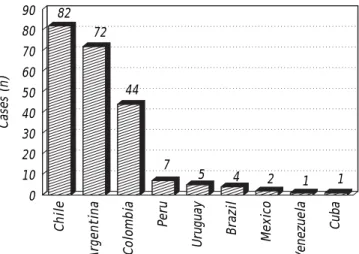
Latin American countries with identified publica-tions of hepatotoxicity cases were Argentina, Brazil, Colombia, Cuba, Chile, Mexico, Peru, Uruguay and Venezuela, as shown in figure 1.
From 1996 to 2012, a total of 176 cases (inclu-ding 10 pediatric cases) with a DILI episode, involving 53 suspicious drugs, were published in LA.
Figure 1. Reports of idiosyncratic DILI published in Latin-America between 1996 and 2012 according to country source.
Chile
Argentina Colombia
Peru
Uruguay Brazil Mexico
Venezuela
Cuba
Cases (n)
90 80 70 60 50 40 30 20 10 0
82 72
44
7
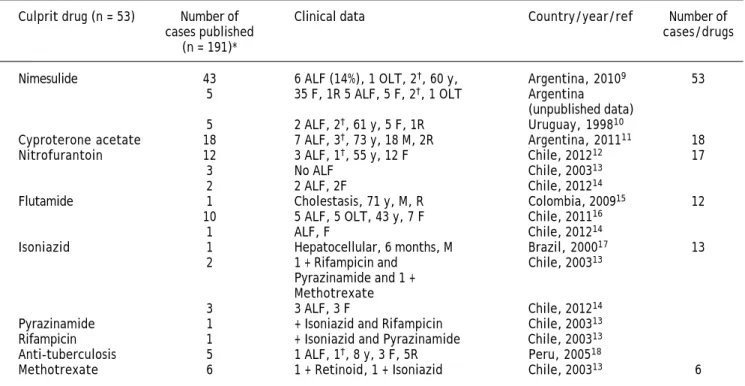
(9-33) Of the 53 drugs involved, 24 were responsi-ble for at least two cases (Taresponsi-ble 1). In 13 cases (7%) more than one drug was involved, twelve cases involved two drugs and one case involved three. The median age of the adult population was 55 years (17-82), with a prevalence of women in 112/166 cases (67%). Imaging data were available in 76% of the publications. As regards virological tests, HBV, HCV, HAV, CMV, EBV, HSV, HEV were recorded in 72, 68, 64, 28, 24, 8 and 4% of the cases, respective-ly. The authors state alcohol history in 28% of the reports and auto antibodies titres are provided in 72% of them. Liver histology was available in 79 ca-ses (8 explanted liver and 3 postmortem). A positive re-challenge was described in 11 cases (6.25%).
The main causative pharmacologic group of drugs was skeletal muscle (32%), followed by anti-infectio-us (19%), and genito urinary system and sex hormones (18%). Among the main therapeutic class, the rank order was non-steroidal anti-inflammatory drugs (NSAID) (61 cases) and systemic antibiotics (37 cases) (Table 2). Nimesulide was the individual drug responsible for the highest number of cases (53), followed by cyproterone acetate (18), nitrofu-rantoin (17), antituberculous drugs (13) and fluta-mide (12).
Thirty two percent of published cases evolved to ALF, and half of them required liver transplantation
or the patient eventually died. Causative drugs more frequently implicated in ALF were flutamide (6/12, 50%), followed by cyproterone acetate (7/18, 39%) and nimesulide (13/53, 25%).
The largest DILI series published analyzed in this study came from a Medellin Hospital (Colombia).7 The authors identified 42 DILI patients between 2001 and 2008, with a mean age of 41 years (0.4-67) and poly-medicated (67%). Causality was assessed by applying the Maria and Victorino scale.34 Four patients received doses above the therapeutic range. The drugs most commonly reported as responsible for liver injury were antibiotics (36%), followed by anticonvulsants (12%), immunosuppressive agents (9.5%) and NSAIDs drugs (7.2%) and acute hepati-tis was the most frequent presentation (38%). Eight patients (20%) went on to develop ALF, while only 9.8% of them underwent liver transplantation.
Using a different methodological approach, Chi-lean authors analyzed 57 cases that had liver biop-sies performed under suspicion of hepatotoxicity during a period of 12 years (1988-2000), and found 33 DILI cases in which the Maria and Victorino scale34 was used for causality assessment. The average age was 48 years (20-76) with a predominance of cholestatic liver injury (30%), hepatocellular injury being present in only 24% of the cases biopsied. ALF was observed in 9% of cases. Similar to the
Colom-Table 1. Causative drugs in case reports or series of drug-induced liver injury published in Latin America between 1996 and
2012. (N patients = 176).
Culprit drug (n = 53) Number of Clinical data Country/year/ref Number of
cases published cases/drugs
(n = 191)*
Nimesulide 43 6 ALF (14%), 1 OLT, 2†, 60 y, Argentina, 20109 53
5 35 F, 1R 5 ALF, 5 F, 2†, 1 OLT Argentina
(unpublished data)
5 2 ALF, 2†, 61 y, 5 F, 1R Uruguay, 199810
Cyproterone acetate 18 7 ALF, 3†, 73 y, 18 M, 2R Argentina, 201111 18
Nitrofurantoin 12 3 ALF, 1†, 55 y, 12 F Chile, 201212 17
3 No ALF Chile, 200313
2 2 ALF, 2F Chile, 201214
Flutamide 1 Cholestasis, 71 y, M, R Colombia, 200915 12
10 5 ALF, 5 OLT, 43 y, 7 F Chile, 201116
1 ALF, F Chile, 201214
Isoniazid 1 Hepatocellular, 6 months, M Brazil, 200017 13
2 1 + Rifampicin and Chile, 200313
Pyrazinamide and 1 + Methotrexate
3 3 ALF, 3 F Chile, 201214
Pyrazinamide 1 + Isoniazid and Rifampicin Chile, 200313
Rifampicin 1 + Isoniazid and Pyrazinamide Chile, 200313
Anti-tuberculosis 5 1 ALF, 1†, 8 y, 3 F, 5R Peru, 200518
Propylthiouracil 1 ALF, †, 51 y, F Cuba, 200819 5
2 1 ALF, 1† Chile, 200313
2 2 ALF Chile, 201214
Piroxicam 2 1 + Dipyrone Chile, 200313 5
1 22 y, F, cholestasis Chile, 199820
2 1 F, 44 y, ALF; 1 M, 42 y, Argentina, 201021
cholestasis
Halothane 1 ALF, OLT, 35 y, F, R Colombia, 200122 5
2 2 ALF, 2†, 1 + Paracetamol Chile, 200313
2 2 ALF Chile, 201214
Valproic acid 3 1 ALF, 1†, 4 y, 2 M Brazil, 199623 3
Amoxicillin-clavulanate 1 Cholestasis, 72 y, M Chile, 199924 3
1 Hepatocellular, 27 y, M Mexico, 201125
1 No ALF Chile, 200313
Phenytoin 1 + Benzathine Penicillin Chile, 200313 3
2 2 ALF, 2 F Chile, 201214
Ketoconazole 1 No ALF Chile, 200313 3
2 2 ALF, 2 F Chile, 201214
Diclofenac 1 No ALF Chile, 200313 2
1 ALF, F Chile, 201214
Dipyrone 2 1 + Estradiol /Prasterona Chile, 200313 2
1 + Piroxicam Ethinyl-Estradiol/
Levonorgestrel 2 1 + Cotrimoxazole Chile, 200313 2
Lamivudine 2 + Zidovudine Chile, 200313 2
Methyldopa 1 No ALF Chile, 200313 2
1 ALF, F Chile, 201214
Propafenone 2 Cholestasis, 68 y, 2 F Argentina, 200326 2
Retinoids 2 1 + Methotrexate Chile, 200313 2
Terbinafine 1 Hepatocellular, 53 y, F Mexico, 200327 2
1 Cholestasis, 31 y, F Peru, 200428
Zidovudine 2 + Lamivudine Chile, 200313 2
Amitriptyline 1 + Carbamazepine Chile, 200313 1
Anaproline (Nandrolone) 1 No ALF Chile, 200313 1
Carbamazepine 1 + Amitriptyline Chile, 200313 1
Cyclophosphamide 1 + Procarbazine Chile, 200313 1
Claritromycyn 1 ALF, F Chile, 201214 1
Chlormezanone 1 No ALF Chile, 200313 1
Chlorpromazine 1 No ALF Chile, 200313 1
Sulfamethoxazole/ 1 + Ethinyl- Estradiol/ Chile, 200313 1
Trimethoprim Levonorgestrel
Naproxen 1 ALF, F Chile, 201214 1
Disulfiram 1 ALF, F Chile, 201214 1
Estradiol/prasterona 1 + Dipirone Chile, 200313 1
Enalapril 1 + Ticlopidine Chile, 200313 1
Griseofulvin 1 ALF, F Chile, 201214 1
Imatinib 1 ALF, †, 59 y, F Argentina, 200729 1
Mebendazole 1 No ALF Chile, 200313 1
Mycophenolate 1 ALF, F Chile, 201214 1
Nevirapine 1 ALF, M Chile, 201214 1
Paracetamol 1 ALF, †, + Halothane Chile, 200313 1
Benzathine Penicillin 1 + Phenytoin Chile, 200313 1
Procarbazine 1 + Cyclophosphamide Chile, 200313 1
Progesterone 1 ALF, F Chile, 201214 1
Gold salts 1 Cholestasis, 37 y, F Peru, 200430 1
Tamoxifen 1 ALF, F Chile, 201214 1
Ticlopidine 1 + Enalapril Chile, 200313 1
Trovafloxacin 1 ALF, †, 52 y, F Venezuela, 200031 1
Verapamil 1 Cholestasis, 62 y, F Chile, 201032 1
Vitamin A 1 Chronic Hepatitis, 25 y, M Argentina, 200633 1
ALF: acute liver failure. OLT: orthotopic liver transplantation. AH: acute hepatitis. †: death. y: years. F: female. M: male. R: positive re-challenge. (*) 13
bian study described above, antibiotics ranked first as the causative group.13
With the exception of the two series mentioned above (assessing causality by the Maria and Victori-no),7,13 and the cyproterone series,11 where the CIO-MS/RUCAM scale was applied,34 none of the other published series or cases stated applying any diag-nostic scale.9,10,12,14-33
Countries that provide liver transplantation cen-ters in LA are: Argentina, Brazil, Colombia, Costa Rica, Cuba, Chile, Ecuador, Mexico, Peru, Venezue-la and Uruguay. A survey in Argentina (VilVenezue-lamil F, personal communication) of 206 adults and 219 chil-dren with ALF found that hepatotoxicity accounted for 12 and 1.4% of the cases, respectively. It is worth mentioning that no liver toxicity due to acetamino-phen overdose was identified among the ALF cases. Spontaneous survival in adults was 20%, which is lower than the figure for viral etiologies. In Chile, the experience of two centers in the last 10 years showed that 32% of 129 ALF cases corresponded to idiosyncratic hepatotoxicity, with paracetamol ac-counting for 5.4% of the cases.14
DISCUSSION
The true incidence of DILI in LA remains unk-nown. A prospective study carried out in France found an incidence of DILI of 14/100,000 inhabitants per year, which is in the same range as the inciden-ce of viral hepatitis.36 More recently, Björnsson, et al. (2013) found in Iceland an annual crude incidence of DILI of 19.1/100.000 inhabitants.37 Since pros-pective population based studies are difficult to conduct, alternative approaches such as the organization of local DILI registries have been set up in other areas of the world in order to gain knowledge on the epidemiology of DILI.38A simpler way to estimate the relevance of DILI is to analyze published reports in the literature from a given area or country. This approach does not allow for obtaining figures of DILI incidence but at least reflects the general characteristics of the problem in the geographic area where the cases are identified. The present study examined published case reports and case series related to hepatotoxicity in LA in a time frame of 16 years. An important finding of this analysis has been the dissimilarities in the reporting of DILI cases among countries, since the bulk of the reports came from Chile, Argentina and Colombia, altoge-ther accounting for 91% of all cases reported. The reason for these major differences is unclear, but it could include more awareness of the
groups reporting cases in these countries, as well as the exclusion of herbal products and alternative medicines from the analyses, which could repre-sent a leading cause of DILI in countries such as Brazil and Mexico.39
Non-steroidal anti-inflammatory and anti-infectious drugs were the most frequently reported therapeutic group of causative drugs in LA. In the prospective study conducted by Björnsson, et al., amoxicililin-clavulanate and diclofenac were the most frequently agents implicated (22 and 6%, respectively).37 While anti-infectious drugs predominate in existing registries, NSAIDs are variably represented.3-5 Interestingly, in an international collaborative work that compared drugs by study groups in Spain, Sweden, and the USA as causes of DILI,40 only 31 of the 385 drugs listed (9.6%) were present in the three registries.
The over-representation of NSAIDs in this study can be explained at least in part by the publication of the largest series of nimesulide instances of hepa-totoxicity by Bessone et al. in Argentina.9
Interestingly, the antiandrogen drug cyproterone acetate (10%) ranked second as responsible for DILI instances in the series published in LA, despite its rarity or absence in other sources and data-bases. Its high prevalence in this study is mainly due to the large cyproterone series reported by Bes-sone, et al.11 Indeed, cyproterone acetate is not in-cluded among the list of drugs most commonly related to hepatotoxicity in the different regis-tries.40 On the contrary, cyproterone acetate is fre-quently related to ALF.41 Flutamide, another antiandrogen, was one of the drugs most often identified as causal in hepatotoxicity, highlighting the impact of the large series of severe cases repor-ted by Brahm, et al. from Chile.16
DILI cases associated with cyproterone acetate and nitrofurantoin, which ranked third in this com-pilation, were frequently reported in the publications retrieved, however, they are seldom reported in other countries.40 This finding highlights the dif-ferences in pharmaceutical policies and prescription patterns among LA and other areas. As well, this epidemiological approach to DILI analysis has allo-wed for obtaining information relating to safety or benefit/risk concerns that ultimately may facilitate regulatory decision-making.
have also been taken in LA, including its withdrawal from the market in Argentina,43 and the reduction of the maximum prescribable dose to 100 mg in Uruguay.
It is worth mentioning the difficulties in obtaining detailed information to ascertain causality. These dif-ficulties were recently discussed by Agarwal, et al.,44 who analysed 97 published hepatotoxicity cases relat-ing to six causative drugs. Many essential diagnostic elements were under-reported and the minimal data needed to determine the causes of the adverse effects were not provided. In the present analysis we could verify this serious problem (for example: one third of the cases have not ruled out HAV, and in most
of them EBV and HEV were not ruled out). A positive rechallenge to a suspect drug is considered the most robust evidence for DILI diagnosis, but is rarely performed on-purpose due to life-threating risks which pose an ethical concern.
Indeed, although the authors in their respective publications pointed out the type of liver injury, this item was not analysed in the present study since definitions used were heterogeneous. Recently, an international group of experts published a consensus document setting up definitions and phenotype standardization in DILI6 that should be mandatory to follow if comparative analyses are to be performed.
Table 2. Rank order of the main therapeutic classes involved in cases of suspected DILI published in Latin America between 1996
and 2012.
Therapeutic class n (%) ALF-OLT
n (%) †
Non-steroidal anti-inflammatory and anti-rheumatic drugs 62 (32) 16 (26)
(Nimesulide*, Piroxicam*, Gold salts, Diclofenac*, Naproxen*)
Anti-infectious
(Nitrofurantoin,* Isoniazid,* Pyrazinamide, Rifampicin, Amoxicillin clavulanate, 37 (19) 11 (30) Trovofloxacin,* Sulfamethoxazole/Trimethoprim, Benzathine penicillin, Clarytromycin*)
Genito urinary system and sex hormones 34 (18) 14 (22)
Sexual Hormones (4)
(Ethinyl -estradiol/levonorgestrel, estradiol/Prasterone, Progesterone*) Anti-androgens (30)
(Cyproterone acetate,* Flutamide*)
Antineoplastics and immunomodulators 10 (5) 2 (3)
(Methotrexate, Imatinib,* Cyclophosphamide, Procarbazine, Tamoxifen*)
Anticonvulsivants (Valproic acid,* Carbamazepine, Phenytoin*) 7 (4) 3
Cardiovascular system (Propafenone, Verapamil, Enalapril, Methyldopa*) 6 (3) 1
Anti-virals (Zidovudine, Lamivudine, Nevirapine*) 5 (3) 1
Anesthetics (Halothane*) 5 (3) 5
Antithyroid (Propylthiouracil*) 5 (3) 4
Other groups: analgesics (Acetaminophen/Paracetamol, Dipyrone), 20 5
retinoids (Retinoids), antifungal agents (Terbinafine, Ketoconazole*, Griseofulvin*), vitamins (Vitamin A), antihelmintic (Mebendazole), psychoanaleptics (Amitriptyline), psycholeptics (Chlorpromazine), anti-thrombotic (Ticlopidine), anabolic steroidal (Anaproline/Nandrolone), muscular relaxants (Chlormezanone), other nervous system drugs (Disulfiram*), immunosuppressants (Mycophenolate*).
Total 191 62 (32)
* Drugs involved in drug-induced liver injury (DILI) cases with progression to Acute Liver Failure (ALF) or Liver transplant (OLT). † No percentage of ALF/OLT
Sixty-two (32%) of the 191 DILI cases considered in this work involved ALF, and were ascribed to 22 medications. The design of this study could explain the overrepresentation of ALF cases in comparison to other case series included in registries,3-5 as there may have been a selection bias in the reporting with a tendency to publish more severe cases or cases with atypical presentation.
Again, NSAIDs were responsible for the highest number of ALF cases, although the relative frequen-cy of ALF was greater for frequen-cyproterone acetate. This data would probably be an overestimation because of the large nimesulide series reported,9 representing 11 of the 16 ALF cases related to NSAIDs. Even when NSAIDs have shown progression to liver failure, these cases are less frequently described.41
This LA casuistic analysis of ALF cases is quite different from the reality of other series from USA or Europe. A recent analysis of the US-based UNOS (United Network for Organ Sharing) database from 1987 to 2006 showed that of 661 patients transplan-ted because of ALF due to DILI, acetaminophen was the first causative medication (40%), followed by antituberculous drugs (8%), antiepileptic (7%) and then antibiotic (6%) medications.45 The NIH ALF group analysis, recently updated with a large num-ber of patients (n = 1198), demonstrated that 11.1% of ALF corresponded to idiosyncratic hepatotoxicity, antibiotics being the main related group (46%), with female predominance (71%) and a low free-of-trans-plantation outcome (27%).41
Physicians, authors, reviewers, editors all need to understand the importance of establishing the most likely or probable cause of liver problems observed and providing the clinical information needed for making the medical differential diagno-sis. Just finding an “association” is not sufficient. Indeed, there are cases that are being published and made available to the scientific community lacking minimal elements to reliably ascertain causality -mainly a consistent time sequence and carefully exclusion of other liver diseases causes. As there is no specific biomarker for DILI, a positive rechal-lenge provides available evidence and has become the gold standard for diagnosis.46 The application of a specific diagnostic tool for causality assess-ment before and adverse reaction is accepted for publication and particularly the CIOMS/RUCAM scale which provides a framework that highlights the topics to be addressed in cases of suspected hepatic adverse reaction to improve the consistency of judgments, would help to obtain a more accurate DILI diagnosis.47 Educational programs on DILI
clinical diagnosis and management are being implemented by the LA group in order to expand knowledge on this complex and intriguing disorder.
Latin America comprises more than 20 coun-tries with a variety of ethnic groups. Thus, it is very likely that there are significant differences in DILI features, both within the LA region and between it and the rest of the world. These po-tential differences in DILI susceptibility may be relevant for the introduction of new drugs in the area and therefore deserves characterization. A pan-Latin American registry of hepatotoxicity is cur-rently being organized with the support of the Spanish DILI Registry (www.slatindili.uma.es) as hepatotoxicity registries are the ideal instru-ment for systematic and continual data collec-tion, using preestablished criteria based on consensus, which ultimately stimulate research and improve understanding of the complex me-chanism underlying this disease.48 This ambitious project is expected to provide a more realistic picture of idiosyncratic hepatotoxicity in LA and will contribute to conducting more robust pheno-typic and genopheno-typic studies of DILI in this area of the world.
ABBREVIATIONS
• ALF: acute liver failure.
• CIOMS:Council for International Organizations
of Medical Sciences.
• CMV: cytomegalovirus.
• DILI: drug-induced liver injury.
• EBV: Epstein Barr virus.
• HAV: hepatitis A virus.
• HBV: hepatitis B virus.
• HCV: hepatitis C virus.
• HEV: hepatitis E virus.
• HSV: herpes simplex virus.
• LA: Latin America.
• NSAID: non steroidal anti-inflammatory drugs;
• OLT: orthotopic liver transplantation.
• RUCAM: Roussel Uclaf Causality Assessment
Method.
FINANCIAL SUPPORT
REFERENCES
1. Ostapowicz G, Fontana R, Schiedt F, Larson A, Davern T, Han S, McCashland T, et al. Results of a prospective study of acute liver failure at 17 tertiary care centers in the United States. Ann Intern Med 2002; 137: 947-54. 2. Fontana RJ, Seeff LB, Andrade RJ, Björnsson E, Day CP,
Se-rrano J, Hoofnagle JH. Standardization of nomenclature and causality assessment in drug-induced liver injury: summary of a clinical research workshop. Hepatology 2010; 52: 730-42.
3. Bjornsson E, Olsson R. Outcome and prognostic markers in severe drug-induced liver disease. Hepatology 2005; 42: 481-9.
4. Andrade RJ, Lucena MI, Fernández MC, Pelaez G, Pachko-ria K, García-Ruiz E, García Muñoz B, et al. Drug-induced liver injury: an analysis of 461 incidences submitted to the Spanish registry over a 10-year period.
Gastroentero-logy 2005; 129: 512-21.
5. Chalasani N, Fontana RJ, Bonkovsky HL, Watkins PB, Davern T, Serrano J, Yang H, et al. Causes, clinical features, and outcomes from a prospective study of drug-induced liver injury in the United States. Gastroenterology 2008; 135: 1924-34.
6. Aithal GP, Watkins PB, Andrade RJ, Larrey D, Molokhia M, Takikawa H, Hunt CM, et al. Case definition and phenotype standardization in drug-induced liver injury. Clin
Phar-macol Ther 2011; 89: 806-15.
7. Restrepo JC, Muñoz JF, Correa G, Zuleta J, Londoño M, Bo-tero A, Osorio G, et al. Hepatotoxicidad detectada en un hospital de cuarto nivel en la ciudad de Medellín. Acta Med
Colomb 2008; 33: 261-7.
8. WHO Collaborating Center for Drug Statistics Methodolo-gy, Guidelines for ATC classification and DDD assignment 2013. Oslo, 2012.
9. Bessone F, Colombato L, Fassio E, Reggiardo M, Vorobioff J, Tanno H. The spectrum of nimesulide induce hepatotoxi-city. An overview. Antiinflamm Antiallergy Agents Med
Chem 2010; 9: 355-65.
10. Grignola JC, Arias L, Rondan M, Solá L, Bagnulo H. Hepato-toxicidad asociada a la nimesulida. Revisión de 5 casos.
Arch Med Int 1998; XX: 13-18.
11. Bessone F, Colombato L, Frider B, Tsariktsian G, Bruguera M, Cohen H, Hernández N, et al. Ciproterone induced-liver–injury includes autoimmune-hepatitis and a spectrum of varying severity of acute hepatocellular damage. Basic
Clin Pharmacol Toxicol 2011; 109: 32-40.
12. Bermúdez J, Brahm M, Poniachik J, Contreras J, Valera J, Smok G, Brahm J. Espectro clínico de la hepatotoxicidad por nitrofurantoína en una serie clínica de 12 pacientes.
Gastroenterol Latinoam 2012; 23: 129-33.
13. Contreras J, Poniachik J, Planzer M, Lazarte R, Smok G, Oksenberg D, Madrid A, et al. Daño hepático por fárma-cos: características clínicas e histológicas en 33 casos.
Rev Med Chile 2003; 131: 1128-34.
14. Zapata R, Sanhueza E, Gómez F, Contreras J, Uribe M, Hu-meres R, Martinez W, et al. Falla hepática fulminante en adultos. Etiología, pronóstico y evolución de pacientes evaluados en dos unidades de trasplante hepático en Chile durante una década. Gastroenterología Latinoamericana 2012; 23(S4): (abstract).
15. García del Risco F, Camargo JM, Arrieta HE. Hepatitis co-lestásica inducida por flutamida. Presentación de un caso.
Rev Col Gastroenterol 2009; 24: 408-12.
16. Brahm J, Brahm M, Segovia R, Latorre R, Zapata R, Ponia-chik J, Buckel E, et al. Acute and fulminant hepatitis
indu-ced by flutamide: case series report and review of the li-terature. Ann Hepatol 2011; 10: 93-8.
17. Pereira R, Tresoldi A, Hessel G. Insuficiência Hepática pelo uso de isoniazida. Relato de caso. Arq Gastroenterol 2000; 37: 72-5.
18. Reto L, Castillo J, Pichilingue P, Pichilingue O. Hepatotoxi-cidad por fármacos antituberculosos en pediatría. Rev
Gastroenterol Peru 2005; 25: 362-5.
19. Gonzalez O, Arpa A, Peñaranda O, Montero T, Perez M, Perez F. Reacción idiosincrásica fatal al propiltiouracilo. Disponible en: [http://bvs.sld.cu/revistas/mil/vol37_4_08/ mil12408.htm] [19/09/2011].
20. Poniachik J, Guerrero J, Calderon P, Smok H, Morales A, Munoz G, Venegas M. Hepatitis colestasica por piroxicam: caso clínico. Rev Med Chile 1998; 126: 548-52.
21. Bessone F. Non-steroidal anti-inflammatory drugs: what is the actual risk of liver damage? World J Gastroenterol 2010; 16: 5651-61.
22. Gutiérrez M. Falla hepática por halotano-reporte de un caso. Rev Col Anestesiol 2001; 2: 163-5.
23. Antoniuk S, Bruck I, Honnicke LR, Flenik L, Barreiro J, Cat R. Insuficiencia aguda hepatica associada ao acido val-proico na infancia. Arq Neuropsiquiatr 1996; 54: 652-4. 24. Soza A, Riquelme F, Alvarez M, Duarte I, Glasinovic J,
Arrese M. Hepatotoxicidad por amoxicilina/ácido clavulá-nico: caso clínico. Rev Med Chile 1999; 127: 1487-91. 25. Castro MG, Molina A, Martínez JM, Gallardo V, Liceaga M.
Hepatotoxicidad por amoxicilina-clavulanato y revisión de la bibliografía. Med Int Mex 2011; 27: 406-10.
26. Cocozzella D, Curciarello J, Corallini O, Olivera A, Alburquer-que MM, FraAlburquer-quelli E, Zamagna L. Propafenone hepatotoxicity Report of two new cases. Dig Dis Sci 2003; 48: 354-7. 27. Zapata A, Casillas A, Bosques F. Terbinafine
hepatotoxici-ty. A case report and review of literature. Ann Hepatol 2003; 2: 47-51.
28. Burstein Z, Vildósola H, Lozano Z, Verona R, Vargas G. He-patitis tóxica colestásica por terbinafina: reporte de caso. Rev Gastroenterol Peru 2004; 24: 357-62.
29. Ridruejo E, Cacchione R, Villamil A, Marciano S, Gadano A, Mandó O. Imatinib-induced fatal acute liver failure. World
J Gastroenterol 2007; 13: 6608-11.
30. Días J, Dávalos M, Roman R, Bustios C, Zumaeta E. Hepato-toxicidad y pancreatitis por sales de oro: reporte de caso.
Rev Gastroenterol Peru 2004; 24: 353-6.
31. Romero J, Carreiro M, Hinesfrosa H, Leon R, Cifuentes C, Longart L, Roa J, et al. Insuficiencia hepática fulminante secundaria a trovafloxacina: reporte de un caso. GEN 2000; 54: 287-91.
32. Soza A, Larrain S. Hepatotoxicidad por verapamil. Reporte de un caso. Gastroenterol Latinoam 2010; 21: 27-9. 33. Castaño G, Etchart C, Sookoian S. Vitamin A toxicity in a
physical culturist patient: a case report and review of the literature. Ann Hepatol 2006; 5: 293-5.
34. Vasco M, Rui V. Development and validation of a clinical scale for the diagnosis of drug-induced hepatitis.
Hepato-logy 1997; 26: 664-9.
35. Danan G, Benichou C. A novel method based on the conclu-sions of international consensus meetings: application to drug-induced liver injuries. J Clin Epidemiol 1993; 46: 1323-30.
36. Sgro C, Clinard F, Ouazir K, Chanay H, Allard C, Guillemet C, Lenoir C, et al. Incidence of drug induced hepatic inju-ries. A French population-based study. Hepatology 2002; 36: 451–5.
drug induced liver Injury in the general population in Ice-land. Gastroenterology 2013; 144: 1419-25.
38. de Abajo FJ, Montero D, Madurga M, García Rodríguez LA. Acute and clinically relevant drug-induced liver injury: a population based case-control study. Br J Clin Pharmacol 2004; 58: 71-80.
39. Hernández N, Sánchez A, di Pace M, Bessone F, Arrese M, Brahm J, et al. Espectro de la hepatotoxicidad en Latino-américa: fundación y resultados iniciales del registro es-pañol-latinoamericano de hepatotoxicidad. Gastroenterol
Hepatol 2013; 36: 85 (abstract).
40. Suzuki A, Andrade R, Björnsson E, Lucena M, Lee W, Yuen N, Hunt C, et al. Drugs associated with hepatotoxicity and their reporting frequency of liver adverse events in Vigi-BaseTM unified list based on international collaborative work. Drug Saf 2010; 33: 503-22.
41. Reuben A, Koch D, Lee W, and the Acute Liver Failure Stu-dy Group. Drug-induced acute liver failure: results of a U.S. multicenter, prospective study. Hepatology 2010; 52: 2065-76.
42. Lucena MI, Cohen H, Hernández N, Bessone F, Dacoll C, Stephens C, Borraz Y, et al. Hepatotoxicidad, un problema global con especificidades locales: hacia la creación de una Red Hispano Latinoamericana de Hepatotoxicidad.
Gas-troenterol Hepatol 2011; 34: 361-8.
43. ANMAT suspende la comercialización de la droga nimesuli-da. Boletín para profesionales 2009: XVII(3): 17-24. 44. Agarwal V, Mc Hutchinson J, Hoofnagle J. Important
ele-ments for the diagnosis of drug-induced liver injury. Clin
Gastroenterol Hepatol 2010; 2008: 463-70.
45. Mindikouglu AL, Magder LS, Regev A. Outcome of liver transplantation for drug-induced acute liver failure in the Unitred States: analysis of the united network for organ sharing database. Liver Transplantation 2009; 15: 719-29. 46. Andrade RJ, Robles M, Lucena MI. Rechallenge in drug-in-duced liver injury: the attractive hazard. Expert Opin
Drug Saf 2009; 8: 709-14.
47. García-Cortés M, Stephens C, Lucena MI, Fernández-Castañer A, Andrade RJ, Spanish Group for the Study of Drug-Induced Liver Disease (Grupo de Estudio para las Hepatopatías Asociadas a Medicamentos GEHAM). Causality assessment methods in drug induced liver injury: strengths and weaknesses. J Hepatol 2011; 55: 683-91.