Occult HBV infection among anti-HBc positive HIV-infected
patients in apex referral centre, Eastern India
R. Panigrahi,* S Majumder,† M. Gooptu,† A. Biswas,* S. Datta,‡
P.K. Chandra,§ A Banerjee,|| S. Chakrabarti,¶ D. Bandopadhyay,† B.K. De,† R. Chakravarty*
*ICMR Virus Unit, Kolkata, West Bengal, India. †Calcutta Medical College and Hospital, Kolkata, India.
‡Molecular Virology Lab, Biotechnology Div., Defense Research Laboratory, Defense R&D Organization (DRDO), Tezpur, India. § Department of Pathology & Laboratory Medicine, Tulane University School of Medicine, New Orleans, LA 70112.
|| Translational Health Science and Technology Institute, Gurgaon, India. ¶ National Institute of Cholera and Enteric Diseases, Kolkata, India.
ABSTRACT
Background. The prevalence of occult HBV, defined by the presence of HBV DNA in individuals with anti-bodies to HBV core antigen and with absence of HBV surface antigen, but its clinical significance and viro-logical features in HIV-infected patients is still unclear. Aim. To investigate the prevalence, clinical significance and molecular characterization of occult hepatitis B virus infection in ART-Naive HIV-positive individuals. Material and methods. Among the 1077 HIV-infected patients with different risk factors for HIV infection, 297 were HBsAg-ve ART-naive, of them 112 was randomly selected for the study. HBV DNA was tested by in-house PCR and quantified by qPCR. Molecular characterization was performed by sequencing the envelope and overlapping polymerase genes. Results. We found the prevalence of occult HBV to be 10.7% among a randomly selected group of HBsAg-ve/antiHBc+ve HIV-infected patients. Overall 33.9% (38 of 112) of the patients were antiHBc positive indicating exposure to HBV infection. HBV DNA was detected in 12/38 (31.5%) antiHBc positive samples and 50% of them had CD4 T cell count < 200 cells/mm3. HCV coinfec-tion was low (2.7%). No surrogate marker for OBI could be identified. Presence of antiHBs antibodies did not rule out OBI. Liver biopsy in six cases showed varying stages of chronic hepatitis. Several mutations were detected but not the common immune escape mutant G145R. Conclusion. In conclusion the preva-lence of OBI was significantly high among HIV coinfected patients, which highlights the importance of HBV DNA testing in these patients and indicates need for further prospective studies in larger cohorts to assess its clinical significance.
Key words. OBI. ART naive. Antibodies to HBV core antigen. HBV DNA.
Correspondence and reprint request: Runu Chakravarty, Ph.D.
ICMR Virus Unit, Kolkata, GB 4, 1st. Floor, ID & BG Hospital Campus, 57, Dr. Suresh Chandra Banerjee Road, Kolkata 700010, India
Ph.: +91 33-2353-7425. Fax: +91 33-2353-7424 E-mail: [email protected]
Manuscript received: April 28, 2011. Manuscript accepted: May 25, 2012.
INTRODUCTION
Hepatitis B virus (HBV) is a major health problem with approximately 400 million chronically infected people worldwide, and an estimated more than 40 mi-llion chronic carriers in India.1 These chronically in-fected individuals are not only at increased risk of developing liver cirrhosis and hepatocellular carcino-ma but also serve as a potential reservoir of infec-tion. The major structural protein of virus envelop,
hepatitis B surface antigen (HBsAg); is universally considered as a diagnostic marker of HBV infection. The absence of HBsAg in the serum and presence of antibodies to core antigen (antiHBc) and viral surfa-ce antigen (anti-HBs) usually indicates resolved in-fection. Occult HBV has been defined as chronic low-level HBV replication in the absence of detectable HBsAg.2 Individuals with occult HBV infection (OBI) usually have serological evidence of previous exposu-re to the virus, mainly positive antiHBc, although the absence of serological evidence of previous HBV in-fection has been described in a few cases.2,3
HIV co-infection has been reported to modify the natural history of HBV with potential consequences
on morbidity and mortality.4 Data on OBI in ART
mutational pattern varies considerably in different parts of the country. Our previous study from eas-tern India showed high prevalence of OBI among blood donors, but no study has been carried out on HIV co infected patients from this part of the country. This is particularly important as, exposure to HBV is common among HIV infected cases because of sha-red routes of transmission.5 Notably, there is consi-derable variation in prevalence of HIV/HBV co infection according to geographic region and expo-sure risk.6
Successful implementation of ART leads to immu-ne reconstitution that can potentially result in im-mune mediated liver injury in the setting of HBV coinfection. Some studies have reported an associa-tion between OBI and elevaassocia-tion of transaminases7,8 therefore identification of OBI is of importance.
Most of our patients are screened for HBV co-in-fection by ELISA for HBsAg which is cheap, widely available and often the screening test of choice in developing countries with high HIV prevalence. In this study we have analyzed the prevalence and associated biochemical, virological and molecular features of OBI among ART-naïve HIV patients; with a view to identify surrogate markers of occult infection.
MATERIAL AND METHODS
Patients group
The Apex Referral Centre for HIV/AIDS at Medi-cal College, Kolkata, cares for a large number of HIV infected cases every year coming from different regions of eastern India. Of 1077 HIV-infected pa-tients enrolled in the Apex Referral Centre for HIV/ AIDS at Medical College, Kolkata, between August 2006 and October 2006, we identified 297 HBsAg-ve ART-naïve subjects. Among them 112 subjects were selected for the study by simple random method. In-formed consent was obtained from the patients, and the Institutional ethical committee approved the stu-dy protocol. The sera were stored at -80 °C until analysis.
Serological markers
All samples were tested for HBsAg, anti-HBs, anti-HBc, anti-HCV and anti-HIV using commercial ELISA kits (Biomerieux, Boxtel, Netherlands). All anti-HBc positive samples were retested for HBsAg as well as for anti-HBc and only repeat positive sam-ples were included in the study.
DNA extraction and amplification
DNA was extracted from serum as described
pre-viously.9 HBV DNA was detected using in-house
nested polymerase chain reactions (PCR) targeting the DNA sequences encoding the surface regions by the method described earlier.10,11 Instructions to prevent cross contamination were followed strictly12 and the results were considered valid only when they were repeatedly found positive in duplicates.
HBV DNA sequencing
The amplified HBV DNA was sequenced from both directions by using ABI Prism 3130 xl automa-ted DNA sequencer (Applied Biosystems, Foster City, CA, USA). The sequence aligning and editing was performed using BioEdit version 7.0.5.3.13 Mega 3.1 was used for genotyping and phylogenetic analy-sis.14
Quantification of HBV-DNA
HBV-DNA was quantified by real-time PCR assay as previously described.15
Quantification of HIV-RNA
HIV-RNA was quantified by using commercially available kit Amplicor HIV-1 Monitor Test Version 1.5 (Roche diagnostic corporation, Indianapolis,
USA)16 with lower detection limit of 50 RNA
copies/mL.
Statistical analysis
Median age and all the numerical data were analyzed using the student’s t-test. The chi-square test and the Fisher’s exact test were used to compa-re categorical data. For the purpose of our study, a p-value ≤ 0.05 was considered statistically signifi-cant.
RESULTS
al-cohol use. HCV coinfection was low among the stu-dy group (only 3 of 112, 2.7%).
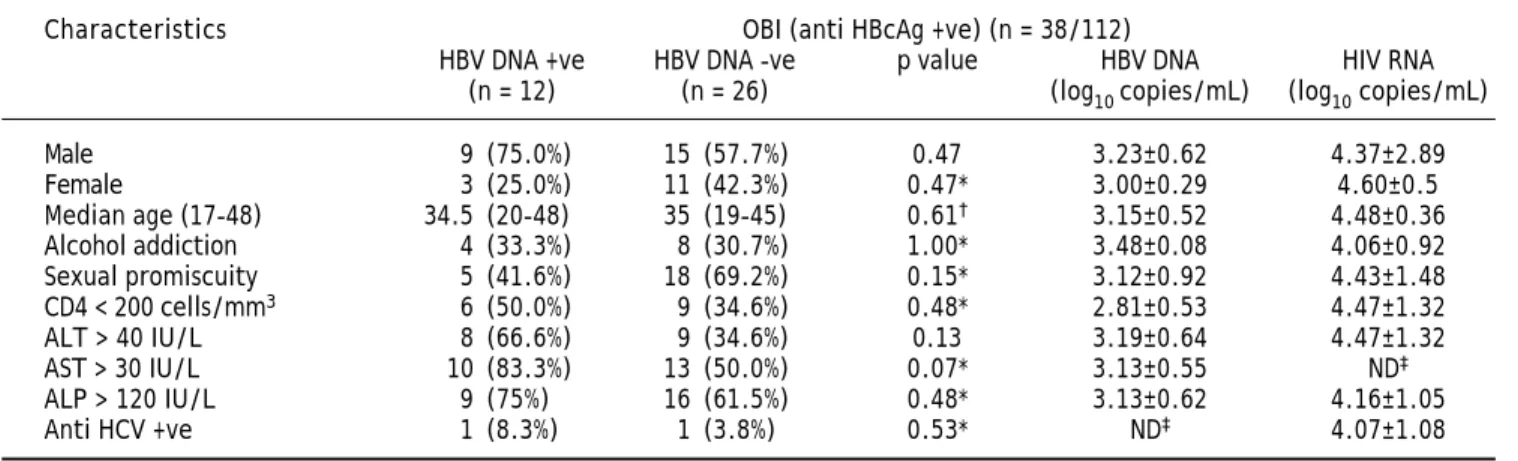
Overall 33.9% (38 of 112) of patients were reactive for antiHBc indicating prior exposure to HBV infection and of these 9 (23.6%) were antiHBs positive. Analysis of HBV DNA by PCR among antiHBc posi-tive patients, revealed that 31.5% (12 of 38) were positive for HBV DNA and majority of them were male (75%, 9 of 12) (Table 2). Thus, in the total study population 10.7% (12 of 112) was identified with OBI. Among 38 antiHBc positive patients, overall HBV DNA load and HIV RNA load was 3.15 ± 0.52 and 4.09 ± 1.08 respectively. The HIV RNA load among the HBV DNA positive and HBV DNA negative cases was 4.51 ± 1.21 and 3.86 ± 0.98 respectively and the difference was not statistically significant (p = 0.25). Comparing the samples with CD4 count greater than
and lesser than 200 cells/mm3, HBV DNA load was
2.81 ± 0.53 and 3.42 ± 0.35 (p = 0.1) respectively.
CD4 count was below 200 for 50% of patients with OBI. Serum levels of AST and ALT were higher among patients with OBI in comparison to antiHBc +ve/HBV DNA negative individuals, but the differen-ce failed to reach statistical significandifferen-ce (p = 0.13 and p = 0.07 respectively). The comparison of diffe-rent demographic, biochemical and virological factors between HBV DNA positive and negative cases was illustrated in table 3.
PCR amplicon derived from five occult HBV infec-ted patients were successfully sequenced. Phylogene-tic analysis based on S region showed that the three isolates belonged to genotype D (subtype ayw3), one as genotype A (subtype adw2) and the remaining one as genotype C (subtype adr). Sequence analysis for amino acid substitution in the surface gene region (aa 68-168) was performed. None of them had G145R mutation indicating the absence of commonly found immune escape mutant among the OBI cases.
Table 1. Evaluation of overall demographic, biochemical and virological parameters of the study population.
Characteristic Over all status in Anti-HBc status in the study population (n = 112)
under analysis study population Positive, Negative, p value
(n = 112) n=38 (33.9%) n=74 (66.0%)
Male 56 (50.0%) 24 (63.2%) 32 (43.2%) 0.05
Female 56 (50.0%) 14 (36.8%) 42 (56.8%) 0.05
Median age (17-48) 30 (17-48) 35 (19-48) 29 (17-45) 0.009*
Alcohol addiction 30 (26.8%) 12 (31.6%) 18(24.3%) 0.41
Sexual promiscuity 51 (45.5%) 23 (60.5%) 42 (56.7%) 0.70
CD4 < 200 cells/mm3 30 (26.8%) 15 (39.5%) 15 (20.3%) 0.02
ALT > 40 IU/ L 38 (33.9%) 17 (44.7%) 22 (29.7%) 0.11
AST > 30 IU/ L 57 (50.8%) 23 (60.5%) 34 (45.9%) 0.14
ALP > 120 IU/ L 68 (60.7%) 25 (65.7%) 43 (58.1%) 0.43
Anti-HCV positive 3 (2.7%) 2 (5.3%) 1 (1.35%) 0.25*
Anti-HBs positive 11 (9.8%) 9 (23.6%) 2 (2.7%) 0.0001
*p value by t-test.
Table 2. Evaluation of overall demographic, biochemical and virological parameters of anti-HBc positive samples.
Characteristics OBI (anti HBcAg +ve) (n = 38/112)
HBV DNA +ve HBV DNA -ve p value HBV DNA HIV RNA
(n = 12) (n = 26) (log10 copies/mL) (log10 copies/mL)
Male 9 (75.0%) 15 (57.7%) 0.47 3.23±0.62 4.37±2.89
Female 3 (25.0%) 11 (42.3%) 0.47* 3.00±0.29 4.60±0.5
Median age (17-48) 34.5 (20-48) 35 (19-45) 0.61† 3.15±0.52 4.48±0.36
Alcohol addiction 4 (33.3%) 8 (30.7%) 1.00* 3.48±0.08 4.06±0.92
Sexual promiscuity 5 (41.6%) 18 (69.2%) 0.15* 3.12±0.92 4.43±1.48
CD4 < 200 cells/mm3 6 (50.0%) 9 (34.6%) 0.48* 2.81±0.53 4.47±1.32
ALT > 40 IU/L 8 (66.6%) 9 (34.6%) 0.13 3.19±0.64 4.47±1.32
AST > 30 IU/L 10 (83.3%) 13 (50.0%) 0.07* 3.13±0.55 ND‡
ALP > 120 IU/L 9 (75%) 16 (61.5%) 0.48* 3.13±0.62 4.16±1.05
Anti HCV +ve 1 (8.3%) 1 (3.8%) 0.53* ND‡ 4.07±1.08
Liver biopsy was performed in six patients with OBI and showed varying stages of chronic hepatitis and significant fibrosis in all (HAI score 9.7 ± 2.7; range 5-15) even in those with a normal transami-nases and no radiological evidence of chronic liver disease. The stage and grade of chronic hepatitis did not correlate to the HBV or HIV viral load in these patients. Among these six patients, only one was anti-HBs positive.
DISCUSSION
The present study represents a comprehensive cross-sectional analysis of prevalence of OBI in an ART-naive HIV-positive cohort comprising various risk groups. Most previous studies looking at the clinical effects of OBI in HIV include a large number of patients on anti-HBV drugs as a component of ART. This study describes risk factors associated with OBI, frequency of anti-HBc positivity and its possible value as a serological marker for identifying HIV-infected patients who would benefit from HBV DNA assay.
We found the prevalence of occult HBV to be 10.7% among a randomly selected group of HIV-in-fected patients. The prevalence of OBI in HIV positi-ve individuals varies worldwide between 0-90%, depending on geographic regions, risk groups and the type of exposure involved.5,17,18,19,20 The present study as well as our previous pilot study on antiHBc positive blood donors showed significant prevalence
of OBI in our community.21 In the present study,
the prevalence of antiHBc (33.9%; 38 of 112) and OBI (31.5%; 12 of 38) among the ART-naive HIV-po-sitive cohort was higher compared to our previous report on blood donors from the same geographical area which reported 21.3% OBI among the HBsAg negative/antiHBc positive donors.21
Within India HBV and HCV co-infection among HIV infected patients have been reported sporadically
from different regions.22,23 Most of the studies aimed at detecting HBV prevalence in the HIV population are based on HBsAg positivity (prevalence 9.9 to 11%),24,25 but report on OBI is limited. Our previous study on intravenous drug users in northeastern India detected a prevalence of 15.9% OBI among the HIV infected injecting drug users.26
Among the OBI cases, the rate of antiHBs was lo-wer (3/12; 25%), which might be due to the fact that HIV infected patients are prone to lose anti-HBs im-munity at a higher frequency than the general popu-lation.27
Previous reports suggest that lower HBV
repli-cation is associated with milder hepatic damage28
but our results differ from them as in our study group hepatic injury was found in spite of low HBV viral loads. Among the subjects with OBI elevated ALT or AST was found among 66.67% (8 of 12) and 83.3% (10 of 12) respectively, though statistically not significant. However, our study is cross-sectio-nal; therefore evaluation of long term clinical signi-ficance of OBI should be better addressed by follow up studies.
HIV patients are screened for concomitant chronic hepatitis B using HBsAg ELISA and it is not considered cost-effective to perform HBV DNA testing for all in our resource poor setting. Our study tried to identify possible clinical and serolo-gical markers which could guide DNA testing in these patients. OBI is reported to be common among HCV infection but we found its prevalence to be low among our study group (112 patients). However, anti-HCV was not tested among the other HIV positive samples attending the Apex cli-nic. Furthermore, none of the risk factors were found to be statistically significant markers of OBI and cannot be used as an independent marker for identifying patients who would benefit from HBV DNA estimation. However as one third of the antiHBc positive HBsAg negative patients
Table 3. Comparison of different demographic, biochemical and virological factors between HBV DNA positive and HBV DNA negative.
Characteristics HBV DNA negative (n = 100) HBV DNA positive (n = 12)
Male 47 (47.0%) 9 (75.0%)
Female 53 (53.0%) 3 (25.0%)
Median age (17-45) 30.0 (17-45) 34.5 (20-48)
Alcohol addiction 26 (26.0%) 4 (33.3%)
CD4 count 378.8 ± 254.5 196.1 ± 100.6
ALT IU/L 42.2 ± 45.8 60.0 ± 30.8
AST IU/L 41.7 ± 29.9 74.7 ± 45.4
were positive for HBV DNA (12 of 38), it is recom-mended that HIV positive patients with HBsAg ne-gative/antiHBc positive pattern should be tested for the presence of HBV DNA irrespective of their antiHBs status.
Nevirapine is commonly included in the first-line ART regimens at most treatment centers in India. A higher frequency of severe hepatotoxicity has been observed among persons co infected with HBV/HCV, receiving a Nevirapine-containing ART regimen compared with other regimens. In our study group one patient with occult HBV infection developed ful-minant hepatic flare after initiation of Nevirapine containing HAART, suggesting need for further fo-llow up studies aimed at the effects of potentially he-patotoxic drugs on liver function in patients with occult HBV.
Our study identified only 12 subjects with OBI and all the samples were collected from a single cen-tre, indicating that results might differ in settings with significantly different demographic characteris-tics. Thus in future multicentric study involving lar-ge sample size should be taken up.
CONCLUSION
In conclusion, the prevalence of OBI in our HIV positive, ART naïve study population was found to be high, irrespective of antiHBs status. Presence of histological evidence of chronic hepatitis in our OBI patients who underwent biopsy highlights the clini-cal importance of identifying these patients early in the course of HIV treatment. Subsequent multicen-tric prospective studies aimed at evaluating the long-term clinical implications of OBI in HIV-infec-ted patients are required to find out the clinical sig-nificance of OBI in HIV HBV co-infection.
ABBREVIATIONS
• HBV: hepatitis B virus.
• HBsAg: hepatitis B surface antigen. • OBI: occult hepatitis B virus infection.
• Anti-HBc: antibodies to hepatitis B core antigen. • Anti-HBs: antibodies against HBsAg.
• HBeAg: hepatitis B e antigen. • Anti-HBe: antibodies to HBeAg.
• ALT: alanine aminotransferase.
• PCR: polymerase chain reaction. • HBc: hepatitis B core protein.
• ART: antiretroviral therapy ELISA.
• ELISA: enzyme linked immunoassay. • NAT: nucleic acid amplification technology.
ACKNOWLEDGEMENT
This research was supported by the Indian Coun-cil of Medical Research (ICMR), New Delhi, India. We thank Tapan Chakraborty for excellent technical assistance.
REFERENCES
1. Tandon BN, Acharya SK, Tandon A. Epidemiology of hepa-titis B virus infection in India. Gut 1996; 38(Suppl. 2): S56-S59.
2. Torbenson M, Thomas DL. Occult hepatitis B. Lancet In-fect Dis 2002; 2: 479-6.
3. Brechot C, Thiers V, Kremsdorf D, Nalpas B, Pol S, Paterli-ni-Brechot P. Persistent hepatitis B virus infection in subjects without hepatitis B surface antigen: clinically significant or purely “occult”. Hepatology 2001; 34: 194-203.
4. Pérez-Rodríguez MT, Sopeña B, Crespo M, Rivera A, González del Blanco T, Ocampo A, Martínez-Vázquez C. Clinical significance of “anti-HBc alone” in human immuno-deficiency virus-positive patients. World J Gastroenterol
2009; 15: 1237-41.
5. Thio CL. Hepatitis B in human immunodeficiency virus-in-fected patient; epidemiology, natural history and treat-ment. Semin Liver Dis 2003; 23: 125-36.
6. Shire NJ, Rouster SD, Rajicic N, Sherman KE. Occult hepa-titis B in HIV-Infected Patients. J Acquir Immune Defic Syndr 2004; 36: 869-75.
7. Modi A, Feld J. Viral hepatitis and HIV in Africa. AIDS Re-views 2007; 9: 25-39.
8. Filippini P, Coppola N, Pisapia R, Scolastico C, Marrocco C, Zaccariello A, Nacca C. Impact of occult hepatitis B virus infection in HIV patients naive for antiretroviral therapy.
AIDS 2006; 20: 1253-60.
9. Boom R, Sol CJ, Heijtink R, Wertheim-van Dillen PM, van derNoordaa J. Rapid purification of hepatitis B virus DNA from serum. J Clin Microbiol 1991; 29: 1804-11.
10. Datta S, Banerjee A, Chandra PK, Chowdhury A, Chakravarty R. Genotype, phylogenetic analysis, and transmission pattern of occult hepatitis B virus (HBV) infection in fa-milies of asymptomatic HBsAg carriers. J Med Virol 2006; 78: 53-59.
11. Banerjee A, Banerjee S, Chowdhury A, Santra A, Chowd-hury S, RoychowdChowd-hury S, Panda CK, et al. Nucleic acid se-quence analysis of basal core promoter/precore/core region of hepatitis B virus isolated from chronic carriers of the virus from Kolkata, eastern India: low frequency of mutation in the precore region. Intervirology 2005; 48: 389-99.
12. Kwok S, Higuchi R. Avoiding false positives with PCR. Natu-re 1989; 339: 237-38.
13. Hall TA. Bioedit: a user-friendly biological sequence align-ment editor and analysis program for windows 95/98/NT.
Nucleic Acids Symp Ser 1999; 41: 95-8.
14. Kumar S, Tamura K, Nei M. MEGA 3: Integrated software for Molecular Evolutionary Genetics Analysis and sequence alignment. Briefings in Bioinformatics 2004; 5: 150-63. 15. Chandra PK, Banerjee A, Datta S, Chakravarty R.
16. Holmes H, Davis C, Heath A, Hewlett I, Lelie N. An in-ternational collaborative study to establish the 1st international standard for HIV-1 RNA for use in nu-cleic based techniques. J Virological Methods 2001; 92; 141-50.
17. Hofer M, Joller-Jemelka HI, Grob PJ, Luthy R, Opravil M. Frequent chronic hepatitis B virus infection in HIV-infected patients positive for antibody to hepatitis B core antigen only. Swiss HIV Cohort Study. Eur J Clin Microbiol Infect Dis 1998; 17: 6-13.
18. Shire NJ, Rouster SD, Rajicic N, Sherman KE. Occult He-patitis B in HIV-Infected Patients. J Acquir Immune Defic Syndr 2004; 36: 869-75.
19. Nunez M, Rios P, Perez-Olmeda M, Soriano V. Lack of “occult” hepatitis B virus infection in HIV-infected pa-tients. AIDS 2002; 16: 2099-101.
20. Santos EA, Yoshida CF, Rolla VC, Mendes JM, Vieira IF, Arabe J, Gomes SA. Frequent Occult Hepatitis B Virus Infection in Patients Infected with Human Immunodefi-ciency Virus Type 1. Eur J Clin Microbiol Infect Dis
2003; 22: 92-8.
21. Bhattacharya P, Chandra PK, Datta S, Banerjee A, Chakraborty S, Rajendran K, Basu SK, et al. Significant increase in HBV, HCV, HIV and syphilis infections among blood donors in West Bengal, Eastern India 2004-2005: Exploratory screening reveals high fre-quency of OBI. World J Gastroenterol 2007; 13: 3730-3.
22. Kumarasamy N, Solomon S, Flanigan TP, Hemalatha R, Thyagarajan SP, Mayer KH. Natural history of human
immunodeficiency virus disease in southern India. Clin Infect Dis 2003; 36: 79-85.
23. Sud A, Singh J, Dhiman RK, Wanchu A, Singh S, Chawla Y. Hepatitis B virus co-infection in HIV infected patients.
Trop Gastroenterol 2001; 22: 90-2.
24. Jain M, Chakravarti A, Verma V, Bhalla P. Seroprevalence of hepatitis viruses in patients infected with the human immunodeficiency virus. Indian J Pathol Microbiol 2009; 52: 17-9.
25. Solomon SS, Srikrishnan AK, Mehta SH, Vasudevan CK, Murugavel KG, Thamburaj E, Anand S, et al. High prevalen-ce of HIV, HIV/hepatitis C virus coinfection, and risk be-haviors among injection drug users in Chennai, India: a cause for concern. J Acquir Immune Defic Syndr 2008; 49: 327-32.
26. Datta S, Banerjee A, Chandra PK, Chowdhury A, Chakra-varty R. Genotype, phylogenetic analysis, and transmis-sion pattern of occult hepatitis B virus (HBV) infection in families of asymptomatic HBsAg carriers. J Med Virol
2006; 78: 53-9.
27. Piroth L, Binquet C, Vergne M, Minello A, Livry C, Bour JB, Buisson M, et al. The evolution of hepatitis B virus serolo-gical patterns and the clinical relevance of isolated anti-bodies to hepatitis B core antigen in HIV infected patients. J Hepatol 2002; 36: 681-6.