
Insertion of isocyanides into zirconium alkyl bonds of di ansa zirconocene complexes X ray molecular structure of [Zr{(SiMe2)2(η5 C5H3))Cl(η2 C(i Pr)N(2,6 Me2C6H3)}]
7
0
0
Texto completo
(2) 248. A.M. Barri,da et aL /Journ,,11 of Organometailic Chemistry 542 ¢1997) 247-25.t. which leads m the ~.hydrogen-free alkyl complexes [Zd(SiMe2)2(~-CsH~).,}RX] (X = R = Me; X CI. R = CHzCMe.,Fn). In similar reactions the much less stable I~-hydrogencontaining chloro..ethyl, n-prowl and i-propyl derivatives [Zr{(SiMe,):(~q~-CsH3),,}CIR] (R = Et. n-Pr. i-Pr) were also prepared [13]. All of these compounds reacted with isocyanides to give the corresponding iminoacyl complexes. Reaction of a toluene solution of the dimethyl zirconium compound [Zd(SiMez),(~qs-CsH~),}Me,] with one equivalent of CN(2,6-Me,C,H~) at room temperature led to the methyl iminoacyl complex [Zr{(SiMe,),(WsCsH~)z}Me{~ILCMeN(2,6-Me:C, Hj)}] 1. which did not react when heated with further additions of the isocyani~, as expected for an 18 electron zirconium compound containing the vl:-coordinated iminoacyl group. Similar behaviour was observed when CN(t-Bu) was used, leading to the iminoacyl complex [Zr{(SiMez)~(vls-C~H~),}Me(w'-CMeN(t-Bu)}] 2 (see Scheme 1). Both compounds 1 and 2 are extremely moisture ~nsitive and react with a stoichiometric amount of water to give the p,-oxo dimers [Zd(SiMe: ):(~I~=C~H ~):}('q-~-CMeNR)]:(I~-O) (R 2.6oMe:C,H ~ 3, t=Bu 4). Likewise reaction of CN(t-Bu) with the chloro neophyl complex under the same conditions led to the related chloro iminoacyl derivative [Zd(SiMe; )~( ~I~oC~H .~), }CI{~q:-C(CH,CMe, Ph)[N(2.6Me:C,H~)]}] S. ° = ° Likewise addition of one equivalent of CN(2.6-. Me.,Cc,H~) to toluene solutions of the B-hydrogen containing chloro-ethyl, n-propyl and i-prowl zirconium complexes at room temperature led to the related infinoacyl derivatives [Zr{(SiMe.,),(Ws-CsHa)_,}CI(~I-'CR{N(2,6-Me_,C6H ~)})] (R = Et 6, n-Pr 7, i-Pr 8), reactions being complete after stirring tbr I h. The chloro-ipropyl complex was used in situ to avoid isomerization. All of the chloro iminoacyl compounds show a remarkable thermal stability and can be manipulated in air without transformation for short periods, as expected for rather inert 18 electron species.. =. M# ~. Me. 2.2. Stnwtural characwrizarion. All of the new iminoacyl complexes 2-8 show the v(CN) absorption band between 1575 and 1610cm-! in their IR spectra and the NMR behaviour expected tbr C, symmetrical molecules having equivalent cyclopentadienyl rings, but each showing non-equivalent ring protons and carbon atoms. Theretbre their :H NMR spectra show four singlets between # 0,39 and ~ i.02 for the four non-equivalent silicon bonded methyl groups located in the equatorial plane of symmetry along with the metal atom and the other three substituents, and three multiplets between 8 5.(16 and 6 6.90 for the nonequivalent protons of the rings (see Section 3). The resonances due to the migrated alkyl group are shifted downofield with respect to the values observed for the starting metal bonded species. Similar behaviour is also. t. 3. 2. ~Me;IC~H~NC. #~54y. M~. ~t. ~ C !. Me. Scheme I,. 4.
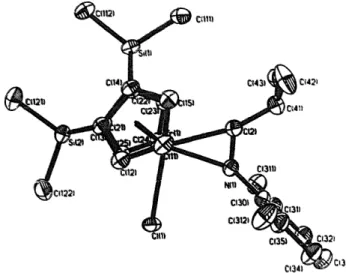
(3) A,M. BarrioA~ e~ aL /,hmrnaU of Orgammwt~Ulh" Chnnistrv .542 ~'~ 7 ~ 247-253. [T'A. ~. C134~ Ct33~ Fig, I, Molecular structure of 8,. 249. is quite similar to that found for the above mentioned dinuclear zirconium complex [2.216(4),~] and the ZrC(2)-N(I) angle 71.3(2) ° is slightly smaller (74.@3)°). A more noticeable difference is observed in the Zr(I)-C(2) distance 2.267(3)/~,, clearly longer than in the iminoacyl compound [ZrCp_~{rI-'-CMeN(t-Bu)}(gO,O'-O2CHCF3)ZrCp_,Me] [7] 2.206(5)A. This large distance in our case can probably be explained by the steric interaction of the methyl substituents of the i-propyl group with the Cp ring. The nitrogen atom is located in an "inside" position which is the more common fo, this ~yj'~e of iminoacyt iigand. The Zr-C! distance is 2.532(1)A, longer than in the starting dichloro complex [11] where the distances are 2.427(I) and 2.428(I)A. The two Cp rings are planar and the distances from Zr to the planes are 2.233(2),~, in both cases. The distances from the Zr to the C atoms of the Cp rings range fi'om 2.466(3)A to ° the distances to the carbon atoms bonded to 2.611(.3 )A, silicon being shorter. This feature was also observed in o. observed in the a~C NMR spectra, which show five signals for the ring carbon atoms and four resonances for the silicon carbon bonded atoms due to the chelating disposition of the dicyclopentadienyl ligand and the presence of three different substituents in the equatorial plane. Only one isomer is observed tbr all the new iminoacyi complexes, but from the spectral data it is not possible to distinguish the relative disposition of the two carbon and nitrogen coordinated atoms. For clarification we made a crystallographic study of the i-propyl compound [Zr{(SiMe, ).~(YIs-C s H ~),}CI{YI'-C(n-PrJ~'~(2.6M%C,H ~)}] 8.. Cry:tals of compound 8 suitable Ibr X-ray diffraction a S studies wei~ obtained fronl hcxane. Fig, I shows the resulting molecular stroclure of 8. Selected bond dis° tm|ces nod angles are presented in Table I, The molecular s|ructure is a typical mctalloccne sys,~ tern with the chlorine and the iminoacyl groups located aproximately in the plane bisecting the Cp=Zr-Cp unit. The coordination around the zirconium can be consido ered tetrahedra~ if the cyclopentadienyl rings and the iminoacyl system are taken as occupying only one coordination site. The two Cp rings are bonded by two SiMc: units leading to an eclipsed disposition. The central plane is defined by two silicon atoms from the doubly-bridged system and the metal atom. The N(I) atom is located in this plane, but CI(I) is displaced by i).1)43/~ and the C(2) and C(41) ato,ns are displaced by (I.062,4, and 0.2 ,~, respectively on the opposite side to the chorine. The i-propyl group is out of the phme. The rl2-coordination of the iminoacyi group is similar to that found in [ZnCp~{'q'-CMeN(t-Bu)}(Ix-OX O2CHCF~)ZrCp2Me] [7]. The N(I)-C(2) distance 1.268 A is consistent with a double bond aml similar to the 1.255(5)/~ Ibund in the above mentioned complex. in contrast to N-C distances of i.44 A corresponding to single bonds tbund tbr rlZ-amino- and amido-alkYol complexes [ 14-16]. The Zr( I )-N( i ) distance 2.215(2) A. Table l Selected bond lengths (A) and bond angles C) for compound 8 Zr( I )-N( I ) Zff I )=CI( I ) Zffl )-C(12) Zr( I)-C(14) lff I )-C?(21 ) Zr(I)~C(23) Zr(I)=C(25) Si( I )~C(112) Si( I )~C(14) Si( 2)o-C( 122 ) Si(2L C(13) N(I) C'(3()) C(41) ('(42) C(31 )-C(31 I) Zr( I )-Cpl. 2.215(2) 2.532( I ) 2,566( 3 ) 2.48713) 2.496(3) 2554(3) 2,588(3). N(I)oZd I),-('(2) N(I )-z.11)-el(I ) C(2)=Zff I )=CI( I ) N( I )-C(2)~Zr( I ) N(I)-C(2)-C(41 ) C(41 )-C(2)~Zff I) C(35)-C(30)- N( I ) C(31 )-C(30)~ N( I ) C(42)-C(41 )~C(2) C(42 )=.C(41 )=C(43 ) C(2)-C(41 )~C(43) C(22)~Si( I )~C(14) C(21 )~Si(2)~C(13) C p l - Z f f I )-Cp2 C'll I )-Z;t I )-Cpl Cl(1)=Zfl I)-Cp2 C(2)-Zr( I )-Cpl ('( 2)-Zr( I )-Cp2 N( I )-Zff I )--Cp I N( I )-Zr( I )-Cp2. 32,8( I ) 80,53(7) 113,33(8) 71,3(2) 123,3(3) 165.(X3) 110.6(3) 119,1(3) 111,2(3) 112.4(4) 110,7(3) 91,4(I ) 92,4(I) I I g,() L05,7 I04,3 106,6 IOO, I I19.1 118.5. ,~7(3) ,~159(4) 441~ 4) 521{t~) 5()7(~) 2,239. Zff I )-C(2) Zd I )-C( I I) Zr( I L~C( I ~) Zr( I )-C( 15 ) Zd I)-(?(22) Zd I )-, C(24) Si( I )-~C( I I I) Si( I hC(22) Si(2) C(121) Si(2) C(21) N(I) ~C(2) C( 2 ) ('(41 ) ('(41 ) -('(.t:'~ ) C(35)~C(312) Z~t I )~Cp2. Cp I is the centroid of C I I. C 12. C'I 3. C I 4. ('15. Cp2 is the centroid of C21. C22. ('23. C24. C25.. 2.267(3) 2.611(3) 2.487(3) 2.563(3) 2,4t'~5(3) 2 t~23(3) ,S5h(4). ,,~x 2( 3 ) ,261,1(4) ,523(~). ,512(6).
(4) A.M. Barriola el aL / Journal t~'Organometailic Chemisto' 54211997) 247-253. cases [11]. ~ angle between the two planes is 1~.4(9~ and t ~ centroid-~-centroid angle is 118.0°. slightly snmller than in the starting dichloro compound. The phenyl group is planar and is located almost perpendicular to the Zr-Si( I )-Si(2) plane (angle 82.12(8)°).. (Si Me,). 8 3.52 (Si Me:), 8 - 3.78 (Si Me,_), 8 - 3.8 (Si Me,).. 3.2. Synthesis of [Zd #-ltSiMe 2 ),(rl5-C5 H s ), l/Melrl"CMeN(t-Bu)}] (2). All manipulations were perfo~,:aed under an inert a t m o s ~ (argon) using Schlenk and high vacuum line t e c ~ u c s or a VAC Model HE 63P glovebox. Solvents purified by distillation from an appropriate drying/deoxygenating agent (sodium/benzophenone for diethyl ~ther. ~ u m for toluene, and sodium/potassium alloy for hexane). The complexes [Zr{ix-[(SiMe,)2(~lS-CsH.~):]}CI, ] [II] and [Zr{Ix-[(SiMe2)2(~IS-CsH~):]}CIR] [!1-13] were prepared according to literature procedures. CN(tBa) and C N(2.6-Me:C~,H~) (Aldrich) were obtained commercially. NMR spectra were recor~d on Varian Unity 300 and Varian Unity 500 Plus instruments ('H and ~C chemical shi~s were referenced to external SiMe~. 8 0ppm). IR spectra were performed in Nujol mulls on a Perkin=Elmer 883 spectrophotometer. Mass spectra were rccoMed on a Hew!ett=Pack~ 5890 spectrome. ter. Elemental C and H analy~s were carried out on a Perki~=Elmer 240B mi¢~analyser.. Toluene (30ml) was added to a mixture of [Zr{It[(SiMe.,).,(~ls-C5Ha).,]}Me.,] (0.5 g, 1.37 mmol) and CN(t-Bu) (0.15 ml, 1.37 mmot) at room temperature and then stirred for I h. The solvent was completely removed in vacuo to give a white-yellow solid. Recrystallization from hexane at -20°C gave a microcrystalline solid characterized as 2 (0.57g, 93% yield). Anal. Found: C. 56.50; H, 7.07; N, 3.01. C:~ H3.aSi:ZrN Calc.: C. 56.44; H, 7.44; N, 3.13%. Mas.' "s spectrum re~z: M+-(Me) (17%); M + - Me (21%); M + -[CMe=N(t-Bu)] (12%); M + is not observed. IR v,(C=N): 1624cm -~. ~H NMR (C6D6): 6 6.81 (m, 2H, CsH3). ~ 6.17 (m. 2H, C~H~), 8 5.06 (m, 2H, C~Ha). 8 2.28 (s. 3H, Me-C=N-R), 8 !.09 (s, 9H, MeaC), 0.75 (s. 3H, Si Me,_), 8 0.69 (s, 3H, Si Me:), 8 0.68 (s, 3H. SiMe,), 8 0.57 (s, 3H, SiMe,), 8 0.23 is, 3H, ZrMe). ~C NMR (C~D~,): 8 233.30 (RN=CMe), 142.54 (CsH~), ~ 133.47 (CsHa), 8 122.06 (CsHa), 105.74 (CsH~), 8 105.24 (CsHoa), 8 62.02 (Me3C), 30.11 (Me aC), 8 24.50 (RN=CMe), ~ 7.24 (ZrMe), 4.19 (SiMe:), t~ 4.11 (SiMe:), ~$ -3.37 (SiMe:), = 3.58 (Si Me~ ).. 3.1. Synthesis of IZrl#°IfSiMe,) CMeNf2.OoMe:C~ H~ )]] f l ~. CMeN¢2.6oMe: C~ H , )] l:¢ btoO) f,t~. ~. Toluene (30ml) was added to a mixture of [Zdl~o [(SiM¢:)~(~oC~H~)~]}M¢~] (0.Sg, 1.37mmol) and CN(2,6oMe~C~H~) (0,18g~ 1.57 retool) at ~ m temper° atuge and t b , ~ti~d for I h. The solvent was como pletely remo~, ~ in ~,acuo to give a white-yellow solid. Reer),stallizati~ from hexane at -20°C gave a white-yellow solid characterized as I (0,64g, 94% yield). Anal. Found: C, 60.41; H, 6.40: N, 3,01. C:~H~Si~ZrN Cal¢.: C, 60,67: H, 6,72: N, 2,83%. Mass spectrum re~z: M * - ( M e ) (3%): M* [ ¢ N(2,6-Me,C~H~)] (2%): M ~[CMe=N(2,6Me:Cc~H~)]-(Me) (29%); M* is not observed, IR v,(C~N): 1582cm °~, IH NMR (C¢~D~): 8 6,89 (m, 3H, C~H~), ~ 6,81 (m. 2H, CsH~), ~ 6,32 (m, 2H, C~H~), 8 :~.28(m, 2H, C~H~), ~ I~95 (s, 3H, Me=c~N), 6 1.70 (s, 6H, 2,6-Me,C~.H~), 8 0,74 (s, 3H, SiMe,), 8 0.~ (s, 3H, SiMe~)~ 8 0,63 (s, 3H, SiMe,), 6 0,62 is, 3H, SiMe:), 8 0,[2 (s, 3H, Z~Me), I~C IqMR (C~,D¢,): 8 243,75 (RN~CMe), 6 144,81 (C~H~), 6 141,74 (CsH~), 8 132,32 (CsH~), 6 129,28 (C~H~), 6 128,51 (C~H~), 8 I~,II (C~H~), 6 122,24 (C~H~), 6 110,15 (CsH~), 6 107,50 (C~H~), 8 24,84 (RN=CMe), 6 18,63 (2,6-Me:...CsH~) , ~ 7,41 (ZrMe), 6 3,72. A solution of [Zdtto[(SiMe:):(~I~oC~H~):]}MeI11:o CMeN(2,6-Me:C~,H~)}] (i) (0.35g, 0.71retool) in toluene (20 ml) at r ~ m temperature was stied lbr 48 h with a stoichiometdc amount of water (0.(gJ7ml, 0.35retool). The solvent was completely removed in vacuo to give a white-yellow solid characterized as 3 (0.22 g, 64% yield). Anal. Found: C, 58,55; H, 5,98; N, 3.28, C~H~Si.~Zr:N: Calc.: C. 59.08: H, 6.2: N, 2.87%. Mass spectrum m/.:: M*-(Me) (3%): M* - [CMe=N(2,6-Me:Cc.H ~)] (2%): M + -[CMe=N(2.6Me:C~H})]=(Me) (29%); M + is not observed. IR v,(C=N): 1608cm -I. IH NMR (C,D,): 8 7.22 (m. 4H. C~H~), 8 6.90 (m, 6H, C~,H~), (5 6,39 (m, 4H, CsH~), 5.48 (m, 4H, CsH~). /$ 1.91 (s. 6H. Me-C=N), 6 i.84 (s, 12H, 2,6-Me:C~,H~). ~ 0.97 is. 6H. SiMe:). 0,69 (s, 6H, SiMe,), 6 0,67 is, 6H, SiMe,), 6 0.39 (s, 6H, SiMe,), ~'~CoI~MN(C¢.D¢,):/~ 298.80 (RN=CMe). /$ 139.21 (C~H~),/~ 137,92 (CsH~), 6 130.54 (C~H~), 6 128,55(C~H~), 8 124.91 (CsH~), 8 138.07 (C~HI~), 6 136,44 (C~,H~), 6/ I17.43 (C~,H~), 8 20.68 (RN=CMe), 6 16.85 (2.6-Me,-C~H~), 8 0.36 (SiMe~), 8 0.19 (SiMe:), 8 - 3.56 (SiMe~), 6 - 7.57 (SiMe,),.
(5) A.M, ~m'iola e~ al, / Jounud oJ"Orgm,~,memllic Chemis~r)" 542 ~1997~ 247-253. 3.4. Synthesis of IZr{l~-lfSiMe: CMeN(t-Bu)]]:( Ix-O) (4) A solution of [Zd~t-[(SiMe.,).,(~q~-C~H~):]}Me{'q'CMeN(t-Bu)}] (2) (0.35 g, 0.78 mmol) in toluene (20 ml) at room temperature was stirred for 48 h with a stoichiometric amount of water (0.007ml, 0.39mmoi). The solvent was completely removed in vacuo to give a white-yellow solid characterized as 4 (0.22g, 64% yield). Anal. Found: C, 54.39~ H, 6.61; N, 3.39. C4oH~oSi4Zr:N: Calc.: C, 54.66; H, 6.82; N, 3.19%. Mass spectrum re~z: M + is not observed. IR v,(C=N): 1600cm -~. ~H NMR (C~Dt): 8 7.20 (m, 4H, C sH3), 6 6.22 (m, 4H, CsHa), 6 5.28 (m, 4H, C~H3), 6 2.19 (s, 6H, Me-C=N-R), 6 1.12 (s, 18H, Me,C), 8 1.02 is, 6H, SiMe,), ~ 1.00 (s, 6H, SiMe,), 6 0.69 (s, 6H, Si Me,), 6 0.68 ( s 6H, Si Me: ).. 3.5. Synthesis of [ZrCll i~-lfSiMe: ),(~S-C: H: ),.II/~ 2CfCH:CMe:(C~ H: ))Nf2,6-Me,C~ H~)}] (5). 251. -20°C gave a white solid characterized as 6 (0.63 g, 95% yield), Anal. Found: C, 56.74; H, 6.18; N, 2.74. C~sH3~Si_~ZrN Calc.: C, 56.74: H, 6,05; N, 2,64%. Mass spectrum m/z: [M +] - (Et) (0.6%); [M +] - (EtCNR) (3%); [Et-CNR] + (60.6%). IR v~(C=N): 1585cm -~. ~H NMR (CtDt): ~ 7.21 (m, 2H, CsH3), 6.89 (m, 3H, C6Hs), 6 6.60 (m, 2H, CsHs), 6 5.51 (m, 2H, CsHs), 6 2.40 (q, J = 7.69Hz, 2H, CH2CHs), $ 1.88 (s, 6H, 2,6-Me_~CtH3), 6 0.98 (s, 3H, SiMe2), 6 0.71 (s, 3H, Si Me2), 6 0.68 (s, 3H, Si Me2), $ 0.65 it, J = 7.69 Hz, 2H, CH2CH3), 6 0.41 (s, 3H, SiMe2). lSc NMR (CtDt): 6 243.61 (RN=CMe), 8 143.7 (CtHs), 6 141.9 (CsH~), 6 129.4 (C6H3), 8 128.5 (CtHs), 8 125.6 (ctns), 8 123.9 (csn3), 8 111.4 (CsHa), $ 109.5 (CsH~), 8 108 (CsHs), 8 31.6 (-CH:CHs), 8 19.1 (2,6-Me2-CtHs), 8 9.91 (CH2CHs), 8 3.3 (Si Me2), 6 3.2 (Si Me,), 6 - 3.6 (Si Me~), 8 - 4.5. (SiMe,). 3.Z Synthesis of [ZrCiilz-[tSiMe: ),(tlS-CsH., ), II/~:CtCH:-CH ,-CH : )N(2.6-Me2C~H ~)}] (7). Toluene (30ml) was added to a mixture of [Zr{p.[(SiMe,)~(vlS-C~H ~),]}CI(CH,CMe_,Ph)] (0.5 g, 0.99 retool) and CN(2,6-Me~C~H3) (0.13g, 0.99mmol) at room temperature and then stirred ibr l h. The solvent was completely removed in vacuo to give a white-yellow solid. Recrystallization from hexane at -20°C gave a white-yellow solid characterized as $ (0.59 g, 94% yield).Anal. Found'. C, 62.56: H. 6.06: N, 2.83. C,I~I~,~Si~ZrNCI Calc.: C, 62.58: H. 6.32: N. 2.21%. Mass spectrum re~z" M~-[CMe=N(2,6 Me~C~H~)] (14%); M + is not observed. IR v~(C=N): 158(~~m :~ . ~lt NMR (C~D~): ~ 7.17 (m, 5H, CMe: Ph), 6 7.12 (m, 2H, CsH~), ~ 6.89 (m, 3H, C~H~), ~ 6.23 (m, 2H, CsH:~), 6 5.44 (m, 2H, CsH~), 6 3.15 is, 2H. CH~), 8 1.99 (s, 6H. 2,6°Me~C,H~), 8 1.05 (s, 12H, CMe~PhL B 0.98 (s, 3H, SiMe~), ~ 0.69 (s, 3H. SiMe~), ~ 0.64 (s, 3H. SiMe~), 8 0.36 (s, 3H, SiMe~). I:~C I~MR (C~,D,): 6 244.69 (RN=CMe), 8 148.86 (C~,H~), 8 142.74 (CsH~), 8 129.60 (G,H~). 8 128.89 (C~,Hs), 8 128.68 (C~Hs), 8 128.55 (C,H~), 8 126.66 (C~H~), 8 125.88 (C~,Hs). 8 125.74 (Ct, Hs), 8 124.52 (CsH~), B II0.94 (CsH~). 8 110.41 (CsH3), 8 107.52 (C~H~), 8 30.32 (CMe:Ph), 8 29.45 (RN=CCH~-), 8 19.71 (2,6-Me,-Ct,H~). 8 3.43 (SiMe:). 8 3.14 (St ~e:). 8 -3.38 (SiMe:), 8 -3.53 (SiMe:).. Toluene (50ml) was added to a mixture of [Zr{~[(SiMe,)2(-qS-CsH3):]}CI(CH2-CH.~-CHs)] (0.5 g, 1.21 mmol) and CN(2,6-Me:C~,Hs) (0.158g, 1.21 retool) at room temperature and then stirred for I h. The solvent was completely removed in vacuo to give a white-yellow solid. Recrystallization from hexane at - 2 0 °C gave a white solid characterized as 7 (0.625 g, 95% yield). Anal. Found: C, 57.40: H, 6.32: N, 2.49. C:~H~Si,ZrN Calc.' C, 57.46; H, 6.30', N, 2.57%0 Mass spectrum re~z: [M+]~(Pr)(2%); [M*]~(Pr~ CNR) (7.8%): [Pr-CNR]* (100%). IR t,(CN): 1585cm :=l. IH NMR (C~Dc,): ~ 7.22 (m, 2H. Csit~), 6.89 (m, 3H, C~,H:~). ~ 6.62 (m, 2H, C~H~), ~ 5.52 (m. 2H, CsH~), 8 2.47 (m, 2H, CH2CH2CH~), 8 1.91 (s. 6H. 2.6°Me~CoH~), 8 1.27 (m, 2H, CHaCHaCH~), 0.99 (s, 3H, SiMe:), 8 0.72 (s, 3H, SiMe~), 8 0.69 is. 3H, SiMe:), 8 0.58 (t, 3H, CH~CH,CH~), 8 0.43 (s, 3H, SiMe~). 13C NMR (Ct,D~,): 8 242.8 (RN=CM¢), 6 143.9 (CtH~), 8 142 (CsH~). 8 129.6(Celia). B 128.6 (C~,H~). 8 125.6 (Ct,H3). 8 124.1 (CsH~), 8 Ill.4 (CsH~), 8 109.4 (CsH~), 8 108 (CsH~), 8 40.8 (= CH,CH,CH~), 8 19.3 (=CH~CH:CH~). 8 19.2 (2,6Me,2C~H~). $ 14.7 (=CH:CH:CH~), 8 3.3 (SiMe~), 3~.2 (SiMe:). 6 -3.6 (SiMe~). 8 -4.5 (SiMe:).. 3.6. Synthesis of IZrClll~-ltSiMe:):(~"-C:H~ : Ill~:. CtCH:=CH~)Nt2.6-Me,C~ H~ )}] (6). 3.8. Synthesis of IZrCi{ Iz-I( SiMe : ):( tl'LCs Ho~)21} { ~l2" Ct CIJ-( Clto~): )Nt2.6-Me2Cr,Ho~)11 (8). Toluene (30ml) was added to a mixture of [Zr{Ix[(SiMe:)~(~qS.C~Hs)~]}CI(CH~-CH~)] (0.5 g, 1.25 mmol) and CN(2,6-Me~Ct, H.~) (0.164 g, 1.25 mmoi) at room temperature and then stirred for I h. The solvent was completely removed in vacuo to give a white-yellow solid. Recrystallization from hexane at. A 2M solution of MgCI(i-Pr) in THF (lml, 1.98mmol) at -78°C was added to a solution of [ZrCI2{~.(SiMe2):(~q%C~H~)2}] (0.88, 1.98retool) in THF (25 mi) at ca. - 7 8 °C and the mixture was stirred for 2 h at 10 °C. The solvent was completely removed in vacuo. A solution of CN(2,6-Me2C~,H3) (0.268,.
(6) 252. A.M. Burriolaet aL/ Journal ~" Organometallic Chemisto'542 (1997) 247-253. 1.98 ~ O in toluene (50ml) at room temperature was to the mixture and then stirred for l.Sh. The solvent was completely removed in vacuo to give a white-yellow solid. Recrystallization from hexane at - 2 0 ° C gave a white-yellow crystalline solid character-. 110.9 (CtH~), 6 110.5 (C~H3), 6 107.8 (~H3), 6 38 (CH(CH3):), 6 19.5 (CH(CH3)2), 6 19.3 (2,6-Me2C6H3), 8 3.51 (SiMe2), 6 3.36 (SiMe~), 6 -3.04 (SiMe2), 6 -3.5 (SiMe2).. ized as g (l.0g, 94% yield). Anal. Found: C, 57.34; H, 6.297: N, 2.77. C2~,H34SizZrN Calc.: C, 57.47; H, 6.30; N, 2.58%. Mass specm~m re~z: [M +] - (i-Pr) (4.6%);. 3.9. X-ray structural determination for compound 8. [M +] - ( i - P r - C N R ) (10.4%); [ i - P r - C N R ] + (100%). IR ~(CN): 1575cm -~. tH N M R (CoDe): ~ 7.23 (m, 2H, CsH~). ~ 6.89 (m. 3H. C, H3). ~ 6.84 (m. 2H. CsH3),. /$ 5.54 (m. 2H. CsH3). ~ 2.69 (spt. J==6.96Hz. IH, CH(CH~)~), ~ 1.87 is. 6H, 2,6-Me2C6H3), ~ 1.02 (s. 3H, SiMe2). 8 0.9 (d. J = 6.96Hz. 6H. CH(CH3)2). 0.73 (s. 3H. Si Me,). ~ 0.68 (s. 3H. Si Me,). ~ 0,48 is. 3H. SiMe2). t~C I~MR (C6D6):/) 2,4A.2(i~N= CMe). 143.7 (C,H~). 6 142.5 (CsH~). ~ 129.5 (C~H~). /~ 128.4 (C,H~). 8 125.5 (C,H~). ~ 122.5 (C5H3).. Table 2. C~tal data and structurerefinementfor compound8 Empirical formula C~lal .~ize(ram ;). ZrCISi ~NC ~ H ~, 0..~x 0.3 x 0.3. Colour. Yellow-pale Prismatic ~43.4. Cry~.lal habit Formula weigh! Temperature (K) Wavelength (/~) ¢l~tal ~y~t~m Space group U,i! ceil dimen~ion~. V o l . ~ (A ~) g Density (caleJ (gem: ~) Absol~ion coefficient(cm: ~) F(000) # rangefor dat~ collection(o) ti~x rallges. Refl~ioa~ collected Independentretl~tioas R e ~ t i ~ ob.~.rved with I > 2 ~ ( I ). Al~tion conectio~ Rofi~nt. m~ql~l. Crystallographic and experimental details of the crystal structure determinations are given in Table 2. Suitable crystals of complex 8 were mounted on an EnrafNon(us CAD4 automatic four-circle diffractometer with bisecting geometry, equipped with a graphite-oriented monochromator and Mo Ka radiation (A = 0.71073 ,A). Data were collected at room temperature. Intensities were corrected for Lorentz and polarization efl~cts in the usual manner. No absorption or extinction corrections were made. The structure was solved by direct methods (SHELXS 90) [17] and refined by full-matrix least-squares against F 2 (SHELXL 93) [18]. All non-hydrogen atoms were refined anisotropically. In the last cycle of refinement the hydrogen atoms were positioned geometrically and refined using a tiding model with fixed thermal parameters (U ~ 0.08 A: ). Calculations were carried out on an ALPHA AXP (Digital) workstation.. 29~ 2 ). 0.71073 Triclinic i)~ . ~ 9,~.~( I )A 1~~ I 1,94~ I )/~. # -: 9~,(~ 1r y ~- 91A~ I )~ 1336~7(2) 2 1.3~0 6.IS 504. 2,08 to 2497 = I I < h < I I, ~ 14 < k < I.~. 0 < / < 14. 4942 4699 (R,m- 0,0212) 4095. 4. Supplementary material available. Tables of anisotropic thermal parameters for non°hy, d~gen atoms (Table I). hydrogen c~ndinales (Table 2), coordinates for aonohydlx)gea atoms (Table 3), complete lists of bond lengths and angles iTable 4, 2 pages). and observed and calculated structure factors ( I I pages),. Acknowledgements. We acknowledge the Direcci6n General de Investigaci6n Cient|fica y T~cnica (Spain) for financial support of this t e s e ~ h (Project 92-0178-C), A.M. and FJ.F. are grateful to CAM and DGICYT respectively for fellowships, A,B, acknowledges BID-CONICIT (Venezuela) for financial support,. N/A Fullomatrix leasto~Uare~on F:. O~ita/t~stralms/i~rameter,~. 4t~99/0/280. ~ s s o o l ~ f l t on F ~ Fi~Idl R il~lic~S [ I > 2{r(/)] R i~Ic~s (~!1 dat~) Largestd~ff~rencepeak. 1.08~S R l ~ 0.0378, wR: ~ 0.H)19 R~ - 0,0470, wR~ - 0.1084 i, 172 ~nd = 0,738. Weighing ~i~n~ (c~Ic,). w ~ I/[ er :(F,~)+ (0,0745P ): + o,~i ISe]. References [I] L,D, Durfe¢, I,P, Rolhw¢ll, Chore, R~v, 88 (Ig88) 1059. [2] L,R, Chamberlain, L.D. DuKee, P.E. Fanwick, L Kobriger.S.L. La~esky, A,K,M. Mollen, I,P, Rothw¢il, K Felling.J.C. Huff° m~, W,E, Sit,lb, R, Wang, J. Am. Chem. Sac. 109 (198"/)390.. [3] M,V, Gala.khov, M. G6,~, G. Jin~nez, P. Royo, M.A. Pellinghelli, A, Tiripicchio,Organometallics13(1994) 1564:14 (1995) 1901, 2843..
(7) A.M. l~trriola el al. / 3oumal of Organomettdli¢ Chemist~" ~ 2 ¢1997J 247-253 [4] B.K. Campion, J. Falk, T.D. Tilley, J. Am. Chem. Soc, 109 (1987) 2049; M.F. Lappert, N.T. Luong-Thi, C.R.C, Melne, J. Organomet, Chem, 1"14(1979) C35, [5] K. Tatsumi, A, Nakamura, P, Hofm~n, P, Stauffert, R. Hoffmann, J. Am, Chem. Sl~e. 107 (1985) ~ , [6] G. Erker, F, Rosenfeldt, J. Organomet, Chem. 188 (1980) C I, [7] P J, Fagan, J,M. Mannluez, S,H. Voiimer, C.S. Day, V.W. Day, TJ, Marks, J. Am. Chem. Soc. 103 (198 I) 2206. [8] G.S. Bristow, M,F, Lapperk J.L Atwood, W.E, Hunter, unpublished work (cited in DJ. Cardin, M,F. Lappert, C.L Raston, Chemistry of Organo-zirconium and -hafnium Compounds, Halsted, New York, 1986, p. 223). 191 B.D, Martin, S.A, Matchett, J.R. Norton, O.P. Anderson, J. Am. Chem. Soc, 107 (1985) 7952. Iio1 T.V. Lubhen, K. Pl6ssl, J.R. Norton, M.M. Miller, O.P. Anderson, Organometallics I I (I 992) 122.. 253. [lll A, Carlo. T. Cuenca, P, G6met-Sal, B. Royo. P. Royo, Organ~anetaUics 13 ( 1 ~ ). 1688.. [121 A. Carlo, T. Cuenca, P. G6mez-Sai, A. Manzanero, P. Royo. J. Organomet, Chem. 526 (1996) 227.. [131 F,L Fern',indez, M,P. G6mez Sal, A. Manzanero. P. Royo. H. Jacobsen, H. Berke, Organometallics, 16 (1997) 1553. [141 D.A. Gately. J.R. Norton, P.A. Goodson. J. Am. Chem. Soc. 117 (1995) 986. [151 S.L Buchwald, B.T. Watson, M.W. Wannamaker, LC. Dewan. J. Am. Chem. Soc. I 1! (1989) 4486. [16] W.E. Hunter, D.C. Hmcir. R.V. Bynum, R,E. Penttila, J.L Atwood, Organometallics 2 (1983) 750. [17] G.M. Sheldrick, Acta Crystallogr. A46 (1990) 467. [181 G.M. Sheldrick, SHELXL93. University of G6ttingen, Germany, 1993..
(8)
Figure
Documento similar