An ordinal multi-criteria decision-making procedure
under imprecise linguistic assessments
Jos´e Luis GARC´IA-LAPRESTA∗
PRESAD Research Group, BORDA Research Unit, IMUVA, Departamento de Econom´ıa Aplicada, Universidad de Valladolid, Spain
Raquel GONZ ´ALEZ DEL POZO
PRESAD Research Group, IMUVA, Departamento de Econom´ıa Aplicada, Universidad de Valladolid, Spain
Abstract
Many decision-making problems such as quality control analysis, market surveys
or sensory analysis require ordered qualitative scales, rather than numerical
ones. It is very common to assign some cardinal mathematical objects, such as
numerical values, intervals of real numbers or fuzzy numbers, to the linguistic
terms of ordered qualitative scales. However, when agents perceive that the
psychological proximity between each pair of consecutive terms of the scale is
not identical, these conversions are meaningless and an ordinal approach to deal
with these non-uniform ordered qualitative scales is more appropriate. The aim
of this paper is to introduce an ordinal multi-criteria decision-making procedure
for ranking alternatives in the setting of ordered qualitative scales that are
non-necessarily uniform. The possibility of doubt is also considered, by allowing
agents to assign two consecutive terms of the scale when they hesitate. The
proposed procedure is applied to a real case study in which nine experts assessed
eight wines regarding different criteria.
Keywords: Multiple criteria analysis; group decision-making; qualitative scales;
ordinal proximity measures.
Email addresses: Corresponding author. [email protected](Jos´e Luis
1. Introduction
Decision-making problems are very common in operational research,
man-agement sciences, economics and engineering (e.g., quality control analysis,
mar-ket surveys, sensory analysis, wine tasting, etc.).
A significant part of the problems addressed by decision-making can be
con-sidered as multi-criteria decision-making (MCDM) problems, where a group
of experts assess alternatives regarding multiple criteria for obtaining the best
alternative(s) or a ranking of them (see, for instance, Greco et al. [13] and
Hong-Bin et al. [16]).
Many decision-making problems use ordered qualitative scales formed by
linguistic terms, since words are more natural than numbers (see Zimmer [29],
Teigen [24] and Windschitl and Wells [26], among others). The reason is that
words are an appropriate tool for dealing with vagueness, imprecision and
un-certainty in human decisions (see Larichev and Brown [19] and Fasolo and Bana
e Costa [6], among others).
In general, ordered qualitative scales used in decision-making problems are
Likert-type scales [20]. They are characterized by ordered response categories, a
balanced number of positive and negative options and a numerical value assigned
to each category. This is, for instance, the case of the scale{‘Objectionable’, ‘Poor’, ‘Deficient’, ‘Acceptable’, ‘Good’, ‘Excellent’, ‘Extraordinary’}, used by
the American Wine Society for evaluating some sensory aspects of wines, where
each term is identified with a number: 0, 1, 2, 3, 4, 5 and 6, respectively.
How-ever, when agents can perceive different proximities between the terms of the
scale, this conversion of linguistic terms into numerical values is meaningless
and could generate distinct outcomes when individual assessments are
aggre-gated using different codifications of the same ordered qualitative scale (see, for
instance, Roberts [23] and Franceschini et al. [7]).
Although in the literature there are few approaches dealing with non-uniform
ordered qualitative scales in an ordinal way (see Franceschini et al. [7]), the vast
majority of methods manage linguistic terms through cardinal approaches or
fuzzy techniques (see Zadeh [28], Herrera-Viedma and L´opez-Herrera [15] and
Herrera et al. [14], among others). These cardinal approaches are practically
equivalent to using numerical values and they make no sense in the context of
non-uniform ordered qualitative scales.
On the other hand, the limited number of linguistic terms used in ordered
al. [18] and Lozano et al. [21]), sometimes, it may lead agents to have difficulties
for choosing a single linguistic term in their assessments. For this reason, it is
interesting to allow agents to assign two (or more) consecutive terms of the scale
when they are not confident about their opinions. This possibility of doubt is
addressed by Trav´e-Massuy`es and Piera [25] and Falc´o et al. [5], among others,
and it is also considered in this contribution.
The aim of this paper is to propose a MCDM procedure when agents
eval-uate a set of alternatives regarding different criteria by means of the linguistic
terms of an ordered qualitative scale non-necessarily uniform. The procedure is
developed in an ordinal way through the notion of ordinal proximity measure,
introduced by Garc´ıa-Lapresta and P´erez-Rom´an [10]. This proposal extends
the procedures introduced by Garc´ıa-Lapresta and Gonz´alez del Pozo [8] and
Garc´ıa-Lapresta and P´erez-Rom´an [12].
The procedure follows a purely ordinal approach in all the steps. Given
that the weights are numbers in the unit interval and they cannot multiply the
linguistic assessments given by agents, we propose to replicate the assessments
obtained for each alternative in each criterion a number of times following the
proportions among weights. For instance, if there are three criteria with weights
0.2, 0.3 and 0.5, the corresponding assessments are replicated 2, 3 and 5 times, respectively.
Once the assessments are replicated, the procedure ranks the alternatives
taking into account the medians of the ordinal proximities between the
assess-ments given by the agents and the highest term of the scale. Since some
al-ternatives can share the same medians, a tie-breaking procedure is provided.
Additionally, the practicality of the proposed procedure is illustrated in a real
case study in which nine experts assessed eight wines regarding different criteria.
Our procedure is related to the Majority Judgment voting system,
intro-duced by Balinski and Laraki [1, 2], where voters evaluate candidates by means
of linguistic assessments in an ordered qualitative scale, and candidates are
ranked through the lower medians of the corresponding assessments. However,
there are some differences between Majority Judgment and our approach.
1. Majority Judgment does not take into account whether the scales are
uni-form or not. If the scale is not uniuni-form, using the (lower) median as overall
assessment could not be representative of the individual assessments. In
our procedure the ordinal degrees of proximity between the terms of the
scale can generate different rankings on the set of alternatives. Thus, our
procedure is sensitive to the perception of the scale.
2. Selecting the lower median (of individual assessments, in Majority
Judg-ment) could be considered as arbitrary when the number of assessments
is low. In fact, if the upper median is considered, the outcome could be
different. In our procedure the two medians (of degrees of proximity) are
taken into account and we avoid loss of information.
3. Majority Judgment does not allow voters to hesitate between consecutive
linguistic terms of the scale. Since usually qualitative scales have a low
number of linguistic terms, it is common that voters hesitate. Thus, our
procedure enhances the voter expressivity of Majority Judgment.
The rest of the paper is organized as follows. Section 2 is devoted to
in-troduce ordinal proximity measures which allow us to work with non-uniform
ordered qualitative scales in a purely ordinal way. In this section, we also
ad-dress the possibility that agents assign two consecutive terms of an ordered
qualitative scale to each alternative, when they are not confident about their
opinions. To do that, we introduce an extension of ordinal proximity measures.
Section 3 presents the proposed ordinal MCDM procedure. Section 4 includes
the real case study. Finally, Section 5 concludes with some remarks.
2. Measuring proximities between imprecise linguistic assessments In this section we introduce an ordinal procedure for measuring the
proxim-ities between imprecise linguistic assessments.
Along the paper we consider an ordered qualitative scale (OQS) L = {l1, . . . , lg}, with g ≥ 3 and l1 < l2 < · · · < lg. We say that L is uniform
if the proximity between each pair of consecutive linguistic terms,lr and lr+1
for r∈ {1, . . . , g−1}, is perceived as identical.
First we analyze how to measure the ordinal proximities between single
lin-guistic terms of an OQS.
2.1. Ordinal proximity measures
In order to deal with non-uniform OQSs, we present the notion of ordinal
proximity measure which was introduced by Garc´ıa-Lapresta and P´erez-Rom´an
[10].
An ordinal proximity measure is a mapping that assigns an ordinal degree of
of proximity belong to a linear order ∆ = {δ1, . . . , δh}, with δ1 · · · δh,
beingδ1 and δh the maximum and the minimum ordinal degrees of proximity, respectively.
Definition 1. ([10]) An ordinal proximity measure (OPM) onL with values in ∆ is a mapping π : L2 −→ ∆, where π(l
r, ls) = πrs means the degree of proximity betweenlr andls, satisfying the following conditions:
1. Exhaustiveness: For every δ∈∆, there exist lr, ls∈ L such that δ=πrs. 2. Symmetry: πsr =πrs, for all r, s∈ {1, . . . , g}.
3. Maximum proximity: πrs=δ1 ⇔ r=s, for all r, s∈ {1, . . . , g}.
4. Monotonicity: πrs πrt and πst πrt, for all r, s, t ∈ {1, . . . , g} such that r < s < t.
Every OPM can be represented by a g×g symmetric matrix with coefficients in ∆, where the elements in the main diagonal are πrr =δ1, r= 1, . . . , g:
π11 · · · π1s · · · π1g · · · ·
πr1 · · · πrs · · · πrg · · · ·
πg1 · · · πgs · · · πgg
.
This matrix is calledproximity matrix associated withπ.
A prominent class of OPMs, introduced by Garc´ıa-Lapresta et al. [9], is the
one of metrizable OPMs which is based on linear metrics on OQSs.
Definition 2. ([9]) Alinear metriconL is a mapping d:L2−→
R satisfying
the following conditions for all r, s, t∈ {1, . . . , g}: 1. Positiveness: d(lr, ls)≥0.
2. Identity of indiscernibles: d(lr, ls) = 0 ⇔ lr=ls. 3. Symmetry: d(ls, lr) =d(lr, ls).
4. Linearity: d(lr, lt) =d(lr, ls) +d(ls, lt) whenever r < s < t.
Definition 3. ([9]) An OPM π : L2 −→ ∆ is metrizable if there exists a
linear metric d:L2−→
R such that πrsπtu ⇔ d(lr, ls)< d(lt, lu), for all
r, s, t, u∈ {1, . . . , g}.
2.2. Ordering medians of ordinal degrees of proximity
In the procedure introduced in Section 3 we will deal with medians of lists
of ordinal degrees of proximity and we will need to compare medians. We now
present a median operator in this context and an appropriate linear order on
Let y= (y1, . . . , yp)∈∆p be a vector of ordinal degrees of proximity whose
components are ordered in a decreasing fashion, from the highest to the lowest
degrees. If pis even, then y has two medians, say δr, δs ∈ ∆ such as r ≤s. However, ifpis odd, thenyhas a unique median, say δr∈∆.
In order to unify the assignment of medians and to avoid loss of information,
we would consider the pair of medians of ordinal degrees of proximity as follows:
1. If the number of ordinal degrees of proximity is even, then consider the
two medians.
2. If the number of ordinal degrees of proximity is odd, then duplicate the
median.
Formally, themedian operator is the mapping
M :
∞ [
p=1
∆p−→∆2,
that assigns the corresponding pair of medians to each vector of ordinal degrees
of proximity, where ∆2={(δr, δs)∈∆2|r≤s} is the set of feasible medians. Once the medians of ordinal degrees of proximity are obtained, it should be
necessary to have an appropriate linear order on ∆2 to rank order the
corre-sponding pairs of medians.
The binary relation<b on ∆2 defined as
(δr, δs)<b (δt, δu) ⇔ (r≤t and s≤u),
for all (δr, δs),(δt, δu) ∈ ∆2, is a partial order (reflexive, antisymmetric and
transitive). We say that<bis thebasicorder on ∆2. The Hasse diagram of <b
for h= 4 is shown in Fig. 1.
Every admissible weak or linear order on ∆2should be an extension1 of<b.
We now present a suitable linear order 2 on ∆2 introduced by
Garc´ıa-Lapresta and P´erez-Rom´an [11]. We note that it is related to the one given by
1A weak or linear order < on ∆
2 extends <b if (δr, δs)<b(δt, δu)⇒(δr, δs)<(δt, δu),
(δ1, δ1)
(δ1, δ2)
(δ1, δ3) (δ2, δ2)
(δ1, δ4) (δ2, δ3)
(δ2, δ4) (δ3, δ3)
(δ3, δ4)
(δ4, δ4)
Figure 1: The Hasse diagram of <b for h= 4.
Xu and Yager [27] in the setting of intervals of real numbers2. It is defined as
(δr, δs)2(δt, δu) ⇔
r+s < t+u
or
r+s=t+u and s−r≤u−t,
for all (δr, δs),(δt, δu)∈∆2.
It is easy to check that if r+s=t+u, then s−r≤u−t ⇔ r≥t ⇔ s≤u. Obviously, (δr, δr)(δt, δt) ⇔ r≤t.
2As mentioned by Bustince et al. [4], it corresponds to the lexicographic order of random
For instance, for h= 4, 2 extends <b (see Fig. 1) in the following way:
(δ1, δ1) 2 (δ1, δ2) 2 (δ2, δ2) 2 (δ1, δ3) 2 (δ2, δ3) 2
(δ1, δ4) 2 (δ3, δ3) 2 (δ2, δ4) 2 (δ3, δ4) 2 (δ4, δ4).
It is important to mention that 2 is not the only possible extension of <b
and other linear orders on ∆2 can be considered (see, for instance, Bustince et
al. [4]).
2.3. Extension of OPMs
Since sometimes agents may hesitate between two consecutive terms of the
scale when they provide their assessments over a set of alternatives (see
Garc´ıa-Lapresta and Gonz´alez del Pozo [8]), we will allow agents to assign two
consecu-tive linguistic terms of the OQS to each alternaconsecu-tive when they are not confident
about their opinions. The set of these intervals is denoted by
L2={[lr, ls]|r, s∈ {1, . . . , g}, s∈ {r, r+ 1}}.
The elements of L2 are either subsets of two consecutive linguistic terms,
[lr, lr+1] ={lr, lr+1}, or a single linguistic term, [lr, lr] ={lr}. For practical reasons we identify [lr, lr] ={lr} with lr. Notice that the cardinality of L2 is
2g−1.
We now extend the original linear order < on L to L2 in the natural way:
lr<[lr, lr+1]< lr+1, for every r∈ {1, . . . , g−1}, and generalize the notion of
OPM to the setting ofL2.
Definition 4. Given an OPM π: L2 −→∆, the extension of π to L 2 is the
mapping π∗: (L2)2−→∆2 defined as
π∗([lr, ls],[lt, lu]) =
(
M(πrt, πru, πst, πsu), if [lr, ls]6= [lt, lu],
(δ1, δ1), if [lr, ls] = [lt, lu].
The pairs of ordinal degrees of proximity π∗([lr, ls],[lt, lu]) ∈ ∆2 will be
arranged in a (2g−1)×(2g−1) symmetric matrix whose elements in the main diagonal correspond to the maximum proximity, (δ1, δ1). This matrix is called
proximity matrix associated withπ∗.
Remark 1. Given an OPM π : L2 −→ ∆, the extension of π to L
2 satisfies
1. Symmetry: π∗([lr, ls],[lt, lu]) =π∗([lt, lu],[lr, ls]).
2. Maximum proximity: π∗([lr, ls],[lt, lu]) = (δ1, δ1) ⇔ [lr, ls] = [lt, lu]. 3. Monotonicity: If [lr, ls] < [lt, lu] < [lv, lw], then π∗([lr, ls],[lt, lu]) 2
π∗([lr, ls],[lv, lw]) and π∗([lt, lu],[lv, lw])2π∗([lr, ls],[lv, lw]).
Example 1. Consider the OQS L={l1, l2, l3} equipped with the metrizable
OPM π:L −→∆ ={δ1, δ2, δ3, δ4} with associated proximity matrix3
A23=
δ1 δ2 δ4
δ1 δ3
δ1
Then, L2={l1,[l1, l2], l2,[l2, l3], l3} and
∆2={(δ1, δ1),(δ1, δ2),(δ1, δ3),(δ1, δ4),(δ2, δ2),(δ2, δ3),(δ2, δ4),(δ3, δ3),(δ3, δ4),(δ4, δ4)}.
For instance,
π∗([l1, l2], l3) =M(π13, π13, π23, π23) =M(δ4, δ4, δ3, δ3,) = (δ3, δ4).
After some computations, we obtain the proximity matrix associated with
π∗:
π∗(l1, l1) π∗(l1,[l1, l2]) π∗(l1, l2) π∗(l1,[l2, l3]) π∗(l1, l3)
π∗([l1, l2],[l1, l2]) π∗([l1, l2], l2) π∗([l1, l2],[l2, l3]) π∗([l1, l2], l3)
π∗(l2, l2) π∗(l2,[l2, l3]) π∗(l2, l3)
π∗([l2, l3],[l2, l3]) π∗([l2, l3], l3)
π∗(l3, l3) =
(δ1, δ1) (δ1, δ2) (δ2, δ2) (δ2, δ4) (δ4, δ4)
(δ1, δ1) (δ1, δ2) (δ2, δ3) (δ3, δ4)
(δ1, δ1) (δ1, δ3) (δ3, δ3)
(δ1, δ1) (δ1, δ3)
(δ1, δ1) .
Notice that π∗ is not exhaustive: (δ1, δ4) does not belong to the image of
π∗.
3The subindices 23 of the matrixA
3. The ordinal MCDM procedure
Many MCDM problems use linguistic terms for assessing and ranking a set
of alternatives.
Balinski and Laraki [2, 21.3] introduced an extension of their Majority
Judg-ment voting system to multicritieria problems. In their procedure, alternatives
are evaluated regarding several criteria by means of an OQS. Weights are
at-tached to each criterion according to its importance, and the linguistics
assess-ments obtained for each alternative are replicated according to the weights of
the corresponding criteria. Once the assessments are replicated, the alternatives
are ranked by using the Majority Judgment voting system.
However, the possibility that agents may perceive different proximities
be-tween the linguistic terms of an OQS is not addressed in the Multicriteria
Ma-jority Judgment proposed by Balinski and Laraki [2, 21.3].
In this section, we present a MCDM procedure for ranking a set of
alter-natives regarding different criteria assessed through an OQS, considering the
non-uniformity of the scale and the possibility that agents can select two
con-secutive terms of the scale when they hesitate4. The proposed procedure is an
extension to one introduced recently by Garc´ıa-Lapresta and P´erez-Rom´an [12]
in a more simple context.
Let A={1, . . . , m}, withm≥2, be a set of agents and let X ={x1, . . . , xn},
with n≥2, be the set of alternatives which have to be evaluated by the agents regarding a set of different criteria C = {c1, . . . , cq} through the intervals of
linguistic terms ofL2. Consider thatLis equipped with an OPM π:L2−→∆.
We also consider the extension ofπto L2, π∗: (L2)2−→∆2.
The opinions of all the agents over all the alternatives regarding the criterion
ck ∈C are collected in aprofile Vk, that is a matrix of mrows andncolumns with coefficients inL2:
Vk=
v11,k · · · v1i,k · · · v1,k n · · · ·
va,k1 · · · via,k · · · va,k n · · · ·
vm,k1 · · · vim,k · · · vnm,k
,
4Notice that this is technically equivalent to adding new linguistic terms, but without
where va,ki is the assessment given by the agent a to the alternative xi with respect to the criterionck.
Since each criterion may have different importance in the decision, we
con-sider a weighting vector (w1, . . . , wq) ∈ [0,1]q, with w1+· · ·+wq = 1. For practical reasons, we assume that these weights have at most two decimals, i.e.,
the percentages 100·w1, . . . ,100·wq are integer numbers.
To rank the alternatives, the procedure is divided in the following steps:
• Step 1. Gather the assessments given by the agents in the corresponding profiles V1, . . . , Vq.
• Step 2. Replicate the previous profiles, taking into account the corre-sponding percentages 100·w1, . . . ,100·wq. In practice, calculate the
greatest common divisor (gcd) of percentages associated with the weights,
and divide each percentage by the gcd. Then, the minimum number of
replications of each profile is obtained:
ti =
100·wi
gcd{100·w1, . . . ,100·wq}
, i∈ {1, . . . , q}. (1)
• Step 3. For each alternative xi ∈ X, calculate the ordinal proximities between the obtained assessments (taking into account the corresponding
replications) and lg:
π∗vi1,1, lg
, . . . , π∗vim,1, lg
, . . . , π∗vi1,q, lg
, . . . , π∗vim,q, lg
∈∆2.
• Step 4. For each alternative xi∈X, arrange the previous pairs of ordinal degrees of proximity in a decreasing fashion with respect to the linear
order 2 on ∆2.
• Step 5. For each alternative xi∈X, select the medians Mi∈∆4, with
∆4= n
(δr, δs),(δt, δu)
∈(∆2) 2
|(δr, δs)2(δt, δu)
o
,
in the following way:
1. If the number of pairs of ordinal degrees of proximity is even, then
consider the two medians. For instance,
(δ1, δ1),(δ1, δ2),(δ2, δ2),(δ2, δ2)
7→ (δ1, δ2),(δ2, δ2)
2. If the number of pairs of ordinal degrees of proximity is odd, then
duplicate the median. For instance,
(δ1, δ1),(δ1, δ2),(δ2, δ2)
7→ (δ1, δ2),(δ1, δ2)
∈∆4
The proposed procedure uses medians like the Majority Judgment voting
system introduced by Balinski and Laraki [1, 2]. However, while Majority
Judgment considers the lower median of individual assessments, in our
proposal we select the pair of medians of the degrees of proximity between
individual assessments and the highest possible assessment. Therefore,
the medians are of different nature. In addition, our procedure avoids the
loss of information by considering the two medians when the number of
assessments is even.
• Step 6. Rank order the alternatives through the weak order <4 on ∆4,
defined as
(δr, δs),(δt, δu)
<4
(δr0, δs0),(δt0, δu0)
⇔
r+s+t+u < r0+s0+t0+u0
or
r+s+t+u=r0+s0+t0+u0 and
D(δr, δs, δt, δu)≤D(δr0, δs0, δt0, δu0),
where D(δr, δs, δt, δu) =|r−s|+|r−t|+|r−u|+|s−t|+|s−u|+|t−u| measures the dispersion in (δr, δs, δt, δu).
Notice that <4 follows the same pattern that 2: first focus on the sum
of the subindices and then on the dispersion (D(δr, δs) =|r−s|=s−r). However, <4 is not a linear order. For instance,
(δ1, δ3),(δ2, δ3)
and
(δ1, δ2),(δ3, δ3)
are indifferent: 1 + 3 + 2 + 3 = 1 + 2 + 3 + 3 = 9 and
D(δ1, δ3, δ2, δ3) =D(δ1, δ2, δ3, δ3) = 7.
Then, the weak order<X onX is defined as
xi<X xj ⇔ Mi<4Mj,
for all xi, xj∈X.
in Step 2 (see Eq. (1)) the replications arek·ti, the medians are the same, for every positive integerk.
• Step 7. Since some alternatives can be indifferent with respect to<4, it is
necessary to devise a tie-breaking process for ordering the alternatives. We
propose to use a sequential procedure based on Balinski and Laraki [1] (see
Balinski and Laraki [3] for practical examples). It consists of withdrawing
the medians of the alternatives that are in a tie, and then selecting the
new medians for the corresponding alternatives and applying steps 5 and
6. The process continues until the ties are broken.
4. Case study
In this section, we apply the proposed MCDM procedure for ranking wines
during a blind wine tasting carried out inConsejo Regulador de la Denominaci´on
de Origen Cigales (Cigales, Valladolid, Spain, October 10th, 2017), under
ap-propriate conditions of temperature, light and service, without communication
among experts.
Nine wine experts recruited byAcademia Castellano Leonesa de Gastronom´ıa
y Alimentaci´on tasted eight red wines from Cigales Protected Designation of
Origin using the five linguistic terms of Table 1 (or the corresponding interval of
two consecutive linguistic terms, when they hesitated). The wines’ assessments
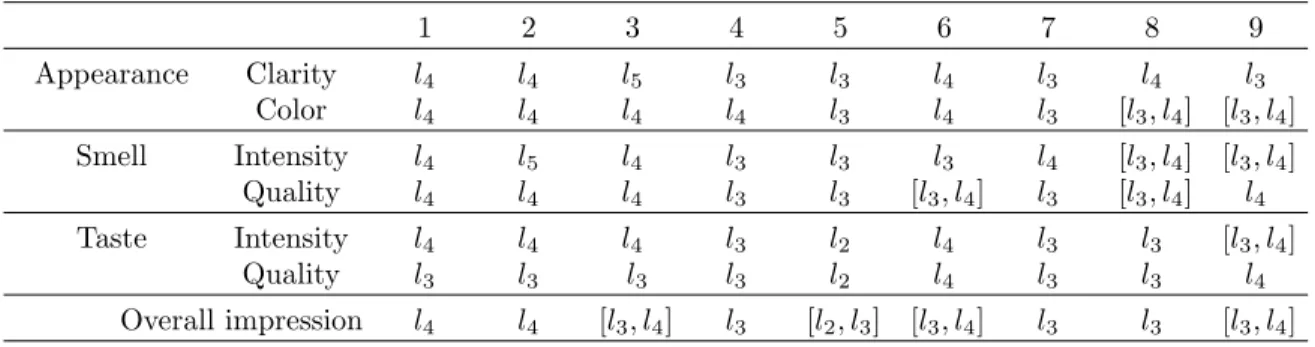
made by each expert are included in the Appendix.
The nine experts assessed each wine taking into account the most important
sensory aspects in wine tasting: appearance, smell and taste, as well as essential
factors of each criterion, such as clarity, color, intensity and quality, and also
the overall impression (see Jackson [17]).
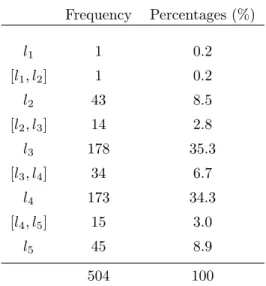
Table 2 contains the frequencies and percentages of the assessments in global
terms. Notice that the proportions ofl3andl4reached 69.6% of the assessments,
whilel1 and [l1, l2] only represented 0.4%. Also, it is important to remark that
eight out the nine experts used sometimes two consecutive terms, being this
type of the assessments 64 out of 504, i.e., approximately 12.7% of the cases.
Most tasting sheets, like Davis 20-point scorecard, use detailed score sheets
for evaluating sensory aspects of wines, giving a particular weight to each aspect
in the total score (see Jackson [17]). Since each sensory aspect may have different
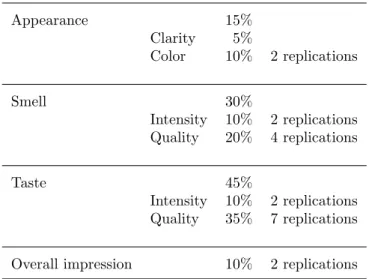
importance in wine tasting, a weight was assigned to each criterion5. Aspects,
l1 Insufficient
l2 Fair
l3 Good
l4 Very good
l5 Excellent
Table 1: Linguistic terms in L.
Frequency Percentages (%)
l1 1 0.2
[l1, l2] 1 0.2
l2 43 8.5
[l2, l3] 14 2.8
l3 178 35.3
[l3, l4] 34 6.7
l4 173 34.3
[l4, l5] 15 3.0
l5 45 8.9
504 100
Table 2: Summary of the assessments given by the wine experts.
weights and the corresponding replications considered in the case study are
shown in Table 3.
In order to know if the OQS used in the wine tasting was perceived as
uniform, after the wine tasting we asked the nine wine experts to complete an
on-line survey regarding the proximities between the terms of the OQS of Table
1.
With the information obtained in the survey, we generated the metrizable
OPM for each expert following the algorithm introduced in Garc´ıa-Lapresta et
al. [9, 2.3]. This algorithm starts by asking the expert about the comparison
between the ordinal proximities π12 and π23. The next question differs
de-pending on whether one of these ordinal degrees of proximity is greater than
the other or they are the same. The algorithm continues with similar questions
Appearance 15%
Clarity 5%
Color 10% 2 replications
Smell 30%
Intensity 10% 2 replications
Quality 20% 4 replications
Taste 45%
Intensity 10% 2 replications
Quality 35% 7 replications
Overall impression 10% 2 replications
Table 3: Sensory aspects and replications.
comparing the ordinal proximities between the remaining pairs of terms of the
OQS until the metrizable OPM is obtained.
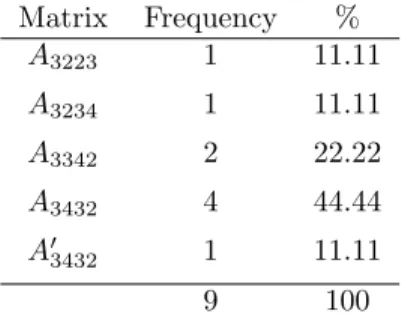
The matrices associated with the metrizable OPMs of the nine experts were
A3223=
δ1 δ3 δ5 δ6 δ7
δ1 δ2 δ4 δ6
δ1 δ2 δ5
δ1 δ3
δ1
, A3234=
δ1 δ3 δ5 δ7 δ9
δ1 δ2 δ5 δ8
δ1 δ3 δ6
δ1 δ4
δ1 ,
A3342=
δ1 δ3 δ5 δ8 δ9
δ1 δ3 δ6 δ7
δ1 δ4 δ5
δ1 δ2
δ1
, A3432=
δ1 δ3 δ5 δ7 δ8
δ1 δ4 δ5 δ6
δ1 δ3 δ4
δ1 δ2
A03432=
δ1 δ3 δ6 δ8 δ9
δ1 δ4 δ6 δ7
δ1 δ3 δ5
δ1 δ2
δ1
.
The frequency of these matrices is shown in Table 4. It is interesting to note
that none of the experts perceived the OQS as uniform.
Matrix Frequency %
A3223 1 11.11
A3234 1 11.11
A3342 2 22.22
A3432 4 44.44
A03432 1 11.11
9 100
Table 4: Matrices of the survey.
Since experts’ opinions about the proximities between the linguistic terms
of the OQS produced 5 different metrizable OPMs, it was advisable to find
a collective metrizable OPM that represents individual opinions as faithfully
as possible. To do that, we applied the aggregation procedure introduced in
Garc´ıa-Lapresta et al. [9, 4.3]. The procedure is based on weighted-metrics and
it provides the metrizable OPM that minimizes the sum of distances (square
distances) between itself and the metrizable OPMs of the experts.
The final outcome obtained after applying the mentioned aggregation
pro-cedure was the metrizable OPM associated with the proximity matrix A3432
that can be visualized in Fig. 2.
l1 l2 l3 l4 l5
Figure 2: Metrizable OPM with associated matrix A3432.
Once the metrizable OPM was obtained, we generated the extension of π
considers the proximities between the assessments given by agents andlg. Thus, we considered the pairs of δ’s contained in the last column of the proximity matrix associated withπ∗:
π∗(l1, l5)
π∗([l1, l2], l5)
π∗(l2, l5)
π∗([l
2, l3], l5)
π∗(l3, l5)
π∗([l3, l4], l5)
π∗(l4, l5)
π∗([l4, l5], l5)
π∗(l5, l5) =
(δ8, δ8)
(δ6, δ8)
(δ6, δ6)
(δ4, δ6)
(δ4, δ4)
(δ2, δ4)
(δ2, δ2)
(δ1, δ2)
(δ1, δ1) . (2)
After replicating the profiles according to Table 3 and applying the steps 3,
4, 5 and 6, we obtain the following pairs of medians:
M1=M3=M5=M6=M7= (δ4, δ4),(δ4, δ4)
,
M2=M8= (δ2, δ4),(δ2, δ4)
, M4= (δ2, δ2),(δ2, δ2)
.
Then, M4 4 (M2 ∼4 M8) 4 (M1 ∼4 M3 ∼4 M5 ∼4 M6 ∼4 M7).
In order to break the ties between wines 2 and 8, and wines 1, 3, 5, 6 and 7,
it is necessary to use the tie-breaking procedure of step 7.
For wines 2 and 8, after two tiebreakers, we have:
M2= (δ2, δ4),(δ4, δ4)
, M8= (δ2, δ4),(δ2, δ4)
.
Then, M4 4 M8 4 M2 4 (M1 ∼4 M3 ∼4 M5 ∼4 M6 ∼4 M7).
For wines 1, 3, 5, 6 and 7, after applying a tiebreaker, we have:
M1= (δ2, δ4),(δ4, δ4)
, M3=M5=M6=M7= (δ4, δ4),(δ4, δ4)
.
Then, M4 4 M8 4 M2 4 M1 4 (M5 ∼4 M3 ∼4 M6 ∼4 M7).
After applying again the tie-breaking procedure for the rest of wines, we
finally obtain the following ranking:
M4 4 M8 4 M2 4 M1 4 M5 4 M3 4 M6 4 M7.
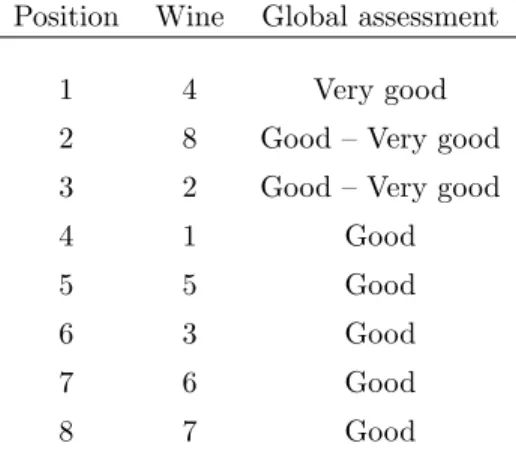
Table 5 contains the final ranking of wines and the global assessment
Position Wine Global assessment
1 4 Very good
2 8 Good – Very good
3 2 Good – Very good
4 1 Good
5 5 Good
6 3 Good
7 6 Good
8 7 Good
Table 5: Ranking of wines obtained after applying the MCDM procedure.
obtained taking into account the initial pairs of ordinal degrees of proximity for
each wine and the last column of the proximity matrix associated withπ∗ (Eq. (2)).
For instance, for wine 2 the initial pair of medians is M2= (δ2, δ4),(δ2, δ4),
which correspond to [l3, l4] inπ∗. Thus, the global assessment for the wine 2 is
between Good and Very good.
5. Concluding remarks
Since words are more appropriate than numbers for expressing human
sub-jective opinions, many decision-making problems use ordered qualitative scales
formed by linguistic terms for evaluating alternatives.
In general, the use of ordered qualitative scales is based on the implicit
assumption that scales are uniform, assigning a numerical value to each linguistic
term of the scale. However, sometimes agents can perceive that the proximities
between the terms of the scale are not identical. In these cases, the conversion of
linguistic terms into numerical values is meaningless, being more appropriate an
ordinal approach for dealing with these non-uniform ordered qualitative scales.
In this paper, we have introduced a MCDM procedure that is based on
the ordinal proximities between the highest linguistic term of the scale and the
individual assessments (a single term or two consecutive linguistic terms of the
scale, when they hesitate).
It is worth pointing out that our proposal avoids the use of numerical values
criteria are used in a qualitative fashion by replicating experts’ opinions
pro-portionally to the weights.
Section 4 illustrated the practicality of the procedure in a wine tasting where
experts assessed eight wines regarding different criteria. However, our procedure
can be implemented in many different scenarios such as satisfaction surveys,
quality of life questionnaires, or quality controls in manufacturing processes,
when agents evaluate a set of alternatives using the same ordered qualitative
scale for each criterion.
For further research, it could be interesting to devise a MCDM procedure
that considers different ordered qualitative scales (equipped with the
corre-sponding ordinal proximity measures) associated with the criteria.
Acknowledgments.
The authors are grateful to Academia Castellano Leonesa de Gastronom´ıa
y Alimentaci´on andConsejo Regulador de la Denominaci´on de Origen Cigales,
specially to his president, Julio Valles, to the nine wine experts for their
col-laboration in the wine tasting, and also to three anonymous referees for their
useful comments and suggestions. The financial support of the Spanish
Minis-terio de Econom´ıa y Competitividad (project ECO2016-77900-P) and ERDF is
acknowledged.
References
[1] Balinski, M., Laraki, R.: A theory of measuring, electing and ranking.
Proceedings of the National Academy of Sciences of the United States of
America 104, pp. 8720-8725, 2007.
[2] Balinski, M., Laraki, R.: Majority Judgment: Measuring, Ranking, and
Electing. The MIT Press, Cambridge, MA, 2011.
[3] Balinski, M., Laraki, R.: How best to rank wines: Majority Judgment,
in: Wine Economics: Quantitative Studies and Empirical Observations.
Palgrave-MacMillan, pp. 149-172, 2013.
[4] Bustince, H., Fern´andez, J., Koles´arov´a, A., Mesiar, R.: Generation of
linear orders for intervals by means of aggregation functions. Fuzzy Sets
[5] Falc´o, E., Garc´ıa-Lapresta, J.L., Rosell´o, L.: Allowing agents to be
impre-cise: A proposal using multiple linguistic terms. Information Sciences 258,
pp. 249-265, 2014.
[6] Fasolo, B., Bana e Costa, C.A.: Tailoring value elicitation to decision
makers’ numeracy and fluency: Expressing value judgments in numbers
or words. Omega 44, pp. 83-90, 2014.
[7] Franceschini, F. , Galetto, M., Varetto, M.: Qualitative ordinal scales: the
concept of ordinal range. Quality Engineering 16, pp. 515-524, 2004.
[8] Garc´ıa-Lapresta, J.L., Gonz´alez del Pozo, R.: An ordinal multi-criteria
decision-making procedure in the context of uniform qualitative scales, in:
Soft Computing Applications for Group Decision-making and Consensus
Modeling (eds. M. Collan, J. Kacprzyk). Studies in Fuzziness and Soft
Computing 357. Springer, pp. 297-304, 2018.
[9] Garc´ıa-Lapresta, J.L., Gonz´alez del Pozo, R., P´erez-Rom´an, D.: Metrizable
ordinal proximity measures and their aggregation. Information Sciences
448-449, pp. 149-163, 2018.
[10] Garc´ıa-Lapresta, J.L., P´erez-Rom´an, D.: Ordinal proximity measures in
the context of unbalanced qualitative scales and some applications to
con-sensus and clustering. Applied Soft Computing 35, pp. 864-872, 2015.
[11] Garc´ıa-Lapresta, J.L., P´erez-Rom´an, D.: A consensus reaching process in
the context of non-uniform ordered qualitative scales. Fuzzy Optimization
and Decision Making 16, pp. 449-461, 2017.
[12] Garc´ıa-Lapresta, J.L., P´erez-Rom´an, D.: Aggregating opinions in
non-uniform ordered qualitative scales. Applied Soft Computing 67, pp.
652-657, 2018.
[13] Greco, S., Ehrgott, M., Figueira, J.R. (Eds.): Multiple Criteria Decision
Analysis: State of the Art Surveys. International Series in Operations
Re-search & Management Science 233, Springer, 2016.
[14] Herrera, F., Herrera-Viedma, E., Mart´ınez, L.: A fuzzy linguistic
method-ology to deal with unbalanced linguistic term sets. IEEE Transactions on
[15] Herrera-Viedma, E., L´opez-Herrera, A.G.: A model of an information
re-trieval system with unbalanced fuzzy linguistic information. International
Journal of Intelligent Systems 22, pp. 1197-1214, 2007.
[16] Hong-Bin, Y., Tieju, M., Van-Nam, H.: On qualitative multi-attribute
group decision making and its consensus measure: A probability based
perspective. Omega 70, pp. 94-117, 2017.
[17] Jackson, R.S.: Wine Tasting: A Professional Handbook. Elsevier Academic
Press, 2017.
[18] Koles´arov´a, A., Mayor, G., Mesiar, R.: Weighted ordinal means.
Informa-tion Sciences 177, pp. 3822-3830, 2007.
[19] Larichev, O., Brown, R.: Numerical and verbal decision analysis:
compar-ison on practical cases. Journal of Multi-Criteria Decision Analysis 9, pp.
263-274, 2000.
[20] Likert, R.: A technique for the measurement of attitudes. Archives of
Psy-chology 22 (140), pp. 1-55, 1932.
[21] Lozano, L.M, Garc´ıa-Cueto, E., Mu˜niz, J.: Effect of the number of response
categories on the reliability and validity of rating scales. European Journal
of Research Methods for the Behavioral and Social Sciences 4, pp. 73-79,
2008.
[22] Miller, G.A.: The magical number seven, plus or minus two: some limits
on our capacity for processing information. Psychological Review, 63(2),
pp. 81-97, 1956.
[23] Roberts, F.S.: Measurement Theory. Addison-Wesley Publishing Company,
Reading, 1979.
[24] Teigen, K.H.: The language of uncertainty. Acta Psychologica 68, pp.
27-38, 1988.
[25] Trav´e-Massuy`es, L., Piera, N.: The orders of magnitude models as
quali-tative algebras. Proceedings of the 11th International Joint Conference on
Artificial Intelligence 2, pp. 1261-1266, 1989.
[26] Windschitl, P.D., Wells, G.L.: Measuring psychological uncertainty: Verbal
versus numeric methods. Journal of Experimental Psychology: Applied 2,
[27] Xu, Z.S., Yager, R.R.: Some geometric aggregation operators based on
intuitionistic fuzzy sets. International Journal of General Systems 8, pp.
417-433, 2006.
[28] Zadeh, L.A.: The concept of a linguistic variable and its application to
approximate reasoning. Information Sciences 8, pp. 301-357, 1978.
[29] Zimmer, A.C.: Verbal vs. numerical processing of subjective probabilities.
Appendix
1 2 3 4 5 6 7 8 9
Appearance Clarity l4 l4 l5 l3 l3 l4 l3 l4 l3
Color l4 l4 l4 l4 l3 l4 l3 [l3, l4] [l3, l4]
Smell Intensity l4 l5 l4 l3 l3 l3 l4 [l3, l4] [l3, l4]
Quality l4 l4 l4 l3 l3 [l3, l4] l3 [l3, l4] l4
Taste Intensity l4 l4 l4 l3 l2 l4 l3 l3 [l3, l4]
Quality l3 l3 l3 l3 l2 l4 l3 l3 l4
Overall impression l4 l4 [l3, l4] l3 [l2, l3] [l3, l4] l3 l3 [l3, l4]
Table 6: Assessments obtained for wine 1.
1 2 3 4 5 6 7 8 9
Appearance Clarity l5 l4 l5 l5 l3 l4 l3 l4 l4
Color l4 l4 l4 l4 l4 l2 l3 l3 l4
Smell Intensity l4 l4 l3 l4 [l2, l3] l3 l4 [l3, l4] l3
Quality [l4, l5] l3 l4 l4 l3 l3 l3 l3 l3
Taste Intensity l4 [l3, l4] l4 l3 l3 l3 l2 l4 l3
Quality l4 [l3, l4] l4 l3 l2 l2 l2 l4 l4
Overall impression l4 l3 [l3, l4] l4 l2 l3 [l2, l3] [l3, l4] l3
1 2 3 4 5 6 7 8 9
Appearance Clarity l5 l4 l4 l5 l4 l4 l4 l4 l3
Color l5 l4 l3 l5 l4 l3 l4 l4 l4
Smell Intensity l4 l4 l4 l3 l4 l3 l4 l4 l4
Quality l2 l2 l3 l3 l3 l2 l3 l4 [l3, l4]
Taste Intensity l2 l3 l4 l3 l3 l3 l4 l4 l4
Quality l1 l2 l3 l4 l3 [l2, l3] l3 l4 [l3, l4]
Overall impression l2 l2 l3 l4 [l3, l4] [l2, l3] [l3, l4] l4 [l3, l4]
Table 8: Assessments obtained for wine 3.
1 2 3 4 5 6 7 8 9
Appearance Clarity l5 l4 l5 l4 l4 l4 l4 l4 [l3, l4]
Color l5 l5 l4 l5 l4 l4 l4 l4 [l3, l4]
Smell Intensity l5 l5 l4 l5 l4 l5 l3 [l4, l5] [l3, l4]
Quality l5 l4 l3 l4 l3 l5 l3 l4 l3
Taste Intensity l5 l4 l4 l5 l3 l4 l3 l4 l4
Quality l5 l3 [l3, l4] l4 l3 l4 l3 [l3, l4] [l4, l5]
Overall impression l5 l4 l4 l5 l3 l4 l3 l4 l4
Table 9: Assessments obtained for wine 4.
1 2 3 4 5 6 7 8 9
Appearance Clarity l5 l4 l4 l3 l4 [l3, l4] l4 l4 [l4, l5]
Color l5 l5 l4 l3 l4 l3 l4 l4 l4
Smell Intensity l3 l5 l3 l3 l4 l3 l4 l4 l3
Quality l3 l5 l2 l3 l3 l4 l3 [l3, l4] [l3, l4]
Taste Intensity l4 l4 l4 l2 l3 l3 l2 l4 l4
Quality l3 [l4, l5] l3 l2 l2 l3 l3 l4 l4
Overall impression l3 [l4, l5] l3 l3 l3 l3 [l3, l4] l4 l4
Table 10: Assessments obtained for wine 5.
1 2 3 4 5 6 7 8 9
Appearance Clarity l5 l4 l5 l4 l4 l3 l3 l4 [l4, l5]
Color l5 [l2, l3] l3 l3 l4 l3 l3 l3 [l3, l4]
Smell Intensity l3 l3 l3 l2 l3 l4 l4 l3 l3
Quality l2 l4 l3 l3 l2 l4 l3 l3 l3
Taste Intensity l3 l3 l3 l4 l3 l4 l2 l3 l3
Quality l3 l2 l3 l3 l3 l3 l3 l3 l3
Overall impression l3 l2 l3 l3 l3 [l3, l4] l3 l3 l3
1 2 3 4 5 6 7 8 9
Appearance Clarity l5 l3 l5 l4 l3 l2 l3 l4 l3
Color l5 l4 l4 l3 l3 l3 l3 l4 l3
Smell Intensity l4 [l4, l5] l3 l2 l3 l2 l2 [l4, l5] l4
Quality l4 l3 l2 l2 l2 l2 l3 [l4, l5] l4
Taste Intensity l5 l4 l3 l3 l3 l3 l2 [l4, l5] [l2, l3]
Quality [l4, l5] l3 l3 l3 l2 l2 l2 l4 [l2, l3]
Overall impression [l4, l5] l3 [l2, l3] l3 [l2, l3] l2 [l2, l3] l4 [l2, l3]
Table 12: Assessments obtained for wine 7.
1 2 3 4 5 6 7 8 9
Appearance Clarity l5 l3 l5 l5 l4 l3 l4 l4 l4
Color l5 [l4, l5] l3 l5 l4 l3 l3 [l3, l4] [l4, l5]
Smell Intensity l5 l4 l3 l4 l3 l3 l3 l3 l4
Quality l4 l4 l3 l5 l3 [l1, l2] l3 l3 [l3, l4]
Taste Intensity l4 l4 l4 l4 l2 l3 l2 l4 l4
Quality l4 l3 l3 l4 l2 l3 l2 l4 l4
Overall impression l4 l4 l3 l5 [l2, l3] l3 [l2, l3] [l3, l4] l4