The importance of early treatment with tranexamic acid in
bleeding trauma patients: an exploratory analysis of the
CRASH-2 randomised controlled trial
The CRASH-2 collaborators*
Summary
Background
The aim of the CRASH-2 trial was to assess the eff ects of early administration of tranexamic acid on
death, vascular occlusive events, and blood transfusion in trauma patients with signifi cant haemorrhage. Tranexamic
acid signifi cantly reduced all-cause mortality. Because tranexamic acid is thought to exert its eff ect through inhibition
of fi brinolysis, we undertook exploratory analyses of its eff ect on death due to bleeding.
Methods
The CRASH-2 trial was undertaken in 274 hospitals in 40 countries. 20 211 adult trauma patients with, or
at risk of, signifi cant bleeding were randomly assigned within 8 h of injury to either tranexamic acid (loading dose
1 g over 10 min followed by infusion of 1 g over 8 h) or placebo. Patients were randomly assigned by selection of
the lowest numbered treatment pack from a box containing eight numbered packs that were identical apart from
the pack number. Both participants and study staff (site investigators and trial coordinating centre staff )
were masked to treatment allocation. We examined the eff ect of tranexamic acid on death due to bleeding
according to time to treatment, severity of haemorrhage as assessed by systolic blood pressure, Glasgow
coma score (GCS), and type of injury. All analyses were by intention to treat. The trial is registered as
ISRCTN86750102, ClinicalTrials.gov NCT00375258, and South African Clinical Trial Register/Department of
Health DOH-27-0607-1919.
Findings
10 096 patients were allocated to tranexamic acid and 10 115 to placebo, of whom 10 060 and 10 067,
respectively, were analysed. 1063 deaths (35%) were due to bleeding. We recorded strong evidence that the eff ect of
tranexamic acid on death due to bleeding varied according to the time from injury to treatment (test for interaction
p<0·0001). Early treatment (≤1 h from injury) signifi cantly reduced the risk of death due to bleeding
(198/3747 [5·3%] events in tranexamic acid group vs 286/3704 [7·7%] in placebo group; relative risk [RR] 0·68,
95% CI 0·57–0·82; p<0·0001). Treatment given between 1 and 3 h also reduced the risk of death due to bleeding
(147/3037 [4·8%] vs 184/2996 [6·1%]; RR 0·79, 0·64–0·97; p=0·03). Treatment given after 3 h seemed to increase
the risk of death due to bleeding (144/3272 [4·4%] vs 103/3362 [3·1%]; RR 1·44, 1·12–1·84; p=0·004). We recorded
no evidence that the eff ect of tranexamic acid on death due to bleeding varied by systolic blood pressure, Glasgow
coma score, or type of injury.
Interpretation
Tranexamic acid should be given as early as possible to bleeding trauma patients. For trauma patients
admitted late after injury, tranexamic acid is less eff ective and could be harmful.
Funding
UK NIHR Health Technology Assessment programme, Pfi zer, BUPA Foundation, and J P Moulton
Charitable Foundation.
Introduction
The CRASH-2 trial showed that administration of
tranexamic acid to adult trauma patients with, or at risk
of, signifi cant haemorrhage, within 8 h of injury,
signi fi cantly reduces all-cause mortality (relative risk
[RR] 0·91, 95% CI 0·85–0·97; p=0·0035) with no apparent
increase in vascular occlusive events.
1As a consequence
of this trial, tranexamic acid has been incorporated into
trauma treatment protocols worldwide.
Results from the CRASH-2 trial raise some important
questions. The trial was motivated by the evidence that
tranexamic acid reduces bleeding in patients undergoing
elective surgery, and the hypothesised mechanism
was inhibition of fi brinolysis leading to improved
eff ectiveness of haemostasis.
2However, no signifi cant
diff erence was recorded in transfusion requirements
between the tranexamic acid and placebo groups, and
the CRASH-2 trial did not measure the eff ect of this
drug on fi brinolytic assays. Thus an alternative
hypo-thesis is that tranexamic acid might act by reducing the
pro-infl ammatory eff ects of plasmin, rather than by
improving haemostasis.
3There has also been discussion about which trauma
patients should be treated with tranexamic acid. The
CRASH-2 trial
1reported the few subgroup analyses that
were prespecifi ed in the statistical analysis plan. These
analyses assessed the eff ect of tranexamic acid on the
primary endpoint of all-cause mortality, according to
time since injury, systolic blood pressure, Glasgow coma
score, and type of injury. No strong evidence of
Lancet 2011; 377: 1096–101
Published Online
March 24, 2011 DOI:10.1016/S0140-6736(11)60278-X
See Online/Comment
DOI:10.1016/S0140-6736(11)60396-6
See Online/Correspondence
DOI:10.1016/S0140-6736(11)60317-6
*Members listed at end of Article and in online version of this paper
Correspondence to: Clinical Trials Unit, London School of Hygiene and Tropical Medicine, London WC1E 7HT, UK
heterogeneity was recorded for any of these analyses,
suggesting that tranexamic acid is likely to be equally
eff ective in all the subgroups examined.
The focus on all-cause mortality was appropriate
because it is an outcome that matters to patients and one
that is not aff ected by the methodological problem of
competing risks.
4However, the eff ect of the trial treatment
on the biologically relevant outcome could have been
diluted by outcomes on which tranexamic acid might
have little or no eff ect. In response to these concerns, we
undertook exploratory analyses of the eff ect of tranexamic
acid on mortality due to bleeding. We report the same
prespecifi ed subgroup analyses but for the outcome that
we hypothesise would be most aff ected by this drug,
specifi cally mortality due to bleeding.
Methods
Study design and patients
The background to the trial, methods, and baseline
characteristics of the randomised patients have been
previously reported.
1Briefl y, we randomly allocated
20
211 adult trauma patients with, or at risk of,
signifi cant bleeding who were within 8 h of injury to
either tranexamic acid (loading dose 1 g over 10 min
followed by infusion of 1 g over 8 h) or matching
placebo, with 99·6% follow-up. In most hospitals we
used a local pack system for randomisation. After
eligibility had been confi rmed and the locally approved
consent procedures had been completed, patients were
randomly assigned by selection of the lowest numbered
treatment pack from a box containing eight numbered
packs. Apart from the pack number, the treatment
packs were identical. The pack number was recorded
on the entry form, which was sent to the Trial
Coordinating Centre in London, UK. Hospitals with
telephone access used a telephone randomisation
service. Both participants and study staff (site
investigators and trial coordinating centre staff ) were
masked to treatment allocation.
Statistical analysis
The primary outcome was death in hospital within
4 weeks of injury, with cause of death described with the
following categories: bleeding, vascular occlusion
(myocardial infarction, stroke, and pulmonary embolism),
multiorgan failure, head injury, and other.
All analyses were by intention to treat. We examined
the eff ect of the trial treatment on death due to bleeding
subdivided by four baseline characteristics: (1) time from
injury to treatment (≤1, >1–3, >3 h); (2) severity of
haemorrhage as assessed by systolic blood pressure (≤75,
76–89, >89 mm Hg); (3) Glasgow coma score (severe 3–8,
moderate 9–12, mild 13–15); and (4) type of injury
(penetrating only, blunt plus blunt and penetrating).
These were the same subgroup analyses that were
reported previously, but for the outcome of death due to
bleeding rather than for all-cause mortality.
Heterogeneity in treatment eff ects across subgroups
was assessed by a χ² test. We had prespecifi ed that unless
there was strong evidence against the null hypothesis of
homogeneity of eff ects (ie, p<0·001), the overall RR
would be considered the most reliable guide to the
approximate RRs in all subgroups. To test the
N All causes of death Bleeding death Non-bleeding death
Overall 20 127 0·91 (0·85–0·97); p=0·0035
0·85 (0·76–0·96); p=0·0077
0·94 (0·86–1·02); p=0·13 Time to treatment (h)
≤1 7451 0·87 (0·76–0·97) 0·68 (0·57–0·82) 1·04 (0·89–1·21) >1–3 6033 0·87 (0·77–0·97) 0·79 (0·64–0·97) 0·91 (0·78–1·05) >3 6634 1·00 (0·90–1·13) 1·44 (1·12–1·84) 0·89 (0·78–1·02) χ² test of homogeneity ·· 4·411 (p=0·11) 23·516 (p=0·0000) 2·537 (p=0·28)
Table 1: Relative risk (95% CI) of death with tranexamic acid, overall and by time to treatment
≤1 h (n=7451) >1–3 h (n=6033) >3 h (n=6634)
Age (years)
Mean (SD) 33·4 (13·9) 35·0 (14·0) 35·5 (14·8) <25 2283 (30·6%) 1557 (25·8%) 1773 (26·7%)
25–34 2360 (31·7%) 1832 (30·4%) 1882 (28·4%)
35–44 1356 (18·2%) 1177 (19·5%) 1262 (19·0%)
>44 1452 (19·5%) 1467 (24·3%) 1716 (25·9%) Systolic blood pressure (mm Hg)
≤75 1380 (18·5%) 1012 (16·8%) 768 (11·6%)
76–89 1203 (16·1%) 1064 (17·6%) 1029 (15·5%)
>89 4857 (65·2%) 3955 (65·6%) 4821 (72·7%) Heart rate (beats per min)
<77 681 (9·1%) 450 (7·5%) 603 (9·1%)
77–91 1189 (16·0%) 971 (16·1%) 1326 (20·0%)
92–107 1888 (25·3%) 1562 (25·9%) 1625 (24·5%) >107 3637 (48·8%) 2990 (49·6%) 3059 (46·1%) Respiratory rate (breaths per min)
<10 149 (2·0%) 82 (1·4%) 77 (1·2%)
10–29 6144 (82·5%) 4992 (82·7%) 5590 (84·3%)
>29 1077 (14·5%) 901 (14·9%) 923 (13·9%)
Capillary refi ll time (s)
≤2 2450 (32·9%) 2140 (35·5%) 2217 (33·4%)
3–4 3472 (46·6%) 2773 (46·0%) 3110 (46·9%)
>4 1131 (15·2%) 963 (16·0%) 1257 (19·0%)
Glasgow coma score
Severe (3–8) 1000 (13·4%) 1124 (18·6%) 1494 (22·5%) Moderate (9–12) 868 (11·7%) 915 (15·2%) 909 (13·7%) Mild (13–15) 5577 (74·9%) 3994 (66·2%) 4214 (63·5%) Continents
Asia 1213 (16·3%) 2475 (41·0%) 3656 (55·1%)
Africa 2490 (33·4%) 1437 (23·8%) 872 (13·1%)
Central and South America 2453 (32·9%) 1456 (24·1%) 1355 (20·4%) North America, Europe, and Oceania 1295 (17·4 %) 665 (11·0%) 751 (11·3%)
Data are number (%), unless otherwise stated.
independence of any observed treatment interactions we
ran a logistic model including all possible interactions in
the four prespecifi
ed baseline characteristics and
treatment subgroups.
A logistic regression was estimated with death due to
bleeding as the dependent variable and treatment group
and time to treatment as explanatory factors. We included
an interaction parameter to allow for a proportional change
in the odds ratio (OR) as time to treatment increases. ORs
and 95% CIs were estimated for diff erent times to
treatment. CIs were calculated with a logistic model with
time as a continuous term and an interaction term between
time and tranexamic acid. We also ran a model with an
interaction term for time to treatment squared to allow for
a non-constant proportional change in the OR.
The trial is registered as ISRCTN86750102,
ClinicalTrials.gov NCT00375258, and South African
Clinical Trial Register/Department of Health
DOH-27-0607-1919.
Role of the funding source
The sponsor of the study had no role in study design,
data collection, data analysis, data interpretation, or
writing of the report. The corresponding author (IR) had
full access to all the data in the study and had fi nal
responsibility for the decision to submit for publication.
Results
Of the 3076 deaths from all causes, death due to bleeding
accounted for 1063 (35%). The risk of death due to
bleeding was signifi cantly reduced with tranexamic acid.
489 of 10 060 (4·9%) patients died because of bleeding in
the tranexamic acid group versus 574 of 10 067 (5·7%) in
the placebo group (RR 0·85, 95% CI 0·76–0·96;
p=0·0077). We noted no signifi cant eff ect on the risk of
death for all other (non-bleeding) causes combined
(table
table 1).
Table
Table 2 shows the baseline characteristics of patients
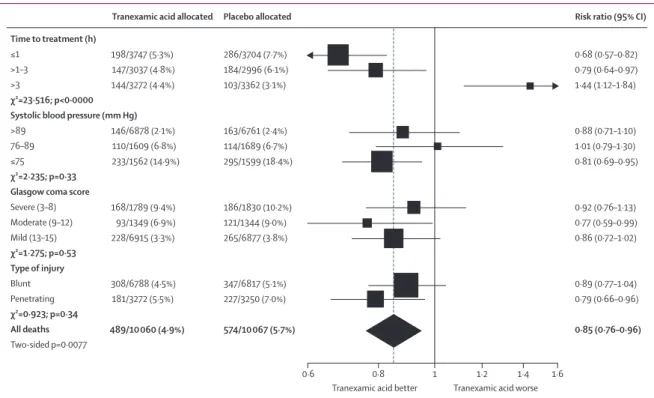
according to time to treatment. Figure
Figure 1 shows the
results of the subgroup analyses for death due to
bleeding. Time to treatment was unknown in nine
participants. Treatment given 1 h or less from injury
signifi cantly reduced the risk of death due to bleeding
(198/3747 [5·3%] in tranexamic acid group
vs
286/3704
[7·7%] in placebo group; RR 0·68, 95% CI 0·57–0·82;
p<0·0001). Treatment given between 1 and 3 h also
reduced the risk of death due to bleeding (147/3037
[4·8%]
vs
184/2996 [6·1%]; RR 0·79, 0·64–0·97; p=0·03).
Treatment given more than 3 h after injury signifi cantly
increased the risk of death due to bleeding (144/3272
[4·4%]
vs
103/3362 [3·1%]; RR 1·44, 1·12–1·84; p=0·004).
We recorded strong evidence that the eff ect of
tranexamic acid on death due to bleeding varied
according to time from injury to treatment (p<0·0001).
The evidence for interaction remained strong even after
adjustment for interactions between the other
prespecifi ed baseline characteristics and treatment
(p<0·0001; data not shown).
The estimated OR of tranexamic acid on death due to
bleeding when given immediately after injury was 0·61
Figure 1: Mortality due to bleeding by subgroups
Tranexamic acid allocated Placebo allocated Risk ratio (95% CI)
Time to treatment (h)
≤1 >1–3
>3
χ²=23·516; p<0·0000 Systolic blood pressure (mm Hg)
>89
76–89 ≤75
χ²=2·235; p=0·33
Glasgow coma score
Severe (3–8) Moderate (9–12)
Mild (13–15)
χ²=1·275; p=0·53 Type of injury
Blunt
Penetrating
χ²=0·923; p=0·34 All deaths
Two-sided p=0·0077
198/3747 (5·3%)
147/3037 (4·8%)
144/3272 (4·4%)
146/6878 (2·1%)
110/1609 (6·8%)
233/1562 (14·9%)
168/1789 (9·4%)
93/1349 (6·9%)
228/6915 (3·3%)
308/6788 (4·5%)
181/3272 (5·5%)
489/10 060 (4·9%)
286/3704 (7·7%)
184/2996 (6·1%) 103/3362 (3·1%)
163/6761 (2·4%) 114/1689 (6·7%) 295/1599 (18·4%)
186/1830 (10·2%)
121/1344 (9·0%) 265/6877 (3·8%)
347/6817 (5·1%) 227/3250 (7·0%)
574/10 067 (5·7%)
0·68 (0·57–0·82)
0·79 (0·64–0·97) 1·44 (1·12–1·84)
0·88 (0·71–1·10) 1·01 (0·79–1·30) 0·81 (0·69–0·95)
0·92 (0·76–1·13)
0·77 (0·59–0·99) 0·86 (0·72–1·02)
0·89 (0·77–1·04) 0·79 (0·66–0·96)
0·85 (0·76–0·96)
1
0·6 0·8 1·2 1·4 1·6
(95% CI 0·50–0·74). We estimated that this OR is
multiplied by 1·15 (95% CI 1·08–1·23) for every hour
that passes since the injury. Figure
Figure 2 shows how the OR
and 95% CIs vary with time to treatment. The interaction
term for time to treatment squared was not signifi cant
(OR=0·99; p=0·38).
We recorded no evidence of heterogeneity for the
subgroup analyses according to systolic blood pressure,
Glasgow coma score at randomisation, or type of injury
(fi gure 1). We detected no evidence of heterogeneity in
the eff ect of tranexamic acid on the risk of non-bleeding
deaths (table 1).
Discussion
The eff ect of tranexamic acid on death due to bleeding
depends on the time between injury and onset of
treatment. Early treatment with this drug seems to be
much more eff ective than does late treatment. These
results also raise the possibility that late treatment with
tranexamic acid might increase the risk of death due to
bleeding, although there was no evidence of any
increase in all-cause mortality in patients treated after
3 h (table 1). This fi nding might indicate that patients
treated with tranexamic acid beyond 3 h who died from
bleeding might otherwise have died from some other
non-bleeding cause (competing risks). If late
admin-istration does cause harm, this fi nding would be
important since many bleeding trauma patients in
low-income and middle-low-income countries have long
prehospital times. Indeed, about a third of trauma
patients in the CRASH-2 trial were treated more than
3 h after the injury.
The inclusion criteria in the CRASH-2 trial were
entirely clinical, and refl ect the situation that doctors are
faced with in clinical practice. Patients were enrolled if
the treating physician judged them to have ongoing
signifi cant haemorrhage, as evidenced by hypotension or
tachycardia, or if they were considered to be at risk of
signifi cant haemorrhage. Some of the included patients
might not have been actively bleeding. Any such
misdiagnosis would have reduced the power of the trial
to show an eff ect of tranexamic acid on mortality from
bleeding, in which case the large and highly signifi cant
reduction in bleeding mortality in patients treated with
this drug within 1 h of injury is particularly noteworthy.
Because patients were randomly assigned soon after
hospital admission, before the precise anatomical
location of bleeding and other injury was known, we
were unable to do a stratifi ed analysis based on an
anatomical assessment of injury severity. We acknowledge
that this omission is a methodological weakness, since
such an analysis might provide insight into the
mechanism of action of tranexamic acid. However, since
this information would not normally be available to
treating clinicians, especially in view of the importance
of early treatment, the clinical value of a stratifi ed analysis
based on anatomical injury severity is small.
Data for the time between injury and treatment were
available for all but nine trial participants. Because in
some cases the injury would not have been witnessed,
this interval sometimes had to be estimated and might
therefore be inaccurate. However, any inaccuracy would
be independent of the trial treatment and therefore
should not bias the results. The ascertainment of a death
as a bleeding death might also have been inaccurate, but
similarly any inaccuracy should be independent of the
trial treatment.
In clinical trials, a treatment is not often benefi cial in
one subgroup but harmful in another (qualitative
interaction), and some trialists recommend that
qualitative interactions should generally be disbelieved.
5The results of our analysis of the eff ect of tranexamic
acid on death due to bleeding do, however, satisfy most of
the criteria against which the credibility of subgroup
results should be judged:
6time from injury was measured
at baseline; the hypothesis that early treatment with
tranexamic acid might be more eff ective was prespecifi ed
in the trial protocol; the interaction suggests a very low
likelihood that chance explains the fi ndings; the
interaction remained signifi cant after controlling for the
non-signifi cant interactions between treatment and the
other prespecifi
ed baseline prognostic factors; the
subgroup eff ect is large; and a biological rationale
supports the interaction. Although this clinical trial was
not powered to examine subgroup eff ects, the interaction
recorded is large and highly signifi cant.
7Nevertheless, we prespecifi ed in our trial protocol that
the main subgroup analyses would be undertaken for
all-cause mortality, and not for mortality due to bleeding.
Even though we postulated that tranexamic acid would
act by reducing bleeding, we focused on all-cause
mortality because overall survival is most important to
patients. However, in view of the signifi cant reduction in
all-cause mortality, most of which was attributable to the
eff ect of tranexamic acid on death due to bleeding, and
the biological rationale that this drug would act by
Figure 2: Eff ect of tranexamic acid on death due to bleeding by time to treatment
Shaded area shows 95% CI. OR=odds ratio.
0·5 1·0 1·5 2·0 2·5 3·0
8 7 6 5 4 3 2 1 0
Time to treatment
(h)
improving haemostasis, our analyses, although not
prespecifi ed, would seem justifi ed.
Acute severe trauma is associated with increased
fi brinolysis that contributes to an early coagulopathy and
increased mortality.
8,9Fibrinolysis can be assessed by
measurement of fi brin degradation products, which
include small protein fragments called D-dimers. Brohi
and colleagues
8showed that D-dimer concentrations are
raised in trauma patients at the time of hospital admission
(median prehospital time 28 min), with the highest
concentrations measured in the most severely injured
patients.
8Similar results were recorded in a 2009 study
from Japan that measured fi brin degradation product
and D-dimers in 314 severe trauma patients.
10If this early
increased fi brinolysis exacerbates bleeding and increases
the risk of death, then we might expect that an
antifi brinolytic drug such as tranexamic acid would be
most eff ective in this period.
Although we had anticipated that early treatment with
tranexamic acid might be most eff ective, the apparent
increase in the risk of death due to bleeding in patients
treated more than 3 h after the injury is unexpected and
cannot readily be explained. It could be a chance fi nding
and there might be no real biological eff ect. However,
patients in the late phase of trauma can develop
thrombotic disseminated intravascular coagulation,
and antifi brinolytics could be contraindicated in this
period.
10,11Although disseminated intravascular
coagu-lation is characterised by fi
brin formation and
coagulation, the rapid consumption of coagulation
proteins can lead to their exhaustion, resulting in
uncontrolled bleeding. The need to avoid giving an
antifi brinolytic in this late phase was why we restricted
trial inclusion to patients who were within 8 h of
injury. The possibility that the change to a prothrombotic
state might occur sooner than was previously expected
is open to debate and needs further research. We
should also bear in mind that patients who arrive at
hospital many hours after injury are likely to diff er from
those who arrive early. For example, there could
be an increased prevalence of hypothermia and
acidosis. These or other diff erences could explain the
decreased effi
cacy of tranexamic acid administration
when given late.
A 2011 systematic review of randomised controlled
trials concluded that tranexamic acid safely reduces
mortality in bleeding trauma patients.
12Our results
strongly endorse the importance of early administration
of tranexamic acid in bleeding trauma patients and
suggest that trauma systems should be confi gured to
facilitate this recommendation (panel
panel). In patients
presenting late (several hours after injury) the clinician
should be more cautious and make an assessment of the
individual benefi ts and risks of this treatment, since the
drug is likely to be much less eff ective and possibly even
harmful. To the extent that our subgroup analyses are
consistent with the results of studies showing an early
increased fi brinolytic coagulopathy, they support the
hypothesis that tranexamic acid acts through the
inhibition of fi brinolysis with improved haemostasis.
Future research
using the CRASH-2 trial data will
develop a prognostic model to predict death due to
bleeding.
13This model will facilitate further analysis of
the eff ect of tranexamic acid according to baseline risk of
haemorrhage death.
Contributors
All members of the Writing Committee, apart from AA and GG, attended a 2-day meeting in London, UK, at which the subgroup analyses were presented and discussed and the report was drafted. Both AA and GG contributed to the discussions and drafting by phone and in correspondence.
CRASH-2 trial coordination
Writing Committee: Ian Roberts (UK) (chair), Haleema Shakur (UK), Adefemi Afolabi (Nigeria), Karim Brohi (UK), Tim Coats (UK), Yashbir Dewan (India), Satoshi Gando (Japan), Gordon Guyatt (Canada), B J Hunt (UK), Carlos Morales (Colombia), Pablo Perel (UK), David Prieto-Merino (UK), Tom Woolley (UK).
National coordinators: Jonathan Dakubo (Ghana), Tamar Gogichaishvili (Georgia), Nyoman Golden (Indonesia), Mario Izurieta (Ecuador), Hussein Khamis (Egypt), Edward Komolafe (Nigeria),
Jorge Loría-Castellanos (Mexico), Jorge Mejía-Mantilla (Colombia), Jaime Miranda (Peru), Ángeles Muñoz (Spain), Vincent Mutiso (Kenya), Patrick Okwen (Cameroon), Zulma Ortiz (Argentina), María Pascual, CENCEC (Cuba), R Ravi (India), April Roslani (Malaysia), Stefan Trenkler (Slovakia), Annalisa Volpi (Italy), Surakrant Yutthakasemsunt (Thailand).
Trial Coordinating Centre team: Ian Roberts (clinical coordinator, chief investigator), Haleema Shakur (trial manager), Pablo Perel (regional coordinator), Lin Barnetson (data manager), Maria Ramos (trial administrator), Lisa Cook (assistant trial manager, regional coordinator from 2007), Taemi Kawahara (assistant trial manager, regional coordinator from 2007), Eni Balogun (regional coordinator from 2006), Matthew Berle (trial assistant from 2007), Collette Barrow (assistant administrator from 2008), Tony Brady (programmer to 2006), Chris Rubery (data assistant from 2009), Jackie Wayte (UK nurse coordinator from 2008), Cynthia To (data assistant 2007–09).
Steering Committee: Ian Franklin (chair), Brigitte Chaudhry, Tim Coats, Charles Deakin, Steve Goodacre, Beverley Hunt, David Meddings, Richard Peto, Ian Roberts, Peter Sandercock.
Management Group: Ian Roberts (chair), Haleema Shakur, Tim Coats, Phil Edwards, Beverley Hunt, Maria Ramos.
Data Monitoring and Ethics Committee: Rory Collins (chair), Adrian Grant, John Myburgh, Alex Baxter (independent statistician). For the full list of collaborators please see the online version of this Article and Lancet 2010; 376: 23–32.
Panel:
Research in context
Systematic review
A 2011 Cochrane systematic review
12of antifi brinolytic drugs
for acute traumatic injury identifi ed two randomised trials of
tranexamic acid in bleeding trauma patients, involving
20 451 patients. The review concluded that tranexamic acid
safely reduces mortality in bleeding trauma patients without
increasing the risk of adverse events.
Interpretation
Confl icts of interest
Members of the Writing Committee declare that they have no confl icts of interest.
Acknowledgments
The London School of Hygiene and Tropical Medicine supported the core trial coordinating staff during the fi rst year of the trial set-up. Funding for the run-in stage was provided by J P Moulton Charitable Foundation and the BUPA Foundation. A grant-in-aid for purchasing the tranexamic acid and placebo was provided by Pfi zer. The main phase of this trial was funded by the UK NIHR Health Technology Assessment programme and will be published in full in the Health Technology Assessment journal series. The views and opinions expressed therein are those of the authors and do not necessarily refl ect those of the Department of Health.
References
1 The CRASH-2 Collaborators. Eff ects of tranexamic acid on death, vascular occlusive events, and blood transfusion in trauma patients with signifi cant haemorrhage (CRASH-2): a randomised, placebo-controlled trial. Lancet 2010; 376: 23–32.
2 Henry DA, Carless PA, Moxey AJ, et al. Anti-fi brinolytic use for minimising perioperative allogeneic blood transfusion.
Cochrane Database Syst Rev 2007; 4: CD001886.
3 Levy JH. Antifi brinolytic therapy: new data and new concepts.
Lancet 2010; 376: 3–4.
4 Lauer MS, Blackstone EH, Young JB, Topol EJ. Cause of death in clinical research: time for a reassessment? J Am Coll Cardiol 1999; 34: 618–20.
5 Yusuf S, Wittes J, Probstfi eld J, Tyroler HA. Analysis and interpretation of treatment eff ects in subgroups of patients in randomized clinical trials. JAMA 1991; 266: 93–98.
6 Sun X, Briel M, Walter SD, et al. Is a subgroup eff ect believable? Updating criteria to evaluate the credibility of subgroup analyses.
BMJ 2010; 340: c117.
7 Assmann SF, Pocock SJ, Enos LE, Kasten LE. Subgroup analysis and other (mis)uses of baseline data in clinical trials. Lancet 2000; 355: 1064–69.
8 Brohi K, Cohen MJ, Ganter MT, et al. Acute coagulopathy of trauma: hypoperfusion induces systemic anticoagulation and hyperfi brinolysis. J Trauma 2008; 64: 1211–17.
9 Hess JR, Brohi K, Dutton RP, Hauser CJ, Holcomb JB, Kluger Y. The coagulopathy of trauma: a review of mechanisms. J Trauma
2008; 65: 748–54.
10 Sawamura A, Hayakawa M, Gando S, et al. Disseminated intravascular coagulation with a fi brinolytic phenotype at an early phase of trauma predicts mortality. Thromb Res 2009; 1214: 608–13. 11 Prentice CR. Basis of antifi brinolytic therapy. J Clin Pathol 1980;
33: 35–40.
12 Roberts I, Shakur H, Ker K, Coats T, for the CRASH-2 Trial collaborators. Antifi brinolytic drugs for acute traumatic injury.
Cochrane Database Syst Rev 2011; 1: CD004896.
CRASH-2 trial collaborators by country
Albania (115)—National Trauma Centre Hospital: Fatos Olldashi, Mihal Kerçi, Tefi k Zhurda, Klotilda Ruçi; Spitali Civil Durres: Arben Banushi. Argentina (51)—Hospital Ángel Cruz Padilla: Mario Sardón Traverso, Juan Jiménez; Hospital Regional Rio Grande: Jorge Balbi; Hospital "4 de Junio" Dr Ramon Carrillo: Christian Dellera; Hospital Castro Rendón: Silvana Svampa; Hospital San Martín de La Plata: Gustavo Quintana; Hospital Municipal de Agudos "Dr Leonídas Lucero": Gustavo Piñero; Hospital Interzonal General de Agudos “Dr Oscar Alende”: Jorge Teves. Australia (17)—Nepean Hospital: Ian Seppelt; Sir Charles Gairdner Hospital: David Mountain; John Hunter Hospital: Zsolt Balogh. Bangladesh (12)—United Hospital Limited: Maniruz Zaman. Belgium (51)—Sint-Vincentius Hospital: Patrick Druwé, Robert Rutsaert; Centre Hospitalier Regional de Namur: Guy Mazairac. Cameroon (124)—Tombel District Hospital:
Fogang Pascal, Zognou Yvette, Djeuchon Chancellin; St Theresa's Catholic Medical Centre: Patrick Okwen; Bamenda Provincial Hospital: Jules Djokam-Liapoe; Bali District Hospital: Ernest Jangwa; Bafut District Hospital: Lawrence Mbuagbaw; Fundong District Hospital: Ninying Fointama; St John of God Medical Centre: Fogang Pascal.
Canada (2)—Hamilton General Hospital: Frank Baillie.
China (51)—Renji Hospital: Ji-yao Jiang, Guo-yi Gao, Yin-hui Bao.
Colombia (2940)—University of Antioquia, Hospital San Vicente de Paul: Carlos Morales, Juan Sierra, Santiago Naranjo, Camilo Correa, Carolina Gómez; Hospital Universitário San Jose de Popayan: Jorge Herrera, Liliana Caicedo, Alexei Rojas, Henry Pastas, Hugo Miranda; Hospital Pablo Tobon Uribe: Alfredo Constaín, Mayla Perdomo, Diego Muñoz, Álvaro Duarte, Edwin Vásquez; Hospital San Andrés de Tumaco: Camilo Ortiz, Bernardo Ayala, Hernán Delgado, Gloria Benavides, Lorena Rosero; Fundación Clínica Valle del Lili: Jorge Mejía-Mantilla, Ana Varela, Maríaisabel Calle, José Castillo, Alberto García; Clínica las Americas: Juan Ciro, Clara Villa, Roberto Panesso; Hospital General de Medellin: Luz Flórez, Argemiro Gallego; Hospital San Felix ESE: Fabián Puentes-Manosalva, Leonor Medina, Kelly Márquez; Hospital Universitário del Caribe:
Adalgiza Reyes Romero, Ricardo Hernández, Julio Martínez; Hospital Universitário San Jorge: Wilson Gualteros; Hospital San Rafael Tunja: Zulma Urbina, Julio Velandia; Clínica La Estancia SA: Federico Benítez, Adolfo Trochez; Fundación Hospital San José de Buga: Andrés Villarreal, Pamela Pabón; Hospital Civil de Ipiales: Hernán Delgado; Hospital Universitário Departamental Nariño: Héctor López; Hospital Universitário del Valle: Laureano Quintero; Hospital Universitário de Neiva: Andrés Rubiano; Hospital Manuel Uribe Ángel: Juan Tamayo.
Cuba (575)—Hospital Clínico-Quirúrgico Docente "Saturnino Lora": Marjoris Piñera; Hospital General Universitário
"Carlos Manuel de Céspedes": Daimi Martínez, Heriberto Martínez; Hospital Provincial Docente "Manuel Ascunce Domenech": Eugenio Casola; Hospital Universitário "Arnaldo Milián Castro": Mario Domínguez, Carlos Herrera; Hospital Universitário "Dr Gustavo Aldereguía Lima": Marcos Iraola, Omar Rojas; Hospital Abel Santamaría Cuadrado: Irene Pastrana, Daniel Rodríguez, Sergio Álvarez de la Campa; Hospital Miguel Enríquez: Thorvald Fortún; Hospital General Calixto García: Martha Larrea; Hospital Antonio Luaces Iraola: Lensky Aragón; Hospital Provincial Docente VI Lenin:
Aida Madrazo. Czech Republic (17)—Research Institute for Special Surgery and Trauma: Petr Svoboda. Ecuador (1198)—Hospital Luis Vernaza: Mario Izurieta, Alberto Daccach, Mónica Altamirano, Antonio Ortega, Bolívar Cárdenas, Luis González; Hospital José Carrasco Arteaga: Marcelo Ochoa, Fernando Ortega, Fausto Quichimbo, Jenny Guiñanzaca; Hospital de Niños Dr Roberto Gilbert Elizalde: Ines Zavala, Sayra Segura; Hospital Naval Guayaquil: Johnny Jerez; Hospital Alcivar: Daniel Acosta; Hospital
"Dr Rafael Rodríguez Zambrano": Fabián Yánez; Clínica De Especialidades Medicas "San Gregorio": Rubén Camacho.
Egypt (2234)—Mataria Teaching Hospital: Hussein Khamis, Hossam Shafei, Ali Kheidr, Hani Nasr, Moetaz Mosaad, Safwat Rizk; Suez Canal University: Hesham El Sayed, Taha Moati, Emad Hokkam; Aswan Teaching Hospital: Mamdouh Amin, Hany Lowis, Medhat Fawzy, Nabil Bedir, Mohamed Aldars. El Salvador (84)—Hospital Nacional Rosales: Virginia Rodríguez, Juan Tobar, Jorge Alvarenga.
Georgia (1783)—Tbilisi State University Clinical Hospital
'I Javakhishvili': Budu Shalamberidze, Elza Demuria,
Nikoloz Rtveliashvili, Gocha Chutkerashvili, David Dotiashvili; Tbilisi First Hospital, University Clinic, Neurosurgery Center:
Tamar Gogichaishvili, George Ingorokva, David Kazaishvili, Besik Melikidze, Natia Iashvili; Tbilisi City Hospital #1: Gia Tomadze, Manana Chkhikvadze, Leri Khurtsidze, Zviad Lomidze, Diana Dzagania; Tbilisi State Medical University ER Department: Nikoloz Kvachadze, Giorgi Gotsadze, Vakhtang Kaloiani; Institute of Critical Care Medicine: Nino Kajaia. Ghana (136)—Korle Bu Teaching Hospital:
Jonathan Dakubo, Simon Naaeder, Priscilla Sowah; Nyinahin Government Hospital: Adamu Yusuf, Alhaji Ishak; Sogakope District Hospital: Paul Selasi-Sefenu; Methodist Hospital Wenchi: Ballu Sibiri; Effi a Nkwanta Regional Hospital: Sampson Sarpong-Peprah; Saint Theresa's Hospital: Theodore Boro. India (4768)—Medical Trust Hospital Kochi: Kanjithanda Bopaiah, Kishore Shetty, Raja Subbiah, Lukman Mulla, Anand Doshi; Christian Medical College Ludhiana: Yashbir Dewan, Sarvpreet Grewal, Pradipta Tripathy, Jacob Mathew, Bharat Gupta; Aditya Neuroscience Centre: Anil Lal, Majulie Choudhury; Sri Sai Hospital: Sanjay Gupta, Smita Gupta, Arun Chug; Care Hospital: Venkataramana Pamidimukkala, Palaniappan Jagannath,
Mohan Maharaj, Ramaraju Vommi, Naresh Gudipati; North Bengal Neuro Research Centre: W H Chhang; Sheth VS General Hospital and NHL Municipal College: Pankaj Patel, Nilay Suthar, Deepa Banker, Jyotish Patel; LTM Medical College and General Hospital: Satish Dharap, Ranjeet Kamble, Shraddha Patkar, Sushil Lohiya; Government Medical College and Associated Hospitals Jammu: Rakesh Saraf, Dinesh Kumar, Satish Parihar, Rahul Gupta; MKCG Medical College:
Rasananda Mangual, Alagumuthu, Don Kooper, Chinmaya Mohapatra; Christian Medical College Hospital Vellore: Suresh David,
Wesley Rajaleelan, Appas; KLE Hospital and Medical Research Centre: Ashok Pangi, Vivek Saraf, Santhosh Chikareddy; NKP Salve Institute of Medical Sciences and Lata Mangeshkar Hospital: Sushil Mankar, Anil Golhar, Rahul Sakhare, Nilesh Wagh; Sanjivani Diagnostics and Hospital: Anil Lal, Dhiman Hazarika; Parkar Hospital:
Pratyush Chaudhuri; Jeevan Jyoti Hospital and Research Centre: Prakash Ketan; Mansarovar Hospital: Govindbhai Purohit, Yogesh Purohit, Mandakini Pandya; Postgraduate Institute of Medical Science Rohtak: Rakesh Gupta, Shashi Kiran, Saurab Walia; Goyal Hospital Jalna: Sonam Goyal, Sidhant Goyal, Satish Goyal; Government Medical College Chandigarh: Sanjay Gupta, Ashok Attri, Rajeev Sharma; Oberai Hospital: Ashok Oberai, Mahesh Oberai, Supriya Oberoi; Rajeev Gandhi Memorial Hospital and Research Centre: Gajendra Kant Tripathi; Calicut Medical College Hospital: Vijayan Peettakkandy,
Premkumar Karuthillath, Pavithran Vadakammuriyil; Krishnamai Medical and Research Foundation's NIKOP Hospital: Jalindar Pol, Sunita Pol, Manisha Saste; St Stephen's Hospital: Subrat Raul, Shashi Tiwari, Neileino Nelly; Government Rajaji Hospital: M Chidambaram; Medical College Trivandrum:
Sharad Vyas; Sukhdev Raj Soin Hospital: Sujoy Bhattacharjee; Sancheti Institute for Orthopaedics and Rehabilitation: Parag Sancheti; St James Hospital: T Manoj; Al Shifa Hospital: Mubarak Moideen; Anant Institute of Medical Sciences: Kailash Pansey; Vinayaka Mission Hospital: V P Chandrasekaran; Gauhati Medical College and Hospital: Kabul Saikia; Krishna Hospital and Medical Research Centre: Hoshedar Tata; Ruby Hall Clinic: Sanjay Vhora; Shreejee Hospital: Aniket Shah; Nazareth Hospital: Gordon Rangad; Ganga Hospital: S Rajasekaran; Vadamalayan Hospitals: S T Shankarlal; Devadoss Multispeciality Hospital: Sathish Devadoss; KIOT Hospital: M Saleem; Baby Memorial Hospital: Haroon Pillay; Bethany Hospital:
Zulfi quer Hazarika; Suretech Hospital and Research Centre: Parikshit Deshmukh; Surya Hospital: S P Murugappan; Apollo Clinic Varanasi: Amit Jaiswal; Fortis Escorts Hospital: Deepak Vangani; Gokul Hospital and Trauma Centre: Prakash Modha; International Hospital Assam: Chawngrolien Chonzik; Lifeline Multispeciality Hospital: Megha Praveen; Meenakshi Mission Hospital and Research Centre: Vijaya Sethurayar; MOSC Medical College Hospital: Sojan Ipe; MS Ramaiah Memorial Hospital: Naresh Shetty; Saykhedkar Hospital and Research Centre: Aniket Shah; Shanti Mukand Hospital: R P Gupta; Shri KM Memorial Jain Heart and General Hospital: Vinod Jain; Usha Hospital: Ketan Shah. Indonesia (706)—Soebandi Hospital Jember: Moch Dwikoryanto; Sanglah General Hospital: Nyoman Golden, Kuning Atmadjaya, Ketut Wiargitha, Ketut Sudiasa, Gede Suwedagatha; Saiful Anwar General Hospital: Farhad Bal'afi f; Dr Soetomo General Hospital: Vicky Budipramana, Tabrani, Agung Lemuel; Cipto Mangunkusumo Hospital: Susilo Chandra; Muhammadiyah Lamongan Hospital: Faisol Ama. Iran (134)—Nemazi Hospital:
Ehsan Sherafatkazemzadeh, Ehsan Moradi, Alireza Sheikhi; Erfan Hospital: Ali Ziaee, Ahmad Fanaei; Loqman Medical Center: Esmaeil Hajinasrollah; Imam Hosain Hospital: Kamran Heidari.
Iraq (392)—Diwaniyah College of Medicine: Bassim Mohammad, Najah Hadi. Italy (57)—Spedali Civili di Brescia: Giovanna Perone, Elena de Peri; Azienda Ospedaliera Di Parma: Annalisa Volpi.
Jamaica (11)—University Hospital of the West Indies: Jean Johnson.
Japan (9)—Fukuoka University Hospital: Masayoshi Abe.
Kenya (31)—Kenyatta National Hospital: Vincent Mutiso, Benjamin Okanga; Kapenguria District Hospital: Daniel Ojuka.
Malaysia (216)—Hospital University Science Malaysia:
Baharudin Abdullah, Hishamuddin Rahman, Yazid Noh; Sungai Buloh Hospital: Sabariah Jamaluddin, Hasnah Dawal; University of Malaya Medical Centre: April Roslani, Chee-Wei Law, P Devashanti; Hospital Tengku Ampuan Rahimah: Yusof Wahab, Shanta Velaiutham; Ampang Hospital: Ridzuan Dato. Mexico (479)—Hospital General Regional 25: Jorge Loría, Erandy Montes, Eduardo Gómez, Víctor Cazales, Paúl Bautista; Hospital Gustavo Rovirosa: Raúl Bautista,
David Ahumada, Edwin Hernández, Germahin Velásquez; Hospital General de Uruapan "Dr Pedro Daniel Martínez": Patricia Ortega, Gabriel Lira, Francisco Estrada; Hospital General Ecatepec Las Américas: Jorge Martínez; Hospital General La Perla: Juan Martínez; Hospital General de Ecatepec "Dr José María Rodríguez": Julio Casasola.
Nigeria (2053)—National Hospital Abuja: Oluwole Olaomi, Yari Abubakar, Kanati Apollo, Olawale Badejo, Ogemdi Ihekire; University of Benin Teaching Hospital: Pius Iribhogbe, Olugbenga Oludiran, Emmanuel Obeta, Collins Okojie,
Ernest Udefi agbon; Obafemi Awolowo University Teaching Hospitals: Edward Komolafe, Patrick Olaleye, Tochukwu Uzochukwu, Uvie Onakpoya; Irrua Specialist Teaching Hospital: Andrew Dongo; Olabisi Onabanjo University Teaching Hospital: Lateef Thanni; University College Hospital Ibadan: Adefemi Afolabi, Titilade Akinola, Adeyinka Ademola, Olusola Akute; Ahmadu Bello University Teaching Hospital: Lawal Khalid, Lawal Abubakar, Muhammad Aminu, Mike Ogirima; Baptist Medical Centre: Ambrose Attansey, Durodola Michael, Olaniran Aremu; University of Ilorin Teaching Hospital: Odebode Olugbenga, Udoff a Ukpong, Yusuf Salman; Enugu State University Teaching Hospital: Nene Obianyo, Chinenye Ani, Roderick Ezeadawi; LAUTECH Teaching Hospital: Oluwadiya Kehinde,
Agodirin Olaide; Federal Medical Centre Makurdi: Andrea Jogo, Terna Bitto; Nnamdi Azikiwe University Teaching Hospital:
Stanley Anyanwu, Okechukwu Mbonu; Lagos State University Teaching Hospital: Mobolaji Oludara, Michael Somoye; Usmanu Danfodiyo University Teaching Hospital: Bello Shehu, Nasir Ismail; National Orthopaedic Hospital Enugu: Amechi Katchy; University of Calabar Teaching Hospital: Rowland Ndoma-Egba, Ngim Grace-Inah; University of Abuja Teaching Hospital: Zumnan Songden, Abdulrahman Abdulraheem; University of Uyo Teaching Hospital: Akpan Otu, Timothy Nottidge; Federal Medical Centre, Yenagoa: Domingo Inyang, David Idiapho; Seventh Day Adventist Hospital: Herb Giebel; Federal Medical Centre Birnin-Kebbi: Ramatu Hassan; Abia State University Teaching Hospital: Adeyinka Adisa; Wesley Guild Hospital: Akinbolaji Akinkuolie; Federal Medical Centre, Umuahia: Kalu Okam; University of Maiduguri Teaching Hospital: Abubakar Musa; National Orthopaedic Hospital, Igbobi: Ignatius Falope; University of Nigeria Teaching Hospital Enugu: John Eze. Peru (452)—Hospital Regional Docente de Trujillo: José Caballero, Wenceslao Azabache, Oscar Salirrosas; Hospital Nacional Hipolito Unanue: Alonso Soto, Elfi Torres, Gloria Ramírez, Mónica Pérez; Clinica Santa Ana: Cesar Malca; Hospital La Caleta: Juan Velez; Hospital Nacional Sergio E Bernales: Raul Yepez; Hospital de Apoyo de Sullana: Hernan Yupanqui; Hospital IV Essalud Huancayo: Pedro Lagos; Hospital Nacional Arzobispo Loayza: Diana Rodriguez; Hospital Municipal Los Olivos: Jorge Flores; Hospital Jose Cayetano Heredia: Anselmo Moya; Hospital Nacional Carlos Alberto Seguin Escobedo: Alejandro Barrionuevo; Hospital Nacional Dos De Mayo: Marco Gonzales-Portillo; Hospital Nacional Cayetano Heredia: Edgar Núñez. Saudi Arabia
(70)—King Khalid University Hospital: Abdelazeem Eldawlatly, Mohammed Al Naami, Bilal Delvi; King Khalid National Guard Hospital: Walid Alyafi . Serbia (1)—Klinicki Centar Srbije: Branko Djurovic.
Singapore (2)—National Neuroscience Institute: Ivan Ng.
Slovakia (38)—FNsP Ružinov: Aktham Yaghi; NsP Poprad: Anton Laincz; NsP JA Reiman Hospital: Stefan Trenkler; Faculty Hospital F D Roosevelta: Jozef Valky. South Africa (76)—Dr George Mukhari Hospital: Mphako Modiba, Peter Legodi, Thomas Rangaka; George Provincial Hospital: Lee Wallis. Spain (23)—Hospital
Universitário Virgen del Roció: Ángeles Muñoz; Hospital Ramón y Cajal de Madrid: Ana Serrano; Hospital Universitário Germans Trias i Pujol: Pilar Marcos; Hospital Torrecardenas: Martin Rubi; Hospital Universitário Virgen de la Victoria: Victoria de la Torre.
Sri Lanka (103)—National Hospital of Sri Lanka: Ranjith Ellawala, Samitha Wijeratna, Lukshrini Gunaratna, Crishantha Wijayanayaka.
Tanzania (64)—Muhimbili Orthopaedic Institute: Kitugi Nungu, Billy Haonga, Grenda Mtapa. Thailand (903)—Khon Kaen Regional Hospital: Surakrant Yutthakasemsunt, Warawut Kittiwattanagul, Parnumas Piyavechvirat, Tawatcahi Impool, Santipong Thummaraj; Pattani Hospital: Rusta Salaeh; Suratthani Hospital:
Sakchai Tangchitvittaya; Bhumibol Adulyadej Hospital:
Kamol Wattanakrai, Teerasak Jiravongbunrod, Chatchai Soonthornthum; Lampang Hospital: Surasak Meephant; Rayong Hospital: