SECTION
Introduction: systematisation as an action-learning
methodology
To systematise means to ‘arrange according to an organised system’.1A process of systematisation can be used to bring
order and sense to an experience, which may otherwise seem chaotic. When done in a participatory mode, it can poten-tially promote dynamic processes of collective learning and action.
This article tells the story of a group of 20 NGOs from nine Latin America and Caribbean (LAC) countries which committed to learning and replicating a participatory system-atisation methodology in their communities and organisa-tions. All the NGOs were involved in strengthening local food and nutritional security and developing approaches to reduc-ing hunger, malnutrition and food insecurity in the region. They used the systematisation process to generate informa-tion and knowledge about the different approaches used, with the aims of:
• sharing their knowledge with other audiences, helping to sustain local experience and to spread the approaches beyond the local level;
• capturing and articulating diverse community perspectives,
complementing the largely quantitative information gener-ated by an externally-driven evaluation of the projects; • increasing the voice of poor rural communities in the design
of public policies and actions for food security and sustain-able rural development;
• helping NGOs and communities to refine community-level strategies to improve livelihoods;
• develop and institutionalise the capacity for action-learn-ing in the communities and organisations involved.
by FRANCES HANSFORD, VIRGINIA ARAÚJO LIMA SANTANA, and
GÉRMAN HILARES REINOSO
5
From participatory
systematisation to a regional
network for policy change
“… project leaders wanted to continue
to learn together and share their
accumulated experience with others.
The idea emerged to train a group of
leaders as facilitators of systematisation
methodologies, allowing them to
generate and disseminate information
and learning about their project
experiences”
GENERAL
SECTION
Background
The 20 NGOs were part of a larger group of organisations working in the region between 1995 and 2002. They devel-oped a number of projects which worked with farmers in diverse social and ecological settings, and aimed to increase local food production and improve nutrition by supporting small-scale sustainable agriculture. All the projects were partially funded by the Kellogg Foundation and the NGOs had participated in regular meetings to promote exchange and learning across projects.
As the funding drew to a close, project leaders wanted to continue to learn together and share their accumulated experience with others. The idea emerged to train a group of leaders as facilitators of systematisation methodologies, allowing them to generate and disseminate information and learning about their project experiences. The Kellogg Foun-dation agreed to provide financial support and technical
expertise. A sub-set of innovative projects was identified and project leaders were invited to take part in the systematisa-tion process on a voluntary basis. The methodology described here is illustrated by examples from two NGOs involved: APAEB – Association for the Sustainable and Supportive Development of the Sisal Region (Bahia, Brazil) and CEPROM – Centre for the Advancement of Women (Huancayo, Peru).
The capacity-building process
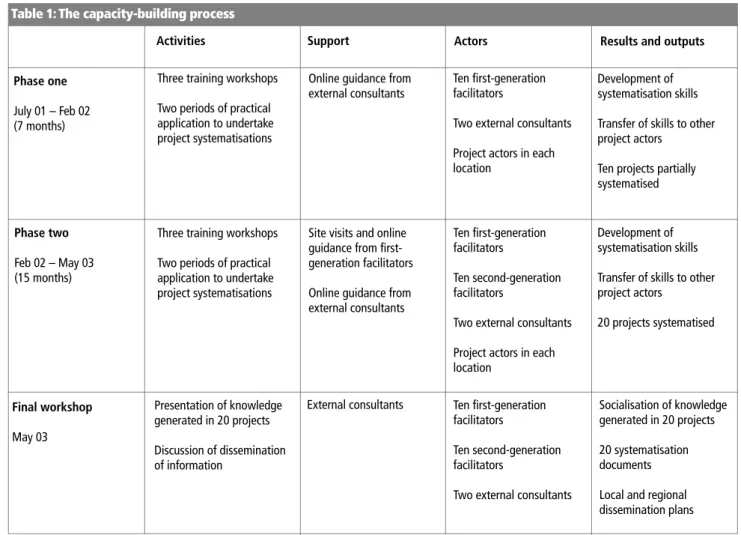
We used a two-phase process to build capacity and under-take the project systematisations (Table 1).
In phase one, ten facilitators were trained by two exter-nal consultants with expertise in systematisation and social communications. An action-learning approach was used, combining three face-to-face workshops with periods of three to four months of practical application. The first work-shop presented the concepts and methodological
Table 1: The capacity-building process
Phase one
July 01 – Feb 02 (7 months)
Three training workshops
Two periods of practical application to undertake project systematisations
Three training workshops
Two periods of practical application to undertake project systematisations
Presentation of knowledge generated in 20 projects
Discussion of dissemination of information
External consultants Site visits and online guidance from first-generation facilitators
Online guidance from external consultants Online guidance from external consultants
Phase two
Feb 02 – May 03 (15 months)
Final workshop
May 03
Development of systematisation skills
Transfer of skills to other project actors
Ten projects partially systematised Ten first-generation
facilitators
Two external consultants
Project actors in each location
Ten first-generation facilitators
Ten second-generation facilitators
Two external consultants
Project actors in each location
Development of systematisation skills
Transfer of skills to other project actors
20 projects systematised
Socialisation of knowledge generated in 20 projects
20 systematisation documents
Local and regional dissemination plans Ten first-generation
facilitators
Ten second-generation facilitators
Two external consultants
Actors Support
GENERAL
SECTION
approaches of systematisation and considered how the infor-mation generated could be used. The second workshop reviewed progress in how the methodology was applied. This helped to equip facilitators to deal with difficulties they had encountered, and provided further input on information analysis, documentation and dissemination. The third work-shop reflected on the facilitators’ experiences. It prepared them to replicate the methodology with a second set of proj-ects. The external consultants supported the facilitators with online guidance during the application periods. This phase lasted for seven months.
In phase two, a further ten facilitators were trained by both the external consultants and the first generation of facil-itators. Again, they used an action-learning approach. The first workshop was for all 20 facilitators. They discussed the systematisation methodology and planned how to replicate it
in the second set of projects. The second and third workshops reviewed progress and discussed difficulties, and continued to think about dissemination strategies. The first generation assisted the second generation of facilitators through site visits and online support. The external consultants were also avail-able to provide online support throughout this second phase. Next, a prolonged nine-month application period allowed all the facilitators to complete their project systematisations. This phase lasted for 15 months.
A final workshop was held to present and discuss the knowledge generated in each of the 20 projects and to plan local and regional dissemination strategies.
Methods used in project systematisations
Each facilitator formed a core local research team of three to five people, generally composed of NGO staff. The facilita-Huancayao, Peru
Photo:
German Hilar
e
GENERAL
SECTION
tors shared knowledge acquired in the workshops. Then the teams drew up basic work plans. The plans varied consider-ably, according to local conditions and objectives, but usually contained nine basic steps:
Step 1: outreach to project actors – farmers, community groups, local leaders, extension workers, local politicians, NGO staff etc. – to explain the concept and purposes of the systematisation and motivate people to get involved.
Step 2: selecting a particular theme or work to systematise (e.g. rural micro-finance, nutrition programme, rural educa-tion programme) to keep the exercise focused and manage-able.
Step 3: formulating basic questions for the systematisation to address. These questions should be about:
• reconstructing the original project idea (theoretical frame-work, principles and strategies);
• problems and challenges encountered in translating the idea into practice;
• what actions were taken and their degree of success in achieving the original idea; and
• rethinking the idea based on what had happened.
Step 4: using a variety of participatory exercises and tech-niques to reflect upon and interpret the meaning of actions
and experiences. Methods included open discussions and other classic ‘participatory’ visualisation techniques (brain-storming, mapping, timelines, flow diagrams, calendars etc.) in community forums, focus groups, and individual inter-views. A desk review of relevant documentation was often also done.
Step 5: the core team do a first-level analysis of the informa-tion. Organising and analysing large amounts of information meant:
• classifying it into relevant themes or categories; • reducing and synthesising;
• analysing and interpreting; and • drawing lessons and conclusions.
Step 6: discussing the analysis with project actors to get their reactions and further insights.
Step 7: the core team do a second-level analysis on the basis of participants’ reactions, and prepare a written document containing the systematised information.
Step 8: a written document is presented to project actors. Then the knowledge and learning generated is used to refine strategies and plan new actions at the community level.
Step 9: communication and dissemination plans are designed to share information with other audiences accord-ing to community and NGO change objectives.
Box 1 summarises the approaches used by APAEB and CEPROM.
Local and regional outcomes: towards policy change
At the local level there were a number of tangible outcomes: • Communities and organisations gained sociallyconstructed knowledge and recognition of what worked (and what didn’t) in their projects. This gave them renewed motivation to act based on their learning.
• Lessons learnt were documented from the 20 projects. This can be used as a database from which to draw infor-mation for specific audiences.
• A body of trained facilitators now exists, able to institu-tionalise action-learning-oriented methodologies by build-ing systematisation approaches into regular activities. They also gained enhanced capacity and confidence to articu-late their stories to other audiences.
The APAEB and CEPROM teams both devised ways to build
systematisation activities into regular community meetings and events, minimising the extra time and effort required of community residents.
The APAEB team made the ambitious choice to systematise three lines of work: rural micro-finance, technical assistance and the Family Agriculture School. One of its central concerns was to include the widest possible variety of perspectives and opinions. This included all age groups, from young people to the elderly, students and parents, and women of all positions. To do so, they employed a broad array of methods suited to different participants.
The core CEPROM team consisted of three NGO staff. It was augmented by 30 women from the communities, who were directly involved in outreach activities, formulating key questions, and facilitating participatory activities with their peers to reflect upon project experiences. The core team was responsible for analysis and writing up results. The involvement of the local women was crucial to engaging the local population: the women explained the concepts, purposes and practical steps of the systematisation in their own words, eliminating technical terms, and illustrating their points with analogies from their everyday lives.
GENERAL
SECTION
• There is increased awareness of the potential of policy change as an instrument to improve livelihoods.
Some of the communities and NGOs have successfully used the knowledge and learning generated to:
• influence public policies and practices that condition local food security;
• improve rural livelihoods by institutionalising their project approaches;
• appropriate public resources for their initiatives; and/or • scale-up experiences to cover broader geographical areas.
Box 2 gives some examples from APAEB and CEPROM.
At regional level, the process culminated in a group of leaders with a collective vision for the future of the region in terms of local food security and sustainable development. They have an enhanced capacity to articulate their vision and experience to wider audiences. The group undertook a further exercise to elaborate a ‘regional synthesis’ of the knowledge generated at local level. This resulted in more generalised, regionally relevant principles and lessons for general use across diverse contexts (RedLayc, 2004a). They also prepared a methodological guide to project systemati-sation (RedLayc, 2004b). Establishing a region-wide network, RedLayc, to promote conditions favourable to local food security was a direct outcome of the regional vision of this group and of its members’ recognition of the power of collective – rather than isolated – efforts.2The network
provides support for local and national-level initiatives to promote policy change.
Power dynamics and the politics of participation
The systematisation process was sponsored and funded by the Kellogg Foundation. This created the potential to impose demands on NGOs largely dependent on external funding. But NGO leaders welcomed it as a way to continue to learn together and generate impact beyond the local level. The Foundation made it clear that participation was voluntary,The systematisation process allowed APAEB staff and community participants to recognise what they had achieved. This increased their confidence to continue to disseminate innovative approaches. Key elements of their micro-finance and technical assistance programmes have been incorporated into national policies to strengthen small-scale farming in semi-arid regions. APAEB also participates in a government-sponsored network for technical assistance in the north-east of Brazil. The federal government now channels some of its resources to develop technical assistance suited to the agro-ecological conditions of the semi-arid north-east through APAEB. Technical assistance has increased and improved. So has the availability of federal microfinance. These factors have allowed small-scale producers to increase and diversify food production, improving local food security through subsistence and supply to local markets. In addition, the systematisation process awakened participants’ awareness of the importance of public policy as an instrument for local change – and the shortcomings in existing public policy. They have since invested in preparing their own community leaders to lobby local political offices.
CEPROM staff witnessed improvements in local people’s capacity to question how things happen, formulate new proposals, express themselves in verbal and written format, and manage information and communications. These skills have brought greater confidence – particularly amongst women and youth – to speak out about their experiences and opinions in public forums, including district-level negotiations to formulate local public policies. CEPROM has become well known for its expertise in small-scale rural agro-industrial development. Its members participate in the Regional Agro-industry Board and are frequently consulted about the government’s National Agro-industry Plan and the National Programme for Water Basin Management. The municipal government has used information from CEPROM’s systematisation to promote its own rural community-based micro-businesses with innovative approaches to technical assistance and technology transfer. It now funds rural youth job skills training in a CEPROM-run training centre. Adopting CEPROM’s approaches in local and national policies and practice has ensured that such approaches have spread beyond the original geographical scope covered by CEPROM. This has allowed more small-scale producers to experience the benefits of agro-industrial development, such as: • the value added to food products;
• the diversified use of food products; • nutritional improvements;
• the generation of additional incomes; and
• using incomes to invest in health, education, and other welfare goods.
Box 2: Local outcomes: APAEB and CEPROM
“At regional level, the process
culminated in a group of leaders with a
collective vision for the future of the
region, in terms of local food security
and sustainable development.”
2Red Latinoamericana y del Caribe de Seguridad Alimentaria y Desarrollo
GENERAL
SECTION
APAEB/Valente: Group celebration to mark the end of one phase of the systematisation process, Valente, Bahia, Brazil
Photo:
V
ir
g
inia Ar
aújo
and that systematisation results would not influence future funding since none would be available for the projects. Most participants understood that the benefits of participation lay in the potential to create broader impacts based on their project experiences. However, a few had hoped that partici-pation might bring future funding, approaching the exercise as a necessary additional burden rather than an opportunity to generate learning for their own ends. This is an unfortu-nate consequence of the inequitable power relations between funders and NGOs.
There is no denying that the systematisation process was initially imposed on communities by NGOs. They needed to discuss the purposes and process of systematisation at
GENERAL
SECTION
APAEB was a second-generation project. Staff were quick to recognise the benefits of the systematisation explained to them by the first generation facilitator assigned to their project. CEPROM was one of the first generation projects. Its staff had hired an external facilitator to systematise and document project experiences in 1998. But it had reaped none of the potential learning outcomes associated with the methodology, given the non-participatory nature of the exercise. So its staff were glad of the opportunity to learn how to undertake a participatory systematisation themselves.
Both APAEB and CEPROM staff created a fairly good balance between their own participation and that of community members. They involved a number of interested community residents to facilitate
systematisation activities. These community-based facilitators used home visits and individual interviews to incorporate the voices of residents who did not appear in community forums, because they did not have the time or energy, or because they did not feel comfortable voicing their opinions in public.
Box 3: Power dynamics experienced in APAEB and CEPROM
own goals.
Internal inequities in the community also impacted the outcomes of the systematisation process. The perspectives of those community members who could be present at community and group events or in interviews – and had the confidence to voice their opinions – shaped the knowledge generated. The voices of the most marginalised sectors of the community – some women and ethnic groups, the poorest – may have remained unheard, even though facili-tators took efforts to include their perspectives.
Some last reflections on the process
We believe a number of factors contributed to the success of the process. The two-phase training process and the action-learning approach were effective in preparing well-trained facilitators able to motivate partic-ipation and keep sight of the central concept and purposes of the systematisation. The first generation facilitators’ roles in preparing the second generation rein-forced their own learning, and the second generation benefited from the fresh experience of the first in learn-ing and applylearn-ing the approach. The transfer of learnlearn-ing to others in each location ensured that skills, and the workload, were shared. Rather than using a uniform approach, the context-specific adaptation of the method-ology allowed facilitators to take into account local socio-political inequities. This increased the chances of local ownership and sustainability of the methodology.
Anyone thinking of embarking on a systematisation process should be aware of the inherent challenges. The
most important challenges that we faced were:
• Reflection, orderly analysis and written documentation are not everyone’s ‘thing’ in terms of interest or ability. This is especially true in the fast-moving, practice-oriented worlds of development practitioners and community leaders. It was important to bring together people who were inter-ested in, and had the capacity to develop, these kinds of skills.
• The systematisation was sometimes confounded with eval-uation approaches. This led to overly mechanical methods to collect data and focus on a tangible product– a written document – rather than the more important processof the social construction of knowledge. Much effort was needed to clarify the purpose and concepts of systematisation. • Collectively reconstructing and interpreting activities can
generate conflict about the meaning of past and present events, as well as the priorities for future actions, in communities and organisations. Facilitators needed adequate preparation to handle potential conflict. • The quality of participation in each location affected the
quality of the outcomes – collective learning, dissemina-tion strategies and products, and policy change. It depended largely on each facilitator’s ability to explain the benefits of the process, as well as the strength of commu-nity-NGO relations and the history of local community organisation.
• Participatory approaches are not immune to local social and political inequities. It was important to ask questions at every stage. Who was setting the agenda? Who was benefiting from the process? Who was bearing the costs of participation (time, energy and financial)?
• Inherent power inequities between funder and recipients needed to be addressed explicitly. For instance, by clarify-ing the terms and conditions of the exercise, in order to minimise their impact on the process, outcomes and long-term sustainability of the effort.
• Institutionalising reflection and systematisation approaches in everyday organisational practices was usually low prior-ity, as ‘one more thing to be done’, until the benefits of such approaches were clearly recognised.
Conclusion
GENERAL
SECTION
CONTACT DETAILS
Frances Hansford Adviser to RedLayc 162 Kingston Road Oxford
OX2 6RP UK
Tel: +44 1865 559252
Email: [email protected]
Virginia Araújo Lima Santana
Associação de Desenvolvimento Sustentável e Solidário da Região Sisaleira (APAEB) Rua Duque de Caxias, 78 – Centro, CEP 48890-000
Valente-BA Brazil
Tel: +55 75 3263 2181 Email: [email protected]
Gérman Hilares Reinoso
Centro de Promoción de la Mujer y el Desarrollo (CEPROM)
Alfonso Ugarte 293, 2do. Piso, El Tambo Huancayo
Perú
Tel/fax: +51 64 24 1880 Email: [email protected]
NOTES
See also page 56 (Tips for trainers): ‘Reflective learning: building capacity in systematisation methodologies’.
REFERENCES
APAEB (2003) Sistematização da Experiência da Associação dos Pequenos Agricultores do Município de Valente* (APAEB).
Desenvolvimento Rural Sustentável e Solidário: Estudo das Experiências de Assistência Técnica e Extensão Rural, Credito Rural e Escola Família Agrícola. Valente, Bahia, Brasil. Março 2003. * the Association changed its name after the systematisation document was completed
CEPROM (2003) Procesamiento de Cereales y Granos Andinos, Nutrición y Alimentación en Comunidades Campesinas del Valle del Mantaro.Huancayo, Perú.
RedLayc (2004a). Rompiendo Barreras. Sistematización de la Iniciativa de Nutrición Humana. Un ejercicio de aprendizaje en un conjunto de proyectos sociales en América Latina y El Caribe.Red Latinoamericana y del Caribe para Seguridad Alimentaría y Desarrollo Sustentable, RedLayc. Julio de 2004.
RedLayc, (2004b) Metodologia de Sistematización.
To obtain copies of these documents and examples of other project systematisations, please see the RedLayc website: