Multi-Expert Multi-Criteria Decision Support Model for
Traffic Control
Sergio Gramajo
Artificial Intelligence Research Group. National Technological University, (3500) Resistencia Argentina, [email protected]
Abstract. The common use of IP networking structures implies the increasing demand of resources by users and applications. For this reason, organizations must guarantee adequate conditions for critical traffic. To face this problem, network administrators constantly need to make decisions regarding this situation by means of using different strategies and tools of Quality of Service (QoS), such as Traffic Control (TC). Such decisions can be modeled by a decision support system that handles subjective information about decision maker’s perceptions. This information involves uncertainty and requires precise evaluation of traffic quality demanded. Subjectivity is modeled by using linguistic information (LI) in order to choose adequate solution to networking performance problems. This paper proposes a Multi-Expert (ME) Multi-Criteria (MC) Linguistic Decision Making (LDM) Model for TC in networking. Finally, an application example to show the model’s benefits is presented.
Keywords: Multi-Expert Multi-Criteria Decision Making, Linguistic Information, Traffic Control.
1
Introduction
Decision Support Systems (DSS) are used in order to help the decision maker and they provide more confidence during the DM process [4][5][6]. Although DSS currently require strong computational component, the development and implementation of mathematical models are still the key to success of such systems. This means it is of significant importance that the DSS are based on robust models to control the relevant variables in the DM process. Thus, quantitative models have had great importance in the development of DSS providing results that the decision maker can easily interpret.
In this way, the Fuzzy Linguistic Approach [7] based on Fuzzy Sets Theory [8] is a useful technique for DM. They provide a powerful framework that allows easy representation through Linguistic Information and it uses solid mathematical structure to determine their relative importance. The decision maker establishes his/her preferences by using linguistic labels. These labels are word expressed in natural language. Then, with the collected information the best alternative (problem solution) is computed. In this work, a ME MC DM model based on LI is proposed. In Section 2 QoS fundamentals and LI background are explained. The scenario for simulations is described in Section 3. The proposal model is explained in Section 4. Simulation and results are shown in Section 5 and Conclusions are exposed in Section 6.
2
QoS and Linguistic Information
2.1 Quality of Service
QoS involves a set of techniques for improvement of the computer network traffic. Basically, the main goal of QoS is to maximize the use of networking resources for all users and to obtain the best network traffic performance. QoS consists of a set of tools used to administrate network resources.
Currently IP-based networks use best-effort service. It implies that the traffic is processed as soon as possible, but there is no guarantee of satisfaction of process conditions in the network[9]. This situation, added to growing demand of network resources, requires more confidence for traffic conditions and adequate use of the mentioned resources [10]. Furthermore, there are critical apps that need to ensure a minimum of network resources in order to function correctly. Diverse QoS models are being proposed in order to ensure more traffic confidence, i.e. they provide tools for facing problems like transmission delay, loss of packages, bandwidth management, and content quality [11][12]. The most important standardized techniques are
network architectures and their implementation depends on the necessities of the organization. However, its implementation is not easy task because it requires deep knowledge and network architecture analysis. It is a high complexity activity that needs different administrators` points of view. In this context it is desirable to implement a Multi-Expert Decision Making process based on Linguistic Information that helps network’s administrators to decide among available configuration options.
2.2 Linguistic Information
The heterogeneous nature of the experts who express their preferences about networking resources; the complexity in terms of multiplicity of services, applications and networking users working together; and information subjectivity provided by the experts demand information modeling tools able to handle these aspects simultaneously. Thus, the use of LI, and some of its extensions such as Computing with Words (CW) [16] help to manage the information to solve this problem.
The proposal introduced in this paper to manage uncertain information uses 2-tuple linguistic representation model that is briefly reviewed below. The 2-tuple Fuzzy Linguistic Representation Model was presented in [17], for overcoming the drawback of the loss of information presented by the classical linguistic computational models [18]. It is based on the symbolic method and takes the concept of Symbolic Translation as the base of its representation.
Definition 1. The Symbolic Translation of a linguistic term = { , … , } is a numerical value assessed in [-0.5, 0.5) that supports the “difference of information” between an amount of information [0, ] and the closest value in {0, … , } that indicates the index of the closest linguistic term in S, being [0, ] the interval of granularity of S. From this concept a new linguistic representation model is developed, which represents the linguistic information by means of 2-tuples
s , α , s ϵ S y α ϵ [−0.5,0.5 . This model defines a set of functions between linguistic 2-tuples and numerical values.
Definition 2. Let be = , … , a linguistic term set and [0, ] a value supporting the result of a symbolic aggregation operation, then the 2-tuple that expresses the equivalent information to is obtained with the following function:
: [0, ] → × [−0.5,0.5
= , $ , %$ = − & $ [−0.5,0.5 & = '()*+ (1) where round(·) is the usual round operation, has the closest index label to “β” and “$” is the value of the symbolic translation. It is noteworthy that Δ is a one to one mapping and ∆/0: S × [−0.5,0.5 → [0, g] is defined as ∆/0 s , α = i + α. Thus, a 2-tuple is identified by means of a numeric value in the interval [0, g].
The transformation of a linguistic term into a linguistic 2-tuples consists of adding value 0 as symbolic translation: s ϵ S ⇒ s , 0 . This model has a linguistic computational technique associated. For further detailed description see [17].
Nothing VeryLow Low Medium High VeryHigh Perfect (Medium, 0.25)
Fig. 1. A 2-tuple Linguistic Representation Model.
3
Application Scenario
To probe the proposed model an analysis of a State Agency that manages water resources is performed. The Agency tasks include projects, works, water resources regulation, monitoring, emergency aid for flood and drought, and more.
To perform these functions, the main building has a networking environment that connects all areas of the organization. The existing data network has approximately 300 devices (PCs, notebooks, printers, IP cameras, and smartphones) that use their own local network and Internet (see Fig. 2).
Fig. 2. Application Scenario.
From their activities network administrators have identified different types of traffic on the network. These traffic types correspond to all areas in the organization (basically, employees’ daily functions), and they are:
• T1. Centralized documentation system. Used by all provincial agencies.
• T2. Financial Accounting System. Centralized system used by all provincial agencies for account management, auditing, payments and more.
• T3. E-Government.
• T4. Centralized Human Resources System.
• T5. E-Mails.
• T6. Web browsing.
• T7. Social Networks and Messaging.
• T8. Geographic Information System (GIS).
When the performance of some critical services is affected by other non-critical services, the productivity of the organism is reduced. Suppose that one particular situation to be solved is happening now:
• It is the last week of the month.
[image:4.595.143.455.374.459.2]• The salary of employees is being paid.
• It is also necessary to pay a variety of providers.
• It is important to note that the main building is far away from the city center so communication systems are very useful in times of emergency.
In order to determine the adequate network parameter for improving QoS at this situation, a ME MC LDM Model is proposed (section4) and tested (section 5).
4
Linguistic Decision Support Model for Traffic Control
This model uses criteria which are ToT defined by network managers, but unlike the model used in [19], alternatives are defined previously. Although this definition process requires higher-level analysis, it reduces the number of possible actions to perform. The basic idea is to define all possible network states and link them to specific network configurations, i.e. characteristic network situations (and their adequate configuration) must be identified by network administrators. For example, under normal conditions, priorities for critical and non-critical traffic must be assigned to, consequently, establish adequate network parameters (by using configuration scripts [14]). This analysis is repeated for each possible network state.
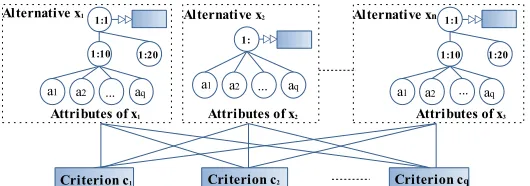
[image:5.595.167.432.414.507.2]When network administrator modifies the priorities of ToT, he/she creates a current network state that is compared to each previous-defined state. The previously defined closest state is selected and used to set-up network parameters.
Fig. 3. Relationship between Criteria, Attributes and Alternatives in CT.
Fig. 1 shows a generic model schema using the TC hierarchical structures [14]. Thus, each alternative is a specific network configuration defined by 7 attributes expressed in Triangular Fuzzy Numbers (TFN). These numbers indicate the QoS for each ToT identified previously and each
8
9 is related to one criterion:
;. Therefore, to formalize the solution of the problem, it proposes a model with 2 phases:Phase 1. LDM for Alternatives-Creation Process
Thus, the selection and assessment processes for each alternative and its attributes is based on a ME-MC LDM process in which each expert expresses his/her opinion to build each alternative. It consists of four steps:
p1.1) Object Identification. This phase involves preliminary studies about relevant network services and consists of identifying the following objects to DM process:
• A finite set of experts or network administrators, E={e1,e2,…,en}.
• Structure and representation of the LI used by experts, i.e. the linguistics term set with its semantic and syntax, @= { , 0, … , A/0} .
• Identification of useful network services and network applications, i.e. ToT (attributes), B = 80, 8C, … , DE .
• Identification of alternatives set F = {G0, GC, … , GH}, i.e. network states.
p1.2) Information Gathering. Once the evaluation framework has been done, the experts provide their opinions by indicating the QoS desired regarding each attribute on each alternative by means of a linguistic preference vector,I.
Let I9= J90, J9C, … , J9E, ; & = 1, … *; ; = 1, … , 7 be a vector of preferences given by the expert D regarding G9about the attribute 8L and J9L∈ @.
p1.3) CW process. Here a global assessment for each alternative is computed. This process is made by aggregation of information. To obtain the global assessment for each alternative the information must transformed to 2-tuple linguistic representation model. Here Weighted Average Aggregation operator over 2-tuples [17] is used. Definition 3.Weighted Average Operator (WAO). Be G = { '0, $0 , … , 'N, $N } a 2-tuple linguistic set and O = {O0, … , ON} a numeric vector of weights. The WAO is computed by G̅Q:
G̅Q[ r
0, α0 , … , rS, αS ] = ∆ T∑ ∆ /0 S
V0 r , α . w
∑ wS
V0 X = ∆ T
∑ βS V0 . w
∑ wS
V0 X (2)
p1.4) Expressing results. In this step the results are expressed into an alternatives matrix, Y, with its global assessment in Triangular Fuzzy Number.
Y = Z [0
0, \ 0 0, '
00 … [E0, \E0, 'E0
… … …
[0H, \0H, '0H … [EH, \EH, 'EH
] (3)
Where [L9, \L9, 'L9 is a global value of the attribute ^ corresponding to the alternative
; expressed in TFN.
Phase 2. LDM for Traffic Control Process.
Once the alternative matrix is built, then it must determine the best alternative for described situation in the organization. Therefore, to carry out this idea it proposes a model that consists of four steps:
p2.1) Object Identification. Just like in phase 1 the framework consists of:
• A finite set of experts or network administrators, _ = {D0, DC, … , DN}.
• Identification of a finite set of criteria, ` = :0, :C, … , DE , according to ToT identified to be valued by experts.
Ja ∈ N A. Being * b the granularity of the linguistic terms set used by experts,
D, to express their preferences regarding the criterion :a ∈ `.
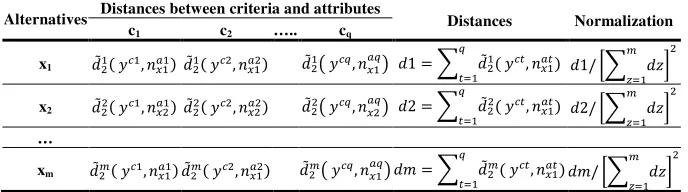
p2.2) Information Gathering. This phase gathers the linguistic assessments in linguistic vectors provided by the experts. Here, each expert will provide their opinions about the QoS desired regarding each criterion (ToT) by means of a linguistic preference vector,I. Let Ia = J0, JC, … , JE, ; & = 1, … , *; ℎ = 1, … , 7 be a vector of preferences given by the expert D about the criterion :a and Ja ∈ N A. p2.3) CW process. Here a QoS global assessment for each alternative is computed. This step is carried out with two processes. Initially, the linguistic aggregation process (as above) to calculate the collective assessment for each criterion is made. Then, the distance between each alternative’s attribute, expressed in TFN according to the matrix obtained, and collective assessment of each criteria is computed. It is noteworthy that each attribute has a criterion related, i.e. if there exists a criterion called “video”, it must have an attribute in each alternative that is “video” with its TFN value. In this way it is possible to calculate the distances to obtain the global value of QoS for each alternative (using the Minkowski Euclidean distance)
Definition 4. Let de = d0, dC, df , *e = *0, *C, *f two TFN, the Minkowski distance is defined as follows:
+gh de, *e = ij13k |d0− *0|h + |dC− *C|h + |df− *f|h m
(4)
[image:7.595.123.467.449.545.2]where n ≥ 1 is a distance parameter. If n = 2 is the Euclidean distance. Finally, it obtains the results table as follows:
Table 1. Results Table
Alternatives Distances between criteria and attributes Distances Normalization
c1 c2 ….. cq
x1 +gC0 dp0, *q0r0 +gC0 dpC, *rCq0 +gC0s dpE, *q0rEt +1 = u +gC0 dpA, *q0rA E
AV0 +1/ wu +x
H
yV0 z
C
x2 +gCC dp0, *qCr0 +gCC dpC, *rCqC +gCCs dpE, *qCrEt +2 = u +gCC dpA, *q0rA E
AV0 +2/ wu +x
H
yV0 z
C
…
xm +gCH dp0,*q0r0 +gCH dpC,*rCq0 +gCHs dpE, *q0rEt+\ = u +gCH dpA, *q0rA E
AV0 +\/ wu +x
H
yV0 z
C
Where +gC9{ d:ℎ,*G;8^| the distance between the criterion :a and its related attribute
8L of the alternative G9. +; is the QoS global assessment for the alternative G9. p2.4) Expressing results. In order to improve understanding, the final results are ordered according to the normalized utility for each alternative.
5
Simulations and Results
set. @= { = VL = Very Low 0,0, .25 , 0= L = Low 0, .25, .5 , C= M =
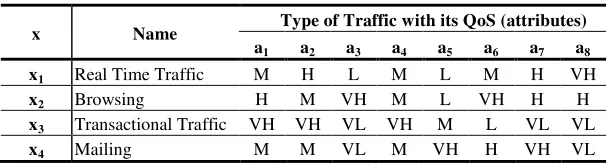
[image:8.595.146.452.250.332.2]Medium . 25, .5, .75 , f= H = High . 5, .75,1 , ‡= Very High .75,1,1 } For this case a single decision maker has participated. Therefore, it directly obtains alternatives matrix (see Table 1). Then, Phase 2 is made. According to the situation described in Section 3, it is necessary that experts express their opinions about the ToT (criteria) to select the alternative that best suits the situation. To accomplish this, it follows the process according to the following steps:
Table 2. Alternatives Matrix.
x Name Type of Traffic with its QoS (attributes) a1 a2 a3 a4 a5 a6 a7 a8
x1 Real Time Traffic M H L M L M H VH
x2 Browsing H M VH M L VH H H
x3 Transactional Traffic VH VH VL VH M L VL VL
x4 Mailing M M VL M VH H VH VL
p2.1) Object Identification. This step shows the results with two experts (network administrators) who know or work transversally in the organization, _ = {D0, DC}. They use a set of seven linguistic labels whose syntax and semantics is the following:
N A{ = VL = Very Low 0,0, .17 ,
0= L = Low 0, .17, .33 , C= MoL
= ModerateLow . 17, .33, .5 , sf= M = Medium . 33, .5, .67 , ‹= MoH
= ModerateHigh . 5, .67, .83 , s‡= H = High . 67, .83,1 , •= VH = Very High .83,1,1 } The criteria set ` = {:0, :C, :f, :‹, :‡, :•, :Ž, :•}
[image:8.595.149.447.479.535.2]p2.2) Information Gathering. To achieve this, the decision process involves multiple experts that can interpret which criteria (ToT) are the most or the least important using LI according to the conditions above (see Table 3).
Table 3. Information Gathering.
Experts Criteria: Type of Traffic
c1 c2 c3 c4 c5 c6 c7 c8
e1 A A M MA M M B B
e2 MoB MoA B MA A M M MB
p2.3) CW process. Here the QoS global assessment for each alternative is computed. Due to the fact that the gathered information is assessed in linguistic terms, this step is carried out in three processes. Initially the linguistic information is transformed to 2-tuple linguistic representation model (see Table 4). Then, the information aggregation process is made to obtain the collective assessment for each criterion using WAO over 2-tuple (see Eq. (2)) and the results are shown in Table 5. It uses w = 0.4; 0.6 .
Table 4. Information Gathering in 2-tuple.
c1 c2 c3 c4 c5 c6 c7 c8
e1 ‡Ž, 0 ‡Ž, 0 fŽ, 0 •Ž, 0 fŽ, 0 fŽ, 0 0Ž, 0 0Ž, 0
Table 5. Collective Criteria in 2-tuple.
c1 c2 c3 c4 c5 c6 c7 c8
Collective criteria s‹Ž, −.2 s‡Ž, −,4 sCŽ, .2 s•Ž, 0 s‹Ž, −.2 sfŽ, 0 sCŽ, −,2 s0Ž, −.4
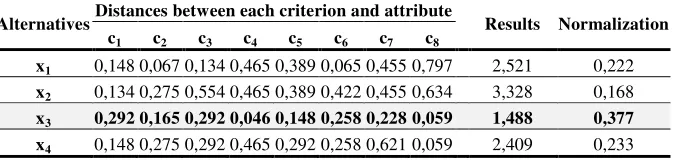
Finally, Fuzzy Distance Computing between TFN is carried out. To do this, the distance between each alternative’s attribute (Table 2), expressed in TFN, and collective assessment of each criteria (Table 5) is computed (Table 6).
Table 6. Results Table
Alternatives Distances between each criterion and attribute Results Normalization c1 c2 c3 c4 c5 c6 c7 c8
x1 0,148 0,067 0,134 0,465 0,389 0,065 0,455 0,797 2,521 0,222 x2 0,134 0,275 0,554 0,465 0,389 0,422 0,455 0,634 3,328 0,168 x3 0,292 0,165 0,292 0,046 0,148 0,258 0,228 0,059 1,488 0,377 x4 0,148 0,275 0,292 0,465 0,292 0,258 0,621 0,059 2,409 0,233
p2.4) Expressing results. In this case, to face the situation described in section 3, it can be observed that Alternative 3 (Transactional Traffic) is the winner (utility value: 0,377). Then alternatives 4(Mailing) and 1(Real Time Traffic) appear with a very similar utility and finally Alternative 2(Browsing).
To finish this proposal, it is only indicated that it can be extended to support multiple linguistic scales [20]. Therefore, the steps p1.1 and p2.1 should adjust its structure and representation of information. This allows higher flexibility of expression.
6
Conclusions
In this paper it has been presented a Multi Expert Multi Criteria Decision Making model based on the fuzzy linguistic approach that facilitates the network administrators to define the states of networks (phase 1) and choose the best state according to particular situation of the organization (phase 2). The main advantage of this model is the continuous control of the possible network configurations. In addition, for traffic congestion situations, the network is always evolving to well-known states. This allows to maintain the adequate performance and safety levels over network traffic. Furthermore, the use of IL provides the experts with a tool for using natural language words allowing to dissociate them from the complexity of implementing QoS systems.
Finally, it should be remarked that the QoS mechanisms (like TC) suggested in this paper allow the development of distributed architectures based on DM for QoS. They stabilize the system very quickly and in an interactive way.
[image:9.595.127.464.262.342.2]References
1. Simon, H.A.: The New Science of Management Decision. Harper and Brothers, New York (1960)
2. French, S.: Decision Theory: An Introduction to the Mathematics of Rationality. Ellis Horwood, Chichester, England (1986)
3. Miller, G.A.: The Magical Number Seven, Plus or Minus Two: Some Limits on Our Capacity for Information Processing. Psychological Review 63, 81-97 (1956)
4. Shim, Warkentin, J.P., Courtney, M., Power, J.F., Sharda, D.J., Carlsson, R., Porcel, C., Herrera-Viedma, E.: Past, Present, and Future of Decision Support Technology. Decision Support Systems 33, 111-126 (2002)
5. Holsapple, C.W.: Decision Support Systems. Encyclopedia of Information Systems
6. Power, Sharda, D.J., Braden, R., Shenker, D.C.a.S.: Decision support systems. Springer Handbook of Automation (2009)
7. Zadeh, L.: The concept of a linguistic variable and its application to approximate reasoning. Part I, Part II and Part III. Information Sciences 199–249,301–357,143–180 (1975) 8. Zadeh, L.A.: Fuzzy sets. Information and Control 8, 338-353 (1965)
9. Campbell, A., Aurrecoechea, C., Hauw, L.: A review of QoS architectures. ACM Multimedia Systems Journal 6, 138-151 (1996)
10. Gheorghe, L.: Designing and Implementing Linux Firewalls with QoS using netfilter, iproute2, NAT and L7-filter. Packt Publishing, Birmingham, UK (2006)
11. Szigeti, T., Hattingh, C.: End-to-End QoS Network Design: Quality of Service in LANs, WANs, and VPNs. Cisco Press, Indianapolis (2004)
12. Vegesna, S.: IP Quality of Service. Cisco Press, Indianapolis (2001)
13. Evans, J., Filsfils, C.: Deploying IP and MPLS QOS for Multiservice Networks. Theory and Practice. Elservier (2007)
14. Gheorghe, L.: Designing and Implementing Linux Firewalls with QoS using netfilter, iproute2, NAT and L7-filter. Packt Publishing, Birmingham, UK (2006)
15. Hubert, B., Graf, T., Maxwell, G., Mook, V., R., Oosterhout, V., R., Schroeder, P., Spaans, Larroy, J.a., P: Linux Advanced Routing and Traffic Control How-to. Technical Report (2003)
16. Martínez, L., Ruan, D., Herrera, F.: Computing with Words in Decision support Systems: An overview on Models and Applications. International Journal of Computational Intelligence Systems (IJCIS) 3, 382-395 (2010)
17. Herrera, F., Martínez, L.: A 2-tuple Fuzzy Linguistic Representation Model for Computing with Words. IEEE Transactions on Fuzzy Systems 8, 746-752 (2000)
18. Herrera, F., Martínez, L.: The 2-tuple Linguistic Computational Model, Adventages of its linguistic description, accuracy and consistency. Int.J. of Uncertainly, Fuzziness and Knowledge-Based Systems 9, 33-48 (2001)
19. Gramajo, S., Martínez, L.: A linguistic decision support model for QoS priorities in networking. Knowledge-Based Systems 32, 65-75 (2012)