UNIVERSIDAD TECNICA PARTICULAR DE LOJA
La Universidad Católica de Loja
ÁREA SOCIO HUMANÍSTICA
TITULACIÓN DE LICENCIADO EN CIENCIAS DE LA EDUACIÓN
MENCIÓN INGLÉS
Teachers and students’ perceptions of teaching English in small classes in
Ecuador
TRABAJO DE FIN DE TITULACIÓN
AUTOR: Silva Acosta, María Augusta
DIRECTOR: Quiñónez Beltrán, Ana Lucía, Dra.
ii
APROBACIÓN DEL DIRECTOR DEL TRABAJO DE FIN DE TITULACIÓN
Doctora:
Ana Lucía Quiñonez Beltrán. DOCENTE DE LA TITULACIÓN
De mi consideración:
El trabajo de fin de titulación: Teachers and students’ perceptions of teaching English in small classes in Ecuador, realizado por Silva Acosta María Augusta, ha sido revisado durante su ejecución, por cuanto se aprueba la presentación del mismo.
Loja, febrero de 2015
iii
DECLARACION DE AUTORIA Y CESIÓN DE DERECHOS
“Yo, Silva Acosta María Augusta declaro ser autora del presente trabajo de fin de
titulación Teachers and students’ perceptions of teaching English in small classes in
Ecuador, de la Titulación de Ciencias de la Educación mención Inglés, siendo la Dra. Ana Lucía Quiñónez directora del presente trabajo; y eximo expresamente a la Universidad Técnica Particular de Loja y a sus representantes legales de posibles reclamos o acciones legales. Además certifico que las ideas, conceptos, procedimientos y resultados vertidos en el presente trabajo investigativo, son de mi exclusiva responsabilidad.
Adicionalmente, declaro conocer y aceptar la disposición del Art. 67 del Estatuto Orgánico de la Universidad Técnica Particular de Loja que en su parte pertinente textualmente dice: “ Forman parte del patrimonio de la Universidad la propiedad intelectual
de investigaciones, trabajos científicos o técnicos y tesis de grado que se realicen a través, o con el apoyo financiero, académico o institucional (operativo) de la Universidad”
f.
iv
DEDICATION
I dedicate my thesis to my son, Daniel and my daughter, Elisa, whose love and support are my strength in weakness times.
To my loving parents, whose words encourage me to continue steadfastly towards achieving my goals.
I also dedicate this thesis to my brother and his family who have supported me throughout the process.
I dedicate this work and give special thanks to the Universidad Técnica Particular de Loja for being there for me throughout the entire degree program.
v
ACKNOWLEDGMENT
I would like to express my deepest gratitude to my advisor, Dra. Ana Lucía Quiñónez, for her excellent guidance and patience. I would like to thank all the authorities from Centro Educativo Frau Klier, who allowed me to do the observations and practical classes and all the students that helped me to develop my research.
vi CONTENTS
COVER i
APROBACION DEL DIRECTOR DEL TRABAJO DE FIN DE TITULACION ii
DECLARACION DE LA TUTORIA Y CESION DE DERECHOS iii
DEDICACION iv
ACKNOWLEDGMENT v
CONTENTS vi
ABSTRACT 1
RESUMEN 2
INTRODUCTION 3
METHOD 6
DISCUSSION 8
Literature Review 8
Description, Analysis and Interpretation of Results 21
Conclusions 45
Recommendations 46
REFERENCES 47
1 ABSTRACT
The current study: “Teachers and students’ perceptions of teaching English in small
classes in Ecuador”, aims at finding possible benefits and limitations while teaching and learning English as a second language in small groups.
In order to carry out this research quantitative and qualitative methods were used; the instruments employed were the observation as well as teachers’ and students’ surveys. The analysis was based on questionnaires with 22 posed statements, they were handed out to 80 students aged between 11 and 15 years old from a private high school in Quito - Ecuador; likewise, five teachers, with more than eight years of experience on teaching in small classes. In addition, five classes were observed to gather the most relevant information regarding strategies and resources used by teachers and students’ feelings and perceptions towards these.
The findings demonstrate that learning and teaching English in small classes are beneficial for both, teachers and students, since they facilitate teachers to perform personalized
activities which improve students’ significant learning and the activities allow pupils to participate more frequently and actively.
2 RESUMEN
Este estudio: “Las percepciones de profesores y estudiantes respecto a estudiar en clases pequeñas”, tiene como objetivo encontrar posibles beneficios y limitaciones al enseñar y aprender inglés como segunda lengua en grupos pequeños.
En esta investigación los métodos cuantitativo y cualitativo fueron usados, los instrumentos fueron la observación y encuestas hechas a estudiantes y docentes. El análisis se realizó en base a cuestionarios con enunciados pre-establecidos que fueron entregados a 80 alumnos de entre 11 y 15 años de edad, de un colegio particular en Quito – Ecuador; asimismo, a cinco profesores con más de ocho años de experiencia enseñando inglés en clases pequeñas. Adicionalmente cinco clases fueron observadas para recopilar información relevante sobre estrategias usadas por profesores y las percepciones de los estudiantes frente a estas.
Los resultados encontrados en este estudio, demuestran que el aprendizaje y la enseñanza del idioma inglés en clases pequeñas es beneficioso para profesores y estudiantes, ya que facilitan al docente realizar actividades personalizadas que aseguran un aprendizaje significativo y las actividades desarrolladas permite a los estudiantes participar más frecuente y activamente.
3
INTRODUCTION
During the last two decades there has been a constant debate about the effects of class size on teaching and learning English as a foreign language, these deliberations have been the source to develop different kind of researches; regarding the relevance of this subject, the present study was carried out to know teachers and students’ perceptions of teaching and learning
English in small classes through these proposal research questions: What are the benefits of teaching and learning English in small classes?, What teaching strategies and resources benefit the teaching of English in small classes?, How do students feel about learning English in small classes?, Are there any limitations when teaching English in small classes?
Concerning small classes benefits, teaching small groups provides positive benefits for teachers and students, because small classes increase teacher – student interaction, also they offer better teaching and more effective learning; furthermore, students show more appreciation for one another and more willingness to participate.
According to Finn & Wang ( 2002), in small classes teachers can monitor each individual student and his/her learning progress; they also provide students with curricula that are relevant to them; the teachers are able to give students more appropriate feedback; in addition, the activities developed in small classes offer students a social comfort zone which is necessary for students’ autonomy
4
purpose of this study was to examine from the students’ perspective how small class size might
decrease language learning anxiety, which is an obstacle to second language acquisition. This
study shows that the students’ anxiety can be reduced in small classes. The pupils affirmed that small class size promotes a sense of security, besides they experienced more confidence at the moment of participating actively during class lessons because they felt safer when they talk. Moreover, the students’ performances reflected that studying in reduced class size strengthens self-confidence and weakens students’ fear of negative appraisement from their peers or teachers.
No limitations in this study were found
The same author (Harfitt, 2013) carried out a new study that examined the relationship between class size and pedagogical practices. The goal of this study was to identify pedagogical practices based on teachers working in large and small classes at the same level. This study affirms that important differences were noted in teacher-student interaction patterns such as, classroom organization, the establishment of classroom rules, the teachers’ use of humour, more group work and pair work, greater use of open questions and more individualization, as well as sustained periods of teacher interaction with individual students which involves challenging questioning and feedback. The author pointed out some limitations of his work, such as that with only four teachers it is difficult to generalize and on other hand, he suggested that more longitudinal studies must be undertaken in order to examine multiple teachers working in large and small classes over a longer period.
5
identified by Chinese rural teachers were, among others, that small classes are easier to manage and facilitate teaching effectiveness. On other hand, teachers find more straightforward to provide individualized help to students. The author did not make any note about limitations in his study.
The present research findings can benefit both teachers and students. It might shed some lights that can be taken in to account to enhance teaching and learning English as a second language.
The limitation of this current study is related to the sample size used to analyze this investigation as it is evident that the number of teachers and students surveyed is not representative and the data gathered was not sufficiently extensive to generalize. In order to have
6 METHOD
Setting and Participants
This study was carried out in Quito, Ecuador. The sample was taken from a private urban high school, where each class has less than 20 students. The participants in this study were 80 students with a high level of English, from five different classes, comprised one 7th grade of Basic Education, one 8th of Basic Education, one 9th of Basic Education, and two 10th of Basic Education. The students were aged between 11 to 15 years old; all of them attend classes in the morning, and have more than fourteen periods of English lessons per week. Most of them, have approved the examinations and got their International Certifications awarded by Cambridge University inside the Common European Framework of Reference (CEFR).
In addition, five teachers who participated in this research, have more than 8 years of experience of teaching English in small classes; such long experience is a significant factor since
the teachers’ perceptions on this topic constitute worth sources of data for this study.
It should be noted that the classrooms are pedagogically designed and equipped with audio visual aids and appliances; additionally, the teachers are given all the institutional methodological, pedagogical and technical support.
Procedure
7
techniques, strategies or activities for teaching and learning English in small classes, as well as, learning environment in small classes.
The methods used in this study were quantitative and qualitative. To set up the quantitative analysis and obtain the necessary data, teacher’s and student’s questionnaires were
used. These instruments included a set of 21 and 22 statements respectively, divided into four specific aspects: benefits on teaching and learning English in small classes, teaching strategies and resources that benefit this teaching process, students’ feelings about learning English in small
classes and, teaching limitations in these smaller groups.
Each participant was asked to register his or her agreement with each asseverations through the use of a four-point scale, ranging from totally agree to disagree.
On other hand, the qualitative analysis was done by taking in to account the following aspects: teachers´ pedagogical decisions, students – teachers’interaction, students’ relationships,
individualization and assistance. This collection of facts was done through direct observation sheets that recorded meaningful events which taken place during five classes that lasted 40 minutes.
8 DISCUSSION
Literature Review
English is by far one of the most used language in our globalized world, in fact, English is the most widespread worldwide language, mainly used in technology, science and medicine; it has been the reason that has encouraged many academic institutions as well as the government in Ecuador to invest in order to improve English learning.
Being so, it is necessary to analyze some factors that may influence this teaching learning process, among them, the impact of small classes, that is the subject of this current study.
Many researches have been focused on class size and its repercussion on teaching and learning English; some of them constitute the theoretical support of this investigation.
Managing Learning
Classroom management is identified as the teacher’s strategies used in order to create an environment where positive interpersonal interaction and effective learning are promoted to improve new knowledge acquisition, enhance cognitive, as well as personal and social students’
growth (Ming-tak & Wai-shing, 2008).
One of these important strategies is managing time effectively. Savage & Savage (2010) identify time as a very important factor in teaching and learning process because student achievement is directly related to the concept of “the opportunity to learn” which is described as providing the students with adequate time to maximize their chances of working on an objective successfully.
These authors also mention that managing time effectively is not only important in
9
problems; in addition, they explain that the mayor dimension of time is to increase the amount of period that students are working on a specific task properly. These authors ensures that academic learning time can be substantially risen by establishing classroom routines, managing transitions and providing effective assistance to students
Regarding the class time management in small classes, Blatchford (2003) states that teachers spend less time on control and there is little need to keep students on task, since pupils are focused on their learning and task developing, and the educator does not waste time on discipline control or dispersion, due to the lack of distracting elements which disturb learning and teaching process; being that, a small number of students per class constitutes a considerable advantage in teaching and learning English as a foreign language.
Other aspect related to management of learning is connected with effective feedback, Blatchford (2003) states that teachers consider a great benefit having small classes, argues that teachers in classes with a small number of students, are able to give effective assistance to almost all learners more frequently. According to this author, teachers in small classes know pupils individually and offer immediate feedback; additionally, the students who need help receive sustained attention; this perception is supported by Wilson (2002) argues that small classes afford
teachers more opportunities to know students and offer more time to pupils’ individual learning
needs.
Another important issue about managing learning is considered by Finn & Wang (2002) state that teachers have more time to better address student’s learning and provide them
10
These authors also claim that individualization is the aspect that appears to have the greatest influence on students learning in small classes, Blatchford (2003) says about this point that individualization of teaching is possible in small classes because it is easier for teachers to identify specific learners’ problems as the same as students’ needs and set individual targets for pupils in small classes. He adds that during the last decades there have been many teachers who think that small classes lead better teaching and more effective learning; insomuch as, in small classes teachers’ personal attention improves learning and provides more opportunities for an efficient second language acquisition, since language skills are improved easily as the same as interpersonal skills and creative thinking.
Teacher-students, and student-student interaction
Within teaching and learning process, teacher- students and students – students’
interactions play an important role. Hamre, Painta, Bear & Minke (2006) argue that students’
relationships with teachers are crucial for school success. In fact, forming strong and supportive relationships with teachers allows students to feel safer and more secure in school settings which improves student’s self-confidence and facilitates the second language acquisition. Students in this environment have sense of being more competent and make greater academic achievement; in addition, students have demonstrated a greater ability to make more positive connections with their peers.
11
Another important dimension of classroom interaction is the one that occurs between students themselves. Johnson (1995, p.112) holds that if “the student- student interaction is structured and managed appropriately, it can play an important role in students’ cognitive development, educational achievement and emerging social competences”. This author also claims that student – student interaction constitutes a fundamental attribute of classroom communication.
According to Blatchford (2003), in small classes, pupils perform significantly better than pupils in regular classes, since teachers and students experience better relationships in smaller environments. In accordance with this author, Harfitt (2012) ensures that students can learn from each other, perform competently and self-confidently, since small classes influence on cultural values and learning styles, because the pupils experiment more spontaneous communication acts and humorous exchanges with teacher and with peers.
Students in small classes may also feel that the atmosphere is more convenient because of the sense of unity and cohesion among classmates; these benefits are not only measured in terms of academic achievements, but also they include social advantages such as better verbal skills as well as better social accomplishment, better attainment for overcoming challenges and problems; also, improving self-esteem (Finn & Wang 2002).
Class size
There have been many different points of view and concepts to define class size, in fact, although it seems to be straightforward to determinate what a class size is, it has been a little complicated; however, it can be defined as “the total of number of pupils allocated to a teacher
12
On other hand Blatchford (2003) mentions that an important measure of class size is related with the number of pupils in a class at one point in time. But the closest concept of class size, according with this author, is related with the number of pupils for whom a teacher is responsible.
The notion of when a class is large or small is not an absolute, it depends on the situation, purpose and experience (Dudley & Jo St John, 2007). According to these authors, in primary and secondary education a class of over 35-40 pupils may be large; while, a private EFL schools with over 15 students could be considered large; meanwhile Leo (2007), states that the ideal size for a language class is around 12 students. He also mentions that a difference between a large class and a small one is the amount of time the teacher has to monitor the group.
Teaching techniques, strategies or activities for teaching English to small classes
The teacher in small classes can adopt more adventurous, diverse and flexible teaching activities such as, “making time lines, observing courts in sessions, or taking field trips to museums” (Orlich, Harder, Callahan, Trevisan & Brown 2009, p. 252). These authors also mention that such exercises are part of meaningful learning, as the same as role plays, simulation or re- recreation of real objects, problems, events or situations; all of them can be used to encourage students, provide information, enhance conceptual development, change attitudes, assess performance, among others. In addition, they claim that most of activities developed in learning small groups are focused in the experience, and the most important learning outcome is the process itself rather than its end result.
13
ask them to write down their thoughts, after; the learners can share their ideas with their neighbors
This author also remarks that rounds can be useful icebreakers; they involve the teacher goes around everyone in the group and asks them to respond a question about a specific topic. Furthermore, he asks the students to speak for three minutes on a given subject or theme with a partner, this is an excellent way to articulate ideas and also means that the students are given opportunities to speak and be heard.
Among others, the aforementioned author notes that pyramiding could be helpful to increase the complexity of the tasks. It starts by giving students a simple individual exercise and then, the teacher could ask the pupils to work in pairs on a more complex work and so forth. Additionally, the author mentions that cross overs are useful in making sure that everyone in the group be active.
Regarding strategies used in small classes, Johnson (1995), considers that working in small groups stimulates interaction and students’ abilities to work collaboratively rather than
competitive, which constitutes an interpersonal skill growth and a good possibility to develop creative thinking easily.
Other strategy regularly used in small classes, is the questioning due to all students can participate. It consists on the teacher asks questions and simply lets students call out answers, this gives the chance to think and share as well as improve language skills (Doff, 1988).
Learning environment in small classes
Finn & Wang (2002) mention that the activities performed in small classes can better
14
aggressive and exhibit a hostile behavior; less space is associated with reduced social interaction and in many cases lower scores are associated with less space per child, especially girls (Frumkin, Geller & Ruben, 2006). According to the authors mentioned above, students with special needs, including learning disabilities, attention deficit disorder, intellectual and development disabilities and chronic medical conditions may react difficulty in large classes. In addition, larger groups seem to be less effective since it was difficult to give students the attention they might want and need.
Additionally, Brown (2007) states that the physical environment, provided with sight, sound, and comfort will be appropriate by students, since it really affects students learning. According to this author, the classroom must be neat and located far from external noises as machinery, airplanes, cars, etc. Besides that, the chairs and tables must allow interactions among students and teacher; also, the use of technology and audio- visual educational material must be displayed in an accessible way. This author adds that the voice and body language are very important in the development of lessons; that is why he suggests that teachers in the classroom have to manage proximity, movement, awareness, using voice adequately, as well as to ensure good surrounding conditions for his or her pupils.
So far, the bibliographic information concerning issues related to this research has been set out; below, a synthesis of some previous researches associated with this topic is exposed. These studies constitute a valuable contribution for this present investigation.
Harfitt (2012) carried out a study in Hong Kong, where secondary schools have already started to experiment with class size reduction. The purpose of this study was to examine
15
acquisition. According to the author, this feeling can be manifested through apprehension, sweating, anguish, lack of concentration, forgetfulness, among others, in brief; students adopt a passive role in classroom, poor self-esteem and fear of making mistakes.
In this study, the participants were students aged between 13 and 15 years old, they studied English as a compulsory subject from primary school, and native Chinese teachers, who possessed between 6 and 13 years of experience in teaching English. Data were collected in four secondary schools, two classes with 21 and 25 students and two classes with 38 and 41. It is important to remark that the learners in this study were in the same grade year and had similar academic abilities.
Several interviews were conducted with the four teachers and a total of 78 lessons were observed. The students’ interview questions met on their experiences of studying in large or reduced size class.
Students reported that smaller classes promote a strong sense of security; they also felt more confident about participating in English lessons since they were not concerned about negative evaluation from their peers, these perspectives were supported by evidence from classroom observations.
This exploratory research study reveals that students’ sense of anxiety can be reduced in classes with a small number of students; additionally, small classes help to break down cultural barriers. Then, it is undeniable that a low level of stress facilitates learning English language because students feel safer when they talk or make any kind of production work. The students’
performances reflect that studying in reduced class size enhances self-confidence since this environment promotes a strong sense of security within their classroom community and seems to
16
A year later Harfitt, (2013) set out a new study in which he examined the relationship between class size and pedagogical practices. The goal of this study was to identify pedagogical practices based on teachers working in large and small classes at the same level.
The participants in this study came from the same urban area of Hong Kong, Kowloon and this study focused on teachers working in different secondary schools. Four English teachers were observed and video-recorded over one cycle of teaching (approximately 8 lessons in each cycle with each lesson lasting for 40mins). The four teachers were all female, all of them held
Master’s degrees in Education and had between 5 and 20 years of experience; therefore, they can be described as experienced educators. In this study the same teacher taught two English language classes, at the same grade level in their respective schools, one large class with 37 learners and a smaller one with 27 pupils, both with comparable students’ level and academic ability.
The database for the study included 29 semi-structured interviews as well as 60 lesson observations. Interviews focused on lesson objectives, classrooms episodes and incidents,
teachers’ pedagogical decisions, learning organization, classroom interaction, students’
relationships, individualization opportunities, whereas the observation and field notes were about opportunities for increasing student- student interaction.
This study reveals that the teachers observed did adopt different approaches in their small classes compared with their larger ones; important differences were noted in teacher-student interaction patterns such as, classroom organization, the establishment of classroom rules,
17
which involved challenging questioning and feedback might be seen as crucial determinants on
pupils’ progress and were more frequently used in the small classes in this study.
Other research that contributes to understand the small classes advantages, is the one carried out by Din (1999). This study was designed to investigate what kind of factor class size is, what the benefits for having small classes in schools are and, what teachers and students in large classes should do to teach and learn effectively.
The participants for this study were full-time teachers in the school district. They had five or more years on teaching experience. In order to set this study, a random survey was conducted in a southern Chinese rural school district (a country system with 132 schools and 41,200 students). All the schools in the district are located either in small towns or villages because over 90% of the country population is involved in agricultural business. In this district a class with 50 or more students is considered a large class meanwhile, a class with 30 or fewer students is considered a small one according to educational administrators.
From the school directory of the school district, the first of every four schools was selected. Five schools (three elementary and two secondary schools) were sampled for the project; all these schools were ordinary schools, not different from other schools in the district, according to the school district official.
The principals were requested to distribute the survey packages to his/her teachers with five or more years of teaching experience. In total, 100 surveys were sent out by this way. Approximately 50% of the teachers in each school were surveyed.
18
majority of these teachers considered a class with 45 to 50 students a small class and a class with 50 or more students a large class.
The conclusions show that there is a cultural difference in what size of class is
considered “large or small,” American educators have a different standard. Nevertheless, it appears that most Chinese rural teachers prefer to teach smaller classes.
In addition, according with the author, the main benefits of teaching smaller classes identified by the educators who took part in this study were, among others, that classes with a small number of students are easier to manage; teachers found more straightforward to provide individualized help to students; as well as small classes facilitate teaching effectiveness, and mean less work for teachers, and so forth.
Even though the Chinese rural teachers did not identify a necessary link between class size and students’ achievement, the benefits of small classes seemed to be sufficient reasons for educators to prefer teaching classes with a small number of students.
Another important contribution is the study carried out by Owoeye & Yara (2010), their investigation look at if there is or not a significant difference in students’ achievement from
small classes or large classes, as the same as the performance of students of rural and urban secondary schools in term of whether they are in small or large classes.
19
The research instrument was Student Class Size Questionnaire (SCSQ) designed by the researchers. It has a section with seven items dealing with profile of the respondents such as gender, age, school type (rural/urban), grade among others, and another with eight items that measured the number of students in class in rural and urban schools, number of periods taught by teachers, etc.
At the end of this study, the author concluded that there was no significant difference
in students’ achievement marks, compared the school certificate examination achievement score between rural large and rural small classes. According to the researcher, it is recommended that the educational policy makers should formulate policies that will ensure that the number of students per class should not exceed 30 students, because the teachers mentioned they could be able to manage the class effectively and give individual attention to students who have problems of assimilating concepts in small classes.
Bahanshal (2013) developed a study to explore the effect of large classes on English teaching and learning in Saudi secondary schools. The main purpose of this research is to know
teacher’s perception about teaching English in large classes and identify the best method to teach
English in such context.
The participants in this study were six English teachers from two public secondary schools in Jeddah, Saudi Arabia and in order to collect the data, the researcher used personal interviews with a set of predetermined questions and additional ones that can be done at that moment, this is known as semi – structured interview.
20
were done focused on teachers’ perceptions related with the appropriate number of students per
class and the explanation of the reasons for their preferences.
The author of this study concludes that in large classes teachers focus more on
students’ behavior than in productive teaching – learning activities; in addition, classes with big number of pupils do not allow teachers to correct students, discuss their problems, provide constructive feedback, assess or evaluate achievement. On other hand, students in large classes receive less individual attention, have fewer chances to participate effectively and feel demotivated. Furthermore, a big number of learners per class makes difficult for educators to move around to monitor individual production. In contrast, smaller classes contribute to teach efficiently by promoting critical thinking, enhancing, using of language, emotional development, among other benefits.
The study findings let us know that class size has a significant role in teaching and learning process; even though, teaching large class involves assertiveness, leadership, strict rules, etc, all the participants express the difficulty to work in large classes and prefer to work in small ones.
21
Description, Analysis and Interpretation of Results
In this section, the results of the information gathered from the students’ and teachers’
surveys, were compiled in percentages and compared against the data collected from the class observations and analyzed based on the theoretical support of this research.
The results of the students’ and teachers’ surveys were organized in tables that are related with the predetermined questions for this study.
[image:27.612.87.558.341.640.2]What are the benefits of teaching and learning English in small classes?
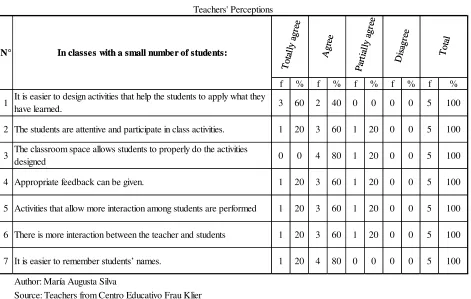
Table 1 Teachers' Perceptions
N°
Tot ally a
gree Agr
ee
Part ially a
gree Dis agr ee Tot al In classes with a small number of students:
f % f % f % f % f %
1 3 60 2 40 0 0 0 0 5 100
2 1 20 3 60 1 20 0 0 5 100
3 0 0 4 80 1 20 0 0 5 100
4 1 20 3 60 1 20 0 0 5 100
5 1 20 3 60 1 20 0 0 5 100
6 1 20 3 60 1 20 0 0 5 100
7 1 20 4 80 0 0 0 0 5 100
Author: María Augusta Silva
Source: Teachers from Centro Educativo Frau Klier N°
Tot ally a
gree Agr
ee
Part ially a
gree
Dis agr
ee
It is easier to design activities that help the students to apply what they have learned.
The students are attentive and participate in class activities.
The classroom space allows students to properly do the activities designed
Appropriate feedback can be given.
Activities that allow more interaction among students are performed
There is more interaction between the teacher and students
It is easier to remember students’ names.
22 0 10 20 30 40 50 60 70 80 90
Totally agree Agree Partially agree Disagree
It is easier to design activities that help the students to apply what they have learned.
The students are attentive and participate in class activities.
The classroom space allows students to properly do the activities designed Appropriate feedback can be given.
Activities that allow more interaction among students are performed There is more interaction between the teacher and students
Author: María Augusta Silva
[image:28.612.85.561.89.392.2]Source: Teachers from Centro Educativo Frau Klier
Table 2 Students' Perceptions
N° In classes with a small number of students:
Tot ally agre e Agre e Part iall
y ag ree Dis agre e Tot al
f % f % f % f % f %
1 59 74 20 25 1 1 0 0 80 100
2 32 40 45 56 3 4 0 0 80 100
3 43 54 28 35 9 11 0 0 80 100
4 57 71 20 25 2 3 1 1 80 100
5 52 65 26 33 1 1 1 1 80 100
6 50 63 20 25 4 5 6 8 80 100
7 57 71 19 24 4 5 0 0 80 100
8 57 71 22 28 1 1 0 0 80 100
Author: María Augusta Silva
Source: Students from Centro Educativo Frau Klier
The teacher remembers the students’ names.
The activities done in class help to apply what students learn.
The students are attentive and participate in class activities.
The students can better concentrate because there is less noise in the classroom.
The classroom space allows students to carry out the activities assigned by the teacher.
N° In classes with a small number of students:
Tot ally agre e Agre e Part iall
y ag ree Dis agre e Tot al
Students receive proper feedback form the teacher.
There is interaction between the students.
23
There are four questions in teachers’ and students’ questionnaires, each of them has a
set of statements which aims at exploring participants’ perspectives about teaching and learning
English in small classes. The first question’s asseverations seek information about classes with a small number of students.
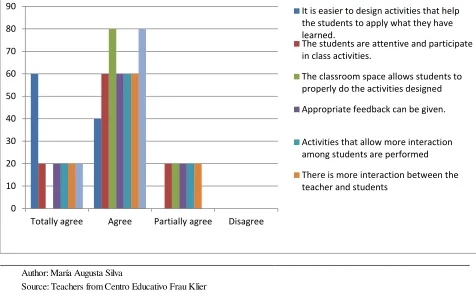
Concerning to the first statement three out of five teachers, claim that the activities done in class help to apply what students learn, this means that 60% of the surveyed teachers totally agree with this asseveration and believe that the activities proposed in small classes permit students to practice what they have been learning. Meanwhile, 40% of them agree with this pronouncement. Based upon these results, it is undoubtedly that the teachers consider that the
0 10 20 30 40 50 60 70 80
Totally agree Agree Partially agree Disagree
The activities done in class help to apply what students learn.
The students are attentive and participate in class activities. The students can better concentrate because there is less noise in the classroom.
The classroom space allows students to carry out the activities assigned by the teacher.
Students receive proper feedback form the teacher.
There is interaction between the students.
There is interaction between the teacher and students.
The tea her re e ers the stude ts’
names.
Author: María Augusta Silva
24
class size is a factor that allows them to develop activities that enable students to apply their acquired knowledge, which constitutes a positive helping aspect to enhance students’ language
skills. This result is corroborated by the students’ responses, as 74% the scrutinized students totally agree with this asseveration, while 25% of them agree.
In effect, during the class observations, it was palpable that the students in a small class, not only used what has been taught by teachers, but also, they delighted doing the tasks the teachers asked them to perform. The students were involved in class and participated actively using the new knowledge, the activities were very dynamic and enjoyable and the interaction with the teachers, in general it was cordial; it was unmistakable that the students received all the support they needed in order to incorporatethe new acquired knowledge and the contents were displayed in classes in different ways and contexts. Likewise, teachers’ personal attention
improves learning and provides more opportunities for an efficient second language acquisition, since language skills are improved easily as the same as interpersonal skills and creative thinking.
It can be said with certainty that the students can use new language knowledge in different ways, which enriches their learning and makes it meaningful. Regarding this point, Blatchford (2003) claims that small classes lead better teaching and more effective learning.
About the second statement concerning whether the students pay attention and participate in the activities proposed in class 60%, that is 3 out of 5 teachers, agree with this asseveration, and 20% of them totally agree and partially agree respectively. This means that teachers’ perceptions lean to indicate that a small number of students per class promotes a better
25
This trend is supported by the students´ answers in the surveys, which do not differ from teachers´ because 40% of the students, which means that 32 out of 80, totally agree and 56% agree.
Additionally, the observations carried out in this study, suggest that in small classes the students participate actively, spontaneously or mandatorily because teachers promote students’ communication, attendance and encouragement, as well as group activities. Educators also can explore more creative activities which approach students interests and also make the learning process not only more meaningful but also enjoyable. In fact, interaction, group participation and use of humor are essential, engage pupils and make information memorable and relevant.
With reference to this aspect, Blatchford (2003), ensures that in small classes the students are more likely to interact with their teachers and more engaged in the activities, as the same as, in classes with a small number of students, there is more teacher support, which is reflected in the amount of individual attention paid to students during the classroom activities and tasks.
26
process. On other hand, 9 out of 80 participants, that constitute the 11% in this research, partially agree with this argument. This percentage can be due to the noise in a classroom not only depends on how many students there are, but also the control discipline that the teacher manages in his or her class.
Respecting to the statement related to the classroom space that permits performing class activities properly, 80% of teachers agree, since 1 out of 5, which represents 20% of the surveyed teachers partially agree with this statement. It is important to mention that school in which this study took place, has pedagogically structured classrooms with a total area of 43 m2 by 50 m2 per class, representing an average of 2.50 m2 per student; in consequence, classrooms’
surface provides enough space to develop different activities.
On other hand, 96% (summed the percentages of the students that totally agree and agree) consider that the classroom space allows students to carry out the activities designed by the teacher, 3% of them partially agree and 1% disagrees. With these results it is indisputable that small classes permit a better performance of the activities. This could be evidenced during the class observations because the adequate space facilitates creative activities, such as role plays, games and contests.
The most teachers surveyed believe that small classes are better settings to provide students with effective feedback, in total 80% summed 20% of the teachers who totally agree and 60%, who agree, perceive that in small classes, there are more opportunities to provide students with the assistance they need and give them individual support. In the same way, students’
27
the teacher, 65% of them totally agree with this asseveration and 33% agree, it means that 98% of surveyed students perceive that they can receive appropriate feedback.
This point of view was upheld by the most information recorded in all the five observed classes, as they evidenced that the students were given the personalized attention they required because teachers had an adequate chance to correct both oral and written mistakes and supplied students with efficient responses to particular processes or activities. These answers are consistent with what Blatchford (2003) states about small classes, he affirms that on one hand teachers know students individually and on other hand, students are given immediate feedback and those, who need help receive sustained attention in small classes.
Another statement that teachers in this research mostly agreed was the amount of interaction that the students have among themselves. Not only the students, but also the teachers agreed that there is more interaction among students in small classes; 80% of the teachers and 88% of the students, summed both teachers’ and students’ responses that totally agree or agree, think that there is more interaction in classes with a small number of students, which plays a fundamental aspect in learning process.
According to Johnson (1995) student –student interaction is important in students’
28
The aforementioned interaction is complemented by the interaction between teacher and students. Hamre, et.al (2009) claims that this kind of relationship between educators and learners is developed over the course of the school year and this interaction must be strong and supportive in order to allow the students to feel safer and more secure, competent and positive. This kind of interaction is more frequently observed in small classes
Regarding the statement that wonders about if small classes promote strong relationships between teachers and pupils, the results got from the teachers’ surveys show that 80% of the teachers totally agree or agree, with this asseverations, on other hand 95% of the students, which represents, 57 out of 80 who totally agree and 19, who agree, share this point of view. Under these circumstances it can be concluded that in classes with less than 20 students, there is a hard connection, empathy and relationship between people involved in teaching and learning process; that is to say, between teachers and trainees.
About the perceptions got in reference with the last statement from table 1 that affirms
the teachers remain his or her students’ names, 100% of the surveyed teachers and 95% of the
students accord that it is uncomplicated for teachers retain students’ names. It is palpable, that having fewer students per class facilitates the educators not only recall students' names, but also knew them individually. During classes observed, teachers knew exactly the strengths and weakness of their students, their feelings, problems, worries, etc.
Based on the results got from surveys, it is undoubtedly that both students and teachers, found many different benefits of studying in small classes, such as teachers can provide
29
what they have learnt in different ways more frequently and they are engaged in class tasks; on other hand, classes with less than 20 students facilitate an adequate area that enables an appropriate performance of the class activities, a safer environment that promotes a constant interaction between all people that take part in the learning - teaching process and a personalized and individualized instruction. These aforementioned aspects are important elements that ensure a meaningful learning and make possible to raise the language acquisition quality.
[image:35.612.89.553.300.605.2]What teaching strategies and resources benefit English teaching in small classes?
Teachers' Perceptions Dis agr ee Tot al
N° In classes with a small number of students, it is easier to:
Tot ally a
gree Agr
ee
Part ially a
gree Table 1
f % f % f % f % f %
8 3 60 2 40 0 0 0 0 5 100
9 2 40 3 60 0 0 0 0 5 100
10 2 40 3 60 0 0 0 0 5 100
11 3 60 2 40 0 0 0 0 5 100
12 3 60 2 40 0 0 0 0 5 100
13 2 40 3 60 0 0 0 0 5 100
14 3 60 2 40 0 0 0 0 5 100
15 3 60 2 40 0 0 0 0 5 100
Author: María Augusta Silva
Source: Teachers from Centro Educativo Frau Klier
Design and apply activities that allow students to practice reading skills
Design and apply activities that allow students to practice writing skills.
Design and apply group work activities.
Design and apply individual activities.
Use technological tools
Use didactic materials.
Design and apply activities that allow students to practice listening skills.
Design and apply activities that allow students to practice speaking skills. Dis agr ee Tot al
N° In classes with a small number of students, it is easier to:
Tot ally a
gree Agr
ee
Part ially a
30 0 10 20 30 40 50 60 70
Totally agree Agree Partially agree Disagree
Design and apply activities that allow students to practice listening skills. Design and apply activities that allow students to practice speaking skills. Design and apply activities that allow students to practice reading skills Design and apply group work activities. Design and apply group work activities. Design and apply individual activities. Use technological tools
Use didactic materials.
Author: María Augusta Silva
[image:36.612.81.555.84.693.2]Source: Teachers from Centro Educativo Frau Klier
Table 2 Students' Perceptions
N° In classes with a small number of students:
Tot ally a
gree Agr
ee Part
ially a gree
Dis agree
Tot al
f % f % f % f % f %
9 59 74 18 22 3 4 0 0 80 99,5
10 56 70 22 27 2 3 0 0 80 99,5
11 54 68 19 23 7 9 0 0 80 99,25
12 64 80 12 15 3 4 1 1 80 100
13 41 51 33 41 4 5 2 3 80 100
14 55 69 21 26 4 5 0 0 80 100
15 40 50 26 33 9 11 5 6 80 100
16 51 64 20 25 6 7 3 4 80 100
Individual activities are used.
Technological tools are used.
Didactic materials are used.
The activities done allow students to practice listening skills.
The activities done allow students to practice speaking skills.
The activities done allow students to practice reading skills.
The activities done allow students to practice writing skills.
Group activities are used
Author: María Augusta Silva
Source: Students from Centro Educativo Frau Klier
N° In classes with a small number of students:
Tot ally a
gree Agr
ee Part
ially a gree
Dis agree
31
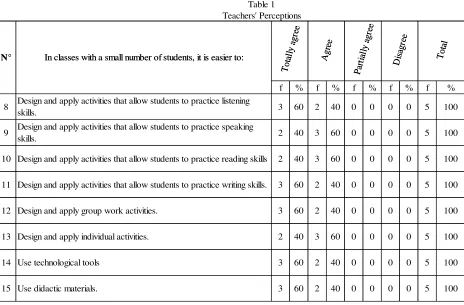
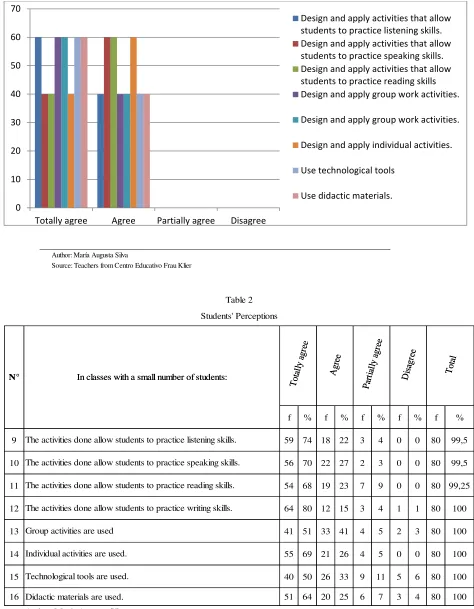
About the second questions that is part of this study, what teaching strategies and resources benefit the teaching of English in small classes, it is noteworthy that both teachers and students agreed that small classes promote activities that allow students use the four language skills: listening, reading, speaking and writing. 100% of the teachers, that is summed the teachers who totally agree and agree, asseverate that they design activities to develop these skills.
This point of view is shared by the students, who confirmed teachers’ perceptions, 59 out of 80 who totally agree and 18 who agree, that means 96% of the surveyed students believe that they achieve listening activities. This can be evidenced during all class observations, because the teachers used audio resources such as songs, stories, dialogues, listening exercises with gaps to be completed, etc.; these activities ensure the development of listening skills.
Respecting the second statement, 97% of the students participants in this research, summed 70% that totally agree and 27% that agree, consider that they perform speaking
0 10 20 30 40 50 60 70 80 90
Totally agree Agree Partially agree Disagree
The activities done allow students to practice listening skills.
The activities done allow students to practice speaking skills.
The activities done allow students to practice reading skills.
The activities done allow students to practice writing skills.
Group activities are used
Individual activities are used.
Technological tools are used.
Author: María Augusta Silva
32
activities. It can be demonstrated during the observations, the teacher asked the students to organize role plays, create dialogues for simulated events, answer open – questions, etc. They also provided learners realistic settings in which students could practice their knowledge and their communication skills; furthermore, the information collected in the observation sheets reflected that all the exercises and games required spoken interaction, creative discussion, language construction and using new acquired language.
Regarding to the statement, which declares that in small classes, reading activities are performed to practice knowledge, only 9%, that means 7 out of 80, partially agree, the rest of them, that is 68% and 23%, totally agree or agree respectively; it means that 91% of the students think that reading exercises are carried out during classes, these contribute to practice and develop language. This is supported by the class observations; activities such as: reading instructions, matching exercises, using reading texts, coding and decoding exercises from readers, predicting, changing endings, etc., were recurrent exercises and the students not only had the opportunity to practice reading, but also analyzed what they had read as the same as developed critical thinking skills.
33
In consequence both, these statistics and the class observations show clearly that studying English as a second language in small classes, constitutes a benefit because students have most opportunities to improve their language acquisition and strengthen their language skills.
Concerning the statement that claims that teachers in small classes use group and individual activities, 100% of the teachers in this research totally agree or agree with this proclamation; consequently, the teachers believe that it is important to plan these kind of activities during the class time, inasmuch as grouping involves student interaction.
This perspective is supported by the statistics results from students’ surveys, 92% of the students, summed 51% that totally agree and 41 that agree, perceive that small classes facilitate the chance to use group activities, additionally during the observations carried out, it was easy to visualize that group work is one of the most recurrent activity in classes with a small number of students because it makes feasible to produce interaction opportunities.
According to the results got from students’ surveys, 95% the students consider that individual activities are done during lessons; 55 participants out of 80, that constitutes 69% totally agree and 21 out of 80, that represents 26%, agree with the asseveration that these kind of activities are performed in small classes. The class observations set up during this study demonstrated that the teachers spent some time on individual exercises, such as production work, quizzes, paragraph writing, completion, among other, because these tasks offer teachers valuable insights about students’ progress, difficulties, levels, etc.
34
show that 60% of the teachers, who participated in this research, totally agree and 40% of them agree with this statement. In fact, during the observations, it was evidenced that teachers used different kind of technological resources, not only because the classes were equipped with audio
– visual appliances, but also because, it is absolutely indispensable for teachers to create an environment that affords students to be in contact with real stuff and settings, these resources can be found in web sites, videos, documentaries, etc. This is corroborated by the students, whose surveys show that 83% of the students participants in this study, combining 50% who totally agree and 33% who agree, think that technological elements form part of the English lessons in small classes.
About using didactic material, both teachers and students believe that educational material is used in small classes. 100% of teachers, summed 60% who totally agree and 40% who agree, affirm that supporting material is used for teaching English. On other hand 89% of the students, perceive that didactic resources are used during the class time, that is combining 64% that totally agree and 25% that agree. Additionally, in the observations, it was evidenced that flashcards, posters, videos, worksheets, web pages, etc. were used in accordance and pertinence, thus they contributed to encourage the students to pay attention, participate and be involved in learning process
35
communicative events. On other hand the individual tasks performed in classes with a small number of students, offer teachers a great source to measure students’ progress and needs, this individualization guarantees learning as well as appreciation, which raises the quality of second language acquisition. Furthermore, as it was evidenced, using technology and educational material in small classes are important to engage students’ attention because the visual and audio aids awaken the senses and stimuli the learning developing.
How do students feel about learning English in small classes?
[image:41.612.84.558.313.553.2]Par tial ly a gree Dis agr ee Tot al Table 1 Teachers' Perceptions
N° In classes with a small number of students,
Tot ally a
gree
Agr ee
f % f % f % f % f %
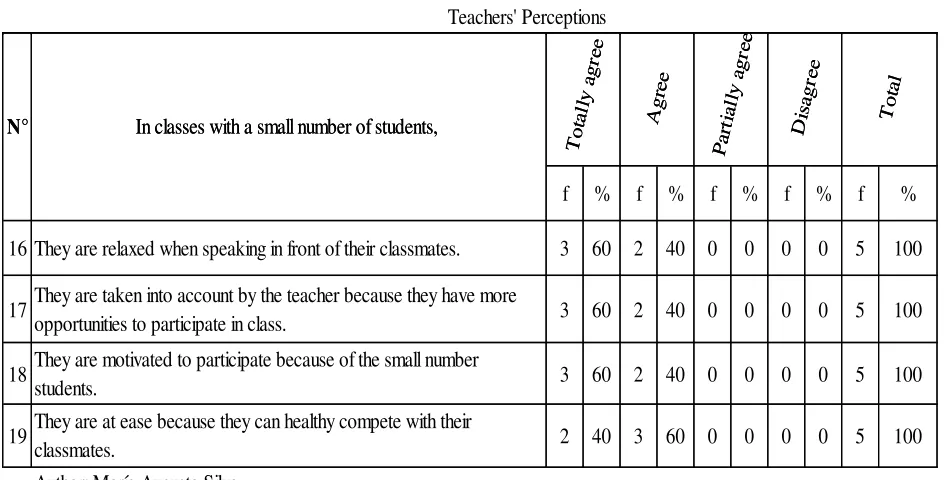
16 3 60 2 40 0 0 0 0 5 100
17 3 60 2 40 0 0 0 0 5 100
18 3 60 2 40 0 0 0 0 5 100
19 2 40 3 60 0 0 0 0 5 100
Source: Teachers from Centro Educativo Frau Klier They are relaxed when speaking in front of their classmates.
Par tial ly a gree Dis agr ee Tot al
Author: María Augusta Silva
They are taken into account by the teacher because they have more opportunities to participate in class.
They are motivated to participate because of the small number students.
They are at ease because they can healthy compete with their classmates.
N° In classes with a small number of students,
Tot ally a
gree
36 0 10 20 30 40 50 60 70
Totally agree Agree Partially agree Disagree
They are relaxed when speaking in front of their classmates.
They are taken into account by the teacher because they have more opportunities to participate in class. They are motivated to participate because of the small number students.
They are at ease because they can healthy compete with their classmates.
Author: María Augusta Silva
Source: Teachers from Centro Educativo Frau Klier
Students' Perceptions
N° In classes with a small number of students,
Tot ally a
gree Agr
ee
Part ially a
[image:42.612.83.562.99.546.2]gree Dis agr ee Tot al Table 2
f % f % f % f % f %
17 48 60 26 33 5 6 1 1 80 100
18 52 65 24 30 4 5 0 0 80 100
19 59 74 18 22 3 4 0 0 80 99,5
20 44 55 33 41 1 1 2 3 80 100
Author: María Augusta Silva
Source: Students from Centro Educativo Frau Klier
I am relaxed when speaking in front of my classmates.
I am taken into account by the teacher because I have more opportunities to participate in class.
I am motivated to participate because of the small number of classmates.
I am at ease because I can healthy compete with my classmates. N° In classes with a small number of students,
Tot ally a
gree Agr
ee
Part ially a
37
The third question gathers information about students’ feelings through four
statements: students are relaxed when they have to talk in front of their classmates, pupils have higher opportunities to participate in class, learners are motivated to participate because there are a limited number of classmates per class and, students feel comfortable because they interact in an environment of fair competition. These proclamations can help us to explore deeper students’
disposition and willingness to learn, which is actually essential and invaluable in learning a new language.
Teachers’ perceptions regarding how students feel about learning English in small classes show that, 100% of the surveyed teachers believe the students feel relaxed when they speak in front of their classmates. It accords with the study done by Harfitt (2012) in Hong Kong
0 10 20 30 40 50 60 70 80
Totally agree Agree Partially agree Disagree
I am relaxed when speaking in front of my classmates.
I am taken into account by the teacher because I have more opportunities to participate in class. I am motivated to participate because of the small number of classmates.
I am at ease because I can healthy compete with my classmates.
Author: María Augusta Silva
38
which reveals that the students’ sense of anxiety can be reduced in smaller classes, this nerves reduction promotes a strong sense of security and a better classroom atmosphere that enhances self-esteem. In addition, the observations carried out in this study show that the students executed their tasks calmly and self-confidently, they could perform activities positively since classes with a small number of students facilitates security sense. Learners did not show fear or anxiety, on contrary they felt appreciated and respected.
Overall, it can be stated that small classes benefit self- esteem and confidence, this
environment enables dynamic and spontaneous students’ participation, weakens students’ fears
and motivates affection and appreciation, which makes possible a better language execution or accomplishment.
This overwhelming totally agreement and agreement from teachers’ answers coincides with students responses, since 48 out of 80 students, that represents the 60% who totally agree and 26 out of 80, that represents 33% of the students who agree, claim they feel relaxed in small class time, this allows them to participate without fear
According to the information got from the surveyed teachers about the statement that claims that the students are taken into account because they have more opportunities to participate in class, 3 out of 5, that is 60% of the educators, totally agree with the fact that in small classes, students have higher opportunities to participate, meanwhile 2 out of 5, that is 40% agree with this statement. These findings are consistent with Fin & Wang (2002), they hold that the students have more chances to participate in small classes and the teachers can better meet
students’ needs, besides that, teachers have higher quality time to address each student’s unique
39
On other hand, the students’ statistics show that 52 out of 80 students, that is 65% totally agree with the fact that in small classes the learners are taken into account by teachers because they have more opportunities to talk during lessons, meanwhile 24 out of 80, that is 30% of the participants agree. These results are supported by the observations, which confirm that in classes, with a small number of students, there is more available time to be spent by teacher in hearing, supporting and helping students, on other hand, this active taking part and encouragement permit teachers to realize how well the students are enhancing their knowledge and students feel more comfortable about taking turns to talk in small classes.
In accordance with the observations made in this study, it was easy to visualize that students mostly participate in small class activities because there are more chances to do it, due to the small number of students per class. Consistently with the observations records done during classes, the statistics demonstrate that 40% of the teachers, who took part in this research, agree with this proclamation, meanwhile 60% of them totally agree. On other hand, 96% of the surveyed students, that is combining 74% who totally agree and 22% who agree, consider that a small number of students per class allows a better and more frequent participation. It can be inferred that, both teachers and students feel that small classes favor student’ participation,
because there are more occasions for pupils to reflect what they are learning as well as, being active protagonists in their second language acquisition.
40
collaboratively rather than competitively. Additionally, the facts collected in the observation sheets, show undoubtedly, that small classes allow interaction, which makes possible strong relationships, self – confidence and mutual appreciation; these factors produces a better students’
attitude and contributes to create a positive environment, which constitutes a key factor in learning a foreign language; besides, teachers’ recognition and attention motivate and encourage students.
Based on the statistics mentioned above, it may be concluded that small classes promote environments where the students feel more relaxed at the moment to talk in front of their peers and work collaboratively; in addition, pupils have more opportunities to participate and teacher can provide learner with enough time to attend them individually, this encourages the students to use language, improve fluency, practice new vocabulary, take part in creative discussions and be spontaneous. Furthermore, the personalized attention that is promoted in small classes ensures students individual achievement, because they feel heard and appreciated, additionally the students feel comfortable because they interact in an environment of fair competition.
[image:46.612.85.557.571.713.2]Are there any limitations when teaching English in small classes?
Table 1
Teachers' Perceptions
N° In classes with a small number of students:
Total ly agr
ee
Agr ee
Parti ally a
gree
Disa gree
Total
f % f % f % f % f %
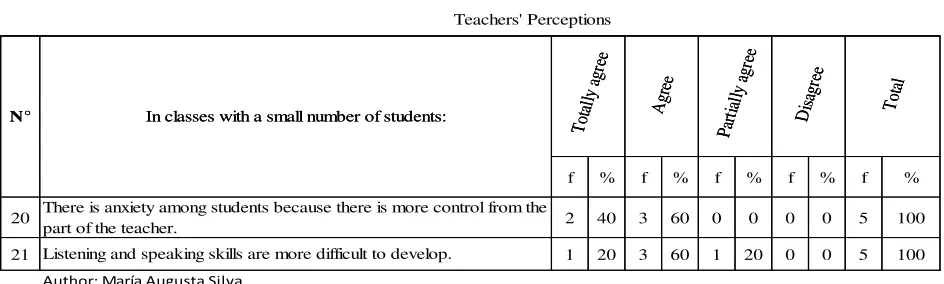
20 2 40 3 60 0 0 0 0 5 100
21 1 20 3 60 1 20 0 0 5 100
Author: María Augusta Silva
Source: Teachers from Centro Educativo Frau Klier
N° In classes with a small number of students:
Total ly agr
ee
Agr ee
Parti ally a
gree
Disa gree
Total
There is anxiety among students because there is more control from the part of the teacher.
41
[image:47.612.82.555.121.344.2]Source: Teachers from Centro Educativo Frau Klier Author: María Augusta Silva
Table 2 Students' Perceptions
N° In classes with a small number of students:
Tot ally a
gree Agr
ee
Part ially a
gree Dis agr ee Tot al
f % f % f % f % f %
21 29 36 27 34 15 19 9 11 80 100
22 25 31 18 23 21 26 16 20 80 100
Author: María Augusta Silva
Source: Students from Centro Educativo Frau Klier
There is anxiety among the students because there is more control on part of the teacher.
Listening and speaking skills are more difficult to develop. N° In classes with a small number of students:
Tot ally a
gree Agr
ee
Part ially a
42
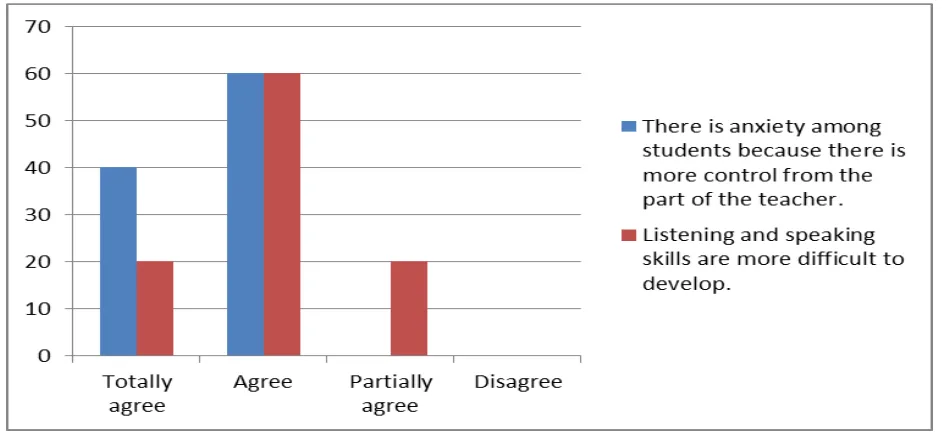
The fourth question that was displayed in this survey is related with the limitations in small classes and the information gathered in this section focused on two specific aspects: if in small classes there is anxiety among the students because there is a strict control on part of the teachers and if it becomes difficult to practice the speaking and listening skills during the lessons time.
In order to mention the teaching English limitations in small classes, it is necessary to take into consideration that an overwhelming amount of teachers, that is represented 40% of them, who totally agree and 60% who agree, think that the students feel slightly controlled by teachers by cause of the small number of students per class; the students’ perceptions are similar, 36% of the survey students who totally agree and 34% partially agree feel a little anxiety because the teacher is always mindful about them. According with the observations set up, this little stress could be positive because the students did what they had to do, the discipline was
Author: María Augusta Silva