Using Parallel Pivot vs. Clustering-based Techniques for
Web Engines
Gil-Costa Veronica and Marcela Printista
DCC, Universidad de San Luis,
San Luis, Argentina
{
gvcosta,mprinti
}
@unsl.edu.ar
July 25, 2007
Abstract
Web Engines are a useful tool for searching information in the Web. But a great part of this information is non-textual and for that case a metric space is used. A metric space is a set where a notion of distance (called a metric) between elements of the set is defined. In this paper we present an efficient parallelization of a pivot-based method devised for this purpose which is called the
Sparse Spatial Selection (SSS) strategy and we compare it with a clustering-based method, a parallel implementation of theSpatial Approximation Tree(SAT). We show that SAT compares favourably against the pivot data structures SSS. The experimental results were obtained on a high-performance cluster and using several metric spaces, that shows load balance parallel strategies for the SAT. The implementations are built upon the BSP parallel computing model, which shows efficient performance for this application domain and allows a precise evaluation of algorithms.
Keywords: Metric Space, BSP, Parallel Search, Distance Computations.
1
Introduction
The World Wide Web has information useful to millions of people. Some simple browse the Web through entry points such as Yahoo!. But many information seekers use a search engine to begin their Web activity. In this last case usually users submit a query of keywords, and receive a list of Web pages containing the keywords that may be relevant. There is no question that the Web is a huge and challenging to deal with. For helping users tofind their answers, the search engine module is respon-sible for receiving andfilling search request from users. The engine relies heavily on the indexes and some time on the page repository. Because of the Web’s size, and the fact that users typically only enter one or two keywords, result sets are usually very large. Therefore the ranking operation has the task of sorting the results. The query module is of special interest because traditional information retrieval (IR) techniques have run into selectivity problems when applied without modifications to Web searching: most traditional techniques rely on measuring the similarity of query texts with texts in a collection’s documents.
between two objects makes similarity search an expensive operation and a case for its efficient par-allelization. This fact has motivated the development of many research works aiming to do efficient similarity search over very large collections of data.
Many research studies have been presented so far about multimedial structures. Some of them are Burkhard-Keller-Tree (BKT) [5], Fixed-Queries Tree (FQT) [2], Fixed-Height FQT (FQHT) [1], Fixed-Queries Array (FQA) [6], Vantage Point Tree (VPT) [22], Approximating and Eliminating Search Algorithm (AESA) [21], LAESA (Linear AESA) [12], Bisector Trees (BST) [9], Generalized-Hyperplane Tree (GHT) [17], Geometric Near-neighbor Access Tree (GNAT) [3] and Spatial Approx-imation Tree (SAT) [13]. These structures are used to perform similarity searches in ametric space.
In this paper we present a parallel strategy for the Sparse Spatial Selection (SSS) index which is a pivot based-technique. We present strategies to reduce the number of distances computations and the I/O requirements. We compare the efficiency of the algorithms implemented with the parallel implementation of a clustering-based technique, the Spatial Approximation Tree (SAT). We use the Bulk Synchronous Parallel - BSP [20] model to perform the parallel querying and data distribution.
The rest of this paper is organized as follow. Section 2 introduces the theoretical concepts needed to understand the problem. In Section 3 the sequential SSS index is presented. Section 4 presents the Sequential SAT algorithm. In Section 5 the parallel platform is explained. In Section 6 we present the parallel SSS index strategies and in Section 7 the parallel SAT algorithms. Section 8 preset the results obtained andfinally Section 9 presents the conclusions and future works.
2
Theoretical Concepts
Ametric space(X, d)is composed of a universe of valid objectsXand adistance functiond:X×X→
X+
defined among them. The distance function determines the similarity or distance between two given objects. The goal is given a set of objects and a query, retrieval all objects close enough to the query. This function holds several properties: strictly positiveness(d(x, y)>0and ifd(x, y) = 0then x =y), symmetry (d(x, y) =d(y, x)), and the triangle inequality(d(x, z) = d(x, y) +d(y, z)). The finite subsetU ⊂ Xwith sizen = |U|, is called dictionary or database and represents the collection
of objects where searches are performed.
Ak-dimensional vector space is a particular case of metric space in which every object is repre-sented by a vector ofkreal coordinates. The definition of the distance function depends on the type of objects we are managing. In a vector space,dcould be a distance function of the familyLs, defined as Ls(x, y) = (1≤i≤k|xi−yi|
s
)1s [4]. For example, s = 2 yields Euclidean distance, that is the
number of insertions, detentions or modifications we have to performe to make two words equal. The computational cost of the algorithms that determine the similarity between two objects makes similarity search an expensive operation and a case for its efficient parallelization. This fact has motivated the development of many research works aiming to do efficient similarity search over very large collections of data. Data parallel programming is particularly convenient for two reasons. The first is its easiness of programming. The second is that it can scale easily to large problem sizes.
There are two main queries of interest for a collection of objects in a metric space:
• range search: that retrieves all the objectsu ∈ U within a radius r of the query q, that is:
{u∈U/d(q, u) =r};
• nearest neighbor search: that retrieves the most similar object to the query q, that is {u ∈
In this paper we are devoted to range queries. Nearest neighbor queries can be rewritten as range queries in an optimal way [8], so we can restrict our attention to range queries. The evaluation of the distance function is very expensive, and therefore searches become inefficient if the collection has a high number of elements. Thus, reducing the number of evaluations of the distance function is the main goal of the methods for similarity search in metric spaces. To do that, they first build indexes over the whole collection. Later, using the triangle inequality, those indexes permit to discard some elements without being necessary to compare them against the query.
Search methods can be classified into two types [7]:pivot-basedandclustering-basedtechniques. Pivot-based search techniques choose a subset of the objects in the collection that are used as pivots. The index is built by computing the distances from each pivot to each object in the database. Given a query (q, r), the distances from the queryq to each pivot are computed, and then some objects of the collection can be directly discarded using the triangle inequality and the distances precomputed during the index building phase. Being x ∈ U an object in the collection, we can discard x if
|d(pi, x)−d(pi, q)| > rfor any pivotpi, since by the triangle inequality, if this condition is true, its distance to q will bed(x, q)> r. The objects that can not be discarded by this condition make up the candidate list, and they must be compared against the query. The total complexity of the search is the sum of the internal complexity, the comparisons ofqwith each pivot, and the external complexity, the comparisons of q with each object in the candidate list.
Clustering-based techniques split the metric space into a set of equivalence regions each of them represented by a cluster center. During searches, whole regions can be discarded depending on the distance from their cluster center to the query. Two good surveys can be found in [8] and [23].
A recent pivot-based technique is theSparse Spatial Selection(SSS) [4]. SSS is a dynamic method since the collection can be initially empty and/or grow later. It works with continuous distance func-tions and it is suitable for secondary memory storage. The main contribution of SSS is the use of a new pivot selection strategy. This strategy generates a number of pivots that depends on the intrinsic dimensionality of the space. Moreover, this pivot selection strategy is dynamic since it adapts the index when new objects are added to the collection.
A recent clustering-based technique is theSpatial Approximation Tree (SAT) devised to support efficient searching in high dimensional metric spaces [13]. This structure has been compared suc-cessfully against other data structures [15] and update operations have been included in the original design [14]. The SAT is a nice example of tree data structure in which well-known tricks paralleliza-tion simply do not work [11, 10]. It is too sparse, unbalanced and its performance is too dependent on the workload generated by the queries being solved by means of searching the tree.
3
Sequential SSS Index
Let(X, d)be a metric space,U ⊂Xan object collection, andM the maximum distance between any pair of objects,M = max{d(x, y)/x, y ∈X}. The set of pivots contains initially only thefirst object
of the collection. Then, for each elementxi ∈ U, xi is chosen as a new pivot if its distance to every pivot in the current set of pivots is equal or greater thanα M, beingαa constant parameter. That is, an object in the collection becomes a new pivot if it is located at more than a fraction of the maximum distance with respect to all the current pivots. For example, if α = 0.5an object is chosen if it is located farther than a half of the maximum distance from the already selected pivots. The following pseudocode summarizes the pivot selection process:
PIVOTS← {x1}
if∀p∈PIVOTS,d(xi, p)≥α M then PIVOTS = PIVOTS← ∪ {xi}
A key observation here is that the calculations performed to obtain the values of the distance function d(xi, p)during the construction of the SSS index are not discarded, they actually form the index itself. Namely for each pivot, the SSS index maintains the distance between each database object and all of the pivots. Thus solving the range query (q,r) takes the following steps:
foreachpivotpdodq[p]← d(q, p) n← 0
foreachobjectodo foreachpivotpdo
if ( distance[o][p]>(dq[p]−r) and
distance[o][p]<(dq[p]+r) ) then
n← n+ 1
endif endfor
if (n= total number of pivots ) then
add objectoto a list of candidate objectsℓ.
endif endfor
foreachobjecto∈ℓdo if (d(o, q)≤r)then
report objectoas solution
endif endfor
It seems evident that all the selected pivots will not be too close to each other. Forcing the distance between two pivots to be greater or equal thanMα, ensures that they are well distributed in the whole space. It is important to take into account that the pivots are not very far away from each others neither very far from the rest of objects in the collection (i.e., they are notoutliers), but they are well distributed covering the whole space. The hypothesis is that, being well distributed in the space, when a search is performed the set of pivots will be able to discard more objects than pivots selected with a different strategy.
Being dynamic and adaptive is another good feature of the pivot selection technique. The set of pivots adapts itself automatically to the growing of the database. When a new elementxi is added to the database, it is compared against the pivots already selected and it becomes a new pivot if needed. In this way the number of pivots does not depend on the collection size but on its intrinsic dimen-sionality of the metric space. Actually the collection could be initially empty, which is interesting in practical applications.
4
Sequential SAT
The SAT construction starts by selecting at random an element a from the databaseS ⊂ U. This element is set to be the root of the tree. Then a suitable setN(a)of neighbours ofais defined to be the children ofa. The elements ofN(a) are the ones that are closer toa than any other neighbour. The construction ofN(a)begins with the initial nodeaand its bag holding all the rest ofS. Wefirst sort the bag by distance toa. Then we start adding nodes to N(a)(which is initially empty). Each time we consider a new nodeb, we check whether it is closer to some element ofN(a)than toaitself. If that is not the case, we addb toN(a). We now must decide in which neighbour’s bag we put the rest of the nodes. We put each node not ina∪N(a), but in the bag of its closest element of N(a). The process continues recursively with all elements inN(a).
The structure is a tree that can be searched for anyq ∈ S by spatial approximation for nearest neighbour queries. The mechanism consists in comparingqagainsta∪N(a). Ifais closest toq, then ais the answer, otherwise we continue the search by the subtree of the closest element toqinN(a).
It is a little interest to search only for elementsq ∈ S. The tree we have described can, however, be used as a device to solve range queries for anyq ∈ U with radiusr. The key observation is that, even if q ∈ S, the answer to the query are elementsq′ ∈ S. So we use the tree to pretend that we are searching an element q′ ∈ S. Range queriesq with radius r are processed as follows. We
first determine the closest neighbourcofqamong{a}∪N(a). We then enter into all neighboursb∈N(a) such thatd(q, b)≤ d(q, c) + 2r. This is because the virtual elementq′ can differ fromqby at mostr at any distance evaluation, so it could have been inserted inside any of thosebnodes. In the process we report all the nodesq′
we found close enough toq. Finally, the covering radiusR(a)is used to further prune the search, by not entering into subtrees such thatd(q, a)> R(a) +r, since they cannot contain useful elements. The following pseudocode summarizes the range search:
SEARCH(Node a, Query q, Radius r, Dist. dmin)
if (d(a,q)≤R(a)+r) then if (d(a,q)≤r) then
report a
endif
dmin =min{d(c, q), c∈N(a)} ∪dmin
for(b∈N(a))do
if (d(b,q)≤dmin+2r)then RangeSearch(b,q,r,dmin)
endif endfor endif
5
Parallel Platform
The practical model of programming is SPMD, which is realized as C and C++ program copies running onP processors, wherein communication and synchronization among copies are performed by ways of libraries such as BSPlib [18] or BSPpub [19].
We choose the BSP model because it is deadlock-free and has a particular way of organizing computations and the resulting performance is in fact not too far from the one obtained with fully asynchronous message passing realizations. Its main advantage stems from the fact that BSP provides a cost model that allows a seemingly precise evaluation of the communication and computation costs of parallel programs. In this particular work, we have used the BSPonMPI library that allows running BSP using the MPI primitives.
The environment selected to process the queries is a cluster of computers connected by fast switch-ing technology. We assume a server operatswitch-ing upon a set of P machines, each containing its own memory. Client request are sent to a broker machine, which in turn distribute those request evenly onto the P machines implementing the server. Requests are queries that must be solved with the data stored on theP machines. We assume that under a situation of heavy traffic the server start the processing of a batch of Q = q P queries in every superstep. Basically every processor has to deal with two kinds of messages, those from newly arriving queries coming from the broker, in which case a search is started in the processor, and those from queries located in others processors that decided to continue their search locally in this processor.
We assume that the broker distributeQ = q P queries in every superstep so thatq new queries arrive at each processor in each superstep. In this case, it is not difficult to see that the cost of the broadcast operation we employ isO(q P +q P G+L)against the O(q P +q P2
G+L)common practice strategy reported in the literature.
6
Parallel Strategies for the SSS Index
The SSS index is a pivot-based technique where distances between the objects in the collection and the pivots are computed before the search operation starts. It can be seen as a table with so many columns as pivots and so many rows as objects in the database. This strategy can be easily parallelizable distributing the rows among the processors. But in this case the pivots must be replicated in all processors because the query objects have to be compared against them. The replication is due to the SSS index performs an intersection between the database objects and the pivots. Therefore all objects with d(o, piv) ∈ {d(q, piv) +r, d(q, piv)−r} for every pivot in the set of pivots, are selected as candidates to be part of the answer. The non-pivot objects are distributed in a multiplexed way.
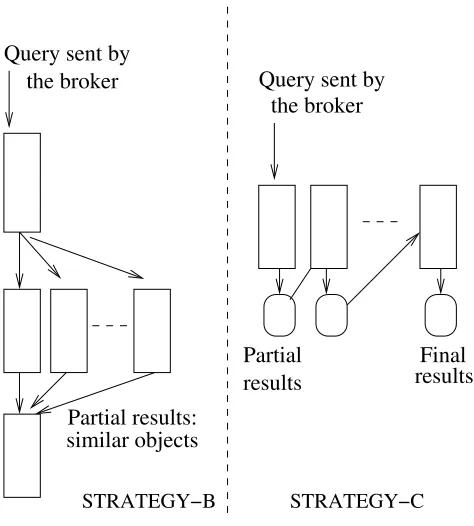
This method can be seen as a global strategy because all processors share the same pivots but they have only a piece of the whole database. With this approach we can use two different strategies to perform the queries searches. In the first one called Strategy-B, the broker machine sends the query to one processor of the system selected in a circular way as in thefirst strategy. Then the processor receiving the query performs a broadcast so all processors get the same query. After receiving this query, processors search in their local SSS index the most similar objects, namely the objects that satisfies the range query (q,r) and send them to the requesting processor. This processorfinally waits for all the results obtained in the previous step, and sends the results to the broker machine (see Figure 1). For the case of queries requiring the nearestkobjects within distancer– we denote this operation (q, r, k)– every processor sends itsknearest objects and the requesting processor determines the best kamong thek P candidates.
Query sent by the broker
similar objects Partial results:
the broker Query sent by
STRATEGY−B STRATEGY−C
Partial results
[image:7.595.169.406.79.342.2]Final results
Figure 1: Global index distribution.
local similarity search using its portion of the SSS index. This processor gets a partial result for the query and sends it to the next processor. This is repeated until all processors have searched in their local indexes for similar objects. And the last one sends thefinal results to the broker machine. For k-nearest queries(q, r, k), together with the message travelling from one processor to the another there is an indication of the maximum distance toq of the set ofK candidates contained in the message. This value is used to prone the number of distance calculations in the receiving processor.
This case is very similar to the Strategy-B, but here the communication is performed in smaller chunks. The results are passed from one processor to another until building thefinal results, so we haveP messages with partial results for every query, and all processors are performing the same tasks in every superstep. While in the other strategy, the communication is performed in bigger chuncks and the receptionist machine has to perform the selection of the best results.
Another way to parallelize the SSS index would be to spread the space between the processors and then each one builds its own SSS index with the local data (Strategy-A). The problem in this strategy is that each processor will have to select new pivots locally, different from the global ones. And therefore, the number of pivots will be greater than in the other strategies proposed. To avoid the effects of imbalance from objects skewed to particular regions in space, we use multiplexed object distributed strategy, so each object is sent to the processorp=idobjmod P.
7
Parallel SAT Strategies
Afirst point to emphasize is that the SAT structure contains nodes of very diverse number of children. Every child node causes a distance comparison, so it is relevant to be able to balance the number of distance comparisons performed in every processor per superstep. In thefirst parallel strategy for the SAT, we propose to distribute the subtree of the root node among processors at random (Rstrategy). In this case the root is replicated in all processors and queries are distributed in a circular way. The processor receiving the query determines where it has to be solved.
Another parallel implementation considers the number of nodes that each processor has. So we select the processors with fewer nodes to send a subtree. Queries are distributes in a circular way and the processor receiving one query will determinate where the query must be solved. But, while we were doing some experiments to study the results obtained by this strategy (load processor strategy -LP), we realize the number of comparisons performed depends not only in the number of nodes but also in the query itself. Therefore to reduce the number of comparison distance we present another strategy to map the tree nodes onto the processors by considering the number of distance comparisons that may be potentially performed in every subtree rooted at the children of the SAT’s root. That is, the subtrees associated with nodesb inN(a)whereais the root andN(a)is the set neighbour ofa. To do that, we replicate the root and each child of the root in every processor and we distribute all the others nodes evenly through the processors, in a multiplexed way. A disadvantage is that every node has to replicate its children locally, to be able to perform the distance comparisons and in this way continue the searching operation.
In the multiplexed strategy (M), we also have to send the query to one processor and then it determinates where the query has to be solved. Therefore, we have more communication and more synchronization during a query processing operation.
These three strategies have a global distribution, because the SAT is sequentially built and then the nodes are distributed in the server. Another way to parallelize this structure (named local strategy L) is to distribute the database among the processors and then each processor builds its own local SAT structure. This case requires broadcasting the queries, because there is no communication between the processors during the query search operation and because they process these queries in a sequential way.
To improve efficiency we set an upper limit V to the number of distance comparisons that are performed per processor in each superstep. During a superstep, every time any processor detects that it has performed more thanV distance comparisons, it suspends query processing and waits until the next superstep to continue with this task. Under the BSP model it means that all queries going down in a tree in each processorkhas to be sent again to the processorkas a message, exactly as if it found out that the search have to continue in other processor. But no communication cost is involved for these extra messages. Also the processors stop extracting messages from its input queue. Besides, everySsupersteps we collect statistics that are used to define the value ofV for the next sequence of supersteps. This statistics are independent of the value ofV and of theS supersteps used to calculate them. In this way the value of V can adapt itself to the workload changes produced by the flow of queries arriving constantly to the server.
query to the processor. Besides, every time a query has to migrate to another processor we increase the virtual supersteps in one unity, because it takes one virtual superstep to get there. Additionally, we count the total number of distance calculations that has been performed in every processor k. It gives us a precise idea of global load balance (across supersteps).
8
Results
The database collection used in the experiments showed below is a 69Kwords English dictionary and a 51Kwords Spanish dictionary. This system has 32 dual processors (2.8GHz) that use NFS mounted directories. Queries were selected at random from a log of 127,000 queries. In each superstep we introduceQ= 32queries per processor and each of them solves 10,000 queries. So the total number of queries processed in the system is 10,000P.
We measure the efficiency of each strategy explained in this paper as the ratioA/BwhereAis the average distance computation performed in each supersptep by all processors, andBis the maximum number of distance computations performed in that superstep by any processor. This measure gives us an idea about the load balance of the system.
1
1
1
1
315 310 305 300 290 285 280
Efficiency
Supersteps P=4 P=8 P=16 P=32
B C A
Figure 2: Efficiency obtained by the Strategy-A, Strategy-B and Strategy-C using up to 32 processors with the SSS technique.
Figure 2 shows the efficiency in each superstep. StrategiesB andCobtains a good performance (they are overlapped in the graphic) and they show a better load balance than the Strategy-A. This last one presentsfluctuations and the efficiency is more unstable. This is because queries requiring more distance computations may fall in the same processor, while in both others strategies the work is distributed among the processors. Figure 3 shows the efficiency obtained by the proposed parallel strategies for the SAT. In this case theL strategy is the one presenting less efficiency and therefore less load balance between supersteps.
1
1
1
1
280 285 290 295 300 305 310 315
Efficiency
Supersteps P=4 P=8 P=16 P=32
LP R M L
Figure 3: Efficiency obtained with 4,8,16 and 32 processors using the LP, R, M and L parallel strategies proposed for the SAT method.
0 0.2 0.4 0.6 0.8 1 1.2 1.4
L M R LP C B A L
M R LP C B A
Running Time (Sec)/Max
Strategies
SSS SAT
Enghish Spanish
SSS SAT
P= 4 8 16 32
Figure 4: Running time. Each machine process10,000P queries in batches ofQ = 32. The results are presented with a system with up to 32 processors.
in some processors, while other may remind with less load work.
The parallel SAT strategies proposed used an upper limitV to balance the number of computations performed in each superstep. Figure 5 shows in they−axis the values obtained by the upper limit per superstep. This is presented for 4-32 processors using theLP,R,M andLstrategies for the SAT. Finally, Figure 6 shows in the x-axis the parallel strategies A, B and C for the SSS index and LP, R, M andLfor the SAT. At the left of this graphic we have the average distance computations performed using 4, 8, 16 and 32 processors for the SSS index. In this case the B strategy is the one reporting higher values. On the other hand, the different distance computations presented by the execution of the algorithms with more processors is hard to distinguish. The average efficiency is presented. We can see that theAstrategy is the one reporting less distance computations but also has less load balance due to the efficiency reported is very low.
0 2 4 6 8 10
P= 4, LB R M L 0 2 4 6 8 10 P= 8 0 2 4 6 8 10 12 P= 16 0 2 4 6 8 10 12 P= 32
Figure 5: Upper limits adaptation for the parallel strategies of the SAT.
0 1 2 3 4 5 L M R LP L M R LP C B A C B A Strategies P= 4 8 16 32
SSS SAT
Average Distances Average Distances Average Efficiency Average Efficiency
Figure 6: Average measures taken for the three strategies with 4,8,16 and 32 processors, using the English dictionary.
9
Conclusions and Future Works
In this paper we have presented the parallelization of a recent index method used to search similar objects in a metric space and we compared it with some parallel implementations of a clustering-based technique, the SAT. Results show that the SAT is more balance and obtains a better performance decreasing the number of distance computations. The SSS index allows obtaining an optimal number of pivots used to reduce the number of distance computations performed for searching similar objects. The parallel strategies are based in two main schemes, a local scheme where the database is distributed among the processors and then each processor builds its own index or tree to perform the queries searches. The others strategies are based in a global distribution of the database. In these cases a unique SSS-index is built and then all pivots are replicated in all processors (because the intersection between queries and pivots is required by the SSS method). The database objects are distributed among the processors in a multiplexed way. In the SAT method a unique tree is built and the each node is multiplexed among processors.
reduction of query execution times.
References
[1] R. Baeza-Yates. Searching: an algorithmic tour. Encyclopedia of Computer Science and Technology, 37:331–359, 1997.
[2] R. Baeza-Yates, W. Cunto, U. Manber, and S.Wu. Proximity matching using fixed-queries trees. In Proceedings of the 5th Annual Symposium on Combinatorial Pattern Matching, pages 198–212, Springer-Verlag, Berlin,1994.
[3] S. Brin. Near neighbor search in large metric spaces. In 21st conference on Very Large Databases, 1995. [4] N. R. Brisaboa, A. Farina, O. Pedreira, and N. Reyes. Similarity search using sparse pivots for efficient multimedia information retrieval. InISM ’06: Proceedings of the Eighth IEEE International Symposium on Multimedia, pages 881–888, Washington, DC, USA, 2006. IEEE Computer Society.
[5] W. A. Burkhard and R. M. Keller. Some approaches to best-matchfile searching. Communications of the ACM, 4(16):230–236, 1973.
[6] E. Chavez, J. L. Marroquyn, and G. Navarro. Overcoming the curse of dimensionality. In European Workshop on Content-based Multimedia Indexing (CBMI99), pages 57–64, 1999.
[7] E. Chavez, G. Navarro, R. Baeza-Yates, and J. L. Marroquyn. Searching in metric spaces. ACM Comput-ing Surveys, 3(33):273–321, 2001.
[8] E. Chavez, G. Navarro, R. Baeza-Yates, and J. L. Marroquyn. Searching in metric spaces. ACM Comput-ing Surveys, 3(33):273–321, 2001.
[9] I. Kalantari and G. McDonald. A data structure and an algorithm for the nearest point problem. IEEE Transactions on Software Engineering, pages 631–634, 1983.
[10] M. Marin. Range queries on distributed spatial approximation trees. International Conference on Databases and Applications (DBA’05), Innsbruck, Austria,Feb. 2005.
[11] M. Marin and N. Reyes. Efficient parallelization of spatial approximation trees. International Con-ference on Computational Science (ICCS 2005), Lecture Notes in Computer Science 3514 (10031010), (SpringerVerlag), Atlanta, May 2005.
[12] L. Mico, J. Oncina, and R. E. Vidal. A new version of the nearest-neighbor approximating and eliminating search (aesa) with linear pre-processing time and memory requirements. Pattern Recognition Letters, 15:9–17, 1994.
[13] G. Navarro. Searching in metric spaces by spatial approximation. n Proceedings of String Processing and Information Retrieval (SPIRE99), pages 141–148, IEEE CS Press, 1999.
[14] G. Navarro and N. 3. Fully dynamic spatial approximation trees. InIn Proceedings of the 9th International Symposium on String Processing and Information Retrieval (SPIRE 2002),, 2002.
[15] S.Berchtold, C. Bohm, and D. Kein. Searching in highdimensional spaces: Index structures for improving the performance of multimedia databases. InACM Computing Surveys, (33(3):322373), 2001.
[16] D. Skillicorn, J. Hill, and W. McColl. Questions and answers about BSP. Technical Report PRG-TR-15-96, 1996. Also inJournal of Scientific Programming, V.6 N.3, 1997.
[17] J. K. Uhlmann. Satisfying general proximity/similarity queries with metric trees. AInformation Process-ing Letters, 40:175–179, 1991.
[18] URL. BSP and Worldwide Standard, http://www.bsp-worldwide.org/.
[19] URL. WWW.BSP PUB Library ar Paderborn Univertity, http://http://www.uni-paderborn.de/bsp/. [20] L. Valiant. A bridging model for parallel computation. Comm. ACM, 33:103–111, Aug. 1990.
[21] E. Vidal. An algorithm forfinding nearest neighbors in (aproximately) constant average time. Pattern Recognition Letters, 4:145–157, 1986.
[22] P. Yianilos. Data structures and algorithms for nearestneighbor search in general metric spaces. ACM Press, pages 311–321, 1993.