
Responses shown by plant populations to real settings of polluted soils: an ecological approach to remediation
274
0
0
Texto completo
(2) Ana Jesús Hernández Sánchez, Profesora Emérita del Departamento de Ciencias de la Vida, de la Universidad de Alcalá, Jesús Pastor Piñeiro, “Investigador vinculado ad honorem” del Museo Nacional de Ciencias Naturales, CSIC,. HACEN CONSTAR:. Que el trabajo descrito en la presente memoria, titulado "Responses shown by plant populations to real settings of polluted soils: an ecological approach to remediation", ha sido realzado bajo su dirección por María Jesús Gutiérrez Ginés en el Departamento de Ciencias de la Vida de la Universidad de Alcalá, dentro del Programa de Doctorado “Ecología, Conservación y Restauración de Ecosistemas” (D330), reuniendo todos los requisitos necesarios para su aprobación como Tesis Doctoral.. Alcalá de Henares, 6 de junio de 2013. Dra. Ana Jesús Hernández Sánchez. Dr. Jesús Pastor Piñeiro. Directora de la tesis. Codirector de la tesis.
(3)
(4) DEPARTAMENTO DE CIENCIAS DE LA VIDA Edificio de Ciencias Campus Universitario 28871 Alcalá de Henares (Madrid) Telf. +34918854927 Fax: +34918854929 E-mail: [email protected]. Gonzalo Pérez Suárez, Director del Departamento de Ciencias de la Vida de la Universidad de Alcalá,. hace constar:. UNIVERSIDAD DE ALCALÁ, PATRIMONIO DE LA HUMANIDAD. que el trabajo descrito en la presente memoria, titulado “Responses shown by plant populations to real settings of polluted soils: an ecological approach to remediation”, ha sido realizado dentro del Programa de Doctorado “Ecología, Conservación y Restauración de Ecosistemas” (D330), reuniendo todos los requisitos necesarios para su aprobación como Tesis Doctoral, por acuerdo del Consejo de Departamento celebrado el día 13 de Junio de 2013.. Alcalá de Henares, 13 de Junio de 2013.. Dr. Gonzalo Pérez Suárez.
(5)
(6) UNIVERSIDAD DE ALCALÁ, PATRIMONIO DE LA HUMANIDAD. Departamento de Ciencias de la Vida. Responses shown by plant populations to real settings of polluted soils: an ecological approach to remediation. Memoria presentada para optar al grado de Doctora por la Universidad de Alcalá. Programa de doctorado: “Ecología, Conservación y Restauración de Ecosistemas” (D330). Mª Jesús Gutiérrez Ginés Directora: Dra. Ana Jesús Hernández Sánchez Co-director: Dr. Jesús Pastor Piñeiro. Alcalá de Henares, Junio de 2013.
(7)
(8) Ítaca Cuando emprendas tu viaje hacia Ítaca debes rogar que el viaje sea largo, lleno de peripecias, lleno de experiencias. No has de temer ni a los lestrigones ni a los cíclopes, ni la cólera del airado Posidón. Nunca tales monstruos hallarás en tu ruta si tu pensamiento es elevado, si una exquisita emoción penetra en tu alma y en tu cuerpo. Los lestrigones y los cíclopes y el feroz Posidón no podrán encontrarte si tú no los llevas ya dentro, en tu alma, si tu alma no los conjura ante ti. Debes rogar que el viaje sea largo, que sean muchos los días de verano; que te vean arribar con gozo, alegremente, a puertos que tú antes ignorabas. Que puedas detenerte en los mercados de Fenicia, y comprar unas bellas mercancías: madreperlas, coral, ébano, y ámbar, y perfumes placenteros de mil clases. Acude a muchas ciudades del Egipto para aprender, y aprender de quienes saben. Conserva siempre en tu alma la idea de Ítaca: llegar allí, he aquí tu destino. Mas no hagas con prisas tu camino; mejor será que dure muchos años, y que llegues, ya viejo, a la pequeña isla, rico de cuanto habrás ganado en el camino. No has de esperar que Ítaca te enriquezca: Ítaca te ha concedido ya un hermoso viaje. Sin ellas, jamás habrías partido; mas no tiene otra cosa que ofrecerte. Y si la encuentras pobre, Ítaca no te ha engañado. Y siendo ya tan viejo, con tanta experiencia, sin duda sabrás ya qué significan las Ítacas Kostantino Cavafis, 1911 (Traducción de Ramón Irigoyen).
(9) Agradecimientos Son la doctoranda y sus directores quienes firman la memoria de la Tesis, pero detrás de este documento, está también el trabajo de muchísimas personas sin las cuales llegar a hasta aquí no habría sido posible, o por lo menos, habría sido mucho más difícil. Por fin llega el momento de escribir estas líneas y no sé ni por dónde empezar, así que lo haré por el principio, o casi. El Departamento de Ecología (todavía llamado así por aquel entonces) ya era bastante conocido por los alumnos de Ambientales, pero cuando decidí emprender el viaje de la tesis una de las primeras personas a las que debía ver era a Ana Guerrero, secretaria del Departamento. No es casualidad que también haya sido una de las últimas a las que he tenido que pedir ayuda. Muchas gracias por estar siempre atenta y “cuidando” de nosotros. La segunda persona era Lorenzo, quien debía encargarse de facilitarme todo el soporte necesario; gracias por tu ayuda y tu paciencia cuando nada funciona. Después, todos los profesores que, de una u otra manera han contribuido a mi formación, especialmente al Dr. Julio Camargo y al Dr. José Vicente de Lucio por haberme permitido colaborar con ellos en las clases prácticas de “Ecotoxicología”, “Toxicología Ambiental y Salud Pública” y ”Educación Ambiental”. Puesto que la práctica totalidad de la parte experimental se llevó a cabo en el Centro de Ciencias Medioambientales del CSIC (todavía llamado así por aquel entonces), las siguientes personas a las que debía conocer eran todos los técnicos de laboratorio y personal de apoyo, quienes serían una parte fundamental de este trabajo. Su dedicación ha sobrepasado muchas veces lo puramente profesional. Tengo que agradecer a Pilar Carmona su organización en el caos de las miles de muestras; a Mª José Villoslada su ayuda en la preparación de muestras y en las medidas con Mastersizer, siempre dispuesta a echar una mano en el trabajo y en lo que no lo era (cuántos cafetitos liberadores de estrés). Fue Irene Ranz con quien se puso a punto la “pistola de rayos X”, con ella he compartido semanas y meses (muchos). Gracias a las tres por vuestro trabajo y vuestra amistad. Ha sido inestimable también el trabajo y la paciencia (sobre todo paciencia) de Octavio Cedenilla, Luis Cuadra y Elena Fernández, quienes han realizado todas las determinaciones químicas de las muestras. Agradezco también la colaboración de Elisa Garzo, responsable de Ambientes Controlados (ICA); de Fernando Pinto, técnico del LTSEM (ICA); de Alberto García y Marta Furió, Microscopía Electrónica del MNCN. Tengo que agradecer a Sofía Hernández su ayuda en la preparación de tantas y tantas muestras de plantas, y a Víctor Pastor que se ofreció a moler suelos en los momentos más necesarios..
(10) Durante el viaje he llegado a muchos puertos, muchos de ellos insospechados. Many thanks to Dr. Jaco Vangronsveld for welcoming me in the Centre for Environmnetal Sciences, Hasselt Univesity (Belgium), where I learnt how to work with endophytes. I am very grateful for all I learnt during my three month stay there, which was a result of Jaco’s advice and the tireless supervision of Dr. Nele Weyens and all students of the Center. They helped me cheerfully with all my doubts, and were always ready to teach me a bit more. Thank you, Michelle, Sara, Sacha, especially Sofie and Panos. Todo lo que empezó en Hasselt, continuó en el Departamento de Microbiología de la Universidad de Alcalá (actualmente Dpto. de Ciencias Biomédicas). Fue la Dra. Mª Isabel Pérez-Leblic quien colaboró en el trabajo con las bacterias endófitas. Con gran interés y dedicación, siempre sacaba tiempo para ayudarme, resolver todas las dudas y superar todas las dificultades, que no han sido pocas. Mil gracias. Ha sido fundamental también la ayuda de la Dra. Carmen Bartolomé en la determinación de muchas especies vegetales. Muchas gracias. Recuerdo las semanas que pasé en el Departamento de Geología y Geoquímica de la Universidad Autónoma de Madrid, donde aprendí y realicé las extracciones secuenciales con la ayuda y supervisión de la Dra. Ana Mª Álvarez. I will never forget my short stay at Fish, Wildlife and Conservation Biology Deparment,. Colorado State University. Dr. William Clemens received me in his. laboratory (and his home) with great enthusiasm, and counted on me for every activity, even before my arrival. Thanks to him and to Pete Cadmus, I got to learn how to work in community ecotoxicology of aquatic ecosystems. I will not forget those great discussions about what had to be improved in our subject methodologies. It is very unlikely that someone could learn as much as I did in such a short time. Many thanks to Justin, Henry and to families Clements-Hammerdorfer and Cadmus for being my own. Gracias a Ana Burton por su gran profesionalidad en la corrección de los artículos en ingles, y también a Álvaro Álvarez, sobre todo en los momentos en los que las correcciones hacían falta para ayer. Y a Eugenio Molina, por su ayuda con ArcMap, para realizar esos preciosos mapas de distribución de contaminantes. No me olvido de Ángel Mínguez, con quien hemos llevado a cabo muchas actividades con gran ilusión. Gracias por ayudarnos a “experimentar” con tus alumnos del Colegio Santa Cruz (Guadalajara) todas las actividades educativas sobre contaminación de suelos. Del mismo modo, al Centro Cultural Poveda (Sto..
(11) Domingo), donde me embarqué en la investigación didáctica de temas medioambientales. Todo este trabajo se ha podido realizar gracias a la financiación que he recibido, primero de la beca de Formación de Personal Investigador de la Universidad de Alcalá (marzo-diciembre 2009), y posteriormente de la beca de Formación de Profesorado Universitario del Ministerio de Educación (AP2008-02934). Gracias a esta última se han podido realizar las dos estancias breves (Bélgica y EE.UU). Todo el trabajo experimental ha sido financiado por el proyecto CTM 2008-04827/TECNO del Ministerio de Ciencia e Innovación y el Programa EIADES de la Comunidad de Madrid (P2009/AMB-1478). Unas líneas especiales para mi familia y amigos que me han apoyado y me han sufrido. Gracias a mis padres y a mi Abue siempre pacientes y comprensivos; sobre todo a mi madre, que ha querido ser parte de esta tesis recogiendo experimentos, yendo a vertederos o lo que fuera necesario; y a Miguel, que accedía pacientemente a regar a horas intempestivas, cargar con muestras de suelos o cualquier otro trabajo aburrido. A mi hermano y Almudenita, que siempre han sabido cómo animarme en los momentos más difíciles. Y a todos mis amigas/os y compañeras/os “eco-geofísicos” por todos los buenos momentos y los malos también. Gracias a todos. En contra de todo lo establecido, dejo a mis directores para el final, porque mis agradecimientos a ellos trascienden esta tesis. Todo este viaje empezó hace más de 8 años, cuando con motivo de la beca de Excelencia de la CM contacté con Ana Jesús para participar en un proyecto de Educación Ambiental. Como resultado de ese trabajo, Ana Jesús “me mandó” al Congreso Internacional de Educación Ambiental en Granada. Yo estaba tan sorprendida que mi respuesta fue: “¿pero cómo voy a ir?, yo no puedo presentar ese trabajo”. Su respuesta en aquel momento indica perfectamente lo que ha sido una gran dedicación por su parte a lo largo de todos estos años: “pero ¿cómo no vas a poder?, anda, anda”. Y es que, desde entonces Ana Jesús y Jesús me han animado a seguir adelante con todo lo que nos proponíamos, siempre positivos y optimistas, siempre exigiendo más porque confiaban en que yo sería capaz. Su capacidad para manejar situaciones difíciles ha sido fundamental en muchos momentos de gran presión durante la tesis. Han sido muchos años en los que mi formación ha sido y sigue siendo una prioridad para ellos y de lo que me siento tremendamente agradecida. Gracias a los dos por vuestra confianza y vuestra entrega..
(12) Contents. ABSTRACT - RESUMEN. i-iv. Capítulo 1. Introducción. 1. Chapter 2. Assessment of field portable X-ray fluorescence spectrometry. 9. for the in situ determination of heavy metals in soils and plants Chapter 3. Implementing the “Gauss Peak Spectra” fitting method to. 33. assess the combined effects of heavy metals on the chlorophylls of plants growing in polluted soils Chapter 4. Integrated approach to assessing the effects of soils polluted. 51. with heavy metals on a plant population Capítulo 5. Metodología de estudio para la revegetación de vertederos de. 81. residuos sólidos urbanos sellados con suelo Chapter 6. Phytoremediation of co-polluted soils by organic compounds. 135. and heavy metals: bioassays with Lupinus luteus L. And associated endophytic bacteria Chapter 7. Contents of heavy metals and trace elements in native plant. 165. species growing in abandoned mine sites: tolerant species and accumulator species in polluted soils Chapter 8. Phytostabilization of heavy metals by the root systems of. 191. grassland communities growing at abandoned mine sites Chapter 9. General conclusions – Conclusiones generales. 217. Anexo: Transferencias de resultados a la docencia. 227. La presente Tesis Doctoral está escrita en formato bilingüe para aspirar a la Mención Internacional.
(13)
(14) Responses shown by plant populations to real settings of polluted soils: an ecological approach to remediation. ABSTRACT This research is based on sites with sealed urban waste landfills in Community of Madrid, grouped by different lithologies (granites and gneisses, arkosic substrates - Madrid facies -, limestone and marl) and sites with abandoned mines of Central Iberian Peninsula. The research group supporting my project had a large database of these scenarios with polluted soils, which was a valuable background that led to the objectives of this thesis: (i) optimize various analytical techniques of soil pollutants and their effect on grass plants and integrate them in different levels of biological organization; (ii) systematize available information regarding urban landfills sealed with soil from their surroundings and plant populations that have been colonizing them for 30 years, aimed towards the revegetation of these systems; (iii) analyze heavy metals and organic pollutants in topsoil layers of ecosystems located on referred sites and relate them with native plant populations adapted to pollution (tolerant species, metal accumulators and hyperaccumulators); (iv) conduct a set of bioassays in microcosms and greenhouse for remediation (phytoaccumulation, phytostabilization and biodegradation) of polluted soils collected from referred sites. Hard work was necessary to achieve those objectives: field sampling and preparation of samples for analysis, greenhouse bioassays, application of methods for data analysis, knowing how to adjust them at each scenario. However, the results are provided in an integrated way and presented in chapters that correspond to articles published or to be published in scientific journals (some of them submitted or under review). Additionally, an annex is included to present publications related to transference of the results to education and teaching. Although the methodology integrates analytic insights with those more holistic, it is evident that the advance in the study of addressed issues exposes gaps that need further work. Thus, this research opens up possibilities for future research. However, we highlight the following conclusions. Field portable X-ray fluorescence has proved to be very effective for detecting in situ and reliably heavy metals and trace elements in soils and plants, thus it is interesting in screening research of sites with potentially polluted soils. Much quantitative data is exposed: topsoil layer pollutants that affect plant populations (heavy metals, trace elements, Al, chlorides, sulfates, nitrates and nitrites, hydrocarbons, polycyclic aromatic hydrocarbons, polychlorinated biphenyls, pesticides and other organochlorinated compounds, phenols and volatile compounds); heavy metals and trace elements taken up. i.
(15) by plant species growing in sites with polluted soils; underground phytomass grown in them. Most of analyzed plant species, especially those of Poaceae family, are tolerant to more than one heavy metal at a concentration higher that accepted levels (Cu, Zn, Pb and As). Only Agrostis castellana resulted to be hyperaccumulator of Cu, Zn and Pb. On the other hand, some endophyte strains with plant growth promoting capacity and tolerant to benzo(a)pyrene and other organics (diesel and commercial mixtures of PCBs) were isolated. These results are interesting for phytoremediation and bioremediation of polluted soils. Likewise, the combined contribution of perennial herbaceous species with rhizomes and species of Poaceae family to phytostabilization of soil heavy metals was assessed. The accumulation of metals by root systems is related to metal concentration in the first centimeters of soil, being higher for Zn, Cu, Cd and Mn. Finally, many of the followed protocols are considered interesting for ecotoxicological assessment of sites with polluted soils, as well as for risk analysis.. ii.
(16) Respuestas de poblaciones vegetales a los principales casos de suelos contaminados: técnicas de remediación con enfoque ecológico. RESUMEN La investigación realizada está referida a emplazamientos con vertederos de residuos sólidos urbanos clausurados en la Comunidad de Madrid, agrupados en diferentes litologías (granitos y gneis, substratos arcósicos -facies Madrid-, calizas y margas) y a los emplazamientos con minas abandonadas situadas en la zona centro de la Península Ibérica. El banco de datos relativos a dichos escenarios con suelos contaminados del que disponía el grupo de investigación que acogía nuestra incorporación al trabajo, resultaba un rico antecedente que nos condujo a proponernos los objetivos que hemos pretendido alcanzar en esta tesis: (i) poner a punto diversas técnicas analíticas de contaminantes del suelo y para sus efectos en plantas herbáceas y poder ser integradas a distintos niveles de su organización biológica; (ii) sistematizar la información disponible en relación a vertederos VRSU sellados con suelo de los respectivos entornos donde se ubican, a partir de la las poblaciones vegetales que los han ido colonizando en los últimos 20 años pero dirigida hacia la revegetación de estos sistemas; (iii) analizar los metales pesados y los contaminantes orgánicos en la capa superficial edáfica de ecosistemas ubicados en los emplazamientos referidos y relacionarlos con poblaciones vegetales autóctonas adaptadas a la contaminación (especies tolerantes, acumuladoras e hiperacumuladoras de metales; (iv) realizar en microcosmos y en ambientes controlados, una batería de bioensayos de remediación (fitoacumulacion, fitoestabilización y biodegradación) en suelos contaminados recogidos en los emplazamientos aludidos. Es fácil deducir el mucho trabajo realizado para alcanzar los objetivos aludidos, tanto de recogida de muestras de campo, como de su correspondiente preparación para análisis, así como los ensayos en invernadero, o la aplicación de métodos de tratamiento numérico de los datos, sabiendo ajustarlos a cada uno de los escenario de estudio. No obstante, los resultados obtenidos son contemplados de forma integrada y se presentan en capítulos que responden a la publicación de los mismos en diferentes revistas científicas (algunos de ellos en fase de envío y/o revisión). Así mismo, se muestra en un Anexo otras publicaciones concernientes a la transferencia de resultados a la docencia. Aunque la metodología utilizada integra visiones analíticas concretas con aquellas más holísticas, se reconoce que, a medida que avanzamos en el conocimiento de la temática abordada, se presentan lagunas que deben seguirse trabajando. Así pues, el estudio abordado deja posibilidades abiertas a la investigación futura. No obstante destacamos las siguientes conclusiones.. iii.
(17) La fluorescencia de rayos-X portátil se ha revelado muy eficaz para detectar in situ y de forma fiable, metales pesados y elementos traza de suelos y plantas, por lo que resulta eficaz en la investigación preliminar de emplazamientos con suelos potencialmente contaminados. Se muestran muchos datos de tipo cuantitativo referidos tanto a la contaminación de la capa superficial edáfica que afectan a las poblaciones vegetales que se desarrollan en ella (metales pesados, elementos traza, aluminio, cloruros, sulfatos, nitratos y nitritos, hidrocarburos totales, hidrocarburos aromáticos policíclicos, bifenilos policlorados, insecticidas y otros compuestos organoclorados, fenoles y compuestos orgánicos volátiles), como a datos cuantitativos respecto a los metales que son absorbidos por las especies vegetales que se ubican en emplazamientos con suelos contaminados, además de datos respecto a la fitomasa subterránea que puede desarrollarse en ellos. Una gran mayoría de las especies analizadas, especialmente de la familia Poáceas son tolerantes a más de un metal presente en el suelo por encima de sus niveles aceptados, (Cu, Zn, Pb y As). Solamente una especie, Agrostis castellana, se ha revelado como hiperacumuladora de Cu, Zn y Pb. Por otro lado, se han obtenido algunas cepas bacterianas endofitas que demuestran capacidad de incentivar el crecimiento de las plantas y tolerar BaP y otros contaminantes orgánicos (gasoil y mezclas comerciales de PCBs). Estos resultados son de interés tanto para la fitorremediación como para la biorremediación de suelos contaminados. Así mismo, valoramos la contribución conjunta de especies herbáceas perennes y con rizomas, así como la de Poáceas a la fitoestabilización de metales en suelos contaminados. La acumulación de metales absorbidos por los sistemas radiculares está relacionada con la concentración de ellos en los primeros cm del suelo, siendo mayor para el Zn, Cu, Cd y Mn. Finalmente, decir que muchos de los protocolos seguidos para la obtención de resultados, son considerados de interés para la evaluación ecotoxicológica emplazamientos con suelos contaminados, así como también para aplicar al análisis de riesgos.. iv.
(18) Capítulo 1. Introducción.
(19)
(20) Capítulo 1. Introducción 1. Motivaciones para esta investigación El proyecto de tesis doctoral que ahora presentamos nació de una amplia experiencia de trabajo de campo en escenarios reales con suelos contaminados, adquirida por el equipo interdisciplinar al que me fui incorporando desde 2008, al comenzar trabajando con el mismo con motivo de una beca de iniciación a la investigación concedida por la Universidad de Alcalá. Desde entonces nos ha interesado progresar en todo aquello relacionado con emplazamientos que tienen suelos contaminados, algunos de ellos ubicados en zonas de gran valor ecológico, tanto para nuestro país como para otros enclaves latinoamericanos. Por otra parte, nuestra incorporación al amplio grupo de investigadores del Programa EIADES “Tecnologías de evaluación y recuperación de emplazamientos contaminados” de las dos convocatorias de Programas de I+D en Tecnologías, de la Comunidad de Madrid, (Ref. P2009/AMB-1478), mediante la beca referida anteriormente, (Programa en el que seguimos vinculada en la actualidad), así como la participación en el proyecto “Estudio de suelos contaminados mediante nuevas tecnologías. Remediación para diferentes modelos de contaminación” (CTM 2008-04827/TECNO, del Ministerio de Ciencia e Innovación), y la beca de FPU disfrutada, han resultado decisivos para nuestra investigación. Entre las razones por las cuales consideramos pertinente continuar la investigación en esta temática, responde a la gran cantidad de suelos contaminados existentes en España, y que no son reconocidos como tales por las diferentes administraciones, que prácticamente los han ignorado (CM, 2006), lo que se traduce en un funcionamiento deficiente de los ecosistemas allí ubicados y en la existencia de unos niveles nocivos de metales (Cd, As, Cu, Cr, Pb, Zn, Ni), para los seres vivos, de los que no se tiene constancia y cuya importancia desconocen. La presencia de alguno o varios contaminantes, reduce significativamente la calidad de los suelos y sus posibilidades para usos de carácter selectivo (zonas verdes o agrícolas, habitacionales, hospitales, escuelas). Muchos de estos suelos no tienen responsables solventes, que puedan pagar por la detección de los problemas de contaminación y por su limpieza, ya que pertenecen a pequeños propietarios o a los ayuntamientos.. 1.
(21) Introducción. Por otra parte, es de urgente necesidad que algunos países latinoamericanos (como República Dominicana, escenario de mi proyecto fin de carrera), y otros de la Europa del Este, así como países con economías emergentes, puedan incorporar estos conocimientos, debido a que presentan este tipo de problemática en enclaves de interés ecológico (como reservas de la biosfera), o de importancia industrial (obtención y/o aplicación de minerales), o de uso predominantemente agrícola. El medio ambiente no entiende de fronteras nacionales o europeas, sino que resulta un fenómeno verdaderamente mundial. 2. Fase de investigación previa: escenarios seleccionados para este estudio y revisión de técnicas para la evaluación de las respuestas de las plantas a suelos contaminados Emplazamientos con vertederos de residuos sólidos urbanos clausurados en la Comunidad de Madrid, agrupados en diferentes litologías (granitos y gneis, substratos arcósicos -facies Madrid-, calizas y margas) y emplazamientos con minas abandonadas situadas en la zona centro de la Península Ibérica, fueron elegidos para la investigación. El banco de datos relativos a dichos escenarios que disponía el grupo de investigación que acogía nuestra incorporación al trabajo, resultaba un rico. antecedente. donde. comenzar. a. rastrear. información. pertinente. y. contextualizada. De esta fase podemos sintetizar las cuestiones que exponemos a continuación. La contaminación de suelos produce una degradación de los mismos que conlleva una disminución de la producción de biomasa y del reciclaje de nutrientes, afectando pues a los ecosistemas. El impacto en los mismos está ligado a su biodisponibilidad por parte de la componente autótrofa. Los trabajos relativos a esta temática suelen basarse solo en análisis químicos de plantas y suelos, o en la medida de la biomasa de las plantas como parámetro evaluador de la toxicidad (Cala et al., 1986; Gutiérrez et al., 1997; Ebbs and Kochian, 1998; Ebbs and Kochian, 1998; Lombi et al., 2001; Conde et al., 2008; Hernández-Allica et al., 2008; Millán y Lobo, 2008; Shams et al., 2010 y Su et al., 2010; Adesodun et al., 2010). En general, suelen quedarse en experimentos de invernaderos y cámaras de crecimiento, con ensayos bastante limitados en el tiempo y en donde se sólo se evalúa el efecto de un solo metal pesado en una especie concreta. En la mayor parte de los casos son utilizados. 2.
(22) Capítulo 1. cultivos hidropónicos y, por lo general, no son utilizados microcosmos con suelos de escenarios reales. Sin embargo, es relativamente frecuente encontrarnos con un emplazamiento en el que haya más de un metal en el suelo y que varios ecosistemas del mismo estén afectados por este tipo de contaminación (Hernández et al., 2009). Las técnicas más comúnmente utilizadas para evaluar la acción de contaminantes del suelo en las plantas hoy están consideradas desde el punto de vista de lo que se denominan las técnicas de fitorremediación. Prácticamente no hay estudios de revegetación en los escenarios con vertederos aludidos, y son escasos respecto a la restauración de emplazamientos con minas abandonadas en el territorio aludido, aunque comienzan a aparecer en otras zonas de nuestro país. Además, se desconoce prácticamente el comportamiento de una población vegetal concreta sometida a la acción múltiple de varios contaminantes en el suelo donde se ubica. A la vista de toda la información consultada, percibimos la exigencia de combinar estudios de campo con experimentación en ambientes controlados, así como aplicar técnicas analíticas que en la actualidad fuese más respetuosas con el medio ambiente. Así mismo, para que el avance en la caracterización de la contaminación de los suelos y sus posibles impactos en la componente autótrofa de los sistemas en orden a la fitorremediación basada en principio ecológicos, era preciso tener información acerca de comunidades vegetales de referencia, además de no perder de vista la idea de poder restaurar la multifuncionalidad de las comunidades vegetales, es decir su fertilidad (Hernández y Pastor, 2008 a). Toda la temática se articula actualmente con muchas de las dimensiones de la sostenibilidad (no solo de los recursos naturales como son los suelos y las especies vegetales de emplazamientos contaminados, sino con las aguas superficiales y subterráneas de los entornos de los mismos), así como con aspectos ligados a la salud animal y humana por posibles ecopatologías. La salud de ecosistemas podría haber sido el marco conceptual donde cabrían pues las cuestiones que en la actualidad se consideran vinculadas a muchos aspectos del desarrollo sostenible (Bunger & Gochfeld, 2001; Edwards, 2002; Friis, 2007; Hernández y Pastor, 2007 y 2008 b; Hernández et al., 2009). Y pensamos que también pueden encaminarse a la temática del “cambio global” en la mentalidad de muchos investigadores que, de una u otra forma, siguen refiriéndose a temas de recuperación de suelos. 3.
(23) Introducción. contaminados con visiones muy parciales o reduccionistas. Con toda probabilidad la ecología, como una de las ciencias de enfoques integrados, puede aportar un marco referencial en la investigación que se pretende realizar (Rapport et al., 1995 y 2003; Jensen et al., 2000; Bunger and Gachfeld, 2001; Pastor y Hernández, 2007; Hernández y Pastor 2008 a; Rufo y de la Fuente 2010). 3. Objetivos que se pretenden alcanzar - Poner a punto diversas técnicas analíticas de contaminantes del suelo y sus efectos en planta: la fluorescencia de rayos X portátil, la determinación de clorofilas de plantas vasculares afectadas por metales pesados del suelo mediante el método “Gauss Peak Spectra”, la aplicación de técnicas microbiológicas para el aislamiento y cultivo de bacterias endófitas, la determinación de la distribución de metales en diferentes tejidos vegetales mediante microanálisis SEM-EDS y la representación espacial de contaminantes en un emplazamiento mediante Sistemas de Información Geográfica (ArcMap). - Sistematizar la información disponible en relación a vertederos VRSU sellados con suelo de los respectivos entornos donde se ubican en la Comunidad de Madrid, a partir de la las poblaciones vegetales que los han ido colonizando en los últimos 20 años pero dirigida hacia la revegetación de estos sistemas. - Analizar los metales pesados y los contaminantes orgánicos en la capa superficial edáfica de ecosistemas (pastos fundamentalmente y herbazales), ubicados en diferentes sustratos de la zona centro de la Península Ibérica en los siguientes emplazamientos: antiguos vertederos de residuos clausurados mixtos, escombreras de residuos industriales y emplazamientos de minas abandonadas, y conocer poblaciones vegetales autóctonas adaptadas a la contaminación, susceptibles o no de dejar pasar los contaminantes a la red trófica (especies tolerantes, acumuladoras e hiperacumuladoras de metales). - Abordar la temática de las relaciones suelos contaminados-respuestas de especies herbáceas vasculares a diferentes escalas desde la integración de resultados provenientes de la cuantificación de parámetros tanto a nivel de individuo (planta entera), los obtenidos mediante el análisis químico de sus órganos principales (raíz y parte aérea), así como los que proporciona la aplicación de la microscopía electrónica a nivel tisular y celular.. 4.
(24) Capítulo 1. - Realizar en microcosmos y en ambientes controlados, una batería de bioensayos de remediación (fitoacumulacion, fitoestabilización y biodegradación) en suelos contaminados. recogidos. en. origen,. según. los. casos. de. contaminación. frecuentemente encontrados. Se utilizarán, por lo general, especies cultivadas que, además de poder adaptarse a los escenarios de contaminación, soporten otros factores relacionados con la climatología, la erosión y degradación física de los suelos. - Investigar acerca de la percepción de la gente (estudiantes fundamentalmente), acerca de la contaminación de los suelos y sus efectos en la salud ambiental, mediante la elaboración de instrumentos sencillos y el análisis de sus respuestas, así como diseñar estrategias para insertar esta temática en los curricula docentes. Es fácil deducir la gran cantidad de trabajo que debe realizarse para alcanzar los objetivos aludidos, tanto de recogida de muestras de campo, como de su correspondiente preparación para análisis, así como los ensayos en invernadero, o la aplicación de métodos de tratamiento numérico de los datos, sabiendo ajustarlos a cada uno de los escenario de estudio. 4. Esquema de la investigación realizada en la tesis y organización de esta Memoria En la figura 1 se muestra de forma integrada tanto el esquema metodológico que se hemos seguido para la consecución de los objetivos aludidos, como la organización de los resultados que se exponen en los capítulos siguientes. Cada uno de los capítulos se vincula a un artículo publicado, aceptado o enviado a una revista científica, pro lo que se respetan los requisitos de sus correspondientes editoriales en relación a estructura y referencias bibliográficas, si bien no mantenemos el texto a dos columnas como corresponde a algunas de las mismas. Además se han añadido los resúmenes en español a cada uno de ellos. Solamente el capítulo 5 se encuentra en vías de preparación para un capítulo de libro, con lo que ponemos su correspondiente guión al comienzo del mismo.. 5.
(25) Introducción. FASE PRELIMINAR DE LA INVESTIGACIÓN de emplazamientos con suelos contaminados. Capítulos 2y3. Capítulo 1. EVALUACIÓN DE MÉTODOS Y TÉCNICAS PARA EL ESTUDIO DE LAS RESPUESTAS DE POBLACIONES VEGETALES EN SUELOS CONTAMINADOS - Aplicación de técnicas menos usuales para el análisis de contaminantes en suelos y plantas (FRX portátil, Gauss Peak Spectra,Microscopia LTSEM +BSED/SEM) - Técnicas Remediación de suelos contaminados - Revegetación - Biorremediación - Fitorremediación (fitoextracción y fitoestabilización). - Integración técnicas analíticas para resolución de la problemática - Revegetación en VRSU sellados con suelo - Remediación utilizando plantas vasculares y bacterias endofitas para contaminación conjunta compuestos inorgánicos + orgánicos - Fitoacumulación de metales pesados en poblaciones vegetales autóctonas en emplazamientos de minas abandonadas - Fitoestabilización de metales pesados y elementos traza por raíces y rizomas. Capítulos 4 5 6 7 8. FASE DE INVESTIGACIÓN EXPERIMENTAL. SELECCIÓN DE EMPLAZAMIENTOS: VRSU CLAUSURADOS Y MINAS ABANDONADAS - Estudio de la información disponible acerca de las relaciones suelos contaminados - impacto en poblaciones vegetales. ANEXO. Figura 1. Referencias bibliográficas Adesodun JK, Atayese MO, Agbaje TA, Osadiaye BA, Mafe OF, Soretire AA. 2010. Phytoremediation Potentials of Sunflowers (Tithonia diversifolia and Helianthus annuus) for Metals in Soils Contaminated with Zinc and Lead Nitrates. Water, Air and Soil Pollution, 207: 195-201. Burger J, Gochfeld M. 2001. On developing Bioindicators for Human and Ecological Health. Environmental Monitoring and Assessment, 66: 23-46 Cala V, Jiménez Ballesta R, Rodríguez J, Guerra A. 1986. Contribución a la evaluación edáfica de suelos mediante el estudio del comportamiento de diversos metales pesados. Anales de Edafología y Agrobiología, XLV, 5-6: 681-696 CM (Comunidad de Madrid). 2006. Plan Regional de Suelos Contaminados (2006-2016) de la Comunidad de Madrid. En: Estrategias de Residuos de la Comunidad de Madrid (20062016), Consejería de Medio Ambiente y Ordenación del Territorio. pp. 435-469. Conde P, Bellido E, Martín Rubí JA, Jiménez Ballesta R. 2008. Concentration and spatial variability of mercury and other heavy metals in surface soil samples of periurban waste. 6.
(26) Capítulo 1. mine tailing along a transect in the Almadén mining district (Spain). Environmental Geology, 56(5): 815-824. Ebbs SD, Kochian LV. 1998. Phytoextraction of Zinc by Oat (Avena sativa), Barley (Hordeum vulgare), and Indian Mustard (Brassica juncea). Environmental Science and Technology, 32: 802-806. Edwards CA. 2002. Assessing the effects of environmental pollutants on soil organisms, communities, processes and ecosystems. European Journal of Soil Biology, 38: 225-231. Friis RH. 2007. Essentials of Environmental Health. Jones and Bartlett Publishers, Boston. Gutiérrez A, Navarrete J, Jiménez Ballesta R. 1997. Concentraciones de metales pesados en la vegetación autóctona desarrollada sobre suelos del entorno de una mina abandonada (Sistema ibérico, Bubierca-Zaragoza). Boletín Geológico y Minero, 108(1): 69-74. Hernández AJ, Pastor J. 2007. Ecosystems health and geochemistry: concepts and methods applied to abandoned mine sites. En: J. Loredo (Ed.) The 23rd International Applied Geochemistry Symposium (IAGS 2007), Universidad de Oviedo. pp. 219-231. Hernández AJ, Pastor J. 2008 a. La restauración ecológica de ecosistemas degradados: marcos conceptuales y metodologías para la acción. En: R Milán, C Lobo (Eds.) Contaminación de Suelos. Tecnologías para su Recuperación, CIEMAT, Madrid. pp. 61-82. Hernández AJ, Pastor J. 2008 b. Validated Approaches to Restoring the Health of Ecosystems Affected by Soil Pollution. In: JB Dominguez, F Columbus (Eds.) Soil Contamination Research Trends, Nova Science Publishers, Inc., Hauppauge, NY. pp. 51-72. Hernández AJ, Gutiérrez-Ginés MJ, Pastor J. 2009. Ecology and health in risk analysis of polluted soils. In: C.A. Brebbia (Ed.) Environmental Health Risk, WIT Press, Southampton. pp. 257-268. Hernández-Allica J, Becerril JM, Garbisu C. 2008. Assessment of the phytoextraction potential of high biomass crop plants. Environmental Pollution, 152: 32-40. Jensen ME, Redmond RL, Dibenedetto JP, Bourgeron PS, Goodman IA. 2000. Application of Ecological Classificatiob and Predictive Vegetation Modeling to Broad-Level Assessments of Ecosystem Health. Environmental Monitoring and Assessment, 64: 197-212. Lombi E, Zhao FJ, Dunham SJ, McGrath SP. 2001. Phytoremediation of Heavy Metal– Contaminated Soils: Natural Hyperaccumulation versus Chemically Enhanced Phytoextraction. Journal of Environmental Quality, 30: 1919–1926. Millán R, Lobo C (Eds.). 2008. Contaminación de Suelos. Tecnologías para su Recuperación. Ed. CIEMAT, Madrid. Pastor J, Hernández AJ. 2007. La fitorremediación y la revegetación en suelos en el contexto ecológico. En: Tecnologías para el Tratamiento de suelos Contaminados. Soil Remediation Tecnologies. Ed. Comunidad de Madrid. pp. 100-114. Rapport DJ, Gaudet CL, Calow P. 1995. Evaluating and Monitoring the Health of Large Scale Ecosystems. Ed. NATO, ASI Series, vol 128, Springer-Verlag, Berlin. pp. 33-41.. 7.
(27) Introducción. Rapport DJ et al. (Eds.). 2003. Managing for Healthy Ecosystems. Ed. Lewis Publishers, U.S.A. Rufo L, de la Fuente V. Successional Dynamics of the Climatophile Vegetation of the Mining Territory of the Río Tinto Basin (Huelva, Spain): Soil Characteristics and Implications for Phytoremediation. Arid Land Research and Management, 24 (4): 301 - 327. Shams, K.M.; Tichy, G.; Fischer, A.; Sager, M.; Peer, T.; Bashar, A. y Filip, K. 2010. Aspects of phytoremediation for chromium contaminated sites using common plants Urtica dioica, Brassica napus and Zea mays. Plant and Soil, 328: 175-189. Su, Y.H.; McGrath, P. y Zhao, F.J. 2010. Rice is more efficient in arsenite uptake and translocation than wheat and barley. Plant and Soil, 328: 27-34.. 8.
(28) Chapter 2. Assessment of field portable X-ray fluorescence spectrometry for the in situ determination of heavy metals in soils and plants.
(29) This chapter reproduces the article accepted for publication: Gutiérrez-Ginés MJ, Pastor J, Hernández AJ. 2013. Environmental Science: Processes & Impacts. DOI:10.1039/C3EM00078H..
(30) Chapter 2. Assessment of field portable X-ray fluorescence spectrometry for the in situ determination of heavy metals in soils and plants. Abstract In soil pollution studies, large numbers of soil samples collected at random need to be processed and analyzed to determine their heavy metal contents. This study was designed to assess the use of a field portable X-ray fluorescence (FPXRF) spectrometry system for the in situ determination of heavy metal levels in both soil and plant samples. First, we optimised the method using 84 reference soil standards and soil samples from known polluted sites. The optimised method was then used to determine heavy metals at three abandoned mine sites and two sealed landfills in central Spain. Given that knowledge of heavy metal levels in plants is important for the ecotoxicological study of these sites, the FPXRF device was also used to determine heavy metals in plants.. Our results indicate the acceptable to high. quality of the data provided by the system especially for soil samples. The costbenefits and sustainability of this instrument in relation to other techniques was also examined. The use of the FPXRF system for the study of potentially polluted sites was found to save on costs, time and materials. Results indicate its suitable use for the preliminary screening of heavy-metal polluted sites.. 11.
(31) Capítulo 2. Evaluación de la espectrometría portátil de fluorescencia de rayos-X para la determinación in situ de metales pesados en suelos y plantas. Resumen En los estudios de contaminación del suelo, es necesario recoger y procesar una gran cantidad de muestras edáficas recogidas al azar para determinar su contenido en metales pesados. El presente trabajo se diseñó para evaluar el uso de un equipo portátil de fluorescencia de rayos-X (FRX-P) para la determinación in situ de niveles de metales pesados en suelos y plantas. Primero, el equipo se puso a punto con 84 patrones de suelo así como con muestras de suelo procedentes de un emplazamiento contaminado conocido. Posteriormente, el equipo se usó para analizar los metales pesados del suelo en tres emplazamientos de minas abandonadas y dos vertederos sellados del centro de España. Puesto que el conocimiento de los niveles de metales en plantas es importante para studios ecotoxicológicos en estos emplazamientos, el equipo de FRX-P se utilizó también para determinar los metales pesados en planta. Los resultados indican que la calidad de las medidas realizadas por el equipo es aceptable a alta, sobre todo en las muestras de suelo. También se ha examinado el balance costes-beneficios así como la sostenibilidad de utilizar este aparto en relación a otras técnicas. El uso del equipo FRX-P para el estudio de emplazamientos con suelos potencialmente contaminados puede suponer un ahorro de costes, tiempo y materiales. Los resultados indican que su uso es apropiado para tareas de investigación preliminar de sitios contaminados por metales pesados.. 12.
(32) Chapter 2. 1. Introduction After many years of characterizing sites with heavy-metal polluted soils (abandoned mines and sealed landfills with high concentrations of Al, Fe, Mn, Zn, Cu, Pb, Cd, Ni, Cr and/or As), we have noted tremendous variation in the distribution and concentration of these heavy metals.1 This has determined the need to collect and analyse large numbers of samples containing from negligible to high levels of metals and to search for an economical, time-saving accurate method for the high throughput screening of polluted soil samples. Here we assess the use of a field portable X-ray fluorescence (FPXRF) spectrometer prompted by the description of the technique reviewed by Kalnicky and Singhvi.2 The main hypothesis of this work is that the use of such a system to screen topsoil samples in the field will guide the collection of suitable samples for subsequent ecotoxicological studies. The amount of a given heavy metal taken up by plants depends both on its concentration in the soil and on the plant species. Studies examining the accumulation of heavy metals in organisms at the bottom of a food network also require the analysis of large numbers of samples to assess toxicity problems related to the health of an ecosystem affected by this kind of pollution.3 Therefore, the objectives of this work are: i) optimizing the FPXRF system for heavy metal polluted soils; ii) assessing its performance in the in situ and laboratory determination of heavy metal in polluted soils; iii) studying the possibility of using it for the in situ analysis of plants; iv) evaluating the convenience of using this system in sites with heavy metals and trace elements that can affect plants.. 2. Materials and methods The Niton XLt 792WY FPXRF system is a single unit element analyser of less than 2 Kg weight. The device, consisting of a high resolution Si-PIN detector and a Peltier cooler, detects elements from Cl to U. The excitation source is a low intensity X-ray tube, 40kV, and a Rh anode. Its two rechargeable lithium batteries give it autonomy in the field of 16 hours (8 hours per battery). Besides its use in fieldwork, the instrument is also able to connect to a computer to analyse dry, sieved, ground and pressed samples in the laboratory. It was factory calibrated with international soil. 13.
(33) Field portable X-ray fluorescence for in situ metal detection. standards to simultaneously determine 22 elements (Ag, As, Ca, Cd, Co, Cr, Cu, Fe, Hg, K, Mn, Ni, Pb, Rb, Sb, Sc, Se, Sn, Sr, Ti, V, Zn), though this calibration can be empirically modified. The general methodology corresponds to each objective. First the system was optimized with soil reference standards and samples of heavy metal polluted soils. Once the system was optimized, it was tested in field and its results were compared with laboratory determinations. Finally, these results encouraged us to study the possibility of using it in fresh and dried plant samples. 2.1 Optimising the FPXRF system The optimisation procedure consisted of two steps. First we assessed the quality of FPXRF measurements made on 22 elements and when possible improved on the resultant accuracy. We used 48 international soil reference standards, whose metal levels are reported in Govindaraju.4 Since the heavy metal levels of these standards were in some cases not as high as those found in polluted soils, 36 further soil standards containing high heavy metal concentrations were used. These standards had been prepared in our XRF laboratory for use in a SIEMENS SRS 300 instrument. The heavy metal values of soil standards will be called certified values, although those prepared in our laboratory were not certified. Next, results were analyzed (precision and detection limits) for different sample preparation methods and measurement times. This time we only considered the elements most frequently found at the study sites that were of known ecotoxicological impact (As, Cd, Cu, Fe, Mn, Ni, Pb, Zn). Both reference standards and polluted soil samples were used. The latter were collected at random from previously studied sites. 2.2 In situ and laboratory determination of heavy metal polluted soils Five sites with heavy metal polluted soils, previously studied by our research group, were chosen to test the efficacy of the FPXRF system. Three of these sites were abandoned mine sites (two copper mines and one silver mine) and two were sealed landfills. The three mines fell into disuse 40 to 100 years ago. Presently, their tailings occupy volumes of 3500 m3 to 25000 m3 and the sites have not been restored in any way. Soils around the copper mines are mainly copper-polluted but may also. 14.
(34) Chapter 2. contain high levels of other metals. Metals mainly found in the silver mine soils are Zn and Pb. Both the soil pollution and plant communities affected by heavy metals at all three sites had been extensively investigated.3,5,6 The two landfills occur in two areas in the south and east of Madrid (Spain) that have recently undergone extensive urban and industrial development. In the 1980s, these landfills were sealed for the first time using rubble and soil from the surroundings to create a layer no deeper than 50 cm. The two areas have not been restored. Both landfills received mixed urban/industrial waste even after their sealing, such that sealing soils show a high variability and concentration of heavy metals. The landfills extend across areas of 50000 and 70000 m2 respectively, though the most polluted area of the second site is restricted to some 5000 m2.7,8 The five sites have in the past or recently been used as grazing land for livestock or game so he study of heavy metal uptake by plants is of special interest.3,5,6,9 Although 38 samples were collected at random from these sites for the optimization of the system, a complete sampling was made for the in situ testing. The sampling effort was designed to represent the known variability in the distribution and concentration of heavy metals, and was in accordance with the previous samplings made in each site1,3,5-9. Here, it can be summarized that the topsoil layer (0-10 cm) of each site was subjected to stratified sampling taking into account the topography, the different tailings or landfill slopes and the plant communities growing at the sites. The numbers of sampling points were 32 in the copper mines, 22 in the silver mine and 58 in the landfills. In each selected point, vegetation was withdrawn and FPXRF 60s measurements were made in the soil surface. 5 measurements per point were done in an area about 1 m2 and the average of them is considered the result for that point. This is the same procedure than that conducted for collecting average soil samples. Soil samples (about 2 kg) were also collected for laboratory analyses. They were dried at room temperature, sieved through a 2 mm mesh, ground in an agate mortar, and analyzed by both FPXRF and inductively-coupled plasma optical emission spectroscopy (ICP-OES) with prior digestion with nitric and perchloric acid in proportion 4:1.10. 15.
(35) Field portable X-ray fluorescence for in situ metal detection. 2.3 Plant sampling and analysis Samples of different plant species (roots and shoots) growing at the three mines were collected along the pollution gradient. The species were the dominant ones in each site: Agrostis castellana Boiss. & Reut., Andryala ragusina L., Anthoxanthum aristatum Boiss., Bromus tectorum L., Centranthus calcitrapae (L.) Dufr., Corrigiola telephiifolia Pourr., Crepis vesicaria L., Dactylis glomerata L., Jasione montana L., Phleum pratense L., Plantago holosteum Scop., Plantago lanceolata L., Rumex bucephalophorus L., Sinapis arvensis L., Spergularia rubra (L.) C. Presl, Stipa lagascae Roem. & Schult. and Thymus zygis Loefl. ex L. Plants were washed in deionised water, oven dried (48 h, 70ºC), ground in a Culatti AG MicroHammer Mill (with a 0,5 mm sieve for shoots and 0,2 mm for roots) and analyzed by ICP-OES after nitric and perchloric acid digestion.10 Half of each sample was kept for assessment of the FPXRF system. Fewer samples were subjected to ICP-OES than FPXRF, since some sample quantities were insufficient for the two techniques. 2.4 Data analysis Groups of data were compared by linear regression using Microsoft Excel 2007 software.. 3. Results and discussion 3.1 Optimising the FPXRF system 3.1.1 Quality of measurements and improving accuracy The 84 soil reference standards were used for this study. After subjecting the standards to FPXRF, the relationship between the certified values and the concentrations obtained was used to modify the instrument’s calibration factors. As many reiterations of this process as needed were conducted for each element. However, we considered more than 5 as unworthy according to a result/effort balance. After choosing the best of the 5 calibration factors, standards were measured again, and the regression between certified values and measurements was calculated (accuracy concept according to EPA11). This study was performed for each of the 22 elements that the instrument detects. However, the system’s accuracy could only be improved for elements for which we had 10 or more standards. Only one standard had a sufficiently high Sb concentration for its detection by the FPXRF. 16.
(36) Chapter 2. Table 1 Regression analysis between FPXRF measurements and certified values of soil standards. system. Corresponding numbers. Standard concentration Results of the regression Element 2 a range (mg/kg) Slope R N. Se, 6 for Hg and 7 for Ag and Co.. As. 1 – 1660. 0.90. 0.955. 13. Despite. Ca. 286 – 395714. 0.66. 0.983. 33. Cd. 25 –750. 1.18. 0.926. 13. fairly. Cr. 4 – 24000. 1.09. 0.999. 27. were obtained for Se and Hg so. Cu. 2 – 5000. 1.11. 0.990. 35. these could be at least taken as. Fe. 315 – 179550. 0.71. 0.947. 43. K. 83 – 127372. 1.04. 0.991. 36. Mn. 15 – 10100. 0.97. 0.970. 42. Co, FPXRF measures showed no. Ni. 3 – 2380. 0.92. 0.985. 20. significant. Pb. 3 – 5532. 0.98. 0.984. 47. Rb. 5 – 2200. 1.06. 0.992. 33. Sr. 3 – 4600. 1.11. 0.993. 35. sufficient standards for Sc, the. Ti. 54 – 16246. 0.88. 0.942. 35. poor quality of its measures. V. 2 – 950. 0.98. 0.744. 22. Zn. 5 – 6952. 0.89. 0.997. 44. a. N, number of points in the regression.. of standards were 3 for Sn, 5 for these accurate. few. standards,. measurements. semi-quantitative. For Sn, Ag and correlation. with. certified values. Although we had. (R2=0.01). determined. this. technique is unsuitable for this element.. Table 1 provides the results of the regression analyses performed for the rest of the elements (As, Ca, Cd, Cr, Cu, Fe, K, Mn, Ni, Pb, Rb, Sr, Ti, V and Zn). Since accuracy depends on the metal concentration, the relationship between the FPXRF measurements and certified values (FPXRF/standard) was plotted against the FPXRF measurements in Fig. 1. This figure clearly shows the range over which measurements were more accurate (FPXRF/standard close to 1) and more precise (less scatter). The regression analysis indicates the fairly high quality of the measurements of these elements. In contrast, Kilbride et al.12 reported the poor quality of Ni and Cd measurements made using a similar XRF system. The precision of our Ca and V determinations was low so results can only be considered semi- quantitative. For Cr, although its R2 indicates a strong relationship between FPXRF measurements and certified concentrations, Fig. 1 illustrates that this relationship is attributable to only two samples with a concentration higher than 1000 mg/kg. Those with lower concentrations showed an up to 10-fold difference with respect to the certified value. If we eliminate these two high concentration samples, an R2 of 0.72 is. 17.
(37) Field portable X-ray fluorescence for in situ metal detection. Fig.1 Relationship between FPXRF measurements and certified values (FPXRF/standard) versus the FPXRF measurements (mg/kg). Some abscissa scales are logarithmic.. obtained. The results of the regression analyses between FPXRF measurements and standard values are of considerably higher quality than those reported by Weindorf et al.13 These authors related FPXRF readings with aqua regia digestion–ICP results, showing R2 of 0.016 (for Cr) to 0.968 (for Pb). In that work, maximum metal concentrations were much lower than the metal contents of soil standards used in our study. This demonstrates again that the quality of measurements increases in higher metal concentration. When taking measurements, it must be taken into account that As could give false negative readings even in samples with relatively high concentrations of this element. According to the EPA,11 interference between As and Pb can modify the detection limits and accuracy of FPXRF measurements when the ratio Pb:As is higher than 10:1 and vice versa.. 18.
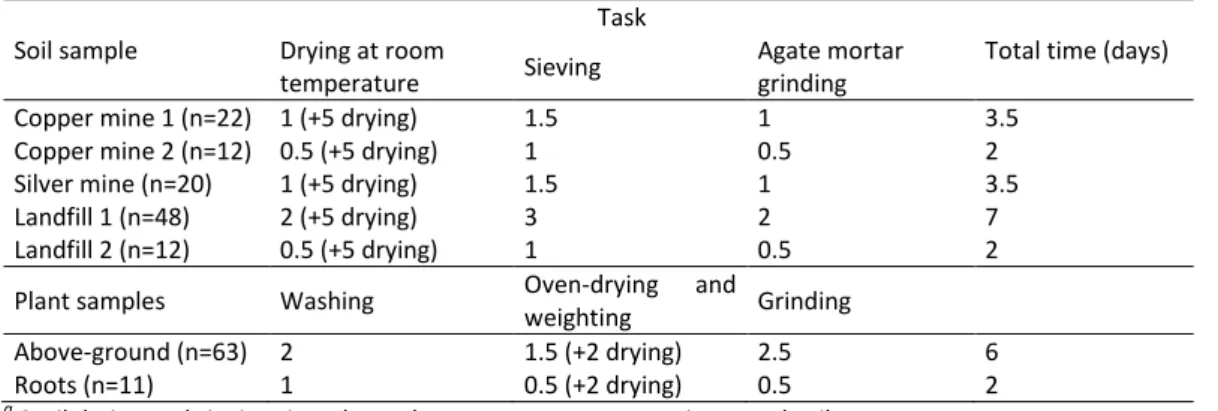
(38) Chapter 2. It should also be considered that Fe measurements have a clear second-order relation with certified standard values. This determines three concentration ranges showing different behaviour: i) a range up to 80000 mg/kg over which the FPXRF system underestimates the Fe concentration; ii) a range 80000 to 110000 mg/kg over which the system provides appropriate measurements, and iii) a range of 110000 mg/kg and higher, over which the system overestimates Fe contents. Due to selfabsorption effects, a second-order calibration is needed for XRF Fe determinations. Since this is not possible with the FPXRF system, several calibration curves are recommended for the different concentration ranges. 3.1.2 Effects of sample preparation To examine how measurements were affected by the sample preparation method, soil samples from 17 points in the landfills and 21 in the abandoned mines were measured right after their collection. Subsequently, these samples were processed in the laboratory as described above. The samples were subjected to FPXRF after drying and sieving (hereafter denoted “sieved” soil samples) and then after also grinding and pressing (hereafter denoted “pressed” soil samples). Measuring fresh samples is closely similar to in situ determinations. We checked if there were differences with results on prepared samples. Ground and pressed is the standard preparation for laboratory determination with this system. We considered drying and sieving as an intermediate step. Measurements on fresh samples were highly comparable to those obtained for the dried samples. In fact, soils of these sites with Mediterranean climate are rather dry in the sampling period (late spring), with a maximum soil moisture about 10 %. According to the instrument’s instructions a water content under 20% does not affect measurements. Results for the “sieved” samples were generally lower than for the “pressed” samples. This may be explained by the smaller particle size of the latter samples. 3.1.3 Effects of measurement time The measurement time of the FPXRF device can be varied such that the longer the measurement time the better the accuracy and precision. Six determinations of increasing measurement times were made on each of three international standards. Results showed no differences when metal contents were high except for the. 19.
(39) Field portable X-ray fluorescence for in situ metal detection. Table 2 Detection limits (mg/kg) of elements in fresh and “pressed” soil samples and soil reference standards with a 60s scanning.. measurement error calculated. Sample As Cd Cu Mn Ni Pb Zn Fresh M. 36 30 29 65 Max. 465 91 39 416 Pressed M. 23 19 17 39 Max. 175 43 19 77 Standard M. 18 28 30 56 54 12 19 Max. 279 70 48 64 128 19 19 a M - mean; Max - maximum. The high As detection limit is attributed to Pb interference. Mn, Pb and Zn concentration in soil samples was always higher than detection limit. low. by the system. However, for metal. contents,. the. detection limit improved with increasing measurement time. This means that samples with metal. contents. detection. limit. near. the. should. be. measured for 120 or 240 s to ensure proper detection. Notwithstanding, only in the case of metals of special interest would it be worth lengthening the measurement time so much. Kilbride et al.12 considered 120 s as optimal to obtain appropriate accuracy and precision. However, we found that 60 s is sufficient to correctly detect each element in our landfill and mine samples. Higher measurement times could be impractical for field work. 3.1.4 Precision study Three international standards, three “sieved” and three “pressed” landfill samples were used in this study. After taking 12 measurements on each sample, the coefficient of variation (CV) was determined as an indicator of precision. Results varied depending on the concentration of each element. Thus, precision was higher (lower CV) in samples with a higher metal concentration, which are the samples of most interest in pollution studies. Precision for the “pressed” samples was higher than for the “sieved” samples. 3.1.5 Detection limits The detection limits shown in table 2 corresponds to those determined by the system, below which the system does not give a result (<LOD). The detection limits of “sieved” samples are not shown as they are not very different from “pressed” samples. In the landfill soil samples with high Pb concentrations, As could not be detected with a detection limit over 300 mg/kg. 3.2 Determination of heavy metals in the topsoil layers of polluted sites As explained above, metals were determined in situ at different points in the five sites and soil samples were collected for subsequent determination in the laboratory.. 20.
(40) Chapter 2. Table 3 Element concentrations (mg/kg) determined by FPXRF in pressed samples from the five sites Site As Cd Cu Fe Mn Ni Pb Zn Copper mine I (N=22) M 67 n.d. 1395 32624 701 55 68 243 sd. 30 1401 7712 257 13 32 98 Max 116 6590 49957 1398 84 169 627 Min 18 123 21094 431 37 19 168 N n.d 0 22 0 0 0 12 0 0 Copper mine II (N=12) M 125 n.d. 2905 21688 411 40 77 140 sd. 100 5591 4582 119 4 35 61 Max 319 19432 34328 644 44 168 276 Min 9 25 15538 253 36 40 71 N n.d 3 12 0 0 0 9 0 0 Silver mine (N=20) M 394 21 62 34353 677 63 3483 3020 sd. 201 35 10836 407 17 3478 1683 Max 953 162 63728 1908 90 14771 6270 Min 163 26 20864 117 46 372 355 N n.d 0 19 0 0 0 15 0 0 Landfill 1 (N=48) M 167 376 791 117514 5470 372 3955 25100 sd. 299 217 1403 230299 11893 382 9363 63984 Max 1163 659 5348 1323623 60475 1442 41543 317097 Min 10 34 17 10592 217 36 19 67 N n.d 11 39 6 0 0 30 0 0 Landfill 2 (N=12) M 94 66 283 34386 2650 85 605 736 sd. 158 29 582 70493 5649 60 1712 1348 Max 647 93 4006 340794 22907 241 8118 8116 Min 14 35 28 4519 104 21 14 88 N n.d 4 10 0 0 0 4 0 2 a N - number of samples; M - mean; sd.- standard deviation; Max - maximum; Min - minimum; n.d.- not detected; N n.d. - number of samples in which the given element was not detected.. Obviously, in situ results are more variable than laboratory ones, as the latter come of a homogenizing process. However, the average of all determinations in each point is not very different from the result in laboratory determinations. In general, determinations of prepared samples are higher than the in situ ones. The greatest difference is in Cd, with a mean (and ± standard deviation) relationship between in situ and laboratory results of 1.85 ± 0.25. The lowest difference is in Fe (1,05 ± 0,27). Table 3 provides the results of the laboratory tests. The table also reveals the high heterogeneity in heavy metal concentrations shown by each site. The distributions of the different metals and their concentrations at the sites revealed by FPXRF coincide with the results of ICP-OES analyses. The table also shows that the ratio As:Pb was no higher than 1:10, such that interference problems did not arise. The Cu and Ni contents of some samples were not too high, which suggests the low. 21.
(41) Field portable X-ray fluorescence for in situ metal detection. precision of these measurements. The Fe contents of the mine soils were lower than 70000 mg/Kg, covering the range over which measurements are underestimated. In contrast, the landfill soils showed Fe contents in the ranges suggesting different qualities of measurements. Maximum Zn and Pb levels in samples from the first landfill were extremely high, much higher than those provided by ICP-OES (18136 mg/kg for Pb and 22992 mg/kg for Zn), suggesting the need for a second-order calibration as for Fe. In the study by Kilbride et al.12, FPXRF-determined soil metal concentrations were also found to be higher than ICP-OES values but the difference was much smaller. 3.3 Efficacy of FPXRF for determining heavy metal levels in plant tissue. 3.3.1 Comparison between ICP-OES and FPXRF results Since certified plant standards were not available, 74 plant samples (roots and shoots) collected from the abandoned mines containing a wide range of metals, as determined by ICP-OES, were used for this study. As with the soil standards, the assessment of FPXRF measurement quality in this type of matrix was made with plant samples. Each plant sample was divided into two aliquots for ICP-OES and FPXRF. For the field portable instrument, rather than being acid digested, samples were pressed in the system’s devices. After making determinations in the 74 samples, results were correlated with the ICP-OES results and, if necessary, the calibration curve was corrected. The regression results are shown in Table 4. Only elements occurring at sufficiently high concentrations for their FPXRF detection that could be determined by ICP-OES were examined. Measurement time was set at 60 s since we Table 4 Results of regression analysis between FPXRF and ICP-OES measurements made in plant tissue samples ICP concentration Regression results 2 range (mg/kg) Slope R N Ca 1278 - 13793 0.74 0.788 70 Cu 3 - 177 1.14 0.946 44 Fe 37 - 2793 0.74 0.978 73 K 2633 - 48184 1.06 0.936 74 Mn 6 - 439 0.63 0.913 28 Pb 0 - 593 1.04 0.953 23 Zn 17 - 2897 0.99 0.989 73 a N - number of points in the regression. Element. 22. do not consider longer times practical for field work. The FPXRF results are highly correlated with those provided by ICP-OES. In addition, the calibration curve could be corrected so results were comparable. As observed in the soil samples and in Fig. 2, measurement accuracy was.
(42) Chapter 2. Fig.2 Relationship between FPXRF and ICP-OES measurements (FPXRF / ICP) plotted against the FPXRF measurements (mg/kg). higher for the higher metal concentrations. Good quality Cu, Zn, Pb, K and Fe measurements were obtained when these occurred at the higher concentrations, and values were similar to those provided by ICP-OES (difference less than 20%). Concentrations for Ca and Mn differed considerably between FPXRF and ICP-OES so these results can only be taken as semi-quantitative. Although some plant samples showed high Cd contents when determined by ICP-OES (up to 38.5 mg/kg), FPXRF could not detect this metal, its reported detection limit being 15 mg/kg. This is a major drawback considering the important role of this metal in phytotoxicity and bioaccumulation in food webs. 3.3.2 FPXRF determinations in fresh plant samples Determinations were made in 89 fresh plant samples before and after oven drying (48 h, 70 ºC). Fresh plant tissue is expected to show lower concentrations of elements due to the important water content of this kind of samples. In fact the average water content is 52 % for grass species and even higher (74 %) for the rest of them. It was expected to find a relation according to the equation: F/D = 1 – w where F means metal concentration in fresh samples, D metal concentration in dry samples and w represents the water content. This means that the two sets of measurements (F/D) should show the relationship (1–w) represented by a line whose slope is equal to 1. For most metals, however, this relationship was barely detected (see example in Fig. 3A). In addition, when such a. 23.
(43) Field portable X-ray fluorescence for in situ metal detection. relationship did seem to exist (e.g., for K), the slope was not equal to unity, as shown in Fig. 3B. This indicates that the water content of the plant tissue Fig.3 Checking the equation F/D = 1 – w. affects. the. device’s. measurements, as reported for soils. in. the. instructions.. However, a relationship between measurements made in dry and fresh plants was identified (R2 ranging from 0.92 for Cu to 0.28 for K). Thus, in situ determinations in plants are possible as long as these aspects are kept in mind and results are taken as semi-quantitative. Nevertheless, it should be emphasized that the lower concentrations recorded in fresh plant samples means that plants with significant heavy metal contents could pass unnoticed. 3.3.3 Detection limits Detection limits in this type of matrix were much lower than those observed for the soil samples and were also lower in fresh than dry plant samples, with the exception of the limits for Ca and Cu (see Table 5). This observation has been attributed to the plant tissue matrix, which is almost transparent to X-rays.14 3.4 Economic and environmental sustainability of using the FPXRF system Results obtained in the in situ determination of most heavy metals and trace elements that can affect plants (As, Cd, Cu, Fe, Mn, Ni, Pb, and Zn) are very comparable with those obtained in laboratory and by a more frequent technique as ICP-OES. In spite of the shortcomings (low precision, above all in lower concentrations, and high detection limits), it is proven that the system is able to indicate the level of pollutants in a site and delimit pollution hotspots. Although we have tested this system in known sites, we consider that its main potential lies in screening sites whose soils are potentially polluted with heavy metals, in agreement with the claims by Loredo.15 At this preliminary stage of a pollution study, possible effects of heavy metal pollution according to land use need to be examined. Not only the FPXRF instrument could be useful in unknown potentially polluted sites, but also for monitoring polluted soil remediation measures at a given site. At both. 24.
(44) Chapter 2. Table 5 Detection limits (mg/kg) of elements in plant tissue samples Sample. As. Ca. Cd. Cu. Fe. Mn. Ni. Pb. Zn. Dry. M 4.2 108 16 6.6 30 27 19 4.7 Max 6.7 114 19 8.5 30 36 26 5.9 Fresh M 2.4 263 11 7.4 16 17 14 2.9 5.7 Max 4.6 264 11 9.1 17 22 15 3.8 6.0 a M - mean; Max - maximum; Zn concentration in dry samples was always higher than the detection limit. these stages of research, detecting pollution and its distribution is crucial. Thus, the FPXRF system is an ideal complement to the subsequent selection of samples to be analyzed more thoroughly using laboratory equipment in detailed research and intervention phases. Authors such as Kilbride et al.12 and Martín et al.16 have already used similar systems and recommend their use at these stages of research. Even though the use of laboratory XRF in plants has been reported,14 we have found no reference to its use for the in situ analysis of native plants, but other techniques have been previously investigated for detection in plants of Cd17,18 and Pb.18,19 Investigating heavy metal accumulation by plants is expensive and time-consuming since numerous plant samples from different polluted sites need to be analyzed. These studies usually have two objectives: 1) to determine the effects of heavy metals at the base of food webs; and 2) to identify metal accumulating species for phytoremediation purposes. According to Marguí et al.,14 advantages of XRF over other techniques for plant analyses are its use directly on solid samples, a high throughput and a low cost per determination. Thus, the benefits of a portable device are added to those of XRF. However, the low sensitivity limits the use of this FPXRF to plants with important accumulation capacity. Before purchasing the FPXRF system, large numbers of plant and soil samples had to be collected, prepared and analyzed to characterize the pollution state of the sealed landfills and abandoned mines examined here. Depending on soil stoniness, samples of some 1-2 kg were collected from each sampling point and transported to the laboratory. These samples were dried and sieved, and aliquots separated for the different tests. Aliquots were previously ground in an agate mortar. For the study of affected native plants, dominant plant species were collected from each sampling point in sufficient quantity for subsequent analyses. The number of plant samples depends on diversity, but from points showing most diversity we collected up to 10. 25.
Figure


+7



![Fig. 5. Bioaccumulation indices ([metal] plant · [metal] soil -1 ) calculated for the roots and shoots of oats grown in the different polluted soils](https://thumb-us.123doks.com/thumbv2/123dok_es/7333391.359103/83.892.170.684.134.530/bioaccumulation-indices-metal-plant-calculated-shoots-different-polluted.webp)

Documento similar