ASSESSMENT FOR LEARNING:
A CHALLENGE FOR TEACHERS
AND LEARNERS IN PRIMARY
EDUCATION.
GRADO EN EDUCACIÓN RIMARIA, MENCIÓN INGLÉS
TRABAJO DE FIN DE GRADO
Abstract
This work focuses on how the development of an assessment program can help the students be involved and aware of their own learning process. Its main purpose is to differentiate the different methods that can measure students’ progress. This study was centred on the develop and implementation of an assessment program during my training period in a rural CLIL public school, where I was assigned to 6th course of Primary Education. It was the first time these students saw a program like this, which made it more challenging for both the teacher and the students, who constantly needed help. When analysing the results, I could see that most of them were able to offer a feedback of their own work, and as a teacher I actually was able to systematize assessment.
Key words
Index
1.
Introduction
4
2.
Objectives
5
3.
Justification
6
3.1 Why should we develop this proposal?
6
3.2 Teaching competences related to this paper
6
4.
Theoretical foundation
8
4.1 Assessment and evaluation, definitions and differences
8
4.2 Anne Davies theory
12
4.3 Types of assessment
13
5.
Methodology and design
14
5.1 Proposal, and proposal development
14
5.1.1 Self-assessment
16
5.1.2 Peer-assessment
18
5.1.3 Teacher assessment
20
5.2 Analysis of the results
21
6.
Conclusions
23
7.
Bibliography
24
1. INTRODUCTION
It is important to have information on whether the teaching-learning process is being successful. There are different methods, which might help teachers to identify success; some of them are very punctual (evaluation) while others are based on the day-by-day progress (assessment). This means that there is a clear difference between assessment and evaluation
Assessment is used in class, but the teachers are not the only ones that use it; it is also good for the students to use the assessment if they are used to it, because it can help them on their learning process.
Teachers need information on whether their teaching is being successful or not, in order to learn and be aware of their students’ learning process.
Meanwhile learners have to know how their progress is going on, and how can they help improve their performance, although they might need to be protected from the possible discouraging effect of negative assessment, this means that the teacher is a very important part in the assessment of the students because it is the teacher who has to avoid those situations. The use of the assessment with the learners also helps to develop their autonomy through self-assessment, in which the students will revise the information they got and they will be able to judge their own work.
There is also another kind of assessment that can be used with learners: Peer-assessment, in which the students would observe and judge other students work.
2. OBJECTIVES
The present work centered on the design and implementation of an Assessment for Learning program aims at achieving the following objectives –level-at a Primary School:
- To develop the first steps of the design and implementation of an assessment program in a school during a training period.
- To set the differences that exists between the terms assessment and evaluation according to some authors.
- To get the students be involved and aware of their own learning process.
According to the BOE, ORDER ECI/2211/20071, there are some outcomes that students must command by the end of this level, which are also related to the theme developed throughout this work, and constitutes part of it:
1. Develop individual and group work habits, effort and responsibility in their studying as well as self-confidence attitudes, critical sense, personal initiative, curiosity, interest and creativity through their learning process.
2. Acquire in at least one foreign language the basic communicative competence that will allow the students to express and understand simple messages and unfold in everyday situations.
3. Use different representations and artistic expressions and get started in the constructions of visual proposals.
Farther more, when our topic centre is Evaluation, teachers should also take into consideration the grounds on which our work would be settled in order to evaluate or assess students.
According to the 13 article, BOE ORDER ECI/2211/2007, about the evaluation of the learning process and the teaching practice, teachers will evaluate the teaching process and their own work according to the achievement of the educative outcomes and the develop of the basic competences. This evaluation will include:
a) The adequacy of the objectives, contents and the evaluation criteria to the characteristics and necessities of the students.
b) The learning achieved by the students.
c) The individualization measures of teaching paying special attention to the support and reinforcement actions used.
d) The classroom program and its develop, teaching strategies, the evaluation process of students, classroom organization and the use of school resources. e) The relationship with students as well as the climate of work together.
Besides, if the school is a CLIL, Primary Bilingual Teachers are also supposed to command the following competences:
Engage students in assessment for learning.
Make connections between outcomes, learning skills and processes. Use self and peer-assessment tools.
Tell apart the characteristics of assessment and evaluation.
3. JUSTIFICATION
3.1 WHY SHOULD WE DEVELOP THIS PROPOSAL?
This research is about assessment, because Assessment is a part of students’ learning process whose importance teachers and students should be aware of.
It is a tool that allows teachers to improve the teaching-learning process. I believe that the way to control student’s progress can’t be focussed only on exams. For me, exams are not the best way to see the work that students have been doing or the best option to determine the development on students learning process.
This proposal was developed during my training period. I thought that since I was going to have a real experience in a school, I consider that I could develop a work with those students I was going to be with, so I could create the work and see the results on students.
Assessment for learning is something that has to be included in every class, and teachers should train students from Early Years starting.
This proposal was developed with students from the last course, 6thcourse, of the 3rd cycle of Primary Education. This proposal is centered on the first steps to develop an assessment program.
3.2 TEACHING COMPETENCES RELATED TO THIS PAPER
This proposal related to assessment and developed during my training period is connected to the following teaching competences2:
General competences
1. Design, plan and assess teaching-learning process.
2. Process effectively teaching-learning language situations in multicultural and plurilingual contexts
3. Design and regulate learning spaces in contexts of diversity.
4. Promote coexistence in class as well as students’ effort and perseverance.
5. Know the organization of primary schools and the diversity of actions which includes its functioning.
6. Consider the training period in order to improve as a teacher.
7. Acquire habits and skills for independent learning and promote it among students.
2In order to elaborate these competences the objectives of the title Degree in Elementary
Specific teaching skills as an English Language Teacher
1. Know the main educational currents on the teaching-learning process of a second language.
2. Know the cognitive, linguistic and communicative bases on the acquisition of a second language.
3. Promote the develop of oral and written skills.
4. Develop the general competences as well as the linguistic competences.
5. Plan what will be taught and assessed.
6. Use several assessment strategies in order to determine students’ progress.
7. Consider the Common European Framework of Reference (CEFR) for Language as a guide for self and peer assessment strategies.
4. THEORETICAL FOUNDATION
4.1 ASSESSMENT AND EVALUATION, DEFINITIONS AND
DIFFERENCES
In order to determine students’ progress teachers design different tasks, some of them are called assessment and some are defined as evaluation. As evaluation and assessment are completely different, and also meant to achieve different aims, the first step in this work must be clearing up the terms.
According to Fenton (1996) “too often these processes (evaluation and assessment) are confused, we say assess, but we mean evaluate or we use the term evaluation when we really are doing assessment.” (p. 8)
Marie Baehr, in the Program Assessment Handbook, also stated that: “educators use two distinct processes—assessment and evaluation—to help students build lifelong learning skills. Assessment provides feedback on knowledge, skills, attitudes, and work products for the purpose of elevating future performances and learning outcomes. Evaluation determines the level of quality of a performance or outcome and enables decision-making based on the level of quality demonstrated. These two processes are complementary and necessary in education.” (p. 442)
Here are some definitions of evaluation from different authors.
- Dr. Bob Kizlik (2012) in Measurement, Assessment, and Evaluation in Education3stated that: “when we evaluate, what we are doing is engaging in
some process that is designed to provide information that will help us make a judgment about a given situation. Generally, any evaluation process requires information about the situation in question. A situation is an umbrella term that takes into account such ideas as objectives, goals, standards, procedures, and so on. When we evaluate, we are saying that the process will yield information regarding the worthiness, appropriateness, goodness, validity, legality, etc., of something for which a reliable measurement or assessment has been made. (…) We evaluate every day. Teachers, in particular, are constantly evaluating students, and such evaluations are usually done in the context of comparisons between what was intended (learning, progress, behavior) and what was obtained.”
- According to Ellington, Percival and Race (1988), Mary Thorpe in "Handbook of Education Technology" said that “evaluation is the collection of, analysis and interpretation of information about any aspect of a programme of education or training as part of a recognized process of judging its effectiveness, its efficiency and any other outcomes it may have.” (p. 6)
- According to The National Academy for Academic Leadership, in their document, Assessment and evaluation in higher education: Some concepts and principles4, “evaluation uses information based on the credible evidence
3It is an online document that can be found at http://www.adprima.com/measurement.htm 4It is an online document that can be found in the page of The National Academy for Academic
generated through assessment to make judgments of relative value: the acceptability of the conditions described through assessment.”
- Fenton (1996) said that, “evaluation is the application of a standard and a decision-making system to assessment data to produce judgments about the amount and adequacy of the learning that has taken place.” (p.13)
Here are some definitions of assessment from different authors; some of them also defined evaluation.
- Huba, M. E. & Freed, J. E (2000) said that “assessment is the process of gathering and discussing information from multiple and diverse sources in order to develop a deep understanding of what students know, understand, and can do with their knowledge as a result of their educational experiences; the process culminates when assessment results are used to improve subsequent learning.” (P.45)
- According to The National Academy for Academic Leadership, in their document, Assessment and evaluation in higher education: Some concepts and principles5, “assessment is a process of determining "what is." Assessment
provides faculty members, administrators, trustees, and others with evidence, numerical or otherwise, from which they can develop useful information about their students, institutions, programs, and courses and also about themselves. This information can help them make effectual decisions about student learning and development, professional effectiveness, and program quality.”
- According to Fenton (1996), “assessment is the collection of relevant information that may be relied on for making decisions.” (p.22)
- The Higher Learning Commission (2006) in their research Making a Difference in Student Learning: Assessment as a Core Strategy, defines assessment of student
learning in the following way: “Assessment of student learning is a participatory, interactive process that:
Provides data/information you need on your students’ learning.
Engages you and others in analyzing and using this data/information to confirm and improve teaching and learning.
Guides you in making educational and institutional improvements.
Evaluates whether changes made improve/impact student learning, and documents the learning and your efforts.” (p. 75)
- In a recent study about Teaching Effectiveness Program, lead by Dr. Lee
Rumbarger, at the University of Oregon, we find this definition of assessment “the process of gathering and discussing information from multiple and diverse sources in order to develop a deep understanding of what students know, understand, and can do with their knowledge as a result of their educational
5It is an online document that can be found in the page of The National Academy for Academic
experiences; the process culminates when assessment results are used to improve subsequent learning.” (2012 p. 15)
- Cape Breton-Vitoria Regional School Board (2010-2011) include among its premises that:
“Assessment is the systematic collection, review, and use of information about educational programs undertaken for the purpose of improving student learning and development. (Palomba & Banta, 1999). It is a method for analyzing and describing student learning outcomes or program achievement of objectives. Many assessments are not tests. For programs, an interview can be an assessment, and good assessment requires feedback to those who are being assessed so that they can use that information to make improvements.
Assessment focuses on learning, teaching and outcomes. It provides information to improve learning and teaching. Assessment is an interactive process between students and faculty that informs faculty how well their students are learning what they are teaching. The information is used by faculty to make changes in the learning environment, and is shared with students to assist them in improving their learning and study habits.” (p. 5)
- In 2001, the United States National Research Council published a guidebook on educational assessment: “Knowing what Students Know: The Science and Design of Educational Assessment.” As stated therein, here is the purpose of educational assessment.
Educational Assessment seeks to determine how well students are learning and is an integrated part of the quest for improved education. It provides feedback to students, educators, parents, policy makers, and the public about the effectiveness of educational services.” (p. 1)
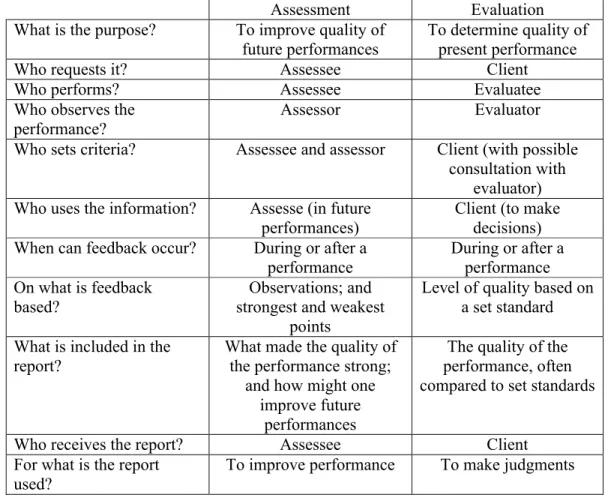
Table 1. Differences Between Processes of Assessment and Evaluation (p. 442)
There are many theories about assessment and the different types of assessments that exist and that should be developed in class, below will be named and explained some of them.
Cape Breton-Vitoria Regional School Board6 (2010-2011) includes and sets the definition of two types of assessment, the former suggested by Leskes (2002)
Formative assessment, often referred to as assessment for learning, is the assessment that is done before and during teaching to inform instruction. Formative assessment includes things like teacher–student conferences, listening in on student book discussions, taking records of children’s oral reading, examining students’ writing pieces, and so forth. Though these assessments might be standardized, they often are not. To be formative, an assessment must affect instruction. It is the gathering of information about student learning during the progression of a course or program and usually repeatedly, to improve the learning of those students. (p. 4)
While, they assume that Summative assessment, is
Often referred to as assessment of learning, is the after-the‐fact assessment in which we look back at what students have earned, such as end‐of‐course or end‐of‐year examinations. The most familiar forms are the end-of‐ year standardized tests, though in classrooms we also assess student’s learning at the end of a unit. These assessments are likely to be uniform or standardized. The purpose of summative assessment is to create a mark or grade. (p. 4)
6From the document Assessment Primer, based on the definition made by Leskes.
Assessment Evaluation
What is the purpose? To improve quality of
future performances To determine quality of present performance
Who requests it? Assessee Client
Who performs? Assessee Evaluatee
Who observes the performance?
Assessor Evaluator
Who sets criteria? Assessee and assessor Client (with possible consultation with
evaluator) Who uses the information? Assesse (in future
performances)
Client (to make decisions) When can feedback occur? During or after a
performance During or after a performance On what is feedback
based? strongest and weakest Observations; and points
Level of quality based on a set standard
What is included in the
report? What made the quality of the performance strong; and how might one
improve future performances
The quality of the performance, often compared to set standards
Who receives the report? Assessee Client
For what is the report
4.2 ANNE DAVIES THEORY
Anne Davies has developed a wide theory about Assessment, which also includes a complete web to train teachers. Anne Davies7designs a complete classroom context, which supports “assessment for learning”. Through different techniques and a complete and organized program she offers support to the student’s learning and helps them to share their learning with others. Classroom assessment, in order to support student learning, needs to involve students in the assessment process.
Students’ learning is supported by elements that appear on the classroom assessment process. Pupils need to be aware of the knowledge they already have, the knowledge they need to achieve and how success looks like, so the teacher can be sure of all students’ success particularly those who have problems. Pupils can learn the way to guide their own learning process if teachers involve them in the setting and use of criteria, giving feedback on their own learning, which is called self-assessment, setting goals and informing to others about the evidence of learning.
Teachers involve students in gather and organize a wide variety of proof of their learning. Teachers review the evidence of learning in the pupils by contrasting that learning to the learning destination, not to the learning of a partner.
Teachers know exactly what it is that students need to know and do, but they also understand the proper quality level for the curse.
The good thing about the fact that pupils are involved in the assessment process, is that they can control their own way to success. Thanks to assessment activities, that provide assessment data, the students achieve deep involvement and it helps them know what is important and what is quality.
After a short training period, teachers and researchers realized that when the students are involved in the classroom assessment process they become more aware of their own strengths, but they become also aware of the areas where they need some kind improvement. They are allowed to choose whether to take action to close the gap between the place where they are at in their learning and where they need to be.
Although some people don’t know, or they want to get to the end as soon as possible, the assessment for learning is a continuous work, which means that it has to be developed and improve throughout the entire educational stage.
The classroom assessment must be focused on the improvement of the students’ learning. The role of the teacher should be centered on keeping on learning/discovering optional roads little by little.
7Ann Davies web page is one of the leading Assessment theories more popular in the USA. It can be
4.3 TYPES OF ASSESSMENT
Going back to Europe, the Common European Framework of Reference for Languages (1999, p. 183), in the chapter 9 Assessment, it sets a clear distinction about assessment.
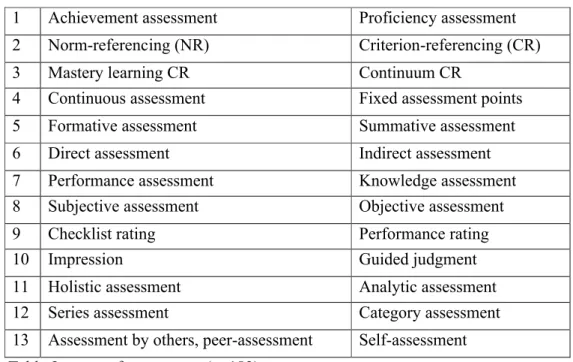
There is a list with clearly different types of assessment.
1 Achievement assessment Proficiency assessment
2 Norm-referencing (NR) Criterion-referencing (CR)
3 Mastery learning CR Continuum CR
4 Continuous assessment Fixed assessment points
5 Formative assessment Summative assessment
6 Direct assessment Indirect assessment
7 Performance assessment Knowledge assessment
8 Subjective assessment Objective assessment
9 Checklist rating Performance rating
10 Impression Guided judgment
11 Holistic assessment Analytic assessment
12 Series assessment Category assessment
13 Assessment by others, peer-assessment Self-assessment
Table 2: types of assessment (p. 183)
Below there are the descriptions of assessment by others and self-assessment according to the Common European Framework of Reference for Languages, chapter 9:
“Assessment”:
Assessment by others, peer assessment/self assessment: Assessment by others is the judgements made by the teacher or examiner.
Self-assessment is the judgements about your own proficiency.
Research suggests that provided ‘high stakes’ (e.g. whether or not you will be accepted for a course) are not involved, self-assessment can be an effective complement to tests and teacher assessment. Accuracy in self-assessment is increased when assessment is in relation to clear descriptors defining standards of proficiency and/or when assessment is related to a specific experience. This experience may itself even be a test activity. It is also probably made more accurate when learners receive some training.
5. METHODOLOGY AND DESIGN
5.1 PROPOSAL AND PROPOSAL DEVELOPMENT
This paper covers the experiences lived in a class when the use of different types of assessment with the students were analyzed.
As Anne Davies said in her theory about “What is assessment for learning”, teachers are becoming aware of the fact that when students get the chance to be involved in the assessment process, they become more aware of their own strengths and the areas that need some improvement. The students can choose to take action to close the gap between the place where they are at their own learning and where it needs to be.
This sentence has been a leading thought in this work, thus, it became one of the most important goals to achieve through the development of this proposal, to get our students involved in their own learning process and get them be aware of the steps given to succeed.
In order to make it easier to understand the main lines of the design, the next step will focus on explaining the most outstanding features about the school and the class where the proposal was developed during my training period.
The experience took place in a CLIL bilingual school, with a very short time of implementation of the program –we can say that it was a CLIL school only in the first cycle of Primary Education. This school is placed in Frómista, 30 km from Palencia. Frómista shares border with different villages that are associated with it, which means that the kids from those villages will go to this school. For the students of this school the second language subject is very important because “ El Camino de Santiago”8 crosses Frómista, and this village is one of the stages in the route where pilgrims can get their stamp for the Pilgrim’s passport. This implies that the students will have the opportunity to communicate with the pilgrims from other countries using other languages, which means that they should achieve enough level of English so as to be able to provide them directions, instructions or offer help just in case they need some.
The proposal was developed in second language subject, English, to 6thgraders. In this class there were 12 students with 5 girls and 7 boys. In the class there were different levels; two of the girls had a 2nd grade level in every subject, neither of them was from Spain, but one was from a country were they speak Spanish, while the other wasn’t and besides the language problem she had an audition problem which affected her speech also, besides all this problems, they didn’t had an English subject regular schedule, which meant that sometimes one was missing the whole lesson, some other times it was either one or the other who missed part of the lesson. Besides, one boy had a very low level of Spanish grammar and it was difficult for him to make sentences in English written or spoken; as for the rest of the students, there were some of them with a really good level of English, while others had a lower level and some others had almost no command of the language and could not communicate with their peers through English.
In order to develop the assessment program, just at the beginning of every unit decisions were taken with our class tutor about what to do or what to expect. The unit, we will refer to, was based on the student’s class book, but it had also links to the former unit that was developed with these students. The task that the students were going to perform as well as the way the data about their learning process, which was going to be collected, were also included in our tutor’s debates.
While the unit was being developed the aims/ outcomes/ expectations that students should achieve and learn according to the curricula and the textbook includes as content or the teacher’s expectations about students.
All the former elements helped to create the design of the whole unit because were taken into consideration to design the work the students were going to fulfill. In this way, assuming the decisions about the different activities that students were going to accomplish and also to plan the different lessons was easier and supported on reasons.
The unit that was developed in class was named “Robin Hood and the archery contest”. The leading lesson of this unit was the representation of the play “Robin Hood and the archery contest”.
In order to make it clearer, in appendix (page 25) are the templates of the unit developed in the class.
The outcomes that students should achieve with this unit were:
Description of a character or a person. The students made a description of a
partner saying things about the way he looked, the clothes he was wearing, the way he act, how is he with his friends…
The next thing about descriptions that the students did was a small introduction to the play in which every student was going to introduce their character saying the name and something that characterized the character they were playing.
In the students textbook appeared some activities about adjectives, and some new adjectives that the students didn’t know. In order to prepare the activities about the adjectives, first we did the exercises that appeared on the book, as an introduction.
Sing and dance a song. The students had to learnt a song about Robin Hood in
which appeared adjectives that described some characters or actions the students also had to learn a dance for the song. This was included in the representation of the play at the end of it. This was going to help the students relax after the representation.
The past tense, its use and pronunciation. In class we read the story that
appeared on the book and we worked with the past. Once we read the story the students told me the verbs that were on past and which character was the one that said them, then they said the infinitive of those verbs or the present. With this, the students were aware of the use of the past, because sometimes they used it but they were not aware of it.
The importance of a role-play. This was the leading activity of the Unit. The
them to use gestures at the same time they speak, because it could help them to get people to understand them better.
All of this was included in the assessment, because this is what they were going to work.
With the students different types of assessment were developed:
5.1.1 Self-assessment
The students had to revise and evaluate their own work.
In order to develop this kind of assessment the students had to complete an evaluation sheet and a form.
Each student had to complete the form with the impressions that they got about their own work during the rehearsals of the play, on the performance of the play and the performance of the song.
The students were going to be able to go through the work they did during the whole unit and explain a little about the impressions they got of their work.
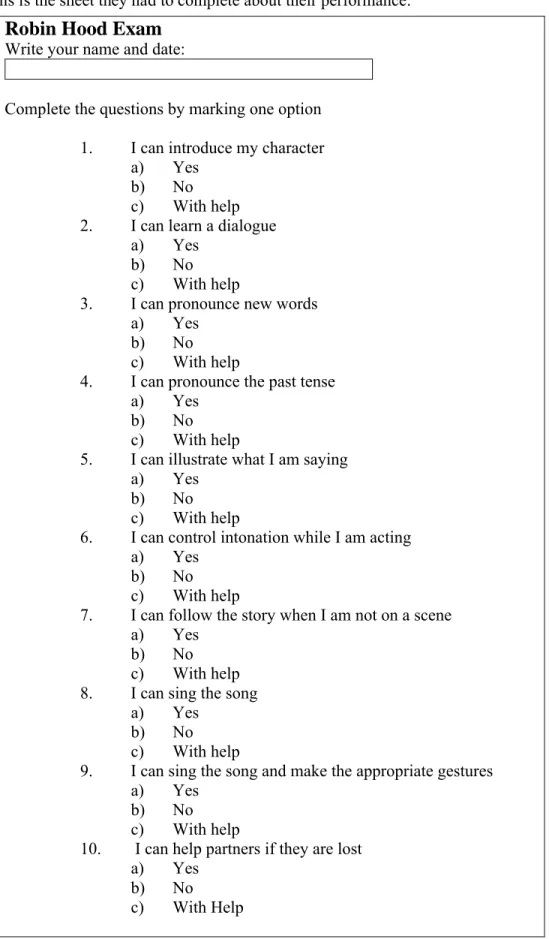
In the evaluation sheet the students had to mark a checkbox saying if they were able to do the things, if not or if they did it but with the help of a partner.
In the evaluations form the students had to complete each question explaining them. They had to answer them and then give the reasons why they thought that.
The different levels of the students were taken into consideration. While the questions were in English, the students could answer in Spanish. The students were told that the their effort was going to be valuated, it means that they could make some effort and tried to answer them in English, because there were some students that could do it in English.
Instead of give the students the form in paper, it was sent to them so they could complete it using the mini-computers. They had to complete it in class, but if anyone could do it at home, they could do it.
This is the sheet they had to complete about their performance:
Table 3: Self-assessment sheet.
Robin Hood Exam
Write your name and date:
Complete the questions by marking one option
1. I can introduce my character
a) Yes
b) No
c) With help 2. I can learn a dialogue
a) Yes
b) No
c) With help
3. I can pronounce new words
a) Yes
b) No
c) With help
4. I can pronounce the past tense
a) Yes
b) No
c) With help
5. I can illustrate what I am saying
a) Yes
b) No
c) With help
6. I can control intonation while I am acting
a) Yes
b) No
c) With help
7. I can follow the story when I am not on a scene
a) Yes
b) No
c) With help 8. I can sing the song
a) Yes
b) No
c) With help
9. I can sing the song and make the appropriate gestures
a) Yes
b) No
c) With help
10. I can help partners if they are lost
a) Yes
b) No
This is the form they had to complete about their performance:
Complete in English or Spanish (as you wish) having in mind the representation of the play: Robin Hood and the Archery Contest.
Justify your answer.
1. Did I represent my character according to the description?
2. Did I interact with my partners?
3. Could my mates understand me?
4. Was I quiet, listening to, while my partners were acting?
5. Did I help my partners when they didn’t know what they had to say?
6. Did I do the appropriate gestures while I was playing my part?
7. Did I control my voice according to what I was saying?
Table 4: Self-assessment form.
5.1.2 Peer-assessment
The students had to revise and evaluate the work of a partner.
In order to develop this type of assessment the students had to complete an evaluation sheet about the work that a partner did during the representation of the play, and the performance of the song.
Each student evaluated a partner and to decide who assessed whom, a drawing lot was held. Papers with the name of each student were on a bag, and they had to take one. The name that appeared on the paper was the partner they had to assess.
The students complete the form with the impressions they got about they partners performance and about the rehearsals of the play.
The students were going to be able to analyze a partner work about something that they also did.
There were different things they had to analyze and some things were for some people only. The students had to decide if the person they had to assess did the things that appeared on the sheet.
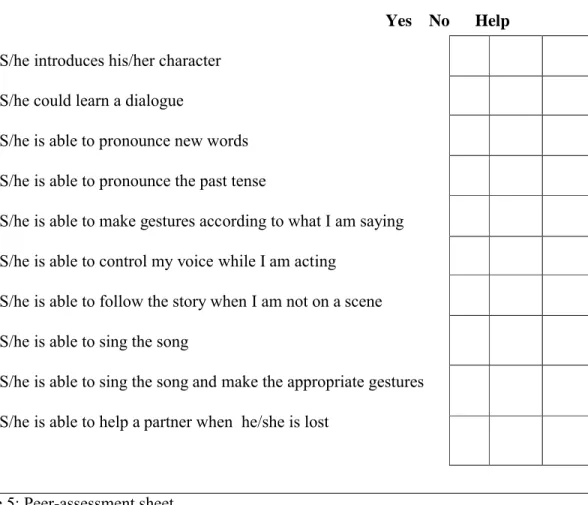
They had three options. They had to say if that person was able to do those things, if he or she did it, if not or if that person did it but with help of a partner, because it happened some times. They also had to say if that person helped a partner when someone needed help.
Before the students had the sheet, they were explained what they were going to do, that way when they had the sheet they already knew what was expected from them.
Once they had the sheet the different sentences were read with them. Between the entire class the sentences were analyzed and the students tried to understand what they meant. This helped them to understand the sheet better.
This is the form they completed:
Table 5: Peer-assessment sheet.
The students had to think about the impression they had of the way they performance the play. In order to do that the students had to complete the self-assessment sheet. Once they did it they had to complete the peer-assessment sheet.
Once they completed both assessment sheets, a video about their performance was played. The students had to observe the way they played their character, because they were going to completed the self-assessment sheet and form again, thinking about what they saw on the video.
Name: Date:
Complete by choosing yes, noor helpaccording to how do you think your partner did
the play
Yes No Help
S/he introduces his/her character
S/he could learn a dialogue
S/he is able to pronounce new words
S/he is able to pronounce the past tense
S/he is able to make gestures according to what I am saying
S/he is able to control my voice while I am acting
S/he is able to follow the story when I am not on a scene
S/he is able to sing the song
S/he is able to sing the song and make the appropriate gestures
5.1.3 Teacher assessment
This is what the teacher in the training period did to evaluate the students
In order to evaluate the students, we registered all the different steps designed in unit, comparing our expectations with the real outcomes. We also included homework, if any, their performance on the rehearsals of the play, as well as their participation when they were required to listen and follow the instructions given by the scenery director, interest while preparing or care about the others either rehearsing or in the final representation were also considered.
The teacher registered and archived all the different students’ outcomes and products, and used the criteria selected to name achievements. Besides, pupils were given the opportunity to select what they considered their best products, as part of the process of learning, as it was explained above.
5.2 ANALYSIS OF THE RESULTS
As for the results of this program it has to be said that it cannot be analyzed in a quantitative way, because the information gathered during the develop of the unit and the impressions that the teacher in training period got, were given to the tutor as the evaluation of the students, but it wasn’t set with a numerical mark.
With this assessment teachers can get a lot of information about their students, because besides the information that can be collected during every lesson they have the chance to see how students see themselves in an English class and also how they see a partner.
The first time the students completed the form and the sheet about them, some of them had problems because they didn’t understand what they were asked although it had already been explained. On the other hand some other students tried to understand it or looked for the meaning on the dictionary.
In order to complete the form with the long answers, the students had the freedom to do it in English or Spanish, as they wanted. Some students were going to be able to do it in English and so they did, while some others weren’t and they did it in Spanish.
In this class there were some students that made an effort and tried to complete the form in English, although it was more complicated for them, while others took the easy way and did it in Spanish when they could have done it in English.
With the assessment, the students had the chance to explain their thoughts however they wanted. The students had the opportunity to explain their thoughts in English, something unusual for them, but something that they should have done more often.
Everybody is a little bit lazy, especially the students, but sometimes they want to show that they can do things that no one think they can do, this gave the students the opportunity to do something different and allowed them to evaluate their own work.
By leaving the students evaluate their own work and the work of a partner, we are giving them some power on their learning process which shows them that they are important, actually they are the most important part in the teaching-learning process although sometimes we forgot about that.
The students had to complete two forms about them, one before watching their representation of the play and one after because this gave them the chance to say what they think about them without having any information about the way they did it except for their own impressions, and then they could say what were they thoughts having all the information.
interacting, speaking in English, singing and dancing and they were going to have a visual reference in which they could relate to complete the form more objectively.
The assessment in general was different from what they did during the curse, which make that they were curious about what they were going to do, but they were also afraid because it was something new form them, something they didn’t know and they didn’t know what to expect from it.
At first it was complicated for the students, because it was something new, something they didn’t done before and they didn’t know how to do it or what to look at.
I believe that if it was such a good experience was in part because it was a new experience for them and also because they had some power.
For some of the students it was really difficult, because they were not used to evaluate the work they did. Until now, they just did the work, the activities and then all they had to do was wait for someone else evaluation on their work. The fact that they had to evaluate themselves was not easy, not for anyone, because they had to say how they did it, but they had to be honest. Maybe when they thought about how was the play the lied to themselves, or maybe they didn’t even think about it, but with this they had to think about it and they had to recall their work, but not only their work because after all, they didn’t just did the self-assessment sheet, but also a peer-assessment one.
I don’t know which one was harder to complete for them because one thing was to evaluate your own work, but another is to evaluate a partner work. They had to think about how another person acted, talked, interacted with the other partners…
6. CONCLUSIONS
As can be deduced with this proposal, there are different methods that can measure the learning progress of the students, evaluation and assessment.
Those two methods shouldn’t be used individually, because they complement each other. Both of them provide different information about the students’ development. On one hand the evaluation provides information of the students in a punctual moment, while the assessment gives continuous information throughout the entire students’ learning process.
During the training period the first steps of an assessment program were developed despite the lack of knowledge the students had about that topic.
This proposal has helped to know at what point, related to assessment, those students were. The students from that class had an initiation on an assessment program, but the work with them is far from over, because there is a lot of work to do with them in order to improve their teaching-learning process.
This proposal makes clear that an assessment program is an ongoing process that has to be developed with the students through their entire educational stage. Although the proposal developed in this paper was about the first steps a teacher could take to start implementing an assessment proposal with students that never did it before, it doesn’t mean that it should stop there.
7. BIBLIOGRAPHY
BIBLIOGRAPHY FOR OBJECTIVES
- ANECA (2005). Libro Blanco. Título de Grado en Magisterio. Vol. 1.
- Bertaux, P. et all (2010). The CLIL teacher’s competence grid.
http://www.ccnclil.eu/index.php?name=Content&nodeIDX=3857 (Research: 16thJuly 2013)
- MINISTERIO DE EDUCACIÓN Y CIENCIA (2007). BOE num.173. ORDEN ECI/2211/2007, de 12 de julio, por la que se establece el currículo y se regula la ordenación de la Educación primaria.
BIBLIOGRAPHY ABOUT EVALUATION AND ASSESSMENT
- Baehr, M Program Assessment handbook, An Overview of Assessment.
- Fenton, R. (1996). Performance assessment system development. Alaska
Educational Research Journal, (8-22).
BIBLIOGRAPHY ABOUT EVALUATION
- Ellington, H, Percival, F, and Race, (1993) "Handbook of Educational Technology",Kogan Page, London
- Kilzik, B. (2006) Measurement, Assessment and Evaluation in Education.
http://www.adprima.com/measurement.htm(Research: 20thJuly 2013)
- National Academy for Academic Leadership, Assessment and evaluation in higher education: Some concepts and principles.
http://www.thenationalacademy.org/readings/assessandeval.html (Research: 13hJuly 2013)
BIBLIOGRAPHY ABOUT ASSESSMENT
- Council of Europe (2001). Common European Framework of Reference for Languages: Learning, Teaching Assessment (CEFR). Cambridge: Cambridge University Press.
http://www.coe.int/t/dg4/linguistic/Source/Framework_en.pdf(Research: 11th July 2013)
- Higher Learning Commission (2006) Making a Difference in Student Learning: Assessment as a Core Strategy
campuses: Shifting the focus from teaching to learning(pp. 32-64).
Needham Heights, MA: Allyn & Bacon.
- Palomba & Banta (1999). “Assessment Essentials: Planning, Implementing, and Improving Assessment in Higher Education”.Jossey-Bass Publishers,San
Francisco.
- United States National Research Council (2001). “Knowing What Students Know: The Science and Design of Educational Assessment”. National Academy
About the unit/ Where this unit fits
Unit 4: Robin Hood and the Archery Contest
During this Unit students will work with the past, but to do it we will work with the legend and a play of Robin Hood.
Prior Learning
Language used in the unit
Important Resources
- The students have seen the Disney movie: Robin Hood, so they know what is the legend about. - They know what is a
legend and the format they have.
- Adjectives to descriptions
-Word level: spelling strategies -Sentence level: specific vocabulary -Text level: written report
-Non-verbal language: eye contact, illustrators.
-Mini computers -Digital board -Book
-Online book:
http://elt.oup.com/student/surprise/level6/;j sessionid=F395125EC25F61AC81E58F8E ABF8BC90?cc=global&selLanguage=en
Expectations
At the end of this unit all the children must
-Describe a partner.
-Introduce their character and represent the play with help of their partners. - Sing part of the song.
-Make the gestures of the song with the help of partners. -Complete a self-assessment sheet.
-Complete a peer-assessment sheet. At the end of
this unit most of the
children should
-Describe a partner.
-Introduce their character and represent the play by themselves. -Sing the song and make the gestures.
-Make a book review.
-Complete a self-assessment sheet.
-Complete a self-assessment form with long answers in Spanish. -Complete a peer-assessment sheet.
At the end of this unit some of the children could
-Describe a partner
-Introduce their character and represent the play with the appropriate gestures. -Sing the song and make the appropriate gestures
-Make a book review
-Complete a self-assessment sheet
28
Lessons Overview
Lesson Learning goals Learning outcomes Main activity Assessment criteria
1 -To know how to describe a
person
-To sing the song and dance
-Be able to use new adjectives -Be able to write a description of a partner.
Key competences:
Linguistic communication Social competence
Create a description of
appearance and character of a partner
Kids will:
-Said at least one thing about their partner
2
-To identify the verbs of the text. -To identify which verbs are in past and which ones are in present.
-Say the present and infinitive of those verbs
-To sing the song and dance
-Be able to identify the verbs that appear in a text and say their tense.
Key competences:
Linguistic communication Autonomy and personal initiative
Write the verbs that appear in the text. For those which appear in past, write the present and the infinitive.
Kids will:
-Name at least one verb
3
-To sing the song and dance -To introduce the character they are going to play on the Robin Hood play.
-To pronounce the past tense of the verbs.
-Be able to sing and dance the song
-Be able to introduce their character
-Be able to pronounce their lines appropriate.
Key competences: Autonomy and personal initiative
Present their character and pronounce their lines appropriate.
Kids will:
4
-To introduce the character by themselves.
-To rehears the play.
-To sing and dance the song.
-Be able to introduce their character including gestures. -Be able to represent the play scene by scene.
-Be able to sing and dance the song doing the appropriate gestures.
Key competences:
Linguistic communication Autonomy and personal initiative
Rehears the play scene by scene doing the appropriate gestures.
Kids will:
-Rehears the play -Make the appropriate gestures.
5
-To rehears the play doing the appropriate gestures, with the appropriate intonation, and introducing the character.
-Be able to rehears the play without the paper.
-Be able to do the appropriate gestures, make the appropriate intonation and introduce their character.
Key competences:
Linguistic communication Autonomy and personal initiative
Rehears the play complete without the paper and doing the appropriate gestures and with the appropriate intonation.
Kids will:
-Rehears the play without the paper doing the appropriate gestures.
6
-To represent the play in front of people from other courses.
-Be able to represent the play doing the appropriate gestures, using the right intonation. Key competences
Linguistic communication Autonomy and personal initiative
Social competence
The students will represent the play.
Kids will:
30
7
8
9
10
-To represent the play. -To evaluate their own performance during the representation of the play.
-Be able to represent the play again.
-Be able to complete a form about their performance Key competences
Autonomy and personal initiative
Linguistic communication
The students will complete a self-assessment sheet and a form.
Kids will:
-Complete the self-assessment sheet and a form.
-To evaluate their own performance during the representation of the play. -To evaluate a partner performance during the representation of the play.
-Be able to complete a form about their performance. -Be able to complete a sheet about a partner performance. Key competences
Autonomy and personal initiative.
Linguistic communication Social competence
The students will complete the self-assessment sheet and form, and a peer-assessment sheet
Kids will:
-Complete the self-assessment sheet and form.
-Complete the peer-assessment sheet.
-To evaluate their performance after watch it on a video.
-To make a book review
-Be able to complete a self-assessment sheet and form after watching their performance on a video.
Key competences
Autonomy and personal initiative
Linguistic communication
The students will complete the self-assessment sheet and form after watching the video with their performance
Kids will:
-Complete the self-assessment sheet and form according to what they saw on the video.
-To make a book review
-Be able to make a book review and answer some questions about that book.
Key competences
Linguistic communication
The students will read their book review out loud and then they will answer their partner’s questions about that book.
Kids will:
32
Lesson 1
Learning objectives Learning outcomes Evidence for Assessment
-To know how to describe a person -To sing the song and dance
-Be able to use new adjectives
-Be able to write a description of a partner.
Kids will:
-Said at least one thing about their partner
Discourse/Text targeted Language targeted- Non-verbal L Targeted
Description: -Identification -Describe
-Eye contact -Affect displayers
Outline of leading activities
Create a description of appearance and character of a partner
C la s s ro o m M a n a g e m e n t Timin g Groupin
g Pupils Teacher Resources
1 min Everybo
dy
Say hello to the teacher and follow the date and weather routines.
Enter to the class, say hello to the students and follow the date and the weather
routines.
-3 min Everybo
dy
Get the books and read the part about the adjectives.
Tell the students to get their books and
read the part about the adjectives. -Class Book
10 min
Everybo dy
Listen to the teacher s explanation and then complete the activity sheet.
Explain the students the activity about adjectives showing them the activity sheet. Then give them the sheet.
-Activity sheet
7 min Everybo
dy
Correct the activity sheet with the teacher.
Correct the activity sheet about adjectives out loud with the students and the help of the board.
10 min
Everybo dy
Describe the partner that the teacher chooses.
Ask the students to help describe a partner. Write the things that the students say on the board so everybody can see them.
-A student as example
-Board
5 min Everybo
dy
Read the song of the book after the teacher.
Read the song of the book with the
students. Make them repeat what it is read. -Class Book
18 min
Everybo dy
Sing the song and imitate the gestures the teacher is doing,
Sing the song and make the gestures so the students can do them too.
-Computer -Online book
5 min Teacher Listen to the teacher s explanation Explain the students the homework.
-1 min Everybo
dy
Clean up the desks. Say goodbye to the teachers.
Ask the students to clean up the desks. Say goodbye to the students and leave the class.
-Assessment Criteria
All children must be able to
Describe the appearance of a partner. Dance most of the song.
Most of the children will be able to Describe the appearance of a partner and part of the character.
Dance the song and sing part of it.
Some of the children could Describe the appearance and the character of a partner.
Sing and dance the song.
Lesson 2
34
-To identify the verbs of the text.
-To identify which verbs are in past and which ones are in present.
-Say the present and infinitive of those verbs
-To sing the song and dance
-Be able to identify the verbs that appear in a text and say their tense.
Kids will:
-Name at least one verb
Discourse/Text targeted Language targeted- Non-verbal L Targeted
Description: -Identification -Describe
Eye contact Affect displayers
Outline of leading activities
Write the verbs that appear in the text. For those which appear in past, write the present and the infinitive
C la s s ro o m M a n a g e m e n t
Timing Grouping Pupils Teacher Resources
1 min Everybod
y
Say hello to the teacher and follow the date and weather routines.
Enter to the class, say hello to the students and follow the date and the weather routines.
-30 sec Teacher - Check every student homework’s
-25 min Everybod
y
Read the descriptions out loud and
complete the partner s descriptions
about someone else.
Ask the students to read the descriptions out loud. Ask if everybody agree and add some things to the descriptions. Write the new things on the board.
-Student s
descriptions. -Board
5 min Everybod
y
Read the story of Robin Hood with the teacher
Read the story of Robin Hood with the
5 min Students Read in silence the story of Robin Hood from the book.
Ask the students to read the story of Robin
Hood individually. -Class Book
5 min Everybod
y
Find the verbs that appear on the story.
Ask the students to find the verbs that
appear on the story. -Class Book
6 min Everybod
y
Tell the teacher the verbs that appear on the story.
Ask the students to say the verbs that they see. Write the verbs on the board.
-Class Book -Board
6 min Everybod
y
Change the tense of the verbs and write them on the notebook.
Ask the students to change the tense of those verbs and write them on their notebook.
-Board -Notebook
5 min Everybod
y Sing and dance the song. Sing and dance the song. -Online Book
1 min 30 sec
Everybod
y Clean up and say goodbye.
Give the students the screenplay of
Robin Hood and the Archery Contest .
Ask the students to clean up, say goodbye and leave the class.
-Assessment Criteria
All children must be able to -Read their descriptions out loud. -Name one verb.
Most of the children will be able to -Read their descriptions out loud. -Add one thing to their partner s descriptions.
-Name every verb
Some of the children could -Read their descriptions out loud -Add several things to their partner s descriptions.
-Name every verb.
36
Lesson 3
Learning objectives Learning outcomes Evidence for Assessment
-To sing the song and dance
-To introduce the character they are going to play on the Robin Hood play. -To pronounce the past tense of the verbs.
-Be able to sing and dance the song
-Be able to introduce their character
-Be able to pronounce their lines appropriate.
Kids will:
-Describe their character
-Pronounce the lines the way the teacher does.
Discourse/Text targeted Language targeted- Non-verbal L Targeted
Description: -Identification -Describe
Eye contact
Outline of leading activities
Present their character and pronounce their lines appropriate.
C
la
s
s
ro
o
m
M
a
n
a
g
e
m
e
n
t Timing Grouping Pupils Teacher Resources
1 min Everybody Say hello to the teacher and follow the
date and weather routines.
Enter to the class, say hello to the students and follow the date and the weather routines.
-2 min Everybody Read the song out loud. Read the song with the students. -Class Book
5 min Everybody Sing and dance the song. Sing and dance the song. -Online book
8 min Everybody Listen to the teacher s explanation and
introduce the character.
Show the students how to make an introduction of a character and ask the students to introduce their character.
7 min Everybody Read the scenes with the teacher. Read each scene with the students. -Screenplay
15 min Everybody Read the scenes with the teacher and
imitate the gestures the teacher does.
Read the scenes with the students and
mark the gestures they'll have to do. -Screenplay
18 min Everybody
Rehears the play with the teacher marking the past and making the gestures.
Rehears the play with the students
marking the past and making the gestures. -Screenplay
3 min Everybody Sing and dance the song. Sing and dance the song. -Online Book
1 min Everybody Listen to the teacher and say goodbye.
Ask the students to study the screenplay. Say goodbye to the students and leave the class.
Assessment Criteria
All children must be able to -Read the play out loud. -Sing the song.
Most of the children will be able to -Read the play out loud.
-Make some of the gestures. -Sing the song.
-Dance the song
38
Lesson 4
Learning objectives Learning outcomes Evidence for Assessment
-To introduce the character by themselves.
-To rehears the play.
-To sing and dance the song.
-Be able to introduce their character including gestures. -Be able to represent the play scene by scene.
-Be able to sing and dance the song doing the
appropriate gestures.
Kids will:
-Rehears the play
-Make the appropriate gestures.
Discourse/Text targeted Language targeted- Non-verbal L Targeted
Description: -Identification -Describe
-Eye contact -Affect displayer
Outline of leading activities
Rehears the play scene by scene doing the appropriate gestures.
C
la
s
s
ro
o
m
M
a
n
a
g
e
m
e
n
t
Timin
g Grouping Pupils Teacher Resources
1 min Everybod
y
Say hello to the teacher and follow the date and weather routines.
Enter to the class, say hello to the students and follow the date and the weather routines
-9 min Everybod
y Introduce their characters.
Ask the students to introduce their
-2 min Everybod
y Line up and in silence move to the library.
Ask the students to line up and in silence
move to the library.
-40 min
Everybod
y Rehears scene by scene.
Rehears with the students scene by
scene. -Screenplay
2 min Everybod
y Line up and in silence return to the class.
Ask the students to line up and in silence
return to the class.
-5 min 30 sec
Everybod
y Sing and dance the song. Sing and dance the song. -Digital Book
30 sec
Everybod
y Say goodbye to the teacher.
Say goodbye to the students and leave the
class.
-Assessment Criteria
All children must be able to
-Introduce their character, if necessary with help.
-Sing the song.
Most of the children will be able to -Introduce their character.
-Represent their part with the help of the paper.
-Make some of the gestures. -Sing the song.
-Dance the song
Some of the children could -Introduce their character.
-Represent their part, if necessary with the help of the paper.
40
Lesson 5
Learning objectives Learning outcomes Evidence for Assessment
-To rehears the play doing the appropriate gestures, with the
appropriate intonation, and introducing the character.
-Be able to rehears the play without the paper.
-Be able to do the
appropriate gestures, make the appropriate intonation and introduce their character.
Kids will:
-Rehears the play without the paper doing the appropriate gestures.
Discourse/Text targeted Language targeted- Non-verbal L Targeted
Description: -Identification -Describe -Eye contact -Affect displayers -Paralanguage Outline of leading activities
Rehears the play complete without the paper and doing the appropriate gestures and with the appropriate intonation.
C la s s ro o m M a n a g e m e n
t Timing Grouping Pupils Teacher Resources
1 min 30 sec
Everybod y
Say hello to the teacher and follow the date and weather routines.
Enter to the class, say hello to the students and follow the date and the weather routines
-2 min Everybod
y Line up and in silence move to the library.
Ask the students to line up and in silence
move to the library.
-46
min Students
Rehears the play, including the introduction
-8 min Students Sing and dance the song - -Digital Book
2 min Everybod
y Line up and return to class in silence.
Ask the students to line up and return to
class in silence.
-30 sec
Everybod
y Say goodbye to the teachers. Say goodbye and leave the class.
-Assessment Criteria
All children must be able to
-Introduce their character, if necessary with help.
-Sing the song.
Most of the children will be able to -Introduce their character.
-Represent their part with the help of the paper.
-Make some of the gestures. -Sing the song.
-Dance the song
Some of the children could -Introduce their character.
-Represent their part, if necessary with the help of the paper.
42
Lesson 6
Learning objectives Learning outcomes Evidence for Assessment
-To represent the play in front of people from other courses.
-Be able to represent the play doing the appropriate
gestures, using the right intonation
Kids will:
-Represent the play doing the gestures and using the right intonation.
Discourse/Text targeted Language targeted- Non-verbal L Targeted
Description: -Identification -Describe -Eye contact -Paralanguage -Affect displayers Outline of leading activities
The students will represent the play.
C la s s ro o m M a n a g e m e n tTiming Groupin
g Pupils Teacher Resources
2 min Student
s
The students will introduce the play and
their characters.
--Stage scenery -Costumes
10 min Student
s
The students will represent the play and
sing the song.
--Stage scenery -Costumes -Song Assessment Criteria
All children must be able to
-Introduce their character, if necessary with help.
-Say their lines, if necessary with help.
Most of the children will be able to -Introduce their character.
-Say their lines, if necessary with help.
Some of the children could -Introduce their character. -Say their lines.
Lesson 7
Learning objectives Learning outcomes Evidence for Assessment
-To represent the play.
-To evaluate their own performance during the representation of the play.
-Be able to represent the play again.
-Be able to complete a form about their performance
Kids will:
-Complete the self-assessment sheet and a form.
Discourse/Text targeted Language targeted- Non-verbal L Targeted
Description: -Identification -Describe -Eye contact -Affect displayers -Paralanguage Outline of leading activities
The students will complete a self-assessment sheet and a form.
C la s s ro o m M a n a g e m e n t
Timing Grouping Pupils Teacher Resources
2 min Everybod
y
Say hello to the teachers and follow the date and weather routines.
Move to the library in silence.
Enter to the class, say hello to the students and follow the date and the weather routines.
Ask the students to move to the library in silence
-Costumes
10 min Students The students will represent the play and sing the
song.
--Stage scenery -Costumes -Song
10 min Students The students will represent the play and sing the
song.
--Stage scenery -Costumes -Song
2 min Everybod
y Clean up and return to class in silence.
Ask the students to clean up and return to class
44
7 min Everybod
y Change their clothes and pick up the costumes.
Ask the students to change their clothes and pick
up the costumes.
-1 min Everybod
y Take the mini computers and switch them on.
Ask the students to take and switch on their mini
computers. -Mini computers
10 min Teacher Listen to the teacher s explanation. Explain the students the form and sheet they'll
have to complete about their performance.
-1 min Everybod
y Open the form Send the form to the students
-Mini computers -Computer
15 min Everybod
y
Revise the form with the teacher and look for
things they don t understand.
Take a look with the students to the form and
explain the parts they don t understand.
-Mini computers -Projector
1 min Teacher Listen to the teacher s explanation Tell the students to complete the form at home if
they can.
-1 min Everybod
y
Switch off the mini computers, clean up and say goodbye.
Tell the students to switch off the computers,
clean up. Say goodbye and leave the class. -Mini computers
Assessment Criteria
All children must be able to
-Introduce their character, if necessary with help.
-Say their lines, if necessary with help.
Most of the children will be able to -Introduce their character.
-Say their lines, if necessary with help.
Some of the children could -Introduce their character. -Say their lines.