P
Respiratory Impact of Electronic
Cigarettes and “Low-Risk” Tobacco
Ireri Thirión-Romero
1, Rogelio Pérez-Padilla
1, Gustavo Zabert
2and Inti Barrientos-Gutiérrez
3*
1Department of Research in Tobacco and COPD, Instituto Nacional de Enfermedades Respiratorias Ismael Cosío Villegas, Mexico City, Mexico; 2Facultad de Ciencias Médicas, Universidad Nacional del Comahue, Cipolletti, Río Negro, Argentina; 3Department of Tobacco Research, Center for Population Health Research, Instituto Nacional de Salud Pública, Cuernavaca, MexicoReceived for publication: 02-06-2018 Approved for publication: 28-08-2018 doi: 10.24875/RIC.18002616
ABSTRACT
Electronic cigarettes, handheld devices that generate an aerosol that may contain nicotine by heating a solution or e-liquid, have been increasingly used especially in the young population. The aerosol’s composition is determined by temperature, and by the substances contained in the heated liquid: glycerin, propylene glycol, nicotine in variable concentrations, flavoring agents, and other non-nicotine compounds. >80 compounds (including known toxics, e.g., formaldehyde, acetaldehyde, metallic nanopar-ticles, and acrolein) have been found in e-liquid and aerosols. Airway irritation, mucus hypersecretion, and inflammatory response, including systemic changes, have been observed after the exposure to e-cigarettes, leading to an increase in respiratory symp-toms and changes in respiratory function and the host defense mechanisms. E-cigarette has been linked with an increase of symptoms in individuals with asthma, cystic fibrosis, and chronic obstructive pulmonary disease. One of the major concerns in public health is the rise in e-cigarette experimentation among never-smokers, especially children and adolescents, which leads to nicotine addiction and increases the chances of becoming with time a conventional smoker. There is an urgent need to regulate e-cigarettes and electronic nicotine delivery systems, at least with the same restrictions to those applied to tobacco products, and not to consider them as harmless products. (REV INVEST CLIN. 2019;71:17-27)
Key words: Chronic obstructive pulmonary disease. Tobacco. E-cigarettes. Lung health.
Corresponding author:
*Inti Barrientos-Gutiérrez
Department of Tobacco Research Center for Population Health Research National Institute of Public Health C.P. 62100, Cuernavaca, Mor., Mexico E-mail: [email protected]
INTRODUCTION
Electronic cigarettes, also known as “e-cigarettes,” “e-cigs,” “cigalikes,” “e-hookahs,” “mods,” “vape pens,” “vapes” or “tank systems,” refer to a device that de-livers nicotine through the respiratory system, thus their proposed technical name of electronic nicotine
delivery system (ENDS)1,2. A recently released ENDS,
launched by Phillip Morris as IQOS, was designed to produce an aerosol by heating tobacco without burn-ing it. This “heat-not-burn” device is a novel ENDS different from e-cigs. ENDS not only disembarked widely in the tobacco consumer’s market but also has introduced a wedge in the scientific smoking-cessa-tion and tobacco-control advocacy communities.
The first commercially available e-cigs device was de-veloped in China, in 2003, as an alternative to smok-ing in places where smoksmok-ing regular cigarettes were prohibited3,4. It was named Ruyan, a Chinese word for
“resembling smoking,” and unlike nicotine patches, gum or lozenges it was not designed as a pharmaco-logic tool for smoking cessation but to deliver “enjoy-able” nicotine and overcome regulations5.
E-cigs are by definition handheld devices that generate an aerosol, improperly named as “vapor,” by heating a solution or e-liquid. The generic e-cig is a battery-powered device that heats a metal coil to atomize the e-liquid drawn by wicks, typically made of cotton or silica, from a cartridge or a refilling reservoir1,2,4.
Al-though e-cigs are diverse in terms of design, technol-ogy, and liquid filling system, they all operate simi-larly. Activation is triggered by pressing a button or
by airflow sensor in the mouthpiece so that the gen-erated vapor is disposed by inhalation into the respi-ratory system, resulting in variable exposures, deposi-tion, and absorption depending on the composideposi-tion, device and inhalation patterns1,2 (Fig. 1).
Composition of the aerosol, particles suspended in gas, is determined by temperature and the substanc-es contained in the heated liquid. E-liquids are solu-tions that contain vegetable glycerin (VG), propylene glycol (PG), nicotine in variable concentrations, flavor-ing agents, and other non-nicotine compounds2,4. Up
to 7700 different flavoring components in e-ciga-rettes have been described in the market1.
Although manufacturers have proposed standardiza-tion for e-liquid, they offer scarce accurate informa-tion about the chemical components in the e-liquid and the e-cigarette aerosol1,6. >80 compounds have
been found in e-liquid and aerosols, while PG and VG are the liquid vehicle through which the heating pro-cess generates formaldehyde, acetaldehyde, and ac-rolein by pyrolysis. Other identified substances are nicotine, acetone, benzaldehyde, siloxanes, reactive oxygen species, volatile organic compounds, polycy-clic aromatic hydrocarbons, and tobacco-specific ni-trosamines (TSNAs), including N-nitrosonornicotine (NNN)2,6,7. Even when the nicotine concentration, as
well as that of other components, is listed on the labels of e-cigarette cartridges and refill solutions, large differences have been described between brands, and in some e-liquids labeled as “no nicotine,” a high nicotine content was found. Total TSNAs, NNN, nicotine-derived nitrosamine ketone (NNK), and N′-nitrosoanatabine have also been found with 3 order of magnitude variation between different brands. Nickel-chromium, chromium-aluminum-iron, copper, silver, zinc, tin, or manganese have been de-scribed as metal nanoparticles in the e-liquid and va-por as toxins resulting from the device’s components and the heating process. Nickel contained in the e-cig aerosol was 2-100 times higher than in tobacco smoke8.
E-cigarette aerosol is not produced by combustion. Therefore, neither smoke nor carbon monoxide is emitted. Although there is no side steam vapor, in chamber studies and model café environments, a low level of most of the vapor components can be found in the air9. Furthermore, serum cotinine was similar in Figure 1. Structure of an e-cigarette. E-cigarettes have some
basic components as shown, although new generations have changed considerably the shape. Most current models differ considerably from a cigarette. 1: Battery: usually
recharge-able, and as other batteries with the possibility of leaks and explosions. 2: Heating coil: amount of vapor depends on
temperature, and new devices can modify it. 3: Vaporizing
non-smoking bystanders’ exposure to aerosol and smokes using machine-smoked e-cigarettes and ciga-rettes10.
E-cig’s aerosol is a source of high exposure of the human respiratory system to fine particles (100-160 nm); their size and concentration are similar to those of tobacco smoke11. Since the composition, inhalation
and exposure pattern to e-cig aerosol and tobacco smoke are very different, the health consequences and risks should not be evaluated with the same model.
E-cigs and tobacco cigarettes have similar patterns of particle deposition in the lungs, and nicotine is rap-idly absorbed and delivered to the brain. Early phar-macologic reports found that nicotine delivery was significantly slower with e-cigs compared to regular cigarettes, but more recent evidence shows that nico-tine levels are influenced by e-cig generation, inhala-tion patterns, and users’ experience1,12. In some
late-generation devices, users can increase the heating temperature and therefore, modify the aerosol com-position by increasing up to 2.5-fold the nicotine, formaldehyde, acetaldehyde, and acetone content as well as carbonyl compounds2,7,12,13.
Although the toxins’ concentration of e-cig’s aerosol is significantly lower than that in tobacco cigarette smoke, there is no clinical evidence to support the long-term use so far14-16.
EPIDEMIOLOGY
Epidemiological definition of e-cigarette vapor expo-sure is challenging since the term user may include from those who use it daily to those who have only used it once or twice4,17-19. Some studies report
e-cigarette users as ever, regularly or daily users but in any case, the device, filling system, and/or e-liquid used are considered. The heterogeneity and impreci-sion of this exposure must be taken into consider-ation as a source of inaccuracy while appraising vap-ing as a health risk factor.
E-cigarettes were launched in China, in 2003, but they were commercially available in the marketplace in the United States and Europe since 200720. Based on a
2014 market report on brands (466), sales (3000 M US$) and forecast of sales for 2030 to increase by a factor of 17, the use of e-cigarettes are apparently escalating21.
Estimations of e-cigarette use around the world are questionable due to the definition of prevalence. The most reliable data are from International Tobacco Control (ITC)20. In a survey to current and former
smokers older than 18 years from 10 different coun-tries between 2009 and 2013, 34% were aware of the e-cigarette, and 4% had tried it20. The authors
observed considerable cross-country variation by year of data collection, for awareness (33-88%), and pres-ent use of e-cigarettes (<1-14%).
E-cigarette use among young people is a major pub-lic health concern globally since it may lead or prog-ress to conventional smoking of cigarettes22,23. In
Europe, e-cigarette use was associated with younger age and heavier tobacco use. Regular e-cigarette prevalence was also associated with the current (20.3%), former (4.7%), and never (1.2%) tobacco smoker condition24. The prevalence of ever, current
(at least 1 in the past 30 days), and regular (at least 20 in the past 30 days) e-cigarette use reported in the US, in 2017, was 7.7%, 2.1%, and 0.9%, respec-tively25. Since 2014, self-report of e-cigarette use
among youth exceeded conventional cigarette’s con-sumption1.
In Mexico, ENCODAT (National Drugs, Alcohol and Tobacco Use Survey, Encuesta Nacional de Consumo de Drogas, Alcohol y Tabaco) revealed that the prev-alence of use of e-cigarettes for 2016-2017 was 0.6%, lower in women (0.4%) than in men (0.9%). These figures estimate that 5 million persons ever experimented with e-cigarettes, and almost 1 million are regular users26. In 2015, 10% of secondary school
students tried e-cigarettes22. A 2016 survey among
teenagers 11 and 16 years old in Mexico City, Mon-terrey and Guadalajara revealed a prevalence of hav-ing ever experienced e-cig of 35% and 31%, and regular use, 14% and 13%, respectively; of them, 5-7% declared having initiated tobacco smoking after experiencing with e-cigarettes27,28.
and friends smoking tobacco, and tendency for drug-seeking22,29.
Two waves of the National Adult Tobacco Survey (2012-2013 and 2013-2014) explored characteris-tics of tobacco quitters and of those who switched to e-cigarettes. Male gender (odds ratio [OR] 1.2; 95% confidence interval [CI], 1.0-1.5) and younger age (18-24 years old; OR 3.6, 95% CI 2.4-5.5) were as-sociated with e-cigarette use before quitting30.
Tobacco and e-cigarette consumers declared to use e-cigarettes as an aid to quit smoking (52.6%), to avoid second-hand tobacco smoke (16.1%), and also as a harm-reduction tool (8%)19,22.
Regulation of ENDS varies significantly between coun-tries, and to date, there is no consensus among the ITC community20. While in the UK there are few
re-strictions and ENDS is widely available, the US Food and Drug Administration (FDA) proposed regulations similar to those for traditional tobacco products, and FCTC’s COP recommended objective-based regula-tions (prevent initiation in non-smokers and youth, reduce ENDS’ health risks and second-hand emissions, prevent unproven health claims, protect tobacco con-trol activities, avoid commercial interests, in particu-lar, and of tobacco industry)31.
THE HEALTH RISK DILEMMA
OF E-CIGARETTES
Since Doll’s report, in 1954, uncontroversial evidence has been growing regarding the burden of health consequences of smoking tobacco. However, a glob-al heglob-alth response consistent with the magnitude of the challenge was launched only half a century lat-er32. Along the XXI century, the world will still be
facing hundreds of millions of deaths as a toll of nicotine addiction and tobacco industry revenues. The tobacco documents released in 1998 as a re-sponse to a legal action revealed the ignominious and systematic efforts of these cartels to prevent the decline of their trade33. In fact, one of the
strat-egies of tobacco manufacturers in the 60s was to launch light and low-tar cigarettes as less harmful smoking. Subsequent studies not only failed to dem-onstrate the health benefits of smoking light and
low-tar cigarettes versus standard cigarettes but also they observed an increase in the risk as well1,34.
Faced with the categorical evidence of the burden of tobacco deaths, the tobacco industry developed a broad and comprehensive strategy to preserve and expand their market. Creating doubt and controversy around the health risks of tobacco, and promoting falsely safer smoking products were cornerstones of this strategy. During the 70 s and 80 s, filtered or “light” and “low” tar or “low” nicotine cigarettes cre-ated among smokers a wrong impression of being less harmful than others, which may have curbed their motivation to quit smoking. The WHO Framework Convention on Tobacco Control Art 11 addressed and promoted parties to regulate tobacco product pack-aging and labeling to avoid by any means false, mis-leading, and deceptive messages32.
E-cigarette is now reloading the dilemma of low-risk nicotine consumption through the respiratory sys-tem. The cornerstone argument of e-cigarette sup-porters is that the vapor’s concentration of toxic substances is significantly lower than that of tobacco smoke35-37.
By modeling analysis, a selected number of drug ex-perts estimated the harm of nicotine products, con-cluding that e-cigarette’s relative harm is 5% com-pared to cigarettes. Some limitations to this argument should also be addressed apart from the conflict of interest warned by journals’ editors. First, there is a clear inductive fallacy in the paper by Nutt et al., since harm reduction was estimated based on the authors’ opinion while they recognized the lack of hard evi-dence for the harm of most of the nicotine prod-ucts35. Second, the process for recruiting experts was
not specified, resulting in potentially serious selection bias. Finally, asking the experts to assign a scale val-ue based on their subjective perception of harm for each product, and the difference in damage between the most and least harmful products in 16 dimen-sions, leads to several criticisms, as has been ob-served38.
MECHANISMS OF DAMAGE
OF E-CIGARETTES
There is no doubt that the concentration of ingredi-ents in e-cigarettes’ aerosol is significantly lower than that of combustible cigarettes, but this does not mean that it is “harmless vapor.” As described, e-cigarettes are a novel source of high concentrations of submicron-sized particles, and users are subjected to an unusual and original model of inhalation expo-sure since the inhalation pattern of e-cigarettes in terms of length, volume, and puffing frequency is dif-ferent from that of conventional cigarettes. The aero-sol generated “in vitro” has particle sizes in the range of 100-600 nm, similar to the conventional cigarettes. Other studies described a bimodal particle size distri-bution: 11-25 nm and p 96-175 nm11. One report
estimated that 6.25 × 10¹⁰ particles generated would
be deposited in the respiratory system while most particle depositions would occur in the alveolar re-gion2. Ultrafine particles, <100 nm, were described to
cause DNA damage, pro-inflammatory cytokine ex-pression and production of free oxygen radicals11.
Among the aerosol’s contents described above, po-tent carcinogens such as NNN and NNK were identi-fied in the vapors generated from a different brand of e-cigarettes40. TSNAs are related to curing and
pro-cessing tobacco, or possibly with the addition of to-bacco flavorings1,41. Formaldehyde, acetaldehyde, and
acrolein are well-known potent irritants and toxics and have been found exceeding the National Institute of Occupational Safety and Health recommended level for short-term exposure6. There is also growing
concern for the presence of heavy metals in e-liquids as potential carcinogens42.
Flavoring components of e-cigarettes are major con-tributors of carbonyl species production2. In one
re-port, diacetyl (DA, the most well-known artificial fla-voring) and acetyl propionyl were found in 28.3% of a sample of e-liquids. These substances were associ-ated with bronchiolitis obliterans that cause fixed ob-structive lung disease1. Nicotine concentrations in the
e-cigarette vapor vary more widely than in conven-tional cigarette’s smoke1. Most e-liquids, even those
labeled as “nicotine free,” contain nicotine and 60-70% of the nicotine is the one released by the aero-sol9,13. E-liquid labels report the nicotine
concentra-tion, but this is inaccurate. Goniewicz et al. estimated
an average of 82.8 mg of nicotine per 100 mL of aero-sol in an 18-mg nicotine cartridge, and in those e-cig-arettes in which 15 puffs are equivalent to smoking one cigarette41. A typical cigarette delivers
approxi-mately 2 mg of nicotine to its smoker, and the lethal dose LD50 is 60 mg2. The evidence supports that
nico-tine availability in e-cigarettes is effective to saturate brain receptors and to avoid abstinence symptoms43,44.
The systemic and airways’ changes observed after exposure to e-cigarette aerosol may be explained by different mechanisms, some of which are still under debate and research:
Aldehydes (formaldehyde and acrolein) exposure has been associated with altered epithelial response, mu-cus hypersecretion, activation, and degranulation of neutrophils and induction of neutrophil apoptosis12.
Exposures to e-cig aerosol induce measurable oxida-tive and inflammatory responses in lung cells and tis-sues, and in bronchial epithelial cells cause acute tox-icity and reduce the antiviral response45,46. E-cigarette
users show increased proteins secretion in sputum related to the innate defense functions of leukocytes, bronchial inflammation, and structural damage. These include neutrophil elastase, proteinase 3, azurocidin 1, and myeoloperoxidase as well as other secondary neutrophil granule proteins12.
Exposure to e-cigarette induces platelet aggregation and upregulates expression of CD41, CD42b, and CD62p, independently of nicotine content and expo-sure time possibly due to fine particulate matter. These facts may be the hallmarks of cardiovascular and other systemic diseases47.
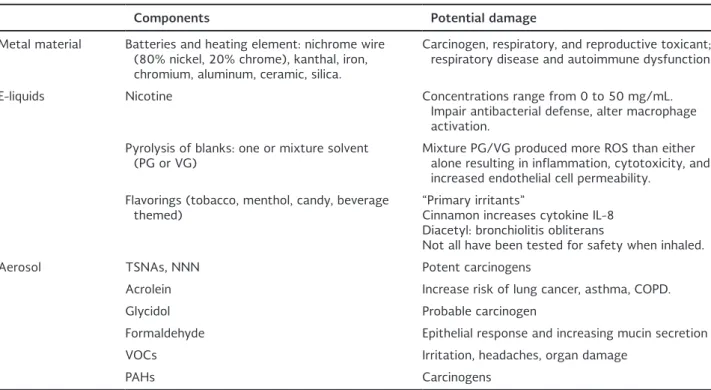
E-cigarettes have been linked to lung and systemic damage (Table 1), with consistent evidence and bio-logic plausibility that the constituents of e-cigarettes’ aerosol cause airway irritation, bronchitis, cough, phlegm, bronchoconstriction, platelet dysfunction, and carcinogenic changes among others (Fig. 2).
IN VITRO DAMAGE BY E-CIGARETTES
AND EVIDENCE IN ANIMAL MODELS
important gaps to understand fully the burden of harms from this distinctive and varied exposure2. In
vitro exposure of human bronchial cells to e-ciga-rettes’ carrier solution containing PG and/or VG de-creased cell metabolic activity, bronchial cell viability and cilia activity, and increased mitochondrial oxida-tive stress (consistent with reduced glutathione lev-els)2,13. Some reports suggest that artificial flavoring
and nicotine concentrations may influence these dys-functions45,48-50. In vivo, short-term exposure to
e-cigarette aerosols in mice models reproduced similar changes resulting in oxidative stress, macrophage-mediated inflammation, and lung injury with increased capillary permeability45,51. Furthermore, exposure to
e-cigarette aerosol in mice showed impaired bacterial and influenza A clearance, increase in lung viral titers, and deleterious effects in morbidity and mortality51.
Other report highlighted the increase of bacterial load, especially of methicillin-resistant Staphylococ-cus aureus, pneumococcal adhesion to upper and lower airway epithelial cells, and increased macro-phages in bronchoalveolar lavage samples, but with impaired bacterial phagocytosis and increased alveo-lar-capillary permeability2,52.
One report explored long-term exposure to e-ciga-rette aerosol containing nicotine in a mouse model and human bronchial epithelial cells and revealed changes as a causative factor of progression of chron-ic obstructive pulmonary disease (COPD), including cytokine expression, airway hyperreactivity, and lung tissue destruction53.
SYSTEMIC IMPACT OF E-CIGARETTES
IN HUMANS
Nicotine induces stimulation of the sympathetic ner-vous system, with tachycardia, increase in blood pressure and cardiac output, leading to an increase in myocardial oxygen consumption as well as vaso-constriction of cutaneous and coronary blood ves-sels54. Increased cardiac sympathetic activity
associ-ated to regular smoking was described 20 years ago and, lately, similar effects were observed for e-ciga-rette as well as oxidative stress and inflammation signaling55-57. Recently, evidence of population-based
e-cigarette impact on cardiovascular health has been reported56,57.
Table 1. Components of e-cigarettes and potential damage.
Components Potential damage
Metal material Batteries and heating element: nichrome wire (80% nickel, 20% chrome), kanthal, iron, chromium, aluminum, ceramic, silica.
Carcinogen, respiratory, and reproductive toxicant; respiratory disease and autoimmune dysfunction.
E-liquids Nicotine Concentrations range from 0 to 50 mg/mL. Impair antibacterial defense, alter macrophage activation.
Pyrolysis of blanks: one or mixture solvent
(PG or VG) Mixture PG/VG produced more ROS than either alone resulting in inflammation, cytotoxicity, and increased endothelial cell permeability.
Flavorings (tobacco, menthol, candy, beverage
themed) “Primary irritants”Cinnamon increases cytokine IL-8 Diacetyl: bronchiolitis obliterans
Not all have been tested for safety when inhaled.
Aerosol TSNAs, NNN Potent carcinogens
Acrolein Increase risk of lung cancer, asthma, COPD.
Glycidol Probable carcinogen
Formaldehyde Epithelial response and increasing mucin secretion
VOCs Irritation, headaches, organ damage
PAHs Carcinogens
There is considerable evidence that carcinogenic sub-stances and some compounds causing DNA damage and mutagenesis have been detected in e-cigarette aerosols, but there is no available evidence so far that e-cigarette use is associated with cancer, abnormal fetal development, or immune defects leading to in-creased risk of respiratory infections18. However, the
period of observation since the massive launch of e-cigarettes is too short to analyze the occurrence of cancer. On the other hand, there is usually a time gap between the description of toxicologic impacts on in vitro or in vivo models and the description of clinical or epidemiologic outcomes. The diversity of the de-vices and exposures is also barriers to categorize the exposure18.
Other reported risks associated with e-cigarette use include device explosions, accidental, and intentional poisoning with PG and nicotine overdose in children,
increased circulating endothelial progenitor cells, and potential acute endothelial injury, and nickel contact dermatitis2,18.
EVIDENCE OF PULMONARY DAMAGE
ASSOCIATED WITH E-CIGARETTE
EXPOSURE IN HUMANS
While evidence of median and long-term adverse ef-fects of e-cigarette exposure on the respiratory sys-tem emerges, it is desirable to review and monitor intermediate outcomes, such as alterations in lung structure and function and respiratory symptoms18.
Most of the information comes from dual users (smoking tobacco and e-cigs) or individuals switching completely from conventional tobacco smoking to e-cigarettes, thus avoiding a valid comparison of users of e-cigs versus unexposed individuals2,58,59. Studies Figure 2. Probable mechanisms of lung abnormalities with e-cigarette. The combination between high temperature and several components of e-aerosol including particulate matter (1) has the potential of generating pro-inflammatory effects, production
of reactive oxygen species in lung with varied consequences such as airway hyperreactivity, increased airway resistance, de-creased antimicrobial activity, dede-creased alveolar development, endothelial disruption, and fragmentation of fibroblasts (2).
Systemic changes are produced by nicotine with increases in heart rate and blood pressure, as well as an addiction with all consequences including tolerance, craving, abstinence, and change to normal cigarettes or inhalation of other liquids containing other drugs (3).
in healthy e-cigarette users revealed an increase in oxidative stress, nitric oxide deficiency, and endothe-lial/vascular dysfunction; acute and short-time expo-sure to PG in aerosol from artificial smoke generators resulted in ocular and respiratory symptoms and del-eterious lung function in healthy non-asthmatic pa-tients, but this evidence, in contrast with the effect of tobacco smoke, is considered marginal13,60,61.
Exposure to e-cigarette aerosol has been associated with respiratory symptoms in healthy individuals, changes in respiratory physiology and host defense, and with increased symptoms in asthma, cystic fibro-sis (CF), and COPD2.
There is growing evidence that adolescents who were exposed to e-cigarettes more often have cough and phlegm (OR 2.1, 95% CI 1.8-2.5)62,63. Adolescents
using e-cigarettes more frequently report not only respiratory symptoms but also school absentee-ism18,64. Airway exposure to nicotincontaining
e-cigarette vapor inhibits bronchial and nasal mucocili-ary clearance, with the production of a cough and rhino-nasal symptoms, compared with individuals unexposed to e-cigarette aerosol18,65.
Short-term exposure to e-cigarette with and without nicotine in healthy adults increases airway resistance and reduces nitric oxide in exhaled air (fractional ex-haled nitric oxide, FeNO)1,18,66. This evidence is
con-sistent with a report that revealed decreased pulmo-nary function (decrease in forced expiratory volume in one second [FEV1], FEV1/forced vital capacity; and increase in airflow resistance) after exposure to aero-solized PG in healthy humans2,10,66. So far, there is
neither evidence supporting long-term safety nor im-provements in lung function in smokers who switch to e-cigarettes, as is observed in quitters67.
Recent evidence reports parenchymal and bronchial inflammation, lung damage and toxicity (e.g., lipoid pneumonia), as well as impaired systemic inflamma-tion signaling, and defense mechanisms associated with e-cigarette exposure12,58.
E-CIGARETTE AND MORE COMMON
LUNG DISEASES
A recent report revealed that the prevalence of ever use of e-cigarettes was higher among adults with one
or more comorbidities, compared with those without comorbidities, and in smokers with COPD, asthma, and cardiovascular disease compared to “healthy” smokers68. Use of e-cigarette was associated with
higher odds of asthma symptoms, considering ciga-rette smoking and marijuana use69. Adolescents with
asthma or CF who use e-cigarettes were more likely to have respiratory symptoms and exacerbations18,64.
Common flavoring agents in e-cigarettes are recog-nized as “primary irritants” of mucosal tissue of the respiratory tract; airway irritants and sensitizers have been reported to cause occupational asthma64.
In patients with COPD, the use of e-cigarettes has been associated with more cough and phlegm, more exacerbations and possibly a more rapid decline in lung function, even after adjusting for tobacco smok-ing and age70.
E-cigarettes have been shown to lower indoor air qual-ity, and non-smokers have been found to absorb nic-otine from second-hand vaping comparable to passive smoking2,9. Although passive exposure to e-cigarette
vaping does not include combustion of toxic agents, there is significant secondhand exposure to nicotine in the exposure chamber, leading to serum cotinine levels among those exposed that can be higher than levels obtained from conventional cigarettes9.
SMOKING CESSATION WITH
E-CIGARETTES
Two Cochrane reviews had explored in 2014 and 2016 the effectiveness of e-cigarettes for smoking cessation and safety, and both agreed on the low quality of the evidence based only on a small number of studies; therefore, further research was suggest-ed71-75. The latter meta-analysis revealed that
absti-nence was higher among e-cigarette users compared with placebo, but no effect was observed comparing e-cigarettes with nicotine patches. Despite the scarce information, supporters of e-cigarettes promote them as a better option to smoking or to reduce cigarette consumption in a harm-reduction strategy, while skeptic tobacco-control actors alert of a boost in the nicotine market by attracting youths that may later start smoking regular cigarettes73,76,77.
addiction through early experimentation by children and adolescents, since e-cigarettes saturate the nico-tinic receptors in the brain as much as conventional cigarettes do28,69,78.
Recent “aggressive” and restriction-free e-cigarette advertisements in internet sites, social media and movies resulted in a growing awareness, perception of safer behavior than smoking, and increased appeal and interest to try e-cigarettes79,80. Data from the US,
Canada, United Kingdom, and Australia obtained in the ITC project revealed a higher prevalence of e-cigarette use among young and non-daily smokers, as a consequence of feeling that vaping was safe. How-ever, teens and young adults from the US who have used e-cigarettes were in a significantly higher risk of smoking regular cigarettes in the following years (OR 3.87; 95% CI, 1.86-8.06), a risk also found in a new longitudinal study in Great Britain (OR 1.34; 95% CI, 1.05-1.72; p=0.018)29,78,81. A recent meta-analysis
confirmed that e-cigarette experimentation among never smokers almost quadrupled the chances of be-coming a smoker at follow-up82.
Flavoring or taste in e-cigarette not only stimulated experimentation and initiation behaviors but also in-creased the risk of smoking combustible ciga-rettes83,84. These facts may partially explain the
dra-matic increase in e-cigarette use among youths observed in the US, UK, Italy, Poland, South Korea and Finland, and among other countries.
A key public health challenge is e-cigarette initiation in a never-smoker youth, as it may not only cause harm to the respiratory system but also lead to smoke regular cigarettes and vape other substances, like cannabis derivatives.
The awareness of e-cigarettes’ potential health risk, their regulation as tobacco products, and the promo-tion of banning must be considered among other ac-tions to prevent the evolving scenario3,18. In the US,
FDA e-cigarette policies resulted in a significant de-cline of e-cigarette use among young persons, in 201685.
In established smokers, an e-cigarette may be less deleterious to the respiratory system, but so far there is insufficient evidence of whether e-cigarettes increase the likelihood of smoking cessation19.
Furthermore, existing reports fail to compare e-ciga-rettes with state-of-the-art proven therapies.
CONCLUSION
For >50 years, a solid body of incontrovertible evi-dence revealed that smoking cigarettes are a cause of disease in almost every organ of the body1. In the
early 60s, it was a challenge to prove the real burden of tobacco on global health, as the evidence required decades to emerge entirely; in the meantime, millions of deaths occurred. Now, e-cigarettes emerged, spread promptly, and challenge the scientific, and public health community, since they have to act to control and regulate the market based on public health, even with incomplete proofs and evidence, which are needed without delay7,86.
ENDS, and particularly e-cigarettes, are devices that effectively deposit nicotine in the brain and generate nicotine addiction. These e-cigarette aerosols contain fewer toxins than tobacco smoke, but a safety com-parator must be clean air breathing. There is growing evidence of the presence of a variety of toxic prod-ucts in vaporizing liquids in e-cigarettes that result in chemical, morphologic, and functional deleterious ef-fects in in vitro and in vivo models12,47. Evidence for
acute respiratory damage and toxicity is evolving, but data on mid- and long-term effects are still lacking as well as standardization models to compare different devices.
It is urgent to regulate e-cigarette design, e-liquid and aerosol composition, health warnings, marketing, pro-motion, sales, taxation, and secondhand vapor expo-sure at least at a level equivalent to that of regular tobacco products22,78.
REFERENCES
1. Disease Control Center for Chronic Disease Prevention, Promo-tion on Smoking. E-Cigarette use among Youth and Young Adults: A Report of the Surgeon General. Rockville, MD: Depart-ment of Health Services for Disease; 2016
2. Chun LF, Moazed F, Calfee CS, Matthay MA, Gotts JE. Pulmonary toxicity of e-cigarettes. Am J Physiol Lung Cell Mol Physiol. 2017;313:L193-206
3. Monraz-Pérez S, Regalado-Pineda J, Pérez-Padilla R. El cigarro electrónico: peligro u oportunidad. Neumol Cir Torax. 2015; 74:82-6
5. Barbara D. A high-tech Approach to Getting a Nicotine Fix. The Electronic Cigarette-a Gadget that looks like the Real Thing and Delivers Nicotine Without Smoke-is Established in China, and Companies are Taking aim at the U.S. market. Los Angeles Times; 2009
6. Herrington JS, Myers C. Electronic cigarette solutions and resul-tant aerosol profiles. J Chromatogr A. 2015;1418:192-9 7. Breland A, Soule E, Lopez A, et al. Electronic cigarettes: what are
they and what do they do? Ann N Y Acad Sci. 2017;1394:5-30 8. Williams M, Villarreal A, Bozhilov K, Lin S, Talbot P. Metal and
silicate particles including nanoparticles are present in electron-ic cigarette cartomizer fluid and aerosol. PLoS One. 2013; 8:e57987
9. Czogala J, Goniewicz ML, Fidelus B, et al. Secondhand exposure to vapors from electronic cigarettes. Nicotine Tob Res. 2014; 16:655-62
10. Flouris AD, Chorti MS, Poulianiti KP, et al. Acute impact of active and passive electronic cigarette smoking on serum cotinine and lung function. Inhal Toxicol. 2013;25:91-101
11. Zhang Y, Sumner W, Chen DR. In vitro particle size distributions in electronic and conventional cigarette aerosols suggest com-parable deposition patterns. Nicotine Tob Res. 2013;15:501-8 12. Reidel B, Radicioni G, Clapp PW, et al. E-cigarette use causes a
unique innate immune response in the lung, involving increased neutrophilic activation and altered mucin secretion. Am J Respir Crit Care Med. 2018;197:492-501
13. Cai H, Wang C. Graphical review: the redox dark side of e-ciga-rettes; exposure to oxidants and public health concerns. Redox Biol. 2017;13:402-6
14. Callahan-Lyon P. Electronic cigarettes: human health effects. Tob Control. 2014;23 Suppl 2:ii36-40
15. Dinakar C, O’Connor GT. The health effects of electronic ciga-rettes. N Engl J Med. 2016;375:1372-81
16. Schraufnagel DE, Blasi F, Drummond MB, et al. Electronic ciga-rettes. A position statement of the forum of international respi-ratory societies. Am J Respir Crit Care Med. 2014;190:611-8 17. Amato MS, Boyle RG, Levy D. How to define e-cigarette
preva-lence? Finding clues in the use frequency distribution. Tob Con-trol. 2016;25:e24-9
18. Stratton K, Kwan LY, Eaton DL. Committee on the Review of the Health Effects of Electronic Nicotine Delivery Systems, Board on Population Health and Public Health Practice, Health and Medi-cine Division, National Academies of Sciences, Engineering, and Medicine. Public Health Consequences of E-Cigarettes. Wash-ington, D.C. National Academies Press; 2018
19. Biener L, Hargraves JL. A longitudinal study of electronic ciga-rette use among a population-based sample of adult smokers: association with smoking cessation and motivation to quit. Nicotine Tob Res. 2015;17:127-33
20. Gravely S, Fong GT, Cummings KM, et al. Awareness, trial, and current use of electronic cigarettes in 10 countries: findings from the ITC project. Int J Environ Res Public Health. 2014; 11:11691-704
21. Conference of the Parties to the WHO Framework Convention on Tobacco Control. Electronic nicotine delivery systems. FCTC/ COP/6/10 Rev.1; 2014
22. Thrasher JF, Abad-Vivero EN, Barrientos-Gutíerrez I, et al. Prev-alence and correlates of E-cigarette perceptions and trial among early adolescents in Mexico. J Adolesc Health. 2016;58:358-65 23. Lozano P, Barrientos-Gutierrez I, Arillo-Santillan E, et al. A lon-gitudinal study of electronic cigarette use and onset of conven-tional cigarette smoking and marijuana use among Mexican adolescents. Drug Alcohol Depend. 2017;180:427-30
24. Vardavas CI, Filippidis FT, Agaku IT. Determinants and preva-lence of e-cigarette use throughout the European Union: a sec-ondary analysis of 26/566 youth and adults from 27 countries. Tob Control. 2015;24:442-8
25. Levy DT, Yuan Z, Li Y. The prevalence and characteristics of E-cigarette users in the U.S. Int J Environ Res Public Health. 2017;14:10
26. Secretaría de Salud. ENCODAT Encuesta Nacional de Consumo de Drogas, Alcohol y Tabaco 2016-2017 Reporte de Tabaco; 2017 27. Instituto Nacional de Salud Pública. Consumo de Nicotina en
Alumnos de Secundaria, 2016. Tabaco y cine en América Latina. México: Instituto Nacional de Salud Pública; 2016
28. Instituto Nacional de Salud Pública. Consumo de Substancias en Alumnos de Secundaria, 2015-2016. Tabaco y cine en América Latina. México: INSP; 2016
29. East K, Hitchman SC, Bakolis I, et al. The association between smoking and electronic cigarette use in a cohort of young peo-ple. J Adolesc Health. 2018;62:539-47
30. Park SH, Duncan DT, Shahawy OE, et al. Characteristics of adults who switched from cigarette smoking to E-cigarettes. Am J Prev Med. 2017;53:652-60
31. David K. The Deeming Rule: Vape Shops. Division of ment and Manufacturing Office of Compliance and Enforce-ment, CTP, FDA; 2016
32. World Health Organization. WHO Framework Convention on Tobacco Control. Geneva: World Health Organization; 2003 33. World Health Organization. The Tobacco Industry Documents
What they are, What They Tell us, and How to Search Them. A Practical Manual. Geneva, Switzerland: World Health Organiza-tion; 2004
34. U.S Department of Health and Human Services Food and Drug Administration Center for Tobacco Products. Guidance for In-dustry and FDA Staff. Use of Light, Mild, Low, or Similar Descrip-tors in the Label, Labeling, or Advertising of Tobacco Products. U.S Department of Health and Human Services Food and Drug Administration Center for Tobacco Products; 2010
35. Nutt DJ, Phillips LD, Balfour D, et al. Estimating the harms of nicotine-containing products using the MCDA approach. Eur Ad-dict Res. 2014;20:218-25
36. Hajek P, Etter JF, Benowitz N, Eissenberg T, McRobbie H. Elec-tronic cigarettes: review of use, content, safety, effects on smokers and potential for harm and benefit. Addiction. 2014; 109:1801-10
37. Farsalinos KE, Polosa R. Safety evaluation and risk assessment of electronic cigarettes as tobacco cigarette substitutes: a sys-tematic review. Ther Adv Drug Saf. 2014;5:67-86
38. Polosa R. E-cigarettes: public health England’s evidence based confusion? Lancet. 2015;386:1237-8
39. McNeill A, Brose LS, Calder R, Hitchman SC. E-cigarettes: An Evidence Update. London: A Report Commissioned by Public Health England; 2015
40. Goniewicz ML, Knysak J, Gawron M, et al. Levels of selected carcinogens and toxicants in vapour from electronic cigarettes. Tob Control. 2014;23:133-9
41. Goniewicz ML, Kuma T, Gawron M, Knysak J, Kosmider L. Nico-tine levels in electronic cigarettes. NicoNico-tine Tob Res. 2013; 15:158-66
42. Hess CA, Olmedo P, Navas-Acien A, et al. E-cigarettes as a source of toxic and potentially carcinogenic metals. Environ Res. 2017;152:221-5
43. Vansickel AR, Weaver MF, Eissenberg T. Clinical laboratory as-sessment of the abuse liability of an electronic cigarette. Addic-tion. 2012;107:1493-500
44. Farsalinos KE, Spyrou A, Tsimopoulou K, et al. Nicotine absorp-tion from electronic cigarette use: comparison between first and new-generation devices. Sci Rep. 2014;4:4133
45. Lerner CA, Sundar IK, Yao H, et al. Vapors produced by elec-tronic cigarettes and e-juices with flavorings induce toxicity, oxidative stress, and inflammatory response in lung epithelial cells and in mouse lung. PLoS One. 2015;10:e0116732 46. Higham A, Bostock D, Booth G, Dungwa JV, Singh D. The effect
of electronic cigarette and tobacco smoke exposure on COPD bronchial epithelial cell inflammatory responses. Int J Chron Ob-struct Pulmon Dis. 2018;13:989-1000
47. Hom S, Chen L, Wang T, et al. Platelet activation, adhesion, in-flammation, and aggregation potential are altered in the pres-ence of electronic cigarette extracts of variable nicotine con-centrations. Platelets. 2016;27:694-702
48. Leigh NJ, Lawton RI, Hershberger PA, Goniewicz ML. Flavourings significantly affect inhalation toxicity of aerosol generated from electronic nicotine delivery systems (ENDS). Tob Control. 2016; 25:ii81-7
49. Scheffler S, Dieken H, Krischenowski O, et al. Evaluation of E-cigarette liquid vapor and mainstream E-cigarette smoke after direct exposure of primary human bronchial epithelial cells. Int J Environ Res Public Health. 2015;12:3915-25
50. Schweitzer KS, Chen SX, Law S, et al. Endothelial disruptive proinflammatory effects of nicotine and e-cigarette vapor ex-posures. Am J Physiol Lung Cell Mol Physiol. 2015;309:L175-87 51. Sussan TE, Gajghate S, Thimmulappa RK, et al. Exposure to
electronic cigarettes impairs pulmonary anti-bacterial and anti-viral defenses in a mouse model. PLoS One. 2015; 10:e0116861
52. Miyashita L, Suri R, Dearing E, et al. E-cigarette vapour en-hances pneumococcal adherence to airway epithelial cells. Eur Respir J. 2018;51:1-10.
54. Benowitz NL. Pharmacology of nicotine: addiction, smoking-in-duced disease, and therapeutics. Annu Rev Pharmacol Toxicol. 2009;49:57-71
55. Narkiewicz K, van de Borne PJ, Hausberg M, et al. Cigarette smoking increases sympathetic outflow in humans. Circulation. 1998;98:528-34
56. Moheimani RS, Bhetraratana M, Yin F, et al. Increased cardiac sympathetic activity and oxidative stress in habitual electronic cigarette users: implications for cardiovascular risk. JAMA Car-diol. 2017;2:278-84
57. Qasim H, Karim ZA, Rivera JO, Khasawneh FT, Alshbool FZ. Impact of electronic cigarettes on the cardiovascular system. J Am Heart Assoc. 2017;6:1-14.
58. Shields PG, Berman M, Brasky TM, et al. A review of pulmonary toxicity of electronic cigarettes in the context of smoking: a focus on inflammation. Cancer Epidemiol Biomarkers Prev. 2017;26:1175-91
59. Polosa R, Cibella F, Caponnetto P, et al. Health impact of E-cigarettes: a prospective 3.5-year study of regular daily users who have never smoked. Sci Rep. 2017;7:13825
60. Wieslander G, Norbäck D, Lindgren T. Experimental exposure to propylene glycol mist in aviation emergency training: acute ocular and respiratory effects. Occup Environ Med. 2001; 58:649-55
61. Polosa R, Russell C, Nitzkin J, Farsalinos KE. A critique of the US surgeon general’s conclusions regarding e-cigarette use among youth and young adults in the United States of America. Harm Reduct J. 2017;14:61
62. McConnell R, Barrington-Trimis JL, Wang K, et al. Electronic cigarette use and respiratory symptoms in adolescents. Am J Respir Crit Care Med. 2017;195:1043-9
63. Cho JH, Paik SY. Association between electronic cigarette use and asthma among high school students in South Korea. PLoS One. 2016;11:e0151022
64. Clapp PW, Jaspers I. Electronic cigarettes: their constituents and potential links to asthma. Curr Allergy Asthma Rep. 2017;17:79 65. Kumral TL, Saltürk Z, Yildirim G, et al. How does electronic
cigarette smoking affect sinonasal symptoms and nasal muco-ciliary clearance? B-ENT. 2016;12:17-21
66. Vardavas CI, Anagnostopoulos N, Kougias M, et al. Short-term pulmonary effects of using an electronic cigarette: impact on respiratory flow resistance, impedance, and exhaled nitric oxide. Chest. 2012;141:1400-6
67. Anthonisen NR, Connett JE, Murray RP. Smoking and lung func-tion of lung health study participants after 11 years. Am J Respir Crit Care Med. 2002;166:675-9
68. Kruse GR, Kalkhoran S, Rigotti NA. Use of electronic cigarettes among U.S. Adults with medical comorbidities. Am J Prev Med. 2017;52:798-804
69. Schweitzer RJ, Wills TA, Tam E, Pagano I, Choi K. E-cigarette use and asthma in a multiethnic sample of adolescents. Prev Med. 2017;105:226-31
70. Bowler RP, Hansel NN, Jacobson S, et al. Electronic cigarette use in US adults at risk for or with COPD: analysis from two obser-vational cohorts. J Gen Intern Med. 2017;32:1315-22
71. McRobbie H, Bullen C, Hartmann-Boyce J, Hajek P. Electronic cigarettes for smoking cessation and reduction. Cochrane Da-tabase Syst Rev. 2014;1-58:CD010216
72. Caponnetto P, Campagna D, Cibella F, et al. Efficiency and safe-ty of an electronic cigarette (ECLAT) as tobacco cigarettes sub-stitute: a prospective 12-month randomized control design study. PLoS One. 2013;8:e66317
73. Polosa R, Caponnetto P, Morjaria JB, et al. Effect of an elec-tronic nicotine delivery device (e-cigarette) on smoking reduc-tion and cessareduc-tion: a prospective 6-month pilot study. BMC Public Health. 2011;11:786
74. Bullen C, Howe C, Laugesen M, et al. Electronic cigarettes for smoking cessation: a randomised controlled trial. Lancet. 2013; 382:1629-37
75. Hartmann-Boyce J, McRobbie H, Bullen C, et al. Electronic ciga-rettes for smoking cessation. Cochrane Database Syst Rev. 2016;9:CD010216
76. Gulland A. E-cigarettes help smokers quit, cochrane review con-firms. BMJ. 2016;354:i4993
77. Glantz SA, Bareham DW. E-cigarettes: use, effects on smoking, risks, and policy implications. Annu Rev Public Health. 2018; 39:215-35
78. Primack BA, Soneji S, Stoolmiller M, Fine MJ, Sargent JD. Progres-sion to traditional cigarette smoking after electronic cigarette use among US adolescents and young adults. JAMA Pediatr. 2015;169:1018-23
79. Singh T, Agaku IT, Arrazola RA, et al. Exposure to advertise-ments and electronic cigarette use among US middle and high school students. Pediatrics. 2016;137:1-7.
80. Vasiljevic M, Petrescu DC, Marteau TM. Impact of advertise-ments promoting candy-like flavoured e-cigarettes on appeal of tobacco smoking among children: an experimental study. Tob Control. 2016;25:e107-12
81. Bold KW, Kong G, Camenga DR, et al. Trajectories of E-cigarette and conventional cigarette use among youth. Pediatrics. 2018; 141:1-7.
82. Soneji S, Barrington-Trimis JL, Wills TA, et al. Association be-tween initial use of e-cigarettes and subsequent cigarette smoking among adolescents and young adults: a systematic review and meta-analysis. JAMA Pediatr. 2017;171:788-97 83. Corey CG, Ambrose BK, Apelberg BJ, King BA. Flavored tobacco
product use among middle and high school students-United States, 2014. MMWR Morb Mortal Wkly Rep. 2015;64:1066-70 84. Dai H, Hao J. Flavored electronic cigarette use and smoking
among youth. Pediatrics. 2016;138:1-8.
85. Food and Drug Administration, HHS. Deeming tobacco products to be subject to the federal food, drug, and cosmetic act, as amended by the family smoking prevention and tobacco control act; restrictions on the sale and distribution of tobacco products and required warning statements for tobacco products. Final rule. Fed Regist. 2016;81:28973-9106