Low-income status is an important risk
factor in North East Mexican patients with cystic fibrosis
Celia Nohemí Sánchez-Domínguez,* Miguel Ángel Reyes-López,
†Adriana Bustamante,
‡Víctor Trevino,
§Herminia Guadalupe Martínez-Rodríguez,* Augusto Rojas-Martínez,*
,||Hugo Alberto Barrera-Saldaña,* Rocío Ortíz-López*
,||*Departamento de Bioquímica y Medicina Molecular, Facultad de Medicina, Universidad Autónoma de Nuevo León. †Medicina de Conservación, Centro de Biotecnología Genómica, Instituto Politécnico Nacional.
‡Clínica de Fibrosis Quística, Centro de Prevención y Rehabilitación de Enfermedades Pulmonares Crónicas (CEPREP), Hospital Universitario, Universidad Autónoma de Nuevo León.
§Cátedra de Bioinformática, Instituto Tecnológico y de Estudios Superiores de Monterrey (ITESM). ||Centro de Investigación y Desarrollo en Ciencias de la Salud. Universidad Autónoma de Nuevo León.
ARTÍCULO ORIGINAL
ABSTRACT
Background. Factors such as environment, income status, as well as access to proper healthcare influence the survival and quality of life of people affected by chronic diseases in-cluding cystic fibrosis (CF). Survival factors in Mexican pa-tients with CF have not been reported before, even when it has been estimated that this disease could not be negligible in the Mexican population. Objective. To compare the influence of the mutant allele ΔF508 and environmental factors on the survival of Mexican CF patients. Material and methods. We collected epidemiological data of 40 patients molecularly tested between 1987 and 2008 in the Clínica de Fibrosis Quística from the Hospital Universitario of the Universidad Autónoma de Nuevo León in Northeastern México. Kaplan-Meier plots and survival statistics were estimated and compared. Results. Survival analysis revealed statistical significance for low-in-come status (p = 3.13 x 10⁻⁶), cor pulmonale (p = 0.00169),
severe pulmonary disease (p = 0.00136), and BMI ≤15 kg/m2
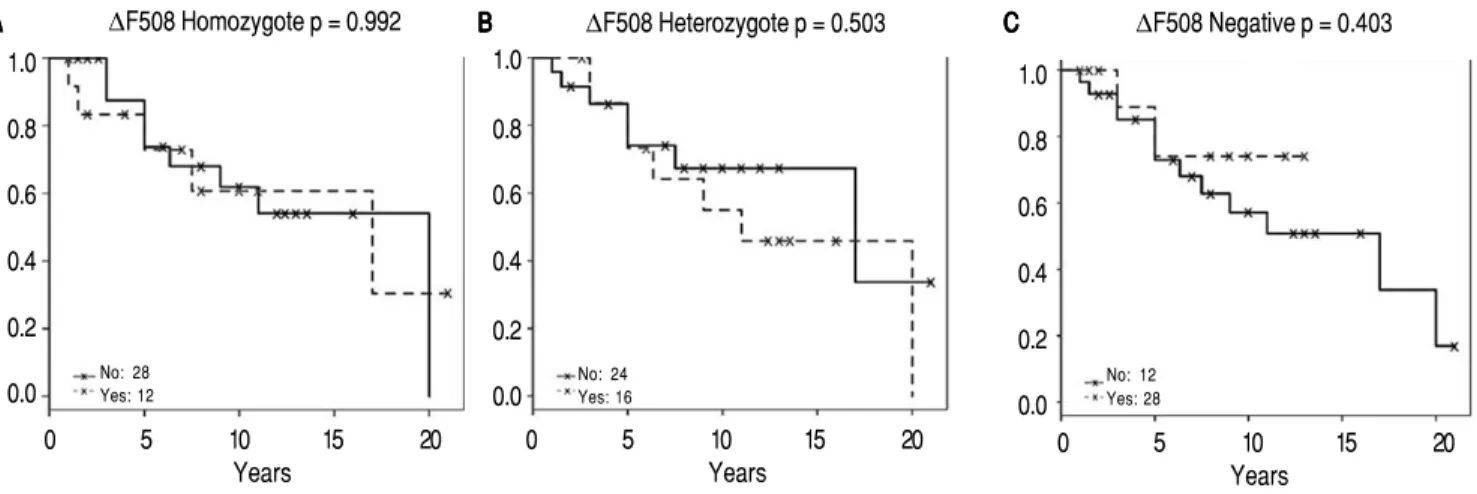
(p = 0.00678). Statistical significance was not observed for the predominant allele ΔF508 considering two (p = 0.992), one (p = 0.503) or no (p = 0.403) mutant allele. Conclusions. Low income status was the most detrimental factor; followed by cor pulmonale, severe pulmonary disease and BMI ≤ 15 kg/m2 for the survival in North East Mexican patients with
CF. Carrying the ΔF508 allele did not influence survival.
Key words. Cystic fibrosis. Mexican population. Low Income Status. Survival. ΔF508.
El nivel de ingresos bajos es un
factor de riesgo importante en pacientes con fibrosis quística del noreste de México
RESUMEN
Antecedentes. Factores como el medio ambiente, el nivel de ingresos, así como el acceso a atención médica adecuada in-fluyen en la supervivencia y calidad de vida de las personas afectadas por enfermedades crónicas como la fibrosis quísti-ca (FQ). No existen reportes de la supervivencia en pacientes mexicanos con FQ, incluso cuando se ha estimado que esta enfermedad puede no ser insignificante en la población mex-icana. Objetivo. Comparar la influencia del alelo mutante
ΔF508 y factores ambientales en la supervivencia de los pa-cientes mexicanos con FQ. Material y métodos. Se colectaron datos epidemiológicos de 40 pacientes analizadas molecularmente entre 1987 y 2008 en la Clínica de Fibrosis Quística del Hospital Universitario de la Universidad Au-tónoma de Nuevo León, en el noreste de México. Se real-izaron gráficas de supervivencia Kaplan-Meier a partir de los datos colectados para este estudio. Resultados. Las grá-ficas Kaplan-Meier arrojaron significancia estadística para el nivel de ingresos bajo (p = 3.13 x 10⁻⁶), cor pulmonale (p =
0.00169), enfermedad pulmonar severa (p = 0.00136) e índice de masa corporal ≤ 15 (p = 0.00678). No se observó signifi-cancia estadística para el alelo predominante ΔF508 consid-erando dos (p = 0.992), uno (p = 0.503) o ningún alelo mutante (p = 0.403). Conclusiones. El nivel de ingresos bajo fue el factor más perjudicial para la supervivencia, seguido de cor pulmonale, enfermedad pulmonar grave e IMC ≤ 15 kg/m2 en pacientes del noreste de México con FQ.
Portar el alelo ΔF508 no influyó en la supervivencia.
Sánchez-Domínguez CN, et al. Low-income status is an important risk factor in cystic fibrosis. Rev Invest Clin 2014; 66 (2): 129-35e n
130
Enfermedades Pulmonares Crónicas (CEPREP), Hospital Universitario Dr. Jose E. Gonzalez, Universidad Autónoma de Nuevo León, Monterrey, México) recruited between 1987 and 2008 were included. This study was adhered to the ethical principles of The Declaration of Helsinki,10 and
was approved by the institution’s Research and Ethics Committee (Registry number BI09-003).
In most cases, CFTR molecular diagnosis was previously established. For those patients without a previous molecular diagnosis, DNA was obtained from peripheral venous blood and CFTR molecular screening was done by PCR and reverse dot blot hybridization with the INNO-LiPA CFTR36 Kit (Innogenetics, Gent, Belgium). This kit is based on the simultaneous detection and identification of 36 CF-related mutations and their wild-type sequences in human whole blood, dried blood spots, and buc-cal brush samples. In addition, probes for the iden-tification of the Tn polymorphism within intron 8 are included (www.innogenetics.com).
Parameters included in the data analyses were: age at diagnosis and age at death, pancreatic in-sufficiency (PI), mild, moderate and severe pulmo-nary disease (according to forced expiratory volume in 1 second or FEV1 for adults and chil-dren, and clinical data for small children), liver disease, positive cultures for Pseudomonas aerugi-nosa and Burkholderia cepacia, type 1 diabetes mellitus (DM), meconial ileus (MI), cor pulmo-nale, body mass index (BMI), and income status according to the 10 x 6 Rule of AMAI (Mexican as-sociation of market research and public opinion agencies; www.amai.org) for towns with more than 50,000 habitants. The 10 x 6 AMAI rule is an index that ranks households in six levels, consid-ering nine characteristics or possessions of the household and the education level of the person who contributes with the most of the income. It includes technology and entertainment, basic and practice home infrastructure, health infrastruc-ture and human capital. Points were assigned at the selected variables considering the coefficient of each regression values on family income. Fam-ilies were classified as high-income (A, B, C + and C), average income (D +), and low income (D and E).11
Statistical analyses
Kaplan-Meier plots, survival analysis, and Fisher exact tests were estimated using the R software (http://cran.r-project.org). The Log-Rank test was INTRODUCTION
Cystic fibrosis (CF) is an autosomal recessive dis-ease caused by mutations in the CF transmembrane conductance regulator (CFTR) gene, affecting Cau-casian population with an estimated incidence of one in 3,000 live births. CF has been diagnosed in all ra-cial and ethnic groups. In Hispanics, incidence has been reported to be 1/4,000-1/10,000,1 and it has
been estimated that around one in 8,500 children born with CF every year in México.2 The Mexican
Association of Cystic Fibrosis (AMFQ, http:// www.fibrosisquistica.org. mx) had registered only 1,200 CF cases in 25 years; this means that about 15% of them are diagnosed, six thousand of Mexican CF children do not have access to specialized treat-ment or medical care, and one in 60 Mexicans is car-rier of one of the CF mutated alleles (personal communication). A new born screening from Mexico City reported 2 out of 7,193 live births, which sug-gests that this disease could not be negligible in Mexican population.3 Around 1,900
mutations/vari-ants have been reported for the CFTR gene with ΔF508 being the most prevalent (50-60%, http:// www.genet.sickkids.on.ca/app). In Mexican popula-tion, a previous study in 40 unrelated patients re-ported a frequency of 45% for ΔF508, and five more mutations (G542X, 3849 + 10 kb C → T, N1303K, S549N, and 621 + 1 G → T) were detected.4 A
re-cent report in 230 CF Mexican patients resulted in the characterization of 77.7% of the CF alleles with a total of 46 different mutations detected.5
The CFTR mutation profile is dependent on the patient’s genetic background.6-7 Allelic heterogeneity
in Mexican CF patients is attributed to their com-plex ethnic composition,8 complicating the full
cov-erage of the molecular diagnosis. Misdiagnosis and failure of monitoring and treating of CF, along with environmental factors, play an essential role in the survival and quality of life of CF patients. Such lat-ter factors include income status as well as cultural, community, and healthcare-related influences and long-term medical monitoring.9
In this study, we analyzed the genetic CFTR pro-file, epidemiologic and environmental factors that could influence the survival in a group of 40 Mexi-can CF patients from Northeastern México.
MATERIAL AND METHODS
used to estimate significances in the difference be-tween survival curves.
RESULTS
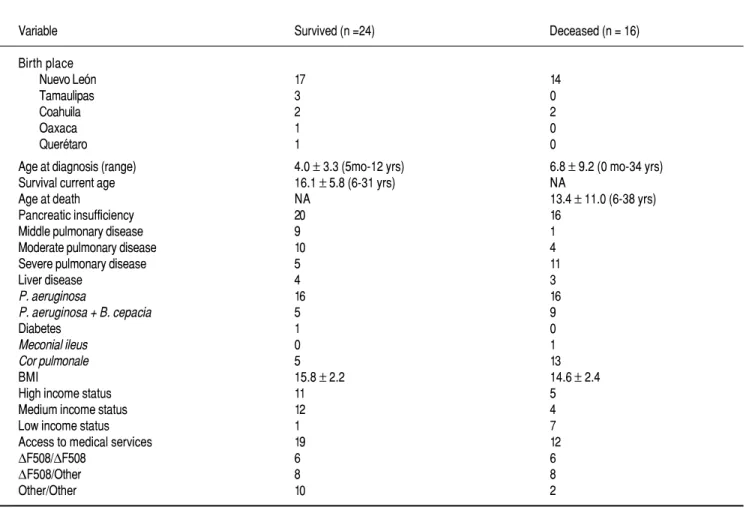
The epidemiological data of the 40 Mexican CF patients are summarized in table 1. Epidemiological and molecular data were classified according to the survival (n = 24) and non-survival (n = 16) status. Most of the CF patients arrived from the state of Nuevo León and neighboring states (Northeastern México).
When compared between live and deceased, cor
pulmonale (p = 0.0006, OR = 16.4, CI =
3.33-81.21), severe pulmonary disease (p= 0.0024, OR = 8.36, CI = 1.97-35.46), low income status (P = 0.0078, OR = 17.88, CI = 1.91-166.78) and coinfection [P. aeruginosa and B-cepacia (p = 0.02, OR = 4.8, CI = 1.21-19.7] resulted with statistical significance. There were not statistically significant
differences for the rest of the epidemiologic and ge-netic data.
Genotype frequencies for the CFTR gene are de-scribed in table 2. A complete genotype characteriza-tion was achieved in 55 % of the CF patients; in 37.5% of the CF patients, only one mutation was identified, and in 7.5% of the CF patients, both mu-tations remained undetected. As shown in table 1, the most prevalent genotypes were ΔF508/other (40%) and ΔF508/ΔF508 (30%). The overall fre-quency of the ΔF508 allele among CF patients was 50%.
Eight other mutations were detected: G542X (6.25%), S549N (6.25%), and 2789 + 5G → A (5.0%), along with 3849 + 10 kb, G85E, R1162X, I148T and R334W (1.25% each). Twenty-one of the total CFTR alleles (26.3%) remained undetected.
Survival analysis are shown in figures 1 and 2 for significant non-genetic data and ΔF508 status respectively.
1 .
Table 1. Epidemiological data of the 40 CF Mexican patients.
Variable Survived (n =24) Deceased (n = 16)
Birth place
Nuevo León 17 14
Tamaulipas 3 0
Coahuila 2 2
Oaxaca 1 0
Querétaro 1 0
Age at diagnosis (range) 4.0 ± 3.3 (5mo-12 yrs) 6.8 ± 9.2 (0 mo-34 yrs) Survival current age 16.1 ± 5.8 (6-31 yrs) NA
Age at death NA 13.4 ± 11.0 (6-38 yrs)
Pancreatic insufficiency 20 16
Middle pulmonary disease 9 1
Moderate pulmonary disease 10 4
Severe pulmonary disease 5 11
Liver disease 4 3
P. aeruginosa 16 16
P. aeruginosa + B. cepacia 5 9
Diabetes 1 0
Meconial ileus 0 1
Cor pulmonale 5 13
BMI 15.8 ± 2.2 14.6 ± 2.4
High income status 11 5
Medium income status 12 4
Low income status 1 7
Access to medical services 19 12
ΔF508/ΔF508 6 6
ΔF508/Other 8 8
Other/Other 10 2
Sánchez-Domínguez CN, et al. Low-income status is an important risk factor in cystic fibrosis. Rev Invest Clin 2014; 66 (2): 129-35e n
132 l 2
Table 2. Genotype frequencies from the 40 Mexican CF patients.
Genotype n (%)
ΔF508/ΔF508 12 (30.0)
ΔF508/X 10 (25.0)
X/X 3 (7.5)
ΔF508/G542X 2 (5.0) S549N/S549N 2 (5.0)
G542X/X 2 (5.0)
ΔF508/3849 + 10Kb 1 (2.5) ΔF508/S549N 1 (2.5) ΔF508/2789 + 5G → A 1 (2.5) ΔF508/G85E 1 (2.5) 2789 + 5G → A/2789 + 5G → A 1 (2.5) G542X/R1162X 1 (2.5) 2789 + 5G → A/X 1 (2.5)
I148T/X 1 (2.5)
R334W/X 1 (2.5)
Total 40 (100)
X: unknown mutation.
g e .
Figure 1. Figure 1. Kaplan-Meier survival curves forg e . significant factors [low income status (A), cor pulmonale (BB), severe pulmonary disease (C), and BMI < 15 kg/m2 (D)] are shown. X denotes
censored information. p-values represent statis-tical difference of survival. hr: stands for ha-zard ratio, which include confidence intervals in parentheses.
Non genetic data showed statistical significance for low-income status (p = 3.13 x 10⁻⁶), cor
pulmo-nale (p = 0.00189), severe pulmonary disease (p =
0.00136), and BMI ≤ 15 kg/m2 (p = 0.00678). We
ob-served that low-income was the highest risk factor
having a hazard ratio greater than 10. In addition, we observed that BMI ≤ 15, cor pulmonale, and pul-monary disease were correlated to low-income status (Fisher exact test p = 0.046, p = 0.014, and p = 0.042 respectively). From the 8 low-income patients, 7 had low BMI, 6 had severe pulmonary disease, and 7
had cor pulmonale. There were not statistically
sig-nificant differences for diabetes (p = 0.16), meconial
ileus (p = 0.405), tobramycine (p = 0.055),
corticos-teroid treatment (p = 0.331), pancreatic insufficiency (p = 0.149), hepatic disease (p = 0.442), P. aerugino-sa (p = 0.174), B. cepacia infection (p = 0.165) and gender (p = 0.205). B. cepacia infection was always present as secondary infection to P. aeruginosa.
Presence or absence greaterthom the ΔF508 allele was not significant for two positive alleles (p = 0.992), one positive allele (p = 0.503) or non-mutant allele (p = 0.403). Contrary, non-genetic information such as low-income, data was highly significant.
DISCUSSION
Low income status is an important predictor of survival disease outcome in many chronic polygenic
1.0
0.8
0.6
0.4
0.2
0.0
0 5 10 15 20
Years
1.0
0.8
0.6
0.4
0.2
0.0
0 5 10 15 20
Years
A IIncome status st u BB Cor pulmonaleo lm a p = 0.00169 hr = 7.79 (1.74 ~ 34.95) p = 3.13e-06
hr = 10.3 (3.34 ~ 31.74)
Low: B
High + middle: 32
Yes: 18 No: 22
Severe: 16
Mild + moderate: 24
BMI ≤ 15:21 BMI > 15:19 C
C Pulmonary diseasePulmonary diseasePuPu nn d d sese DDDD Body mass indexBody mass indexs iss ins n xx p = 0.00678 hr = 10 (1.29 ~ 77.42) p = 0.00136
hr = 8.02 (1.77 ~ 36.34) 1.0
0.8
0.6
0.4
0.2
0.0
0 5 10 15 20
Years
1.0
0.8
0.6
0.4
0.2
0.0
0 5 10 15 20
diseases. In this study, it was the most important factor for survival in Mexican CF patients. In Northeastern México, medical care for CF patients is offered at the Clínica de Fibrosis Quística of the CEPREP (http://www.ceprep.edu.mx). Since 1987, about 200 patients have been diagnosed as CF based on clinical and molecular analyses. Once the diagno-sis of CF is established, the lower adherence to med-ical treatment causes that only a small group of patients continue with long-term medical monitor-ing.
Adherence is the extent to which a person’s be-havior including taking medication, following a diet, and/or executing lifestyle changes, corresponds with agreed recommendations from a healthcare provid-er.12 Most of our CF patients have access to medical services such as those provided by the Instituto Mex-icano del Seguro Social (IMSS); alternatively, they could be subrogated to CEPREP for medical care and tests such as lung capacity testing, microbio-logical analyses, treatment, and rehabilitation. It has been reported that patients having therapies and disease management, survival of Mexican CF pa-tients has reached 211 months.13 However, the lower adherence to medical treatment in the poorest fami-lies has been attributed to lower education levels and less understanding of this disease, with these being decisive factors for poor prognosis.
Exposure to polluted air both inside and outside the home, the habit of smoking and viral infections among others, can influence the progression of lung damage acting as modifiers of disease evolution, which we observed in survival differences for cor
pulmonale and pulmonary disease. Further research
in CF is needed to confirm this. A recent study
con-ducted in Mexico in pandemic and post pandemic positive H1N1 patients, found that health-care-seek-ing behavior, poverty level, and the distribution of information affect the occurrence and severity of pneumonia due to H1N1 virus from a socioeconomic point of view. These socioeconomic factors may explain the different patterns of morbidity and mor-tality for H1N1 influenza observed among different countries and regions.14
Patients having no access to health care insur-ance may experience larger delays in diagnosis, which may have a high impact in outcome even ear-ly death. In the United States, Medicaid is associat-ed with a significantly poor outcome, considering that sicker patients with low income status are more likely to receive Medicaid.15 When low vs. high income status was compared in the records of the United States Cystic Fibrosis Foundation Patient Registry of 2003, a 44% increased risk of death was present in the lowest income category.16 The Epide-miologic Study of Cystic Fibrosis (ESCF), which is a large, multicenter, longitudinal, prospective obser-vational study of the clinical course of patients with CF in the United States and Canada, reported from data collected between 1994 and 2005 that CF health outcomes are correlated with the income status. Nevertheless, these disparities are not explained by differential use of health services, prescription of chronic therapy17 or differential treatment of pulmo-nary exacerbations.18 A recent report from the Unit-ed States using data obtainUnit-ed from the ESCF of 4,751 patients enrolled between 2003 and 2005, and classified as non-Hispanic whites, African-Ameri-cans, and Hispanics, showed that low socioeconomic and minority status (ethnicity) may affect
impor-Figure 2. Figure 2.Figure 2.
Figure 2.Figure 2. ∆F508 influence on survival. The Kaplan-Meier plots for two (homozygote), one (heterozygote) or no (negative) ∆F508 mutant alleles are shown. p-values represent statistical difference of survival.
1.0
0.8
0.6
0.4
0.2
0.0
0 5 10 15 20
Years
AAAAA ∆F508 Homozygote p = 0.992
0 5 10 15 20
Years
BBBBB ∆F508 Heterozygote p = 0.503
1.0
0.8
0.6
0.4
0.2
0.0
0 5 10 15 20
Years C
CC
CC ∆F508 Negative p = 0.403
No: 28
Yes: 12 No: 24Yes: 16
No: 12 Yes: 28 1.0
0.8
0.6
0.4
0.2
Sánchez-Domínguez CN, et al. Low-income status is an important risk factor in cystic fibrosis. Rev Invest Clin 2014; 66 (2): 129-35e n
134
tant clinical and patient-reported outcomes across their life span.19 This is in concordance to our
re-sults where low income as an estimated risk factor of 10 compared to higher incomes.
In our study, severe pulmonary disease (p = 0.00136) and a BMI ≤ 15 kg/m2 (p = 0.00678) were
important factors in survival for CF patients. This is in agreement with a study in Brazil conducted in 85 CF patients in which a BMI below the 10th per-centile and an albumin level below 4.1 mg/dL were predictors of low FEV1, and consequently increased association with chronic methicillin resistant
Sta-phylococcus aureus pulmonary colonization
infec-tion.20 Overall, these results suggest that
low-income status in CF northeast Mexican patients is influencing the health care and the diet.
ΔF508 mutant allele generally has been considered with a more severe clinical phenotype in Caucasian populations than heterozygotes and patients with no F508 allele.21 However, in this study it was not
signif-icant for survival. CFTR mutations have been classi-fied according their effects in one of these groups: the absence of synthesis (class I); defective protein matu-ration and premature degradation (class II); disor-dered regulation, such as diminished ATP binding and hydrolysis (class III); defective chloride conductance or channel gating (class IV); a reduced number of CFTR transcripts due to a promoter or splicing abnormality (class V); and accelerated turnover from the cell sur-face (class VI).22 The common mutation ΔF508 is
cate-gorized as a class II defect. Patients with CFTR genotypes associated with severely reduced CFTR pro-duction (class I to III) had a very similar severe pheno-type with higher mortality rates than patients with a CFTR genotype associated with some residual CFTR function (class IV to V).22-23
On the other hand, it has been proven that the mutation profile is dependent on the ethnicity of the group.24 It is necessary to design a kit that is in
accord with the profile of the Mexican population. CFTR molecular diagnosis in this study was done according to costs and availability of diagnostic kits. Consequently, 26.3% of the CFTR alleles remain undetected. However, seventy percent of the CF patients in our study were carriers of the muta-tion ΔF508, thus we suggest as a first screening tool, PCR specific for this mutation followed by polyacrylamide or capillary gel electrophoresis.
CONCLUSIONS
In summary, we found that in our CF patients group, low-income status was the most important
risk factor, followed by cor pulmonale, severe pul-monary disease and a BMI ≤ 15 kg/m2. We observed
correlation of low-income status with cor
pulmo-nale, pulmonary disease and BMI ≤ 15. The
pres-ence or abspres-ence of the DF508 allele does not influence survival. Notwithstanding we suggest its molecular screening as the first diagnostic approach step considering its prevalence in our studied group and the accessibility of its testing.
ACKNOWLEDGMENTS
The present work was supported by grants from the Consejo Nacional de Ciencia y Tecnología CONACyT (62291 and 48497) and UANL’s PAICyT (1648-07) for ROL, Fondo Mixto de Fomento a la In-vestigación Científica y Tecnológica CONACyT-Go-bierno del Estado de Tamaulipas (180879. 73578) and SIP-IPN (20080682) for MARL. We gratefully acknowledge scholarships from CONACyT, PIFI-IPN and Universia Santander for CNSD, and espe-cially the volunteers, whose cooperation made these studies possible. The authors gratefully acknowl-edge the critical reading of the manuscript by Dr. Sergio Lozano, and Dr. José Luis Lezana-Fernández for the information provided about cystic fibrosis in México.
REFERENCES
1. Voter KZ, Ren CL. Diagnosis of cystic fibrosis. Clin Rev Aller-gy Immunol 2008; 35: 100-06.
2. O’Sullivan BP, Freedman SD. Cystic fibrosis. Lancet 2009; 373: 1891-904.
3. Velázquez A, Vela-Amieva M, Naylor EW, Chace DH. Tamiz neonatal ampliado. Rev Mex Pediatr 2000; 67: 206-13. 4 Villalobos-Torres C, Rojas-Martinez A, Villareal-Castellanos E,
Cantu JM, Sanchez-Anzaldo FJ, Saiki RK, et al. Analysis of 16 cystic fibrosis mutations in Mexican patients. Am J Med Genet 1997; 69: 380-2.
5. Chavez-Saldana M, Yokoyama E, Lezana JL, Carnevale A, Ma-cias M, Vigueras RM, et al. CFTR allelic heterogeneity in Mexican patients with cystic fibrosis: implications for molecu-lar screening. Rev Invest Clin 2010; 62: 546-52.
6. Estivill X, Bancells C, Ramos C. Geographic distribution and regional origin of 272 cystic fibrosis mutations in European populations. The Biomed CF Mutation Analysis Consortium. Hum Mutat 1997; 10: 135-54.
7. Bobadilla JL, Macek M Jr., Fine JP, Farrell PM. Cystic fibrosis: a worldwide analysis of CFTR mutations—correlation with in-cidence data and application to screening. Hum Mutat 2002; 19: 575-606.
8. Orozco L, Velazquez R, Zielenski J, Tsui LC, Chavez M, Leza-na JL, et al. Spectrum of CFTR mutations in Mexican cystic fi-brosis patients: identification of five novel mutations (W1098C, 846delT, P750L, 4160insGGGG and 297-1G—>A). Hum Genet 2000; 106: 360-5.
10. Vollmann J, Winau R. Informed consent in human experimen-tation before the Nuremberg code. BMJ 1996; 313: 1445-9. 11. López-Romo H. Los niveles socioeconómicos y la distribución
del gasto. En: Instituto de Investigaciones Sociales. 2009. Dispo-nible en: www.amai.org/NSE/NivelSocioeconomicoAMAI. pdf 12. Adkinson N, Bochner B, Busse W, Holgate S, RF L, Simons F.
Adherence. In: Middleton’s Allergy: Principles and Practice. 7th Ed. Elsevier Inc.; 2009, p. 1473-83.
13. Cystic fibrosis: clinical guidelines for diagnosis and treatment. In: Lezana-Fernandez JL (ed.). México, D.F.: Intersistemas edi-tores; 2008.
14. Manabe T, Higuera Iglesias AL, Vazquez Manriquez ME, Mar-tinez Valadez EL, Ramos LA, Izumi S, et al. Socioeconomic factors influencing hospitalized patients with pneumonia due to influenza A(H1N1)pdm09 in Mexico. PLoS One 2012; 7: e40529.
15. Schechter MS, Shelton BJ, Margolis PA, Fitzsimmons SC. The association of socioeconomic status with outcomes in cystic fi-brosis patients in the United States. Am J Respir Crit Care Med 2001; 163: 1331-7.
16. O’Connor GT, Quinton HB, Kneeland T, Kahn R, Lever T, Maddock J, et al. Median household income and mortality rate in cystic fibrosis. Pediatrics 2003; 111: e333-e339.
17. Schechter MS, McColley SA, Silva S, Haselkorn T, Konstan MW, Wagener JS. Association of socioeconomic status with the use of chronic therapies and healthcare utilization in children with cystic fibrosis. J Pediatr 2009; 155: 634-9 e1-4.
18. Schechter MS, McColley SA, Regelmann W, Millar SJ, Pasta DJ, Wagener JS, et al. Socioeconomic status and the likelihood of antibiotic treatment for signs and symptoms of pulmonary exacerbation in children with cystic fibrosis. J Pediatr 2011; 159: 819-24 e1.
19. Quittner AL, Schechter MS, Rasouliyan L, Haselkorn T, Pasta DJ, Wagener JS. Impact of socioeconomic status, race, and eth-nicity on quality of life in patients with cystic fibrosis in the United States. Chest 2010; 137: 642-50.
20. Souza dos Santos Simon MI, Drehmer M, de Abreu ESFA, Ho-ffmann A, Druck Ricachinewsky C, de Fonseca Andrade Pro-cianoy E, et al. Association of nutritional status, plasma, albumin levels and pulmonary function in cystic fibrosis. Nutr Hosp 2011; 26: 1322-7.
21. Kerem E, Corey M, Kerem BS, Rommens J, Markiewicz D, Le-vison H, et al. The relation between genotype and phenotype in cystic fibrosis—analysis of the most common mutation (del-ta F508). N Engl J Med 1990; 323: 1517-22.
22. Rowe SM, Miller S, Sorscher EJ. Cystic fibrosis. N Engl J Med 2005; 352: 1992-2001.
23. McKone EF, Goss CH, Aitken ML. CFTR genotype as a pre-dictor of prognosis in cystic fibrosis. Chest 2006; 130: 1441-7. 24. Rohlfs EM, Zhou Z, Heim RA, Nagan N, Rosenblum LS, Flynn K, et al. Cystic fibrosis carrier testing in an ethnically diverse US population. Clin Chem 2011; 57: 841-8.
Reimpresos:
Dra. Rocío Ortiz-López
Departamento de Bioquímica y Medicina Molecular Facultad de Medicina
Centro de Investigación y Desarrollo en Ciencias de la Salud Universidad Autónoma de Nuevo León Av. Francisco I. Madero, s/n, esq. Dr. Eduardo Aguirre Pequeño Col. Mitras Centro
64460, Monterrey, N.L. Tel./Fax: +52 (81) 8333-7747
Correo electrónico: [email protected]
![Figure 1. Figure 1. Kaplan-Meier survival curves for g e . significant factors [low income status (A), cor pulmonale (B B), severe pulmonary disease (C), and BMI < 15 kg/m 2 (D)] are shown](https://thumb-us.123doks.com/thumbv2/123dok_es/6831643.279466/4.918.95.819.540.1074/figure-kaplan-survival-significant-factors-pulmonale-pulmonary-disease.webp)