www.medigraphic.com
Review
Vol. 1, Núm. 1 Enero-Diciembre 2008 pp 15-23
Ozone application for the people health state monitoring
by the total unsaturation index determination
Tatyana Poznyak,* Alejandro García,**Elena Kiseleva***
* Superior School of Chemical Engineering, National Polytechnic Institute of Mexico (ESIQIE - IPN). ** Department of Automatic Control, CINVESTAV-IPN, Mexico.
*** Department of Polymers and Composite Materials, Institute of Chemical Physics of Academy of Sciences, Moscow, Russia, Moscow.
Correspondence:
Tatyana Poznyak
Edif. 7 UPALM, 07738, México D.F., México. E-mail: [email protected]
ABSTRACT
There exists evidence about the influence of oxidative stress in certain pathologic states, especially chronic diseases. Mea-surements of lipid peroxide levels and the levels of their by-products are routinely used as indices of oxidative stress; how-ever, until now, analytic assays used to determine lipid peroxidation have limitations regarding sensitivity, specificity, and timing of analysis. In the present brief review, we intro-duce the method of the double bond index (DB-index), a promising method of evaluation for lipid metabolism distur-bance and lipid peroxidation measurement. DB-index calcu-lation is based on the patented Total Unsaturation Analyzer (TUA) which instrumentation is fundament on the organic un-saturated compounds property of integrate ozone in the double bond site (one ozone molecule by each double bond) in a fast way. By this technique it is possible to determine in a short time (1-3 minutes) and with high precision (± 1%) the lipids total unsaturation in plasma and in cellular membranes. Some notable cases where DB-index has been established as diag-nostic and progdiag-nostic criteria in different diseases and possi-bilities of present and future applications in the clinical analy-sis are discussed.
Key words: Total lipids unsaturation, DB-index, oxidative stress, health state monitoring.
RESUMEN
Es evidente la influencia del estrés oxidativo en ciertos estados patológicos, especialmente en enfermedades crónicas. La medi-ción de los niveles de lipoperoxidamedi-ción, así como de sus subproductos, son usados de forma rutinaria como índices de estrés oxidativo; sin embargo, hasta ahora los métodos analíticos empleados en la determinación de la lipoperoxidación presentan limitaciones asociadas a la sensibilidad, especificidad y tiempo total de análisis. En la presente breve reseña, se describe el méto-do del índice de méto-dobles enlaces (DB-index), un métométo-do promete-dor para la evaluación de trastornos en el metabolismo de los lípidos y la medición de la lipoperoxidación. El cálculo del DB-index se basa en el analizador de insaturación total (TUA patentado), cuya instrumentación se fundamenta en la propie-dad de los compuestos orgánicos insaturados de integrar rápida-mente ozono en el sitio de la doble ligadura (una molécula de ozono por cada doble ligadura). Mediante esta técnica, es posi-ble determinar en un corto tiempo (1-3 minutos) y con alta precisión (± 1%) la insaturación total de los lípidos en plasma y en membranas celulares. Se discuten algunos casos notables don-de el DB-indon-dex se ha establecido como criterio don-de diagnóstico y pronóstico en diferentes enfermedades, así como posibles apli-caciones presentes y futuras en el análisis clínico.
Palabras clave: Insaturación total de los lípidos, DB-index, estrés oxidativo, monitoreo del estado de salud.
www.medigraphic.com
INTRODUCTION
Oxidative stress is generally described as a situation of imbalance in which excessive levels of oxygen free radi-cals or reactive oxygen species are present in the body in the face of inadequate availability of the relevant neutral-izing substances, referred to as antioxidants, which destroys these harmful products of metabolic process.1,2
Oxidative stress has been implicated in the pathology of several human diseases, including cancer, atherosclerosis, malaria, and rheumatoid arthritis and neurodegenerative dis-eases.3-5 Consequently, several methods have been devel-oped to monitor in vivo oxidative stress, for instance: direct quantification of reactive species by electron spin resonance6 and indirect methods such as determination of antioxidants and total antioxidant capacity (TRAP)7,8 and detection of oxidized biological markers.9,10 Among biomarkers we can find: products of lipoperoxidation (malondialdehyde, 4-hy-droxynonenal, isoprostanes, oxidized LDL), protein oxida-tion (hydroxyl and carbonyls), and measurements of DNA damage (high-performance liquid chromatography, gas chro-matography). However, until now each of these assays has limitations regarding sensitivity, specificity, and timing of analysis. In the present brief review, we introduce the meth-od of the double bond index (DB-index) determination based on the patented total unsaturation analyzer (TUA) equip-ment11 analog of the double bonds analyzer (DBA).12 By this technique it is possible to determine in a short time (1-3 minutes) and with high precision (± 1%) the lipids total un-saturation in plasma and in cellular membranes.13,14 The es-timation of the total unsaturation (TU) of plasma (DBpl-in-dex) and cell membrane (DBcell-in(DBpl-in-dex) lipids has became a promising method of evaluation for lipid metabolism distur-bance and lipid peroxidation (LPO). The TU determination is carried out by ozonation of lipid fractions of plasma and cells. This method consists to the measuring of ozone ab-sorbed by lipid double bonds (remaining LOP substrate). Remarks about advantages and technical characteristics of the method are included. Some notable cases where DB-index has been established as diagnostic and prognostic cri-teria in different diseases (15-20) and its implementation and possibilities of present and future applications in the clinical analysis for the investigation and commercial fields are discussed.21
OZONE IN THE DEVELOPMENT OF CLINICAL ANALYSIS TECHNIQUES
(THE DB-INDEX DETERMINATION)
Background
Ozone is recognized as a strong oxidant, aspect that has widely considered in the development of environmental
remediation techniques since the first half of the last cen-tury,22 more recently, many professionals on medicine and human healthcare have took advantage of this characteris-tic of ozone and have contributed with their theorecharacteris-tical and practical knowledge in the advance of the so called “ozonotherapy”,23 which has been employed in the treat-ment and control of many infectious and metabolic diseas-es.24-26 However, the exact mechanism of this therapy is not known at all, and it still being a challenge for the scien-tist in the area.27-29 Alternatively ozonation of some cellular and non cellular components of mammal’s blood (includ-ing human beam) have been realized by some scientists in order to reach two main objectives:
• To study the mechanism between ozone and intra and inter cellular components.30-32
• To develop a new branch of study employing ozone in the clinical analysis and not only as therapy approach.
Regarding with last point of view we can find the new technique to determine lipids total unsaturation (TU) in plasma and cellular membranes by ozonation; whose fundamentals were developed since the second middle of last century by Russian researches. TU is represented by a concise parameter called Double Bond Index (DB-Index). This DB-index is strongly correlated with the stress oxidative level, since lipids involve in its determi-nation correspond to remaining substrate not affected by oxidative stress mechanism. As it is known, the level of the TU for practically healthy peoples does not de-pend of the age or sex of the person and its value is altered in the presence of some disease.17,33 For this rea-son the DB-Index determination provides a methodolog-ical technique for the differential and prospective clini-cal analysis, providing multiple possibilities in the control
RCH
O
CH2
H
O O
O O
O O
O O
OO O3
= + RCH CH2
RCH
RCH +
+ H2CO
H2C +
RCH CH2
Izoozonide
www.medigraphic.com
of the therapeutic treatments.15-21 Of course a personal doses strategy in differences diseases and pathologies as well as in ozonotherapy could also be studied by this approach.
Double Bond Index (DB-index) fundamentals
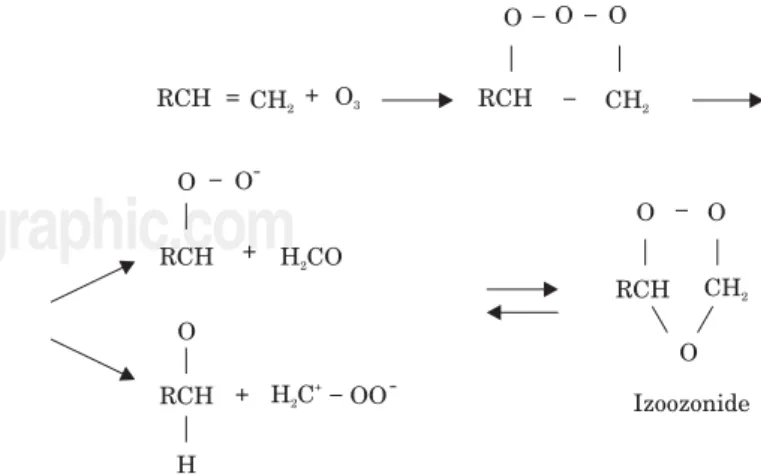
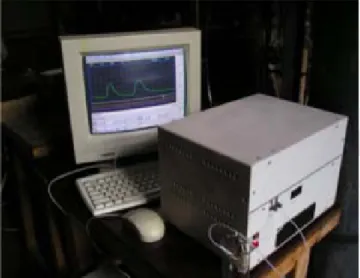
High selectivity of the ozone reaction for the identification of double bonds has been proven according with the ozo-nation kinetic constants.34,35Figure 1 depicts the mecha-nism of ozone with unsaturated double bond compounds. Based on these facts special equipment denominated total unsaturation analyzer (TUA) has been created (Figure 2). The TUA based its operation on the property of organic unsaturated compound of integrate ozone in the double bond site (one ozone molecule by each double bond) in a fast way.
The general TUA operation involves next steps:
1. Oxygen gas is transformed into ozone by a photovoltaic reactor.
2. Controlled ozone concentration is obtained in order to carry out the reaction with a sample of lipids ex-tracted from plasma or cells by a simple modified Folch method.14
3. The measure of non reacting ozone concentration (gas-phase) is realized by the principle of UV detection,36 values are registered and plotted in a computer, and the obtained curve is called ozonogram. Figure 3 depicts an ozonogram for lipids of plasma obtained from healthy Latin individual.
4. Total area of the obtained ozonogram proportionality corresponds to the double bond quantity in the sample. Calculation of DB-index will be described below.
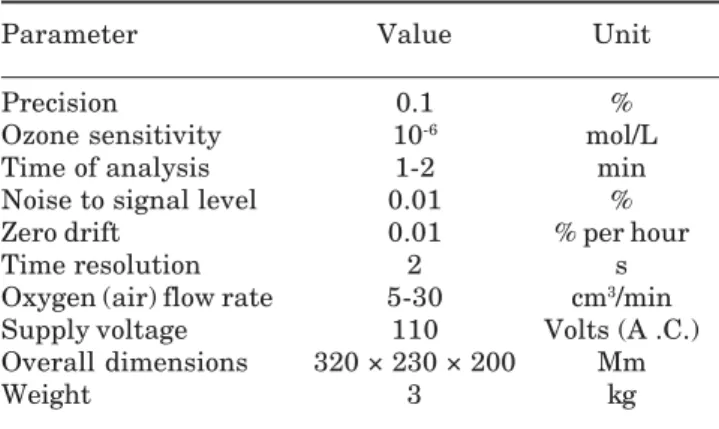
Technical specifications of TUA are showed in table I.
Double Bond Index (DB-index) calculation
Calculation of DB-Index is derived from the expression (I):
DB index
C ×st V × S × Vst s sol
S ×st V × V × Ks pi
= (c.u) (I)
Where:
Cst is concentration of the standard solution (mol/mL),
Vst, Vs are the volumes of the standard sample and the analyzed sample, respectively (mL), Sst, Ss are the areas of the standard ozonograms and the analyzed sample (c.u.),
Vsol is the solution volume of the analyzed sample (mL),
Vpi is the blood plasma volume of the analyzed sample (mL), K is the calculated coefficient equal to 10-7 (mL/ mol), (c,u) means “conditional unit” (1 c.u.=1x10⁻⁵ mol d.b./mL).
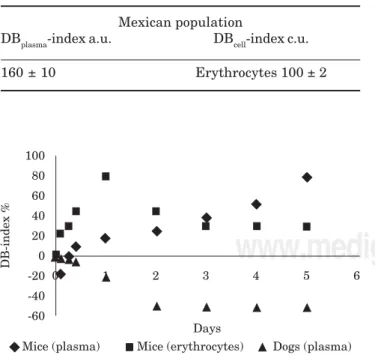
For instance, some DB-index values for healthy Europe-an Europe-and Latin-AmericEurope-an population are presented in the
ta-bles II and III, respectively:
The presented values play the role of a standard in the discrimination process between healthy and unhealthy population for each characterized group; DB-index increas-ing and diminution can be observed in the presence of
Figure 2. Total unsaturation analyzer (TUA).
0 20 40 60 80 100 120 140 0.97
0.975 0.98 0.985 0.99 0.995 1
Time [s]
C/C
0
www.medigraphic.com
some disease and pathology. The value of this difference respecting to the normal level has proven a strongly rela-tion with the disease severity.15-21
Characteristics of the lipids TU determination
The determination of the lipids TU using the TUA can be resumed as follows:
• It is a micro-method, it means only 50 micro liters or 200,000 cells are needed for one analysis
• It is a quick method 2-30 seconds • High sensibility (Table I)
• High precision (Table I)
• Reproducibility (Table I)
Furthermore, DB-index calculation provides:
1. Possible criterion in the risk groups selection or identifi-cation.
2. Predictive information of the health state before dis-ease manifestation.
3. Determination way for the latency periods and collater-al effects.
4. Possibility of verification and correction of the therapeu-tic treatment.
SUCCESSFULLY APPLICATION CASES OF THE LIPIDS TOTAL
UNSATURATION METHOD
In this section we would like to show some examples of studies where the determination of the total unsaturated lipids has been applied; two aspects have been mainly considered, evaluation of a harmful environmental factor and differential diagnostic in a specific disease.
Use the lipids TU determination for the toxicity level evaluation of a harmful environmental factor in an animal and a
human population
Chromium toxic effect monitoring using ozonation method17
The hexavalente chromium toxicity (in vitro) to plasma, erythrocytes and semen lipids was evaluated in a sample from exposed Mexican population. The ozonation tech-nique is suggested to realize the rapid measurement of the lipid peroxidation (LPO) by means of the double bond indexes (DB-index and DBcell-Index) calculation. Main con-clusions of this study are listed as follows:
• The values of the index DB obtained for people in Mex-ico City are significantly smaller with respect to Europe-an ones.
• The DBcell-index for human sperms has been determined showing that these cells are very sensitive to chromium, even to very small doses (2.5 µM).
• The micro dose effect of chromium on the LPO de-pends on the initial value of DB-indexes.
The obtained experimental results permitted conclude that it is possible to detect the chromium effect on LPO by ozonation. The DB-index ad DBcell-index determination in the plasma, erythrocytes, and sperm can be considered as a measure of this effect.
Table I. TUA technical specifications. Parameter Value Unit
Precision 0.1 %
Ozone sensitivity 10-6 mol/L
Time of analysis 1-2 min Noise to signal level 0.01 % Zero drift 0.01 % per hour Time resolution 2 s Oxygen (air) flow rate 5-30 cm3/min
Supply voltage 110 Volts (A .C.) Overall dimensions 320 × 230 × 200 Mm
Weight 3 kg
Table II. DB-index value for European healthy population.
European population
DBPlasma-index a.u. DBcell-index c.u.
www.medigraphic.com
Total unsaturation of plasma and cell membrane lipids as a new biochemical test
of ionizing radiation aftereffect37
Total unsaturation of plasma (DB-index) and cell mem-brane (DBcell-index) lipids of shallow and big animals was studied by means of the ozonation method. The doses dependence of the DB-index in the acute radiation re-gime was studied considering groups of Dogs and mice irradiated by different radiation doses (10, 25, 50 and 100 radian) and in long and acute radiation. Table IV shows the nominal DB-index values obtained for non irradiat-ed animals.
In the cases of irradiated mice, both two DB-indexes changed in the first 6 hours after radiation. Specifically DB-index was decreased from 7 up to 30%, and DBcell-index for erythrocytes was increased from 30% up to 45% as can be see it in figure 3.
In the case of dogs group during first two days after radiation dose the DB-index filled down up to 50% re-spect to nominal value; however, it was not showed a ten-dency to normalization (Figure 4a).
The experimental data showed that the relative decreas-ing of the DB-index which was determined in the first 6 hours after radiation depends on the radiation doses
(Fig-ure 4b).
Total unsaturated lipid level as a differential diagnostic and prognostic
parameter in a specific disease
Differential diagnostic and prognostic of pneumonia by DB-index determination13
Clinical validation of the DB-index for the diagnostic and prog-nostic of pneumonia in children was developed. DB-index was compared against the LPO level and with the dynamic of the disease in a 15 children sample with pleural pneumonia and purulent lung damage. Patients shown an inverse correla-tion between DB-index and LPO activity, concluding that the proposed ozonation method can characterize the membrane destruction process in complicated pneumonia forms usually non detectable since the first stage. The sample of patients was divided into three different groups according to their The DB-index determination and their radiological and clinical exams (Figure 5). As could be seen it destructive pneumonia forms present a DB-index diminution respecting to the first day evaluation and slow increasing tendency, in the case of the lees aggressive pneumonia type it was observed a fast growth of the DB-index which corresponds with a positive recuperation among the first 3-7 days.
Quick diagnostic of the lipids metabolism alteration for the evaluation and prognostic
of burned patients15
The study was realized considering a 100 burned patients sample with different burnt level; evaluation of their evolu-tion at different time was realized. DB-index presented a variation in an interval from 34 to 287 depending of the burnt magnitude. DB-index was correlated with the magnitude of the damage and with the treatment effectiveness. The direct correlation between DB-index and the unsaturated fatty ac-ids concentration is presented in the table V.
100
80
60
40
20
0
-20
-40
-60
DB-index
%
0 1 2 3 4 5 6
Days
Mice (plasma) Mice (erythrocytes) Dogs (plasma)
Figure 4a. Dynamics of the DB-index variation of plasma and erythrocytes for mice by the acute regime (25 radians) and for dogs by prolonged irradiation regime (50 radians).
35
30
25
20
15
10
5
0
0 50 100 150
Radiation dose
DB-index,
%
Figure 4b. The dependence of the DB-index on the radiation doses for mice in acute radiation regime.
Table III. DB-index value for Mexican healthy population.
Mexican population
www.medigraphic.com
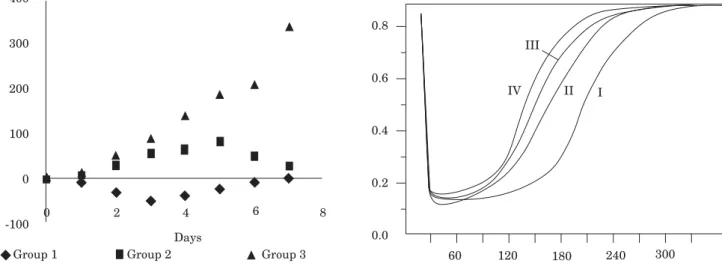
Under normal conditions the number of DB in lipids of blood plasma varied from 190 x 10-8 to 311 x 10-8 moles DB/mL, with a mean value of 244 x 10-8 moles DB/mL. For a healthy group selected to this test the ozone absorp-tion curves had similar characteristics and, as a rule, they repeated one another (figure 6). No differences were dis-covered depending on the sex and age of the patients.
figure 7 depicts as an example the results of 8-day
moni-toring of patient (called G)., aged 26 years with a chemical burn affecting 40% of the body surface and of the IIIA+ B degree, starting from the first few hours after trauma and until discharge from the clinic. The number of DB in the blood plasma lipid of the patient 5 h after burning was 183x10-8 moles DB/mL, and on the 2nd day after burning it was 88 x 10-8 moles DB/mL. At this time massive suppu-ration had begun in the patient’s wounds, the nitrogen balance was showing negative features, and marked tox-emia was present. From the 18th day after burning the number of DB gradually began to increase, and as the burn healed and the patient’s condition improved, the number increased steadily until the patient’s discharge from hospi-tal (165 x 10-8 moles DB/mL).
As a second example the results of investigation of pa-tient (Feminine), aged 21 years, with thermal burns of the III A + B degree affecting 70% of the body surface, are shown in figure 8. It is reported that her state on admission was extremely grave because of toxemia and extensive burns: the number of DB on admission was 56 x 10-8 moles DB/ mL. On the 18th day of her stay in the burns unit, treated by the open method on a “Clinitron” bed (France), the num-ber increased to 116 x 10-8 moles DB/mL, and as the wounds healed gradually, the number of DB continued to rise. How-ever, after 40 days the patient’s condition deteriorated, heal-ing became sluggish, and signs of burn exhaustion appeared: loss of body weight, loss of appetite, inability to assimilate food (vomiting, retching, and meteorism). The DB level on the 42nd day had fallen from 197 x 10-8 to 133 x 10-8 moles DB/mL. From that moment the patient began to receive additional feeding through nasal gastric tube, and after 3 weeks the number of DB became normal (236 x 10-8 moles DB/mL). This coincided with a considerable improvement in the patient’s condition: during this period she gained 7 kg in weight, her appetite improved, pink granulations appeared, and marginal epithelization of the wounds took place.
Au-Days
Group 1 Group 2 Group 3 400
300
200
100
0
-100
DB-index
variation
0 2 4 6 8
Figure 5. DB-index variation respecting to the first day: Group 1- purulent lung destruction, Group 2 - multisegmentarium serosum pleuritis, Group 3- multisegmentary pneumonia.
Table IV. Nominal values of the DB-index and the DBcell-index for different animals. DB-index c.u. DBcell-index mole d.b/106 cells
Animals Plasma Erythrocytes Leucocytes Lymphocytes Dogs 200 ± 10 41 ± 3 (0.64 ± 0.03) x 10-5
-Mice 57 ± 3 43 ± 3 - (0.12 ± 0.03) x 10-7 Figure 6. Ozonograms of blood plasma lipids of healthy pa-tients. (Abscissa: time, s; ordinate: ozone absorption (in moles DB/mL x 10-8).
0.8
0.6
0.4
0.2
0.0
I II III
IV
www.medigraphic.com
ESTE DOCUMENTO ES ELABORADO POR MEDIGRA-PHIC
Table V. Variation of the DB-index and the unsaturated fatty acids concentration. Unsaturated fatty Time after trauma (days)
acids mM/L 5 10 30 37
Oleic (C 18:1) 1.47 0.10 5.09 5.97
Linoleic (C 18:2) 0.68 0.49 3.83 3.96
Arachidonic (C 20:4) 0.09 0.04 0.96 3.26
DB-index 94 35 119 165
0.8
0.6
0.4
0.2
0.0 A
200
150
100
1
B
2 11 18 52 61 69 76
60 120 180 240
Figure 7. Ozonograms of blood plasma lipid of burned patient (A). (Abscissa and ordinate are as in Figure 6). DB variation in blood plasma lipids depending on time after trauma (B). (Ab-scissa: is time after trauma (days); ordinate: are moles DB/mL x 10-8).
Figure 8. Ozonograms of blood plasma lipid of burned patient F. (A). (Abscissa and ordinate are as in figure 6). DB variation in blood plasma lipids depending on time after trauma (B). (Abscissa: is time after trauma (days); ordinate: are moles DB /mL x 10-8).
60 120 180 240 0.8
0.6
0.4
0.2
0.0
11 250 200 150 100 250 200 150 100
A B
300
18 26 36 42 67
thors conclude that response of a change in the DB-index preceded clinical manifestation of the corresponding change in the patient’s condition. So, the ozonation method in burned patients poses enormous possibilities in the prog-nostic evaluation, as could be seen.
Distribution of the total unsaturation in lipid components of plasma, as a new differential
diagnostic method in clinical analysis14
In that study children suffering from Insulin-Dependent Dia-betes Mellitus (IDDM) were examined for TU of blood plas-ma lipids and for unsaturation in individual fractions of blood plasma lipids. The objective was to find a biochemical criteri-on for metabolic disorders and in IDDM, based criteri-on the DB-index calculation. Twenty children were examined during the compensation stage (group 1), and twelve during decompen-sation with ketoacidosis (group 2). According with the authors DB-index depends on the compensation degree, as well as duration of the disease. Total unsaturation distribution in plas-ma lipid fractions was found to be significantly decreased when compared to those in healthy controls (Table VI). The DB-index dynamic observation in children with IDDM could be used to determine the adequate treatment formulation in-cluding the insulin dosage correction, hypolipidemic and mem-branostabilizing medicine introduction.
CONCLUSIONS
www.medigraphic.com
Table VI. The total unsaturation distribution in plasma lipid fractions in children groups of different stage. DB-index rel %
Children groups DBliq-index PhL FCh NEFA TG Control 260 ± 10 13.9 ± 5.0 10.0 ± 2.3 43.4 ± 7.1 17.5 ± 1.9 First 164.3 ± 11 13.8 ± 3.2 14.3 ± 1.9 40.5 ± 7.4 14.6 ± 1.9 Second 150.5 ± 11 17.1 ± 2.8 14.7 ± 1.9 23.7 ± 6.1 22.5 ± 12
1. Crimi E, Sica V, Williams-Ignarro S, Zhang H, Slutsky AS, Ignarro LJ, Napoli C. The role of oxidative stress in adult critical care (Review Article). Free Radical Biology & Med-icine 2006; 40: 398–406.
2. Svend J, Jensen K. Oxidative stress and free radicals. Journal of Molecular Structure (Theochem) 2003; 666–667: 387–392. 3. Aruoma OI. Free radicals, oxidative stress, and antioxidants in human health and disease. Journal of the American Oil Chemists Society 1998; 75(2): 199-212.
4. Opara EC. Oxidative Stress. Disease-a-Month Nutrition in Inflammatory Bowel Disease, Part II 2006; 52(5): 183-198. 5. Rahimi R, Nikfar S, Larijani B, Abdollahi M. A review on the role of antioxidants in the management of diabetes and its complications. Biomedicine & Pharmacotherapy 2005; 59: 365–373.
6. Khan N, Swartz H. Measurements in vivo of parameters pertinent to ROS/RNS using EPR spectroscopy. Molecular and Cellular Biochemistry 2002; 234/235: 341–357. 7. Erel O. A novel automated direct measurement method for
total antioxidant capacity using a new generation, more stable ABTS radical cation. Clinical Biochemistry 2007; 37: 277–285.
8. Harmaa M, Harmaa M, Erelb O. Measurement of the total antioxidant response in preeclampsia with a novel auto-mated method. European Journal of Obstetrics & Gyne-cology and Reproductive Biology 2005; 118: 47–51. 9. Karatas F, Karatepe M, Baysarb A. Determination of free
ma-londialdehyde in human serum by high-performance liq-uid chromatography. Analytical Biochemistry 2002; 311: 76–79.
10. Kim Ok-Sun, Maekawa K, Kusuda K. Cyclic voltammetry of lipophilic compounds in oil: Direct determination of lipid peroxide with a carbon past electrode. Journal of the Amer-ican Oil Chemists’ Society 1995; 72(3): 299-303. 11. Arhipov AYU, Grinevich TV, Poznyak TI, Kiseleva EV, Garcia
JA, Spectrophotometer. RU 2273004 C1, 27/03/2006. 12. Brajnikov EM, Rajnikov VM, Lisitsyn DM, Poznyak TI.
De-vice for determination of organic compounds unsatura-tion, No 882307, 1979, (USSR).
13. Sergeev VM, Burkin IA, Levin AB, Poznyak TI et al. Patent of USSR, No 1500943, 1989.
14. Poznyak TI, Kiseleva EV, Turkina TI. Distribution of the total unsaturation in lipid components of plasma as a new dif-ferential diagnostic method in clinical analysis, Journal of Chromatography A 1997; 777: 47-50.
BIBLIOGRAPHY
15. Sologub VK, Olyunina NA, Lisitsyn DM, Lavrov VA, Babskaya YuE. Determination of double bonds of the blood plama lipid fraction by the ADS-4M apparatus in burned patient, Trans-lated from Byulleten’ Eksperimental’ noi Biologii i Meditsiny for Springer-Verlag, 100, 1985; 9: 308-310.
16. Turkina TI, Marchenko LF, Poznyak TI. Method of the insulin doses correction in the medical treatment of diabetes melli-tus, Patent of the USSR, No. 4946801/14, 1994, Bull. Izobr. 5. 17. Poznyak T, Puga JM, Kiseleva E, Martínez L. Chromium toxic effect monitoring using ozonation method, Interna-tional Journal of Toxicology 2002; 21: 211-217. 18. Kogarco IN, Poznyak TI, Kiseleva EV. Lymphocyte and blood
plasma lipid unsaturation investigation in hemoblastosis. Jour-nal of Experimental Oncology USSR 1991; 13(1): 48-51. 19. Korman DB, Potapov SL. Breast cancer and unsaturated
blood lipids. Wopr Onkolog 1997; 43: 164-170. 20. Korman DB, Potapov SL. The level of double bonds in
blood lipids of patients with lung carcinoma. Izw Ac Sci Russ, S Biol B 1992; 6: 931-936.
21. Poznyak T. Determinación de insaturación en los lípidos de plasma y membranas celulares por medio de la ozo-nación para diagnóstico diferencial y monitoreo del efec-to tóxico del medio ambiente, un aspecefec-to nuevo de la aplicación de ozono en medicina. Primer Congreso Na-cional de Salud OcupaNa-cional Seguridad e Higiene, Méxi-co Distrito Federal 2001.
22. Shammas NK, Wang LK. Ozonation, In the Handbook of environmental Enginnering, Volume 3, Physicochemical Treatment Process Edited by: Wang LK, Hung YT, Shammas N. The humana Press and Springer-Verlag.
23. Bocci AV. Scientific and medical aspects of ozone thera-py. State of the art. Archives of Medical Research 2006; 37: 425-435.
24. Smirnov AV, Pestova Y, Krivatkin SL, Krivatkina EV, Ivanova OA. Ozonetherapy in localized scleroderma. Journal of the European Academy of Dermatology and Venereology 1995; 5: S158.
25. Martínez-Sánchez G, Al-Dalain S, Menéndez S, Re L, Giuliani A, Candelario-Jalil E, Álvarez, Fernández-Monte-quín J, León O. Therapeutic efficacy of ozone in patients with diabetic foot. European Journal of Pharmacology 2005; 523: 151–161.
www.medigraphic.com
27. Travagli V, Zanardi I, Bocci V. A realistic evaluation of theaction of ozone on whole human blood. International Jour-nal of Biological Macromolecules 2006, 39: 317–320. 28. Travagli V, Zanardi I, Silvietti A, Bocci V. A physicochemical
investigation on the effects of ozone on blood. International Journal of Biological Macromolecules 2007; 41: 504–511. 29. Bocci AV. Can ozonetherapy be permormed if the biochem-istry of the process cannot be controlled? (Letter to the editor). Archives of Medical Research 2007; 38: 584-585.
30. Cataldo F, Gentilini L. Chemical kinetics measurements on the reaction between blood and ozone. International Jour-nal of Biological Macromolecules 2005; 36: 61-65. 31. Bocci V. Tropospheric ozone toxicity vs usefulness of ozone
therapy. Archives of Medical Research 2007; 38: 265-267. 32. Pryor WA, Squadrito GL, Friedman M. The cascade mech-anism to explain ozone toxicity the role of lipid ozonation products. Free Radical Biology and Medicine 1995; 19: 935-941.
33. Poznyak T. New method of monitorin study of people health state under toxic effect of environment. In Proceedings of practical methods for environmental analysis conference. Ontario, Canada, 1996: 13-16.
34. Razumovskii SD, Zaikov GE. Ozone and its reactions with organic compounds, Elseviere 1984.
35. Lisitzin DM, Poznayk TI, Razumovskii SD. Kinetic and Ca-talysis, USSR 1976; 17(4): 1049-1055.
36. Rakness K, Gordon G, Langlais B, Masschelein W, Matso-moto N, Richard Y, Robson M, Somiya I. Guideline of mea-surement of ozone concentration in the process gas from an ozone generator, Ozone Sience and Engineering 1996; 18: 209-229.