Interferon beta 1a-induced severe
autoimmune hepatitis in patients with multiple sclerosis:
report of two cases and review of the literature
Alejandra Villamil, Eduardo Mullen, Paola Casciato, Adrian Gadano
Hospital Italiano de Buenos Aires. Ciudad Autónoma de Buenos Aires, Argentina.
ABSTRACT
Type I interferons are potent cytokines that possess antiviral, immunomodulating and antiproliferative ac-tions. The development of autoimmune hepatitis is a well recognized complication of treatment with alpha IFN in patients with chronic viral hepatitis. Yet, the occurrence in patients under treatment with beta IFN for other indications is controversial and its occurrence often underestimated. We report two cases of severe acute autoimmune hepatitis in two patients undergoing therapy with IFN beta 1a for multiple scle-rosis who recovered under early immunosuppressive therapy.
Key words. Autoimmunity. Liver failure. Hepatotoxicity. Early steroid treatment.
Correspondence and reprint request: Alejandra Villamil, M.D.
Hospital Italiano de Buenos Aires. Internal Medicine
Gascon 450, Ciudad Autónoma de Buenos Aires, 1181. Argentina. Tel: 005-411-4959-0200 (8599). Work: 005-411-4959-0200 (5370) Fax: 005-411-4959-0346
e-mail:[email protected]
Manuscript received: June 11, 2014. Manuscript accepted: August 26, 2014. INTRODUCTION
Type I interferons are potent cytokines that pos-sess antiviral, immunomodulating and antiprolifera-tive actions.1 Both recombinant, natural and
pegylated alpha IFNs are approved for treatment of chronic hepatitis C and B, condyloma acuminatum, Kaposi’s sarcoma in HIV positive patients and other malignancies. IFN beta has been approved by the FDA for the treatment of relapsing and relapsing-re-mitting multiple sclerosis (RRMS) where it has proven to reduce disease activity, progression and relapse rate.2,3 Interferons have important adverse
effects that may limit their use. Side effects include exacerbations of preexisting autoimmune diseases or induction of autoimmunity, attributed to the immu-nomodulatory properties of IFNs.4 The development
of autoimmune hepatitis is a well recognized compli-cation of treatment with alpha IFN in patients with chronic viral hepatitis.5 Yet, the occurrence in
pa-tients under treatment with beta IFN for other
indi-cations is controversial and its occurrence often un-derestimated.
We report two cases of severe acute autoimmune hepatitis in two patients undergoing therapy with IFN beta 1a for multiple sclerosis who recovered un-der early immunosuppressive therapy.
CASE REPORT
Case 1
dis-comfort and nausea. Liver function tests showed to-tal bilirrubin 16.1 mg/dL, AST 670 UI/dL, ALT 710 UI/dL, alkaline phosphatase 192 UI/dL and gamma-glutamyl transpeptidase 64 UI/Dl (Table 1). The pa-tient had no previous history of liver disease and she did not consume alcoholic beverages, illicit drugs or any other hepatotoxic medications, with the exception of occasional ibuprofen. Pre-treatment liver function tests were normal. Viral serologies for hepatitis A, B and C, citomegalovirus and Epstein Barr virus were negative.
Anti smooth muscle antibody was positive in low titers (1/40), with negative antinuclear antibody and anti LKM 1 antibodies, as well as antimitochondrial antibody, anticardiolipins IgG and IgA, anti gastric
parietal cell and ANCA. Copper metabolism was nor-mal. An ultrasound with Doppler study of the he-patic vessels was unremarkable.
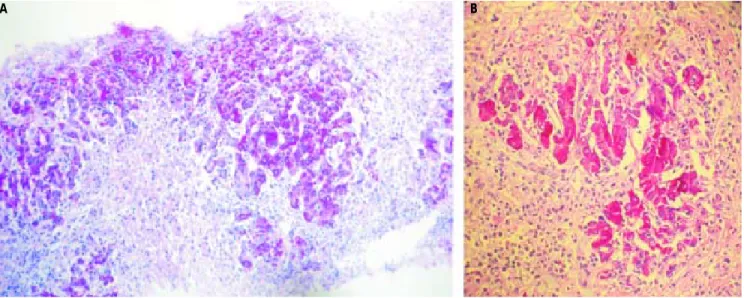
Three weeks after jaundice, she abruptly devel-oped decreased level of consciousness, asterixis and a fall in prothrombin time to 23%, with a coagula-tion factor V of 27 %. She was transferred to our Liver Transplantation Unit within 6 h of encepha-lopathy and admitted to the Intensive Care Unit. A transjugular liver biopsy was performed 4 h post-ad-mittance that showed submassive hepatocellular necrosis with marked portal and lobular inflamma-tion and parenchymal collapse, interface hepatitis with abundant plasma cells and rosette formation (Figures 1-3). Gammaglobulin level was 3.3 mg/dL.
Table 1. Laboratory data of case 1.
Case 1 - 12 months - 5 weeks - 4 weeks Admission + 2 days + 10 days Hb (gr/dL)/ 13.7/4,800 12.9/5,580 13.1/5,420 13.3/6,220 12.7/9,740 12.3/8,790 White cell count
(mill/mm3)
Glycemia (mg/dl) 79 82 78 72 89 91
Creatinine (mg/dL) 0.7 0.6 0.7 0.7 0.8 0.6 Total/Dir Bil (mg/dL) 0.9/0.7 3.9/2.8 16.1/12.7 19.3/15.7 17.1/12.2 7.2/5.9 AST/ALT (< 40 UI/L) 105/128 191/218 670/710 580/605 370/410 86/92 Alk Phosph (< 100 UI/L) 96 101 192 156 114 109
GGT (< 49 UI/mL) 32 42 64 59 53 56
Quick time (%) 96 82 77 19 21 67
Factor V (%) - - - 27 43 76
Gammaglob (g/dL) - - 3.3 3.1 2.8 2.1
Figure 1. Anatomopathological liver specimen of case 1 (H&E stain). A.Lymphoplasmocytic portal and peri-portal infiltrates with
drop out and stromal collapse (H&E 400X). B. Perinodular infiltrates with necrosis and interface hepatitis (H&E 100X).
Figure 2. Anatomopathological liver specimen of case 1 (PAS stain). Massive hepatocellular necrosis. Lymphoplasmocytic infiltrate
with active interface and bridging necrosis. A. PAS stain 100X. B. PAS stain 400X.
A B
Figure 3. Anatomopathological liver specimen of case 1 (reticulin stain). A. Portal tract with stromal collapse and short
peri-por-tal fibrosis (reticulin stain 100X). B. Periporperi-por-tal fibrous tract without mononuclear inflamatory activity (Reticulin stain 400X).
A B
The patient quickly progressed to grade III encepha-lopathy and was listed for liver transplantation. Prednisone was started via a nasogastric tube at a dose of 1 mg/kg (60 mg/day). By day 2 post-corticos-teroids her liver function started to improve, she had no evidences of encephalopathy and presented complete normalization of prothrombin time and factor V by day 10 post treatment (Figure 4). She was started on azathioprine (50 mg/day) on day 15 and steroid tapering and remained with normal liver function tests for the following 24 months. A new
muscle (1/160), anti-actin +. Eight months after starting immunosuppressive treatment she devel-oped hypothyroidism with associated antithyroglob-ulin and anti thyroperoxidase antibodies in high titers and is currently replaced with levothyroxin 100 μgr/day.
Case 2
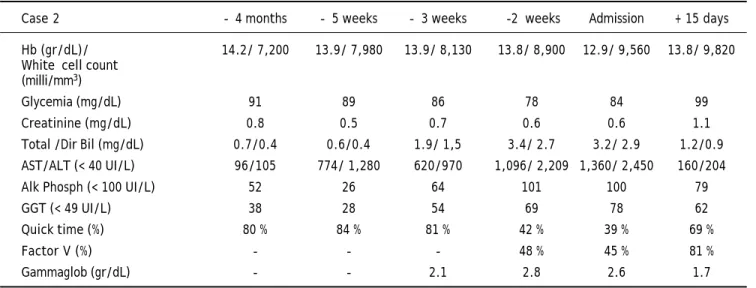
47-year-old man with diagnosis of relapsing-re-mitting MS who started treatment with IFN beta 1a forty-one months before admittance. Four months before entry, IFN was discontinued as a result of an increase of transaminases x 3 followed by rapid normalization of liver function tests and progressive re-introduction of IFN. In a subsequent routine liver test 1 month later, he presented alkaline phosphatase 26 UI/dL, AST 774 UI/dL, ALT 1,280 UI/dL (Table 2). Antithyroperoxidase antibodies were positive and TSH was 7.2 uIU/mL. IFN was discontinued and thyroid supplementation started with levothyroxine 100 μgr/day. One month later, AST was 620 UI/dL, ALT 480 UI/dL, alkaline phos-phatase 64 UI/dL and prothrombin time was 51 %, refractory to vitamin K parenteral supplementation. The patient had no history of previous hepatic
dis-ease, no alcohol consumption or use of other hepato-toxic drugs. Pre-treatment liver biochemistry was normal. Viral serology for hepatitis A, B and C were negative. One week later, transaminases were AST 1,096 UI/dL, ALT 2,209 UI/dL. ANA titer was 1/320 (speckeled pattern), with negative anti smooth mus-cle and antimitochondrial antibodies. Gammaglobu-lin level was 2.8 mg/dL. Prothrombin time fell to 42%, with factor V 48 % without evidence of hepatic encephalopathy. A transjugular liver biopsy was performed, that demonstrated severe periportal in-terface hepatitis with plasma cell infiltration, piece-meal necrosis and bridging, without evidences of fibrosis.
The patient started treatment with 60 mg/day of prednisone, followed by dose reduction by 15 days post-treatment He presented progressive normaliza-tion of transaminases and a rapid recovery of liver synthetic parameters (Figure 2). Azathioprine was started on day 20 post-steroids. The patient re-mained asymptomatic, with normal liver function tests. He denied a new liver biopsy, and was weaned from immunosuppression 3 years post-treatment. He presented no relapse post steroids and AZA removal. MS remained stable, without any further relapses by three years of follow up.
Figure 4. Patient 1 Time course of total bilirrubin, ALT levels and prothrombin time before and after the initiation of
immunosup-pressive treatment.
Prothrombin time (%)
750 700 650 600 550 500 450 400 350 300 250 200 150 100 50 0 100
90 80 70 60 50 40 30 20 10
ALT (IU per mL)
Prothrombin time (%)
ALT (IU per ml) Normal value < 40 IU/mL Total Bilirrubin (mg dL) 28
24
20
16
12
8
4
0
- 8 weeks- 4 weeks - 1 weeks
At admission + Day 2 + Day 5 + Day 10 + Day 15 + Month 24
DISCUSSION
It has been reported that both type I IFNs (alpha and beta) share their side effects profile, though it has been speculated that their different receptor binding affinity and bioavailability may result in dif-ferent side effects severity.1,6 Their most frequent
untoward effect is an acute influenza like syndrome beginning several hours after injection. Dose limit-ing toxicities are bone marrow suppression, neuro-toxicity, asthenia, depression, thyroid dysfunction and cardiotoxicity.1
Liver abnormalities during IFN therapy are usu-ally asymptomatic and restricted to transient bio-chemical events.7 Yet, it has been observed that
IFN alpha may induce hepatic decompensation and liver failure, especially in cirrhotic patients with chronic hepatitis B or C.8-10 Possible explanations
have been related to exacerbations by IFN of im-mune mediated lysis of virus-infected hepatocytes,10
direct cytotoxic effect8 or induction of autoimmune
events.11,12 It has also been observed the
develop-ment and/or exacerbation5,13 of AIH in association
with IFN alfa treatment for hepatitis C, a viral infection that per se has been related with autoim-munity.14-16
Multiple sclerosis is a demyelinating disease of autoimmune nature resulting from dysregulation of TH1 and TH2 lymphocytes, cytokines and regula-tory T cells. MS patients have a higher level of re-sponsiveness to autoantigens compared to controls, yet autoimmune events induced by IFN beta have been usually restricted to the production of autoan-tibodies, with the thyroid being the most common
target organ involved.17,18 Overall incidence of
thy-roid dysfunction has been observed in 33% over 1 year of IFN beta therapy17 and is usually subclinical
and transient.18-22
Exacerbations of autoimmune diseases, though unusual, have also been described, including Myasthenia gravis, Raynaud’s phenomenon, sar-coidosis, rheumatoid arthritis and lupus erythema-tosous. Yet, information related to the potential of IFN beta in multiple sclerosis patients to induce or exacerbate autoimmune liver disease is limited and controversial.
Liver involvement among patients with MS receiv-ing IFN Beta is limited to non specific increases of citolytic hepatic enzymes. These abnormalities have been observed in about 20% of patients in the IFN beta 1b trial in MS and in about 30% of patients in post marketing surveillance follow up studies.23,24
These changes were seldom serious and over 50% occurred during the first three months of exposure to IFN beta, while only 11 % persisted after two years post treatment.25
Different reports have also described the develop-ment of autoantibodies related to autoimmune liver disease, mainly antinuclear antibody and anti smooth muscle antibody.
Verdun demonstrated the development de novo of autoantibodies in 7.2 % of patients. Yet, he did not observe any correlation between the positivity of au-toantibodies at baseline or during treatment and the occurrence of any liver function test alteration.26
Speciale observed that both ANA and ASMA may fluctuate over time during treatment without evi-dence of clinical impact, except for one patient in
Table 2. Laboratory data of case 2.
Case 2 - 4 months - 5 weeks - 3 weeks -2 weeks Admission + 15 days Hb (gr/dL)/ 14.2/ 7,200 13.9/ 7,980 13.9/ 8,130 13.8/ 8,900 12.9/ 9,560 13.8/ 9,820 White cell count
(milli/mm3)
Glycemia (mg/dL) 91 89 86 78 84 99
Creatinine (mg/dL) 0.8 0.5 0.7 0.6 0.6 1.1 Total /Dir Bil (mg/dL) 0.7/0.4 0.6/0.4 1.9/ 1,5 3.4/ 2.7 3.2/ 2.9 1.2/0.9 AST/ALT (< 40 UI/L) 96/105 774/ 1,280 620/970 1,096/ 2,209 1,360/ 2,450 160/204 Alk Phosph (< 100 UI/L) 52 26 64 101 100 79
GGT (< 49 UI/L) 38 28 54 69 78 62
Quick time (%) 80 % 84 % 81 % 42 % 39 % 69 %
Factor V (%) - - - 48 % 45 % 81 %
their prospective series of 69 patients in whom IFN treatment had to be interrupted after 6 months be-cause of the occurrence of high ASMA levels associ-ated with typical manifestations of autoimmune hepatitis, yet with no evidences of liver failure.27
Minor liver function tests alterations have also been described in patients with MS independently of treatment with IFN. The association of MS with AIH has been described with a prevalence of 0.17% within a French cohort of MS compared to 0.0016 in the general population.28 Durelli observed liver
al-terations in 4.6% of patients with MS at baseline, stepping to 37.5% after initiation of IFN beta treat-ment.20
Whether significant liver abnormalities with higher transaminases levels and associated autoan-tibodies represent true autoimmune hepatitis is con-troversial.
Several reports have emphasized the develop-ment of compatible clinical, serological and patho-logical pictures of autoimmune hepatitis among these patients, yet in some of these descriptions clinical condition improved with the discontinua-tion of IFN, without requirement of steroids or other immunosuppressive medications. It can also be discussed if this is a real association or a coinci-dental presentation of two autoimmune diseases in a predisposed individual, maybe favored by the con-current use of IFN.
Though rare, severe cases of autoimmune hepati-tis have already been described in this group of pa-tients. Two reports of liver failure complicating the treatment of MS have been published,29,30 yet in one
of them requiring emergency liver transplantation information obtained after its publication revealed that the patient had received a known hepatotoxic medication, nefazadone, that has been associated with severe liver failure in more than 20 patients and hepatic adverse effects in 109 more.31,32
Considering this potential of IFN for considerable hepatotoxicity, limits of tolerable liver function labo-ratory abnormalities under therapy with IFN beta have been proposed and should be closely monitored, particularly during the first year of treatment or af-ter re-trial. They include elevated total bilirrubin 2-3 times above normal values, transaminases or alka-line phosphatase over per 3, or the simultaneous in-crease of the three parameters. The finding of these alterations is an indication of dosage reduction. When extreme deviations of normal values occur, IFN treatment should be discontinued. In most in-stances hepatic enzyme abnormalities return to nor-mal after discontinuation of therapy. Once these
parameters normalize, it has been recommended that IFN beta can be reintroduced at 25% of the usual dose with a slow dosage building as liver func-tion is monitored. Evidences of compromised liver synthetic function (ie fall in prothrombin time, fac-tor V below 30% or development of hepatic encepha-lopathy) should prompt the evaluation of these patients by a Liver Transplantation Unit.33,34
Both of our patients presented with severe syn-thetic derangement associated with transaminases over x 10 and bilirrubin above 10 mg/dL. They had no previous history of liver dysfunction and present-ed with a normal pre-treatment liver biochemistry. They both developed severe acute hepatitis with posi-tive autoantibodies either at presentation or during the progression of disease, high levels of gammaglob-ulin and a fall of prothrombin time. One of the pa-tients behaved as a subfulminant liver failure with development of hepatic encephalopathy within three weeks of jaundice, sub massive hepatocellular necro-sis and required listing for liver transplantation.
Pathologic examination of hepatic biopsies pre-sented with typical features of autoimmune hepatitis with no evidences suggestive of chronic hepatitis or significant fibrosis. Pre-treatment IHAG score35 for
patient 1 was 13 (probable autoimmune hepatitis) and for patient 2 it was 16 (definitive autoimmune hepatitis), both responsive to steroids. IFN discon-tinuation and rapid initiation of corticosteroid treat-ment led to full recovery in both patients, with rapid normalization of synthetic function. It can be ar-gued that the usefulness of immunosuppressive ther-apy in severe and fulminant forms of AIH has not been fully demonstrated. Moreover, the fact that cor-ticosteroid therapy might obviate the need for liver transplantation (LT) has not been proven.36 Yet, in
our own experience,37 and as it has been reported in
diverse reports, the early introduction of steroids can control acute inflammation and allow the recov-ery of liver function.38,39 Whether these cases
repre-sent simply hepatotoxicity or IFN behaves as a trigger unmasking AIH in a predisposed individual is difficult to define. Yet, management with drug dis-continuation and immunosuppression seems to be above discussion.
As far as we know, this is the first report of se-vere autoimmune hepatitis developing years after in-itial exposure to IFN beta 1a therapy.
even after IFN discontinuation evolve to liver fail-ure if untreated. Rapid evaluation with liver biopsy and prompt initiation of corticosteroids may prevent the progression of liver failure and the need for liver transplantation.
REFERENCES
1. Interferons. In: Goodman and Gilman’s eds. The pharma-cological basis of therapeutics. 10th Ed. McGraw Hill; 2001: 1332-4.
2. The IFN Beta Multiple Sclerosis Study Group: Interferon beta 1b is effective in relapsing-remitting multiple scle-rosis: Clinical results of a multicenter randomized, dou-ble blind, placebo controlled trial. Neurology 1993; 43: 655-61.
3. The IFN Beta Multiple Sclerosis Study Group, the Universi-ty of Columbia MS/MRI Analysis Group. IFN beta 1b in the treatment of MS: Final outcomes of the randomized con-trolled trial. Neurology 1995; 45: 1277-85.
4. Vial T, Descotes J. Immune-mediated side-effects of cy-tokines in humans. Toxicology 1995; 105: 31-57.
5. Garcia-Buey L, Garcia-Monzon C, Rodriguez S, Borque MJ, Garcia Sanchez A, Iglesias R, De Castro M, et al. Latent autoimmune hepatitis triggered during IFN therapy in pa-tients with chronic hepatitis C. Gastroenterology 1995; 108: 1770-7.
6. Platanias LC. Mechanisms of type-I and type-II interferon-mediated signalling. Nat Rev Immunol 2005; 5: 375-86. 7. Durelli L, Ferrero B, Oggero A, Verdun E, Ghezzi A,
Mon-tanari E, Zaffaroni M; Betaferon Safety Trial (BEST) Study Group. Liver and thyroid function and autoimmunity dur-ing interferon-beta 1b treatment for MS. Neurology 2001; 57: 1363-70.
8. Durand JM, Kaplanski G, Portal I, Scheiner C, Berland Y, Soubeyrand J. Liver failure due to recombinant alpha in-terferon. Lancet 1991; 338: 1268-9.
9. Janssen HL, Brouwer JT, Nevens F, Sanchez-Tapias JM, Craxi A, Hadziyannis S. Fatal hepatic decompensation as-sociated with interferon alfa. European concerted action on viral hepatitis (Eurohep). BMJ 1993; 306: 107-8. 10. Sheen IS, Liaw YF, Tai DI, Chu CM. Hepatic decompensation
associated with hepatitis B e antigen clearance in chronic type B hepatitis. Gastroenterology 1985; 89: 732-5. 11. Papo T, Marcellin P, Bernuau J, Durand F, Poynard T,
Ben-hamou JP. Autoimmune chronic hepatitis exacerbated by alpha-interferon. Ann Intern Med 1992; 116: 51-3. 12. Borg FA, Isenberg DA. Syndromes and complications of
in-terferon therapy. Curr Opin Rheumatok 2007; 19: 61-6. 13. Burdick LM, Somani N, Somani AK. Type I IFNs and their
role in the development of autoimmune diseases. Expert
Opin Drug Saf 2009; 8: 459-72.
14. Muratori L, Lenzi M, Cataleta M, Giostra F, Cassani F, Bal-lardini G, Zauli D, et al. Interferon therapy in liver/kidney microsomal antibody type 1-positive patients with chronic hepatitis C. J Hepatol 1994; 21: 199-203.
15. Eddleston AL. Hepatitis C infection and autoimmunity. J
Hepatol 1996; 24(2 Suppl.): 55-60.
16. Lunel F. Hepatitis C virus and autoimmunity: fortuitous association or reality? Gastroenterology 1994; 107: 1550-5.
17. Monzani F, Caraccio N, Meucci G, Lombardo F, Moscato G, Casolaro A, Ferdeghini M, et al. Effect of 1-year treat-ment with interferon-beta1b on thyroid function and
au-toimmunity in patients with multiple sclerosis. Eur J
Endo-crinol 1999; 141: 325-31.
18. Caraccio N, Dardano A, Manfredonia F, Manca L, Pasquali L, Iudice A, Murri L, et al. Long-term follow-up of 106 mul-tiple sclerosis patients undergoing interferon-beta 1a or 1b therapy: predictive factors of thyroid disease develop-ment and duration. J Clin Endocrinol Metab 2005; 90: 4133-37.
19. Tremlett H. Liver and thyroid function and autoimmunity during interferon-beta 1b treatment for multiple sclero-sis. Neurology 2002; 58: 1868.
20. Durelli L, Ferrero B, Oggero A, Verdun E, Ghezzi A, Mon-tanari E, Zaffaroni M. Betaferon Safety Trial Study Group. Thyroid function and autoimmunity during interferon beta-1b treatment: a multicenter prospective study. J
Clin Endocrinol Metab 2001; 86: 3525-32.
21. Monzani F, Caraccio N, Dardano A, Ferrannini E Thyroid autoimmunity and dysfunction associated with type I in-terferon therapy. Clin Exp Med 2004; 3: 199-210. 22. Rotondi M, Oliviero A, Profice P, Mone CM, Biondi B, Del
Buono A, Mazziotti G, et al. Occurrence of thyroid autoim-munity and dysfunction throughout a nine month follow-up in patients undergoing interferon-beta therapy for multi-ple sclerosis. J Endocrinol Invest 1998; 21: 748-52. 23. Byrnes V, Afdhal N, Challies T, Greenstein PE. Drug
in-duced liver injury secondary to interferon-beta (IFN-beta) in multiple sclerosis. Ann Hepatol 2006; 5: 56-9. 24. Tremlett HL, Yoshida EM, Oger J. Liver injury associated
with the beta interferons for MS: a comparison between the three products. Neurology 2004; 62: 628-31.
25. Francis GS, Grumser Y, Alteri E, Micaleff A, O’Brien F, Al-sop J, Stam Moraga M, et al. Hepatic reactions during treatment of multiple sclerosis with interferonbeta-1a: incidence and clinical significance. Drug Saf 2003; 26: 815-27.
26. Verdun E, Isoardo G, Oggero A, Ferrero B, Ghezzi A, Mon-tanari E, Zaffaroni M, et al. Autoantibodies in multiple sclerosis patients before and during IFN-beta 1b treat-ment: are they correlated with the occurrence of autoim-mune diseases? J Interferon Cytokine Res 2002; 22: 245-55.
27. Speciale L, Saresella M, Caputo D, Ruzzante S, Mancuso R, Calvo MG, Guerini FR, et al. Serum auto antibodies pres-ence in multiple sclerosis patients treated with beta-interferon 1a and 1b. J Neurovirol 2000; 6 (Suppl. 2): S57-S61.
28. de Seze J, Canva-Delcambre V, Fajardy I, Delalande S, Sto-jkovic T, Godet E, Vermersch P. Autoimmune hepatitis and multiple sclerosis: a coincidental association? Mult
Sclero-sis 2005; 11: 691-3.
29. Yoshida EM, Rasmussen SL, Steinbrecher UP, Erb SR, Scudamore CH, Chung SW, Oger JJ, et al. Fulminant liver failure during interferon beta treatment of multiple scle-rosis. Neurology 2001; 56: 1416.
30. Duchini A. Autoimmune hepatitis and interferon beta-1a for multiple sclerosis. Am J Gastroenterol 2002; 97: 767-68.
31. Yoshida EM, Rasmussen SL, Steinbrecher UP, Erb SR, Scudamore CH, Chung SW, Oger JJ, et al. Fulminant liver failure during interferon beta treatment of multiple scle-rosis. Erratum in: Neurology 2001; 57: 2153.
32. Stewart DE. Hepatic adverse reactions associated with nefazodone. Can J Psychiatry 2002; 47: 375-77.
34. Tremlett H, Oger J. Hepatic injury, liver monitoring and the beta-interferons for multiple sclerosis. J Neurol 2004; 251: 1297-303.
35. Alvarez F, Berg PA, Bianchi FB, Bianchi L, Burroughs AK, Cancado EL, Chapman RW, et al. International Autoimmune Hepatitis Group Report: review of criteria for diagnosis of autoimmune hepatitis. J Hepatol 1999; 31: 929-38.
36. Ichai P, Duclos-Vallee JC, Guettier C, Ben Hamida S, Antoni-ni T, Delvart T, Saliba F, et al. Usefulness of Corticosteroids for the Treatment of Severe and Fulminant Forms of Autoim-mune Hepatitis. Liv Transplant 2007; 13; 996-1003.
37. Villamil AG, Casciato P, Mullen E, Bustos, Giunta D, Ciardullo M, Bandi M, et al. Fulminant autoimmune hep-atitis type I: Clinical presentation, outcome and prog-nostic factors. Am J Transplant 2005; 5 (Sup 11); 278 (Abs 480).
38. Potts JR, Verma S. Optimizing management in autoimmune hepatitis with liver failure at initial presentation. WJ
Gas-troenterol 2011; 17:2070-5.