Association Between Hepatitis B Virus
and Chronic Kidney Disease:
a Systematic Review and Meta-analysis
Fabrizio Fabrizi,* Francesca M. Donato,** Piergiorgio Messa*
* Division of Nephrology, ** Division of Gastroenterology, Maggiore Hospital and IRCCS Foundation, Milano, Italy. January-February, Vol. 16 No. 1, 2017: 21-47
INTRODUCTION
Chronic kidney disease is a growing public health issue
worldwide. The prevalence of chronic kidney disease,
defined by a reduction in glomerular filtration rate and/or
increased urinary albumin excretion, exceeds 10% of the
adult general population, according to some
population-based studies.
1Conventional risk factors for chronic
kidney disease include demographics (aging, gender),
life-styles (smoking, alcohol intake, physical exercise), and
co-morbidities (diabetes mellitus, arterial hypertension,
anaemia, overweight);
2also, chronic hepatitis C virus
infection has been recently associated to the risk of
chron-ic kidney disease in the general population
3and among
HIV-infected individuals.
4However, the mechanisms
underlying the current frequency of chronic kidney
disease in the general population of developed world
remain unclear.
Hepatitis B virus (HBV) infection is an important
cause of liver disease and cancer and infects about 400
million individuals worldwide. In addition to its
effects in the liver, extra-hepatic manifestations may be
observed in up to 20% of patients infected with HBV, in
both acute and chronic infections. Manifestations
relat-ed to HBV include mixrelat-ed cryoglobulinemia vasculitis,
polyarteritis nodosa, and renal disease.
5The association
between HBV infection and glomerular disease has
been already explored by various authors; the most
common type of HBV-related glomerulonephritis is
membranous nephropathy, particularly in the Asian
The Official Journal of the Mexican Association of Hepatology,the Latin-American Association for Study of the Liver and the Canadian Association for the Study of the Liver
Manuscript received: Manuscript received:Manuscript received:
Manuscript received:Manuscript received: July 17, 2016. Manuscript accepted:Manuscript accepted:Manuscript accepted:Manuscript accepted:Manuscript accepted: August 29, 2016. DOI:10.5604/16652681.1226813.
A B S T R A C T A B S T R A C T A B S T R A C T A B S T R A C T A B S T R A C T
Background. Background.Background. Background.
Background. Hepatitis B virus infection and chronic kidney disease are prevalent and remain a major public health problem world-wide. It remains unclear how infection with hepatitis B virus impacts on the development and progression of chronic kidney disease. Aim.
Aim.Aim. Aim.
Aim. To evaluate the effect of infection with HBV on the risk of chronic kidney disease in the general population. Material andMaterial andMaterial andMaterial andMaterial and methods.
methods.methods. methods.
methods. We conducted a systematic review of the published medical literature to determine if hepatitis B infection is associated with increased likelihood of chronic kidney disease. We used the random effects model of DerSimonian and Laird to generate a sum-mary estimate of the relative risk for chronic kidney disease (defined by reduced glomerular filtration rate and/or detectable proteinu-ria) with hepatitis B virus across the published studies. Meta-regression and stratified analysis were also conducted. Results.Results.Results.Results.Results. We identified 16 studies (n = 394,664 patients) and separate meta-analyses were performed according to the outcome. The subset of longitudinal studies addressing ESRD (n = 2; n = 91,656) gave a pooled aHR 3.87 (95% CI, 1.48; 6.25, P < 0.0001) among HBV-in-fected patients and no heterogeneity was recorded. In meta-regression, we noted the impact of male (P = 0.006) and duration of fol-low-up (P = 0.007) upon the adjusted hazard ratio of incidence of chronic kidney disease (including end-stage renal disease). No relationship occurred between HBV positive status and prevalent chronic disease (n = 7, n = 109,889 unique patients); adjusted odds ratio, were 1.07 (95% CI, 0.89; 1.25) and 0.93 (95% CI, 0.76; 1.10), respectively. Conclusions.Conclusions.Conclusions.Conclusions.Conclusions. HBV infection is possibly associ-ated with a risk of developing reduced glomerular filtration rate in the general population; no link between HBV sero-positive status and frequency of chronic kidney disease or proteinuria was noted in cross-sectional surveys.
Key words. Key words. Key words. Key words.
continent.
6Also, chronic hepatitis B serum promotes
apoptotic damage in human renal tubular cells.
7Either
insulin resistance
8and oxidative stress
9have been
relat-ed to HBV infection; both conditions may contribute to
renal injury.
Whether HBV-infected individuals have increased risk
for development and progression of chronic kidney
dis-ease has not been appropriately investigated. The aim of
this study was to review the available evidence on the link
between HBV infection and frequency of chronic kidney
disease (low estimated glomerular filtration rate and/or
detectable proteinuria) at population-based level by
per-forming a systematic review of the literature with a
meta-analysis of clinical observational studies.
MATERIAL AND METHODS
This work is in agreement with the Preferred
Report-ing Items for Systematic reviews and Meta-Analyses
state-ment
10(Supplementary file 1).
Search strategy and data extraction
Two authors (F.F., and F.M. D.) independently
re-viewed English-language citations from the national
Li-brary of Medicine’s Medline database from 1970 through
July 1, 2015. Data on HBsAg status were not available
be-fore 1970, when the first assay for HBsAg was
manufac-tured. We conducted our search by four Medline databases
engines (Embase, Grateful Med, Ovid, and PubMed).
Our Medline search was limited to human studies. We
ap-plied the following algorithm in medical subject heading
and in free text words: (“HEPATITIS B” or “HEPATITIS
B VIRUS INFECTION” or “HBsAg POSITIVE
STA-TUS” or “HBc ANTIBODY POSITIVE STASTA-TUS”) and
(“CHRONIC KIDNEY DISEASE” or “CKD” or
“END-STAGE RENAL DISEASE” or “ESRD” or “LOW
GLOMERULAR FILTRATION RATE” or “RENAL
IMPAIRMENT” or “RENAL INSUFFICIENCY” or
“RENAL FAILURE” or “PROTEINURIA” or
‘’GLOMERULONEPHRITIS’’) and (“RELATIVE RISK”
or “RISK RATIO” or “RR” or “ODDS RATIO” or “OR”
or “HAZARD RATIO” or “HR” or “INCIDENCE”). An
additional search was performed with electronic searches
of the Cochrane Library; manual searches of selected
spe-cialty journals were done to identify all pertinent
litera-ture. Reference lists from qualitative topic reviews and
published clinical studies were also searched. It was
pre-viously demonstrated that a Medline search alone might
not be sensitive enough.
11Data on study design, study
pe-riod, patient characteristics, HBV prevalence, and kidney
disease outcomes were abstracted. Authors of selected
pa-pers were contacted to obtain missing data and only data
from individuals with known HBV status were included
in the meta-analysis. Consensus was achieved for all data.
Studies were compared to eliminate duplicate reports for
the same patients, which included contact with
investiga-tors when necessary. Eligibility and exclusion criteria
were pre-specified. Our search was limited to human
studies that were published in the English literature.
Inclusion criteria
Studies were included if they met the following
inclu-sion criteria:
• They presented original data from cohort and
cross-sectional studies.
• The outcome of interest was clearly defined as
inci-dence or prevalence of chronic kidney disease, i.e.,
re-duced glomerular filtration rate and/or detectable
proteinuria in the adult general population according
to HBV serological status; and
• They provided adjusted risk estimates and their
confi-dence intervals.
We considered both case-control studies and cohort
studies as eligible for inclusion in the analysis. We
includ-ed studies where the diagnosis of HBV infection was done
by testing for HBsAg in serum and/or HBc antibody.
In-formation on HBV serological status was collected at the
time of enrolment. If data on the same population were
duplicated in more than one study, the most recent study
was included in the analysis.
Ineligible studies
Studies were excluded if they reported inadequate data
on the association between chronic kidney disease and
HBV sero-positive status (e.g., incomplete information on
HBV status or renal outcomes). Unpublished studies,
studies that were only published in abstract form or as
in-terim reports were excluded; letters and review articles
were not considered for this systematic review.
Quality assessment
There-fore, cross-sectional studies assigned 8-10, 6-7, 4-5, or 0-3
points (stars) were evaluated as very good, good,
satisfac-tory or unsatisfacsatisfac-tory studies, respectively. Similarly,
co-hort/case-control studies with 7-9, 5-6, 4 and 0-3 points
(stars) were identified as very good, good, satisfactory or
unsatisfactory, respectively. We carried out subgroup
anal-yses based on those studies provided with very good
quali-ty. Data extraction and quality scoring were performed
independently by two reviewers (F.F. and F.M. D.) and
the results were merged by consensus. The complete
pro-tocol for quality scoring is available on-line
(Supplemen-tary file 2).
Outcomes measures
We performed separate meta-analyses according to the
outcome. One meta-analysis included longitudinal
stud-ies addressing the incidence of chronic kidney disease or
end-stage renal disease; and another regarded cohort
studies assessing the prevalence of CKD. An additional
meta-analysis was performed for prevalent proteinuria.
Staging of chronic kidney disease was categorized
ac-cording to the Kidney Disease Outcomes Quality
Initia-tive (K/DOQI) definition, and estimated glomerular
filtration rate was calculated using the 4-variable MDRD
equation.
13The primary end point was to provide
adjust-ed estimates of the risk (and 95% CIs) of incidence (or
prevalence) of chronic kidney disease in the general
pop-ulation according to HBV serological status. Multivariate
analysis was made to estimate the independent effect of
HBV positive status on the frequency of chronic kidney
disease after adjustment for potential confounders
(cov-ariates) (e.g., age, gender, race/ethnicity, diabetes
melli-tus, and others). Longitudinal studies adopted Cox
regression analysis to assess the independent predictors
of the incidence of chronic kidney disease; multiple
lo-gistic regression analyses were done in cross-sectional
surveys. An additional end point was the adjusted
esti-mate of the risk (and 95% CIs) of prevalence of
pro-teinuria in the adult general population according to
HBV serological status. Cox proportional hazard
regres-sion analysis was carried out to assess the effect of HBV
sero-positivity per se on the incidence of chronic kidney
disease after adjustment for differential follow-up time
and distribution of potential confounders.
Data synthesis and analysis
We weighted the study-specific log odds ratios for case
control and cross-sectional studies, and log hazard ratios
for longitudinal studies by the inverse of their variance to
obtain a pooled effect estimate and its 95% confidence
in-tervals. For each study, we used the estimate of the effect
measure that was adjusted for the largest number of
con-founders. We present both fixed-effects and
random-ef-fects pooled estimates but use and report the latter when
heterogeneity was present. We used the random-effects
ap-proach, as described by DerSimonian and Laird.
14Co-chrane Q-test was used for quantifying the heterogeneity.
15The I
2statistic, which is the percentage of total variation
across studies due to heterogeneity rather than chance, was
also calculated.
16The null hypothesis of this test is the
ab-sence of heterogeneity. We explored the origin of
hetero-geneity by restricting the analysis to subgroups of studies
defined by study characteristics such as country of origin,
CKD stage, and others. Heterogeneity was also evaluated
by meta-regression in order to look at the effect of
poten-tial and continuous covariates on the outcome of interest.
Subgroup or stratified analyses and meta-regression were
pre-specified. We performed random-effects
meta-regres-sion using the method of moments or maximum
likeli-hood approaches where appropriate, a single predictor is
allowed in each model (simple meta-regression).
Publica-tion bias was assessed by the Egger test for funnel-plot
asymmetry. All analyses were done with the statistical
package Comprehensive Meta-Analysis (CMA), version
2.0 (Biostat Inc., USA, 2005). The 5% significance level
was adopted for á risk. Every estimate was given with its
95% CIs.
RESULTS
Literature review
Patient and study characteristics
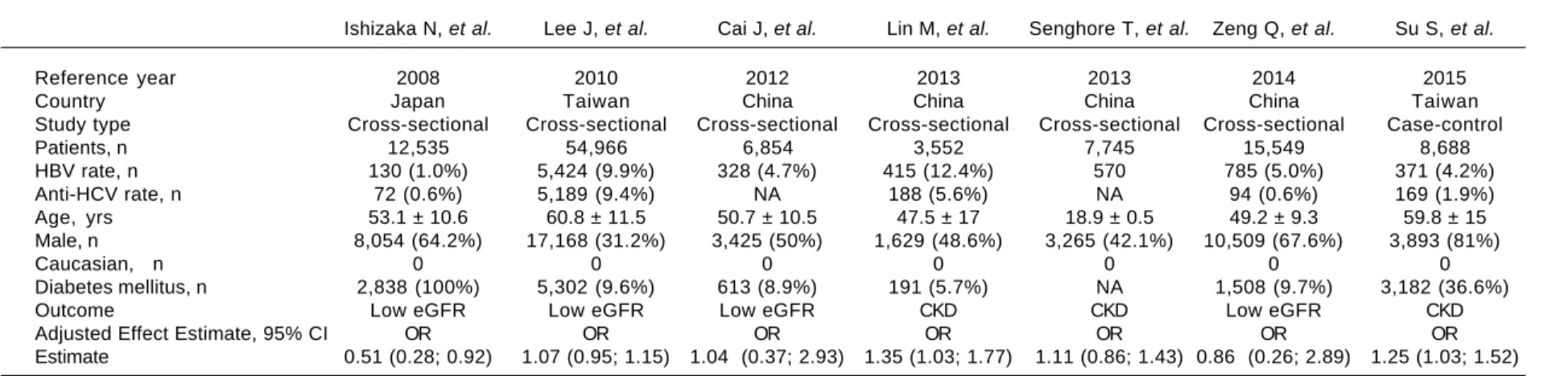
Tables 1-3 reports some salient demographic, and
clin-ical characteristics of subjects enrolled in the included
studies. The mean age of patient cohorts ranged from 18.9
± 0.5 to 60.8 ± 11.5 years. The gender distribution ranged
from 31.2% to 67.6% male. Five reports were Taiwan,
four from China, one from Japan and Hong Kong,
respec-tively. The average follow-up ranged between 3.5 and 6.5
years, among longitudinal studies. The quality scores
ranged between 7 and 8 points (cohort/case-control
stud-ies), and between 8 and 9 (cross-sectional studies)
(Sup-plementary file 2).
• Summary estimate of outcome: Incidence of
CKD (reduced eGFR or end-stage renal disease).
Four
longitudinal studies (n = 184,937 patients; 36,192 HBV
positive and 148,745 HBV negative patients) gave
infor-mation on the incidence of CKD (or ESRD) among
HBV positive patients
19-22(Table 1). The relationship
between positive HBV serologic status and increased
incidence of CKD neared the statistical significance,
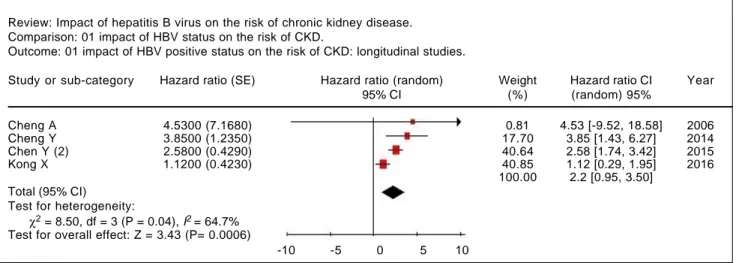
adjusted HR with HBV across the surveys, 2.22 (95%
CI, 0.95; 3.50, NS). There was some heterogeneity
(I
2= 64.7%, P = 0.04) across the four studies (Figure 2).
Publication bias was not found (Egger test, P = 0.61)
(Figure 3). The subset of longitudinal studies
address-ing ESRD gave a pooled aHR 3.87 (95%CI, 1.48; 6.25,
P < 0.0001) among HBV-infected patients and no
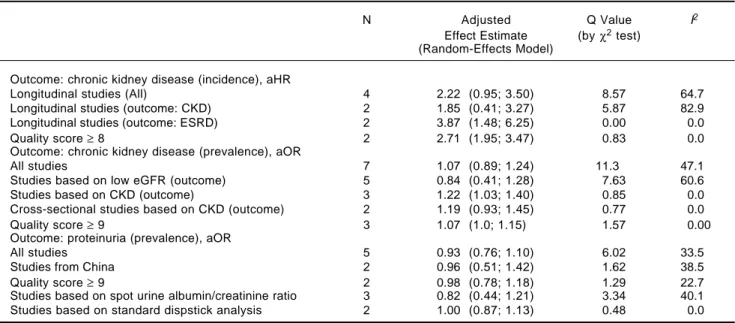
het-erogeneity was recorded (Table 4).
• Summary estimate of outcome: Prevalence of
CKD (reduced eGFR).
Seven studies (n = 109,889
unique patients; 8,023 HBV positive and 101,866
HBV-negative patients) with cross-sectional (or
case-control) design addressed the prevalence of CKD (or
reduced GFR) in HBV-infected patients.
23-29Table 2
shows some demographic, and clinical parameters of
subjects enrolled in the included studies. We found no
relationship between positive HBV serologic status
and increased prevalence of CKD, adjusted OR with
HBV across the studies, 1.069 (95% CI, 0.89; 1.248,
P = NS). Tests for homogeneity of the aOR across the
Table 1. Longitudinal studies included in the meta-analysis (outcome: frequency of end-stage renal disease or chronic kidney dis-ease).
Cheng A, et al.* Chen Y, et al.** Chen Y, et al.*** Kong X, et al.****
Reference year 2006 2014 2015 2016
Country Hong Kong Taiwan Taiwan China
Study type Cohort prospective Nationwide cohort Nationwide cohort Cohort prospective
Patients, n 2,838 88,790 88,980 4,329
Mean observation time, yrs 3.5 6.5 6.5 5
HBV rate, n 286 (10.1%) 17,758 (20%) 17,796 (20%) 352 (8.1%)
Anti-HCV rate, n NA 0 NA 0
Age, yrs 59.7 ±12.9 NA NA 46.2 ± 13.7
Male, n 1,169 (41%) 51,990 (58.5%) 52,140 (58.5%) 2,907 (67.2%)
Caucasian, n 0 0 NA 0
Diabetes mellitus, n 2,838 (100%) 7,062 (7.9%) 6,841 (7.7%) 352 (8.1%)
Outcome ESRD ESRD CKD CKD
Adjusted Effect Estimate, 95% CI HR HR HR HR
Estimate 4.53 (1.1; 18.5) 3.85 (2.36; 6.27) 2.58 (1.95; 3.42) 1.12 (0.65; 1.95)
* ESRD: need for dialysis, doubling of serum creatinine, or serum creatinine ≥ 500 μmol/L. ** ESRD: end-stage renal disease requiring long-term dialysis. *** CKD = decreased eGFR (< 60 mL/min/1.73 m2) or proteinuria (urine protein > 1+). **** CKD: chronic kidney disease stage 1-5.
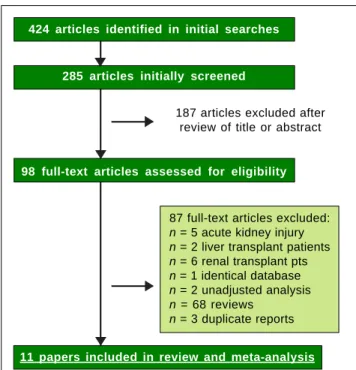
Figure 1. Flow diagram of study selection.
87 full-text articles excluded:
n = 5 acute kidney injury
n = 2 liver transplant patients
n = 6 renal transplant pts
n = 1 identical database
n = 2 unadjusted analysis
n = 68 reviews
n = 3 duplicate reports 187 articles excluded after
review of title or abstract
424 articles identified in initial searches
285 articles initially screened
98 full-text articles assessed for eligibility
25
, 2017; 16 (1): 21-47
Ishizaka N, et al. Lee J, et al. Cai J, et al. Lin M, et al. Senghore T, et al. Zeng Q, et al. Su S, et al.
Reference year 2008 2010 2012 2013 2013 2014 2015
Country Japan Taiwan China China China China Taiwan
Study type Cross-sectional Cross-sectional Cross-sectional Cross-sectional Cross-sectional Cross-sectional Case-control
Patients, n 12,535 54,966 6,854 3,552 7,745 15,549 8,688
HBV rate, n 130 (1.0%) 5,424 (9.9%) 328 (4.7%) 415 (12.4%) 570 785 (5.0%) 371 (4.2%)
Anti-HCV rate, n 72 (0.6%) 5,189 (9.4%) NA 188 (5.6%) NA 94 (0.6%) 169 (1.9%)
Age, yrs 53.1 ± 10.6 60.8 ± 11.5 50.7 ± 10.5 47.5 ± 17 18.9 ± 0.5 49.2 ± 9.3 59.8 ± 15
Male, n 8,054 (64.2%) 17,168 (31.2%) 3,425 (50%) 1,629 (48.6%) 3,265 (42.1%) 10,509 (67.6%) 3,893 (81%)
Caucasian, n 0 0 0 0 0 0 0
Diabetes mellitus, n 2,838 (100%) 5,302 (9.6%) 613 (8.9%) 191 (5.7%) NA 1,508 (9.7%) 3,182 (36.6%)
Outcome Low eGFR Low eGFR Low eGFR CKD CKD Low eGFR CKD
Adjusted Effect Estimate, 95% CI OR OR OR OR OR OR OR
Estimate 0.51 (0.28; 0.92) 1.07 (0.95; 1.15) 1.04 (0.37; 2.93) 1.35 (1.03; 1.77) 1.11 (0.86; 1.43) 0.86 (0.26; 2.89) 1.25 (1.03; 1.52)
Low eGFR: eGFR < 60 mL/min per 1.73 m2. CKD: CKD stage 1-5 alternatively eGFR < 60 mL/min per 1.73 m2 with or without proteinuria.
Table 3. Studies included in the meta-analysis (outcome: frequency of proteinuria).
Huang J, et al. Ishizaka N, et al. Lee J, et al. Cai J, et al. Zeng Q, et al.
Reference year 2006 2008 2010 2012 2014
Country Taiwan Japan Taiwan China China
Study type Cross-sectional Cross-sectional Cross-sectional Cross-sectional Cross-sectional
Patients, n 9,934 12,535 54,966 6,854 15,549
Observation time, yrs 0 0 0 0 0
HBV rate, n 1,363 (13.7%) 130 (1%) 5,424 (9.9%) 328 (4.7%) 785 (5.1%)
Anti-HCV rate, n 646 (6.5%) 72 (0.6%) 5,189 (9.4%) NA 94 (0.6%)
Age, yrs 55.2 ± 6 53.1 ± 10.6 60.8 ± 11.5 50.7 ± 10.5 49.2 ± 9.3
Male, n 4,291 (43.1%) 8,054 (64.2%) 17,168 (31.2%) 3,425 (50%) 10,509 (67.6%)
Caucasian, n NA 0 0 0 0
Diabetes mellitus, n 1,241 (12.5%) NA 5,302 (9.6%) 613 (8.9%) 1,508 (9.7%)
Outcome Proteinuria Proteinuria Proteinuria Proteinuria Proteinuria
Adjusted Effect Estimate, 95% CI OR OR OR OR OR
Figure 3. Funnel plot of precision: Impact of HBV seropositive status on the risk of chronic kidney disease (longitudinal stud-ies).
3
2
1
0
-5 -4 -3 -2 -1 0 1 2 3 4 5
Point estimate
Precision (1/std err)
seven studies gave a Q-value (by χ
2test) of 11.3
(P = 0.007) (I
2= 47.13), that is, the homogeneity
assumption was rejected (Table 4). No publication
bias was found, according to the Egger test (P = 0.89).
• Summary estimate of outcome: prevalence of
proteinuria.
Five studies (n = 99,838 unique patients,
8,030 being HBV seropositive and 91,808 HBV
nega-tive)
23-25,28,30evaluated the prevalence of proteinuria
ac-cording to HBV positive serologic status. Two studies
defined proteinuria by semiquantitative urine protein
dispstick test
24,30and three measured albuminuria by
spot urine albumin/creatinine ratio.
23,25,28The
summa-ry estimate for adjusted OR of proteinuria with HBV
was 0.93 (95% CI, 0.76;1.10, P = NS) across the
identi-fied studies (Table 4). The homogeneity assumption
was not rejected (Q = 6.02, P = 0.19). Publication bias
did not occur (Egger test, P = 0.42).
• Stratified analysis and meta-regression.
As shown
in table 4, there was substantial difference in pooled
ef-fect estimates across designs (i.e., cross-sectional vs.
longitudinal studies) and the homogeneity assumption
was rejected in many subsets. As listed in table 5,
meta-regression demonstrated an inverse relationship
between the frequency of males (P = 0.006) and the
outcome of interest (adjusted HR of incidence of
CKD among HBV positive patients). In addition, a
direct relationship between follow-up duration
(P = 0.007) and the outcome of interest (adjusted HR
of incidence of CKD among HBV positive patients)
was noted.
There was no significant difference in outcomes
ac-cording to the diagnosis of HBV infection (data not
shown).
DISCUSSION
The association between HBV infection and chronic
kidney disease in the general population is controversial
even if the renal involvement of hepatitis B virus infection
was first reported four decades ago.
31The relationship
be-tween hepatitis B virus infection and CKD occurs in
sev-eral ways- some forms of renal disease are induced by
HBV infection and patients with chronic kidney disease
are at increased risk for acquiring HBV. In the current
re-view, we have summarized the scientific evidence and
car-ried out a meta-analysis on the exposure to HBV infection
and the risk of chronic kidney disease and proteinuria in
the adult general population. This meta-analysis (16
stud-ies, n = 394,664 patients) should suggest an association
be-tween positive serologic status for HBV and an increased
risk of chronic kidney disease, aHR being 2.22 (95%
Con-fidence Interval, 0.95; 3.50) in HBV infected individuals
Figure 2. Impact of HBV positive serologic status on the incidence of CKD (longitudinal studies). Review: Impact of hepatitis B virus on the risk of chronic kidney disease.
Comparison: 01 impact of HBV status on the risk of CKD.
Outcome: 01 impact of HBV positive status on the risk of CKD: longitudinal studies.
Study or sub-category Hazard ratio (SE) Hazard ratio (random) Weight Hazard ratio CI Year
95% CI (%) (random) 95%
Cheng A 4.5300 (7.1680) 0.81 4.53 [-9.52, 18.58] 2006
Cheng Y 3.8500 (1.2350) 17.70 3.85 [1.43, 6.27] 2014
Chen Y (2) 2.5800 (0.4290) 40.64 2.58 [1.74, 3.42] 2015
Kong X 1.1200 (0.4230) 40.85 1.12 [0.29, 1.95] 2016
100.00 2.2 [0.95, 3.50] Total (95% CI)
Test for heterogeneity:
χ2 = 8.50, df = 3 (P = 0.04), I2 = 64.7%
Test for overall effect: Z = 3.43 (P= 0.0006)
compared with HBV negative. The subset of longitudinal
studies addressing ESRD gave a pooled aHR 3.87 (95%CI,
1.48; 6.25, P < 0.0001) among HBV-infected patients,
without heterogeneity.
Several pieces of evidence are in keeping with a
detri-mental role of HBV on the development of chronic
kid-ney disease.
32-39In the 2-year cross-sectional HARPE
study,
32renal abnormalities were highly prevalent in
chronic HBV infection and occurred before the
initia-tion of any antiviral therapy towards HBV. Around 64%
of the patients enrolled in the HARPE study (n = 260)
were found to have kidney disease according to the
KDOQI/KDIGO classification. In their observational
and longitudinal study, Mallet, et al.
33observed 214
pa-tients with chronic HBV infection who were treated
with various nucleos(t)ide analogues, the eGFR
re-mained stable or increased over time in patients with
chronic HBV mono-infection with a baseline eGFR of
90 mL/min/1.73 m
2or higher and treated with tenofovir
disoproxil fumarate or entecavir. In the GLOBE study,
34a significant improvement in mean GFR was noted in
patients treated with telbivudine for 2 years, but not
in those on lamivudine. GLOBE extension studies
Table 5. Meta-regression: impact of continuous covariates on the outcome of interest (incidence of CKD).
Point estimate 95% CI P-value (std error)
Diabetes 1.35 (7.88) -14.1; 16.8 0.86 Year -1.07 (0.41) -1.88;-0.27 0.008 Follow-up, time 1.03 (0.38) 0.27; 1.79 0.007 Males -17.5 (6.39) -30.0; -5.00 0.006 Size 0.0003 (0.0001) 0.000; 0.000 0.007
Table 4. Summary measure for adjusted effect estimate according to HBV serologic status among various subgroups of interest.
N Adjusted Q Value I2
Effect Estimate (by χ2 test)
(Random-Effects Model)
Outcome: chronic kidney disease (incidence), aHR
Longitudinal studies (All) 4 2.22 (0.95; 3.50) 8.57 64.7
Longitudinal studies (outcome: CKD) 2 1.85 (0.41; 3.27) 5.87 82.9
Longitudinal studies (outcome: ESRD) 2 3.87 (1.48; 6.25) 0.00 0.0
Quality score ≥ 8 2 2.71 (1.95; 3.47) 0.83 0.0
Outcome: chronic kidney disease (prevalence), aOR
All studies 7 1.07 (0.89; 1.24) 11.3 47.1
Studies based on low eGFR (outcome) 5 0.84 (0.41; 1.28) 7.63 60.6
Studies based on CKD (outcome) 3 1.22 (1.03; 1.40) 0.85 0.0
Cross-sectional studies based on CKD (outcome) 2 1.19 (0.93; 1.45) 0.77 0.0
Quality score ≥ 9 3 1.07 (1.0; 1.15) 1.57 0.00
Outcome: proteinuria (prevalence), aOR
All studies 5 0.93 (0.76; 1.10) 6.02 33.5
Studies from China 2 0.96 (0.51; 1.42) 1.62 38.5
Quality score ≥ 9 2 0.98 (0.78; 1.18) 1.29 22.7
Studies based on spot urine albumin/creatinine ratio 3 0.82 (0.44; 1.21) 3.34 40.1 Studies based on standard dispstick analysis 2 1.00 (0.87; 1.13) 0.48 0.0
demonstrated that the improvement was maintained
throughout 4-6 years of continuous telbivudine therapy.
The mean increase in eGFR was ± 14.9 mL/min/1.73 m
2at week 208 (P < 0.0001). In 74% (165 of 223) of the
telbivudine-treated patients with baseline eGFR of
60-89 mL/min/1.73 m
2(CKD stage 2), renal function
improved to ≥ 90 mL/min/1.73 m
2after 4 years of
treat-ment. A prospective survey from Germany reported
recently that GFR (calculated with the CKD-EPI
equa-tion), declined by approximately -2 mL/min/year in
HBsAg-positive (n = 60) untreated patients over a median
follow-up of 24 months.
35Chronic kidney disease is an important public-health
problem which significantly increases the likelihood of
adverse outcomes and high health-care costs; in addition
to the conventional risk factors for chronic kidney
dis-ease in the general population, HBV may be an additional
agent. Various mechanisms have been implicated in the
adverse impact of HBV sero-positive status on chronic
kidney disease, including an accelerated endothelial
dys-function at renal level. An atherogenic activity of HBV
has been suggested to explain a five-fold increased risk of
cardiovascular events in a selected cohort of HBsAg
pos-itive patients with type 2 diabetes and overt nephropathy
over a median follow-up of 24 months.
17Steatosis is a
typical feature of chronic HBV infection and could
in-duce lipid peroxidation and increase plasma
inflammato-ry biomarkers.
39The pathogenesis of HBV-associated
nephropathy is still under investigation; however, the
small number of patients who develop
glomerulonephri-tis suggests that concomitant factors are needed for
de-velopment of nephropathy (i.e., genetic susceptibility,
abnormalities in cell-mediated immunity, and/or
envi-ronmental conditions).
5These pieces of evidence are in
apparent conflict with other findings from the general
population- chronic HCV is an important factor for
de-veloping insulin resistance, type 2 diabetes mellitus and
atherosclerosis.
41Such relationships in patients with
chronic hepatitis B are not so straightforward.
40, 42-43The findings from our meta-analysis are subject to
sever-al limitations. First, many studies were cross-sectionsever-al, a
design that does not allow for causal inference and can
overestimate relative risks given its reliance on prevalence
ratios. When restricted to cross-sectional studies, no
signif-icant relationship was found between hepatitis B serologic
status and frequency of CKD and proteinuria. Therefore,
there is some evidence that the findings may be impacted by
study design. Second, we included in the current review
only studies providing adjusted estimates of outcomes (risk
of end-stage renal disease or chronic kidney disease, or
pro-teinuria), but residual confounding (confounding
remain-ing after adjustment) likely exists as full information has not
been given on various covariates in all studies retrieved. As
an example, information on HBV DNA or HBV genotypes,
socioeconomic status, compliance with medical visits over
follow-up, and substance abuse which are important
poten-tial confounders was incomplete. Finally, the occurrence of
significant heterogeneity clearly precluded more definitive
conclusions; our subgroup analysis with meta-regression
was not able to capture all the sources of heterogeneity
ob-served. As an example, all the studies enrolled in our
sys-tematic review came from Asia and we need studies from
other continents.
In conclusion, this meta-analysis of observational
stud-ies should suggest a relationship between HBV infection
and higher incidence of low eGFR and/or end-stage renal
disease in the adult general population. We need
addition-al studies with appropriate size and design (i.e.,
prospec-tive longitudinal studies) to increase our knowledge on
this issue and to explore potential mechanisms underlying
such association. A heightened awareness of an increased
chronic kidney disease risk should dictate more careful
follow-up of renal defects among patients with hepatitis B
virus infection.
SUPPORTING INFORMATION
•
Supplementary file 1.
PRISMA 2009 check list.
PRISMA’s items and their application within the paper.
•
Supplementary file 2.
Quality study.
Details on the quality study process (cohort and
cross-sectional studies).
•
Supplementary file 3.
Excluded papers.
List of excluded papers sorted by publication year.
ABBREVIATIONS
•
ACR:
albumin to creatinine ratio.
•
APR:
albumin to protein ratio.
•
CC:
case-control.
•
CKD:
chronic kidney disease.
•
CI:
confidence intervals.
•
Co:
cohort.
•
CS:
cross-sectional.
•
eGFR:
estimated glomerular filtration rate.
•
ESRD:
end-stage renal disease.
•
HBV:
hepatitis B virus.
•
HBcAb:
hepatitis B core antibody.
•
HBsAg:
hepatitis B surface antigen.
•
HCV:
hepatitis C virus.
•
HR:
hazard ratio.
•
MDRD:
Modification of Diet in Renal Disease.
•
NOS:
Newcastle/Ottawa Scale.
ACKNOWLEDGMENTS
This work was supported in part by a ‘Project
Glomer-ulonephritis’ grant, in memory of Pippo Neglia, by
Asso-ciazione Amici del Croff-Onlus. The funders had no role
in study design, data collection analysis, decision to
pub-lish, or preparation of the manuscript
DISCLOSURES
None.
REFERENCES
1. Eggers P. Has the incidence of end-stage renal disease in the USA and other countries stabilized? Curr Opin Nephrol Hypertens 2011; 20: 241-5.
2. Chacko E, Surrun S, Mubarack Sani T, Pappachan J. Chronic viral hepatitis and chronic kidney disease. Postgrad Med J
2010; 86: 486-92.
3. Fabrizi F, Verdesca S, Messa P, Martin P. Hepatitis C virus infection increases the risk of developing chronic kidney dis-ease: a systematic review and meta-analysis. Dig Dis Sci
2015; 60: 3801-13.
4. Fabrizi F, Dixit V, Martin P, Messa P. Hepatitis C virus in-creases the risk of kidney disease among HIV-positive pa-tients: systematic review and meta-analysis. J Med Virol
2016; 88: 487-97.
5. Johnson R, Couser W. Hepatitis B infection and renal dis-ease: clinical, immunopathogenetic and therapeutic consider-ations. Kidney Int 1990; 37: 663-76.
6. Zeng C, Chen H, Wang R, Chen Y, Zhang S, Liu L, Li L, et al. Aetiology and clinical characteristics of membranous neph-ropathy in Chinese patients. Am J Kidney Dis 2008; 52: 691-8. 7. Deng C, Song W, Liang H, Feng C, Sheng Y, Wang M. Chronic hepatitis B serum promotes apoptotic damage in hu-man renal tubular cells. World J Gastroenterol 2006; 12: 1752-6.
8. Pais R, Rusu E, Zilisteanu D, Circiumaru A, Micu L, Voicules-cu M, Poynard T, et al. Prevalence of steatosis and insulin resistance in patients with chronic hepatitis B compared with chronic hepatitis C and non-alcoholic fatty liver dis-ease. Eur J Intern Med 2015; 26: 30-6.
9. Pawlak K, Pawlak D, Mysliwiec M. Hepatitis intensified oxi-dative stress, MIP-1 beta and RANTES plasma levels in urae-mic patients. Cytokine 2004; 28: 197-204.
10. Liberati A, Altman D, Tetzlaff J, Mulrow C, Gotzsche P, Ioannidis J, Clarke M, (PRISMA Group). The PRISMA state-ment for reporting systematic reviews and meta-analyses of studies that evaluate health care interventions: ex-planation and elaboration. J Clin Epidemiol 2009; 62: e1-e34.
11. Poynard T, Conn H. The retrieval of randomised clinical trials in liver diseases from the medical literature: a comparison of Medlars and manual methods. Control Clin Trials 1985; 6: 271-9.
12. Institute OHR. The Newcastle-Ottawa Scale (NOS) for as-sessing the quality of nonrandomised studies in meta-analy-ses. Disponible en: http://www.ohri.ca/programs/clinical_ epidemiology/oxford.asp (access date 26 Apr 2014). 13. National Kidney Foundation. K/DOQI clinical practice guidelines
for chronic kidney disease: evaluation, classification, and stratification. Am J Kidney Dis 2002; 39(Suppl. 1): S1-S266.
14. DerSimonian R, Laird N. Meta-analysis in clinical trials. Con-trol Clin Trials 1986; 7: 177-88.
15. Petitti D. Approaches to heterogeneity in meta-analysis. Stat Med 2001; 20: 3625-33.
16. Higgins J, Thompson S, Deeks J, Altman D. Measuring incon-sistencies in meta-analysis. Br Med J 2003; 327: 557-60. 17. Lo M, Lee K, Chan N, Leung W, Ko G, Chan W, So W, et al.
Effects of gender, Helicobacter pylori and hepatitis B virus serology status on cardiovascular and renal complications in Chinese type 2 diabetics with overt nephropathy. Diabetes Obesity Metabolism 2004; 6: 223-30.
18. Lee J, Lin M, Chang J, Hung C, Chang J, Chen H, Yu M, et al. Hepatitis C virus infection increases risk of developing end-stage renal disease using competing risk analysis. Plos One
2014; 9: e100790.
19. Cheng A, Kong P, Wong V, So W, Chan H, Ho C, Lam C, et al. Chronic hepatitis B viral infection independently predicts renal outcome in type 2 diabetic patients. Diabetologia
2006; 49: 1777-84.
20. Chen Y, Su Y, Li C, Wu C, Lee M. A nationwide cohort study suggests chronic hepatitis B virus infection increases the risk of end-stage renal disease among patients in Taiwan.
Kidney Int 2015; 87: 1030-8.
21. Chen Y, Su Y, Li C, Hung S. 13-year nationwide cohort study of chronic kidney disease risk among treatment-naive patients with chronic hepatitis B in Taiwan. BMC Nephrol
2015; 16: 110.
22. Kong X, Ma X, Su H, Xu D. Relationship between occult hep-atitis B virus infection and chronic kidney disease in a Chi-nese population-based cohort. Chronic Dis Transl Med
2016; 2: 55-60.
23. Ishizaka N, Ishizaka Y, Seki G, Nagai R, Yamakado M, Koike K. Association between hepatitis B/C viral infection, chronic kidney disease and insulin resistance in individuals undergo-ing general health screenundergo-ing. Hepatol Res 2008; 38: 775-83. 24. Lee J, Lin M, Yang Y, Lu S, Chen H, Hwang S. Association of hepatitis C and B virus infection with CKD in an endemic area in Taiwan: a cross-sectional study. Am J Kidney Dis
2010; 56: 23-31.
25. Cai J, Fan X, Mou L, Gao B, Liu X, Li J, Liu L, et al. Associa-tion of reduced renal funcAssocia-tion with hepatitis B virus infecAssocia-tion and elevated alanine aminotransferase. Clin J Am Soc Ne-phrol 2012; 7: 1561-6.
26. Lin M, Chiu Y, Lee C, Yu H, Chen H, Wu M, Hwang S. Fac-tors associated with CKD in the elderly and non-elderly pop-ulation. Clin J Am Soc Nephrol 2013; 8: 33-40.
27. Senghore T, Su F, Lin Y, Chu F, Yeh C. Association between hepatitis B virus infection and chronic kidney disease in uni-versity students receiving physical check-ups: a cross-sec-tional study. J Exp Clin Med 2013; 5: 181-6.
28. Zeng Q, Gong Y, Dong S, Xiang H, Wu Q. Association be-tween exposure to hepatitis B virus and chronic kidney dis-ease in China. J Int Med Res 2014; 42: 1178-84.
29. Su S, Lin C, Kao S, Wu C, Lu K, Lai C, Yang H, et al. Risk factors and their interaction on chronic kidney disease: a multicentre case control study in Taiwan. BMC Nephrol
2015; 16: 83.
30. Huang J, Chuang W, Dai C, Ho C, Hwang S, Chen S, Lin Z, et al. Viral hepatitis and proteinuria in an area endemic for hep-atitis B and C infections: another chain of link? J Int Med
2006; 260: 255-62.
31. Combes B, Shorey J, Barrera A, Stastny P, Eigenbrodt E, Hull A, Carter N. Glomerulonephritis with deposition of Aus-tralia antigen-antibody complexes in glomerular basement membrane. Lancet 1971; 2: 234-7.
Math-urin P, de Ledinghen V, et al. Prevalence of renal abnormali-ties in chronic HBV infection:the HARPE study. Liver Int
2015; 148-55.
33. Mallet V, Schwarzinger M, Vallet-Pichard A, Fontaine H, Corouge M, Sogni P, Pol S. Effect of nucleoside and nucle-otide analogues on renal function in patients with chronic hepatitis B virus mono-infection. Clin Gastroenterol Hepa-tol 2015; 13: 1181-8.e1.
34. Gane E, Deray G, Liaw Y, Lim S, Lai C, Rasenack J, Wang Y, et al. Telbivudine improves renal function in patients with chronic hepatitis B. Gastroenterology 2014; 146: 138-46. 35. Tsai M, Chen C, Tseng P, Hung C, Chiu K, Chang K, Yen Y,
et al. Does nucleos(t)ide analogues treatment affect renal function in chronic hepatitis B patients who have already decreased eGFR? A longitudinal study. PLoS One 2016; 11: e0149761.
36. Mauss S, Berger F, Filmann N, Hueppe D, Henke J, Hegener P, Athmann C, et al. Effect of HBV polymerase inhibitors on renal function in patients with chronic hepatitis B. J Hepatol
2011; 55: 1235-40.
37. Shin J, Kwon H, Jang H, Lee J, Gwak G, Huh W, Jung S, et al. Risk factors for renal functional decline in chronic hepa-titis B patients receiving oral antiviral agents. Medicine
2016; 95: e2400.
38. Wong G, Tse Y, Wong W, Yip T, Tsoi K, Chan H. Long-term safety of oral nucleos(t)ide analogues for patients with chronic hepatitis B: A cohort study of 53,500 subjects.
Hepatology 2015; 62: 689-93.
39. Turan I, Yapali S, Bademkiran F, Kose T, Duman S, Sozbilen M, Gunsar F, et al. Telbivudine in liver transplant recipients: renal protection does not overcome the risk of polyneuropa-thy and myopapolyneuropa-thy. Liver Int 2015; 21: 1066-75.
40. Shimizu I, Kohno N, Tamaki K, Shono M, Huang H, He J, Yao D. Female hepatology: favourable role of estrogen in chronic liver disease with hepatitis B virus infection. World J Gas-troenterol 2007; 13: 4295-305.
41. Adinolfi L, Zampino R, Restivo L, Lonardo A, Guerrera B, Marrone A, Nascimbeni F, et al. Chronic hepatitis C virus in-fection and atherosclerosis: clinical impact and mechanisms.
World J Gastroenterol 2014; 20: 3410-7.
42. Wang C, Chen C, Lee M, Yang H, Hsiao C. Chronic hepatitis B infection and risk of atherosclerosis-related mortality: a 17-year follow-up study based on 22,472 residents in Tai-wan. Atherosclerosis 2010; 2111: 624-9.
43. Jacurska P, Drazilova S, Fedacko J, Pella D, Janicko M. As-sociation between hepatitis B and metabolic syndrome: cur-rent state of art. World J Gastroenterol 2016; 22: 155-64.
Correspondence and reprint request: Fabrizio Fabrizi, M.D.
Division of Nephrology, Maggiore Hospital and IRCCS Foundation, Pad. Croff, Via Commenda 15, 20122,
Milan, Italy.
SUPPLEMENTARY FILE 1.
PRISMA 2009 check list.
PRISMA’s items and their application within the paper.
Supplemetary file 1.
Section/topic No. Checklist item Reported on
page No.
TITLE
Title 1 Identify the report as a systematic review,
meta-analysis, or both. 1
ABSTRACT
Structured summary 2 Provide a structured summary including, as applicable: 1 background; objectives; data sources; study eligibility criteria,
participants, and interventions; study appraisal and synthesis methods; results; limitations; conclusions and implications of key findings; systematic review registration number.
INTRODUCTION
Rationale 3 Describe the rationale for the review in the context of 1-2 what is already known.
Objectives 4 Provide an explicit statement of questions being addressed 1-2 with reference to participants, interventions, comparisons,
outcomes, and study design (PICOS).
METHODS
Protocol and 5 Indicate if a review protocol exists, if and where it can be Not available registration accessed (e.g., Web address), and, if available, provide registration
information including registration number.
Eligibility criteria 6 Specify study characteristics (e.g., PICOS, length of follow-up) 2 and report characteristics (e.g., years considered, language,
publication status) used as criteria for eligibility, giving rationale.
Information sources 7 Describe all information sources (e.g., databases with dates of 2 coverage, contact with study authors to identify additional studies)
in the search and date last searched.
Search 8 Present full electronic search strategy for at least one database, 2 including any limits used, such that it could be repeated.
Study selection 9 State the process for selecting studies (i.e., screening, eligibility, 2 included in systematic review, and, if applicable, included in
the meta-analysis).
Data collection process 10 Describe method of data extraction from reports 2 (e.g., piloted forms, independently, in duplicate) and any
processes for obtaining and confirming data from investigators.
Data items 11 List and define all variables for which data were sought 2 (e.g., PICOS, funding sources) and any assumptions and
simplifications made.
Risk of bias in 12 Describe methods used for assessing risk of bias of 2 individual studies individual studies (including specification of whether this was done
at the study or outcome level), and how this information is to be used in any data synthesis.
Synthesis of results 14 Describe the methods of handling data and combining results of 3 studies, if done, including measures of consistency (e.g., I2)
for each meta-analysis.
Risk of bias 15 Specify any assessment of risk of bias that may affect the 3-4 across studies cumulative evidence (e.g., publication bias, selective reporting within studies).
Additional analyses 16 Describe methods of additional analyses (e.g., sensitivity or 3-4 subgroup analyses, meta-regression), if done, indicating which
were pre-specified.
RESULTS
Study selection 17 Give numbers of studies screened, assessed for eligibility, and included 3-6 in the review, with reasons for exclusions at each stage,
ideally with a flow diagram.
Study characteristics 18 For each study, present characteristics for which data were extracted 3-6 (e.g., study size, PICOS, follow-up period) and provide the citations.
Risk of bias 19 Present data on risk of bias of each study and, if available, 3-6 within studies any outcome level assessment (see item 12).
Results of 20 For all outcomes considered (benefits or harms), present, for each study: 3-6 individual studies (a) simple summary data for each intervention group (b) effect estimates
and confidence intervals, ideally with a forest plot.
Synthesis of results 21 Present results of each meta-analysis done, including confidence intervals 3-6 and measures of consistency.
Risk of bias 22 Present results of any assessment of risk of bias across studies 3-6 across studies (see Item 15).
Additional analysis 23 Give results of additional analyses, if done (e.g., sensitivity or 3-6 subgroup analyses, meta-regression [see Item 16]).
DISCUSSION
Summary of evidence 24 Summarize the main findings including the strength of evidence for 6-8 each main outcome; consider their relevance to key groups
(e.g., healthcare providers, users, and policy makers).
Limitations 25 Discuss limitations at study and outcome level (e.g., risk of bias), 6-8 and at review-level (e.g., incomplete retrieval of identified research, reporting bias).
Conclusions 26 Provide a general interpretation of the results in the context of other evidence, 6-8 and implications for future research.
FUNDING
Funding 27 Describe sources of funding for the systematic review and other support 9 (e.g., supply of data); role of funders for the systematic review.
From: Moher D, Liberati A, Tetzlaff J, Altman DG. The PRISMA Group (2009). Preferred Reporting Items for Systematic Reviews and Meta-Analyses: The PRISMA Statement. PLoS Med 6(6): e1000097. doi:10.1371/journal.pmed1000097. For more information, visit: www.prisma-statement.org
SUPPLEMENTARY FILE 2.
Quality study.
Details on the quality study process (cohort and cross-sectional studies).
NEWCASTLE - OTTAWA QUALITY ASSESSMENT SCALE
(Cohort studies)
Note: A study can be awarded a maximum of one star for each numbered item within the Selection and Outcome
categories. A maximum of two stars can be given for Comparability (maximum 8 items, 9 stars).
Selection
(Maximum 4 stars).
1. Representativeness of the exposed cohort.
a) Truly representative of the average _______________ (describe) in the community.
b) Somewhat representative of the average _______________ in the community.
c) Selected group of users, e.g. nurses, volunteers.
d) No description of the derivation of the cohort.
2. Selection of the non-exposed cohort.
a) Drawn from the same community as the exposed cohort.
b) Drawn from a different source.
c) No description of the derivation of the non exposed cohort.
3. Ascertainment of exposure.
a) Secure record (e.g. surgical records).
b) Structured interview.
c) Written self-report.
d) No description.
4. Demonstration that outcome of interest was not present at start of study.
a) Yes.
b) No.
Comparability
(Maximum 2 stars).
1. Comparability of cohorts on the basis of the design or analysis.
a) Study controls for ______________ (select the most important factor).
b) Study controls for any additional factor (this criteria could be modified to indicate specific control for a
second important factor).
Outcome
(Maximum 3 stars).
1. Assessment of outcome.
a) Independent blind assessment.
b) Record linkage.
c) Self report.
d) No description.
2. Was follow-up long enough for outcomes to occur.
a) Yes (select an adequate follow up period for outcome of interest).
b) No.
3. Adequacy of follow up of cohorts.
a) Complete follow up - all subjects accounted for.
b) Subjects lost to follow up unlikely to introduce bias - small number lost - > ____ % (select an adequate
%) follow up, or description provided of those lost).
c) Follow up rate < ____% (select an adequate %) and no description of those lost.
d) No statement.
Cheng A, et al. (Diabetologia, 2006).
• SELECTION.
1c no star.
2a one star.
3a one star.
4a one star.
• COMPARABILITY.
1a one star.
1b one star.
• OUTCOME.
1b one star.
2a one star.
3d no star.
N = 7 stars
Chen Y, et al. (Kidney Int, 2015).
Chen Y, et al. (BMC Nephrology, 2015).
• SELECTION.
1a one star.
2a one star.
3a one star.
4a one star.
NEWCASTLE-OTTAWA QUALITY ASSESSMENT SCALE
(Cohort studies)
• COMPARABILITY.
1a one star.
1b one star.
• OUTCOME.
1b one star.
2a one star.
3d no star.
N = 8 stars
Kong X, et al. (Chronic Dis Transl Med, 2016).
• SELECTION.
1b one star.
2a one star.
3d one star.
4a one star.
• COMPARABILITY.
1a one star.
• OUTCOME.
1b one star.
2a one star.
3d no star.
N = 7 stars
NEWCASTLE - OTTAWA QUALITY ASSESSMENT SCALE
(Adapted for cross-sectional studies)
(Maximum 7 items, 10 stars).
Selection
(Maximum 5 stars).
1. Representativeness of the sample:
a) Truly representative of the average in the target population* (all subjects or random sampling).
b) Somewhat representative of the average in the target population* (non-random sampling).
c) Selected group of users.
d) No description of the sampling strategy.
2. Sample size:
a) Justified and satisfactory.*
b) Not justified.
3. Non-respondents:
a) Comparability between respondents and non-respondents characteristics is established, and the
re-sponse rate is satisfactory.*
b) The response rate is unsatisfactory, or the comparability between respondents and non-respondents is
unsatisfactory.
c) No description of the response rate or the characteristics of the responders and the non-responders.
4. Ascertainment of the exposure (risk factor):
a) Validated measurement tool.**
b) Non-validated measurement tool, but the tool is available or described.*
c) No description of the measurement tool.
Comparability
(Maximum 2 stars).
1. The subjects in different outcome groups are comparable, based on the study design or analysis.
Confound-ing factors are controlled.
a) The study controls for the most important factor (select one). *
b) The study control for any additional factor. *
Outcome:
(Maximum 3 stars)
1. Assessment of the outcome:
a) Independent blind assessment.**
b) Record linkage.**
c) Self report.*
d) No description.
2. Statistical test:
a) The statistical test used to analyze the data is clearly described and appropriate, and the measurement of
the association is presented, including confidence intervals and the probability level (p value).*
b) The statistical test is not appropriate, not described or incomplete.
This scale has been adapted from the Newcastle-Ottawa Quality Assessment Scale for cohort studies to perform a
quality assessment of cross-sectional studies for the systematic review.
NEWCASTLE - OTTAWA QUALITY ASSESSMENT SCALE
(Cross-sectional studies)
CAI J, et al. (Clin J Am Soc Nephrol, 2012).
• SELECTION.
1a one star.
2a one star.
3 not applicable (no star).
4a two stars.
• COMPARABILITY.
1a one star.
1b one star.
• OUTCOME.
1b two stars.
2a one star.
N = 9 stars
ISHIZAKA N, et al. (Hepat Res, 2008).
• SELECTION.
1d no star.
2a one star.
3 not applicable (no star).
4a two stars.
• COMPARABILITY.
1a one star.
1b one star.
• OUTCOME.
1b two stars.
2a one star.
N = 8 stars
ZENG Q, et al. (J Int Med Res, 2014).
• SELECTION
1d no star.
2a one star.
3 not applicable (no star).
4a two stars.
• COMPARABILITY.
1a one star.
1b one star.
• OUTCOME.
1b two stars.
2a one star.
N = 8 stars
Lin M, et al. (Clin J Am Soc Nephrol, 2013).
• SELECTION.
1a one star.
2a one star.
3 not applicable (no star).
4a two stars.
• COMPARABILITY.
1a one star.
1b one star.
• OUTCOME.
1b two stars.
1a one star.
N = 9 stars
Lee J, et al. (Am J Kidney Dis, 2010).
• SELECTION.
1d no star.
2a one star.
3 one star.
4a two stars.
• COMPARABILITY.
1a one star.
1b one star.
• OUTCOME.
1b two stars.
1a one star.
N = 9 stars
NEWCASTLE - OTTAWA QUALITY ASSESSMENT SCALE
(Case-control studies)
Note:
A study can be awarded a maximum of one star for each numbered item within the Selection and Exposure
categories. A maximum of two stars can be given for Comparability.
Selection.
1. Is the case definition adequate?
a) Yes, with independent validation.
b) Yes, e.g. record linkage or based on self-reports.
c) No description.
2. Representativeness of the cases.
a) Consecutive or obviously representative series of cases.
b) Potential for selection biases or not stated.
3. Selection of controls.
a) Community controls.
b) Hospital controls.
c) No description.
4. Definition of controls.
a) No history of disease (endpoint)
b) No description of source
SENGHORE T, et al. (J Exp Clin Med, 2013).
• SELECTION.
1c one star.
2a one star.
3a one star.
4a one star.
• COMPARABILITY.
1a one star.
• OUTCOME.
1b one star.
2a one star.
N = 7 stars
HUANG J, et al. (J Intern Med, 2006).
• SELECTION.
1b one star.
2a one star.
3a one star.
4c one star.
• COMPARABILITY.
1a one star.
• OUTCOME.
1b one star.
2a one star.
N = 7 stars
Comparability.
1. Comparability of cases and controls on the basis of the design or analysis.
a) Study controls for _______________ (select the most important factor).
b) Study controls for any additional factor (this criteria could be modified to indicate specific control for a
second important factor.)
Exposure.
1. Ascertainment of exposure.
a) Secure record (e.g. surgical records).
b) Structured interview where blind to case/control status.
c) Interview not blinded to case/control status.
d) Written self-report or medical record only.
e) No description.
2. Same method of ascertainment for cases and controls.
a) Yes.
b) No.
3. Non-response rate.
a) Same rate for both groups.
b) Non respondents described.
c) Rate different and no designation.
Su S, et al. (BMC Nephrol, 2015).
• SELECTION.
1a one star.
2a one star.
3a one star.
4a one star.
• COMPARABILITY.
1a one star.
1b one star.
• OUTCOME.
1a one star.
2a one star.
3c none.
N = 8 stars
STUDIES BASED ON UNADJUSTED ANALYSIS
1. Lo M, Lee K, Chan N, Leung W, Ko G, Chan W, So W, et al. Effects of gender, Helicobacter pylori and hepatitis B virus serology status on cardiovascular and renal com-plications in Chinese type 2 diabetics with overt neph-ropathy. Diabetes Obesity Metabolism 2004; 6: 223-30.
STUDIES BASED ON SIMILAR DATABASE
1. Lee J, Lin M, Chang J, Hung C, Chang J, Chen H, Yu M, et al. Hepatitis C virus infection increases risk of develop-ing end-stage renal disease usdevelop-ing competdevelop-ing risk analy-sis. Plos One 2014; 9: e100790.
HBV AND CKD: NARRATIVE REVIEWS (AND META-ANALYSES) (NATIVE KIDNEYS, ADULTS ONLY)
1. Wang W, Wu M, Ma F, Sun T, Xu Z. Meta-analysis of the efficacy and safety of nucleotide/nucleoside analog monotherapy for hepatitis B virus-associated glomeru-lonephritis. Clin Nephrol 2015; Dec 4 [Epub ahead of print].
2. Naicker S, Ranmanian S, Kopp J. HIV and chronic kidney disease. Clin Nephrol 2015; 83(Suppl. 1): 32-8. 3. Gluhovschi G, Petrica L, Sporea I, Timar R, Curescu M,
Velciov S, Gluhovschi C. Chronic kidney disease-chron-ic liver disease. An Immunologdisease-chron-ic cross-talk. Rom J Intern Med 2015; 53: 3-12.
4. Liang T, Block T, McMahon B, Ghany M, Urban S, Guo J, Locarnini S, et al. Present and future therapies of hepati-tis B: from discovery to cure. Hepatology 2015 Aug 3. doi: 10.1002/hep.28025 [Epub ahead of print] Review. 5. Mikolajczyk A, Aronsohn A. Current management of
chronic hepatitis B and C in chronic kidney disease. Adv Chronic Kidney Dis 2015; 22: 352-60.
6. Cholongitas E, Tziomalos K, Pipili C. Management of pa-tients with hepatitis B in special populations. World J Gastroenterol 2015; 21(6): 1738-48. doi: 10.3748/ wjg.v21.i6.1738. Review.
7. Gupta A, Quigg R. Glomerular diseases associated with hepatitis B and C. Adv Chronic Kidney Dis 2015; 22: 343-51
8. Pipili C, Cholongitas E, Papatheodoridis G. Review article: nucleos(t)ide analogues in patients with chronic hepati-tis B virus infection and chronic kidney disease. Aliment Pharmacol Ther 2014; 39: 35-46.
9. Murakami C, Melda Urekli H, Atta MG. Antiviral medica-tions for the treatment of hepatitis B and C infecmedica-tions and their effects on kidney function. Minerva Gastroenterol Dietol 2014; 60(3): 177-89. Epub 2014 Jul 16.
10. Yapali S, Lok A. Potential benefit of telbivudine on renal function does not outweigh its high rate of antiviral drug resistance and other adverse effects. Gastroenterology
2014; 146: 15-9.
11. Vergani D, Mieli-Vergani D. Autoimmune manifestations in viral hepatitis. Semin Immunopathol 2013; 35: 73-85.
SUPPLEMENTARY FILE 3.
Excluded papers.
List of excluded papers sorted by publication year.
12. Pipili C, Papatheodoridis G, Cholongitas E. Treatment of hepatitis B in patients with chronic kidney disease. Kid-ney Int 2013; 84: 880-5.
13. Zheng X, Wei R, Tang L, Li P, Zheng X. Meta-analysis of combined therapy for adult hepatitis B virus-associated glomerulonephritis. World J Gastroenterol 2012; 18: 821-32.
14. Urbanek P. Viral hepatitis infections in chronic kidney disease patients and renal transplant recipients. Kidney Blood Press Res 2012; 35: 454-67.
15. Hrstic I, Ostojic R. Chronic liver diseases in patients with chronic kidney disease. Acta Med Croatica 2011; 65: 349-53.
16. Papafragkakis H, Fabrizi F, Martin P. Viral hepatitis in re-nal transplantation. Clin Nephrol 2011; 76: 29-39. 17. Yi Z, Jie Y, Nan Z. The efficacy of anti-viral therapy on
hepatitis B virus-associated glomerulonephritis: a sys-tematic review and meta-analysis. Ann Hepatol 2011; 10: 165-73.
18. Kalia H, Fabrizi F, Martin P. Hepatitis B virus and renal transplantation. Transplant Rev (Orlando) 2011; 25: 102-9.
19. Elewa U, Sandri A, Kim W, Fervenza F. Treatment of hepatitis B virus-associated nephropathy. Nephron Clin Pract 2011; 119: c41-c49.
20. Huskey J, Wiseman A. Chronic viral hepatitis in kidney transplantation. Nat Rev Nephrol 2011; 7: 156-65. 21. Terrier B, Cacoub P. Hepatitis B virus, extrahepatic
im-munologic manifestations ans risk of viral reactivation.
Rev Med Interne 2011; 32(10): 622-7. doi: 10.1016/ j.revmed.2010.08.013. Epub 2010 Sep 25. Review. French.
22. Roccatello D, Solfietti L, Salussolia I, Sorasio D, Manna E, Binello G, Strani G, et al. Hepatitis virus-related neph-ropathies. G Ital Nefrol 2012; 29(Suppl. 56): S62-S69. 23. Xu G, Huang T. Hepatitis B virus-associated glomerular
nephritis in East Asia: progress and challenges. Eur J Intern Med 2011; 22: 161-6.
24. Fabrizi F, Martin P, Messa P. Hepatitis B and hepatitis C virus and chronic kidney disease. Acta Gastroenterol Belg 2010; 73: 465-71.
25. Pol S, Sogni P. Treatment of chronic hepatitis B: adher-ence and safety. Gastroenterol Clin Biol 2010; Suppl. 2: S142-S148.
26. Tsai M, Chen Y, Chien Y, Chen T, Hu T. Hepatitis B virus infection and renal transplantation. World J Gastroen-terol 2010; 16: 3878-87.
27. Fabrizi F, Messa P, Basile C, Martin P. Hepatic disorders in chronic kidney disease. Nat Rev Nephrol 2010; 6: 395-403.
28. Chan T. Hepatitis B and renal disease. Curr Hepat Rep
2010; 9: 99-105.
29. Zhang Y, Zhou J, Yin X, Wang F. Treatment of hepatitis B virus-associated glomerulonephritis: a meta-analysis.
World J Gastroenterol 2010; 16: 770-7.
30. Kes P, Slavicek J. Hepatitis B virus and chronic progres-sive kidney disease. Acta Med Croatica 2009; 63: 397-402.
31. Cacoub P, Terrier B. Hepatitis B-related autoimmune man-ifestations. Rheum Dis Clin North Am 2009; 35: 125-37. 32. Rotman Y, Brown T, Hoofnagle J. Evaluation of the
pa-tient with hepatitis B. Hepatology 2009; 49: S22-S27. 33. Cacoub P, Terrier B. Hepatitis B-related autoimmune
man-ifestations. Rheum Dis Clin North Am 2009; 35: 125-37. 34. Liang T. Hepatitis B: the virus and disease. Hepatology
2009; 49: S13-S21.
35. Peters M. Special populations with hepatitis B virus in-fections. Hepatology 2009; 49: S146-S155.
36. Adeyi O. Vascular and glomerular manifestations of viral hepatitis B and C: a review. Semin Diagn Pathol 2009; 26: 116-21.
37. Liang T. Hepatitis B: the virus and disease. Hepatology
2009; 49: S13-S21.
38. Fabrizi F, Dixit V, Martin P. Meta-analysis: anti-viral ther-apy of hepatitis B virus-associated glomerulonephritis.
Aliment Pharmacol Ther 2006; 24: 781-8.
39. Chabane N, Loghmanri H, Melki W, Hellara O, Safer L, Bdiou F, Saffar H. Chronic viral hepatitis and kidney fail-ure. Presse Med 2008; 37: 665-78.
40. Akagi S, Sugiyama H, Makino H. Infection and kidney dis-ease. Nihon Rinsho 2008; 66: 1794-8.
41. Lai A, Lai K. Viral nephropathy. Nat Clin Pract Nephrol
2006; 2: 254-62.
42. Izzedine H, Massard J, Poynard T, Deray G. Lamivudine and HBV-associated nephropathy. Nephrol Dial Trans-plant 2006; 21: 828-9.
43. Cacoub P, Saadoun D, Bourliere M, Khiri H, Martineau A, Benhamou Y, Varastet M, et al. Hepatitis B virus geno-types and extrahepatic manifestations. J Hepatol 2005; 43: 764-70.
44. Kanan N, Goffin E. Antiviral therapies for hepatitis-relat-ed glomerulonephritis. Lancet 2005; 366: 203.
45. Seedat Y. Glomerular disease in the tropics. Semin Ne-phrol 2003; 23: 12-20.
46. Wong F. Liver and kidney diseases. Clin Liver Dis 2002; 6: 981-1011.
47. Han S. Extra-hepatic manifestations of chronic hepatitis B. Clin Liver Dis 2004; 8: 403-18.
48. Fabrizi F, Martin P, Bunnapradist S. Treatment of chronic viral hepatitis in patients with renal disease. Gastroen-terol Clin North Am 2004; 33: 655-70.
49. Fabrizi F, Bunnapradist S, Martin P. HBV infection in pa-tients with end-stage renal disease. Semin Liver Dis
2004; 24: 63-70.
50. Bhimma R, Coovadia H. Hepatitis B virus-associated ne-phropathy. Am J Nephrol 2004; 24: 198-211.
51. Dando T, Plosker G. Adefovir dipivoxil: a review of its use in chronic hepatitis B. Drugs 2003; 63: 2215-34. 52. Wang N, Wu Z, Zhang Y, Guo M, Liao L. Role of hepatitis
B virus infection in pathogenesis of IgA nephropathy.
World J Gastroenterol 2003; 9: 2004-8.
53. di Belgiojoso G, Ferrario F, Landriani N. Virus-related glomerular diseases: histological and clinical aspects. J Nephrol 2002; 15: 469-79.
54. Lhotta K. Beyond hepatorenal syndrome: glomerulone-phritis in patients with liver disease. Semin Nephrol
2002; 22: 302-8.
55. Trepo C, Guillevin L. Polyarteritis nodosa and extrahe-patic manifestations of HBV infection: the case against autoimmune intervention in pathogenesis. J Autoimmun
2001; 16: 269-74.
56. Pyrsopoulos N, Reddy K. Extra-hepatic manifestations of chronic viral hepatitis. Curr Gastroenterol Rep 2001; 3: 71-8.
57. Krane N, Gaglio P. Viral hepatitis as a cause of renal dis-ease. South Med J 1999; 92: 354-60.
58. Yamabe H. Hepatitis virus and glomerulonephritis. Intern Med 1998; 37: 800-1.
59. Praditpornsilpa K, Eiam-Ong S, Sitprijia V. Hepatitis virus and kidney. Singapore Med J 1996; 37: 639-44.
60. Safadi R, Almog Y, Dranitzki-Elhalel M, Rosenmann E, Tur-Kaspa R. Glomerulonephritis associated with acute hepatitis B. Am J Gastroenterol 1996; 91: 138-9. 61. Pucillo L, Agnello V. Membranoproliferative
glomerulone-phritis associated with hepatitis B and hepatitis C viral infections: from viruslike particles in the cryoprecipitate to viral localization in paramesangial deposits, problemat-ic investigations prone to artifacts. Curr Opin Nephrol Hypertens 1994; 3: 465-70.
62. Martin P, Friedman L. Chronic viral hepatitis and the man-agement of chronic renal failure. Kidney Int 1995; 47: 1231-41.
63. Glassock R. Secondary membranous glomerulonephritis.
Nephrol Dial Transplant 1992; 7: 64-71.
64. Lai K, Lai F. Clinical features and the natural course of hepatitis B virus-related glomerulopathy in adults. Kidney Int Suppl 1991; 35: S40-S45.
65. Levy M, Chen N. Worldwide perspective of hepatitis B-associated glomerulonephritis in the 80s. Kidney Int Sup-pl 1991; 35: S24-S33.
66. Johnson R, couser W. Hepatitis B infection and renal dis-ease: clinical, immunopathigenetic and therapeutic con-siderations. Kidney Int 1990; 37: 663-76.
67. Ronco P, Verroust P, Morel-Maroger L. Viruses and glomerulonephritis. Nephron 1982; 31: 97-102.
68. Dienstag J. Hepatitis B as an immune complex disease.
Semin Liv Dis 1981; 1: 45-57.
69. Levo Y. Extrahepatic manifestations of hepatitis B virus infection. Isr J Med Sci 1979; 15: 276-82.
70. Dienstag J. Immunopathogenesis of the extra-hepatic manifestations of hepatitis B virus infection. Springer Semin Immunopathol 1981; 3: 461-72.
71. McIntosh R, Carr R, Kohler P. Etiology, epidemiology, and pathogenesis of renal disease. Pathobiol Annu 1977; 7: 143-89.
72. Gocke D. Extrahepatic manifestations of viral hepatitis.
Am J Med Sci 1975; 270: 49-52.
73. Howard R, Balfour H. Viral infections and kidney dis-ease. Min Med 1975; 58: 809-12.
REPORTS REGARDING ACUTE KIDNEY INJURY / HBV
(INCLUDING TRANSPLANT RECIPIENTS; ADULTS ONLY)
1. Huang Z, Lin C, Fang J, Wang N, Zhou R, Pan C. Acute kidney injury in hepatitis B-related acute-on-chronic liver failure without pre-existing liver cirrhosis. Hepatol Int
2015; 9: 416-23.
2. Wan Z, Wang J, You S, Liu H, Zhu B, Zang H, Li C, et al. Cystatin C is a biomarker for predicting acute kidney inju-ry in patients with acute-on-chronic liver failure. World J Gastroenterol 2013; 19: 9432-8.