Risk factors for acute kidney injury and
30-day mortality after liver transplantation
Adller G. C. Barreto,* Elizabeth F. Daher,* Geraldo B. Silva Junior,** José Huygens P. Garcia,*** Clarissa B. A. Magalhães,* José Milton C. Lima,* Cyntia F. G. Viana,*** Eanes D. B. Pereira*
* Post-Graduation Program in Medical Sciences, Department of Internal Medicine, School of Medicine, Federal University of Ceara. Fortaleza, Ceara, Brazil. ** School of Medicine, Post-Graduation Program in Collective Health, Health Sciences Center, University of Fortaleza. Fortaleza, Ceara, Brazil.
*** Liver Transplantation Center, Walter Cantidio University Hospital, Federal University of Ceará. Fortaleza, Ceara, Brazil.
ABSTRACT
Introduction. The aim of this study is to evaluate the risk factors for acute kidney injury (AKI) and 30-day mortality after liver transplantation. Material and methods. This is a retrospective cohort of consecutive adults undergoing orthotopic liver transplantation (OLT) at a referral hospital in Brazil, from January 2013 to January 2014. Risk factors for AKI and death were investigated. Results. A total 134 patients were in-cluded, with median age of 56 years. AKI was found in 46.7% of patients in the first 72 h after OLT. Risk factors for AKI were: viral hepatitis (OR 2.9, 95% CI = 1.2-7), warm ischemia time (OR 1.1, 95% CI = 1.01-1.2) and serum lactate (OR 1.3, 95%CI = 1.02-1.89). The length of intensive care unit (ICU) stay was longer in AKI group: 4 (3-7) days vs. 3 (2-4) days (p = 0.001), as well as overall hospitalization stay: 16 (9-26) days vs. 10 (8-14) days (p = 0.001). The 30-day mortality was 15%. AKI was an independent risk factor for mortality (OR 4.3, 95% CI = 1.3-14.6). MELD-Na ≥ 22 was a predictor for hemodialysis need (OR 8.4, 95%CI = 1.5-46.5). Chronic kidney disease (CKD) was found in 36 patients (56.2% of AKI patients). Conclusions. Viral hepatitis, longer warm ischemia time and high levels of serum lactate are risk factors for AKI after OLT. AKI is a risk factor for death and can lead to CKD in a high percentage of patients after OLT. A high MELD-Na score is a pre-dictor for hemodialysis need.
Key words. Renal failure. Hepatic failure. Organ donation. AKIN. MELD.
Correspondence and reprint request: Elizabeth De Francesco Daher, M.D., Ph.D.
Rua Vicente Linhares, 1198. Fortaleza, CE, Brazil - CEP: 60135-270. Tel./Fax: (+55 85) 3224-9725, (+55 85) 3261-3777.
E-mail: [email protected], [email protected]
Manuscript received: December 30, 2014. Manuscript accepted: February 11, 2015.
INTRODUCTION
The development of renal dysfunction before or after liver transplantation remains a complicated, multifaceted, and critical issue that adversely affects patients’ outcomes, which range from increased costs of care to inferior grafts and decreased patient survival.1
Despite lack of standardized definitions, renal dysfunction before liver transplantation is common and may be due to chronic kidney disease (CKD), acute kidney injury (AKI), or their combination. Sharma, et al.2 demonstrated that at the time of liver
transplantation, 51% of their patients had an eGFR < 60 mL/min, and 6.3% needs dialysis.
AKI after orthotopic liver transplantation (OLT) is a common complication, with incidences ranging from 12-95%.3-6 Renal function deterioration in this
setting is also associated with increased 30-day mor-tality rate, graft dysfunction and 1-year mormor-tality.7,8
In the last decade, there have been many efforts to improve perioperative management and to enhance the use of intervention drugs with less nephrotoxici-ty.9 Still, there remains a lack of understanding
about the risk factors leading to AKI after OLT. The aim of this study was to determine the risk factors for AKI during the early post-transplant pe-riod and the 30-day mortality in patients undergo-ing OLT.
MATERIAL AND METHODS
from January 2013 to January 2014. The study pro-tocol was reviewed and approved by the Committee of Ethics from Walter Cantidio University Hospital, Federal University of Ceara, in Fortaleza, Brazil (protocol 052.07.12).
Information recorded from patients’ charts in-cluded demographic characteristics, previous histo-ry of hypertension (HTN), diabetes mellitus (DM) , heart disease (HD), previous liver disease, hepatic encephalopathy, Child-Pugh classification and MELD and MELD-Na. Preoperative laboratory val-ues were also recorded: serum creatinine, INR and bilirubin. From the intraoperative period, we re-corded: volume of blood components transfused, warm ischemia time, cold ischemia time, duration of surgery. Post-operative factors included: lactate lev-els during the first 24 h after surgery, days of ICU and overall in-hospital stay, and in-hospital mortali-ty rates. The glomerular filtration rate 3 months af-ter surgery was recorded.
AKI was defined according to the Acute Kidney Injury Network (AKIN) as an increase more than two times in serum creatinine (AKIN 2 or 3) in the first 72 h after procedure.10 Reference creatinine
was defined as the last lowest creatinine available before the transplantation procedure, measured by the colorimetric kinetic method. The diagnosis of AKI in our study was based on only one of the com-ponents of the AKIN since data on urinary output was not available for all patients. A comparison be-tween patients with and without AKI was done, as well as between survivors and non-survivors. Glomerular filtration rate (GFR) was estimated through the modification of diet in renal disease (MDRD) equation,11 and chronic kidney disease was
considered as GFR < 60 mL/min/1.73 m2 three
months after AKI episode.
Statistical analysis
Variables in the study were evaluated by the Sha-piro-Wilk W test and distribution plots to test nor-mality of distribution. Data that did not meet normality assumptions are presented as median and percentiles and the Mann-Whitney U test was used to compare groups. Data that met the normality dis-tribution are showed by the t student test. For cate-gorical variables, the Pearson χ2 test or Fisher’s
exact test was applied as appropriate. We evaluated the association between baseline characteristics and perioperative factors with the development of AKI within 72 h after transplant. The risk factors for in-hospital mortality were analyzed. Multivariate
logis-tic regression analysis was used to evaluate varia-bles that were independently associated with devel-opment of AKI and mortality. A backward stepwise elimination algorithm was used with p = 0.05 for predictors to remain in the final model.
RESULTS
A total of 148 OLT were performed in that period from which 134 were included in the study. A total of 14 patients have been excluded because they had no complete follow-up after transplantation or had been referred to another hospital (n = 6), were younger than 18 years-old (n = 5), had undergone simultaneous kidney and liver transplantation (n = 3). There were 67 (50%) males. The median and in-terquartile range of age was 56 (48-62) years. The incidence of hypertension was 24%, diabetes melli-tus 26% and heart disease 1.5%. The median serum
Table 1. Socio-demographic, clinical and laboratory
charac-teristics of 134 patients undergoing liver transplantation.
Variable 134 patients
Gender
Female, n (%) 67 (50%)
Male, n (%) 60 (50%)
Age (years), median (IQ) 56 (48-62)
Transplant indication
Viral liver disease, n (%) 67 (50%)
Alcoholism, n (%) 80 (59%)
Hepatic encephalopathy, n (%) 62 (46%)
Child-Pugh classification
Class A or B, n (%) 92 (69%)
Class C, n (%) 42 (31%)
Hypertension, n (%) 32 (24%)
Diabetes, n (%) 35 (26%)
Heart disease, n (%) 2 (1.5%)
Glomerular filtration rate,
median (IR) 93 (65.2-115.2)
MELD, median (IR) 19 (15-23)
Creatinine (preoperative, mg/dL),
median (IR) 0.9 (0.7-1.2)
INR, median (IR) 1.5 (1.2-1.7)
Bilirubin, median (IR) 2.8 (1.7-6.3)
Sodium, median (IR) 136 (132-139)
MELD-Na, median (IR) 22 (18-26)
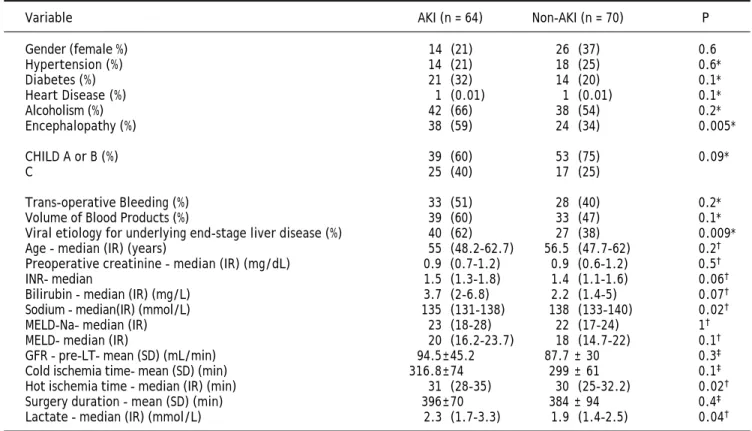
creatinine was 0.9 mg/dL (0.7-1.2 mg/dL) and medi-an calculated MELD medi-and MELD-Na was 19 (15-23) and 22 (18-26), respectively. Most of patients (69%) were classified as Child-Pugh A or B, viral liver dis-ease was an indication for transplant among 67 pa-tients with end stage liver disease and hepatitis C virus was the most frequent etiology (76%) (Table 1). Among the 134 patients, 64 (47%) developed AKI after OLT. Table 2 shows the risk factors for AKI. The following factors were AKI predictors: presence of encephalopathy preoperatively (p = 0.0005), presence of viral liver disease as an indi-cation for hepatic transplantation (p = 0.009). Patients who developed AKI had significantly higher levels of lactate, the warm ischemia time was longer and the measured level of serum sodi-um was lower.
In the multivariate analysis, independent risk fac-tors for AKI were: viral etiology for underlying end-stage liver disease (OR 95% = 2.9, 95% CI = 1.2-7), warm ischemia time (OR = 1.1, 95% CI = 1.01-1.20) and serum level of lactate (OR 95% = 1.3, 95% CI = 1.02-1.89) (Table 3).
AKI patients had a longer ICU stay, 4 days (3-7)
vs. 3 days (2-4), p = 0.001, as well as longer overall hospital stay, 16 days (9-26) vs. 10 days (8-14), p = 0.001 than non AKI patients, respectively.
Thirty three of the 64 patients (51.5%), who de-veloped AKI, were submitted to hemodialysis. The logistic regression showed that MELD Na ≥ 22 was a risk factor for hemodialysis (OR = 8.4, 95% CI = 1.5-46.5).
Overall in-hospital mortality rate was 15%. After multivariate analyses, AKI was the only variable
as-Table 3. Logistic regression analysis to evaluate the risk factors for acute kidney injury.
Predictor Adjusted Odds P IC 95%
Viral liver disease 2.9 0.01 1.2 - 7
Warm ischemia time 1.1 0.02 1.01 - 1.20
Serum lactate 1.3 0.03 1.02 - 1.89
Table 2. Risk factors for development of acute kidney injury.
Variable AKI (n = 64) Non-AKI (n = 70) P
Gender (female %) 14 (21) 26 (37) 0.6
Hypertension (%) 14 (21) 18 (25) 0.6*
Diabetes (%) 21 (32) 14 (20) 0.1*
Heart Disease (%) 1 (0.01) 1 (0.01) 0.1*
Alcoholism (%) 42 (66) 38 (54) 0.2*
Encephalopathy (%) 38 (59) 24 (34) 0.005*
CHILD A or B (%) 39 (60) 53 (75) 0.09*
C 25 (40) 17 (25)
Trans-operative Bleeding (%) 33 (51) 28 (40) 0.2*
Volume of Blood Products (%) 39 (60) 33 (47) 0.1*
Viral etiology for underlying end-stage liver disease (%) 40 (62) 27 (38) 0.009*
Age - median (IR) (years) 55 (48.2-62.7) 56.5 (47.7-62) 0.2†
Preoperative creatinine - median (IR) (mg/dL) 0.9 (0.7-1.2) 0.9 (0.6-1.2) 0.5†
INR- median 1.5 (1.3-1.8) 1.4 (1.1-1.6) 0.06†
Bilirubin - median (IR) (mg/L) 3.7 (2-6.8) 2.2 (1.4-5) 0.07†
Sodium - median(IR) (mmol/L) 135 (131-138) 138 (133-140) 0.02†
MELD-Na– median (IR) 23 (18-28) 22 (17-24) 1†
MELD- median (IR) 20 (16.2-23.7) 18 (14.7-22) 0.1†
GFR - pre-LT- mean (SD) (mL/min) 94.5±45.2 87.7 ± 30 0.3‡
Cold ischemia time- mean (SD) (min) 316.8±74 299 ± 61 0.1‡
Hot ischemia time - median (IR) (min) 31 (28-35) 30 (25-32.2) 0.02†
Surgery duration - mean (SD) (min) 396±70 384 ± 94 0.4‡
Lactate - median (IR) (mmol/L) 2.3 (1.7-3.3) 1.9 (1.4-2.5) 0.04†
sociated with higher mortality rate (OR = 4.3, 95% CI = 1.3-14.3).
Renal function evaluation three months after OLT evidenced a decrease in eGFR. The eGFR pre-transplant was 81 ± 33 mL/min and, 3 months after transplant, eGFR was 71 ± 23 mL/min (p = 0.004). CKD was found in 36 patients, which corre-sponds to 56.2% of patients with AKI. All patients with CKD had presented AKI in the post-operative period. No patient in the “non-AKI” group had de-veloped CKD during the first 3 months after trans-plantation.
DISCUSSION
Liver transplantation is the only option for pa-tients with advanced hepatic failure, and this proce-dure is growing in Brazil. Our hospital is now one of the biggest hepatic transplant centers in Latin America.12 AKI is a frequent complication after
OLT. There are many factors that contribute to AKI development in liver transplantation. Intra-opera-tive factors, such as inferior portal vein clamping, which interrupts venous return, along with cardiac output and blood pressure reduction, decreases re-nal perfusion and contributes to AKI occurrence (pre-renal injury).13 Cabezuelo, et al.14 demonstrated
that the “piggyback” technique decreases the occur-rence of AKI in the post-transplant period when compared to standard technique (with or without veno-venous bypass). Aggressive bleeding control in the intra-operative period, cardiac output optimiza-tion, hemodynamic stabilization and hydroelectro-lytic disturbances control are extremely important measures to AKI prevention in OLT.13 Risk factors
for AKI in the post-transplant period included neph-rotoxic drugs use, mainly calcineurin inhibitors, such as cyclosporine and tacrolimus, infectious com-plications, antibiotics use, prolonged hypotension, sepsis and radiologic contrast use.13
AKI was observed in almost half of patients in the post-operative period. Previous studies found a prev-alence of AKI after OLT varying from 17 to 95%, which is large dependent on the definition used for AKI.3,13,15-18 The new AKI classifications, such as
RIFLE and AKIN, have standardized the AKI defini-tion, and this is important to better compare the study results from different parts of the world.
In the present study there was a significant number of patients in the most advanced AKI stag-es, and this could be related to the liver disease stage, which was also advanced in the majority of cases (high MELD score). Other studies found a
lower prevalence of severe AKI forms after OLT,8,16
but the MELD score was also lower.8
The presence of viral liver disease was a predic-tor of AKI, and this could be related to an underly-ing viral glomerulonephritis. McGuire, et al.,19 in a
study with 30 patients with hepatitis C virus who underwent renal biopsy during liver transplanta-tion, found a series of glomerular diseases, includ-ing membranoproliferative glomerulonephritis (n = 12), IgA nephropathy (n = 7) and mesangial glomerulonephritis (n = 6). In this same study, se-rum creatinine levels were normal in the majority of cases, evidencing the limitations of this biomar-ker. It is possible that glomerular changes, induced by viral hepatitis, along with hemodynamic insta-bility, play an important role in the genesis of AKI after OLT.
AKI was associated with high lactate levels. Lac-tate is a marker of poor tissue perfusion and it is also an indicator of hepatic graft dysfunction in OLT.20 Graft dysfunction is associated with
hemo-dynamic instability, hypotension and, consequently, AKI. This can explain, at least in part, the associa-tion between high lactate levels and AKI in the present study.
Interestingly, warm ischemia time was longer in the AKI group, suggesting a possible occurrence of ischemia-reperfusion injury. The longer the liver is exposed to ischemia, the higher will be the release of reactive oxygen species, including superoxide anion, hydrogen peroxide and hydroxy 1 radical generated by xanthine oxidase and hypoxanthine, and this can contribute to kidney injury.21-23
Sodium metabolism is altered in advanced hepatic disease, and hyponatremia is a predictor of worse outcome after liver transplantation.24 In the present
study, serum sodium was lower in the AKI group, which can reflect the higher severity of liver disease in these patients.
After OLT, dialysis is required for 8 to 17% of patients,25,26 which is lower than the observed in
the present study. Zand, et al.,27 in a study with
need (or with “severe AKI”). The use of means in statistics can generate some confusion as in this case. MELD as a quantitative (continuous) varia-ble presented no significant difference between pa-tients with and without AKI, but when analyzing this as a qualitative variable it was shown to be as-sociated with severe AKI (interpreted here as need for dialysis). MELD is then more useful if used as a qualitative variable. When evaluating patients with liver disease for AKI risk it is more important to classify them as having a “high” or “low” MELD, and possibly the cut-off level of 22 is useful to de-termine which patients are at high risk of develop-ing severe renal dysfunction. Narciso, et al.,28
found 20% of dialysis need in a group of patients with mean MELD = 13, and in the present study mean MELD was 22, which reflects the worse con-dition of liver function in our patients. A previous study has found a significant association between MELD score and mortality after liver transplanta-tion,29 and this is expected because a higher MELD
score reflects a higher patients’ severity, but this was not observed in our study. The MELD score found in the present study was higher than found in other studies18,29 and the distribution among our
134 patients was homogeneous (i.e. both survivors and non-survivors had similar MELD scores), and did not show association with death. However, MELD was a predictor of dialysis need. Better se-verity scores should be investigated for patients un-dergoing liver transplantation.
AKI patients had a longer ICU and hospital stay, and it was the only independent risk factor for in-hospital mortality after OLT. Overall in-hos-pital mortality rate was 15%, which is lightly lower than observed by others, which is around 17%.20,29,30 In general, AKI increases the length of
hospital stay,31 and this also occurs after OLT.32,33
AKI increases mortality in different clinical set-tings, representing a complication of different clini-cal conditions.34 In the present study, mortality
among patients with AKI was 25%, which is similar to other studies,18 but considering that our
pa-tients had a higher MELD score than in other studies, we had similar mortality rates, even with patients presenting higher severity. Several studies evidences AKI as a risk factor for mortality after OLT, and it is also associated with other bad out-comes, including length of hospital stay and devel-opment of chronic kidney disease (CKD).25,26,35,36 In
a recent study, in which cardiovascular morbidity and mortality was investigated among 389 adult pa-tients after liver transplantation, MELD score and
AKI were independent risk factors for cardiac-re-lated mortality.29 In our study AKI was also
identi-fied as an independent risk factor for mortality. We can consider AKI development as the most impor-tant predictor of mortality after OLT, and efforts to its early diagnosis and adequate treatment are ur-gently required in an attempt to decrease mortali-ty. New biomarkers which could early identify or predict AKI development have a huge importance in the setting of liver transplantation, including neu-trophil gelatinase-associated lipocalin (NGAL) and cystatin C.37-40 New AKI biomarkers, such as
N-acetyl-β-D-glucosamininidase (NAG), kidney injury molecule-1 (KIM-1) and Interleukin 18 (IL-18),41
should be investigated in liver transplant recipients in order to stablish its role in the early diagnosis of kidney injury.
The impact of AKI in long-term renal function was evidenced in our study. More than half of pa-tients presenting AKI in the early post-operative period had decreased GFR three months after transplantation, which can be considered as chron-ic kidney disease (CKD). Recent studies have point-ed AKI as an important risk factor for development of CKD.31,42,43 Both AKI and CKD, which are now
considered as interconnected syndromes, are impor-tant risk factors for cardiovascular diseases,43 and
then increase mortality in any patient, including those undergoing OLT. It is important to point out that the early stages of CKD, in which serum creat-inine can be within normal limits, has also impact on long-term patients’ survival,36 so that it is
im-portant to estimate glomerular filtration rate in every patient after OLT to early diagnose CKD and to adopt measures to slow kidney disease progres-sion.
In summary, AKI is a frequent complication of liver transplantation, which is associated with long-er hospital stay and highlong-er mortality. The value of MELD-Na ≥ 22 is a predictor for renal replacement therapy among these patients. AKI has also an im-portant impact on long-term renal function, as a high proportion of patients developed chronic kid-ney disease.
ACKNOWLEDGEMENTS
We are very grateful to the team of physicians, residents, medical students and nurses from the Walter Cantídio University Hospital for the excep-tional assistance provided to the patients and for the technical support provided to the development of this research. EFD received a grant from the Brazil-ian Research Council (Conselho Nacional de Desen-volvimento Científico e Tecnológico, CNPq).
REFERENCES
1. McCauley J, Van Thiel DH, Starzl TE, Puschett JB. Acute and chronic renal failure in liver transplantation. Nephron 1990; 55: 121-8.
2. Sharma P, Welch K, Eikstadt R, Marrero JA, Fontana RJ, Lok AS. Renal outcomes after liver transplantation in the Model for End-Stage Liver Disease era. Liver Transpl 2009; 15: 1142-8.
3. Barri YM, Sanchez EQ, Jennings LW, Melton LB, Hays S, Levy MF, Klintmalm GB. Acute kidney injury following liver transplantation: definition and outcome. Liver Transpl 2009; 15: 475-83.
4. Bilbao I, Charco R, Balsells J, Lazaro JL, Hidalgo E, Llopart L, Murio E, et al. Risk factors for acute renal failure re-quiring dialysis after liver transplantation. Clin
Trans-plant 1998; 12: 123-9.
5. O’Riordan A, Wong V, McQuillan R, McCormick PA, Hegarty JE, Watson AJ. Acute renal disease, as defined by the RI-FLE criteria, post-liver transplantation. Am J Transplant 2007; 7: 168-76.
6 . Paramesh AS, Roayaie S, Doan Y, Schwartz ME, Emre S, Fishbein T, Florman S, et al. Post-liver transplant acute renal failure: factors predicting development of end-stage renal disease. Clin Transplant 2004; 18: 94-9.
7. Cywinski JB, Mascha EJ, You J, Sessler DI, Kapural L, Ar-galious M, Parker BM. Pretransplant MELD and sodium MELD scores are poor predictors of graft failure and mor-tality after liver transplantation. Hepatol Int 2011; 5: 841-9.
8 . Zhu M, Li Y, Xia Q, Wang S, Qiu Y, Che M, Dai H, et al. Strong impact of acute kidney injury on survival af-ter liver transplantation. Transplant Proc 2010; 42: 3634-8.
9. Xu X, Ling Q, Wei Q, Wu J, Gao F, He ZL, Zhou L, et al. An effective model for predicting acute kidney injury after liver transplantation. Hepatobiliary Pancreat Dis Int 2010; 9: 259-63.
10. Kellum JA, Bellomo R, Ronco C. Definition and classification of acute kidney injury. Nephron Clin Pract 2008; 109: c182-C187.
11. Levey AS, Bosch JP, Lewis JB, Greene T, Rogers N, Roth D. A more accurate method to estimate glomerular filtration rate from serum creatinine: A new prediction equation Modification of Diet in Renal Disease Study Group. Ann
In-tern Med 1999; 130: 461-70.
12. Garcia JHP, Mesquita DFG, Coelho GR, Feitosa Neto BA, Nogueira EA, Silva Filgo ACS, Vasconcelos JBM. Results from a liver transplant center in northeastern Brazil that performed more than 100 transplants in 2011. Transplant
Proc 2014; 46: 1803-6.
13. Pham PTT, Pham PCT, Wilkinson AH. Management of renal dysfunction in the liver transplant recipient. Curr Opin
Organ Transplant 2009; 14: 231-9.
14. Cabezuelo JB, Ramírez P, Ríos A, Acosta F, Torres D, Sansa-no T, Pons JA, et al. Risk factors of acute renal failure after liver transplantation. Kidney Int 2006; 69: 1073-80. 15. Rymarz A, Serwacki M, Rutkowski M, Pakosinski K,
Grodz-icki M, Patkowski W, Kacka A, et al. Prevalence and pre-dictors of acute renal injury in liver transplant recipients. Transplant Proc 2009; 41: 3123-5.
16. Umbro I, Rossi M, Tinti F, Fiacco F, Piselli P, Ianni S, Ginan-ni CorradiGinan-ni S, et al. Stages of early acute renal dysfunc-tion in liver transplantadysfunc-tion: the influence of graft function. Transplant Proc 2012; 44: 1953-5.
17. Romano TG, Schmidtbauer I, Silva FM, Pompilio CE, D’Albuquerque LA, Macedo E. Role of MELD sco re and se-rum creatinine as prognostic tools for the development of acute kidney injury after liver transplantation. PLoS One 2013; 8: e64089.
18. Klaus F, Keitel da Silva C, Meinerz G, Carvalho LM, Goldani JC, Cantisani G, Zanotelli ML, et al. Acute kidney injury af-ter liver transplantation: incidence and mortality.
Trans-plant Proc 2014; 46: 1819-21.
19. McGuire BM, Julian BA, Bynon JS Jr, Cook WJ, King SJ, Cur-tis JJ, Accortt NA, et al. GlomerulonephriCur-tis in patients with hepatitis C cirrhosis undergoing liver transplanta-tion. Ann Intern Med 2006; 144: 735-41.
20. Basile-Filho A, Nicolini EA, Auxiliadora-Martins M, Silva Jr Ode C. The use of perioperative serial blood lactate levels, the APACHE II and postoperative MELD as predictors of early mortality after liver transplantation. Acta Cir Bras 2011; 26: 535-40.
21. Andreoli SP, McAteer JA, Mallett C. Reactive oxygen mole-cule-mediated injury in endothelial and renal tubular epi-thelial cells in vitro. Kidney Int 1990; 38: 785-94.
22. Oliveira-Santos M, Lopes MF, Catré D, Gonçalves E, Cabri-ta A. Effect of hydroxyethyl sCabri-tarch on acute renal injury in a modelo f hepatic ischemia-reperfusion. Acta Med Port 2012; 25: 308-16.
23. Guan LY, Fu PY, Li PD, Li ZN, Liu HY, Xin MG, Li W. Mecha-nisms of hepatic ischemia-reperfusion injury and protec-tive effects of nitric oxide. World J Gastrointest Surg 2014; 6: 122-8.
24. Park C, Kim D, Choi J, Kim E. Intraoperative changes in hyponatremia as a risk factor for prolonged mechanical ventilation after living donor liver transplantation.
Trans-plant Proc 2010; 42: 3612-6.
25. Yalavarthy R, Edelstein CL, Teitelbaum I. Acute renal fail-ure and chronic kidney disease following liver transplanta-tion. Hemodial Int 2007; 11: S7-S12.
26. Lewandoska L, Matuszkiewicz-Rowinska J. Acute kidney injury after procedures of orthotopic liver transplanta-tion. Ann Transplant 2011; 16: 103-8.
27. Zand MS, Orloff MS, Abt P, Patel S, Tsoufas G, Kashyap R, Jain A, et al. High mortality in orthotopic liver transplant recipients who require hemodialysis. Clin Transplant 2011, 25: 213-21.
28. Narciso RC, Ferraz LR, Mies S, Monte JC, dos Santos OF, Neto MC, Rodrigues CJ, et al. Impact of acute kidney ex-posure period among liver transplantation patients. BMC
Nephrol 2013; 14: 43.
29. Nicolau-Raducu R, Gitman M, Ganier D, Loss G, Cohen A, Patel H, Girgrah N, et al. Adverse cardiac events after orthotropic liver transplantation: a cross-sectional study in 389 consecutive patients. Liver Transpl 2015; 21: 13-21.
30. Fraley DS, Burr R, Bernardini J, Angus D, Kramer DJ, John-son JP. Impact of acute renal failure on mortality in end-stage liver disease with or without transplantation.
Kidney Int 1998; 54: 518-24.
31. Bedford M, Stevens PE, Wheeler TW, Farmer CK. What is the real impact of acute kidney injury? BMC Nephrol 2014; 15: 95.
32. Kundakci A, Pirat A, Komurcu O, Torgay A, Karakayali H, Arslan G, Haberal M. RIFLE criteria for acute kidney dys-function following liver transplantation: incidence and risk factors. Transplant Proc 2010; 42: 4171-4.
33. Chen J, Singhapricha T, Hu KQ, Hong JC, Steadman RH, Bu-suttil RW, Xia VW. Postliver transplant acute renal injury and failure by the RIFLE criteria in patients with normal pretransplant serum creatinine concentrations: a matched study. Transplantation 2011; 91: 348-53. 34. Bellomo R, Ronco C, Kellum JA, Mehta RL, Palevsky P. Acute
Dialysis Quality Initiative workgroup. Acute renal failure – definition, outcome measures, animal models, fluid therapy and information technology needs: the second interna-tional consensus conference of the Acute Dialysis Quality Initiative (ADQI) group. Crit Care 2004; 8: R204-R212. 35. Weber ML, Ibrahim HN, Lake JR. Renal dysfunction in liver
transplant recipients: evaluation of the critical issues.
Liver Transplant 2012; 18: 1290-301.
36. Leithead JA, Ferguson JW. Chronic kidney disease after liver transplantation. J Hepatol 2015; 62: 238-51.
37. Ling Q, Xu X, Li JJ, Chen J, Shen JW, Zheng SS. Alterna-tive definition of acute kidney injury following liver trans-plantation: based on serum creatinine and cystatin C levels. Transplant Proc 2007; 39: 3257-60.
38. Wagener G, Minhaz M, Mattis FA, Kim M, Emond JC, Lee HT. Urinary neutrophil gelatinase-associated lipocalin as a marker of acute kidney injury after orthotopic liver transplantation. Nephrol Dial Transplant 2011; 26: 1717-23.
39. Dedeoglu B, de Geus HR, Fortrie G, Betjes MG. Novel bi-omarkers for the prediction of acute kidney injury in pa-tients undergoing liver transplantation. Biomark Med 2013; 7: 947-57.
40. Aberg F, Lempinen M, Hollmén M, Nordin A, Mäkisalo H, Iso-niemi H. Neutrophil gelatinase-associated lipocalin associ-ated with irreversibility of pre-liver transplant kidney dysfunction. Clin Transplant 2014; 28: 869-76.
41. Charlton JR, Portilla D, Okusa MD. A basic science view of acute kidney injury biomarkers. Nephrol Dial Transplant 2014; 29: 1301-11.
42. Kazancioglu R. Risk factors for chronic kidney disease: an update. Kidney Int 2013; 3: 368-71.