On cumulativity in the context of
defeasible argumentation
A. G. Stankevicius
M. Capobianco
∗Laboratorio de Investigaci´on y Desarrollo en Inteligencia Artificial
Departamento de Ciencias e Ingenier´ıa de la Computaci´on
Universidad Nacional del Sur
Bah´ıa Blanca - Buenos Aires - ARGENTINA
e-mail:
{
ags,mc
}
@cs.uns.edu.ar
Abstract
Logics for nonmonotonic reasoning have often been described by the property they lack—that is,monotonicity—instead of by those they do enjoy. Gabbay, Makinson and Kraus proposed a set of core properties for inference relations that every nonmonotonic theory ought to have. Yet, there are some apparently well-behaved formalisms that fail to comply with some of these principles, such as most defeasible argumentation formalisms. In this article we determine the status of these core properties in the context of two well-known argumentation frameworks.
Keywords:NONMONOTONIC REASONING,DEFEASIBLE REASONING,ARGUMENTATION FRA
-MEWORKS
Resumen
Las l´ogicas que permiten razonar de manera no-mon´otona suelen ser caracterizadas por la propiedad que carecen—casualmente, la monoton´ıa—en vez de serlo por aquellas que s´ı gozan. Gabbay, Makinson y Kraus propusieron un conjunto de propiedades b´asicas de las relaciones de inferencia que toda teor´ıa no-mon´otona deber´ıa satisfacer. No obstante, existen varios formalis-mos aparentemente razonables que no satisfacen algunos de estos principios, por caso la mayor´ıa de los formalismos de argumentaci´on rebatible. En este art´ıculo determinamos el estado de estas propiedades b´asicas en el marco de dos populares sistemas argumentativos.
Palabras Clave: RAZONAMIENTO NO-MONOTONO´ , RAZONAMIENTO REBATIBLE, MARCOS ARGUMENTATIVOS
1
Introduction
Logics for nonmonotonic reasoning have often been described by the property they lack—that is,
monotonicity—instead of by those they do enjoy. These theories flourished in the early ‘80s in
∗Partially supported by CONICET(Consejo Nacional de Investigaciones Cient´ıficas y T´ecnicas de la Rep´ublica
response to the challenges incomplete and changing information posed to classic, monotonic ap-proaches. Several nonmonotonic formalisms were introduced in the literature, such as inheritance networks, default logic, preferential entailment, autoepistemic logic, and defeasible argumentation among others. The introduction of these many proposals in such a short span of time made it difficult to decide which formalism is best suited for a given context.
In a landmark paper, Dov Gabbay [6] pioneered the comparison of nonmonotonic theories with respect to a set of desirable properties. He endorsed focusing our attention on the properties of the inference relation induced by the formal theory, that is, the relation between conclusions and the set of premises supporting them. Further pursuing this approach, first Krauset al. [9], and later Makinson [10], studied the set of core properties every nonmonotonic theory ought to have. These properties can be roughly divided in the so-calledpureconditions, that solely depend on the inference relation, and those that also interact with the logical connectives.
For any inference relation |∼ its correspondinginference operator, notedC, is defined asC(Φ) =
{φ|Φ|∼φ}. Assuming thatΦandΨare sets of premises, the pure conditions can be defined in terms of this operator as follows:
Inclusion: Φ⊆C(Φ)
Idempotence: C(Φ) =C(C(Φ))
Cut: Φ⊆Ψ⊆C(Φ)implies thatC(Ψ)⊆C(Φ)
Cautious monotonicity: Φ⊆Ψ⊆C(Φ)implies thatC(Φ)⊆C(Ψ)
Inclusion is clearly desirable in the context of any sensible inference relation, as it stands for accepting those premises upon which we reason. Idempotence states that we have inferred as much as possible, in the sense that no new conclusions can be obtained fromΦthrough multiple applications ofC. Cut ensures that adding known consequences into our set of premises does not give us new information. In contrast, cautious monotonicity, states the opposite: adding known consequences into our set of premises does not make us loose information. Finally, those inference relations satisfying all these properties are calledcumulative.1
Some authors have gone a step further, suggesting that every nonmonotonic theory should be en-gineered around a cumulative inference relation. For instance, Krauset al. [9] claim that“. . . [these properties] are rock-bottom properties without which a system should not be considered a logical system.”Yet, there are some apparently well-behaved formalisms for nonmonotonic Knowledge Rep-resentation and Reasoning (KR&R) that do not uphold it. For instance, it is quite startling that most defeasible argumentation formalisms do not comply with cumulativity, even though those same theo-ries were also successfully applied to a myriad of complex problems.
Let us delve a bit into this apparent contradiction (that is, having a sensible framework for KR&R which fails to uphold cut, cautious monotonicity, or both). It can be argued that defeasible argumen-tation has evolved in the last twenty years as a successful approach for modelling commonsense rea-soning. With several formalism reported in the literature reaching a mature state [16, 14, 13, 5, 7, 2], research in this field has played a major role in the development and deployment of solutions to tough, complex real world problems involving varying degrees of common-sense reasoning, such as mediation framework for supporting decision making in groups [8], intelligent systems used in med-ical research [12], or providing proactive assistance for natural language usage assessment [4]. We refer the interested reader to the comprehensive survey of applications built around argumentation frameworks compiled by Carbogimet al.[3].
1
In these formalisms, knowledge is structured asfactsandrules, where facts represent knowledge explicitly observed and rules capture the relation between some evidence and some conclusion fol-lowing from it. New conclusions can be obtained chaining rules and facts, much like classical logic. However, these formalisms also allow a sort of weak or default rules that can be discarded as soon as new knowledge contradicting them is discovered, clearly giving rise to a form of reasoning that is indeed defeasible. These rules that can be overruled are usually calleddefeasible, whereas those that cannot are called strict. In this context, when we allow the use of defeasible rules in order to reach a certain conclusion, we obtainargumentsinstead of proofs. Of course, arguments can also compete with each other (for instance, when they support conflicting conclusions), rebutting or undercutting one another, hence an argumentation process arises from the search of which arguments should be ultimately accepted, orwarranted. To do so, competing arguments are compared to determine which one wins and which one is defeated, frequently applying a preference criterion. But defeaters may as well be defeated by other arguments and this prompts for a recursive analysis which is usually modelled by a tree or graph structure. When an argument is finally accepted after considering all its possible defeaters, it is said to bewarranted orjustified.
Going back to the open question we posed before, that is, how come these formalisms, success-fully applied to those tough problems, yet fail to uphold cumulativity. Prakken and Vreeswijk in their survey of argumentation frameworks [15] had the following to say on this regard:
“. . . [we have shown] that reasonable argumentation systems with plausible criteria for defeat are conceivable which do not satisfy cumulativity, so that cumulativity cannot be required as a minimum requirement for justified belief.”
The authors propose a set of intuitive examples to sustain their claim, but they stop short of formally determining the status of cumulativity in any concrete formalisms. To this end, the purpose of this article is coincidentally to correct and extend a previous work [17] that addressed cumulativity in a particular formalism to other argumentation theories. In the following section we introduce several entailment relations that can be identified in these formalisms, and then in section 3 we proceed to de-termine the status of cumulativity with respect to all these relations in two well-known argumentation theories. Finally, section 4 briefly summarizes the conclusions reached in this study.
2
Entailment relations in argumentation frameworks
Most formal theories tend to characterize a single entailment relation. Argumentation frameworks, given its layered architecture, introduce many. Before formally defining each one of them, let us first overview some introductory notions, common to every argumentation theory. According to Prakken and Vreeswijk [15], every argumentation theory:
1. provide an underlying logic,
2. formally define the concept of argument,
3. capture when two arguments are in conflict,
4. also capture when an argument defeats another, and
Every argumentation theory begins by defining anunderlying logicwhere knowledge is initially cod-ified. Even though these formalisms behave non-monotonically, most of these logics tend to define a monotonic entailment. The rationale is that the addition of new premises should allow the con-struction of newarguments(possibly changing the conclusions sanctioned by the theory as a whole), without requiring to invalidate previous deductions. These arguments, the second aspect in common, are usually associated with proofs or deductions in this underlaying logic. In this context, an argu-ment is understood as a tentative piece of reasoning supporting a given conclusion. However, not every conclusion drawn on this logic leads to an argument, since these systems usually impose addi-tional restrictions on those derivations, such as being based on consistent premises, being minimal, etc.
Regarding the third aspect, every formalism easily allows you to construct arguments for con-flicting conclusions. This relation among arguments is also calledattack or counter-argumentation
in some of them. Although the most obvious form of conflict is the support of complementary con-clusions, an argument may conflict with another for other reasons, for example, when the first denies one of the premises of the second. Considering that this relation only captures disagreement between arguments, it cannot tell appart successful attacks from those that are not. The relation calleddefeat, fourth notion common to every argumentation theory, is a refinement of the previous relation that only reflects successfull attacks. Note that this relation captures the conditions under which an argument is able to deny the conclusive force of another argument, effectively banishing the latter. On some systems, this relation is called attack as well, or interference. Even though the conflict relation is usually symmetric, the defeat relation is usually not: some sort of argument comparison criterion is applied to determine which argument prevails in those reciprocal conflicts.
Finally, defeat alone is not enough to determine the final stateof an argument, as it only sanc-tions what the outcome of the conflict between two particular arguments is. This key notion, also common to every argumentative system, is used to determine the set of conclusions sanctioned by the formalism. Therefore, several alternatives have been explored in the literature, for instance fix point vs. constructive semantics, single vs. multiple state assignments, skeptic vs. credulous semantics, etc. All these proposals identify at least two disjoint sets: one containing those arguments that are
warranted, and the other containing those that are not. In a sense, an arguments is warranted when it is not defeated, or when its defeaters are in turn defeated, since defeaters are arguments as well. Note that this process may continue recursively, as long as additional defeaters of any defeater remain to be considered. This accounts why warranted arguments are sometime called undefeated in other theories, though they have been termedjustifiedoractiveas well.
Warrant clearly constitutes an obvious—yet fundamental—entailment relation induced by these theories, as it is its semantics. Formally speaking, this first relation only entails those conclusions that are backed by warranted arguments. We call these warranted inference and denote them as
⊢W . However, to determine which arguments are warranted the formalism must first build regular arguments. The set of conclusions supported by just regular arguments can also be considered as an entailment relation. We call it argument-based inference, and denote its corresponding abstract inference operator as⊢A .
and warrant.
Having identified these four abstract entailment relations one might wonder whether they satisfy cumulativity. Given their abstract nature, we need to instantiate them according to the particular formalism under study. In the next section we analyze two concrete instantiations of these relations, but before we do so we need take into account the way argumentation frameworks structure their knowledge, distinguishing facts from rules. That is to say, the previous entailment relations must be considered as a function from sets of rules and facts into sets of rules and facts. Formally speaking:
1. Strict inference: CS(hF,Ri) =h{φ | hF,Ri ⊢S φ},Ri
2. Defeasible inference:CD(hF,Ri) = h{φ | hF,Ri ⊢D φ},Ri
3. Argument-based inference:CA(hF,Ri) =h{φ | hF,Ri ⊢A φ},Ri
4. Warranted inference:CW(hF,Ri) = h{φ | hF,Ri ⊢W φ},Ri
3
Selected case studies
In what follows, we analyze how two alternative concrete instantiations of the inference relations introduced in the previous section behave with respect to the properties of inclusion, idempotence, cut and cautious monotonicity. Due to space constraints, we can only report our findings regarding Garc´ıa and Simari’s Defeasible Logic Programming [7], and Caminada and Amgoud’sASPICargumentation framework [2]. The choice of frameworks attempt to reflect the wide array of alternatives available when it comes to reasoning and representing knowledge using defeasible argumentation.
3.1
Defeasible Logic Programming
Defeasible Logic Programming(DeLP, henceforth), combines a language similar to the one of logic programming with an argumentative inference engine [7]. DeLPstructures knowledge using a set of strict rules, denoted asΠ, and a set of defeasible rules, denoted as∆. Facts, denoting the evidence at hand, are written as strict rules with an empty body. A defeasible logic programP is defined by the tuple(Π,∆). The conclusions endorsed by a given a program P are obtained through a dialectical process which can decide if a given query is warranted by the system. In DeLP, the set of facts F
is composed by strict rules with an empty body and the set of rules R is made of both strict and defeasible rules. In what follows, for a given setQ, the operatorsstrict(Q)anddefeasible(Q)return,
respectively, the strict or defeasible rules inQ.
Strict inference: We say that hF,Ri ⊢DeLP
S φ if, and only if, there exists adefeasible derivation
forφfrom the programP = (F ∪strict(R),defeasible(R))(cf. definition 2.5 in [7]) that uses
only strict rules. Accordingly, the notion of strict inference is defined as CDeLP
S (hF,Ri) =
h{φ | hF,Ri ⊢DeLP
S φ},Ri.
Defeasible inference: We say thathF,Ri ⊢DeLP
D φif, and only if, there exists adefeasible derivation
forφfrom the programP = (F ∪strict(R),defeasible(R))(cf. definition 2.5 in [7]).
Accord-ingly, the notion of defeasible inference is defined asCDeLP
D (hF,Ri) = h{φ | hF,Ri ⊢
DeLP
D
Argument-based inference: We say thathF,Ri ⊢DeLP
D φif, and only if, there exists an argument
forφfrom the programP = (F ∪strict(R),defeasible(R))(cf. definition 3.1 in [7]).
Accord-ingly, the notion of argument-based inference is defined asCDeLP
A (hF,Ri) =h{φ|hF,Ri ⊢
DeLP
A
φ},Ri.
Warranted inference: We say thathF,Ri ⊢DeLP
D φif, and only if, there exists awarrantforφfrom
the program P = (F ∪strict(R),defeasible(R)) (cf. definition 5.2 in [7]). Accordingly, the
notion of warranted inference is defined asCWDeLP(hF,Ri) = h{φ | (F,R)⊢DeLP
W φ},Ri.
Having instantiated the four abstract entailment relations we turn our attention to the status of cumu-lativity. The following proposition summarizes our findings for the first two relations:
Proposition 1. The consequence operators CDDeLP and CSDeLP satisfy inclusion, idempotence, cut, and cautious monotonicity.
It is straightforward to see thatCDeLP
D andC
DeLP
S are both monotonic, and therefore cumulative.
This can be shown by any standard proof of monotonicity from classical logic. It should be mentioned that the strict part of any defeasible logic program is by definition bound to be consistent with respect to strict inference (that is, no pair of contradictory literals can be derived).
Regarding argument-based inference,DeLPdefines an argument as the set of defeasible rules that allow us to defeasibly derive a given conclusion. The properties of this inference relation greatly differ from the previous ones.
Proposition 2. The consequence operatorCDeLP
A satisfies inclusion, but fails idempotence, cut, and
cautious monotonicity.
Inclusion trivially holds, given that every fact is supported by the empty argument (note that facts can always be strictly derived). The failure of idempotence is shown next:2
Example 1. Let P = (Π,∆) be a DeLP program (de.l.p for short), where Π = {a} and ∆ =
{b −≺ a; ∼b −≺ a}. Let Rbe the union of both strict and defeasible rules inP. In this case we have thatCADeLP(h{a},Ri) = h{a; b; ∼b},Ri 6=hLit,R) =CADeLP(CADeLP(h{a},Ri)).
Finally, the following counterexamples show that argument-based inference does not satisfy cut nor cautious monotonicity.
Example 2. LetP = (Π,∆) be ade.l.p, whereΠ = {c}and∆ = {a −≺ b; b −≺ ∼a; ∼a −≺ c}. In this setting, it is possible to build the argumentA1 ={b −≺ ∼a; ∼a−≺ c}forb. However, shouldbbe added toP as a fact, we now can obtain a new argumentA2 ={a−≺ b}fora, previously unavailable. This addsato the set of argument-based conclusions and therefore cut does not hold.
Example 3. LetP = (Π,∆)be ade.l.p, whereΠ ={a}and∆ ={b −≺ a;∼b −≺ a}. In this context, the argumentsA1 ={b −≺ a}forbandA2 ={∼b−≺ a}for∼bcan be constructed fromP. However, shouldbbe added toP as a fact, we can no longer argueA2(it now contradicts our strict knowledge). Thus, sinceA1was the only argument supporting∼b, this previously held conclusion is now lost.
With respect to warranted inferences, we encountered a similar situation:
Proposition 3. The consequence operatorCWDeLP satisfies inclusion but fails idempotence, cut, and cautious monotonicity.
2
To see whyCDeLP
W satisfies inclusion note that every fact in a given program is trivially supported
by the empty argument, and that the empty argument cannot be defeated since it is entirely based on strict information. Regarding idempotence, the following counterexample shows its failure:
Example 4. LetP = (Π,∆) be a de.l.p, whereΠ = {c; a ← b} and∆ = {b −≺ c; ∼a −≺ c}. In this case, two arguments can be built: A1 = {b −≺ c}for b andA2 = {∼a −≺ c} for∼a. Both are warranted and thus the warranted conclusions fromP are{c,∼a, b}.
However, as soon as we add these conclusions as new facts intoP, we derive the wholeLit(since the resulting setΠof strict knowledge is inconsistent). Formally speaking:
CWDeLP(h{c},Ri) =h{c; ∼a; b},Ri 6=hLit,Ri =CWDeLP(CWDeLP(h{a},Ri))
Finally, we have developed the following counterexamples in order to show the failure of cut and cautious monotonicity:
Example 5. LetP = (Π,∆) be a de.l.p, where Π = {c} and∆ = {a −≺ b, c; b −≺ ∼a; ∼a −≺ c}. In this setting, it is possible to build an argument A1 = {b −≺ ∼a; ∼a −≺ c}for b that is a warrant. However, once b is added to P as a fact, we can obtain a new argument A2 = {a −≺b, d} for a, previously unavailable, that is also a warrant (since argument A3 = {∼a −≺ d} is defeated byA2). This addsato the set of warranted conclusions and therefore cut does not hold.
Example 6. LetP = (Π,∆)be ade.l.p, whereΠ = {a}and∆ = {c −≺ b; b −≺ a; ∼c −≺ a}. The arguments A1 = {c −≺b; b −≺ a}, A2 = {∼c −≺ a}, and A3 = {b −≺ a}, supporting respectively c, ∼c, and b, can all be built fromP. Yet, only∼cand b are warranted on the basis of P, sinceA2 defeatsA1, but bothA2andA3remain undefeated. Finally, shouldbbe added toP as a fact, the new argument A4 = {c −≺ b}for cnow defeatsA2. Thus, since A2 was the only argument for∼c, this previously warranted conclusion is now lost.
3.2
Amgoud and Caminada
Amgoud and Caminada introduced theASPICargumentation theory [2], proposing a particular instan-tiation of Dung’s abstract argumentation framework [5], filling the gaps intentionally left unspecified (namely, the internal structure of arguments). In ASPIC, the knowledge base is a pair T = (S,D) of sets of strict and defeasible rules. Arguments are constructed chaining recursively both kinds of rules. Defeat is determined in terms of two kind of attacks: rebuttals (attacks on the ultimate conclu-sion of an argument), and undercuts (attacks on the intermediate premises). Finally, the acceptability of these arguments, that is, which arguments survive and which do not, is decided applying one of Dung’s standard semantics. In what follow, we consider whether the four abstract consequence op-erators instantiated accordingly to theASPIC formalism satisfy cumulativity. Bear in mind that facts in this framework are codified as strict rules with empty body. Thus, the set of factsF is composed by those strict rules with an empty body and the set of rules Ris composed by the remaining strict and defeasible rules. Once again, for a given setQ, the operatorsstrict(Q)anddefeasible(Q)return,
respectively, the strict or defeasible rules inQ.
Strict inference: We say thathF,Ri ⊢ASP I C
S φif, and only if, there is astrict argumentforφin the
theoryT = (F ∪strict(R),defeasible(R))(cf.definition 8 in [2]). Accordingly, the notion of
strict inference is defined asCSASP I C(hF,Ri) =h{φ | hF,Ri ⊢ASP I C
S φ},Ri.
Defeasible inference: We say that hF,Ri ⊢ASP I C
D φ if, and only if, there is adefeasible argument
forφin the theoryT = (F ∪strict(R),defeasible(R))(cf.definition 8 in [2]). Accordingly, the
notion of defeasible inference is defined asCASP I C
D (hF,Ri) = h{φ | hF,Ri ⊢
ASP I C
Argument-based inference: We say thathF,Ri ⊢ASP I C
A φif, and only if, there is anargumentfor
φin the theoryT = (F ∪strict(R),defeasible(R))(cf.definition 7 in [2]). Accordingly, the
notion of defeasible inference is defined asCASP I C
A (hF,Ri) = h{φ | hF,Ri ⊢
ASP I C
A φ},Ri.
Warranted inference: We say that hF,Ri ⊢ASP I C
W φ if, and only if, φ is a justified conclusion3
that can be obtained from the theory T = (F ∪strict(R),defeasible(R)) (cf. definition 12
in [2]). Accordingly, the notion of defeasible inference is defined as CASP I C
W (hF,Ri) =
h{φ | hF,Ri ⊢ASP I C
W φ},Ri.
Note that the ASPICframework does not distinguish the logical level from the argument level. Also, the first three inference relations being all based on the notion of argument emphasize this. However, since arguments do not impose any restriction upon the derivation that leads to its conclusion, both self-defeating and non-minimal arguments are allowed (two kind of rather nasty arguments, which can lead astray the semantics of any formalism). Turning our attention back to the status of cumulativity, the following proposition summarizes our findings regarding these entailment relations.
Proposition 4. The consequence operatorsCSASP I C, CDASP I C, andCAASP I C satisfy inclusion, idem-potence, cut, and cautious monotonicity.
The previous proposition stems from the fact that all these entailment relations are monotonic. Warrant inference, in contrast, failed them all.
Proposition 5. The consequence operator CWASP I C fails inclusion, idempotence, cut, and cautious monotonicity.
The failure of inclusion is somewhat surprising, given that this is a fundamental property for any inference relation. This is a consequence of accepting as valid any arbitrary set of facts, even inconsistent ones. The following counterexample exploits that:
Example 7. LetT = (S,D)be an ASPIC theory, whereS = {→ a; → ∼a}and D = {}. In this context, two arguments can be built: P = [→a], andP = [→∼a]such that they defeat at each other. Under, for instance, the stable semantics, there are two extensions:{P}, and{P}. Thus, there are no justified conclusions (provided that the intersection of these extensions is empty), so inclusion does not hold.
To show the failure of idempotence we have developed the following counterexample:
Example 8. LetT = (S,D)be an ASPIC theory, whereS = {→ c; → d; d → a; b, c → ∼a}and
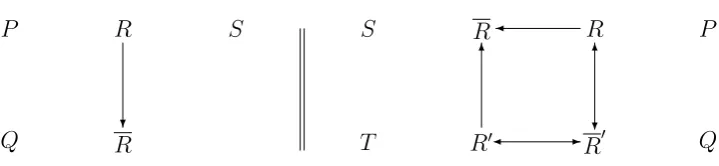
D = {d ⇒ b}. In this context, five arguments can be built,P = [→ d], Q = [→ c], R = [P → a], S = [P ⇒ b], andR = [S, Q→ ∼a]. Note that Ris defeated byR and there is no other pair in the defeat relation (R cannot by defeated byR, since former is strict and the latter is defeasible). In this example, no matter which semantics we apply, only one extension containing{P, Q, R, S}exists (cf.
figure 1), thus the resulting set of justified conclusions is{a, b, c, d}.
However, when the inference operator is applied again over this new theory, we obtain a different result. Note that the set S now contains {→ a; → b; → c; → d; b, c → ∼a; d → a} (observe that both aand b have been added as facts), but the setD remains unchanged. In this new context, three new arguments can be built: T = [→ b], R′ : [→ a], and R′ : [T, Q → ∼a]. T is not in conflict with any argument,R′ andR′ defeat each other, and so doesR′ andR, yet R′ defeatsRbut Rdoes not defeatR′. As a consequence, there are now two different extensions using once again the
3
Q R
P R S
❄
T R′ R′ Q
S R R P
✻ ✻
❄ ✛
[image:9.595.118.478.85.168.2]✛ ✲
Figure 1: Defeat relations from example 8, before (left) and after (right) adding{a, b}
S
P R R′
Q Q R
❄ ✲ ✛
✲ ✛
❘
■ ✒
✍ ✙
S T R′′
P R R′
Q Q R
❄ ✲ ✛
✲ ✛
❘ ■
❘ ✒
✍ ✙
Figure 2: Defeat relations from example 9, before (left) and after (right) addingc
stable semantics: {P, Q, S, T, R, R′}and{P, Q, S, T, R, R′}(cf. figure 1). Thus, the set of justified conclusions is now{b, c, d}, wherea, a previously held conclusion is lost. Formally speaking, should
Rdenotes the union of both strict and defeasible rules inT, we have that:
CWASP I C(h{c, d},Ri) =h{a, b, c, d},Ri 6=h{b, c, d},Ri=CWASP I C(CWASP I C(h{c, d},Ri)) The next two properties usually require taking advantage of the more advance capabilities of the formalism, either to prove or disprove it. RegardingASPIC, we have found that cautious monotonic-ity does not hold using, luckily enough, the same example as before, since adding all the justified conclusions as new premises made us loosea, a previously held conclusion.
Finally, we also show that cut does not hold by virtue of the following counterexample:
Example 9. LetT = (S,D)be anASPICtheory, whereS ={→a; →d; a →∼a; ∼a→b; c, d→
∼b} and D = {d ⇒ c; d ⇒ ∼b}. In this context, seven arguments can be built, Q = [→ a], P = [→ d],Q = [Q → ∼a], R = [P ⇒ ∼b], S = [P ⇒ c], R = [Q → b], andR′ = [S, P → ∼b]. Q defeatsR, who in turn defeats R and R′. ArgumentsQ and Qdefeat at each other, also Q and R. Moreover, R and Q are self-defeating arguments. Adopting the preferred semantics, the only extension is{P, Q, S}(cf. figure 2), and the set of justified conclusion is{a, c, d}.
However, when cis added two new arguments arise: T = [→ c] andR′′ = [T, P → ∼b]. NowR andR′′ attack each other, hence the only preferred extension is{P, Q, S, T, R, R′, R′′}(cf. figure 2). Finally, since∼bis present in every extension, it is a justified conclusion, and thus cut does not hold.
4
Conclusions
[image:9.595.145.457.216.359.2]andcautious monotonicity, taking into account that the last two let us determine whether the theory under consideration iscumulative. However, since argumentation frameworks are usually defined fol-lowing a layered approach, more than one entailment relation is commonly used. In fact, we identified and formally defined four of them.
[image:10.595.105.494.358.470.2]The first argumentation theory we considered wasDefeasible Logic Programming. The following table summarizes our findings regarding the principles under consideration:
Inclusion Idempotence Cut Cautious M.
CSDeLP √ √ √ √
CDDeLP √ √ √ √
CDeLP
A
√
× × ×
CDeLP
W
√
× × ×
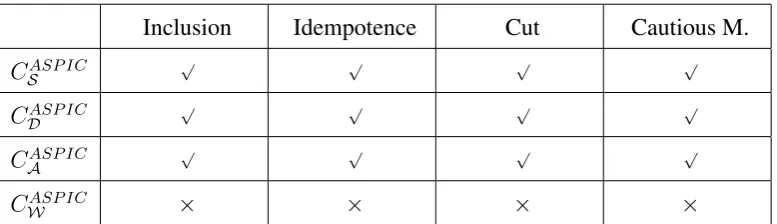
The second argumentation theory we analyzed was theASPICframework, with the following table once again summarizing our findings:
Inclusion Idempotence Cut Cautious M.
CSASP I C √ √ √ √
CDASP I C √ √ √ √
CAASP I C √ √ √ √
CASP I C
W × × × ×
Briefly comparing both tables one result we did not expected quickly becomes apparent: the properties enjoyed by the corresponding inference relations of the two formalism do not concord. For instance,CASP I C
A behaves monotonically (much likeC
ASP I C
S andC
ASP I C
D ), butC
DeLP
A evidently
does not. Even more striking is the difference betweenCWDeLP andCWASP I C, since the former satisfy inclusion, yet the latter does not. It seems that the definition of theASPICformalism still require some polishing, as pointed out by the failure of such an intuitive and clearly desirable property.
Regarding cumulativity, neither warranted inference in Defeasible Logic Programming nor in the ASPIC formalism satisfy it. It is interesting to note that in both cases the more refined the inference relations gets, the less properties it satisfies. Granted, more complex inference relations are built using the simpler ones as building blocks. As a result, facts (the building blocks of the lower layer) do receive a distinctive treatment in these frameworks, so the failure to comply with cumulativity in both formalisms should not come as a shock according to [11].
Finally, as future work we plan to extend this analysis to other argumentation frameworks using the same set of abstract inference relations we have identified in this study as common to every theory.
References
[1] ANTONIU, G. Nonmonotonic Reasoning. MIT Press, 1996.
[3] CARBOGIM, D., ROBERTSON, D., AND LEE, J. Argument-based Application to Knowledge Engineering. The Knowledge Engineering Review 15, 1 (2000), 119–149.
[4] CHESNEVAR˜ , C., AND MAGUITMAN, A. An argumentative approach to assesing natural lan-guage usage based on the web corpus. InProceedings of the European Conference on Artificial Intelligence (ECAI 2004)(Valencia, Spain, 2004), IOS Press, pp. 581–585.
[5] DUNG, P. M. On the the acceptability of arguments and its fundamental role in nonmonotonic reasoning, logic programming and n-person games. Artificial Intelligence 77, 2 (1995), 321– 358.
[6] GABBAY, D. Theoretical foundations for nonmonotonic reasoning in expert systems. InLogics and Models of Concurrent Systems, K. Apt, Ed. Springer-Verlag, Berlin, Germany, 1985.
[7] GARC´IA, A. J., ANDSIMARI, G. R. Defeasible Logic Programming: An Argumentative Ap-proach. Theory and Practice of Logic Programming 4, 1 (2004), 95–138.
[8] GORDON, T. F., AND KARACAPILIDIS, N. The Zeno argumentation framework. InIn Pro-ceedings of the Sixth International Conference on AI and Law (Melbourne, Australia, 1997), ACM Press, pp. 10–18.
[9] KRAUS, S., LEHMANN, D., ANDMAGIDOR, M. Non-monotonic reasoning, preferential mod-els and cumulative logics. Artificial Intelligence 44(1990), 167–207.
[10] MAKINSON, D. General patterns in nonmonotonic reasoning. InHandbook of Logic in Artificial Intelligence and Logic Programming, H. Gabbay and Robinson, Eds., vol. 3. Oxford University Press, 1994, pp. 35–110.
[11] MAKINSON, D., AND SCHLECHTA, K. Floating conclusions and zombie paths: two deep difficulties in the ‘directly skeptical’ approach to inheritance nets. Artificial Intelligence 48, 1 (1991), 199–209.
[12] MCBURNEY, P., AND PARSONS, S. Dialectical argumentation for reasoning about chemical carcinogenicity. Logic Journal of the IGPL 9, 2 (2001), 191–203.
[13] POLLOCK, J. L. Cognitive Carpentry: A Blueprint for How to Build a Person. The MIT Press, 1995.
[14] PRAKKEN, H., ANDSARTOR, G. Argument-based extended logic programming with defeasi-ble priorities. Journal of Applied Non-classical Logics 7(1997), 25–75.
[15] PRAKKEN, H., AND VREESWIJK, G. Logics for defeasible argumentation. In Handbook of Philosophical Logic, D. Gabbay and F. Guenthner, Eds., vol. 4. Kluwer Academic Publishers, 2002, pp. 218–319.
[16] SIMARI, G. R., ANDLOUI, R. P. A Mathematical Treatment of Defeasible Reasoning and its Implementation. Artificial Intelligence 53, 1–2 (1992), 125–157.