AL ST
ATEMENTS
ABSTRACT:
Cardiogenic shock is a high-acuity, potentially complex,
and hemodynamically diverse state of end-organ hypoperfusion that is
frequently associated with multisystem organ failure. Despite improving
survival in recent years, patient morbidity and mortality remain high, and
there are few evidence-based therapeutic interventions known to clearly
improve patient outcomes. This scientific statement on cardiogenic shock
summarizes the epidemiology, pathophysiology, causes, and outcomes
of cardiogenic shock; reviews contemporary best medical, surgical,
mechanical circulatory support, and palliative care practices; advocates
for the development of regionalized systems of care; and outlines future
research priorities.
C
ardiogenic shock (CS) is a low-cardiac-output state resulting in
life-threat-ening end-organ hypoperfusion and hypoxia.
1,2Acute myocardial infarction
(MI) with left ventricular (LV) dysfunction remains the most frequent cause of
CS.
1,3Advances in reperfusion therapy have been associated with improvements
in survival, but significant regional disparities in evidence-based care have been
reported, and in-hospital mortality remains high (27%–51%).
1,4–9Management
recommendations are distributed between disease-specific statements and
guide-lines, and a dedicated and comprehensive clinical resource in this area is lacking.
Thus, consolidating the evidence to define contemporary best medical and surgical
CS practices for both MI-associated CS and other types of CS may be an important
step in knowledge translation to help attenuate disparities in evidence-based care.
Regional systems of care coupled with treatment algorithms have improved
sur-vival in high-acuity time-sensitive conditions such as MI, out-of-hospital cardiac arrest
(OHCA), and trauma.
10–12Applying a similar framework to CS management may lead
to similar improvements in survival, and CS systems of care are emerging within
ex-isting regional cardiovascular emergency care networks; however, guidance from a
national expert group on structure and systems of care has not been available.
13,14Ac-cordingly, the purposes of this American Heart Association (AHA) scientific statement
on CS are to summarize our contemporary understanding of the epidemiology,
patho-physiology, and in-hospital best care practices into a single clinical resource document;
to suggest a stepwise management algorithm that integrates medical, surgical, and
mechanical circulatory support (MCS) therapies; and to propose a Mission: Lifeline–
supported pathway for the development of integrated regionalized CS systems of care.
DEFINITION OF CS
Acute cardiac hemodynamic instability may result from disorders that impair
func-tion of the myocardium, valves, conducfunc-tion system, or pericardium, either in isolafunc-tion
Sean van Diepen, MD,
MSc, FAHA, Chair
Jason N. Katz, MD, MHS,
Vice Chair
Nancy M. Albert, RN, PhD,
FAHA
Timothy D. Henry, MD,
FAHA
Alice K. Jacobs, MD, FAHA
Navin K. Kapur, MD
Ahmet Kilic, MD
Venu Menon, MD, FAHA
E. Magnus Ohman, MD
Nancy K. Sweitzer, MD,
PhD, FAHA
Holger Thiele, MD
Jeffrey B. Washam,
PharmD, FAHA
Mauricio G. Cohen, MD
On behalf of the
Ameri-can Heart Association
Council on Clinical
Cardiology; Council
on Cardiovascular and
Stroke Nursing; Council
on Quality of Care and
Outcomes Research;
and Mission: Lifeline
Contemporary Management of
Cardiogenic Shock
A Scientific Statement From the American Heart Association
© 2017 American Heart
Association, Inc.
Key Words:
AHA Scientific
Statements
◼
delivery of health
care
◼
disease management
◼
shock, cardiogenic
by guest on September 18, 2017
http://circ.ahajournals.org/
Downloaded from
by guest on September 18, 2017
http://circ.ahajournals.org/
Downloaded from
by guest on September 18, 2017
http://circ.ahajournals.org/
Downloaded from
by guest on September 18, 2017
http://circ.ahajournals.org/
Downloaded from
by guest on September 18, 2017
http://circ.ahajournals.org/
Downloaded from
by guest on September 18, 2017
http://circ.ahajournals.org/
Downloaded from
by guest on September 18, 2017
http://circ.ahajournals.org/
Downloaded from
by guest on September 18, 2017
http://circ.ahajournals.org/
Downloaded from
by guest on September 18, 2017
http://circ.ahajournals.org/
Downloaded from
by guest on September 18, 2017
http://circ.ahajournals.org/
Downloaded from
by guest on September 18, 2017
http://circ.ahajournals.org/
Downloaded from
by guest on September 18, 2017
http://circ.ahajournals.org/
Downloaded from
by guest on September 18, 2017
http://circ.ahajournals.org/
Downloaded from
by guest on September 18, 2017
http://circ.ahajournals.org/
Downloaded from
by guest on September 18, 2017
http://circ.ahajournals.org/
or in combination. CS is pragmatically defined as a state
in which ineffective cardiac output caused by a primary
cardiac disorder results in both clinical and
biochemi-cal manifestations of inadequate tissue perfusion. The
clinical presentation is typically characterized by
persis-tent hypotension unresponsive to volume replacement
and is accompanied by clinical features of end-organ
hypoperfusion requiring intervention with
pharmaco-logical or mechanical support. Although not
mandat-ed, objective hemodynamic parameters for CS can help
confirm the diagnosis and enable comparison across
cohorts and clinical trials. Definitions in clinical practice
guidelines and operationalized definitions used in the
SHOCK (Should We Emergently Revascularize Occluded
Coronaries for Cardiogenic Shock) and IABP-SHOCK II
(Intraaortic Balloon Pump in Cardiogenic Shock II) trials
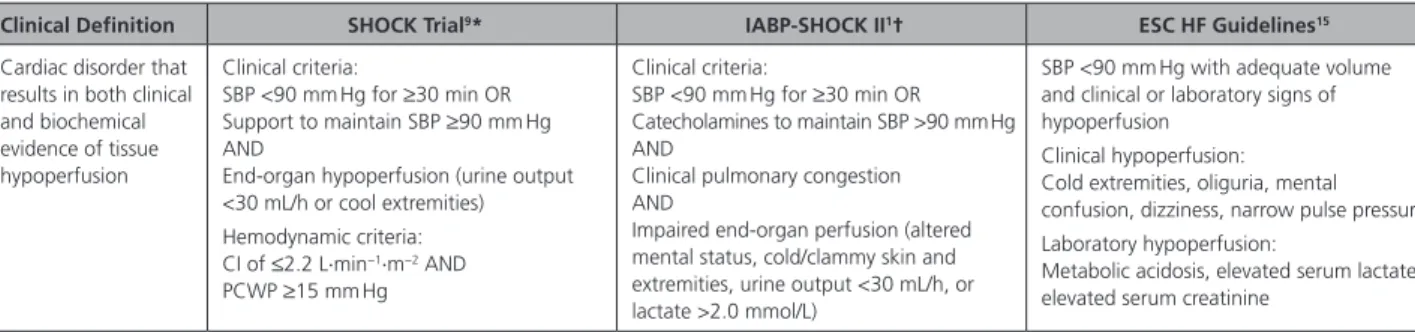
are presented in Table 1.
1,9,15HISTORICAL PERSPECTIVES
Before the routine use of early revascularization,
MI-associated CS had an in-hospital mortality exceeding
80%. A registry trial of 250 patients with acute MI
de-scribed the association between bedside physical
ex-amination (Killip classification) for the assessment of
heart failure (HF) and the risk of mortality.
16Patients
with Killip class IV (CS) had a mortality of 81%.
Sub-sequently, the Diamond and Forrester classification
us-ing right-sided heart catheterization described the role
of cardiac hemodynamics in stratifying risk after acute
MI in the prereperfusion era.
17Patients in Diamond
and Forrester subgroup IV with a pulmonary capillary
wedge pressure (PCWP) >18 mm Hg and a cardiac
in-dex (CI) <2.2 L
·
min
−1·
m
−2, indicative of CS, had a
mor-tality of 51%.
Treatment efforts to reduce mortality initially focused
on improvement of hemodynamic parameters by
me-chanical devices. The intra-aortic balloon pump (IABP),
introduced in a registry cooperative trial, decreased
systolic blood pressure (SBP), increased diastolic blood
pressure, and modestly but significantly increased CI.
18Nevertheless, mortality remained virtually unchanged,
with only 15 survivors among 87 patients (83%
mortal-ity).
18The early reperfusion era did not affect outcomes
for shock complicating acute MI. Fibrinolysis was
effec-tive for patients with ST-segment–elevation MI (STEMI)
in general, but it is less clear if fibrinolysis reduces
mor-tality in those with CS.
19,20The first major breakthrough in CS treatment was
achieved by the randomized SHOCK trial. Although an
early invasive strategy coupled with percutaneous
coro-nary intervention (PCI) or corocoro-nary artery bypass
graft-ing (CABG) did not reduce 30-day mortality (the primary
outcome of the trial), a significant mortality reduction
emerged at 6 and 12 months that persisted at
longer-term follow-up.
9,21,22Subsequent registries confirmed
the survival advantage of early revascularization.
5,6,8Further efforts to reduce CS mortality have been
di-rected toward improvements in MCS devices. The
larg-est randomized trial in patients with acute MI
compli-cated by CS did not show a benefit with routine IABP
placement in addition to revascularization.
1As a result,
there has been a decrease in the use of IABPs in clinical
practice and a downgrading in guideline
recommenda-tions.
23,24Recently, other percutaneous MCS devices
have shown promise in the treatment of CS, but more
data from randomized clinical trials are needed.
25PATHOPHYSIOLOGY
Our understanding of the complexity and
pathophysi-ology of MI-associated CS in particular has evolved
over the past 2 decades.
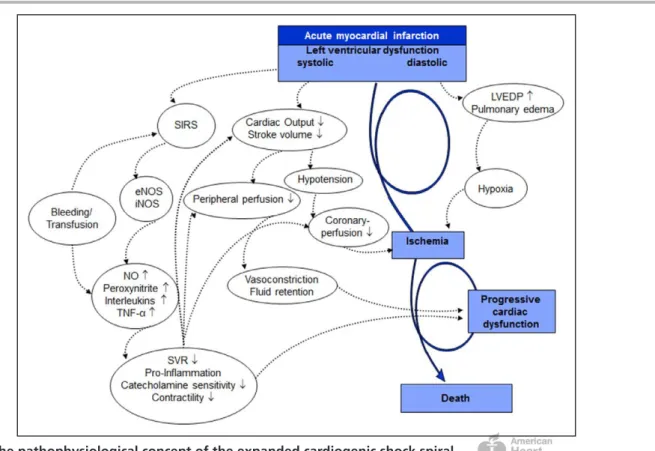
2,3,25–27In general, there is a
profound depression of myocardial contractility
re-sulting in a potentially deleterious spiral of reduced
cardiac output, low blood pressure, and further
cor-onary ischemia, followed by additional reductions in
contractility (Figure 1). This cycle may lead to death.
This classic paradigm also includes compensatory,
al-though pathological, systemic vasoconstriction that
Table 1.
Pragmatic and Clinical Trial Definitions of CS
Clinical Definition SHOCK Trial9* IABP-SHOCK II1† ESC HF Guidelines15
Cardiac disorder that results in both clinical and biochemical evidence of tissue hypoperfusion
Clinical criteria:
SBP <90 mm Hg for ≥30 min OR Support to maintain SBP ≥90 mm Hg AND
End-organ hypoperfusion (urine output <30 mL/h or cool extremities) Hemodynamic criteria: CI of ≤2.2 L·min−1·m−2 AND
PCWP ≥15 mm Hg
Clinical criteria:
SBP <90 mm Hg for ≥30 min OR Catecholamines to maintain SBP >90 mm Hg AND
Clinical pulmonary congestion AND
Impaired end-organ perfusion (altered mental status, cold/clammy skin and extremities, urine output <30 mL/h, or lactate >2.0 mmol/L)
SBP <90 mm Hg with adequate volume and clinical or laboratory signs of hypoperfusion
Clinical hypoperfusion: Cold extremities, oliguria, mental confusion, dizziness, narrow pulse pressure Laboratory hypoperfusion:
Metabolic acidosis, elevated serum lactate, elevated serum creatinine
CI indicates cardiac index; CS, cardiogenic shock; ESC, European Society of Cardiology; HF, heart failure; IABP-SHOCK II, Intraaortic Balloon Pump in Cardiogenic Shock II; LV, left ventricular; MI, myocardial infarction; PCWP, pulmonary capillary wedge pressure; SBP, systolic blood pressure; and SHOCK, Should We Emergently Revascularize Occluded Coronaries for Cardiogenic Shock.
*In setting of MI complicated by predominantly LV dysfunction. †In setting of acute MI.
by guest on September 18, 2017
http://circ.ahajournals.org/
AL ST
ATEMENTS
AND GUIDELINES
results from acute cardiac injury and ineffective stroke
volume.
3Emerging evidence has also shown that
im-pairment of tissue microcirculation is associated with
30-day mortality and temporal changes in SOFA (Sepsis-
Related Organ Failure Assessment) scores and may be
improved with MCS.
28,29In fact, it is now well established that CS can result
in both acute and subacute derangements to the entire
circulatory system, including the peripheral vasculature.
Extremity and vital organ hypoperfusion remains a
clini-cal hallmark. Although ineffective stroke volume is the
inciting event, inadequate circulatory compensation
may also contribute to shock. Peripheral
vasoconstric-tion may improve coronary and peripheral perfusion at
the cost of increased afterload. Alternatively, systemic
inflammation triggered by acute cardiac injury may
induce pathological vasodilatation. Endothelial and
inducible nitric oxide (NO) synthase may play a major
role in the production of high NO levels, along with
peroxynitrite, which has a negative inotropic effect and
is cardiotoxic.
26Other inflammatory mediators such as
interleukins and tumor necrosis factor can also
contrib-ute to systemic vasodilation and have been associated
with mortality in CS.
30In addition, bleeding and
transfu-sions may be associated with mortality.
31,32Alterations
in erythrocyte NO biology of stored blood can lead to
vasoconstriction, platelet aggregation, and ineffective
oxygen delivery, whereas transfusion of stored blood
may also contribute to inflammation.
33HEMODYNAMIC PHENOTYPES
Early reports of CS described patients with HF and
elevated central venous pressures (CVPs).
34With the
advent of invasive hemodynamic measurements,
pa-tients with CS were further characterized by a low CI,
an elevated systemic vascular resistance, and a high
PCWP.
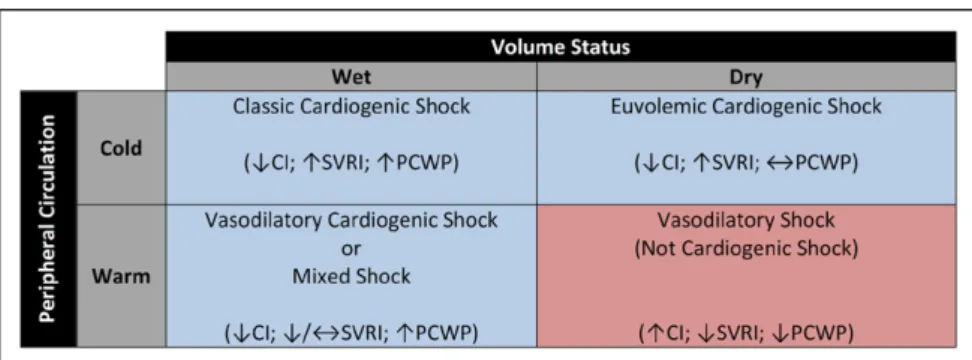
35This classic “cold and wet” (Figure 2) profile is
the most frequent CS phenotype, accounting for
near-ly two thirds of patients with MI-associated CS.
36Al-though some teaching and reference materials
contin-ue to describe a singular CS presentation, SHOCK trial
ancillary studies have helped to identify an expanded
spectrum of CS hemodynamics.
37The common
physio-logical characteristic among all phenotypes is a low CI,
but ventricular preload (PCWP or CVP), volume, and
systemic vascular resistance may vary. Notably, whereas
CI thresholds <1.8 to 2.2 L
·
min
−1·
m
−2have been
pro-Figure 1.
The pathophysiological concept of the expanded cardiogenic shock spiral.
eNOS indicates endothelial nitric oxide synthase; iNOS, inducible nitric oxide synthase; LVEDP, left ventricular end-diastolic
pressure; NO, nitric oxide; SIRS, systemic inflammatory response syndrome; SVR, systemic vascular resistance; and TNF-
α
,
tumor necrosis factor-
α
. Adapted from Hollenberg et al
3with the permission of American College of Physicians, Inc, copyright
© 1999, American College of Physicians, all rights reserved; from Hochman,
26copyright © 2003, American Heart Association,
Inc; from Reynolds and Hochman,
2copyright © 2008, American Heart Association, Inc; and from Thiele et al
27by permission
of the European Society of Cardiology, copyright © 2010, The Author.
by guest on September 18, 2017
http://circ.ahajournals.org/
posed for CS, absolute cutoffs are likely impractical
given that end-organ hypoperfusion with higher CIs
has been documented.
2,38,39Euvolemic or “cold and
dry” CS typically describes a diuretic-responsive patient
with chronic HF with a subacute decompensation but
also represents a reported 28% of patients with
MI-associated CS.
36,40Compared with patients with classic
CS, those with euvolemic CS were less likely to have
had a previous MI or chronic kidney disease and had
significantly lower PCWPs.
36There is growing recognition of the cytokine cascade,
chemokine response, and inducible NO synthase
ex-pression associated with coronary plaque rupture.
26,41–46As previously described, putative mechanisms also are
associated with a “wet and warm” CS presentation
wherein a systemic inflammatory response syndrome
and vasodilation can occur after an MI.
26,47This
pheno-type is characterized by systemic inflammatory response
syndrome features, lower systemic vascular resistance,
and a higher risk of sepsis and mortality.
48,49Overlaid on this framework are 2 uncommon but
hemodynamically distinct entities of normotensive CS
and right ventricular (RV) CS. In the SHOCK trial
regis-try, 5.2% of patients were normotensive with
periph-eral hypoperfusion despite an SBP >90 mm Hg.
50This
group had comparable CIs, PWCPs, and LV ejection
fractions but higher systemic vascular resistance
com-pared with hypotensive patients with CS, thus
high-lighting the risk of relative hypotension and the
poten-tial for hypoperfusion without profound hypotension.
The reported prevalence of RV CS is 5.3% among
patients with MI-induced CS. For these patients, the
severity of shock may depend on the degree of both
RV and LV ischemia, given a shared septum and the
importance of ventricular interdependence on RV
function.
51–53Hemodynamically, this cohort is
charac-terized by relatively higher CVPs, LV ejection fractions,
and lower pulmonary artery systolic pressures, with no
differences in CI or PCWP. Only 71% of patients with
an RV infarct in the SHOCK registry met the classic
hemodynamic definition of RV infarction (CVP:PCWP
≥
0.8); however, other studies have shown that fluid
challenges increased the prevalence of this
hemody-namic definition.
51,54PATHOGENESIS
After hemodynamic resuscitation and stabilization
of a patient presenting with CS, identification of the
underlying cause (
Supplemental Table 1
) can permit
the initiation of specific pharmacological or
mechani-cal therapies. A contemporary registry has reported
that as many as 81% of patients presenting with CS
had an underlying acute coronary syndrome (ACS).
55Thus, among patients with CS within the appropriate
demographic or with risk factors for coronary artery
disease, ACS should be the focus of initial diagnostic
testing, and this testing should include an ECG within
10 minutes of presentation.
56Although 5% to 12%
of ACS cases are complicated by CS, this presentation
is often associated with a large degree of at-risk
myo-cardium.
4,57In patients with a recent ACS, mechanical
complications (including papillary muscle rupture,
ven-tricular septal defect, or free wall rupture) were
his-torically thought to be late complications but most
fre-quently present within 24 hours of hospitalization.
58,59An index of suspicion and rapid echocardiography are
required for such diagnoses.
Chronic HF can present in an acute decompensated
state and may account for up to 30% of CS cases.
60These patients have often experienced a decline in
disease stability or have poor adherence to
guideline-based therapies that may trigger an acute worsening
of their chronic disease. Treatment of patients with
chronic HF presenting in CS can differ substantially
from the treatment of other types of CS because the
hemodynamic condition and neurohormonal milieu
are often strikingly different. Patients with HF often
have profound upregulation of vasoconstrictor
sub-stances such as angiotensin II, endothelin-1, and
nor-epinephrine.
61,62Among patients who had cardiac
sur-gery, 2% to 6% of patients develop postcardiotomy
shock.
63,64This state may be attributable to low
car-diac output (a result in part of myocardial hibernation,
stunning, or inadequate cardioprotection), systemic
vasodilation, or both.
63–65If these common causes of CS are not consistent
with the presentation, then less common causes listed
in
Supplemental Table 1
should be considered. In acute
Figure 2.
Potential hemodynamic
presentations of cardiogenic
shock.
CI indicates cardiac index; PCWP,
pulmonary capillary wedge pressure;
and SVRI, systemic vascular
resis-tance index.
by guest on September 18, 2017
http://circ.ahajournals.org/
AL ST
ATEMENTS
AND GUIDELINES
myocarditis, paradoxically, the sickest patients on
pre-sentation have the best odds of recovery, particularly in
younger age groups.
66,67Survival may depend on rapid
recognition of the clinical syndrome and early
institu-tion of aggressive hemodynamic support.
67–70Stress-induced cardiomyopathy is increasingly recognized,
and although it often presents with mild cardiovascular
compromise, it has been associated with CS and may
require MCS. Patients with stress-induced
cardiomy-opathy typically recover.
71–73Advanced valvular heart
disease and prosthetic dysfunction, especially when
previously undetected or inadequately monitored, may
present as CS, although this has become less common
as echocardiographic techniques and surveillance have
improved.
74–76Thyroid disorders, both
hyperthyroid-ism and hypothyroidhyperthyroid-ism, can also cause circulatory
collapse.
77,78Pregnancy-associated cardiac conditions,
including both peripartum cardiomyopathy and acute
coronary dissection, may present as CS. Numerous
ad-ditional causes of CS have been reported, but they
typi-cally occur in <1% of patients.
79,80LABORATORY EVALUATION,
NONINVASIVE TESTING, AND
HEMODYNAMIC MONITORING
Laboratory Evaluation
Biomarkers of cardiac myonecrosis are useful to gauge
the severity of acute underlying myocardial injury in
conditions such as fulminant myocarditis. In ACS,
car-diac troponin is noted to be elevated and has a
rise-and-fall pattern consistent with acute ischemic injury.
81A mismatch between the degree of segmental
dysfunc-tion on imaging and troponin release may be noted
in the setting of stunned/hibernating myocardium or
when presentation is significantly delayed after the
ischemic insult. Myocardial necrosis biomarker levels
may provide an idea of the extent of myocardial injury,
whereas serial measurements are useful in assessing
early washout after successful reperfusion and in
esti-mating the amount of cardiac necrosis. Natriuretic
pep-tides are significantly elevated in the setting of acute HF
culminating in CS and are associated with mortality in
MI-associated CS.
82,83Oxygen-carrying capacity is the product of cardiac
output and the oxygen content of blood. Thus, an
in-effective CI will result in inadequate peripheral tissue
oxygen delivery. Elevated arterial lactic acid levels are
nonspecifically indicative of tissue hypoxia but are
asso-ciated with mortality in CS.
84,85The pathogenesis of
lac-tate production in CS is uncertain, although impaired
oxygen delivery, stress-induced hyperlactatemia, and
impaired clearance are likely contributors.
86A
peripher-al oxygen demand-delivery mismatch will result in low
central venous oxygen measurements. A mixed venous
oxygen saturation sample is ideally obtained from the
distal port of a pulmonary artery catheter (PAC) and is a
reflection of oxygen saturation from blood returning to
the heart via the superior and inferior vena cava, as well
as the coronary sinus. Serial measurements of arterial
lactate and mixed venous oxygen saturation levels may
be helpful to temporally monitor responses to
thera-peutic interventions. Arterial blood gas measurements
also permit the assessment of arterial oxygenation and
ventilation, as well as metabolic and respiratory
acid-base disorders.
Acute kidney injury, which is reflected by a rise in
serum creatinine and a potential reduction in urinary
output, in the setting of CS may indicate renal
hypo-perfusion and is associated with poor outcomes.
87,88It
should be noted that novel renal biomarkers such as
neutrophil gelatinase–associated lipocalcin, kidney
in-jury molecule 1, and cystatin C were not more
effec-tive than standard evaluation with serum creatinine
for assessing risk.
87Acute ischemic or congestive liver
injury can occur in the setting of CS and manifests as a
marked elevation in serum aspartate aminotransferase,
alanine aminotransferase, serum bilirubin, and lactate
dehydrogenase levels, often accompanied by an
in-crease in prothrombin time with a peak at 24 to 72
hours that subsequently recovers to baseline within 5
to 10 days, and a ratio of alanine aminotransferase to
lactate dehydrogenase of <1.5.
89,90This should be
dif-ferentiated from chronic to subacute elevation of liver
function abnormalities in the setting of venous
conges-tion resulting from right-sided HF.
Noninvasive Testing
Despite its limitations, the chest x-ray provides
informa-tion on cardiac size and pulmonary congesinforma-tion and may
suggest alternative pathogeneses such as aortic
dissec-tion, pericardial effusion, pneumothorax, esophageal
perforation, or pulmonary embolism. The test enables
clinicians to confirm the position of the endotracheal
tube and the position of supportive devices, including
temporary pacing wires and MCS. The resting 12-lead
ECG is diagnostic in patients with STEMI but can
pro-vide epro-vidence for other clinical conditions, including
non–ST-segment–elevation ACS, pulmonary embolism,
acute myocarditis, electrolyte imbalances, and drug
tox-icity. A comprehensive transthoracic echocardiogram is
suggested. It can provide additional hemodynamic
in-formation, exclude mechanical complications, and help
to guide medical and mechanical therapeutic decisions
(
Supplemental Table 2
). When images are inadequate
or the diagnosis remains uncertain, a transesophageal
echocardiogram should be considered. An overview of
invasive hemodynamic testing and monitoring is
pro-vided later in Management of CS.
by guest on September 18, 2017
http://circ.ahajournals.org/
Suggestions for Clinical Practice
We suggest that all patients with CS be evaluated with
an ECG, chest x-ray, and comprehensive
echocardio-gram with the specific purpose of understanding the
dominant mechanism responsible for acute
hemody-namic instability. In the absence of contraindications,
additional imaging with a computed tomography scan
or transesophageal echocardiogram (as appropriate)
if an acute aortic syndrome or pulmonary embolism is
suspected is appropriate. Suggested laboratory tests
in-clude a complete blood count, electrolytes, creatinine,
hepatic function tests, arterial blood gas and lactate,
and serial cardiac troponin levels.
CONTEMPORARY OUTCOMES,
PROGNOSIS, AND RESOURCE USE
Trends in Outcomes and Therapies
CS remains the most common cause of in-hospital
mor-tality in the setting of an acute MI, and most
longitu-dinal studies and registries have reported a decline in
MI-associated CS mortality.
4,57,91–93An analysis of the
Nationwide Inpatient Sample Database between 2003
and 2010 reported an increase in the prevalence of CS
from 6% to 10% in the overall population and from
7% to 12% among patients >75 years of age
present-ing with STEMI.
4In-hospital mortality decreased from
45% to 34% over the same time frame, although
mor-tality rates remained high (55%) in patients >75 years
of age. The provision of angiography (64% to 74%),
early PCI (26% to 54%), and IABP (45% to 54%)
in-creased, whereas PAC use (10% to 6%) decreased over
time. The declining rates of in-hospital mortality may be
partly attributed to more aggressive early
revasculariza-tion, although this improvement was not supported by
a more contemporary analysis of patients with
MI-asso-ciated CS undergoing PCI between 2005 and 2013.
57Those authors reported that despite an overall increase
in PCI, in-hospital mortality increased from 27% to
30% and deaths occurring in the catheterization
labo-ratory increased from 15% to 20%. In addition,
pa-tient complexity increased over the same time frame
with more delayed presentations (>6 hours after
symp-tom onset), multivessel coronary disease, and complex
(type C) coronary lesions. Furthermore, the percentage
of patients with MI-associated CS undergoing PCI at
low-volume (<500 PCIs a year) centers increased from
30% to 48%. Collectively, these data identify several
concerning trends in the field: a potential increase in
mortality, an increase in patient complexity and use of
MCS, and a geographic shift toward care being
deliv-ered by lower-volume centers that may have less
expe-rience dealing with complex hemodynamic and
coro-nary patient subsets. In addition, confounding related
to changes in hospital-based coding of CS cannot be
excluded. In the non-ACS CS population, a
contempo-rary registry (limited to 42 patients with non-ACS CS)
reported an in-hospital mortality rate of 24% and that
non-ACS pathogenesis was independently associated
with better survival.
55Prognostic Models and Variables
Multiple scoring systems to predict clinical outcomes in
CS have been proposed. Several models were derived
in the general intensive care unit (ICU) population and
include the APACHE (Acute Physiology and Chronic
Health Evaluation)-II score and SAPS (Simplified Acute
Physiology Score)-II scoring systems.
94–97APACHE-II
in-cludes 13 physiological variables and was designed to
be measured during the first 24 hours after ICU
ad-mission for patients >16 years of age. The APACHE-III
scoring system adds variables such as pathogenesis of
shock, sex, race, and comorbidities to the APACHE-II
system and was validated in >17 000 ICU patients in the
United States. The SAPS-II includes 12 physiological and
3 disease-related variables, was validated in 12 997
pa-tients from 12 countries, and is used to predict
in-hos-pital mortality. A small study comparing the APACHE-II,
APACHE-III, SAPS-II, and SOFA scoring systems in CS
re-ported that APACHE-III and SAPS-II had the best
mortal-ity discrimination.
98The CardShock study was a series of
219 patients with all-cause CS and identified 7 variables
associated with in-hospital mortality (c index 0.85), but
it lacked external validation.
55Among patients with an
ACS complicated by CS, the GRACE (Global Registry of
Acute Coronary Events) score has good discrimination
and calibration for in-hospital and long-term mortality
among all patients presenting with ACS, but it is not
applicable to non-ACS presentations.
99Additional
pub-lished clinical, imaging, and hemodynamic variables
as-sociated with in-hospital mortality in the CS population
include anoxic brain damage, end-organ
hypoperfu-sion, elevated lactate, prior CABG, ACS pathogenesis,
LV ejection fraction, RV function, pulmonary artery
pul-satility index (defined as the ratio of pulmonary artery
pulse pressure to right atrial pressure), mitral
regurgita-tion, LV stroke work, cardiac power output, SBP,
num-ber of vasopressors, systemic inflammatory response
syndrome, and TIMI (Thrombolysis in Myocardial
Infarc-tion) flow.
39,48,100–105Limitations of available models
in-cluded the lack of a CS-specific derivation population,
external validation, dynamic application (ie, single point
in time only), applicability to all CS types, and capture
of all potentially prognostic clinical, laboratory,
hemo-dynamic, imaging, and biomarker data.
Resource Use and Costs
The economic impact of CS remains poorly understood.
The median reported ICU length of stay is 6 days and
by guest on September 18, 2017
http://circ.ahajournals.org/
AL ST
ATEMENTS
AND GUIDELINES
hospital length of stay is 8.9±11.8 days in the United
States and a median of 12 days (7–25 days) in
Eu-rope.
1,4,55A recent analysis of patients with STEMI
com-plicated by CS in the United States reported that the
average total hospital cost was $41 774±45 252.
4In the
contemporary IABP-SHOCK II trial, there were higher
average costs in the IABP arm (
€
33 155±14 593) than
in the control arm (
€
32 538±14 031).
106In summary, CS
treatment incurs substantial resource use and costs.
Long-Term Outcomes
Among patients with ACS-associated CS who had
re-vascularization and who survived to hospital discharge,
long-term follow-up of the SHOCK trial suggests that the
majority (62%) were alive 6 years later.
21In comparison,
a contemporary study of patients
≥
65 years of age with
MI-associated CS who survived to hospital discharge
re-ported an increased risk of mortality in the first 60 days
after discharge and then a mortality rate comparable
to that of patients without shock thereafter. The 1-year
survival was 87.6%.
107Despite favorable longer-term
survival, CS may be associated with considerable
mor-bidity. Registry data have reported 1-year all-cause and
HF rehospitalization rates of 59% and 33%,
respective-ly.
107The SHOCK and IABP-SHOCK II trials have reported
modest quality of life among 1-year survivors, with New
York Heart Association class II to IV symptoms in 43%
and self-care, physical, or psychological impairments in
≈
20% to 30%.
108,109Considerably less is known about
the long-term outcomes in the non-ACS CS population.
These data further support the need for new in-hospital
and postdischarge therapeutic approaches to improve
outcomes for patients with CS and the need for more
analyses in the non-ACS CS population.
REGIONALIZED SYSTEMS OF CARE
Clinical Volume and Patient Outcomes
Hospital and medical provider volumes have been
consistently and positively associated with survival in
medical and surgical care. Luft and colleagues
110ini-tially described this relationship in 1979, demonstrating
25% to 41% lower postoperative mortality in hospitals
performing >200 annual surgical procedures. In
subse-quent studies, investigators demonstrated a direct
re-lationship between volumes and outcomes at both the
operator and institutional level for surgery and PCI.
111– 114A meta-analysis of 15 PCI studies and 7 CABG
stud-ies, including >1 million patients from >2000 hospitals,
reported lower in-hospital mortality in large-volume
(>600 cases) PCI and CABG centers.
115Multiple studies
have also reported improved survival after primary PCI
for acute MI in high-volume centers and by
high-vol-ume operators.
116–118On the basis of these relationships,
professional associations, including the AHA, American
College of Cardiology, and Society for Cardiac
Angiog-raphy and Interventions, have recommended minimum
procedural volumes for hospitals and operators for the
maintenance of accreditation and competency.
119Simi-lar volume-outcome relationships have been reported
for other common conditions, including HF and
pneu-monia, and for medical ICU patients requiring
mechani-cal ventilation (MV).
120,121In CS, a complex acute
condi-tion that requires a multidisciplinary treatment team to
provide procedural, surgical, and medical care, clinical
volume has also been associated with survival. A study
from the Nationwide Inpatient Sample reported that
hospitals treating >107 cases per year more frequently
provided early revascularization, ventricular assist
de-vices, extracorporeal membrane oxygenation (ECMO),
and hemodialysis. There was a direct relationship
be-tween adjusted in-hospital mortality and hospital
vol-ume. Mortality was 37%, 39.3%, 40.7%, and 42% in
hospitals that treated ≥107, 59 to 106, 28 to 58, and
<27 cases per year (
P
<0.05).
122Of note, large-volume
sites were more likely to be academic, located in urban
areas, and serve as referral hubs. Reasons underpinning
this finding have not been clearly elucidated, although
we hypothesize that patients treated at high-volume
hospitals may be more likely to receive evidence-based
care and prompt revascularization by high-volume
op-erators and that high-volume hospitals may include
a multidisciplinary team who more frequently
imple-ments MCS and cares for patients with multisystem
organ failure. Accordingly, establishing systems of care
with high-volume hospitals used as hubs integrated
with emergency medical systems and spoke centers
with clearly defined protocols for early recognition,
management, and transfer has the potential to improve
patient outcomes.
Existing Regional Systems for
Coordination of Care
Regionalized care systems have been successfully
imple-mented for time-sensitive conditions, including STEMI,
stroke, trauma, aortic dissection, and OHCA.
107,123–130In
trauma care, mortality has been reduced by 15% to
20% with patient triage and transport to designated
American College of Surgeons Level 1 trauma
cen-ters.
124In stroke care, integrated systems of care have
been associated with higher rates of fibrinolytic therapy
use and improved survival.
123,131In OHCA, wherein
pre-hospital and pre-hospital management are mutually
criti-cal for improved survival, regional systems of care have
been successfully implemented.
125,130,132,133In Arizona,
hospital bypass by emergency medical services to
desig-nated OHCA centers equipped to provide best-practice
in-hospital care was associated with improved overall
survival from 8.9% to 14.4%.
134The management of
by guest on September 18, 2017
http://circ.ahajournals.org/
STEMI represents the paradigm for integrated systems
of care with coordinated emergency medical services,
community, and tertiary care centers, coupled with
standardized hub-and-spoke transfer protocols, quality
assurance, real-time feedback, and healthcare provider
education.
128,135–138The AHA has endorsed and certified
STEMI referral and receiving hospitals as part of its
Mis-sion: Lifeline initiative, which also implements
continu-ous review and quality improvement.
135Regional Systems for the Management
of CS
One of the earliest CS regional care systems was
imple-mented by cardiothoracic surgeons in New York City in
the 1990s for the management of refractory
postcar-diotomy shock requiring temporary surgical left-sided
MCS as bridge to transplantation (BTT) or recovery.
139The program consisted of a network of spoke hospitals
located within a 250-mile radius of a hub institution.
The authors emphasized the need for an early dialogue
(within 12 hours of shock) between the referring and
accepting centers to determine the viability of the
can-didate and the suitability for transfer and developed a
management algorithm. Implementation of this
net-work was associated with a 66% survival rate, higher
than the 25% historical survival rate.
The feasibility of a traveling CS team within a
re-gional hub-and-spoke model was demonstrated in the
cardiac-RESCUE pilot study.
13In this French study, the
investigators developed a network of 22 tertiary and 53
nontertiary centers that transferred patients with CS to
3 designated centers using a mobile ECMO team. A call
from the spoke institution requesting assistance
initi-ated the departure of the mobile team, consisting of a
surgeon, a perfusionist, and a nurse, within 30 minutes.
Stabilized patients were subsequently transferred to the
hub institution. There were no adverse events during
transfer among 75 stabilized patients; 32 patients were
discharged alive; and 30 patients were alive at 1 year.
In addition, the Arizona Mayo clinic traveling team
re-ported an initial experience with 27 patients from 18
community hospitals, among whom 56% survived to
hospital discharge.
14Taken together, these studies
dem-onstrated the feasibility of mobile CS teams who can
successfully facilitate early support and treatment in
pa-tients with CS within a hub-and-spoke model.
Proposed Shock Center Characteristics
The writing group proposes that all CS regional referral
centers should meet minimum Level 1 unit
organiza-tional and staffing criteria as outlined by internaorganiza-tional
scientific statements.
140–142CS centers should have the
onsite monitoring, medical services, and
therapeu-tic technologies to coordinate and deliver care for all
causes of CS from the resuscitation phase to recovery,
durable supportive therapy, or palliation. Examples of
coordination and delivery of care have already been
implemented in some tertiary care centers with the
creation of multidisciplinary shock teams of
cardiotho-racic surgeons, interventional cardiologists, advanced
HF specialists, critical care specialists, and allied health
professionals. Although there is no evidence suggesting
that these teams improve outcomes, they can
central-ize medical, surgical, and MCS care and conduct daily
rounds on patients with CS in coordination with the
primary team caring for the patient.
143Tertiary high-volume cardiovascular centers should
be designated as CS receiving (or hub) centers. Within
each cardiovascular system of care, these centers would
accept transfers of appropriately selected patients with
CS from lower-acuity sites for further evaluation and
treatment.
15,144,145Moreover, to consolidate clinical
vol-umes and professional experience, we advocate that a
single cardiac ICU (CICU) or ICUs within each CS center
be designated to receive all CS admissions before the
initiation of MCS. We recognize that after the initiation
of some MCS therapies, patients may need to be
trans-ferred to surgical ICUs.
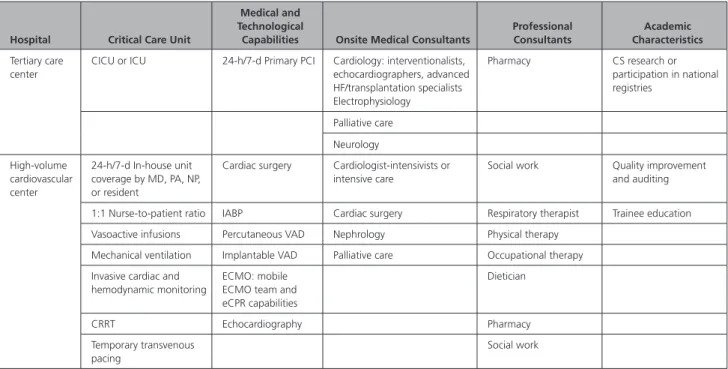
The suggested hospital, care unit, professional,
tech-nological, and academic capabilities of CS centers are
outlined in Table 2.
CICU Versus ICU Admission
Many contemporary tertiary care center CICUs have
evolved into critical care environments for patients with
a primary cardiovascular diagnosis, with an acuity and
therapeutic technologies that mirror those of many
ICUs.
146,147Although the CICU environment may be best
suited to centralize cardiac care of patients with CS,
at-tending cardiologists and teams may not have the
dedi-cated training to address the ancillary multisystem organ
failure often associated with CS.
142Conversely, although
the ICU may be well suited to manage noncardiac organ
failure, surveys have reported that ICU trainees may be
unprepared to manage cardiovascular illness and to
per-form common cardiovascular procedures.
148ICU-based
observational studies have reported improved outcomes
in a closed unit staffing model.
149In addition, in the CICU,
there is emerging evidence from a before-and-after study
that transition from an open low-intensity care model
to a closed unit model with care led by a dual-trained
cardiologist-intensivist may improve outcomes; however,
further studies are required to evaluate the independent
influence of staffing and physician training.
150Suggestions for Systems Development
We do not preferentially advocate for either a CICU or
ICU as a designated CS unit. Rather, we suggest that
each tertiary hub center develop care pathways to
by guest on September 18, 2017
http://circ.ahajournals.org/
AL ST
ATEMENTS
AND GUIDELINES
liver the comprehensive, collaborative, and
multidisci-plinary care outlined in Table 2.
Regionalization of CS Care
The development and implementation of systems to
streamline care and to optimize outcomes of patients
with CS have challenges associated with triage
deci-sions, need for expertise with MCS, identification of
tertiary care centers to serve as hubs, team training,
and resource allocation for mobile transport teams.
Al-though many of the lessons learned during the
imple-mentation of OHCA and STEMI systems of care can be
applied in a regionalized system for CS, the
develop-ment and coordination required for CS care will have
unique challenges. Potential barriers and solutions are
displayed in
Supplemental Table 3
.
A proposed model for CS regional care is provided
in Figure 3. Leadership of national and regional
or-ganizations will be required to spearhead the
imple-mentation of hub-and-spoke CS systems of care. Hub
centers would be required to create mobile
multidis-ciplinary CS teams available 24 hours a day, 7 days a
week for onsite or offsite consultation, referral, and
ECMO/MCS insertion. In addition, hub centers would
be required to identify the CS units with the expertise
and resources outlined above. Because spoke
hospi-tals would have variable patient acuity and
therapeu-tic technologies, including PCI and temporary MCS,
individual hospitals would have to develop CS
treat-ment algorithms according to onsite capabilities and
expertise. Regional protocols should standardize
man-agement practices, provide futility parameters, and
determine the timing of transfer once the diagnosis of
refractory CS is established.
Public Reporting
Although public reporting may improve accountability
and promote better care, it may have had the
unin-tended consequence of encouraging risk-averse
be-haviors among physicians and a reluctance to treat
CS (a condition that historically has had a higher risk
of procedural mortality). The unfortunate sequela for
patients with CS is that this has also been associated
with an increased risk of mortality resulting from
un-dertreatment. A solution that has been undertaken in
New York State is to exclude all patients with CS from
public reporting.
151Considerations for Public Reporting
Therefore, in an effort to improve patient outcomes, we
suggest that either patients with CS be excluded from
public reporting, or reporting should be implemented
only after all process, outcome, safety, and economic
measures are clearly identified and risk-adjusted.
Knowledge Translation: Mission: Lifeline
In March 2006, in response to a call to action to
in-crease the number of patients with STEMI with timely
access to primary PCI, the AHA convened a conference
Table 2.
CS Center Characteristics
Hospital Critical Care Unit
Medical and Technological
Capabilities Onsite Medical Consultants
Professional Consultants
Academic Characteristics
Tertiary care center
CICU or ICU 24-h/7-d Primary PCI Cardiology: interventionalists, echocardiographers, advanced HF/transplantation specialists Electrophysiology
Pharmacy CS research or participation in national registries
Palliative care Neurology High-volume
cardiovascular center
24-h/7-d In-house unit coverage by MD, PA, NP, or resident
Cardiac surgery Cardiologist-intensivists or intensive care
Social work Quality improvement and auditing
1:1 Nurse-to-patient ratio IABP Cardiac surgery Respiratory therapist Trainee education Vasoactive infusions Percutaneous VAD Nephrology Physical therapy
Mechanical ventilation Implantable VAD Palliative care Occupational therapy Invasive cardiac and
hemodynamic monitoring
ECMO: mobile ECMO team and eCPR capabilities
Dietician
CRRT Echocardiography Pharmacy
Temporary transvenous pacing
Social work
CICU indicates cardiac intensive care unit; CRRT, continuous renal replacement therapy; CS, cardiogenic shock; ECMO, extracorporeal membrane oxygenation; eCPR, extracorporeal membrane oxygenation–facilitated cardiopulmonary resuscitation; HF, heart failure; IABP, intra-aortic balloon pump; ICU, intensive care unit; MD, medical doctor, NP, nurse practitioner; PA, physician assistant; PCI, percutaneous coronary intervention; and VAD, ventricular assist device.