UNIVERSIDAD TÉCNICA PARTICULAR DE LOJA
La Universidad Técnica Particular de Loja
ESCUELA DE CIENCIAS DE LA EDUCACIÓN
MENCIÓN INGLÉS
MODALIDAD ABIERTA Y A DISTANCIA
A DESCRIPTIVE ANALYSIS OF ANGLICISMS USED IN
ECUADORIAN NEWSPAPERS
Research done in order to achieve
the Bachelor’s Degree in Teaching
English as a Foreign Language
AUTOR:
CORELLA ARROBA PATRICIO RENÁN
DIRECTOR:
Msc. INÉS TORRES
´
QUITO, VILLAFLORA
Abstract
The research performed was “A descriptive analysis of
anglicisms used in Ecuadorian newspapers”. The purpose of this
investigation is to recognize how Spanish can be altered with the
influence of the English language in newspapers, and the
unnecessary use of these foreign expressions in the Ecuadorian
printed press.
The research took place in the city of Quito. The samples were
three different newspapers, which are commonly read by the majority
of the citizens of Quito. These samples were continuously collected
during seven days.
In this thesis, four types of research methodology had been
used such as: the scientific, bibliographic, analytic and descriptive.
Note taking, collection of bibliographic information, personal
interview and public surveys; had also been used as techniques to
gather information.
After a thorough analysis of the results. I came to the
conclusion that in the area of sports and technology, the use of
English words are essential and necessary as we have no translation
for these terms. However, in all other areas, there is the correct or
equivalent word in Spanish to be used instead the English one. The
continuous and frequent use of English expressions in our language
would lead to the fact that those borrowed terms will be part of our
Introduction
“A descriptive analysis of anglicisms used in Ecuadorian
Newspapers” is a topic of great importance nowadays. Anglicisms are
English words that have been regularly used in our language.
The use of English terms is necessary in certain areas such as
sports and technology. On the other hand, the use of these terms for
purely the purpose of making the Spanish language to look more
fashionable is not acceptable and their use is unnecessary.
In relation to the topic some previous studies had been wrote,
such as: “Anglicisms in Business Sings, Banners and Billboards”,
“Archaims and Anglicisms in the Spanish Spoken in Ecuador”,
“Anglicismos en el Deporte” and “El Anglicismo en la Lengua
Española”.
Excellent articles have been performed about the inappropriate use of
the Spanish language as in “Vicios del language”. This writing refers
to the factors that alter the normal fluency of the language
communication. The other publication was “un millar de
anglicismos”, this dictionary recollects many terms and utterances
that are borrowed from English and converted into Spanish.
This topic is very interesting to be researched since the world is
experiencing a quick development in the science area, the growing of
technology, cultural and commercial exchanges; have made that
terms from the English language have been taken or adapted to our
Spanish language.
The purpose of this research is to carry out a descriptive,
linguistic and social analysis of the written language used in
Ecuadorian newspapers. The analysis is based on words or phrases
of English, which most frequently appear in newspapers articles.
This topic is not only important to UTPL; it is also a personal
interest that led me to know how a language can be altered with the
more frequent use of loanwords in the writing of the newspapers.
This reason made me to acquire knowledge to carry out this research
and to be prepared in order to obtain my professional degree.
In this study, several methods were used to obtain the results
of the investigation: scientific, bibliographic, analytic and descriptive
methods were applied. Meanwhile note taking, direct observation,
interviews and surveys were used as techniques.
The completion of the project was very demanding in terms of
time. Finding the examples of anglicisms in the articles and analyzing
their meaning in a particular context, was also a great effort.
Determining the level of influence of the English language on
the linguistic expressions used in Ecuadorian newspapers, it is a fact
that all the loanwords found in the analysis came from the English
In the process of identifying the most commonly syntactic and
lexical anglicisms, it was concluded that there was a determined
number of repeated terms especially in the Ads section.
To make a deep analysis of the anglicisms found in Ecuadorian
newspapers about etymological, syntactic-semantic, and
morphological aspects, it was required to perform an extensive
linguistic analysis given to thirty anglicisms taken from each one of
the variables.
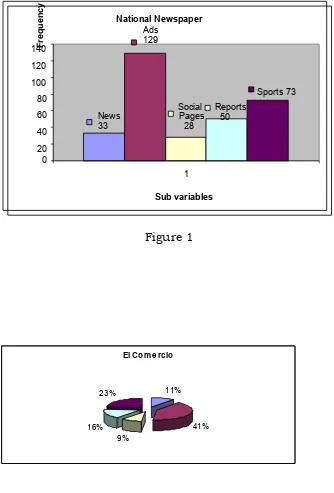
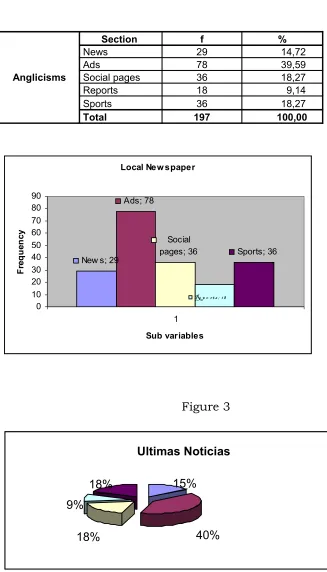
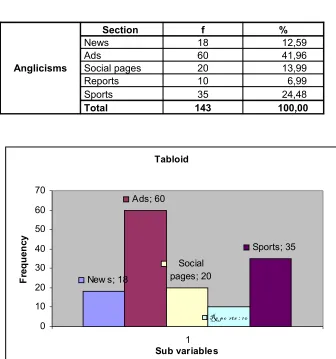
In order to determine the written sections of Ecuadorian
newspapers in which anglicisms are mostly used; it was necessary to
do a quantitative analysis with frequencies and percentages in every
section. It could be identified the sub variable Ads with the highest
number of anglicisms.
To know the level of acceptance Ecuadorians have on the use of
anglicisms in newspapers; there was a survey trying to interview five
learned readers and one linguistic. They had different opinions about
this topic but as a general idea, they agreed with the use of
anglicisms in Ecuadorian newspapers but only when their usage is
Methodology
The research “A descriptive Analysis of Anglicisms Used in
Ecuadorian Newspapers” started when this topic was introduced to
the students during the last cycle. Therefore, it was possible to obtain
information and find related details about this theme.
The first part of the current project started with the search of
bibliographical information related to the topic. This section was
called Theoretical Background, which was performed with theories,
ideas, and previous studies about the theme of study. Afterwards this
kind of information was useful to support the process investigation.
The field research was performed in the city of Quito with the
most important newspapers read by the population. Three different
newspapers were selected: A National newspaper “Diario EL
Comercio”, a local newspaper “Diario Ultimas Noticias”, and finally a
tabloid “ Diario Extra.
This project was carried out recollecting day after day newspapers in
a period of a week. During this time the articles were read and
analyzed to find anglicisms in them. Once the anglicisms were found,
they were organized according the section they belonged. This part of
the research was the qualitative tabulation of the results. The
anglicisms found were tabulated in charts with the following
information: the Anglicism, the context where the term was found,
After that, the frequencies and percentages of every section
were presented in statistical tables according their variable. This
study was known as the quantitative tabulation of the results, which
represented the number of anglicisms that appeared in each one of
the sub variables. (Annex 2). At the same time it was performed an
interview to a linguistic and to five learned readers about the use of
anglicisms in the Spanish Language and their interference in
Ecuadorian newspapers. (Annex 1).
The techniques used during the performing of this research
were reading, bibliographical researching, selection the best
information, tabulation, and finally surveys.
The data obtained in the field investigation were used as the
basis to perform the analysis of the results. This investigation
incorporated the Linguistic analysis. In this part, ten (10) anglicisms
were chosen from each one of the three variables. Those loanwords
were analyzed in etymological, syntactic-semantic, and morphological
manner.
After that, a comparative analysis of the variables and sub
variables about their frequencies and percentages, was performed.
Finally, a sociological analysis was considered with the
opinions and criteria given by the learned readers and the
commentaries provided by the linguistic. These hypotheses were
related to the use of borrowing words and how they may change the
Results
This part of the research refers to the anglicisms found in the
different newspapers during the field research.
The investigation took place in the city of Quito with three of
the most important newspapers such as “Diario EL Comercio”,
“Ultimas Noticias”, and the tabloid “El Extra”. They were called
variables, at the same time they were divided in sections or sub
variables. News, ads, reports, social pages, and sports were the
sections in which anglicisms were carefully analyzed.
All the anglicisms found were organized and tabulated in charts
according the variable and section they belonged. Finally, a
quantitative tabulation was performed with the frequencies and
Chart One
Variable: National Newspaper: El Comercio
Subvariable: News
Anglicisms Examples Times Title of the article Date
malls
los malls de Quito se anclan
a las ofertas 3 Negocios 14/12/2009
outlet el el Granados outlet 1 Precios tientan al cliente 14/12/2009 mitin tras un mitin político 3 Berlusconi agredido 14/12/2009 Human
rights
human right solicita reformar
el proyecto de ley 1 Proyecto a reformarse 15/12/2009 kilobyte el precio del internet por hora 3 Enegía alternativa 16/12/2009 shopping la gente va de shopping 3 compras navideñas 17/12/2009
lider Lider del abierto de sudáfrica 1 Golf 18/12/2009
Republic
en su libro de Banana
Republic a la No Republica 1
Rafael Correa lanza su
libro 17/12/2009
stock
la garantia técnica y el stock
de repuestos 1
El equipamiento de 115
ambulancias 15/12/2009
record
El correo batió el record de
envíos 2 En breve 15/12/2009
internet
los sitios de internet que
incitan a la violencia 2
El ataque a Berlusconi
abre debate 15/12/2009
stock
gran parte del stock se
encontraba en bodegas 2
Consumismo en el
Ecuadro 18/12/2009
gasoil para la importación de gasoil 4 Demanda de derivados 19/12/2009
9nternet
tengo que navegar en
internet 3 crisis energética 20/12/2009
cibercafe para buscar un cibercafe 2 crisis energética 20/12/2009
country siguieron al la banda country 1
Dixie chicks en un
documental 20/12/2009
Chart Two
Variable: National Newspaper: El Comercio Subvariable: Ads
Anglicisms Examples Times
Title of the
article Date
full modelo full equipo 16 automobile 14 to 20 Dec
leasing con la posibilidad de leasing 5 real state 14 to 20 Dec
call center
se necesita joven para call
center 8
job and
services 14 to 20 Dec work and
travel work and travel solicita personal 8
job and
services 14 to 20 Dec
manager manager en productividad 3
job and
services 14 to 20 Dec suites hermosas suites en la playa 14 real state 14 to 20 Dec laptop impresora mas laptop 500 17 products 14 to 20 Dec wireless memoria expandible y wireless 6 products 14 to 20 Dec
Ram Ram 2GB y teclado 14 products 14 to 20 Dec
Sexy Se vende sexy lenceria 11 products 14 to 20 Dec
Sportman
Con experiencia y licencia
sportman 5 job and services 14 to 20 Dec
Discman
de oportunidad reproductor de
peliculas discman 1 products 14 to 20 Dec
Plotter
se ofrece servicio de plotter,
gigantografias 7 products 14 to 20 Dec
garage ventas de garage 3 products 18/12/2009
diseñador web
se requiere diseñador web con
experiencia 2 job and services 19/12/2009
show Mariachi Show 3 job and services 20/12/2009
marketing
Busca persona para su
departamento de marketing 4 job and services 20/12/2009 bodys fajas y bodys en todas las tallas 2 products 20-12--2009
Chart Three
Variable: National Newspaper: El Comercio Subvariable:
News Social Pages
Anglicisms Examples Times Title of the article Date
web se la pudo ver en la web 2
Actriz contrajo
matrimonio 14/12/2009
swing
durante sus ejecuciones de
swing y 1 Baile de celebración 14/12/2009
stress para evitar el stress 2 jet set 15/12/2009
sex-symbol el sex symbol de la pantalla 1 Farándula 16/12/2009 tattoo se realizo el tatto en honor a ella 2 Farándula 16/12/2009
miss en el miss continente americano 2
Nuevo concurso de
belleza 16/12/2009
marketing el departamento de marketing 1
Presentación del
producto 17/12/2009
hit
con el lanzamiento de su nuevo
hit 3
Beyonce con nuevo
album 19/12/2009
show que nos trae su show? 2 En exclusiva 18/12/2009
break dance
a través del break dance
demuestran 3 Zona Urbana 18/12/2009
pop esta banda de pop se formo 2 En Exclusiva 18/12/2009 graffiti este arte en grafiti revela 4 Chismografo 18/12/2009
junior
el analista junior junto a su
familia 1 jet set 20/12/2009
fan
cientos de fans le esperaron a
la.. 2 Farándula 20/12/2009
Chart Four
Variable: National Newspaper: El Comericio Subvariable: Reports
Anglicisms Examples Times Title of the article Date
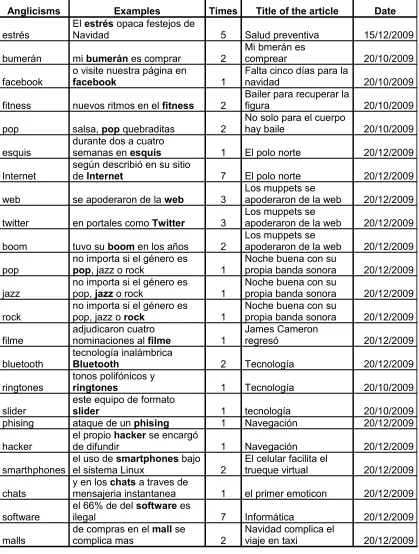
estrés
El estrés opaca festejos de
Navidad 5 Salud preventiva 15/12/2009
bumerán mi bumerán es comprar 2
Mi bmerán es
comprear 20/10/2009
o visite nuestra página en
facebook 1
Falta cinco días para la
navidad 20/10/2009
fitness nuevos ritmos en el fitness 2
Bailer para recuperar la
figura 20/10/2009
pop salsa, pop quebraditas 2
No solo para el cuerpo
hay baile 20/10/2009
esquis
durante dos a cuatro
semanas en esquís 1 El polo norte 20/12/2009
Internet
según describió en su sitio
de Internet 7 El polo norte 20/12/2009
web se apoderaron de la web 3
Los muppets se
apoderaron de la web 20/12/2009
twitter en portales como Twitter 3
Los muppets se
apoderaron de la web 20/12/2009
boom tuvo su boom en los años 2
Los muppets se
apoderaron de la web 20/12/2009
pop
no importa si el género es
pop, jazz o rock 1
Noche buena con su
propia banda sonora 20/12/2009
jazz
no importa si el género es
pop, jazz o rock 1
Noche buena con su
propia banda sonora 20/12/2009
rock
no importa si el género es
pop, jazz o rock 1
Noche buena con su
propia banda sonora 20/12/2009
filme
adjudicaron cuatro
nominaciones al filme 1
James Cameron
regresó 20/12/2009
bluetooth
tecnología inalámbrica
Bluetooth 2 Tecnología 20/12/2009
ringtones
tonos polifónicos y
ringtones 1 Tecnología 20/10/2009
slider
este equipo de formato
slider 1 tecnología 20/10/2009
phising ataque de un phising 1 Navegación 20/12/2009
hacker
el propio hacker se encargó
de difundir 1 Navegación 20/12/2009
smarthphones
el uso de smartphones bajo
el sistema Linux 2
El celular facilita el
trueque virtual 20/12/2009
chats
y en los chats a traves de
mensajeria instantanea 1 el primer emoticon 20/12/2009
software
el 66% de del software es
ilegal 7 Informática 20/12/2009
malls
de compras en el mall se
complica mas 2
Navidad complica el
viaje en taxi 20/12/2009
[image:13.595.111.530.122.676.2]Chart Five
Variable: National Newspaper: El Comercio Subvariable: Sports
Anglicisms Examples Times Title of the article Date
fútbol
para mundial de fútbol se
alistan amistosos 10 Mundial 14/12/2009
futbolista
el nivel competitivo del
futbolista 5
Pichincha mejoro en
su dirigencia 14/12/2009
máster
se inician finales del Máster de
Ecuajunior 2
Se inician
campeonato en Quito 14/12/2009
corner mediante un corner 6
Goleada en racha
seguida 15/12/2009
club
el jugador prestó sus sevicios
en el club 8
Mercado de
jugadores se mueve 16/12/2009
6
Listos grupos de
Copa Libertadores 17/12/2009
6
Champons League
en fase de clubes 17/12/2009
raquetbol
se inaguró el certamen de
ratquebol 4
Ecuador triunfa en
mundial de racquet 18/12/2009 future en Quito habría un future 2 tenis ecuatoriano 17/12/2009
country club
se desarrollo en el Country
Club de Liga 5 Tenis ecuatoriano 17/12/2009
hat trick
el jugador logró su primer hat
trick 3
El destino del Bieler
aun incierto 19/12/2009
ring
ocho boxeadores subirán al
ring 2 Desafio en el coliseo 20/12/2009
sparrring
será el sparring para la
pretemporada 1
Preparación de cara
al nuevo campeonato 20/12/2009 set el partido se jugó en tres sets 2 Semifinal de tennis 18/12/2009
estándar
se debe cumplir un tiempo
estándar 1
Los ciclistas cierran
su año deportivo 16/12/2009
racquet
Ecuador triunfa en mundial de
racquet 2 Deportes 18/12/2009
junior Mundial Junior de Racquetbol 1 Deportes 18/12/2009 karting La torneo de karting reunirá 2 En breve 18/12/2009 derbi emocionte derbi del 2008 3 Internacional 19/12/2009
rally
con emocionantes corredores
de rally 2
Rally en
Chile-Argentina 20/12/2009
Chart Six
Variable: Local Newspaper: Ultimas Noticias
Subvariable: News
Anglicisms Examples Times
Title of the
article Date
cd
manualidades, o un CD
grabado 3 Mas consejos 14/12/2009
sandwich
en la venta de internet y
hot dogs 2
Comida
Chatarra 14/12/2009
best seller
en la presentación del
best-seller 2 Acontecimientos 15/12/2009
drag queen
con su vestimenta de
drag queen 1 Acontecimientos 15/12/2009
slogan
haciendo alusión al
slogan de campaña 1
Noticias
Nacionales 16/12/2009
pop
en homenaje al rey del
pop 4
Aun hay dudas
fallecimto 16/12/2009
broker
ha sido el broker por
muchos años 3 Seguridad 17/12/2009
kilobyte
de mas capacidad en
kilobytes 2 Tecnologia 17/12/2009
web
en la web hay mensajes
como 5
Robos
Informáticos 18/12/2009
internet
el servicio de internet
contarára con 4
Seguro Social y
Fondos 18/12/2009
lider el lider de derecha 2
Política
económica 19/12/2009
Chart seven
Variable:
Local Newspaper: Ultimas Noticias
Subvariable: Ads
Anglicisms Examples Times
Title of the
article Date
laptop flamantes laptops a 17 products 14 to 20 dec
internet cabinas, llamados por internet 20 products 14 to 20 dec
cyber cybers, toda operadora 12 products 14 to 20 dec
cd movil
se alquila cd movil ,
garantizamos 14 products 14 to 20 dec
outlet outlet ropa americacana 6 products 14 to 20 dec
show show inolvible 3
Jobs and
services 17/12/200
sponsor Somos sponsor de 2
jobs and
services 18/12/2009
garage
departamento en el norte,
garage 1 rental state 18/12/2009
confort
siente el confort con este
sillón 2 products 19/12/2009
comic de oportunidad comics 1 products 19/12/2009
Chart Eight
Variable: Local Newspaper:Ultimas Noticias Subvariable: Social pages
Anglicisms Examples Times Title of the article Date
pop con un pop que se refleja 2
Las dos caras de
Fernandez 14/12/2009
shows Con un show de Nirvana 3
Un gran recuerdo
de los noventa 14/12/2009
rock un gran concierto de rock 3
Un gran recuerdo
de los noventa 14/12/2009
roqueros para ese cuarteto de roqueros 2
Retribucion
Metallica 14/12/2009
DVD junto al DVD en estuche especial 3
Retribucion
Metallica 14/12/2009 comic salio a la venta el comic 3 El arte del dibujo 15/12/2009
camping con el equipamiento de camping 2
De viaje a la
serrania 16/12/2009
reality el nuevo reality de la televisión 3 Cotorreando 17/12/2009
chip el chip mejoraria el desempeño 4
Microprocesadores
de alta gama 19/12/2009
wireless
con capacidad de navegación
wireless 2 Consolas de video 19/12/2009
wi fi en lugares con cobertura wi fi 2
Redes
inalambricas 19/12/2009
top model
con la presencia de famosas top
models 2 Cotorreando 19/12/2009
video clip el artista grabó su video clip 2 Cotorreando 19/12/2009
stand
las novedades que cada stand
presentaba 3 Ferias 19/12/2009
Chart Nine
Variable: Local Newspaper: Ultimas Noticias
Subvariable: Reports
Anglicisms Examples Times Title of the article Date
Restaurant
en el restaurant de comidas
típicas 3 Sitios de alojamiento 15/12/2009
Hobby su principal hobby es bailar 2
El gusto de las
momtañas 16/12/2009
laptop
las laptop son las preferidas
por los ladro 4
De viaje por nuestro
país 18/12/2009
Internet
en el internet se pueden
conocer las rutas 3
Noticiasde la Super de
Compañias 19/12/2009
web
el sitio web de la
organización 2 Nuevos proyectos 19/12/2009
reality
es un reality que divertirá a
la gente 2 En Boga 19/12/2009
light
lo light marca el consumo y
oferta de la 2 Vida Sana 20/12/2009
Chart Ten
Variable: Local Newspaper:Ultimas Noticias Subvariable: Sports
Anglicisms Examples Times Title of the article Date
Premier
A Valencia le va bien en la
Premier 2 Noticias Tricolores 14/12/2009
Junior El Quito Junior Open 3 Al cierre 14/12/2009
Open El Quito Junior Open 3 Al cierre 14/12/2009
Tenis
La Confederacion
Sudamericana de Tenis 4 Al cierre 14/12/2009
set
se llevó la victoria en el tercer
set 2 Al cierre 14/12/2009
chip los corredores llevaran el chip 5
Marathon en el
Sur 15/12/2009
Club el club de futbol argentino 4
A un paso de ser
campeon 15/12/2009
futbol Asociacion del fútbol 6
La situación de los
equipos 15/12/2009
derbi todo listo para el gran derbi 2
Dos grandes se
enfrenta 16/12/2009
play off
se jugaran los play offs para
la temporada 3
Con ventaja para
las finales 16/12/2009
centro foward
el equipo busca un centro
forward 1 Contrataciones 17/12/2009
performance
pero pese a su mala
performance, 1 Internacional 18/12/2009
se mantiene como el mejor
Chart Eleven
Variable: Tabloid "El Extra" Subvariable: News
Anglicisms Examples Times Title of the article Date
crack Fueron detenidos con crack 3 Detenidos brujos 14/12/2009
gay
Abaleado gay en la
perimetral 2 Asesinato en Guayaquil 14/12/2009
watt
el foco normal consume 100
watts 1 Ahorre Luz 15/12/2009
adrenalina
la adrenalina se aceleraba
mientras 2
Operativo en Bastión
Popular 16/12/2009
se escribian a trves de e
mails 3
Muerte llegó a la vuelta
de su casa 17/12/2009
poster
el poster de su artista
favorito 2 El sabor de Don Viche 17/12/2009
strés
el occiso sufria de llanto y
strés 1 Tragedia en Daule 18/12/2009
shopping
se iba de shopping cuando
ocurrió 2
Robos en el norte de
Guayaquil 19/12/2009
manager
acudió junto a su novio y
nuevo manager 2 Famosos 19/12/2009
Chart Twelve
Variable: Tabloid El Extra Subvariable:
News Ads
Anglicisms Examples Times Title of the article Date
sexy sexy tienda 16 sexual services 14al 20 -2009
suite alquilo centro, suites 14 real state 14al 20 -2009
rentacar
aprovecha rentacar
navideño 7 automobile 14al 20 -2009
discjockey
Luis López el mejor
discjokey 3 jobs and services 15/12/2009
cybers
Cabinas telefónicas,
cybers 5 products 15/12/2009
laptop Laptop LG , como nueva 4 products 15/12/2009
beagles
perros de raza, beagles
shitzus 1 pets 16/12/2009
garage
se arrienda piezas con
garage 2 products 17/12/2009
offset gigantografñias , offset 3 products 17/12/2009
Fantasy Real fantasy 3 sexual services 18/12/2009
top model
quisieras parecerte a una
top model 2 products 19/12/2009
Chart Thirteen
Variable: Tabloid El Extra Subvariable:
News Social pages
Anglicisms Examples Times Title of the article Date
ranking
Su canción es la primera en el
ranking musical 1
la canción mas
exitosa 15/12/2009
internet
Circula por la internet sus
fotos 3 escándalo de actriz 16/12/2009
teen
Ecuador gana miss teen
America 2
Ecuador gana
corona 16/12/2009
miss
Ecuador gana miss teen
America 2
Ecuador gana
corona 16/12/2009
web publicó su página web 2
Nueva sitio de
publicidad 17/12/2009
playboy
las conejitas de playboy
deleitaron 3
Gran compañía del
magnate 18/12/2009
casting
realizó un casting en
televisión 2 Farándula 19/12/2009
sketch
estan preparando el nuevo
sketch 4 Farándula 19/12/2009
topless la modelo poso en topless 2 Calendario caliente 19/12/2009
Chart Fourteen
Variable: Tabloid El Extra Subvariable:
News Reports
Anglicisms Examples Times Title of the article Date
blog
es un blog dedicado a la
música 3 Laboratorios de droga 17/12/2009
cine y al teatro. Videoconferencias 18/12/2009
software en el mundo del software 2
Laboratorios en el
Ecuador 19/12/2009
staff
se incorporó al staff de
conductores 1 Farándula 19/12/2009
en el programa de la mañana
internet a través de la internet 4
Se puede rastrear
carros robados 19/12/2009
Chart Fifteen
Variable: Tabloid El Extra Subvariable: Sports
Anglicisms Examples Times Title of the article Date
master en el torneo master 2 Internacional 14/12/2009
penalti
con un gol del crack
argentio 3 Fianal de infarto 15/12/2009
crack por el precio del crack 3
Leonel Messi el mejor
del mundo 16/12/2009
récord
el futbolista es todo un
recordman 2
No hay propuestas
claras 16/12/2009
sponsor
los sponsors del deporte
ecuatoriano 2
Equipos con menos
ingresos 16/12/2009
fútbol
el campeonato ecuatoriano
de futbol 5
Propuestas de
campeonato 17/12/2009
gol
con el único gol se salvo la
tarde 7 Internacional 17/12/2009
hat trick
con su hat trick en la copa
sudamericana 2
Aun no definido
equipo 18/12/2009
derbi
el derbi se jugará con casa
llena 2
Dos grandes de
Europa 19/12/2009
web
en la página web oficial del
equipo 3
Quieren 2 millones por
el jugador 19/12/2009
rally
el próximo rally de Dakar se
llevará 4
Otra vez en
sudamerica 19/12/2009
The Most Frequent Anglicisms (in all variables)
Chart nineteen
Anglicisms Times word repeated
internet 47 laptop 38 suite 28 sexy 27 club 24 futbol 21 web 18 cyber 17 full 16 Ram 14
cd movil 14
show 11
pop 11
software 9
chip 9
work and travel 8
wireless 8
call center 8
rentacar 7 Plotter 7 outlet 7 gol 7 derbi 7 rally 6 garage 6 crack 6 corner 6 sportman 5 shopping 5 reality 5 móvil 5 marketing 5 malls 5
leasing 5
kilobyte 5
junior 5
hat trick 5
futbolista 5
estrés 5
country club 5
top model 4
Tenis 4
sketch 4
set 4
raquetbol 4 miss 4 master 4 grafiti 4 gasoil 4 comic 4 twitter 3 stock 3 Restaurant 3 playboy 3
play off 3
penalti 3 open 3 offset 3 mitin 3 manager 3 lider 3 hit 3 Fantasy 3 e-mail 3 DVD 3 discjockey 3 cd 3 broker 3
break dance 3
stand 3
light 2
wi fi 2
video clip 2
topless 2 teen 2 tattoo 2 stress 2 smarthpjones 2 sandwich 2 roqueros 2 ring 2 récordman 2
record 2
racquet 2
Premier 2
poster 2
mánager 2 karting 2 Hobby 2 gay 2 future 2 fitness 2 fan 2
diseñador web 2
confort 2
cibercafe 2
camping 2
bumerán 2
boom 2
bodys 2
bluetooth 2
best seller 2
adrenalina 2
watt 1
swing 1
strés 1
staff 1
sparrring 1
slider 1
sex-symbol 1
ringtones 1
Republic 1
ranking 1
phising 1
jazz 1
Human rights 1
hacker 1
filme 1
facebook 1
estándar 1
esquis 1
drag queen 1
slogan 1
Discman 1
country 1
chats 1
centro foward 1
beagles 1
Total (131)
Author: Patricio Corella A
This is the main part in the process investigation. In the
following chapter the theories, definitions, ideas, and hypothesis
acquired in the recollection of bibliographical information, will
support the analysis of the results obtained from the field research.
First, the Theoretical Background will be focused on, after that,
the Description and Analysis of Results and finally some conclusions
will be stated from the whole research.
Theoretical Background
This is the section that is related to the bibliographic
investigation, which contains information obtained from books,
essays, journals, internet, and previous studies. This type of
knowledge was correctly documented and quoted to avoid plagiarism.
Language
The Education and Career Information Portal states “language
is considered to be a system of communicating with other people
using sounds, symbols and words in expressing a meaning, idea or
thought. This language can be used in many forms, primarily
through oral and written communications as well as using
In addition, according to Encyclopedia Britannica (2009),
language is the system of conventional spoken or written symbols
where human beings, as members of a social group and participants
in its culture express themselves. The functions of language comprise
communication, the expression of identity, play, imaginative
appearance, and emotional release.
To complement with the previous ideas, Richards and Schmidt
(2002) describe the human language as “the system of human
communication which consists of the structured arrangement of
sounds (or their written representation) into larger units, e.g.
morphemes, words, sentences, utterances”.
Linguistics
Crystal (2001) says that Linguistics is the scientific study of
language. It tries to answer the question- what language is and how it
is represented in the mind. Linguistics focuses on describing and
explaining language and is not concerned with the prescriptive rules
of the language (do not split infinitives). Linguistics is not required to
know many languages and linguistics are not interpreters.
The underlying goal of the linguists is to try to discover the
universals concerning language. That is, what are the common
elements in a theoretical framework that will describe all languages
and also predict what can not occur in a language.
According to this, Crystal (2001) says that Linguistics is a
social science that shares common ground with other social sciences
such as psychology, anthropology, sociology, and archaeology. It also
may influence other disciplines such as English, communication
studies and computer science. Linguistics for the most part though
can be considered a cognitive science; linguistics is ultimately
concerned with how the human brain functions
Branches of Linguistics
Concerning Morphology, Hymes (1971) argues that it is the
study of word formation and structure. It studies how words are put
together from their smaller parts and the rules governing this
process. The elements that are combining to form words are called
morphemes. A morpheme is the smallest unit of meaning you can
have in a language. The word cats, for example, contains the
morphemes cat and the plural –s.
In the same way, Richards and Schmidt (2002) state
Morphology as the study of morphemes and their different forms as
the allomorphs and the way they combine in word formation. For
example, the English word unfriendly is formed from friend, the
In other aspect Hymes (1971) explains that Semantics is the
study of meaning. It is concerned with describing how we represent
the meaning of a word in our mind and how we use this
representation in constructing sentences. Semantics is based largely
on the study of logic in philosophy,
There are many different approaches to the way in which
meaning in language is studied. Philosophers, for instance, have
investigated the relation between linguistic expressions, such as the
words of a language, and persons, things and events in the world to
which these words refer.
According Richards and Schmidt (2002), linguists have
investigated, for example, the way in which meaning in a language is
structured and have distinguished between different types of
meanings. There have also been studies of the semantic structure of
sentences as the case of prepositions.
In recent years, linguists have generally agreed that meaning
plays an important part in grammatical analysis but there has been
disagreement on how it should be incorporated in a grammar
Other important branch of Linguistics is Syntax. According to
Richards and Schmidt (2002) “Syntax concerns the ways in which
words combine to form sentences and the rules which govern the
formation of sentences, making some sentences possible and others
not possible within a particular language”. In addition, the Concise
study of the grammatical relations between words and other units
within a sentence”, adding to this idea, Wekker (1996) states that
syntax may be defined as:
a) Determining the relevant component parts of a sentence.
b) Describing these parts grammatically.
The component parts of a sentence are called constituents. In other
words syntax involves the two closely related tasks of: -breaking
down the sentence into it constituents and -assigning some
grammatical label to each constituent, stating what type of
constituent (or grammatical category) it is, and what grammatical
functions it has.
The same author argues that the definition of syntax implies that we
start from what is regarded as the largest unit of syntactic
description – the sentence- and proceed until we arrive at the
smallest meaningful unit; this is in a hierarchy form.
.
Sentence Clause Phrase Word Morpheme
Continuing the field of study of Syntax, Richards and Schemidt
(2002) explains that one of the major goals of linguistics is to identify
the syntactic regulations of a language and to provide descriptions
that group together those words in a sentence which hang closely
together both formally and semantically, these groups are called
Syntax theories are concern with the study of small units and their
relationship, that provide syntactic rules to explain the hierarchical
structure of sentences in order to be grammatically correct.
Finally Richards and Schemidt (2002) explains that the study of
syntax has been perhaps the most active branch of linguistics for the
past half century and disputes concerning syntax and the ways in
which it is to be represented have been the basis of many theoretical
proposals and controversies.
Equally important, according to Burneo (2008), Pragmatics is
the branch of linguistics that study the hole language used in the
communication, this branch of the linguistic revises the relation
between utterances and the social context in which they are
produced so pragmatics deals with a sentence or linking word.
Moreover Richards (2002) says that Pragmatics also includes
the study of how speakers use and understand speech acts and how
the structure of sentences is influenced by the relationship between
the speaker and the hearer
Hymes (1971) says that Phonology is the study of the sound
patterns of language. It is concerned with how sounds are organized
in a language. Phonology examines what occurs to speech sounds
when they are combined to form a word and how these speech
sounds interact with each other. It tries to explain what these
Morphological procedures
Lahne (2006) says “In linguistics, morphology is the study of
inflectional forms, parts-of-speech (lexical categories) and word
formation”. Along with the last ideas Crystal (1994) mentions
affixation as “the three possible types of affix are: those which occur
before the root or stem of a word (prefixes), those which occur after
(suffixes) and those which occur within (infixes)”. Besides Lahne
(2006) adds some morphological concepts such as:
Root: morpheme which carries lexical meaning, typically belongs to a
lexical category.
Example: think is the root
- Simple word/simple stem: word made up of exactly one root
morpheme.
Example: think
- Complex word/ complex stem: word which consists of more than
one morpheme, i.e., a root morpheme +one or more affixes. Ex.:
thinkable, unthinkable in are complex
- Base: form to which an affix is added; can be a root or a complex
word.
Example: think is the base for think-able, think-able is the base for
(*un-think cannot be the base, as it has a different meaning:
unthinkable doesn’t mean ’possible to revise one’s opinion’, but
’impossible to think’)
Regarding to types of word formation Lahne (2006) says about
word formation as “the study of the structure of complex words,
concerned with the rules of combining smaller building blocks to
form bigger units, can be called word syntax”.
Likewise, Richards (2002) argue that derivation is the
formation of new words by adding affixes to other words or
morphemes, for example, the noun insanity is derived from the
adjective sane by the addition of the negative prefix in- and the
noun-forming suffix –ity. Derivation typically results in changes of parts of
speech it can be contrasted with inflection, which never changes the
lexical category. So according to Lahne (2006) derivation is a word
formation process by which a base is combined with an affix to forms
a word with a meaning and/or lexical category distinct from that of
its base.
The same author cites the compounding as “word formation
process by which two or more root morphemes or bases are
combined” Compound words are nouns, verbs or adjectives (with very
few exceptions). The morpheme which determines the word category
and the meaning of the entire word is called the head of the word. In
Forms of compounds:
Closed form: elements of the compound appear graphically as
one word (lawsuit, wallpaper )
Hyphenated form: elements of the compound are connected by
a hyphen (blue-green, mother-of-pearl, house-builder)
Spaced form: elements of the compound are separated
(distance learning, winter holidays)
Finally Lahne (2006) mention as word formation the Inflection
that is a “modification of the form of a word (through affixation,
internal change, reduplication or suppletion) to indicate the
grammatical subclass to which it belongs. Dominant inflectional
process: affixation”
Historical Linguistics
Richards and Schmidt (2002), refers to Historical Linguistics
also as Diachronic Linguistics and defines “an approach to linguistics
which studies how languages change over time”, for example the
change in the sound systems of the Romance languages from their
roots in Latin (and other languages) to modern times or the study of
changes between Early English to Modern British English.
In addition, Wikipedia explains Historical Linguistics as the study
to describe and account for observed changes in particular
languages;
to reconstruct the pre-history of languages and determine their
relatedness, grouping them into language families
(comparative linguistics);
to develop general theories about how and why language
changes;
to describe the history of speech communities;
to study the history of words, i.e. etymology.
As a result, the first historical linguistics was comparative
linguistics and mainly concerned with establishing language families
and the reconstruction of prehistoric proto-languages, using the
comparative method and internal reconstruction. The focus was on
the well-known Indo-European languages, many of which had long
written histories. But since then, significant comparative linguistic
work has been done on the Uralic languages, Austronesian languages
and various families of Native American languages, among many
others. Comparative linguistics is now, however, only a part of a more
broadly conceived discipline of historical linguistics. For the
Indo-European languages comparative study is now a highly specialized
field and most research is being carried out on the subsequent
development of these languages, particularly the development of the
Language Change
MESA (2008) tells us about the language change certainly we
all are aware that English has changed over time. None of us would
be able to understand Old English as it was spoken many centuries
ago. We also know of words such as chat that our grandparents
would not have known about.
A basic assumption in historical linguistics is that languages
are constantly changing. Rather than assuming that languages are
static, non-changing "things," we need to think about them as one of
the most dynamic areas of culture. The same author states an
example of how the languages has change over the time with the
following example:
Middle English (1066-1476)
And a litil aftir, thei that stooden camen, and seiden to Petir, treuli
thou art of hem; for thi speche makith thee knowun. (The Wycliff
Bible, 14th century)
Early Modern English (1476-1700)
And after a while came vnto him they that stood by, and saide to
Peter, Surely thou also are one of them, for they speech bewrayeth
thee. (The King James Bible, 1611)
Modern English
‘Surely you are another of them; your accent gives you away!”
(The New English Bible, 1961)
The same author reports that the languages changes in many way
such as:
Phonological
Old English /mi:s/ , Modern English mice /mais/
• Morphological
Loss of gender distinctions in English, OE: brethren Modern English :
brothers
• Syntactic
Loss of subject-verb inversion: OE :‘and after a while came vnto him
they’ Modern English :‘and after a while they came….’
• Semantic
OE, Deer: animal; Modern English specific type of animal
In conclusion according Richards and Schmidt (2002), says
that there is language chance when language takes place over time.
All living languages have changed and continue to change. For
example, in English, changes which have recently been occurring
include the following:
a) The distinction in pronunciation between words such as what and
Watt is disappearing
b) Hopefully may be used instead of I hope, we hope, it is to be hoped
c) New words and expressions are constantly entering the language,
Language Vice
According Carreño (2004) concerning the systematic study of
the communication and the language, he argues that we not only
have to be worried in improving the linguistic competence but also it
must to be identified and overcome difficulties that dull the language.
Carreño mentions the term “Language Vice” as the factors that
disrupt the normal flow of verbal communicative experience. These
vices defined by the author are usually against the concept of the
Rhetoric.
Inside the classification the author divide the vices in three
groups: Pragmatic Vices, that is, they occur by the fact of using any
form of language outside the convention, and act temporality. The
grammatical form may be correct and there is a precise meaning
leaving the syntactic and semantic levels covered, but by using old or
invented forms, the communication is hindered. They are of two
types: archaism and neologisms.
The syntactic vices are the ones that most affect the linguistic
communication in the manner that breaks the grammatical structure
directly. Examples of syntactic vices are: Catachresis happens when
using a word for another, which also exists, though with different
Solecism are vices of various natures: a) where a phrase “left
over” say, for example you must obey your father, rather than obey
your father and you) or “missing words ( I go, instead of I’m going).
The monotony is the lack of a sufficient vocabulary to deal with a
particular communication.
Pleonasm is the meaningless repetition of the same concept
with synonymous words or similar phrases. Examples: “Raise up, get
down, go outside, time lapse, the difficult problems of a city have no
easy solutions”.
The Semantic Vices are those who, while not altering the
pragmatic or syntactic orders, they obscure the meaning or attack it
directly by including foreign words with their equivalent in natural
language.
Neologisms
Richards and Schmidt (2002) states neologism as “a new word
or expression which has come into a language.” It is often difficult to
pinpoint the exact year when a neologism appears in a language but
it has been suggested that, in English, the word non-standard has
been used regularly since about 1923 and the word null-hypothesis
since about 1935”.
Wikipedia declares neologism from Greek neo 'new' + logos
'word' Neologisms are often created by combining existing words like
suffixes or prefixes. Neologisms also can be created through
abbreviation or acronym, by intentionally rhyming with existing
words or simply through playing with sounds.
Neologisms often become popular through young people,
through media, the Internet, and gossip, including academic
discourse in many fields renowned for their use of distinctive jargon,
and often become accepted parts of the language. Other times,
however, they disappear from common use just as readily as they
appeared. Whether a neologism continues as part of the language
depends on many factors, one of the most important of which is
acceptance by the public. It is unusual, however, for a word to enter
common use if it does not resemble another word or words in an
identifiable way.
When a word or phrase is no longer "new", it is no longer a
neologism. Neologisms may take decades to become "old", however.
Opinions differ on exactly how old a word must be to cease being
considered a neologism.
Often neologisms are the result of the releasing of new areas of
art, science or technology. For example, the field of computer science
brought about a large range of neologisms such as user-friendly,
software, floppy disk, etc.
Neologisms form a highly relevant linguistic category for many
reasons: they are the elements that make a language living and
they form a serious obstacle in computational analysis and
translation, and they help to show productive morphology of a
language.
There are two main goals in the linguistic observation of
neologisms. On the one hand, updating existing lexicons and
dictionaries with the newly arisen words. And on the other hand the
analysis and description of the neologisms themselves in terms of
distribution over word-classes, statistics on derivational methods,
statistics on loan word origination, etc.
Especially the final type of research depends on the detection of
all the neologisms occurring in a given corpus. However, there is no
clear definition of what a neologism is – making the detection of all
neologisms a far from trivial task.
One of the best attempts at a definition of a neologism is given
by Rey (1995), who concludes that there are no objective criteria for
being a neologism. Furthermore, there is a classification of neologism
definitions formulated by Cabré (1999): a psychological definition (A
neologism is a word that is perceived as new by the language
community), a lexicographic definition, (Any word that does not appear
in the dictionary is considered a neologism), a diachronic definition
(Any word-form that appears in a recent general language text, and
was not previously part of that language is a neologism.), and a
definition based on a word exhibiting systematic signs of formal or
identity criteria is accepted as an inevitable consequence of applied
linguistics, and almost all observation groups take one of the four
criteria of Cabré without further discussion.
It is said the a borrowing is the incorporation of a foreign word
into a language either having had some phonetic alterations or not,
whose foreign origin (at least in the first step of incorporation) is clear
to a greater or lesser degree. A common example in this case is the
word “fútbol” an English borrowing whose Spanish spelling reflects
the English phonetics
It is important to consider the terms Calque and Equivaltent
in which the “calque” is used for the words or expressions of foreign
origin that have been translated literally with a possible lack of sense
in the target language, as the translated word is not used with the
same sense value and in the same contexts. An example of this is the
use of “posición,” from English “position” with the sense “puesto de
trabajo.”
In the other hand “equivalent” is used for those words that,
although translated directly, have the same sense value in the
Second Language. The term “equivalent” is widely used in the
Barbarism: Anglicism
Fischer (2008) explains that Languages respond to the
changing needs of communication, following changes in the world
and ways of living”. The growing influence of English on Latin
America is an example of a linguistic change under contact
conditions. It can be traced back to political, economic and
technological developments, which have been taking place at a
growing pace in the past few decades.
Moreover, Wikipedia says, “Anglicisms are loanwords from
English into another language. Many times they are a product of
faulty translations of printed or spoken in English and sometimes the
opposite occurs: are created by the absence of an appropriate word to
translate a specific word or term”.
Also the webpage comments that these words are very common
in the language used by adolescents, due to the influence of regional
media and outsiders have about their speech and expression, and in
the technical language of science and engineering and software for
the many contributions that the countries English speakers do the
research and development of new technologies.
Anglicisms are constantly being incorporated into Spanish
language they are accepted by the population and spreading by
are not only part of sports dialect but they are starting to be
incorporated into other fields, such as:
Cooking: Burgers, coctel, curry, light, picnic, sandwich, steak,
pudding.
Drugs: cannabis, crack, base
Automobile: airbag, brake, charter, claxon, scooter, jeep, jet,
jumbo, rally.
Dogs: bulldog, spaniel, cocker
Fashion: Baby, blazer, blue jeans, body, smoking , nylon,
overall, short, topless, unisex
House: camping , hall
Literature, best- seller, book, cameraman, comic , slogan,
graffiti, pop
Games: Black jack, boomerang,
Economics: The economy is another section where there are
many loanwords due in part to Currently, the economic data
has a special section in every daily life : Bonus, boom, broker
Business: Leasing, manager, marketing
Politics, meeting
Music: disc jockey, beat, compact disc, cassette, player, ipod ,
stereo, mega bass.
Computer and software: In the pages of scientific and
technological issues appear many loans. Journalists use them
accuracy, and because translation involves using more words
such as: back up, byte, giga, mouse, cassette, chip, CPU,
desktop, e-mail, flash floppy, wi- fi, microchip, offset, password,
walkman, watio, web.
Those concepts are supported according to Oxford English Dictionary
(2008) that reports the term anglicism was first used in the 17th
century and refers to an expression from English used in another
language.
Today the term is commonly associated with the increasing
influx of English borrowings from WW II onwards, related to the
international role of mainly the United States, and to English as a
lingua franca. Opponents of anglicisms often use the term
derogatively.
Though anglicism is connected to the word England etymologically, it
is generally not only used for anglicisms from England, but also for
English loans from all varieties of the English language. Sometimes,
in order to specify the origin of an anglicism, the term Americanism is
also used for borrowings originating from the United States, this then
being a subordinate of the term anglicism.
As with any neologism, an anglicism may undergo certain phases
of integration into a language. At first, it is still very new and not
known to many speakers. Eventually, it may spread and take part in
a process of institutionalization. This process is brought to a close
(Fischer 1998), by which time, ideally, the anglicism will not be
recognized as such any more, and as a consequence, should not be
called an anglicism any longer.
Since it is often difficult to decide whether an anglicismhas
become a fully accepted word of the vocabulary of a language,
especially when only decades and not centuries have passed by,
many scholars include all English borrowed expressions in their
analysis. However, this procedure is not really satisfying because it
goes against the native speaker's intuition.
Foreign Language Interference
Richards & Schmidt (2002) firstly introduce the word “language
transfer” in order to explain what foreign language interference is,
and states
Moreover be in agreement with the last ideas, Ellis (1997) refers
to interference as ‘transfer’, which he says is “the influence that the
learner’s L1 exerts over the acquisition of an L2”. He argues that
transfer is governed by learners’ perceptions about what is
transferable and by their stage of development in L2 learning. In
learning a target language, learners construct their own interim
rules, states :(Selinker, 1971, Seligar, 1988 and Ellis, 1997) with the
use of their L1 knowledge, but only when they believe it will help
them in the learning task or when they have become sufficiently
proficient in the L2 for transfer to be possible.
Ellis (1997) raises the need to distinguish between errors and
mistakes and makes an important distinction between the two. He
says that errors reflect gaps in the learner’s knowledge; they occur
because the learner does not know what is correct. Mistakes reflect
occasional lapses in performance; they occur because, in a particular
instance, the learner is unable to perform what he or she knows.
The same author suggests that learner language serve as a
useful way to investigate L2 acquisition. Learner language,
linguistically speaking, refers to “the language that learner produce
when they are called on to use an L2 in speech or writing.” Learner
language may consist of errors, reflecting the gaps in a learner’s
knowledge. Errors are systematic and predictable, resulting in the
construction of some kind of rule, albeit a rule different from that of
learners, such as errors of omission and over generalization; other
errors, on the other hand, result from learners’ attempt to make use
of their L1 knowledge. These kinds of errors are called transfer errors.
In the same way Carroll (1964) argues that the circumstances of
learning a second language are like those of a mother tongue.
Sometimes there are interferences and occasionally responses from
one language system will intrude into speech in the other language.
Newspapers and Tabloid
The Wikipedia comments that newspaper is a publication
containing news, information, and advertising. General-interest
newspapers often feature articles on political events, crime, business,
art& entertainment, society and sports. Most traditional papers also
feature an editorial page containing columns that express the
personal opinions of writers. There are often supplementary sections
inside that may contain advertising, comics, and coupons to use in
order to save some money.
Wikipedia classifies newspapers in some categories as follows:
“While most newspapers are aimed at a broad spectrum of readers,
usually geographically defined, some focus on groups of readers
defined more by their interests than their location”: for example,
there are daily and weekly business newspapers and sports
usually free and they are circulated within limited locations .These
may serve communities as specific as certain immigrant populations,
or certain vulnerable groups.
A daily newspaper is issued every day, rarely with the
exception of Sundays and some national holidays. Weekend editions
of daily newspapers have a tendency to be larger, include more
specialized sections and advertising inserts, and cost more. Typically,
the majority of these newspapers’ staff work Monday to Friday, so the
Sunday and Monday editions largely depend on content done in
advance or content that is syndicated. Most daily newspapers are
published in the morning. Afternoon or evening papers are aimed
more at commuters and office workers.
Weekly newspapers are common and try to be smaller than
daily papers. In the majority, they are newspapers that are published
twice or three times a week. In the United States, as well as
newspapers are generally still classified as weeklies.
Regarding National newspapers, according to Wikipedia, most nations
have at least one newspaper that circulates throughout the whole
country: a national newspaper, as contrasted with a local newspaper
that serves a city or region.
The same source tells that “There is also a small group of newspapers
which may be characterized as international newspapers. Some, such
as The International Herald Tribune, have always had that focus,
editions” of national-scale or large metropolitan newspapers.”
Sometimes these international editions are press to remove articles
that won’t interest the wider range of readers.
Finally online newspapers are according to Wikipedia “with the
introduction of the Internet, web-based “newspapers” have also
started to be produced as online-only publications·, Some
newspapers are only online and they must be web-published once a
day but it needs to be update a regular time and keep to a fixed news
format, like a hardcopy newspaper. They must also be only published
by professional media companies and regarded under the national
and international press rules.
Previous studies
There are several studies regarding Anglicisms in a general
way. Some of them are as follows:
UTPL proposed “Anglicisms in Business Signs, Banners and
Billboards” as a part of a thesis topic in 2007. Some conclusions in
this investigation tells that we don’t have to pay attention about the
way a word in English sounds but it is a huge the use they can give it
to that word in their own benefits and the impact that it causes to
their possible customers.
Barbora Katriková from the University of Masarykova explained