Learning by Generation in Computer Science Education
Andreas Kerren
Institute of Computer Graphics and Algorithms, Vienna University of Technology
Favoritenstraße 9-11, A-1040 Vienna, Austria
ABSTRACT
The use of generic and generative methods for the development and application of interactive educational software is a relatively unexplored area in industry and education. Advantages of generic and generative techniques are, among other things, the high degree of reusability of systems parts and the reduction of development costs. Furthermore, generative methods can be used for the development or realization of novel learning models. In this paper, we discuss such a learning model that propagates a new way of explorative learning in computer science education with the help of generators. A realization of this model represents the educational software GANIFA on the theory of generating finite automata from regular expressions. In addition to the educational system’s description, we present an evaluation of this system.
Keywords: Finite automata, generation, explorative learning, visualization, animation, evaluation
1. INTRODUCTION
During the past years, the development of interactive, multimedial learning software has become more and more relevant in industry and education. In Germany, research funds of several millions EUR were supplied for the research and development of new media in educa-tion. However,genericandgenerativeapproaches for the implementation and application of such educational soft-ware (ES) are neither in the center of actual research in-terests nor have they been realized frequently. Important advantages of generic and generative techniques are the high level of software reusability and the reduction of de-velopment costs (see [18, 20]). For example, ES mostly supports the same kind of exercises. This is a well-suited starting-point for using generativetools and techniques which focus on the automated development of software from formal specifications. By means of them, exercises can be generated from specifications. It is no law that such a specification has to declare only from teachers. Also the learner can use this possibility, see the next Sec-tion 2 for details. We will concentrate on such generative methods in the rest of the paper1.
Different from this, generic ES is developed for a whole content area. Following, instances are built for special learning units. A common part of ES could be,
1This paper is a slightly modified and extended version of [19] that
was presented at the ACM ITiCSE ’04 Conference in Leeds, UK.
e. g., a control for learning targets whereas other ele-ments, like interfaces to knowledge databases, have a more subject-related character. The system InterTalk of Diehl and Ohlmann realizes such a generic concept. It is described at the web site [11] in more detail.
In addition to reduction of development costs and soft-ware reusability, generative methods can be used for real-izing new learning models. Such a learning model, called “levels of exploration”, is discussed by Diehl and Kerren in the conference paper [8] and clarified with topics in compiler construction and formal languages. Visualiza-tions and animaVisualiza-tions of computational models, e. g., fi-nite automata or abstract machines (see [24]) are consid-ered which can be integrated in ES for compiler construc-tion. The discussed learning model could also be used for other process-oriented application areas, like electrical engineering or physics. Important is the descriptiveness of these processes by specifications. It divides explo-rative learning[6] into four different levels. The degree of learner exploration is relatively limited in the first both levels: they describe a static approach (level 1) on the one hand respectively an interactive approach (level 2) on the other.
In the static approach, the execution of an instance of a computational model is animated for a given, fixed in-put. This approach has a strong behavioristic character-istic (see [23]). The knowledge transfer of the working of a special instance is in the foreground and the pas-sive learner has only a low influence on the kind of the presented information. He/she has merely the control on when the animation is started or how fast the anima-tion runs. An example for an implementaanima-tion of this ap-proach is the ADLA-system of Braune et al. [5]: an ES on the theory of lexical analysis of programming languages with the help of finite automata.
In the interactive approach, an user-defined input is possible. This approach supports the learner to exam-ine computational models with own examples. But, the visualized instance of the computational model is—as in the static approach—fixed and cannot be changed. The ADSA-system [16, 17] for the animation of the semanti-cal analysis of programming languages is an example for this interactive approach.
So far, generators for producing animations of in-stances of computational models from specifications have been ignored. In the next section, we discuss how generative methods can facilitate explorative learning with the help of both higher levels of exploration. Then, a generative ES system is presented. Its learning efficiency is analyzed on the basis of an evaluation with more than 100 participants.
2. LEARNING BY GENERATION
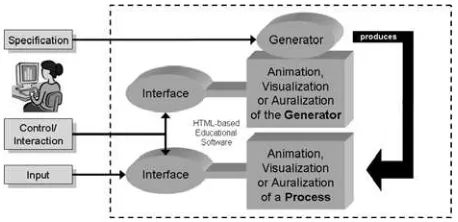
Figure 1 shows a coarse overview of a potentially HTML-based ES which uses generative techniques. The HTML-document covers the learning content of a process-oriented topic, i. e., it contains definitions, de-scriptions, images, simple examples, etc. Additionally, the learner can formulate a specification of a process de-scribed in the HTML-document. This specification is transferred to a generator embedded into the ES. The generator produces a didactically wise representation of the specified process, e. g., a visualization (including an-imations) or an auralization. The ES offers an—possibly generated—interface to this representation that is used by the learner for input, interaction or control purposes.
Figure 1: Use of generative methods for developing ES
In essence, the last paragraph discussed the generative approach of the third level [8]. Beside the pure knowl-edge transfer, the understanding and the interpretation of the learning content should be encouraged. Informa-tion is not structured by a teacher but learners have to explore and to order their own information. This ap-proach (called “first-order generative apap-proach”) enables learners to formulate new hypotheses and validate them by changing specifications or user inputs. The GANI
-MAM-system [10] is an example for an implementation of the first-order generative approach. It is about a web-based generator for interactive animations of abstract ma-chines. The learner can enter a specification of an ab-stract machine as instance of a given machine model. A generator produces a visualization of the specified ab-stract machine in the shape of an interactive JAVAapplet. This generated machine can interpret machine instruc-tions written by hand or automatically translated from a high level programming language. The learner can find out much about the computational model, but nothing about its generation process.
This disadvantage is avoided by the generative ap-proach of the fourth level (called “second-order gener-ative approach”). Here, we can check hypotheses about the generation process itself because the generator is rep-resented within the ES, e. g., in form of an animation, see Figure 2. Such a system supports the learner to better understand the computational model (or any process in general) but also the working of generators which pro-duce instances of such models. This is one of the most important insights on the teaching of compiler construc-tion. According to this, learners should really understand mathematical basics on the one hand and coherences at
[image:2.595.60.287.253.347.2]generating computational models on the other hand. Sec-tion 3 describes an ES system that realizes this second-order generative approach. In the context of learning, we combine these two generative approaches to the term “learning by generation”.
Figure 2: Use of the second-order generative approach
Our second-order generative approach leads to an analogy with the so-called “microworlds” metaphor. This term means a tiny world inside which a learner can explore alternatives, test hypotheses, manipulate con-stituent parts, and discover facts that are true about that world, see for example [23]. Thus, microworlds are sim-ilar to the well-known simulations which can be found in ES on physics or electrical engineering. A microworld differs from a simulation in that it can be considered as a second-order simulation that supports the own construc-tion or modificaconstruc-tion of models instead of a pure monitor-ing of a model. Blumstengel [2] states that microworlds (and simulations too) often promote active and explo-rative learning and act motivating if the ES has a good didactical design.
Furthermore, learning by generation is closely re-lated with the constructivist view of learning. The term “constructivism” refers to the idea that learners con-struct knowledge for themselves as he or she learns. Each learner individually and socially constructs mean-ing. Therefore, knowledge cannot be transferred in a tra-ditional way, e. g., by instruction. The learner has to inte-grate the knowledge into his/her individual mental struc-ture and existing knowledge constructs. Consequently, moderate constructivism attaches great importance to the creation and design of stimulating learning environments that give the learner the possibility to generate individual knowledge constructs (cp. [15, 23, 2]).
3. TEST CASE: GANIFA
In context of the GANIMAL project2 [13], we have de-signed a development environment for the realization of the fourth level of exploration. The resulting ES system, called GANIFA, is an electronic, HTML-based textbook on the theory of finite automata and their generation from regular expressions [9]. GANIFA can be locally used as well as via the Internet [12, 4].
2This research has been partially supported by the German Research
Council (DFG) under grant number WI 576/8-1 and WI 576/8-3.
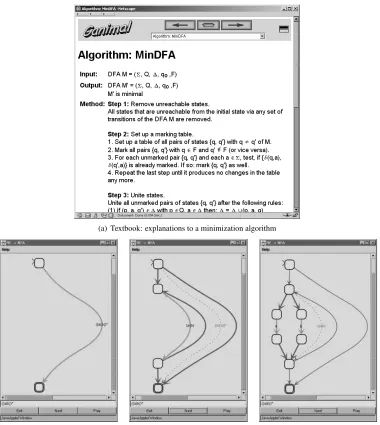
(a) Textbook: explanations to a minimization algorithm
(b) Animation of the generation of a NFA from a RE(a|b)∗
[image:3.595.113.493.73.498.2](c) Animation of the minimization algorithm based on a DFA that was generated from the REa|b|c∗
System Description
The textbook introduces into the theory of finite au-tomata. Particularly, it gives an overview of general for-mal languages, regular languages and expressions. After-wards, transition diagrams, non-deterministic and deter-ministic finite automata are described in more detail. The system shows formal definitions in a separate browser window if the learner chooses the corresponding hyper-links in the textbook.
Advanced techniques for software generation as used in compiler construction have been applied to the auto-matic generation of animations contained in the learning system, i. e., in the form of a customizable JAVAapplet. It is possible to specify any finite automata with the help of regular expressions and to animate the respective gen-eration process. Figure 3 shows three different screen-shots: on Subfigure 3(a), one page of the electronic text-book is displayed. It contains explanations to the theory on minimizing finite automata as well as to an appro-priate algorithm. The minimization is the last phase of the whole generation process. Via hyperlink, the learner can change to another page containing a form to enter a regular expression. First, the generator produces a non-deterministic finite automaton (NFA) from a regular ex-pression, e.g. (a|b)∗. This generation process is
repre-sented by an animation. Subfigure 3(b) illustrates three steps of the generation of a NFA. After that, the user could enter an input word to watch the acceptance be-havior of the generated automaton or he/she could com-pletely skip over all intermediate phases of the generation (see below) to watch the minimization phase only. An example animation of the minimization algorithm on the basis of the regular expressiona|b|c∗ is shown by
Sub-figure 3(c). Each generation phase can be animated with the help of the GANIFA system:
1. Generation of a non-deterministic finite automaton (NFA) from a regular expression (RE) [24].
2. Removal ofε-transitions of a NFA [22, 24].
3. Transformation of a deterministic finite automaton (DFA) from a NFA withoutε-transitions [22, 24].
4. Minimization of a deterministic finite automaton (minDFA) [14].
(5.) The GANIFA-applet can visualize the computation of each generated automaton on an user-defined in-put word.
The applet draws all generated automata as transition diagrams using a special graph layout algorithm in order to preserve the mental map [21], see the paper of Diehl et al. [7] for details. In addition, it is possible to visual-ize the acceptance behavior of generated automata for an input word entered by the learner (see Item 5 of the enu-meration). The GANIFA-applet is customizable through a large set of parameters, and it is easy to integrate the ap-plet into existing web pages. So, it is possible to visualize only a range of algorithms and to pass a finite automaton
or a regular expression respectively an input word to the applet directly. Based on these functionalities, GANIFA supports the second-order generative approach.
Evaluation
An evaluation of new ES should give information about its usability and effectiveness. Unfortunately, most of new ES systems are not evaluated adequately. One rea-son could be that there is a risk to get bad results. Conse-quences are a bad usability, inconsistent design or im-practical preparation of learning contents. The accep-tance and effectiveness of GANIFA were proved by a summativeevaluation (see e. g. [2]) based on learning experiments with more than 100 test persons. Aim of this evaluation is to prove that persons learning with the generative ES system GANIFA have an equal or a better learning performance than persons learning with other teaching methods. We used inferential statistics (t-test resp. analysis of variance (ANOVA)) to execute the anal-ysis.
Test Design: At first, we performed an usability testtogether with some students to detect mistakes of the electronic textbook. Typos, dead hyperlinks, runtime er-rors of the JAVA applet, etc. lead to a painful system appliance and increase the risk of a negative evaluation result from the first.
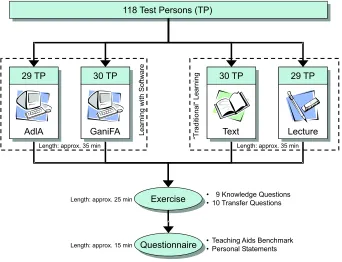
As test persons (TP) we chose 118 students of a com-puter science foundation course at the Saarland Univer-sity in Germany. The evaluation was not announced, i. e., the students could not agree to participate. In this way, we could eliminate registrations of test persons who have a positive/negative preference for interactive, multime-dial ES. They were informed at the beginning of the lec-ture and evenly divided into four groups. Each group was escorted to a separate room. As schematically shown in Figure 4, these four learner groups studied the theory of generating finite automata each with the help of differ-ent methods: classical instruction, text book, and two ES systems with (GANIFA) and without (ADLA) gen-erative part. All groups had a time frame of 35 minutes. We had to take care of identical presentation of learn-ing content between the groups. Followlearn-ing the learnlearn-ing phase, an exercise with nine knowledge and ten trans-fer questions was performed. Knowledge questions ask for the reproduction of learning content described by the learning method. Additionally, transfer questions ask for a deeper understanding of the content. Finally, all test persons should complete questionnaires with regard to personal statements and teaching aids (learning meth-ods). They are based on 11-ary rating scales with nu-meric markers and on so-called “open questions”: test persons could formulate their answers in written form. Note that all participants were informed about their re-sults on a special web page. For this purpose, they could leave their matriculation number on the questionnaire.
118 Test Persons (TP) 118 Test Persons (TP)
Length: approx. 35 min Length: approx. 35 min
Exercise Exercise
Questionnaire Questionnaire
•19 Knowledge Questions • 10 Transfer Questions
• Teaching Aids Benchmark • Personal Statements 29 TP 29 TP AdlA AdlA 29 TP 29 TP AdlA AdlA 29 TP 29 TP Lecture Lecture 29 TP 29 TP Lecture Lecture 30 TP 30 TP GaniFA GaniFA 30 TP 30 TP GaniFA GaniFA 30 TP 30 TP Text Text 30 TP 30 TP Text Text Learning with S oftware “T raditional“ Learnin g
Length: approx. 25 min
[image:5.595.130.472.77.339.2]Length: approx. 15 min
Figure 4: Test design of our evaluation
Knowledge Questions
[image:5.595.54.540.396.537.2]5,57 6,00 5,02 5,75 0 1 2 3 4 5 6 7 Test Groups K -Inde x AdlA GaniFA Text Lecture Transfer Questions 7,27 5,93 6,83 7,00 0 1 2 3 4 5 6 7 8 9 10 11 Test Groups T -Inde x AdlA GaniFA Text Lecture
Figure 5: Histograms of means of summative performance indices for the knowledge (maximal score: 7) and transfer questions (maximal score: 13)
4,8 5,0 5,2 5,4 5,6 5,8 6,0 6,2 S15 K -I n d ex: E st imat ed M ean AdlA GaniFA Text Lecture 4,8 5,0 5,2 5,4 5,6 5,8 6,0 S13 K -I n d ex: E st imat ed M ean AdlA GaniFA Text Lecture
[image:5.595.68.538.596.739.2]scores for the exercise answers, we obtain the statisti-cal values of the sample, shown at Figure 5. The stan-dard deviations are represented as error bars. In case of the knowledge questions (K-Index), the performance mean PM of the text group is the highest one (PM = 6,00). Otherwise, the highest performance mean for the transfer questions (T-Index) goes to the GANIFA group (PM = 7,27). This result would confirm our assump-tion that a convenassump-tional text book is a better choice to learn basic knowledge than one of the both ES systems if a suitable statistical test model would have a significant result. In contrast, the both ES systems would have ad-vantages in the consolidation and deeper understanding of the learned knowledge.
An one-factorial analysis of variance that scans the random differences of the learning efficiency between our four groups adduces no significant results neither at the knowledge questions nor at the transfer questions. Also, we could not discover any difference computing the effect value [3]. In consequence, we tried to improve the precision of our analysis with the help of a covariance analysis. With involvement of two control variables S15 “computer science course at school as intensive/basic course, voluntary study group, or no course” and S13 “mathematics in school as intensive/basic course”, we obtained with S15 a significant performance difference at the knowledge questions in favor of the text group (er-ror probability: 4,1 %). The GANIFA group and the text group had nearly the same performance with con-trol of S13. For both concon-trol variables, the GANIFA group achieved a performance improvement in compar-ison with the ADLA and the lecture group (error proba-bility: 4,7 %), cp. Figure 6. So, we have a solid base for further optimizations and development of the GANI -FA system and of the discussed second-order generative approach3.
A critical view on the test design lets infer that a part of the knowledge questions was chosen too simple because of the very good average performance results in this cat-egory. Is is possible that some effects could fail to appear for this reason. Future evaluations should include a pre-test to check the previous knowledge of the participants. Furthermore, it is probably that the short time frame of the evaluation was not sufficient to discover all advan-tages and interactive possibilities of the GANIFA system. In general, this could be a drawback of our (widely-used) test design, cp. the statements of Baumgartner [1].
The answers of the open questions show that the elec-tronic textbook GANIFA is well-convenient as meaning-ful supplement of traditional learning/teaching methods because of the interactive animations, clarity, and better motivation. The students liked the generated animations of GANIFA and esteemed to work indepedendly and to use all possibilities of our generated animations. This good opinion holds also for graphics, didactical design and formal definitions in a separate definition window. Some students disliked the form of the definitions: “too
3A more detailed description of the realization and analysis of this
evaluation is contained in the author’s PhD thesis [18].
formal”. There was a further problem if students tried to enter their own regular expressions: regular expressions had to be completely set in brackets. This did not meet the established standard in this area. We could not cor-rect the non-intuitive input of them early enough.
Web Access Statistics
We have analyzed the web access to the electronic text-book GANIFA on the basis of the web server’s log files. This was done within a time period of 27 days. In this period of time, we could identify web accesses to at least one web page of the textbook from 479 IP addresses (no robots). Note that all accesses from the same IP address were counted several times if they did not occur within one hour. 44.9 % of them were accesses to at least three web pages of the textbook, i.e., we had an average value of approximately 8 user accesses per day. More than 50 % of these users accessed to at least one web page that contained the embedded JAVAapplet. But we could not ascertain how many users had really run the applet.
4. CONCLUSION
In this paper, an approach for explorative learning with generative methods was presented. Learning by gener-ation has a constructivist orientgener-ation and supports self-organized and self-controlled learning. Our educational software GANIFA is a realization of this approach and was developed in context of the GANIMALproject. We discussed the system in more detail as well as an evalua-tion of the system with more than 100 participants. The results of the following statistical analysis prove that the learning efficiency of GANIFA is higher than the one of classical instruction and nearly as good as the textbook’s. GANIFA was observed as learning aid very positively. The most participants would like to use GANIFA as lec-ture supplement. Admittedly, the test design itself can be critically regarded because of the necessary improve-ments with respect to the influence of user interaction at the educational software.
5. ACKNOWLEDGEMENTS
I would like to thank Stephan Diehl, Carsten G¨org, Torsten Weller, Julia Kneer, Christoph Glasmacher, and all other people involved in the GANIMALproject.
6. REFERENCES
[1] P. Baumgartner. Evaluation of Media-based Learn-ing (in German). In M. Kindt, editor, Projektevalu-ation in der Lehre – Multimedia an Hochschulen zeigt Profil(e), pages 61–97. Waxmann, M¨unster, 1999.
[2] A. Blumstengel. Development of Hypermedial Learning Systems (in German). Wissenschaftlicher Verlag Berlin, WVB, 1998.
[3] J. Bortz. Statistics for Social Scientists (in Ger-man). Springer, Berlin, Heidelberg, 5. edition, 1999.
[4] B. Braune, S. Diehl, A. Kerren, T. Weller, and R. Wilhelm. Generating Finite Automata – An Interac-tive Online Textbook, 2002. URL:http://www. cs.uni-sb.de/GANIMAL/GANIFA.
[5] B. Braune, S. Diehl, A. Kerren, and R. Wilhelm, Animation of the Generation and Computation of Finite Automata for Learning Software. In Au-tomata Implementation, Proceedings of the 4th In-ternational Workshop on Implementing Automata (WIA ’99), volume 2214 ofLecture Notes on Com-puter Science, LNCS, pages 39–47, Potsdam, 1999. Springer.
[6] J. S. Bruner. The Act of Discovery.Harvard Edu-cational Review, 31:21–32, 1961.
[7] S. Diehl, C. G¨org, and A. Kerren. Preserving the Mental Map using Foresighted Layout. In Proceed-ings of Joint Eurographics – IEEE TCVG Sym-posium on Visualization (VisSym ’01), Eurograph-ics, pages 175–184, Ascona, Swizerland, 2001. Springer.
[8] S. Diehl and A. Kerren. Levels of Exploration. In Proceedings of the 32nd ACM Technical Sym-posium on Computer Science Education (SIGCSE ’01), pages 60–64, Charlotte, NC, USA, 2001. ACM.
[9] S. Diehl, A. Kerren, and T. Weller. Visual Ex-ploration of Generation Algorithms for Finite Au-tomata. InImplementation and Application of Au-tomata, volume 2088 of Lecture Notes on Com-puter Science, LNCS, pages 327–328. Springer, 2001.
[10] S. Diehl and T. Kunze. Visualizing Principles of Abstract Machines by Generating Interactive An-imations. Future Generation Computer Systems, 16(7), 2000. Elsevier.
[11] S. Diehl and M. Ohlmann. InterTalk, 2002. URL: http://www.cs.uni-sb.de/∼diehl/ InterTalk/.
[12] GaniFA. Download Page, 2002. URL:
http://www.cs.uni-sb.de/GANIMAL/ download.html.
[13] Ganimal. Project Homepage, 2002. URL:http: //www.cs.uni-sb.de/GANIMAL.
[14] J. Hopcroft and J. Ullman. Introduction to Au-tomata Theory, Languages and Computation. Addison-Wesley, 1979.
[15] D. H. Jonassen, T. Mayes, and R. McAleese. A Manifesto for a Constructivist Approach to Uses of Technology in Higher Education. In T. M. Duffy, J. Lowyck, and D. H. Jonassen, editors,Designing Environments for Constructive Learning, volume 105 ofNATO ASI, Series F, Computer and System Sciences, pages 231–247. Springer, Berlin, Heidel-berg, New York, London, 1993.
[16] A. Kerren. Animation of the Semantical Analysis (in German). InProceedings of the 8th GI Confer-ence on Informatics and School (INFOS ’99), In-formatik aktuell, pages 108–120. Springer, 1999.
[17] A. Kerren. Visualization and Animation of the Se-mantical Analysis of Programs (in German). Infor-matica Didactica – Journal on Didactical Basics in Informatics, 1(1), 2000.
[18] A. Kerren. Generation of Interactive Animations for Compiler Design (in German). PhD thesis, Saarland University, Saarbr¨ucken, Germany, 2002. Shaker Verlag, Aachen, ISBN 3-8322-0899-2.
[19] A. Kerren. Generation as Method for Explorative Learning in Computer Science Education. In Pro-ceedings of the 9th Annual Conference on Innova-tion and Technology in Computer Science Educa-tion (ITiCSE ’04), pages 77–81, Leeds, UK, 2004. ACM Press.
[20] A. Kerren, R. Wilhelm, and S. Diehl. MALL – Final Report (in German), June 2000.
URL: http://www.cs.uni-sb.de/RW/
projects/mall/.
[21] K. Misue, P. Eades, W. Lai, and K. Sugiyama. Lay-out Adjustment and the Mental Map. Journal of Visual Languages and Computing, 6(2):183–210, 1995.
[22] M. Rabin and D. Scott. Finite Automata and their Decision Problems.IBM J. Res. Dev, 3/2:115–125, 1959.
[23] R. Schulmeister.Basics of Hypermedial Learning Systems (in German). Addison-Wesley, Bonn, 1996. English version accessible under URL: http://www.izhd.uni-hamburg.de/ paginae/Book/Frames/Start FRAME. html.