i
UNIVERSIDAD TÉCNICA PARTICULAR DE LOJA
La Universidad Católica de Loja
ESCUELA DE CIENCIAS DE LA EDUCACIÓN
MENCIÓN INGLES
DISTANCE SYSTEM
The use of supplementary materials for teaching children in Efl classes
Research done in order to achieve the Bachelor’s Degree
in Teaching English as a Foreign language
AUTHOR:
Samaniego Andrade, Mariana Genoveva
ADVISOR:
Lic. Paredes Zúñiga, Fabián Marcelo
ESMERALDAS UNIVERSITY CENTER
ii
CERTIFICATION
Lic. Marcelo Paredes
Certifies that:
This research study has been thoroughly revised by the graduation committee.
Therefore, authorizes the presentation of this thesis, which complies with all of
the norms and internal requirements of the Universidad Técnica Particular de
Loja.
Loja, March, 2012.
……….
iii
CONTRATO DE CESIÓN DE DERECHOS DE TESIS DE GRADO
“Yo, Mariana Samaniego Andrade declaro ser autora del presente trabajo
y eximo expresamente a la Universidad Técnica Particular de Loja y a sus
representantes legales de posibles reclamos y acciones legales.
Adicionalmente declaro conocer y aceptar la disposición del Art. 67 del
Estatuto Orgánico de la Universidad Técnica Particular de Loja que en su parte
pertinente textualmente dice: “formar parte del patrimonio de la Universidad la
propiedad intelectual de investigaciones, trabajos científicos o técnicos y tesis de
grado que se realicen a través, o con el apoyo financiero, académico o
institucional (operativo) de la Universidad.”
………..
Mariana Samaniego Andrade
iv
AUTHORSHIP
The thoughts, ideas, opinions and the information obtained through this research
are only the author’s responsibility.
March, 2012
………..
v
DEDICATION
I want to thank God, my family, especially my parents and my son. First, God
because he is my eternal guide in everything I do. Second, my parents who are my
greatest support at home. Finally, my son since he is my everyday motivation to
get all my goals in life. All of them together inspired me to carry out this special
vi
ACKNOWLEDGEMENT
I appreciate the great help received from all the people from the UTPL involved in
the process to carry out this research. I also thank all my friends who somehow
helped me with their ideas and experiences. First my friend, Livio Aguas, a
former UTPL graduated student who gave me a lot of support throughout this
work. Second my UTPL friends who supported me with their friendship. And
vii
CONTENTS
CERTIFICATION ii
CONTRATO DE CESIÓN DE DERECHOS iii
AUTHORSHIP iv
DEDICATION v
AKNOWLEDGMENT vi
CONTENTS vii
ABSTRACT 1
INTRODUCTION 2
METHODOLOGY 5
DISSCUSSION 7
Literature Review
Results
Description, Analysis and Interpretation of Results
Conclusions
Recommendations
REFERENCES
ANNEXES
8
24
29
56
57
58
1
ABSTRACT
This research is focused on the use of supplementary materials for teaching
children in EFL classes. Its objective is to determine and analyze the type of
supporting materials used for teaching children in EFL classes. The data was
collected from two public schools located in Esmeraldas Province. The population
for this research included the students of 4th, 5th, and 6th grades of Basic Education,
as well as the English teachers of these grades. The instruments used for the data
collection were the observation, the questionnaire, and the survey.
The collected information was analyzed by means of the Qualitative method
in order to identify the supporting material taking into account if they were used
considering aspects of pertinent, appropriateness, quality according to the learning
styles process requirements. And the frequency of use of the supporting materials
was determined through the Quantitative method.
In conclusion, since the board was the supplementary material used the most,
the lack of variety and appropriateness of supplementary materials make students
bored and unmotivated. Consequently, the English acquisition was very hard for the
2
INTRODUCTION
Foreign language teaching is a growing field around the world. However, as
most teachers should agree, foreign language teaching is not an easy task to do. It is
relevant to consider at this point the multiple dimension of the English learning
process which involves socio-linguistic, psychological, and cultural aspects. So, in
order to achieve the class’ objectives, teachers use teaching aids which help them
fulfill the language teaching- learning process successfully. These teaching aids are
supplementary materials which will facilitate this process. Furthermore, according to
Araya (2007) “materials are vital resources because they stimulate and develop
students’ linguistic skills”. Also, this author asserts “the significance of teaching
materials has been mostly associated to the issues of motivation because they
activate students’ affectively towards academic performance and the competence of
the language in study”.
Additionally, there is a wide range of supplementary materials such as
visuals, audios, audio visuals, realia, and websites which can be used in our classes.
However, there was a concern on whether these materials are used adequately in
EFL classes. In other words, whether they are pertinent for the topic and lesson’s
objectives. Besides, the appropriateness of the supplementary materials was
considered according to the understanding and student’s level. And it was also
considered whether they had the best quality at the moment of their use. In order to
reach the most important objectives of this research, a study about the use of
supplementary materials for teaching children in EFL was carried out using the
3
The purpose of this research was to identify, describe, analyze the supporting
materials used in each lesson and determine the frequency of their use for teaching
children in EFL classes in each grade.
In addition, the purpose of this research is to awake the teacher’s interest on
the importance and benefits gotten from the use of supplementary material because
this is one of the best ways to achieve the English learning process effectively.
Moreover, earlier studies have been carried out about this theme. For
instance; the study done by Williams & Lutes ( n.d) whose objective was to
establish the impact of video in ESL classroom on students interest, and therefore on
student motivation. In this research the authors discovered that student’s interest in
the video lesson was significantly higher when compared with the standard lessons.
On the other hand, no limitation was found throughout this research.
Another study was done by Viethamani & Too (2003) whose purpose was
to answer “if songs can be a useful resource in the language development and
connect learners to issues that are of interest to young adults”. However, in this
research was found out that not all students were familiar with the songs.
Finally, the study done by Hwang (2005) demonstrated that “substantial
input of authentic materials that are pegged to learner’s level and interest naturally
increases their sensitivity to competence in the target language”. Nonetheless,
limitations were found in this research because some of the language used into films
and TV shows fall flat on students in Taiwan.
On the other side, teachers may be favored a lot from this research because
they will be aware of the adequate use of the supplementary materials.
4
supporting materials taking into account aspects such as; pertinence,
appropriateness, and quality.
Additionally, the main benefiters will be our students because they will have
more understandable and motivating classes with supplementary material help.
Furthermore, this research will make education authorities get more conscious on
the importance of using supplementary materials for the English teaching and
organize seminaries on didactic materials in order to improve the English learning
process. Alternatively, this research will serve as a reference guide for future
researchers.
In contrast, one of the limitations of the research was that the instructions for
the survey applied to students were confusing. As a result, the students could not
understand them and they did not answer properly. So, the researcher was always
there to help students. Second, schools in this region dedicate only two hours a week
for the English teaching. Consequently, it was not possible to observe more lessons
in the involved classes. It is recommended that the researchers use a larger sample
for future studies in order to collect more information which will help analyze the
5
METHODOLOGY
Setting and Participants
Participants were students and teachers from two schools which are located
in the Esmeraldas province. One of the observed schools is public while the other
one is missionary. Three classes of Basic Education were observed. The fourth class
was observed in the public school. The fifth and the sixth ones were observed in the
missionary school. The students of class 4 were between 8 to 10 years old. This
class had 20 students. In contrast, in the class 5 the majority of the students were 9
years old. This class had between 30-35 students. Furthermore, the class 6 was the
largest one. This had 40 students. The majority of the students were 10 years old.
Additionally, two teachers participated answering to the surveys which were useful
at moment of contrasting opinions about the use of supplementary material in these
classes.
Procedures
In order to carry out this research it was necessary to find bibliographic
themes such as: teaching foreign language, learners, learning styles, teaching
techniques, different contexts in teaching and supplementary material. All these
themes were useful as they provided information during the observations. Besides,
they were necessary to support the opinion of the researcher.
The general approach of this study is Qualitative and Quantitative. The data
collection included observations, tables and questionnaires. On the other hand, the
techniques and instruments used in this research were reading, note-taking and
6
Furthermore, ten lessons were observed in the fourth, fifth and sixth classes.
The data collected was useful to identify the supporting materials used in these
classes and show them in the tables 1, 2, 3, and 4 provided by the university. Next,
the data collected was also used in order to determine the frequency of the
supplementary materials used in each class, after; this data was summarized and
showed in the table 5.
Finally, the data collected was used in order to analyze each supporting
material. First in terms of pertinence considering the lesson’s content and objective.
Second, for its appropriateness according to student’s level and understanding, and
third describing the quality of these materials. Furthermore, the data collected was
useful in order to obtain a percent of the frequency and variety of the supporting
7
DISCUSSION
In this section it will be provided the scientific information which will be
indispensable in order to support this research. The literature review will be useful at
the moment of supporting some ideas, and the analyses qualitative and quantitative
will be used in order to describe the use and the frequency of the supplementary
material in each grade.
Literature Review
In former times, foreign language teaching was carried out only through a
direct method. Nowadays, this has changed. We can have access to a foreign
language through the exposure to it. Teachers integrate supplementary materials in
their classes with the purpose of involving students in real foreign language
situations. It is said that students are more motivated if they are exposed to natural
experiences and situations in the foreign language. Moreover, motivation has been
considered as an important aspect in language learning. According to this, Araya
(2007) claims that supplementary materials have been related to motivation because
they improve the student’s performance and competence in language learning.
This literature review will discuss themes such as: teaching a foreign
language, learners, learning styles, teaching techniques focused on children,
different teaching contexts, and some varieties of supplementary materials such as:
visual, audio, audio-visual, realia, on-line.
These themes will help to get a clear idea why supplementary materials are
useful in the field of education.
In addition, previous studies will be mentioned in order to support the effectiveness
8 Teaching a foreign language
Scott & Ytreberg (n. d.) asserts that in order to teach pupils a foreign
language it is necessary to do activities which involve all the senses. Teachers may
use the school and its surroundings, objects or pictures to work in the classroom.
This author also states that using rhymes, singing songs and telling stories will help
the students to learn the target language. Furthermore, this author maintains teachers
should use the L1 when it is necessary in order to young students understand
difficult expressions. Moreover, they argue that children at the age of eight to ten
need that teacher communicate with them using facial expressions or movement.
Also, the authors declare that variety in the activities plays an important role.
Furthermore, they mention that routines are helpful in the classroom because
children enjoy using familiar situations in their classroom. To this respect, Shin
(n.d) suggests to establish routines such as: start the class with a song or a short
rhyme and add classroom language to those routines.
Additionally, Scott & Ytreberg (n.d) reports that children enjoy learning
language if it is presented to them through games and funny activities which involve
them in learning. Moreover, Shin (n.d.) mentions the following ideas for teaching
English to young learners: -supplement activities with visual, realia or movement;
involve students in making supplement materials or collaborate with the teacher to
make them; -students can bring their own toys for the lesson.
Besides, this author suggests to move from one activity to another, that is to
move from quiet to noisy exercises, from listening to talking, from reading to
writing activities; to do individual work or in pairs work; teamwork to whole class,
or teacher- pupil to pupil- pupil activities.
9
In addition, the author writes that the introduced themes should be common
and interesting for young learners. For instance: animals, friends, family life,
shopping, environment, etc. Likewise, this author recommends, if teachers choose a
story to be presented in the classroom, the students should be familiar with its
contexts because it enhances their interest in it. Also, he says that themes based on
other subjects are another possibility. Moreover, he claims it can be motivating for
students to bring native speakers of the target language into the classroom.
Also, Scott & Ytreberg (n.d) argues that teach grammar should not be the
main point in primary levels, but be explained when pupils ask.
To conclude with this point, Saville- Troike (2006) declares that knowing the
goals that individuals and groups have for learning an additional language can
contribute to effectiveness and efficiency in language teaching. So this author
recommends taking into account priorities for the learning and teaching process that
are compatible with those goals.
Also, he suggests approaching tasks which consider the multiple dimensions
that are involved: linguistic, psychological, and social. Moreover, figure out the
potential strengths and limitations of particular learners and contexts for learning in
order to use them in adapting learning/teaching procedures. In addition, he suggests
not being inflexible in subscribing to any instructional approach, and to recognize
achievement on incremental progress. Finally, he recommends being patient.
Learners
According to Harmer (1991) children have short attention spans; therefore,
they need frequent changes of activity in order to maintain their concentration.
At this aspect, Brown (2001) argues that children attention spans will be
10
Therefore, activities should be designed with variety and use sensory aids such as:
smell flowers, touch of plans and fruits etc, or audiovisual aids. Furthermore, this
author declares because children have little appreciation for adult’s notions, they
should not be taught terms like;” present progressive” or “relative clause”.
On the other hand, Harmer (1991) writes that because of the difficult task of
teaching adolescents it is important to involve them in doing interesting tasks and to
encourage them to accomplish them. In addition, Brown (2001) states about this
group that teachers should try to keep their self- esteem high because it will help in
learning. On the other hand, according to Harmer (1999) adults can be motivated if
they are shown new material.
Also, Brown (2001) claims adults have longer attention spans but easy and
interesting activities also apply to them.
Furthermore, Saville- Troike (2006) reports some advantages for both
younger and older learners. According to this author because the older learner has a
greater learning capacity; they will have better memory for vocabulary.
Moreover, they have greater analytical ability, so they are able to understand
and apply explicit grammatical rules, and more real-world knowledge enables them
to perform tasks of more complexity.
In contrast, the author claims that “younger learners develop more native-like
grammatical intuitions because of their un-analytical process”. Another advantage of
younger students is that they will not feel inhibited with people who speak their
same language.
There are as well other differences between students which may be
11
that intelligence may be a strong factor when the analysis of rules is necessary in the
language learning process.
On the other hand, these authors assert there is evidence that aptitude for
language learning play a role in learning because the aptitude for language learning
is composed of different types of abilities, these are: “the ability to identify and
memorize new sounds”, to “understand the function of particular words in sentences
or to figure out grammatical rules from language samples”, and the ability to
memorize new words. These authors also maintain that knowing these components
of aptitude will help teachers to select a variety of activities for particular groups of
students. Similarly, personality comes into play.
According to some studies presented by these authors, it has been found that
extrovert people may be more successful in language learning due to assertiveness
and adventurousness. Also, inhibited people may avoid taking risk, a factor which is
necessary in language learning. Especially, in adolescents it may be a problem in the
performance of pronunciation.
Additionally, Saville- Troike (2006) mentions that anxiety also tends to
interfere in language acquisition because it is associated with lower levels of
success.
Alternatively, “there appear to be some sex differences in language
acquisition. For example; women’s brain may be less asymmetrically organized than
men’s for speech, that is say, females seem to be better at memorizing complex
forms while men appear to be better at computing compositional rules” ( Saville
-Troike ,2006, p .84) .
In contrast, Brown (2001) says that there are differences in learners
12 techniques and materials play an important role because it will determine students’
success.
Moreover, Brown (2001) suggests that students work in groups in order to
get taking focus off you. He also mentions using simple vocabulary and structures,
and not allowing excessive use of the native language. In addition, the author
declares that the use of language in authentic communication will be helpful; for
example, simple greetings or introductions. Also, he recommends not correcting
every mistake, it should be left up to the students practice freely, if the teacher
correct every mistake, it may cause inhibition in them.
On the other hand, Brown (2001) writes that students at an intermediate
level may benefit from simple explanations of points in English. In contrast, at an
advanced level focal attention should be give to interactive communication. “Natural
language at natural speed is a must at this level”.
Another factor linked strongly to learning is motivation. According to
Harmer (1991, p.3) “the motivation that students bring to class is the biggest single
factor affecting their success”. This author distinguishes two categories of
motivation: intrinsic motivation which is concerned with what takes place outside
the classroom; in contrast, extrinsic motivation concerns factors inside classroom.
Similarly, Saville-Troike (2006) defines motivation as integrative which is
defined as the interest in L2 because of emotional factors and instrumental based on
practical value, such as: occupational or business opportunities and enhance power
or prestige, etc.
Also, Harmer (1991) claims extrinsic motivation may be affected by peer’s
criticizes, previous experiences as language learner, so teachers have to be more
13
Furthermore, the author asserts that intrinsic motivation is vital in language learning.
He writes that this motivation can be affected by physical conditions in the
classroom, even the board conditions, the method used by the teacher, and the
teacher himself because teachers have to do everything possible to create a good
relationship with their students, that is say if teacher fulfill it, students will be more
motivated for learning.
Likewise, Lightbow & Spada (1999) provide us with an interesting opinion
about motivation: they state that If teachers can create a pleasant environment where
learning takes place, present topics with interesting contents, take into account the
level, learning styles, and goals to learning in their students; if the teachers’ position
are supportive rather than critical, they will contribute strongly to students’
motivation.
These authors also assert that it has been observed that the remarks teachers
make about forthcoming activities can lead to higher levels of interest. Also, they
suggest varying the activities, task, and materials and not to show lessons which
always consist of the same routines, patterns and formats.
Learning style
It is said that learning style is defined as preferred ways of learning and
studying. According to this, Lightbow & Spada (1999) mention some learning
styles, as there are: visual learners which cannot learn something until they have
seen it, other people can learn something in a better way if they hear it, and others
need to add physical action to the learning.
Another styles considered by these authors are according to field dependent
14
and tend to separate details, on the other hand, dependent learners analyze
information in a general way.
Alternatively, Richards (1994) mentions four different types of learners
regarding their learning styles: for example; concrete learning style- they like to vary
activities and dislike routines and written work; analytical learners are serious and
independent, they prefer a logical and systematic presentation of new learning
material. On the other hand, communicative learners prefer a social approach to
learning- they like to interact with the teacher or classmates, and authority learners
who prefers the feedback and support of the teacher all the time.
This author also mentions visual learners which prefer information presented
visually, in contrast, verbal learners like spoken or written presentations added to
those visuals materials.
Furthermore, active learners prefer to learn in situations that make them to
work actively, and moving; reflective learners like having the opportunities to think
about the learnt things. Moreover, the author reports that for sequential learners it is
necessary to present information in small chunks, they can work with incomplete
understanding of course material, while global learners seem to understand slowly
the learning process, but when they fulfill it, they can do homeworks successfully. In
addition, the author writes about the inductive and deductive learners, he indicates
that inductive learners learn better if they are engaged to make observations and
draw conclusions, while in deductive learners presentation should start with rules,
15 Teaching techniques
Some authors agree that children love to sing and be creative. To this respect,
Shin (n.d) suggests chants because these are fun and their rhythmical way puts into
practice.
Also, he says that poems give students the opportunity to express their
feelings and inspire others.
Additionally, this author claims that storytelling is effective for teaching
younger learners because of its communicative purposes; it provides listening
experiences and reduces anxiety.To this respect, Scott & Ytreberg (n.d) mention the
teacher can adapt the language according to their level and use gestures or facial
expressions to help pupils understand it.
Furthermore, Shin (n.d) mentions techniques for direct-interactive
communication, these are: repeat- ask and answer questions- paraphrase the content-
summarize the content- give examples- express opinion on the content or
personalize it.
On the other hand, Scott & Ytreberg (n.d) suggest using techniques as: mime
stories told by the teacher and the students make the actions. Another technique
effective in children is drawing; this technique is favorite for listening activities.
Also, the author declares that rhymes are effective, since children like them and love
to repeat them again and again.
Guided practice also can be used with children, but the choice of language
should be limited. The author also suggests chain work which use picture cards or
word cards. In this technique two pupils should pick up a card and ask about it.
Alternatively, these authors recommend role play which is another way of
16
reading and listening skills. Also, the authors write that dictations can be effective in
this level if these are presented for young learners in a short way, are composed of
sentences which you can say in one breath, have a purpose, and are connected to a
work presented earlier. Furthermore, according to May (2003) “much language
learning comes from active listening and observation”.
For this reason, this author recommends: dynamics- these can be effective if it is
presented briefly but done regularly.
Also, questioning technique & logical thinking, but it should be student- centered
and focused on what happens in the classroom.
Similarly, this author mentions repetition; however, the author claims this may
cause boredom. Thus, repetition should be linked students’ interest.
Different teaching contexts
In this aspect, Woodward (2001) suggests for teaching in very small groups
it is helpful to bring other people into the classroom through photos, letters, phone
anecdotes, etc. And use the local environment.
Also, the author argues it results to bring a lot of activities more than in a
normal class, and make students develop all their senses in each class.
On the other hand, this author writes that to work with classes with few
resources or facilities, teachers may use dictation activities, use the board as a
supplementary material or ask students to bring in their own materials, such as:
pictures, objects, or create their materials themselves.
Alternatively, teachers may find larger classes with limited resources.
According to this, Renaud, Tannenbaum., & Phillip (2008) suggest planning a
17
interests of the students can be useful and help with the discipline. Additionally,
group work because it can avoid loss of time and it encourages communication.
Furthermore, Renaud, Tannenbaum., & Phillip (2008) mention using
pictures or drawings is effective in teaching vocabulary and it increases speaking or
writing activities. These authors also suggest to “bring realia- actual objects that
language learners can see, hear, and touch into the classroom”.
Additionally, the authors argue to make activities which students are able to fulfill
them; it will increase their confidence in themselves.
Another context which teachers may face is the multiple proficiency levels
found in the same class. At this aspect, Brown (1994) recommends not to categorize
the students as good or bad because each student is a world, each one with specific
abilities or needs. Similarly, this author suggests offering a great variety of
techniques and activities. He also says to take advantage of a language laboratory
may be useful or we might work with group work tasks. To conclude, Renaud,
Tannenbaum., & Phillip (2008) argue it is useful have an objective in each class; this
will help students to have cleared the goals of each learning activity.
Supplementary material
“Supplementary material is defined as any resource used in addition to the
coursebook that complements the teachers’ work” (Spratt, Pulverness., & Williams,
2005, p. 114).
According to Tomlinson, cited in Araya (2007) materials could be cassettes,
videos, CD-rooms, dictionaries, grammar books, workbooks or photocopied
exercises. Spratt, Pulverness., & Williams (2005) claim materials are important in
18
Moreover, Spratt, Pulverness., & Williams (2005) mention that the role
those supplementary materials perform are: first, replace inappropriate materials in
the course-book. Second, fill in gaps in the course-book. Third, provide materials
which consider learner’s differences.
Fourth, present extra language or skill practice. Finally, teach in a varied
way.
Furthermore, Araya (2007) asserts that materials are useful because these
diminish the level of difficulties found in the target language since them show real
images and authentic communication of the target language. Additionally, Nikky
(2010) in an article of internet reports that teaching aids are important in the
teaching-learning process because they motivate students. Thus, they can learn,
clarify or understand the subject matter better and more easily. Also, this author
states material may be useful in order to increase the vocabulary of the students
more efficiently; they avoid time looses and provide direct experience to the
students. Furthermore, the author declares “proper use of teaching aids helps to
retain more concepts permanently”.
To conclude with the supportive themes, I will present the varieties of
supplementary materials which will be taken into account in this research, these are:
Visual, use sense of vision, “they may take many forms but the most common are real objects and pictures or photographs”. These may have a variety of
uses, as these are: “arousing interest and concentrate attention at the beginning of the
lesson, illustrate a new language item as vocabulary, set the scene for a story or
19
Also, Audio defined by Akanbi (1988) cited in Maniruzzaman (2008) as
“models and devices that can be heard and give an image of something in some
situations”. They include materials like radios, cassette players etc.
In addition, Klaus (2010) claims audio materials are useful because some
students learn better if they are exposed to audio activities.
Also, Maniruzzaman (2008) asserts that they motivate students to enhance
their learning process, to reduce their exhaustion and help students to improve their
performance in all the skills, especially in listening and speaking. Likewise, this
author declares that by exposing students to native voices they become more
enthusiastic and excited. Also, teaching with audio may increase active participation
of the students.
Moreover, Audio-visuals defined by Moss (1999) as materials which
“convey information via sound and image instead of the text”. For example:
television, tapes, DVDs, or projectors. This author mentions that students may
benefit from the audio- visual material because it makes them focus their attention
on the topic. Moreover, Huebener (1969) declares audio- visuals appeal to several
senses so learning is more permanent. Also, these make learning more pleasant and
enjoyable. To conclude, this author argues these materials can be productive if
teacher make good use of them.
Additionally, Realia which is defined by Smith (n.d) as real objects or real
texts brought into the classroom. Celce (1988) argues that realia can be effective to
teach grammar structure as demonstratives or prepositions of place and it may be
useful to teach vocabulary. In addition, this author claims that realia help to show
20
And the last variable of supplementary material presented here, is the
On-line: which is another modern teaching aid. According to Spratt , Pulverness., &
Williams (2005) the use of technology is a way to bring the outside world into the
classroom.
In addition, these authors say that some of the purposes for using on-line
resources are: direct communication (chatting), online newspaper and magazines,
online dictionaries,etc. Furthermore, Smith (n.d) argues that through of internet
teachers and students are exposed to realia because they can travel anywhere in the
world and encounter printed materials usually found in the target community.
In order to understand better the research done, it was necessary to analyze
the following studies carried out on supplementary materials for teaching in EFL
classrooms.
The study done by Viethamani & Too (2003) whose purpose was to answer
the following research question; “Can songs be a useful resource in the language
development and connect learners to issues that are of interest to young adults?”.
In this study two groups of students were observed; the students were
between nineteen and twenty-one years old. They were asked to answer questions
about songs, while they were listening to them, and afterwards had to complete
reading and writing activities. Although, not all of the students were familiar with
the songs, the author found that all of the students were able to understand the
themes of the songs. In short, this author concludes that if we use popular songs,
these may be good learning materials because they are a form of entertainment.
Williams & Lutes (n. d) carried out a study whose objective was to “establish
21 student motivation”. In this research, a control group and a test group were
established for the purpose of this study.
The video used was “The Grapivine Video 1”. Next, both groups were
distributed identical questionnaires which contained several statements regarding the
students’ attitude towards the class and level of agreement or disagreement”.
As results, these authors discovered that student interest in the video lesson
was significantly higher when compared with the standard lessons. Students were
more motived to study in classes where video was used; they also found that
students learned more through video. For these reasons, these authors conclude that
video can also be an extremely effective intrinsic motivator.
Kazuko, Takeuchi., & Edasawa (1989) carried out other study which had two
purposes: the first was to see empirically whether “transcribing a film script
interferes with students improving their Listening Comprehension and to answer
questions and summarizing content” ,the second was to see if there is any difference
in the effects between having pre-listening activities and not having pre-listening
activities in Listening Comprenhension instruction. The study was done in the
following way: the subjects of the study were 235 female Japanese first-year
students, their major was English. The subjects were given different activities in
order to measure student’s progress in listening comprehension.
The authors discovered with the data obtained that though the film as LC
materials seems to be too difficult to Japanese students observed, film material can
be used simultaneously with other materials and appropriate exercises because films
motivate students a lot to study. Also, it helps students to improve their listening
22 Hwang (2005) whose objective was to demonstrate that “substantial input of
authentic materials that are pegged to learners’ levels and interest increases naturally
their sensitivity and competence in the target language”; In this study, the sample
consisted of 180 college students of classical English Literature.
They were observed by their own teacher who is the author of this research.
This author experimented with incorporating in her classes some materials as;
reading /best-sellers and watching TV instead of EFL textbooks in Taiwan. As
results, the author found that” after a few years of exposure and activation as such,
her students feel empowered by being able to communicate in English on a greater
variety of topics”. Therefore, the author asserts that when EFL education makes a
foray into the dynamist of popular authentic materials, students will experience the
power of being energized and they will see the effect of genuine communicative
competence.
And the study done by Quiang, Hai., & Wolf (n. d) whose objective was to
answer “ if movies can be beneficial in teaching English, why not utilize them to
teach business English, culture, history, etc”?. The sample of this research was done
with 500 Chinese students in various Shanghai universities.
The authors pre-screened the movie “Working Girl”, during the pre
-screening they compiled a vocabulary list with words and phrases they believed
might not be readily understood by their students. Next, they showed the movie to
3er year class of fifty business majors, but did not pre-teach any movie vocabulary,
so more than half of the students dozed off, started chatting or playing games on
their cell phones. The same occurred with other three groups. Therefore, they
changed the method and gave another group a list with definitions, one week in
23
fell asleep, no one chatted and no one played cell phone games. They repeated the
experiment using other movies, the results were similar.
In summary, the authors assert that “professional teachers who teach specific
subjects simultaneously with teaching English can successfully utilize movies in the
24
RESULTS
Author:Mariana Samaniego A.
Source: 4th , 5th, and 6th classes.
Variable
Indicators
Yes
No
Visual
Flash cards
power point
presentation
maps
pictures
charts
handouts
posters
word cards
White/black board
Audio
Songs
dialogues
stories
tales
Audiovisual
videos
movies
documentaries
Realia objetcs (toys,plants,fruit)
Online websites
Qualitative Tabulation
25 Chart two: Pertinence and Appropriateness of the supplementary material used to teach children
V
ar
iab
le
Indicators 1s
t cl as s 2n d cl as s 3r d cl as s 4th c las s 5th c las s 6th c las s 7th c las s 8th c las s 9th c las s 10th c las s P er t. A pp rop . P er t. A pp rop . P er t. A pp rop . P er t. A pp rop . P er t. A pp rop . P er t. A pp rop . P er t. A pp rop . P er t. A pp rop . P er t. A pp rop . P er t. A pp rop . V is ual flash cards power point
presentations Maps Pictures Charts Handouts Posters word cards white/black board x x √ x x x A ud io Songs Dialogues Stories Tales A ud iovi su al Videos Movies documentaries R eal
ia objects (toys, plants,
fruits) √ x √ x
O nl in e Websites
26 Chart four: Pertinence and Appropriateness of the supplementary material used to teach children.
V
ar
iab
le
Indicators 1st
cl as s 2n d cl as s 3r d cl as s 4th c las s 5th c las s 6th c las s 7th c las s 8th c las s 9th c las s 10th c las s P er t. A pp rop . P er t. A pp rop . P er t. A pp rop . P er t. A pp rop . P er t. A pp rop . P er t. A pp rop . P er t. A pp rop . P er t. A pp rop . P er t. App rop . P er t. A pp rop . V is ual flash cards power point
presentations Maps Pictures Charts Handouts Posters word cards white/black board √ x x x x x √ x √ x √ x √ x √ √ √ x
A ud io Songs Dialogues Stories Tales A ud iovi su al Videos Movies documentaries R eal
ia objects (toys, plants,
fruits) O nl in e Websites
Author : Mariana Samaniego A.
27 Chart four: Pertinence and Appropriateness of the supplementary material used to teach children.
V
ar
iab
le
Indicators 1st
cl as s 2n d cl as s 3r d cl as s 4th c las s 5th c las s 6th c las s 7th c las s 8th c las s 9th c las s 10th c las s P er t. A pp rop . P er t. A pp rop . P er t. A pp rop . P er t. A pp rop . P er t. A pp rop . P er t. A pp rop . P er t. A pp rop . P er t. A pp rop . P er t. A pp rop . P er t. A pp rop . V is ual flash cards power point
presentations Maps Pictures Charts Handouts Posters word cards white/black board x x √ x √ x x x x x x x x x A ud io Songs Dialogues Stories Tales A ud iovi su al Videos Movies documentaries R eal
ia objects (toys, plants,
fruits) √ x
O nl in e Websites
Author : Mariana Samaniego A.
28 Quantitative tabulation
Chart five: Frequency of use of supplementary material.
Variable Indicators
4th grade (8 years old)
5th grade (9 years old)
6th grade (10 years
old) Total Percentage
f f f f %
Visual
flash cards
power point presentations maps
pictures charts handouts posters word cards
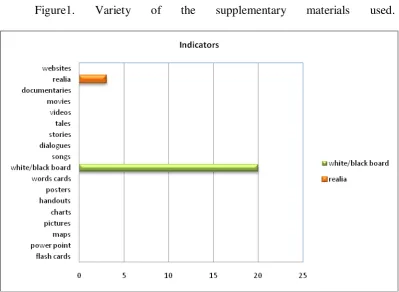
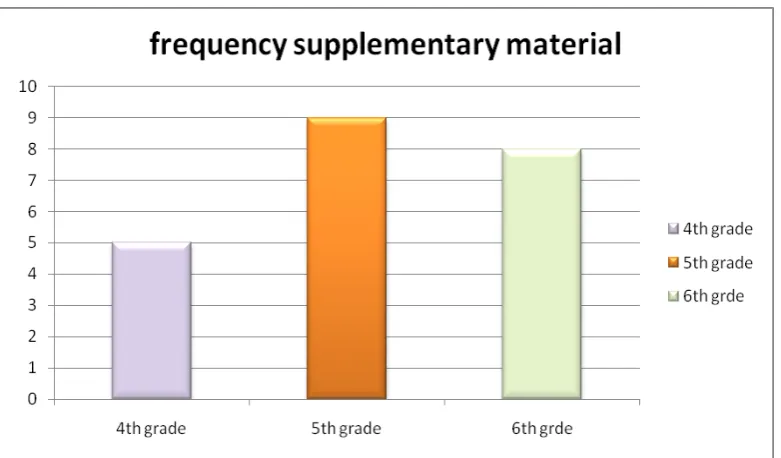
white/black board 3 9 7 19 86,36
Audio
songs dialogues stories
Tales
Audiovisual
videos
movies
documentaries
Realia objects fruits) (toys, plants, 2 1 3 13,63
Online websites
TOTAL 5 9 8 22 100%
29
Descriptive Analysis and Interpretation of Results
This part will cover qualitative and quantitative analysis of each material
used at 4th, 5th, and 6th grades of Basic Education. The qualitative analysis will
describe each material considering aspects such as pertinence, appropriateness, and
quality of the material used in the observed classes. Additionally, considering that in
each classes there are different learning styles and teachers should consider them in
order to involve all students in learning, it will give a criterion concerning whether
the teacher considered the learning styles in these classes. On the other hand, it was
seen that the teachers used the board in the majority of the observed classes as
supplementary material to the textbook. Only in three classes it was used a different
supporting material as realia.
On the other side, the quantitative analysis will describe the variety of
supplementary materials used in the observed classes and also the frequency for the
use of these materials for each grade observed.
Qualitative Analysis
4th grade/8 years old
The Board
In most of the observed lessons the most used supplementary material was
the board. It was also observed that the objectives of the lessons were not clearly
defined. The teacher did not tell the students what the objective of the lesson was.
In lesson one the teacher introduced the theme, “Demonstrative Pronouns”.
The teacher used the board in order to write the demonstrative pronouns and
their translations. In this lesson the teacher did not have a clear objective because
30
However, as if the teacher wanted students to know about the theme
proposed, but it was observed the use of the board was not adequate since the
teacher did not use this material in an attractive way, he only used it to write words
on it. He did not get students’ attention; therefore, while the teacher was writing on
the board, the students were doing other things. Consequently, the students could not
know this topic clearly. Furthermore, to this respect, Celce (1988) claims that realia
can be more effective to teach grammar structure as demonstrative pronouns.
Moreover, since the teacher only made students write a list of words using the board,
the board did not help students understand the new topic properly. Therefore, when
the teacher asked them to do an exercise which consisted of making one sentence
using the demonstrative pronouns, they could not do it. According to this, Brown
(2001) argues that children attention spans will be short when they find that the
material is boring, useless, or difficult. Therefore, activities should be designed with
variety and or audiovisual aids.
In this lesson the board was in good condition centered into the classroom,
and all the students could see what the teacher wrote on it. Moreover, the teacher
used two different color markers in order to distinguish the demonstrative pronouns
and its translations.
In lesson four, the teacher introduced the topic “The Numbers”. He used the
board in order to list the cardinal numbers in English.
The class’s objective was to know the numbers from one to twenty. The use
of the board was pertinent this time because it helped the teacher introduce the topic
at an easier way. The children could develop knowledge easily with the use of the
31
Furthermore, Gower, Philips., & Walters ( 2005) assert “ visuals materials are
effective to illustrate a new language item as vocabulary”.
However, when the teacher made students repeat each number written on the
board, the students felt bored because some students repeated them, but others were
distracted. Furthermore, considering this group of students seemed to be very active,
this material was not appropriate because the teacher only made students copy the
numbers. He did not use other activities in order to teach this topic. As a
consequence, when the teacher asked students to do an exercise in the textbook in
which they had to recognize the numbers, they could not do it. According to this,
May (2003) mentions repetition may cause boredom and when people are bored they
do not learn; thus, repetition should be linked student’s interest. Moreover, Scott &
Ytreberg (n.d) say it is a good idea to ask pupils to read aloud to themselves while
they are copying the words because it makes them connect the oral and written
word. In addition, it is important to cite Scott & Ytreberg (n.d) who report that
children enjoy learning language if it is presented to them through games and funny
activities which involves them in learning.
At lesson four, the board was also in good conditions. Although, according
to the observations it was clearly seen this material was not used at an interesting
and creative way.
In lesson five, the teacher also worked with numbers. His lesson objective
was to make students practice numbers to do written exercises in the book.
The teacher used the board to write the numbers and making students repeat
them, but this material was not pertinent because it did not help the teacher catch the
32
It was clearly seen the students felt bored for much repetition. Consequently, they
were distracted and undisciplined. To this respect, Scott & Ytreberg (n.d) say that “
words are not enough”.
These authors assert that in order to teach younger students a foreign language it is
necessary to involve all their senses.
Furthermore, the teacher did not supplement the use of this material with
other activities; therefore, the board did not help students understand the theme
because when the teacher asked them to do the tasks in the book, one of which
consisted on putting the name below each number, they could not do it. To this
respect, Trujillo, Torrecillas., & Salvadores (n.d) suggest to complement the use of
the board with printed handouts, OHP transparencies or computer presentations.
Additionally, Renaud, Tannenbaum., & Phillip (2008) suggest planning a variety of
activities considering the different learning styles- level – age and interests of the
students can be useful and help with the discipline.
Moreover, it was noticed that the teacher used too much Spanish. He even
used it to give the instructions. To this respect, Brown (2001) recommends that it
has not to allow excessive use of the native language in order to teach beginners
levels in EFL classes.
Additionally, according to the teacher this was a class with few resources, to
this respect, Woodward (2001) suggests it results to work with classes of few
resources bringing a lot of activities more than in a normal class, and making
students develop all their senses in each lesson.
To conclude, at this occasion the board was also in good conditions, the class
was small and all students could see it very well. However, this material was not
33 Realia
In lesson two the teacher used the classroom’s objects in order to make
students write sentences using the demonstrative pronouns.
This material was adequate because it helped teacher show exercises using the
demonstrative pronouns in an attractive way which helped to catch the student’s
attention and interest; therefore, the majority of the students had willingness to
participate in the activity. Furthermore, Celce- Murcia (1988) asserts that realia is
effective to teach demonstrative pronouns.
However, it was noticed that the students had not learned the vocabulary
which they had to use; for example: chair, table, door, map etc. Consequently, they
could not make the sentences. Besides, it was observed while some students and the
teacher were doing the activity, the rest were doing other things.
In summary, the use of the classroom to make students practice the
demonstrative pronouns was interesting because it provided variety.
However, it was clearly noticed the teacher did not consider the student’s
knowledge level in order to do this activity. For this reason the classroom used as
realia was not appropriate for this lesson.
In lesson three the teacher used the classroom to make students practice the
demonstrative pronouns using them into sentences though it was noticed this activity
did not work in this lesson either.
The board was pertinent because it made students acquire knowledge about
this topic easily because the students could look the objects used while the teacher
was telling the sentences orally; also, this was adequate in order to explain the
34
However, this was not appropriate since the students had not learned yet the
vocabulary either the verb “be” which they would use into the sentences. From this
point of view, Saville- Troike (2006) suggests not being inflexible in subscribing to
any instructional approach, and to recognize achievement on incremental progress.
To conclude, the use of realia was interesting according to the lesson’s topic.
Moreover, it provided variety to the lesson.
However, taking into account the students’ knowledge level, which was
necessary to make sentences using the demonstrative pronouns, this material was not
adequate.
Learning styles
While recent years have seen the development of many learning styles very
little research has examined the interaction between different learning styles and
success second language acquisition. Furthermore, Lightbow & Spada (1999) claims
that each student has a preferred way of absorbing, processing, and retaining new
information and skills.
At this part, it will be questioned if the teacher considered learning styles in
order to involve all his students in learning. At this point, it was clearly noticed the
teacher did not consider the sequential learner who it is necessary to present
information in small connected chunks, and the global learners that seem to
understand slowly the learning process because the teacher did not include exercises
which followed a sequence and were presented little by little during the lesson.
Additionally, regarding that the majority of the observed lessons consisted of
the same format, patter, design, it was clearly seen the teacher did not take into
35
routines and written work. Consequently, these students were not interested for these
lessons the majority time.
Furthermore, Shin (n.d.) suggests for teaching children to move from one
activity to another, that is to move from quiet to noisy exercises, from listening to
talking, from reading to writing activities; to do individual work or in pairs work;
teamwork to whole class, or teacher- pupil to pupil- pupil activities.
In addition, Lightbow & Spada (1999) recommend varying the activities,
task, and materials and not to show lessons which always consist of the same
routines, patterns and formats can lead to higher levels of interest. Neither, the
teacher gave opportunities to the reflective learners because he did not include
activities which let them to think about the information presented because the
observed teacher did not add learning experiences such as: dialogues or minidramas,
writing exercises or question formulation exercises which would give the students
opportunity for learning. Besides, Scott & Ytreberg (n.d) mention into the
techniques in order to teach younger learners effectively the dialogues and
questioning technique & logical thinking because these add listening and speaking
practice.
5th grade/9 years old
The Board
In this class the teacher used the board as supplementary material in the
majority of the observed lessons. For example; in lesson one, the theme proposed
was “past simple of verbs”.
The teacher used the board to explain the grammar structure for writing a
sentence in present tense and change it into past tense. His lesson’s objective was to
36
it was clearly noticed the board helped the teacher explain this theme in an easy
way. Furthermore, it was observed this material helped the students recognize the
simple present and simple past of the verbs because through it the students could
know clearly how they write the simple past of the verbs in English. Moreover,
Gower, Philips., & Walters (2005) claim that visual materials arousing interest and
concentrate attention at the beginning of the lesson.
However, in spite of this material was pertinent, it was observed the board
did not help teacher catch the students’ concentration during all the lesson because it
was noticed some of them were distracted doing others things while another students
were writing on the board. Additionally, it was observed the teacher used much the
target language to explain the theme, so the board used as supplementary material
was not appropriate since it was clearly observed the majority of the students did not
understand the topic properly. Consequently, when the teacher asked students to do
complete a sentence using the simple past they could not do it. To this respect, Scott
& Ytreberg (n.d) recommends teachers should use the L1 when it is necessary in
order to young students understand difficult expressions.
Furthermore, according to Harmer (1991) children have short attention
spans; therefore, they need frequent changes of activity in order to maintain their
concentration. Additionally, Brown (2001) argues that in order to teach children the
activities should be designed with variety and use sensory aids such as: smell
flowers, touch of plans and fruits etc, or audiovisual aids.
In contrast, this material was enough big, and in good condition. The
students could read what the teacher wrote from every corner of the classroom.
During lesson two, the teacher introduced the theme “past simple of verbs”
37
teacher used the board in order to make students take a dictation of sentences in
English using the past simple. However, it was observed, the use of the board was
not adequate because it did not help the teacher fulfill his class’s objective, since the
students found the activity very difficult, they did not want to participate and
preferred doing other things like talking with their fellows. To this respect, Brown
(2001) argues that children attention spans will be short when they find that the
material is difficult. Therefore, activities should be designed using sensory aids such
as: smell flowers, touch of plans and fruits etc, or audiovisual aids.
Furthermore, using the board in order to take a dictation was not appropriate
in this lesson. It was clearly seen that the majority of the students could not make the
sentences because they did not know the vocabulary which the teacher used into the
dictation. Moreover, this material did not motivate the participation in the students.
Additionally, the teacher did not use simple sentences in order to make this
task easier. At this aspect, Brown (2001) suggests to do dictation it is necessary
using simple vocabulary and structures according their level. Furthermore; Scott &
Ytreberg (n.d) say dictation can be effective in this level if these are presented for
young learners in a short way, are composed of sentences which you can say in one
breath, have a purpose, and are connected to a work presented earlier.
Additionally, Renaud, Tannenbaum., & Phillip (2008) argue making
activities which students are able to fulfill them; it will increase their confidence in
themselves.
In contrast, the board was enough big, and in good condition. The students
could read what the teacher wrote from every corner of the classroom.
At the third lesson, the teacher also worked with the theme “past simple of
38
spite of this, it was noticed the teacher used the board in order to make students
identify the simple past of verbs. In order to get it the teacher wrote on the board
incomplete sentences which students had to complete using the simple past, but
this material was not adequate because the students could not remember the past
simple verbs easily, so they could not complete the activity.
Furthermore, it was also noticed the use of the board was not
appropriate according to students’ knowledge level since they could not understand
the content of the sentences, the majority of the students could not do the activity,
only a few of them got it. According to this, Brown (2001) recommends in this level
using simple vocabulary and structures that are according to their level.
On the other hand, the board was in a good condition; the teacher used
different colors of marker in order to make the different verbs bold.
At the fourth lesson, the teacher worked with the same topic “past simple of
verbs”. His class’s objective was to identify the simple past.
At this occasion, the teacher used the majority of time the textbook for doing
activities which consisted to complete sentences using the past simple, but he also
used the board in order to write sentences which students had to complete using the
past simple of verbs found in the textbook. In addition, it was noticed this material
did was pertinent because it was observed the students could see and differentiate
the past and present tense of the verbs without difficulty.
However, in spite the students recognized the present and past tense of the
verbs, it was observed the majority of the students could not do the exercises
proposed by the teacher because the teacher wrote sentences which the students had
to read them and deduce with which verb complete them, but it was clearly noticed