FACULTAD de FILOSOFÍA Y LETRAS
DEPARTAMENTO de FILOLOGÍA INGLESA
Grado en Estudios Ingleses
TRABAJO DE FIN DE GRADO
English and Spanish Metaphors in Wine Tasting
Notes
Myriam Santana Pinacho
Tutor: Dra. María Belén López-Arroyo
ABSTRACT
Wine tourism is considered an increasingly popular activity practiced in rural areas, restaurants, hotels or resorts that offer a treatment of wine and they include a tasting of their wines and a walk through the vineyards. Over the years, wine tasting notes have turned into a specific genre due to its literariness and its abundance of metaphors. Metaphors in wine tasting notes are common words from our daily language which acquire different nuances within the Oenology field. My research deals with the different metaphors existing in wine speak. After providing a theoretical framework, I set up an English-Spanish wine tasting notes comparable corpus in order to study the interlinguistic relationships between them from a comparable perspective and finally provide a classification according to specific parameters.
Key words: metaphor, descriptor, wine speak, collocability, dimensions, degree of generality.
El turismo del vino es una actividad cada vez más practicada en zonas rurales y en hoteles o complejos turísticos que tratan con el mundo del vino e incluyen catas de vinos o paseos a través de las viñas. Las fichas de cata, con el paso de los años, se ha convertido en un género específico por su carácter literario y su abundancia en metáforas. Las metáforas en las fichas de cata son palabras comunes provenientes de nuestra lengua del día a día y que adquieren un matiz distinto dentro del mundo del vino. Mi trabajo tratará sobre las distintas metáforas existentes en el mundo del vino. Después de proporcionar cierta teoría sobre las metáforas, hemos compilado un corpus comparable sobre fichas de cata en inglés y español para estudiar las relaciones interlinguísticas entre ellas desde una perspectiva comparable para posteriormente clasificarlas de acuerdo a unos parámetros específicos.
Palabras clave: metáfora, descriptor, lenguaje del vino, colocabilidad, dimensiones, grado de generalidad.
INDEX
1. INTRODUCTION………...1
2. METAPHORS IN WINE SPEAK
2.1 DESCRIPTORS OF WINE AND THE INTRALINGUISTIC RELATIONS
BETWEEN THEM.
2.2. AMPLIFIED VOCABULARY: HOW METAPHORS ARE BROUGHT INTO
WINE SPEAK
2.2.1 MORPHOLOGICAL PROCESSES
2.2.2. SEMANTIC PROCESSES
3. METHODOLOGY
3.1 CORPUS
3.2 KEY NOUNS AND METAPHORS IN 3 MOVES.
3.3 CO-OCURRENCES OF METAPHORS IN BOTH LANGUAGES.
3.4 CLASSIFICATION OF METAPHORS ACCORDING TO A SPECIFIC
PARAMETERS
CONCLUSIONS
BIBLIOGRAPHY
1. INTRODUCTION
The world of wine, particularly wine tourism, is a booming activity increasingly practiced in the world of entertainment. This activity is not only characteristic of rural areas but it is also practiced in restaurants, hotels or resorts that offer a treatment of wine and they include a tasting of their wines and a walk through the vineyards.
Wine tasting notes are considered as a specific genre for its literary and sophisticated character and furthermore for its plenty of metaphors. Thereby, terms such as “soft” (suave) or “attractive” (atractivo), could be strange or odd if we do not know the exact meaning of the term in question.
Therefore, given its specific character and the use of technicalities, this language could be incomprehensible if a person is not familiar with the terms of wine tasting notes or he has not been initiated in this field.
Considering the theory exposed by Lehrer in her book “Wine and Conversation”, (1983), the purpose of my research is to explain how metaphors had been included in wine speak and also show the different dimensions we meet in wine speak. I will extract my own metaphors from a corpus using the collocability process and analyzing them from a contrastive perspective (English-Spanish).
Besides, I will analyze the different interlinguistic relationships of a metaphor and I will study if a metaphor can be included in one or more different dimensions of wine. Then, I will classify them according to the degree of generality or specifity. Furthermore, I will do a list with English metaphors and their equivalent in Spanish and finally I will classify the metaphors according to a specific parameters: “Wines are Living Organisms, Wines are Pieces of Cloth and Wines are Three Dimensional Artifacts” (Caballero and Suárez-Toste 2008: 383-385) in order to provide the final conclusions.
2. METAPHORS IN WINE SPEAK
2.1 DESCRIPTORS OF WINE AND THE INTRALINGUISTIC RELATIONS BETWEEN THEM.
Since 1970, the world of wine relied on a wide literature with regular newspapers, magazine columns, wine advertisements, and labels and of course books which contained glossaries in order to teach the audience about the use and the meaning of the oenologist terms.
Before 1980, there was a long list with the commonest technical words in wine speak to classify and evaluate wines.
An aspect to take into account in wine discourse, is the intralinguistic relations between words, that is, the meaning aspects of the vocabulary of wine regarding two parts: first, the relationship between synonymy and antonymy and second, the semantic relationship among words.
When we are referring to the taste in wine, there are basically, four tastes: sweet,
sour, bitter and salty (Lehrer 1983: 7). But when we relish a wine we do not only
perceive the taste itself but other aspects related to it such as: smell and the texture; these two elements are fused with the taste and this is called mouthfeel (Lehrer 1983: 6).
Regarding the aspect of smell, there are innumerable types of them and it is considered as the previous step before taking a food or drink because the aspect of the taste is based on the smell. The aspects of texture or the sensations perceived in the mouth include several aspects such as: viscosity, warmth, astringency, acidity and others (Lehrer 1983: 7).
According to Lehrer, the technical terms in wine speak can be studied taking into account the following dimensions: acidity, sweetness, body, balance, feel, age, nose, finish, activity, and quality (Lehrer 1983: 7).
Taking as a reference Lehrer´s classification of the dimensions, we will examine the basic semantic configuration and the different dimensions in wine speak.
She classifies wine descriptors into three categories: “too much” (negative), “right amount of” (positive) and “too little” (negative). The words, which appear below the column “too much”, and those which are listed below the column “too little” are antonyms mainly in wine speak but not necessarily in other contexts. Table 1 presents
the basic semantic configuration and some of her examples.
Too much negative
Positive Too little negative
Acetic
Sour Pricked Sour Acidic
Sharp
Tart Bland Flabby Crisp Piquant Lively Zestful Tangy
Hard Biting
Table 1. Basic Semantic Configuration (Lehrer 1983: 8).
To understand better this classification, we assume that a wine is good as a product when it has a correct proportion of the ingredients that comprises it but if there is an excess amount of the ingredients or there is a defect in the amount of those ingredients, the wine would become unpleasant or undesirable. That is why the terms compiled below, under “too much” and “too little” columns are considered negative terms. Let´s start with “too much” negative terms.
Acidity
This dimension is related with other aspects such as: taste, smell and feeling in the mouth. Table 1, for example, shows the word “sour” in Spanish means “agrio” which can have two connotations in wine speak: (1) the taste itself and (2) acetous, when the wine becomes acid or it tastes like vinegar.
Another terms such as “piquant”, “crisp” and “sharp” could refer to taste and texture for qualifying the acidity in wines.
Sweetness
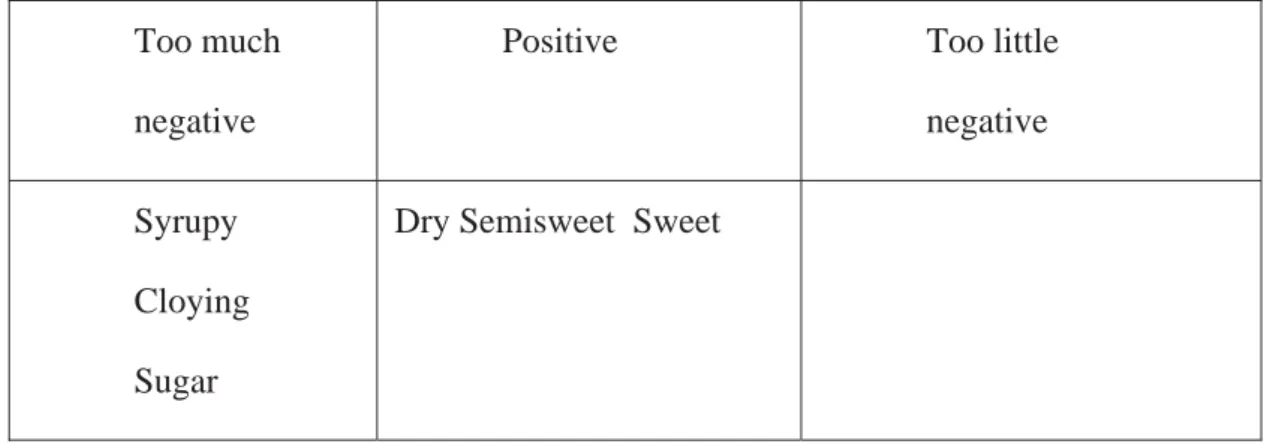
Sweetness is another important dimension in wine speak. We see that the descriptor “dry” is considered by the wine writers as a positive term because there are wines that can be both sweet and dry and this is the reason why the term “dry” appears under the positive column. However, wines can be “too dry”, that means that they have not sweetness at all and wine writers use the expression “bone dry” to describe this type of wines. “Syrupy” and “cloying” are terms to express the excess of sweetness that are not balanced with acidity.
Too much
negative
Positive Too little
negative
Syrupy
Cloying
Sugar
Dry Semisweet Sweet
Table 2.Sweetness (Lehrer 1983: 8).
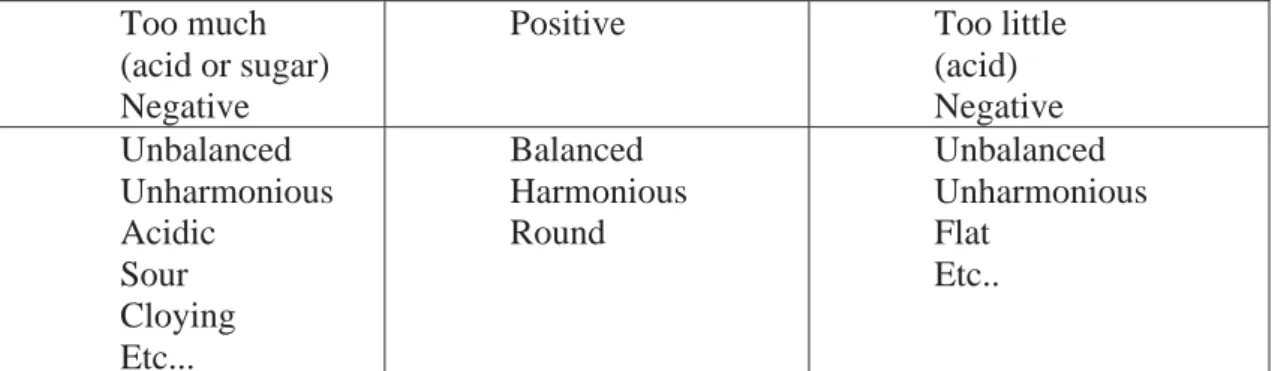
Balance
Too much
(acid or sugar) Negative
Positive Too little (acid)
Negative Unbalanced
Unharmonious Acidic
Sour Cloying Etc...
Balanced Harmonious Round
Unbalanced Unharmonious Flat
Etc..
Table 3. Balance (Lehrer 1983: 9).
Too much Negative
Positive Too little negative
Sweetnes s
Cloying Sweet Dry
Acidity Sour Tart Flat
Unbalanced Balanced Unbalanced Table 4.Interaction of Balance, Acidity, and Sweetness (Lehrer 1983: 9).
As table 4 shows, the terms cloying and sour are extreme descriptors to qualify the excess of the amount of sugar in a wine in the first case, and acidity in the second case which leads into an unbalanced wine. The same occurs with the term flat indicated to describe wines that “have lost its effervescence” or to express “lack of acidity”. In this case flat can be synonym of flabby.
Astrigency
The aspect of astringency is related to the texture presented in the mouth when we are tasting a wine. When we are referring to the dimension of astringency, we are talking about the tannins presented in the wine, basically red wines and can also be applied to those wines aged in oak barrels. Slinkard, a wine expert, provides a complete definition of tannins: “A wine's pucker power, generally more dominate in younger red wines that haven had the time to soften up with age. Tannins are derived from the skins,
stems and seeds of the grapes used to produce the wine. Technically, they are
plant-derived polyphenols. Tannins are often described as the textural component that "dries
the mouth" out in red wines.. Tannins are largely responsible for giving red wines a
defined structure - somewhat like a skeleton provides support for the body and allows
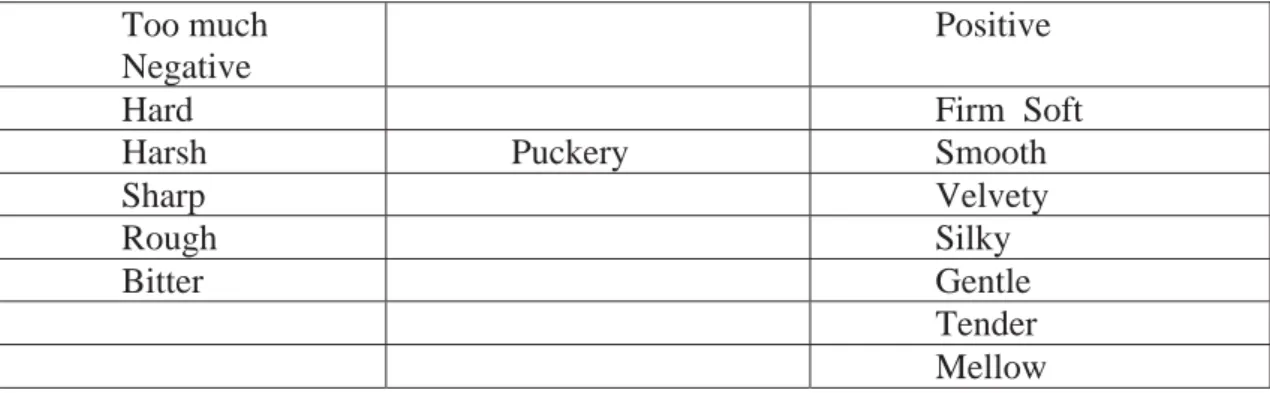
Too much
Negative
Positive
Hard Firm Soft
Harsh Puckery Smooth Sharp Velvety Rough Silky Bitter Gentle Tender Mellow Table 5.Feel (Astringency) (Lehrer 1983: 10).
Astrigency is a mouth experience that produces sensations such as dryness,
roughness and sometimes puckerness often in red wines. The table includes terms
related to the roughness in the mouth situated under the positive column. The terms compiled under too much column are indicated to describe very astringent wines that produce coarseness and hardness sensations. Puckery wines often cause your mouth to move.
Wine writers often use terms such as “harshness” (dureza) or “sharpness” (nitidez) to describe wines which are “too astringent” in contrast with the property of sweetness that a wine could have. Table 5 indicates the descriptors in the “too much” column to express acidity and the tannins presented in the wine. In the case of bitter, originally it was not a term referring to the mouthfeel of the wine, it describes a taste sensation but the term bitterness overtime has been related to the aspect of astringency that is why this term appears in the table.
There are another descriptors of wine related to the aspect of feel that are negative by themselves such as “flabby” or “hard” in contrast with other terms like “firm” and “soft” which are positive entirely.
Age
The dimension of age is related with the aspects of taste and feel in the elements of acidity and astringency. When we are referring to the age of the wine, wine writers use descriptors such as young and old. Old wines are mainly clarets and ports whereas
“Old Moselle” and “Old Beauyolais” are important marks of young wines (Lehrer
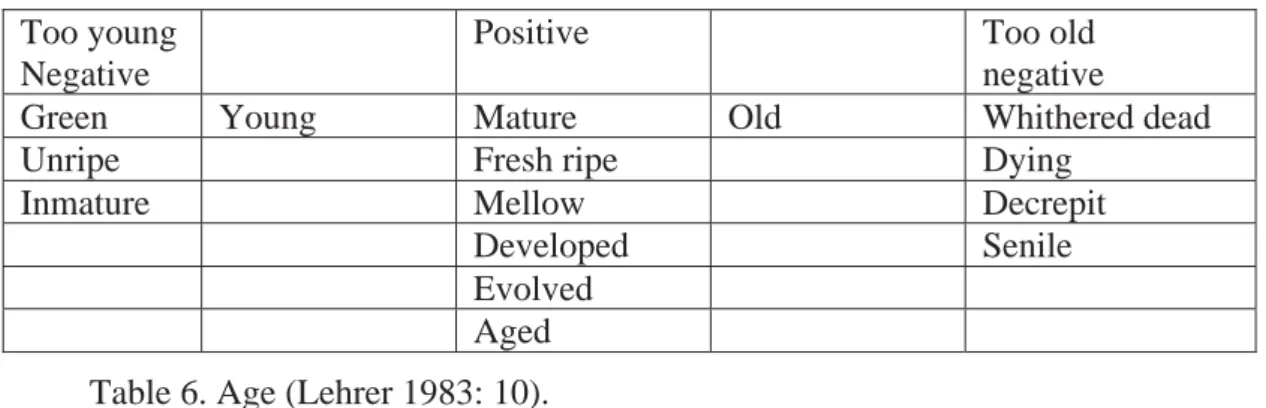
Too young
Negative
Positive Too old negative
Green Young Mature Old Whithered dead Unripe Fresh ripe Dying
Inmature Mellow Decrepit Developed Senile Evolved
Aged Table 6. Age (Lehrer 1983: 10).
Age, acidity and astringency are often interrelated in wine speak. As the table 7 pictures, the term “flat” could refer both to those wines that have been aged too much time in barrels and they are wines ideally for drinking when they are young or to those wines labelled as a sparkling wines that they have lost the effervescence.
Astringent wines could be both “too young wines” or “too old wines”. “Too
young wines” made from underripen grapes are often sharp or bitter producing
roughness and harshness sensations in the mouth. “Withered wines” are those made from “shriveled grapes” that has lost its acidity. “Mature wines” are those with a correct process of maceration and they have a correct proportion of acidity “crispy” producing soft and smooth sensations in the mouth.
Too young Negative
Positive Too old Negative
Age
Unripe Mature Withered Acidity
Sharp Crisp Flat Acetic
Astrigency
Rough Soft Harsh Smooth
Table 7.Correlation of Age, Acidity, and Astringecy (Lehrer 1983: 11).
Body
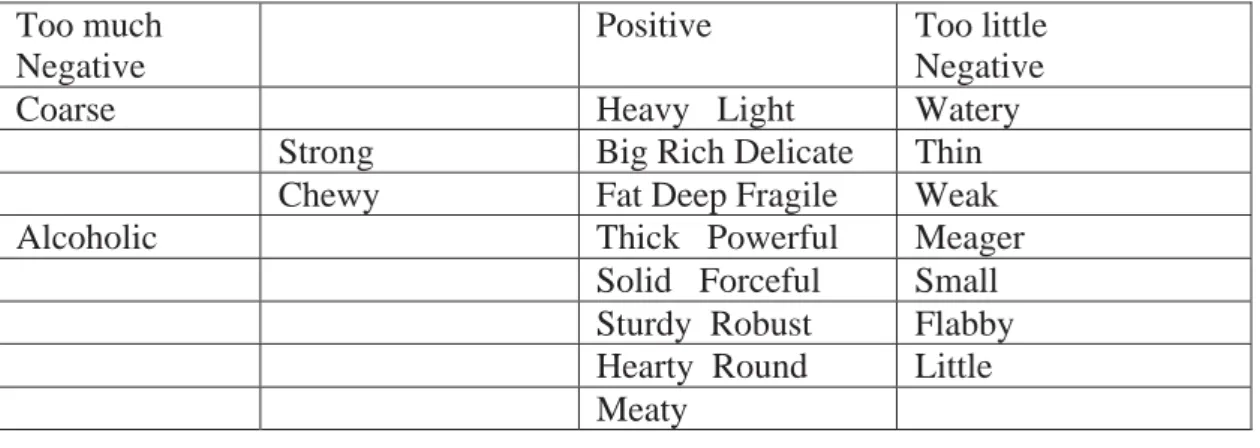
see, the descriptors heavy and light are opposed in wine speak. Usually, the term heavy in our daily language is used for describing things that are big or thing that “weight too much”.In this case, heavy and big are considered synonyms in the world of wine. The other words that appear under the positive column are often related to the terms heavy and light.
Too much Negative
Positive Too little Negative
Coarse Heavy Light Watery Strong Big Rich Delicate Thin Chewy Fat Deep Fragile Weak Alcoholic Thick Powerful Meager
Solid Forceful Small Sturdy Robust Flabby
Hearty Round Little Meaty
Table 8.Body (Lehrer 1983: 12).
Nose
The terms often used to describe the aspect of smell in wine speak, sometimes acquired evaluative character in other dimensions. Some experts distinguish in the aspect of smell, terms such as aroma and bouquet referring to the aroma of the grape and bouquet to the different aromas perceived in the wine whatsoever. As table 9 presents, many of the descriptors referring to the smell are names of fruits and they have suffered the process of suffixation by adding –y at the end of the adjective to refer to different aromas. Like other dimensions, these terms can be positive, negative or neuter and many of the terms that qualify the aromas are categorized rather than scaled.
The term fruity - is a general term that can be related to all types of aromas such as apples, cherries, raspberries, this descriptor is perfect to describe the “bouquet of aromas.”
However, fruity is opposed to grapy, expression that deals with to the grape by itself. There are another terms such as smoky and woody ideally for describing specific odors.
Positive Negative Fruity
Flowery
Perfumed
scented Fragrant
Comparisons, like Burnt Rubber, Leather, etc.
Table 9.Nose (Lehrer 1983: 12).
Finish
This dimension is important to describe the aftertaste of the wine. According to a wine glossary from a web page, the term aftertaste is defined as: “The taste or flavors that linger in the mouth after the wine is tasted, spit or swallowed. May be "harsh,"
"hot," "soft," "lingering," "short," "smooth," or nonexistent” (Winehaven, 2015).
The descriptor mostly used in this dimension is lingering (a wine which endures much time in the mouth) and it is a positive term in contrast with short and hollow (a wine lacking the sense of fruit) which are negative.
If a wine does not have a “good finish” producing a firm and fresh sensations in your mouth, it is not considered a good well-balanced wine. On the contrary, wines that have “short finish” lead into a watery sensation. The key factor falls into the correct degree of acidity.
To understand better the dimension of finish, Broadbent provides the following explanation:
“A wine cannot be considered well-balanced without a good finish by which is
understood a firm, crisp and distinctive end. The opposite, a short or poor finish, will be
watery, the flavor not sustained and tailing off inclusively. The correct degree of the
right sort of acidity is a decisive factor.” A hollow wine has a foretaste and some
aftertaste “but without a sustaining middle flavor” (Broadbent 1977: 96).
Beginning of taste sensations
Foretaste middle flavors
End of taste Sensation Aftertaste (finish) Hollow Lingering
Short Table 10. Finish (Lehrer 1983: 13).
Effervescence
The terms which represent the acid scale such as lively and zestful are indicated to express the amount of carbon dioxide presented in a wine. The term gassy presented in the table in most of the cases is used as a negative term.
Still Gassy Sparkling
Bubbling
Table 11.Effervescence. The activity dimension (Lehrer 1983: 14).
Evaluation
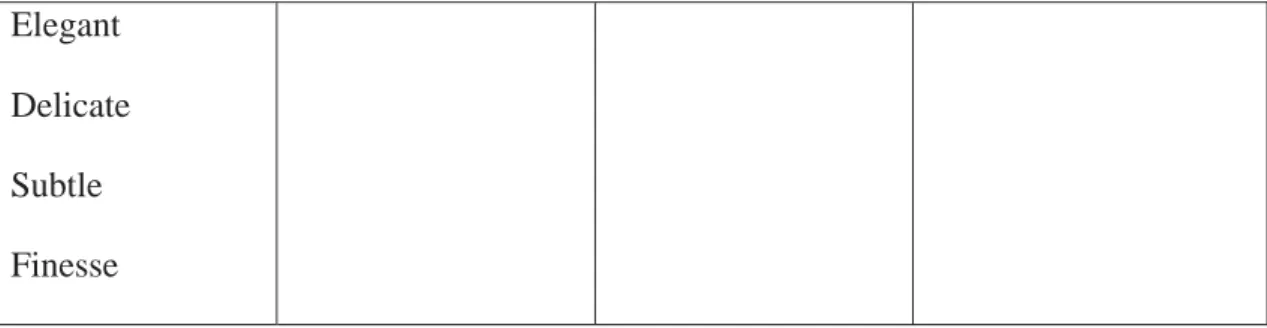
The last table reflects the descriptors of wine which have evaluative character. The basic common terms to evaluate the wine are: good, bad, excellent, awful, terrible, but there are many others that can be classified into four categories as it is shown in table 12: high praise, low praise, mildly derogative and strongly derogative. For instance, the term subtle is used for referring to a “light wine” rather than a “heavy one”.
High praise Low Praise Mildly Derogatory Strongly Derogatory
Complex
Breed
Character
Distinguished
Great
Fine
Clean
Sound
Simple
Refreshing
Insipid
Bland
Common
Ordinary
Off
(General Terms of
Elegant
Delicate
Subtle
Finesse
Table 12. Evaluation (Lehrer 1983: 14).
Broadbent provides a technical definition for the term “complex”: “ many-faceted smell and taste, the hallmark of a developing fine wine” (Broadbent 1977:95).
Another writer, Machamer (1977), considers the term complexity useful for referring to all the wine properties that explode in all its dimensions:
“Complexity . . . is an evaluative parameter. Its contrast term is simple.
Complexity is the measure for the degree of intensity with which all the factors in the
wine assault your senses in harmonious fashion.
Complex wines . . . burst forth in the mouth in manifold dimensions providing
the wine with an unmistakable depth and intra-connection of components. . . . Simple
wines are just that—one taste and flavor of the wine dominates and not much else
happens; there are no overtones played upon its basic note”. (Machamer 1977: 6)
Last but not least, it should be noted two important dimensions in wine speak: clarity and appearance. Broadbent (1977: 24), provides three types of classification referred to the degrees of clarity: firstly, the positive terms such as brilliant, star-bright, bright, clear are ordered depending on the degree of desirability. Secondly, the following terms such as bitty and dull are used to describe wine that are tedious or boring and thirdly, in the last classification ordered from bad to worse we have terms such as hazy and cloudy.
Regarding the appearance dimension, we meet color, hue and depth (the latter is used to describe the degree of saturation in a wine). Wines are classified into three types: red, rosé and whites. Broadly speaking, red wines presents “dark color” or
“reddish brown” combined with orange and pink tones. Sometimes, depending on the
In relation with the semantic dimension, the terms white and red are referred to the color of the wine by itself. However, another term black is used in other languages as a substitute to describe red wines.
There are plenty of terms that have not been represented before because they do not belong to a clear classification; Lehrer enumerates these descriptors used to describe specific flavors: “oaky and woody; chalky and earthy; metallic, mineral, and steely; smoky, nutty, spicy, herby, herbaceous, stony and pebbly”(Lehrer 1983: 16).
Ensrud also contributes to provide a list of specific terms related to the taste dimension; some of these terms are taken out from his glossary: “brix, flinty, grip, intricate, petillant, spritzy, tired, tough, weedy.” (A Wine Taster´s Glossary, 2015).
Finally, it should be noted that in wine speak exists a range of descriptors which belong to the fields of personality and character. Furthermore, in the world of wine we meet with unusual descriptors and even subjective in describing a wine. Some of them are: confident, loud, relaxed, shy, intelligent, hedonistic, etc…
We can state that most of the descriptors in describing a wine are interrelated in one or more dimensions which may in turn be evaluative or descriptive regarding their semantic field.
2.2. AMPLIFIED VOCABULARY: HOW METAPHORS ARE BROUGHT INTO WINE SPEAK?
2.2.1 MORPHOLOGICAL PROCESSES
In this section, I will deal with the different linguistic processes used in wine speak in order to expand the vocabulary in this field by adding new words or providing new meanings to existing words. Every language have several resources which help to amplify the vocabulary. In this case, the method most used is the morphological process called suffixation which consists in adding the particle “-y” to concrete nouns providing new adjectives.
The meaning of resembling is the most common one although wine writers often use the verb “have+ noun” for instance “the wine has a generous bouquet of lifted cherries.”
However, there are other descriptors ending with the particle “-y” which do not carry the meanings mentioned before. This is the case of foxy, this term is designated to described “sweet wines” made from “Vitis LAmbrusca” grapes, in Spanish is well-known as “uva de zorro”.
From the point of view of pragmatic semantics, the process of suffixation which leads to new words is not restricted to only one meaning in wine speak.
Lehrer provides several terms showing the suffixation process and as a result, these terms are considered descriptors of wine: muddy, sandy, coppery, barky, apply, pickly, chicken, leafy, walnut, olivy. (Lehrer 1983:20).
However, there are terms formed by a “noun+y” but they are not used very often as wine descriptors. For instance, the terms brawny, gavey and pruney. These terms are highlighted by its meanings: “a big masculine and muscular style wine”, “wines with aromas of earth baryards and meat”, “a big masculine and muscular style wine” and they do not pose problems of interpretation.
Another morphological process frequently used in wine speak is by adding (-like suffix) to the term and this particle provides a straightforward and clear meaning. Examples would be “cherry-like”, “lemmon-like” and “carrot-like”. The suffix (-like) would be added to other items as for instance “butter-like”, “rocks-like” or “oak-like”. These terms mentioned before are unlikely used in wine speak because there are well-established adjectives for those descriptors: buttery, rocky and oaky.
The following table provides some wine vocabulary extracted from my corpus that have suffered the process of suffixation:
WINE VOCABULARY WITH –Y SUFFIX
Herby Cheesy Smoky Inky Silky Plummy Fruity Graisy Jammy Fleshy
Table13. Descriptors of wine with “-y” suffix.
Continuing with the suffixation process, there are other existent suffixes in wine speak although they are less common and less productive; this is the case of “– ish”,(borrowish, stylish, cherryish), “–ic” (majestic, hedonistic) which could have two meanings : having or resembling. The following suffixes added to nouns, presents one intended meaning: having: “-ful” (powerful, flavourful, youthful, harmful)l, “-ous” (harmonious, pretentious, sensuous, vigorous) (Ljung 1970).
We can include also past participles like concentrated, filled, polished, croushed and present participles such as offering, starting, appealing, striking formed through verb stems.
2.2.2. SEMANTIC PROCESSES
Up to now, we have mentioned several descriptors which have entered in wine vocabulary through the morphological processes described before. However, many of the words are included in this field through the semantic extension specially by using metaphors, as we have seen before, their intralinguistic relationships could be included into one or more dimensions.
A starting point to deal with the intralinguistic relations between terms in wine talking is the semantic field.
Lehrer claims that a semantic field is a good aspect to study the lexical structures: “A semantic field is roughly a subject matter or conceptual sphere, such as kinship, motion, personality traits, or furniture. A lexical set is a group of lexemes
(words) that bear certain specifiable relationships to one another” (Lehrer 1983: 21).
However, we can construct other semantic fields with appropriate lexical items that could be included in that semantic field. For instance, we can form the semantic field for love by adding terms such as heart, flower, love, music and passion.
In wine speak, the semantic relations are based on synonymy-,antonymy and hyponymy. In this aspect, it is interesting how words within the same semantic field can be included in other conceptual domains.
“If there is a set of words that have semantic relationships in a semantic field, and if one or more items pattern in another semantic field, then the other items in the
first field are available for extension to the second field. The semantic relationships will
remain the same: synonyms will remain synonyms, antonyms will remain antonyms, etc.
Perceived similarity is not a necessary condition for semantic extension”. (Lehrer 1978a:96)
To display in more detail how the vocabulary of wine has been amplified, I will start dealing with the different semantic fields existent in the world of wine.
The first one is composed by terms referring to flavor and the meaning of those descriptors are straightforwardly in wine speak. Lehrer enumerates some of them: sweet, sour, bitter, tart, salty, and dry (Lehrer 1983: 22)
There are two groups of words regarding the dimension of touch and feel involving these two dimensions. The first group refers to flavor and feel aspects and they are very often used to describe acidity since this can be producing a “sour flavor” or “felt” generating a bitter or “mordant feeling”. This group of words is formed through antonymy by the terms sharp (tart, sour, bitter) and flat (tasteless, bland, insipid).
To emphasize the descriptors regarding acidity, some of them imply a straightforward meaning and most of them are used in a conventional way, for instance, the term sharp historically was employed to describe meals and beverages which according to Lehrer produce “intense sensation”(Lehrer 1983: 23).
However, descriptors such as crisp, zestful and lively require some explanations.
The terms crisp and lively are not direct synonyms of sharp because sharp implies “strong flavor” and “biting feel” whereas crisp and lively are used to describe “fresh, delicate and pleasant acidity in wines”.
These descriptors are included in the “animation aspect” under the semantic field of sharp meaning animated or “full of life” and can be extended to the “animation aspect” of flavor.
The term zestful under the dimension of flavor is used to describe both flavor and animation, so the most common meanings of zestful are animated and “full of life”. For these reasons zestful functions as a link between crisp and lively and they are used to describe wine tastes.
The second group of words under touch and feel dimensions are related with the tannins of the wine, (see definition of tannins above). Broadly speaking, this group is based on the antonymy and is subdivided into two sets:
SOFT-SMOOTH HARD-ROUGH Smooth Rough Soft Hard Flabby Firm Flat Sharp
Table 14. (Lehrer 1983: 25).
Table 14 represents the dimension of touch related to texture. The semantic fields are subdivided at the same time into different subfields:
The first one,“pleasantness and regularity of the surface-”; Under this dimension, several terms denoting this aspect: “smooth, soft, gentle and flat” and “sharp rugged”.
domain because in one descriptor could be involved several meanings. This is the case of the words: firm, flabby, velvety, silky and gentle. (Lehrer 1983: 25).
The semantic dimension of body is divided into different lexical fields (size, weight and strength) to describe the “spatial dimension”. The following descriptors big, little, small, flat, thin, thick are included under the size and descriptors such as deep, high, sallow and low are included in the dimensions.
However, the term plump, is not considered straightforwardly because it would mean “a little flat” or “moderately big”.
The terms huge and massive are considered according to Asher (1974: 34-35: 12-14, 52) for describing wines that are “vey big”.
Regarding the “size dimension”, there are words like meaty and fleshy which denote matter with respect to the body of wine in a metaphorical meaning. The descriptors under size are connected with the dimension of weight with terms like heavy and light (the latter could be included in various semantic domains) are related to the wine itself, and could be linked to those wines whose concentration of the ingredients could be dissolved or not and also for referring to the intensity of flavor. In this case heavy and light are related to the strength words.
However, both domains of size and strength are closely related, because those descriptors included in the size domain can be utilized for strength domain as well. For instance, thin means “slim in size” or regarding the strength domain could mean “having little concentration”. The term thick is an antonym for both domains.
The descriptors strong and weak could be applied in weight regarding the concentration of the ingredients in liquids and they could also refer to strength in the sense of resist applying to those wines that last too much on the mouth (a long or a lingering finish). On the contrary, weak meaning “fragile and delicate” are considered antonyms regarding the strength side of the domain but fragile and delicate are positive terms.
To sum up, the meaning of the descriptors strong and weak are used in a straightforward way to indicate the concentration of the wine. However, there are other terms in other domains that semantically are related to those descriptors and for this reason they are accessible for expanding the wine domain.
Balance can be defined as the correct proportion of sweetness and acidity. Related to this domain, we have other descriptors like: unbalanced, unharmonious and graceful to describe aesthetic properties of the wine.
There are several descriptors related to the shape domain that is important to mention. VanDycke writes, (1975: 44):
“Flat and its opposite sharp have already been mentioned for referring to wines that are not properly balanced. Other shape words that might be extended to wine could be angular, pointed, or curved. A curved wine might be “balanced,” while a pointed or angular wine would be sharp. (VanDycke 1975: 44)
The semantic field of age is important in wine speak because wines are often described as young or old as if the wine goes through different stages of life like the human beings. In this field, there has been an important semantic extension in wine speak for words referring to young and old.
Besides, Complexity is an important domain in the world of wine. Under this semantic field, the more general descriptors are complex or simple. However, we can encounter terms such as complicated or naïve (which comes from personality domain) function as partial synonyms for complex and simple.
Regarding the personality, behavior and character domains, the vocabulary of wine has been extended in a high degree leading to a lexical innovation. These domains can permeate with others domains such as strength and balance because the descriptors under the later domains are well connected with descriptors related to personality. Lehrer establishes the following examples: strong, willed, weak person, unbalanced mind, rounded personality (Lehrer 1983: 31).
scale we meet terms such as ordinary or common being vulgar terms to qualify mediocre wines. Under the scale of quality respectable would be in the middle.
Another terms such as character is applied by itself and also could be enforced to complexity and quality domains.
According to Lehrer, there is no obvious relation between the descriptors and physical characteristics of wine. For this reason, it is important to explain some of them. In the case of pretentious it is applied to a person who aspires to achieve qualities that does not have. The same could be applied into the wine domain. When a writer says that a wine is pretentious is describing an ordinary wine that aspires to aim the quality of an
“Old Chateau Lafite”, for instance. For this reason pretentious has a negative
connotation because is used to qualify ordinary wines that actually are not good wines.
If we link pretentious with heavy and rich, “a pretentious wine could be heavier and richer”(Lehrer 1983: 31).
Another descriptor to consider is honest meaning “very ancient” and it was used to describe things that could be respectable, worthy or commendable. Applying this term to wine speak it is used for describe wines without defaults as for example those wines that they have not added sugar in them to cover its extreme acidity. In this context, we can say that honest contrasts with pretentious. Although honest is a term positioned under the column low praise, it is a good descriptor to qualify a wine with an appropriate quality. However, honest is closely related to the term straightforward related to notions of truthfulness.
Continuing with the characteristics of personality in wine speak, we consider a set of terms applying to seriousness like: serious, disciplined, austere, severe, nonserious, frolicsome, gay and silly (Lehrer 1983: 32).
Austere and severe are terms applying to describe wines that are “too acidic”. Although there are terms that the semantic relation is not clear, their association between them is weak. This is the case of feminine and masculine. Descriptors related to feminine are the folowings: soft, smooth, light, round, perfumed and sweet (Lehrer 1983: 32).
On the contrary, terms such as high and vigorous are used to described masculine wines.
With the domains of personality and character it has been amplified the lexical vocabulary via semantics into this field. Lehrer enumerates terms such as: sincere, furtive, frank, well-intentioned and villainous (Lehrer 1983: 32). Their interpretation will depend on the meaning we want to include and the semantic property of the term in the world of wine.
3. METHODOLOGY
3.1 CORPUS
The main purpose of my undergraduate research is to study the interlinguistic relationships of metaphors. To that end, I have compiled a comparable corpus including wine tasting notes of both languages (English and Spanish) and furthermore, I consider the pragmatic text selection criteria for the compilation of the corpus: these kind of texts meet the criteria of specialized language that belong to members of a discourse community, in this case wine writers. The purpose is to construct a corpus representative enough for this type of discourse.
The corpus contains 285 wine tasting notes in English and 216 wine tasting notes in Spanish, with a total of 51,776 and 55,187 words appropriately.
Besides, it is a labelled corpus. Swales (1990) stated that in certain specialized genres follow a rhetorical structure. It is a very frequent rhetoric and semantic structure that the discourse community uses and accepts. The rhetorical structure is divided into: moves (semantic units according to the writer purpose) and steps (the sub-semantic units).
three lists in accordance with their degree of generality and specifity. Besides, I will group the same metaphors in both languages in order to analyze whether a metaphor appears in the same dimensions in English and Spanish. Finally, I will classify them according to specific parameters in wine tasting notes.
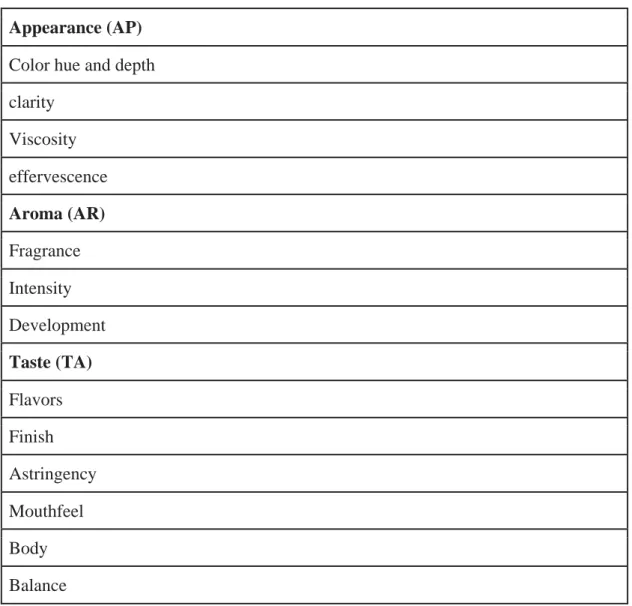
For my research, I will take the rhetorical structure of wine tasting notes from López-Arroyo and Roberts (2014: 25-49). This structure is divided into 5 moves and several steps but my research will focus in three moves: Appearance, Aroma and Taste. The following table shows the typical structure for wine tasting notes:
Appearance (AP)
Color hue and depth
clarity
Viscosity
effervescence
Aroma (AR)
Fragrance
Intensity
Development
Taste (TA)
Flavors
Finish
Astringency
Mouthfeel
Body
Balance
Table 15. Moves and steps in wine tasting notes. López-Arroyo and Roda Roberts (2014: 31-32).
3.2 KEY NOUNS AND METAPHORS IN 3 MOVES.
The analysis of metaphors is focused into three moves: Appearance (AP), Aroma (AR) and Taste (TA) López-Arroyo and Roda Roberts (2014: 35-37).
In order to extract the metaphors, we first detected the key nouns which appear in each step of the three moves mentioned above: color hue and depth, clarity, viscosity and effervescence for Appearance; fragrance, intensity and development for Aroma and finally flavors, finish, astringency, mouthfeel and acidity regarding Taste. They key nouns coincide with the name of the step in most cases but we were able to identify another synonyms for each step: tone (a synonym of color), transparency (a synonym of clarity), bubbles, (a synonym for effervescence). Regarding fragrance step, we have included aroma and perfume; profundity for intensity, and finally for taste move we have considered notes (a synonym of flavor), tannins for Astringency; palate mid-palate, aftertaste, attack and entry are synonyms of mouthfeel; and structure for body (López-Arroyo and Roda Roberts 2014:35-37).
The figures showed below contain the key nouns found in each step in English and Spanish languages:
Moves and steps Key nouns in English
APPEARANCE (AP)
Color hue and depth Color, Tone
Clarity Clarity, Transparent Viscosity Viscosity
Effervescence Effervescence, Bubbles
AROMA (AR)
Fragrance Aroma, Fragrance, Perfume
Intensity Intensity, Profundity Development Development
TASTE (TA)
Flavors Flavors, Notes Finish Finish
Astringency Tannins, Astringency Mouthfeel Palate, Mid-palate, Entry
body Body, Structure Table 16. English key nouns appearing in each step. López-Arroyo and P.Roberts (2014: 33).
Color hue and depth Color, Tonalidad
Clarity Claridad, Transparencia Viscosity Viscosidad
Effervescence Efervescencia, Burbujas AROMA (AR)
Fragrance Aroma, Fragancia, Perfume
Intensity Intensidad, Profundidad Development Desarrollo
TASTE (TA)
Flavors Notas, Sabor, Gusto
Finish Final
Astringency Taninos, Astringencia Mouthfeel Retrogusto, Posgusto, Entrada, Ataque,
Boca
body Cuerpo, Estructura Table 17. Spanish key nouns appearing in each step. López-Arroyo and
P.Roberts (2014: 33).
Taking the key nouns presented in each step, we were able to identify the different metaphors appearing in both languages in terms of collocability.
The figures presented below contain different metaphors extracted in English and Spanish identifying the move and the step and also the number of occurrences in which appear the metaphor in each step:
Metaphor Moves and Steps Occurrences Spicy Appearance (AP)
Color hue
Aroma (AR)
Fragrance
Taste (TA)
Flavors Finish Astringency Mouthfeel Body
5
104
97 29 45 34 42 Ripe Aroma (AR)
Fragrance
Taste (TA)
Flavors Finish Astringency Mouthfeel
62
83 22 42 49 Fresh Aroma (AR)
Taste (TA)
Flavors Finish Astringency Mouthfeel Body
80 36 10 190 7 Sweet Taste (TA)
Flavors Finish Astringency Mouthfeel
95 48 132 32 Rich Taste (TA)
Flavors Finish Astringency Mouthfeel Body
123 20 30 140 36 Lovely Aroma (AR)
Fragrance
Taste (TA)
Flavors Acidity Mouthfeel
50
60 15 47
Soft Taste (TA)
Flavors Finish Astringency Mouthfeel
24 30 38 122 Deep Appearance (AP)
Color hue and depth
Aroma (AR)
Fragrance
Taste (TA)
Flavors Finish Body
115
52
74 8 40 Complex Aroma (AR)
Fragrance
Taste (TA)
Flavors Finish Acidity Mouthfeel Body Balance
85
20 10 20 30 27 4 Intense Aroma (AR)
Taste (TA)
Flavors Finish Mouthfeel Balance
30 13 27 10
Long Taste (TA)
Finish Astringency Mouthfeel Balance
82 7 35 4 Pure Aroma (AR)
Fragrance
Taste (TA)
Flavors Finish Acidity Mouthfeel
4
4 13 3 134
Meaty Appearance (AP)
Viscosity
Aroma (AR)
Fragrance
Taste (TA)
Flavors Mouthfeel
20
30
60 25 Nice Appearance (AP)
Viscosity
Aroma (AR)
Fragrance
Taste (TA)
Flavors Acidity Mouthfeel Balance
20
20
10 4 90 3 Perfumed Aroma (AR)
Fragrance 41 Elegant Aroma (AR)
Fragrance
Taste (TA)
Astringency Mouthfeel Body
72
20 30 6 Round Taste (TA)
Finish Astringency Mouthfeel Body
Floral Aroma (AR)
Fragrance
Taste (TA)
Flavors
65
63 Great Appearance (AP)
Color hue
Aroma (AR)
Fragrance
Taste (TA
Flavors Body Balance
2
1
47 30 45 Young Aroma (AR)
Development
Taste (TA)
Flavors Astringency
85
25 2 Silky Taste (TA)
Astringency Mouthfeel
69 43 Dry Aroma (AR)
Fragrance
Taste (TA)
Flavors Finish Astringency Mouthfeel Body
25
56 34 58 24 23 Open Aroma (AR)
Fragrance
Taste (TA)
Flavors Acidity Body
17
72 15 5
Little Aroma (AR)
Fragrance Development
Taste (TA)
Flavors Finish Astringency Body
13 23
12 34 45 34 High Taste (TA)
Flavors Astringency
9 93 Opulent Taste (TA)
Finish
Acidity Mouthfeel Body
2 4 7 52 Dense Apperance (AP)
Color hue
Taste (TA)
Flavors Acidity Body
39
26 10 20 Firm Taste (TA)
Flavors Astringency Body
31 53 10 Unusual Aroma (AR)
Fragrance
Taste (TA)
Flavors Body
1
4 4 Amazing Appearance
Viscosity
Aroma (AR)
Development
Taste (TA)
Flavors Finish
2
1
2 3 Beautifully Aroma (AR)
Fragrance Intensity
Taste (TA)
Flavors Mouthfeel Balance
7 3
3 2 6 Dusty Aroma (AR)
Fragance
Taste (TA)
Astringency Mouthfeel Body
6
11 3 2 Fleshy Taste (TA)
Finish Mouthfeel Body
4 7 6 Huge Aroma (AR)
Fragrance
Taste (TA)
Astringency Mouthfeel
6
Body 10 Strong Taste (TA)
Flavors Astringency Body
5 1 3 Leafy Aroma (AR)
Fragrance
Taste (TA)
Flavors Acidity Body
12
3 1 4 Fantastic Aroma (AR)
Fragrance
Taste (TA)
Flavors Body
4
3 2 Hedonistic Taste (TA)
Flavors Finish Mouthfeel Body
4 1 2 4 Light Appearance (AP)
Color hue
Aroma(AR)
Fragrance
Taste (TA)
Flavors Finish Acidity Mouthfeel Body
22
9
9 2 1 7 4 Warm Aroma (AR)
Fragrance
Taste (TA)
Mouthfeel Body
5
9 1 Intense Appearance (AP)
Color hue
Aroma (AR)
Fragance
Taste (TA)
Flavors Finish Mouthfeel Body
1
22
39 6 21 52 Delicate Aroma (AR)
Fragrance
Taste (TA)
Astringency
Body
1 3 Hot Taste (TA)
Finish 3 Large Aroma (AR)
Development
Taste (TA)
Mouthfeel Body
2
2 1 Subtle Aroma (AR)
Fragrance
Taste (TA)
Flavors Astringency Mouthfeel Body Balance
4
24 1 2 1 1 Refined Taste (TA)
Flavors Finish Acidity Mouthfeel Body Balance
1 3 1 27 10 2 Distinctive Aroma (AR)
Fragance
Taste (TA)
Flavors Body
13
15 9 Big Aroma (AR)
Fragance development
Taste (TA)
Flavors Acidity Mouthfeel Body
4 6
1 5 8 5
Exotic Aroma (AR)
Fragrance
Taste (TA)
Flavors Mouthfeel
14
6 18 Toasty Aroma (AR)
Fragrance development
Taste (TA)
flavors
17 5
body
Balance
4 2 Hard Taste (TA)
Finish Astringency
1 2 Ample Aroma (AR)
Development
Taste (TA)
Flavors Finish Acidity Mouthfeel Body
2
5 4 4 1 7 Youthful Appearance (AP)
Color hue
Aroma (AR)
Fragrance Development
Taste (TA)
Flavors Mouthfeel Body
6
3 1
5 2 14 Low Taste (TA)
Acidity 75 Tight Aroma (AR)
Fragrance
Taste (TA)
Flavors Acidity Body
11
2 11 12 Velvet Taste (TA)
Finish Astringency Mouthfeel
3 2 27 Expressive Aroma (AR)
Fragrance
Taste (TA)
Flavors Mouthfeel
6
2 14 Pretty Aroma (AR)
Fragrance
Taste (TA)
Flavors Acidity Mouthfeel
2
3 7 15 Sensuous Taste (TA)
Mouthfeel Body
Broad Aroma (AR)
Fragrance
Taste (TA)
Flavors Finish Body
7
3 2 19 Perfect Taste (TA)
Balance 33 Wonderful Appearance (AP)
Clarity
Aroma (AR)
Fragrance
Taste (TA)
body
11
12
1 Decadent Taste (TA)
Flavors Finish Mouthfeel Body
7 2 11 7 Inky Aperance (AP)
Color Hue 48 Plummy Aroma (AR)
Fragrance
Taste (TA)
Flavors Finish Acidity Mouthfeel Body
1
7 8 1 4 3 Thick Apperance (AP)
Color hue
Taste (TA)
Mouthfeel Body
2
8 25 Austere Taste (TA)
Astringency Mouthfeel
2 10 Impressive Appearance (AP)
Color Hue 1 Silk Taste (TA)
Mouthfeel 18 Polished Taste (TA)
Finish Astringency Mouthfeel Body
Balance 2
Structured Taste (TA)
Flavors Finish Astringency Body
2 1 1 23 Old Aroma (AR)
Fragrance Development
Taste (TA)
Flavors
1 6
3 Balanced Taste (TA)
Finish Acidity Body
4 6 24 Mature Aroma (AR)
Development
Taste (TA)
Flavors Astringency Mouthfeel Body
62
1 1 3 2 Lush Aroma (AR)
Fragrance
Taste (TA)
Astringency Mouthfeel
7
2 68 Smooth Aroma (AR)
Fragrance
Taste (TA)
Finish Acidity Mouthfeel
4
1 8 64 Attractive Appearance (AP)
Color hue
Aroma (AR)
Fragrance Acidity Mouthfeel Body
17
20 2 30 1 Serious Aroma (AR)
Development
Taste (TA)
Mouthfeel
5
45 Light Appearance (AP)
Color hue
Aroma (AR)
Fragrance
19
Taste (TA)
Flavor Finish Acidity Mouthfeel Body
3 2 3 20 2 Sexy Taste (TA)
Finish Mouthfeel
3 52 Powerful Aroma (AR)
Fragrance
Taste (TA)
Mouthfeel
13
37 Supple Taste (TA)
Finish Acidity Mouthfeel
2 2 65 Fat Aroma (AR)
Fragrance
Taste (TA)
Flavors Mouthfeel
2
1 44 Modern Aroma (AR)
Fragrance
Taste (TA)
Mouthfeel
3
12 Pure Aroma (AR)
Fragrance
Taste (TA)
Flavors Finish Mouthfeel
2
2 2 122 Clean Aroma (AR)
Fragrance
Taste (TA)
Flavors Finish Mouthfeel
1
1 8 27 Easy Aroma (AR)
Fragrance 1 Table 18. English metaphors in wine tasting notes.
Metaphor Step Ocurrences Limpio Appearance (AP)
Clarity
Aroma (AR)
Fragrance
218
Intenso Appearance
Color hue
Aroma (AR)
Fragrance
Taste (TA)
Mouthfeel
20
11
1 Brillante Appearance (AP)
Clarity 185 Agradable Aroma (AR)
Fragrance
Taste (TA)
Flavors Astringency Mouthfeel Body Balance
29
13 4 92 5 3 Persistente Taste (TA)
Body 34 Equilibrado Aroma (AR)
Fragrance
Taste (TA)
Acidity Mouthfeel Body Balance
3
21 7 107 3 Madura Aroma (AR)
Fragrance
Taste (TA)
Flavors Mouthfeel
14
71 8 Ligero Appearance (AP)
Color hue
Taste (TA)
Flavors Mouthfeel Body
1
3 68 20 Fresco Aroma (AR)
Fragrance
Taste (TA)
Mouthfeel body
20
47 3 Fina Appearance (AP)
Color Hue Effervescence
77 1 Suave Appearance (AP)
Fragrance
Taste (TA)
Flavors
2
Astringency
Mouthfeel Body
10 39 3 Pulido Taste (TA)
Astringency Balance
45 14 Redondo Taste (TA)
Astringency Body/Balance
9 52 Envejecido Aroma (AR)
Development 54 Juventud Appearance (AP)
Color Hue Development
Taste (TA)
Effervescence Mouthfeel
14 19
2 1 Elegante Appearance (AP)
Color hue
Aroma (AR)
Fragrance
Taste (TA)
Astringency Mouthfeel Body
2
23
3 2 1 Goloso Aroma (AR)
Fragrance
Taste (TA)
Flavors
24
10 Complejo Aroma (AR)
Fragrance
Taste (TA)
Mouthfeel Balance/Body
16
3 8 Franco Aroma (AR)
Fragrance Intensity
19 10 Intenso Appearance (AP)
Color Hue
Aroma (AR)
Fragance
18
8 Persistente Taste (TA)
Flavors Body
1 34 Pálido Appearance (AP)
Color Hue 1 Potente Aroma (AR)
Taste (TA)
Flavors Body
1 40
Carnoso Taste (TA)
Body 35 Sedoso taste (TA)
Astringency Mouthfeel
21 11 Secante Taste (TA)
Astringency 29 Atractivo Apperance (AP)
Color Hue
Aroma (AR)
Fragance
6
7 Largo Taste (TA)
Finish Mouthfeel Body
8 34 38 Untuoso Taste (TA)
Mouthfeel Body
21 19 Amable Taste (TA)
Astringency Mouthfeel Body
3 17 1 Perfecto Taste (TA)
Balance 7 Maduro Aroma (AR)
Fragrance
Taste (TA)
Flavors
2
4 Expresivo Aroma (AR)
Fragrance
Taste (TA)
Mouthfeel Body
6
1 5 Sutil Aroma (AR)
Fragrance
Taste (TA)
Flavors Mouthfeel
13
1 1 Vivo Appearance (AP)
Color Hue
Taste (TA)
Mouthfeel
51
19 Agresivo Taste (TA)
Mouthfeel 5
Interesante Aroma (AR)
Fragrance Body
43 2 Complejo Aroma (AR)
Fragrance
Taste (TA)
Finish Body
14
2 3 Table 19. Spanish metaphors in wine tasting notes.
We found in total, 103 metaphors in English and only 41 metaphors in Spanish. Although the metaphors extracted varied in number, there is a proportion of the total of metaphors that appear in more than one move, 71 in English and 21 in Spanish. The tables presented below, include metaphors grouped according to the degree of generality or specificity.
Metaphors that appear in three moves in English and Spanish:
Metaphor Moves and steps occurrences Spicy Appearance (AP)
Color Hue
Aroma (AR)
Fragrance
Taste (TA)
Flavors Finish Astringency Mouthfeel body
5
104
97 29 45 34 42 Deep Appearance (AP)
Color hue and depth
Aroma (AR)
Fragrance
Taste (TA)
Flavors Finish Body
115
52
74 8 40 Meaty Appearance (AP)
Viscosity
Aroma (AR)
Fragrance
Taste (TA)
Flavors Mouthfeel
20
30
Viscosity
Aroma (AR)
Fragrance
Taste (TA)
Flavors Acidity Mouthfeel Balance
20
20
10 4 90 3 Great Appearance (AP)
Color hue
Aroma (AR)
Fragrance
Taste (TA
Flavors Body Balance
2
1
47 30 45 Amazing Appearance
Viscosity
Aroma (AR)
Development
Taste (TA)
Flavors Finish
2
1
2 3 Light Appearance (AP)
Color hue
Aroma(AR)
Fragrance
Taste (TA)
Flavors Finish Acidity Mouthfeel body
22
9
9 2 1 7 4 Intense Appearance (AP)
Color hue
Aroma (AR)
Fragance
Taste (TA)
Flavors Finish Mouthfeel Body
1
22
39 6 21 52 Youthful Appearance (AP)
Color hue
Aroma (AR)
Fragrance Development
Taste (TA)
6
Flavors
Mouthfeel Body
5 2 14 Wonderful Appearance (AP)
Clarity
Aroma (AR)
Fragrance
Taste (TA)
body
11
12
1 Light Appearance (AP)
Color hue
Aroma (AR)
Fragrance
Taste (TA)
Flavor Finish Acidity Mouthfeel Body
19
11
3 2 3 20 2 Table 20. English metaphors in three moves.
Metaphor Moves and Steps Occurrences Intenso Appearance
Color hue
Aroma (AR)
Fragrance
Taste (TA)
Mouthfeel
20
11
1 Elegante Appearance (AP)
Color hue
Aroma (AR)
Fragrance
Taste (TA)
Astringency Mouthfeel Body
2
23
3 2 1 Table 21. Spanish metaphors in three moves.
Mepahors that appear in two moves, first in English, then in Spanish:
Metaphor Moves and Steps Occurrences Ripe Aroma (AR)
Fragrance
Taste (TA)
Flavors Finish Astringency
62
Mouthfeel 49
Fresh Aroma (AR)
Fragrance
Taste (TA)
Flavors Finish Astringency Mouthfeel Body
74
80 36 10 190 7 Lovely Aroma (AR)
Fragrance
Taste (TA)
Flavors Acidity Mouthfeel
50
60 15 47
Complex Aroma (AR)
Fragrance
Taste (TA)
Flavors Finish Acidity Mouthfeel Body Balance
85
20 10 20 30 27 4 Intense Aroma (AR)
Fragrance
Taste (TA)
Flavors Finish Mouthfeel Balance
94
30 13 27 10
Pure Aroma (AR)
Fragrance
Taste (TA)
Flavors Finish Acidity Mouthfeel
4
4 13 3 134
Elegant Aroma (AR)
Fragrance
Taste (TA)
Astringency Mouthfeel Body
72
Fragrance
Taste (TA)
Flavors
65
63 Young Aroma (AR)
Development
Taste (TA)
Flavors astringency
85
25 2 Dry Aroma (AR)
Fragrance
Taste (TA)
Flavors Finish Astringency Mouthfeel Body
25
56 34 58 24 23 Open Aroma (AR)
Fragrance
Taste (TA)
Flavors Acidity Body
17
72 15 5
Little Aroma (AR)
Fragrance Development
Taste (TA)
Flavors Finish Astringency Body
13 23
12 34 45 34 Dense Apperance (AP)
Color hue
Taste (TA)
Flavors Acidity Body
39
26 10 20 Unusual Aroma (AR)
Fragrance
Taste (TA)
Flavors Body
1
4 4 Beautifully Aroma (AR)
Fragrance Intensity
Taste (TA)
Flavors Mouthfeel
7 3
Balance 6
Dusty Aroma (AR)
Fragance
Taste (TA)
Astringency Mouthfeel Body
6
11 3 2 Huge Aroma (AR)
Fragrance
Taste (TA)
Astringency Mouthfeel Body
6
3 3 10 Leafy Aroma (AR)
Fragrance
Taste (TA)
Flavors Acidity Body
12
3 1 4 Fantastic Aroma (AR)
Fragrance
Taste (TA)
Flavors Body
4
3 2 Warm Aroma (AR)
Fragrance
Taste (TA)
Mouthfeel Body
5
9 1 Delicate Aroma (AR)
Fragrance
Taste (TA)
Astringency Body
3
1 3 Large Aroma (AR)
Development
Taste (TA)
Mouthfeel Body
2
2 1 Subtle Aroma (AR)
Fragrance
Taste (TA)
Flavors Astringency Mouthfeel Body Balance
4
Fragance
Taste (TA)
Flavors Body
13
15 9 Big Aroma (AR)
Fragance development
Taste (TA)
Flavors Acidity Mouthfeel Body
4 6
1 5 8 5
Exotic Aroma (AR)
Fragrance
Taste (TA)
Flavors Bouthfeel
14
6 18 Toasty Aroma (AR)
Fragrance Development
Taste (TA)
Flavors Body Balance
17 5
6 4 2 Ample Aroma (AR)
Development
Taste (TA)
Flavors Finish Acidity Mouthfeel Body
2
5 4 4 1 7 Tight Aroma (AR)
Fragrance
Taste (TA)
Flavors Acidity Body
11
2 11 12 Expressive Aroma (AR)
Fragrance
Taste (TA)
Flavors Mouthfeel
6
2 14 Pretty Aroma (AR)
Fragrance
Taste (TA)
Flavors
2
Acidity
Mouthfeel
7 15 Broad Aroma (AR)
Fragrance
Taste (TA)
Flavors Finish Body
7
3 2 19 Plummy Aroma (AR)
Fragrance
Taste (TA)
Flavors Finish Acidity Mouthfeel Body
1
7 8 1 4 3 Thick Apperance (AP)
Color hue
Taste (TA)
Mouthfeel Body
2
8 25 Old Aroma (AR)
Fragrance Development
Taste (TA)
Flavors
1 6
3 Mature Aroma (AR)
Development
Taste (TA)
Flavors Astringency Mouthfeel Body
62
1 1 3 2 Lush Aroma (AR)
Fragrance
Taste (TA)
Astringency Mouthfeel
7
2 68 Smooth Aroma (AR)
Fragrance
Taste (TA)
Finish Acidity Mouthfeel
4
1 8 64 Attractive Appearance (AP)
Color hue
Aroma (AR)
Fragrance
17
Acidity
Mouthfeel Body
2 30 1 Serious Aroma (AR)
Development
Taste (TA)
Mouthfeel
5
45 Powerful Aroma (AR)
Fragrance
Taste (TA)
Mouthfeel
13
37 Fat Aroma (AR)
Fragrance
Taste (TA)
Flavors Mouthfeel
2
1 44 Modern Aroma (AR)
Fragrance
Taste (TA)
Mouthfeel
3
12 Pure Aroma (AR)
Fragrance
Taste (TA)
Flavors Finish Mouthfeel
2
2 2 122 clean Aroma (AR)
Fragrance
Taste (TA)
Flavors Finish Mouthfeel
1
1 8 27 Table 22. English metaphors in two moves.
Metaphor Moves and Steps Occurrences Limpio Appearance (AP)
Clarity
Aroma (AR)
Fragrance
218
48 Agradable Aroma (AR)
Fragrance
Taste (TA)
Flavors Astringency Mouthfeel Body Balance
29
Equilibrado Aroma (AR)
Fragrance
Taste (TA)
Acidity Mouthfeel Body Balance
3
21 7 107 3 Maduro Aroma (AR)
Fragrance
Taste (TA)
Flavors Mouthfeel
14
71 8 Ligero Appearance (AP)
Color hue
Taste (TA)
Flavors Mouthfeel Body
1
3 68 20 Fresco Aroma (AR)
Fragrance
Taste (TA)
Mouthfeel Body
20
47 3 Suave Appearance (AP)
Fragrance
Taste (TA)
Flavors Astringency Mouthfeel Body
2
1 10 39 3 Juventud Appearance (AP)
Color hue Development
Taste (TA)
Effervescence Mouthfeel
14 19
2 1 Goloso Aroma (AR)
Fragrance
Taste (TA)
Flavors
24
10 Complejo Aroma (AR)
Fragrance
Taste (TA)
Mouthfeel Balance/Body
16
3 8 Intenso Appearance (AP)
Color hue
Aroma (AR)
Fragrance 8
Potente Aroma (AR)
Fragrance
Taste (TA)
Flavors Body
6
1 40
Maduro Aroma (AR)
Fragrance
Taste (TA)
Flavors
2
4 Expresivo Aroma (AR)
Fragrance
Taste (TA)
Mouthfeel Body
6
1 5 Sutil Aroma (AR)
Fragrance
Taste (TA)
Flavors Mouthfeel
13
1 1 Vivo Appearance (AP)
Color hue
Taste (TA)
Mouthfeel
51
19 Atractivo Apperance (AP)
Color Hue
Aroma (AR)
Fragance
6
7 Table 23. Spanish metaphors in two moves.
Metaphors that appear in one move, first in English, then in Spanish:
Metaphor Moves and Steps Occurrences Sweet Taste (TA)
Flavors Finish Astringency Mouthfeel
95 48 132 32 Rich Taste (TA)
Flavors Finish Astringency Mouthfeel Body
123 20 30 140 36 Soft Taste (TA)
Finish
Astringency Mouthfeel
30 38 122 Long Taste (TA)
Finish Astringency Mouthfeel Balance
82 7 35 4 Perfumed Aroma (AR)
Fragrance 41 Round Taste (TA)
Finish Astringency Mouthfeel Body
8 10 30 80 Silky Taste (TA)
Astringency Mouthfeel
69 43 High Taste (TA)
Flavors Astringency
9 93 Opulent Taste (TA)
Flavors Finish Acidity Mouthfeel Body
40 2 4 7 52 Firm Taste (TA)
Flavors Astringency Body
31 53 10 Fleshy Taste (TA)
Finish Mouthfeel Body
4 7 6 Strong Taste (TA)
Flavors Astringency Body
5 1 3 Hedonistic Taste (TA)
Flavors Finish Mouthfeel Body
4 1 2 4 Hot Taste (TA)
Finish 3 Refined Taste (TA)