Controlling CO adsorption on Pt clusters by dopant induced
charge transfer
Piero Ferrari1, Luis M. Molina2, Vladimir E. Kaydashev3, Julio A. Alonso2, Peter Lievens1 and
Ewald Janssens1
1 Laboratory of Solid State Physics and Magnetism, KU Leuven, Leuven, Belgium
2 Department of Theoretical, Atomic and Optical Physics, Universidad de Valladolid, Valladolid,
Spain
3 Laboratory of Nanomaterials, Southern Federal University, Rostov-on-Don, Russia
The study of small clusters, particles composed of only a few atoms, is not only interesting because of their intrinsic physical properties, strongly influenced by quantum confinement and subjected to significant size-to-size variations, but also because clusters are ideal model systems for the investigation of complex reactions. In this article, we describe how doped platinum clusters, composed of less than 20 atoms, can be used to address questions on complex physical and chemical processes taking place in fuel cells. Combining mass spectrometric experiments with density functional theory calculations, the particular role of electronic charge transfers in the interaction of platinum nanoparticles with carbon monoxide molecules is investigated.
Fuel cells and CO poisoning
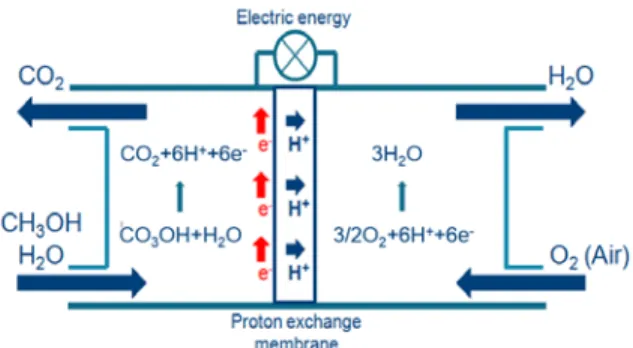
The development of efficient substitutes to fossil fuel technologies is an important topic of current scientific research. Fuel cells are, in this respect, a very promising alternative; they have high fuel conversion and electrical efficiency, in addition to a low generation of greenhouse gases [1]. The basic principle of a direct fuel cell is the oxidation of a molecule, such as methanol, CH3OH, which in the
presence of H2O is decomposed into six protons, six
electrons and CO2. Following, protons diffuse
through an exchange membrane, after which they react with O2 forming water, whereas electrons are
transported to a device powered with electrical energy (Figure 1). This oxidation reaction is usually catalyzed by platinum nanoparticles (NPs), which
are deposited at the surface of the membrane. A major drawback of state-of-the-art fuel cells is the CO poisoning. The catalytic Pt NPs are very reactive toward carbon monoxide, which is present both as a contaminating agent in the gas lines of the cell and as a sub product of the methanol oxidation reaction. CO is rapidly adsorbed at the NP’s surface, decreasing the number of reactive sites and thus, reducing the cell’s performance [2].
element in the NP, which then interacts with CO, adsorbed onto Pt, forming a more stable complex that therefore can be released from the NP’s surface [3]. The second alternative is a purely electronic effect. By alloying the NP, the local electronic structure at the Pt reaction site is modified, directly affecting its interaction with CO [4].
Figure 1. Schematic representation of a direct methanol fuel cell.
Gas-phase clusters as model systems
It is challenging to disentangle the influence of the bi-functional mechanism from the electronic effect by traditional fuel cell experiments. Small Pt clusters (particles composed of a countable number of atoms) in the gas phase are, in this context, ideal model systems for investigation [5]. In catalyzed reactions, such as those in fuel cells by platinum NPs, low-coordinated sites play a major role. Even though a small cluster differs significantly from these NPs, low-coordinated sites are well represented. In addition, clusters in molecular beams are produced under well-defined conditions. Critical parameters such as the particle’s composition, size and charge state are under
control. Moreover, experiments are performed under high-vacuum conditions, so undesired molecules are avoided (as OH groups, for instance); in a gas-phase experiment the bi-functional mechanism can be excluded. An additional advantage of gas-phase experiments on small clusters is that, because of their few-atom nature, detailed theoretical calculations can be performed and results directly compared with the experiment.
Bimetallic clusters are produced by the techniques of laser ablation and inert gas condensation [6]. Basically, two metallic targets are vaporized by two independent high-energy lasers, focused at the surface of the targets. By changing the time delay between both lasers as well as their energy, clusters of different compositions can be produced. In the study presented here, conditions are selected such that Pt clusters with a single dopant atom (Sn, Ag, Nb and Mo) are formed. In order to induce aggregations of the ablated atoms, He gas at a high pressure is added; by collisions with He the ablated plasma is cooled down forming a distribution of clusters of different sizes and charge states.
A scheme of the cluster beam setup at KU Leuven is shown in Figure 2. Details can be found elsewhere [7]. In a first vacuum chamber clusters are produced, as described previously. Following, the formed clusters enter a second chamber in which they interact with CO at controlled pressures in a low-collision reaction cell [8]. Finally, the intensities of the cluster-CO complexes are recorded by time-of-flight (TOF) mass spectrometry. In this technique, clusters are accelerated by a potential difference ∆𝑉𝑉 and the time 𝑡𝑡 needed for the clusters to travel a distance
𝑑𝑑, where a time-sensitive detector is placed, is measured. In a simplified electrostatic model this time is basically a function of the cluster mass 𝑀𝑀, if its charge 𝑞𝑞 is known.
𝑡𝑡 = 𝑑𝑑�𝑚𝑚 2𝑞𝑞∆𝑉𝑉� . (1)
Thus, by measuring the time-of-flight of a cluster, its mass or atomic composition is known. As shown later, in the experiments presented here this technique is not only used to characterize the size of the Pt and doped-Pt clusters, but also to study their interaction with CO, since once a cluster adsorbs a molecule, its change in mass can be detected.
Mass spectrometric investigations
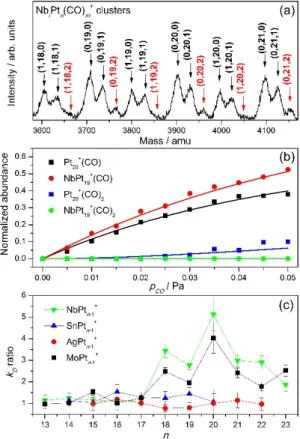
Valuable information on the interaction of a cluster with CO, and more importantly, on the effect of doping on this interaction, can be extracted from a mass spectrometric investigation. Figure 3a [9] shows part of such a spectrum, in which the time-axis has been converted into mass. As seen, under the applied experimental conditions a wide distribution of monometallic as well as Nb doped Ptn+ clusters are produced, with both species present in the same molecular beam. These clusters, as a function of size and composition, can be clearly distinguished in the mass spectrum. Furthermore, by adding CO through the reaction cell, clusters react and form cluster–(CO) and –(CO)2
complexes. Already from this spectrum differences in CO interaction, induced by doping, can be observed; in clusters doped by Nb, the intensity of complexes with two CO molecules are clearly lower than the corresponding (CO)2 complexes of the
monometallic Pt cluster of the same size.
Figure 3. a) Mass spectrum of monometallic and Nb-doped Pt clusters exposed to CO gas. b) Fit of normalized intensities of (CO) and (CO)2
complexes of Pt20+ and NbPt19+ clusters as a
function of 𝑝𝑝𝐶𝐶𝐶𝐶. c) Size dependent ratio of
backward reaction coefficients 𝑘𝑘𝐷𝐷 [9].
Thus, as seen in Figure 3a, Nb doping can influence the interaction of a small Pt cluster with CO, resembling to some extent the observation that alloy-Pt nanoparticles are less affected by CO poisoning. In our research four doping elements were selected, all of them known to improve the performance of Pt catalysts in fuel cells: Nb, Mo, Sn and Ag [3]. In order to obtain quantitate information about the effect of doping on the clusters’ reactivities, CO was added at different pressures (𝑝𝑝CO) in the reaction cell, and the relative
intensity of a CO complex and its corresponding bare cluster was extracted from the recorded mass spectra. An example of this type of experiment is presented in Figure 3b; by increasing 𝑝𝑝CO, the
complexes increase, although differently for the monometallic and doped clusters.
The formation of a cluster–CO complex can be characterized by a forward (𝑘𝑘𝑓𝑓) and a backward
(𝑘𝑘𝑑𝑑) reaction coefficient, assuming a two-step reaction mechanism as described by Eq. (2):
𝑀𝑀 + 2(CO)𝑘𝑘𝑓𝑓
(1)
⇄ 𝑘𝑘𝑑𝑑(1)
𝑀𝑀(CO) + CO𝑘𝑘𝑓𝑓
(2)
⇄ 𝑘𝑘𝑑𝑑(2)
𝑀𝑀(CO)2, (2)
with 𝑀𝑀 representing a cluster. In fact, Eq. (2) represents a set of differential equations that can be solved numerically and fitted to the normalized abundances of Figure 3b, with 𝑘𝑘𝑑𝑑 as a free parameter. This coefficient characterizes the interaction of CO with the clusters, since it is sensitive to the cluster–CO binding energy; the life-time of a cluster–CO complex in which CO is strongly adsorbed on the cluster will be longer and thus, its 𝑘𝑘𝑑𝑑 coefficient smaller. An overview of
these coefficients, for the different cluster sizes and dopant atoms studied is presented in Figure 3c. In the figure, ratios of 𝑘𝑘𝑑𝑑(2) coefficients for the doped
cluster and their corresponding monometallic species are shown, so that the effect of doping is clearly visible. When Nb and Mo atoms are used as dopants, ratios are higher than 1, meaning that upon doping, 𝑘𝑘𝑑𝑑 coefficients are increased or
binding energies reduced. Surprisingly, when Sn and Ag are used as dopants, no effects on 𝑘𝑘𝑑𝑑 are
observed, as ratios stay basically equal to 1, within the error margin of the experiment. Noteworthy is that the observed effects are only visible for sizes larger than n=17; this is a consequence of the reduced heat capacity of the smaller clusters and the specific time scale of the experiment (see Ref. [9]).
Theoretical calculations
Information about the effect of the dopant atom on the electronic structure and consequently on the
interaction of CO with the clusters, , was obtained by theoretical calculations. Density functional theory (DFT) simulations were performed on a specific cluster size (19-atom system) for both, the monometallic as well as the doped species.
Figure 4. Minimum-energy structures of Pt19+
and XPt18+ clusters (X=Nb, Mo, Ag, and Sn).
Dopant atoms are colored in red (Nb, Mo) and green (Ag, Sn). Inequivalent surface sites are numbered [9].
An extensive search for structures was performed on the studied clusters, in order to obtain the minimum-energy configurations, which are shown in Figure 4. It is found that the most stable structure of the clusters depends on the type of dopant atom. Whereas Nb and Mo atoms take an endohedral position in the cluster, forming a cage surrounded by Pt atoms, Sn and Ag are located at the surface of the cluster.
The effect of electronic charge transfer on
the clusters’ CO reactivity
As seen, the structures adopted by the doped clusters already shed some light on a different behavior depending on the selected dopant atom. However, to understand how this actually affects the interaction of the system with CO, the results from the calculations must be analyzed at an electronic level.
CO 5σ orbital to the empty Pt 5d states and back-donation from occupied Pt 5d states to the CO 2π antibonding orbital. This is exemplified in Figure 5, in which wavefunctions of the different molecular orbitals (MOs) of the free CO molecule are depicted (obtained by a DFT calculation), together with those orbitals produced by the hybridization of the d
states of a Pt atom and the MOs of CO. This hybridization is usually interpreted as an electronic charge donation in the Blyholder model. The bottom line of local electronic structure modifications as explanation for the CO tolerance in Pt-X alloy nanoparticles is that electron transfer from the alloying agent to the empty Pt 5d states reduces the Pt–CO bonding strength, since then there is less possibility for CO to donate charge to Pt [4].
Figure 5. Scheme of the interaction between a metal surface and CO. Left: electronic bands of the metal surface. Right: 5σ and 2π molecular orbitals of the free CO. Middle: Hybridized orbitals of the one atom Pt-CO system.
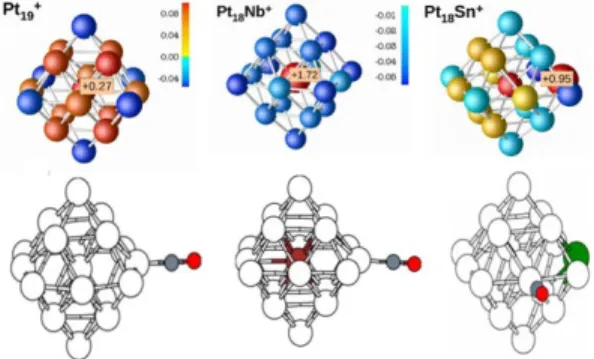
Therefore, an important parameter to explain the experimental findings is the electronic charge distributions within the pure and doped platinum clusters, which can be obtained from the performed DFT calculations. This is shown in the top panel of Figure 6, with different colors representing different electronic charges per atom. In the figure, positive charges are represented in red, whereas negative ones in blue. As seen, in Pt19+
depending on coordination the Pt atoms can get a slightly positive or slightly negative charge, adding in total the +1 charge of the positively charged
cluster. This, however, is very different when Nb or Mo atoms are added to the cluster; the highly-coordinated dopant atom transfer electronic charge to all surrounding Pt atoms. This transfer is so strong that, even though the overall change of the cluster is +1, all Pt atoms become negatively changed. A different charge distribution is found for Ag or Sn doped platinum clusters: less electronic transfer is induced in these cases with the consequence that, as in Pt19+, Pt atoms are slightly
positive or slightly negatively charged.
Figure 6. Top: Bader charges on Pt19+, NbPt18+,
and SnPt18+. Positively (negatively) charged
atoms are colored with various shades of red (blue). Bottom: Minimum-energy structures of the 19-atom clusters after CO adsorption [9].
The question remains, however, as to how much these charge transfers affect the interaction of the cluster with CO. To answer that, CO molecules were included in the calculations, as shown in the bottom panel of Figure 6. From these calculations, CO adsorption energies (𝐸𝐸𝑎𝑎𝑑𝑑𝑎𝑎) can be
extracted, as defined by Eq. (3):
𝐸𝐸ads= 𝐸𝐸cluster+CO− 𝐸𝐸cluster− 𝐸𝐸CO, (3)
with 𝐸𝐸cluster+CO, 𝐸𝐸cluster and 𝐸𝐸CO the total energy of
electron charge transfer, a major reduction in CO adsorption energy is found (i.e. for Nb and Mo dopants). In the case of Sn and Ag dopants, a small electron charge transfer and minor changes in 𝐸𝐸ads
are found.
Table 1. Calculated CO adsorption energies and Bader charges on X in XPt18+ clusters.
Cluster Charge at X Eads / eV
Pt19+ -2.38
NbPt18+ +1.72 -1.81
MoPt18+ +1.40 -1.83
AgPt18+ +0.37 -2.26
SnPt18+ +0.95 -2.21
Theoretical results thus agree very well with the experimental observations. Because of the strong dopant to Pt electron charge transfer in clusters doped with Nb and Mo, adsorption energies of CO are reduced, with the consequence that dissociation rates are increased. This is observed in the experiment as a reduction in the intensity of the cluster-CO complexes. On the contrary, Sn and Ag affect only minorly the charge distributions of the clusters and thus, only small changes in adsorption energies are induced, traduced in no significant effects in the experiment.
Conclusions
In summary, a combined mass spectrometric and density functional theory study has shown that a single dopant atom in small cationic Pt clusters alters the interaction of the clusters with CO. The magnitude of the effect depends on the kind of dopant atom, with a significant change in the cluster–CO interaction upon Nb and Mo doping and no or minor influence for Sn and Ag doping. The higher occupancy of the Pt valence d band in Nb and
Mo-doped clusters is responsible for the reduced CO
adsorption energies, which explains the lower abundances of the cluster–(CO)2 complexes in the
experiment.
Several Pt alloy nanoparticles, including PtNb, PtMo, PtSn and PtAg, have been tested in real PEMFCs and show an improved tolerance to CO poisoning. Here the particular role of intraparticle charge transfer on the CO binding energies in Pt clusters containing a single dopant atom was demonstrated. Since CO binding is a local event, conclusions from this work may be relevant for larger Pt-X alloy nanoparticles that show enhanced CO tolerance and should be considered when developing future fuel cells with better durability.
Acknowledgments
This work at KU Leuven was supported by the Research Foundation-Flanders (FWO) and by the KU Leuven Research Council (GOA/14/007). P.F. acknowledges CONICYT for Becas Chile scholarship. The work in Valladolid was supported by MINECO (grant number MAT2014-54378-R) and Junta de Castilla y Leon (grant number VA050U14).
References
[1] S. Badwal, S. Giddey, A. Kulkarni, J. Goel and S. Basu, Appl. Energy 145, 80 (2015).
[2] J. J. Baschuk and X. Li, Int. J. Energy Res. 25, 695 (2001).
[3] S. M. M. Ehteshamia, S. H. Chan, Electrochim. Acta, 93, 334 (2003).
[4] M.-S. Liao, C. R. Cabrera, Y. Ishikawa, Surf. Sci. 445, 267 (2000).
[5] H. Schwarz, Angew. Chem. Int. Ed. 54, 10090 (2015).
[6] M.A. Duncan, Rev. Sci. Instrum. 83, 041101 (2012).
[8] E. Janssens, H. T. Le, P. Lievens, Chem. Eur. J. 21, 1 (2015).
[9] P. Ferrari, L.M. Molina, V.E. Kaydashev, J.A. Alonso, P. Lievens, E. Janssens, Angew. Chem. Int. Ed. 55, 11059 (2016).