ARTÍCULO ORIGINAL
Spray drying of calcium and magnesium citrate from
dolomite
Secado por aspersión de citrato de calcio y magnesio a partir
de dolomita
Dr.C. Jorge Enrique Rodríguez Chanfrau,I Dr.C. Orestes Dario López
Hernández,II Lic. Osiris Blanco Cantero, II Lic. Antonio Nogueira Mendoza, II
Tec. Marilyn López ArmasII
I Faculty of Chemistry, Havana University, Havana, Cuba II Drug Research and Development Center. Havana, Cuba
ABSTRACT
Introduction: calcium is an essential nutrient required in substantial amounts, but many diets are deficient in calcium making supplementation necessary or desirable. On the other hand, spray drying is an important technology used in the
pharmaceutical industry. In this process the end-product must comply with precise quality standards.
Objective: To evaluate the spray drying of calcium and magnesium citrate and to make comparison with the traditional method of drying.
Methods: calcium and magnesium citrate salt was obtained at bench scale from dolomite and suspended in water in a proportion 1:10 (w/v) and spray-dried. The final batches were evaluated by chemical and technological analysis methods Results: the results showed that calcium, magnesium, citric acid and total ash content have similar concentrations regardless of the used drying method. Residual moisture content of the dried product by spray drying method was higher than that of the dried sample by traditional method. Nevertheless, all the results were below the maximum allowable limit. The physical properties of the samples for each drying method were similar except for density because the spray-dried samples showed values lower than those of traditionally dried samples.
Keywords: calcium and magnesium citrate, residual moisture content, Dolomite, density, spray dried.
RESUMEN
Introducción: el calcio es un nutriente esencial que se requiere en cantidades sustanciales, pero muchas dietas son deficientes de calcio, lo que hace necesario suplementar el mismo. Por otro lado, el secado por aspersión es una tecnología importante usada en la industria farmacéutica. Con este proceso de secado se obtiene un producto final que obedece a los estándares de calidad necesarios. Objetivo: este estudio se realizó para evaluar el secado por aspersión del citrato de calcio y magnesio y su comparación con el método tradicional de secado. Métodos: se obtuvieron lotes de citrato de calcio y magnesio a escala de banco a partir de dolomita y se suspendieron en agua en una proporción 1:10
(masa/volumen). Posteriormente fueron secados mediante secado por aspersión. Se evaluaron los lotes obtenidos mediante métodos de análisis químicos y
tecnológicos.
Resultados: los resultados mostraron que el contenido de calcio, magnesio, ácido cítrico y cenizas totales eran similares independiente del método de secado
empleado. El contenido de humedad residual en las muestras secadas por aspersión fue superior al de las muestras secadas por el método tradicional. No obstante, los resultados obtenidos en ambos casos estaban por debajo del límite máximo permisible. Las propiedades físicas de las muestras para cada método de secado estudiado fueron similares, excepto para la densidad, dónde se observó que las muestras secadas por aspersión tienen valores de densidad menores que las muestras secadas por el método tradicional.
Conclusiones: los resultados demuestran que las condiciones de secado por aspersión estudiadas son adecuadas para el secado del citrato de calcio y magnesio obtenido a partir de dolomita.
Palabras clave: citrato de calcio y magnesio, contenido de humedad, Dolomita, densidad, secado por aspersión.
INTRODUCTION
Drying may be defined as the vaporization and removal of water or other liquid from a solution, suspension, or other solid-liquid mixture to form a dry solid. Drying is normally associated with the removal of relatively small quantities of liquid to give a dry product. During the trial of drying of a material, static dryers or
Spray drying is an important technology used in the pharmaceutical industry. In this process the end-product must comply with precise quality standards regarding particle size distribution, residual moisture content, bulk density and morphology.2,3
Calcium is an essential nutrient required in substantial amounts, but many diets are deficient in calcium making supplementation necessary or desirable. The absorption of calcium from dietary supplements has been studied by many methods. Some studies have shown the more soluble calcium citrate to be somewhat better absorbed than the relatively insoluble calcium carbonate.4-6
A process to obtain calcium and magnesium citrate from dolomite has been developed. This process consists on making react dolomite with citric acid, with later precipitation of the calcium and magnesium citrate.7 Hot air ovens during eight
hours to dry the end-product were used.8 This study aimed to evaluate the spray
dried of the calcium and magnesium citrate and their comparison with the traditional method of drying.
METHODS
MATERIALS
Dolomite (GEOMINERA, Cuba) and citric acid (Proquibasa, Spain) were used. Both compounds obtained commercially were of the highest purity in accordance with the monographs of quality of the makers.
PREPARATION OF CALCIUM AND MAGNESIUM CITRATE SALT
Calcium and magnesium citrate salt was obtained at bench scale from dolomite in accordance with a modification to the procedure described in earlier paper.7 The
modification consisted in the filtered sample is suspended in water in a proportion 1:10 (w/v) and dried by spray dried.
The parameters of dryings were carried out according to Vidal et al.9 The
suspension was spray dried in a Büchi B 191 model spray dryer (Switzerland). Inlet air temperature (180 °C) and outlet air temperature (100 °C) were carried out. The product was fed into the spray dryer at room temperature 600 L/h: the rate was varied to regulate exit air temperature at the desired value. After cooling to room temperature, the powder was placed in plastic bags and stored until analysis. The results were compared with the traditional method of drying, consistent in the drying of the product in hot air ovens (static drying) during 8 hours at 100 ºC.8
EVALUATION OF CALCIUM AND MAGNESIUM CITRATE SALTS
Chemical evaluation: calcium and magnesium determination (complexometric
method) and citric acid determination (volumetric method) were used according to Rodriguez y col.10 Moisture content and total ash according to USP were
BULK AND TAPPED DENSITY (HAUSNER´S RATIO AND CARR´S COMPRESSIONAL INDEX)
The density parameters (bulk and tap densities) were determined using an appropriate amount of the sample was poured in a 100 mL tared graduated
cylinder. The volume was then read directly from the cylinder and used to calculate the bulk density according to the mass/volume ratio. For tap density the cylinder was tapped 1 000 times using a tap density analyzer (Erweka SVM1, Germany). The flow rate was measured by a glass funnel with a round orifice of 120 mm, its outlet is separated 100 mm respect to a horizontal surface, and with a wall angle of 45 degrees.12
POWDER PARTICLE SIZE ANALYSIS
The particle size distribution was measured using a laser scattering particle size analyzer (model LS 230, Beckman Coulter, USA). For measurement, the sample was diluted to less than 0,02 % w/w to prevent multiples scattering effects. The size distribution of sample powders was determined by dispersing them in absolute ethanol and analyzing them with the same laser scattering spectrophotometer. Determinations were done in triplicate. The powder was characterized as the average particle size (µm).
STATISTICAL ANALYSIS
Obtained results were expressed as mean ± standard deviation (SD) and assessed by analysis of variance (ANOVA) followed by Duncan's test. Results were considered significant when p< 0.05.
RESULTS
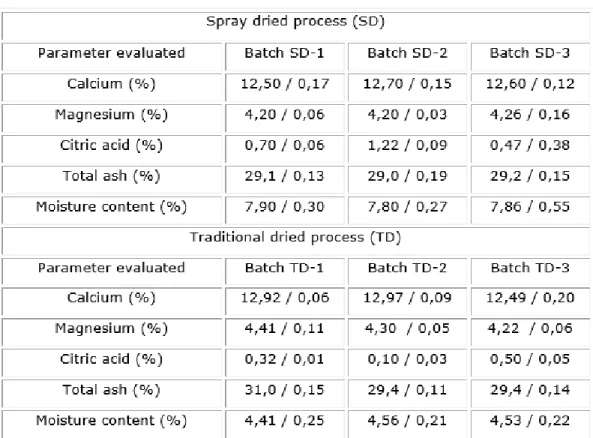
The table 1 show the results of chemical evaluation of the studied batch. Calcium, magnesium, citric acid and total ash content have similar concentrations
independent of the drying method used. These results coincide with results reported in previous works.8,10,13
Table 2 show the physical properties of the samples for each method of studied drying. Concerning the sample density, in both cases descending values of tapped density>bulk density were observed. The high values of Hausner’s ratio and Carr’s index are indicative of an extremely poor flow according to USP 11 causing their
DISCUSSION
A critical process control parameter during the spray dryer is the humidity of the exhaust air. Thermodynamic modeling was used to estimate the humidity of the exhaust air for a particular set of processing conditions. However, this methodology was not able to predict most particle/powder related attributes such as particle size and moisture level. On the other hand, the process of atomization and particle formation events occur in sequence, where the droplets formed come into contact with the hot gas leading to evaporation of the solvent and solute precipitation.2 The
understand of these processes can help to improving powders attributes. In the pharmaceutical applications pressure nozzles are preferred to two-fluid nozzles, however, when feeds have very high viscosities or large suspended
materials may block the nozzle orifice. To avoid this situation, the quantity of water is generally increased being bigger the residual moisture content in the final
product.
In this case, the product contained high concentration of particles in suspension what blocked the nozzle orifice, being necessary to dilute the solution until 10 % of particle in suspension. As consequence of this process a high content of water is necessary to evaporate with an increment of the humidity of the exhaust air. This situation causes a superior content of residual moisture in the samples dried by spray dried. Nevertheless, the obtained results were below the permissible
maximum limit (10 %).17 These results are also inferior to Calcium citrate available
commercially which contains about 13 % water.9,11
The density is an essential parameter in the characterization of the powders. It can be observed that the samples dried by spray dried have bulk and tap density values smaller than the bulk and tap density values of the samples dried by the traditional method. This is because the porous structures are favored by high drying rate promoted by the use of high temperatures due to the expansion of evaporation of water vapour leaving the empty spaces occupied by the air. The particles occupy space with little weight.16,18
The porosity values were in the range of 45 % to 52 % for both samples and were not affected by the conditions of drying under study. The high porosity percentage observed was motivated maybe by the packaging type open of the solid mass. It is cause of the packaging type open of the solid mass, indicating the tendency of the material to form agglomerates, affecting the rheology properties of the samples. These results coincide with previous studies.13
On the other hand, the Hausner’s ratio and Carr's index were not affected by the conditions of drying. In both cases, high values of Hausner's ratio and Carr's index was observed. These results confirm an extremely poor flow according to USP causing their inability to flow.11
The particle size was smaller in the dried samples by spray dried. This is because an increase of the atomization speed due to higher atomizer wheels speeds, decrease of droplet and therefore particle size.19
A white powder with moisture contents about 6% and a bulk density between 0.3 and 0.7 g/cm3 was obtained by Vidal et al when drying by spray dried calcium
citrate obtaining by neutralization of citric acid with calcium hydroxide.9 These
In conclusion, the results indicate that the spray drying conditions studied to dry calcium and magnesium citrate were satisfactory.
REFERENCE
1. Hickey A, Ganderton D. Drying. In: Pharmaceutical Process Engineering. Drugs and the Pharmaceutical Science. Vol 112. Cap 6. New York, USA:Marcell Dekker Inc; 2001. p.86-109.
2. Gil M, Vicente J, Gaspar F. Scale-up methodology for pharmaceutical spray drying. Chemistry Today. 2010; 28(4):18-22.
3. Patel R, Patel M, Suthar A. Spray drying technology: an overview. Indian Journal of Science and Technology. 2009; 2(10):44-47.
4. Hanzlik R, Fowler S, Fisher D. Relative Bioavailability of Calcium from Calcium Formate, Calcium Citrate, and Calcium Carbonate. JPET. 2005;313(3):1217–1222. 5. Heaney R P. Factors influencing the measurement of bioavailability, taking calcium as a model. J Nutr 2001; 131: S1334–S1348.
6. Sakhaee K, Bhuket T, Adams-Huet B, Sudhaker Rao D. Meta-analysis of calcium bioavailability: a comparison of calcium citrate with calcium carbonate. Am J Ther. 1999;6:313–321.
7. Rodríguez Chanfrau JE, Graveran T, Rodríguez I, Díaz I, Roberto Y, Mateus L, et al. Proceso de obtención de citrato de calcio y magnesio a partir de dolomíta. Patente CO1F 1/00; A61K 33/06, A61K 9/00, C07C 51/41. Certificado 22794. 2002. 8. Rodríguez Chanfrau J E, López Hernández OD, Nogueira Mendoza A. Calcium magnesium citrate drying at bench scale. Rev Cubana Farm. 2009;43(1). [cited 2014 feb 08]; Available from:
http://scielo.sld.cu/scielo.php?script=sci_arttext&pid=S0034-75152009000100004&lng=es&nrm=iso .
9. Vidal S, Saleeb Fouad Z. Calcium Citrate anticaking agent. United States patent US 5208372;1993.
10. Rodríguez Chanfrau JE, Lagarto Parra A, Bueno Pavón V, Guerra Sardiña I, Vega Hurtado Y. Effectiveness of washout process to obtain calcium and magnesium citrate at bench scale. Rev Cubana de Farm. 2010;45(1):5-12. 11. USP. United States Pharmacopoeia 31. US Pharmacopoeia Convention, Inc. Washington DC. 2008; p. 149, 753 – 757, 1914 – 1917, 2834 – 2838.
14. Ré MI. Microencapsulation by spray drying. Drying Technology. 1998;16(6):1195-1136.
15. Nath S, Sapathy GR. A systematic approach for investigation of spray drying process. Drying Technology. 1998;16(6):1173-1193.
16. Santos Souza A, Vilela Borgues S, Ferreira Magalhaes N, Vaz Ricardo H, Pascoli Cereda M, Regina Daiutos E. Influence of spray drying conditions on the physical properties of dried pulp tomato. Ciênc. Tecnol. Aliment. 2009;29(2):291-294. 17. Rodríguez Chanfrau JE, Fuste Moreno V.Citrato de calcio. Ficha técnica de control de la calidad. Centro de Investigación y Desarrollo de Medicamentos. La Habana, Cuba: BioCubaFarm;2002.
18. Walton D. E. The morphology of spray dried particles: a qualitative view. Drying Technology. 2000;18(9):1943-86.
19. Chegini G. R, Ghobadian B. Effect of spray drying conditions on physical properties of orange juice powder. Drying Technology, 2005;23(3):657-668.
Recibido: 25 de marzo de 2014 Aprobado: 2 de junio de 2014