r e v i e w a r t i c l e
The n e w e n g l a n d j o u r n a l of m e d i c i n e
c u r r e n t c o n c e p t s
Acute Cardiac Tamponade
David H. Spodick, M.D., D.Sc.
From the Division of Cardiovascular Med-icine, Department of MedMed-icine, Saint Vin-cent Hospital–Worcester Medical Center, Worcester, Mass.
N Engl J Med 2003;349:684-90. Copyright © 2003 Massachusetts Medical Society.
ardiac tamponade is life-threatening, slow or rapid compres
-sion of the heart due to the pericardial accumulation of fluid, pus, blood, clots, or gas, as a result of effusion, trauma, or rupture of the heart.1,2 Because the
causes of pericardial disease1 and thus of tamponade are diverse, clinicians must choose
the most probable diagnosis, always anticipating surprises. Thus, traumatic tampon-ade is most apt to follow cardiac surgery, and tuberculous tampontampon-ade is relatively com-mon in Africa but rare in the United States.
Understanding the physiological changes produced by tamponade is essential to diagnosis and treatment.3-12 The primary abnormality is rapid or slow compression of
all cardiac chambers as a result of increasing intrapericardial pressure. The pericardial contents first reach the limit of the pericardial reserve volume6 — the volume that
would just distend the pericardium — and the rate of expansion then increases, soon exceeding that of pericardial stretch. Although the pericardium stretches normally over time, at any instant it is inextensible, making the heart compete with the increased peri-cardial contents for the fixed intraperiperi-cardial volume.6,10 As the chambers become
progressively smaller and myocardial diastolic compliance is reduced, cardiac inflow becomes limited, ultimately equalizing mean diastolic pericardial and chamber pres-sures.1-3 Key elements are the rate of fluid accumulation relative to pericardial stretch
and the effectiveness of compensatory mechanisms. Thus, intrapericardial hemorrhage from wounds or cardiac rupture occurs in the context of a relatively stiff, unyielding peri-cardium and quickly overwhelms the pericardial capacity to stretch before most com-pensatory mechanisms can be activated, whereas in the case of a slow increase in pericar-dial volume as a result of inflammation, 2 liters or more may accumulate before critical, life-threatening tamponade occurs.13
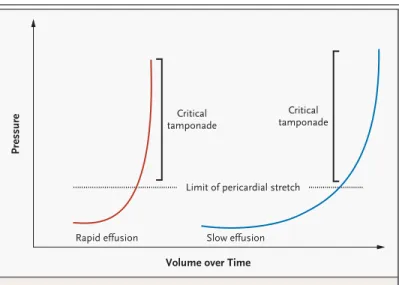
The stiffness of the pericardium determines fluid increments precipitating tam-ponade, as illustrated by characteristic pericardial pressure–volume (strain–stress) curves (Fig. 1): there is an initial slow ascent, followed by an almost vertical rise.2 This steep rise
makes tamponade a “last-drop” phenomenon: the final increment produces critical car-diac compression, and the first decrement during drainage produces the largest relative decompression.
The true filling pressure is the myocardial transmural pressure, which is intracardiac minus pericardial pressure.14 Rising pericardial pressure reduces and ultimately offsets
this transmural pressure, first for the right heart and ultimately for all chambers. On av-erage, during inspiration and expiration, the right heart increases its filling at the expense of the left, so that its transmural pressure transiently improves and then reverts during expiration.1,2,14 In florid tamponade such a mechanism cannot compensate for reduced
stroke volumes, since these volumes depend on the elements that protect cardiac output and arterial pressures, principally beta-adrenergically increased heart rate, peripheral re-sistance and ejection fractions, and given sufficient time, expansion of the blood vol-ume. Additional compensation provided by neurohormonal stimulation is similar to that occurring in heart failure,15 except that the levels of atrial natriuretic peptide do
c u r r e n t c o n c e p t s
not increase because the compressed myocardium cannot stretch.16
Acute tamponade thus reflects decompensation as patients reach the steep portion of the pressure– volume curve (Fig. 1). Moreover, intercurrent fac-tors can cause the decompensation of any effusion — for example, the influx of blood, effusion-expand-ing osmotic effects of fragmenteffusion-expand-ing intrapericardial clots, or inflammatory stiffening of the pericardi-um.1,17,18 Finally, although coronary blood flow is
reduced in tamponade, there is no ischemic compo-nent because coronary flow remains proportional to the reduced work and operational requirements of the heart.8
Critical tamponade is a form of cardiogenic shock, and the differential diagnosis may initially be elu-sive. Since most symptoms are nonspecific, tam-ponade must be suspected in many contexts — for example, in patients who have wounds of the chest or upper abdomen and hypotension or in those who have hypotension preceded by symptoms of an in-citing pericardial disease, such as chest discomfort and pleuritic pain. Tachypnea and dyspnea on exer-tion that progresses to air hunger at rest are the key symptoms, but it may not be possible to obtain such information from patients who are unconscious or obtunded or who have convulsions at presentation. Most patients are weak and faint at presentation and can have vague symptoms such as anorexia, dyspha-gia, and cough.1 The initial symptom may also be
one of the complications of tamponade, such as re-nal failure.19
Most physical findings are equally nonspecif-ic.1,19 Tachycardia (a heart rate of more than 90 beats
per minute) is the rule. Exceptions include patients with bradycardia during uremia and patients with hypothyroidism. Contrary to common belief, a peri-cardial rub is a frequent finding in patients with inflammatory effusions.20 Heart sounds may be
at-tenuated owing to the insulating effects of the peri-cardial fluid and to reduced cardiac function. Al-though the precordium may seem quiet, an apical beat is frequently palpable, and patients with preex-isting cardiomegaly or anterior and apical pericar-dial adhesions may have active pulsations.
Clinically significant tamponade usually produc-es absolute or relative hypotension; in rapid tam-ponade, patients are often in shock, with cool arms and legs, nose, and ears and sometimes peripheral
cyanosis. Jugular venous distention is the rule, with peripheral venous distention in the forehead, scalp, and ocular fundi unless the patient has hypovolemia. Thus, rapid tamponade, especially acute hemoperi-cardium, may produce exaggerated jugular pulsa-tions without distention, because there is insuffi-cient time for blood volume to increase. Venous waves usually lack the normal early diastolic y de-scent. In compressive pericardial disease (tampon-ade and constriction), venous waves are not out-ward pulsations; rather, x and y collapse from a high standing pressure level.1
A key diagnostic finding, pulsus paradoxus21 —
conventionally defined as an inspiratory systolic fall in arterial pressure of 10 mm Hg or more during normal breathing — is often palpable in muscular arteries. With very low cardiac output, however, a catheter is needed to identify pulsus paradoxus. Other conditions causing pulsus paradoxus include massive pulmonary embolism, profound hemor-rhagic shock, other forms of severe hypotension, and obstructive lung disease. Moreover, certain con-ditions can impede the identification of tamponade by making pulsus paradoxus undetectable (Table 1). c l i n i c a l f i n d i n g s
Figure 1. Cardiac Tamponade.
Pericardial pressure–volume (or strain–stress) curves are shown in which the volume increases slowly or rapidly over time. In the left-hand panel, rapidly in-creasing pericardial fluid first reaches the limit of the pericardial reserve vol-ume (the initial flat segment) and then quickly exceeds the limit of parietal pericardial stretch, causing a steep rise in pressure, which becomes even steeper as smaller increments in fluid cause a disproportionate increase in the pericardial pressure. In the right-hand panel, a slower rate of pericardial filling takes longer to exceed the limit of pericardial stretch, because there is more time for the pericardium to stretch and for compensatory mechanisms to become activated.
Pressure
Volume over Time
Critical tamponade
Limit of pericardial stretch
Rapid effusion Slow effusion
The n e w e n g l a n d j o u r n a l of m e d i c i n e
Cardiac catheterization will show equilibration of average diastolic pressure and characteristic res-piratory reciprocation of cardiac pressures: an in-spiratory increase on the right and a concomitant decrease on the left — the proximate cause of pul-sus paradoxus. Except in low-pressure tamponade, diastolic pressures throughout the heart are usually 15 to 30 mm Hg. These are similar to pressures present in heart failure, but for unknown reasons, tamponade does not cause alveolar pulmonary ede-ma.16 Although any type of large cardiac silhouette
in a patient with clear lung fields should suggest the presence of pericardial effusion, chest films may not be helpful initially, since at least 200 ml of fluid must accumulate before the cardiac silhouette is affected. In the lateral film, definite pericardial-fat
lines are uncommon but are highly specific for large effusions.19
An electrocardiogram may show signs of peri-carditis, but the only quasispecific sign of tampon-ade is electrical alternation,22 which may affect any
or all23 electrocardiographic waves or only the QRS.
If the QRS complex is affected, every other QRS com-plex is of smaller voltage, often with reversed po-larity. Combined P and QRS alternation is virtually specific for tamponade.1 In rare cases, very large
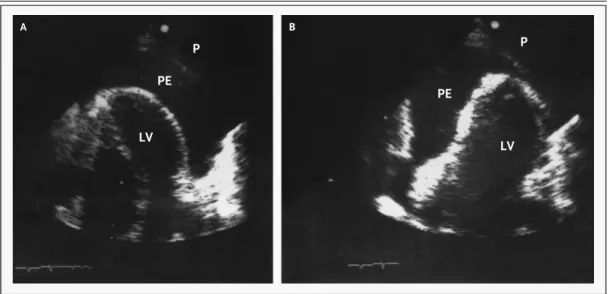
ef-fusions, even without tamponade, cause QRS alter-nation. Echocardiography reveals its mechanism: swinging of the heart (Fig. 2).23,24 The volume of
most nonhemorrhagic effusions that cause tam-ponade is moderate to large (300 to 600 ml).
Doppler echocardiography is the principal tool for diagnosing pericardial effusion and cardiac tam-ponade. Computed tomography (CT) and magnet-ic resonance imaging are often less readily available and are generally unneeded unless Doppler echo-cardiography is not feasible. In the absence of my-ocardial disease or injury, echocardiography dem-onstrates the usually circumferential fluid layer and compressed chambers with high ventricular ejection fractions.24 Doppler study discloses marked
respiratory variations in transvalvular flows. One mechanism of pulsus paradoxus is visible: on inspi-ration, both the ventricular and atrial septa move sharply leftward, reversing on expiration1; in other
words, each side of the heart fills at the expense of the other, owing to the fixed intrapericardial volume. The inferior vena cava is dilated, with little or no change on respiration.
Among echocardiographic signs, the most char-acteristic, although they are not entirely specific, are chamber collapses, which are nearly always of the right atrium and ventricle. During early diastole, the right ventricular free wall invaginates, and at end di-astole, the right atrial wall invaginates.25 Right
ven-tricular collapse is a less sensitive but more specific finding for tamponade, whereas right atrial col-lapse is more specific if inward movement lasts for at least 30 percent of the cardiac cycle. Right atrial collapse may be seen in patients with hypo-volemia who do not have tamponade. In about 25 percent of patients, the left atrium also collapses, and this finding is highly specific for tamponade. Left ventricular collapse usually occurs under spe-cial conditions such as localized postsurgical tam-ponade. These wall changes occur when respective chamber pressures temporarily fall below the peri-cardial pressure.24,25
l a b o r a t o r y i n v e s t i g a t i o n s
* In patients with marked left ventricular hypertrophy or severe left-sided heart failure, pericardial pressure effectively equilibrates only with right heart pres-sures, a form of right ventricular tamponade, with the much less compliant left ventricle resisting phasically changing pericardial pressure. Under these conditions, respiratory changes cannot alternately favor right- and left-sided filling.
Table 1. Conditions Leading to the Absence of Diagnostic Pulsus Paradoxus in Cardiac Tamponade.
Condition Consequence
Extreme hypotension, as in shock, and even severe tamponade
May make respiration-induced pressure changes unmeasurable Acute left ventricular myocardial
infarction with occasional effusion causing tamponade
—
Pericardial adhesions, especially over the right heart
Volume changes impeded
Local (usually postsurgical) pericardial adhesions
Local cardiac compression by loculated fluid
Pulmonary vein and left ventricular diastolic pressures and left ven-tricular stiffness markedly exceed those of the right ventricle*
Reduced effects of respiration on right-heart filling
Right ventricular hypertrophy without pulmonary hypertension
Causes right-sided resistance to the effects of breathing
Severe aortic regurgitation, with or without severe left ventricular dysfunction
Produces sufficient regurgitant flow to damp down respiratory fluctua-tions
Atrial septal defects Increased inspiratory venous return balanced by shunting to the left atrium
Some cases of low-pressure tamponade
c u r r e n t c o n c e p t s
Low-pressure tamponade occurs at diastolic pres-sures of 6 to 12 mm Hg and is virtually confined to patients with hypovolemia and severe systemic dis-eases, hemorrhage, or cancer, or in patients with hy-povolemia after diuresis.19 Patients are weak and
generally normotensive, with dyspnea on exertion and no diagnostic pulsus paradoxus, but with char-acteristic respiratory fluctuations in transvalvular diastolic Doppler flows. The low-pressure effusion equilibrates only with right-sided diastolic pres-sures and does so at first only during inspiration (“inspiratory tracking”).1,3 A fluid challenge with
a liter of warm saline can evoke tamponade dy-namics.26
Hypertensive cardiac tamponade27 with all
the classic features of tamponade, occurs at high and very high arterial blood pressures (even over 200 mm Hg)27 and is ascribed to excessive
beta-adrenergic drive. Affected patients typically have had antecedent hypertension.
Regional cardiac tamponade19,24 occurs when
any cardiac zone is compressed by loculated effu-sions, which are usually accompanied by localized
pericardial adhesions, especially after cardiac sur-gery. Sometimes the typical hemodynamic abnor-malities are found only in the compressed chambers or zones. However, loculation can also produce clas-sic tamponade, presumably by tightening the un-involved pericardium; for example, loculated effu-sions after cardiac surgery may include hematomas over the right atrium and atrioventricular groove.28
Localized right atrial tamponade may also cause right-to-left shunting through a patent foramen ovale or an atrial septal defect.29
After right ventricular infarction, loculated effu-sion can cause selective right-heart tamponade in which right atrial pressure is higher than left atrial pressure.28 The absence of pulsus paradoxus
(Ta-ble 1) makes this form difficult to recognize. Effu-sive–constrictive pericarditis is characterized by mixed clinical, imaging, and hemodynamic signs, because a constrictive epicarditis underlies the peri-cardial effusion. In some patients with scarred, rig-id parietal and visceral pericardium, tamponade can occur with relatively little accumulation of flu-id. Effusive–constrictive pericarditis is revealed in these patients when drainage of pericardial fluid does not cause intracardiac pressures to return to normal.30,31
v a r i a n t f o r m s o f c a r d i a c t a m p o n a d e
Figure 2. Swinging of the Heart with a Large Pericardial Effusion (PE), Causing Electrical Alternation and Consequent Tamponade.
Apical four-chamber two-dimensional echocardiograms show the extremes of oscillation and the resultant effect on the QRS complex. In Panel A, the heart swings to the right, and lead II shows a small QRS complex. In Panel B, the heart swings to the left, and the QRS complex is larger. P denotes pericardium, and LV left ventricle.
A B
P
PE
LV
P
PE
The n e w e n g l a n d j o u r n a l of m e d i c i n e
Postoperative tamponade,28 which is more frequent
after valve surgery than after coronary-artery bypass surgery and is more frequent with postoperative an-ticoagulant therapy, is due to trauma-induced peri-cardial effusion and bleeding. Since some degree of pericarditis occurs after every cardiac operation,28
and most patients have a small, seemingly benign effusion postoperatively, it is not surprising that tamponade eventually occurs in some. Postopera-tive myocardial stiffness, variable fluid–electrolyte abnormalities, and hemorrhage tend to preclude the appearance of classic signs such as pulsus par-adoxus (Table 1); thus, when tamponade is suspect-ed postoperatively, prompt imaging — particularly Doppler echocardiography — is necessary. Late tam-ponade, occurring more than five days postopera-tively,32 must be suspected in any patient in whom
hypotension develops. Primary care physicians may not be familiar with tamponade, and if it occurs very late (two weeks or more) after surgery, they may not suspect it. Some episodes of late hemorrhage may be delayed because the rates of bleeding are rel-atively slow and intrapericardial clotting compli-cates diagnosis and management.
The treatment of cardiac tamponade is drainage of the pericardial contents, preferably by needle paracentesis19 (Fig. 3) with the use of
echocardio-graphic or another type of imaging, such as fluoros-copy or CT. The needle tip is evident on imaging, and imaging can thus safely be used to identify the optimal point at which to penetrate the pericardi-um.33 Drainage may be performed in the
catheter-ization laboratory when the diagnosis is uncertain or effusive constrictive pericarditis is possible. How-ever, sudden circulatory collapse warrants the use of pericardiocentesis without imaging, since further decompensation may occur without warning. If the heart cannot be reached by a needle or catheter, sur-gical drainage is required, usually through a subcos-tal incision. Surgical drainage is desirable in patients with intrapericardial bleeding and in those with clotted hemopericardium or thoracic conditions that make needle drainage difficult or ineffective.34
Subcritical uremic tamponade often responds to in-tensified renal dialysis, but if this approach is un-successful, drainage is required.
Recurrences, especially in patients with malig-nant tamponade, may require balloon pericardi-otomy through the use of special catheters that cre-ate “windows” between the pericardium and the absorbing surface of the pleura or peritoneum.32
Death in patients with tamponade is usually her-alded by pulseless electrical activity19: the
electro-cardiogram continues to register complexes in the absence of blood flow or pressure.
Medical treatment of acute cardiac tamponade, including inotropic support with or without vaso-dilators,17 is relatively controversial35 and is aimed
at supporting compensatory mechanisms to reduce the elevated vascular resistance. Thus, dobutamine, administered to reverse the hypotension, is theo-retically ideal.3,11,13 During tamponade, however,
endogenous inotropic stimulation of the heart is of-ten already maximal.
The approach to medical therapy has been based on studies in animals. However, these results are the subject of controversy, since in short-term sur-gical experiments in anesthetized animals, the pres-ence of myocardial depression causes almost any measure to improve function.7,12,35 Studies in
tact, unanesthetized animals with indwelling in-struments and euvolemia have yielded different results that have cast doubt on the value of various approaches, especially volume infusion.7,12,35
In-deed, increasing the volume may help only in pa-tients with hypovolemia, since in papa-tients with normovolemia and hypervolemia, volume infu-sion may increase intracardiac pressures as well as heart size, which in turn increases pericardial pressure, further reducing or eliminating the low transmural myocardial pressures supporting the circulation.7,12,19 Moreover, intravenous
admin-istration of resuscitative fluid can precipitate tam-ponade.36
An opioid mechanism contributes to the hypo-tension of cardiac tamponade; experiments in an-imals show that naloxone counteracts the hypo-tension,12 but this approach has not been used
clinically.
Mechanical ventilation with positive airway pres-sure should be avoided in patients with tampon-ade, because this further decreases cardiac output.19
In patients with cardiac arrest and a large amount of pericardial fluid, external cardiac compression has little or no value, because there is little room for additional filling and because even if systolic pres-sure rises, diastolic prespres-sure falls and, in doing so, reduces coronary perfusion pressure.36
s p e c i a l p r o b l e m s
c u r r e n t c o n c e p t s
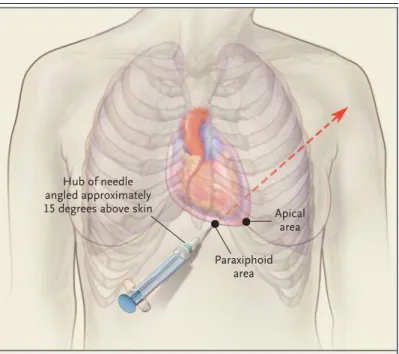
Needle drainage of pericardial fluid, whether or not it is done on an emergency basis (e.g., in a patient in rapidly worsening hemodynamic condition), re-quires the clinician to select a point on the patient’s chest or epigastrium to insert the needle. This is best done with imaging, as already discussed, to deter-mine which anterior landmarks, usually paraxiphoid or apical, are closest to the fluid. The paraxiphoid approach is also most often used for pericardiocen-tesis that is performed without imaging.1 Common
points of access are illustrated in Figure 3. The nee-dle is usually inserted between the xiphoid process and the left costal margin; in patients with tough skin, a small nick may be made first with a scalpel. The needle is inserted at a 15-degree angle to bypass the costal margin, and then its hub is depressed so that the point is aimed toward the left shoulder. The needle is then advanced slowly, until the pericar-dium is pierced and fluid is aspirated. Electrocar-diography should not be used to monitor the pa-tient’s condition, since attaching an electrode to the needle may provide misleading results.1 The use of
a 16-gauge to 18-gauge polytetrafluoroethylene-sheathed needle facilitates the process, since its steel core can be withdrawn once the pericardium has been breached, leaving only the sheath in the pericardial space. For prolonged drainage, a guide wire passed through the sheath will facilitate the introduction of a pigtail angiographic catheter. Thereafter, patients should be followed with the
use of Doppler echocardiography to ensure that the pericardial space has been adequately drained and to avert a recurrence. When the amount of fluid drained is less than 50 ml a day, the catheter may be withdrawn; the patient should continue to be observed.
p e r i c a r d i o c e n t e s i s
r e f e r e n c e s
1. Spodick DH. Pericardial diseases. In: Braunwald E, Zipes DP, Libby P, eds. Heart disease: a textbook of cardiovascular medi-cine. 6th ed. Vol. 2. Philadelphia: W.B. Saun-ders, 2001:1823-76.
2. Shabetai R. Diseases of the pericardium. In: Schlant RC, Alexander RW, eds. Hurst’s the heart: arteries and veins. 6th ed. Vol. 1. New York: McGraw-Hill, 1994:1647-74. 3. Reddy PS, Curtiss EI, Uretsky BF. Spec-trum of hemodynamic changes in cardiac tamponade. Am J Cardiol 1990;66:1487-91. 4. Beloucif S, Takata M, Shimada M, Ro-botham JL. Influence of pericardial constraint on atrioventricular interactions. Am J Physi-ol 1992;263:H125-H134.
5. Friedman HS, Lajam F, Zaman Q, et al. Effect of autonomic blockade on the hemo-dynamic findings in acute cardiac tampon-ade. Am J Physiol 1977;232:H5-H11. 6. Spodick DH. Threshold of pericardial constraint: the pericardial reserve volume and auxiliary pericardial functions. J Am Coll Car-diol 1985;6:296-7.
7. Cogswell TL, Bernath GA, Keelan MH Jr, Wann LS, Klopfenstein HS. The shift in the relationship between intrapericardial flu-id pressure and volume induced by acute left ventricular pressure overload during cardiac tamponade. Circulation 1986;74:173-80. 8. Grose R, Greenberg MA, Yipintsoi T, Cohen MV. Cardiac tamponade in dogs with normal coronary arteries. I. Effect of chang-ing intravascular volume on hemodynamics and myocardial blood flow. Basic Res Cardiol 1984;79:531-41.
9. Hurrell DG, Symanski JD, Chaliki HP, Klarich KW, Pascoe RD, Nishimura RA. As-sessment of right atrial pressure by hepatic vein Doppler echocardiography: a simulta-neous catheterization/Doppler echocardio-graphic study. J Am Coll Cardiol 1996;27: Suppl A:212A. abstract.
10.Santamore WP, Li KS, Nakamoto T, Johnston WE. Effects of increased pericar-dial pressure on the coupling between the ventricles. Cardiovasc Res 1990;24:768-76. 11.Martins JB, Manuel WJ, Marcus ML,
Ker-ber RE. Comparative effects of catechola-mines in cardiac tamponade: experimental and clinical studies. Am J Cardiol 1980;46: 59-66.
12.Klopfenstein HS, Mathias DW. Influence of naloxone on response to acute cardiac tamponade in conscious dogs. Am J Physiol 1990;259:H512-H517.
13.Reddy PS, Curtiss EI, O’Toole JD, Shaver JA. Cardiac tamponade: hemodynamic ob-servations in man. Circulation 1978;58:265-72.
14.Boltwood CM Jr. Ventricular perform-ance related to transmural filling pressure in clinical cardiac tamponade. Circulation 1987;75:941-55.
15.Schrier RW, Abraham WT. Hormones and hemodynamics in heart failure. N Engl J Med 1999;341:577-85.
16.Spodick DH. Low atrial natriuretic fac-tor levels and absent pulmonary edema in pericardial compression of the heart. Am J Cardiol 1989;63:1271-2.
17.Gascho JA, Martins JB, Marcus ML, Ker-Figure 3. Most Common Sites of Blind and Image-Guided Insertion of the Needle for Pericardiocentesis.
In the paraxiphoid approach, the needle should be aimed toward the left shoulder. In the apical approach, the needle is aimed internally.
Apical area
Paraxiphoid area Hub of needle
c u r r e n t c o n c e p t s
ber RE. Effects of volume expansion and vasodilators in acute pericardial tamponade. Am J Physiol 1981;240:H49-H53. 18.Spodick DH. The normal and diseased pericardium: current concepts of pericardial physiology, diagnosis and treatment. J Am Coll Cardiol 1983;1:240-51.
19.Cooper JP, Oliver RM, Currie P, Walker JM, Swanton RH. How do the clinical find-ings in patients with pericardial effusions in-fluence the success of aspiration? Br Heart J 1995;73:351-4.
20.Spodick DH. Pericardial rub: prospec-tive, multiple observer investigation of peri-cardial friction in 100 patients. Am J Cardiol 1975;35:357-62.
21.Shabetai R. Pericardial and cardiac pres-sure. Circulation 1988;77:1-5.
22.Spodick DH. Truly total electric alterna-tion of the heart. Clin Cardiol 1998;21:427-8. 23.Idem. Electric alternation of the heart: its relation to the kinetics and physiology of the heart during cardiac tamponade. Am J Car-diol 1962;10:155-65.
24.D’Cruz I, Rehman AU, Hancock HI. Quantitative echocardiographic assessment
in pericardial disease. Echocardiography 1997;14:207-14.
25.Reydel B, Spodick DH. Frequency and significance of chamber collapses during cardiac tamponade. Am Heart J 1990;119: 1160-3.
26.Angel J, Anivarro I, Domingo E, Soler-Soler J. Cardiac tamponade: risk and benefit of fluid challenge performed while waiting for pericardiocentesis. Circulation 1997;96: Suppl I:I-30. abstract.
27.Ramsaran EK, Benotti JR, Spodick DH. Exacerbated tamponade: deterioration of car-diac function by lowering excessive arterial pressure in hypertensive cardiac tamponade. Cardiology 1995;86:77-9.
28.Bommer WJ, Follette D, Pollock M, Are-na F, BogAre-nar M, Berkoff H. TampoAre-nade in patients undergoing cardiac surgery: a clini-cal-echocardiographic diagnosis. Am Heart J 1995;130:1216-23.
29.Thompson RC, Finck SJ, Leventhal JP, Safford RE. Right-to-left shunt across a patent foramen ovale caused by cardiac tampon-ade: diagnosis by transesophageal echocar-diography. Mayo Clin Proc 1991;66:391-4.
30.Spodick DH, Kumar R. Subacute con-strictive pericarditis with cardiac tamponade. Dis Chest 1968;54:62-6.
31.Hancock EW. Subacute effusive-constric-tive pericarditis. Circulation 1971;43:183-92. 32.Pepi M, Muratori M, Barbier P, et al. Peri-cardial effusion after cardiac surgery: inci-dence, site, size, and haemodynamic conse-quences. Br Heart J 1994;72:327-31. 33.Callahan JA, Seward JB. Pericardiocente-sis guided by two-dimensional echocardiog-raphy. Echocardiography 1997;14:497-504. 34.Merce J, Sagrista-Sauleda J, Permany-er-Miralda G, Soler-Soler J. Should pericar-dial drainage be performed routinely in pa-tients who have a large pericardial effusion without tamponade? Am J Med 1998;105: 106-9.
35.Spodick DH. Medical treatment of car-diac tamponade. In: Caturelli G, ed. Cura intensiva cardiologica. Rome: TIPAR Poli-grafica, 1991:265-8.
36.Hashim R, Frankel H, Tandon M, Rab-inovici R. Fluid resuscitation-induced car-diac tamponade. Trauma 2002;53:1183-4. Copyright © 2003 Massachusetts Medical Society.
images in clinical medicine
The Journal welcomes consideration of new submissions for Images in Clinical Medicine. Instructions for authors and procedures for submissions can be found on the Journal’s Web site at http://www.nejm.org. At the discretion of the editor, imag-es that are accepted for publication may appear in the print version of the Journal,