Problematics
Yeimmy Gisella Hernández Vargas Paula Andrea Cruz Cruz
Directed by:
Pedro Adolfo Cabrejo Ruiz
Universidad Distrital Francisco José de Caldas Licenciatura en Educación Básica con Énfasis en Ingles
Contents
Introduction 1
Justification 3
Statement of the problem 4
Chapter I: Literature review 7
Theoretical framework 14
Cross-linguistic influence (CLI) in English Foreign Language (EFL). 14
Writing skill in English Narrative Texts. 20
Cognate awareness in written texts. 22
Chapter II: Instructional design 25
Instructional objective 25
Specific objectives. 25
The pedagogical Innovation oriented to CLT and cognate awareness as an action plan 27
The methodological organization of the pedagogical intervention 29
Chapter III: Research design 34
Research question 34
Research sub-question. 34
General Objective 34
Specific objectives 34
Research paradigm 34
Mixed method research 34
General plan. 37
Sampling technique. 37
Data collection instruments. 38
Chapter IV: Data analysis. 40
Reducing data. 40
Document collection. 40
Transcription. 40
Field notes. 41
Classification through color coding/visual makers. 43
Substitutions. 43
Overextension of analogy. 43
Cognates well-used. 43
Error in meaning. 43
Error in spelling. 44
Error in Meaning + Spelling. 44
No error Meaning + Spelling. 44
Data representation 59
Final analysis 82
Chapter V: Conclusion and implications 88
Chapter VI: Limitations and further research 90
Tables and figures
Table 2.1. Examples of some common Greek and Latin roots 18
Table 2.2. A general view of the Innovative Pedagogical Intervention. 29
Table 5.1 Chronological classification of the activities in the intervention 42
Table 5.2 Cognate’s classification in color coding. 45
Table 5.3. Specific Analysis of each procedure in class using graphics. 60
Figure 1.1. Theoretical structure. 7
Figure 5.1. Cognate awareness percentage in the first activity. 60
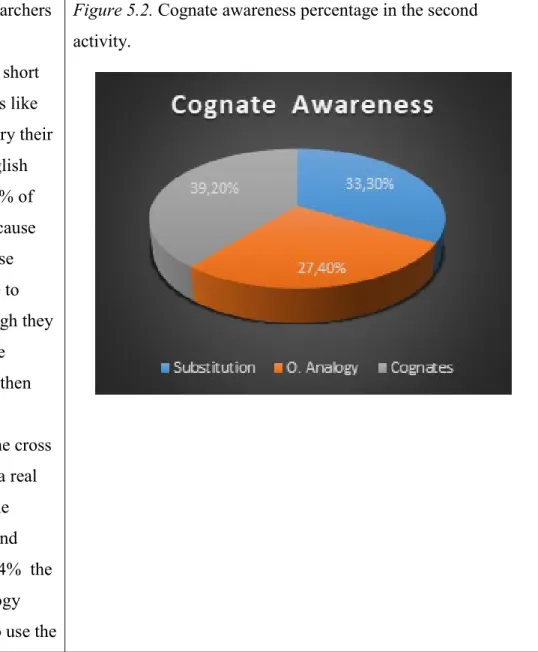
Figure 5.2. Cognate awareness percentage in the second activity 63
Figure 5.3. Cognate awareness percentage in the third activity 65
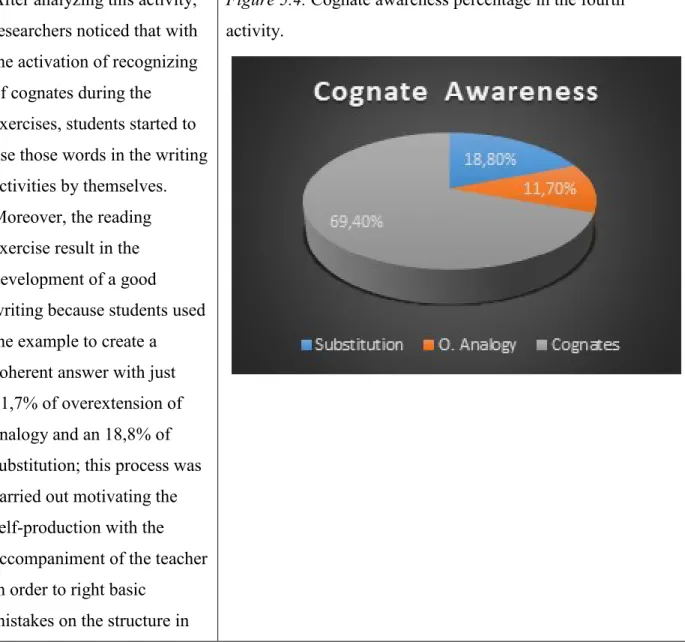
Figure 5.4. Cognate awareness percentage in the fourth activity 67
Figure 5.5. Cognate awareness percentage in the fifth activity 69
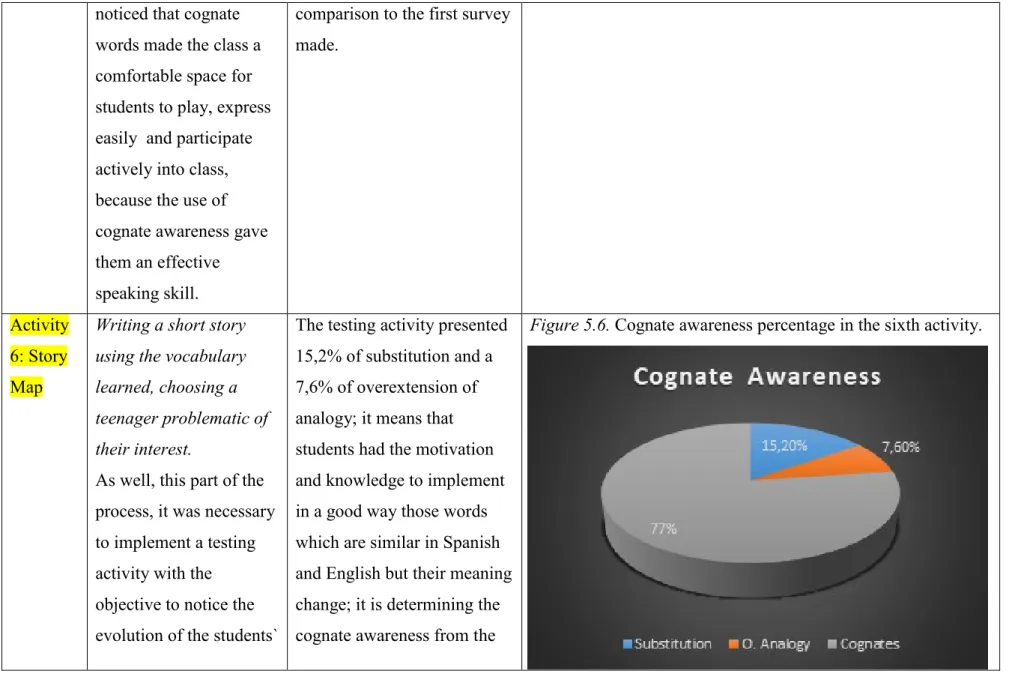
Figure 5.6. Cognate awareness percentage in the sixth activity 70
Figure 5.7. Cognate awareness percentage in the seventh activity. 73
Figure 5.8. Cognate awareness percentage in the eighth activity 74
Figure 5.9. Cognate awareness percentage in the ninth activity 75
Figure 5.10. Cognate awareness percentage in the tenth activity 77
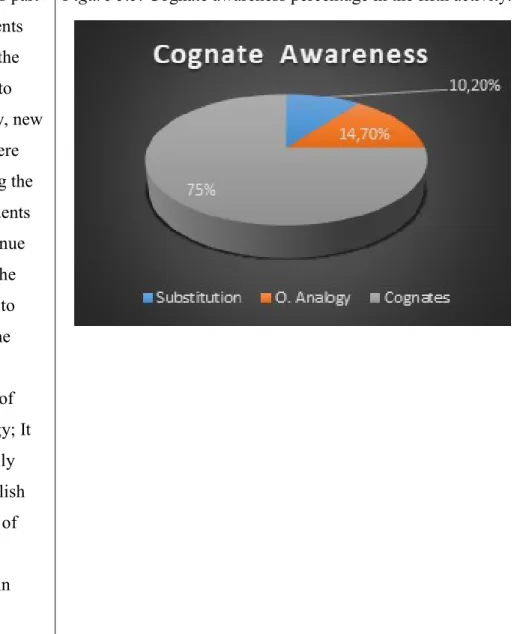
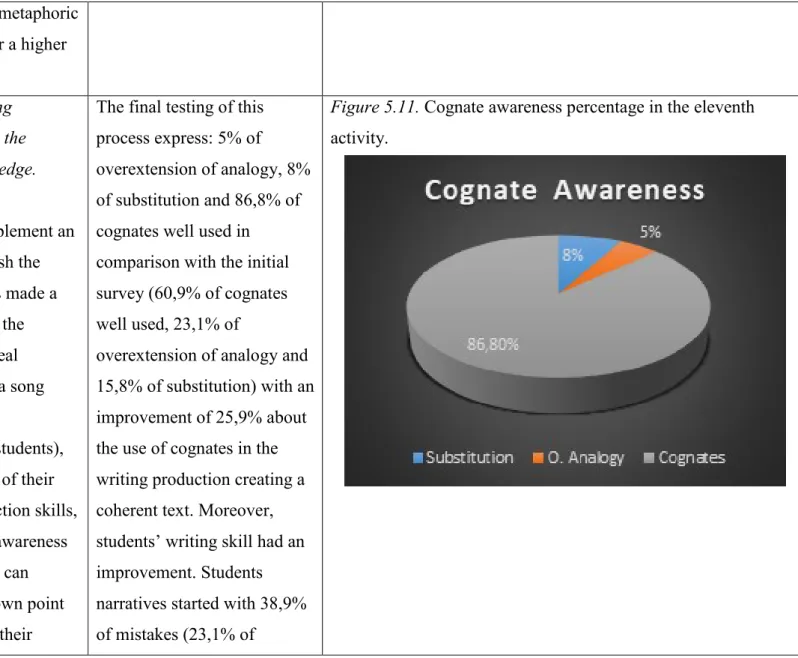
Figure 5.11. Cognate awareness percentage in the eleventh activity 79
Figure 5.12. Data analysis collection and analysis procedures 82
Introduction
Cognates are seen as a difficulty during the teaching and learning of the foreign language and this is more evident in the high school during the development of the writing skill, both languages (Spanish-English) have semantic similarities which could cause confusion between those similar words.
Therefore, according to our observations and personal experience as participants in different roles within the class, we wanted to study the awareness people can have on cognates use in the English as a foreign language classroom, evidenced through the writing production of tenth graders which wrote about some teenagers’ problematics.
We found through the needs analysis results that the students faced many difficulties when learning English, one of them based on the correlation between their native language and the foreign one. The cognates are one of the most representative phenomenon when they want to express an idea using writing.
The research question that we formulated: “What influence has the cognate-awareness based EFL activities in tenth graders’ writing production in narratives dealing with teenagers’ social problematics?” was answered by means of analyzing some written activities.
We framed this study into action and mixed research as tools in order to eventually
contribute to the students’ English written process and the teaching knowledge using cognates with a fundamental role within the strategies in the classroom.
The following monography is organized in six chapters revealing the process of
the type of research approach, the type of study, the setting, the participants and finally the instruments that were used for data gathering.
The fourth chapter shows the data analysis procedures and the research categories applied to our findings. The fifth chapter is about the conclusions of the research, answering the research question and highlighting the most relevant and valuable information of the whole process, and the implications of the research for the academy and the context in which this was applied. Finally, the sixth chapter is about the limitations we faced during the research and which issues of this study would be interesting to study in the future.
Justification
The initial inquiry which lead us to develop this research was that students while learning English build some bridges linking their native language (Spanish) to their foreign language (English) with the cognates use, those bridges can facilitate the understanding or generate some confusion.
Furthermore, from a compilation of previous investigations, experiences, and development of our own work; the contribution of this research to the university is the effort to promote the strategic strengthening of the cognate awareness to improve academic potential in the English class.
This research have some advantages in different aspects. First, this process influences future research because the cognates’ were presented as a tool which benefits the meaningful vocabulary learning in Colombian context. Second, the Universidad Distrital Francisco Jose de Caldas increases its competiveness in the linguistic educational area because this allows a deep understanding of a contemporary topic.
Statement of the Problem
For many years, people have debated about the influence of L1 on L2 learning, particularly when expressing an idea in writing. Two of the most common errors are the misinterpretation of meaning1 and the substitution2 related to cognates use. Based on the results of different studies, the use of grammar structures and vocabulary are the most challenging areas for students writing in English. To continue supporting this linguistic research area, we wanted to examine the situation in which the EFL learners subconsciously use the cognates as a way to compensate their foreign language gaps when producing written texts related to teenagers’ social problematics.
The current study took as informants tenth graders of a public school in Colombia. The students wrote narrative texts about some teenager problematics using cognates as a source, developing by that way the awareness about them. At first glance, as Colorado (2010) states "For Spanish-speaking ELLs (English Language Learners), cognates are an open bridge to the English language" (p.9); a fact that is evidenced in the most elemental sentences created by students. For example, in the sentence: “I can tramited my thoughts” instead of using “express”, students are using their mother tongue (in this case substitution) in order to write their ideas and opinions.
In essence, “Cognates in linguistics are words that have the same origin or are related in some way. E.g. the Italian word "mangiare" (= to eat) is cognate with the French "manger” (Cambridge Dictionary, 2017). But cognates do not necessarily have the same meaning e.g. the Spanish word "arma" (=gun) is cognate with the English word "arm", being this a clear example of false friends. Which is defined as "an L2 word that is formally similar to an L1
1 “Students misuses a vocabulary item because it is similar” stated by Lotte cited in Alonso (1997)
word in spelling and/or pronunciation but whose meanings are entirely or partially different in both languages” (Talebinejad & Sarmazdeh, 2012, p.2). We can see in the case: “write is tediouse” instead of “tedious or bored”; because of that, the EFL students misinterpret the meaning of some words due to the semantic transference relationship between L1 and L2 in the English classroom.
As specific example of cognates’ evidence collected through some elemental writing activities and survey implemented in the English class with the sample (tenth graders students); there were some phenomena: the use of “histories” instead of storieswhen the student was answering a question (What kind of text do you like to work?) using a cognate in his writing. Also, the misinterpretation of meaning was recognized during an exercise where students had to write a sentence based on a word (in this case dating). Here it was used the word “program” instead of “book” the date; this was because of the confusion about the meaning and the unexplored contextualization from the pupil or perhaps the understanding of “over” instead of “about” when the student made reference to write about a particular topic. Furthermore, we analyzed how the learners, due to the incomplete knowledge of
The phenomenon of substitution was used writing “convencionly” instead of “convincing” or the use of “razón” instead of “reason”. Adding other examples, we could mention about the sentence “the stories get me more conocimient” in order to express the idea: “The stories gives/give me more knowledge” we can see the substitution using cognates, which are an interference of L1 in the writing skill of students.
Once we understand the use of cognates, or more specifically the cognate awareness, as a strength within the activities in the classroom (writing of narratives about teenagers’ social problems) we took into account the evidence that students use the mother tongue to express their ideas in a foreign language.
This is due to the unknown meaning of some words, while students support their writing in the cognates without the real awareness of this practice, fact that is understood and supported by the theory in different research studies. These have supported that in order to develop the written learning process in foreign language, the native language was an essential resource for making meaning of text, helping language from memorization, exploration creating new knowledge, and guiding the learner learning with the exercise as ensured by (Pan, 2010) making of this study an interdisciplinary-dynamic construction that should be studied from a holistic perspective.
Chapter I: Literature review
In recent years, the use of cognate awareness in the writing production is an increasingly relevant topic that gains strength every day. Likewise, the role of the mother tongue in foreign language learning has received considerable attention from various theorists and researchers on the overall understanding of second and third language acquisition; it takes therefore two of the most common errors in writing production, the misinterpretation of meaning and the substitution related to cognates use.
The purpose of this research is to study the awareness students can have on cognates use in English as a foreign language classroom which is evidenced through the writing productions about some teenagers’ problematics. This is supported by data from investigations of main authors which developed mainly research on this terms: Cross-linguistic influence,
interlingual error, false friends and cognates, cognates in classroom. Figure 1.1. Theoretical structure.
The theory deepen by some authors with their investigations classified and presented in this document study mainly the correlation between the native language with the foreign one making the cognates one of the phenomenon when students want to express themselves through writing. Firstly, Chapeton (2008) and Alonso (2016) contribute to this research with their perceptions about cross-linguistic influence to continue language interference named as interlingual errors wrote by Alonso (1997) and more specially false friends with Chacon (2006) makes some contributions about how the false friends could be classified to finish with the specification of cognates with Cabrera and others (2014) which is based on the use of similarities in mother tongue and foreign language, in this case, English-Spanish research focused on the production of narratives.
Each study and conception are highly relevant for the research due to the psycholinguistic incidence in cognate awareness such as the substitution and misinterpretation for the
interference of L1 during the L2 acquisition; adding, the importance of the writing skill for the process. Consequently, we have to break down these concepts to understand their role in the development of the objective set.
During the learning process in our students expressed themselves with Spanish words when they did not know the term; so, in order to acquire relevant information for this aspect, the text “Cross-linguistic influence in the writing of an Italian learner of English as a foreign language: An exploratory study” written by Chapetón (2008) gave us some information about the nature of the first language influence on the writing production; the case was developed with an Italian learner of English as a foreign language with the objective to present, through an exploratory study, the analysis of the cross-linguistic influence from syntax and lexis specifically.
Consequently, it is useful for supporting our research because of the enriching
Spanish. As the results showed, learners’ knowledge is shaped and expressed by the influence of the mother tongue; students implemented the forms and meanings in L2 using their
dominion and conceptions of L1, for example, the word: constitution (constitución) as reference in the debate (activity 9); facts that give relevance to the use of the native language in written production being studied from our students’ perspectives and the needs derived from their context.
To continue with the development of this topic; Alonso (2016) in her text “Cross-linguistic influence in second language acquisition” worked on cross-linguistic phenomenon taking into account cognates, it means, for this research is helpful the chapter 5: Helm and Vedran
"Cross-linguistic lexical influence: Cognate facilitation”.
In Alonso’s text is determinant the cognate facilitation and the aspect of lexical transfer which involves the organization and functioning of the bilingual lexicon linking the L1 and L2 cognates, an issue of lexical transfer that greatly interests psychologists and
neuroscientists, contributing to the pedagogic field especially ones identical in form and meaning. It is an interesting perspective about the psycholinguistic relevance in the foreign language teaching and learning in two lexicons while we are understanding the whole role of cognates in the different activities that were be used. For example, in the second activity (comic creation), students implemented some Spanish expression to give life to their creations, so as Alonso´s text assures the lexical transfer is an advantage when students express their ideas.
considerations were helpful during the creation of the background in the research, also about facts during the application and the possible response of the students.
Therefore, to continue this line, researchers examined some error, because if we wanted to change those words in advantages, we needed to understand why those expressions were a mistake. Thus, in “Language transfer: Interlingual errors in Spanish students of English as a foreign language” written by Alonso (1997). The objective was to find out about the most common types of interlingual errors that Spanish students make when they are learning English as a foreign language with the participation of a sample: twenty-eight first-year High School students; it was made some activities and different exercises, to examine their abilities and recognize a different kind of mistakes.
This type of research is useful taking into account that most of the errors are due to the transfer of structure because of the interference of mother tongue during the foreign language learning, this is a usual interference which is relevant in the case of the writing skill. Students tend to apply the rules of their mother tongue when they do not know the norms of the second language, it is a relevant factor for cognate awareness and its use in foreign language learning. We noticed, students conscious and subconsciously try to use their previous knowledge in Spanish to cover the necessities in the second language; for example, during the activity 7 and 8 "Roleplay with chart", students integrated some cognates to express an idea for that specific moment because they did not have a written support.
Continuing, Alonso’s conclusions present four types of interlingual errors (obtained from the corpus): transfer of structure, overextension of analogy, interlingual/intralingual and substitution. Each of these types has been analyzed separately taking into account the word class where it occurs. The results showed that most of the errors were in a transfer of structure, then was the overextension of analogy, to finish with substitution and
possible results. As researchers, we implemented for classification of the cognate words the Alonso’s perception, defining it to this research: Substitution as the Literal use of the native language instead of the foreign one and the over extension of analogy as the misuse of vocabulary because it is similar; thus, we had a main point to contrast the data collected. As a next step, closing up to the specific similarities English-Spanish we have the contribution of Chacón (2006), with her article “Towards a Typological Classification of False Friends (Spanish-English)”. Here was presented the diachronic relationship from the origin of cognate words in a second or third language; it has been useful in the creation and application of the different activities which were implemented in this research taking advantage that Chacón established some formal and semantic affinity. It was implemented considering the Colombian context to complement the activities applied into classroom. As a reflection made during the investigation's process, we concluded that cognate words can facilitate the foreign language learning process; bearing in mind that they have similar meanings and they can support the acquisition and learning of a non-native language using those advantages in the narratives which were produced. However, Chacon (2006), Cabrera and others (2014) assure, these words can also have a deceptive meaning due to the semantic change and the development in the second and third language; they may be misleading to cognate words or false friends.
It is an important contribution because provide a framework for the analysis of cognate words in order to create or enrich the teaching and learning strategies and foundations. It focuses on this topic whereas students tend to overgeneralize and assume they know the meaning of these words, which are deceptive for language learners' processes.
common framework for the analysis of cognate awareness which helped in the development of specific teaching and learning activities and the possible results.
As the final research, we have the text of Cabrera & Others (2014) “Spanish interference in EFL writing skills: a case of Ecuadorian senior high schools”. The importance of the writing skills in students’ learning is one of the most relevant aspects of this research because of the objective to create narratives about teenagers’ social problems using students’ context. Following this purpose, Cabrera & Others (2014) worked with the interference of mother tongue (L1) while students are developing writing skills. They wanted to study the influence of native language in the learning writing abilities in the second language (L2).
It is helpful as an example due to the similarities with this research; it was applied in the Ecuadorian senior high schools in Loja, with the participation of more than 300 students and 42 teachers from second-year senior high schools who worked in public and private contexts. It provides the knowledge of some difficulties about the creation of activities and during the application of those topics in class, that can be directly related to the cognates awareness and we have a reference in order to predict some mistakes, behaviors and also the psycholinguistic response with the fact to be involved with writing narratives too.
Continuing, all those authors and investigations are resources that have shed light on the general view of the processes to this project while clarifies many concepts as a cross- linguistic influence. Cognate awareness, language transfer, false friends, mother tongue, interference, L1, L2, English Foreign Language (EFL), writing skills among others, with the objective to understand and appropriate of the incidence about the role of these aspects during the teaching-learning of a foreign language.
Theoretical Framework
In the present section, we elaborated three constructs in the field of research on applied linguistics focus on the corpus linguistics study according to Davis (2009) regarding the authentic written narrative texts of some tenth grade students about how it is performed their language variation and the use the students make of it related to cognates. The following constructs are: Cross-Linguistic Influence in EFL which explains the relations stablished between the L1 and L2, Writing Skill in English Narrative Texts which explains why was selected the writing skill as the main source to identify the influence of the cognate awareness, and Cognate Awareness in Written Texts which explains what is the Cognate Awareness and how this has a relation with the written texts, highlighting in all of them the main ideas of different theorists and researchers.
Cross-Linguistic Influence (CLI) in English Foreign Language (EFL).
Based on the conception of Sharwood cited in Chapetón (2008) Cross-linguistic influence is a common term used to talk about how different language systems in the mind interact and affect either the linguistic performance or the linguistic development (or both) of the
individual concerned. Current studies have examined how cross-linguistic evidence affects most linguistic subsystems such as pragmatics, semantics, syntax, morphology, phonology, orthography, etc. According to Chapetón (2008) not only in the second but also in the third or subsequent language. In this research, in which we are studying based on the linguistic performance of our students, the Cross Linguistic Influence has a broad impact to deeply understand the internal processes students made when stablishing relations between their native language and the foreign language, specifically in the semantic aspect through the cognate awareness.
1960s. As was established “points out the CA hypothesis, which was deeply rooted in
behaviorism, asserts that the principal barrier to L2 acquisition arises from interference factors created by the L1 system, being the L1 regarded as the primary source of confusion” (Koda cited in Chapetón, 2008, p. 7).
About this issue, Ringbom (2001) divides various types of lexical transfer into two main blocks, transfer of form and transfer of meaning. As our main focus is the lexical transfer of meaning, we just took the definition of that “The former type comprises mainly complete language switches and the use of deceiving cognates, which may be partially or entirely deceptive” (Ringbom cited by Letica and Mardešić, 2007, p.4). The latter referring to other instances of lexical transfer like calques and semantic extension on the basis of patterns in other languages.
In terms of foreign language teaching and learning according to the mother tongue, the transfer is “the influence of the learner´s native language in a second language, and when the linguistic interference results in correct language production, it is called positive transfer. However, if the learner’s foreign language induces to error, we will be referring to negative transfer" (Colorado, 2010, p.2).
Relating this concepts with this research, first we want to observe our students’ positive and negative language transfer as the result of the interaction of the Spanish and the English; noticing then, which is the influence the use of L1 used as a source of reference and even interference has in the L2, it is expected that at the end of the process, the students, due to the cognate awareness-based activities, stablish more positive transfer relations than negative ones.
(Ferris & Hedgcock. Cited in Manchón, 2009, p. 27). The transfer of textual characteristics takes place not only from L1 to L2 but rather in both directions even at beginner-writer levels as was said by Manchón (2009).
Chapetón (2008) also made a brief summary of some research concerning transfer in which those shared features between languages are manifested. Ravem (1971) documented that the learner's native language played a certain role in the formation of his second language syntax. Hakuta (1974) also demonstrated that there is a firm relationship between L1 transfer and the emergence of structure in second language acquisition. In addition, Larsen-Freeman evidenced “such a relationship through the learner's learning of English grammatical
morphemes” (Freeman, 1975, p. 15). To Gass (1979), transfer helped us to see the grammatical element universal in human languages. Ringbom (1987), found that the L1 influence could manifest itself in various ways depending greatly on how similarities were perceived by the L2 learner and how those similarities could affect the learning process (Ravem, Hakuta, Larsen-Freeman, Gass, and Ringbom cited by Chapetón, 2008, pp. 11-20).
Concerning semantic transfer, as stated by the research made by the Spanish Ministry of Education & Galician Ministry of Innovation and Industry. (2010) the "Spanish students use some English terms as translation equivalents for some Spanish concepts and words as in actual, advertise, career or pretend." (p.9). Based on those results, we can conclude that the influence of the L1 could be highly used as an advantage for the learning process of a foreign language, because if the students can use the lexical items understanding their semantic properties, they will stablish more positive semantic transferences from L1 to L2.
concepts learned in the L1 can be accessed and used in the second language in L2 skills that are developed” (Njoroge, Mwangi and others, 2014. p.36).
As the English in Hispanic countries is taught as a Foreign Language in the educative context but it has a few real use, the difficulties around how to teach effectively the language avoiding the interference of the mother tongue are bigger. Therefore, the interference is a situation which is evident when using productive skills, especially in written texts this is the reason why in some studies as the one by Cabrera and Gonzales (2015) students use Spanish written structures when writing English texts, being common for students to translate word for word from Spanish into English, situation which was evidenced also in this study.
As a result, L1 has a negative influence when writing narratives in English as was explained by Lopez cited in Cabrera (2014). The variables indicate that the most common Spanish interference was “misuse of verbs, the omission of personal and object pronouns, misuse of prepositions, overuse of articles, and incorrect word order. It is important to mention that these errors mainly had a negative influence on developing writing skills in the target language” (Cabrera, Gonzales and Lopez, cited in Cabrera Solano, P. 2015, p.40). In this study, both high and low-frequency interference errors were identified. High-frequency interference errors included misuse of verbs (20%), the omission of personal and object pronouns (16%), misuse of prepositions (11%), overuse of articles (9%), incorrect word order (9%), and misuse of articles (5%). Conversely, low-frequency errors included the omission of prepositions (4%), false cognates (4%), the omission of articles (3%), the misuse of personal and object pronouns (3%), invented words (3%), and weak noun concordance (2%). Other variables, which are identified in this study as “Others”, had the lowest frequencies (2% or less).
2009, pp. 87-100) considering that exist some principles in the use of L1 in conjunction with L2. The ones, which have been proposed for a variety of pedagogical reasons:
To provide scaffolding for tasks (Anton & Dicamilla, 1998). To promote the transition from L1 to TL use (Shamash, 1990) To improve negotiations (Swain & Lapkin, 2000)
To enhance L2 comprehension (Turnbull, 2001).
Pan (2010) also affirmed that L1 is used as an effective strategy for reducing learning anxiety and increasing their motivation to learn the second/foreign language. If as Pan (2010) stated, the teachers as us can present the L1 to the students as a strategy for learning the foreign language but that also has some issues which it is important to take into account to create a meaningful production, avoiding in that way the negative transfer.
Highlighting the relation between the languages we are using in our context,
Colorado (2010) shares a chart which contains the Common Greek and Latin roots as an exemplification of the existence in the correlation between the cognates in English and Spanish (see Table 2.1).
Table 2.1
Examples of some common Greek and Latin roots.
Root Meaning Origin English examples
Spanish examples
aud hear Latin auditorium
audition
auditorio audición astir star Greek astrology
astronaut
astrología astronauta
bio life Greek biography
biology
biografía biología dict speak,tell Latin dictate
dictator
mit,mis send Latin mission transmit
misión transmitir
ped foot Latin pedal
pedestal
pedal pedestal
phon sound Greek phoneme
microphone
fonema micrófono port carry Latin transport
portable
transportar portatil Note. Recovered from http://www.colorincolorado.org/article/using-cognates-develop-comprehension-english copyright 2010 by Colorin Colorado.
Hiebert & Lubliner made reference to Trask (1996) who identified four categories that describe the relationship between cognates that differ semantically.
1) Generalization: the English word is more general than the Spanish word. 2) Specialization: the English word is narrower and more specific than the Spanish
word.
3) Melioration: the English word has a more positive meaning than the Spanish word. 4) Pejoration: the English word is more negative in meaning than the Spanish word. (Trask. cited in Hiebert and Lubliner.2011, p.4)
Writing Skill in English Narrative Texts.
The main skill in this research to be evaluated and analyzed is the writing, the students write some narratives about teenager problematics which are the basis to notice the cognate awareness influence. To get to positive results it is important to firstly know how the writing skill is processed and developed in the midst of the two languages interaction.
When the writing is produced in an EFL context, as Cabrera and Gonzales (2015) ensured this is often considered an indispensable skill that enables students to develop an appropriate level of linguistic competence. Also, according to Harmer cited in Cabrera and Gonzales (2015), writing helps students to express their ideas in written form and to achieve a high level of communication.
“Writing in English as a foreign language constitutes a primary concern for high school students because they need this skill in their academic life (e.g. studying abroad,
understanding academic information, etc.). However, producing a coherent, fluent and
extended piece of writing is the most difficult activity to do in language learning, especially in a second or, in this case, a foreign language” (Nunan, Cabrera and Harmer cited by Gonzalez, P. 2015, pp. 95-97).
Writing is the skill that will be the basis to develop the cognate awareness, because as explained before, this is one of the most difficult skills to be developed, also when getting to know our students we noticed that they were not familiarized with writing in English, just with speaking, we found that for learning English it is important to use all the 4 skills
effectively and also we want them to express themselves so in that way it is easier to stablish some communication with them due to the high amount of students.
task. Furthermore, Kaushanskaya, Yoo and Marian (2011) concluded that "In general, studies on literacy transfer suggest a positive relationship between L1 and L2 skills when the two languages overlap in terms of their writing systems". The benefits of recognizing cognates may not be the only advantage that Spanish speakers have in learning English. Besides,
another utility is that Spanish speakers will have more time to focus on unknown vocabulary. By means, using cognates, the teacher is providing a “shelter” to his/her students. Learners may feel more confident and motivated if they realize that they already know “something” about that second language. This may contribute to their self-confidence and be translated into motivation when getting the input and being asked for production.
Kaushanskaya; Yoo and Marian (2011) referenced to various authors who have studied this topic Harrison & Kroll, (2007); Luk & Bialystok, (2008); Wang, Perfetti, & Liu, (2005) concluding that "the transfer patterns for bilinguals whose two languages do not share the writing system are more complex. It appears that phonologically based processes show
positive transfer between bilinguals’ two languages, even when the languages do not share the writing system".
Finally, due to the similarities the English and Spanish have, which can influence
Cognate Awareness in Written Texts
Cognates are defined as “The vocabulary items in two different languages that are similar both orthographically and semantically” according to Holmes and Ramos (1995) cited in Akbarov (2015). “Cognates are classified between true cognates and false cognates. Both types of cognates have the same or very similar form in two languages, but only true cognates have the same meaning” (Reid, 1968; cited in Lengeling, M. 1995, p. 17).
These cognates have a formal distribution named CCVF (Clasificación de Cognados Verdaderos y Falsos/Classification of True Cognates and False Cognates), that “intends to help in the taxonomy of particular groups of cognate words. The author hopes that this typology can facilitate and pave the way for future research in the fields of foreign language teaching and learning” Chacón (2006, p.34).
In the specific case of cognate awareness, this is understood as “the ability to use cognates in a primary language as a tool for understanding a second language. Children can be taught to use cognates to then, move up the grade levels, they can be introduced to more
sophisticated cognates, and to have multiple meanings in both languages” (Colorado, 2010, p.1).
As the cognate awareness is the capacity to use cognates words in the mother tongue to help understand words in a second language, and this the main aim of our research proposal; we planned to use cognate awareness as the way to improve our students writing proficiency. The activities implemented are based on some common topics for students as the case of self-esteem, bullying, depression, etc. being facts of interest for the group in order to use their previous knowledge and their self-expression in the construction of narratives about teenagers’ social problems.
Due to those helpful similarities between English-Spanish cognates, in both spelling and meaning, it makes easier to establish meaningful and positive relationships between the uses of those in the narrative texts. Cognates are also easier to learn and less susceptible to forgetting that is why they are useful for developing the writing skill. (Higher Learning Inc, cited in the research supported by the Spanish Ministry of Education and by the Galician Ministry of Innovation and Industry, 2010, pp.2-7).
Referring to total false friends, Palacios (2005) explain. “the conspicuous semantic
difference between the L2 and the L1: English and Spanish in this case (e.g. English vase vs. Spanish vaso, English avocado vs. Spanish abogado, English robe vs. Spanish robo)” (Higher Learning Inc. and Palacios. cited in the research supported by the Spanish Ministry of
Education and by the Galician Ministry of Innovation and Industry, 2010, p.6).
In synthesis, as ensured Lubiner, Shira & Hiebert cited by Pan, (2009). It was found, from English, 30-40% of all words in English have a related word in Spanish. "For
Spanish-speaking ELLs, cognates are an obvious bridge to the English language". Cognates do not necessarily have the same meaning: head (English) and chef ("chief, head", French),
constitutes an example of how cognate terms may have a different meaning according to Pan (2010).
For the better understanding of Cognates, we have made a previous search of some similar research carried out before in order to contribute to the construction of the current
teaching a language facilitating the learning as a practical technique functioning like a jumping board to teach a new language to the students, especially to the beginners. Finally, Hiebert and Lubliner (2011) claimed that:
“Cognates Are Not Merely Words that share meaning; they also share orthographic features that illustrate their common origin. They vary in the orthographic overlap. The more similar the spelling of an English cognate is to its Spanish equivalent, the greater the degree of orthographic transparency of that particular cognate”. (p.9)
Based on that, Cristoffanini, Kirsner, & Milech cited in Hiebert. (2011, p. 9.) Categorized cognates into five groups according to their orthographic relationship. These are:
1. Orthographically identical cognates, 2. Common stem cognates (cion-tion).
3. Common stem cognates with regular suffix (dad-ty). 4. Common stem cognates with irregular suffixes. 5. Morphologically unrelated translations”.
As a conclusion we can verify through these sources that he cognates are a reliable tool to understand the second language, we think also this can help to the students to produce more and better narrative texts in which the EFL learners pass from subconsciously use the cognates as a way to compensate their foreign language gaps to produce written texts in which they are consciously using the cognates as a source to acquire some vocabulary, and use this in the context it is made for.
Chapter II: Instructional design Instructional Objective
To develop cognates' awareness through the identification and use of some practical activities focused in narrative texts about teenagers` social problems within the written production.
Specific Objectives.
To make written production as a means for developing cognate awareness. To recognize and identify cognate awareness through those written activities.
To examine and evaluate the use of cognates in written activities focused on teenager
social problems.
The following instructional design contains information of the group in which we
developed our practicum for secondary. For the curriculum, we linked the School’s ideals of a curriculum based on a communicative approach, social projects and technical formation with our research in the English classroom related to the use of cognates to strengthen the writing skill.
As part of the ethical considered for development of the study was the implementation of activities and topics proposed by our students, with their perception and contributions during the process. Teachers guided the class while students were participants in their own
implemented. The students also gave feedback about what to improve in future activities, how they felt during the process, what they enjoy and dislike the most on the activity and its development, this to know what we lack in each activity and to keep rise the activities quality on the process.
We have chosen tenth graders to carry out a project which impulses an experiential
learning where students develop some activities practiced in the classroom. Students make an inner progress about the aspects taught, getting influenced and going to some positive changes in a problematic situation related to the foreign language use. The role of the teachers is to create conditions which help the students to develop the ability to use a language effectively, in this particular case in the written aspect according to Tudor (2001).
Moreover, the language in the classroom was a means to the self-expression Tudor (2001). The idea is to build bonds with the students to allow a comfortable context, inviting the students to express their emotions, aspirations, and interests as the output using the language as a social action so the students play a significant role with the emotional and personal side of the writing, giving conditions for self-realization that goes by the project fifth cycle students have in school for them to plan their labor life.
The Pedagogical Innovation Oriented to CLT and Cognate Awareness as an Action Plan This innovative pedagogical intervention has the goal to deepen about a topic which has been studied in recent years. Our innovation is the new perspective about the use of cognate awareness during class. It means that the presence of those specific words (true and false friends) have been a constant mistake during lessons of a second language due to the confusion caused by similarities of mother tongue and second language during learning. Nevertheless, this research has presented the use of cognates in class as an advantage using the false friends to interrelate the learning; thus, students are going to remember and use those words during their writing production taking advantage of the similarities in both languages in order to express their ideas efficiently.
It was possible because we observed and analyzed the data from the survey. As a result of a needs analysis, we decided to put into action a plan that could help address a learning need. This action plan is based on the principles of Communicative Language Teaching (henceforth CLT).
The purpose or aim of CLT is to develop some activities for the teaching of the principal language skills (listening, speaking, reading and writing) that acknowledge the
interdependence of language and communication based on Richards and Rodgers (2007). For this, learners have to work in the ability to get the meaning through the listener in order to understand other speakers. Kumar, Phillip, Kalaiselvi (2013) ensure:
“Communication in the classroom is achieved by creating real-life situations and making the learners role- play it. A task-based learning alternative is planned to ensure that communication takes place between the students. Through these alternatives, the learner gets access to the social, cultural and pragmatic aspects of the language. If students achieve communicative competence, it means the success of CLT”. (p. 25)
Activities that involve real communication which promotes learning: The communication principle.
Activities in which language is used for carrying out meaningful tasks to promote the learning: the task principle.
Activities that provide opportunities to use exact language as a means to support the learners’ learning process (Johnson cited in Richards & Rodgers; 2007): the meaningfulness principle.
The role of the learner is to be a negotiator (between himself, the learning process, and the object of learning). The learner should contribute as much as he gains, and learn in an
interdependent way, that is why they are expected to interact primarily with each other rather than with the teacher. Students follow a continuous process of giving and receiving
information mainly from their partners but also from the teacher (Richards & Rodgers, 2007). This approach is useful for our project because it gives emphasis to the learners’
production which is the studied, also strengthening the students’ competencies to write and speak. The students develop those skills using the information that they have gotten from their context, and by helping them to express efficiently and having a comfortable
The Methodological Organization of the Pedagogical Intervention
The following chart displays a general view of the pedagogical intervention. Then a concise account of the intervention is given.
Table 2.2
Activities Classification.
Engage students in communication, require the use of communicative processes like information sharing, negotiation of meaning and interaction. Furthermore, an activity is goal-directed, extended, structured, and controlled (Richards & Rodgers, 2007).
Social interaction activities: conversation and discussion sessions, dialogues, role
plays, simulations, improvisations, and debates.
Goal-directed discourse: by means of communicating to accomplish a specific goal
Structured discourse using writing from a task designed to provide with an
easy-to-follow structure as well as an all-important completion point.
Controlled discourse means that the topic and the task type are influenced by the task.
The methodology applied in the pedagogical intervention has four steps which include the activities proposed here. The first is “Recognizing”, here will be applied the first two
activities, the survey and the comic. These are activities in which students wrote using the language level they had until the moment to start the intervention without any influence of the cognate awareness, those are to notice the cognates’ use of the students, how they are
stablishing the relations between both languages in real use.
The second is “Learning”, here were implemented two activities words definition and comfortably numb, here the students used the first cognates (True or false cognates) learning that some of them have the correspondence with the Spanish meaning and that others do not, being aware of the cognates existence and the influence this can have on their writing
production.
The third is the “integration”, here with three main activities: Stress case, story map and role play; we noticed how the students used those cognates in the production of writing and speaking, the feedback was constant about how to analyze if the cognates are being useful to express the ideas or by the contrary were making them lose the main idea when writing in the L2.
Finally the “application” was to let the students use the knowledge acquired as a whole, so they were asked to do more long and complex tasks using the cognates, those will be the final evaluation of the process as a whole.
Activity 1: Survey
This activity consist in four questions about the students’ interest in writing and what they know about the relation between Spanish and English.
Activity 6: Story map
This activity consist in writing a short story using the vocabulary learned, choosing a teenager problematic of their interest.
Activity 11: Expressing My experience 2
Creating a song integrating all the learned knowledge. (Final survey)
These three activities were selected because showed the students writing level, in the three of them the main production required is through writing and they were the ones with the longest amount of cognate words. This does not mean the other activities were going to be evaluated, the other activities complement and evidenced the process carried out by the students between the four main phases of the methodology.
Moreover, Cabrera & Others (2014) “Spanish interference in EFL writing skills: a case of Ecuadorian senior high schools” gave us important contributions for the process because of the similarities in both research while their investigation works about the importance of the writing skills in students’ learning when it is one of the most relevant aspects of this research because of the objective to create narratives about teenagers’ social problems using students’ context.
Chapter III: Research design Research Question
What influence has the cognate-awareness based EFL activities in tenth graders’ writing production in narratives dealing with teenagers’ social problematics?
Research Sub-Question.
What implications has the activities based in cognate awareness in the writing process in students of 10th grade?
General objective:
To analyze the influence of cognate awareness in the writing production of narrative
texts dealing with teenagers’ social problematics by tenth graders Specific objectives.
To implement some cognate awareness-based activities in tenth graders of English as a Foreign Language.
To examine how the cognates were used by the students in the activities of writing narrative texts.
The following research design describes the research methodology of this study. It
explains how was done it the process of collecting information and carrying out an analysis of teaching English as a foreign language with tenth graders under some particular views that go following the purpose of the research itself. The mixed research is its paradigm, and the type of study is Action Research.
Research Paradigm
Mixed Method Research
Creswell (2011) defines Mixed Method as “a research design with philosophical
the mixture of qualitative and quantitative approaches in many phases in the research process”.
Also, Creswell said “As a method, it focuses on collecting, analyzing, and mixing both quantitative and qualitative data in a single study or series of studies. Its central premise is that the use of quantitative and qualitative approaches in combination provides a better understanding of research problems than either approach alone” (Creswell, 2011, p.5). As he said, it is a methodology for applying a research which involves using quantitative and qualitative methods in the collection, integration and analysis of the data, to provide a deep understanding of the research Problem.
Creswell proposes three kinds of mixing in the process “merging or converging the two datasets by actually bringing them together, connecting the two datasets by having one build on the other, or embedding one dataset within the other so that one type of data provides a supportive role for the other dataset” (Creswell, 2011. p.5). In this investigation, the
Type of Study Action Research.
This is a type of research that mostly people related to school environments’ use as are teacher researchers, principals, counselors or other stakeholders in the learning/teaching environment. It can be defined as a form of collective self-reflective inquiry undertaken by participants in social situations to improve the rationality and justice of their social or educational practices, as well as their understanding of these practices and the situations in which these practices are carried out.
The approach is only action research when it is collaborative, though it is important to realize that the action research of the group is achieved through the critically examined action of individual team members (Kemmis and McTaggart cited in Cohen, Manion & Morrison, 2007, p. 227).
This gathers information about some issues as how a school operates how teachers teach and how students learn. In this study, we focused on how the students learn and the way they use writing as a source to express their thoughts. The participants that are our tenth graders English as a Foreign Language students were responsible for the research process itself by their development of powers of reflective thought, discussion, decision and action using teenagers’ problematics (Johnson & Christensen, 2016).
The primary purpose of this kind of research is to bring change to social situations as a result of problem-solving collaboration. The action research validates classroom observation and encourages teachers to value their judgments, developing in that way a critical
General Plan.
This Research followed the Eleven Action Research Phases’ proposed by Burns (1999).
1. Exploring: Identifying and agreeing upon a general idea or issue of interest to the group.
2. Identifying Fact-finding process, where the teacher refines their thoughts about their area of interest.
3. Planning: Developing a plan of action for gathering data, trailing a particular course of action.
4. Collecting data: Data gathering events and begin to go deeply on the issue being researched.
5. Analyzing: Close analysis of data to reflect on it.
6. Reporting: articulating data, activities, and results that came in the research process. 7. Writing: Writing the outcomes of the investigation in a report or article.
8. Presenting: Formal presentation about the research issue, to the whole school or people interested on this (other teachers, etc.).
Sampling Technique
EFL Students: Tenth Graders of a public school in Colombia.
The population was chosen by a non-probability sampling technique. The Nonprobability sampling is defined by McMillan (1996). “A nonprobability sample is one in which the probability of including population elements is unknown. Usually, not every element in the population has a chance of being selected”. The participants of this research are selected based on naturally occurring groups, that means we do not choose the school nor the specific subjects to be analyzed but just the grade in which they can produce written texts in English as a foreign language.
Description.
The collaborator for this research is a group of 35 teen students of the tenth grader with ages between fifteen and sixteen years old belonging to the public school “Republica de Guatemala” located in the neighborhood “las ferias” in Bogota, Colombia. They accepted participate voluntarily developing different activities focused in the main topic.
Based on the needs analysis the group has A2 learning level according to the CEFR (Common European Framework of Reference for languages) with an ability to deal with simple information and to express themselves in familiar contexts (teenager social problematics) using speaking and writing skills effectively.
Data Collection Instruments.
The number of potential data sources in an action research study is very broad. We can group them into four general types of data: observations, interviews, questionnaires /surveys, and available data.
Corey (1953) and Cohen, Lawrence and Morrison (2007) defined and explained these sources of data collection instruments.
Journals:An observation is when observing participants and recording this helping to determine the curriculum's effectiveness. Moreover this, it is necessary to keep a daily journal to take field notes (narrative qualitative data) and an observation record (numerical
quantitative data) according to Corey (1953). These instruments give the opportunity to gather ‘live’ data from ‘live situations. The observations that were collected during this research process are structured observations. “The observers that will be the teacher – researchers will adopt a passive non-intrusive role, merely noting down the incidence of the factors being studied” (Cohen, Manion & Morrison, 2007).
interviews or you have big groups. The questionnaires made include closed-end item
questions in which the researchers give a limited number of responses or opened-ended items in which the students write their responses according to Corey (1953).
In the questionnaire was applied, “open-ended questions, Dichotomous questions, multiple choice questions, rank order, and rating scales”. (Cohen, Manion & Morrison, 2007). The questionnaire was applied in an anonymously way, students won’t need to write their names to look for more honest questions.
Readily available data: to validate the analysis you need to have available information or naturally occurring data. Available data is, for example, analyze homework examples or quiz results from students, included tallies (e.g., list of books read, or projects completed),
demographic information, test results, students’ grades, attendance records, journals, writing samples, student or teacher portfolios and parent information; all this based on Corey (1953). The main source of readily available data was the students' written narratives and the graphic organizers they are going to use.
We used these data collection instruments in our research to collect qualitative data:
Chapter IV: Data analysis
In this chapter is explained in detail, the data analysis procedures adopted in order to get to the final conclusion of this research. The data is the collected information that is completely related to the inquiry, we stated in chapters, which allowed us to respond to our research question. (Veillard, 1998).
Reducing data
The first step was to reduce the data we have gotten from the intervention. The three instruments used to gather that data were:
Document collection.
Veillard (1998) defines document collection as “set of documents relevant to the research context, e.g., course overviews, lesson plans, students` writing, classroom materials/texts, assessment task/texts, students 'profiles, student record" (p.93). In our specific case, it is understood as all the written exercises our students make in class as part of the application activities proposed. This research has as the principal tool the information which allows the "content analysis", Burns (1999) explained, “Content analysis is commonly used in written forms of data to uncover incidences of certain words, phrases or key themes” (p.167). Procedures such as the following are commonly used in content analysis:
Define the universe of the content
Write clear definitions of the key categories Analyze the data and code the categories
Quantify the data and carry out counts (Burns, 1999). Transcriptions
activities that later were adapted to transcripts. The transcripts just highlight the most important issues of the vocabulary used by the students.
Field notes.
Farrel (2015) defines this as the “descriptions and accounts of observed events, including non-verbal information, physical settings, group structures, interactions between participants. Notes can be time-based or unstructured according to the teacher`s purpose” (p.90).
Teacher–researchers in their intervention took notes about different issues in the class given. The field notes were organized in a chart where they focus in made a class description and pointing out the main research issues to take into account.
Table 5.1
Classification through color coding / visual markers:
As the importance of this research is if students through cognate awareness-based activities would influence their writing production dealing with teenager narratives. We started by taking out all the cognates used by students in the instruments document collection and transcription. Color coding is a tool which “helps learners to organize information into useful patterns which enables the learners to interpret and adjust to the environment” (Dwyer and Moore, 1995. p.6).
There were three main categories:
Substitutions: Term adopted by Alonso (1997) to refer. "Those errors produced by the Literal use of the native language word instead of the foreign one"(p.8).
Overextension of analogy: Term adopted by Lott cited in Alonso (1997) defined. "when the student misuses a vocabulary item because it is similar, either phonetically,
orthographically, semantically or syntactically to another form in the Ll" (p.8.). Cognates well-used: Cognates by Holmes and Ramos cited in Akbarov (2015) are defined. “The vocabulary items in two different languages that are similar both
orthographically and semantically” (p. 8). In this context, we understand as cognates the words that share the same root with Spanish words that were used in the text following the coherence and cohesion from the text.
The four main categories created using the color coding technique to classify the cognates presented in the written texts are the following:
Error in meaning:
Example: Place attention instead of Pay attention, the words are written correctly but the context demands the use of pay attention, place attention has been used as a confusion of its meaning.
Error in Spelling
Students committed some mistakes when they wrote words which are useful for the context in which they are writing, but wrote words with some spelling mistakes as can be: Example: Objets instead of object.
Error in Meaning + Spelling
Students committed some mistakes when first, they use a cognate word thinking of a possible meaning to it due to its root and also didn’t write correctly the word in English. Example: Vicies instead of addiction.
No error Meaning + Spelling
This can be understood as the good use students gave to those cognates, using them in the context ideal for it, and also writing it correctly.
Table 5.2
Cognate’s classification in color coding.
Type of error Activity 1 Survey Activity 2 Comic Activity 3 Drugs word definition Activity 4 Drugs- pink floyd song Activity 5 Stress guide Activity 6 Story map Activity 7 Roleplay Activity 8 Roleplay chart Activity 9 What do you think Activity 10 Debate Activity 11 Creating a song
Substitution Similarity-similar Importan-important Comunication- communication Differents - different Lenguage - language Cultura – culture
Encounter – am Interes- interest Espanish – spanish Respire – breath Estomagui - stomach Drogs-Drugs Realy – reality Interes – interest Compang– campaign Bapelo – weed Clik – click Convencion ly – Convention ally Addictión-Addiction Musica-Music Realice – Make A - To
Absorber CigarrittieExpe nd - Sell
Convencionly- conventionally Passing – Past Escondite- Hiding Fume- Smoke Englis – English Objets Incommde -Uncomfort Común - Common Citación - Meeting Fisica – Physics Explicate – Explain Voleibol – Voleyball Deseperation – Despair respite -respirar Religion con tilde Razon Controlled Personalty Necesitary Revelde Continuet Recuperat e Profesión Logro Cycle Utilice Complied Precioso – precious Informan -inform tender (tendero)- grocer Expire-die out Robers - assaulted Interesan d - Interestin g Entrenad or-coach Soport- support Oficine - office Consome – consume Distints- Different Permissión Relacined – Related Drogs – Drugs Deports – Sports Traffic Permit – Permission Fantasic – Fantasy Genial – cool Hay - had
Disacord - Disagree Ñeros - bad people Osea – I mean Salida – Out of the school Entra – enters Es- is Consituition – Constitution Irresponsabl e – Irresponsibl e
Vicies – addiction Destrucciòn- destruction Satisfaccion-
Significa-means Inspirit- inspiration Pronunceiton – pronunciation Gramatis – grammar Overextensi on of analogy very -many What-that Feed-enrich Letter-lyric Related- link solid-alone self-same Why-because Nice-good Comeon-common Us-we The –he Thee- I For – in but-more Exact – exactly Ugly – bad My – I Utilization – consume Dating- Dated Carry-Has Place attention – Pay attention Capture – got Liquid Utilize – consume Connetec - connect Favour – Favorite
Labour - Labor Company Cite –Date
Carry – bring
Aggressive - Big
Spell – like(love) Pronunce – pronunciation Alone – just Simile- similar Amid- among He-the
Connective – connections My – I Over – about Notice – news Poe – poems Bit – but I get – I am Met – date Han – and
Of – the Substantiv e What – that Persons – people Sure- assure Temper -Temperament Usage – Used Company- Companion Realize- Make Solution-Solve Obligate – Demand Certificate Resolve Discussió n - Discussio n Relatión - relation Solución - solution Persecuti ón- persecuti on Ofice- office Actuatión - actuation Violece- violence Estupid – stupid Dependenc ie - Dependanc e Fault – Lack Musik - Music Utilize – use Shape – Manners Note - Grades Coonpeteition- competitiongroop- group
Spick – speak My - I
Realice – do Us – we Couse – case Spell - write Storis- stories Historis – stories
Practice Traffic German Dictionary Elemental Translate In
Class Student Participate Terror Interesting
Dentist Vocation Distributio n
Illeyal Resolie Volition
Family Support Honest Debilitated Visible Vulgar Addition Oportunity-
Opportunity perdition Affect
Trancend- transcend Accepted
Consume Machine Vice Liquor Confirm Serve
Use Perfect Habit Complicate Fantastic Stupid Create Oblige Alcohol Destroy Opinion Opine Decide Destiny Machismo Baby Type
Identificate Enter
Affectionate act
Accident Second Finally False Critic enemy nature attention
Colors
Error in meaning Error in Spelling
Data representation
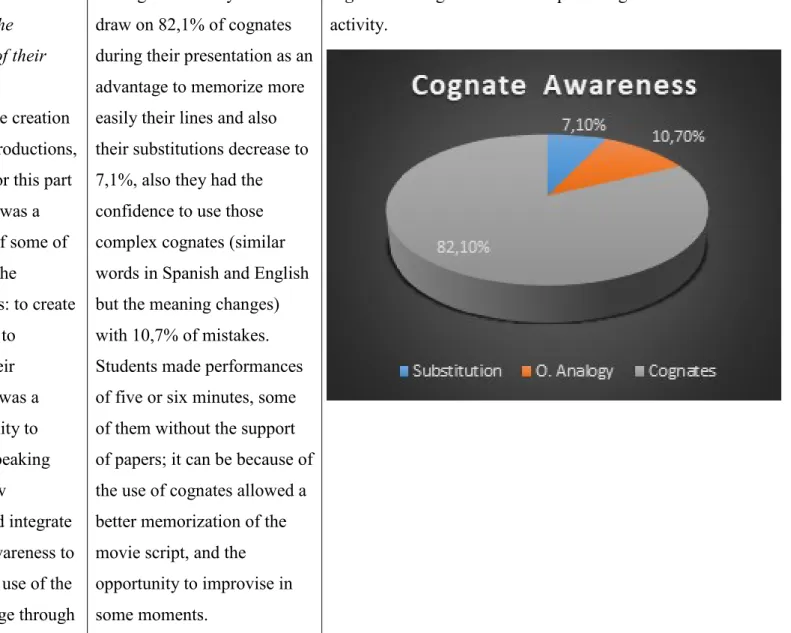
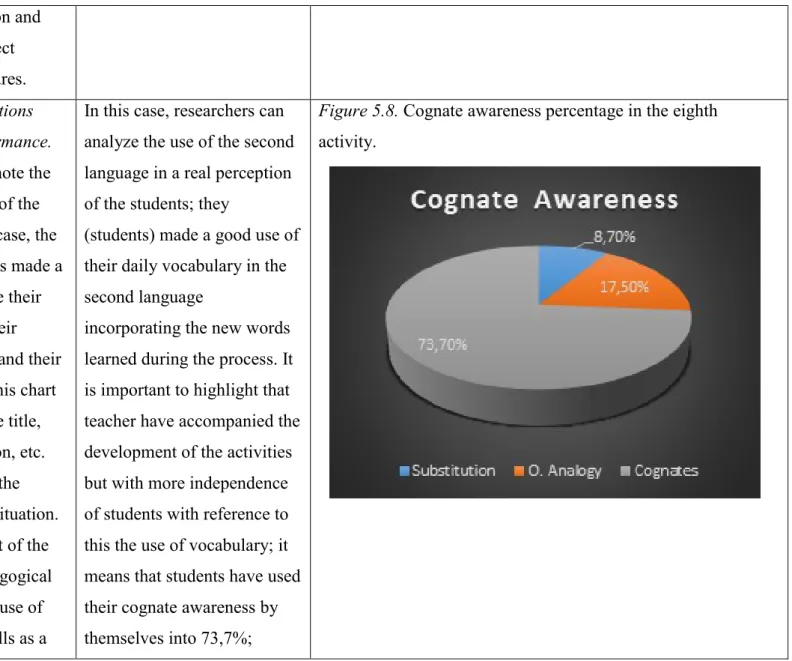
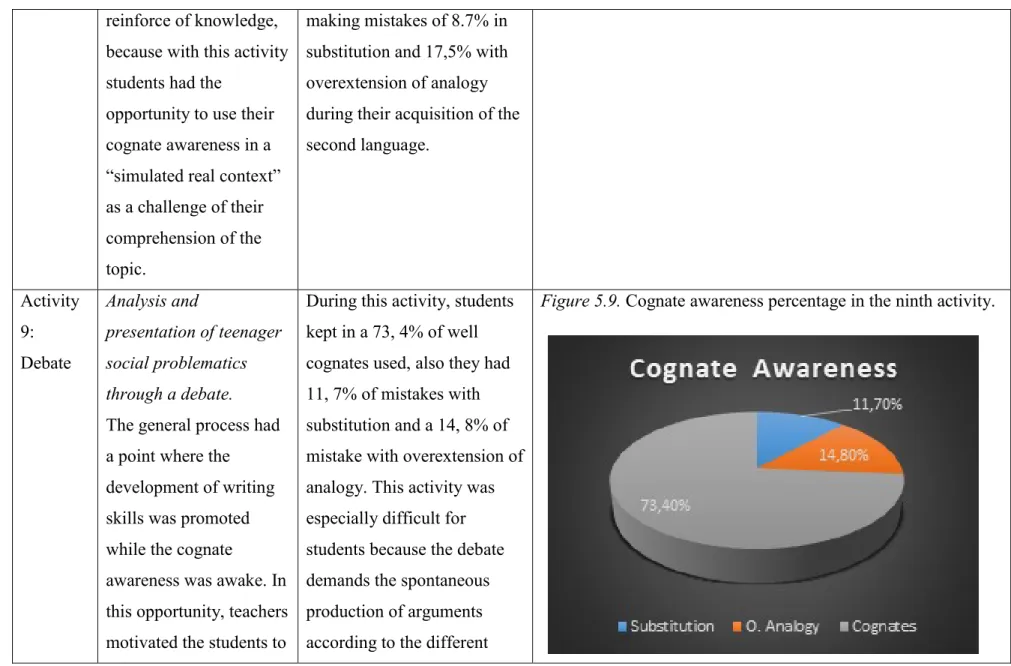
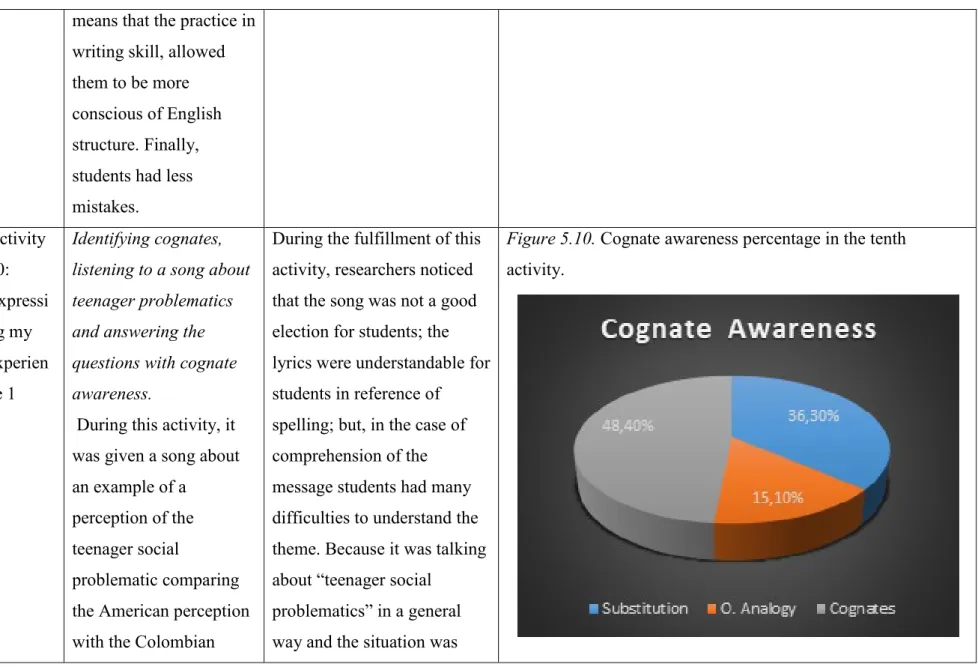
The use of graphic has been one of the most useful tools to represent and understand, in an easier way, the information. The objective is to achieve the comprehension of multivariable dates. In this project was used different kinds of graphics in order to take advantage of the graphical intelligence.
Cicalo 2017 says “Graphical intelligence is the ability to use graphics skills and, more generally, the ability to integrate the use of eye, mind, and hand to solve problems of various kinds and generate effective products aimed at creating, acquiring and communicating knowledge”. Thus, researchers analyzed in a better way and more deeply the process of the proposal. It enriched in a big way the analysis procedure and motivate an effective visual communication for people interested in the research.