
Dynamic distributed measurement of temperature changes using phase sensitive OTDR with chirped pulses
5
0
0
Texto completo
(2) Dynamic distributed measurement of temperature changes using phase-sensitive OTDR with chirped pulses Juan Pastor-Graells*a, Hugo. F. Martinsb, Andres Garcia-Ruiza, Sonia Martin-Lopeza, Miguel Gonzalez-Herraeza a Departamento de Electrónica, Universidad de Alcalá, 28805, Madrid, Spain; b FOCUS S. L., C/ Orellana 1, 1º Izquierda, 28804, Madrid, Spain ABSTRACT A new and simple distributed fiber sensor which allows for the dynamic (single-shot) and quantitative measurement of perturbations is presented. It is based on a phase-sensitive OTDR using direct detection and linearly chirped pulses. Perturbations result in longitudinal shifts of the fiber trace, which can be calculated using a local correlation. As a proof of concept, distributed temperature variations of up to 5 Kelvin with millikelvin temperature resolutions over several minutes are demonstrated. Since the technique does not require a frequency sweep, operation ranging from dynamic strain measurements at kHz rates to temperature monitoring over several hours is readily envisaged. Keywords: Fiber optic sensors, phase sensitive OTDR, linear chirp, distributed temperature sensing. 1. INTRODUCTION Distributed Optical Fiber Sensors (DFOS) allow for the monitoring of different parameters over long fiber distances and are based mainly on Rayleigh, Brillouin and Raman scattering phenomena [1]. Raman and Brillouin DOFS are generally characterized by long measurement times, which can take several minutes [2,3], due the requirement to implement frequency sweeps and/or high averaging. Recently, schemes using Brillouin based sensing have been proposed for dynamic strain sensing [4] with samplings of 10 kHz, however the strain dynamic range is limited by the Brillouin gain spectral width. In contrast, Rayleigh based sensing typically requires lower averaging than Raman or Brillouin, and is therefore better suited for dynamic measurements such as vibrations or intrusions [5]. Phase sensitive OTDR (ΦOTDR) systems can be adapted for high-resolution temperature change measurements [6], significantly lower than the typical resolutions of ≈1ºC provided by Brillouin sensors. However, in this case a frequency scan is needed, increasing the measurement times and complexity of the system. Dynamic measurements of strain have been demonstrated using ΦOTDR with phaserecovering techniques [7,8]. In this case however, the complexity of the system is increased and the long term-stability of these systems has not been clearly addressed. In this paper, we provide a method based on ΦOTDR using linearly chirped pulses, which allows for the quantitative measurement of distributed temperature changes without the requirement of a frequency scan while maintaining the simplicity of a traditional ΦOTDR using direct detection. The temperature resolution is dependent on the chirp applied in the pulses and sampling of the ΦOTDR trace. The possibility to have mK resolutions is clearly demonstrated. An experimental demonstration featuring 10 m resolution over a 1 km fiber with mK resolution and sampling rates of Hz is provided, but the sensor should in principle allow achieving the conventional features of a ΦOTDR, i.e., measurement ranges over several tens of kilometers with metric spatial resolutions.. 2. FUNDAMENTALS OF THE SENSOR AND EXPERIMENTAL SETUP This new temperature DOFS is, as it was commented, based on ΦOTDR technique. Highly coherent optical pulses are injected into an optical fiber. The Rayleigh backscattered light is monitored in the time domain, which is then associated with a fiber position. The ΦOTDR signal of interest will therefore be the result of the coherent interference between the fields which are Rayleigh backscattered from the multiple fiber scattering centers. Due to the random position of the *[email protected]; phone (+34)-91-885-69-14.
(3) scattering centers the detected trace presents random variations, but this pattern remains constant over the time if the fiber is not perturbed. Commonly, ΦOTDR analyzes changes of intensity in the fiber trace which indicate the presence of perturbations such as vibrations. However, the intensity variations will depend nonlinearly in the applied perturbations. When there is a change in optical path difference between the scattering centers induced by a uniform refractive index change ∆n, it can be compensated by a shift of the pulse frequency Δν, which allows the recovery of the original ΦOTDR pattern. Assuming ∆n<<n, the necessary Δν to compensate for a given ∆n can be derived from [6]:. n n 0. (1). Where ν0 is the central frequency of the pulse and n the effective refractive index of the fiber. The measurement of Δn along the fiber then allows for distributed temperature variation ∆T measurements, by using the conversion relation [6]:. n 6.92·106 T n 0. (2). For this task, traditional operation required a frequency sweep, which implied long measurement times. In the presented sensor however, this sweep is not necessary. A pulse P(t) with a linear chirp is used, in which the instantaneous frequency is varied linearly by ν(t)=ν0+Δνp/2-Δνp·[t/τp]. The pulse has a frequency slope Δνp/τp, where Δνp and τp are the pulse spectral content and length, respectively. In this case, it can be demonstrated algebraically that if a small Δn occurs at a certain location of the fiber z, then the local ΦOTDR pattern, E(t), will be longitudinally shifted by an amount ∆t at that location, which can be translated (through the chirp value) to a value of ∆ν which compensates for the Δn. The demonstration of the theoretical principle is out of the scope of this paper, which intends to provide an experimental demonstration of this effect. A full description of the theoretical model will be presented by the same authors in a separate work [9]. The associated local Δn change is then given by:. n n p t p 0 . (3). In this case, the measurement is essentially continuous, and the minimum detectable Δn is determined by the chirp (Δνp/τp) and the sampling (and bandwidth) with which E(t) is detected. ∆t can be determined along the fiber by calculating a local (spatial) correlation of two traces obtained for two different pulses sent to the fiber. The retrieved local temporal shifts are then translated into refractive index variations through equation (3). From here, the strain/temperature change values can be readily obtained. The experimental setup used to measure temperature changes with the new proposed technique, is depicted in Fig. 2a. It is based on a traditional ΦOTDR scheme [5] but introducing a linear chirp in the pulse simply acting on the current control of the laser. The light source was a laser diode (LD) with a linewidth of 1.6MHz emitting at 1546.66nm and working in continuous emission. The LD was driven by a standard current and temperature controller to select the laser central wavelength. A secondary current control applied a repetitive electric ramp signal in the laser driver, which introduced a linear chirp at certain times in the outputted laser light. This light was then gated in the time domain by a semiconductor optical amplifier (SOA) – whose driver was synchronized with the secondary laser current control - thus generating linearly chirped pulses. The SOA had rise/fall times in the order of 2.5ns, and was driven to create 100ns square pulses, which implies a spatial resolution of 10m in this case. The light backscattered from the fiber is detected in a p-i-n photo-detector with a bandwidth of 13GHz and a high-speed digitizer with 40Gsps sampling ratio. For more information about the other setup elements presented in Figure 2 (EDFA, Bragg Filter, Attenuators and Isolators) an interested reader is invited to consult [5]. In order to illustrate the dependence of the sensitivity of the sensor on the chirp slope of the optical pulses, three different chirp slopes were used. These were experimentally characterized using balanced phase reconstruction using optical ultrafast differentiation (balanced PROUD), a self-referenced technique which allows to recover the instantaneous frequency of optical pulses [10] in real-time. The details of the used balanced PROUD detection scheme can be found in a previous work by the same authors [10], as the experimental setup was the same as used here. The instantaneous frequency profiles ωinst(t) of the three pulses are presented in Fig. 2b, from which it can be observed that their total spectral contents are: Chirp1=0.81±0.02GHz (black), Chirp2=1.62±0.04GHz (red) and Chirp3=2.35±0.05GHz (green). It is estimated that the detection scheme used in the PROUD setup should have an uncertainty of at least 1%, mainly due to the.
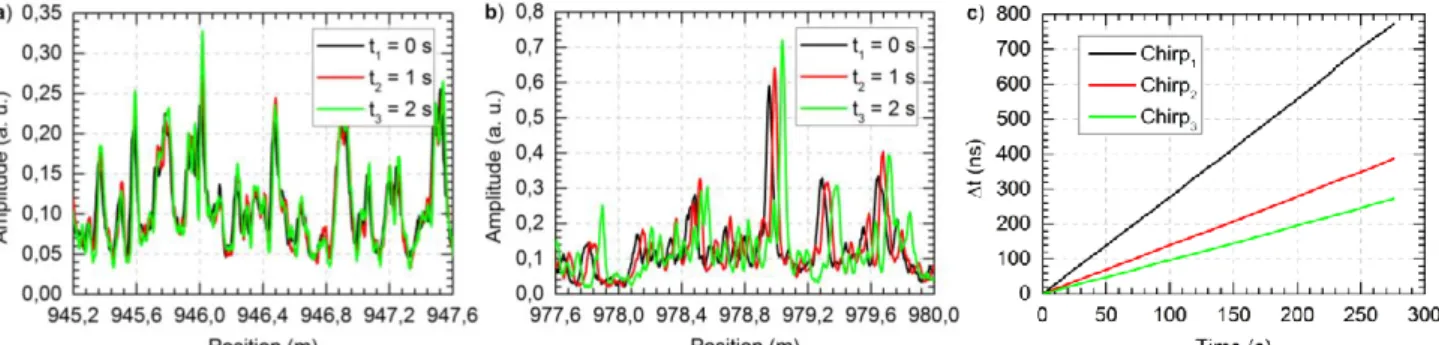
(4) optical filter used to derivate the signal [10]. In any case, the chirp profile of the pulses showed a good linearity, and should therefore introduce low errors in the temperature measurements.. Figure 2. a) Experimental setup: Acronyms are explained in the text. b) Instantaneous frequency profile of the three different chirps induced in 100 ns square optical pulses.. The fiber under test (FUT) was a 1 km single-mode fiber which was immersed in a water bath in order to maintain its temperature stable. The last 20m of the FUT were placed inside an oven which allowed to apply controlled temperature variations to the fiber. These temperature variations were monitored with the ΦOTDR sensor and compared against the temperature recorded by a thermometer placed inside the oven, which had a resolution of 0.1K.. 3. TEMPERATURE MEASUREMENTS As it has been commented before, in this new sensor when a fiber section suffers a temperature change, the trace presents a temporal shift. To demonstrate this idea, a pulse with Chirp 3 of 2.35±0.05GHz was employed and the last 20m of a 1km FUT was heated. Traces were acquired with a frequency of 1 Hz. In Fig. 3a (Non-heated region) the trace remains constant over the time but in Fig. 3b (Heated region) the trace shifts longitudinally. As it can be seen, consecutive traces are separated by ≈ 0.43ns (17 samples with 40GHz sampling ratio) which corresponds to a temperature variation of ≈ 8·10-3K (eq. 3). These results demonstrate the potential for high resolution of this new distributed fiber sensor.. Figure 3. Longitudinal shift of the ΦOTDR trace when temperature changes are applied to the FUT. a) Non-heated region b) Heated region c) Accumulated longitudinal trace shift observed for a linear temperature variation of 5K applied over 280s for the three different pulse chirp slopes shown in Figure 2b.. To perform measurements of large temperature variations over time, an accumulated delay is computed for each point, by adding the local relative trace delays obtained in the comparison of consecutive traces. To demonstrate the feasibility of this method even over long measurement times, the same last 20m of the 1km FUT were heated in a controlled manner. The fiber was heated 5K along 280s three times and interrogated with each one of the three different chirps presented in the previous section for each heating. The final results are presented in Fig 3c, where it is demonstrated that the accumulated longitudinal temporal shift of the trace (produced by a linear temperature change) depends on the chirp slope (Δνp/τp) used as it is explained in Eq. (3). Note that the delay in the vertical axis correspond to an accumulation of delays registered in consecutive traces, and not a local delay obtained between the first and last trace. The temperature change measured was calculated for each chirp: ∆TChirp1=4.957K, ∆TChirp2=5.005K, ∆TChirp3=5.116K, all of which agree well with the temperature change measured by a manual thermometer 5±0.1 K. This temperature change corresponds to a ≈6.7GHz.
(5) frequency shift (eq. 2) which exceeds the spectral content of the pulse in the three cases. Since the measurement is relative, the range of temperature measurements is in principle not limited, being in practice determined by how the cumulative errors of the measurement are handled.. 4. CONCLUSION In this work, a simple and innovative distributed fiber sensor which allows the dynamic and quantitative measurement of perturbations was presented. It is based on phase-sensitive OTDR using linearly chirped pulses. The sensor has potential for high resolution measurements and distributed temperature measurements with a resolution of mK were readily demonstrated. The resolution of the sensor can be tuned by acting on the pulse chirp slope. As a proof of concept, an experimental demonstration featuring a spatial resolution of 10 m over 1km and sample rate of 1Hz is provided. The system should in principle allow for similar settings to traditional ΦOTDR, with metric spatial resolutions over tens of kilometers and sample rates of kHz, also applied to strain measurements. The range of temperature measurements is in principle not limited for the vast majority of situations, being in practice determined by how the cumulative errors of the measurement are handled. Compared to traditional ΦOTDR, the need for a frequency sweep is replaced by the computation of simple local temporal correlations from trace to trace. Truly single-shot determination of perturbations is achieved with this system. Without the requirement of a frequency sweep, the complexity/cost of the pulse generation setup is decreased, being traded by an increase of the costs of detection, where bandwidths of the photodetector/digitizer should be of the order of the pulse spectral content (in this case GHz).. ACKNOLEDGEMENTS This work was supported by the European Research Council through Starting Grant UFINE (Grant no. 307441), the Spanish MINECO through project TEC2013-45265-R, and the regional program SINFOTON-CM: S2013/MIT-2790. Juan Pastor-Graells acknowledges funding from the Spanish MINECO through a FPI contract. Hugo F. Martins acknowledges EU funding through the FP7 ITN ICONE program, gr. #608099. Sonia Martin-Lopez acknowledges funding from the Spanish MINECO through a “Ramon y Cajal” contract.. REFERENCES 1. 2.. Bao, X. and Chen, L., "Recent progress in distributed fiber optic sensors," Sensors 12(7), 8601–8639 (2012). Bolognini, G., Park, J., Soto, M. A. and Di Pasquale, F., "Analysis of distributed temperature sensing based on Raman scattering using OTDR coding and discrete Raman amplification," Meas. Sci. Technol. 18(10), 3211-3218 (2007). 3. Angulo-Vinuesa, X., Martin-Lopez, S., Nuño, J., Corredera, P., Ania-Castañon, J. D., Thévenaz, L. and GonzalezHerraez, M., "Raman-Assisted Brillouin Distributed Temperature Sensor Over 100 km Featuring 2 m Resolution and 1.2 °C Uncertainty," J. Lightwave Technol. 30(8), 1060-1065 (2012). 4. Peled, Y., Motil, A. and Tur, M., "Fast Brillouin optical time domain analysis for dynamic sensing," Opt. Express 20(8), 8584-8591 (2012) 5. Martins, H. F., Martin-Lopez, S., Corredera, P., Filograno, M. L., Frazão, O. and González-Herráez, M. "Coherent Noise Reduction in High Visibility Phase-Sensitive Optical Time Domain Reflectometer for Distributed Sensing of Ultrasonic Waves," J. Lightwave Technol. 31(23), 3631-3637 (2013). 6. Koyamada, Y., Imahama, M., Kubota, K. and Hogari, K. "Fiber-Optic Distributed Strain and Temperature Sensing With Very High Measurand Resolution Over Long Range Using Coherent OTDR," J. Lightwave Technol. 27(9), 1142-1146 (2009). 7. Wang, Z., Zhang, L., Wang, S., Xue, N., Peng, F., Fan, M., Sun, W., Qian, Rao, J. and Rao, Y., "Coherent Φ-OTDR based on I/Q demodulation and homodyne detection," Opt. Express 24(2), 853-858 (2016). 8. Masoudi, A., Belal, M. and Newsol, P., "A distributed optical fibre dynamic strain sensor based on phase-OTDR," Meas. Sci. Technol 24(8), 0.85204 (2013). 9. Pastor-Graells, J., Martins, H. F., Garcia-Ruiz, A., Martin-Lopez, S., and Gonzalez-Herraez, M. "Single-shot distributed temperature and strain tracking using direct detection phase-sensitive OTDR with chirped pulses," Opt. Express (2015) (Submitted). 10. Martins, H. F., Pastor-Graells, J., Romero Cortes, L., Piote, D., Martin-Lopez, S., Azaña, J., and Gonzalez-Herraez, M. "PROUD-based method for simple real-time in-line characterization of propagation-induced distortions in NRZ data signals," Opt. Lett. 40(18), 4356-4359 (2015)..
(6)
Figure
Documento similar
In this chapter, an automated method for brain hematoma and edema segmentation, and volume measurement using computed tomography imaging is presented.. The method combines a
In this paper we improve the perfor- mance of Boosting-based detectors by refining the target bounding box using a new cost-sensitive multi-class boosting scheme.. This is a
Since we were interested in measuring the probability of secondary pulses per primary avalanche, we obtained this time distribution selecting pairs of pulses in which the first one
The first application of attosecond pulses to follow rapid electron dynamics in a molecule revealed that the dissociative ionization of hydrogen by a two-color extreme-ultraviolet
We show that using the field dependence of magnetocaloric effect, the order of the phase transition can be unambiguously determined using a quantitative criterion even for
This study assesses the pattern of intra-individual changes of the precloacal vertebral series of an adult specimen of Daboia russelli (Viperidae) using GMM. We provide a
Here we use the spectral resolution of the high- order harmonic coherent frequency comb combined with the possibility to tune the laser wavelength, as well as a weak infrared
In this paper we estimate a demand for private medical services equation based on the tradition of the Grossman´s model of demand for health using data for a panel of
