
Teachers and learners negotiation of a school syllabus for EFL
38
0
0
Texto completo
(2) Contents Chapter I.................................................................................................................................. 4 Abstract ............................................................................................................................... 4 Key words: .......................................................................................................................... 6 Introduction ......................................................................................................................... 6 Problem statement ............................................................................................................... 7 Justification ......................................................................................................................... 8 Chapter II ................................................................................................................................ 8 Literature review ..................................................................................................................... 8 Chapter III ............................................................................................................................. 12 Methodological implementation of the proposal .............................................................. 12 General objective............................................................................................................... 13 Specific objective. ............................................................................................................. 13 Methodological implementation in the internship ............................................................ 13 Chapter IV............................................................................................................................. 15 Expected results................................................................................................................. 15 Population, results and analysis of the results................................................................... 15 Chapter V .............................................................................................................................. 19 Conclusions ....................................................................................................................... 19 References ......................................................................................................................... 20 Annexes................................................................................................................................. 21 Annex 1 - survey #1 .......................................................................................................... 21 Annex 2 - survey #2 .......................................................................................................... 21 Annex 3 - survey #3 .......................................................................................................... 22 Annex 4 -Survey #1 analysis............................................................................................. 22 Annex 5 - survey #2 analysis ............................................................................................ 23 Annex 6 - Survey #3 analysis and tabulation .................................................................... 24 Annex 7 - will agreement among students, university and school.................................... 25 Annex 8 – acceptance letter internship ............................................................................ 27 Annex 9- plan of work ...................................................................................................... 28 Annex 10- chronogram...................................................................................................... 29 Annex 11 – syllabus created at school .............................................................................. 30 2.
(3) Annex 12 –syllabus stablish in the school before the internship began. ........................... 30 Annex 13 – meeting formats ............................................................................................. 34 Annex 14 - letter professional assignment by the school.................................................. 35 Annex 15 - survey evidences ............................................................................................ 36 Annex 16 - picture evidences of the work done ................................................................ 37 Annex 17 - Hours verification........................................................................................... 38. 3.
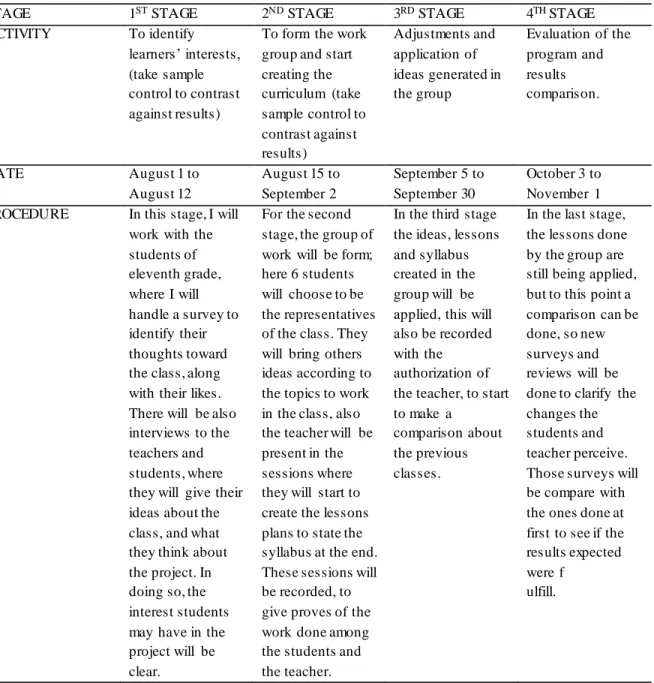
(4) Chapter I Abstract When we talk about designing a syllabus, it is necessary to consider all people that participated in this process, meaning teachers and students. They should work together to establish the topics, rules, methodology, etc., but this premise is not always developed and applied. Many times, we have seen only teachers deciding what to work in the class. Therefore, the establishment of a group of work between teachers and students will help to reach the premise consider before. Students know what they like, what could inspire them to work, and there is where this project aims, to let students take their interests and apply them to the class. Collaborative action research (CAR) is the path to follow to achieve this project. Taking into account that CAR guides those teachers who seek to work with a specific group in a particular setting with the main goal of finding better ways to do their job. In this case this enables teachers to conduct an inquiry, which will improve student learning, along with improving their own practice, and most importantly to overcome the isolation commonly experienced by teachers. (Bryant, 1995) Working together, teachers and students can establish the syllabus, subsequently, the full potential of the class can be accomplished. Students will give the topics and with the guide of the teacher those topics will be prepared and developed with the requirements a syllabus have, this process is called syllabus negotiation. Within this project there are 4 stages that will be done, the first stage is to identify learners’ interests, (take sample control to contrast against results), in this stage, I will work with the students of eleventh grade, where I will handle a survey to identify their thoughts about the class, along with their likes. There will be also interviews to the teachers and students, where they will give their ideas about the class, and what they 4.
(5) think about the project. In doing so, the interest students may have in the project will be clear. For the second stage, I will form the work group and start creating the syllabus (take sample control to contrast against results), here six students will be chosen to be the representatives of the class. They will bring others’ ideas according to the topics to work in the class. Also, the teacher will be present in the sessions where they start creating the lessons plans to state the syllabus at the end. These sessions will be gather in a meeting format; to give evidence of the work done among the students and the teacher. The next stage, is the adjustments and application of ideas done in the group. Those ideas, lessons and syllabus created in the group will be applied, to start making a comparison about the previous classes. Finally, in the fourth stage an evaluation of the program will be done to set up results. The lessons and syllabus done by the group are still being applied, but to this point a comparison can be stated, so new surveys and reviews will be applied to give evidence of changes in the syllabus adjusted. The surveys students took at the end of the process will be compare to the ones applied at the beginning to see if the results expected were fulfill. The previous chronogram can be seen in (annex 10) It is important to highlight that it does not mean students will have the control of the class, but they will help to set their learning process’ pace. Along with letting students participate in the development of the of the syllabus, they can also realize which could be their learning style.. 5.
(6) Key words: Collaborative action research, English foreign language, group work, interest, learner centered, lesson plan, participatory curriculum, self-conscious learning, syllabus negotiation. Introduction When teaching, English teachers may face difficulties in their classrooms, which sometimes are hard to overcome. One of those difficulties my classmates and I witnessed in the teaching practicum was students’ lack of interest and boredom. Some students did not consider the activities given in the classes interesting. One of the solutions proposed was to negotiate the content of the syllabus, which is the main interest for this project. However, few times some teachers have thought about including students into that process, in the sense of not just asking, “what would you like to do?” but actually including them in the construction and developing of the syllabus. Students and teacher will get together in a group work in order to develop the syllabus, taking into account students’ interests and ideas, which will be monitored by the teacher. That process is what collaborative learning aim to do and is the approach this project will based on. Collaborative learning tells us, learning is a social construct where the learner is the primary focus of the class, so they can realize the importance they have inside the classroom. For this inquiry, I plan to conduct a survey to the students. This survey will let me know the way students think about the class together with their thoughts on how it could be better and the expectations they had at first of the class. With those results along teacher’s ideas about how the class should be conduct, I plan to put them together to see if there is a 6.
(7) common point so I can attempt to get some ideas from the group work in the first meeting, that will allow me to create or design the syllabus. (annex 15) Problem statement There are different statements which seem to be recurrent among the EFL students from eleventh grade at Julio Garavito Armero school, such as “I don’t like English” “the class is boring” “I don’t like what teachers do”, those statements may show that learners lose interest about the class, meaning participation gets low and they just do not care about learning English. Based on these beliefs, Fuglei and Gunkel, K. Moore, F., (2005) talk about letting students take ownership of the class and participate in the creation of the syllabus. I will use collaborative action research as the basis of this project. It is well known that learning is not only a personal process but it is a social construct as well. There have been teachers like Fuglei, s.f. (N/D) and Monti (2007) that have applied this idea to their classes, leading to positive results, as students do not just improve their participation, interest and attitude towards the class, but also show personal growth.. 7.
(8) Justification Negotiating the course syllabus with the students bring different changes to the class and the learning process. Those changes can give a new perspective on what you and the students want for a class. That is why this project is being applied, as sometimes classes can get stressful or monotones for the participants. The negotiation of the syllabus can help to solve those problem, as everybody is able to let other participants of the learning process what they think and like about the classes. In a short time, it will be a bit complicated to set rules on how they can participate or to help students get familiar to a new environment. This was a project I was looking for to apply based on my previous experience, where students most of the time have to agree with the class syllabus. As we are in a new era where technology and approaches change, the center of the class changes too. Thus, this project aims to let students take a different role in the class decisions.. Chapter II. Literature review This proposal focuses on the development of a syllabus for an EFL class. “A syllabus is an expression of opinion on the nature of language and learning; it acts as a guide for both teacher and learner by providing some goals to be attained” (Rabbini, 2002). According to Robinson (1998) “Syllabus design is based essentially on a decision about the 'units' of classroom activity, and the 'sequence' in which they are to be performed”. Similarly, Nunan (1988) defined the syllabus design as “a statement of content which is used as the basis for planning courses of various kinds, and that the task of the syllabus designer is to select and grade this content”. 8.
(9) However, the syllabus can be separate in two big mainstreams, product-oriented and process-oriented, Alshumaimeri (2003). The first one emphasizes in the product of language learning; it is divided in different approaches (structural, situational and notional approach). The second one, enhance communicative language skills that is focus on the specification of learning tasks and activities that the students will undertake during the course. (Rabbini, 2002) Those mainstreams mentioned before are also name as the product-based approach and the process-based approach. The first one, “product-based approaches identify the kinds of uses of language the learner is expected to be able to master at the end of a given period of instruction. Teaching strategies are then selected to help achieve ments on these goals” Richards (2006), and the second one, “process-based approaches focus on creating classroom processes that are believed to best facilitate language learning using two methodologies: content-based instruction (CBI) and task-based instruction (TBI)”. Richards (2006) Based on what was explained before, I used as the focus of this proposal the process-based approach, which fulfil the students´ objectives. It is defined by Richards (2006), who established the characteristics of this approach. It is an internal process, where the learning process is negotiated between learners and teachers; they both get to take decisions, also what the learner wants to learn is an important piece of this approach. Another characteristic given by the American Language program (n/d.) Processbased approach’s goals are based on the process of communication and negotiation.. 9.
(10) Process-based approach has an important component, which is the base for its operation; it is also learner-centered. The Learner-Centered designs are used when educators feel the students may be able to make more informed decisions, which at the same time is one of the goals for this project. O'Neill (2010) As it has been told until this point, letting students participate in a more open way in the class and its formation is the focus for this research, learner-centered design and the process-based approach let us handled that objective. There are a few principles that allow us to understand what can be done in order to apply this project.. Working with syllabus is not as simple as it looks, as there are different concepts to take under consideration, like the type of syllabus to the theoretical referent, which is use to base the learning, teaching and working process. As set before, the type of syllabus’s approach is the process-based, which contains two methodologies, the content-based instruction and task-based instruction. Content-based instruction (CBI) is based on the assumptions that in language learning people learn a language more successfully when they use the language as a means of acquiring information, rather than as an end in itself, also, CBI reflects learners’ needs for learning a second language, and its content provides a coherent framework that can be used to link and develop all of the language skills. The resulting syllabus of this project will gather not only teacher and students’ expectations, but also different academic necessities, all of this base on the collaborative learning approach. Task-based instruction, or TBI (also known as task-based teaching), is another methodology that can be use when there is an aim to focus on classroom processes. In the case of TBI, the claim is that language learning will result from creating the right kind of 10.
(11) interactional processes in the classroom, by using specially designed instructional tasks. Richards (2006).. Main constructs to base the project Alongside the approaches mention before, there are two authors that handled researches similar to this one as well as manage methodologies related to this project’s ends. Gunkel, K. Moore, F. (2005) and Abbasian, G. Malerdi, p. (2013) all of them made interesting and innovating researches, first Gunkel and Moore, they implemented a project in which they included students and teachers as partners to co-design the curriculum. They all worked together in a small group where they discussed the topics and activities to develop their curriculum and applied later. This was a great research as it provides useful insights to what I expected to develop. The group work was a good idea, which I took a step farther, for this project was decided to allow all students to participate in the developing process, as with a small group it may be difficult to get an inside on what all students may think. In Gunkel and Moore’s research it can be witness how allowing students to take ownership of the curriculum they can feel better about what they do, improving somehow their participation. On the other hand, there are Abbasian and Malerdi, they implemented a quasiexperimental research similar to the one named before, where they took 54 students and divided them in two groups, one where students were able to participate in the curriculum creation and the other group work with the syllabus already done by teachers. The qualitative results showed that the syllabus negotiation improves motivation, reduces learning anxiety, builds confidence, besides promote comprehension, conversation and. 11.
(12) word learning and facilitate fluency when speaking, which is one of the objectives this research aims to, not only to develop a syllabus with the students, but also enhance their participation, to work with more confidence and joy. In this case, I did not take the idea of dividing the group as I wanted to avoid the issue of feeling left aside in a project that affects students’ class. As it can be seen, involving students in the creation of the syllabus or curriculum, in the case of the constructs, can bring multiple benefits, students may understand the importance of what the teachers do every year and the necessity of having a plan to learn.. Chapter III Methodological implementation of the proposal The methodological implementation of this research was a bit complicated at first, as there were problems with the papers deliver at the University, but as soon as that was solve, it started. First students receive the surveys (annex1, 2 and 3) where I planned to understand their likes and dislikes, what they think about the English class, and the experiences they had with the language. As soon as it was done, I started to work with the students on how they would like the activities, regarding the topics that were already stablished at school, each student gave an idea about activities, readings and games that could be used, those ideas were put under consideration of the class and the teacher to see which ones could be used. While those ideas where implemented, I was writing the syllabus, setting the activities under the dates and stablishing the goals to be fulfil. This part of the 12.
(13) implementation was done for 2 months and 3 weeks. The final week was set to take the samples for the finalresults, there students had a space where they let the teacher know what they thought about the class, the implementation of the internship and what they think could be the next step to take in this kind of activities. (annex 9) General objective. Creating a syllabus which fulfills students and teachers’ expectations of an English class. Specific objective. Encourage students to participate in the creation of the syllabus. Methodological implementation in the internship Nowadays, the implementation of a second language as English, in schools is an important feature, as parents and students consider learning a second language a big step in the professional development. In this case, this project was set up in a school where English does not have the importance it should. The school has some activities to strengthen the use of English in the school, but few students participate in these activities, which is why there is a call to take new methodologies to their class. That is why I apply this project in the school, as there was the necessity of building an interaction among students and teachers, an interaction closer to them, inside their classrooms. With this project, I manage to gather the students of eleven grade (1102) with the teacher to listen to what they wanted to learn, the way they would like to do it; this was done during the first classes where everyone participated, most of the students agreed on what kind of activities they would like to do, which was a good point to start.. 13.
(14) They were told about collaborative learning, as a methodology where they could learn English if they united to help each other in the learning process and not only they manage to understand the importance of working together as a class, but also the necessity of having exercises so they could develop the skills offer in an English class (listening, speaking, reading and writing). The classes and group meeting to work on the syllabus were done first during the class time. Students were divided in small groups where they had to come with activities to do about different topics and they also decide on which criteria use to grade those activities. All those things were done with the supervision of the teacher and I, when the exercise of coming up with the activities finish, the results were discussed and stablished in the syllabus and then implemented in the classroom. Students knew what activities were coming, the date, what they needed for the implementation so they were prepared for that; and finally, they were able to take control of the class’ pace. The syllabus created with the students served as an opportunity to change the old syllabus which needed to be updated, not only because of the time it has been use but also because students did not have any knowledge about it. (annex 12) The way things were done allowed the implementation of the methodology to be successful, the collaborative learning was evidenced in every aspect of the classroom, not only among students, but also with the teacher, who understood the importance of letting students participate in the teaching and learning process.. 14.
(15) Chapter IV Expected results By the end of the internship the following results were expected to be accomplished: 1. A syllabus which contains students and teachers’ thoughts and expectations about the class was created. (annex 11) 2. An increase on students’ participations in the class. 3. Teacher and students worked together to make the class a participatory process. 4. Benefits of letting students participate in the creation of the syllabus were evidence. 5. Students realize they can manage their own process learning but with the teacher´s guidance.. Population, results and analysis of the results In this step the results of the data gathered at the beginning of the internship will be presented from a qualitative and quantitative way (annex 4, 5 and 6). The population of this internship were the students of the eleventh grade of the school Julio Garavito Armero, there were thirty students, among sixteen and eighteen years old, as it will be shown in the data analysis, some students were tired of some activities the teachers had for them, as an example they had a bad experience with a teacher who only gave them worksheets to do translations, as they said “the final homework we had to do was to translate a text of almost 25 pages, which was boring and tiring for us”, so it was good we have had the opportunity to work on something new.. 15.
(16) As it was said in the previous point, there were several results expected by the end of this internship, here some of them will be analyzed or discussed to see if it was fulfilled or not. -. A syllabus which contains students and teachers’ thoughts and expectations about the class was created and applied to the class.. The first result that the implementation gave was good as a syllabus was done getting students and teachers’ ideas and expectations of the class, it was great to observe how students were willing to help on the design of the syllabus, mostly because they did not want for the same problem to happen as they had with the teacher on tenth grade (many worksheets and translations). -. Students’ participation in the class increased.. This was the most notorious and acclaimed by the main teacher, as this group had some difficulties to work together, compared to the other eleventh grade group. The idea of creating the syllabus with the teacher was a “crazy one” at the beginning, according to the students, as the teacher was the one who always decided what to do. But, when it started, they saw that it was possible, that they could participate in that process, therefore they started to work more often together to look for funny activities according to each topic, the teacher was there to be sure each activity fulfilled the academic necessities. All of these, also accomplish something which, even when it was an expectation, it was a difficult one to complete, and it was that students cared more about their studies, they used to look for me and teacher in their breaks to talk about the activities they were preparing, to understand the topic in a better way, any question they had about it they asked; this was surprising, to see most of the students searching for. 16.
(17) guidance, just that action let me know the relevance of the internship and also that the project fulfilled its purpose. -. Teacher and students worked together to make the class a participatory process.. This process was well done as the main teacher along with the students gather all together to work in the activities, students were able to behave with the teacher and felt more comfortable with she. By the end of the meetings the students had many ideas on what they would like to do and how to do it, the teacher guide them so they could know what they need to look for in an activity to do in class. (Annex 13) -. Benefits of letting students participate in the creation of the syllabus were evidence.. At first it was a matter of concern for the teacher to let students decided on which activities to do, as she thought maybe they would choose the easy ones, something that would not challenge them, some students wanted to do this, but there it was where the teacher’s role entered, so I managed to let them know the importance of challenging activities, so they started to do things more complicated but funny. This issue let the teacher know that she could trust more in the students to guide the learning and teaching process, even when the teacher still is the one that presents the topics, students can also have an active role in the class. -. Students realize that they can manage their own learning process.. There was something that students had pretty clear since the beginning of the internship and it was that English is important for their academic and work lives; students saw 17.
(18) how they can learn English in a comfortable way for them and some students actually showed me how they were working outside school to learn more about the second language.. By the time the internship finished, I saw how there are many students that want to learn English and even when they may have had hard experiences learning, it does not mean they do not want to do it, students were trying to find different ways to learn and if the teachers shows that they are there to help, students will open themselves to them, making the learning experience a more productive and interesting thing, not only for the students but for the teacher as well, as we can also learn new things.. 18.
(19) Chapter V Conclusions Learning and teaching are two processes that will be always together, no matter what circumstances they are under, there will be a student and a teacher, either virtual or face to face teacher, so it is important to learn how to work together among all participants, so everybody’s expectations and ideas will be taken under consideration. Students are able to understand the importance of what they do if the teacher take the time to show it to them, so they can as well take more responsibilities in the class, nowadays they need to have a more active role, not only sit and copy but also create, develop, organize your learning process. (annex 16) Traditional teaching is no longer enough to fulfill today’s expectations, rewarding education, students are asked to not only learn a topic but also to develop and create new ways of doing things, they need to learn how to handled themselves every life aspect they may face. Finally, our society needs to advance in a more social and peaceful way, the world is not for just one person, it is a machinery where everybody is involved, children need to understand their decisions could affect others, so we have to work together.. 19.
(20) References. Abbasian, G. Malardi, P. (2013, august). The Effect of Negotiated Syllabus on EFL. Retrieved from http://www.academypublication.com/issues/past/tpls/vol03/08/14.pdf Alshumaimeri, Y. (2003). Types of Language Syllabuses. Retrieved from http://www.academia.edu/8873563/Language_Syllabus_Types Bryant, P. (1995). Collaborative action research "on the edge". Retrieved from https://www.uleth.ca/dspace/bitstream/handle/10133/849/Bryant_Paul.pdf?sequence =1 Fuglei, M. (n.d.). Student-Designed Curriculum: Helping Students Create Their Own Lesson Plans. Retrieved from http://lessonplanspage.com/student-designedcurriculum- helping-students-create-their-own- lesson-plans/ Gunkel, K. Moore, F. (2005). Including Students and Teachers in the Co-Design of the Enacted Curriculum. Retrieved from http://files.eric.ed.gov/fulltext/ED498676.pdf Monti, M. (2007). No-hands teaching: Student-created lessons based on authentic material. Retrieved from http://www.kyae.ky.gov/NR/rdonlyres/4B906AD9-14874180-9DE8464922D43EBE/0/NoHandsTeachingStudentcreatedLessonsBasedonAuthenticMate rials.pdf Nunan, D. (1988). Syllabus design . In D. Nunan, Syllabus design (p. 5). Oxford: Oxford university press. O'Neill, G. (2010, january 13). Programme design. Retrieved from http://www.ucd.ie/t4cms/UCDTLP00631.pdf Rabbini, R. (2002, mayo). An Introduction to Syllabus Design and Evaluation. Retrieved from http://iteslj.org/Articles/Rabbini-Syllabus.html Richards, J. (2006). Communicative Language Teaching Today. New York: cambridge university press. Robinson, P. (1998). State of the art: SLA Theory and Second Language Syllabus Design. Retrieved from http://jalt-publications.org/old_tlt/files/98/apr/robinson.html Tran, N. N. (2011). Syllabus Negotiation: A Case Study in a Tertiary EFL Context in Vietnam. Retrieved from http://dx.doi.org/10.5746/LEiA/11/V2/I1/A06/Nguyen.. 20.
(21) Annexes Annex 1 - survey #1 UNIVERSIDAD DISTRITAL FRANCISCO JOSÉ DE CALDAS “TEACHER- LEARNERS NEGO TIATIO N O F A EFL SYLLABUS” CO LEGIO JULIO GARAVITO ARMERO SURVEY #1 “THO UGHTS ABOUT ENGLISH” T he next survey aims to identify students’ thoughts about the English class as well as their desires towards it. Name: _________________________________________________________________ Age: __________________ Date: ___________________ Grade: _______________ 1.. Do you consider English is important for your life, in any aspect?. 2.. What do you think about the English classes you have had in the school?. 3.. Have you liked the topics they teach?. 4.. Do you like the methodology use to teach you those topics?. 5.. What has been the worst experience you have had with English?. 6.. What has been you best experience you have had with English?. Annex 2 - survey #2 UNIVERSIDAD DISTRITAL FRANCISCO JOSÉ DE CALDAS “TEACHER- LEARNERS NEG OTIATION OF A EFL SYLLAB US” COLEG IO JULIO G ARAVITO ARMERO SURVEY #2 “WHAT DO YOU LIKE?” This survey aims to identify students likes and dislikes about English. Name: _________________________________________________________________ Age: __________________ Date: ___________________ Grade: _______________ 1.. What do you do in your free time?. 2.. Do you practice English in your free time?. 3.. What are your interests from an educational view?. 4.. What do you think about languages?. 5.. What skills would you like to improve the most?. 21.
(22) Annex 3 - survey #3 UNIVERSIDAD DISTRITAL FRANCISCO JOSÉ DE CALDAS “TEACHER- LEARNERS NEGO TIATIO N O F A EFL SYLLABUS” CO LEGIO JULIO GARAVITO ARMERO SURVEY #3 “WHAT WOULD YOU DO?” T he next survey aims to understand the way you as a student would like to do things in a class, there will be several options from which you can choose. Name: _________________________________________________________________ Age: __________________ Date: ___________________ Grade: _______________ 1.. If you are going to learn present simple’s grammar, how would you like to do it? a. b. c. d.. 2.. From the next options, what would you do to learn verbs’ conjugation? a. b. c. d.. 3.. Practice by writing sentences Just reading them With visual aids like flash cards, cardboards or just images With games like find the match, game boards, etc.. When doing a presentation about any topic would rather in group or individual? a. b.. 4.. With readings With song With videos By writing. Group Individual. How would you study for a quiz about future will and going to? a. b. c. d.. Reading the notes, you have on your notebook Looking for activities on internet to practice Looking for a partner that would like to study with you You do not need to study as you already know the topic. 5.. Do you know what the syllabus being implemented in your classroom is about?. 1 2. Yes. I do No, I don’t. Annex 4 -Survey #1 analysis 1.. Do you consider English is important for your life, in any aspect? In this question the answers were unanimous, all students consider important English in their lives, they were between academic and work purposes, but the main response was that English is important for them. This is a clear evidence that students think about their future, even when they don’t show it in the school.. 2.. What do you think about the English classes you have had in the school? T he thoughts in this questions were divided, most of the students like the classes they were having during the time they answer, but before that, they did not like the classes as they do not practice as they would like to, also they think they do not have the level they are supposed to in the eleventh grade, which is actually true according to the classes done.. 3.. Have you liked the topics they teach? Most of the students said yes to this question, only 9 of them said no, although while they were answering the survey I asked if they could tell me the latest topics they’ve seen, but I just got answer from 3 students, so it makes me think maybe they weren’t sure about the topics they are learning.. 22.
(23) 4.. Do you like the methodology use to teach you those topics? Most of the students like the methodology implemented, they said that starting these year it got much better, as they are comparing the classes this year, with the ones last year. That is an issue that was presented since the beginning, students claim the latest teacher really bored them down with her activities.. 5.. What has been the worst experience you have had with English? T his answers prove and back what has been said before, most of the students said their worst experience was to translate text and worksheets, which proves that the precious teacher actually make a bad impression of English for them. Few answers where different, some said speaking or reading.. 6.. What has been you best experience you have had with English? T he difference among the answers showed the diversity we can see in the classroom. One of the recurrent answers was when they listen music or watch movies and they recognize some of the words, others talk about when they can talk and say a complete sentence; those answers prove that students feel good when using English, every time they talk or listen they feel good, they know they are improving and that is a feeling that is important to enhance in the students.. Annex 5 - survey #2 analysis 1.. What do you do in your free time? T hese answers were actually expected base on the gender, boys answer they spend their time, playing soccer or basketball, also video games, and watching tv, while girls were more like listening music, going out with my friends, which proves there is a remarkable difference on what students do based on the gender, but we can assume and ensure this only with this group.. 2.. Do you practice English in your free time? T his was as well a unanimous answer, students answer that they do not practice English in their free time, which let us know that there is not a program to study English outside the classroom, or any activity that the class can propose to practice at home.. 3.. What are your interests from an educational view? Regarding academic purposes, the students already have an idea on what they want to do after the finish school, there is a great percentage that looks for engineering, some goes for arts, like music, deign. Regardless what is important is that they know what they want and have a clear view on the importance of education, which will be a good help for the project.. 4.. What do you think about languages? T his question had the same answer for most of them, languages are important for them, mostly thinking about a professional life, as they already know, they need a second language to have better opportunities at work and at future studies.. 5.. What skills would you like to improve the most? Finally, as what they think will be the most important skill to develop in English, they are balance in their answers, they didn’t go for just one skill, most of them talk about listening and speaking, but on the other hand the same number of students think that reading and writing are also really important, so they do not leave behind any skill that they know is useful.. 23.
(24) Annex 6 - Survey #3 analysis and tabulation 1.. Question 3. If you are going to learn present simple’s grammar, how would you like to do it? a) b) c) d). 20% 80%. With readings With song With videos By writing. a 4.. Question 1 a d 27%. c 33% a b. c. How would you study for a quiz about future will and going to? e. f. g.. 13% b 27%. b. h.. d. Reading the notes, you have on your notebook Looking for activities on internet to practice Looking for a partner that would like to study with you You do not need to study as you already know the topic. Question 4 2.. From the next options, what would you do to learn verbs’ conjugation? a) b) c) d). 0% 10% 53% 37%. Practice by writing sentences Just reading them With visual aids like flash cards, cardboards or just images With games like find the match, game boards, etc.. a 5.. a d b 36% c27% 27%10% a 3.. b. c. c. Yes. I do No, I don’t. Question 5 d. 37%. 63%. When doing a presentation about any topic would rather in group or individual? a) b). d. Do you know what the syllabus being implemented in your classroom is about? a. b.. Question 2. b. a. Group Individual. 24. b.
(25) Annex 7 - will agreement among students, university and school. 25.
(26) 26.
(27) Annex 8 – acceptance letter internship. 27.
(28) Annex 9- plan of work Plan of work Beginning with, we will apply a set of surveys and interviews to understand the thoughts students and teachers have about how the class should be conduct, along with the ideas students may have on what the topics could be. Thar will lead us to the next step, after the data collected has been gathered and analyzed, the meetings will start, which will be done at least twice per week (time to be consulted with the teacher) with representatives of the students and the teacher, those representatives will gather their partners’ comments and will pass the results to them; in the meetings the teacher will let students know the path they had to the class alongside the English grammar topics to work and the students will tell the ideas they have about how to work those topics, which ways can be used to apply them (songs, videos, worksheets, etc.) and from there the group will start to create a syllabus where both sides’ comments will be taken under consideration. In the third step, the application, we will apply the syllabus to the class, so the teacher will take the activities created alongside the students, and according to how they planned to follow the syllabus, it will be done. To conclude, after the syllabus have been applied, and the activities have been followed in the way planned, the results will be gathered, to see if the main objective was accomplished, to fulfill teacher and students’ expectations.. 28.
(29) Annex 10- chronogram CHRONOGRAM INTERNSHIP SCHOOL JULIO GARAVITO ARMERO GRADE TO WORK WITH- ELEVENTH TEACHER IN CHARGE OF THE GROUP: ADRIANA MUÑOZ. TABLE 2. CHRONOGRAM AND PLAN OF WORK STAGE ACTIVITY. 1ST STAGE To identify learners’ interests, (take sample control to contrast against results). DATE. August 1 to August 12 In this stage, I will work with the students of eleventh grade, where I will handle a survey to identify their thoughts toward the class, along with their likes. There will be also interviews to the teachers and students, where they will give their ideas about the class, and what they think about the project. In doing so, the interest students may have in the project will be clear.. PROCEDURE. 2ND STAGE To form the work group and start creating the curriculum (take sample control to contrast against results) August 15 to September 2 For the second stage, the group of work will be form; here 6 students will choose to be the representatives of the class. They will bring others ideas according to the topics to work in the class, also the teacher will be present in the sessions where they will start to create the lessons plans to state the syllabus at the end. These sessions will be recorded, to give proves of the work done among the students and the teacher.. 29. 3RD STAGE Adjustments and application of ideas generated in the group. 4TH STAGE Evaluation of the program and results comparison.. September 5 to September 30 In the third stage the ideas, lessons and syllabus created in the group will be applied, this will also be recorded with the authorization of the teacher, to start to make a comparison about the previous classes.. October 3 to November 1 In the last stage, the lessons done by the group are still being applied, but to this point a comparison can be done, so new surveys and reviews will be done to clarify the changes the students and teacher perceive. Those surveys will be compare with the ones done at first to see if the results expected were f ulfill..
(30) Annex 11 – syllabus created at school. This annex is set in a different file as its content may affect the structure of this paper, as well as its dimensions do not go with the ones presented in this file.. Annex 12 –syllabus stablish in the school before the internship began. COLEG IO JULIO G ARAVITO ARMERO INFORMACIÓN GENERAL DE LA ASIGNATURA CICLO ÁREA ASIG NATURA INTENSIDAD HORARIA SEMANAL. 11 HUMANIDADES INGLES 4 HORAS. INFORMACIÓN ACADÉMICA DE LA ASIG NATURA JUSTIFICACIÓN G ENERAL DE LA ASIG NATURA Contribuir al desarrollo personal y profesional del estudiante, brindándole capacitación, dinamismo y actitud de servicio en el empleo de los criterios educativos de hoy, teniendo como eje los aspectos sociales y culturales de los idiomas y de las herramientas tecnológicas globales. P artiendo de la premisa que estos últimos son en si un sistema de signos y de medios empleados por una comunidad para comunicarse (desarrollo Inter lingual) y como tal le permite al estudiante una oportunidad de involucrarse con los cambios sociales, políticos, económicos, científicos y tecnológicos que presenta el mundo de hoy e inciden en su entorno (desarrollo intercultural). La finalidad es que el estudiante adquiera elementos básicos de la lengua extranjera y de los element os tecnológicos (NTICS) que le permitan acercarse a otras culturas con el fin de comprender diferentes visiones del mundo y determinar cuales de ellas se involucran directamente en su contexto. Con base en los conceptos trabajados de la lengua extranjera, consolidar y fortalecer el estudio de la lengua materna retroalimentando otros conocimientos de formación profesional. P or ende se busca acercar al estudiante a una realidad social cada vez más global, brindándole su desarrollo axi ológico y humanista dentro del plano laboral existente, en su entorno y en el país. OB JETIVO G ENERAL . Generar las competencias idiomáticas pertinentes en relación con las exigencias académicas y laborales que se presentan en el mundo contemporáneo.. . Crear cultura de obtención de nuevas lenguas, a partir de la promoción y enseñanza del idioma inglés, como herramienta principal de desarrollo y expansión personal del estudiante. Lograr que los estudiantes comprendan y asimilen las estructuras que definen los procesos de comunicació n de una segunda lengua. Generar en los estudiantes la capacidad de asimilar los códigos de la lengua extranjera, como puente para desarrollar y forta lecer habilidades comunicativas, asociadas a los procesos de significación y comunicación en contextos de interacción humana. Generar una toma de conciencia sobre el valor y la necesidad de aprender a comunicarse de manera eficaz en una segunda lengua . Aumentar la comprensión de las implicaciones morales, éticas, sociales, económicas y medioambientales del us o de la comunicación, en especial el uso de una lengua extranjera, sus limitaciones y apreciaciones en el contexto del estudiante.. . COMPETENCIAS RELATA SITUACIONES, EVENTOS Y ACTIVIDADES EN TODOS LOS TIEMP OS. . DESCRIBE Y EXP RESA OP INIONES SOBRE EDUCACIÓN FAMILIAR Y ESCOLAR.. . Comprende textos complejos Lee e infiere información específica de una lectura.. . Comprende y hace uso correcto de too/enough/ so/ a deal of. Recrea con originalidad situaciones familiares y escolares de la vida real. Escribe un relato de un suceso de su vida familiar o escolar Lee y comprende textos relacionados con la cotidianidad. Interactúa con acierto evidencia valores de las diferentes actividades de la clase.. DEMUESTRA HABILIDADES COMUNICATIVAS Y ELABORA TEXTOS ESCRITOS. . 30. DESEMPEÑOS Hace uso correcto de las formas simples y compuestas de todos los tiempos básicos Crea y representa posibles situaciones utilizando todos los tiempos y formas. Escucha y clasifica información acerca de personajes de la literatura..
(31) . Identifica y hace uso correcto de present y past passive voice . Hace exposiciones acerca de personajes de literarios. Elabora su autobiografía con los hechos más destacados. Lee e identifica datos importantes a partir de lecturas literarias. Expresa sus sentimientos a partir de la elaboración de una historieta.. DISEÑO METODOLÓG ICO DE LA ENSEÑANZA EN EL MARCO DE LAS COMPETENCIAS. Esta cátedra se trabajará desde el concepto de interacción, profesor, estudiante y objeto del conocimiento. Es decir, que el conocimiento se construye a partir de la acción, ya que ésta le permite al estudiante establecer los nexos, entre los objetos del mundo, entre sí mismo, como herramienta de producción del conocimiento. Lo anterior se implementará dentro del aula, a partir de la creación de espacios donde se desarrollen talleres, guías, exposiciones orales, lectura, análisis y elaboración textos escritos. Esto se encamina ha desarrollar en el estudiante la competencia comunicativa, de la siguiente forma: -El alumno estará en la capacidad de aplicar en diversas situaciones los conceptos gramaticales, ortográficos o semánticos, hac iendo uso del conocimiento de los recursos formales de la lengua como sistema. - El alumno comunica la información eficazmente, haciendo correcto uso de los recursos lingüísticos, donde demuestre su capacidad de organizar oraciones que le permitan la producción de fragmentos textuales, aplicados en situaciones comunicativas reales. - El alumno reconoce y hace uso del conocimiento de las condiciones sociales y culturales que están implícitas en el uso de la lengua, como instrumento para comprender su realidad. MAPA TEMÁTICO EJES RELATAR SITUACIONES, EVENTOS Y ACTIVIDADES EN GENERAL. CONTENIDOS TEMÁTICOS. DURACIÓN 160. ESTRATEG IA METODOLÓG ICA. Escucha y comprende con facilidad términos y oraciones en todos los tiempos básicos.. 6 hrs.. A partir de la escucha de conversaciones grabadas, los estudiantes responden a preguntas concretas formuladas en distintos formatos.. Hace uso correcto de las formas simples y compuestas de los tiempos verbales básicos.. 6 hrs.. Se desarrollan textos escritos con ejercicios de aplicación de las distintas estructuras en todos los tiempos básicos simples y compuestos... Crea y representa situaciones relacionadas con la cotidianidad.. 7 hrs.. Elabora textos escritos utilizando todos los tiempos básicos simples y compuestos.. 7 hrs.. Mediante guías de trabajo se harán diferentes tipos de actividades lúdicas tendientes a la adquisición de destrezas orales y escritas. Elaboración de ensayos cortos acerca de temas libres pero de interés de los estudiantes y socialización de los mismos.. Lee e infiere información específica de una lectura Interviene en narraciones orales acerca de temas determinados.. 7 hrs. 7 hrs.. Desarrollo de tests y formatos de comprensión de lectura para mejorar vocabulario y reforzar estructuras. P resentación de diálogos con temas específicos que involucren tiempos y estructuras vistos.. EXP RESAR P REFERENCIAS, ACUERDOS Y DESACUERDOS ACERCA DE LA FAMILIA.. Identifica y hace uso correcto de los Verbos Modales Caracteriza con originalidad entrevistas con los diferentes miembros de la familia.. 6 hrs. 7 hrs.. Ejercicios escritos utilizando los Modales: Can, Could, May, Might, will, would, shall, should, Must y Ought to Elaboración de entrevistas a los miembros de la familia aplicando el tema de los modales y socialización de las mismas.. P resenta un informe escrito dando solución a un problema real.. 7 hrs.. Lectura de guías con situaciones problema para luego hacer una producción grupal o individual de una situación real dándole solución.. Lee con coherencia acerca de situaciones relacionadas con posibilidades.. 7 hrs.. Ejercicios de comprensión de lectura con diferentes tipos de preguntas de control y desarrollo de cuadros para completar.. 31.
(32) Expresa opiniones respecto a solución de problemas sencillos de la cotidianidad.. 7 hrs.. Discusión por parejas acerca de un problema planteado y solución del mismo presentado en carteleras o cualquier tipo de ayuda visual.. Escucha y da significado personal a información relevante acerca del aprendizaje en general. Comprende y hace uso correcto de too/enough/ so much/ a deal of Recrea con originalidad situaciones familiares y escolares Escribe un relato de un suceso de su vida familiar o escolar. 6 hrs.. Investigación vía internet acerca de distintos aspectos del proceso de aprendizaje y aporte de ideas recogidas durante la misma.. 6 hrs.. Lee y comprende textos relacionados con la cotidianidad Interactúa con acierto y evidencia valores de las diferentes actividades de la clase. 7 hrs.. Desarrollo de guías relacionadas con el tema de los adverbios para lograr un buen uso de los mismos al expresar opiniones. P resentación grupal de situaciones de la vida real en el colegio y en la familia. Elaboración de una carta enviada a un amigo con el relato de una posición personal frente a un acontecimiento específico. Comprensión de lectura acerca de situaciones del diario vivir. P articipación en talleres acerca de temas sacados de diarios y revistas elaborando collages y socializando ideas personales y del grupo.. Escucha y clasifica información acerca de personajes de la literatura Identifica y hace uso correcto de present y past passive voice Hace exposiciones acerca de personajes de literarios Elabora su autobiografía con los hechos más destacados.. 6 hrs.. Lecturas comprensivas acerca de biografías de personajes de la literatura universal.. 6 hrs.. Desarrollo de ejercicios gramaticales en los que se practique el uso de la voz pasiva en todos los tiempos. Investiga acerca de un autor literario y hace una pequeña exposición acerca de vida y obras. Mediante un ensayo elabora su autobiografía destacando los datos y hechos más importantes de su vida.. Lee e identifica datos importantes a partir de lecturas literarias.. 7 hrs.. Comprensión de lectura de cuentos y relatos literarios cortos a partir de tests y ejercicios varios.. Expresa sus sentimientos a partir de la elaboración de una historieta. 7 hrs.. Elaboración de una historieta con personajes y situaciones creadas por los estudiantes mismos.. DESCRIBIR Y EXP RESAR OP INIONES SOBRE EDUCACIÓN FAMILIAR Y ESCOLAR.. 7 hrs. 7 hrs.. 7 hrs.. DEMOSTRAR HABILIDADES COMUNICATIVAS Y ELABORAR TEXTOS ESCRITOS.. 7 hrs. 7 hrs.. ESTRATEG IAS DE EVALUACIÓN. La evaluación del curso se desarrollara de la siguiente manera: . . Evaluación diagnóstica, sobre conceptos básicos de la expresión oral y escrita. Evaluación formativa, a lo largo del curso, teniendo en cuenta el desempeño grupal e individual, que determine los avances al canzados con relación a las competencias propuestas y que demuestre que conocimientos ha adquirido, construido y hasta que punto se ha apropiado de ellos, que habilidades y destrezas ha perfeccionado, que actitudes y valores ha adquirido y hasta donde se han c onsolidado, para este seguimiento se emplearán; la presentación de trabajos, talleres, guías e informes y demás actividades programadas, a partir de la recursividad y lo cotidianos como método de enseñanza. P articipaciones en clases y en las evaluaciones propuesta s. Evaluación sumativa, al final del curso de acuerdo con los resultados obtenidos durante el semestre, así como las actividad d e finalización. CRITERIOS DE EVALUACIÓN. Se tendrá en cuenta el desempeño personal y el progreso del estudiante, además las metas propuestas. P ara este proceso se pro pone la autoevaluación, la coevaluación y la heteroevaluación, para observar si los estudiantes actúan de manera responsable y colaborativa. La medición de estos criterios se hará de forma cualitativa y cuantitativa.. 32.
(33) B IB LIOG RAFÍA. Para trabajar en Clase: OLLER, John W. Language and bilingualism: more tests of tests / John W. Oller, with the assistance of Steve Chesarek, Robert Scott. Lewisburg : Bucknell University Press, c1991 . RODRIGUEZ, M y GARCIA-MERÁS, E: Las estrategias de aprendizaje y sus particularidades en lenguas extranjeras.. . VAN OVERBEKE, Maurice. P ragmatique linguistique Madrid 1.980.. . VIGOTSKY, Lev.S. P ensamiento y Lenguaje: Teoría del Desarrollo cultural de las funciones P síquicas. Fausto. Buenos Aires AR.1999.215P. . BLOOMFIELD, Leonard (1933), Language, Nueva York, Henry Holt and Co. Editado en español: El lenguaje México, Universidad Autónoma de México, 1968. . Mcnamara, J. (1977) Children’ s command of the logic of conversation. Language, learning and thouht. N. York: Academic P ress, pp. 261288.. B ases para el Plan de Estudio: . AUSUBEL, D. P ., Novak, J. y Hanesian, H. P sicología educativa: un punto de vista cognoscitivo, 2ª ED., Trillas, México, 2000. BERNSTEIN B. La construcción social del discurso pedagógico, El Griot, Bogotá, 1990. BRASLAVSKY C. “ Bases, orientaciones y criterios para el diseño de programas de formación de profesores”, Revista Iberoamerica na de Educación, Nº 19, Madrid, 1999.. . ALJURE E., HAKIM r., HERNÁNDEZ C., OROZCO E., P OLO P ., REVELO J. y SERRANO R, Criterios y procedimientos para la acreditación previa de los programas en educación, CNA, Bogotá, 1998. CHOMSKY, Noam (1965). "Aspects of the Theory of Syntax", The MIT P ress, Cambridge, Massachusetts. CUMMINS, J. (1984). The influence of bilingualism on cognitive growth: A synthesis of research findings and explanatory hypotheses. Working P apers on Bilingualism, 9, 1-43. . Estándares Básicos de Competencias en Leguas Extranjeras: inglés. (2006). Ministerio de Educación Nacional, Bogotá. DELACÔTE G. Enseñar y aprender con nuevos métodos, Gedisa Editorial, Barcelona, 1997. Constitución Política de Colombia. 1991. ICETEX-COLOMBO AMERICANO-BRITISH COUNSIL-UNESCO 2003- ICFESMinisterio de Educación Nacional - Secretaria de Educación Distrital Ley General 115 del 94, determina a partir del articulo 67 de la Constitución Lineamientos Curriculares de Idiomas Extranjeros. . Estándares Básicos de Competencias en Lengua Extranjera: Inglés-Francés El P lan Decenal de Educación. P or Cesar Caballero 2006 -2016 Marco Común Europeo. P rograma Nacional de Bilingüismo de Educación Nacional 2019 La Ley 30 de 1992 LEY 115 de 1994. LEY 30 de 1992. LEY 1118 de 2008 CONSEJO NACIONAL DE ACREDITACIÓN. Lineamientos para la acreditación institucional. Santa fde Bogotá. Agosto de 2003. WWW.mansioninglés.com WWW.idiomasycomunicacion.com. FECHA DE ÚLTIMA MODIFICACIÓN FECHA DE ÚLTIMA APROB ACIÓN APROB ADO POR. 25 de Mayo de 2010. 33.
(34) Annex 13 – meeting formats. 34.
(35) Annex 14 - letter professional assignment by the school. Bogotá D.C. agosto de 2016. Señor Daniel Beltrán Coordinador proyecto curricular L.E.B.E.I. Asunto: Aceptación Pasantías y presentación docente Cordial saludo La presente tiene como fin informar que el colegio Julio Garavito Armero con NIT: 8300445 03 -3 ha aceptado la solicitud de pasantía del estudiante Omar Stivent Rodríguez Bernal identificado con cedula 1013633355 de Bogotá, que se efectuara en el segundo semestre del 2016 iniciando el 19 de septiembre y finalizando el 02 de diciembre del año ya nombrado . Así mismo la profesora Adriana Muñoz (profesora de inglés) ha aceptado ser la docente a cargo de acompañar al pasante en el colegio, cumpliendo con lo aceptado en el acuerdo de voluntad.. Cordialmente. 35.
(36) Annex 15 - survey evidences. 36.
(37) Annex 16 - picture evidences of the work done. 37.
(38) Annex 17 - Hours verification. 38.
(39)
Figure
Documento similar