doi: 10.17711/SM.0185-3325.2018.038
Sleep problems and profiles in attention deficit
hyperactivity disorder assessed by the Children
Sleep Habits Questionnaire-Abbreviated in Colombia
Juan DavidPalacio-Ortiz,1,2SujeyGomez-Cano,1,2Daniel Camilo Aguirre-Acevedo3
ABSTRACT
Introduction. Sleep problems are frequent in patients with attention deficit hyperactivity disorder (ADHD), but often underestimated in clinical settings. Objective. To describe the main characteristics of sleep habits in an ADHD outpatient population using the Children Sleep Habits Questionnaire-Abbreviated (CSHQ-A) to compare ADHD groups according to the presence of comorbidity and the presence of current treatment, and to determine sleep profiles by using latent class analysis (LCA). Method. A sample of 228 ADHD patients (Mage = 11.5 years old, (IR = 9 - 15) were enrolled. ADHD comorbidities and treatments were registered. Parents/caregivers filled out the questionnaire. Participants groups were compared, and LCA was used to classify profiles of similar sleep patterns. Results. The ADHD group with treatment had a higher score in the CSHQ-A than the group without treatment. Four classes emerge: Class 1 only children, males, half with co-morbid ADHD, many with treatment, and with many sleep problems (CSHQ-A mean: 25.98). Class 2: mostly adolescents, female, with comorbid anxiety disorder, and who did not show sleep problems (CSHQ-A mean: 12.78). Class 3: only adolescents, males, comorbid with major depressive disorder and CSHQ-A who showed many sleep problems. Class 4: only children, males, the majority with treatment, with some sleep problems.
Discussion and conclusion. In this ADHD sample, patients with psychopharmacological treatment have a greater report of sleep problems by the CSHQ-A compared to those who do not receive treatment.
Keywords: Attention deficit disorder hyperactivity, sleep, questionnaires, children, adolescents, treatment.
RESUMEN
Introducción. Los problemas del sueño son frecuentes en pacientes con trastorno por déficit de atención con hiperactividad (TDAH), pero a menudo se subestiman en la consulta. Objetivo. Describir las principales características de los hábitos de sueño en una población de pacientes ambulatorios con TDAH utilizando el Cuestionario de Hábitos de Sueño de Niños-Abreviado (CSHQ-A), comparar los grupos con TDAH según la presencia de comorbilidad y de tratamiento actual y determinar los perfiles del sueño mediante el análisis de clase latente (ACL). Método. Se recogió una muestra de 228 pacientes con TDAH (edad M = 11.5 años, (RI = 9 - 15). Los padres / cuidadores completaron el cuestionario. Se compararon los grupos de participantes y se utilizó el ACL para clasificar los perfiles de patrones de sueño similares. Resultados. El grupo con TDAH con tratamiento tuvo una puntuación más alta en CSHQ-A que el grupo sin tratamiento. Surgieron cuatro clases: Clase 1 sólo niños varones, mitad con TDAH comórbido, muchos con tratamiento y con muchos problemas de sueño (media CSHQ-A: 25.98). Clase 2: la mayoría mujeres adolescentes con trastorno de ansiedad co-mórbido y sin problemas de sueño (CSHQ-A media: 12.78). Clase 3: adolescentes, varones, con depresión comorbida: el CSHQ-A mostró muchos problemas de sueño. Clase 4: sólo niños, hombres, la mayoría con tratamiento, con algunos problemas de sueño. Discusión y conclusión. En esta muestra de TDAH, los pa-cientes con tratamiento psicofarmacológico tienen un mayor informe de problemas de sueño según CSHQ-A en comparación con aquellos sin tratamiento.
Palabras clave: Trastorno de déficit de atención con hiperactividad, sueño, cuestionarios, niños, adolescen-tes, tratamiento.
1 Departamento de Psiquiatría,
Fa-cultad de Medicina, Universidad de Antioquia, Medellín, Colombia.
2 Programa de Trastornos del Ánimo,
Hospital Universitario San Vicente Fundación, Medellín, Colombia.
3 Instituto de Investigaciones,
Facul-tad de Medicina, Universidad de Antioquia, Medellín, Colombia. Correspondence:
Juan David Palacio-Ortiz
Grupo de Investigación en Psiquiatría, Departamento de Psiquiatría, Facultad de Medicina, Universidad de Antio-quia.
Hospital Universitario San Vicente de Paúl, Calle 64 no. 51 D - 154, Blo-que 4, Medellín, Colombia. Mobile: +5731 4615 - 9744 Email: [email protected] Received: 15 July 2018 Accepted: 3 December 2018 Citation:
Palacio-Ortiz, J. D., Gomez-Ca-no, S., & Aguirre-Acevedo, D. C. (2018). Sleep problems and profiles in attention-deficit hype-ractivity disorder assessed by the Children Sleep Habits Question-naire-Abbreviated in Colombia.
INTRODUCTION
Patients with attention deficit hyperactivity disorder (ADHD) have sleep disorders in up to 25% - 30% of the cases (Nunes & Bruni, 2015), or transient alterations in sleep patterns in 48 - 73% (Barrett, Tracy, & Glaroli, 2013). Sleep distur-bances are frequently reported by both parents and children with ADHD at bedtime or increased night-time awakenings (Mayes, Calhoun, Bixler, & Al, 2009; Owens, Maxim, Nob-ile, McGuinn, & Msall, 2000). Although in some cases it is attributed to the use of stimulants, in many others it is an
al-teration associated with ADHD per se (Corkum, Moldofsky,
Hogg-Johnson, Humphries, & Tannock, 1999). Sleep prob-lems can have an impact on ADHD and also on learning and impulse control (Sadeh, Gruber, & Raviv, 2002). For this reason, a routine evaluation of sleep problems in this popu-lation is highly recommended. Considering the armamentar-ium of sleep evaluation, questionnaires can be the best tools in terms of cost-effectiveness.
The Children’s Sleep Habits Questionnaire (CSHQ) (Owens, Spirito, & McGuinn, 2000), is a parent-rated ques-tionnaire validated for school-aged children (4 - 10 years old), but widely used in clinical settings for children and ad-olescents (2 - 18 years old). The short-form CSHQ includes 33 distinct items grouped into eight subscales: bedtime re-sistance, sleep-onset delay, sleep duration, sleep anxiety, night-waking, parasomnias, sleep disorders of breathing, and daytime sleepiness. The CSHQ alone is not sufficient for a diagnosis, but it is an instrument that can provide com-plementary information to the clinical interview. To date there has been a limited number of studies on this topic published in Latin America.
The purpose of this study was to describe the main characteristics of sleep habits in a population that attended outpatient consultation of child and adolescent psychiatry using the CSHQ reported by their parents. Also, to com-pare ADHD patients according to the presence of comor-bidity and/or current treatment. Another objective was to determine some possible sleep profiles by using latent class analysis (LCA). LCA models use patterns of responses on observed categorical variables to classify individuals into latent classes, where in each class there are different re-sponse probabilities across items.
METHOD
A cross-sectional study was conducted from 05/02/2016 to 05/10/2018. The sample consisted of patients aged 6 - 18 years who were consecutively diagnosed as having ADHD in a clinical setting in Medellin, Colombia, during a 24-month period. ADHD diagnosis was made by a child psychiatrist (20 years of experience). Sample size was calculated based on the total sampling. Patient enrolled in the study met the
following criteria: subjects ages between six and 18 years with a current ADHD as primary diagnosis, subjects that as-sisted with a parent/caregiver who lived at home, and sub-jects who were attending school. The researcher interviewed the children and parents/caregivers and then filled out the CSHQ-Abbreviated (CSHQ-A) after the parents were be-ing informed of the study and gave their written consent. Subjects were excluded if they had: a documented history in medical record of seizure disorder or notable head injury, neurodegenerative disease, mental retardation (IQ > 70 on the Wechsler Intelligence Scale for Children IV), or classic autism (DSM-IV-TR). Subjects who were in their holidays were also excluded.
Materials
The CSHQ-A (NICHD SECCYD-Wisconsin, 2017) was
used in this study to assess sleep problems. These ques-tionnaires were attained primarily by a retrospective meth-od with the parents/caregivers recalling on last week sleep patterns, disturbances, or behaviors (e.g., bed time, sleep behavior, waking during the night, morning wake up) (NICHD SECCYD-Wisconsin, 2017). The 22 items of the CSHQ-A are rated on a five-point scale ranging from 4 = “always” if the sleep behavior occurred seven times in the past week, 3 = “usually” if the behavior occurred five - six times in the past week, 2 = “sometimes” for two to four times that week, 1 = “rarely” for once a week, and 0 = “nev-er” for zero times that week. A total score of more than 30 on CSHQ-A was taken as abnormal and indicative of sleep
problems (NICHD SECCYD-Wisconsin, 2017). The
ques-tionnaire CSHQ-A (NICHD SECCYD-Wisconsin, 2017)
was translated into Spanish with doctor Judith Owens writ-ten permission; the English back translation was revised af-terwards by a native translator. This questionnaire is under its validity process in Colombia.
Procedures
Patients were ascertained in a University Hospital at Me-dellin, Colombia. An experienced child psychiatrist inter-view both parents (caregivers) and patients in order to make the ADHD diagnosis according to the DSM-5 and also psychiatric comorbidities. Data was collected regarding demographic characteristics (subject and family), ADHD presentation either combined (ADHD-C) or inattentive (ADHD-I), psychiatric comorbidities, and current medica-tion (last two months or longer). Clinical medical records were reviewed in order to verify possible exclusion criteria. Parents (or caregivers) were asked to fill out the CSHQ-A and then it was verified to avoid unchecked answers.
(separation anxiety, generalized anxiety, social anxiety, obsessive compulsive, posttraumatic disorders), major de-pression disorder (MDD), learning, language and autism spectrum disorders (specific learning, language and autism spectrum disorders), bipolar spectrum disorders (bipo-lar and unspecified bipo(bipo-lar disorder), other disorders (low frequency comorbidities were group together such as tics disorders, feeding disorders and enuresis), and without co-morbidities (ADHD pure).
Medication groups were determined as follows: stim-ulants (immediate released methylphenidate, long-acting methylphenidate and OROS), selective norepinephrine re-uptake inhibitors (SNRI, such as atomoxetine), selective serotonin reuptake inhibitors (SSRI, such as fluoxetine, sertraline, fluvoxamine), second generation antipsychotics (SGA, such as risperidone, quetiapine, aripiprazole, olan-zapine), alfa-adrenergic (clonidine), melatonin, and without medication (medication naive or no medication during the last two months). If a patient was not currently taking a pre-scribed treatment for any reason, he/she was classified as without treatment in this study. A variable called “medica-tion that can cause insomnia” was arranged to divide the group in those who took stimulants and those who did not, and another variable called “medication that can cause som-nolence” to divide the group into those who took any of these medications: SGA, clonidine, and/or melatonin, and those who did not. In this study, only medications that pa-tients were taking before filling out the questionnaire were described. Although a significant percentage of patients had prescribed medications in prior consultations, due to diffi-culties in the Colombian health system they were not tak-ing them at the time of the study, so they were classified as without treatment. This study was approved by the Ethics Committee Faculty of Medicine, University of Antioquia and Hospital San Vicente Fundación.
Statistical methods
Participants were classified according to whether they pre-sented ADHD comorbidity and/or prescribed medication. They were described according to their demographic and clinical characteristics, and also by the CSHQ-A result, using median and interquartile range (25th and 75th centile) in the quantitative variables and frequency and per-centage in the categorical variables. Groups were compared using Chi-square test or Fisher exact test, Mann-Whitney U test, and effect size (Austin, 2009; Fritz, Morris, & Rich-ier, 2012). For non-parametric effect size we assumed a high effect size above .5, moderate between .3 and .5, and low under .3, and a level of significance p < .05 (Coolican, 2009; Fritz et al., 2012). Using a linear regression model, the difference was estimated in adjusted means with their respective 95% confidence interval (CI) between groups: ADHD with comorbidity versus ADHD pure, and between
ADHD with treatment and ADHD without treatment. Those variables that showed significant differences according to the Hosmer-Lemeshow criterion (p < .25), were adjusted (Hosmer & Lemeshow, 2000). These analyzes were per-formed in IBM SPSS version 23, and STATA version 14.0.
Sleep habits profile in ADHD
Latent class analysis (LCA) was used to explore the sleep habits profile according to ADHD presentation, demo-graphic characteristics, comorbidity and/or prescribed med-ication (Lanza & Rhoades, 2013). This type of analysis al-lows to include both quantitative and qualitative variables. In this analysis the following were included: age (children/ adolescents), gender (male/female), socioeconomic status (low/high), parental age, separation (yes/no), ADHD pre-sentation (ADHD-C/ADHD-I), comorbidity (presence/ab-sence), medication (yes/no), and the CSHQ-A total score. This analysis proposes that the sample can be divided into
K number of classes. The Latent Gold 3.0 software (
Ver-munt & Magidson, 2000) was used to determine the optimal number of classes (profiles). Models were estimated from one class (under the assumption of homogeneity) up to 10 classes (under the assumption of heterogeneity in the sleep habits profiles of K latent class in ADHD). For the selec-tion of the model with K classes, the Bayesian Information Criterion (BIC) was used, so it was selected the best fitting
model with the lowest BIC among 10 models (Vermunt &
Magidson, 2002). Here, the conditional probabilities that indicate the chance of having the characteristic according to class membership are shown, or otherwise the equally con-ditional mean in the quantitative variables. In the same way, the prevalence of each class is shown and for the chosen model the percentage of classification errors and the entro-py (pseudo R2 that indicates the best fitting model: the
clos-er to one is the bettclos-er). Entropy refclos-ers to how well subjects have been classified into each latent group.
RESULTS
at the time of the evaluation. The ADHD-C was associated with a higher frequency of comorbidity (p < .001) and a higher frequency of some treatment (p < .001).
Results of the CSHQ-A
Questionnaires were filled out mostly by mothers (87.3%), and the rest were answered by fathers or other caregivers. There were no missing data. Taking into account as sleep problems only those answers with higher scores (“always” = 4 points), this sample of ADHD presented: “child is restless during sleep” (27.6%), “child resists going to bed at bedtime” (21.9%), night awakenings “child wakes up at once during the night” (16.2%) and waking too early (18.9%). As for “child falls asleep within 20 minutes after going to bed” (“never” = 4 points), 8.3% of the sample had
sleep onset delay. The analysis of the CSHQ-A total score and every dimension by groups according to the presence of comorbidity or medication is shown in Table 3.
The ADHD group with comorbidity had higher scores in the CSHQ-A than the ADHD pure group, especially in the dimension of hypersomnia. After adjusting for gender, socioeconomic status, fathers age, mothers age, ADHD pre-sentation, and comorbidity, the difference is only one point (95% CI = -4, 2). Although hypersomnia item had still a significant difference, the effect size was low. The ADHD group with treatment had a higher score in the CSHQ-A than the group without treatment, not only for total score (median: 25 versus 18 points), but also for each dimension studied. After adjusting by gender, age, ADHD presen-tation, socioeconomic level, age of the father, and age of the mother and comorbidity, the difference was five points Table 1
Demographic and Clinical Characteristics according to ADHD comorbidity
Pure ADHD n = 86
ADHD with Comorbidity
n = 142 Effect Size p value
Gender, n % .18 .184
Female 18 20.9% 41 28.9%
Male 68 79.1% 101 71.1%
Age (years old), median (IR) 11.0 (8 - 14) 12.0 (9 - 15) .09 .187
Age group
4 – 12 year old 57 66.3% 83 58.5%
13 – 18 year old 29 33.7% 59 41.5% .16
School grades, median (IR) 5.0 (3 - 8) 6.0 (3 - 9) .04 .515
School failed grades, median (IR) .0 (0 - 1) .0 (0 - 1) .10 .133
Residence area .02 .875
Rural 22 25.6% 35 24.6%
Urban 64 74.4% 107 75.4%
Socioeconomic status .09 .500
High (4,5 and 6) 19 22.1% 37 26.1%
Low (1,2 and 3) 67 77.9% 105 73.9%
Fathers age, median (IR) 42.5 (37 - 45) 43.0 (38 - 46) .13 .053
Mothers age, median (IR) 35.0 (33 - 40) 35.0 (35 - 42) .11 .091
Number of siblings, median (IR) 1.0 (0 - 1) 1.0 (0 - 1) .695
Place between siblings, median (IR) 1.5 (1 - 2) 1.5 (1 - 2) .969
Mothers age at pregnancy, median (IR) 24.0 (21 - 28) 25.0 (21 - 30.1) .332
Parental separation 29 33.7% 34 23.9% .06 .110
Age at parental separation, median (IR) 6.0 (4 - 8) 7.3 (4 - 10) .10 .133
ADHD presentation, n % .67 < .001
Inattentive 57 66.3% 49 34.5% NA
Combined 29 33.7% 93 65.5%
Comorbidities
Disruptive disorders 66 46.5% NA
Major depressive disorder 35 24.6% NA
Learning, language or autism spectrum disorder 36 25.4% NA
Other comorbidities 20 14.1% NA
Bipolar spectrum disorder 8 5.6% NA
Comorbidity number, median (IR) 1.0 (1 - 2) NA
Actually medicated 26.0 30.2% 60.0 42.3% .18 .070
Medications number, median (IR) 0 1 0 1 .12 .067
Table 2
Demographic and clinical characteristics according to prescribed medication
Without treatment
n = 142 With treatmentn = 86 Effect Size p value
Gender .32 .024
Female 44 31.0% 15 17.4%
Male 98 69.0% 71 82.6%
Age (years old), median (IR) 11.6 (9 - 15) 11.0 (8 - 15) .05 .407
Age group
4 – 12 year old 83 58.5% 57 66.3%
13 – 18 year old 59 41.5% 29 33.7%
School grades, median (IR) 5.5 (3 - 8) 5.0 (3 - 9) .04 .559
School failed grades, median (IR) .0 (0 - 1) .0 (0 - 1) .11 .104
Residence area .07 .636
Rural 37 26.1% 20 23.3%
Urban 105 73.9% 66 76.7%
Socioeconomic status .05 .722
High (4,5 and 6) 36 25.4% 20 23.3%
Low (1,2 and 3) 106 74.6% 66 76.7%
Fathers age, median (IR) 43.0 (39 - 45) 42.4 (36 - 48) .01 .847
Mothers age, median (IR) 35.0 (35 - 39) 39.5 (34 - 45) .23 .001
Number of siblings, median (IR) 1.0 (0 - 1) 1 (0 - 1) .07 .261
Place between siblings, median (IR) 1.0 (1 - 2) 1 (1 - 2) .04 .547
Mothers age at pregnancy, median (IR) 23.2 (20.0 - 27.1) 28.5 (23 - 32) .28 < .001
Parental Separation 41 28.9% 22 25.6% .28
Age at parental separation, median (IR) 8.0 (4 - 10.1) 6.0 (4 - 6.7) .10 .117
ADHD presentation, n % .46 .001
Inattentive 78 54.9% 28 32.6%
Combined 64 45.1% 58 67.4%
Comorbidities
Disruptive disorders 35 24.6% 31 36.0% .25 .066
Major depressive disorder 31 21.8% 13 15.1% .17 .213
Learning, language or autism spectrum disorder 18 12.7% 17 19.8% .19 .15
Other comorbidities 18 12.7% 18 20.9% .22 .098
Bipolar spectrum disorder 12 8.5% 8 9.3% .03 .826
Disruptive disorders 3 2.1% 5 5.8% .19 .141
Comorbidity number, median (IR) 1 (0 - 1) 1 (0 - 2) .97 < .001
Note:n = number; % = percentage; IR = Interquartile range; ADHD = Attention deficit hyperactivity disorder.
Table 3
CSHQ-A Dimension according to presence or absence of comorbidity and prescribed medication
Without comorbidity n = 86 With comorbidity n = 142
Comorbidity Median IR Median IR Effect Size p value
CSHQ-A total score 19.5 (14 - 28) 22.0 (13 - 29) - .03 .656
Sleep resistance 1.0 (1 - 4) 1.0 (1 - 4) - .03 .646
Sleep Onset Delay 1.0 (0 - 2) 2.0 (1 - 2) - .10 .134
Regular sleep duration 1.0 (0 - 1) 1.0 (0 - 1) - .02 .814
Anxiety to get to sleep 4.0 (1 - 8) 3.0 (1 - 9) .00 .958
Nocturnal awakenings 3.0 (1 - 6) 3.0 (1 - 5) - .03 .603
Parasomnias 6.0 (3 - 8) 6.0 (2 - 9) - .03 .614
Respiratory .0 (0 - 2) .0 (0 - 2) - .01 .857
Hypersomnia 4.0 (3 - 6) 5.0 (3 - 7) - .14 .034
Without medication n = 142 With medication n = 86
Prescribed medication Median IR Median IR Effect Size p value
CSHQ - A total score 18.0 (11 - 26) 25.0 (17. - 32) - .29 < .001
Sleep resistance 1.0 (0 - 3) 2.0 (1 - 14) - .16 .015
Sleep Onset Delay 1.0 (0 - 2) 2.0 (1 - 2) - .17 .008
Regular sleep duration 1.0 (0 - 1) 1.0 (0 - 2) - .07 .285
Anxiety to get to sleep 3.0 (0 - 8) 5.0 (2 - 9) - .17 .010
Nocturnal awakenings 2.0 (1 - 5) 4.0 (2 - 7) - .24 .000
Parasomnias 5.0 (2 - 8) 7.0 (4 - 10) - .22 .001
Respiratory .0 (0 - 1) .0 (0 - 2) - .19 .004
Hypersomnia 4.0 (3 - 6) 5.0 (4 - 8) - .18 .006
(95% CI = 2,8). In all dimensions there were significant differences with moderate to low effect sizes, except sleep duration. (Table 3)
The latent classes analysis (LCA) allowed to identify four groups. Information regarding the test criteria to find the best number of latent classes can be found in Table 4. The model of four classes for the sleep profile in ADHD was selected, with these properties: Log-likelihood -3563.6682,
BIC: 7681.1297, number of parameters in model 102,
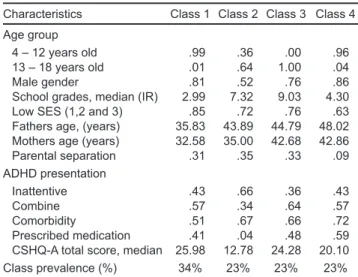
classification errors .0399, and entropy of .9190. Table 5 presents the conditional probability for each characteristic according to de class, and Figure 1 presents the frequency of comorbidity in each class. Class 1 (34%) only children, males with young parents, most with ADHD-C (57%), half with comorbid ADHD (especially disruptive learning or language disorders) many with treatment (41%), and the
CSHQ-A showed many sleep problems (mean: 25.98).Class
2: mostly adolescents (64%), female, ADHD-I (66%), co-morbid ADHD (especially with anxiety disorder) without
treatment and did no show sleep problems (mean: 12.78).
Class 3: only adolescents, males, ADHD-C (64%), comor-bid ADHD (66%), (especially with MDD), half with treat-ment, and CSHQ-A showed many sleep problems. Class 4: only children, males, half of the ADHD-C group, the ma-jority with comorbid ADHD (especially disruptive learning or language disorders), older parents (not separated), the majority with treatment (60%), and CSHQ-A showed some sleep problems (Table 5). Regarding the presence of comor-bidity with anxiety disorders or MDD there were statistical-ly significant differences for class 2 and class 3 (p < .001
and p = .007 respectively) (Figure 1).
DISCUSSION AND CONCLUSION
Sleep problems have been studied in children and adoles-cents with ADHD using different techniques from the most
to the least invasive. The purpose of this study was to de-scribe the sleep profile of patients attending an outpatient service, using the parental report about last week patients’ sleep. The abbreviated questionnaire was used, which is a simple and easy way to collect data in the clinical setting. The CSHQ-A pointed out some sleep problems in this sam-ple of ADHD children and adolescents. Our results showed Table 4
Selection of K classes model. Latent classes analysis of sleep profile in ADHD patients
Model LL BIC Npar Classifica-tion errors Entropy 1-Class -3930.5567 8170.5861 57 .0000 1.0000 2-Classs -3775.8677 7942.6484 72 .0068 .9820 3-Classs -3625.892 7724.137 87 .0182 .9520 4-Classs -3563.6682 7681.1297 102 .0399 .9190 5-Classs -3531.4319 7698.0972 117 .0585 .9007 6-Classs -3502.896 7722.4656 132 .0576 .9089 7-Classs -3479.44 7756.9938 147 .0669 .9021 8-Classs -3453.0621 7785.6781 162 .0615 .9203 9-Classs -3430.0184 7821.031 177 .0653 .9103 10-Classs -3405.1441 7852.7225 192 .0540 .9287 Note: ADHD = Attention deficit hyperactivity disorder; LL = logarithm of like -lihood; BIC = Bayesian information index; npar = number of parameters in the model.
Table 5
Sleep profile, comorbidity, medication in a sample of ADHD. Conditional probabilities of the characteristics according to the class. Results for the model of 4 classes according to the latent classes analysis
Characteristics Class 1 Class 2 Class 3 Class 4 Age group
4 – 12 years old .99 .36 .00 .96
13 – 18 years old .01 .64 1.00 .04
Male gender .81 .52 .76 .86
School grades, median (IR) 2.99 7.32 9.03 4.30
Low SES (1,2 and 3) .85 .72 .76 .63
Fathers age, (years) 35.83 43.89 44.79 48.02 Mothers age (years) 32.58 35.00 42.68 42.86
Parental separation .31 .35 .33 .09
ADHD presentation
Inattentive .43 .66 .36 .43
Combine .57 .34 .64 .57
Comorbidity .51 .67 .66 .72
Prescribed medication .41 .04 .48 .59
CSHQ-A total score, median 25.98 12.78 24.28 20.10
Class prevalence (%) 34% 23% 23% 23%
Note: SES = Socioeconomic Status; % = percentage, ADHD; CSHQ-A = Children Sleep Habits Questionnaire Abbreviated; ADHD = Attention deficit hyperactivity disorder.
0% 10% 20% 30% 40% 50% 60%
Disruptive
Anxiety
Depressive
Learning, Language or Autism
Other Comorbid
p = .317
p = .001
p = .007
p = .048
p = .378 Frequency (%) comorbidity in each class
Class 1 (n = 77) Class 2 (n = 54) Class 3 (n = 53) Class 4 (n = 44)
}
}
}
}
}
Figure 1. Frequency of comorbidities according to the 4 classes in ADHD.
that the ADHD group with any treatment had a higher score in the CSHQ-A than the group without treatment. We also found four groups accordingly with the LCA.
The CSHQ-A allowed to appreciate that there are fre-quent alterations of sleep in ADHD. Some sleep problems found in this sample had been described by other authors (Corkum, Tannock, Moldofsky, Hogg-Johnson, & Hum-phries, 2001; Owens, Maxim, et al., 2000; Ring et al.,
1998). We found almost one third of the sample with
resis-tance for bed time sleep behaviors such as nocturnal awak-enings and restlessness during sleep were prevalent, waking too early was presented in a fifth of the sample, and final-ly prolonged sleep onset duration was found in about 8%. It is worth to mention that this is a sample collected in an outpatient service, and diagnoses were made by a clinician, but neither diagnoses of ADHD nor of sleep disorders were evaluated through a structured interview. Furthermore, only the CSHQ-A responses were used as a sleep param-eter. In spite of those limitations the present findings were analyzed according to ADHD comorbidity and treatment. ADHD comorbidity could be associated with more sleep problems (Alfano, Beidel, Turner, & Lewin, 2006; Armit-age et al., 2000; Ivanenko, Crabtree, & Gozal, 2004; Sadeh et al., 2002) According to our findings, the relationship be-tween psychiatric comorbid ADHD and sleep problems was scarce and it was only present for the case of hypersomnia (with a low effect size).
The ADHD with treatment group had a higher CSHQ-A total score than those without treatment (median: 25 versus 18 points). Each dimension studied showed also differenc-es. These findings have been suggested by other authors (Cortese, Konofal, Yareman, Mouren, & Lecendreux, 2006;
Konofal, Lecendreux, Bouvard, & Mouren-Simeoni, 2001;
Lecendreux, Konofal, Bouvard, Falissard, & Mouren-Sime-oni, 2000; Owens, Maxim, et al., 2000), although they have used different methodologies and in some cases control groups. In the CSHQ-A total score medians a five-point dif-ference was also found (95% CI = 2, 8), even after adjusting for gender, age, ADHD presentation, socioeconomic sta-tus, parental age and comorbidity. Nocturnal awakenings, hypersomnia, and sleep onset delay were the most striking dimensions according to the analysis made of comparison between groups, but almost all dimensions showed signifi-cant differences with low to moderate effect sizes.
A discussion regarding the role of ADHD and/or medi-cations in sleep problems should be held. On the one hand, the ADHD with treatment group was represented mostly by males with ADHD-C, and with a greater number of comor-bidities, especially ODD and MDD. It could be postulat-ed that this group is overrepresentpostulat-ed with a more severe form of ADHD, and probably sleep problems are more prevalent and in accordance to the ADHD severity. But it has to be considered with caution because severity was not measured, and there were some patients that could have
not taken medications for different reasons. On the other hand, regarding the role of medications in this sample, it should be noticed that this ADHD group was not only in treatment with stimulants, but also with other medications that can cause somnolence. Hypersomnia, sleep onset de-lay (Barrett et al., 2013; Nunes & Bruni, 2015), fragment-ed sleep, and nocturnal awakenings have been studifragment-ed and tried to explain as a result of ADHD or medications, or both (Ball, Tiernan, Janusz, & Furr, 1997; Kent, Blader, Kople-wicz, Abikoff, & Foley, 1995; Stein, 1999; Tirosh, Sadeh, Munvez, & Lavie, 1993). Medications can affect sleep in different ways. Although stimulants cause insomnia as an adverse effect, some others have reported somnolence as well (Charach, Ickowicz, & Schachar, 2004; Galand, Tirpp, & Taylor, 2010; Kent et al., 1995; Tirosh et al., 1993). The same is also true for atomoxetine (Kratochvilet al., 2006). Some authors have even pointed out that stimulants can re-duce restlessness and improve sleep in these patients ( Koo-ij, Middlekoop, van Glis, & Buitelaar, 2001).
We found that there is greater presentation of nocturnal awakenings in those who take any type of medication, but when analyzing this variable in the group of those taking stimulants, a lower score was found than those who did not. Our analyzes allow us to realize that either nocturnal awakenings or insomnia cannot be attributed to stimulants in this population, and it can be explained more for ADHD itself. The same is also true for medications such as SGA.
Cortese et al. (2006) examined 16 studies of children with ADHD who were not medicated, and found out higher rates of bedtime resistance, sleep onset difficulties, night awak-enings, and daytime sleepiness than non-ADHD controls according to parent reports (Cortese, Faraone, Konofal, & Lecendreux, 2009). This supports the notion of the role of ADHD in sleep problems.
An alternative analysis in this ADHD sample identi-fied four classes according to sleep. Two classes present-ed a greater number of sleep problems as indicatpresent-ed by the CSHQ-A total score: class 1, represented by male with young parents, and class 3 with male, plus ADHD-C, and comorbidity, especially with MDD. Meanwhile, class 2 was striking because of its low index of sleep problems, repre-sented by adolescent women with ADHD-I, and no treat-ment. While we cannot generalize these findings to other clinical samples, it is interesting to consider that sleep pro-file could help to elucidate the relationship between ADHD and sleep. A study on sleep phenotypes described five pro-files in patients with ADHD, which points out to the impor-tance of recognizing different needs in each patient. How-ever, it was a study oriented more to sleep disorders than to the ADHD characteristics (Miano, Parisi, & Villa, 2012).
scale. These are the classes that present more ADHD-C and ADHD comorbidity, especially with disruptive disorder and MDD. The relationship between these disorders and sleep
problems has been supported by some authors (Armitage
et al., 2000; Cortese et al., 2006; Ivanenko et al., 2004; Sa-deh et al., 2002). Class 2 has a high comorbidity with anx-iety disorders but had few sleep problems. This could be explained by a higher ADHD-I proportion and no subjects with treatment in this class. Although some authors suggest no relationship between sleep problems and ADHD presen-tation (LeBourgeois, Avis, Mixon, Olmi, & Harsh, 2004), others had found more fragmented sleep (Ramos-Platon, Vela-Bueno, Espinar-Sierra, & Kales, 1990), and more
sleep changes in ADHD-C (Dickerson-Mayes et al., 2009;
Lecendreux et al., 2000; Mayes et al., 2009). Some studies had suggested that stimulants can affect the sleep profile in ADHD (Kent et al., 1995; Tirosh et al., 1993), and Class 2 subjects were under no treatment.
Future studies about sleep and ADHD should consider a control group, either from the community or in the outpa-tient service, in order to determine if there is an increased risk of sleep problems in subjects with ADHD, and also if our findings on sleep profiles for LCA are replicable.
Limitations
The CSHQ-A is under the process of validation in Colom-bia, and there are still no reference scores in the population. The instrument is used worldwide in children between four and 10 years of age but to a lesser extent in adolescents. Adolescents may have different sleep problems than chil-dren, and it has to be considered that parents identify less adolescents’ sleep patterns. For this reason, for further stud-ies we suggest to use a scale of adolescent sleep self-report in addition to the parent questionnaire to achieve a better description.
Some study limitations regarding the LCA are worth mentioning. First, the number of parameters of the resulting model was 102, that means 2.23 participants per parame-ter. Although the required sample size depends on several aspects, rule of thumb is at least five participants per pa-rameter (Gorsuch, 1983), so it is required to reproduce the model in a larger sample. Second, other classes could be obtained if the CSHQ-A dimensions are used instead of the total score. Finally, instead of using the comorbidity vari-able (presence/absence), each comorbidity could be includ-ed in the latent model class. The same is also true for the case of medications. This was not done because it would increase the number of model parameters. Therefore, addi-tional studies with larger sample sizes are required. Finally, these results cannot be generalized to other populations.
In this sample of children and adolescents with ADHD, the ADHD-C presentation was associated with a higher fre-quency of comorbidity. These subjects were more likely to
be in psychopharmacological treatment and have a greater report of sleep problems by the CSHQ-A in most dimen-sions compared to those who do not receive treatment. Sub-jects without comorbidity had fewer sleep problems than those with comorbid ADHD. Through the latent classes model, ADHD groups that present more sleep problems were identified.
Funding
None.
Conflict of interests
The authors declare they have no conflict of interests.
Acknowledgment
All families who participated in the study.
Research Group in Psychiatry (Grupo de Investigación en Psiquiatría-GIPSI).
Hospital Universitario San Vicente Fundacion. Facultad de Medicina de la Universidad de Antioquia.
REFERENCES
Alfano, C., Beidel, D., Turner, S., & Lewin, D. (2006). Preliminary evidence for sleep complaints among children referred for anxiety. Sleep medicine, 7(6), 467–473. Armitage, R., Emslie, G. J., Hoffmann, R. F., Weinberg, W. A., Kowatch, R. A., Rin-telmann, J., & Rush, A. J. (2000). Ultradian rhythms and temporal coherence in sleep EEG in depressed children and adolescents. Biological Psychiatry, 47(4), 338-350.
Austin, P. (2009). Using the standardized difference to compare the prevalence of a binary variable between two groups in observational research. Communications in Statistics-Simulation and Computation, 38(6), 1228-1234.
Ball, J., Tiernan, M., Janusz, J., & Furr, A. (1997). Sleep patterns among children with attention-deficit hyperactivity disorder: A reexamination of parent perceptions. Journal of Pediatric Psychology, 22(3), 389-398.
Barrett, J., Tracy, D., & Glaroli, G. (2013). To sleep or not to sleep: a systematic re-view of the literature of pharmacological treatments of insomnia in children and adolescents with attention-deficit/hyperactivity disorder. Journal of child and adolescent psychopharmacology, 23(10), 640-647. doi: 10.1089/cap.2013.0059 Charach, A., Ickowicz, A., & Schachar, R. (2004). Stimulant treatment over five
years: adherence, effectiveness, and adverse effects. Journal of the American Academy of Child & Adolescent Psychiatry, 43(5), 559-567.
Coolican, H. (2009). Research methods and statistics in psychology. United King-dom: Hooder.
Corkum, P., Moldofsky, H., Hogg-Johnson, S., Humphries, T., & Tannock, R. (1999). Sleep problems in children with attention-deficit/hyperactivity disorder: impact of subtype, comorbidity, and stimulant medication. Journal of the American Academy of Child & Adolescent Psychiatry, 38(10), 1285-1293.
Corkum, P., Tannock, R., Moldofsky, H., Hogg-Johnson, S., & Humphries, T. (2001). Actigraphy and parental ratings of sleep in children with attention-deficit/hyper-activity disorder (ADHD). Sleep, 24(3), 303-312.
Cortese, S., Faraone, S. V., Konofal, E., & Lecendreux, M. (2009). Sleep in children with attention-deficit/hyperactivity disorder: meta- analysis of subjective and objective studies. Journal of the American Academy of Child & Adolescent Psy-chiatry, 48(9), 894-908.
Cortese, S., Konofal, E., Yareman, N., Mouren, M., & Lecendreux, M. (2006). Sleep and alertness in children with attention-deficit/hyperactivity disorder: A system-atic review of the literature. Sleep, 29(4), 504-511.
Problems. Journal of Pediatric Psychology, 34(3), 328-337, doi: 10.1093/jpep-sy/jsn083
Fritz, C., Morris, P., & Richier, J. (2012). Effect size estimates: Current use, calcula-tions, and interpretation. Journal of Experimental Psychology General, 141(1), 2. Galand, B., Tirpp, E., & Taylor, B. (2010). The sleep of children with attention defi-cit hyperactivity disorder on and off methylphenidate: a matched case-control study. Journal of Sleep Research, 19(2), 366-373.
Gorsuch, R. (1983). Factor Analysis. Journal of Psychiatry, 126, 237-240. Hosmer, D. & Lemeshow, S. (2000). Applied Logistic Regression. New York: Wiley. Ivanenko, A., Crabtree, V., & Gozal, D. (2004). Sleep in children with psychiatric
disorders. Pediatric Clinics of North America, 51(1), 51-68.
Kent, J., Blader, J., Koplewicz, H., Abikoff, H., & Foley, C. (1995). Effects of late-af-ternoon methylphenidate administration on behavior and sleep in attention-defi-cit hyperactivity disorder. Pediatrics, 96(2), 320-325.
Konofal, E., Lecendreux, M., Bouvard, M., & Mouren-Simeoni, M. (2001). High levels of nocturnal activity in children with attention-deficit hyperactivity disor-der: A video analysis. Psychiatry and Clinical Neurosciences, 55(22), 97-103. Kooij, J., Middlekoop, H., van Glis, K., & Buitelaar, J. (2001). The effect of stimulants
on nocturnal motor activity and sleep quality in adults with ADHD: an open-label case–control study. The Journal of clinical psychiatry, 62(12), 952-956. Kratochvil, C. J., Wilens, T. E., Greenhill, L. L., Gao, H., Baker, K. D., Feldman,
P. D., & Gelowitz, D. L. (2006). Effects of long-term atomoxetine treatment for young children with attention-deficit/hyperactivity disorder. Journal of the American Academy of Child & Adolescent Psychiatry, 45(8), 919-927. Lanza, S. & Rhoades, B. (2013). Latent class analysis: an alternative perspective
on subgroup analysis in prevention and treatment. Prevention Science, 14(2), 157-168.
LeBourgeois, M., Avis, K., Mixon, M., Olmi, J., & Harsh, J. (2004). Snoring, sleep quality, and sleepiness across attention-deficit/hyperactivity disorder subtypes. Sleep, 27(3), 520-525.
Lecendreux, M., Konofal, E., Bouvard, M., Falissard, B., & Mouren-Simeoni, M. (2000). Sleep and alertness in children with ADHD. Journal of Child Psychia-try, 41(6), 803-812.
Mayes, S., Calhoun, S., Bixler, E., & Al., E. (2009). ADHD subtypes and comorbid anxiety, depression, and oppositional-defiant disorder: differences in sleep prob-lems. Journal of pediatric psychology, 34(3), 328-337.
Miano, S., Parisi, P., & Villa, M. (2012). The sleep phenotypes of attention deficit hy-peractivity disorder: the role of arousal during sleep and implications for treat-ment. Medical Hypotheses, 79(2), 147-153. doi: 10.1016/j.mehy.2012.04.020 NICHD SECCYD-Wisconsin. (2017). Children’s Sleep Habits Questionnaire
(Ab-breviated). The National Institute of Child Health and Development (NICHD) Study of Early Child Care and Youth Development (SECCYD). Retrieved from: http://www.education.uci.edu/childcare/pdf/i
Nunes, M. & Bruni, O. (2015). Insomnia in childhood and adolescence: clinical as-pects, diagnosis, and therapeutic approach. Jornal de Pediatria, 91(6), S26-S35. Owens, J., Maxim, R., Nobile, C., McGuinn, M., & Msall, M. (2000). Parental and Self-report of Sleep in Children With Attention-Deficit/Hyperactivity Disorder. Archives of pediatrics & adolescent medicine, 154(6), 549-555.
Owens, J., Spirito, A., & McGuinn, M. (2000). The Children’s Sleep Habits Ques-tionnaire (CSHQ): Psychometric properties of a survey instrument for school-aged children. Sleep, 23(8), 1043-1051.
Ramos-Platon, M., Vela-Bueno, A., Espinar-Sierra, J., & Kales, S. (1990). Hypnop-olygraphic alternations in attention deficit disorder (ADD) children. Interna-tional Journal of Neuroscience, 53(2-4), 87-101.
Ring, A., Stein, D., Barak, Y., Teicher, A., Hadjez, J., Elizur, A., & Weizman, A. (1998). Sleep disturbances in children with attention-deficit/hyperactivity dis-order: A comparative study. Journal of Learning Disabilities, 31(6), 572-578. Sadeh, A., Gruber, R., & Raviv, A. (2002). Sleep, neurobehavioral functioning, and
behavior problems in school-age children. Child development, 73(2), 405-417. Stein, M. (1999). Unravelling sleep problems in treated and untreated children with
ADHD. Journal of Child and Adolescent Psychopharmacology, 9(3), 157-168. Tirosh, E., Sadeh, A., Munvez, R., & Lavie, P. (1993). Effects of methylphenidate
on sleep in children with attention-deficit hyperactivity disorder: an activity monitor study. American Journal of Diseases of Children, 147(12), 1313-1315. Vermunt, J. & Magidson, J. (2002). Latent class cluster analysis. In J. Hagenaars & A.
McCutcheon (Eds.), Applied latent class analysis (pp. 89-106). Cambriddge,: Cambridge University Press.