ELECTROSPRAYING OF POLYMER SOLUTIONS FOR THE GENERATION OF MICRO-PARTICLES, NANO-STRUCTURES AND GRANULAR FILMS
Eszter Bodnár
ADVERTIMENT. L'accés als continguts d'aquesta tesi doctoral i la seva utilització ha de respectar els drets de la persona autora. Pot ser utilitzada per a consulta o estudi personal, així com en activitats o materials d'investigació i docència en els termes establerts a l'art. 32 del Text Refós de la Llei de Propietat Intel·lectual (RDL 1/1996). Per altres utilitzacions es requereix l'autorització prèvia i expressa de la persona autora. En qualsevol cas, en la utilització dels seus continguts caldrà indicar de forma clara el nom i cognoms de la persona autora i el títol de la tesi doctoral. No s'autoritza la seva reproducció o altres formes d'explotació efectuades amb finalitats de lucre ni la seva comunicació pública des d'un lloc aliè al servei TDX. Tampoc s'autoritza la presentació del seu contingut en una finestra o marc aliè a TDX (framing). Aquesta reserva de drets afecta tant als continguts de la tesi com als seus resums i índexs.
ADVERTENCIA. El acceso a los contenidos de esta tesis doctoral y su utilización debe respetar los derechos de la persona autora. Puede ser utilizada para consulta o estudio personal, así como en actividades o materiales de investigación y docencia en los términos establecidos en el art. 32 del Texto Refundido de la Ley de Propiedad Intelectual (RDL 1/1996). Para otros usos se requiere la autorización previa y expresa de la persona autora. En cualquier caso, en la utilización de sus contenidos se deberá indicar de forma clara el nombre y apellidos de la persona autora y el título de la tesis doctoral. No se autoriza su reproducción u otras formas de explotación efectuadas con fines lucrativos ni su comunicación pública desde un sitio ajeno al servicio TDR. Tampoco se autoriza la presentación de su contenido en una ventana o marco ajeno a TDR (framing). Esta reserva de derechos afecta tanto al contenido de la tesis como a sus resúmenes e índices.
ESZTER
BODNÁR
E
LECTROSPRAYING OF POLYMER SOLUTIONS
FOR THE GENERATION OF MICRO
-
PARTICLES
,
NANO
-
STRUCTURES
,
AND GRANULAR FILMS
DOCTORAL THESIS
Rovira i Virgili University
E
SZTER
B
ODNÁR
E
LECTROSPRAYING OF POLYMER SOLUTIONS
FOR THE GENERATION OF MICRO
-
PARTICLES
,
NANO
-
STRUCTURES
,
AND GRANULAR FILMS
DOCTORAL
THESIS
Supervised by Dr. Joan Rosell-Llompart
Department of Chemical Engineering
Tarragona
Department d’Enginyeria Química
Universitat Rovira i Virgili
Campus Sescelades,
Av. Països Catalans, 26 43007 Tarragona Tel: 977559658 Fax: 977559667
Dr. Joan Rosell-Llompart,
I STATE that the present study, entitled “Electrospraying of polymer
solutions for the generation of micro-particles, nano-structures, and
granular films“ presented by Eszter Bodnár for the award of the degree of
Doctor, has been carried out under my supervision at the Department
d’Enginyeria Química (DEQ) of this university.
Tarragona 30
thOctober, 2015
Acknowledgements
During the preparation of this thesis I have accepted, with gratitude, many gifts from my supervisor, Prof. Joan Rosell-Llompart: knowledge, guidance, encouragement, and a thousand different ways of support. Thank you!
I also would llike to thank each former and current members of the DEW research group: Prof. Jordi Grifoll, dr. Pavel Kiselev, dr. Luis Balam Modesto Lopez, Ajith, Nikolas, Laura, Evgenii, Luca. They have been an inspiring company during these years.
I owe a big thank you to my Family and Friends for their patience and support.
Thanks to the financial support extended by the Ministerio de Educación y Ciencia via project CTQ2008-05758/PPQ, DPI2012-35687 & DPI2015-68969-P, and by the
Table of contents
Summary ... i
List of publications and conferences ... iii
List of figures ... v
List of tables ... vii
1. Introduction ... 1
1.1. Electrospray and its unique feature ... 1
1.2. Applications of electrospray ... 2
1.3. Particle and film formation by electrospray of polymer solutions: Physics and engineering aspects ... 4
1.3.1. Overview of electrospray physics ... 5
1.3.2. Physics of particle formation ... 14
1.4. Thesis aims and structure ... 16
1.5. References ... 17
2. Polymeric microparticles and nanoparticles by electrospraying ... 29
2.1. Introduction ... 29
2.2. Materials and Methods ... 31
2.2.1. Materials ... 31
2.2.2. Electrospraying ... 32
2.2.3. Particle collection and imaging ... 34
2.3. Results ... 34
2.3.1. Terminology ... 34
2.3.1.1. Particle kinds arising from jet break up ... 34
2.3.1.2. Coulombic instability vs fission, and progeny particle ... 35
2.3.2. Effects due to the solvent vapor jacket ... 36
2.3.3.1. Poly(methyl)methacrylate morphologies from MEK solutions ... 41
2.3.3.2. Polystyrene morphologies from MEK and DCM solutions ... 43
2.3.3.3. Ethyl cellulose morphologies from MEK and DCM solutions ... 48
2.4. Discussion ... 51
2.4.1. Fluid dynamic-to-solid structure transformation ... 52
2.4.2. Polymer precipitation during jet breakup ... 55
2.4.3. Production of non-filamented particles ... 56
2.5. Conclusions ... 59
2.6. References ... 61
3. Polymeric nanostructures by electrospraying in non-solvent water vapor environment ... 65
3.1. Introduction ... 65
3.1.1. Pore formation at high RH in electrospinning of PS solutions ... 67
3.1.2. Description of VIPS/TIPS and BFF ... 68
3.2. Materials and Methods ... 72
3.2.1. Materials ... 72
3.2.2. Electrospraying ... 73
3.2.3. Particle collection and imaging ... 75
3.3. Results and Discussion ... 75
3.3.1. PMMA-350 morphologies from MEK solution at low and high RH ... 76
3.3.2. PMMA-15 morphologies from MEK solutions at low and high RH ... 79
3.3.3. EC morphologies from MEK solutions at low and high RH ... 80
3.3.4. PS-350 morphologies from MEK solutions at three RH levels ... 82
3.3.5. PS-35 morphologyes from MEK solutions at three RH levels ... 84
3.3.6. PS-35 and EC-15 morphologies from DCM solution at low and high RH ... 86
3.3.7. Proposed mechanisms ... 87
3.4. Conclusions ... 91
3.5. References ... 92
4. Structure and growth of granular films produced by electrospray deposition ... 96
4.2. Materials and Method... 98
4.2.1. Materials ... 98
4.2.2. Electrospray deposition apparatus ... 98
4.2.3. Electrospray film deposition ... 100
4.2.4. Deposits characterization ... 100
4.2.5. Spray imaging experiments ... 101
4.3. Results and Discussion ... 101
4.3.1. Macroscopic features of the film ... 101
4.3.2. Particle size, shape, and segregation by size ... 102
4.3.3. Local mass distribution on the particulate film ... 105
4.3.4. Film thickness, mass and porosity profile ... 108
4.3.5. Hypothesis of electrostatic charging ... 112
4.4. Conclusions ... 116
4.5. References ... 118
4.6. Appendix ... 122
i
Summary
This thesis is focused on the mechanisms of formation of microparticles and their granular films, obtained by electrospraying polymer solutions in the steady cone-jet mode. Electrosprays (ES’s) are dispersions of highly charged droplets which are released by electrohydrodynamic microjets into a gas. Electrospray is a unique method for producing electrically-charged micro- and nano-droplets in the gas phase, with near size monodispersity, and is unsurpassed by other liquid fragmentation methodologies, which produce larger droplets, and/or wider dispersion of droplet sizes. Therefore they have attracted interest for making solid nanoparticles. However, many questions remain about the mechanisms leading to the formation of such particles.
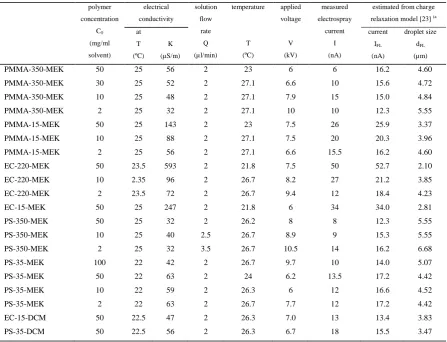
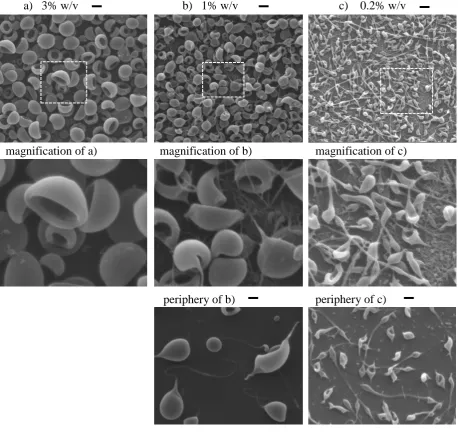
In the first study, we have produced polymeric particles and films of such particles under carefully controlled conditions of operation of the electrospray. We have performed by electrospraying different polymeric solutions under dry ambient conditions, and we have determined the role of the following factors on the drying process of the electrosprayed polymer solution droplets, and resulting morphologies: polymer (PMMA, EC, and PS), solvent (butanone, dichloromethane), initial polymer concentration, and polymer molecular weight (either “low” ~10-35 kDa, or “high” 220-350 kDa). The collected deposits have been analyzed by scanning electron microscopy, revealing a wide variety of particle morphologies. We show that these morphologies present transitions as the initial polymer concentration is reduced, depending on the fluid dynamic regime at which polymer vitrification happens. All of the morphologies have been attributed to either of four regimes identified to be: (1) Incomplete jet break up, (2) complete jet breakup without coulomb instabilities, (3) coulombic instabilities without progeny droplets, and (4) coulombic fission of main droplets (with emission of progeny droplets).
ii
iii
List of publications and conferences
Articles
E. Bodnár, and J. Rosell-Llompart, “Growth Dynamics of Granular Films Produced by Electrospray”, Journal of Colloid and Interface Science, 407, 536-545 (2013) 43.
E. Bodnár, and J. Rosell-Llompart, “Polymeric microparticles and nanoparticles formation by electrospraying”. To be submitted.
E. Bodnár, and J. Rosell-Llompart, “Polymeric nanostructures by electrospraying in non-solvent water vapor environment”. To be submitted.
Conferences
E. Bodnár, P. Kiselev, J. Rosell-Llompart. Thin Film Uniformity as a Function of Electrospray Conditions. AAAR 28th Annual Conference (American Association for Aerosol Research), Minneapolis MN (USA), 26-30 October 2009
E. Bodnár, P. Kiselev, J. Grifoll, J. Rosell-Llompart. Experiments and numerical simulation of electrospray thin film formation. 8th International Aerosol Conference, Helsinki (FINLAND), 29 August - 3 September 2010
E. Bodnár, P. Kiselev, J. Rosell-Llompart. Effect of relative humidity on the microstructure of electrospray deposited polymer thin films. Nanospain 2011, Bilbao (SPAIN), 11-14 April 2011
E.Bodnár, P. Kiselev, J. Grifoll, J. Rosell-Llompart. Morphology dependency of electrospray-generated polymer particles and coatings on ambient humidity [B-WG07S1P53]. European Aerosol Conference 2012 (EAC-2012), Granada (SPAIN), 2-7 September 2012
E. Bodnár, J. Grifoll, J. Rosell-Llompart. Growth Dynamics of Polymer Granular Films Produced by Electrospray Deposition. 1st Iberian Meeting on Aerosol Science and Technology (RICTA-2013), Évora (PORTUGAL), 1-3 July 2013
E. Bodnár, N. Sochorakis, J. Grifoll, J. Rosell-Llompart. Electrostatic charging during electrospray deposition of polymer granular coatings. European Aerosol Conference 2013 (EAC-2013), Prague (CZECH REPUBLIC), 1-6 September 2013
N. Sochorakis, E. Bodnár, J. Grifoll, J. Rosell-Llompart. Scaling of linearly aligned
electrosprays [P10]. RICTA-2014 (2nd Iberian Meeting on Aerosol Science and Technology), Tarragona (SPAIN), July 7-9, 2014
iv
N. Sochorakis, E. Bodnár, J. Grifoll, J. Rosell-Llompart. Multiple electrospraying from extractor-free Linear Arrays [O111]. AT 2015 (Aerosol Technology 2015), Tampere (FINLAND), June 15-17, 2015
v
List of figures
Figure 1-1 Schematics of typical electrospray configuration and jet breakup modes in
Newtonian and viscoelastic liquids. ... 5
Figure 1-2 Example of electrospray, Taylor cone and jet (cone-jet) and beginning of spray. ... 10
Figure 1-3 Examples of droplets undergoing Coulomb fission. ... 13
Figure 2-1 Electrospray setup. ... 33
Figure 2-2 Effect of co-flow on Taylor cone for various solutions in MEK. ... 37
Figure 2-3 Effect of co-flow on jet break-up in the case of high Mw 5% w/v a,c) PS and b,d) PMMA ... 38
Figure 2-4 Effect of co-flow on jet particle morphology in the case of low Mw 5% w/v a,c) EC and b,d) PS ... 39
Figure 2-5 Particle morphologies obtained from 350 kDa PMMA/MEK solutions. . 41
Figure 2-6 Particle morphologies obtained from 15 kDa PMMA/MEK solutions. ... 43
Figure 2-7 Particle morphologies obtained from 350kDa PS/MEK solutions. ... 44
Figure 2-8 Particle morphologies obtained from 35 kDa PS/MEK solutions. ... 46
Figure 2-9 Particle morphologies obtained from 35 kDa PS/DCM solution. ... 47
Figure 2-10 Particle morphologies obtained from 100 cps EC/MEK solutions. ... 49
Figure 2-11 Particle morphologies obtained from 4cps EC/MEK solutions. ... 50
Figure 2-12 Particle morphologies obtained from EC/DCM solutions. ... 51
Figure 2-13 Mechanisms for polymeric nanostructure formation from electro-hydrodynamic (EHD) jetting ... 53
Figure 3-1 Schematic comparison between VIPS and BFF ... 69
Figure 3-2 Phase separation trajectories in binary (solvent/polymer) systems by TIPS, and ternary solvent/non-solvent/polymer system by VIPS. ... 70
Figure 3-3 Composition change in a material element on the droplet surface represented in a ternary phase diagram and a corresponding theoretical concentration profiles along the droplet radius... ... 71
Figure 3-4 Cloud point boundaries represented in ternary phase diagram... 73
Figure 3-5 Electrospray setup. ... 74
vi
vii
List of tables
1
1.
Introduction
1.1.
Electrospray and its unique features
This thesis is focused on the mechanisms of formation of microparticles and their granular films, obtained by electrospraying polymer solutions in the steady cone-jet mode. Electrosprays are dispersions of highly charged droplets which are released by electrohydrodynamic microjets into a gas. Therefore, electrospray is sometimes called
electro-hydrodynamic spraying (EHDS), or electro-hydrodynamic atomization
(EHDA). The droplets are in the micrometer range or smaller (depending on liquid properties and operating conditions), and their release from the end of an EHD-microjet is regular (quasi periodic), producing narrowly dispersed droplet sizes. Since the electrical field is the driving force for the atomization, there is no need for assistance from additional energy sources, such as gas streams (used for pneumatic atomization). Consequently, electrospray has low specific power consumption. In addition, since electrospray is based on laminar (non turbulent) microjet flows, different liquids can be combined in the same jet coaxially in order to produce structured multi-phase droplets, which can be used to make core-shell particles [1,2].
2
1.2.
Applications of electrospray
The electrospray methodology has attracted much interest for applications [3,4] which seek either the small, uniform droplet size, or the high electrical charge density of the droplets, or need to obtain a fine dispersion over a large collection surface. It has been applied to the making of micro- and nano-particles of many different materials with diverse applications in mind [5].
The best known application of electrosprays probably is electrospray ionization mass spectrometry, or ESI-MS. It is an ionization method for converting ions in a solution to ions in the gas phase, which are transferred to a vacuum where their charge-mass ratio is determined by a so called mass spectrometer. This method has revolutionized biomedical science since John B. Fenn and colleagues developed it to generate protein ions [6], work for which Fenn received the Nobel Prize in chemistry in 2002 [7]. ESI-MS has nowadays become a standard analytical chemistry method. One interesting variation on this method is secondary electrospray ionization (SESI), in which an electrospray is used to ionize vapor molecules that are dispersed in trace quantities in ambient air, such as explosives, chemical warfare agents, or drugs, or in human breath, such as drugs, metabolites, or bacterial emissions [8,9].
3
interested in it as a versatile method for particle engineering. One of the attractive features of electrospray is the possibility of making core-shell structures by combining different solutions in a co-flow arrangement [1,15-19]. Another interesting configuration of electrospray for particle production is bipolar coagulation, in which electrospray droplets of different composition and opposite electrical polarity are generated in two opposing cone-jets, and are allowed to coagulate and chemically react in a micro-confined space [20].
Another field of application is electrospray deposition, or ESD, in which electrosprays are directed at solid surfaces for producing coatings or for dispersing small amounts of materials over large surface areas [21]. Interesting examples of ESD are the dispersion of platinum nanoparticles on carbon films for use as cathodes of PEMFC's (proton exchange membrane fuel cells) [22,23], and the coating of pharmaceutical carrier particles with drug nanoparticles [24,25]. One variation of ESD is patterned deposition using dielectric masks [26-30], or ion-induced focusing masks [31-33].
Some other related areas of research and application should be mentioned: (1) EHD direct writing, also called EHD printing or EHD jet printing [34,35], in which the cone-jet is used for directing a cone-jet or micro-drops to precise locations on a moving planar substrate, (2) electrospinning [36-39], an important method for making polymeric nanofibers, which have interest in nanocomposites [40] and biomedical applications [41] (3) colloidal thrusters, designed for imparting thrust to spacecraft by accelerating electrospray-generated droplets or ions [42,43], and (4) focused ion beams, or FIB [44]. The latter two are vacuum applications in which a highly-conducting non-volatile liquid is used, e.g. an ionic liquid or liquid metal, whose Taylor cone can emit ions instead of a liquid jet [45]. Recently, Gamero-Castaño et al. has carried out sputtering of semiconducting surfaces by electrospray nanodroplets in vacuum without attempting focusing, demonstrating high etching rates and amorphization of silicon [46-48]. Electrospray and electrospining have been used for creating a super-hydrophobic coating made of balls and nanofibers of polystyrene [49].
4
One constraints of electrospray is that the electrical conductivity of the liquid determines the range of flow rates at which it can be operated stably. In addition, the flow rate is generally low, typically about 0.1 mL/hr for typical solutions used in ESI-MS, and much lower for applications requiring high conductivity liquids such as colloidal thrusters or FIB. Therefore, electrospray excels in low flow rate applications. However, in many applications, the flow rate is insufficient, and has led to the development of multiplexed arrays of electrospray emitters.
The use of electrosprays for producing a wide range of nanomaterials require much higher flows than are possible with a single emitter, and motivate the development of robust multiplexing of ES emitters. Although this thesis will not develop multiplex systems, it is pertinent to review some of the key efforts in this direction. ES multiplexing has been proposed at lab scale for diverse goals. For example, pharmaceutical particles have been produced using 2D hexagonal arrays [56,57] and 1D linear arrays [58]. 2D arrays have also been designed for use as colloidal thrusters [59;60]. 1D arrays (linear or circular) have also been tested for nano-ESI-MS [61-63], and linear ones for near-field pulsed deposition [64] and electrohydrodynamic (EHD) jet printing [65]. Circular 1D, when equidistant nozzles in a circle experience identical electric field conditions [66], have become popular in electrospinning devices, which are closely related to electrospray. Another application of multiplexed electrosprays is gas cleaning [67]
1.3.
Particle and film formation by electrospray of polymer
solutions: Physics and engineering aspects
5
1.3.1.
Overview of electrospray physics
Steady electrohydrodynamic spraying and scaling laws
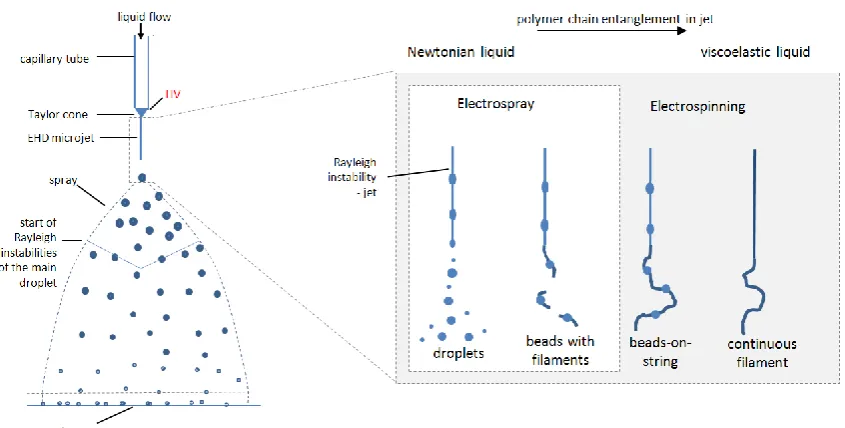
[image:26.595.88.511.338.552.2]Figure 1-1(a) shows the typical configuration of electrospray. Liquid is pumped at a fixed known rate Q through a capillary tube (or “needle”), for example a flat-ended hypodermic needle. This needle is held at a high electrical potential V relative to a nearby electrode, in the Figure an Earth-grounded flat collector plate. For sufficiently high values of V and Q, the liquid meniscus adopts a stationary conical shape, whose vertex ejects a continuous stream in the form of an EHD microjet, which breaks into droplets. Since the microjet radius is independent of the needle radius (especially when the needle is much wider), clogging is not an issue, unlike in microjet methods based on extruding liquid through microholes.
Figure 1-1 Schematics of (a) typical electrospray configuration with Taylor cone and
electrohydrodynamic microjet and (b) jet breakup modes in Newtonian and viscoelastic liquids.
6
increases with liquid surface tension γ [68-71]. Outside of those limits, a rich variety of fluid dynamic modes exist, which include oscillatory modes, astable modes, multijet modes, etc. [72-77]. In addition, for high surface tension liquids, such as water sprayed in standard air, a Taylor cone may coexist with corona discharges [78,79].
In steady cone-jet mode, the electrified meniscus is conical, and is usually called “Taylor cone” in honor of G. I. Taylor, who proved mathematically that conical electrically charged interfaces at constant electrical potential can be in hydrostatic and electrostatic equilibrium [80-82]. In fact, conical menisci encountered in electrospraying are not in equilibrium because the jet emission convects electrical charge, thus overcoming charge transport by electrical conduction, which is necessary for maintaining electrostatic equilibrium [83,84].
Physical models have been developed to describe the electro-hydrodynamics of the transition region between the cone and the jet [85,86]. These models predict droplet mean size dd (or jet radius) and electrical current I, as functions of Q and the liquid
properties: liquid density , surface tension , dynamic viscosity , electrical conductivity K, and dielectric constant . Such relationships are called scaling laws of electrospray. Fernández de la Mora and Loscertales’s pioneered this approach with a model that considers relaxation of electrical charge in the transition region [83]. This model predicts the following scaling relationships for the jet diameter and the current:
3 1 0 K Q dd
(1-1)
12 QK f I (1-2)
Gañán-Calvo [G97] has proposed the following alternative scaling laws:
6 1 0 2 1 3 2 6 . 0 78 . 3 K Q
dd
(1-3)
2 1 2 1 0 ln 25 .4
7
where Q0 is defined as 0 (K). Additional works have checked that these laws are
fulfilled to different degrees depending on the electrosprayed liquid [86-92]. Experimentally, the current is better predicted than the droplet diameter, in part because the ratio of jet diameter to droplet diameter depends on factors not considered by these laws. Additional analytical and numerical models have been developed around this problem [19,84,85,93-99].
EHD microjet breakup
Liquid jets are produced and sustained when any unstable perturbations of the jet flow are convected downstream faster than they can travel upstream [100]. Unstable perturbations can eventually grow downstream, typically by the action of surface tension, leading to jet breakup. Such a jet is said to be convectively unstable [101]. In electrospray (Fig. 1-1(b)), Newtonian liquids form convectively unstable EHD microjets which break up into droplets. Examples of such liquids are water, organic solvent, or a dilute solution or nanoparticle dispersion in those solvents. On the other hand, EHD microjets of viscoelastic liquids, such as concentrated polymeric solutions, can resist the action of surface tension and form continuous filaments thanks to polymer chain entanglements (Fig. 1-1(b)). This is the basis of electrospinning [38]. However, in addition to chain entanglements, Fong et al. have shown that the electrical charge plays a key role in resisting the breaking action of surface tension on electrospun jets [102]. The rest of this section deals with jet behavior of Newtonian liquids. In electrospray, the best known jet breakup mode is the periodic (regular) breakup of a jet called
axisymmetric breakup mode, varicose breakup mode, or Rayleigh breakup mode, in honor of Lord Rayleigh, who developed the first linear stability analysis of an infinitely long, neutral cylinder of an inviscid (i.e. non viscous) liquid [103,104]. Rayleigh’s analysis predicts a droplet to jet diameter ratio dd/dj of ~1.89. In reality, Rayleigh
8
Satellite drops do not always form [89], or, when they do, they may forward merge with the leading or rear merge with the trailing main drop, typically at low Re [69,101,105]. In these cases, the distribution of droplet sizes will be monomodal (made of main droplets only) and quasi monodisperse (due to the breakup periodicity). The merging of satellite droplets has been reported only in a few electrospray works [69,89,106].
Viscous stresses, neglected in Rayleigh’s analysis, are noticeable when the Reynolds number for the capillary flow within the jet, Re, is ~1 or smaller, where
12 Re dj , and where is the liquid density, its surface tension coefficient,
its dynamic viscosity, and dj the initial jet radius [107,101]. This Reynolds number is equal to the jet radius times the characteristic velocity of the capillary flow during breakup, called capillary velocity, namely
2
dj
12, over the dynamic viscosity. The ratio dd/dj = 1.89 has been confirmed in electrospray studies where dj > 7 µm andRe in the range ~10-30 [69,108,109]. However, this ratio becomes larger for much thinner microjets, for which viscous stresses cannot be neglected [87,110]. On the other hand, the role of electrical stresses on the jet break up is to reduce the fastest growing wavelength, thus reduce dd/dj [89,110,111].
Another common instability of EHD microjets is the bending instability, which causes the jet to undergo whipping as the result of amplification of non-axisymmetric perturbations [69,87,89]. (This instability is called kink instability in some older electrospray literature.) In the whipping mode, the jet either thrashes chaotically or undergoes helicoidal motions [17,112]. Jet whipping starts at a critical value of the liquid flow rate Q* (>Qmin, the lowest flow rate compatible with stability), where the
9
instability is common also in electrospinning, as the growth rate of axisymmetric perturbations is greatly suppressed [38].
Electrospray plume structure
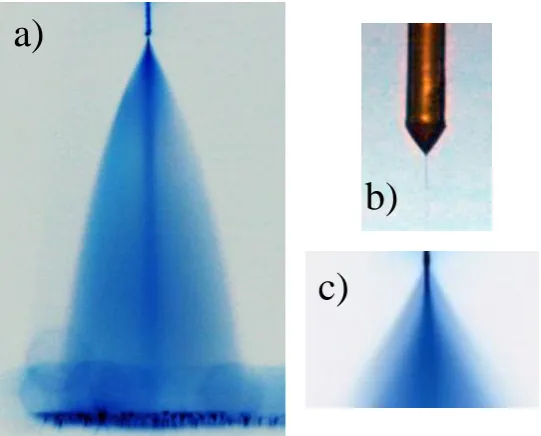
Electrosprays are fine dispersions of liquid droplets into a gas, kept typically at atmospheric pressure, which expand under the repulsion of the droplets. The high electrical charge on the droplets prevents their agglomeration [115]. They are laminar aerosol flows, i.e. non-turbulent, unless gas turbulence is introduced by external energy sources. When the jet undergoes Rayleigh breakup, the satellite droplets segregate to the periphery of the spray plume, forming a shroud around the main spray made of the main droplets (see Figure 1-2) [106,109,116-118]. This effect is due to the fact that a unidimensional array of charges is radially unstable, as any fluctuations in the charges’ radial positions are amplified by the (always-positive) radial electrical force due to the other droplets (especially neighboring ones). The radial acceleration is expected to be much higher for the satellite droplets than the main droplets because both of the key factors involved, charge-over-mass ratio and radial electrical field (whose product equals acceleration), are higher for the satellite droplets [106,109]. This mechanism is similar to that of the bending instability mentioned earlier. Note, however, that when the jet breaks up irregularly, ejecting droplets into a wide cone, the droplets also segregate by size in the spray [119].
10
[image:31.595.161.432.210.428.2]droplet force on the gas (called reactive drag force) induces a laminar (i.e. non turbulent) gas flow pattern. This “induced gas flow” has been neglected on the argument that its average speed was much smaller than the droplet speed [127]. However, the data and analysis of Hartman et al. [117] and more recent numerical simulations [123,124] show that the axial gas speed near the spray centerline can be significantly higher than the average gas speed, up to 30-40% of the droplet axial velocities.
Figure 1-2 Example of (a) electrospray (needle-collector distance: 20 mm, negative image), (b) Taylor cone and jet (cone-jet) (needle OD: 200um), and (c) beginning of spray, showing outer spray due to satellite droplets surrounding inner spray due to main droplets (negative image).
Electrosprays of evaporating droplets have been studied also by both experimental and numerical methods [121,125,128]. In electrosprays of volatile electrosprays of methanol-water mixtures by Olumee et al. [121], the average drop diameter d10
decreases along the spray axis, as expected due to evaporation, when the initial droplet diameter is relatively large (5-7 μm). However, it decreases when the initial droplet diameter is much smaller (1-2 μm). This is either due to depletion of smaller sizes by an analogous mechanism to satellite-primary segregation [121], or by droplet shrinking below the smallest detectable size, due to evaporation and coulombic fission. Homopolar droplet coagulation is suggested also by these authors, but as less likely. The importance of each mechanism could be tested using numerical simulations as performed by Arumugham-Achari et al. [125].
a)
b)
11
Another important effect due to droplet evaporation is droplet cooling, which is very fast initially, as the latent heat is removed the droplet, and becomes slower, as the droplets become sufficiently cold and the latent heat is provided by heat conduction from the warmer gas to the droplet [125]. At this stage, the droplet temperature stabilizes at close to the wet bulb temperature of the solvent [125]. Recent experimental droplet temperature data obtained by ratiometric fluorescence agree with this picture [129]. Lagrangian numerical simulations of methanol, acetone, and heptane electrosprays of average drop diameter d10 = 10 µm confirm also this trend [125], and
further show that (i) the background solvent vapor does not build up significantly compared to the saturation value, except very near the droplet generation zone, and (ii) that the temperature of the gas changes only slightly (a few º C). These simulations, which consider induced gas flow, have also shown that main droplets undergo Coulomb explosions within regions which are approximately conical, with distance from the electrospray needle of 7-15 mm, being slightly larger on the axis than at the spray periphery. Note that any progeny droplets from Coulomb explosions would not migrate to the periphery of the spray, but rather follow similar trajectories as the parent droplets under electrophoretic motion (as a result of their low inertia).
Coulombic instabilities of the droplets
Coulombic instability occurs to electrically charged droplets as they evaporate. While the droplet shrinks, the destabilizing electrical stress due to electrostatic repulsion between net charges on the droplet’s surface increases faster than the stabilizing capillary tension stress. Rayleigh also developed the linear stability analysis for this problem, for a spherical droplet of an inviscid perfectly conducting fluid [104,130]. Instability is predicted for the critical droplet diameter
3 1
0 2
2
8 q dR (1-5) where q is the droplet charge, 0 the electrical permittivity of vacuum (8.854 pF/m) and
the surface tension coefficient of the liquid [130,131]. Another way of expressing Rayleigh’s critical condition is with the charge necessary for a droplet with diameter d
to undergo instability, or Rayleigh limitcharge [82]:
3 0 2
8 d
12
The stability criterion for a drop is the same when slight viscosity and charge relaxation by conduction are allowed, or when very rapid charge relaxation on a very viscous drop is allowed; but it is different for dielectric drops [104].
One of the characteristics of electrosprays is the high charge of its droplets, which is comparable (though smaller) than qR. Therefore, droplets of volatile electrosprays are
known to undergo extensive coulombic instabilities [125,132].
The Rayleigh instability of a charged droplet is a complex problem, which is still not fully understood theoretically, even for Newtonian (i.e. non rheological) fluids. Droplets made of low viscosity, conductive liquids undergo fragmentation (called coulombic fission or Coulomb explosion), in which two small jets form and break up into so called
progeny droplets (or offspring droplets) [82]. Coulombic fissions of droplets in electrosprays were first captured photographically by Gomez and Tang [132]. Their unstable heptane droplets are tens of µm’s in diameter, and some examples are shown in Figure 1-3(a)-(c). Similar behaviors have been photographed for electrodynamically levitated droplets of similarly large sizes, as shown in Figure 1-3(d) [133-135]. Using this technique, Giglio et al. [135] have been able to record detailed deformation pathways of droplets with dR ~50-100 µm, and show that initially an unstable droplet
elongates during the first few 100 µs, becoming spindle-shaped, and then, over the following 1-5 µs, it emits two microjets (dj ~1 µm) from the pointed ends of the droplet.
Micro- and nano-droplets are too small to be imaged by current methods (both because their shape cannot be captured accurately by optical imaging, and because the times scales are much shorter). Some electrospray studies have formed solid relics during
13
The charge and mass fractions released in coulomb fissions of large drops (dR~5-50 µm)
[image:34.595.112.487.287.460.2]have been determined by various methods: (a) levitation in electrodynamic balances (EB) combined with detection of light Mie scattering detection for accurate droplet sizing before and after the explosion [138], (b) phase Doppler interferometry (PDI) detection in a “ping-pong” electrophoretic cell [139]. One conclusion from these studies is that coulombic explosions result in a large droplet charge loss (typically) 10-25% and negligible mass loss (<5%) (as reviewed in [139]; also [133]). Hunter and Ray have studied the effect of electrical conductivity by the EB method, and find that increases in conductivity result in reduced mass loss (< 3%), increased charge loss up to a limit (~30%) [140].
Figure 1-3 Examples of droplets undergoing Coulomb fission.(a-c) [132], (d) [134]
The formation of one jet, instead of two opposite jets, can be produced when a droplet charged below the Rayleigh limit (q < qR) breaks up under the action of an applied field.
In this case, the electrical stresses are significantly higher on one side of the droplet, from where a single jet is emitted [141,142]. Electrosprays of volatile droplets can experience such high field strengths only near the region of jet break up [82,132]. Conceivably, the field due to a near passer-by charged drop (having different speed) could also trigger single-jet emission. Therefore electrospray droplets can undergo single-jet or double-jet emissions.
a) b)
c)
14
1.3.2.
Physics of particle formation
The manufacturing of particles from liquid sprays is known as spray drying, and is widely used in the food, cosmetic, and pharmaceutical industries [143,144]. In spray drying, a precursor solution or nanosuspension is atomized (usually by pneumatic or pressure atomization), as the spray is being mixed with drying gas, and then the dry particles are collected.
Although electrospray drying has not been implemented industrially, it has proven to be able to make unique particles of potential use in many technological fields [13]. In particular, electrosprayed polymeric particles have attracted much pharmaceutical research [3,5,144], because of the promise of easy drug encapsulation and particle design.
The key processes that must be controlled in spray drying are solvent evaporation and solid phase formation. Solute concentration is expected to enrich at the droplet surface as solvent evaporates from it [143]. However, they explain that surface solute concentration will be reduced by solute transport to the droplet core, i.e. by diffusion (and, we may add, internal circulation, as well). Vehring et al. have developed a one-dimensional model which predicts solute concentrations versus radial position within the droplet. Shell formation is assumed to start happening at the surface of the droplet when the surface concentration exceeds the solute solubility concentration. However, their model is for small molecular weight compounds. In addition, they alert that crystallization is not immediate, due to the dynamics associated with crystal nucleation and growth.
A similar model to Vehring’s does not exist for polymeric solutes. On the one hand, the diffusion coefficients of polymers are difficult to estimate, as they are highly dependent on molecular weight, as well as polymer chain conformation, and polymer concentration. Furthermore, the times needed for polymer chains to reach thermodynamic equilibrium may be large compared to the droplet drying time. In addition, the kinetics of polymer nucleation and growth of the glassy amorphous phase (vitrification) is not completely understood.
15
of polymer from inside the droplet. The concentration of polymer on the surface is determined by the interplay between polymer accumulation due to drying (solvent evaporation) and diffusional transport of polymer from the droplet surface towards its core, which will depend on molecular weight, and perhaps internal droplet circulation. Yao et al. [145] explain shell formation in electrosprayed droplets of polymeric solutions as being due to diffusional-limited polymer accumulation at the droplet surface; while they explain compact particles as forming when diffusion is dominant. While generally agreeing with this picture for pharmaceutical microparticles formed by spray drying, Vehring et al. [143] caution that thin shells can form even when solute diffusion is dominant, if the solute is surface active. Clearly, Yao et al.’s model should be expanded to take into account the solubility of the polymer, and the rate of polymer vitrification.
In addition, in electrospray, the electrical charge on the droplets can cause coulombic instabilities during their drying. Such instabilities could result in the formation of nanoparticles, which will broaden the particle size distribution. In addition, exploding droplets can solidify while drying, especially when polymers are dissolved in the droplet. In this case, the instability may be slowed down due to the increase in viscosity and/or polymer chain entanglements. Therefore, the solvent can evaporate significantly from the emitted jet while the jet is forming, leading to polymer precipitation and the halting of the emission. Subsequently the droplet dries up. This scenario therefore leads to particles carrying thin filaments attached. Such particle geometry is often not desirable, especially for pharmaceutical applications. To avoid this scenario, some authors simply follow the approach of using the highest possible concentration to get non-exploded individual particles [136,146] have found that for PLGA in chloroform there is a range of concentrations over which spherical particles are found, and such range becomes narrower as the molecular weight of the polymer increases. However, Almería el al. [56] show that for a given polymer concentration, the liquid flow rate Q
can be adjusted to preclude the coulombic instabilities. A reduction in Q lowers the initial charge-to-Rayleigh limit charge ratio (q/qR), and delays the coulombic instability
16
Besides the variation of shapes due to Coulomb explosion, the morphology (surface structure) of electrospray particles is also diverse, from smooth to textured with highly porous surfaces and even with a hollow structure [5, 3]. The explanations given for the formation of the different morphologies are qualitative, and usually involve solvent properties only. One usual explanation is that fast solvent evaporation reduces the time needed for the polymer chains to re-arrange within the droplet during solidification [3,5,147]. However, we know from electrospinning literature that relative humidity in the ambient surrounding the fiber can lead to fiber porosity. Strangely, the role of this factor has almost not been highlighted in electrospray review literature (e.g. [3], [5]).
1.4.
Thesis aims and structure
In electrospraying of polymeric solutions, important questions still remain open, which are addressed in this thesis. More specifically, these questions refer to the electrospraying of non-water soluble polymeric solutions in organic solvents, and are addressed in this thesis as follows:
1) The control over Rayleigh instability in electrosprays of polymeric solutions could be a powerful tool for particle engineering, whether the goal is spherical fiberless particles or particles with fibers. However, whereas the Rayleigh instability happens often in electrospray of volatile solvents, it is yet not sufficiently studied and explained in the case of polymeric solutions. Our aim is to identify the main factors and mechanisms leading to different morphologies in the presence of Rayleigh instabilities. In Chapter 2 we address this goal, in an investigation over the formation of polymeric microparticles and nanoparticles by electrospray under low ambient humidity.
17
ambient humidity on the particle morphology obtained by electrospraying dilute polymer solutions, and to provide interpretations of the mechanisms of formation based on thermodynamic and transport concepts.
3) Collecting dry polymeric particles made by electrospray onto solid substrates leads to the expansion of the granular film. This phenomenon, which has not been reported in the literature before this investigation, is studied in detail in Chapter 4. Here, we are interested in understanding the growth dynamics of such granular films (not only the expansion rate), as a function of key factors: deposition time, ambient humidity, and deposition flux. This study is focused on a single-electrospraying source or needle, but has important implications for multiplexed systems, where the deposition fluxes can be significantly larger.
All of the experiments reported in this thesis have been performed in the Sescelades Campus of Universitat Rovira i Virgili in Tarragona, Catalonia, Spain.
1.5.
References
[1] Loscertales, I. G., Barrero, A., Guerrero, I., Cortijo, R., Marquez, M., Gañán-Calvo, A. M. (2002). Micro/nano encapsulation via electrified coaxial liquid jets. Science, 295, 1695-1698.
[2] Loscertales, I. G., Barrero, A., Márquez, M. (2004). Production of complex nano-structures by electro-hydro-dynamics. Mater. Res. Soc. Symp. Proc., 860, LL5.9. [3] Bock, N., Dargaville, T. R., Woodruff, M. A. (2012). Electrospraying of polymers with therapeutic molecules: State of the art. Progress in Polymer Science, 37, 1510-1551.
[4] Yurteri, C. U., Hartman, R. P. A., Marijnissen, J. C. M. (2010). Producing pharmaceutical particles via electrospraying with an emphasis on nano and nano structured particles - A Review. KONA Powder and Particle Journal, (28), 91-115. [5] Xie, J., Jiang, J., Davoodi, P., Srinivasan, M. P., Wang, C.-H. (2015). Electrohydrodynamic atomization: A two-decade effort to produce and process micro-/nanoparticulate materials. Chemical Engineering Science, 125, 32-57.
18
[7] Fenn, J. B. (2003). Electrospray wings for molecular elephants (Nobel Lecture). Angew. Chem.-Int. Edit., 42(33), 3871-3894.
[8] Zhu, J., Jiménez-Díaz, J., Bean, H. D., Daphtary, N. A., Aliyeva, M. I., Lundblad, L. K., Hill, J. E. (2013). Robust detection of P. aeruginosa and S. aureus acute lung infections by secondary electrospray ionization-mass spectrometry (SESI-MS) breathprinting: from initial infection to clearance. J Breath Res., 7(3), 037106.
[9] Barrios-Collado, C., Vidal-de-Miguel, G., Martinez-Lozano Sinues, P. (2016). Numerical modeling and experimental validation of a universal secondary electrospray ionization source for mass spectrometric gas analysis in real-time. Sensors and Actuators B: Chemical, 223, 217-225.
[10] Lenggoro, I. W., Xia, B., Okuyama, K. (2002). Sizing of colloidal nanoparticles by electrospray and differential mobility analyzer methods. Langmuir, 18(12), 4584-4591. [11] Hogan, C. J., Kettleson, E. M., Ramaswami, B., Chen, D.-R., Biswas, P. (2006). charge reduced electrospray size spectrometry of mega- and gigadalton complexes: Whole viruses and virus fragments. Analytical Chemistry, 78(3), 844-852.
[12] Okuyama, K., Lenggoro, I. W. (2003). Preparation of nanoparticles via spray route. Chemical Engineering Science, 58(3-6), 537-547.
[13] Jaworek, A. (2007). Micro- and nanoparticle production by electrospraying. Powder Technology, 176(1), 18-35.
[14] Almería, B., Gomez, A. (2014). Electrospray synthesis of monodisperse polymer particles in a broad (60 nm-2 µm) diameter range: guiding principles and formulation recipes. J. Colloid Interface Sci., 417, 121-130.
[15] Chakraborty, S., Liao, I. C., Adler, A., Leong K. W. (2009). Electrohydrodynamics: A facile technique to fabricate drug delivery systems. Adv. Drug Delivery Rev., 61(12), 1043-1054.
[16] Larsen, G., Velarde-Ortiz, R., Minchow, K., Barrero, A., Loscertales, I. G. (2003). A method for making inorganic and hybrid (organic/inorganic) fibers and vesicles with diameters in the submicrometer and micrometer range via sol-gel chemistry and electrically forced liquid jets. Journal of the American Chemical Society, 125(5), 1154-1155.
[17] Barrero, A., Loscertales, I. G. (2007). Micro and nanoparticles via capillary flows. Ann. Rev. Fluid Mech., 39, 89-106.
19
[19] Xu, Q., Qin, H., Yin, Z., Hua, J., Pack, D. W., Wang, C.-H. (2013). Coaxial electrohydrodynamic atomization process for production of polymeric composite microspheres. Chemical Engineering Science, 104, 330-346.
[20] Borra, J. P., Camelot, D., Chou, K.-L., Kooyman, P. J., Marijnissen, J. C. M., Scarlett, B. (1999). Bipolar coagulation for powder production: Micro-mixing inside droplets. Journal of Aerosol Science, 30(7), 945-958.
[21] Jaworek, A. (2007). Electrospray droplet sources for thin film deposition. J. Mater. Sci., 42, 266-297.
[22] Umeda, M., Kawaguchi, S., Uchida, I. (2006). Characterization of Membrane Electrode Assembly for Fuel Cells Prepared by Electrostatic Spray Deposition. Japanese Journal of Applied Physics, 45(7R), 6049.
[23] Martin, S., Garcia-Ybarra, P. L., Castillo, J. L. (2010). Electrospray deposition of catalyst layers with ultra-low Pt loadings for PEM fuel cells cathodes. J. Power Sources, 195, 2443–2449.
[24] Ellis, N., Yurteri, C. U., Ruud van Ommen, J. (2012). Continuous process to deposit nanoparticles onto microparticles. Chemical Engineering Journal, 181-182, 798-805.
[25] Cardoso, M. A. T., Talebi, M., Soares, P., Yurteri, C. U., van Ommen, J. R. (2011). Functionalization of lactose as a biological carrier for bovine serum albumin by electrospraying. International Journal of Pharmaceutics, 414(1-2), 1-5.
[26] Morozov, V. N., Morozova, T. Ya. (1999). Electrospray deposition as a method for mass fabrication of mono- and multicomponent microarrays of biological and biologically active substances. Anal. Chem., 71, 3110–3117.
[27] Avseenko, N. V., Morozova, T. Y., Ataullakhanov, F. I., Morozov, V. N. (2002). Immunoassay with multicomponent protein microarrays fabricated by electrospray deposition. Analytical Chemistry, 74(5), 927-933.
[28] Kim, J.-W., Yamagata, Y., Takasaki, M., Lee, B.-H., Ohmori, H., Higuchi, T. (2005). A device for fabricating protein chips by using a surface acoustic wave atomizer and electrostatic deposition. Sensors and Actuators B: Chemical, 107(2), 535-545. [29] Woo, C. G., Shin, H., Jeong, C., Jun, K., Lee, J., Lee, J.-R., Lee, H., You, S., Son, Y., Choi, M. (2011). Selective nanopatterning of protein via ion-induced focusing and its application to metal-enhanced fluorescence. Small, 7(13), 1790-1794.
20
[31] Kim, H., Kim, J. Yang H., Suh J., Kim T., Han B., Kim S., Kim D. S., Pikhitsa P. V., Choi M. (2006). Parallel patterning of nanoparticles via electrodynamic focusing of charged aerosols. Nature Nanotechnology, 1(2), 117-121.
[32] Lee, H., You, S., Woo C. G., Lim K., Jun K., Choi M. (2009). Focused patterning of nanoparticles by controlling electric field induced particle motion. Appl. Phys. Lett., 94(5), 053104-3.
[33] You, S., Han, K., Kim H., Lee H., Woo C. G., Jeong C., Nam W., Choi M. (2010). High-Resolution, Parallel Patterning of Nanoparticles via an Ion-Induced Focusing Mask (2010). Small, 6(19), 2146-2152.
[34] Huang, Y., Bu, N. Duan Y., Pan Y., Liu H., Yin Z., Xiong Y. (2013). Electrohydrodynamic direct-writing. Nanoscale, 5(24), 12007-12017.
[35] Onses, M. S., Sutanto, E., Ferreira, P. M., Alleyne, A. G., Rogers, J. A. (2015). Mechanisms, capabilities, and applications of high-resolution electrohydrodynamic jet printing. Small, 11, 4237-4266.
[36] Li, D., Xia, Y. (2004). Electrospinning of Nanofibers: Reinventing the Wheel? Advanced Materials, 16(14), 1151-1170.
[37] Greiner, A., Wendorff, J. H. (2007). Electrospinning: A Fascinating Method for the Preparation of Ultrathin Fibers. Angew. Chemie Int. Ed., 46(30), 5670-5703.
[38] Reneker, D. H., Yarin, A. L. (2008). Electrospinning jets and polymer nanofibers. Polymer, 49, 2387-2425.
[39] Bhardwaj, N., Kundu, S. C. (2010). Electrospinning: A fascinating fiber fabrication technique. Biotechnology Advances, 28(3), 325-347.
[40] Huang, Z.-M., Zhang, Y. Z., Kotaki, M., Ramakrishna, S. (2003). A review on polymer nanofibers by electrospinning and their applications in nanocomposites. Composites Science and Technology, 63(15), 2223-2253.
[41] Agarwal, S., Wendorff, J. H., Greiner, A. (2008). Use of electrospinning technique for biomedical applications. Polymer, 49(26), 5603-5621.
[42] Gamero-Castano, M., Hruby, V. (2001). Electrospray as a source of nanoparticles for efficient colloid thrusters. Journal of Propulsion and Power, 17(5), 977-987.
[43] Morris, T., Forget, M., Malardier-Jugroot, C., Jugroot, M. (2011). Multi-scale investigation of a colloid micro-propulsion system. Plasma Processes and Polymers, 8(6), 478-489.
21
[45] Romero-Sanz, I., Bocanegra, R., Fernandez de la Mora, J., Gamero-Castaño, M. (2003). Source of heavy molecular ions based on Taylor cones of ionic liquids operating in the pure ion evaporation regime. Journal of Applied Physics, 94(5), 3599-3605. [46] Gamero-Castaño, M., Mahadevan, M. (2009) Sputtering of silicon by a beamlet of electrosprayed nanodroplets. Appl. Surf. Sci., 255, 8556-8561.
[47] Gamero-Castaño, M., Torrents, A., Valdevit, L., Zheng, J.-G. (2010). Pressure-Induced Amorphization in Silicon Caused by the Impact of Electrosprayed Nanodroplets. Phys. Rev. Lett., 105, 145701.
[48] Borrajo-Pelaez, R., Grustan-Gutierrez, E. Gamero-Castaño, M. (2013). Sputtering of Si, SiC, InAs, InP, Ge, GaAs, GaSb, and GaN by electrosprayed nanodroplets. Journal of Applied Physics, 114(18), 184304.
[49] Jiang, L., Zhao, Y., Zhai, J. (2004). A lotus-leaf-like superhydrophobic surface: A porous microsphere/nanofiber composite film prepared by electrohydrodynamics. Angewandte Chemie International Edition, 43, 4338–4341.
[50] Chen, C. H., Saville, D. A., Aksay, I. A. (2006). Electrohydrodynamic "drop-and-place" particle deployment. Applied Physics Letters, 88(15), 154104.
[51] Tran, S. B. Q., Byun, D., Nguyen, V. D., Kang, T. S. (2009). Liquid meniscus oscillation and drop ejection by ac voltage, pulsed dc voltage, and superimposing dc to ac voltages. Physical Review E, 80(2), 026318.
[52] Stachewicz, U., Dijksrnan, J. F., Burdinski, D., Yurteri, C. U., Marijnissen, J. C. M. (2009). Relaxation times in single event electrospraying controlled by nozzle front surface modification. Langmuir, 25(4), 2540-2549.
[53] Stachewicz, U., Yurteri, C. U., Frits Dijksman, J., Marijnissen, J. C. M. (2010). Single event electrospraying of water. Journal of Aerosol Science, 41(10), 963-973. [54] Lee, M. W., Kang, D. K., Kim, N. Y., Kim, H. Y., James, S. C., Yoon, S. S. (2012). A study of ejection modes for pulsed-DC electrohydrodynamic inkjet printing. Journal of Aerosol Science, 46(4), 1-6.
[55] Lee, S., Song, J., Kim, H., Chung, J. (2012). Time resolved imaging of electrohydrodynamic jetting on demand induced by square pulse voltage. Journal of Aerosol Science, 52, 89-97.
[56] Almería, B., Deng, W., Fahmy, T. M., Gomez, A. (2010). Controlling the morphology of electrospray-generated PLGA microparticles for drug delivery. Journal of Colloid and Interface Science, 343, 125–133.
22
[58] Kawakami, K. (2012). Miscibility analysis of particulate solid dispersions prepared by electrospray deposition. International Journal of Pharmaceutics, 433(1-2), 71-78. [59] Xiong, J., Zhou, Z., Ye, X., Wang, X., Feng, Y. (2002). A colloid micro-thruster system. Microelectronic Engineering, 61-62, 1031-1037.
[60] Huberman, M. N., Beynon, J. C., Cohen, E., Goldin, D. S., Kidd, P.W., Zafran, S. (1968). Present status of colloid microthruster technology. Journal of Spacecraft and Rockets, 5, 1319-1324.
[61] Kelly, R. T., Page, J. S., Tang , K., Smith, R. D. (2007). Array of chemically etched fused-silica emitters for improving the sensitivity and quantitation of electrospray ionization mass spectrometry. Analytical Chemistry, 79(11), 4192-4198. [62] Kelly, R. T., Page, J. S., Marginean, I., Tang, K., Smith, R. D. (2008). Nanoelectrospray emitter arrays providing interemitter electric field uniformity. Analytical Chemistry, 80(14), 5660-5665.
[63] Kim, W., Guo, M., Yang, P., Wang, D. (2007). Microfabricated monolithic multinozzle emitters for nanoelectrospray mass spectrometry. Analytical Chemistry, 79(10), 3703-3707.
[64] Wang, L., Stevens, R., Malik, A., Rockett, P., Paine, M., Adkin, P., Martyn, S., Smith, K., Stark, J., Dobson, P. (2007). High-aspect-ratio silica nozzle fabrication for nano-emitter electrospray applications. Microelectronic Engineering, 84(5-8), 1190-1193.
[65] Lee, J.-S., Kim, S.-Y., Kim, Y.-J., Park, J., Kim, Y., Hwang, J., Kim, Y.-J. (2008). Design and evaluation of a silicon based multi-nozzle for addressable jetting using a controlled flow rate in electrohydrodynamic jet printing. Appl. Phys. Lett., 93, 243114. [66] Sen, A. K., Darabi, J., Knapp, D. R. (2007). Simulation and parametric study of a novel multi-spray emitter for ESI-MS applications. Microfluidics and Nanofluidics, 3(3), 283-298.
[67] Jaworek, A., Balachandran, W., Lackowski, M., Kulon, J., Krupa, A. (2006). Multi-nozzle electrospray system for gas cleaning processes. Journal of Electrostatics, 64, 194-202.
[68] Smith, D. P. H. (1986). The Electrohydrodynamic atomization of liquids. IEEE Transactions on Industry Applications, 22(3), 527-535.
[69] Cloupeau, M., Prunet-Foch, B. (1989). Electrospraying spraying of liquids in cone-jet mode. J. Electrostatics, 22, 135-159.
23
[71] Gañán-Calvo, A. M., Rebollo-Muñoz, N., Montanero, J. M. (2013). The minimum or natural rate of flow and droplet size ejected by Taylor cone-jets: Physical symmetries and scaling laws. New Journal of Physics, 15, 033035.
[72] Cloupeau, M., Prunet-Foch, B. (1990). Electrostatic spraying of liquids – Main functioning modes. Journal of Electrostatics, 25(2), 165-184.
[73] Cloupeau, M., Prunet-Foch, B. (1994). Electrohydrodynamic spraying functioning modes: a critical review. Journal of Aerosol Science, 25(6), 1021-1036.
[74] Jaworek, A., Krupa, A. (1999). Classification of the modes of EHD spraying. Journal of Aerosol Science, 30(7), 873-893.
[75] Paine, M. D., Alexander, M. S. et al. (2007). Nozzle and liquid effects on the spray modes in nanoelectrospray. Journal of Colloid and Interface Science, 305(1), 111-123. [76] Marginean, I., Nemes, P., Vertes, A. (2007). Astable regime in electrosprays. Physical Review E, 76(2), 026320.
[77] Verdoold, S., Agostinho, L. L. F. et al. (2014). A generic electrospray classification. Journal of Aerosol Science, 67, 87-103.
[78] Borra, J. P., Camelot, D. et al. (1997). A new production process of powders with defined properties by electrohydrodynamic atomization of liquids and post-production electrical mixing. Journal of Electrostatics, 40-41, 633-638.
[79] Borra, J.-P., Ehouarna, P., Boulaud, D. (2004). Electrohydrodynamic atomisation of water stabilised by glow discharge—operating range and droplet properties. J. Aerosol Science, 35, 1313–1332.
[80] Taylor, G. I. (1964). Disintegration of water drops in electric field. Proc. R. Soc. Lond. A, 280, 383-397.
[81] Fernández de la Mora, J. (1992). The effect of charge emission from electrified liquid cones. Journal of Fluid Mechanics, 243, 561-574.
[82] Fernández de la Mora, J. (2007). The fluid dynamics of Taylor cones. Annu. Rev. Fluid Mech., 39, 217-243.
[83] Fernández de la Mora, J. F., Loscertales, I. G. (1994). The current emitted by highly conducting Taylor cones. Journal of Fluid Mechanics 260, 155-184.
[84] Herrada, M. A., Lopez-Herrera, J. M., et al. (2012). Numerical simulation of electrospray in the cone-jet mode. Physical Review E, 86(2), 026305.
24
[86] Gamero-Castaño, M. (2010). Energy dissipation in electrosprays and the geometric scaling of the transition region of cone-jets. J. Fluid Mech., 662, 493–513.
[87] Rosell-Llompart, J., Fernández de la Mora, J. (1994). Generation of monodisperse droplets 0.3 to 4 micrometre in diameter from electrified cone-jets of highly conducting and viscous liquids. J. Aerosol Sci., 25, 1093-1119.
[88] Chen, D.-R., Pui, D. Y. H. (1997). Experimental investigation of scaling laws for electrospraying: dielectric constant effect. Aerosol Sci. Tech., 27(3), 367- 380.
[89] Hartman, R. P. A., Brunner, D. J., Camelot, D. M. A., Marijnissen, J. C. M., Scarlett, B. (2000). Jet break-up in electrohydrodynamic atomization in the cone-jet mode. Journal of Aerosol Science, 31(1), 65-95.
[90] Lenggoro, I. W., Okuyama, K., Fernández de la Mora, J., Tohge, N. (2000). Preparation of ZnS nanoparticles by electrospray pyrolysis. Journal of Aerosol Science, 31(1), 121-136.
[91] Gañán-Calvo, A. M., Montanero, J. M. (2009). Revision of capillary cone-jet physics: Electrospray and flow focusing. Phys. Rev. E, 79, 066305.
[92] Ieta, A., Gerlach, H. et al. (2009). Scaling law for electrospray droplet formation. Particulate Science and Technology, 27(3), 238-244.
[93] Yan, F., Farouk, B. et al. (2003). Numerical modeling of an electrostatically driven liquid meniscus in the cone-jet mode. Journal of Aerosol Science, 34(1), 99-116.
[94] Lastow, O., Balachandran, W. (2006). Numerical simulation of electrohydrodynamic (EHD) atomization. Journal of Electrostatics, 64(12), 850-859. [95] Higuera, F. J. (2009). Charge separation in the conical meniscus of an electrospray of a very polar liquid: Its effect on the minimum flow rate. Physics of Fluids, 21(3), 032104.
[96] Higuera, F. J. (2010). Numerical computation of the domain of operation of an electrospray of a very viscous liquid. Journal of Fluid Mechanics, 648, 35-52.
[97] Lim, L. K., Hua, J., Wang, C.-H., Smith, K. A. (2011). Numerical simulation of cone-jet formation in electrohydrodynamic atomization. AIChE J., 57, 57–78.
[98] Sarkar, K., Hoos, P., Urias, A. (2013). Numerical simulation of formation and distortion of Taylor cones. J. Nanotechnology in Engineering and Medicine, 3(4), 041001.
25
[100] Eggers, J., Villermaux, E. (2008). Physics of liquid jets. Rep. Progr. Phys., 71(3), 036601.
[101] Eggers, J. (1997). Nonlinear dynamics and breakup of free-surface flows. Rev. Mod. Phys., 69(3), 865-929.
[102] Fong, H., Chun, I., Reneker, D. H. (1999). Beaded nanofibers formed during electrospinning. Polymer, 40(16), 4585-4592.
[103] Rayleigh, L. (1878). On the instability of jets. Proc. London Math. Soc., s1-10, 4-13.
[104] Saville, D. A. (1997). Electrohydrodynamics: The Taylor-Melcher leaky dielectric model. Ann. Rev. Fluid Mech., 29, 27-64.
[105] Ashgriz, N., Mashayek, F. (1995). Temporal analysis of capillary jet breakup. J. Fluid Mech., 291, 163–190.
[106] Gamero-Castaño, M. (2008). The structure of electrospray beams in vacuum. J. Fluid Mech., 604, 339-368.
[107] Chandrasekhar, S. (1981). Hydrodynamic and Hydromagnetic Stability. Dover, New York.
[108] Jones, A. R., Thong, K. C. (1971). The production of charged monodisperse fuel droplets by electrical dispersion. J. Phys. D: Appl. Phys., 4, 1159-1166.
[109] Tang, K., Gomez, A. (1994). On the structure of an electrostatic spray of monodisperse droplets. Physics of Fluids, 6(7), 2317–2332.
[110] Gamero-Castano, M., Hruby, V. (2002). Electric measurements of charged sprays emitted by cone-jets. Journal of Fluid Mechanics, 459, 245-276.
[111] Melcher, J. R. (1963). Field-Coupled Surface Waves. MIT, Cambridge, MA. [112] Riboux, G., Marín, Á. G. et al. (2011). Whipping instability characterization of an electrified visco-capillary jet. Journal of Fluid Mechanics, 671, 226-253.
[113] de Juan, L., Fernández de la Mora, J. (1997). Charge and size distributions of electrospray drops. Journal of Colloid and Interface Science, 186(2), 280-293.
[114] Hohman, M. M., Shin, M. et al. (2001). Electrospinning and electrically forced jets. II. Applications. Physics of Fluids, 13(8), 2221-2236.
[115] Grifoll, J., Rosell-Llompart, J. (2012). Efficient Lagrangian simulation of electrospray droplets dynamics. Journal of Aerosol Science, 47, 78-93.
26
[117] Hartman, R. P. A., Borra, J. P., Brunner, D. J., Marijnissen, J. C. M., Scarlett, B. (1999). The evolution of electrohydrodynamic sprays produced in the cone-jet mode, a physical model. Journal of Electrostatics, 47, 143–170.
[118] Wilhelm, O., Madler, L. (2006). Cone-jet and multijet electrosprays: Transport and evaporation. Atomization and Sprays, 16(1), 83-102.
[119] Grifoll, J., Rosell-Llompart, J. (2015). Continuous droplets' charge method for the Lagrangian simulation of electrostatic sprays. Journal of Electrostatics, 72, 357-364. [120] Gañán-Calvo, A. M., Lasheras, J. C., Dávila, J., Barrero, A. (1994). The electrostatic spray emitted from an electrified conical meniscus. J. Aerosol Sci., 25, 1121–1142.
[121] Olumee, Z., Callahan, J. H., et al. (1998). Droplet dynamics changes in electrostatic sprays of methanol-water mixtures. The Journal of Physical Chemistry A, 102(46), 9154-9160.
[122] Higuera, F. J. (2012). Eulerian model of a dilute spray of charged droplets. Journal of Aerosol Science, 48, 34-45.
[123] Arumugham-Achari, A., Grifoll, J., Rosell-Llompart, J. (2013). Two-way coupled numerical simulation of electrospray with induced gas flow. Journal of Aerosol Science, 65, 121-133.
[124] Higuera, F. J. (2013). Multifluid Eulerian model of an electrospray in a host gas. J. Fluid Mech., 734, 363–386.
[125] Arumugham-Achari, A., Grifoll, J., Rosell-Llompart, J. (2015). A comprehensive framework for the numerical simulation of evaporating electrosprays. Aerosol Science and Technology, 49(6), 436-448.
[126] Willeke, K., Baron, P. A. (Eds.) (1993). Aerosol Measurement. VNR, New York. [127] Wilhelm, O., Mädler, L., Pratsinis, S. E. (2003). Electrospray evaporation and deposition. J. Aerosol Sci., 34(7), 815–836.
[128] Kiselev, P., Rosell, J., Fenn, J. B. (1997). Determining the composition of liquid droplets in a gas of different composition. Ind. Eng. Chem. Res., 36(8), 3081-3084. [129] Gibson, S. C., Feigerle, C. S., Cook, K. D. (2013). Fluorometric measurement and modeling of droplet temperature changes in an electrospray plume. Analytical Chemistry, 86(1), 464-472.
[130] Rayleigh, J. W. S. (1882). On the equilibrium of liquid conducting masses charged with electricity. Phil. Mag. 14, 184-186.
![Figure 1-3 Examples of droplets undergoing Coulomb fission.(a-c) [132], (d) [134]](https://thumb-us.123doks.com/thumbv2/123dok_es/5259114.96480/34.595.112.487.287.460/figure-examples-of-droplets-undergoing-coulomb-fission-a.webp)