UNIVERSIDAD TECNICA PARTICULAR DE LOJA La Universidad Católica de Loja
ESCUELA DE CIENCIAS DE LA EDUCACIÓN MENCIÓN INGLÉS
MODALIDAD ABIERTA Y A DISTANCIA
A DESCRIPTIVE ANALYSIS OF ANGLICISMS IN ECUADORIAN MAGAZINES
AUTHOR:
CARRIÓN MOGROVEJO JAVIER FERNANDO
ADVISOR:
MGS. LIZALDES ESPINOSA ORLANDO
CENTRO UNIVERSITARIO LOJA
2010
II CERTIFICATION
Mgs. Orlando Lizaldes Espinosa
Thesis Advisor
CERTIFIES THAT:
This research work has been thoroughly revised by the graduation
committee. Therefore, authorizes the presentation of this thesis, which
complies with all the norms and internal requirements of the
Universidad Técnica Particular de Loja
Loja, November 30, 2010
...
THESIS ADVISOR
III CONTRATO DE CESIÓN DE DERECHOS DE TESIS DE GRADO
Yo, Javier Fernando Carrión Mogrovejo, declaro ser autor del presente
trabajo y eximo expresamente a la Universidad Técnica Particular de
Loja y a sus representantes legales de posibles reclamos o acciones
legales.
Adicionalmente declaro conocer y aceptar la disposición del Art. 67 del
Estatuto Orgánico de la Universidad Técnica Particular de Loja que en su parte pertinente textualmente dice: ―formar parte del patrimonio de la Universidad la propiedad intelectual de investigaciones, trabajos
científicos o técnicos y tesis de grado que se realicen a través, o que el
apoyo financiero, académico o institucional (operativo) de la Universidad‖.
……….. AUTOR
IV AUTHORSHIP
The thoughts, ideas, opinions and the information obtained through
this research are the only responsibility of the author.
Date: November 30, 2010
...
Javier Carrión M.
V DEDICATION
I dedicate this thesis with my heart and my love to my wife July and to
my family who has always motivated me to achieve my goals and helped
me with their absolute support in every moment that I needed them.
Javier Carrión M.
VI ACNOWLEDGMENTS
First, thanks to God for being our guide. Then our special and
respectful acknowledgments to the Universidad Técnica Particular de
Loja, to our teachers who have helped and supported us in our studies
VII TABLE OF CONTENTS
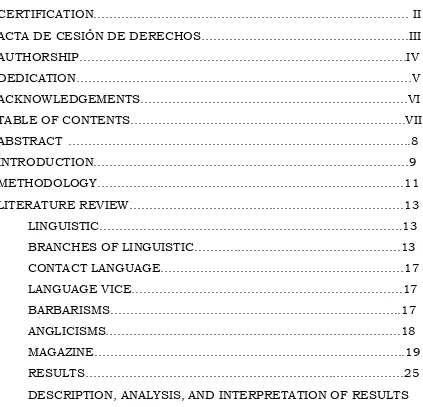
CERTIFICATION………. II ACTA DE CESIÓN DE DERECHOS……….III AUTHORSHIP……….IV DEDICATION………V ACKNOWLEDGEMENTS……….VI TABLE OF CONTENTS………...VII
ABSTRACT ………..8
INTRODUCTION……….………9
METHODOLOGY……….……….…11
LITERATURE REVIEW……..……….………13
LINGUISTIC..……….……….13
BRANCHES OF LINGUISTIC………..………..13
CONTACT LANGUAGE……….……17
LANGUAGE VICE……….….17
BARBARISMS..………..17 ANGLICISMS………..……….………..18
MAGAZINE……….……….……….19
RESULTS………..………25
DESCRIPTION, ANALYSIS, AND INTERPRETATION OF RESULTS ………..….43
COMPARATIVE ANALYSIS………...79
CONCLUSIONS……….……….…..81
BIBLIOGRAPHY………83
8 ABSTRACT
This research is about the
―
DESCRIPTIVE ANALYSIS OFANGLICISMS IN ECUADORIAN MAGAZINES.‖ This study is based in
Ecuadorian magazines printed in 2010 to understand the actual
influence of the Anglicisms in the Ecuadorian magazines. To achieve
this study, I took into the variables such as: cultural magazine,
scholarly magazine, and general interest magazine.
This research is a descriptive analysis, to gather the scientific
material necessary for the theoretical frame, I have used the
bibliographic method; and the Descriptive-analytic methods in order to
do the descriptive and statistical analysis and the interpretation of the
data gathered through the field research.
The strategies were: selection of Ecuadorian magazines printed in
2010, Anglicisms searching in the magazines, marking and researching
if the words selected are or not an Anglicism through of a dictionary or
Web.
This investigation has allowed to see that the Anglicisms found in
the scripts, articles, reports, essays, and general data issued by
journalists, reporters, editors, writers, and experts in science and
technology influence a great deal in the Spanish language usage of the
Ecuadorian readers. Consequently, it is possible to analyze the
Anglicisms regarding to their morphological, syntactic and semantic
9 INTRODUCTION
Magazines offer a lot of information about technology, culture,
sports and entertainment, nowadays. There are a lot of terms that serve
to report a determined aspect and give comprehension to paper.
These Anglicisms can be found almost in all the magazines; therefore,
the theme of this project is concerned with a descriptive analysis of
Anglicisms in Ecuadorian magazines, I have chosen three types of
magazines, cultural magazines, scholarly magazines and general
interest magazines. The magazines can influence so much on the public
and our language is suffering some linguistic alterations.
People consider Anglicisms as normal writing to communicate
some news because are actual words. In fact, language seems to be very
simple, since it is daily used as a single instrument of communication
among ordinary people living in society.
However, language is a complex system. For this reason, it is
important for the people to be aware of the use of correct Spanish
expressions. In this study here explained, there are some aspects of
importance to be taking into account for every magazine that we could
read.
The data collected was analyzed and studied to achieve the
Research on the linguistic phenomenon of Anglicisms used in
Ecuadorian magazine. In fact, I have used linguistic theories and
concepts of the theoretical frame through the direct observation of the
use of language of the magazines and the impact that has suffered the
10 more commonly used in the Spanish structures trough the Ecuadorian
magazines, to make a deep analysis of the Anglicisms found in
Ecuadorian magazines regarding syntactic, semantic, and
morphological aspects, to establish which variable (cultural, scholarly,
and general interest magazine) contains the highest number of
Anglicisms, and to determine which Anglicisms are mostly used.
The goal of this research is the mass media impact on our society,
specially the magazine. Regarding to this aspect, I found magazines that
have a lot of Anglicisms. For example the scholarly magazines that uses
Anglicisms to explain: economics, computer science, electronics, etc. On
the other hand, the cultural magazines have fewer Anglicisms because
11 METHODOLOGY
This study is based on the bibliographic method for gathering the
scientific material necessary for supporting the theoretical frame; and
the Descriptive-analytic methods in order to do the descriptive and
statistical analysis and the interpretation of the data collected through
the field research. Therefore, this research is qualitative and
quantitative because it has a statistical component which includes
statistical figures such as frequencies and percentages, to contrast the
use of the Anglicisms in the magazines; which are the variables.
The Anglicisms were classified and tabulated into corresponding
statistical charts to the three variables.
The research was done in the magazines ―Suridea No.12‖ and
―Mediodía No. 57‖ to the cultural field, the magazines ―Encorto Circuito
No.19‖ and ―Gestión No.193‖ to the variable scholarly magazine, and for
general interest the chosen magazines ―Estadio No. 1612‖ and ―TV y
Novelas No.48.‖ They are six magazines printed in Ecuador that have a
local diffusion and have a high number of readers among the ordinary
and popular people even professional, students, researchers and other
people related with the science.
The collection of the information for the theoretical frame was
done by note-taking, paraphrasing and summarizing scientific data
about language and papers about the Anglicisms in the Spanish
realized for professionals that had finding these variations in the
12 I did this research during some weeks. The Anglicisms are
remarked in the cultural, scholarly and general interest magazines the
possible Anglicism to check it if is or not. The source that supported
this investigation was the electronic direction www.rae.es/rae.html.
I registered a total of 70 Anglicisms in the magazines and took
notes of the Anglicisms in tables; I started the statistical process
according to the charts suggested in the Thesis Project Tutoring (2010).
This statistical analysis is made through statistical charts with
frequencies and percentages for the variables cultural, scholarly, and
general interest topics in the magazines, and there are also statistical
charts for comparing and contrasting the three variables and also for
13 Literature Review
The words that have English origin are called Anglicisms. They
have become on ordinary tool communication in our contemporary
society. The influence of these terms is shown in the mass media,
explaining situations of science, computer, technology, sports, etc. In
this section there is a study about Anglicisms used in some magazines
of scientific, variety and cultural journals.
To begin this study, it is necessary to review some concepts that
help to understand about the matter.
Linguistics
It is defined as the natural process that has the language
pertaining to structure such as phonetics, phonology, morphology, grammar, syntax, semantics, and pragmatics.
According to Funk (1998) ―linguists today understand their job as
that of description, their purpose being to describe how people use
language, not to prescribe how they should use it. Linguists do not
invent rules; they discover them.‖
Branches of linguistics
Linguist it is supported on four important branches which are
Morphology, Semantics, Pragmatics, Phonologic.
Morphology
It is the branch of Linguistics that studies word structures,
14 To McGuigan (2010), ―morphology is a field of linguistics focused
on the study of the forms and formation of words in a language. A
morpheme is the smallest indivisible unit of a language that retains
meaning. The rules of morphology within a language tend to be
relatively regular, so that if one sees the noun morphemes for the first
time, one can deduce that it is likely related to the word morphemes.‖
Semantics
It is the field that studies the meanings of words. The semantic
aspect of any expression is its meaning as opposed to its form.
To Moore (2000), semantics is the study of meaning. It is a wide
subject within the general study of language. ―The comprehension of
semantics is essential to the study of language acquisition (how
language users acquire a sense of meaning, as speakers and writers,
listeners and readers) and of language change (how meanings alter over
time). It is important for understanding language in social contexts, as
these are likely to affect meaning, and for understanding varieties of
English and effects of style.‖ It is thus one of the most fundamental
concepts in linguistics. The study of semantics includes the study of
how meaning is constructed, interpreted, clarified, obscured,
illustrated, simplified negotiated, contradicted and paraphrased.
Pragmatics
According to Keith (n.d) ―pragmatics is all about the meanings
between the lexis and the grammar and the phonology meanings are
15 To Liu (n.d) it is a subfield of linguistics developed in the late
1970s, pragmatics studies how people comprehend and produce a
communicative act or speech act in a concrete speech situation which is
usually a conversation. It distinguishes two intents or meanings in each
utterance or communicative act of verbal communication. One is the
informative intent or the sentence meaning, and the other one is the
communicative intent or speaker meaning.
According to Kasper (1997) the ability to comprehend and
produce a communicative act is referred to as pragmatic competence,
which often includes one's knowledge about the social distance, social
status between the speakers involved, the cultural knowledge such as
politeness, and the linguistic knowledge explicit and implicit.
Phonology
Phonology is the field that studies how sounds are controlled,
organized and used in natural languages.
To Moore (2002), ―phonology is the study of the sound system of
languages‖.
From Columbia Encyclopedia (2010), phonology studies the sound
systems of languages. It is distinguished from phonetics, which is the
study of the production, perception, and physical properties of speech
sounds; phonology attempts to account for how they are combined,
organized, and convey meaning in particular languages. Only a fraction
of the sounds humans can articulate is found in any particular
language. For example, English lacks the click sounds common to many
16 people learning English. Also, a possible combination of sounds vary
widely from language to language-the combination kt at the beginning
of a word, for example, would be impossible in some languages but is
unexceptional in Greek. In phonology, speech sounds are analyzed into
phonemes, the smallest units of sound that can change the meaning of
a word. A phoneme may have several allophones, related sounds that
are distinct but do not change the meaning of a word when they are
interchanged. In English, l at the beginning of a word and l after a vowel
are pronounced differently, so that the l in lit and the l in gold are
allophones of the phoneme l; in other languages the difference between
the two sounds could change the meaning of a word and so be
considered different phonemes.
Syntax
Basically, Syntax is the rules by which signs are combined to
make statements. If you consider the words of a language to be its
signs, then its syntax is the rules which put signs together to make
statements, ask questions, and produce other utterances.
According to Wikipedia (2010), modern research in syntax
attempts to describe languages in terms of such rules. Many
professionals in this discipline attempt to find general rules that apply
to all natural languages. The term syntax is also sometimes used to
refer to the rules governing the behavior of mathematical systems, such
as logic, artificial formal languages, and computer programming
17 Contact Language
This occurs when there is interaction between two or more
languages.
According to McArthur (1998) ―is a simplified variety of language
that develops in situations where most speakers have no common
language, such as ports, trading posts, plantations, and colonial
garrison towns. It generally retains features of the variet
ies that contribute to it, usually local vernaculars and one or more
languages brought by traders, settlers, soldiers, and missionaries. It
may also draw on universal strategies for communicating without a
shared language.‖
Language Vice
It is a deficiency or alteration that has a words or sentences when using the language in inadequate form.
Mejía (n.d) says, ―Vices are improper construction or use of the
term inappropriately, which often can become difficult to interpret,
giving rise to the original. In other, words the vices of speech are those
drawing fouls spoiling the prose-Break the thread violate
semantic-grammar‖.
Barbarisms
They are linguistic construction that expresses an incorrect form
language, making our expressions inadequate.
From Wikipedia (2010), barbarisms refer to a non-standard word,
expression or pronunciation in a language, particularly an error of
18 accepted technical meaning in formal linguistics the term is little used
by descriptive scientists.
Anglicisms
Anglicisms are commons words in languages such as: French,
Spanish, Chinese, German, Polish, Portuguese, and Italian. There are
some definitions given by experts and specialized books about it. According to Rivilla (2010) is a continual process and that it is very
probable that we can find words that have not yet even been adapted to
the Spanish, and perhaps will never be accepted by the Royal Academy
of the Spanish Language. But by the fact of using them, we are required
to be familiar with it and to interpret it correctly, attempting to replace
it with its proper term in Spanish.‖ Also says that ―Carreter, F. Lázaro
(1968), as mentioned by, in a work carried out by Juan Gomez Capuz in
the Group Val.Es.Co – University of Valencia on The Treaty of
linguistics: It defines adoption of foreign words as a linguistic element
that a language takes from others, while adapting it in their primitive
form, either imitating or transforming it more or less.‖
From Professor on line (2010), ―The words which have no
equivalent in Spanish (neologisms) are welcome and necessary
purchases for the evolution of language, what is the import of
objectionable words that replace existing words (even common) in our
language. Scientific writing, like any other formal writing requires the
19 From Wikipedia (2010) defines as words borrowed from English into another language; this phenomenon is shown especially in French and Spanish but considered by purist speakers of that language to be
substandard or undesirable.
Borrowing and loans
It is a process where one language using a borrowing form of
words, phrases or expressions to other language that absorbs this
matters and use for understanding a situation when in a determinate
language has not an adequate word.
Magazines
It is a printing publication that contains articles, stories, pictures,
and other features, about the science, technology, sports, shows,
culture, etc.
According to Wikipedia (2010), ―magazines, periodicals, glossies or
serials are publications, generally published on a regular schedule, containing a variety of articles. Magazines can be distributed through the mail, through sales by newsstands, bookstores or other vendors or through free distribution at selected pick up locations.‖
Regarding Anglicisms, there are many researches of authors that
are studying the effects of this borrowing in the Spanish-language, an
example it is a study did in Ecuador, where deals a newspaper in
Guayaquil that explains about the production of reality shows on TV or
where the Anglicisms are used for realization and comprehension of the
20 talks about the technology used in other countries like The United
Stated where some of these TV programs take a similar format.
A study done by Guzman (2002) explains the impact of lexical
Anglicism, in Spanish film magazines where the use of words in the
type of magazine analyzed the phenomenon of Anglicisms. In the first
part, it says that it is difficult or impossible to find Spanish
equivalents. This is particularly so in three cases: first, it says that
―technical vocabulary: this category comprises a significant number of
the total Anglicism found, since the adaptation of the original word for a
foreign device, technique or procedure is the most frequent way to build
up technical vocabularies. In Spain, film and television came from
abroad, and, consequently, the Spanish lexicon had to adapt itself. The
need for accuracy often leads to the direct introduction of the Anglicism,
as in the case of traveling and blue-backing‖.
According to the second part ― words denoting people, things,
situations which simply do not exist in the Spanish world, and of
which no translation would render the real meaning: for instance sheriff is one of the clearest cases and finally ― trade marks: legal regulations
tend to be quite explicit as to the use of these names; some, on the
other hand, have become extraordinarily popular, entering expressions
like soñar en Technicolor (―to have dreams in Technicolor‖):
Eastmancolor, Panavisión, Cinemascope, Technicolor. ¨
Diéguez, (n,d), has done a study about the Anglicisms in Spanish
for the divulgation of scientific books in Chile , the author explains that
21 Chile. Regarding the linguistic structure, he has some result such as:
4,5 % Anglicism in books of medium school and has a relevant
analysis, says that the Anglicisms have a very important role for
understanding economic aspect, statistics , physics, etc.
Another study entitled ―Anglicisms in Buenos Aires‖ was done by
Tocaimaza (n,d), says ―the attitude of acceptance of Anglicism, the
results of my survey presented the following: When the participants
were asked if they had ever heard these words, 96% of the all
participants indicated that they had heard the words used. In the 16-30
years old group 93% indicated that they knew the meaning of those
words, in the 31-45 years old group 90% indicated knowing their
meaning. When spliting by gender, men indicated that they know 100%
of the words, while women indicated knowing 82% of them. When asked
if they would use these words themselves in conversation, men
indicated approval by 77% and women only 37%. Those who responded
negatively to the previous question indicated that they would not use
any Anglicism because they don’t know how to speak English, or
because they don’t care for the language. Those that indicated that they
would use them stated they would do so only in spoken language. And
the conclusion says that Anglicisms are constantly being incorporated
into Argentina. They are accepted by the population and spreading by
means of phonetic, morphological, and semantic adaptations. They are
not only part of sports jargon but they are starting to be incorporated
22 areas, such as the ones related to economics, and politics are still left to
study.
Another study about the Anglicisms was realized by Delgado (2005)
says ―the Anglicisms in an article about the economic opinion, 45%
more that in the section about international news and sports. The
second place was for sports with 26%. An observation in small news
about the spectacles are very frequent the Anglicism (Small magazine
Viva). When it doesn’t use Anglicisms, the people cannot understand
the context in the article for example the technology (laptop, compact
disc, call center, etc.).
There are other researchers that explain the influence of the
English especially in Spanish, some authors say that people often use
Anglicisms in the ordinary conversation and they do not conceit that
adopt a word or phrases from English. It is a natural and relaxing form
of speaking. Valikova (2007) says that from second ward the people use
often Anglicisms in common conversation especially from the USA.
To Pountain (n.d) ¨the influence of English on Spanish thus
cannot be averted. But it might be more productive to regard it not as a
necessary evil but as an actual benefit. Speaking now not of the
indubitable practical benefits of convergence between English and
Spanish, which we might regard as a ―lowest common denominator‖
version of each language motivated by ease of mutual
comprehensibility, so much as the effects of English influence on
Spanish in its own right. He thinks that it is not out of place for an
23 mixed language par excellence, happily combining its Anglo-Saxon base
with a Norman French overlay and a major input of Latin and Greek
learned words, to say nothing of many borrowings from other foreign
sources.
An important conclusion is ―the influence of English on Spanish is
great and is likely to remain so in the 21st century. On the other hand,
it is extremely unlikely that a language with as bright and strong future
as Spanish is going to be colonized by English to the extent of losing its
fundamental structural properties. Spanish will change anyway and
probably in directions which will not be inconsistent with English.
Anglicisms indiscriminately, commentators and language planners
might do better to recognize some of the benefits of English influence,
both in terms of linguistic convergence and in terms of structural
advantage and expressive enhancement, confident that the real
excesses will probably be short-lived. This is of course the view of a
historical linguist whose mother tongue has no legislative body, and
who therefore is probably predisposed to the view that puristic objection
will in any case not have much effect either on the linguistic creativity
of the human mind or of its cheerful embracing of the exotic, whether it
is because the exotic has advantages to offer or whether it is just for the
thrill of doing it.‖
A research done by Claramonte (n.d), talk about the spelling
changes in the adaptation of the Anglicisms have little common with the
process found in the pidgin and creoles. This language is normally used
24 The system consists in a simplified phonetic version spelling used
in the superstratum language. The important of this paper is the
dynamics present in the adaptation Spanish Anglicism and the parallels
of such dynamics with the process operating in the pidgin languages.
Finally, Rollason (n.d) says, ¨ Spain as in France, there is an
official Academy that attempts to lay down usage, while there is also a
long-established tradition of accepted Anglicism that precedes today's
US-led free-market environment. Examples of older Anglicism are el
líder (leader), el boicot (boycott) and el mitin (meeting, of the political
kind) - all, it should be noted, orthographically modified. As with French
again, some Anglicisms have entrenched themselves despite attempts to
create home-grown alternatives: thus el fútbol (football; again with a
modified spelling) has long since won out over the reverse el balompié
(balón = ball; pié = foot - found in dictionaries but rarely used),
although, conversely, for basketball the truncated Anglicism el basquet.
In order to evaluate the impact of this process, it is here useful to make
25 RESULTS
Since this research is a descriptive analysis, I have obtained this
first-hand data by means of direct observation, case study forms, and
cards in as natural setting as possible.
For making a case study I have spent some months reading and
searching magazines about the three variables raised. Therefore, I
selected six different magazines to fit the requirements demanded in
this research.
Through this field research I have got some Anglicisms and
expression in the Ecuadorian magazines. Consequently, this research is
within the field of Sociolinguistics due to the relationship existing
between language of mass media and society. Therefore, I have been
taking notes of the Anglicisms found in each one of the magazines in
26 RESULTS
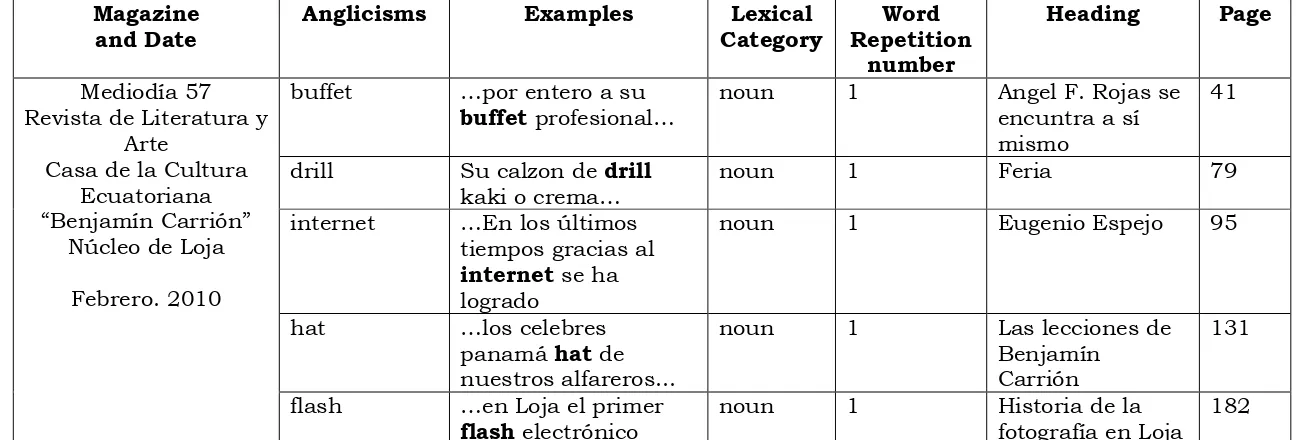
TABLE: One
VARIABLE: Cultural megazine
Magazine and Date
Anglicisms Examples Lexical Category
Word Repetition
number
Heading Page
Mediodía 57 Revista de Literatura y
Arte
Casa de la Cultura Ecuatoriana ―Benjamín Carrión‖
Núcleo de Loja Febrero. 2010
buffet …por entero a su buffet profesional…
noun 1 Angel F. Rojas se
encuntra a sí mismo
41
drill Su calzon de drill
kaki o crema… noun 1 Feria 79
internet …En los últimos tiempos gracias al internet se ha logrado
noun 1 Eugenio Espejo 95
hat …los celebres
panamá hat de nuestros alfareros...
noun 1 Las lecciones de
Benjamín Carrión
131
flash …en Loja el primer flash electrónico
noun 1 Historia de la
27 Magazine
and Date
Anglicisms Examples Lexical Category
Word Repetition
number
Heading Page
Suridea Casa de la Cultura
Ecuatoriana ―Benjamín Carrión‖
Núcleo de Loja No.12 Abril. 2010
poster …que los acerque al ídolo: discos,
posters, camisetas….
noun 1 Estereotipos
musicales.
22
stickers … que los acerque al ídolo: discos, posters, camisetas,
stickers….
noun 1
sandwich Los orígenes del sandwich
noun 3 Los orígenes del
sandwich .
44 …al cuarto conde de
Sandwitch, no hizo otra cosa que pensar en el juego…
noun
…nació el emparedado o sandwitch…
noun
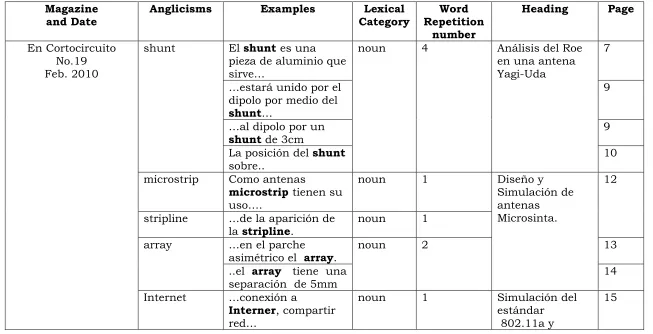
28 TABLE: Two
VARIABLE: Scholary magazines
Magazine and Date
Anglicisms Examples Lexical Category
Word Repetition
number
Heading Page
En Cortocircuito No.19 Feb. 2010
shunt El shunt es una pieza de aluminio que sirve…
noun 4 Análisis del Roe
en una antena Yagi-Uda
7
…estará unido por el dipolo por medio del shunt…
9
…al dipolo por un shunt de 3cm
9 La posición del shunt
sobre..
10 microstrip Como antenas
microstrip tienen su uso….
noun 1 Diseño y
Simulación de antenas Microsinta.
12
stripline …de la aparición de la stripline.
noun 1
array …en el parche asimétrico el array.
noun 2 13
..el array tiene una separación de 5mm
14 Internet …conexión a
Interner, compartir red…
noun 1 Simulación del
estándar 802.11a y
29 script Para la elaboración
del script…
noun 2 802.11b en
NS2.34
15 Este script genera un
archivo… 17
software …mediante el uso del software podemos simular el de magnitud de las señales …
noun 1 Diseño y
simulación de antenas
omnidireccionale s para 2.4GHz
18
máster …la consola puede ser configurada para que trabaje como máster en la red…
noun 1
password …el password es otra ventaja de
seguridad…
noun 1 Descripción e
implementación de tecnología BPL
30 Magazine
and Date
Anglicisms Examples Lexical Category
Word Repetition
number
Heading Page
En Cortocircuito No.19 Feb. 2010
chip …en sí mismo un
solo chip de computadora.
noun 1 Desarrollo de
rutinas para micro controladores aplicados a prototipos de robótica. 27
bluetooth …un dispositivo móvil que posea bluetooth…
noun 3 Diseño e
implementación de un sistema de control orientado a domótica aplicado a tecnología bluetooth. 31 …utilizando tecnología bluetooth.. 32
…rastrea todos los dispositivos
bluetooth…
34
software El software necesario
para el manejo… noun 1 33
laptop ….estará configurada en una laptop.
noun 1
kit …se usa un kit
básico de alarma… noun 1 Desarrollo de módulos de
control remoto vía RF usando micros cont.
31 Magazine
and Date
Anglicisms Examples Lexical Category
Word Repetition
number
Heading Page
En Cortocircuito No.19 Feb. 2010
datalogger Un datalogger es un
dispositivo… noun 3 Diseño e implementación
de un datalogger usando
tecnología de memoria fl.
39 El datalogger
diseñado consta de… 41
Un registrador de datos datalogger con tecnología de
memoria flash..
42
Microblaze …usando un microblaze para mejorar la señal..
noun 1 Diseño e
implementación de un microprocesador utilizando FPGAS aplicando microblaze. 43
bits …es un procesador
de 32 bits…
noun 2 45
Los bits que ocupan.. kit Kit de desarrollo de
… noun 1
keypard …para el escaneo del keypard se estará
noun 1 Diseño e
implementación de un de un sistema de seguridad con envío de alertas por medio de correo
electrónico.
46
string …el valor entero del string.
32 Magazine
and Date
Anglicisms Examples Lexical Category
Word Repetition
number
Heading Page
En Cortocircuito No.19 Feb. 2010
parking Tiene un parking de llamadas..
noun 1 Implementación
de una PBX Con ASTERISK
52 E mail …la voz del e mail,
sala de
conferencias,..
noun 1
swith …es un swith .. noun 1
network La ventana network
configurada… adjetive 1
Enter …presionamos
enter….
noun 1 53
Softphone ..ya que es un softphone que soporta este protocolo…
noun 1 55
displays …es así que en los cuatro displays de
siete segmentos…
noun 1 Buses del
sistema de 8 bits.
68
chat ..a diferencia que el chat es…
noun 1 Chat vía
bluetooth infrarojo
33 Magazine
and Date
Anglicisms Examples Lexical Category
Word Repetition
number
Heading Page
Gestión No.193 Julio 2010
bunker Los subsidios al diesel y bunker…
noun 1 Cuantioso
crédito chino y proyecto Coca con reparos
8
Bar …Como si se tratara de la administración de un Bar…
noun 1 Empleo talón de
Aquiles en el modelo socialista
16
ranking …imponer el mejor ranking . Sin embargo…
noun 1 El buen vivir un
lugar de crecimiento económico
19
ship or pay Sistema mundial de ship or pay, por el cual…
noun 1 OCP una obra
que beneficia al Ecuador.
41
Balanced scorecard
…el llamado
balanced scorecard. Este sistema ….
noun 3 Cada vez es más
urgente medir el desempeño empresarial
42
…del sistema
balanced scorecard se evalúan …
43
El balanced scorecard en el tablero…..
34 Magazine
and Date
post ..la evaluación del ex
postdel proyecto…
adjetive 1 Financiar
infraestructura local
52
Anglicisms Examples Lexical Category
Word Repetition
number
Heading Page
Gestión No.193 Julio 2010
think tank …de acuerdo al think tank Corporación Rand, las reformas…
adjetive 1 EEUU,
Obahama una reforma
histórica
56
souvenirs …..artesanal de souvenirs a base de la cabuya…
noun 1 Capital semilla
impulsa negocios innovadores
58
Delicatessen Delicatessen Mama Miche es una
empresa que brinda…
noun 3 60
…hongos secos de pino. Delicatessen Mama sigue mante…
…hotes, delicatesen
y el sector industrial… premium …de calidad de la
cerveza premium y..
35 Magazine
and Date
Anglicisms Examples Lexical Category
Word Repetition
number
Heading Page
Gestión No.193 Julio 2010
charter …cuatro vuelos charter los invitados…
adjetive 1 Nos contaron
que… 78
boys scouts …al grupo de boys scouts ( amigos de la infancia del presi….)
noun 1
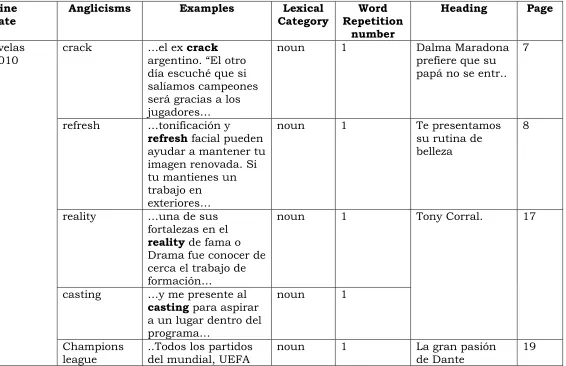
36 TABLE: Three
VARIABLE: General interest magazine
Magazine and Date
Anglicisms Examples Lexical Category
Word Repetition
number
Heading Page
TV y Novelas Jun. 2010
crack …el ex crack argentino. ―El otro día escuché que si salíamos campeones será gracias a los jugadores…
noun 1 Dalma Maradona
prefiere que su papá no se entr..
7
refresh …tonificación y refresh facial pueden ayudar a mantener tu imagen renovada. Si tu mantienes un trabajo en
exteriores…
noun 1 Te presentamos
su rutina de belleza
8
reality …una de sus fortalezas en el reality de fama o Drama fue conocer de cerca el trabajo de formación…
noun 1 Tony Corral. 17
casting …y me presente al casting para aspirar a un lugar dentro del programa…
noun 1
Champions league
..Todos los partidos del mundial, UEFA
noun 1 La gran pasión
de Dante
37 Champions league,
los sigo
apasionadamente, soy un ferviente seguidor del Barcelona FC
Córner …porque dimos
ventaja a la salida del córner y sus rápidos delanteros nos dejaron sin poder de reacciòn...
noun 1 ¡Al final del final! 30
look …Cambio de look de
… noun 1 No se necesita ser adulto para
triunfar
31
hooligans …la seleccioòn inglesa fue alentada por sus hinchas llamados en la
cancha de hooligans, que por su
comportamiento la policía siempre…
noun 1 Al fin juntos
34
exel …y su computadora
siempre tiene abierto el exel donde
elabora sus estadísticas, cronogramas …
noun 1 Jamás abandona
38 Magazine
and Date
Anglicisms Examples Lexical Category
Word Repetition
number
Heading Page
Estadio Jun. 2010
Black stars …un tercio de los black stars actuales provienen, de barrios pobres de la gran ciudad..
noun 1 Los black stars
enloquecen a toda África
4
boomerang Como si fuese el efecto boomerang…
adjetive 1 Bombardeo
alemán
8 panzers …y les abre
esperanzas a los panzers que
esperan…
noun 1
pitbull El término pitbull es usado para..
noun 3 El pitbull de la
roja
18 …ante Honduras el
pitbull mostró que…
18 …no quería que me
dijeran pitbull…
19
ratting También existía el ratting..
noun 1 18
Bull baiting …denominado como : bull baitingel cual…
noun 1 18
scratch …el director técnico del scratch…
noun 1 A Dunga lo que
es de Dunga
39 Magazine
and Date
Anglicisms Examples Lexical Category
Word Repetition
number
Heading Page
Estadio Jun. 2010
living …podría estar en el living de mi casa…
noun 1 Me siento
tocado por Dios 27 plus …al lado de Messi es
un plus...
noun 1
cracks …paraíso de los cracks argentinos..
noun 1 Las decepciones
del mundial
28 apartheid …una nación sin
apartheid…
noun 2 Los townships
39 ..el cerco heredado
del apartheid… townships Los township son los
lugares que estaban reservados para los negros, se
constyruyeron en la periferie de las ciudades
noun 1
safety …tras el safety ve como cada uno de sus compañeros logaron embarcarse a una nueva aventura futbolística.
noun 1 El joven
maravilla, el pillo y el gentleman.
40 gentleman …y el gentleman por
su parte no perdió ninguna de las oportunidades para darse a conocer
noun 1
41 Table: Four
The most frequent Anglicisms
shunt 4
array 2
script 2
bluetooth 3
kit 2
datalogger 3
bits 2
Balanced scorecard 3
Delicatessen 3
pitbull 3
apartheid 2
TOTAL: 11 Anglicisms 29
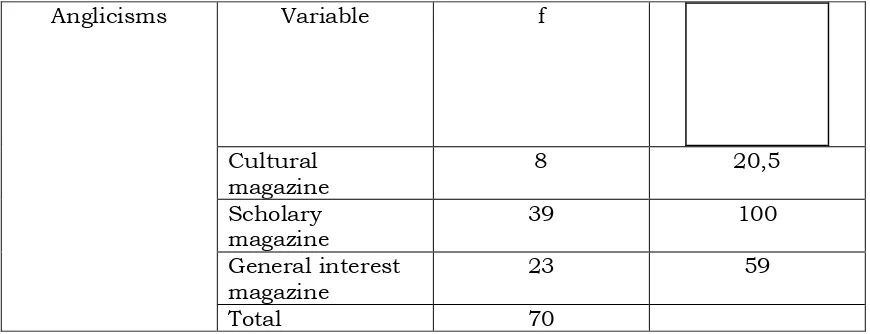
[image:41.595.78.513.93.303.2]42 Table: Five
Comparison between variables.
Author: Javier Carrión M
Anglicisms Variable f
Cultural magazine
8 20,5
Scholary magazine
39 100
General interest magazine
23 59
[image:42.595.79.514.140.307.2]43 DESCRIPTION, ANALYSIS, AND INTERPRETATION OF
RESULTS
The community is always influenced by the mass media.
Obviously, the language variation on the speech community depends on
certain categories, such as social class, ethnic group, age, sex,
occupation, function, and style. Therefore, the mass media uses a
variety of combinations of factors in speech in order to attract the
public’s attention.
According to the sociologist Stanley Lieberson (n,d), ―the media
drives all kinds of language changes. People notice buzzwords when
others use them, and know their source. They then adapt them as
prototypes for other changes in language‖ Throughout my personal
observation, I have found out that this fact is true. Unfortunately, this
kind of influence is negative in our society, because our language is not
studied, and the people feel comfortable using Anglicisms to
communicative competence.
For the analysis I have chosen 10 words for each variable where I
have done the linguistic analysis. This process has some aspects such
as: qualitative analyses that involve a syntactic and semantic study, a
morphologic analysis; and a comparative analysis.
For the first variable about cultural magazines, I have chosen 10
44 Drill
According to RAE, it is an Anglicism. It is a word that means an
instrument with an edged or pointed end for making holes in hard
substances by revolving or by a succession of blows; also : a machine
for operating such an instrument or the act or exercise of training
soldiers in marching and in executing prescribed movements with a
weapon. But also it can be a durable cotton twilled fabric. This word
was known by first time in 1743.
According Wikipedia (2010) ―Drill is stout durable cotton fabric
with a strong bias (diagonal) in the weave. It can be used unbleached,
although it is more often bleached, or dyed.
The most common use of drill in uniforms and casual wear is in
the form of khaki. Strictly speaking, khaki is a tan color, and the word
comes from the Hindi "khak", meaning the color of dust. Troops of the
British Empire during its occupation of India wore uniforms of a white
cotton drill. During the 1840s it was discovered that dying this drill to a
tan closely matching the color of the dusty surroundings resulted in an
effective camouflage. The fabric soon became a popular material for
military uniforms, and, in the United States following World War II, as
veterans returned to college campuses, it became popular in casual
dress as well.‖
The morphologic has a change it is the letter l : Example:
Dril…Spanish
45 In the paragraph this word has the function of a noun; its written
form is as it follows:
―..…Se cubren los hombros flacos con el poncho de algodón café claro.
Su calzón es de dril kaki o crema. Los pies aún conservan el polvo….‖
The author uses this word to explain about durable pants that
the indigenous have.
Internet
According to RAE, it isn’t an Anglicism. It is a word that means an
electronic communication network that connects computer networks
and organizational computer facilities around the world.
In English, internet, according Wikipedia (2010) ―it is a global
system of interconnected computer networks that use the standard
Internet Protocol Suite (TCP/IP) to serve billions of users worldwide. It is
a network of networks that consists of millions of private, public,
academic, business, and government networks, of local to global scope,
that are linked by a broad array of electronic and optical networking
technologies. The Internet carries a vast range of information resources
and services, such as the inter-linked hypertext documents of the World
Wide Web (www) and the infrastructure to support electronic mail.
In Spanish the meaning is similar to English. This concept
explains the same characteristics that in technology used by
professionals of computational science.
The morphologic doesn’t have any change in Spanish and English
46 Example:
Internet…Spanish
Internet…English
In the paragraph studied this word has the function of a noun; its
written form is as it follows:
―En la Habana, en los en los últimos tiempos gracias al internet
se ha logrado levantar algunos trabajos. Un tercer aspecto que llamó mi
atención…‖
The author explains advantages that have the informatics to
diffuse paper and researches.
Rol
According to RAE, it is an Anglicism. It is a word that means a
character assigned or assumed (had to take on the role of both father
and mother), can be also a socially expected behavior pattern usually
determined by an individual's status in a particular society. This word
was known by first time in 1605.
According Wikipedia (2010) ―is the representation of a person in a
narrative or dramatic work of art (such as a novel, play, or film). Derived
from the ancient Greek word kharaktêr (χαρακτήρ), the earliest use in
English, in this sense, dates from the Restoration, although it became
widely used after its appearance in Tom Jones in 1749. From this, the
sense of "a part played by an actor" developed. Character, particularly
when enacted by an actor in the theatre or cinema, involves "the
illusion of being a human person." Since the end of the 18th century,
47 impersonation by an actor. Since the 19th century, the art of creating
characters, as practiced by actors or writers, has been called
characterization.‖
The morphologic has a change in the letter e : Example:
Rol…Spanish
Role…English
In the paragraph this word has the function of a noun; its written
form is as it follows:
―..…Loja jugó un rol protagónico en la gestación de esta corriente
y Manuel Monteros a esa…‖
The author uses this word to explain that Loja city was a
important center of people to the liberty.
Hat
It is a word that means a covering for the head usually having a
shaped crown and brim.
From Wikipedia (2010) say that hat ―it is a hat is a head covering.
It may be worn for protection against the elements, for ceremonial or
religious reasons, for safety, or as a fashion accessory. In the past, hats
were an indicator of social status. In the military, they may denote
rank and regiment.
In Spanish the meaning is similar to English, but usually it is not
an Anglicism. The morphologic does not have any change for Spanish
and in English you can write in the same way.
Hat…Spanish
48 In the paragraph this word has the function of a noun; its written
form is as it follows:
―..…con los sombreros de paja toquilla, los celebres panamá hat
de nuestros alfareros, y tejedores de casimires de Otavalo..…‖
The author tells about the style of hats that were used by the
alfareros group in old times, when Eloy Alfaro was a great leader in
Ecuador.
Flash
According to RAE, it is an Anglicism. It is a word that can mean:
used of flowing water, to break forth in or like a sudden flame or flare,
to appear suddenly (an idea flashes into her mind), to move with great
speed (the days flash by). This word was known by first time in 13th
century.
Wikipedia (2010) says that ―a flash is a device used in
photography producing a flash of artificial light (typically 1/1000 to
1/200 of a second) at a color temperature of about 5500 K to help
illuminate a scene. A major purpose of a flash is to illuminate a dark
scene. Other uses are capturing quickly moving objects or changing the
quality of light. Flash refers either to the flash of light itself or to the
electronic flash unit discharging the light. Most flash units as of 2009
are electronic, having evolved from single-use flashbulbs and flammable
powders. Modern cameras often activate flash units automatically.‖
The morphologic doesn’t have change in Spanish and English you
49 Example:
Flash….Spanish
Flash….English
In the paragraph this word has the function of a noun; its written
form is as it follows:
―..Trae a Loja el primer flash electrónico, la primera máquina
Polaroid, y el primer laboratorio tecnificado de fotografía a ….‖
The author uses flash to explain the first camera in Loja had an
electronic flash and did perfects pictures in old times in our city.
Póster
According to RAE, it is an English Voice. It is a word that can
mean an opaque watercolor paint with a gum- or glue-size binder sold
usually in jars called also poster paint. This word was known by first
time in 1925.
In Spanish say Wikipedia (2010) that ―A poster is any piece of
printed paper designed to be attached to a wall or vertical surface.
Typically posters include both textual and graphic elements, although a
poster may be either wholly graphical or wholly text. Posters are
designed to be both eye-catching and convey information. Posters may
be used for many purposes. They are a frequent tool of advertisers
(particularly of events, musicians and films), propagandists, protestors
and other groups trying to communicate a message. Posters are also
used for reproductions of artwork, particularly famous works, and are
50 is the educational poster, which may be about a particular subject for
educational purposes.‖
This word has suffered a morphologic change. It is the stress in
Spanish in the letter o.
Example:
Póster…Spanish
Poster…English
In the paragraph this word has the function of a noun, we found:
―..…que los acerque al ídolo: discos, pósters, camisetas….‖
The author uses poster to mention souvenirs that the youth
usually have when they fans of a certain musician, dancer, actor, etc.
Sticker
According to RAE, it is an Anglicism. It is a word that mean one
that pierces with a point or a slip of paper with adhesive back that can
be fastened to a surface. This word was known by first time in 15th
century.
For Wikimedia (2010) ―A Sticker is a type of a label. Often it is a
piece of paper or plastic, sticky on one side, and usually with some
pattern on the other. They can come in many different shapes and sizes
(usually colourful) and are put on things such as lunchboxes, in
children's rooms, on paper, lockers, notebooks and so on. Some people
also choose to collect stickers and trade them with friends.
Stickers are very widely used when an object requires
identification with a word or idea. Brand stickers may be attached to
51 They may also be used to describe characteristics of the products that
would not be obvious from simple examination. A Label dispenser is
often used as a convenient way to separate the sticky label from its liner
or backing tape.‖
The morphologic form of this word does not have a change neither
in Spanish or English
Example:
Sticker…Spanish
Sticker …English
In the paragraph this word has the function of a noun; its written
form is as it follows:
―..…que los acerque al ídolo: discos, pósters, camisetas,
stickers….‖
The author uses sticker to explain about a souvenir that usually
the youth have when they are fans of a musician, dancer, actor, etc.
Sándwich
According to RAE, it is an Anglicism. It is a word that can mean:
two or more slices of bread or a split roll having a filling in between or
something resembling a sandwich; especially composite structural
material consisting of layers often of high-strength facings bonded to a
low strength central core. This word was known by first time in 1762.
For Wikimedia (2010), ―A sandwich is a food item, often consisting
of two or more slices of bread with one or more fillings between them, or
one slice of bread with a topping or toppings, commonly called an open
52 taken to work or school, or picnics to be eaten as part of a packed
lunch. They generally contain a combination of salad vegetables, meat,
cheese, and a variety of sauces. The bread can be used as it is, or it can
be coated with any condiments to enhance flavor and texture. They are
widely sold in restaurants and cafés.
About the etymology, the first written usage of the English word
appeared in Edward Gibbon's journal, in longhand, referring to "bits of
cold meat" as a Sandwich. It was named after John Montagu, 4th Earl
of Sandwich, an 18th-century English aristocrat, although he was
neither the inventor nor sustainer of the food. It is said that he ordered
his valet to bring him meat tucked between two pieces of bread, and
because Montagu also happened to be the Fourth Earl of Sandwich,
others began to order "the same as Sandwich!". It is said that Lord
Sandwich was fond of this form of food because it allowed him to
continue playing cards, particularly cribbage, while eating without
getting his cards greasy from eating meat with his bare hands.
The rumor in its familiar form appeared in Pierre-Jean Grosley's
Londres (Neichatel, 1770), translated as A Tour to London 1772;
Grosley's impressions had been formed during a year in London, 1765.
The sober alternative is provided by Sandwich's biographer, N. A. M.
Rodger, who suggests Sandwich's commitments to the navy, to politics
and the arts mean the first sandwich was more likely to have been
consumed at his desk.‖
Its morphology has a change, it is the stress in Spanish in the
53 Example:
Sándwich…Spanish
Sandwich…English
In the paragraph this word has the function of a noun; its written
form is as it follows:
―Los orígenes del sándwich
….cuarto conde de Sándwich…
…..nació el emparedado o sándwich…‖
The author talks about the sandwich’s history, he tells which
the sandwich’s origins.
For the second variable about scholarly magazines I choose the
10 more commons words and I did the respective analysis:
Fútbol
According to RAE, it is an Anglicism. It is a word that mean: any
of several games played between two teams on a usually rectangular
field having goalposts or goals at each end and whose object is to get
the ball over a goal line, into a goal, or between goalposts by running,
passing, or kicking. This word, was known in 15th century.
According to Wikimedia (2010), ―The game is played on a
rectangular field of grass or green artificial turf, with a goal in the
middle of each of the short ends. The object of the game is to score by
driving the ball into the opposing goal. In general play, the goalkeepers
are the only players allowed to touch the ball with their hands or arms,
while the field players typically use their feet to kick the ball into
54 midair. The team that scores the most goals by the end of the match
wins. If the score is tied at the end of the game, either a draw is
declared or the game goes into extra time and/or a penalty shootout,
depending on the format of the competition..‖
It is morphologic form has some changes:
Example:
Fútbol…Spanish
Football…English
In the paragraph this word has the function of a noun; its written
form is as it follows:
―se tala la superficie equivalente a una cancha de fútbol de
bosque, mientras se reforesta una hectárea.. ‖
The author talks about football field as a comparison to explain
that forests with a few trees because there is a global problem.
Blog
According to RAE, it isn’t an Anglicism. It is a word that means: a
Web site that contains an online personal journal with reflections,
comments, and often hyperlinks provided by the writer; also: the
contents of such a site. This word, was known in 1999.
For Wikimedia (2010), ―A blog (a blend of the term web log) is a
type of website or part of a website. Blogs are usually maintained by an
individual with regular entries of commentary, descriptions of events, or
other material such as graphics or video. Entries are commonly
displayed in reverse-chronological order. Blog can also be used as a
55 Most blogs are interactive, allowing visitors to leave comments
and even message each other via widgets on the blogs and it is this
interactivity that distinguishes them from other static websites.‖
The morphologic has not change, Spanish and English is similar.
Example:
Blog…Spanish
Blog…English
In the paragraph this word has the function of a noun; its written
form is as it follows:
―Adaptado del blog de la Unión Europea del año 2009 en el
cálculo de ahorro de carbono‖
The author talks about of a chart that is referred from de
European Union about of pollution in countries such as Germany,
England, etc.
Record
According to RAE, it is an Anglicism. It is a word that can meana
body of known or recorded facts about something or someone especially
with reference to a particular sphere of activity that often forms a
discernible pattern (a good academic record, a liberal voting record), a
collection of related items of information (as in a database) treated as a
unit. This word was known by first time in 14th century.
For Wikimedia (2010), ―In the United States the form World's
Record was formerly more common. The term World Best was also
briefly in use.[citation needed] The latter term is still used in athletics
56 world record: either because the event is a non-qualifying event (e.g. the
150 m run or individual events in a decathlon), or because it does not
fulfill other criteria of an otherwise qualifying event (e.g. the Great North
Run half-marathon, which has an excessive downhill gradient).‖
The morphology of this word has suffered in Spanish a change; it
is the stress on Spanish in the letter e.
Example:
Récord…Spanish
Record…English
In the paragraph this word has the function of a noun; its written
form is as it follows:
―Empezó escribiendo y rompiendo su propio récord de palabras
por minuto...‖
The author talks about a man that wrote very quickly sentences.
For the second variable about scholarly magazines I choose the
10 more commons words and I realized the analysis as follows:
Shunt
According to RAE, it is not an Anglicism. It is a word that means:
to turn off to one side, to switch (as a train) from one track to another,
to provide with or divert by means of an electrical shunt, to divert
(blood) from one part to another by a surgical shunt.
This word has origin in Middle English, to move suddenly, turn
away, evades, perhaps from past participle of shonen, was known in
57 For Wikimedia (2010), ―shunt" in the context of electrical
engineering. For other uses, see Shunt (disambiguation). In electronics,
a shunt is a device which allows electric current to pass around another
point in the circuit. The term is also widely used in photovoltaics to
describe an unwanted short circuit between the front and back surface
contacts of a solar cell, usually caused by wafer damage.‖
The morphology of this word doesn’t have a change. In Spanish
and English it is the same word
Example:
Shunt…Spanish
Shunt…English
In the paragraph this word has the function of a noun; its written
form is as it follows:
―El shuntes una pieza de aluminio que sirve…
….…estará unido por el dipolo por medio del shunt……
…..…al dipolo por un shunt de 3cm…
La posición del shunt sobre… ‖
The author talks about a shunt that is a piece that is used to join
two electronic parts.
Software
It is an Anglicism from RAE. The meaning is: the entire set of
programs, procedures, and related documentation associated with a
system and especially a computer system; specifically: computer
58 For Wikimedia (2010), ―Computer software, or just software, is the
collection of computer programs and related data that provide the
instructions telling a computer what to do. The term was coined to
contrast to the old term hardware (meaning physical devices). In
contrast to hardware, software is intangible, meaning it "cannot be
touched". Software is also sometimes used in a more narrow sense,
meaning application software only. Sometimes the term includes data
that has not traditionally been associated with computers, such as film,
tapes, and records.
The morphology of this word doesn’t have any change, Spanish
and English is similar
Example:
Software…Spanish Software…English
In the paragraph this word has the function of a noun; its written
form is as it follows:
―Mediante el uso del software…‖
The author talks about software as a tool to develop an
application in computer science.
Máster
It is an Anglicism from RAE. The meaning is: a male teacher or a
person holding an academic degree higher than a bachelor's but lower
than a doctor's, often capitalized: a revered religious leader, a worker or
artisan qualified to teach apprentices or an artist, performer, or player