Current status of technology and telemedicine services in
Colombia
Diego Alejandro Barragán Vargas, Karen Andrea Duarte Castiblanco, Lilia Edith Aparicio Pico
Faculty of Engineering, Universidad Distrital Francisco José de Caldas
1
AbstractIn this review article were observed, the projects and advances implemented in Colombian telemedicine, regarding the use given in the different regions of the country, in this way the different branches are visualized around the needs required by each sector of the nation. The article is divided into 5 main sections, in which a description of telemedicine is made, exposing the development of the different techniques used for the user-machine interface, through telecommunications and telematics for a dynamic, continuous and interactive communication with the doctor and the patient, where it was illustrated the main platforms and tools, used for a correct performance of the applications, finally a timeline was generated that allows to show the evolution that this branch has had in Colombia.
Keywor ds: Telematics, Telecommunicati ons, Telemedicine
I. INTRODUCTION
Globalization has reached the countries transcending barriers of time and space, to mold disciplines that have been present through history with particular geographical and social conditions [1] [2]. In this way, Colombia has several challenges and advances to improve in the field of Information and Communication Technologies (ICTs) around the health sector [3], having into account the above and thanks to technological development in areas such as telecommunications, electronics and telematics , Nowadays you can observe and analyze the mechanisms or systems that are controlled through a computer and/or mobile devices with a friendly interface from any remote area, At the same time, various software and hardware projects are being developed with emerging technologies from academic institutions, with agreements in health and research for the development of telemedicine in areas such as telerobotics, teleconsultation, teleoperation, tele diagnosis, tele-education, among others, that allows to develop various tasks such as provision and adequate supply of services, a correct method of diagnosis, a continuously evaluated rehabilitation, an appropriate management of biological waste, etc. [4].
Following the concept of Ehealth that is currently the priority of professionals related to ICT, the health sciences try every day to integrate more to the distances with diverse systems of telecommunications for a right handling of the constant information of their patients , example of this is the National University, the Javeriana University, the Industrial University of Santander, the Pontificia Bolivariana University of Medellín, the University of Córdoba, the Universidad of Norte, the University of Rosario, the University of Cartagena,
the University of Antioquia [4], It should be noted that the country is one of the first Latin American nations that has been
interested in implementing the uses of telemedicine with the current legal regulations., that encourage the formation of new models that can provide an adequate health service and that meet the corresponding needs for both patients , as authorized doctors in different areas and specialties of the country . (see resolution 1448 of 2006 end the law 1419 of 2010) [5].
Telemedicine is the remote connection that intervenes between doctor and patient, where the information acquired during the clinical consultation is transmitted from one point to another, through ICTs [6], however, in emerging countries such as Colombia, good internet connectivity must be guaranteed, good bandwidth and stability in electric power, for a satisfaction of the user and the provider [7]; The most developed telemedicine activities at the national level by the territorial health entities (THE) in departments or municipalities are:
- Tele-consultation
- Tele-education
- The complementary tele-examination [8]
However, in the country there are other services and specialties that are being implemented at the national level, such as :
- Teleodontology: It is "The practice for oral health care, delivering diagnoses, consultations, treatments and education using interactive audio, video or data communication” [9].
- Telefisioterapia: it is based on systems of capture of human movements, that allows to record the movement of each segment of the body, and then send it to a computer system to generate a simulation of human movements in the computer. [10]
- Telemonitoring: Allows the acquisition and monitoring of biological parameters of the patient at distance [11]. - Teletraining: these are teleoperated interaction tools,
which allow the specialist to train in different jobs [12]. - Telecare: It is a domiciliary of immediate and permanent
service attention, with effective response to any incident or emergency situation, which uses new information technologies to maintain contact with the user. [13]. - Telediagnosis: Is the medical evaluation of a patient from
a health center, with a resident doctor which is very distant from a specialty center [13].
2
- Telepsychiatry: It is the use of communication andinformation technologies for the diagnosis and treatment of mental illness [15].
- Tele Optometry: It is the analysis of images through a capture in digital format for the transmission of information for consultation purposes. [16].
- Tele microscopy: Remote access to highly specialized microscopes [17].
- Telepathology: It is defined as a process of study of diseased tissues, diagnosed from digital images seen on a screen, replacing the conventional light microscope with glass sheets. [18].
- Teledermatology: It is the remote analysis of images captured in the skin of the patient, to observe the possible injuries that this have and gives a respectful analysis [19]. - Telesurgery: It is a technique used by surgeons that
consists in the use of teleelectronic and telecommunication equipment to perform surgical procedures, with visual information and manipulation of remote devices. [16].
Most of specialties are divided into two modes called synchronous and asynchronous, the synchronous mode works in real time and can be observed in teleconferences with audio y video, in chats and telephone calls, in other words the attention is provided instantaneously, for this mode a close contact is established with the patient and usually partial records of the information obtained are produced; in the asynchronous mode the res ponse is variable, some cases in which it is possible to observe in the delivery of the analysis of images, videos, among others [20] [21].
The cost of the network topology that is wanted to choose is important, because the situation is variable due the intervention of a third party that is different from the referra l institution and the reference center, as is the case of a star network topology, or specifically the health center and the patient with the open connection, where you can see the difference in management of the economic and administrative terms of the process [22].
II. TELEMATICS IN TELEMEDICINE, THE DISCIPLINE OF CARING FOR INFORMATION
The technological revolution has transformed the interaction, the life profile, the cultural and socio-economic formation of the human being, causing the integration of disciplines associated to the scientific and technological areas with health sciences, generating contributions in the increase or decrease of factors of personal interest in both natural and legal persons. Aspects such as costs or systematization in which these two parts are involved, are addressed thanks to the interaction conceived between these areas, generating new paths in the transmission of personal data from systematization in clinica l care and patient review, which in general terms, the discipline
responsible for implementing these actions is known as "telematics", which has generated an evolution of health services by providing efficiency and quality in social demands, constituting an essential and strategic instrument in the area of telematics sanitary [24].
When a search is made that integrates these two areas (health sciences and Telematics), those texts that provided a solid relationship on topics updated to date have been addressed.
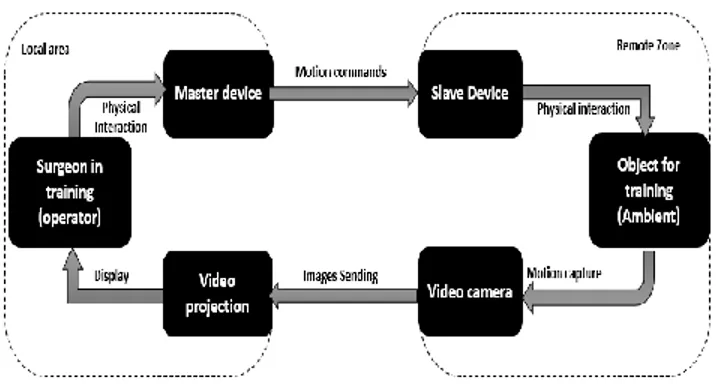
The acquisition of data is possible, due the existence of programs based on models called client-server, defining as server the one in charge of sending and storing a large amount of data located in a remote area, and the client the node capable of receive information locally [25]. For telemedicine services such as teleconsultation, focused on the evaluation and confirmation of diagnoses, there are associated specialties, such as telepsychiatry, where a basic notion in methods related to medical telematics are evidenced, as in the case of the mentioned before client-server architecture, for the implementation of both the project and the protocol, th e School of Engineering of Antioquia-CES University was involved, which took the work stations of the assistance staff that accompanies the patient as clients, and the system that allows the storage of all medical information as a server, these two parts interact each other for the purpose of providing diagnostic and control services to patients suffering from mental illnesses [26], the university proposed as alternative the implementation and interconnection of that architecture, in the National Academic Network of Advanced Technology RENATA together with a filial network called RUANA, due its high speed, with the objective of make possible the academic support among Colombian universities and research centers in developed countries [27]. In this same scenario, thanks to the client-server model, the Universidad Pontificia Bolivariana developed a robotic system, which allows the user exercise in procedures such as basic laparoscopy, obtaining interaction tools used in areas such as teletraining, which make easy the connection between two cities, Bucaramanga and Medellín, identifying first the local area, composed of students and surgeons and another to the remote area with robots, ensuring a continuous interaction between the two parts as can be seen in figure 1, where are visualized the following criteria and strategies for its development:
Visual feedback, through video with intervals of characteristic delays that allows to observe fluidly a video and ensure reliable teleoperation.
Robust and fault-tolerant communication medium, where the time it takes a packet of data to go back and forth through a channel depends on the transmissions as well as the compression and decompression algorithms obtained from the video.
3
link to communicate the master and the slave,integrating concepts such as MVC (Model-Vie w-Controller) that develops the algorithms of the Graphical User Interface [12].
Illustration 1. Block diagram of a teletraining system - Source: [Telemedicine: Teleoperated Robotic System with Application in
Laparoscopic Training: Peg Transfer Test]
On the other hand, the department of systems and computer engineering of the University of Andes (DISC), supported by Colombian dermatologists, jointly developed the Skinhealth application, composed of a client application and a server application that runs on DISC, the function of Skinhealth is based mainly on the characterization of dermatological lesions, these are evaluated from a set of predetermined parameters, the application is connected through the program hosted on the server located in the DISC in Bogotá, granting the data transfer and In turn, consulting ONTODerm, an ontology that offers a support in the dermatological concept for medical assessment, this application uses Web services hosted on an external server to the request service. Later the external Web receives the request and formulates a consultation to the ontological software, performs an exchange of information and carries out the respective storage and sending of data to a mobile device in the rural area, which provides support for the remote diagnosis of information and to the images of injuries obtained by the general practitioner. To check the efficiency of the joint ontology with the designed platform, the results inferred by the designed system were corroborated in parallel with a specialist in dermatology [19].
With the birth of new tools and the strengthening of communication networks, it was possible to connect several health centers with their peripheries, using electronic devices that can be differentiated by an identification number [25] and in turn establish a Continuous communication through the integration of software and hardware allowing him to send reliable and secure data. A specific case of distance medicine was developed by the Cardiovascular Foundation of Colombia , which houses a series of fields of study related to the area of interest, such as telemonitoring that allows the acquisition of vital data of each patient, and improves medical attention in the handling of information, by using exclusive commands of telematics found in different places, but that in general terms are a set of information that in communication networks are
called "layers", an example of this are the AT commands, involving in it, the APN (Access Point Name) connections, the types of antennas used, the respective writing modes, the IP (Internet Protocol) specifications by DHCP (Dynamic Host Configuration Protocol), with the server port and TCP connection (Transmission Control Protocol) [11].
Nowadays, the possibility of communicating two completely independent systems is known as interoperability, thanks to this a connection is achieved between rural areas and urban medical centers and in turn generates an exchange of information through programmable languages such as XML case, which provides and facilitates the use of standards such as HL7, providing a continuous transmission and reception of clinical data by means of telediagnosis, responsible for facilitating communication between physicians and patient -specialist; To define the structure of the system, a series of criteria that define a general diagnosis, defined in section 2 and 3 of the article, must be taken into account. [28].
Having a preceding knowledge of this set of criteria, some institutions have developed an architecture that allows the system to guarantee management processes by describing the following elements :
Logical view: Shows the functionality and division present in the application with its different subsystems and modules. This in turn has the following components :
o Point of reference: Necessary in the patient's analysis.
o Reference Point: It is where the specialist is located.
o Servers: They are in charge of saving the patient's clinical data.
o Network HL7: It is a protocol that defines the "transactions" between different components, so that two different systems can communicate.
Physical view: Shows the development between devices, which make up the solution including both hardware and software [28].
4
In the course of the years countless studies have beengenerated focused on different areas that cover the study of interest and that are observed in a summarized way as follows:
o The applications of pediatrics and morphological alterations involving telematics have been studied by the Cardiovascular Foundation of Colombia , pediatrics techniques such as extracorporeal membrane oxygenation (ECMO) have been examined, counting on a rescue process for critically ill children with cardiopulmonary collapse, the foundation analyzed the possibility of implementin g continuous medical assistance by telemedicine, to produce interventions in pediatric ECMO programs, by delivering diagnostic and therapeutic treatments with the aim of increasing hospital survival and improving the delivery of medical interventions [29 ]. For the second application, an equipment capable of continuously monitoring was designed, aspects such as morphological alterations from an electrocardiographic record that can be performed anywhere in the country without the need of an immediate transfer to a medical center. [30].
o The creation of technology platforms such as the Galénica telehealth system built by the Sinergy Colombia company has facilitated an online backup of the storage and transmission of the neurological data provided in the patient's medical record. The system is connected to a data center located in Bogotá, making communication through Skype software, which allows videoconferences between specialists and patients, including the use of digital tools such as web cameras, which generate the neurological images of each user with respective symptoms of epilepsy, where a synchronous follow-up is carried out by the specialist, with the analysis made by the general practitioner; Another reference of study that allowed the evaluation of the neurological system at distance, was the design and distribution of an electronic survey to the users, analyzing the acceptance and satisfaction of the telemedicine platform [31].
o In the physiotherapeutic field, a remote clinical care system has been developed in the city of Cali for the evaluation of processes in the teleoperated rehabilitation care for patients with mild knee injuries through telecare service, in this way reference was made to the visual section that guides the patient and aims to be a fundamental support for the specialist, in this case the facilities were adapted in a rural center that receives and assists the users who performed the therapies defined by the specialist, allowing the process of rehabilitation from an urban area [32].
Thanks to the integration of some universities, telerehabilitation and telephysiotherapy have also
been worked, which provide interactive long-distance therapy services for patients with motor disorders of the upper limb allowing the capture of the movement through a biomechanical analysis of different parts of the body, by means of the following modules [33] [10]:
o Module 1: Motion capture system, made up of different sensors (inertial, gyroscopic and magnetometers) and devices that comply with the IEEE 802.15.4 standard for a correct vision of the system.
o Module 2: Obtain a capture of information through the Kalman filter to generate the calculation of the angular position of upper limbs that are simulated in the virtual platform.
o Module 3: The electronic medical record (IT Application), saves and consults the basic information of the patient, then propose a medical plan and the subsequent therapy to be performed; it will be installed in the computer where the patient is located (client application).
o Module 4: It is a computer application that facilitates the registration and progress of information about the progress of the therapies recommended by the doctor to see if it is necessary or not its continuation; This is installed on the server of the rehabilitation center (server application).
o Module 5: The active module of integrated video games, consists of different physical rehabilitation games recommended by the specialist (applications developed in C \ #).
For teleoptometry, there are a variety of applications that allow the assessment of different eye conditions, giving the possibility of focusing this area in visual diseases starting from the capture and monitoring images related to diabetes and diabetic retinopathy, in order to provide opportune treatments by means of said images taken from any institution of optometric evaluation in a synchronous way, later they are evaluated by the specialists. An academic center that has studied this area is the University of La Salle with support from the University of California, achieved to link the sending of images from any corner of Colombia, from the creation of a mobile application that allows its transmission between these two medical entities [16]. Similarly, pilot tests have been carried out in cities such as Pereira, in which a model of health care focused on teleophthalmology was structured, which allowed the early diagnosis of diseases such as prediabetes for timely detection of retinopathy. [34].
5
together with the company BIOSYS LTDA, chosetelemicroscopy techniques using adapted cameras to the microscope, enabling the creation of panoramic images obtained by cell phones, with which, from telepathology, proceeded to review the necessary transmission rates in the communications networks of rural areas, which established a study for the exchange of suitable information, granting the pathologist, a visualization in different scales of the obtained results. These results depend on the loading speeds that the country can provide and a consistent time, with which the specialist can sustain a consistent analysis of the response acquired. [17]. The use of the HL7 platform has also been used by the National University of Colombia, which has worked in several branches of telematic systems focused on medicine, an example of this is the teleradiology, through certain platforms, allows to administer digitally the clinical information , following the aforementioned international standard HL7, administering any digital format of visual information (digital videos and images, Videoconferences) that benefits students, general practitioners and specialists [35]. Another work advanced by this institution was carried out by the Faculty of Medicine in collaboration with the RENATA network, by constructing a bank of digital images, with previously selected high resolution, taking into account the semantic terms with which a development in the area of telepathology in the search of those benign and malignant cervical diseases, with which the histological annotations of the images were explored through the digital application Notebook and that together serve as a tool of virtual education for undergraduate and graduate students. postgraduate, as for pathologists [18]. Finally, the study advanced by the Department of Diagnostic Imaging of this University is highlighted by proposing the development of a system that will automatically control a conventional optical microscope for various telepathology applications, such as the detection of cervical cancer, considering three stages:
o First stage: Construction of a system capable of controlling the movements of the microscope, with which the pathologist has a free navigation on the sample that wants to analyze.
o Second stage: Development of a remote system that has the ability to be controlled by internet.
o Third stage: Exploration of super-resolution technique of images in a specific pathology [36].
A pilot system related to teleradiology was carried out in Medellin from a remote access software that enabled a remote communication and interpretation
of biomedical images through the DICOM format [37].
In the cardiovascular area, institutions that address health knowledge, such as the Colombian School of Engineering, have developed a platform for the continuous processing and monitoring of the cardiac signals of a high number of users suffering from a pathology associated with the heart. possible by an alternative software architecture to the multi-threaded application model, guaranteeing an immedia t e response for multiple users, boosting progress in areas such as telemetry and mobile health, it should be noted that this application is flexible to changes and additions generated in its components, which allows new processing algorithms to be easily annexed for future use, both experimentally and academically, however, the project's authors detected two important problems that are:
o Problem 1: A high computational cost is needed, due to the necessary calculations carried out by the electronic filters implemented.
o Problem 2: As there is a large number of concurrent users, continuous support must be given to hundreds of clients who send their data constantly.
Due the above factors, the project proposed an analysis for non-blocking input / output models managed by events, where the open source tool Apache Jmete was used, as an electronic device that detected cardiac signals, discretized and It was sent to the patient's mobile device via Bluetooth, and then processed and transmitted to the application server, once the information is on the platform, the corresponding analysis was carried out by means of the respective filters to reconstruct the signal obtained [38].
A relatively new field is teleodontology, a combination of communication technologies with dental care, this has reduced the cost and the degree of physical, economic and social difficulty benefiting the different populations that attend this type of specialized consultations; There are dental programs at a national level in cities such as Villavicenc io , Pasto, Bogota and Medellin that directly involve the Cooperative University of Colombia for the development of a tele-information system, carried out jointly between the headquarters of this institution, where work has been carried out in the design, validation and start-up for the patients of these cities. The development of the project was developed in four stages:
o Study of the related works in the research areas such as telemedicine and odontology.
6
o Design of validation instruments for the patient’s platform in the different cities, for a later study carried out by the professionals.
o Platform implementation and validation with professionals and patients .
The system seen in a general way, implementing the 4 phases, generates an architecture like the one shown in figure 3 where the specialist doctor can perform the diagnosis and follow-up of patients, to manage, visualize the information of promotion and prevention [9].
Illustration 3Architecture of the system in teleodontology. Source: [Information system in teleodontology for promotion, prevention,
diagnosis and treatment of dental caries].
However, it should be taken into account that Colombia n health centers do not have a private communication system that offers their patients guarantees in the quality of services such as data exchange, used for sensitive traffic as required in the telemedicine, this can be appreciated when using public networks or the internet, when exchanging information and providing services of special treatment and transmission with another hospital point, generating possible degradation caused for the communication channel used; a case where this type of problem occurs, is observed in the home hospitalization, which despite allowing an interactivity and immediate attention 24 hours, does not ensure compliance with the requirements of Quality of Service (QoS) and at wors t of the cases produces a total loss of information that can be fatal to the patient [39].
Taking into account the above, it is important to observe some attributes about the quality of the software oriented to telemedicine, since its legal regulations in force in Colombia give some guidelines to provide an appropriate service, making possible the use of computational and electronic tools in a continuous manner , however, the regulations do not include technical details in the protection of information, therefore, a
free interpretation is given to the parameters that follow the appropriate process around this telemedicine service [40]. For this reason, the University Militar Nueva Granada analyzed the issues of computer security including the procedures of t he services and their security requirements on a telemedicin e network, examining the foreign regulations, as well as the requirements established by CALDICOTT, HIPAA and COBIT. [41], Below is a diagram illustrating the main criteria :
Illustration 4. Vulnerabilities in Telemedicine Networks - Source: [Analysis of security for the management of
medical information in telemedicine]
In this sense, article [39] presents a strategy based on Queue Management (AQM) that seeks to meet the demands of delay and packet loss of specific information. This idea has been developed to solve the congestion problems formed by the constant growth of the networks, in a timely manner, it has focused on offering congestion control resources to the TCP protocol, with the aim of reducing the delay and the rate of package losses (PLR).
III. TELECOMMUNICATIONS IN TELEMEDICINE: THE OPPORTUNITY TO INTERCONNECT PLACES
AT DISTANCE
7
Next, some related studies of telecommunications withmedicine carried out in the country will be exposed, observing the texts generated to date.
The Cardiovascular Dynamics Group of the Universidad Pontificia Bolivariana of Medellín, developed the architecture of a system for autonomous wireless monitoring of t he patient's vital signs, through personalized protocols based on standards such as 802.15.4 (ZigBee) and 802.11n (WIFI). Through a hardware and software platform, a constant, non-invasive and ambulatory monitoring was carried out using local devices, clinical records in web browsers and mobile devices to provide the corresponding medical readings that were generated, by means of wearables, which allow Wireless Body Sensor Network (WBSN) application programming for a model that accepts fast, efficient and reliable processing of body signals [45].
Santo Tomás de Aquino University has generated the design of MPLS connectivity in family welfare telemedicine, for this, a multi-protocol label switching network (MPLS) is operating, which provides telemedicine services directed by specialized health personnel with the order to reach the most difficult places in the country (Puerto escondido, San Francisco, Tumaco, Dibulla, Uribía). MPLS services allow secure and reliable transmission of information that integrates multiple applications such as voice, video, data and Internet into a single network, guaranteeing good availability, reliability and performance for demanding Business to Business applications, using the parameters of Quality of Service (QoS).
To obtain a good performance of the system, the document considered:
Inquire demanded in the communication : Simultaneous video and speed flows are taken into account, since being dependent on said demand, it will be necessary to use the H.261 standards (64 Kb / s to 1.92Mb / s), H.263 ( 15 Kb / s at 34 Kb / s) or MPEG-1 (1.2 - 2 Mb / s) and in its respective compression the MPEG-1 or MPEG-2 8 3 - 15 Mb / s formats are required, in addition, it must be take into account the latency and jitter that have arisen, which in this way can be minimized avoiding the direct impact on the due process of the teleconsultation with the remote diagnosis .
Audio: Like video, telemedicine systems require two or three simultaneous audio streams. Two low-speed teleconferencing and one high-speed audio-diagnostic.
Images: Images are generally transmitted in one direction and had a large volume (10-256 Mbyte / transfer), therefore, the transfer can be dynamically enabled and disabled, according to their bandwidth . Medical records: These records are mainly
transmitted unidirectionally, so latency and jitter are not critical.
Transmission medium: Optical fiber is a data transmission medium that uses light carriers to
transmit the respective information, there are two main optical fibers:
o Fiber mono mode: Its main characteristic is based on the diameter of its core, since being so small only allows the propagation of a single mode, propagated directly and without reflection.
o Fiber Multi Mode: Unlike fiber mono mode, this fiber can guide several modes, each of these will follow different paths [46].
In the Northern University, a study of the different characteristics of each existing wireless technology for the use of telemedicine in rural areas was carried out, considering that in a distance medicine network some minimum transmission requirement must be met, such as they are 64 kbps for static images of low resolution, 384 kbps for static images of medium resolution and 1.54 Mbps for static images of high resolution. In the study carried out by th is institution, Bluetooth technology was discarded, due to the fact that this technology is used in personal area networks and for this reason has low coverage range and low bandwidth.
Next, the wireless technologies analyzed will be shown :
WIFI (Wireless Fidelity): used in Internet access, covers a large number of standards for wireless communication networks based on IEEE 802.11 specifications, has a wireless access point (access point) that transmits and receives data through Radio waves and remote equipment that have a transceiver on an access card. It is a scalable and easy to install platform, however, it does not guarantee quality of service (QoS) nor provides greater security to the information that is transmitted.
WiMAX (Worldwide Interoperability for Microwave Access): is a wireless technology designed for a metropolitan area network that covers 50 km per cell and transmission rates of up to 70 Mbps, using portable technology LMDS (Local Multipoint Distribution Service). With it, 802.11 technologies are improved to the extent that it can cover large geographic areas with sufficient quality of service to transmit video applications that are very important in telemedicine. However, the fact of transmitting in a licensed band, conditions its use to an internet service provider; similarly, as medical information traffic travels over the Internet, it becomes more insecure and less reliable.
8
quality of service, a factor that could affect themedical diagnosis.
Wireless mesh networks (Wireless Mesh Networks): Mesh wireless networks, or wireless mesh networks, consist of a point-to-point topology that transmits information through multiple jumps, where the participating nodes communicate through redundant connections, cooperating with each other to send and receive information. One of its main advantages is the ability to dynamically configure wireless links and establish new network topologies at the same time, so that, in the event of failures, links can be automatically recovered and traffic can be balanced. This type of networks offers qualities of quality of service, security and robustness, in a platform that is easy to implement, such as a WIFI network, which does not include these features .
With reference to the preliminary topic, it was concluded in the study that mesh network technology combines the main qualities to address the problem of coverage in rural areas, in addition to not working in a licensed frequency band, makes it suitable for the required solution [47]. The University of Córdoba carried out a research work for the development of a telemedicine system based on web RTC for consultations, diagnosis and prevention of diseases in cattle as a tool in practice for students of veterinary medicine and zootechnics of the institution, It should be noted that the practices of these programs are carried in the open field visiting farms surrounding the university field with a tutor in charge of 32 students of the last grade, it is at this precise moment where telemedicine plays an important role, since it becomes in a help tool for its structure consisting of diagnosis, consultation and prevention of the patient, in this case animal, generating a clinical history and allowing a constant help from a tu tor in permanent learning through the information obtained from ICA and FEDEGAN , regarding the diseases that the bovine presents [48].
The National Government through the Ministry of Information Technology and Communications MINTIC developed a plan known as "Live Digital", which seeks to promote the use of internet in the country for a large population, the idea was to guarantee all regions, equal opportunities in access to the universe of information, this is achieved through the deployment of a telecommunications infrastructure that guarantees citizens, companies and public institutions, access to the applications and services available worldwide through Broadband Internet connections, as well as the transport of information to any point of the national territory, it is important to consider that a broadband network provides access to the internet, data transmission, as well as bringing the population closer to music, videos, television channels, cameras located in different points of certain cities, etc..
Telecommunications systems are set up by:
Transport network: It is the infrastructure, the way of transmission and necessary equipment to transport telecommunications signals. This network consists of links that link several areas of the same city and mainly uses three kinds of means of transport:
o Fiber optic: They are characterized mainly by a high initial cost, extreme ly high capacity, high performance, immunity to RF interference and flexibility of applications. Can be classified by their use in:
Dark Fiber: It is the optical fiber that for the moment is not being occupied.
Illuminated Fiber: It is the optical fiber that is connected to equipment and is the one that is offered as a service.
o Satellite links: They have a high cost of capital investment, however, the introduction of bands like the Ka, has allowed to reduce prices compared to the technologies that use the C band. Additionally, its main advantage is a low-cost access for remote communities, additionally there are low traffic demands, however, the reliabilit y of these systems can be compromised by various environmental phenomena.
o Microwave links: In terms of capacity and cost, microwave systems are at midpoint between satellite systems and fiber, both for the initial capital and for growth needs since the costs are linked to the design of the radio link. This design determines the height of the towers that are required to achieve reliable communications in any weather condition, which also affects long-term operating costs in terms of potency (energy) to power remote sites .
Access network: Consists in the infrastructure, telecommunications equipment and access means necessaries to connect the terminals of the users with the network. This network has a range of a few kilometers that is usually within a city or municipality, mainly using one of the following technologies :
o ADSL
o DOCSIS
o WiMAX
o UMTS
o HSPA
o LTE VSAT
9
From the above, the MINTIC considered that the infrastructuremust be supported by fiber optic networks because it is an adequate, robust and dynamic technology to guarantee such connectivity. It is for this reason that within the framework of the "Plan Vive Digital", the aforementioned Ministry has implemented the development of the National Fiber Optic Project (PNFO) in order to extend a network through the national territory to interconnect 1078 municipalities . The expansion, coverage and commercialization of telecommunications services (broadband Internet, televis ion, telephony, and others) in each of the municipalities will be responsibility of both the provider that executes the project, and the network providers of telecommunications interested in the provision of these services [49].
IV. TIME LINE OF TELEMEDICINE IN COLOMBIA
Finally, other important details are shown, such as the regulations generated in telemedicine, history, evolution and current advances, which have been taken in Colombia in the following table:
Year 1986 - Begun the implement of telemedicine techniques in Colombia [50]. End of the 90 - Two important experiences were
developed in the country:
o The telemedicine center of the National University of Colombia.
o Development offered by the
Cardiovascular University of Bucaramanga [51].
Year 2006 - Resolution number 1448 - Conditions are defined for habilitation of institutions that provide health services under the modality of Telemedicine [52].
Year 2007 - Resolution number 3763 - Resolutions 1043, 1448 of 2006, Resolution 2680 of 2007 are modified partially, other dispositions are dictated, adjustments are indicated, to perform in some of health service habilitation standards under the modality of Telemedicin e [53].
Year 2007 - Law 1122 - Some modifications are made in the General System of Social Security in Health and other dispositions are dictated, mentioned in Paragraph 2 of article 26 the promotion of Telemedicine services by the Nation and territorial entities [54].
Year 2007 - Agreement 357- The criteria for distributing the resources in the subaccount of the Catastrophic Events and Traffic Accidents, ECAT, assigned for the strengthening of the National Emergency Network in the 2007 period, are approved in article 2. distribution criteria where 80 % for the provision of medica l equipment for services that include Telemedicin e [55].
Year 2009 - Law 1341 - Principles and concepts are defined on the information society and the organization of Information and Communicatio n Technologies (ICT), the National Spectrum Agency is created and other provisions are dictated [56].
Year 2009 - Telemedicine protocol for psychiatric consultation - At the CES University of Antioquia the architecture of a protocol for psychiatric teleconsultation and the implementation of a web application was proposed, with the purpose of providing diagnosis and control services to patients with incidences of mental diseases [26].
Year 2010 - Law 1419 - The guidelines for the development of Telehealth in Colombia are established, in addition, article 2 defines the concepts of telehealth, telemedicine and tele-education in health [57].
Year 2010 - Cardiac, Respiratory and Oximetric Telemonitoring through a Web Application using JSP - The Universidad del Norte presented a development of Java applications for the acquisition and management of data on vital signs (blood pressure, heart rate and respiration and saturation in blood oxygen) of a patient, which was displayed on a computer and sent over the internet [58].
Year 2010 - ECG Monitoring System Based on ARM9 and Mobile Phone Technologies - The Catholic University of Colombia proposed the development of an ECG monitoring system for clinical and non-clinical environments, the archetype performs the tasks of detection and realization of alarms for tachycardia, bradycardia, acute myocardial infarction and ventricular fibrillation [59].
Year 2011 - MediCom: Telemedicine Tool for the Analysis of Shared Images and Information - The Javeriana University presented the development of a prototype of MediCom telemedicine tool, with the purpose of improving the communication and interaction between the medicine specialists for the correct diagnosis of diseases, applying the DICOM standard for the handling of data and medical information [60].
Year 2011 - Creation of a collection of images of pathology of the cervix for the RENATA network - At the National University of Colombia, a bank of benign and malignant cervical pathology images was built, makin g notes that will highlight the determining histological aspects for the diagnosis pathological [18].
10
telemedicine - The Universidad Militar NuevaGranada conducted a study on the subject of computer security over a telemedicine network, including analysis of the mos t characteristic procedures with the respective requirements used [26].
Year 2011 - Law 1438 - By means of which the General System of Social Security in Health is reformed and other dispositions are dictated, in which it defines in the article 64 the regulation for the qualification of the integrated networks of health services with the criteria for the coordination of electronic communicatio n schemes, telemedicine services, assistance and home care [61].
Year 2013 - Telemedicine Platform for Follow-up of Diabetic Retinopathy - The University of La Salle together with the Research and Vision Center developed a computational model for the follow-up of diabetic retinopathy, which allows the communication of the optometrists with the specialists, with the desire to be a backup in the diagnosis and a source of data that provides a repository that could be accessible in real time and from anywhere [62]. Year 2013 - Resolution 5521 - The Compulsory
Health Plan (POS) is defined, clarified and updated, the telemedicine modality is included in article 13 [63].
Year 2013 - Implementation of an Andr oi d based teleoperation application for Controlling to KUKA-KR6 robot by using fusion sensor - The Universidad Pontificia Bolivariana based in Medellin created an Android application based on teleoperation to control a robotic arm KUKA KR6 [4].
Year 2013 - Biomechanical Motion Captur e Methods Focused On telephysiotherapy - The Pedagogical and Technological University of Colombia, presented the architecture of a system framed in the telephysiotherapy for the generation of capture methods for people with motor disorders of the upper limb [10].
Year 2013 - A wireless body sensor networ k platform to measure vital signs in clinical monitoring - The Universidad Pontificia Bolivariana in Medellín presented a systematic architecture of autonomous wireless monitoring for vital signs with nodes fed by means of batteries and medical sensors that allowed to transmit signals for the determination of the oxygenation, heart rate, respiratory and temperature at central time in a central monitoring station that integrates a touch screen with graphic interface and mini-OLED screens. Year 2014 - Informati on system in
teleodontology for promotion, preventi on,
diagnosis and treatment of dental caries - The Cooperative University of Colombia developed an information system in teleodontology for the promotion, prevention, diagnosis and treatment of dental caries [9]
Year 2014 - Study and development of a telemicroscopy technique applicable in rural areas of Colombia - At the Universidad Industrial de Santander (UIS) an algorithm was developed that, using a camera adapted to the microscope, allowed the creation of panoramic images of cell samples, to send them asynchronously through a communications network [17].
Year 2014 - Pattern classification of brai n tissues for navigation in telemedicine systems - In the Colombian School of Industrial Careers ECCI showed a model of multiple classification of brain tissue in a stage of simulation of magnetic resonance (MRI), the objective of the institution was to improve the quantification of brain pathologies and the planning of neurosurgery [65].
Year 2015 - Development of a vital telemonitoring system using reconfigurabl e hardware - The cardiovascular foundation of Colombia exposed the process of characterization of an electronic system responsible for generating remote monitoring by sending physiological parameter data using mobile networks and Web visualization through Internet [11].
Year 2015 - M-Health system backe nd supported by an actor’s model - The Colombian School of Engineering presents the development of a platform for remote and real-time processing of cardiac signals [38].
Year 2015 - Towards a Robotic Exoskeleton for Remote Evaluati on of Elbow and Wrist Joints - The Antonio Nariño University bioengineering group presented a system based on a robotic exoskeleton for the remote evaluation of elbow and wrist joints, by which measurements of joint angle and interaction strength [66].
Year 2015 - Satisfaction of the neurologist and patients diagnosed with epilepsy in a follow -up consultation through synchronous telemedicine at the Hospital San José de Arjona (Bolívar), 2014-2015 - An assessment was made on the neurologist's and patients diagnosed with epilepsy in a follow up consultation through synchronous telemedicine [31].
11
Medellin generated the implementation of amobile application called Asimov under the Android operating system for the automated control of an industrial robotic arm KUKA KR6 through connection WIFI, for robotic teleoperation [67].
Year 2015 - Development of a prototype arduinomobile in area of telemedicine for remote monitoring of diabetic people- The American University located in Barranquilla developed with Arduino a mobile prototype for the remote monitoring of diabetic people [68]. Year 2016 - Clinical validation study of the
SignCare Vital Signs Monitor of Cardiovascular Foundati on of Colombia - The Cardiovascular Foundation of Colombia generated a clinical validation study of the SignCare telemedicine tool, which is a monitor of vital signs [30].
Year 2016 - Proposal of a mobile applicati on GoDoc for the improveme nt of the opportuni ty in the provision of medical emergency service in Bogotá-Colombia - It is a master's work carried out at the International University of La Rioja that proposed the proposal of a mobile application for the improvement of the quality of the medical emergency service, providing users with the location of the sites, in the same way allowing the possibility of reserving quotas for the arrival time and contributing to the monitoring of termina l patients [69].
Year 2016 - Design of an Architecture for Telemedicine Applications in IoT- At the Francisco José de Caldas District University, the design of an architecture for telemedicin e applications in IOT was carried out, managing the information obtained from a generated device that obtains the vital signs and capture for the analysis of telemedicine applications [70]. Year 2016 - Compression of video in
telepathology using compressing sensing - In the National University a work was carried out that explored several techniques and tools for the creation of a viable telepathology platform, starting with a solution in the free navigation of the pathologist on the sample, which was built by means of a system trained in the control of the movement of the microscope from a remote site using the internet, to then perform an exploration with a technique of super-resolution of images of a predetermined pathology [36].
Year 2016 - Remote Monitoring System of vital signs for triage and detection of anomalous patient states in the emergency room - The University of Barranquilla developed a system of remote monitoring of vital signs for
the triage and the detection of anomalous states of the patient in the emergency room [71]. Year 2016 -e-Health Prototype System for
Cardiac Telemonitoring -The Universidad Pontificia Bolivariana in Bucaramanga developed a prototype e-health system for cardiac telemonitoring [72].
Year 2016 -Teleoperated Robotic System with Application in Laparoscopic Training: Peg Transfer Test - The Universidad Pontificia Bolivariana in Bucaramanga presented a teleoperated telerobotic system with application in laparoscopic training that is also intended for training in telesurgery [12].
Year 2016 - Queue Occupation - Based RED with Adapti ve Control for Telemedicine Traffic - In this project led by the University of Antioquia a new access control scheme was proposed based on the occupation of the queue and the definition of traffic classes [39].
Year 2017 - Development of an informati on system for teleoperated physical rehab care service via Internet. Pilot case: patients with mild knee injury who live in geographicall y vulnerable zones - Universidad del Valle developed an information system for the teleoperation service of physical rehabilitation, via internet, where patients with mild knee injuries who live in geographical vulnerability areas [32].
Year 2017 - UDC Telemedicine System: A ne w paradigm in Colombian medical care for the south of Bolivar- In the Technical University of Manabí, the pilot project of the Udc Telemedicine System developed by the University of Cartagena was studied and disseminated. the Progreso and Health Foundation of the Caribbean, which validated that the tools of information technology and communication implemented in health allowed to overcome geographical barriers and facilitate the medical work of the specialist in rural areas [73].
Year 2017 - Design of a measurement tool in Arduino-Ras pberry PI technology - In the American University Corporation, a technological tool was designed to measure the levels of auditory contamination in closed spaces, considering the decibel levels defined by the WHO [74].
12
Year 2018 -Opening of second and third levelservices in "nueva salud integral" IPS SAS municipality of San José del Guaviare, unde r the modality of telemedicine for the provisi on of services of specialties and subspecialties - In the department of Guaviare was developed a model of benefit of services, of specialty and subspecialty under the modality of telemedicin e as a remitting entity (Nueva Salud Integral IPS), which allows improving access and availabilit y of services [76].
Year 2018 - Proposal for the installation of a telehealth and telemedicine laboratory - At the Francisco José de Caldas District University, a proposal was generated for a telehealth and telemedicine laboratory assembly in Colombia [77].
V. TELEMÉDICINE NUMB ERS IN COLOMBIA
The headquarters of reference center services located in Colombia (figure 5) are mostly private entities :
Figure 5: Location of Reference Center Services -Source: [Ministry of Health and Social Protection - DPSAP -
REPS]
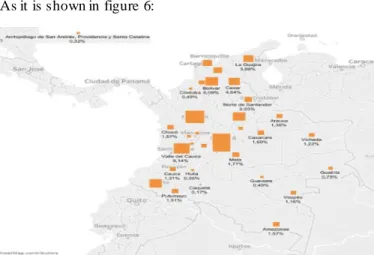
Significant participation was observed around telemedicin e projects in:
Antioquia with 13,32\% Bogotá with 11,02\% Valle del Cauca with 9,14\% Santander with 5,95\%
Se pudo apreciar una escasa participación en:
Córdoba with 0,49\% Guaviare with 0,49\%
Archipelago of San Andrés, Providencia and Santa Catalina with 0,32\%
As it is shown in figure 6:
Figure 6: Participation in telemedicine services by cities -Source: [Ministry of Health and Social Protection -
DPSAP - REPS]
VI. CONCLUS IONS
- Telemedicine in Colombia is a versatile tool, which allows the provision of remote medical services, facilitating the connection between patients and doctors, to detail the clinical history, capture the necessary images for medical diagnosis and in this way, give a correct evaluation of the patient, without spend time, money or traveling long distances, to take care of his health. - The importance of medical telematics was observed, since
allows correct treatment of the information acquired from the patient, for later review of specialist, in addition to the security required for the transmission, so that it is not interfered with in the process .
- The telecommunications networks are of vital importance for a correct performance of telemedicine, since it provides the necessary technical support for a good functioning of the platform, since is the infrastructure that allows to have a good bandwidth, an excellent coverage and a network topology that suits the needs of the region .
REFERENCES
[1] F. M . de la Rubia, “Un debate abierto sobre la inexorable globalización,” Instituto Español de estudios estratégicos, Tech. Rep., 2017.
[2] L. Y. A. M artínez and P. P. P. Ruiz, “Tecnologías de la información y la comunicación (tics) en el sector salud,” 2013. [3] C. V. Núñez and C. U. V. Caballero, “Avances y retos para implementar la telemedicina y otras tecnologías de la información (tics),” vol. 30, p. 3, 2014.
13
[5] H. A. B. Jerez and S. N. P. Delgado, “Informe de gira académica,proceso de habilitación medical sky ips, modalidad de telemedicina,” 2018.
[6] E. Y. P. Castaño, L. C. Carvajal, J. J. B. García, and Y. S. P. Rengifo, “Estado actual de la telemedicina: una revisión de literatura,” p. 17,2016.
[7] R. M . Durón, N. Salavarría, H. Hesse, A. Summer, and K. Holden, “Perspectivas de la telemedicina como una alternativa para la atención en salud en honduras,” vol. 5, p. 7, 2016.
[8] M . D. S. Y. P. SOCIAL, “Estudio exploratorio de la situación de la telemedicina en municipios priorizados-Colombia,” 2016. [9] D. J. L. Cuesta, D. R. Suarez, and J. L. R. Arias, “Sistema de información en tele-odontología para promoción, prevención, diagnóstico y tratamiento de caries dental,” vol. 14, p. 7, 2014. [10] M . C. Cuervo, A. F. R. Olaya, and R. M . G. Salamanca, “Biomechanical motion capture methods focused on tele-physiotherapy.” p. 6, 2013.
[11] J. P. Pinilla, O. A. M antilla, L. A. Rodríguez, and S. Plat, “Desarrollo de un sistema de telemonitorización vital usando hardware reconfigurable,” vol. 9, p. 7, 2015.
[12] G. M . Bilgerig, J. R. M artínez, S. A., S. V. Z., Pérez, and J. J. Padilla, “Teleoperated robotic system with application in laparoscopic training: Peg transfer test,” vol. 14, p. 7, 2016. [13] M . C. M . BRAVO, “Sistema de diagnóstico remoto para centros de salud rurales del ecuador,” M aster’s thesis, PONTIFICIA UNIVERSIDAD CATOLICA DEL ECUADOR, 2017.
[14] L. T. O. M ora, “Telerehabilitación como propuesta actual de rehabilitación en pacientes con discapacidad,” p. 12, 2014.
[15] L. Ángela Rojas-Bernal, G. A. Castaño-Pérez, and D. P. R. Bernal, “Salud mental en Colombia. un análisis crítico,” p. 12, 2018. [16] L. L. A. Elizalde, J. P. D. Chaparro, J. S. G. Rocha, L. G. P. Pastrana, Y. M . V. Rodríguez, J. S. A. Gómez, and W. G. J. Barbosa, “Concepto y aplicación de la teleoptometría,” vol. 14, p. 17, 2016. [17] H. A. G. Colmenares, L. X. B. Rozo, M . F. R. Rondón, and L. M . S. Rosas, “Estudio y desarrollo de una técnica de telemicroscopía aplicable en las zonas rurales de Colombia,” vol. 13, p. 11, 2014. [18] M . del Pilar Suarez Ramos, “Creación de una colección de imágenes de patología del cuello uterino para la red renata,” 2011. [19] J. P. Sáenz, M . P. Novoa, D. Correal, and B. R. Eapen, “On using a mobile application to support teledermatology: A case study in an underprivileged area in Colombia,” 2018.
[20] W. D. C. R. Díaz and L. D. A. Carballido, “Pasado, presente y futuro de la teleodontología: un nuevo reto,” p. 9, 2014.
[21] C. Barrera-Valencia, A. V. B. Devia, C. Vélez-Álvarez, M . F. Barrera, and S. M . F. Idárraga, “Costo-efectividad de tele psiquiatría sincrónica frente a asincrónica para personas con depresión privadas de la libertad,” p. 9, 2016.
[22] L. G. N. Trigos, “Consideraciones metodológicas y de diseño para las especialidades de telemedicina en el hospital de tauramena,” vol. 1, p. 6, 2015.
[23] F. de M edicina Universidad Nacional, “Panorama de la informática y telemática médicas,” Universidad Nacional de Colombia, Tech. Rep., 1997.
[24] J. V. Claudios, “Las tecnologías de la información, la medicina y la salud,” Revista Telos, Tech. Rep., 2002.
[25] J. E. O. Triviño, “Un modelo para control de dispositivos electrónicos a través de internet y su aplicación en telemedicina,” vol. 50, p. 6, 2002.
[26] N. L. Jaramillo, P. A. C. Jaramillo, D. M ontoya, and C. Ruiz, “Protocolo de telemedicina para la consulta psiquiátrica,” vol. 14, p. 3, 2009.
[27] E. A. C. M éndez, S. M . C. Díaz, C. G. Restrepo, and J. C. Puyana, “Telemedicina: historia, aplicaciones y nuevas herramientas en el aprendizaje,” vol. 52, p. 26, 2011.
[28] L. E. A. Pico and E. G. Vargas, “Tecnologías de la información para el diagnóstico a distancia,” vol. 16, p. 17, 2011.
[29] A. J. L. M agallon, L. Saenz, J. L. Gutierrez, C. X. Florez, A. D. Althouse, M . S. Sharma, A. Duran, L. Salazar, and R. M unoz, “Telemedicine in pediatric critical care: A retrospective study in an international extracorporeal membrane oxygenation program,” vol. 24, p. 8, 2018.
[30] L. A. R. Salazar, E. M . G. Delgado, S. P. Rangel, O. A. M . Prada, E. S. Caraballo, and J. D. R. Riveros, “Clinical validation study of the signcare vital signs monitor of fundaci´on cardiovascular de Colombia,” vol. 64, p. 5, 2016.
[31] N. Rodríguez, E. Palacios, J. P. Vergara, S. A. Salgado, and I. Gaona, “Satisfacción del neurólogo y de los pacientes con diagnóstico de epilepsia en una consulta de seguimiento a través de telemedicina sincrónica en el hospital san José de Arjona (Bolívar), 2014-2015,” vol. 31, p. 8, 2015.
[32] J. R. Tovar Cuevasa, J. D. D. M utisa, G. E. Q. M oraa, A. P. Romerob, and J. I. G. M eloc, “Desarrollo de un sistema de información para el servicio de atención teleoperado de rehabilitación física, vía internet. caso piloto: pacientes con lesiones leves de rodilla que viven en zonas de vulnerabilidad geográfica,” vol. 85, p. 10, 2018. [33] M . C. Cuervo, M . A. V. Guerrero, A. F. R. Olaya, and R. M. Gutierrez, “Architecture proposal for a support system to upper limb telerehabilitation by capturing biomechanical signals,” vol. 24, p. 8, 2015.
[34] D. G. Amaris, “Diseño y ejecución de un proyecto piloto que involucre la prestación de servicios teleoftalmologicos en Pereira,” 2016. 12
[35] A. J. Lozano and E. Romero, “Telemedicina y telerradiología. La experiencia en la universidad nacional,” vol. 2, p. 5, 2008.
[36] C. A. V. Pulido, “Compresión de video en telepatología usando compresing sensing,” 2016.
[37] A. García, J. F. Isaza, U. Zapata, and S. Roldán, “Ejecución de un sistema piloto de teleradiología en M edellín, Colombia,” vol. 37, p. 6, 2006.
[38] M . A. C. Acosta and H. F. C. Rengifo, “M -health system backend supported by an actors’ model.” p. 7, 2015.
[39] F. E. A. Berrío and N. G. Gómez, “Queue occupation - based red with adaptive control for telemedicine traffic,” p. 6, 2016.
[40] H. F. C. Rengifo, “E-health y m-health en Colombia: antecedentes, restricciones y consideraciones para el desarrollo de nuevas tecnologías basadas en software.” p. 15, 2018.
[41] E. P. G. Pinto, L. J. R. López, and E. P. E. Cuesta, “Análisis de seguridad para el manejo de la información médica en telemedicina,” vol. 21, p. 34, 2011.
[42] C. G. López, N. M . Rivera, J. I. S. Restrepo, and O. Y. R. Angulo, “Hospital digital “un reto para la implementación en hospitales de baja complejidad”,” 2012.
[43] W. G. J. Barbosa and J. S. A. Gómez, “Avances en telesalud y telemedicina: estrategia para acercar los servicios de salud a los usuarios,” vol. 1, p. 15, 2015.
[44] J. P. Tello, O. M anjarrés, M . Quijano, A. Blanco, F. Varona, and M. Manrique, “Remote monitoring system of ecg and body temperatura signals,” vol. 11, p. 1, 2013.
[45] J. J. Pérez, A. J. Saldarriaga, and J. Bustamante, “A wireless body sensor etwork platform to measure vital signs in clinical monitoring,” p. 6, 2013.
[46] C. C. VERGARA, “Diseño de conectividad mpls para telemedicina bienestar familiar,” 2015.
[47] C. V. Núñez, J. C. Peña, and C. L. Garzón, “Análisis comparativo de tecnologías inalámbricas para una solución de servicios de telemedicina,” p. 19, 2009.
14
prevención de enfermedades en los bovinos como herramienta depráctica para los estudiantes de medicina veterinaria y zootecnia de la universidad de córdoba.” 2015.
[49] C. de Regulación de Comunicaciones, “Capacidad de transmisión en las redes de fibra óptica,” Comisión de Regulación de Comunicaciones, Tech. Rep., 2014.
[50] A. F. T. Sosa, “Aplicación y evolución de la telemedicina en medellín. revisión y contextualización de la experiencia coomeva,” 2013.
[51] M . Camacho, “Telesalud en colombia,” 2016.
[52] M . D. L. P. SOCIAL, “Resolución número 1448 de 8 de mayo de 2006,” 2006.
[53] D J Cuestas, “Resolución 3763 de 2007 ministerio de la protección social resolución número 3763 de 2007 (octubre 18),” 2007.
[54] C. D. L. REPU´ BLICA, “Ley número 1122 de 2007 (enero 9),” 2007.
[55] C. N. de Seguridad Social en Salud, “Acuerdo 357 de 2007 (marzo 30) diario oficial no. 46.625 de 11 de mayo de 2007,” 2007. [56] C. D. L. REPU´ BLICA, “Ley 1341 de 2009 (julio 30),” 2009. [57] Congreso, “Ley 1419 de 2010 (diciembre 13) diario oficial no. 47.922 de 13 de diciembre,” 2010.
[58] C. Viloria-Núñez, M . Abouantoun, A. Sosa, and H. Baquero-Latorre, “Cardiac, respiratory and oxymetric telemonitoring through a web application using jsp,” 2010.
[59] E. B. Alzate and F. M . M artinez, “Ecg monitoring system based on arm9 and mobile phone technologies,” 2010.
[60] A. González, D. Osorio, and L. Flórez, “M edicom: Herramienta de telemedicina para el análisis de imágenes e información compartidas,” vol. 1, p. 6, 2011.
[61] C. D. L. REPU´ BLICA, “Ley 1438 de 2011 (enero 19),” 2011. [62] D. J. Lancheros-Cuesta, A. Tumialán, J. Giovanni, V. H. Pérez, and M . Carrizosa, “Plataforma de telemedicina para seguimiento de retinopatía diabética,” p. 6, 2011.
[63] C. D. L. REPU´ BLICA, “M inisterio de salud y p rotección social resolución número (005521) de 27 dic. 2013,” 2013.
[64] J. J. Pérez, A. J. Saldarriaga, and J. Bustamante, “A wireless body sensor network platform to measure vital signs in clinical monitoring,” 2013.
[65] M . J. S. Barón, C. A. Cifuentes, L. E. Rodriguez, and J. C. S. Barón, “Pattern classification of brain tissues for navigation in telemedicine systems,” 2014.
[66] A. F. Ruiz-Olaya, “Towards a robotic exoskeleton for remote evaluation of elbow and wrist joints,” p. 2, 2015.
[67] J. Yepes, J. Yepes, V. Pérez, M . Betancur, and J. M artınez, “Asimov: Asistente móvil para teleoperación robótica bajo la plataforma android,” 2015.
[68] Y. E. R. Julio., “Development of a prototype arduinomobile in area of telemedicin for remote monitoring diabetic people,” p. 5, 2015.
[69] Q. O. G. Andrea, “Propuesta de la aplicación móvil godoc para la mejora de la oportunidad en la prestación de servicio de urgencias médicas en bogotá-colombia,” Master’s thesis, Universidad Internacional de la Rioja, 2016.
[70] A. P. Daza, B. S. R. Daza, and O. J. Salcedo, “Design of an architecture for telemedicine applications in iot,” p . 4, 2016. [71] S. M oreno, A. Quintero, C. Ochoa, M . Bonfante, R. Villareal, and J. Pestana, “Remote monitoring system of vital signs for triage and detection of anomalous patient states in the emergency room,” p. 5, 2016.
[72] L. J. V. Escobar and S. A. Salinas, “e-health prototype system for cardiac telemonitoring,” p. 4, 2016.
[73] F. P. Herrera and F. F. Periche, “Sistema de telemedicina udc: Un nuevo paradigma en la atención médica colombiana para el sur de bolívar,” vol. 1, 2017.
[74] D. S. López, R. M . Espinosa, I. C. Gutierrez, and L. S. de Oliveira, “Diseño de una herramienta de medición de ruidos basados en tecnologías arduino-rasperry pi,” 2017.
[75] J. P. A. M ERCHA´ N, “Entremente - telemedicina para rehabilitación cognitiva,” 2018.
[76] N. L. A. Sabogal, “Apertura de servicios de segundo y tercer nivel en nueva salud integral ips sas municipio de san josé del guaviare, bajo la modalidad de telemedicina para la prestación de servicios de especialidades y subespecialidades,” 2018.