
Dynamite packaging and portable capillary electrophoresis in forensics
216
0
0
Texto completo
(2) Cover: From left to right: a picture of Goma-2 ECO dynamite, the electrophoretic separation of atropine and scopolamine in an infusion of Datura stramonium L., and a detail of a portable capillary electrophoresis.. This work is licensed under a Creative Commons Attribution 3.0 License..
(3) ACKNOWLEDGMENTS First and foremost, I would like to thank my supervisor Professor Carmen García Ruiz for giving me the chance to begin the thesis and for my initiation in the research world. Secondly, I thank Professor Peter C. Hauser for accepting me in the University of Basel to carry out fascinating works on instrument development, which have greatly contributed to this thesis. Finally, I thank all the people who have supported, guided, and helped me in some way during these years (you know who you are!)..
(4)
(5) LIST OF ABBREVIATIONS. LIST OF ABBREVIATIONS: APCI, atmospheric pressure chemical ionization; DAD, diode array detection DBP, dibutyl phthalate DNT, dinitrotoluene C4D, capacitively coupled contactless conductivity detector/detection CWA, chemical warfare agent CWC, chemical weapons convention EDEA, N-ethyldiethanolamine EGDN, ethylene glycol dinitrate or nitroglycol EGDNM, EGDN content in methanol EGDNW, EGDN content in water EIC, extracted ion chromatogram EOF, electro-osmotic flow GC, gas chromatography GC-MS, gas chromatography coupled to mass spectrometry detection HEPES, 4-(2-hydroxyethyl)-1-piperazineethanesulfonic acid HCl, hydrochloric acid HPLC, high performance liquid chromatography HPLC-DAD-MS, high performance liquid chromatography with diode-array detection and mass spectrometry detection HV, high voltage I.D., inner diameter IMS, ion mobility spectrometer LEDs, light-emitting diodes Leff, effective length LIF, laser-induced fluorescence LOD, limit of detection LOQ, limit of quantitation Ltot, total length MES, 2-(N-morpholino)ethanesulfonic acid MDEA, N-methyldiethanolamine MS, mass spectrometry NaOH, sodium hydroxide NM, nitrogen mustard NG, nitroglycerin.
(6) LIST OF ABBREVIATIONS. NIR, near infra-red PEEK, polyether ether ketone P(VP-co-DMAEMA), poly(1-vinylpyrrolidone-co-2-dimethylaminoethyl methacrylate) O. D., outer diameter RSD, relative standard deviation SI, sequential injection TEA, triethanolamine TIC, total ion chromatogram TNT, trinitrotoluene Tris, tris(hydroxymethyl)aminomethane.
(7) CONTENTS SUMMARY. 3. RESUMEN. 9. PROLOGUE. 15. SCOPE AND OUTLINE OF THIS THESIS. 21. PART ONE: Dynamite packaging. 25. I.1.. Introduction. 27. I.2.. Determination of ethylene glycol dinitrate in dynamites using HPLC: Application to the plastic explosive Goma-2 ECO. 39. I.3. Study of losses of volatile compounds from dynamites. Investigation of cross-contamination between dynamites stored in polyethylene bags. 59. I.4.. Study of the suitability of DUO plastic bags for the storage of dynamites. 85. PART TWO: Portable capillary electrophoresis. 101. II.1.. Introduction. 103. II.2.. Portable capillary electrophoresis instrument with automated injector and contactless conductivity detection. 115. II.3.. Determination of nitrogen mustard degradations products in water samples using a portable capillary electrophoresis. 141. II.4.. In situ determination of scopolamine in evidence of recreational and predatory use. 165. CONCLUSIONS AND FUTURE OUTLOOK. 191. CONCLUSIONES Y PERSPECTIVAS DE FUTURO. 199. LIST OF AUTHOR’S CONTRIBUTIONS. 207.
(8)
(9) SUMMARY.
(10)
(11) SUMMARY. Evidence storage is a serious concern in forensic laboratories. If evidential items are not properly packaged and stored, important information can be lost. Specifically, packaging for evidence with volatile compounds is a sore point, since those components tend to volatilize, to leave the evidential item, and to escape from the container. There are many types of containers for evidence with volatile compounds, and all of them have advantages and disadvantages. During the development of this thesis, two types of plastic bags have been studied in order to analyze their suitability for the storage of dynamites, which are explosives with volatile compounds such as ethylene glycol dinitrate or dinitrotoluene. Firstly, an extraction method to recover ethylene glycol dinitrate from dynamites. was. developed.. Then,. high. performance. liquid. chromatography was used for the determination of ethylene glycol dinitrate in the extract. The analytical method was developed and optimized for the separations of seven compounds that may be present in dynamites and was the method also validated. Finally, the EGDN content of a sample of the Goma-2 ECO dynamite was determined obtaining a concentration of 30.29%, which was in accordance with the manufacturer’s specifications for this dynamite (25.7% - 31.4%). The same high performance liquid chromatography but using mass spectrometry detection, which was 2 orders of magnitude more sensitive than diode array detection, was subsequently applied, together with gas chromatography analyses, in a new study on the suitability of polyethylene bags for the storage of dynamites. The results proved that those polyethylene bags were not really appropriate for the storage of dynamites since they allowed the rapid 5.
(12) SUMMARY. escape of volatile compounds as ethylene glycol dinitrate and dinitrotoluene from the bags. Moreover, it was demonstrated that the bags allowed the cross-contamination between dynamites of different compositions. In a following study, the polyethylene bags were compared to a multilayer nylon/polyethylene bag, which have been designed to show high retentiveness for volatile compounds. The ethylene glycol dinitrate released from dynamites stored in the bags was followed by gas chromatography analysis in a comparative study over eleven weeks of storage. The results showed that the new bags were much more suitable for the storage of dynamites, since only a weak signal for ethylene glycol dinitrate was detected out of the new bags after eleven weeks, instead of the first week needed to be released from the polyethylene bags. Furthermore, the use of portable analytical instrumentation has attracted attention in recent years due to its benefits. Portable analytical instrumentation allows in situ analyses, permitting the obtention of results and to make decisions directly at the place of sample collection, usually reducing the number of analyses needed, and reducing the chances of occurrence of sample degradation, alteration, misplacement or loss during its transportation and storage. A new portable capillary electrophoresis with automated injection and contactless conductivity detection was developed. The system, of about 8 kg and able to operate continuously for 9 h in the batterypowered mode, relied on pressurized air for solution delivery and a micromembrane pump for sample aspiration. The injection system 6.
(13) SUMMARY. allowed easy optimization for high separation efficiency, for fast separations, or for low limits of detection. Another portable capillary electrophoresis, allowing to deliver up to four different solutions, was also built. The system was applied to the determination of degradation products of nitrogen mustards in different water samples, taken from a well and from three different rivers. The capillary was coated to avoid analyte-wall interactions and the coating procedure was optimized to get the best repeatability of the analyte migration times. The electrophoretic method was successfully applied to the determination of nitrogen mustards degradation products in the spiked water samples, without matrix interferences. Finally, the same portable capillary electrophoresis was applied to the determination of scopolamine in different samples. Scopolamine has been commonly used in recent years for predatory and recreational uses. In fact, there are several cases in which people have died, have been raped and robbed, due to the abuse of this drug. The different evidential items analyzed were a infusion of Datura stramonium L., a spiked moisturizing cream, and six spiked beverages, since they have recently been used in different criminal actions or used with fatal consequences. An effort was made to develop easy and fast sample treatments which can be readily carried out at the place of sample collection. The developed electrophoretic method was applied to the determination of the drug in the three above-cited evidential items, without sample interferences.. 7.
(14)
(15) RESUMEN.
(16)
(17) RESUMEN. El almacenamiento de muestras es una preocupación importante en los laboratorios forenses. Si las muestras no se almacenan debidamente. puede. producirse. una. pérdida. importante. de. información de las mismas. Concretamente, el almacenamiento de muestras. con. compuestos. volátiles. es. crítico,. ya. que. esos. componentes tienden a volatilizarse, a abandonar las muestras y a escapar del contenedor. Existen muchos tipos de contenedores para muestras con compuestos volátiles y todos ellos tienen ventajas y desventajas. Durante el desarrollo de esta tesis se estudiaron dos tipos de bolsas de plástico para saber si eran apropiadas para el almacenamiento de dinamitas, que son explosivos con compuestos volátiles tales como el nitroglicol o el dinitrotolueno. Primero, se desarrolló un método para la extracción de nitroglicol de dinamitas. A continuación, se optimizó un método de cromatografía líquida de alta eficacia para la separación de siete compuestos explosivos que pueden formar parte de ciertas dinamitas. El método fue validado y se aplicó a la determinación del contenido de nitroglicol en la dinamita Goma-2 ECO, obteniendo una concentración del 30.29%, la cual concordaba con la especificada por el fabricante (25.7–31.4%). El mismo método de cromatografía liquida de alta eficacia pero con detección de espectrometría de masas, por ser dos ordenes de magnitud más sensible que la detección de matriz de diodos, se aplicó posteriormente, junto con análisis por cromatografía gaseosa, en un nuevo estudio sobre la idoneidad de bolsas de polietileno para el almacenamiento de dinamitas. Los resultaron demostraron que esas bolsas de polietileno no eran apropiadas para el almacenamiento de dinamitas ya que permitían la rápida liberación de las bolsas de 11.
(18) RESUMEN. compuestos volátiles como el nitroglicol y el dinitrotolueno. Más aún, se demostró que dichas bolsas permitían la contaminación cruzada entre dinamitas de diferentes composición. En un estudio posterior, se compararon las mismas bolsas de polietileno con otras bolsas multicapa de nylon/polietileno, diseñadas para proporcionar una mejor retención para compuestos volátiles que las bolsas de polietileno. El estudio se realizó siguiendo el nitroglicol liberado de las dinamitas almacenadas en las bolsas mediante cromatografía gaseosa. Los resultados mostraron que las nuevas bolsas eran mucho más apropiadas para el almacenamiento de dinamitas, ya que sólo se detectó una señal débil de nitroglicol fuera de las bolsas nuevas al cabo de once semanas, en lugar de en la primera semana como ocurría para las bolsas de polietileno. Por otro lado, el empleo de instrumentación analítica portátil ha atraído una gran atención en los últimos años debido a sus beneficios. La instrumentación analítica portátil permite llevar a cabo análisis in situ, permitiendo obtener resultados y tomar decisiones directamente en el lugar de la recogida de la muestra, reduciendo, normalmente, el número de muestras necesarias y reduciendo las posibilidades de que la muestra se degrade, se altere, se traspapele, o se pierda durante su transporte y almacenamiento. Se desarrolló un nuevo equipo de electroforesis capilar portátil con inyección automática y detección de conductividad sin contacto. El equipo, de alrededor de 8 kg y capaz de funcionar en modo constante durante 9 h trabajando con baterías, utilizaba gas comprimido para generar el flujo de las disoluciones y un bomba de micromembrana para la toma de muestra. El sistema de inyección se optimizó 12.
(19) RESUMEN. fácilmente para conseguir una alta eficacia separativa, separaciones rápidas o para obtener bajos límites de detección. También se construyó otro equipo de electroforesis capilar portátil, que permitía el trabajo con hasta cuatro disoluciones diferentes. El equipo se aplicó a la determinación de productos de degradación de mostazas de nitrógeno en muestras de agua diferentes, tomadas de un pozo y de tres ríos distintos. Se recubrió el capilar para evitar las interacciones entre la pared del capilar y los analitos y se optimizó el procedimiento de recubrimiento para obtener la mejor repetibilidad de los tiempos de migración. El método electroforético se aplicó con éxito a la determinación de los productos de degradación de las mostazas de nitrógeno en las muestras de agua sin interferencias de matriz. Finalmente, se usó el mismo equipo de electroforesis capilar portátil para la determinación de escopolamina en diferentes muestras. La escopolamina se ha estado usando en los últimos años con fines depredadores y recreacionales. De hecho, hay muchos casos en los que ha muerto gente, o han sido violadas o atracadas mediante el uso de esta droga. Las diferentes muestras analizadas fueron una infusión de Datura stramonium L., una crema adulterada y seis bebidas adulteradas, ya que estas muestras se han utilizado recientemente en distintos actos criminales o utilizado con consecuencias fatales. Se hizo un esfuerzo en desarrollar tratamientos de muestra rápidos y sencillos que pudieran llevarse a cabo en el lugar de recogida de muestra. El método electroforético desarrollado permitió determinar la droga en las muestras analizadas sin interferentes debidas a las muestras. 13.
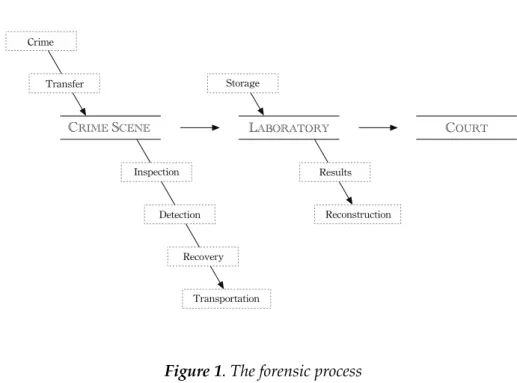
(20)
(21) PROLOGUE.
(22)
(23) PROLOGUE. The aim of this prologue is to contextualize this dissertation in the forensic field. The problems raised and the work carried out during the preparation of this thesis cannot be discussed without talking over some concepts such as forensic science, forensic evidence, and forensic process. According to the Oxford Dictionary, the term forensic “relates to or denotes the application of scientific methods and techniques to the investigation of crime”. Therefore, in accordance with this definition, forensic science (often shortened to forensics) may be defined as the application of basic sciences in the resolution of legal disputes. It is a multidisciplinary subject, which draws upon a variety of scientific principles, including biology, physics, chemistry, geology, psychology, social science, etc. Forensic science plays a pivotal role in most criminal prosecutions, especially those of a more serious nature. Any forensic case follows a process that could be called forensic process. The term forensic process has been recently introduced by Pierre Margot as a process that encompasses many stages from the initial investigation of a crime scene to the presentation of expert witness testimony in court. It requires trace detection of evidence, which must be analyzed and interpreted and, finally, present the results in court. In fact, a forensic process can be long and complicated, depending on the aspects of the case to be investigated. In this thesis, the forensic process has been interpreted according to the different places where a forensic process is developed. As Figure 1 illustrates, the forensic process always begins at the crime scene, progresses in the laboratory, and ends in court. 17.
(24) PROLOGUE. CRIME SCENE. LABORATORY. COURT. Figure 1. The forensic process. 1. The crime scene When a crime occurs, a crime scene is created. A crime scene is the location where the crime took place. It is also the location where trace evidence of the crime may be found. Both places can be the same or different locations. Evidence is every fact, testimony, document, or object that can prove or disprove something. In the case of forensics, a criminal fact is what is intended to be proved or disproved. Locard’s exchange principle holds that whenever two entities (be they people or objects) are in contact, there is a transfer of material between them. In other words: every contact leaves a trace. According to this principle, the perpetrator of a crime will bring something into the crime scene and take something from it, creating one or more crime scenes. The. 18.
(25) PROLOGUE. material moved from or brought to the crime scene constitute the trace evidence of the crime. The forensic investigators will move to the crime scene and will inspect it in search of evidence. When an evidential item is detected it must be properly recovered and then separately and appropriately packaged and labelled. The investigators in charge of the inspection of the crime scene must be highly trained operators. They cannot overlook any evidence and must know how to recover and package them in order to preserve their identities and avoid loss of information. At this point in time, the establishment of chain of custody is extremely important. It ensures a continuity of evidence from the point of its recovery through to its appearance in court. If continuity of an evidential item cannot be demonstrated, then the evidence may be deemed inadmissible in court because of the possibility of any alteration. Once recovered, packaged, and labelled for the chain of custody, evidence is transported to the next scenario in the progression of the forensic process.. 2. The laboratory In the laboratory, evidential items of potential forensic importance are subjected to forensic examination. However, the analysis might not occur immediately after the sample is delivered in the laboratory. Instead, it may be necessary to store the evidence until analysis. When the evidence is examined and analyzed, the investigators must interpret the result by answering the following questions: 19.
(26) PROLOGUE. - where does this trace come from? - why is the trace where it is? - how might it relate to a proposed crime scenario? The answers to these questions will reveal the identity of the evidential item and the mechanism of its appearance at the crime scene. These knowledges will help the investigators to reconstruct the events occurred at the crime scene.. 3. The court The forensic process comes to the end and the forensic investigator is, after all, required to transfer all the information obtained from the investigated case in an objective and readily understandable way to the final receiver: the court. The forensic investigator will present a report, in which his or her findings will be written up. Eventually, the forensic investigator will be required to give testimony of fact and of opinion about the case.. 20.
(27) SCOPE AND OUTLINE OF THIS THESIS.
(28)
(29) SCOPE AND OUTLINE OF THIS THESIS. Nowadays, evidence preservation is a big concern in the forensic laboratories. Forensic investigators and researchers have devised specific devices for packaging of evidence, new protocols for evidence management, and stricter safety measures in the laboratories. However, forensic cases are still being dismissed because evidential items are deemed inadmissible in court due to the possibility of evidence alteration or contamination. For this reason, researchers have put in practice a number of lines of investigation on the study of the suitability of packaging for evidence. On the other side, the employment of portable analytical instrumentation is having a growing interest since no storage is needed. In fact, many portable analytical instruments have been devised and commercialized in the recent years due to the advantageous features of in situ analysis. The works described in the present thesis approach to both the problem of loss of information during storage and the recent tendency to use portable analytical instrumentation for in situ analysis. As consequence, the thesis is divided into two main parts, as follows: - The first part of the thesis will introduce the reader to the loss of information that evidence may suffer throughout its storage and to the different packaging for evidence. A particular emphasis will be placed on the packaging for forensic evidence containing volatile compounds and the difficulties these constitute to the forensic laboratories. The study of dynamite evidence storage, since dynamites. are. commercial. explosives. containing. volatile. compounds, is the aim of this part. Chapter I.1 is focused to introduce the evidence packaging problematic and the most suitable packagings for samples with volatile compounds. Chapter I.2 is focused on the development and validation of an analytical method 23.
(30) SCOPE AND OUTLINE OF THIS THESIS. for the analysis of certain components of dynamites. Chapter I.3 will discuss the possibility of cross-contamination between dynamites when a specific container is used for their storage. In chapter I.4 the suitability of an alternative container for the storage of dynamites will be studied in comparison to the previous container studied in chapter two. - The second part will focus on the development of portable instrumentation and methods for the in situ analysis of evidence. Portable capillary electrophoresis will be considered as an alternative to the transport of evidence to fixed laboratories when evidence storage is not possible or not safe. In this case, the emphasis will be done on the current role of portable capillary electrophoresis for in situ analysis of different evidential items. Chapter II.1 is aimed to introduce the state of the art of portable capillary electrophoresis, which is a technique in a initial state of development. In chapter II.2 a new purpose-built portable capillary electrophoresis instrument is developed. In chapter II.3 a modified version of the portable capillary electrophoresis is used for the determination of nitrogen mustard degradation products in water. Chapter II.4 describes the employment of the portable instrument for the determination of scopolamine, a new emerging drug in Europe, in several evidential items.. 24.
(31) PART ONE. DYNAMITE PACKAGING.
(32)
(33) CHAPTER I.1. CHAPTER I.1 INTRODUCTION. The management, control and protection of evidence during its warehousing must be focused to protect the integrity of evidence. Therefore, evidence storage is critically important and must be thought to avoid loss of information from evidence. Good storage practices must be a top priority in the forensic laboratory. Evidential items are collected at the crime scene and they are packaged in specific containers, depending on the nature of the evidence. Typically, evidence storage is considered to begin once the evidential items are delivered to the laboratory and they are stored until its analysis. Oftentimes those evidential items remain stored directly in the same containers in which they were delivered to the laboratory. This is a good laboratory practice that prevents evidential items from being altered when changing containers. Therefore, in these cases, it can be stated that evidence storage did not begin when the evidence was delivered to the laboratory, but when it was collected and packaged at the crime scene, as the container packaging the evidence will remain the same throughout the entire storage process. Packaging for evidence is of great importance during storage and this is often the source of extreme concern for forensic laboratories. In general terms, every packaging for evidence must fulfill some requirements, as follows:1 27.
(34) PART ONE. - It must be easy to handle; - available in a wide range of sizes, so pieces of different sizes can be contained inside; - resistant to shock, puncturing, cutting, and deterioration; - secure, so no unauthorized person has access to the evidence and it cannot be tampered with, stolen, or substituted, - able to be labeled to correctly identify the evidence with respect to description, source, chain of custody, and provide a unique identifier; - contaminant-free; - protect the evidence from damage, deterioration, partial loss, or any other type of alteration; and finally, it must - avoid cross-transfer from item to item, person to item, item to person, and scene to scene. Moreover, depending on the type of evidence, different containers will be needed because each one fulfills very specific requirements for the preservation of the contained evidence. For example, electronic devices must be protected from electrostatic discharges, blood and body fluids must be packaged in containers that prevent the accumulation of moisture, containers for fluid must avoid fluid leakages, flammable material must be protected from ignition, biological tissues should not decompose, and infection must be 28.
(35) CHAPTER I.1. prevented when containing infectious substances. Thus, anti-static container must be used for electronic devices, paper bags for blood and body fluid stains, glass stoppered bottles for liquid drugs, druggist folds for fibbers or hairs, fireproof containers for gasoline, strong boxes for glass fragments, refrigerated containers for biological tissues, and container that avoids the transmission of pathogens must be used for infectious substances (Figure I.1.1).1-3. Figure I.1.1. Specific containers for some evidential items. From left to right and from top to bottom: anti-static bags, paper bag, containers for gasoline or flammable liquids, druggist fold, refrigerated box, and glass stoppered bottles.. In particular, packaging for evidence with volatile compounds such as accelerants, fire debris, or explosives is a sore point. The presence of 29.
(36) PART ONE. volatile compounds adds further complication to the storage of evidence because they tend to escape from both the evidential item and the container. The most direct consequence of the leakage of volatile compounds from evidence is the loss of qualitative and quantitative information. This fact should be taken into account by the forensic. laboratories. when. analyzing. evidence. with. volatile. compounds. The leakage of volatile compounds from evidence is an inevitable fact because the high vapor pressures of these compounds cause a large number of molecules to evaporate or sublimate into the air. The vapor pressure of a liquid (or a solid) is the force per unit area exerted by its vapor when the liquid (or the solid) and the vapor are in dynamic equilibrium.4 The vapor pressures of a volatile compound indicates that, if released into air, it will exist solely as a vapor into the atmosphere, if we discard other mechanisms of condensation. In an ideal closed container, the pressure in the space above the volatile compound will increase until it stabilizes at a constant value, the vapor pressure. If the closed container is not able to contain this pressure, the vapor in its inside will start to be released to the outside. It is possible to reduce the leakage of volatile compounds by reducing their vapor pressures during storage because vapor pressures increase with temperature. An easy example of the influence of temperature on the vapor pressures may be found in water. Water has a vapor pressure of 24.0 Torr at 25 ºC. At 4 ºC, the usual temperature in any domestic refrigerator, the vapor pressure is reduced down to 6.1 Torr, almost 4 times lower.5 For this reason, keeping evidence with volatile compounds at low temperature is often recommended. 30.
(37) CHAPTER I.1. As explained above, volatile compounds can be released into the air, even when they are contained in closed compartments. There are many types of containers manufactured from a wide variety of materials. Retentiveness of packaging depends on both the design and the container material. Hence, the release of volatile compounds may be produced if the container is not hermetic due to the design and/or due to the material, which might not be impermeable to vapor and volatile substances. An example of a design flaw is the lid of a jar that does not close hermetically. An example of a permeable material might be a polymer with pores of large diameter, which allows the diffusion or leakage of small molecules. However, sometimes the mechanisms of release are not certain, and there are containers that, despite their hermetic and impermeable appearance, they allow the release of volatile substances. An important requirement to be fulfilled by packaging for evidence with volatile compounds is, from the point of view of the chemical composition, that the components of containers must not interfere with the evidence analysis. Packaging must avoid substances in its composition that could chemically react with the analytes of the evidence. Moreover, containers must be free of substances which may hamper the results by background signals. It is necessary to perform blank analysis of containers in order to determine their suitability for containing evidence with volatile compounds. Finally, packaging for evidence with volatile compounds must be durable. Certain vapors may corrode some materials, which lose their physical properties and the container may lose its hermetic nature. Therefore, and considering all the above-mentioned characteristics, containers for evidence with volatile compounds must be:6,8 31.
(38) PART ONE. - Hermetically sealable - Impermeable to vapor and volatile substances - Inert - Free of residues which may interfere with the results - Durable The perfect container does not exist and every container has advantages and disadvantages. Paint cans with compression lids and glass jars have traditionally been used for the storage of this kind of evidence (Figure I.1.2).6,9,10. Figure I.1.2. Metal paint cans and glass jars.. 32.
(39) CHAPTER I.1. Metal cans are more durable than glass jars or plastic containers and are not susceptible of breaking or tearing and spilling the contents. However, they are not transparent and must be opened in order to view what is in the inside. Moreover, they can corrode when stored in a moist atmosphere and their manipulation may result difficult due to their rigid form. Glass jars may also result difficult to manipulate, but they are transparent and there is no need to open the lid to view the content. However, they are fragile and may be easily broken. Moreover, the sealing or rubber gaskets in some glass jars may be damaged by the effect of the vapors of some accelerants, causing the vapors to escape from the container.6,9,10 On the other hand, polymer bags (Figure I.1.3) are transparent, resistant to shock, malleable, so the objects can be easily placed inside, and they occupy little volume when they are folded.. Figure I.1.3. Polymer bag for the evidence packaging.. 33.
(40) PART ONE. However, they can be poorly sealed leaving unclosed segments, can easily be damaged by sharp items, and they are afflicted with background interferences when they are analyzed. In spite of these disadvantages of plastic bags, they are used for the collection and storage of fire debris, accelerant, and other volatile substances.7-9 In fact, in recent years, different polymer bags have been investigated to determine their suitability for the storage of accelerants, fire debris, and other volatile compounds.7-12 W. D. Kinard and C. R. Midkiff7 studied the Kapak bags in terms of presence of contaminants and containment qualities. Their results concluded that the bags were free of contaminants, although they recommended that, prior their use as evidence container, a representative sample, should be tested in the laboratory. They also concluded that the bags had excellent containment qualities for Zippo lighter fluid, gasoline, and kerosene, as only minimal amounts of the materials tested were detected after 60 days of storage. From this study onwards the bags that were produced by Kapak were considered to be one of the best containers for fire debris. Cryovac and Globus bags were tested by M. J. Kocisko.11 The author placed diesel, kerosene, and gasoline in the bags. The bags were then heated for 24 h at 90 ºC to study if diesel, kerosene, or gasoline were absorbed in the bags. The results showed that both Cryovac and Globus bags absorbed components of the ignitable liquids. Moreover, the bags produced by-products that interfered the chromatographic results.. 34.
(41) CHAPTER I.1. J. Pet’ka and col.12 studied three types of bags in order to determinate which material was more suitable for the storage of volatile compounds. Saran, Tedlar, and Teflon materials were studied. This study concluded that Teflon was the most suitable, while Tedlar and Saran were unsuitable because they release a large number of volatile. Kapak bags were also studied in comparison to metal paint cans and glass jars to study which container was more suitable for the storage of ignitable liquids.10 This study demonstrated that the glass jars had the fastest leak rate of hydrocarbons followed by metal paint cans and the polymer bags with the slowest leak rate. The production of Kapak bags were then discontinued from July 2010 and Ampac started offering a new packaging material. This Ampac bags were compared to the Kapak bags in a new study.9 The results proved that the properties of the compared materials were similar. Moreover, Ampac bags showed higher retentiveness for flammable liquids, showing less risk of loss of analytes or cross-contamination. A following study compared Ampac bags with Nylon, DUO, and ALU in terms of background volatiles, leak rate, cross-contamination, recovery, and sorption for ignitable liquids.8 The Ampac bag showed low background signal, no leakage or cross-contamination, good recoveries and only traces of sorption. The DUO and ALU showed some background volatiles, sorption, and poor recoveries. Nylon bags showed relative high levels of leakage and cross-contamination, being the least suitable of the four bags compared. The results of these studies showed that, to date, all the polymer bags for the storage of this kind of evidence show leakages, at least at trace 35.
(42) PART ONE. levels. Despite the disadvantages, some bags are better than others and they must be chosen in basis on the needs and the sample to be packaged. It is important to consider the evidence to be stored, since some bags may show better properties for certain material than for others. It is clear that the evidential item most commonly studied have been ignitable liquids. However, other materials with high volatile compounds, such as explosives, should be studied. In this thesis, the storage of dynamites packaged in different bags will be studied. Thus, after chapter I.2, which is focused on the development of a method for the determination of the volatile compound ethylene glycol dinitrate in dynamites, two chapters are focused on the study of the suitability of two types of plastic bags for the storage of dynamites. Chapter I.3 aim to study the possibility of sample-to-sample. cross-contamination. between. two. dynamites,. differing in their compositions, when they are stored in a certain type of plastic bags. Chapter I.4 compare the plastic bags studied in chapter I.3 with other type of bags, which are supposed to show better retentiveness. This chapter is focused to study an alternative packaging for dynamites.. 36.
(43) CHAPTER I.1. References 1. T. Spear, J. Rush, J. Massetti, J. Weigand, M. Traughber, Evidence packaging: A how-. to guide. California Department of Justice, Bureau of Forensic Services. 2. Handbook of forensic evidence for the investigator, The Centre of Forensic Sciences,. Public Safety Division, Ministry of Community Safety and Correctional Services, 2012. 3. Evidence packaging procedures, Division of Forensic Services, Illinois State.. 4 M.. Johl, Química e investigación criminal. Una perspectiva forense, Reverté, 2008.. 5. J. A. Dean, Lange’s handbook of chemistry, 15th ed. McGraw-Hill, Inc. 1999.. 6. D. C. Mann, Fire and Arson Investigator, 2000.. 7. W. D. Kinard, C. R. Midkiff, Jr., J. Forensic Sci., 1991, 36, 1714-1721.. 8. M. M. P. Grutters, J. Dogger, J. N. Hendikse, J. Forensic Sci., 2012, 57, 1290-1298.. 9. R. Borusiewicz, J. Forensic Sci., 2012, 57, 1059-1063.. 10. M. R. Williams, M. Sigman, J. Forensic Sci., 2007, 52, 579-585.. 11. M. J. Kocisko, J. Forensic Sci., 2001, 46, 356–362.. 12. J. Pet’ka, P. Étievant, G. Callement, Analusis, 2000, 28, 330-335.. 37.
(44)
(45) CHAPTER I.2. CHAPTER I.2. DETERMINATION OF ETHYLENE GLYCOL DINITRATE IN DYNAMITES USING HPLC: APPLICATION TO THE PLASTIC EXPLOSIVE GOMA-2 ECO. Jorge Sáiz, Juan Carlos Bravo, Esperanza Velasco Ávila, Mercedes Torre, Carmen García-Ruiz.. !. J. Sep. Sci., 2011, 34, 3353-3358. http://dx.doi.org/10.1002/jssc.201100523 39.
(46) PART ONE. Abstract In this work, a sequential extraction method using water and methanol to recover ethylene glycol dinitrate contained in Goma-2 ECO dynamite was developed. After, a high performance liquid chromatography method was used for the determination of ethylene glycol dinitrate in the two extracted phases. The analytical method was validated by evaluating its selectivity, sensitivity, linearity and linear. working. concentration. range,. limit. of. detection. and. quantitation, precision (as repeatability and intermediate precision), accuracy, and robustness, providing appropriate values (i.e. RSD values for precision about 6% and accuracy about 100%). Finally, the ethylene glycol dinitrate content of a sample of the Goma-2 ECO dynamite studied was determined obtaining a concentration of 30.29 %, which is in accordance with the manufacturer’s specifications for this dynamite (25.7-31.4 %).. 40.
(47) CHAPTER I.2. 1. Introduction Nitro group containing compounds constitute the most important group of explosives, among them cyclotetramethylenetetranitramine (octogen), hexahydro-1,3,5-trinitro-5triazine (hexogen), 2,4,6,8,10,12hexanitrohexaazaisowurtzitane pentaerythritoltetranitrate. (pentrit),. (CL-20),. nitrocellulose,. trinitrotoluene. (TNT),. dinitrotoluene (DNT), or dinitrobenzene are included.1,2 The nitrate ester ethylene glycol dinitrate (EGDN), also known as nitroglycol, is used in the formulation of explosives such as dynamites.3 EGDN is a yellowish liquid explosive, which replaces totally or partially the nitroglycerin (NG) in dynamites due to its higher resistance against knocks and friction. EGDN is a good solvent for low-grade nitrocellulose, more volatile and less viscous than NG. In addition, EGDN also decrease the freezing point of NG, which helps to the employment of dynamite in countries with a cold climate.4 Most of the studies on EGDN are focused on its effects on health, since this compound is known as a potent vasodilating agent and may provoke adverse effects on cardiac muscle, blood flow or mitochondrial respiration among workers who are exposed to this substance.5-9 Goma-2 ECO is a dynamite containing EGDN. It is a Spanish-made high explosive for industrial use, primarily in mining, demolition and military applications. Goma-2 ECO is a gelatinous dynamite composed of EGDN, ammonium nitrate, nitrocellulose, dibutyl phthalate, calcium carbonate and flour or sawdust. This high explosive is commonly used in Spain and also exported abroad. However, there are several kinds of dynamites, differing in their compositions. For example, Goma-2 ECO is developed according with European regulations on the environment and does not contain DNT, 41.
(48) PART ONE. which is a highly toxic compound.10 Nevertheless, some other dynamites manufactured before this regulation could contain DNT, like Goma-2 EC. Other dynamites can also incorporate other components, like NG, which is included, for example, in the formulation of Titadyne dynamite. Since EGDN is a component of the above-mentioned dynamites, the development of analytical methods for its determination in dynamites is important to achieve two main purposes: (i) its application to the determination of EGDN in explosives used in terrorist attacks in order to identify the explosive components and interpret the explosive used and (ii) its use for the quality control of the explosive composition by the manufacturer or the administration if it is required. High. performance. liquid. chromatography. (HPLC). has. been. commonly used as a separation technique in several works concerning explosives.11 A minority of these works are forensic studies and the great majority of them are focused on environmental matters,12-19 contemplating explosives as contaminating agents, mainly in areas close to a manufacturing or ammunition plants12-14 and/or paying attention to the extraction of the explosives from soils and waters.17-19 Dealing with this, Gaurav and col. compiled a complete review on reported studies employing solid-phase micro-extraction as a technique for the sampling, isolation, enrichment, and analyte introduction to a HPLC equipment for the determination of explosives in environmental samples.20 Up to date, published studies on explosives, either in forensic or environmental fields, cover the vast majority of known explosives and devices. Most of them are focused on explosives such as HMX, RDX and nitrobenzene and nitrotoluene derivatives and a minority are focused on dynamites. To our knowledge, the latest study on the development of extraction and 42.
(49) CHAPTER I.2. separation methods of the components of a dynamite was published by S. Baj and col. in 1993.21 In this article, a ten-step extraction method was performed in order to achieve the total recovery of organic nitro derivative components (TNT, 2,4 DNT, NG, and EGDN) contained in the dynamite analysed. The best separation was obtained when LiChrosorb Si 60 5 μm column and isopropanol-hexane system as eluent were employed. However, since this last study there have not been new developments in the extraction and analysis of the components of dynamites. Recently, Tyrrell and col.22 published a new work, in which a chromatographic based method has been developed for the determination of organic (and inorganic) based explosives, which also includes a sampling/extraction method for explosives targets including EGDN. However, in this work, homemade explosives are analysed, but not dynamite based explosives. Since dynamites. are. heterogeneous. explosive. materials,. further. improvements are needed in order to achieve best separations and more. suitable. extraction. methods. allowing. the. recovery. of. components of dynamites. This subject is of great importance in forensic science and for industrial laboratories. Therefore, the aim of this study was to develop and validate an analytical method by HPLC for the determination of EGDN in dynamites. Due to the heterogeneity of the sample to be analyzed, an extraction method for all the components in dynamites was developed.. 43.
(50) PART ONE. 2. Material and methods 2.1. Apparatus !HPLC analyses were performed in a full-equipped Hewlett-Packard liquid chromatograph series 1100 (Hewlett-Packard, Pittsburgh, PA, USA) with diode-array detection (DAD). The separation was performed in a 250×4.6 mm ODS 5.0 μm Prontosil Hypersorb column (Scharlab S.L., Barcelona, Spain). The separation method used was optimized in this work and consisted of a one-step gradient from 25 to 95% B in 35 min, using a temperature of 40 ºC. Mobile phases were water (mobile phase A) and methanol (mobile phase B); the flow-rate was 1 mL /min, and the injection volume was 10 μL. UV detection at 230 nm and 550 nm as reference wavelength, with 4 nm and 100 nm bandwidth, respectively, were employed. Samples were prepared using a MC210P balance (Sartorius, Göttingen, Germany) with an accuracy of ± 10 μg and a precision of ± 20 μg and an ultrasound bath ULTRASONS-H (JP Selecta, Barcelona, Spain).. 2.2. Reagents, samples, and materials The extraction method was carried out with ultrapure water (18.2 #) from Milli-Q water system and HPLC-grade methanol, purchased from Sigma-Aldrich. EGDN (1000 mg/L) was from Teknokroma (Barcelona, Spain). Goma-2 ECO dynamite, with an EGDN content ranging from 25.7 to 31.4%, was purchased from MaxamCorp Holding, S.L. (Madrid, Spain). Standards of EGDN, NG, TNT, 3,4DNT, 2,6-DNT, 2,4-DNT, 3,5-DNT, and dibutyl phthalate (1000 mg/L) were from Restek Co. (Bellefonte, PA, USA). 44.
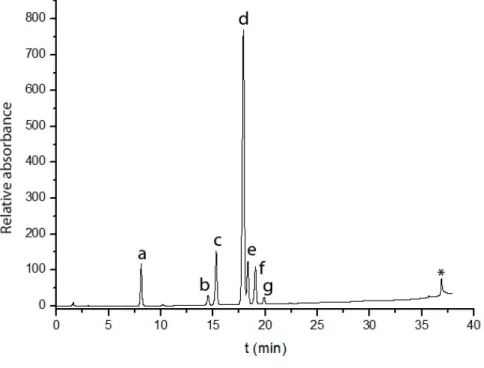
(51) CHAPTER I.2. 2.3 Extraction of EGDN from Goma-2 ECO dynamite Figure I.2.1 shows the scheme of this extraction method.. Figure I.2.1. Scheme of the method developed for the extraction of EGDN from Goma-2 ECO. Abbreviations used: Vf, final volume; EGDNW, EGDN content after the two water extractions; EGDNM, EGDN content after the two methanol extractions; EGDNT, total EGDN content.. 10.0 milliliters of Milli-Q water were added to 100 mg of Goma-2 ECO sample and sonicated for 5 minutes in an ultrasound bath. The liquid phase was collected and stored for later use. Another 10.0 mL of MilliQ water were added to the sample and the mixture was sonicated again for 5 minutes. The liquid phase was collected, added to the previous one and led to a final volume of 25.0 mL adding Milli-Q water. The final solution was stored at room temperature until its 45.
(52) PART ONE. analysis. Then 10.0 mL of methanol were added to the sample, the mixture was sonicated for 5 minutes, and the liquid phase was collected and stored for later use. Another 10.0 mL of methanol were added to the sample and the mixture was sonicated again for 5 minutes. The liquid phase was collected, added to the previous one and led to a final volume of 25.0 mL adding methanol. After this treatment, the entire Goma-2 ECO sample was dissolved, with the exception of sawdust.. 3. Results and Discussion 3.1. Development of an HPLC method for the determination of EGDN in dynamites An HPLC method to determine EGDN in dynamites was developed in this work. Since dynamites are heterogeneous explosives (see Figure I.2.2), the first step was to develop an easy and sustainable exhaustive extraction method of EGDN in dynamites.. Figure I.2.2. Picture of a Goma-2 ECO fragment, in which it can be appreciated the heterogeneity of this sample. 46.
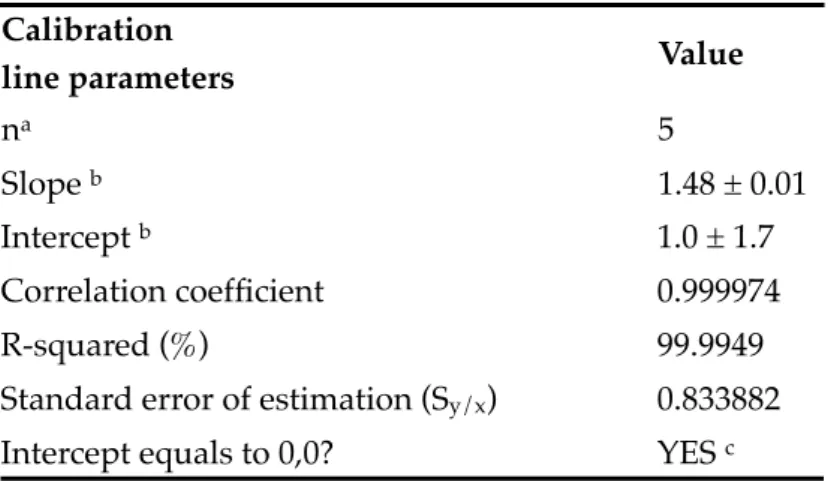
(53) CHAPTER I.2. Due to the solubility of EGDN in water and methanol these two solvents were tested to recover EGDN from the dynamite. Both solvents were also chosen because of their low price and toxicity in comparison with other organic solvents such as acetonitrile and chloroform previously used.21 Different combinations and proportions were tested. Water and methanol were tested as separated solvents, but the complete dissolution of the dynamite could not be achieved. Then, water and methanol were mixed and used as extractive solvent in different proportions, from 30 to 70% of methanol /water (v/v). However, the complete dissolution of the dynamite was only achieved employing the same volume of both solvents separately, first water and, then, methanol and these conditions were chosen as the optimal conditions for the extraction. This extraction method ensured, not only the total dissolution of the EGDN contained in the dynamite used, also the dissolution of the whole dynamite, including salts and nitrocellulose, with the exception of sawdust. This is relevant because the last published study on the recovery of explosives compounds from dynamites only achieved the recovery of the organic nitro derivatives compounds.21 In comparison with this previous work, this extraction method also reduces the time of sample treatment by reducing the number of steps from ten to only two. After the extraction, the EGDN content in both the water (EGDNW) and methanolic (EGDNM) extracts were measured by an HPLC method. An HPLC method based on a gradient elution was also optimized. Different mobile phases and concentrations of them were tested. First, the separation was carried out under isocratic conditions, using methanol as mobile phase. However, since it is possible having explosives with different compositions a gradient was done as follows: from 25 to 40% in 10 min, of phases A (water) and B 47.
(54) PART ONE. (methanol), at 1 mL /min and 30 ºC. This separation method was designed in order to provide swiftness to those urgent forensic cases, being possible to apply the same method to different explosives. For this reason the method was slightly modified and, finally, a gradient elution from 25 to 95% in 35 min, of phases A (water) and B (methanol), at 1 mL /min and 40 ºC were chosen as the optimal conditions for the separation. This method was effective for the separation of seven standards (10 μg/mL) commonly used in the manufacture of dynamites (EGDN, NG, TNT, 3,4-DNT, 2,6-DNT, 2,4DNT, and 3,5-DNT), as it is shown in Figure I.2.3.. Figure I.2.3. Separation of a mixture of seven standards (10 μg/mL) of explosive compounds in methanolic solution. Identification of peaks: a, EGDN; b, NG; c, TNT; d, 3,4-DNT; e, 2,6-DNT; f, 2,4-DNT; g, 3,5-DNT; *, unknown peak. 48.
(55) CHAPTER I.2. For this reason, it was applied to the water and methanolic extracts of the dynamite. The chromatograms obtained in this occasion are shown in Figure I.2.4.. Figure I.2.4. Separation of the components of Goma-2-ECO after (1) the extraction with water and (2) the extraction with methanol. Both separations shown the good selectivity for the determination of EGDN in plastic explosives as Goma-2 ECO. Identification of peaks: a, EGDN; h, ammonium nitrate; i, dibutyl phthalate; *, unknown peak. 49.
(56) PART ONE. These chromatograms also show that the method is also suitable for the determination of ammonium nitrate and dibutyl phthalate (peak identification was established from the correspondence of retention times with standards), which are two compounds that have not been taken into account so far in the analysis of dynamites because it was considered that the determination of organic nitro compounds was usually enough.21. 3.3. Quantitative determination of EGDN in dynamites For the quantitative determination of EGDN in dynamites, peak area of EGDN in the extracts was measured to determine the concentration of EGDN in the sample by external standard calibration. The total content of EGDN in Goma-2 ECO was calculated by summing the EGDN contents obtained for both extracts, as it has been explained in Figure I.2.1. Calibration plots were obtained by analysis of nine standard solutions of EGDN at concentrations in the range 3 mg/L - 400 mg/L. Peak area was measured and plotted against EGDN concentration. Although a linear response was observed in the entire concentration range used for calibration, a linear working concentration range from 10 mg/L to 200 mg/L was selected, to remove those concentrations with higher associated errors. Table I.2.1 compiles the values for the slope, intercept, correlation coefficient, R-squared, and standard error for the calibration plot obtained in the least-square fitting of these data (five concentration levels). 50.
(57) CHAPTER I.2. Table I.2.1. Calibration parameters for the determination of EGDN in the plastic explosive Goma-2 ECO. Calibration line parameters. Value. na. 5. Slope. a. b. 1.48 ± 0.01. Intercept b. 1.0 ± 1.7. Correlation coefficient. 0.999974. R-squared (%). 99.9949. Standard error of estimation (Sy/x). 0.833882. Intercept equals to 0,0?. YES c. Number of standard solutions of EGDN analyzed. Triplicate injections were made. for each standard solution. b. 95.0 % confidence intervals for coefficient estimates.. c. p-value = 0.02. A correlation coefficient above 0.9999 and an intercept including the zero value for a 95 % confidence level, were obtained. The effect of matrix interferences was studied with a homemade dynamite, prepared with ammonium nitrate, flour and sawdust, at which standard solutions of EGDN at 30 mg/L, 70 mg/L, and 150 mg/L were added. Water and methanolic extracts obtained from this sample were analyzed in quintuplicate and EGDN concentrations obtained from the calibration line were compared, by means of least-square fitting, with the standard concentrations added. A straight line with an intercept and slope equals 0.0 and 1.0, at the 90% or higher confidence level, was obtained (P-values: 0.966334 and 0.286526, respectively).. 51.
(58) PART ONE. This analytical method was validated for the determination of EGDN in a plastic explosive as Goma-2 ECO in terms of selectivity, sensitivity, linearity and linear working concentration range, LOD, LOQ,. precision. (evaluated. as. repeatability. and. intermediate. precision), accuracy, and robustness, according to the International Conference on Harmonization (ICH) Guidelines23 and the National Association of Testing Authorities.24 Table I.2.2 summarizes the values obtained for the above-mentioned parameters. Table I.2.2. Figures of merit for the validation of the analytical method developed for the determination of EGDN in the plastic explosive Goma-2 ECO.11, 12 Validation parameters Sensitivity (mg/L) Linearity (mg/L) Linear working concentration range (mg/L) Limit of detection (mg/L) Limit of quantification (mg/L) Precision (%) Repeatability at low-level (30 mg/L) medium level (70 mg/L) high-level (150 mg/L) Intermediate precision (%) Accuracy (%) Low-level (30 mg/L) Medium level (70 mg/L) High-level (150 mg/L) Robustness (%) (3 mg/L) Peak area ± 2s Retention time (min) ± 2s a. 95 % confidence.. 52. Value 1.48 3.0 - 400 10.0 - 200 1.7 ± 0.2a 5.6 ± 0.2a. 4.1 5.7 1.0 6.5 104 101 104 3.3 ± 0.4a 8.34 ± 0.01a.
(59) CHAPTER I.2. Selectivity. As it is shown in the chromatograms corresponding to the extracts obtained from Goma-2 ECO (Figure I.2.4), an adequate selectivity is obtained since EGDN can be determined without any interfering peak in the aqueous and methanolic phases. Sensitivity. It was calculated as the slope of the calibration line. A value close to 1.5 mg/L was determined for EGDN standard. Linear working concentration range. It was calculated by plotting relative response (EGDN peak areas divided by their respective standard concentrations) as a function of the corresponding concentrations, on a logarithmic scale; the method was considered linear up to the point where the plotted relative response line intersected the 95 % line. In this case, as stated above, a linear concentration range from 10 mg/L to 200 mg/L was obtained. LOD and LOQ. These parameters were calculated, according to the ICH guideline on validation,23 based on the standard error of regression (Sy/x) and the slope of the calibration line at levels approaching the limit. Thus, LOD, was calculated as (3.3·Sy/x / slope), and LOQ estimated as (10·Sy/x / slope). The values obtained were 1.7 ± 0.2 mg/L and 5.6 ± 0.2 mg/L, respectively. Taking into account that the injection volume was 10 μL, absolute LOD and LOQs values of 0.17 ng and 0.56 ng, respectively, corresponding to amounts of EGDN injected, were determined. The value of the LOD is slightly higher than that reached by Tyrrell at al.22 in their recently published study, in which EGDN (beside other organic and inorganic explosives) was determined. In this work a Dionex Acclaim® Explosives E2 column (150 mm × 3 mm), 48/52 v/v methanol /Milli-Q water as mobile phase, and UV detection (210 nm) were used. However, in this work, 53.
(60) PART ONE. homemade explosives were analysed, but not dynamite based explosives. Precision. Precision of the analytical method was evaluated as repeatability and intermediate precision. Repeatability (in peak area and in concentration) were expressed as the discordance among the measurements (RSD values in %) of five consecutive injection of solutions of 30 mg/L (low-level), 70 mg/L (medium-level), and 150 mg/L (high level) of EGDN standard. For the three concentration levels studied, RSD values lower than 5.7% were obtained. Intermediate precision was evaluated as the RSD value obtained for the injection, by different analysts on five different days, of a standard solution of whose EGDN corresponding to the medium-level concentration of the linear range (70 mg/L). An RSD value of 6.5% was obtained. According to the calculated values for repeatability and intermediate precision, a good precision of the analytical method was obtained since RSD values about 6% were measured. Accuracy. The accuracy of the method was determined as the percentage of recovery of EGDN when known EGDN concentrations (30 mg/L, 70 mg/L, and 150 mg/L) were added to a sample of similar matrix to that of the plastic explosive studied. Recoveries obtained were 104%, 101%, and 106%, for the low-, medium-, and high-levels, respectively, of the linear working concentration range. Since these values are very close to the ideal recovery (100%), a good accuracy of the analytical method was found. Robustness. Robustness of the method (%) was calculated by analyzing the peak areas and retention times for EGDN of ten injections of a standard solution of 3 mg/L, subjected to variation in the stability of 54.
(61) CHAPTER I.2. the flow-rate. The average peak area (± 2s) was 3.3 ± 0.4 and the average retention time (± 2s) was 8.34 ± 0.01 min. That is, an acceptable RSD value for peak area (~12%) and an excellent RSD value for retention time (0.1%) were obtained. The determination of the main components of explosives is a subject of great importance in forensic chemistry and also for the industrial laboratories, being necessary to obtain reliable analytical data. As stated above, the dynamite analyzed in this work is characterized by a complex. matrix. consisting. of. diverse. components. mixed. heterogeneously (see Figure I.2.2); however, since the method performance criteria were good enough for our practical purpose, the validated method was applied to the determination of the total EGDN content in Goma-2 ECO. The total EGDN content for the Goma-2 ECO analyzed was 30.29%, which is in accordance with the manufactureŕs specifications for this dynamite (25.7%-31.4%).. 4. Concluding remarks A selective, sensitive, and reliable analytical method was validated and applied for the first time for the determination of EGDN in a dynamite as Goma-2 ECO. First, an extraction method enabling to dissolve all the EGDN was developed. Then, an HPLC method providing good selectivity was applied. This method also allowed the determination of other components of dynamites, such as ammonium nitrate and dibutyl phthalate. The analytical method was validated for the reliable quantitative determination of EGDN in dynamites. The results obtained showed that EGDN in Goma-2 ECO was 30.29%, which is in accordance with the manufactureŕs specifications for this 55.
(62) PART ONE. dynamite (25.7%-31.4%). These results show the high potential of the proposed method to perform the quality control of plastic explosives containing EGDN.. Acknowledgements The authors thank to the Ministry of Science and Innovation the project CTQ2008-00633-E. Jorge Sáiz thanks to this Ministry his contract associated to this project. The authors also thank to Jose Luis Ferrando from the Criminalistic Service of Guardia Civil (Spain) its contribution to this work.. 56.
(63) CHAPTER I.2. References K. Hakansson, R. V. Coorey, R. A. Zubarev, V. L. Talrose, P. Hakansson, J. Mass. 1. Spectrom., 2000, 35, 337-346. R. Tachon, V. Pichon, M. B. Le Borgne, J. J. Minet, J. Chromatogr. A, 2007, 1154,. 2. 174-181. A. Dario, M. Schroeder, G. S. Nyanhongo, G. Englmayer, G. M. Guebitz, J. Hazard.. 3. Mater., 2010, 176, 125-130. 4. X. M. Zhao, J. Yinon, J. Chromatogr. A, 2002, 977, 59-68.. 5. Y. Fukuchi, Hokkaido J. Med. Sci., 1981, 56, 245-257.. 6. E. Orlando, G. B. Raffi, G. Miraglia, Lav. Umano., 1966, 18, 455-461.. 7. T. Tai, H. Tsuruta, Ind. Health, 1997 35, 515-518.. 8. E. C. Vigliani, G. Cavagna, G. Locati, V. Foa, Arch. Environ. Health, 1968, 477-484.. 9. L. Maccherini, E. Camarri, Med. Lavoro, 1959, 50, 193-201.. 10. L 141/20, Official Journal of the European Union, Commission Recomendation of 28. May 2008, on risk reduction measures for the substances 2-nitrotoluene and 2,4dinitrotoluene. 11. 12. D. S. Moore, Rev. Sci. Instrum. 2004, 75, 8, 2499-2512. F. Monteil-Rivera, L. Paquet, S. Deschamps, V. K. Balakrishnan, C. Beaulieu, J.. Hawari, J. Chromatogr. A, 2004, 1025, 125-132. 13. W. Kleiböhmer, K. Cammann, J. Robert, E. Mussenbrock, J. Chromatogr., 1993, 638,. 349-356.. 57.
(64) PART ONE. 14. A. Halasz, C. Groom, E. Zhou, L. Paquet, C. Beaulieu, S. Deschamps, A. Corriveau,. S. Thiboutot, G. Ampleman, C. Dubois, J. Hawari, J. Chromatogr. A, 2002, 963, 411– 418. 15. A. Schreiber, J. Efer, W. Engewald, J. Chromatogr. A, 2000, 869, 411–425.. 16. M. Godejohann, A. Preiss, C. Mügge, G. Wünsch, Anal. Chem., 1997, 69, 3832-3837.. 17. F. Monteil-Rivera, C. Beaulieu, S. Deschamps, L. Paquet, J. Hawari, J. Chromatogr.. A, 2004, 1048, 213–221. 18. L. Wu, J. R. Almirall, K. G. Furton, J. High Resol. Chromatogr., 1999, 22, 5, 279–282.. 19. I. Haag, LaborPraxis, 1996, 20, 66–68, 71.. 20. Gaurav, V. Kaur, A. Kumara, A. K. Malik, P. K. Rai, J. Hazard. Mater., 2007, 147, 691–. 697. 21. S. Baj, M. Dawid M. Ambrozek, Chem. Anal. Warsaw, 1993, 38, 323-329.. 22. É. Tyrrell, G. W. Dicinoski, E. F. Hilder, R. A. Shellie, M. C. Breadmore, C. A. Pohl, P.. R. Haddad, J. Chromatogr. A, 2011, 1218, 3007-3012. 23. ICH Validation of Analytical Procedures: Text and Methodology Q2 (R1),. International Conference on Harmonization, http://www.ich.org (2005) 24. Technical Note 17, Guidelines for the validation and verification of chemicals test. methods, p 9-11, National Association of Testing Authorities.. 58.
(65) CHAPTER I.3. CHAPTER I.3. STUDY OF LOSSES OF VOLATILE COMPOUNDS FROM DYNAMITES. INVESTIGATION OF CROSS-CONTAMINATION BETWEEN DYNAMITES STORED IN POLYETHYLENE BAGS. Jorge Sáiz, José-Luis Ferrando, Juan-Carlos Atoche, Mercedes Torre, Carmen García-Ruiz.. Forensic Sci. Int., 2011, 211, 27-33. http://dx.doi.org/10.1016/j.forsciint.2011.04.007 59.
(66) PART ONE. ABSTRACT The purpose of this work was to study the appropriateness of polyethylene bags for the preservation of explosive specimens. To this end, specimens of two types of dynamites, Goma-2 EC, containing EGDN and DNT, and Goma-2 ECO, containing only EGDN, were placed individually inside bags and introduced into hermetically sealed glass jars, which were stored for a period of time. Losses of volatile compounds were studied by headspace analysis using gas chromatography. coupled. to. mass. spectrometry.. The. cross-. contamination between dynamites was studied by using HPLC with mass spectrometry detection to analyze the extracts obtained after a sequential solvent extraction of these specimens. Polyethylene bags permit the loss of volatile compounds since EGDN and DNT were detected in the headspace of the jars. Moreover, cross-contamination between dynamites was also demonstrated since DNT content decreased in the dynamite containing this compound and increased in the dynamite that had not contained it.. 60.
(67) CHAPTER I.3. 1. Introduction Explosive specimens are of great importance in cases of terrorism, in which dynamites and other kinds of explosives may be used. There are many types of explosives, which differ in their composition, appearance, explosive capability or even place of manufacture. These characteristics of the explosives may be used to identify the explosive that was used in the perpetration of a crime. Moreover, due to the fact that terrorists often use a single type of explosive, usually obtained in a robbery, these characteristics may be decisive when determining the source of the explosives used and the authorship of the attack, or at least, to offer some orientation to a forensic investigation. Goma-2 ECO and Goma-2 EC are Spanish-made high explosives (dynamites) intended primarily for industrial use, such as mining and demolition, or military applications. Goma-2 ECO is a gelatinous dynamite composed of EGDN, ammonium nitrate, nitrocellulose, dibutyl phthalate (DBP), calcium carbonate, and flour or sawdust. This high explosive has commonly been used in Spain and also exported abroad. Unlike Goma-2 EC, Goma-2 ECO was developed in line with European environment regulations1 and does not contain the highly toxic compound DNT in its composition. Unlike Goma-2 ECO, Titadyn contains NG and DNT in its formulation. In terms of their composition,. Goma-2. ECO,. Goma-2. EC,. and. Titadyn. are. heterogeneous materials. Goma-2 ECO was allegedly used in the March 11, 2004 train bombings in Madrid (Spain). The authorship of the attack has not yet been clarified, the controversy still lingering today. At first, responsibility was assigned to ETA (the Basque terrorist organization); however, this 61.
(68) PART ONE. organization denied any connection with these attacks while the organization Al-Qaeda later acknowledged its responsibility for the outrage. ETA has used Titadyn repeatedly in terrorist attacks. Since trace amounts of NG and DNT were detected in some of the explosive evidences of the 11 March blast, the possibility ETA authorship was placed back on the table. Pursuant to the action protocol, explosive evidences collected at the scene of the bombings were put into official polyethylene bags and transported to a laboratory where many other explosives were kept. For this reason, the possibility that there might have. been. contamination. between. different. specimens. was. considered. Cross-contamination occurs when certain compounds are transferred from one specimen to another.2 It can take place between very different kinds of specimens and, if not detected, always leads to erroneous results in scientific studies. In forensic investigations, contamination between specimens as a result of incorrect preservation may lead to charging or arresting innocent people. Therefore, it is important to pay special attention when handling, sampling and storing specimens of explosive in order to avoid cross-contamination and incorrect interpretation of forensic cases. Contamination between explosive specimens may occur through physical contact with contaminated surfaces, with other specimens or with particles or vapors. In fact, the contamination of explosives by vapors is possible because highly volatile compounds, such as EGDN, NG or DNT are usually present in many explosives. The vapor pressure of a given compound measures its capacity of volatilization; in general, the higher the vapor pressure, the higher the capacity of volatilization and the lower the capacity to be retained by certain 62.
(69) CHAPTER I.3. materials. EGDN has the highest vapor pressure (7.0 x 10⁻² torr at 25 ºC), followed by DNT and NG (2.0 x 10⁻³ and 2.3 x 10⁻⁴ torr at 25 ºC, respectively).3 Contamination by vapors is also dependent on the adsorption characteristics of the compounds, which are defined by their affinity with the material.4 These compounds may exhibit a very strong affinity to be adsorbed on a variety of materials such as hair,3 charcoal,5 organic matter from soil,6 other components of soils like sands or clays7-9 and some polymers;10-11 in most cases adsorption may occur in an almost irreversible manner.4 In fact, volatile compounds may bind easily to porous materials with a high surface-area-tovolume ratio. It should be stressed that nowadays, adsorbent porous materials such as calcium carbonate are used as components of explosives. As far as we know, there have been very few studies of the loss of volatile compounds due to the material of the container used for storing the specimens in the field of forensics.12-15 Those studies that exist mainly focus on the capability of fire debris evidence receptacles to avoid the loss of vapors. However, both for fire debris and for specimens of explosives had the same objetives: to avoid the loss of volatile compounds and to prevent changes in the specimens. For this reason, the same containers used for specimens of fire debris can be used for specimens of explosives and their characteristics are similar. When dealing with specimens of fire debris the containers recommended are metal paint cans with compression lids, glass mason jars with standard pressure-canning flats and bands, and special polymer sample bags.15-18 However, each type of container has its advantages and disadvantages and care must be taken when choosing the containers to be used for specimen storage. For example, containers made of glass are usually big and their handling and 63.
(70) PART ONE. transport requires special care because they are fragile. On the other hand, they are very simple to use and can be closed easily by screwing the tops of the jars. This is an advantage not shared by polyethylene bags. These are tough and not liable to breakage, but their handling is often complicated and great care is required when sealing the bag in order to ensure that there are no poorly closed segments that may allow the output of volatile compounds. Although the size, robustness and ease of use of containers are very important issues, when choosing a suitable container perhaps more importance should be attached to the capacity of containers to prevent loss of volatile compounds. Nowadays, polymer bags are being used to preserve explosive specimens because they are considered the best system to avoid vapor losses in comparison with metal paint cans and glass mason jars; however, these bags are not fully efficient and may allow losses of trace amounts of volatile compounds in specimens of fire debris.15 In fact, recent discussion of the quality of the methods for sampling and preserving explosive specimens and other volatile substances in forensic laboratories12-15 has led to the conclusion that current procedures are unsuitable or do not ensure the proper preservation of specimens.12,14,15 This represents a huge problem that must always be borne in mind when interpreting the results of a forensic case. Some authors have developed and tested sampling kits for the collection of evidences as alternatives to those currently used,12 paying special attention to avoid contact between the specimen and the walls of the container. This work aimed, firstly, to study the dynamics of the loss of the highly volatile EGDN from Goma-2 ECO dynamite under different temperature and time conditions; and, secondly, to evaluate whether the official polyethylene bags used by the Spanish Security Forces to 64.
(71) CHAPTER I.3. transport and store specimens are suitable systems. For this latter purpose, the chances of losses occurring of volatile components (specifically, EGDN and DNT), as well as of cross-contamination occurring between different dynamite specimens kept in the official bags and stored together in a confined space, were investigated.. 2. Material and methods 2.1. Chemicals and materials The extraction of EDGN and DNT was carried out with ultrapure water (18.2 !) from a Millipore Milli-Q water system (Bedford, MA, USA) and HPLC-grade methanol purchased from Sigma-Aldrich (St. Louis, MO, USA). Mobile phases for HPLC were also prepared with Milli-Q water and HPLC-grade methanol. 2,4-DNT, 2,6-DNT, 3,4DNT, and EGDN standards (1 µg/mL) were supplied by Restek Co. (Bellefonte, PA, USA). Specimens of Goma-2 ECO dynamite were kindly donated by MaxamCorp Holding, S.L. (Madrid, Spain). Specimens of Goma-2 EC dynamite were provided by the Criminalistic Service of the Guardia Civil (Madrid, Spain). The composition of these specimens, together with that of another high explosive (Titadyn), is shown in Table I.3.1. The official plastic bags used by Spanish Security Forces to transport and to store evidence specimens in forensic cases were provided by the Criminalistic Service of the Guardia Civil. These bags, supplied by Royal Pack, S.L. (Alcalá de Henares, Spain), are made from 65.
(72) PART ONE. polyethylene and have a rubber gasket that prevents the output and input of gases. Table I.3.1. Composition, indicated by the manufacturer, of high explosives Goma-2 ECO, Goma-2 EC and Titadyn.. EGDN. Goma-2 ECO. Goma-2 EC. Titadyn. ✓. ✓. ✓ ✓. NG ✓. ✓. ✓. ✓. ✓. Ammonium nitrate ✓. ✓. ✓. DNT Nitrocellulose DBP. ✓. Calcium carbonate ✓ Flour/sawdust. ✓. 2.2. Instrumentation HPLC analyses of the extracts of dynamites were performed in a fully equipped, Agilent series 1100 liquid chromatograph (Pittsburgh, PA, USA) with a DAD and an atmospheric pressure chemical ionization (APCI) mass spectrometer (MS) detector (HPLC-DAD-MS). The separation was performed in an ODS ProntoSIL Hypersorb column (250 x 4.6 mm I.D.; 5.0 μm particle diameter) from Scharlab S.L. (Barcelona, Spain). The separation method used consisted in one-step gradient from 25% to 95% B in 35 min, using a temperature of 40 ºC. The mobile phases were water (mobile phase A) and methanol (mobile phase B); the flow-rate was 1 mL /min and the injection 66.
(73) CHAPTER I.3. volume was 10 μL.19 UV detection at 230 nm as analytical wavelength (4 nm bandwidth) and 550 nm as reference wavelength (100 nm) was employed. For APCI, the instrumental conditions were: nebulizer pressure 40 psi; drying gas (N2) at a flow-rate of 4 mL /min; drying gas temperature at 350 °C; vaporizer temperature at 325 °C; negative scan in the range m/z = 100–650; Vcap (positive) at 4000 V; Vcap (negative) at 1500 V; corona (positive) at 4 µA; and corona (negative) at 10 µA. Every specimen solution was injected by triplicate in the chromatographic system. Data were captured and processed using the LC-MSD ChemStation Software (Agilent Technologies) software package. Gas chromatography coupled with mass spectrometry experiments to study volatile compounds in the headspaces of the glass jars were performed in an Agilent 7000A Triple Quad GC/MS (Pittsburgh, PA, USA). Headspace specimens from each jar was collected employing a solid-phase micro-extraction fiber (75 μm CarboxenTM PDMS) and was injected at 250 ºC with an Agilent 7683B injector (Pittsburgh, PA, USA) working. in. a. pulsed. splitless. mode. (at. 6.5054. psi).. Gas. chromatography analysis was carried out with an Agilent 7890A (Pittsburgh, PA, USA) gas chromatograph with helium as the carrier gas and a HP-5MS (5 % Phenyl Methyl Siloxane) 30 m x 250 μm x 0.25 μm column, initially kept at 325 ºC. The separation method used consisted in a five-step gradient from 50 ºC to 260 ºC over 42 min: first, 50 ºC for 3 min; second, an increase of 2 ºC/min to 70 ºC; third, an increase of 4 ºC/min to 130 ºC; fourth, 130 ºC for 1 min; and fifthly, an increase of 10 ºC/min to 260 ºC. The flow-rate was 0.9 mL /min. Mass spectrometry detection was carried out using an Agilent 7000 A triple quadrupole mass spectrometer (Pittsburgh, PA, USA) operating in electronic impact mode. The temperature at 230 ºC, electron energy at 67.
Figure


+7




Documento similar
1. S., III, 52, 1-3: Examinadas estas cosas por nosotros, sería apropiado a los lugares antes citados tratar lo contado en la historia sobre las Amazonas que había antiguamente
Since such powers frequently exist outside the institutional framework, and/or exercise their influence through channels exempt (or simply out of reach) from any political
In the previous sections we have shown how astronomical alignments and solar hierophanies – with a common interest in the solstices − were substantiated in the
While Russian nostalgia for the late-socialism of the Brezhnev era began only after the clear-cut rupture of 1991, nostalgia for the 1970s seems to have emerged in Algeria
The expansionary monetary policy measures have had a negative impact on net interest margins both via the reduction in interest rates and –less powerfully- the flattening of the
Jointly estimate this entry game with several outcome equations (fees/rates, credit limits) for bank accounts, credit cards and lines of credit. Use simulation methods to
In our sample, 2890 deals were issued by less reputable underwriters (i.e. a weighted syndication underwriting reputation share below the share of the 7 th largest underwriter
At the same time, however, it would also be misleading and simplistic to assume that such Aikido habituses were attained merely through abstracted thought
