This work is licensed under a
B
IB
LIOTECA
Document downloaded from the institutional repository of the University of
Alcala:
http://ebuah.uah.es/dspace/
This is the pre-peer reviewed
version of the following article:
Vázquez, J.J., Panadero, S., Martín, R.M.
&
Díaz-Pescador, V. (2015). Access
to new information and communication technologies among homeless
people in Madrid (Spain).
Journal of Community Psychology
,
43
(3)
, 338-347
.
doi:
https://doi.org/10.1002/jcop.21682,
which has been published in final
form at:
https://doi.org/10.1002/jcop.21682
This article may be used for non-commercial purposes in accordance with
Wiley Terms and Conditions for Use of Self-Archived Versions.
© 2015, Wiley Periodicals, Inc.
Access to new i
nformation and communication technologies
among homeless people in Madrid (Spain).
José Juan Vázquez.
University of Alcalá
Sonia Panadero.
Complutense University of Madrid
Rosa Martín.
University of Alcalá
María del Val Diaz-Pescador.
University of Alcalá
Abstract.- The article analyzes access to various information and communication technologies –ICTs-(mobile phone, computer, Internet, e-mail and social network site) among a representative sample of homeless people in Madrid. The information was collected using a heteroapplied structured interview. The results show that new ICTs are used to some extent among homeless people in Madrid, although at much lower percentages than the general population in Spain. We observed a relatively widespread use of mobile phones, a medium-low level use of the Internet, computer and e-mail, and hardly any use of social networks, with significant differences according to the interviewees' age, level of education and Sapanish or foreign nationality. The digital divide has an especially negative effect on elderly homeless people, those with lower levels of education and those of Spanish origin.
Key words: homeless, mobile phone, Internet, social network site, social inclusion.
Acknowledgments:
Introduction
In Spain, a fifth of the population (21.8%) lives below the poverty line (EUROSTAT, 2012), with homeless people, due to their highly precarious situation, forming the bottom rung of social exclusion. The Spanish National Institute of Statistics estimates that the homeless population in Spain cared for in accommodation and food distribution centres amounts to 22,938 people (INE, 2012a), and various non-governmental organizations estimate that there are more than 50,000 homeless people. Homeless people not only live in a situation of extreme poverty, but also suffer from strong family and social disengagement, and have great difficulties in achieving social/employment reintegration and significant health problems (Muñoz, Vázquez, Bermejo, & Vázquez, 1999). There are many factors that can lead to people sliding into homelessness and remaining in that situation (Muñoz, Vázquez & Vázquez, 2004). Although difficulties in accessing and using new information technologies and communication technologies (ICTs) properly do not appear to play a role in the onset and persistence of homelessness, problems with access to these technologies may be an aspect that in combination with other circumstances, hinders social inclusion processes among homeless people.
Society has experienced major social, cultural and economic changes in recent years, which have largely been due to the impact of the new ICTs in the development of the "knowledge society" (UNESCO, 2005). These new ICTs, and the Internet in particular, can generate knowledge, foster social relationships and break down barriers of time and space. According to Miquel, Rotger and García (2004), use of ICTs is the main aspect of the knowledge society in individuals' inclusion/exclusion from employment and society, especially among the most disadvantaged groups. Today, a life lived on the fringes of the ICTs can lead to significant difficulties in various contexts (work, education, relationships, leisure, etc.). For example, seeking work, continuous training, creating and maintaining social networks, leisure management and access to information now only take place to a large extent by means new technologies. As a result, digital inclusion entails more than just the acquisition of information resources (Bure, 2005); the everyday social relations that are built and maintained using ICTs are also important. Both social inclusion and digital inclusion are concepts that hold normative connotations, in which inclusion is seen as a goal to which policy initiatives should aspire.
According to Raya and Santolaya (2009), living on the fringes of the ICTs is an additional factor in exclusion, as well as various factors related to employment, social, economic, political and cultural aspects. This means that the "digital divide" reinforces exclusion among specific sectors of the population in social difficulties, such as immigrants, ethnic minorities and homeless people. It is therefore essential to design policies to foster access to and use of ICTs among the most socially excluded groups and areas.
In recent years, the most technology that has been most widely disseminated and which has undergone the biggest changes has been the mobile phone. Jenkins (2008) points out that the mobile phone has become an essential tool in the media convergence process, and one of the most widely used media in both the workplace and in individuals' private lives. Mobile phones offer a connection to others without the physical constraints of landlines and may therefore make communication (e.g. access to one’s social support networks) more feasible for homeless individuals. Homeless people who perceive themselves as having greater access to their social support networks have better physical and mental health outcomes, as well as lower rates of victimization (Eyrich-Garg, 2010). This could in turn lead to better health outcomes.
Eyrich-Garg (2010) found that in a sample of homeless people who did not use the shelter system in Philadelphia, 44% owned a mobile phone, of which 20% accessed the Internet via their mobile phone. According to the same author, the participants possessed and used mobile phones to increase their sense of safety, responsibility (employment, stable housing, personal business, and sobriety or “clean time”), and social connectedness (Eyrich-Garg, 2010).
Various studies indicate that Internet use among homeless people in developed countries stands at 19%-47% of adults and 84%-93% of adolescents (Eyrich-Garg and Rice, 2012). Computer technology may be an alternative medium for this population to access their social support systems, which, in turn, could lead toward better health outcomes (Eyrich-Garg, 2011). Homeless adolescents and adults use the Internet to obtain employment and housing, seek services, remain socially connected, and have fun (Eyrich-Garg & Rice, 2012).
Use of social networking sites (SNS) appears to be relatively widespread among young homeless people. As a result, for example, SNS usage was assessed for two age-matched young adult samples. One was drawn from a large introductory psychology subject pool, and the other from homeless young adults who were approached for participation when they entered shelters. In overall terms, technology use was strikingly similar (Guadagno, Muscanell & Pollio, 2013).
Although various initiatives to narrow the "digital divide" have been implemented at European level, according to Malgesine and González (2005), while digital progress is taking place at a rapid pace, the "digital divide" could be becoming more accentuated among the most disadvantaged members of the population. UNESCO (2005) states that there are various reasons that lead to a lack of access to and use of ICTs, including the level of available economic resources, geography, age, gender, language, education and sociological and cultural origin. Among homeless people in Madrid, all of whom have very little or no economic resources, we observed differences in gender, age, origin and education that could have an impact on access to and use of ICTs.
Method
The research was conducted based on a representative sample of homeless people in Madrid, consisting of 188 participants who were all adults, who the night before the interview was conducted had slept in a shelter or other facility for homeless people, on the street or in a place not designed for sleeping (cash dispensers, abandoned buildings, cars, subways, subway stations, etc.) (Toro, 1998).
The sample size was determined based on the available data for the total number of homeless people in the city of Madrid. We designed a strategy for random sampling in the street and in all shelters for homeless people, selecting a given number of participants proportionately and randomly, according to their capacity. The sample selection in the street was also carried out randomly and proportionally, based on the number of homeless people sleeping in the streets of Madrid according to the figures obtained from the most recent count carried out in the city (Cabrera, Muñoz & Sánchez, 2008).
The information was gathered using a heteroapplied structured interview designed for this purpose, which enabled the problems associated with some interviewees' difficulties with reading and understanding to be circumvented. It was applied by interviewers who had received prior training to that end. After explaining the aims of the investigation and the treatment that would be given to the data obtained, the informed consent of the participants was requested, and those that took part were assured that their complete anonymity would be respected at all times.
Table 1. Main sociodemographic characteristics, education and time spent homeless of homeless people in Madrid.
Characteristics n Percentage/mean
Sex
Male 158 84.0%
Female 30 16.0%
Age (Mean (SD)) 188 47.57 (12.17)
Marital status
Single 100 53.2%
Married 7 3.7%
Legally separated or divorced 58 30.9% Separated de facto without legal procedures 19 10.1%
Widow/er 3 1.6%
Other 1 0.5%
Nationality
Foreign 53 28.2%
Spaniard 133 70.7%
Completed education
None (illiterate) 5 2.7%
None (literate) 6 3.2%
Special education 1 0.5%
Incomplete primary 11 5.9%
Primary 45 23.9%
Secondary/first cycle (until 14 years old) 64 34.0% Secondary/second cycle (until 18 years old) 32 17.0% University (intermediate degree and above) 22 11.7%
Slept in one of the following places last month
In the street 49 26.1%
In an unsuitable place 13 6.9%
In a shelter 132 70.2%
Time homeless (Mean (SD)) 182 7.0 yr. (8.45)
As shown in Table 1, the vast majority of homeless people in Madrid were male, of Spanish origin, and their mean age was 48 years old. While more than half of the interviewees were single, 46.3% had been married at some point in their life, although very few were still married when the interview took place. 9.6% had not completed primary education, while 12% had completed some form of university education. The people interviewed had been homeless for a mean period of seven years, and the vast majority reported having slept in a shelter during the month prior to the interview.
three age groups of similar size (under 42 years old, between 43 and 52 years old and over 52 years old) and into four groups based on the education they had received: no education, primary education, education up to 14 years old, education up to 18 years old, and university education.
Results
The most widely used ICT among homeless people in Madrid is the mobile phone, which is a technology used by 59.0% of those interviewed. 40.4% of homeless people in Madrid use a computer, 37.8% access the Internet and 33.5% have an e-mail address. 17.0% use some sort of social network. No statistically significant differences in terms of these aspects were observed according to the gender of homeless people in Madrid.
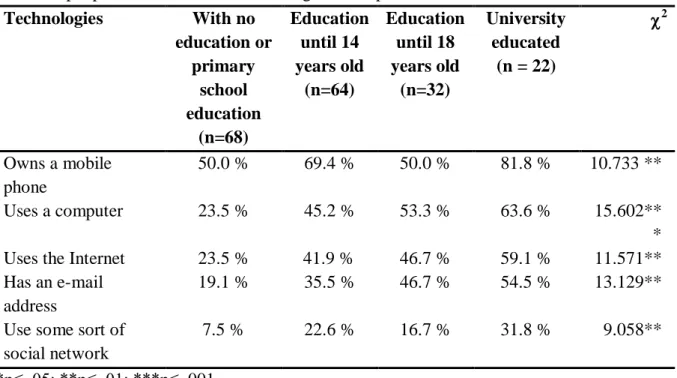
Access to new ICTs by homeless people according to the highest level of education completed is shown in Table 2.
Table 2. Differences in access to new information and communication technologies among homeless people in Madrid based on the highest completed level of education
Technologies With no
education or primary school education (n=68) Education until 14 years old (n=64) Education until 18 years old (n=32) University educated
(n = 22)
2
Owns a mobile phone
50.0 % 69.4 % 50.0 % 81.8 % 10.733 **
Uses a computer 23.5 % 45.2 % 53.3 % 63.6 % 15.602** * Uses the Internet 23.5 % 41.9 % 46.7 % 59.1 % 11.571** Has an e-mail
address
19.1 % 35.5 % 46.7 % 54.5 % 13.129**
Use some sort of social network
7.5 % 22.6 % 16.7 % 31.8 % 9.058**
*p≤ .05; **p≤ .01; ***p≤ .001
As seen in Table 2, there are differences in access to new ICTs depending on the level of education among homeless people in Madrid, so that the higher the educational level, the higher the percentage of interviewees accessing new ICTs. These differences are particularly significant in the field of information technology. Compared to those with no education or primary education, the percentage of homeless people with university education using a computer is 2.7 times higher, the percentage of those using the Internet is 2.5 times higher, the percentage of those with an e-mail account is 2.8 times higher, and the percentage for those accessing social networks is 4.2 times higher.
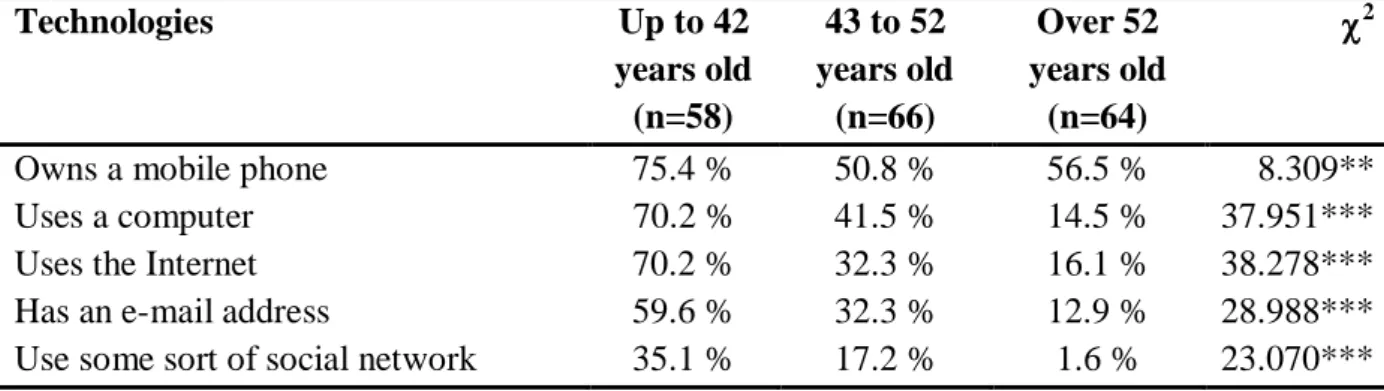
Table 3.Differences in access to new information and communication technologies based on age among homeless people in Madrid
Technologies Up to 42
years old (n=58)
43 to 52 years old
(n=66)
Over 52 years old
(n=64)
2
Owns a mobile phone 75.4 % 50.8 % 56.5 % 8.309** Uses a computer 70.2 % 41.5 % 14.5 % 37.951*** Uses the Internet 70.2 % 32.3 % 16.1 % 38.278*** Has an e-mail address 59.6 % 32.3 % 12.9 % 28.988*** Use some sort of social network 35.1 % 17.2 % 1.6 % 23.070*** *p≤ .05;**p≤ .01;***p≤ .001
As shown in Table 3, as the age of the homeless people falls, the percentage of them accessing new ICTs increases, with the exception of mobile phones, where there are no significant differences between homeless people aged between 43 and 52 years old and those over that age. In particular, we observed differences in access to new ICTs among those aged under 43 years old and those over 52 years old. Compared to the latter group, the percentage of those under 43 years old using a mobile phone is 1.3 times higher, the percentage of those using computers and the Internet is 4.5 times higher, the percentage of those with an e-mail account is 4.6 times higher, and the percentage of those using some sort of social network is 21.9 times higher.
Homeless people who own a mobile phone have a significantly lower mean age (M=45.93 years old; SD=13.204) than those who do not own one (M=49.97 years old; SD=10.193) (t(182)=2.218; p=.021). Similarly, the interviewees who use a computer have a significantly lower mean age (M=40.70 years old; SD=10.798) than those who do not use one (M=52.34 years old; SD=10.846) (t(182)=7.184; p=.000); those using the Internet have a significantly lower mean age (M=40.21 years; SD=11.089) than those who do not (M=52.13 years old; SD=10.596) (t(182)=7.297; p=.000) and those with an e-mail account have a significantly lower mean age (M=40.38 years old; SD=11.156) than those who do not have one (M=51.26 years old; SD=11.092) (t(182)=6.298; p=.000). Likewise, homeless people in Madrid using some kind of social network (SNS) have a significantly lower mean age (M=35.91 years old; SD=11.714) than those who do not use them (M=50.02 years old; SD=10.911) (t(181)=6.562; p=.000).
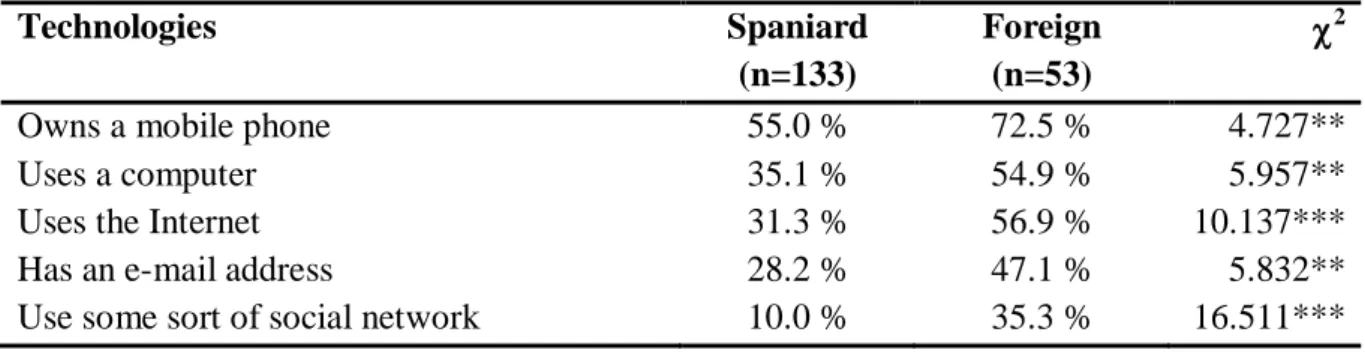
Table 4. Differences in access to new information and communication technologies based on origin among homeless people in Madrid
Technologies Spaniard
(n=133)
Foreign (n=53)
2
Owns a mobile phone 55.0 % 72.5 % 4.727** Uses a computer 35.1 % 54.9 % 5.957** Uses the Internet 31.3 % 56.9 % 10.137*** Has an e-mail address 28.2 % 47.1 % 5.832** Use some sort of social network 10.0 % 35.3 % 16.511*** *p≤ .05;**p≤ .01;***p≤ .001
Table 4 shows the differences in terms of access to new ICTs according to the origin of homeless people in Madrid. In all the cases analyzed, a higher percentage of interviewees of foreign origin than Spaniards used new ICTs. These differences are particularly marked in the use of Internet and social networks, which are used by percentages of foreign-born interviewees that are 1.8 and 3.5 times greater than the Spaniards interviewees respectively.
Discussion and Conclusions
The results obtained suggest that homeless people in Madrid do not live on the fringes of the new ICTs, although the percentage of those using these technologies is well below that of the general population in Spain (INE, 2012b). This suggests that a digital divide that affects them negatively persists. Although the literature on homeless people contains an implicit perception that this group is disconnected from the rest of society and has limited access to technology (Thompson & Pollio, 2006), the data obtained do not seem to fully confirm these findings, since homeless people are gradually making greater use of the new ICTs. The main reason given for using the Internet, especially among younger homeless people, is to keep in touch with friends and family (Guadagno, Muscanell, & Pollio, 2013).
street, to enhance communication between homeless people and providers, and to increase access for homeless people to prevention, intervention, and aftercare services.
Cabrera (2005) notes that in Spain, homeless people are one of the groups in suffering from social exclusion that benefit least from the Internet, which is mainly a result of the lack of public places providing free access to this technology. The results obtained seem to confirm this view, as while 69.8% of the Spanish population have Internet access (INE, 2012b), less than 38% of homeless people in Madrid use this technology. It is Internet access where the digital divide affecting homeless people is particularly apparent, and this issue has potential negative implications for social inclusion processes. As noted by Eyrich-Garg and Rice (2012), the Internet has enormous potential as a tool to improve the lives of individuals experiencing homelessness in terms of social support, advocacy, connection to and rating of services, online education, online intervention scheduling, and online intervention delivery. Furthermore, relationships with different government bodies and agencies are conducted exclusively through the new ICTs to an increasing extent, and as such the digital divide makes homeless people's difficulties in exercising their basic civil rights even more acute.
In Madrid, one in three homeless people said they had an e-mail address, although this does not necessarily mean they use it. As noted by Redpath et al. (2009) in a sample of homeless and indigent drug users, in which 24% had an e-mail account, only 10% had sent or received e-mails in the previous month. In addition to the problems identified for Internet access among homeless people, communication via e-mail is often difficult. For example, when an email account is accessed on a sporadic basis, passwords are regularly forgotten (Bure, 2005).
Only 17% of homeless people in Madrid use some sort of social networking site (SNS), which is 44.9% of the Internet users. This falls far short of the 91% of the Spanish Internet user population with active SNS (TCAnalysis, 2012). This data observed in Madrid is in contrast to those found by Guadagno, Muscanell, and Pollio (2013), who note that in New York and Los Angeles, college students and homeless young adults appear to be more similar than different in terms of their SNS use, which is almost ubiquitous among both groups. However, homeless young adults use social networking more for purposes of communications and less for recreational activities than undergraduates (Guadagno et al., 2013).
Sadly, even homeless people who routinely use new ICTs continue to suffer from social exclusion to a great extent. As noted by Bure (2005), 'digital inclusion' does not necessarily lead to 'social inclusion' into mainstream society, since homeless individuals tend to use ICTs in ways that reinforce the patterns and practices of their subculture.
UNESCO (2005) states that there are various factors that may hinder access and use of new ICTs, including the availability of economic resources, gender, age, education, and sociological and cultural origin. Homeless people in Madrid, who have very little or no financial resources, do not differ by gender in terms of having a mobile phone, an e-mail address or using computers, the Internet or SNS. However, age, educational level and origin (Spananiard or foreign) seem to play an important role in access to and use of the ICTs mentioned above, and the digital divide has a particularly negative effect on homeless people who are Spaniard, older and who have lower levels of education.
Madrid, a higher percentage of the interviewees of foreign origin used new ICTs than their Spanish counterparts. These differences are significant in terms of access to a mobile phone, computer and e-mail, and are particularly marked for using the Internet and SNS. Homeless people of foreign origin in Madrid appear to perceive a greater need to communicate with family and friends, many of whom are still in their country of origin. In this regard, the motivation for use of ICTs and their greater appreciated usefulness appear to be important factors affecting their use.
Meanwhile, level of education is a relevant variable in access to and use of new ICTs among homeless people in Madrid. According to the findings of Munuera (2005) concerning the negative impact of a lack of education on the use of new technologies among the most disadvantaged groups, among the interviewees there is a clear direct relationship between the level of education and use of new ICTs, which is especially marked in the area of computing, which requires more skills of the user to be able to manage them easily. Digital inclusion involves not just access to ICTs (Thomas & Wyatt, 2000) but also ‘ICT capability’: the necessary skills to use the ICT in question, as well as the knowledge about when and how to use it, and the confidence to do so (Faulkner & Kleif, 2003).
Age appears to be a variable which has a major impact on the use of new ICTs among homeless people in Madrid. The highest percentage of ICT use was observed among the younger interviewees, especially when these technologies involve greater dedication and complexity. As a result, while the mean age of homeless people in Madrid is 48 years old, the mean age of homeless people who own a mobile phone is 46 years old, for those who use a computer it is 41 years old, for those who use the Internet or have an e-mail account it is 40 years old, and for those who use SNS it is 36 years old. The differences in this respect are particularly noticeable among those under 43 years old and those over 52 years old, as a percentage 4.5 times higher of the former use computers and the Internet, a percentage 4.6 times higher have an e-mail address and particularly interestingly, a percentage 21.9 times higher uses SNS: less than 2% of homeless people over 53 years old use SNS.
The significant differences in access to new ICTs among homeless people according to age, origin and level of education makes these aspects worthy of special attention when designing programmes to reduce the digital divide affecting this group. As noted by Bure (2005), new digital technologies are instead a new, complicating factor that must be taken into account in the overall process of helping disadvantaged individuals to change their lives for the better. In this regard, facilitating access to mobile telephones and the Internet, adapting technologies to their specific needs, showing them the various uses that these technologies offer in order to generate interest and motivation and enabling them to use them properly are particularly important measures for reducing the digital divide affecting the homeless, and especially the older population and individuals with lower levels of education.
References
Cabrera, P. (2005). Nuevas Tecnologías y exclusión social. Un estudio sobre las posibilidades de las TIC en la lucha por la inclusión social en España. Madrid: Fundación Telefónica.
Cabrera, P., Muñoz, M. & Sánchez, R. (2008). Recuento nocturno de personas sin hogar en Madrid – Invierno. Report of the Ayuntamiento de Madrid.
EUROSTAT (2012). Retrieved 12/12/12 from EUROSTAT website: http://epp.eurostat.ec.europa.eu/cache/ITY_PUBLIC/3-03122012-AP/EN/3-03122012-AP-EN.PDF
Eyrich-Garg, K. M., & Rice, E. (2012). Cyber behavior of homeless adolescents and adults. In Z. Yan (Ed.), Encyclopedia of Cyber Behavior (pp. 284-291).
Eyrich-Garg, K.M. (2010). Mobile phone technology: A new paradigm for the prevention, treatment, and research of the non-sheltered “street” homeless? Journal of Urban Health, 87 (3), 365-380.
Eyrich-Garg, K.M. (2011) Sheltered in cyberspace? Computer use among the unsheltered ‘street’ homeless. Computers in Human Behavior, 27(1), 296-303.
Faulkner, W. & Kleif, T. (2003). One size does not fit all! Digital in/exclusion in a rural community. SIGIS case study report. Edinburgh: University of Edinburgh.
Fortunati, L. & Manganelli, A. (2002). A review of the literature on ICT in Italy. SIGIS Report. METIS Centre: Italy.
Guadagno, R.E., Muscanell, N.L., & Pollio, D.E. (2013). The homeless use Facebook?! Similarities of social network use between college students and homeless young adults.
Computers in Human Behavior, 29 (1), 86–89.
INE (Instituto Nacional de Estadística) (2012a). Encuesta a las Personas sin Hogar. Año 2012. Retrieved 21/12/12 from INE website: http://www.ine.es/jaxi/menu.do?L=0&type=pcaxis&path=%2Ft25%2Fp454&file=ineb ase
INE (Instituto Nacional de Estadística) (2012b). Encuesta sobre Equipamiento y Uso de Tecnologías de Información y Comunicación en los Hogares. Año 2012. Retrieved 12/12/12 from INE website: http://www.ine.es/jaxi/tabla.do?path=/t25/p450/a2012/l0/&file=01002.px&type=pcaxis &L=0
Jenkins, H. (2008). Convergence Culture. La cultura de la convergencia de los medios de
comunicación. Barcelona: PAIDÓS.
Malgesini, G. y González, N. (2005). Cuaderno europeo 2. Cumbre de Lisboa. Estrategia Europea de Inclusión Social. Madrid: Fundación Luis Vives.
Miguel, V., Rotger, J. & García, C. (2004). Minorías culturales y nuevas tecnologías. Lan Harremanak, 2, 113-125.
Muñoz, M., Vázquez, C. & Vázquez, J.J. (2004) A comparison between homeless, domiciled and vulnerable populations in Madrid. Population, 59(1), 129-141.
Muñoz, M; Vázquez, C; Bermejo, M. & Vázquez, J.J. (1999). Stressful life events among homeless people: Quantity, types, timing and perceived causality. Journal of Community Psychology, 27(1), 73-87.
Raya, E. & Santoloya, P. (2009). La sociedad de la información y sus aportaciones para el trabajo social. Portularia, 1, 83-92.
Redpath, D.P., Reynolds, G.L., Jaffe, A., Fisher, D.G., Edwards, J.W., & Deaugustine, N. (2009). Internet Access and Use among Homeless and Indigent Drug Users in Long Beach, California. CyberPsychology & Behavior, 9(5), 548-551.
TCAnalysis (2012). Observatorio de redes sociales. IV oleada abril 2012. Retrieved 12/12/12 from TCAnalysis website: http://www.slideshare.net/TCAnalysis/4-oleada-observatorio-de-redes-sociales
Thomas, G. & Wyatt, S. (2000). Access is not the only problem: Using and controlling the Internet. In S. Wyatt, F. Henwood, N. Miller & P. Senker (Eds.), Technology and in/equality: Questioning the information society (pp. 21-45). London: Routledge.
Thompson, S.J. & Pollio, D.E. (2006). Identifying the role of institutional disaffiliation, psychological dysfunction, identification with runaway culture, and human capital in adolescent runaway episodes. Social Work Research, 30(4), 245-252.
Toro, P.A. (1998). Homeless. In S. Bellock & M. Hersen (Eds). Comprehensive Clinical Psychology (pp. 119-136 ). Elservier Science.