P á g i n a
1 | 80
UNIVERSIDAD DE VALLADOLID
ESCUELA DE INGENIERÍAS INDUSTRIALES
Grado en Ingeniería en Organización Industrial
ERP SUPPORT FOR LEAN MANUFACTURING
Autor:
Hierro Rodríguez, Ángel
Izquierdo Millán, Segismundo Samuel
Universidad de Nysa (Polonia)
P á g i n a
3 | 80
TFG REALIZADO EN PROGRAMA DE INTERCAMBIO
TÍTULO:
ERP SUPPORT FOR LEAN MANUFACTURING
ALUMNO:
ÁNGEL HIERRO RODRÍGUEZ
FECHA:
5 DE FEBRERO DE 2019
CENTRO:
UNIVERSITY OF NYSA
P á g i n a
5 | 80
Resumen
¿Puede una empresa aprovecharse de las características de los ERPs, sin dejar de utilizar Lean manufacturing? Durante este proyecto haré una introducción de ambos, las diferencias entre ellos y hablaré de cómo hay mucha gente que opina que estos sistemas son totalmente opuestos, pero veremos que lo mejor para la compañía será utilizarlos juntos. Veremos cómo trabajando con ERPs y Lena Manufacturing Unidos Podemos mejorar la productividad basándonos en juntar producciones push y pull. Por último, introduciré técnicas Lean que hoy en día son apoyadas por ERPs, y que ofrecen los proveedores de ERP al mundo Lean.
Palabras clave
Lean, Manufacturing, ERP, Pull, Push.
Abstract
Can ERP and Lean Manufacturing match in the same company? During this project I will do an introduction for both of them, the differences between them and how, many people would say that these are systems totally opposites, but we will see that the best for the company is to match both and work together. On this way, we will see how ERP and Lean Manufacturing working together can improve the productivity and how pull and push production can match in a company. In addition, I will introduce some of Lean techniques that nowadays are been supported by ERP, and what can ERP vendors offer to the Lean world.
Key words
P á g i n a
7 | 80
UNIVERSITY OF NYSA
INDUSTRIAL ENGINEERING SCHOOL
Degree in Production Management and Engineering
Title:
ERP SUPPORT FOR LEAN MANUFACTURING
Author:
Hierro Rodríguez, Ángel
Tutor:
Dr Chwastyk, Piotr
Department of Engineering
P á g i n a
9 | 80
GREETMENTS
To everyone from who I have learnt something in this stage of my life.
To my family and my friends, that have allowed and supported me from the day I started my degree.
To my tutor in Poland, Dr. Piotr, and my tutor in Spain, Segis. For helping me when I needed, and for being always there.
P á g i n a
11 | 80
Contents
1. INTRODUCTION ... 13
a. ENTERPRISE RESOURCE PLANNING ... 13
i. Main parts of an ERP ... 13
ii. Main characteristics of ERP systems ... 14
iii. Advantages ... 14
iv. Disadvantages - ... 15
v. Historical outline. ... 15
vi. Basic architecture of an ERP ... 17
b. LEAN MANUFACTURING ... 18
i. History ... 18
ii. Values ... 19
iii. Objectives ... 22
iv. Tools ... 22
v. 6 Wasting types ... 25
vi. Lean Steps ... 25
2. MODERN ERP SYSTEMS AND THEIR IMPORTANCE IN IMPLEMENTING LM PRINCIPES ... 28
a. MODERN ERP SYSTEMS ... 28
i. Reduction in cost and implementation time... 29
ii. Consolidation ... 30
iii. Vertical solutions ... 30
iv. A move towards SMEs ... 30
v. Customizable ERP ... 31
vi. Collaborative ERP ... 31
vii. Software as a service (SaaS) and Cloud Computing ... 31
viii. Web-enabled ERP ... 31
ix. Mobile ERP ... 31
x. Real-time ERP ... 32
b. WHY IS IT NECEARY TO IMPLEMENT LM PRINCIPES? ... 33
i. Push systems ... 33
ii. Pull systems ... 33
iii. Comparation between pull and push ... 34
iv. Hybrid System Pull Push ... 36
3. SOLUTIONS IN ERP SYSTEMS THAT CAN SUPPORT LEAN MANUFACTURING TECHNIQUES ... 38
1. Improving Inventory Management ... 38
P á g i n a
12 | 80
3. Improving Employee Productivity ... 52
4. Improving Manufacturing Processes ... 54
5. Improving Product Quality ... 55
6. Improving Customer Service ... 57
¿What an ERP should do for lean? ... 60
4. EXAMPLES OF LEAN MANUFACTURING TECHNIQUES SUPPORTED ... 62
a. JIT (JUST IN TIME) ... 62
b. KAN BAN ... 62
c. 5S SUPPORTED BY ERP ... 73
d. Vendors ... 75
P á g i n a
13 | 80
1. INTRODUCTION
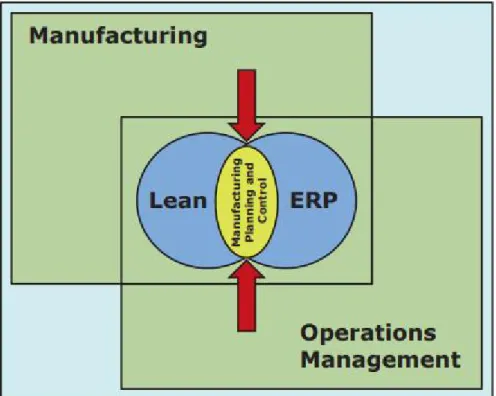
First of all, it is important to introduce the relation between an ERP and Lean Manufacturing. Both, Lean Manufacturing and Enterprise Resource Planning belongs to two important fields of a company, Manufacturing and Operations Management.
Fig. 1. Relation between ERP and Lean Manufacturing (Powell, 2012) a. ENTERPRISE RESOURCE PLANNING
An ERP (Enterprise Resource Planning) is a complex system which contains many modules in him. The finally of an ERP is to help in all the activities that a company can have. From Human Resources to Production Control or Logistics. Webopedia provides a generalized definition of ERP as “a business management system that integrates all facets of the business, including planning, manufacturing, sales, and marketing.”
i. Main parts of an ERP Finances
Human Resources Projects
CRM (Customer Relationship Management) Stock Control
Supply Chain Production Chain Business Intelligence Quality
Trading
P á g i n a
14 | 80
ii. Main characteristics of ERP systems
1. It has to be integral. All departments of the company have to be able to exchange information between them. Doing all the process in the more efficient way, without duplicating information. When we do not have an exchange of information in real time, we are going to have problems between departments, and the company will have problems.
2. It has to be modular. An ERP is divided in different modules, and each person from a company will have access to certain modules. Each company is different, so the needs of one company will be different of another company. Each company will have his own modules, and each module will be different for each company, so, there are not two ERP equals for two different companies.
3. It has to be adaptable. For the reason that each company is different, an ERP has to be able to do the tasks a company wants it to. Each company will have certain modules with certain characteristics.
iii. Advantages
1. Improving the decision-making process. Having a common data base implies that different departments can share real-time information, and information is “power”. With all this information the different departments are able to take decisions in real time doing it more credible.
2. Real planning of future situations. Having information, we can predict what is going to happen in certain situations in the future. For this reason, we will be able to have a good reaction to future problems.
3. Not having duplicities. Companies which don’t have an ERP can have problems with having same informs in different departments, and that’s a loss of efficiency.
4. ERP Systems are composed of different modules. Each module has a group of tasks. The modules are independent between them, but they share information for doing easy the work for the company.
P á g i n a
15 | 80
6. Control and traceability. From a company buy a raw material to when they send the final product, they have the control of it in every moment.
7. Integration of member of the supply chain. Now, both customer and suppliers are integrated to the company. There is an active communication between the company and the suppliers, which makes the company choose designs in new products. Talking about customers, the company is able to adjust the production to the customer needs.
8. Improving intern communication. An ERP makes easier the communication. A company with an ERP does not need almost meetings because of the sharing real-time information.
9. Tasks automation. Many repetitive tasks now are done by ERPs in many companies, saving much money in salaries and in time.
10. Reducing costs. Reducing costs mean being more competitive, and that have to be the first objective in a company. Reducing unitary cost means, increasing gains, reducing prices or both of them.
11. ROI. Thanks to all these ten advantages we could have a smaller ROI and increase cost effectiveness. So, in a large piece of time we will recover the initial investment and we will improve the gains.
iv. Disadvantages -
1. An ERP is not going to run successfully in all the companies
2. The implementation of an ERP is very slow. In a company
3. The implementation is more expensive than the software
4. A half of companies that implanted an ERP will never receive the gains that they expected. One of the biggest problems is being impatient, good results are not immediately.
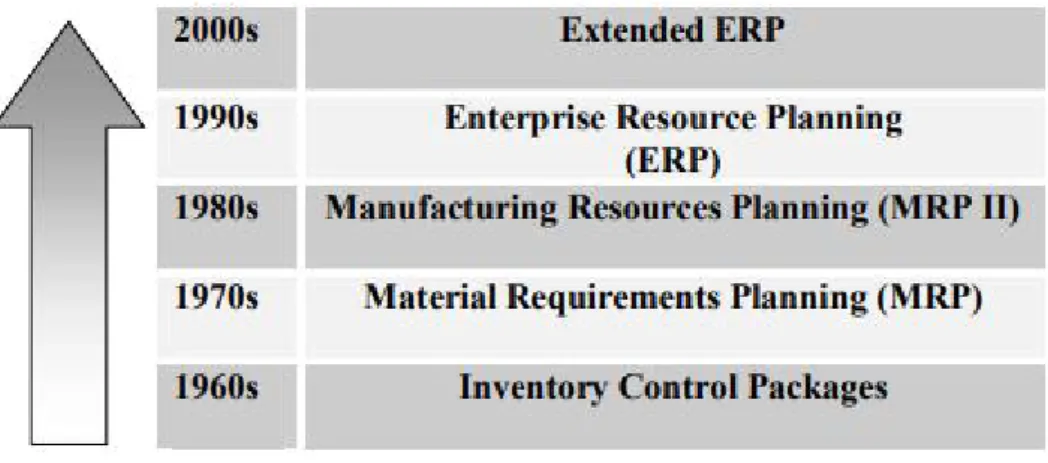
v. Historical outline.
P á g i n a
16 | 80
1. 1960s: The ERP were created to do easier the stock’s control. Many companies started using centralized computing systems to automatize the stock’s control using “Inventory Control Packages” whose programming languages are almost always COBOL, ALGOL, FORTRAN. The activities of “Inventory Control Packages” included knowing inventory requirements, reach targets and monitoring item’s waste.
2. 1970s: The MRP (Material Requirements Planning) was developed. At this time, the MRP had only the function of doing the planification of final products and, also, they could know the needed of raw materials based on production requirements, the inventory levels, the structure of the production.
3. 1980s: It is invented a second generation of MRP, called MRP II. MRP II continued doing the same tasks than MRP. However, MRP II had more tasks. The MRP II was made with the objective of optimizing management processes. New areas are included in this second generation, Human Resources, Project Management, Finance and Engineering.
4. 1990s: The first time we heard about the word ERP was on the late 80s and early 90s. The first ERP included all the improvements that the MRP II had and, also its integrated Distribution, Accounting, Service and maintenance, providing a great vison of the company.
5. 2000s: In the last 90s and 2000s ERP continued improving until having an extended version. These changes included Advanced Planning and Scheduling (APS), Supply Chain Management (SCM) and Customer Relationship Management (CRM).
P á g i n a
17 | 80
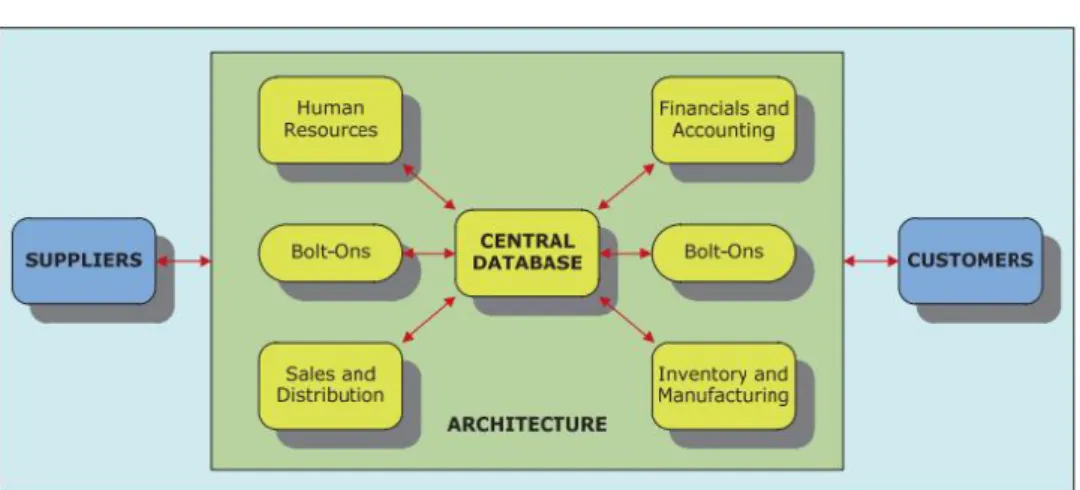
vi. Basic architecture of an ERP
Fig. 3. An Overview of an ERP System (adapted from Mabert et al., 2001)
1. Distribution:
Activities of selling and distribution of the products to the customer. With activities like doing offers or controlling stocks.
It is implicated in Main Functional Areas like Commercial, Transport and Stocks.
We are able to know orders state, analysis of selling or invoice control.
2. Finances. It allows us to control: Bills to pay.
Bills to claim. Sources cost. Treasury. Payroll.
Financial analysis.
3. Production Planification:
Master Production Schedule (MPS). It is able to anticipate bottleneck in the production. It is able to anticipate the needed for next orders.
P á g i n a
18 | 80
Capacity Requirements Planning (CRP). It can calculate the workload rely to the factory in specific conditions. It allows to plan many things like overtime or preventive maintenance
4. Supply Chain Management
Group of process related to vendors with the purpose of satisficing to the customer. The final purpose is to integer customer, vendors, factory, stocks and transporters.
5. Customer Relationship Management (CRM)
Analysis of the selling, marketing and post selling services with the purposes of:
a. Avoid losing customers. b. Increasing benefits.
c. Increasing customer satisfaction. d. Increasing fidelity.
b. LEAN MANUFACTURING
Jorge-Luis García Alcaraz defines Lean Manufacturing in his book “Lean Manufacturing in the Developing World” like: “Lean manufacturing can be defined as a combination of multiple tools to help eliminate activities that do not add value to the product, service and/or process by increasing the value of each activity, aimed to eliminate or reduce waste and improve operations.”. In addition, he describes waste like: “Anything other than the absolute minimum of time and resources to add value to the product and get the highest quality”. It is important to understand that Lean Manufacturing is not a goal, it is a path of improving forever. Lean Manufacturing is a philosophy of life.
i. History
P á g i n a
19 | 80
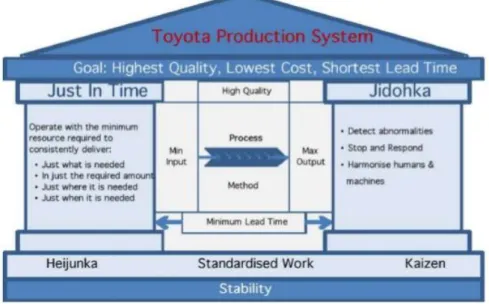
money wasting. At about twenty years later Kiichiro Toyoda introduced the technic of JIT (Just in Time). JIT is a technic in which the factory has the needed stock, the factory asks the suppliers only the amount they need to produce certain time. Consequently, the factory has only the products they are going to sell. With this technic the factory wastes less money in having stocks.
Fig. 4. Description of a modern factory
(https://comunidad.iebschool.com/innovate2day/2015/05/05/jit/)
When the II World War finished, Eiji Toyoda and Taiichi Ohno created the “Toyota Production System” (TPS), which is a method to apply Lean Manufacturing to a factory based on technics like JIT or Jidoka. In the 1970s The TPS was extended in all the Japanese’s factories and it started to translate to different languages starting with English. In the finish of 1970s Toyoda and Ohno started to do meetings around the world explaining their TPS. In 1983 TPS arrived at the first factory in United States, to “New United Motors Manufacturing Inc.”. After that the concept “Lean Manufacturing” started to be in factories around the world.
P á g i n a
20 | 80
“It is not solely the automobile industry that has been experiencing changes in operational practices. In fact, nowadays all industries exposed to global competition and changing technological possibilities are facing similar pressures to transform their practices in ways that are better attuned to the changing environment” (Kochan et al., 1997).
We use the fundamental principles of lean manufacturing identified by Womack and Jones (1996): “precisely specify value by specific product; identify the value stream for each product; make value flow without interruptions; let the customer pull value from the producer; and pursue perfection” (Hines, 2010).
“Value”, for the customer’s point of view.
“The critical starting point for lean thinking is value. Value can only be defined by the ultimate customer. And it’s only meaningful when expressed in terms of a specific product (a good or a service, and often both at once), which meets the customer’s needs at a specific price at a specific time” (Womack and Jones, 1996 p.16). The problem that we can see in many companies in that the immediately needed of the shareholder and the thinking financial-economical of the directives are above tan creating value for the customer, and the customer has to be the first thinking for a directive. It is interesting how Womack and James described how in Germany not so many years ago who decided how much value had a product from a company were the engineers of the same company. Many times, that was a disaster because the things they designed were not as popular as they though. In addition, the airplane’s companies many times has big airplanes to move thousands of people in large distances, when many people only need to go from one city to another n the same country. To sum up, knowing the real value of our product or service is the best way to have a satisfied customer.
Know the “value-stream” and eliminate wastes.
“The value stream is the set of all the specific actions required to bring a specific product through the problem solving task from concept through detailed design and engineering to production launch, the information management task running from order taking through detailed scheduling to delivery, and the physical transformation task proceeding from raw materials to a finished product to the hands of the customer” (Womack and Jones, 1996 p.19)
Attending to Womack and Jones the value-stream has three different stages:
P á g i n a
21 | 80
o Stage of the management of the information: From the request of acustomer of a product, the send to the arrival of the product.
o Stage of physical transformation: From the raw material to the final product arriving to the customer
Studying the value-stream of a company can reveal us a big quantity of “Muda”
Make value flow.
“Once value has been precisely defined, the value stream for a specific product family fully mapped by the lean enterprise, and obviously wasteful steps eliminated, it’s time for the next step in lean thinking…make the remaining, value-creating steps flow” (Womack and Jones, 1996 p.21)
Womack and James wanted to point in that flow production is always more rentable than production by steps, first one operation, later the other ones for an amount of products
Working with a pull system.
“Pull in simplest terms means that no one upstream should produce a good or service until the customer downstream asks for it” (Womack and Jones, 1996 p.67)
Working with a flow system have done that the products which took years in being designed now it takes like months, the orders that took days in being delivered now it takes like a few hours, activities that in the past took years and months in physical production now, it takes days or minutes.
Improvement has to be continuous.
“As organizations begin to accurately specify value, identify the entire value stream, make the value-creating steps for specific products flow continuously, and let customers pull value from the enterprise, something very odd begins to happen…suddenly perfection doesn’t seem like a crazy idea” (Womack and Jones, 1996 p.25).
P á g i n a
22 | 80
iii. Objectives
Lean Manufacturing is a management method to reduce wastage in the production of something or in offering a service. This wastage is called in Japanese with three words Mura, Muri, Muda:
Mura: Any irregularity in the production. When the factory has a “Mura” the system is not in balance.
Muri: Muri means overload. If the factory is doing any no needed activity. Probably if the factory had an overload it would be bottlenecks or breakdowns. A factory can avoid it if they standardize operations.
Muda: Muda means waste. Any consumption of resources without increasing the value of the product for the customer.
iv. Tools
For archiving the objective of the customer satisfaction, a company should use the next tools:
1. 5S’s
The tool of 5 S was invented by Hiroyuki Hirano in 1960 with the purpose of keeping the working place well-organized and cleaned for having a better working environment and improving the production, doing it more efficient. Finally, the 5S’s technic is a method for engaging the workers with the company objectives and having a stronger company culture. The 5S are:
Classification (Seiri): Place all the materials for their use and take no-needed materials out of the working place. Advantages:
o Having additional space.
o No having no-used materials.
o Decreasing non-value movements.
o Decreasing the waste of time in stocks.
o Decreasing the waste of materials.
Order (Seiton): Place the needed materials organized. Advantages:
o Decreasing searching time.
o Decreasing changing time.
o Occupying less space.
P á g i n a
23 | 80
Clean (Seiso): Keep the working place cleaned, deleting all the dirty sources. Advantages:
o Increasing worker’s motivation.
o Increasing the life of the tools.
o Increasing the quality of the production. o Increasing the satisfaction of the customer.
Standardize (Seiketsu): Each material has to be on its position. When the worker has the perfect location for each material, he has to keep it, if the worker changes the place, that will not be as good as it could be.
Keep (Shitkuse): The most difficult and important step. The worker has to keep the work place like the standard if not, 5s will have not any advantages.
2. KAIZEN
Kaizen is not a tool at all, Kaizen is a philosophy of “continuous improvement”. It requires that all employers engage with the company and they look for new ways to improve production and decreasing wasting of materials. It is very important to know very well the objectives of the company. One difficulty of Kaizen is to keep the positive attitude in the working environment.
Kaizen has three important statements:
Thinking People System:
5 Whys: Analysis method based in doing five questions to study the cause-effect relations. The final objective is to determinate a defect root to solve a production problem.
5S
3. POKA YOKE
A “Poka Yoke” is a quality tool which is used to avoid mistakes in manipulation a system. A well-known example could be an USB, introducing an USB into the computer you can only put it in one position, because it will not entry if you try by the wrong way.
It has two mean objectives:
P á g i n a
24 | 80
4. JUST IN TIME
Just in time is the main element of the “Toyota Production System”. Sugimori et al. (1977) defined JIT like a method which allows “all processes to produce the necessary parts at the necessary time and have on hand only the minimum stock necessary to hold the processes together” and Sugimori explained JIT with three characteristics:
iii. Levelling of production (Heijunka)
Heijunka is a Japanese word which means smoothing of the production program using like reference the production volume and the different products made in a determinate time.
It is a great way to deaden the variations of the demand producing some products in the same production line working in small batch.
One method to apply it is Heijunka’s box by calculating the cycle time, how much time it takes to make an item.
iv. One-piece production and conveyance
The second rule of JIT explains that while we are producing an item, we should be conveying another one for not having stocks and for not having machines without use. Obviously, that only can be used when the time in set up is almost zero.
5. KANBAN
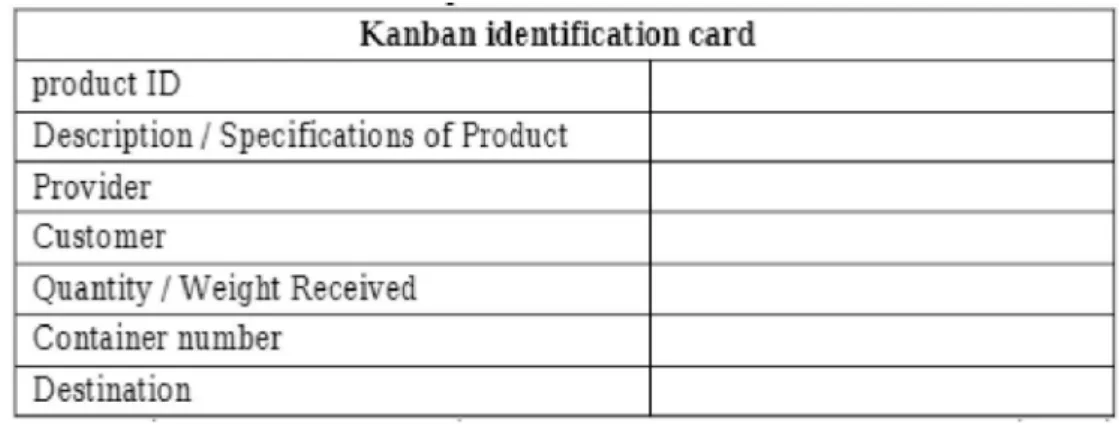
Kanban is an information system based in cards, which controls the quantity and the time of the production of needed products in each process inside and outside the factory
The Kanban cards are like witness in the production process. The workers stuck them in the material’s containers and they take them off when the container is used
The main types of Kanban are:
P á g i n a
25 | 80
item, the number of pieces and the place where it is going to be stocked.
Transport Kanban: These cards order a material transport to a working place. These cards contain the item, number of pieces, number of orders, working place.
Supply Kanban: Theses card rely the reception center of the raw material with the production center.
Urgent Kanban: In the case of a great necessity of material. The items must be transported in a container.
The Kanban cards have to be taken until a special box for them.
v. 6 Wasting types
1. PRODUCT DEFAULTS
a. Reprocessing products b. Wasting raw materials 2. OVERPRODUCTION
a. Wasting energy and workforce b. Excess of stocks
c. Hiding production problems 3. NO-NEEDED PROCESS
a. Great increasing of costs 4. NO-NEEDED WORKER’S MOVEMENTS
a. Stopping the production line
b. Movements without increasing product value 5. NO-NEEDED OBJECTS TRANSPORT
a. Store up in intermediate deport b. Too much manipulation
6. WAITS
a. Avoiding take advantage of resources 7. STOCKS
a. Hiding production problems b. Hiding efficiency
c. Hiding capacity problems d. Increasing financial cost
vi. Lean Steps
P á g i n a
26 | 80
standardized laws of the techniques that form Lean, much less those that should be applied in the field under study. It is a very flexible methodology that adapts to different situations and types of organizations. Once the management has become aware of the need to implement the Lean system, employees will be informed of its start, and then proceed with the diagnosis of the organization. The stages that maximize the value for the user while reducing waste, according to Womack and Jones (2012) are:
1. Identify the value
This point will be defined by the user, both internally and externally. The values that are going to be identified usually correspond to the strategic axes of the centers, depending on the characteristics of the organization and the Mission and Vision that it has. Different examples of values would be: promoting the library as a cultural center of reference to the user; identify and complete the bibliographic and documentary heritage of a region; develop and preserve the collection; improve the promotion of reading; or improve information, accessibility and visibility of the local section, etc.
2. Know the flow of value
Once the values of the library or documentation center have been determined, they must be measured and analyzed to know how they are developed in the organization. We must start with the needs of the client and then go backwards in the analysis of the process. The fact of finding the waste is the first step and fundamental factor in choosing the tools that eliminate it, going on to standardize the work with added value to restart the improvement cycle. It develops sequentially. You can set the stages at a very generic level in the Lean application:
Find waste in the process.
Once the right tools have been selected, eliminate the waste. Standardize work with added value.
Restart the improvement cycle.
Some of the tools that are going to be used for this are VSM, Balanced Scorecard, or radar chart, whose explanation will be made within the tools section in the evaluation phase.
3. Set Pull
P á g i n a
27 | 80
P á g i n a
28 | 80
2. MODERN ERP SYSTEMS AND THEIR IMPORTANCE IN IMPLEMENTING LM PRINCIPES a. MODERN ERP SYSTEMS
P á g i n a
29 | 80
Table 1. Comparation between suppliers of ERP Systems (Halgeri, 2008)
Powell et al. (2012) wrote about the ways in which ERP’s were going to improve. They were: i. Reduction in cost and implementation time
Nowadays all companies are continuously looking for ways to reduce wasting money. ERP helps in nine ways:
1. Implementing an integrated solution
The ERP keeps all the data in only a single platform, providing access to the workers and improving communication between workers. The ERP is flexible too, it can change for each business depending on the needed. Improves the workflow.
2. Automating and standardizing the operational processes Having an ERP which does its tasks automat avoid us having human mistakes than doing it manually. Automating all the process allow the company to improve the productivity
3. Improving the purchasing process
Only with a little mistake an employee can cancel a big purchase, for that reason is important not to have mistaken because it will affect to the relationship with the customer too. With an ERP an employee can easily generate purchase orders.
4. Track costs in detail
P á g i n a
30 | 80
5. Optimize stocks
Stocks are one of the main problems in all the companies. It is important having stocks, but it is a waste of money. With an ERP the company will have very much control in their stocks than not having it.
6. Manage warehouses more effectively
An ERP facilitate the communication between Headquarters and warehouses, also, the space will be used better, which is a really good advantage.
7. Improving the analysis and reporting process
Nowadays Business Intelligence is introducing in the ERP world, which creates a great advantage in analysis providing an overview of all the costs the business generates.
ii. Consolidation
Nowadays it is normal to for a medium-big company to work with an ERP System, the more well-known systems are SAP, Oracle, Sage or Infor. That systems are getting more and more important for the companies. The ERP is well consolidated in nowadays market, but in a few years, it will be more if it is possible
iii. Vertical solutions
One big difference between traditional and modern ERP’s is that traditional ERP’s are very static and not easy to fit with all the companies. The traditional ERP’s only had “horizontal attributes”, these attributes are the main part of the ERP, like finances, human resources or supply chain. However, Modern ERP’s include vertical attributes for specific industries like manufacturing, distribution or retail.
iv. A move towards SMEs
P á g i n a
31 | 80
v. Customizable ERP
Modern ERP’s are being more and more flexible, traditional ERP’s were not customizable, but now, each company have a different ERP depending on their activities, employees, products or suppliers. In addition, modern ERP’s modules can be added or deleted in the company’s life easily.
vi. Collaborative ERP
One of the main characteristics of ERP is the share real-time information between all the departments in a company. Traditional ERPs were not as collaborative as modern one, which was very important to improve. Finally, if an employer is going to take an important decision, he has to have all the information of the company in real time.
vii. Software as a service (SaaS) and Cloud Computing
Nowadays, a great improvement of ERPs is that all the information is keeping in the Internet. That is a great advantage because having a data base all the employees can upload the data, and if the company suffer any problem, the data is still in the data base. However, there are not only advantages, when I was working in Spanish’ company which worked with SAP one day all the internet went down, and the factory was a chaos, the product went out without identification, there were not a quantity control and many raw materials were wasted.
viii. Web-enabled ERP
Web-enabled is a great advantage to the company’s stakeholders who can access to the company information whenever they want by the Internet. The real definition is “Web enabled refers to a product or service that can be used through, or in conjunction with, the World Wide Web. A Web-enabled product may be accessed through a Web browser or be able to connect to other Web-based applications in order to synchronize data.”
ix. Mobile ERP
P á g i n a
32 | 80
x. Real-time ERP
P á g i n a
33 | 80
b. WHY IS IT NECEARY TO IMPLEMENT LM PRINCIPES?
i. Push systems
The technique that an ERP uses to do a control of inventory is Push technique. Push technique consists in forecast the inventory needs predicting the company’s customer demand. The company has a team of demand planner who are studying the market continuously. The demand planner looking at the demand of lasts months, the time of the year and having a safety percentage of demand is able to create a forecast of the demand for next months with what the company is going to work. Many customers do not ask for products until two or three day before receiving it, so if the demand forecast is wrong the company will have a very big problem. Sales many times are unpredictable, also they are changing very much between the season of the year, the month and also the week. Push systems have another great disadvantage, because of the unknowing demand, the stock of raw material and products have to be as much as necessary, which is a very big waste of money. The advantage is that, having the enough stock is very difficult not to serve a customer when they want. As a personal experience, I have been working in a Spanish company called “Grupo Siro” as supply chain technical. That company works only with one company, supermarket company suppling baked goods, the supermarket is one of the most-known in Spain and it has a very strict treat with the suppliers. They told my company the orders with two days to product it. In my company we worked with an ERP (SAP) but, when a mate was in holidays, I had to do some demand planner tasks. Each month, the demand planner of the factory did a forecast for the next month, with this forecast all the factory worked. My supply chain boss asked for raw materials looking to the demand plan, so if there was a problem with the demand plan or we were wasting many raw materials there was situations in which the production had to stop because of the lack of raw materials. That stop of the production were a big waste of money and I saw more than three times. These stops of productions were very dangerous because one or two times my company fail a customer order, and that is not good for the relationship with the customers
To sum up, push systems could be a good option if the company is working in a market in which the demand is very similar between months because if not, the company will have to have a lot of inventories, production stops and in the worst case the impossibility of serving to the customer.
ii. Pull systems
P á g i n a
34 | 80
under the pull systems is the ideal state of just-in-time manufacturing: deliver the customer what they want, when they want it and in the quantity they want.
An example that we have all seen from a pull system are the majority of supermarkets. These have a small amount of inventory in an interior warehouse based on historical purchases and predictions of future demand. Customers are consuming the products they want from the shelves of the "visible" area of the supermarket and a person in charge of the replacement goes over time to time to see what products are missing and replaces them from the interior warehouse. So far everything seems logical, however, the key to the system comes with the following. The worker not only worries about filling the shelves, he asks the supplier for the products too, he has used to fill the shelves so that daily (or more often according to the supermarket) the supermarket receives exactly what customers have consumed. A clear example of a pull system.
Toyota’s system works in a very similar way to this example. It is not a completely null inventory system but depends on small controlled warehouses that are filled by a pull system. These small inventories, despite the fact that the lean philosophy seeks to eliminate them, are necessary due to the natural interruptions of the flow from the transformation of raw material to the finished product.
This seems simple if we think of a supermarket in which a worker does not take more than a couple of hours or three hours to go through all the shelves scoring and replacing what customers have consumed. However, when it comes to large factories where suppliers may be located far from the production line, a system is needed to indicate when a piece has been used and what type it was. At this moment is when the so-called cards (containers, cars, ...) appear a Kanban.
A Kanban card is the signal that indicates that you have to fill a piece or a set of pieces that have been consumed, but I will talk about it in more detail in the next entry, for now we are left with what is the method that allows us to manage a pull system.
iii. Comparation between pull and push
P á g i n a
35 | 80
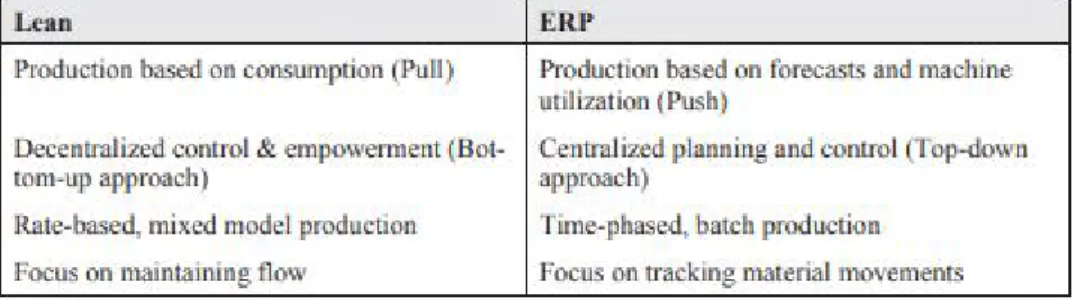
1. Pull vs push: ERP vs lean
Now that we know what Pull and Push is, we know the management of an ERP and the management of Lean, we are going to compare them, we are going to see which characteristics can help between them. First of all, it is important to know that both of them are tools with what a company wants to take advantage to their competitors. However, ERP systems have been regarded as tools with what the company is wasting resources. Nowadays, the ERPs are used to improve the manufacturing planning, in this way lean manufacturing can help, because the target is the same. However, the question is, when we want to eliminate non-value-added actions should we use ERP, Lean or both?
Benton and Shin (1998) said that “there is a common agreement among researchers that a lean, kanban controlled production system functions as a pull system, whereas those systems using MRP logic are predominantly push.” Rother and Shook (2003) said that “to qualify as pull, parts must not be produced or conveyed when there is no kanban, and the quantity produced must be the same as specified on the kanban.”
Olhager and Östland, (1990) said that “When defined in terms of information flow, in a pull system, the physical flow of materials is triggered by the local demand from the subsequent customer. On the contrary, a push system uses global and centralized information stored within the central ERP system in order to drive all production stages.” Reading Olhager and Östland we can find another big difference between ERP and Lean. While ERP suggest a centralized information control
There is another way of thinking that ERP systems are not capable to control in real time the production.
Reading all these authors we can take one common thing in their thoughts. The ERP systems are systems made for working in a medium-large period of time, for example with the raw materials, the company has to take the control for minimum one-week production, because if not, it could be that they will not have enough raw material for the production. While the ERP is a medium-large planning, Lean Manufacturing is a short time solution, it is continuously searching for the best way to produce and applying it as soon as possible.
2. Bottom-up and Top-down
P á g i n a
36 | 80
The top-down is a method with what the company focus on the market characteristics They will also look at the performance of sectors or industries. These investors believe that if the sector is doing well, chances are, the stocks in those industries will also do well.
Top-down investment analysis includes:
Studying the growth of the market in which the company is moving.
Monetary policy.
Inflation and the price of commodities.
Bond prices and yields.
The bottom-up strategy focus on little pieces together to create more complex systems investing. They will focus less on market conditions, macroeconomic indicators, and industry fundamentals.
Bottom-up analysis focus includes:
Financial ratios, current ratio, return on equity, and net profit margin.
Earnings growth including future expected earnings.
Revenue and sales growth.
Financial analysis of a company's financial statements.
Cash flow and free cash flow.
Management's leadership and performance.
A company's products, market dominance, and market share.
The bottom-up approach invests in stocks where the above factors are positive for the company, regardless of how the overall market may be doing.
3. Rated-based model & Time-phased mode
4. Maintaining flow & Tracking material movements
iv. Hybrid System Pull Push
P á g i n a
37 | 80
motivated by considerations of effectiveness. Centralized control of ERP system uses global information essential for this mode of operation, which will dominate a pull system using only local information. Pull is reflected in more decentralized and participatory management, while providing a better service, but a higher cost in a world where random events occur. Finally, pull is a common concept in Japanese environments (Kanban) and push is considered an American approach (MRP). The concept of ERP systems is based on best practices, providing a mechanism for the standardization of business processes. These motivations and benefits are clearly aligned with the principles of Lean. In addition, many companies are now using Lean approaches based on ERP to communicate the request through the supply chain to facilitate the just in time delivery. For example, Nissan Motors (UK) communicates its demand for carpets to its supplier electronically; the supplier then produces products to the specification and the correct sequence and delivers them directly to the production line in 20 minutes. Unsurprisingly,
P á g i n a
38 | 80
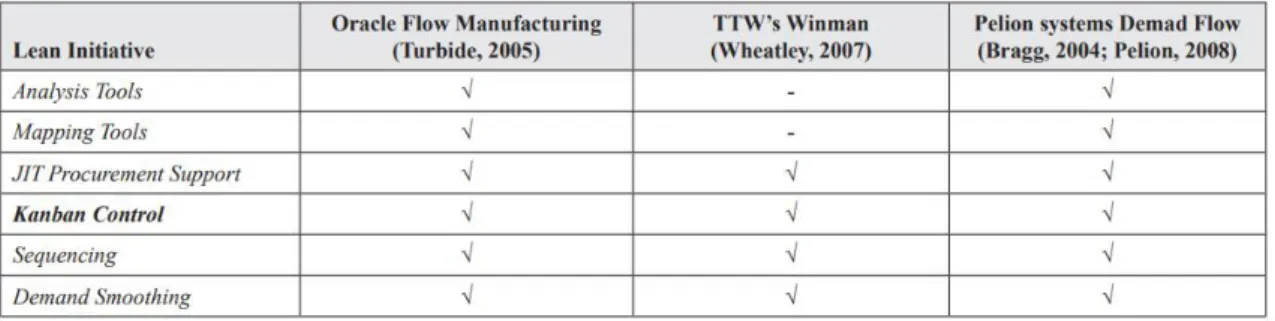
3. SOLUTIONS IN ERP SYSTEMS THAT CAN SUPPORT LEAN MANUFACTURING TECHNIQUES While a business can implement lean initiatives without aid of an ERP system, doing so may not optimize key processes:
Lean is designed to eliminate waste across the board, from labor to raw materials and equipment capacity. ERP can support these efforts by accurately predicting production trends, allowing manufacturers to review analytics and accurately project anticipated production spikes, staffing needs, machinery run times, and needed inventory.
Manufacturers have to be at the top of their game to stay competitive in crowded markets. One-way companies choose to do that is by installing an enterprise resource planning (ERP) application. ERP can help organizations improve operations and stay competitive, even when competition is tight. Here are five ways in which an ERP can help Lean Manufacturing to reduce wasting.
1. Improving Inventory Management
There are two types of management inventory. First, there’s raw materials management—the processes that go from the reception of raw material until the raw material is used. In addition, there’s product inventory—the products that are produced through the manufacturing process and how they are moved to customers. The right ERP application can help on both types of that inventory equation by advising to the company when they have to ask for raw material for the manufacturing process, for not having less raw material than the needed and that the production levels are correct, and the levels of product are enough to satisfy customers.
More than half of all new businesses will fail within the first five years of setting up operations. A further 30 percent of the businesses will not enter their 10th year of operation. While there are a significant number of reasons for businesses to fail, one of the most striking, and avoidable, reason is poor inventory management. Companies unable to manage their inventory either have too much of a stock in one place or not enough where there is a demand for it. They could also be saddled with excess inventory and not be aware of it.
However, this is one reason that can easily be avoided by simply having an ERP solution in place to manage inventory. The following are the different ways an ERP helps manage inventory:
P á g i n a
39 | 80
ERPs are a very efficient method to improve the tracking. However, there are a lot of changes to do in ERPs to improve tracking. These are some examples:
o Link Customer Orders to Production Orders and Raw Materials
Many ERP systems do not provide a direct link between customer sales orders and the associated work order or job. This link is vital in providing a view of the manufacturing process and potential purchased parts necessary to satisfy each and every customer order. When I was working in my company last summer, the orders arrived at the logistic department two days before the product sending. That order was put into SAP, and then SAP created new necessities. In my opinion, the process was very wrong, if a worker forgets to look the necessities, or introduces wrongly the orders, the production will be wrong, and the company could fail an order. If the ERP receive the orders and on his own creates the production orders and we can avoid the human mistake.
o Digitize Your Tooling Inventory
Tooling is a critical input to most production operations, and most ERP systems ignore it when it comes to work scheduling in production operations.
Simply putting tooling in a separate desktop database or a spreadsheet doesn’t cut it when it comes to improving work scheduling.
o Be Clear About Priorities
The best way to manage work scheduling effectively is to be sure production priorities are clear. Prioritize work orders needed to fulfill customer demand over orders that are supporting forecasts.
Most ERP systems at best provide loose links between shop orders and customer sales orders, making it hard to keep priorities in line with customer expectations. They also make no distinction between production orders released to fill forecast and those needed for actual customer sales order demand. Relying on paper routings makes it difficult for shop personnel to reorganize the floor part sequencing with changes in due dates that reflect the constant changes in demand. In addition, the infinite MRP planning used by most ERP systems almost guarantees you will have orders that aren’t required for immediate customer demands, but it will prioritize them over other orders with real demand.
P á g i n a
40 | 80
o Simplify Setups Whenever PossibleThe best way to minimize downtime whether planned or unplanned. You already know that keeping up with recommended preventive maintenance schedules will help but simplifying setups can help by getting the most production process “performance” time out of your equipment on a shift-by-shift basis.
One of the best ways to simplify setups is to run jobs with similar setups consecutively so that you can take advantage of the common raw materials and/or tooling and setup elements already in place. It’s extremely difficult to sequence jobs manually, and most ERP systems don’t even try, and it a great improving way.
o Cross Train
It’s wasteful to have a job already to go only to discover that you don’t have a skilled operator available to run the job. Even if your ERP system allows you to put a skills code on a routing step, most don’t do anything with the information when it comes to scheduling.
It is important to understand that operator skills are required input to an operation, and real-time labor reporting will help provide visibility into operator availability as the shift wears on.
A cross-training program helps improve quality, operational flexibility and employee loyalty. Employees enjoy learning new skills, and your most skilled operators can be energized by teaching newcomers or rising stars.
o Implement Scheduling Software the Right Way
Scheduling software should be implemented with a production tracking software, such as, a MES. It will increase the effectiveness and improve the productivity on your shop floor by enhancing visibility through the real-time labor reporting and improved visibility. In addition, these solutions help increase schedule accuracy because they can schedule to much finer increments than ERP scheduling solutions, which usually have a day or a shift as the smallest schedule increment.
P á g i n a
41 | 80
Fig. 6. Importance of Real-Time monitoring (https://erpblog.iqms.com/real-time-monitoring-revolutionizing-manufacturing/)
Shipping and Logistics: The shipping process is streamlined from receipt of materials to manufacturing, transport, storage and delivery of products. ERP also records the time and costs associated with storage and transportation. This automation saves you time and expenses while increasing efficiency of your resources and maximizing staff time.
Characteristics of ERP which are important to the transport
With transportation management in ERP, you can accurately forecast demand and shipment volumes, enhance freight management, consolidate orders, maximize the return on your transportation spend, and gain real-time visibility into domestic and international shipping across all transportation modes – basically achieve all of your transportation goals. Let’s look at some key features:
o Requirements management
With transport management in ERP, you can simplify the requirements management process by integrating the processing of your transport orders with the cash order and order to payment processes and obtaining the required visibility. By centralizing transportation management requirements, you can reduce redundant tasks and concentrate on value-added activities.
P á g i n a
42 | 80
Plan, consolidate and optimize shipments while considering restrictions, costs and penalties. Address the requirements of international trade and restricted asset management and reduce expenses while maintaining the required levels of customer service.
o Carrier Booking
Collaborate with carriers, reserve capacity for shipments, change reservation confirmations and shipping instructions, and better coordinate transportation activities. When delivering orders to one or many operators, you can choose the preferred supplier for your shipments based on optimization and classification techniques.
o Effectively monitor transportation
Manage communication with carriers, send and track freight orders and maintain the necessary documentation. The complete integration to your warehouse management system allows a faster, more dynamic and responsive logistic execution and a better handling of the load.
o Route planning
With ERP transport management, you can evaluate a set of orders and determine the optimal transport mode, route and provider to minimize expenses within the required customer service level restrictions.
o Schedule appointments
Check availability of springs for loading and unloading elements. You can receive notifications for scheduled appointments and avoid problems when more than one carrier arrives at a particular location at a certain time.
o Dispatch Planning
ERP transport management helps in effective planning for shipment; You can send material from multiple sales orders and achieve the flexibility to plan the shipment and load effectively.
o Financial support
With ERP transport management, you can easily and efficiently manage the actual cash exchange between your company and cost or revenue centers, such as freight billing and accounting, reduce errors in paid invoices and guarantee qualifications. more accurate freight.
o KPI identification
P á g i n a
43 | 80
o Transport Follow-UpCarry out the physical or administrative operation required in relation to transportation: event traceability event by event, customs clearance, billing, delivery of the shipment and configuration alerts.
o Key benefits of transportation management
Carry out the physical or administrative operation required in relation to transportation: event traceability event by event, customs clearance, billing, delivery of the shipment and configuration alerts.
Going one step further, let's say you have all the key functions mentioned above, and now what? Transport management in ERP can even improve the profitability of the business, by offering the following benefits:
Improved accountability and visibility in the transport chain. Reduction of costs thanks to better route planning and load optimization.
Consolidated and optimized shipments of entry, exit, national and international
Improved transport logistics that guarantees on-time deliveries and expected levels of customer service
Configuration of optimal qualification structures based on charges such as fuel and tolls.
Effective management of large volumes of transport and logistics data through state-of-the-art analysis and planning.
Easy identification of the fastest route or the cheapest rate for a shipment
Strategic purchase and sale of freight capacity with centralized order management.
Efficient management of all expenses associated with the operation of transport vehicles.
o Improvement of transport efficiency
Since ERP transport management systems are a complicated collection of functionalities, it is important that you understand your transport process and identify the critical requirements. Next, you can select the required transport functionalities and make sure that the ERP transport management system you choose is solid in all the areas that are key to your success, and help you improve transportation efficiency.
P á g i n a
44 | 80
to easily manage stock levels in several ways, including automating the ordering of products and materials based on pre-established time intervals or stock levels, as well as inventory analysis reports. ERP offers management functions for product recalls, as well as complete product traceability. ERP's expense and profit management capabilities allow you to track expenses and product availability over time and compare costs among suppliers. You can easily monitor prices, allowing the administration of profits and expenses in one installation, product or unit.
How can ERP technology impact inventory control? After offering process improvement services during several projects, here are three points of reflection:
o Methods to improve data entry: through modern barcode scanners or other
devices that reduce data entry errors, accelerate data collection and prompt timely information and integrate warehouse data into the system ERP
o Reports in real time and throughout the company: to obtain the ability to access
sales / work orders in real time, purchase orders and inventory information that would flow smoothly between the warehouse and the ERP system as they are made the processes.
o Integration with ERP, which is essential to achieve the desired future state. As
an example, it is essential for the improvement of business processes to integrate the transfer of data between the warehouse and the ERP to obtain accurate and timely data for billing, payment of the purchase order and tracking and inventory management, all without manual input of keyboard data.
Ways in which ERP can improve inventory management
“Inventory control backed by ERP technology drives the shop floor, supports materials handling and is what helps drive an organization's revenue,” notes Andres Richter, CEO of ERP solutions provider, Priority Software.
ERP can help manufacturers with a wide range of inventory control functions, from parts management, bills of material and inventory counts to label printing, warehouse control, inventory transactions and delivery tracking. The effective use of ERP is what separates good inventory control from bad.
Are you taking full advantage of your ERP system for inventory? Here are five ways you should use the ERP for better inventory management.
1. Use the sensors for error-free tracking
P á g i n a
45 | 80
"Modern barcode scanners or other devices can reduce data entry errors, accelerate data collection and prompt timely information and integration of warehouse data into the ERP system," says Jeff Carr, founder of the company. business technology consultant Ultra Consultants.
"Where ERP technology is really increasing inventory, control is implementing sensors to 'test' the production floor, taking ERP to a whole new level of efficiency and productivity," Richter adds in Priority Software. "For example, whenever a raw material is used in the manufacturing process, dedicated sensors can alert / report the exact amount displayed."
A good example is Wisco Industries, a metal stamper and manufacturer that produces components for the food industry and that is used to manage inventory manually. The company had approximately 9,000 inventory labels and hand-adjusted inventory, a process that took more than a full month to audit completely every year. But after adapting the barcode scanners and linking them directly to your ERP system, the company has automated inventory tracking, reducing the end-of-year audit process from weeks to a few hours. An additional advantage: Wisco reduced its inventory by 20 percent.
2. Real-time inventory tracking
Real-time reports are a second way you can improve inventory control with your ERP. Now that ERP systems have moved largely to the cloud, there are new opportunities to update inventory movements in real time and also to monitor inventory through production panel panels and mobile devices.
“ERP generates accurate and thorough reports, ensuring information regarding inventory levels, purchases, accounting and employee time management is readily available,” said Richter.
If you do not have inventory visibility in real time, you are not taking advantage of your ERP technology.
3. Manage end-to-end inventory
The monitoring of the inventory at each stage of the manufacturing process not only provides greater visibility and control of costs, but also a better capacity to respond to changes in the demand for manufacturing and adjustments of change in supply. Even if you use several different systems for inventory management, you can connect them all to your centralized ERP system for end-to-end tracking and management.
P á g i n a
46 | 80
inventory levels and maintain tight controls on inventory replenishment, minimizing excess stock and ensuring timely order fulfillment.”
With end-to-end management, manufacturers can also better track production, deliveries, orders, stock adjustments, and inventory transfers between facilities.
4. Reduce system silos
A challenge for the efficient control of inventory is to manage the various silos through which the inventory passes throughout its journey from the workshop to the final consumer.
ERP can play a fundamental role in the automation of data exchange between these systems and in the creation of a centralized system or registry, which provides greater visibility and control.
Cloud-based ERP is particularly good at decomposing silos within a company and in a manufacturer's supplier network through EDI and system APIs.
“Integration with ERP is critical to achieve desired future states,” suggests Carr at Ultra Consulting. “As an example, it’s critical for business process improvement to integrate data transfer between the warehouse and ERP for timely and accurate data for invoicing, purchase order payment and inventory tracking and management, all without manual keyboard data entry.”
Your inventory control still needs work if you do not have visibility of your supplier network and movement or inventory to the customer.
5. Accurately predict demand and replenishment
Finally, ERP can help with inventory control by predicting demand and replacement needs continuously.
“A robust ERP system with an integrated MRP (Material Requirements Planning) module automatically verifies the amount of material in stock, and via predictive analysis (also part of the ERP), a prediction can made as to when new material needs to be ordered/replenished,” says Richter.
Recent advances in artificial intelligence are making these predictions more accurate than ever, and now they often include external factors such as climate and the variability of local demand in forecasts. Sophisticated, fast and in-memory simulations can combine demand, supply, inventory and production data that can then be adjusted by sales, operations and those working in the supply chain.
P á g i n a
47 | 80
Inventory control is a key component of the manufacturing process. Companies must fully utilize their ERP system to ensure that the management of their inventory is working as efficiently as the production team in their shop.
Replenishment planning: inventory management allows you to correctly plan replenishment orders. The ERP inventory management system allows you to sort the pieces, so you can order the correct quantity. An item is requested only when there is a specific demand in the exact amount to meet the demand. Another item is ordered when at a lower cost and is easily acquired. Optimizing replenishments means fewer transactions and that leads to better inventory accuracy.
Features and benefits of automated inventory planning:
o Reduce forecasting errors with seamless integration of ERP (learn more about ERP integrations)
o Spend less time validating data and more time in business operations
o Allow integrated generation of orders in multiple locations and suppliers simultaneously
o Buy only what is needed while improving service levels
o Automatically identify items in excess or will soon be in excess
o Achieve higher service levels through dynamic inventory classification
o Complete replacement according to the company's objectives.
o Generate more sales anticipating better the demand and properly storing the warehouses to satisfy the demand.
o Receive notifications of several high priority problems, including stockouts,
surpluses, forecasting errors, and variations in delivery time.
o Establish objectives and automate a plan to achieve them (multidimensional
ABC classification)
Organizations that use these points of inventory planning solution have:
o 3-5% increase in income and profits, through reductions in stocks and greater customer satisfaction
o 10-30% Inventory reductions - significantly reducing costs o Faster inventory turns: significantly improves profitability
o Greater customer satisfaction: with automated service levels that help to avoid depletion and loss of sales
o Decrease in stock outflows, excess stock and lost sales: reduced costs and higher sales volume
o Increase in employee productivity: increase of 50-70% through process
automation
P á g i n a
48 | 80
Surplus inventory management: you can see and react to the surplus inventory in real time. There are options you have when the surplus is quickly found, and the reaction is immediate. Delay may mean that you have to discard the surplus, thus losing money.
The inventory of surplus is when the inventory of a company has an amount in excess of what is needed, either for the development of the product or an excess of products for the established limit of the company itself. While some managers of the company will see an inventory surplus as something positive, the items they sell with an expiration date may see an inventory surplus as negative, since the surplus is essentially a waste if it is not sold on time.
o Identification of surplus
An inventory surplus can be defined in several ways. If the inventory has an established limit of items in the inventory, the limit can be compared with the actual quantity in the inventory. The inventory is in surplus, if the quantity in stock exceeds the limit established by the company. Another way to identify the surplus is to look at the stock space. Some inventories are full, if the shelves are stored properly. If the items are on the floor or hidden, the inventory may also be in surplus. Finally, the inventory manager can examine the inventory purchasing budget to see if the company has requested more than usual. This method only works if the purchasing budget is consistent each month and the products ordered are identical for each order.
o The surplus as an asset
Since the items stored in an inventory have a certain monetary value, a surplus of inventory can be considered an asset for a company. This is the case if the items in the inventory can be sold for months or do not have an expiration date. For example, electronic equipment is a positive surplus, since it can increase the overall value of inventory, which can increase the value of assets. Electronic equipment must be in demand and capable of being sold to be considered a valuable surplus.
o Surplus as Liability
An inventory surplus can be a costly issue, especially if the items in the inventory have an expiration date or should be used before a certain date. For example, a restaurant with a surplus of meat or dairy products cannot sell dishes with meats or dairy products after the expiration date. This is a health and safety problem for customers.
P á g i n a
49 | 80
Companies that are in a situation where they have a surplus of items must find a productive way to use the surplus to avoid having a monetary waste. Many companies will use surplus raw materials to create more products and have a sale that benefits the end user. This can include buying a purchase to obtain a free purchase or simply buying products at a discounted price. The ultimate goal is to make a profit despite having a surplus.
Reduce costs: an ERP system can help an organization avoid having too little or too much stock available and allow better management and optimization of inventory by avoiding bottlenecks, making accurate predictions, establishing reliable delivery times and accurate prices at suppliers, which ultimately results in better offers. By understanding costs and margins, a company can have a clearer picture of profitable prices and return them to suppliers during negotiations. And with historical sales volumes on hand, inventory managers can take projections to suppliers and take advantage of the best prices by backing them up with indisputable data. Companies can also identify items that can be sold through special orders or direct shipments instead of having them on the site and integrate purchase and sales information in the product data. By knowing exactly how much stock to maintain and when, companies can manage and optimize warehouse space, reducing the overhead of their inventory operations.
An ERP system can help an organization gain visibility into the reward rates and margins of each item that remains in stock, monitor expiring and slow-moving items, anticipate future needs by reviewing accurate data on historical demands and reducing costs when comparing offers and effective negotiation with suppliers.
One of the most important aspects of an ERP system is its ability to accumulate and produce easily digestible data throughout the organization. This allows stakeholders to harness the power of that data to evaluate key performance indicators, provide cost-to-benefit analysis, improve productivity and share information with stakeholders, suppliers, customers and staff members. This access to data can help the whole operation to develop more smoothly and combine competing initiatives into a coherent global strategy that provides optimal inventory supplies at an optimal cost.
2. Improving Manufacturing Efficiencies