ABSTRACT. There are many methods to identify anaerobic nonsporeforming bacilli: histological, bacte-riological (biochemical test, microsystem API 20 A), serological, cell wall composition analysis, molecular methods and gas-liquid chromatography (GLC). A comparison between biochemical tests and gas-liquid chromatography was made in this study for the identification of this group of microorganisms. GLC con-di tions were established with the aid of reference strains. These concon-ditions were then applied to ten strains which were previously identified by biochemical tests. Strains were grown in PYG broth and fermentation end products were analyzed, volatile and non volatile fatty acids. Their qualitative determination was made by comparing the retention time of known standards and the chromatographic pattern of reference strains. In addition, a semiquantitative analysis was made. The results of identification by biochemical tests were: five strains belonged to Actinomyces genus; three were Propionibacterium acnes; one Propioni-bacterium granulosum and one P. propionicum. By the GLC only seven strains were identified: four were Actinomyces and three P. acnes. Only six strains showed identification correlation by both biochemical tests and GLC. GLC is a presumptive identification method that can be used along with other compleme n-tary tests for a definitive identification at genus level.
Keywords: Anaerobes, Identification, gas-liquid chromatography
RESUMEN. Hay varios métodos para la identificación de los bacilos anaerobios Gram positivos no espo-rulados: histológicos, bacteriológicos (pruebas bioquímicas en tubo, microsistema API 20 A), serológicos, análisis de la composición de la pared celular, métodos moleculares y cromatografía gas -líquido (CGL). En este estudio se hizo una comparación entre las pruebas bioquímicas y la cromatografía de gases para la identificación de este grupo de microorganismos. Se establecieron las condiciones para la CGL usando ce-pas de referencia y se aplicaron para estudiar diez cece-pas problema, previamente identificadas por pruebas bioquímicas. Las cepas fueron cultivadas en caldo PYG y se analizaron los productos finales de ferment a-ción de la glucosa, ácidos orgánicos volátiles y no volátiles. Se hizo su determinaa-ción cualitativa por com-paración de sus tiempos de retención con los de patrones conocidos, el patrón cromatográfico de cepas de referencia y un análisis semicuantitativo. Los resultados de la identificación por pruebas bioquímicas fue-ron los siguientes: cinco cepas perteneciefue-ron al género Actinomyces, tres fuefue-ron Propionibacterium acnes; una Propionibacterium granulosum y una P. propionicum. Por cromatografía de gases se identificaron so-lamente siete cepas: cuatro correspondieron a Actinomyces y tres a P. acnes. Sólo en la identificación de seis cepas hubo correlación entre las pruebas bioquímicas y la CGL. La CGL es un método de identifica-ción presuntiva que puede usarse junto con otras pruebas complementarias para llegar a ser confirmativa a nivel de género.
Palabras claves: Anaerobios, Identificación, cromatografía gas-líquido
Identification of Anaerobic Nonsporeforming Gram-Positive
Bacilli by Biochemical Tests and Gas-Liquid Chromatography
PATRICIA CAUICH-SANCHEZ, FELIPE
ALATRISTE
-MONDRAGON, E
LSA GARCIA-CANO,*CARLOS AQUINO-SANTIAGO
Departamento de Microbiología, Escuela Nacional de Ciencias Biológicas. Carpio y Plan de Ayala.
Apartado Postal 4-862, México, D. F.
*Corresponding author E-mail [email protected]. Fax (5) 7296207
INTRODUCTION
Anaerobic nonsporeforming Gram-positive bacilli are found within section 15 of Bergey's Manual, where can be founded Actinomyces, Arachnia, Propionibacterium,
Bifi-dobacterium, Eubacterium and Rothia genera included.17
Until now, there have been several changes in the classifi-cation of this group, for example, A. propionica now is
Propionibacterium propionicum within the genus
Actino-myces; A. israelii serotype II was changed to A.
gerencse-riae; and Bifidobacterium eriksonii was changed to B.
den-tium.9,15
Actinomyces is involved in several pathological
Propionibacte-rium spp. has been reported in cases of uveitis, endophtalmitis, pulmonary abscesses; bone, joint, and cen-tral nervous system infections, endocarditis, and it is also associated with SAPHO (sinovitis, acne, pustulosis, hy-perostosis, and osteomyelitis) syndrome.4,5,6,15
It can be observed that the frequency of these infe c-tions has increased, so it is important to identify the ethiological agents accurately, specially when the treat-ment has not produced the expected results.4,5,11
As it is known, there are different methods to identify the above mentioned bacteria. Among the most used ones are the bacteriological (biochemical tests in tube, API20A microsystem), serological, and histological methods, al-though the analysis of the cell wall composition, molecular biology tests, and the analysis of fermentation products of glucose are useful.7,10,18,19
Identification by biochemical tests, particularly for this group of microorganisms, is not final, even though a big group of substrates were used.7
In serological identification the fluorescent antibody technique is employed. This technique is fast although pre-sumptive, specially when monoclonal antibodies are not used.
It is worth to note that, when cell wall composition is used for the identification, it is necessary to analyze the sugars and aminoacids by paper or thin layer chromatogra-phy. It is important to remember that the cell wall must be free of contaminants.16
Other authors have used the gas -liquid chro matography method (GLC) to identify anaerobic microorganisms. This is done by taking advantage of their capacity to produce metabolites, such as organic acids and alcohols, produced by glucose fermentation.2,3,10,14
This methodology is sensitive, fast, and useful for the final identification to genus level, as well as of great value to determine the species, since less biochemical tests are used (compared to the traditional method). This cause sav-ings of time and costs. Furthermore, it is of great value in the definitive identification of anaerobic non spore forming Gram-positive bacilli.3,6,11,13 However, it is necessary to remember that, in order to identify them by this method, the following information must be available: Gram stain, presence or absence of spores, cell morphology, oxygen susceptibility, and production of catalase and indol. After knowing the characteristics of the several meth-ods, the this work establishes the use of GLC and bio-chemical tests methods for the identification of a group of anaerobic nonsporeforming Gram-positive bacilli, correlat-ing the results obtained by both of them.
MATERIAL AND METHODS
Reference and isolated strains. Actinomyces israelii
CDCW838 Ser2; Actinomyces naeslundii CDC X454;
Ac-tinomyces odontolyticus ATCC 17929; Propionibacterium
acnes CDC 14369; Propionibacterium acnes ATCC 6919.
Test strains were isolated from tonsils with the follo w-ing codes: 1015 ENCB; 1028 ENCB; 1033 ENCB; 1016 ENCB ; 1010 ENCB; 1031 ENCB; 1011 ENCB; 1012 ENCB; 1003 ENCB; 1003 (small colony) ENCB.
Recovery and identification of the strains. Lyophi-lized strains were rehydrated in Tioglycolate broth NIH (Bioxon No. 284-1). Strains were grown in tripticase soy agar (Bioxon No. 108-1) to observe catalase production, and GC agar (BBL No. 11275) enriched with isovitalex (BBL No. 11875) to determine macroscopic and micro-scopic morphology, and the influence of oxygen in its growth. The identification of the test strains was made by conventional biochemical tests and by GLC. In GLC the production of organic acids was detected. All solid media were incubated at 37°C in anaerobic conditions using the Gas-Pak system (BBL No. 70304).
The tests carried out were: carbohydrate fermentation (adonitol, arabinose, glycerol, rafinose, sucrose, and xy-lose) in tioglycolate medium without indicator (Bioxon No. 245-1), indol production, nitrate to nitrite reduction, and esculin and gelatin hydrolysis. The anaerobic condi-tions were obtained by using screw cap tubes (16 x 150 mm) sealed with mineral oil and incubated at 37°C during 3 to 7 days.
Organic acids production and extraction. Production of organic acid test was made in peptone-yeast extract-glucose (PYG) broth as follows: from a culture in medium GC, a collect was made in 1 ml of PYG until turbidity was equal to that of tube No 5 of McFarland nephelometer. With the collected material a culture in PYG was made and after growth, the broth was centrifuged. The extraction and methylation procedures were made according to Rizzo14 with some modifications: 1g of NaCl, 0.1 ml of heptanoic acid (52.72 mg/ml), and 0.15 ml of 50% H2SO4 were added to 4 ml of supernatant and the extraction was made with ether in order to obtain the volatile organic acids. To extract the non volatile ones, 0.1 ml of benzoic acid (24.4 mg/ml) and 4 ml of methanol were added to 2 ml of super-natant the mixture was put on dry ice for 45 min and cen-trifuged. To the supernatant 0.8 ml of 50% H2SO4 was added and the mixture was refluxed at 80ºC for 30 min. Two ml of distilled water were added and the mixture was extracted with chloroform.
C/min up to 215°C for 6 min. The inyection port tempera-ture was 220°C for the VOA and 160°C for NVOA - methyl esters, and the detector temperature was 250°C. Each time that chromatographic analysis of the acids produced by a strain was done, a chromatographic profile of a control tube was made. Control tubes consisted of PYG broth without inoculum.
For the identification of organic acids, a reference mix-ture containing 1 meq (in 100 ml of distilled water) of each of the following acids: acetic, propionic, butyric, is-ovaleric, and heptanoic acid for the reference solution of VOA; and lactic, succinic, and benzoic acid for the refe r-ence solution of NVOA. Before obtaining the chroma-tographic profile of these solutions, they were subjected to the same extraction procedure used for the culture super-natants of the strains.
Semiquantitative analysis of the organic acid pr o-duction. There are diverse reports of the amounts of acids produced by the several strains employed in this study; so, here it was necessary to establish some semiquantitative criteria that allowed to define how much acid was being produced by a given stra in. The way that production of the several acids was calculated, was to evaluate the relative height of each one of the acids produced by the strains with regard to the internal control (heptanoic or benzoic acid). The production criteria based on the amo unt of acid produced expressed in relative height were: 0.0 -0.01 (no production); 0.01-0.05 (traces); 0.05 - 0.20 (small produc-tion) and 0.20 or more production.
RESULTS
Bacteriological identification. Colonies of the refe r-ence strains of genus Actinomyces are smooth, convex, with complete regular edges, except for A. israelii which has dented edges. P. acnes shows smooth, pulvinar colo-nies with complete regular edges.
Colony morphology of the test strains, 1015, 1028, 1033, and 1016 was found to be like that of A. naeslundii
and A. odontolyticus, while the test strains 1003, 1003
small colony, 1010, and 1031 showed a colony morphol-ogy similar to that of P. acnes. Test strains 1011, and 1012 showed different characteristics, their colonies were smooth, convex and with irregular edges.
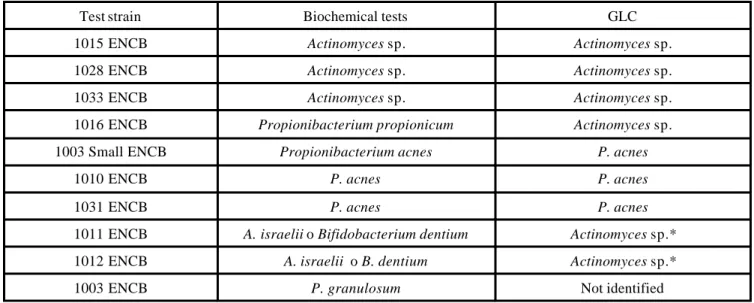
The results of biochemical tests are shown in Table 1. Test strains 1015, 1028, and 1033 were identified only to genus level, while all other ones were identified to species level.
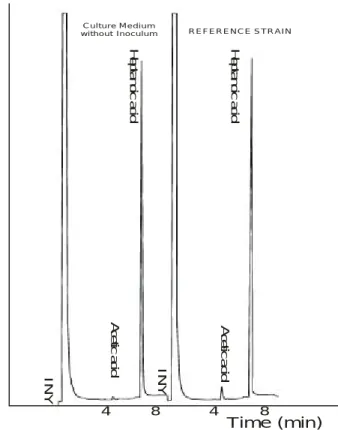
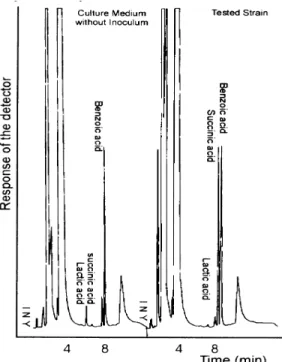
Analysis of the metabolites produced by GLC. In Fig. 1, the reference solutions of volatile, and non volatile organic acids are shown. Fig. 2 to 7 show the chroma-tographic profiles of the metabolites produced by one of the reference strains, and by two of the test strains, from a total of 15 strains tested. Each Fig. includes the chroma-tographic profile of the control (culture medium without inoculum).
Experimentally we found that PYG medium contains some contaminant substances in small amounts, which have similar retention times to those of some acids tested; thus, the sources of said substances were determined. It was found that yeast extract contains substances with re-tention times similar to those of acetic acid and succinic acid. On the other hand, peptone, yeast extract, and resar-zurine contain a substance with a retention time similar to that of lactic acid.
Semiquantitative analysis of metabolite production. Semiquantitative data of production of the diverse acids by the reference strains are shown in Table 2. As it can be noted, A. naeslundii produces a higher amount of lactic acid than A. israelii and A. odontolyticus. It also can be observed that Actinomyces does not produce propionic acid, but Propionibacterium does.
In Table 3 the semiquantitative data of the metabolites produced by the test strains are shown, as well as the iden-tification of these strains based on such data. Test strains 1015, 1028, 1033, and 1016 have the same semiquantita-tive chromatographic profile than Actinomyces genus. Test strains 1003 small colony, 1010, and 1031 have a qualit a-tive chromatographic profile that matches with that of P.
acnes. Test strains 1011 and 1012 showed a high
produc-tion of lactic and acetic acids, and traces of succinic acid. Finally, test strain 1003 produced high amounts of acetic, propionic, and succinic acid, but did not produce lactic acid. The results shown in Tables 2 and 3 were obtained in quadruplicate.
Correlation between identification by biochemical tests and GLC. A comparison between identification by biochemical tests and by GLC is shown in Table 4. Four different correlations were found:
a) Six strains showed identification correlation in both methods
b) One strain which identification does not match in both methods.
c) Two strains in which uncertainty existed by GLC, ma k-ing impossible to establish a correlation with biochemical tests results.
d) One strain identified by biochemical tests, but could not be identified by GLC.
DISCUSSION
It is important to note that identification by biochemi-cal tests of some genera such as Actinomyces,
Bifidobacte-rium, Eubacterium and Propionibacterium is not
Table
1.
Identification of the test strains by biochemical tests
Identification
Catalase
Adonitole
Arabinose
Glycerol
Glucose
Sucrose
Rafinose
Xylose
Indole
production
Nitrate reduction Esculine hydrolysis
Gelatin
hydrolysis
sp.
1015 ENCB
-
-
+
-
+
+
-
-
-
+
+
-
sp.
1028 ENCB
-
-
-
-
+
-*
+
-
-
-
+
+
-
sp.
1033 ENCB
-
-
+
-
+
+
-
-
-
+
+
-
1016
ENCB
-
+
-
+
-
+
+
-
-
-
+
+
-
1003 small
ENCB.**
+
+
-
+
+
-
-
-
+
+
-
+
acnes
1010
ENCB
+
+
-
+
+
-
-
-
+
+
-
+
1031 ENCB
+
+
-
+
+
-
-
-
+
+
-
+
1011 ENCB
-
-
-
-
+
+
+
+
-
-
+
-
1012 ENCB
-
-
-
-
+
+
+
+
-
-
+
-
1003
ENCB
+
+
+
-
+
+
+
+
-
-
-
-
-
*Scarcely positive ** Small colony
Table 2. Semiquantitative data of production of the diverse acids by the reference strains.
A P L S
A. israelii CDC W838 ser 2 Tr No Little Yes
A. naeslundii CDC X454 Tr No Yes Yes
A. odontolyticus TCC 17929 Tr No Little Yes*
P. acnes ATCC 6919 Tr Yes Tr Little
P. acnes CDC 14369 Tr* Yes Tr Little*
A, Acetic acid; P, Propionic acid; L, Lactic acid; S, Succinic acid; *, Irregular; Tr, Traces (0.01-0-.05); Little, Little pro-duction (0.05-0.20); Yes, There is propro-duction (0.20 or more); No, There is not propro-duction.
Table 3. Semiquantitative data of production of the diverse acids by the test strains and their identification.
A P L S
Actinomyces sp. 1015 ENCB Tr No Little Yes
Actinomyces sp. 1028 ENCB Tr No Little Yes
Actinomyces sp. 1033 ENCB Tr No Little Yes
Actinomyces sp. 1016 ENCB Tr No Little Yes
P. acnes 1003 small colony ENCB No Yes Little* Yes
P. acnes 1010 ENCB No Yes Little Little
P. acnes 1031 ENCB Tr Yes Little Yes
Actinomyces sp. 1011 ENCB Yes No Yes Tr
Actinomyces sp. 1012 ENCB Yes No Yes Tr
Strain 1003 ENCB not identified by GLC Yes Yes No Yes
A, Acetic acid; P, Propionic acid; L, Lactic acid; S, Succinic acid; *, Irregular; Tr, Traces (0.01-0-.05); Little, Little pro-duction (0.05-0.20); Yes, There is propro-duction (0.20 or more); No, There is not propro-duction.
Table 4. Correlation of the results of identification by biochemical tests and gas -liquid chromatography (GLC).
Test strain Biochemical tests GLC
1015 ENCB Actinomyces sp. Actinomyces sp.
1028 ENCB Actinomyces sp. Actinomyces sp.
1033 ENCB Actinomyces sp. Actinomyces sp.
1016 ENCB Propionibacterium propionicum Actinomyces sp.
1003 Small ENCB Propionibacterium acnes P. acnes
1010 ENCB P. acnes P. acnes
1031 ENCB P. acnes P. acnes
1011 ENCB A. israelii o Bifidobacterium dentium Actinomyces sp.*
1012 ENCB A. israelii o B. dentium Actinomyces sp.*
1003 ENCB P. granulosum Not identified
Fig. 1. Chromatographic profiles of reference solution of volatile organic acids (VOA) and no volatile organic acids (NVOA).
Fig. 2. Chromatographic profile of volatile organic acids produced by A. Israelii CDC W838 Ser 2 (Reference strain).
Fig. 3. Chromatographic profile of non volatile organic acids produced by A. Israelii CDC W838 Ser 2 (Reference strain).
Fig. 4. Chromatographic profile of volatile organic acids produced by tested strain ENCB 1015.
B e n zo ic a c id B e n z o ic a c id S u cc in ic a c id S u c ci n ic a c id L a c tic a c id L a c tic a c id I N Y I N Y
C u l t u r e M e d i u m
w i t h o u t I n o c u l u m R E F E R E N C E S T R A I N
8 4 8 4 R e sp o n se o f th e d e te ct o r Time (min) B e n z o ic a ci d S u cc ín ic a c id L a c tic a c id H e p ta n o ic a cid Is o va le ric a c id B u ty ric a ci d P ro p io n ic a c id VOA VOA A ce tic a c id I N Y I N Y R e sp o n se o f th e d e te ct o r Time (min) 8 4 8 4 H e p ta n o ic a c id H e p ta n o ic a c id
C u l t u r e M e d i u m
without Inoculum R E F E R E N C E S T R A I N
A c e tic a c id A c e tic a c id I N Y I N Y 8 4 8 4 R e sp o n se o f th e d e te ct o r Time (min) H e p ta n o ic a c id H e p ta n o ic a c id A c e tic a cid A c e tic a c id I N Y I N Y Culture Medium
without Inoculum REFERENCE STRAIN
Fig. 5. Chro matographic profile of non volatile organic acids produced by tested strain, ENCB 1015.
Fig. 6. Chromatographic profile of volatile organic acids produced by tested strain, ENCB, 1003.
Fig. 7. Chro matographic profile of non volatile organic acids produced by tested strain, ENCB 1003
B
e
n
z
o
ic
a
c
id
B
e
n
z
o
ic
a
cid
S
u
c
c
in
ic
a
cid
S
u
cc
in
ic
a
c
id
L
a
c
tic
a
c
id
L
a
c
tic
a
c
id I N
Y
I
N
Y
Culture Medium
without Inoculum REFERENCE STRAIN
8 4 8
4
R
e
sp
o
n
s
e
o
f
th
e
d
e
te
c
to
r
Time (min)
H
e
p
ta
n
o
ic
a
c
id
H
e
p
ta
n
o
ic
a
c
id
P
ro
p
io
n
ic
a
c
id
A
c
e
tic
a
c
id
A
c
e
tic
a
cid
I N
Y
R
E
S
P
O
N
S
E
O
F
T
H
E
D
E
T
E
C
T
O
R
8 4
8 4
Culture Medium without Inoculum
T E S T E D S T R A I N
Time (min)
cases it must be considered as comple mentary to the tradi-tional biochemical tests, if identification to species level is required.
tests, as P. granulosum. This last one showed a peculiar pattern by GLC because, in addition to production of propionic acid, it produced acetic and succinic acid (see Table 2) which does not correspond with the chroma-tographic profile of the reference strain P. acnes (Table 1). Besides, it seems to metabolize the substance with a reten-tion time similar to that of the lactic acid present in the PYG medium. Due to these findings, it would have been necessary to determine the chromatographic profile of a reference strain of P. granulosum in order to compare it with that of this strain, although according to reports of Holdeman and col.8, it does correspond to that identifica-tion.
On the other hand, Table 3 shows that the strains 1003 (small colony), 1010, and 31031 could be identified by GLC as well as by biochemical tests as P.. acnes. Note that for this species the information obtained by the chroma-tographic profile and the complementary tests (catalase, colony and microscopic morphology, influence of O2 and indole) was enough to identify the test strain up to species level. According to the biochemical tests, the strains 1015, 1028, and 1033 belonged to genus Actinomyces, and it was not possible to identify the species because the tests chosen were not selective enough. For these strains, the informa-tion obtained by GLC allowed to identify them as
Actino-myces as they had the same profile that the reference
strains.
According to the results of the biochemical tests made in the strains 1011 and 1012, which were compared to those reported by Dowell and Hawkins2 and Slack and Gerencser 16 , among others, both of the strains may either
be A. israelii or Bifidobacterium dentium, so, more
bio-chemical tests are required in order to differentiate be-tween these two possibilities. By GLC, the strains 1011 and 1012 showed a profile, at qualitative level, similar to that of Actinomyces, but they are semiquantitatively diffe r-ent because in this study the reference strains of Actinomy-ces produced traces of acetic acid and a little lactic acid. However, the test strains produced a large amount of acetic and lactic acid. Due to this, there is a possibility that they belong to Bifidobacterium genus as in literature is reported that this genus produces mainly acetic and lactic acid.6,15 This agrees with the results obtained. To confirm the iden-tity of these strains by GLC, reference strains belonging to this genus must be available so that comparisons of the chromatographic profiles can be done.
The strain 1016 was identified as P. propionicum by biochemical tests, and as Actinomyces by GLC. This dis-crepancy can be explained if we consider that, at biochemi-cal test level, there are only two differential tests, adonitol and esculin hydrolysis, and if the reaction is scarcely posi-tive (see Table 1), it is easy to draw a wrong conclusion. In this case, the GLC confirms the genus, as according to the literature P. propionicum produces propionic acid, and
Ac-tinomyces does not.2,8,12
Although the number of strains is small, it can be
ob-served that there is a correlation between both methods in 6 of the 10 strains studied. In addition, by the GLC tech-nique and with the support of some biochemical tests (catalase production, colony and microscopic morphology, response to O2, and indole), it was possible to identify 7 of the 10 test strains to genus level.
GLC together with the above-mentioned complemen-tary biochemical tests made possible the confirmatory identification, at genus level, of anaerobic nonsporeform-ing gram positive bacilli, with the advantage that this can be done in less time 56 h. The traditional methodology used for the identification of this group of bacteria is trou-blesome, time consuming, and some times the results are difficult to interpret if the species of the microorganism is to be determined.
AKNOWLEDGMENTS
EGC was a fellowship of COFAA, IPN.
REFERENCES
1. Aldridge, K. E. 1984. Monograph: Laboratory parame-ters regarding Isolation and identification of anaerobic bacteria. Marion Scientific Kansas City. p.24-26. 2. Dowell, V. R., and T. M. Hawkins. 1974. Laboratory
Methods in anaerobic bacteriology CDC. Laboratory Manual. DHEW Publication No. (CDC ) 74-8272. U.S. A. p.32, 77-79.
3. Drucker, D. B. 1981. Microbiological applications of gas chromatography. 1st ed. Cambridge University Press Cambridge. p. 70.
4. Evans, D. T. P. 1993. Actinomyces israelii in the fe-male genital tract: a review. Genitourin. Med. 69:54-59.
5. Fiorino, A. S. 1996. Intrauterine contraceptive device associated actinomycotic abscess and Actinomyces de-tection on cervical smear. Obstet. Gynecol. 87:142-149. 6. Forbes, B. A., D. F. Sahm, A. S. Weissfeld. 1998.
Bai-ley & Scott’s Diagnostic Microbiology. 10th ed. Mosby, Inc. p206,687-695.
7. García Ramos, E, M. Kichick Tello, J. Orozco, R. Ca-ballero, and P. Cardona Carrillo. 1984. Aislamiento de
Actinomyces spp y otros microorganismos a partir de
amígdalas hipertróficas en niños. Rev. Lat-Amer. Mi-crobiol. 25:251-255.
8. Holdeman, L. V., E. P. Cato, and W. Moore. 1977. An-aerobe Laboratory Manual, 4th ed. Virginia Politechnic Institute and State University, Blacksburg.
9. Jousimies-Somer, H. 1997. Recently described clini-cally important anaerobic bacterias: Taxonomic aspects and update. Clin. Infect. Dis. 25 (suppl 2)S:S78-87. 10. Kiyama, M, K. Hiratsuka, S. Saito, T. Shiroza, H.
58:151-155.
11. Koneman, W. E., S. D. Ellen, W. M. Janda, P. C. Schreckenberger, and W. C. Winn Jr. 1992. Color Atlas and textbook of diagnostic microbiology. Fourth ed. JB Lippincott company, Philadelphia. p 552-555.
12. Li, Y. F., and L. K. Georg. 1968. Differentiation of
Ac-tinomyces propionicus from Actinomyces israelii and
Actinomyces naeslundii by gas chromatography. Can. J.
Microbiol. 14:749-753.
13. Onderdonk, A. B. B., and M. Sasser. 1995. Gas-liquid and high-performance liquid chromatographic methods for the identification of microorganisms. p 123-129. In
P. R. Murray, E. J. Baron, M. A. Pfaller, F. C. Tenover, and R. H. Yolken. Manual of Clinical Microbiology. 6th ed ASM Press, Washington DC.
14. Rizzo, A. 1980. Rapid Gas-chromatographic method for identification of metabolic products of anaerobic bacteria. J. Clin. Microbiol. 11:418-421.
15. Rodloff, A. C., S. L. Hillier, and B. J. Moncla. 1999.
Peptostreptococcus, Propionibacterium, Lactobacillus,
Actinomyces and other nonsporeforming anaerobic
gram-positive bacteria. p 672-689. In P. R. Murray, E. J. Baron, M. A. Pfaller, F. C. Tenover, and R. H. Yolken. Manual of Clinical Microbiology. 7th ed. ASM Press, Washington DC.
16. Slack, J. M., and M. A. Gerencser. 1975. Actinomyces, filamentous bacteria, Biology and Pathogenecity. Bur-gess Publishing Co., Minneapolis, USA. p. 17-89, 119-126.
17. Sneath, P. H. A., N. S. Mair, E. Shrpe. 1986. Bergey’s Manual of Determinative Bacteriology. Vol. 2. The Williams and Wilkins Co. Baltimore. USA. p 1332-1427.
18. Thurnheer, T., B. Guggenheim, and R. Gmur. 1997. Characterization of monoclonal antibodies for rapid identification of Actinomyces naeslundii in clinical samples. FEMS Microbiol. Lett. 150:255-262.