Determining heavy metal contamination of road dust in Delhi, India
P. V. SURYAWANSHI, B. S. RAJARAM, A. D. BHANARKAR and C. V. CHALAPATI RAO Air Pollution Control Division, CSIR-National Environmental Engineering Research Institute,
Nehru Marg, Nagpur 440020
Corresponding author: A. D. Bhanarkar; email: [email protected]
Received: February 2, 2016; accepted: May 3, 2016 RESUMEN
La contaminación del aire es considerada como uno de los mayores desafíos ambientales debido a sus efectos sobre los ecosistemas y la salud humana. En este estudio se investigan los niveles de concentración y las fuentes de la contaminación por metales pesados en muestras de polvo de caminos recolectadas en varios sitios que incluyen áreas con cuatro actividades diferentes en Delhi, India: industriales, carreteras, residenciales y de uso mixto. El contenido de metales en polvo de caminos se analizó mediante espectroscopia de emisión atómica por plasma de acoplamiento inductivo. Los resultados muestran altos niveles de concentración de Ni, Cr y Pb en áreas industriales. Los coeficientes de correlación de Pearson acoplados con análisis de componentes principales revelaron que el CD, el Cr, el Ni y el Pb están vinculados con fuentes industriales en tanto que el Zn y el Cu proceden principalmente del tráfico vehicular. La contaminación en polvo de caminos se valoró a través de varios métodos: grado de contaminación, índice ecológico e índice de contaminación. El análisis de los factores de contaminación reveló que las muestras de polvo de caminos estaban contaminadas de manera considerable con Zn y Pb. Los índices de potencial ecológico indicaron la presencia de contaminación signi-ficativa por Cd y moderada por Pb en el polvo de camino, en tanto que la contaminación por Cr, Cu, Ni y Zn fue baja. El índice de contaminación de la mayoría de los metales fue mayor a 1, lo cual revela un deterioro en la calidad del polvo de caminos en Delhi a causa de las emisiones antrópicas. El grado de contaminación, el índice de potencia ecológico y el índice integrado de contaminación indican que el polvo de caminos en áreas industriales, de carreteras y de uso mixto exhiben alta contaminación por metales pesados. El polvo del camino también está contaminado de manera significativa. Evaluaciones realizadas por diversos métodos indicaron que todas las técnicas son importantes para valorar la calidad ambiental.
ABSTRACT
Keywords: Correlation analysis, ecological risk index, pollution index, principal component analysis, toxic elements.
1. Introduction
Due to accelerated industrialization and urbanization, nearly half of the population in the world now lives in urban agglomerations. These intensive activities resulted in increasing quantities of contaminants into the urban environment. Consequently, a variety of environmental problems have cropped up and toxic metal pollution has become a major issue, especially in urban air, soils and road dust (Bilos
et al., 2001; Madrid et al., 2002; Han et al., 2006). Road dust is a complex mixture of particles and may contain various components like organics, heavy metals, other inorganics, mould spores, an-imal dander, pollen, pollen fragments etc., which can possibly get resuspended due to movement of vehicles and wind, resulting in an important source of atmospheric air pollution. It was observed that the particles and associated metals, particularly with fine dust, remain suspended in air longer under certain meteorological conditions. Road dust, an important environmental indicator of metal contamination from atmospheric deposition, receives varying inputs of anthropogenic metals from various stationary and mobile sources such as vehicular traffic, industrial activities, power plants, residential fossil fuel burn-ing, waste incineration, construction and demolition activities, and resuspension of contaminated soil (Bilos et al., 2001; Charlesworth et al., 2003; Bhanarkar et al., 2005, 2008; Gupta et al., 2012). Road dust, therefore, is a significant contributor of pollution in the urban environment. The adverse effects of poor environmental conditions on human health are most evident in urban environments, particularly in developing countries where urbanization, industrial-ization and rapid population growth are taking place on an unprecedented scale (Duzgoren-Aydin, 2007).
Toxic metals in urban areas are a subject of great concern, due to their non-biodegradable nature and long residence time. The prolonged presence of the contaminants in the urban environment, particularly in road dust, and their close proximity to the human population significantly increase the exposure of the urban population to metals via inhalation, ingestion, and dermal contact (Mielke et al., 1998; Abrahams, 2002). Metals can accumulate in fatty tissues,
affecting the functions of organs and disrupting the nervous system or the endocrinal system (Waisberg
et al., 2003; Duzgoren-Aydin, 2007) and some metals could cause mutagenic, teratogenic and carcinogenic effects in living beings (Lienesch et al., 2000; Cook
et al., 2005).
Although several studies on metal pollution in road dust have been carried out in developed coun-tries (de Miguel et al., 1997; Arslan, 2001; Rasmussen
et al., 2001; Charlesworth et al., 2003; Sezgin et al., 2003; Tokalioglu and Karta, 2006; Shi et al., 2008; Amato et al., 2009), very little information is avail-able on this topic in developing countries. Only few studies on quantification and distribution of metals in road dust have been conducted recently in Indian cit-ies (Chatterjee and Banerjee, 1999; Banerjee, 2003; Rawat et al., 2009; Rajaram et al., 2014).
Considering the above, the main objectives of this study include: (1) determination of heavy metals con-centration in road dust in various urban environments of Delhi, (2) identification of the possible sources of metals in road dust through statistical analysis and (3) assessment of the metal contamination in urban road dust by various methods.
2. Materials and methods
2.1 Study area
Delhi, the capital of India, is a major center of interna-tional and domestic activities in the Asian subcontinent. It is spread over a 1483 km2 area with a population of
vehicles (LCV) and heavy commercial vehicles (HCV) together account for about 3.2% (GOI, 2002).Besides the vehicular fleet, the city has five power plants and 33 industrial estates in which many medium-scale and small-scale industries that include chemical, pharma-ceutical, automobile part manufacturing, and rubber and plastic manufacturing are present.
2.2 Sample collection and analysis
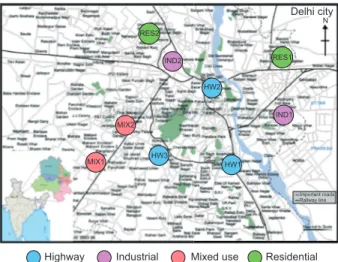
Road dust samples were collected in winter 2009 from nine locations with due consideration to differ-ent represdiffer-entative aspects of urban environmdiffer-ent in the metropolis including industrial (IND), national highway (HW), residential (RES) and mixed use (MIX) areas (Fig. 1). Samples of road dust were collected by using a vacuum cleaner. A representative composite bulk sample for every sampling location was obtained by taking subsamples from three points of the road at each location and then mixing thorough-ly. Description of sampling locations is presented in Rajaram et al. (2014).
All samples were dried in the oven at 110 oC for 48 h
and sieved through 200 mesh sieve. The sieved dust samples were analyzed for metal content according to standard methods (US-EPA, 1999). Measurement of metal concentrations, i.e. Cd, Cr, Cu, Ni, Pb, and Zn was carried out using inductively coupled plasma atomic emission spectroscopy (ICP-AES) (Jobin Yvun, model JY24). Calibration standards were prepared through serial dilution of standard stock solution of multi-elements having concentrations of 1000 mg L–1 (Merck, Cat. No. 111355). Standard
solutions were used to validate the analytical method. All extractions and analysis were made with replicate samples (n = 3) and the mean values were reported. The details of sampling and analysis methodology are presented in a previous study (Rajaram et al., 2014).
2.3 Statistical analysis
In this study, for the identification of the relationship between metals and their possible sources, Pear-son’s correlation coefficient analysis and principal components analysis (PCA) were performed using commercial statistics software package SPSS (ver-sion 17.0 for windows). The correlation coefficient measures the strength of the interrelationship between two metals.
PCA is the most common multivariate statistical method used in environmental studies to reduce the data while retaining important information and to extract a smaller number of independent factors (prin-cipal components, PCs) that can be easily interpreted for analyzing relationships among the observed vari-ables (Massart et al., 1997; Malinowski, 2002; Loska and Wiechuya, 2003; Tokalioglu and Kartal, 2006). PCA starts with the correlation matrix describing the dispersion of the original variables and extracting the eigenvalues and eigenvectors (Lu et al., 2010). An eigenvector is a list of coefficients multiplying the original correlated variables to obtain new uncorrelat-ed PCs, which are weightuncorrelat-ed linear combinations of the original variables. A matrix property, eigenvalue, is used to standardize the number of PCs that can be extracted. Usually, all the PCs with eigenvalues greater than 1 are considered as extracted PCs (Loska and Wiechuya, 2003; Lu et al., 2010).
PCA extracts the PCs from an i,j matrix, where
i corresponds to the number of samples and j to the number of pollutants measured (correlated variables, in this case all the heavy metal species measured) (Franco et al., 2015). The PC extracted corresponds to pollutant (i.e., heavy metal) sources. The number of PCs that can be extracted from the measurements depends on the variability of the available data and on the number of monitored substances. The first PC extracted includes the highest possible variabil-ity, and each succeeding compound accounts for as much as possible of the remaining variability (Han
et al., 2006). The number of PCs that can be ex-tracted depends on the retained variance of each PC (Franco et al., 2015).
Highway Industrial
Delhi city
N
Important roads Rallway line
Mixed use Residential
HW3
HW2
HW1
IND1 IND2 RES1 RES2
MIX1 MIX2
In this study, for the purpose of this exercise, a data matrix consisting of nine sites and six metals was considered (Rajaram et al., 2014). PCA was per-formed by applying varimax rotation with Kaiser’s normalization with eigenvalues > 1 to identify the sources of heavy metals in road dust. By extracting the eigenvalues and eigenvectors from the correla-tion matrix, the number of significant factors and the percent of variance explained by each of them were calculated. Data were checked for normality prior to PCA using Kolmogorov-Smirnova test and Sha-piro-Wilk test, which indicated that the normalized data were suitable for PCA.
2.4 Metal contamination assessment methods
In this study, contamination factor index (Ci f),
de-gree of contamination (Cdeg), potential ecological
risk index (RI), pollution index (PI) and integrated pollution index (IPI) were calculated to assess the metal contamination levels in the road dust. The road dust metal concentrations described in Rajaram et al.
(2014) were also utilized to estimate metal contam-ination assessment.
Hakanson (1980)suggested four classes of Ci f and Cdeg, to evaluate the metal contamination levels. The
degree of contamination (Cdeg) is the sum of
ination factors for all of the elements. The contam-ination factor Ci
f was defined as (Hakanson, 1980):
Ci
f= Ci/Cin (1)
where Ci is the mean content of metal and Ci n is the
concentration of a reference value for individual metal. In this study, the Ci
n values represent the
con-centrations of the metals in the soil from a remote background area in India (Kuhad et al., 1989; Gowd
et al., 2010).
The degree of contamination by the six heavy metals in road dust from the study areas was deter-mined as follows (Hakanson, 1980):
Cdeg = ∑ Cif (2)
The classification for degrees of contamination suggested by Hakanson (1980) was based on eight pollutants, while there were only six heavy metals analyzed in this study. Thus, the original degree of contamination classification was adjusted according to Zhang et al. (2013). The modified classification is presented in Table I.
The assessment of degree of heavy metal pollution was carried out using the RI, based on the toxicity of metals and the response of the environment, as proposed by Hakanson (1980) according to the fol-lowing equations:
RI = ∑ Ei
r (3)
Ei
r = Tir fi (4)
fi= Ci/Ci
n (5)
where Ei
r is the monomial potential ecological risk
factor, Ti
r is the metal toxic factor, fi is the metal
pollution factor, Ci is the concentration of metals in
samples, and Ci
n is a reference value for metals. The
RI classification suggested by Hakanson (1980) was based on eight pollutants. In this study, a modified RI classification suggested by Zhang et al. (2013),was applied in order to evaluate the RI by the analyzed six heavy metals (Table II).
To assess the degree of metal contamination, a revised PI for each metal and an IPI of the six met-als were estimated for each sampling site using the following equations as suggested by Huang (1987). PI was defined as follows and classified as presented in Table III:
PI = C/Xa C ≤ Xa (6)
PI = 1 + (C − Xa)/(Xb − Xa) Xa < C ≤ Xb (7)
Table I. Categories of contamination factors and contamination degree.
Class Ci
f value Category Cdeg value Category
Class 1 Ci
f < 1 Low contamination Cdeg < 6 Low degree of contamination
Class 2 1 ≤ Ci
f <3 Moderate contamination 6 ≤ Cdeg < 12 Moderate degree of contamination
Class 3 3 ≤ Ci
f <6 Considerable contamination 12 ≤ Cdeg < 24 Considerable degree of contamination
Class 4 6 ≤ Ci
PI = 2 + (C − Xb)/(Xc − Xb) Xb < C ≤ Xc (8)
PI = 3 + (C − Xc)/(Xc − Xb) C > Xc (9)
where C is the measured concentration of specific metal, Xa is the threshold concentration of the metal enrichment, Xb is the threshold concentration of the low level of pollution and Xc is the threshold con-centration of the high level of pollution. The values of Xa, Xb and Xc, were taken from Huang (1987)and Bai et al. (2009).
The IPI of all measured elements for each sam-ple is defined below in Eq. (10) (Bai et al., 2009) as the sum of the difference between the individual element’s PI and 1, and then classified (Bai et al., 2009) in Table III:
IPI = ∑(PI – 1) (10)
3. Results and discussion
3.1 Heavy metal concentrations
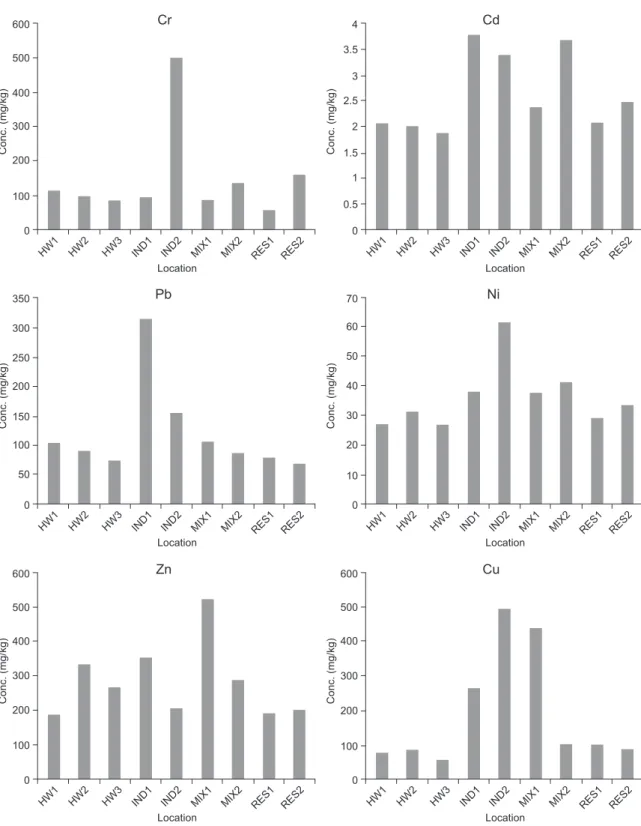
Results on the concentrations of heavy metals in road dust samples collected from the study area and report-ed in Rajaram et al. (2014), were summarized and are presented in Fig. 2. The concentrations varied as fol-lows: Cd, from 1.9 to 3.8; Cr, from 56.4 to 500.3; Cu, from 87.3 to 499.0; Ni, from 27.2 to 61.7; Pb, from 69.0 to 316.0, and Zn from 187.7 to 524.3 mg kg–1.
The mean concentrations ± 95% confidence intervals of Cd, Cr, Cu, Ni, Pb and Zn in Delhi road dust were
found to be 2.65 ± 0.5, 148.8 ± 83.3, 191.7 ± 104.4, 36.4 ± 6.6, 120.7 ± 47.9 and 284.5 ± 67.6 mg kg–1,
respectively. Metal concentrations found in this study were comparable to those observed by Rajaram et al. (2014).
Except Zn, mean metal concentrations in the industrial areas (Cd, Cr, Cu, Ni and Pb: 3.61, 299.5, 383.6, 49.9 and 236.5 mg kg–1, respectively) were
relatively higher than those of other activity zones in Delhi (Rajaram et al., 2014). Industrial processes such as metallurgical, electroplating, chemical, and fuel combustion may be the main reasons for metal emissions in those industrial areas and high metal concentrations (Madrid et al., 2002; Wang and Qin, 2006; Li et al., 2008). The lowest concentrations of Cd, Cu and Ni were found to be 1.9, 58.3 and 27.2 mg kg–1 near the highway, respectively, whereas
the lowest Cr and Pb levels were found to be 56.4 and 69.0 mg kg–1 in residential areas, respectively. The
average highest Zn concentration of 407.3 mg kg–1
was found to be in mixed areas and lowest concentra-tion of 187.7 mg kg–1 near highways. The highest Zn
concentration found in mixed areas was comparable to that observed by Rajaram et al. (2014). In general, lower metal concentrations were obtained in the sam-ples near the highways as compared to those obtained near the roads in other areas (Rajaram et al., 2014). This may be due to the fact that the roads are always jammed with the high vehicular traffic in other areas resulting in heavy metal emission and metal pollution
Table II. Indices and grades of potential ecological risk of heavy metals contamination.
Class Ei
r value Grades of ecological risk
of single metal category RI value Grades of potential ecological risk of the environment
Class 1 Ei
r <40 Low risk RI < 50 Low risk
Class 2 40 ≤ Ei
r <80 Moderate risk 50 ≤ RI < 100 Moderate risk
Class 3 80 ≤ Ei
r <160 Considerable risk 100 ≤ RI < 200 Considerable risk
Class 4 160 ≤ Ei
r < 320 High risk RI ≥ 200 High risk
Class 5 Ei
r ≥320 High risk
Table III. Categories of pollution index and integrated pollution index of metals. Class PI value Category of contamination
of single metal IPI value Category of integrated contamination index of the environment Class 1 PI ≤ 1 No contamination IPI ≤ 0 No contamination
(Chen et al., 2010; Sun et al., 2010). The distribution of metals in different functional areas was compara-ble to the one observed by Wong et al. (1996), who reported that within the urban areas, industrial areas
have the highest metal concentration, followed by commercial and residential districts. Wang and Qin (2006)also found that Pb concentration varied in different functional areas in Shenyang in the order of
600 Cr
500
HW1 HW2 HW3 IND1 IND2 MIX1 MIX2 RES1 RES2
400
300
200
Location 100
0
Conc. (mg/kg)
4 Cd
3.5
3
HW1 HW2 HW3 IND1 IND2 MIX1 MIX2 RES1 RES2
2.5
2
1.5
1
Location 0.5
0
Conc. (mg/kg)
350 Pb
300
HW1 HW2 HW3 IND1 IND2 MIX1 MIX2 RES1 RES2
250
200
150
100
Location 50
0
Conc. (mg/kg)
70 Ni
60
50
HW1 HW2 HW3 IND1 IND2 MIX1 MIX2 RES1 RES2
40
30
20
Location 10
0
Conc. (mg/kg)
600 Zn
500
HW1 HW2 HW3 IND1 IND2 MIX1 MIX2 RES1 RES2
400
300
200
Location 100
0
Conc. (mg/kg)
600 Cu
500
400
HW1 HW2 HW3 IND1 IND2 MIX1 MIX2 RES1 RES2
300
200
Location 100
0
Conc. (mg/kg)
industrial area > commercial area > residential area > suburb. Since the ban of Pb in gasoline, the content of this element in the troposphere has decreased (Wang
et al., 2003).The Pb concentration in road dust could still be attributed to emissions from fossil fuels, his-torical Pb contamination and the long half-life of Pb in soils (Wang et al., 2003; Saint’ Pierre et al., 2004). The above results indicate that industrial and traffic activities were the main sources of metal pollution in road dust of Delhi.
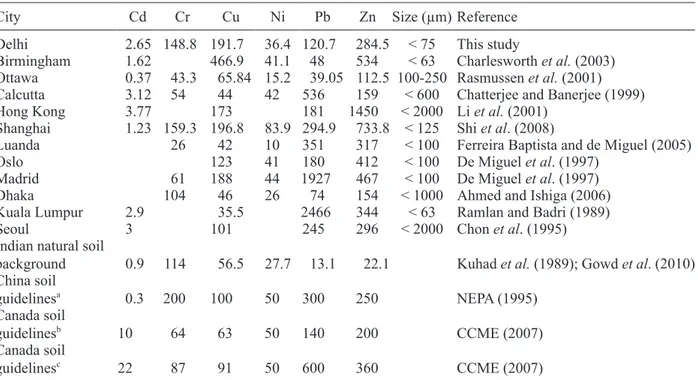
Since no guidelines on metals in road dust or soil have been prescribed by regulatory authorities in India, results of this study were compared with the maximum permissible limits prescribed by China (NEPA, 1995) and Canada (CCME, 2007) for metals in soil. As shown in Table IV, the mean concentrations of Pb and Ni were lower than the guideline values of China and Canada, whereas the mean concentrations of Cu and Zn were higher than the permissible limits prescribed by those countries (Rajaram et al., 2014). The mean concentration of Cd was lower than values recommended by Canadian guidelines, but higher than Chinese guidelines, whereas the mean
concen-tration of Cr was higher than the permissible limit prescribed by Canada but lower than the guideline value of China.
In comparison to documented studies, it was observed that the levels of heavy metals in the road dust of Delhi are comparable with those determined in other cities (Table IV) (Rajaram et al., 2014). In general, the concentration of Pb in Madrid and Kuala Lumpur, and Zn in Hong Kong were higher than the concentration recorded in Delhi road dust.
3.2 Correlation coefficient analysis
Pearson’s correlation coefficient was estimated to evaluate the inter-element relationship of metals in road dust (Table V). The significant positive cor-relations (> 0.624) observed between Ni-Cr-Cd-Cu indicate that the general contamination sources of these metals were primarily industrial and traffic activities (de Miguel et al., 1997; Lu et al., 2010; Rajaram et al., 2014). While Pb showed very weak positive correlations with Cu, Cr, Ni and Zn varying from 0.146 to 0.433, a moderate correlation (0.660) was found between Pb and Cd thereby indicating
Table IV. Heavy metal concentrations (mg kg–1) in road dust in Delhi and various cities of the world.
City Cd Cr Cu Ni Pb Zn Size (µm) Reference
Delhi 2.65 148.8 191.7 36.4 120.7 284.5 < 75 This study
Birmingham 1.62 466.9 41.1 48 534 < 63 Charlesworth et al. (2003) Ottawa 0.37 43.3 65.84 15.2 39.05 112.5 100-250 Rasmussen et al. (2001) Calcutta 3.12 54 44 42 536 159 < 600 Chatterjee and Banerjee (1999)
Hong Kong 3.77 173 181 1450 < 2000 Li et al. (2001)
Shanghai 1.23 159.3 196.8 83.9 294.9 733.8 < 125 Shi et al. (2008)
Luanda 26 42 10 351 317 < 100 Ferreira Baptista and de Miguel (2005)
Oslo 123 41 180 412 < 100 De Miguel et al. (1997)
Madrid 61 188 44 1927 467 < 100 De Miguel et al. (1997)
Dhaka 104 46 26 74 154 < 1000 Ahmed and Ishiga (2006)
Kuala Lumpur 2.9 35.5 2466 344 < 63 Ramlan and Badri (1989)
Seoul 3 101 245 296 < 2000 Chon et al. (1995)
Indian natural soil
background 0.9 114 56.5 27.7 13.1 22.1 Kuhad et al. (1989); Gowd et al. (2010) China soil
guidelinesa 0.3 200 100 50 300 250 NEPA (1995)
Canada soil
guidelinesb 10 64 63 50 140 200 CCME (2007)
Canada soil
guidelinesc 22 87 91 50 600 360 CCME (2007)
aClass II. Metal levels in class II are threshold values established to protect agricultural production and maintain human
health.
that the source for Pb may be industrial activities apart from the vehicular emissions (Rajaram et al., 2014). Zn showed poor correlation with all other metals except Cu (0.438), which may be due to the influence of traffic activities in these areas (Arslan, 2001; Gray et al., 2003).
3.3 Principal component analysis
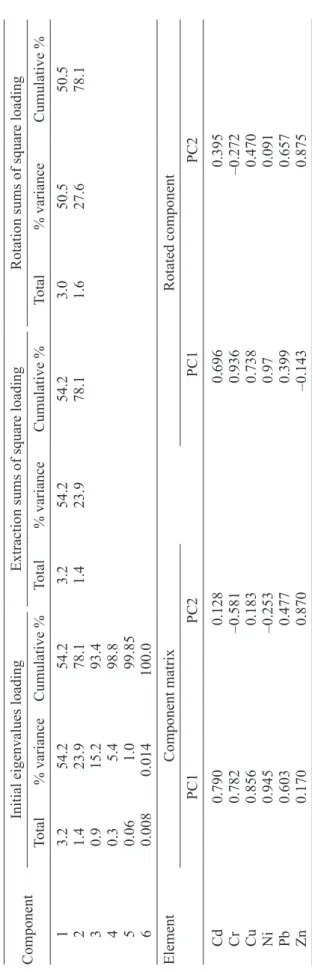
The results of PCA indicated that all the elements are well represented by two components (Rajaram
et al., 2014), which account for nearly 78% of the total variance for the data (Table VI). The initial component matrix indicated that Ni, Cu and Cd are correlated, displaying high loading values in the first component (PC1) whereas Zn showed greater loading values in the second component (PC2) (Rajaram et al., 2014). Cr and Pb are partially represented in both PC1 and PC2. The rotation of the matrix eliminated ambiguities. As shown in Table VI, PC1 included Ni and Cr; PC2 included Zn, whereas Cd, Cu and Pb are distributed in both PC1 and PC2. This implies that Cu, Ni, Cd, Cr, Pb and Zn can be defined as anthropogenic components and may originate from similar pollution sources such as particles released by industrial and traffic activities (Rawat et al., 2009; Lu
et al., 2010). Cr and Ni are important constituents of many metal alloys (Siegel, 2002; Manno et al., 2006); therefore, the emission sources of these elements could be attributed to the metal processing industries (non-ferrous metal, electroplating, galvanizing, etc.) in the area. Although Pb has been banned as additive in petrol since a number of years, the concentration of Pb in urban road dust still reflects the significant degree of historical Pb contamination and the long half-life of Pb in soils. Some of the Pb in the road dust might have originate from particles emitted by industrial activities, whereas Zn and Cu may have been contributed by vehicular sources i.e. use of
Table V. Pearson’s correlation coefficients between different metals.
Cd Cr Cu Ni Pb Zn
Cd 1.000
Cr 0.432 1.000 Cu 0.446 0.624 1.000 Ni 0.682 0.901 0.796 1.000 Pb 0.660 0.146 0.433 0.330 1.00
Zn 0.096 –0.304 0.438 0.026 0.244 1.000
Table
VI.
Total variance explained and component matrices for the metal.
Component
Initial eigenvalues loading
Extraction sums of square loading
Rotation sums of square loading
Total
% variance
Cumulative %
Total
% variance
Cumulative %
Total
% variance
Cumulative %
1
3.2
54.2
54.2
3.2
54.2
54.2
3.0
50.5
50.5
2
1.4
23.9
78.1
1.4
23.9
78.1
1.6
27.6
78.1
3
0.9
15.2
93.4
4
0.3
5.4
98.8
5
0.06
1.0
99.85
6
0.008
0.014
100.0
Element
Component matrix
Rotated component
PC1
PC2
PC1
PC2
Cd
0.790
0.128
0.696
0.395
Cr
0.782
–0.581
0.936
–0.272
Cu
0.856
0.183
0.738
0.470
Ni
0.945
–0.253
0.97
0.091
Pb
0.603
0.477
0.399
0.657
Zn
0.170
0.870
–0.143
brake pads and wear and tear of tires (Saint’ Pierre
et al., 2004; Amato et al., 2009).
3.4 Metal contamination assessment
3.4.1 Contamination factor and degree of contami-nation
Contamination factor and the degree of contami-nation were estimated as suggested by Hakanson (1980) (Fig. 3). The contamination factors (Ci
f)
indicated very high contamination levels (6 ≤ Ci f) of
Pb, Zn and Cu, and considerable contamination levels (3 ≤ Cf < 6) of Cd and Cr in the road dust from the industrial areas. The road dust from the mixed areas had concentrations of Cd and Cu of considerable contamination and concentrations of Zn and Pb of very high contamination. In the road dust near the highways, the contamination factors indicated very high contamination by Zn and Pb. The road dust from the residential areas had considerable contamination of Pb and very high contamination of Zn. These results indicate that road dust is most significantly contaminated by Zn and Pb, followed by considerable contamination by Cu and Cd. The concentrations of Cr and Ni indicated moderate contamination of the road dust.
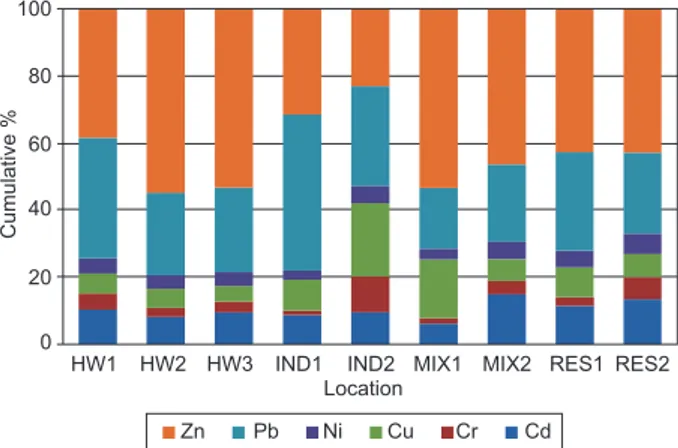
The proportions of the contamination of each metal to the total degree of contamination by the six heavy metals determined in the road dust samples are 6.0-14.4% for Cd, 1.7-10.8% for Cr, 4.5-21.7% for Cu, 2.6-5.7% for Ni, 18.3-36.1% for Pb, and 23.1-54.7% for Zn (Fig. 4). The degree of contamination in road dust from highways, and industrial, mixed and residential areas are 24.2, 46.0, 36.5 and 20.8, respectively (Fig. 3). These results indicate that the
road dust from the highways, the mixed areas and the industrial areas has a very high degree of contamina-tion (24 ≤ Cdeg). Road dust from residential areas has a
considerable degree of contamination (12 ≤ Cdeg < 24).
In particular, the degree of contamination for the mixed area 1 was much higher than the value at the other mixed area, which had lesser industrial units. These results indicate that industrial units might have contributed to the increased concentrations of heavy metals in road dust.
3.4.2 Potential ecological risk index
Results of ecological risk assessment of heavy met-als in road dust (Fig. 5) revealed that the monomial risk indices (Ei
r) of heavy metals were ranked in the
following order: Cd < Pb < Cu < Zn < Ni < Cr. The average Ei
r of Cd in samples from industrial and
mixed areas is above 80 whereas the same average
21 18 15
12 9
60 54 48 42 36 30 24 18 12 6 0
Cd Cr Cu Ni Pb Zn Contamination degree
Contamination degree
6
3
Concentration factor
0
HW IND Area MIX RES
Fig. 3. Contamination factor and degree of contamination of road dust by heavy metals in different areas.
100
80
60
40
20
Cumulative
%
0
HW1 HW2 HW3 IND1 IND2 MIX1 MIX2 RES1
Location RES2
Zn Pb Ni Cu Cr Cd
Fig. 4. Contribution of heavy metals to the degree of contamination.
140 120
100 80 60
300
250
200
150
100
50
0
Cd Cr Cu Ni Pb Zn RI
Potential ecological risk inde
x
40 20
Ecological index
0
HW IND MIX RES
Area
can be found in residential areas, indicating that Cd poses a potentially considerable risk to the local ecosystem. The Ei
r of Pb in road dust samples from
the industrial area (90.3) poses considerable risk to the environments. Ei
r values for the other metals were
below 80, indicating low to moderate risk.
The overall RI of observed metals in road dust was calculated as the sum of all six risk factors (Fig. 5). RI in road dust ranged from 115.6 to 295.7, with an average of 173.5. RI values were higher in the samples from industrial areas and vary between 246.8 and 295.7, indicating that there is a high po-tential ecological risk. Among different functional areas, the RIs pose high risk in industrial areas, and considerable risk in other areas.
The percent contribution of individual metal to overall RI is demonstrated in Fig. 6. It is shown that Cd accounted for most of the total risks, and the percentages ranged from 41.7% to 65.2% with a mean of 52.4%. Pb ranked the second among the six metals contributing to the total risk, and the average
was 25.5%, which was followed by 8.9% (Cu), 7.9% (Zn), 3.9% (Ni), and 1.5% (Cr). It could be concluded that the high ecological risk was primarily posed by two heavy metals, Cd and Pb, as their contribution is nearly 78% of the total potentially ecological risk.
3.4.3 Pollution index
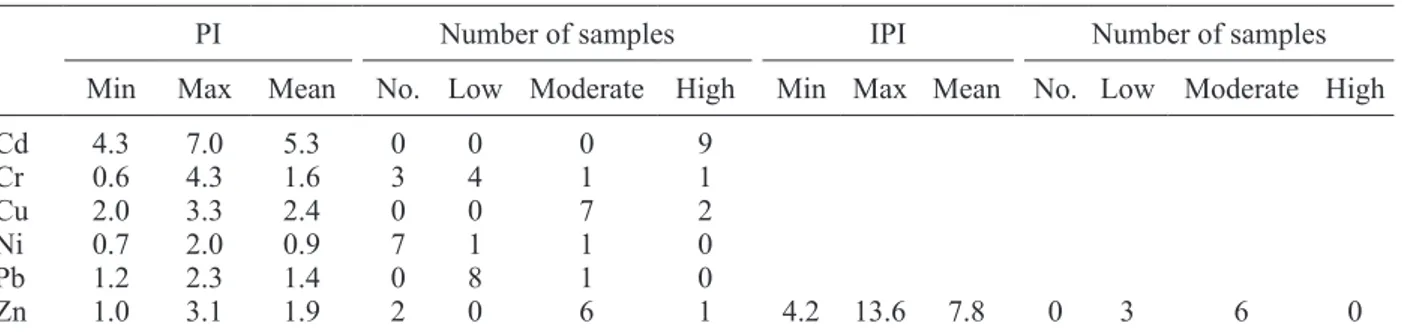
The minimum, maximum and mean values of PI for each metal are shown in Table VII. The mean PI values are generally high, indicating that there was serious pollution of road dust. However, PI values varied among metals. PI values of metals in road dust ranged as follows: Cd, 4.3 to 7.0; Cr, 0.6 to 4.3; Cu, 2.0 to 3.3; Ni, 0.7 to 2.0; Pb, 1.2 to 2.3, and Zn, 1.0 to 3.1 with an average value of 5.3, 1.6, 2.4, 0.9, 1.4 and 1.9, respectively. Most of the samples recorded middle or high pollution level PI values for Cd, Cu and Zn, indicating that urban road dust in Delhi is moderately to highly contaminated.
The PI values of metals were generally higher in industrial areas, indicating the presence of relatively serious heavy metal pollution (Fig. 7). Cd recorded high PI values in all the road dust samples from industrial areas, mixed use areas, residential areas and highways. PI of road dust from industrial areas indicated moderate contamination by Cr, Zn and Cu, whereas road dust from mixed-use areas had mod-erate contamination by Zn and Cu. In highways and residential areas, the mean PI values of Zn and Cu were close to 2. These findings suggest that the major sources of these metals may be vehicular emissions, and the mechanical parts and tires of vehicles as they are subjected to abrasion (Sadiq et al., 1989; Smol-ders and Degryse, 2002; Adachi and Tainosho, 2004). The results showed the following proportions of heavy metal contamination levels (Table VII): 44.4, 11.1, and 88.9% of the road dust samples
Table VII. Statistical results of pollution index and integrated pollution index of metals.
PI Number of samples IPI Number of samples
Min Max Mean No. Low Moderate High Min Max Mean No. Low Moderate High
Cd 4.3 7.0 5.3 0 0 0 9
Cr 0.6 4.3 1.6 3 4 1 1
Cu 2.0 3.3 2.4 0 0 7 2
Ni 0.7 2.0 0.9 7 1 1 0
Pb 1.2 2.3 1.4 0 8 1 0
Zn 1.0 3.1 1.9 2 0 6 1 4.2 13.6 7.8 0 3 6 0
100
80
60
40
20
Cumulative
%
0
HW1 HW2 HW3 IND1 IND2 MIX1 MIX2 RES1
Location RES2
Zn Pb Ni Cu Cr Cd
8 7 6 5
3 4
14 12 10 8
6 4 2 0
Cd Cr Cu Ni Pb Zn IPI
Integrated pollution index (IPI
)
2 1
Pollution index (PI
)
0
HW IND MIX RES
Area
Fig. 7. Pollution index of road dust by heavy metals in different areas.
Fig. 8. Spatial distributions of degree of contamination, potential risk index and integrated pollution index in the road dust of Delhi.
Highway Industrial
N
Mixed use Residential
Class 1 Class 2 Class 3 Class 4
Important roads Rallway line
RI IPI 21
28 135
189 7.3
9.4
41
28
20 124 4.2
130
51
22 132 5.0 5.3
23 44 192
8.4 116
296 10.5 6.6
247 13.6
Delhi city
Cdeg
exhibited low contamination by Cr, Ni and Pb, respectively; 11, 77.8, 11.1, 11.1 and 66.7% of the samples were moderately contaminated by Cr, Cu, Ni, Pb, and Zn, respectively, and 11.1, 22.2 and 11.1% of the samples were highly contaminated by Cr, Ni and Zn, respectively. All the samples were highly contaminated by Cd. These results indicate that Delhi has an important contamination by Cd and a moderate contamination by Cu and Zn. In addition, as shown in Fig. 7, all the roads in this study reported very high values of PI for Cd indicating that Cd contamination in road dust in Delhi is prominent. Furthermore, high (> 1) PI values were observed in only 22% of the samples for Ni. These data indicate that Ni pollution is relatively low in Delhi road dust when compared with other elements.
The IPI value of urban road dust varied from 4.2 to 13.6 with an average of 7.8 (Table VII). There was no sample with IPI < 1, while low pollution levels with IPI lower than 6 accounted for about 33% of all samples. About 67% of all samples with IPI between 6 and 18 indicated moderate contamination. Thus, it is very likely that urban road dust in Delhi is mod-erately polluted with heavy metals.
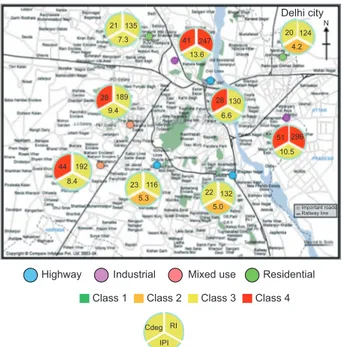
Figure 8 shows the spatial distributions of Cdeg,
RI, and IPI of the road dust of Delhi. It can be seen from this figure that five out of nine locations in this study had very high values (> 24) of Cdeg while the
remaining four locations also had higher values of
Cdeg, close to 24 (very high contamination). RI
lev-els at two locations, out of nine, showed high risk; whereas RI levels indicated considerable risk at all other locations, of which two locations are nearing high-risk category. Similarly, IPI at six locations showed moderate contamination and at remaining
three locations the IPI values are close to 6 (high contamination). It can be concluded that the road dust of Delhi has been highly polluted by anthro-pogenic emissions of heavy metals. These heavy metals can easily enter into human bodies through ingestion, inhalation and dermal contact and they can accumulate in the body and pose risks to human health, potentially causing serious problems at high levels. Therefore, strict heavy metal source control is essential to reduce heavy metal pollution in road dust in Delhi.
From the results of contamination factor evalu-ation, Cd is mainly in the moderately contaminated category. However, ecological risk caused by Cd was considerable due to its high toxicity. On the other hand, Zn accumulated significantly in the road dusts, but its ecological risk is relatively low. Pollution index results showed that road dust is highly contaminated with Cd and Cu, however, Cu has not accumulated significantly as can be seen from estimated contamination factors, and its ecological risks are also relatively low. Thus, it can be seen that Ci
f method mainly focused on
threshold concentrations and can be useful for comparing metal accumulation with the regulatory standards. Therefore, for environmental quality eval-uation, all studied assessment methods are important.
4. Conclusion
The analysis of nine road dust samples from dif-ferent activity zones in Delhi city indicated that the concentration of heavy metals in the road dust collected from industrial area are higher, especially Ni, Cr and Pb. This supports the results of source identification through statistical analysis, which indicates Cd, Cr, Ni and Pb in road dust may be of in-dustrial origin, whereas vehicular traffic may be the major source of Zn and Cu (Rajaram et al., 2014). The metal contamination assessment results based on degree of contamination, potential ecological index and integrated pollution index, revealed that road dusts are mostly contaminated by Zn, Cd and Pb. The road dust from the industrial areas, mixed use areas and highways can be included under a very high degree of contamination with respect to the heavy metals, whereas the road dust from the residential area is having a considerable degree of metal contamination.
The results of the study indicated that the pollution level of road dust in Delhi city is in the category of “moderately to highly contaminated”, and for envi-ronmental quality evaluation all assessment methods should be combined so that more comprehensive and accurate assessment results can be achieved. The findings of the study are based on the limited number of samples; however, a further comprehensive study is needed in order to better understand the metal contamination of road dust in Delhi and to develop environmental policies and strategies to minimize the contamination.
Acknowledgments
The authors express their gratitude to the Director of CSIR-NEERI, Nagpur, for encouragement and permission to publish the paper. Authors are also thankful to their colleagues who participated and provided support in the study.
References
Abrahams P. W., 2002.Soils: their implications to human health. Sci. Total Environ. 291, 1-32. doi:10.1016/ S0048-9697(01)01102-0.
Adachi K. and Y. Tainosho, 2004. Characterization of heavy metal particles embedded in tire dust. Environ. Int. 30, 1009-1017, doi:10.1016/j.en-vint.2004.04.004.
Ahmed F. and H. Ishiga, 2006. Trace metal concen-trations in street dusts of Dhaka city, Bangladesh. Atmos. Environ. 40, 3835-3844, doi:10.1016/j.at-mosenv.2006.03.004.
Amato F. M., M. Pandolfi, X. Viana, A. Querol, T. Alastuey and T. Moreno, 2009. Spatial and chemical Patterns of PM10 in road dust deposited in urban environ-ment. Atmos. Environ. 43, 1650-1659, doi:10.1016/j. atmosenv.2008.12.009.
Arslan H., 2001. Heavy metals in street dust in Bursa, Turkey. J. Trace Microprobe Techn. 19, 439-445, doi:10.1081/TMA-100105058.
Bai J., B. Cui, Q. Wang, H. Ga and Q. Ding, 2009. Assess-ment of heavy metal contamination of roadside soils in Southwest China. Stoch. Environ. Res. Risk Assess. 23, 341-347, doi:10.1007/s00477-008-0219-5. Banerjee A. D. K., 2003. Heavy metal levels and solid
phase speciation in street dusts of Delhi, India. Environ. Pollut. 123, 95-105.
Bhanarkar A. D., D. G. Gajghate, P. S., Rao and P. Nema, 2005.Inventory of SO2, PM and toxic metals
emis-sions from industrial sources in greater Mumbai, India. Atmos. Environ. 39, 3851-3864, doi:10.1016/j. atmosenv.2005.02.052.
Bhanarkar A. D., A. G. Gavane, D. S. Tajne, S. M. Tamhane and P. Nema, 2008. Composition and par-ticle size distribution in parpar-ticles emissions from a coal-fired power plant in India. Fuel 87, 2095-2101, doi:10.1016/j.fuel.2007.11.001.
Bilos C., J. C. Colomobo, C. N. Skorupka and M. J. Rodri-guez Presa, 2001. Source distribution and variability of airborne trace metals in La Plata city area, Argentina. Environ. Pollut. 111, 149-158, doi:10.1016/S0269-7491(99)00328-0.
CCME, 2007. Canadian soil quality guidelines for the pro-tection of environmental and human health. Canadian Council of Ministers of the Environment, Winnipeg. Charlesworth S., M. Everett, R. McCarthy, A. Ordonez
and E. de Miguel, 2003. A comparative study of heavy metal concentration and distribution in deposited street dusts in a large and a small urban area: Birmingham and Coventry, West Midlands, UK. Environ. Int. 29, 563-573, doi:10.1016/S0160-4120(03)00015-1. Chatterjee A. and R. N. Banerjee, 1999. Determination
greater Calcutta. Sci. Total Environ. 227, 175-185, doi:10.1016/S0048-9697(99)00026-1.
Chen X., X. Xia, Y. Zhao and P. Zhang, 2010. Heavy Metal concentrations in road side soils and correlation with carbon traffic in Beijing, China. J. Hazard. Mater. 181, 640-646, doi:10.1016/j.jhazmat.2010.05.060.
Chon H. T., K. W. Kim and J. Y. Kim, 1995. Metal con-tamination of soils and dusts in Seoul metropolitan city, Korea. Environ. Geochem. Health 17, 139-146. Cook A. D., P. Weinstein and J. A. Centeno, 2005. Health
effects of natural dust. Biol. Trace Elem. Res. 103, 1-15, doi:10.1385/BTER:103:1;001.
De Miguel, E., J. F. Llamas, E. Chacón, T. Berg, S. Larssen, O. Royset and M. Vadset, 1997. Origin and patterns of distribution of trace elements in street dust: unleaded petrol and urban lead. Atmos. Environ. 31, 2733-2740.
Duzgoren-Aydin, N. S., 2007. Sources and characteristics of lead pollution in the urban environment of Guang-zhou. Sci Total Environ. 385, 182-195, doi:10.1016/j. scitotenv.2007.06.047.
Ferreira-Baptista, L. and E. de Miguel, 2005. Geochem-istry and risk assessment of street dust in Luanda, Angola: a tropical urban environment. Atmos. Environ. 39, 4501-4512, doi:10.1016/j.atmosenv.2005.03.026. Franco J. F., J. Pacheco, L. C. Belalcázar and E. Behrentz,
2015. Characterization and source identification of VOC species in Bogotá, Colombia. Atmósfera 28, 1-11. GOI, 2002. Auto fuel policy report. Ministry of Petroleum
and Natural Gas, Government of India, New Delhi. GOI, 2011. Delhi population. Provisional population totals.
Census of India. Government of India, New Delhi. Government of NCT Delhi, 2010. State of environment
report for Delhi, 2010. Department of Environment and Forest, Government of NCT Delhi, New Delhi, India, 137 pp.
Gowd S., S. Reddy and M. R. P. K. Govil, 2010. Assess-ment of heavy metal contamination in soils at Jajmau (Kanpur) and Unnao industrial areas of the Ganga Plain, Uttar Pradesh, India. J. Hazard. Mater. 174, 113-121, doi:10.1016/j.jhazmat.2009.09.024.
Gray C. W., R. G. McLaren and A. H. C. Roberts, 2003. Atmospheric accessions of heavy metals to some New Zealand pastoral soils. Sci. Total Environ. 305, 105-115, doi:10.1016/S0048-9697(02)00404-7.
Gupta R. K., D. Majumdar, J. V. Trivedi and A. D. Bhanarkar, 2012. Particulate matter and elemental emissions from a cement kiln. Fuel Process. Technol. 104, 343-351, doi:10.1016/j.fuproc.2012.06.007.
Hakanson L., 1980. An ecological risk index for aquatic pollution control: A sedimentalogical approach. Water Res. 14, 975-1001, doi:10.1016/0043-1354(80)90143-8.
Han Y., P. Du, J. Cao and E. S. Posmentier, 2006. Multi-variate analysis of heavy metal contamination in urban dusts of Xi’an, Central China. Sci. Total Environ. 355, 176-186, doi:10.1016/j.scitotenv.2005.02.026. Huang R., 1987. Environmental pedology. Higher
Educa-tion Press, Beijing, China.
Kuhad M. S., R. S. Malik, A. Singh and I. S. Dahiya, 1989. Background levels of heavy metals in agricultural soils of Indogangetic plains of Haryana. J. Indian Soc. Soil Sci. 3, 700-705.
Li X. D., C. S. Poon and P. S. Liu, 2001. Heavy metal contamination of urban soils and street dusts in Hong Kong. Appl. Geochem. 16, 1361-1368.
Li X., P. Li, X. Lin, Z Gong, S. Fan, L. Zheng and E. A. Verkhozina, 2008. Spatial distribution and sources of polycyclic aromatic hydrocarbons (PAHs) in soils from typical oil-sewage irrigation area, Northeast China. Environ. Monit. Assess. 143, 257-265, doi:10.1007/ s10661-007-9974-x.
Lienesch L. A., J. N. Dumont and J. A. Bantle, 2000. The effect of cadmium on oogenesis in Xenopus laevis. Chemosphere 41, 1651-1658, doi:10.1016/S0045-6535(00)00046-1.
Loska K. and D. Wiechuya, 2003. Application of principle component analysis for the estimation of source of heavy metal contamination in surface sediments from the Rybnik Reservoir. Chemosphere 51, 723-733, doi:10.1016/S0045-6535(03)00187-5.
Lu X., L. Wang, Y. Li, K. Lei, L. Huang and D. Kang, 2010. Multivariate statistical analysis of heavy metal in street dust of Baoji, NW China, J. Hazard. Mater. 173, 744-749, doi:10.1016/j.jhazmat.2009.09.001. Madrid L., E. Díaz-Barrientos and F. Madrid, 2002.
Distri-bution of heavy metal contents of urban soils in parks of Seville. Chemosphere 49, 1301-1308, doi:10.1016/ S0045-6535(02)00530-1.
Malinowski E. R., 2002. Factor analysis in chemistry. John Wiley and Sons, New York, 412 pp.
Manno E., D. Varrica and G. Dongarra, 2006. Metal dis-tribution in road dust samples collected in an urban area close to a petrochemical plant at Gela, Sicily. Atmos. Environ. 40, 5929-5941, doi:10.1016/j.at-mosenv.2006.05.020.
Handbook of chemometrics and qualimetrics, vol. 20A. Elsevier, Amsterdam, 867 pp.
Mielke H. W. and P. L. Reagan, 1998. Soil is an important pathway of human lead exposure. Environ. Health Persp. 106, 217-229.
NEPA, 1995. Environmental quality standard for soils. GB 15618-1995, National Environmental Protection Agency of China, Beijing, China.
Rajaram B. S., P. V. Suryawanshi, A. D. Bhanarkar and C. V. C. Rao, 2014. Heavy metals contamination in road dust in Delhi City, India. Environ. Earth Sci. 72, 3929-3938, doi:10.1007/s12665-014-3281-y.
Ramlan M. N. and M. A. Badri, 1989. Heavy metals in trop-ical city street dust and roadside soils: A case of Kuala Lumpur, Malaysia. Environ. Tech. Lett. 10, 35-444. Rasmussen P. E., K. S. Subramanian and B. J. Jessiman,
2001. Multi-element profile of house dust in relation to exterior dust and soils in the city of Ottawa, Canada. Sci. Total Environ. 267, 125-140.
Rawat M., A. L. Ramanathan and V. Subramanian, 2009. Quantification and distribution of heavy metals from small-scale industrial areas of Kanpur city, India. J. Hazard. Mater. 172, 1145-1149, doi:10.1016/j. jhazmat.2009.07.115.
Sadiq M., I. Alam, A. el-Mubarek and H. M. al-Mohdhar, 1989. Preliminary evaluation of metal pollution from wear of auto tires. Bull. Environ. Contam. Toxicol. 42, 743-748.
Saint’ Pierre T. D., L. F. Dias, S. M. Maia and A. J Curtius, 2004.Determination of Cd, Cu, Fe, Pb and Tl in gaso-line as emulsion by electrothermal vaporization induc-tively coupled plasma mass spectrometry with analyte addition and isotope dilution calibration techniques. Spectrochim. Acta B. 59, 551-558, doi:10.1016/j. sab.2003.12.025.
Sezgin N., H. K. Ozcan, G. Demir, S. Nemlioglu and C. Bayat, 2003. Determination of heavy metal concentra-tions in street dusts in Istanbul E-5 highway. Environ. Int. 29, 979-985, doi:10.1016/S0160-4120(03)00075-8. Shi G., Z. Chen, S. Xu, J. Zhang, L. Wang, C. Bi and J.
Teng, 2008. Potentially toxic metal contamination of urban soils and roadside dust in Shanghai, China. Environ. Pollut. 156, 251-260, doi:10.1016/j.en-vpol.2008.02.027.
Siegel F. R., 2002. Environmental geochemistry of po-tential toxic metals. Springer, Heidelberg, Berlin, Germany, 218 pp.
Smolders E. and F. Degryse, 2002. Fate and effect of zinc from tire debris in soil. Environ. Sci. Technol. 36, 3706-3710, doi:10.1021/es025567p.
Sun Y., Q. Zhou, X. Xie and R. Liu, 2010. Spatial, sources and risk assessment of heavy metal contamination of urban soils in typical regions of Shenyang, Chi-na. J. Hazard. Mater. 174, 455-462, doi:10.1016/j. jhazmat.2009.09.074.
Tokalioglu S. and S. Karta, 2006. Multivariate analysis of the data and speciation of heavy metals in street dust samples from the organized industrial district in Kayseri (Turkey). Atmos. Environ. 40, 2797-2805, doi:10.1016/j.atmosenv.2006.01.019.
US-EPA, 1999. Compendium of Methods for the de-termination of inorganic compounds in ambient air. USEPA/625/R-96/010a. United States Environmental Protection Agency, Washington, D.C.
Waisberg M., P. Joseph, B. Hale and D. Beyersmann, 2003. Molecular and cellular mechanisms of cadmium carcinogenesis. Toxicol. 192, 95-117, doi:10.1016/ S0300-483X(03)00305-6.
Wang X. and Y. Qin, 2006. Spatial distribution of metals in urban topsoils of Xuzhou (China): Controlling factors and environmental implications. Environ. Geol. 49, 905-914, doi:10.1007/s00254-005-0122-z.
Wang X. D., Z. L. Xu, Z. L. Xie and Q. J. Yang, 2003. The change of plumbum content in TSP of Changchun ambient air before and after using lead-free gasoline. J. Jilin University (Science Edition) 41, 548-550. Wong M. H., T. B. Chen and J. W. C. Wong, 1996.
Trace metal contamination of the Hong Kong soil environment: A review. In: Contaminants and the soil environment in the Australasia-Pacific region (R. Naidu, R. S. Kookuna, D. P. Oliver, S. Rogers, M.J. McLaughlin, Eds.). Kluwer Acadenic Publishers, Dordrecht, 501-551.