FREEDOM OF
CONNECTION
FREEDOM OF
EXPRESSION
William H. Dutton • Anna Dopatka • Michael Hills • Ginette Law • Victoria Nash
The Changing Legal and Regulatory
E c o l o g y S h a p i n g t h e I n t e r n e t
Oxford Internet Institute – University of Oxford – 1 St Giles Oxford OX1 3JS – United Kingdom
Communication and Information Sector,
Division for Freedom of Expression, Democracy and Peace www.unesco.org/webworld
UNESCO Publishing www.unesco.org/publishing
© UNESCO 2011 All rights reserved
ISBN 978-92-3-104188-4
The designations employed and the presentation of material
throughout this publication do not imply the expression of any opinion whatsoever on the part of UNESCO concerning the legal status of any country, territory, city or area or of its authorities, or concerning the delimitation of its frontiers or boundaries.
The authors are responsible for the choice and the presentation of the facts contained in this book and for the opinions expressed therein, which are not necessarily those of UNESCO and do not commit the Organization.
PREFACE
As stated in its Constitution, UNESCO is dedicated to ‘Promot(ing) the free ow of ideas by word and image’. Part of this mission, therefore, is to promote freedom of expression and freedom of the press through sensitization and monitoring activities, as a central element in building strong democracies, contributing to good governance, promoting civic participation and the rule of law, and encouraging human development and security. Media independence and pluralism are fostered by the Organization, providing advisory services on media legislation and sensitizing governments and parliamentarians, as well as civil society and relevant professional associations. However, UNESCO recognizes that the principle of freedom of expression must apply not only to traditional media, but also to the Internet. Providing an unprecedented volume of resources for information and knowledge, the Internet opens up new opportunities for expression and participation and holds enormous potential for development.
This comprehensive research publication examines the changing legal and regulatory ecology that has shaped the Internet over the years. The research was supported by UNESCO within the framework of the follow-up process to the World Summit on the Information Society, and as part of UNESCO’s activities relating to the Internet Governance Forum. The principal aim was to provide a reference tool that can inform and stimulate the current debate on the global trends that have shaped freedom of expression on the Internet. The report explores the various legal and policy mechanisms that are crucial for the free ow of information, providing guidance for policy-makers and other relevant users on the creation of environments conducive to the freedom of expression.
As this publication explains, freedom of expression is not just a by-product of technical change; it must be protected by legal and regulatory measures that balance a variety of potentially con icting values and interests in a complex global ecology of choices. The impetus that this report provides for the prioritization of research in this eld encourages further scrutiny of the multifaceted issues that govern the conditions for freedom of expression on the Internet. The ndings of this research point to the need to better track a wider array of global, legal and regulatory trends. It is my hope that this publication proves to be a useful and informative resource for all users working in this domain, whether individual researchers, students or policy makers.
The opinions expressed in this book are not necessarily those of UNESCO and do not commit the Organization. The authors are entirely responsible for the choice of the facts and the presentation of material throughout the publication.
ACKNOWLEDGEMENTS
Support for this report was provided by UNESCO’s Division for Freedom of Expression, Democracy and Peace and by the Fifth Estate Project at the Oxford Internet Institute (OII), through gifts from June Klein, Electronic-Boardroom TMV®. Many others helped in the preparation of this manuscript. We are particularly grateful to a group of advisors we assembled to alert us to key legal and regulatory trends, and review interim drafts of our report. Our advisory committee included:
Ian Brown, a computer scientist and Senior Research Fellow at the OII, with expertise in computer security and privacy.
David Erdos, a legal scholar at Balliol College, Oxford and the Katzenbach Research Fellow at the Centre for Socio-Legal Studies, Faculty of Law, Oxford.
Christopher Millard, OII Senior Fellow and Professor of Privacy and Information Law, School of Law, Queen Mary, University of London.
Richard Susskind, OII’s Visiting Professor in Internet Studies, with expertise in the role of information technology and the Internet in legal professions.
Tracy Westen, Director, Center for Government Studies in Los Angeles, and Adjunct Professor, at the University of Southern California’s Annenberg School.
Jonathan Zittrain, Professor at the Berkman Center at Harvard University, and a founding director of the OpenNet Initiative.
In addition, we are very grateful to Bianca Reisdorf for assistance with the preparation of tables and gures, Mahmood Enayat for observations on Iran, Louise Guthrie and Arthur Thomas for comments on ratings, Alissa Cooper for her perspective on network neutrality, and Arthur Bullard for his help with gures. We owe special thanks to staff of UNESCO’s Division of Freedom of Expression, Democracy and Peace, especially Mogens Schmidt and Xianhong Hu, for comments and guidance.
An earlier version of this report was presented for a workshop at the 2010 Internet Governance Forum in Vilnius. We thank UNESCO for organizing this workshop and those attending who offered constructive comments that have helped us to improve this manuscript.
William Dutton Anna Dopatka
EXECUTIVE SUMMARY
Over the rst decade of the 21st century, the Internet and its convergence with mobile communications has enabled greater access to information and communication resources. In 2010, nearly 2 billion people worldwide – over one quarter of the world’s population – use the Internet. However, during the same period, defenders of digital rights have raised growing concerns over how legal and regulatory trends might be constraining online freedom of expression. Anecdotal accounts of the arrests of bloggers, the ltering of content and the disconnection of users have sparked these concerns. However, they are reinforced by more systematic studies that provide empirical evidence of encroachments on freedom of expression, such as through the increased use of content ltering.
This report provides a new perspective on the social and political dynamics behind these threats to expression. It develops a conceptual framework on the ‘ecology of freedom of expression’ for discussing the broad context of policy and practice that should be taken into consideration in discussions of this issue. This framework draws on an original synthesis of empirical research and case studies of selected technical, legal and regulatory trends. These include developments in six interrelated arenas that focus on:
1. technical initiatives, related to connection and disconnection, such as content ltering;
2. digital rights, including those tied directly to freedom of expression and censorship, but also indirectly, through freedom of information, and privacy and data protection; 3. industrial policy and regulation, including copyright and intellectual property,
industrial strategies, and ICTs for development;
4. users, such as measures focused on fraud, child protection, decency, libel and control of hate speech;
5. network policy and practices, including standards, such as around identity, and regulation of Internet Service Providers; and
6. security, ranging from controlling spam and viruses to protecting national security.
TABLE OF CONTENTS
PREFACE 3
ACKNOWLEDGEMENTS 4
EXECUTIVE SUMMARY
5
INTRODUCTION 8
Legal and Regulatory Trends Shaping Freedom of Expression 8
Freedom of Expression in a Network Society 9
Outline of this Report 15
1.
INTERNET FREEDOM: A PERSPECTIVE ON THE RESEARCH
17
The Literature 17
Limitations of Advocacy and Research 18
2.
THE ECOLOGY OF FREEDOM OF EXPRESSION
21
Freedom of Expression: Foundations in Human Rights 21
The Ecology of Games: A Perspective on the Larger Context 23 A New Framework: The Ecology of Freedom of Expression 24
3.
CONNECTING TO THE INTERNET: RESHAPING ACCESS
26
Law and Regulation Underpinning Internet Diffusion 26
Access to Technologies of the Internet 27
Equality: Access to Skills and Technologies 32
4.
TECHNOLOGIES OF DISCONNECTION
34
Filtering 34
Counter-Measures for Filtering 36
The Arrest of Journalists and Bloggers 37
Alternatives to Filtering 39
5.
NATIONAL PRACTICES AND TRENDS WORLDWIDE
41
Internet Filtering and Censorship 41
Public Opinion: Beliefs and Attitudes Concerning InternetFreedom 44
6.
LEGAL AND REGULATORY PROTECTIONS OF DIGITAL RIGHTS
47
Censorship: Internet Filtering 48
Freedom of Information 50
7.
ECONOMIC DEVELOPMENT AND INDUSTRIAL STRATEGIES
54
Technology-led Industrial Strategies 54
Intellectual Property Rights: Copyright and Patents 55
ICT for Development 56
8.
REGULATING USERS: OFFLINE AND ONLINE
58
Child Protection 59
Libel for Defamation 60
Hate Speech 61
9.
INTERNET-CENTRIC CONTROLS AND STRATEGIES
62
Internet Governance and Regulation 62
Regulatory Models for a ‘Technology of Freedom’ 64
Protective Regulation: Net Neutrality 65
Licensing and Regulation of Internet Service Providers 66
10.
SECURITY
67
Google and China 68
Privacy versus National Security: Blackberry 70
Secrecy and Con dentiality 71
Security against Malware 71
National Security: Counter-Radicalization and Terrorism 72
11.
SUMMARY
AND
CONCLUSION
74
The Ecology Shaping Freedom of Expression 74
Recommendations for Research, Policy and Practice 76
APPENDIX 1.
GLOSSARY
82
APPENDIX 2.
ABBREVIATIONS AND ACRONYMS
86
APPENDIX 3.
LIST OF TABLES AND FIGURES
88
REFERENCES
89
INTRODUCTION
Legal and Regulatory Trends Shaping Freedom of Expression
The continuing reinvention and worldwide diffusion of the Internet has made it an increasingly central medium of expression of the 21st century, challenging the role of more traditional mass media, including radio, television, and newspapers. In 2010, nearly
2 billion people worldwide – over one quarter of the world’s population – use the Internet.1
This could have major societal implications, as the use of the Internet has the potential to reshape global access to information, communication, services, and technologies (Dutton 1999, 2004). Enduring issues, ranging from freedom of the press to the balance of world information ows in all sectors, and from the media to the sciences, will be tied to the Internet as a ‘network of networks’ – an interface between individuals and the news, information, stories, research, cultures and entertainment owing worldwide (Baer et al 2009).
The increasing centrality of the Internet has countervailing implications. On the one hand, the global diffusion of the Internet, along with a continuing stream of innovations, such as the ease with which users can create as well as consume text and video, are making the Internet increasingly pivotal to the communicative power of individuals, groups and institutions with access to networks and the skills to use them effectively (Dutton 2005; Castells 2009).
On the other hand, this very shift in communicative power has spawned greater efforts to restrict and control the use of the Internet for information and communication on political, moral, cultural, security, and other grounds. It is leading also to legal and regulatory initiatives to mitigate risks associated with this new medium, ranging from risks to children, to privacy, to intellectual property rights, to national security, which might more indirectly, and often unintentionally, enhance or curtail freedom of expression. In some cases, limits on expression are intentional, but they are often unintended, such as when regulatory instruments, that might have been appropriate for newspapers, broadcasting or the press, are used inappropriately to control the Internet.2
However, technological innovation will not necessarily enhance freedom of expression. It is not a technologically determined outcome or an inherent consequence of Internet use. This report argues that it will be diminished unless freedom of expression is explicitly and systematically addressed by policy and practice.
This report provides a preliminary view of the evidence behind these concerns, and how they can be addressed through more systematic research, and new frameworks for discussion of policy and practice. It is not a de nitive treatment of the wide-ranging issues it addresses, but an effort to begin an original overview and synthesis of legal and regulatory trends that could reshape freedom of expression in the digital age of networked societies.3 In doing so, it offers a framework that places developments within a
broad ecology of actors, objectives, and strategies forshaping the role of the Internet and Web in local and global communication, based on a critical review of existing research, legal and regulatory documentation, news coverage and expert opinion. The ndings reinforce the signi cance of these concerns, while acknowledging countervailing trends and the uncertain future of freedom of expression. Based on these ndings, the report points toward a need to more systematically monitor a wide range of legal and regulatory developments that directly – and indirectly – shapethe future of free expression on the Internet in local and global contexts.
This synthesis also suggests a need for further research to systematically monitor these developments in ways that are trusted and able to inform debate about policy and practice. Ultimately, the Internet’s great potential contribution to political and democratic institutions and processes will depend on such monitoring and oversight.
Freedom of Expression in a Network Society
Representatives of global institutions and national governments around the world have endorsed freedom of expression as a basic human right. While most often associated with freedom of the press and the First Amendment in the United States, freedom of expression is not only an American value. It has been upheld as a basic human right for decades by a number of international organizations, having been endorsed since 1948 in the United Nations Universal Declaration of Human Rights.4
In 2009, speaking to college students in Shanghai, China, on his rst Asian trip as President of the United States, Barack Obama made this point. He cited freedom of expression, along with religion, as a universal human right, saying:
‘… freedoms of expression, and worship, of access to information and political participation – we believe they are universal rights. They should be available to all people, including ethnic and religious minorities, whether they are in the United States, China or any nation.’5
to connect. She evoked the First Amendment to the US Constitution, and Franklin Roosevelt’s ‘Four Freedoms’ speech of 1941, to discuss freedom of expression on the Internet and extend this to what she called the freedom to connect, de ned as the ‘idea that governments should not prevent people from connecting to the [I]nternet, to websites, or to each other’. She also spoke of a need for ‘freedom of assembly in cyber space’.
In many states, the right to free expression is augmented by rights to freedom of information, providing citizens with a legal right to request and access government-held information, and imposing duties on states to publish open records. The close connection between these rights is obvious, namely that the value of free expression is signi cantly weakened if it cannot be exercised in consideration of key political information relating to how citizens are governed and taxes spent. The importance of this connection was expressed by Viviane Reding (2007), Commissioner for Information Society and Media in the European Commission, in saying: ‘Freedom of expression is one of the most fundamental rights of our European democracies’ ... but that ‘without freedom of information, freedom of expression often remains meaningless’. These recent developments reinforce the commitment of international institutions, such as UNESCO, which ‘promotes freedom of expression and freedom of the press as a basic human right’.6
The logic underlying the defence of these values is twofold. One is that the free ow of ideas is critical to democratic processes and institutions, such as the ability of citizens to vote in an informed way and to hold their governments and other public institutions accountable. A second is based on the priority placed on the autonomy of the individual in relation to larger collectives, a principle that varies cross-culturally, underpinning many debates over the relative weight given to individuals versus communities or other collectivities. For example, a focus on individual autonomy might support the role of the individual in choosing what to lter. In contrast, a focus on the collective could support a greater role for state ltering to protect shared values.
Box 0.1.Three Aspects of Freedom Online*
Freedom House identi es three possible ways in which freedom on the Internet can be limited. These can be mapped onto our two categories, although all overlap and are interrelated:
1. Obstacles to access, including restrictions imposed by governmental policy or economic conditions, such as a lack of infrastructure;
2. Limits to content, such as through self- or government-censorship, when self-censorship includes that imposed by the Internet industry;
3. Restrictions on the rights of users, such as (un)lawful disconnection.
* Adapted from Freedom House (2009).
Twenty- rst-century conceptions of freedom of expression entail at least two general categories of rights tied to the Information Age of networked communication (Klang and Murray 2005: 1). The rst focuses on access to the means for expression. In the age of digital networking, this increasingly translates into access to the Internet – one critical aspect of connection – and related ICTs, as they are becoming a primary interface between individuals and the world (Dutton 1999; Baer et al 2009). For this reason, the global diffusion of the Internet has become a critical issue for those supporting worldwide freedom of expression.7
The second focuses on the rights of individuals and groups to use various media, from association to mass communication in order to support political processes and institutions, such as elections, but also in all areas of life. This is most often associated with freedom of the press and the freedom to associate with others, but increasingly freedom of expression is being extended to the requirement of rights to use the Internet and ICTs for obtaining information and organizing politically, particularly as individual Internet users increasingly take on many roles formerly played by the press.
Table 1.Forms of Communication Enabled by the Web
*Web-enabled Illustrations
Web 1.0. Sharing information Hypertextual links on the Web, enabling the global sharing of documents, text, video, etc.
Web 2.0. User-generated content (UGC) Blogging, micro-blogging (e.g. Twitter), user comments, ratings, polling, etc.
Web 3.0. Co-creation, co-production of information
Wiki-based contributions (e.g. Wikipedia), collaboration software (e.g. Google Docs)
* Adapted from Dutton (2009).
Box 0.2.Global Voices: Complementing and Extending Traditional Media
Global Voices is a collaboration, claiming more than 200 bloggers around the world, that works on translations and reports from blogs and citizen media outlets. They place an emphasis on giving voice to people and views that are not ordinarily heard on international mainstream media and therefore not likely to reach a broad audience. The Global Voices team also has an Advocacy website and network designed to help people express opinions online in countries where their voices are restricted by state censorship.
See: http://globalvoicesonline.org
Box 0.3.WikiLeaks and the Wars in Afghanistan and Iraq
The website WikiLeaks is dedicated to providing access to information by protecting ‘whistleblowers, journalists and activists who have sensitive material to communicate to the public’.* The site leads with a quote from Time Magazine that the site ‘… could become as important a journalistic tool as the Freedom of Information Act.’ It was founded and led by Julian Assange, based in Reykjavik, Iceland, on the notion that ‘principled leaking’ of key documents can support greater public accountability, invoking the spirit of Daniel Ellsberg and the Pentagon Papers. The site was supported primarily by individual volunteers, but the release of notable documents led to some funding through donations (Khatchadourian 2010).
On 25 July 2010, the site became a focus of debate over its posting of an ‘Afghan War Diary, 2004-2010’ on 25 July, which included over 91,000 reports on a dedicated web page. WikiLeaks removed about 15,000 reports from the total archive as part of a ‘harm minimization process demanded by our source’,** but this did not prevent the release of information deemed sensitive by governments, the press, and civil liberties advocates, such as the identities of some informants. There were previous attempts to censor the site, such as in Australia, where the government included WikiLeaks pages in its censorship list (Singel 2009). This was followed in October 2010 by the release of documents related to the war in Iraq,*** reigniting controversy over the propriety and risks of con dential les being released.
* From ‘about page’ of WikiLeaks: http://wikileaks.org/wiki/WikiLeaks:About ** http://wikileaks.org/wiki/Afghan_War_Diary,_2004-2010
*** http://wikileaks.org/
The use of Internet ltering (Box 0.4) and other means of restricting full access to the Internet has led to a number of efforts to track and monitor its prevalence, such as work done by Freedom House (2009), as well as academic research including the OpenNet Initiative. (Box 0.5)
Box 0.4.Internet Filtering
Box 0.5.The OpenNet Initiative
The OpenNet Initiative seeks to discover and report on the Internet ltering practices of countries that may be ltering Internet content for social (moral), political or security purposes. Their research team has employed creative mechanisms to obtain empirical evidence about what content is ltered in different countries, such as by making similar requests for web pages from computers located within different nations. In addition to the study of Internet ltering, the project seeks to understand their outcomes and unintended consequences. The team does comparative assessments across countries, and writes regional overviews as well as country pro les on censorship and ltering to inform public policy makers and civil society advocates. OpenNet is a collaborative partnership of academic institutions, which includes the Citizen Lab at the Munk Centre for International Studies, University of Toronto; the Berkman Center for Internet & Society at Harvard University; and the Advanced Network Research Group at the Cambridge Security Programme, University of Cambridge. See: Deibert et al (2008, 2010) and http://opennet.net/
Many different actors can restrict freedom of expression online. Individuals decide what to read, and what to delete or lter, such as by installing spam lters on their personal computer. Parents, corporate information technology (IT) departments, and many other actors have a role in deciding what content is available to users in different social contexts. In general, however, studies of censorship and ltering and freedom of expression are most often concerned with governmental censorship. Governments can directly, or indirectly (through formal and informal agreements with ISPs) restrict freedom of expression by regulating access to the Internet or to particular Internet content. Many civil society advocates of freedom of expression are concerned that state-supported restrictions on Internet access and information are increasing and thereby threatening freedom of expression online.
Whilst state-led ltering or censorship may be the most obvious and most feared threat to freedom of expression online, the most numerous challenges stem from the daily decisions of multiple different actors pursuing a diverse range of policy goals, many seemingly unrelated to freedom of speech. It is in the pursuit of these diverse objectives that their actions can (with or without intent) expand or limit citizens’ enjoyment of freedom of expression. In some cases, the pursuit of particular goals can enhance freedom of expression. For example, the push towards economic progress by developing countries has been a major impetus behind the worldwide diffusion of the Internet, as it has become a central infrastructure for local and global economic transactions and trade. In other cases, the pursuit of different goals can lead, directly or indirectly, to restrictions of freedom of expression, such as where intellectual property legislation limits the free exchange of scienti c research. These examples raise complicated and unresolved questions about legal and regulatory trends in related areas that might have more or less direct implications on freedom of expression on the Internet. This complex and evolving ecology of law and policy is the focus of this report.
Yet many of the regulatory and legal measures described in this report cannot be so clearly evaluated and weighed up, especially when the plural values of diverse modern states are taken into account. As such the main contribution of this report is to draw attention to the wide range of factors which may limit freedom of expression online, and judgements of signi cance or potential risk are left to the individual reader.
Outline of this Report
This report provides a synthesis of many of the key trends in law and regulation that might be reshaping freedom of expression around the world. It begins by providing a brief overview of previous literature and research on freedom of expression, which identi es key limitations of work in this area. The review leads us to introduce a framework for the many areas of policy and practice that need to be considered, which we call an evolving ‘ecology of freedom of expression’. This framework provides a structure for discussing a broader array of policy choices than are normally considered in discussions of freedom of expression, and establishes the signi cance of several key policy areas that are described in the following sections of the report, ranging from access to the Internet to concerns over national security.
Section 1 of the report undertakes a critical analysis of the literature on freedom of expression, arguing that it has not been suf ciently examined from a broad social science perspective, partly due to the politically sensitive features of this topic. Section 2 then establishes the ‘ecology of freedom of expression’ framework. The report then moves, in Section 3 into a discussion of the key elements of this ecology, beginning with an overview of one of the most positive developments, the worldwide diffusion of access to the Internet. This discussion looks at some of the legal and regulatory underpinnings of the widespread diffusion of the Internet that enable its potential as a means for empowering individuals and groups across the world.
Section 4 provides an overview of countervailing technical developments designed to lter the Internet. Here we argue that new technology is enabling the exercise of worldwide freedom of expression, but also providing governments with new forms of censorship and new ways to disconnect people from information and communication resources.
Building on this claim, Section 5 provides a meta-analysis of evidence regarding worldwide practice. This shows that a sizeable group of nations, including many that are commonly viewed as liberal democracies, are limiting freedom of expression for a variety of reasons, ranging from national security to moral concerns.
8 addresses the regulation of users, mainly by laws that apply of ine and online to protect children and other individuals from harm, whilst Section 9 describes developments in Internet governance and regulation, focusing on competing models for regulating the Internet. Finally, in Section 10 we look at the area of security, a prime motivation behind some governments’ efforts to lter.
1.
INTERNET FREEDOM:
A PERSPECTIVE ON THE
RESEARCH
The Literature
This report provides a synthesis of existing research and literature on freedom of expression in the digital age. It is not based on new data gathering, but aims at pulling data and research together in new ways and identifying areas for further research. We therefore provide only a brief overview of the existing literature, which is then woven throughout this report. However, it is important to present a broad sense of the literature in this eld and indicate why it led us to propose a reconsideration and expansion of empirical research in this area, and also underline why we recommend the re-focusing of research on the larger ecology of freedom of expression on the Internet.
The literature in this eld includes outstanding work that is theoretically and empirically innovative and signi cant. For example, the 1980 report of the MacBride Commission (Box 1.1) has had a major impact on debate over global communication and remains relevant to discussions of the Internet and mobile communications. As the Internet promises to recon gure global information ows, it will be important to revisit many aspects of the MacBride Commission in the coming years.
Box 1.1The MacBride Commission and Report
Sean MacBride, a Noble Peace Prize laureate from Ireland, presided over the International Commission for the Study of Communication Problems. This commission was established in 1977 by UNESCO, and reported in 1980 with the publication of Many Voices One World(ICCP 1980), which came to be known as the MacBride Report. This report became a major reference for advocacy of a ‘New World Information and Communication Order’ (NWICO). The Commission raised concern over the uneven international ow of news and information worldwide, which was protected by the advocacy of a free press. In calling for a new world information order, the report challenged conventional wisdom concerning the free ow of information in order to reduce or eliminate ‘situations of political, economic and cultural dominance and dependence’ on producers in the most developed nations (ibid, p. 43). Despite an expressed commitment by the Commission to the principle of freedom of expression, the NWICO came to be viewed as an argument against the operation of the free market in global communication, and a threat to a press free of governmental oversight and control.
Freedom House and Reporters without Borders, have invested heavily in monitoring governmental efforts to restrict freedom of expression (Freedom House 2009; Reporters without Borders 2010). Studies such as these provide an empirical basis for informing debate and further research.
Limitations of Advocacy and Research
However, these studies and reports remain exceptional cases in a literature that has important limitations taken as a whole. Generally, with notable exceptions such as those identi ed above, the signi cance of the issues tied to freedom of expression has not been well matched by systematic programmes of independent, disinterested research. In contrast, it has been generally:
• under-researched in light of early and continuing risks to freedom of expression;
• composed primarily of normative policy advocacy rather than empirically anchored description and synthesis;
• focused most often on single issues, such as freedom of expression, child protection, or copyright, rather than on the trade-offs among these often con icting values and interests;
• limited to single indicators of trends in selected countries, such as the prominence of ltering in the countries most actively involved, rather than multiple indicators across systematic samples of countries;
• North American and European-centric in perspective, with freedom of expression being viewed as a particularly American priority, given the press freedoms tied to the First Amendment to the US Constitution;
• not attentive to addressing the issues raised by the proliferation of some content on the Web that would be legally actionable in an earlier era, such as mass sharing of copyrighted materials, which undermines systematic debate of appropriate remedies; and
• focused too narrowly on policies explicitly designed to protect or constrain freedom of expression, when the relevant legal and regulatory environment is much broader.
reaching only a quarter of the world’s population by 2009, and is clearly not bound by the same jurisdictional limits.8
Another factor has been the depth of controversy surrounding discussions of global media and information ows, epitomized by the divisions created by the MacBride Commission and its report (see Box 1.1). The global signi cance of international news agencies and the press and mass media, along with the emergence of new media, created a division between advocates of freedom of expression, such as representatives of the press in the most developed nations, and advocates of efforts to balance the global ow of information, such as by redressing inequities between the developed North and the developing South. Critics have called into question basic assumptions about the primacy of freedom of the press, for example, questioning whether these principles undermined the development of a more diverse media landscape, such as by enabling greater dominance of global media rms or the dominance of Western media messages – creating a new era of cultural ‘media imperialism’ (Herman and McChesney 2001).
At times, debate between the advocates of the free ow of information and communication clashed with advocates of the NWICO in ways that made disinterested academic research dif cult to marshal. Each camp sought support for its own position in what at times became an ideologically fraught, and correspondingly less academically reasoned debate.
Nevertheless, the MacBride report acknowledged the importance of freedom of expression, properly balanced with the laws and cultural and political-administrative traditions of nations, arguing that:
‘It is widely recognized that freedom must be reconciled with an obligation to obey the law and must not be exploited to injure the freedom of others; also that the exercise of freedom has a counterpart which is the need to exercise it with responsibility, which in the eld of communication means primarily a concern for truth and the legitimate use of the power it conveys. We need to ask moreover, on what grounds a claim for freedom is being made. The freedom of a citizen or social groups to have access to communication, both as recipients and contributors, cannot be compared to the freedom of an investor to derive pro t from the media. One protects a fundamental human right; the other permits the commercialization of a social need. Yet when all these reservations are made, the principle of freedom of expression is one that admits of no exceptions, and that is applicable to people all over the world by virtual of their human dignity.’ (ICCP 1980: 18)
be seen in the larger context of competing values and interests. Equality and diversity of expression are a subset of a wider range of values and interests critical to understanding the key values that support freedom of expression and also those that are putting it at greater risk as we head into the second decade of the 21st century. That is why it is
2.
THE ECOLOGY OF FREEDOM
OF EXPRESSION
Freedom of Expression: Foundations in Human Rights
The principle of Freedom of Expression is based on internationally recognized laws and standards for human rights (Box 2.1), such as the Universal Declaration of Human Rights (UDHR). Other regional human rights instruments address the issues of freedom of expression and privacy such as in the African Charter on Human and People’s Rights.9
Additionally, national or regional conventions are implemented to transfer these principles into national law and ensure freedoms and rights for residents and citizens.
Across Europe, the most relevant basis for freedom of expression and free speech comes from the European Convention on Human Rights (ECHR), along with the European Union’s Charter of Fundamental Human Rights. While the ECHR guarantees everyone the freedom to hold opinions and to get and pass on information and ideas, it also allows a number of quali cations, stating that these rights:
‘…may be subject to such formalities, conditions, restrictions or penalties as are prescribed by law and are necessary in a democratic society, in the interests of national security, territorial integrity or public safety, for the prevention of disorder or crime, for the protection of health or morals, for the protection of the reputation or rights of others, for preventing the disclosure of information received in con dence, or for maintaining the authority and impartiality of the judiciary.’10
Box 2.1International Guidelines on Freedom of Expression
Internationally recognized standards for human rights:
• Universal Declaration of Human Rights;
• International Covenant on Civil and Political Rights (ICCPR);
• International Covenant on Economic, Social and Cultural Rights (ICESCR). Other regional human rights conventions:
• European Convention, implemented by the European Court of Human Rights;
• Charter of Fundamental Rights of the European Union;11
• American Convention, implemented by the Inter-American Court of Human Rights and Inter-American Commission; and the
In the United States, Freedom of Expression is enshrined in the First Amendment to the US Constitution as part of the Bill of Rights, and upheld in more absolute terms than in most other nations and regions. The rights include freedom of assembly, freedom of the press, freedom of religion and freedom of speech such that:
‘Congress shall make no law respecting an establishment of religion, or prohibiting the free exercise thereof; or abridging the freedom of speech, or of the press; or the right of the people peaceably to assemble, and to petition the government for a redress of grievances.’12
The African Charter on Human and Peoples’ Rights differs from the protection afforded by other treaties as it does not explicitly include a right to hold opinions, but simply the right to receive information and to express and spread their opinions within the bounds of the law.13 In addition, within the charter, freedom of expression is subject to the general
restriction, which requires the individual to exercise protected freedoms ‘with due regard to the rights of others, collective security, morality and common interest’.14
Formal constitutional or legal guarantees provide protection for freedom of expression in much of Asia. Examples include Article 35 of the Constitution of the People’s Republic of China, Article 19 of the Indian Constitution, and Article 19 of the Constitution of Pakistan. Similar guarantees exist in the constitutions of most other Asian countries, with notable exceptions, such as the Union of Myanmar (Burma) and the Democratic People’s Republic of Korea (DPRK).
A Right to Freedom of Connection
A few countries have formally recognized the importance of the right to freedom of connection. In June 2009, the French Constitutional Council ruled that the freedom to access ‘public online communication services’ was a basic human right15 as it struck
down France’s three strikes (HADOPI) law (Bremner 2009). This law was designed to cut off Internet access to users who continued to illegally download copyright material after two warnings. The same year, the Spanish government announced that its citizens would have the legal right to buy broadband Internet at 1mps, starting in 2011 (Morris 2009). Then in July 2010, Finland was recognized for being the rst country in the world to pronounce broadband Internet a fundamental human right (Finnish Ministry of Transport and Communications 2010).
Following these examples, Costa Rica’s constitutional court ruled in September 2010 that the Internet was also a fundamental right for its citizens, and mandated the government to provide universal access for all (Arg
ò
ero 2010).16 Estonia17 and Greece18 were amongstthe rst countries to stipulate that the State has legal obligations to provide access to electronic information and services for its citizens (Anestopoulou and McKenna 2001; Woodard 2003). These countries have made access to the Internet a basic fundamental right since the early 2000s.
which guaranteed all its citizens the right to free Internet access,19 while the idea is being
discussed by Kurdistan Regional Government’s Department of Information Technology (Sutton and Clarke 2010).
A Right to Freedom of Information
As well as protecting freedom of expression, many states also provide legal guarantees for a right to freedom of information. Such rights ensure that citizens have the right to access information about how government operates, and in many cases they also impose duties on government to be transparent in operation, providing ‘open records’ of publicly accessible data. In so far as freedom of expression is deemed to be one of the fundamental civil rights supporting democratic processes, freedom of information is required in order to ensure that citizens can vote in an informed way, and that they can hold their governments accountable through public scrutiny.
The Ecology of Games: A Perspective on the Larger Context
The primary theme of this report is that it is helpful to broaden the context in which ‘freedom of expression’ is conceptualized. Not only does the pursuit of other values shape freedom of expression, but also the pursuit of freedom of expression can serve a variety of other values and interests, from democratizing communication to reinforcing vested interests, as highlighted by the controversies surrounding the NWICO. A framework of value for this purpose is based on the concept of an ‘ecology of games (EoG)’.
The idea of an EoG was introduced in local community studies within the political sciences during the 1950s (Long 1958). The concept was used to focus on a key weakness of dominant elite and pluralist perspectives on community power, arguing that few actors sought to control communities per se. Instead, actors sought to achieve a wide array of more speci c objectives, from making their neighbourhood safer to enhancing the quality of schools to being elected to of ce. That is, there exists an ecology of actors, each pursuing particular objectives, and each making choices in the pursuit of those objectives that shape the development of a community. From this perspective, community development is a largely unplanned process driven by the unanticipated interactions of multiple players or stakeholders within overlapping ‘games’. The unfolding history of such separate but interdependent games is then driving the evolution of local communities.
A New Framework: The Ecology of Freedom of Expression
The ecology of games perspective has been re ned and developed in applications to the study of ICT and policies.20 One contribution of this report is to provide a new perspective
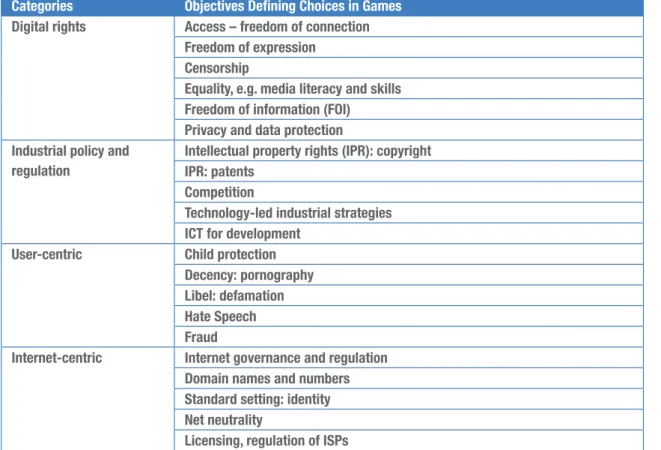
on the study of freedom of expression, by viewing these freedoms as the outcome of an ecology of choices made not only about freedom of expression, but also a variety of other objectives. Table 2 illustrates how the wide range of separate but interrelated goals being pursued by a variety of different actors (governments, NGOs, industry), employing an array of strategies, might in uence the state of freedom of expression on the Internet.
In some cases, actors, such as those from civil society, are explicitly seeking to achieve greater freedom of expression, but others are focused on censoring expression, such as through the use of Internet ltering, the censorship of news and mass media, or efforts to silence journalists or bloggers. More indirectly, some actors are focused on quite different goals altogether, such as protecting children from harmful content, protecting their own reputation, or even promoting the vitality of an economy. The more the Internet has become central to communication, the more it has been a focus of the strategies of multiple actors in achieving their various goals, which explains the wide variety of policy areas listed in the table below.
Table 2.The Ecology of Freedom of Expression on the Internet
Categories Objectives De ning Choices in Games
Digital rights Access – freedom of connection Freedom of expression
Censorship
Equality, e.g. media literacy and skills Freedom of information (FOI)
Privacy and data protection Industrial policy and
regulation
Intellectual property rights (IPR): copyright IPR: patents
Competition
Technology-led industrial strategies ICT for development
User-centric Child protection Decency: pornography Libel: defamation Hate Speech Fraud
Internet-centric Internet governance and regulation Domain names and numbers Standard setting: identity Net neutrality
Categories Objectives De ning Choices in Games
Security Secrecy, con dentiality
Security against malware, such as spam and viruses Counter-radicalization
National security, counter-terrorism
The following sections of this report will develop some of the key goals, actors and strategies underlying the objectives in Table 2. This is not intended to be an exhaustive or detailed survey, but should be suf cient to show how laws and regulations in many of these areas are indeed involved in the larger ecology that is shaping freedom of expression on the Internet. As was said decades ago, by the MacBride Commission (ICCP 1980: 93), the new technologies:
‘offer considerable potential for diversifying messages and further democratizing communication. However, realizing or rejecting this potential depends, of course, on the economic, social and political choices that must be made.’
3.
CONNECTING TO THE
INTERNET: RESHAPING ACCESS
Law and Regulation Underpinning Internet Diffusion
Legal and regulatory initiatives have underpinned increasing worldwide access to the Internet and the information, communication and services that it enables. The Internet’s worldwide diffusion has not been the inevitable outcome of the technology, but the result of a series of technological innovations shaped by policy and practice.
For example, the Internet was developed early on as the ARPANet (Advanced Research Projects Agency Network), supported by funding from the US Department of Defense. However, it was developed within universities and research institutions primarily as a tool for scientists to share computing resources, not as a tool for national defence.21 It was
born therefore in a culture of relatively free, open and trusted communication. This did not mean that abuses of this freedom did not occur. There were problems even early on within universities of individuals, such as a disgruntled student sending hate mail, but such problems were relatively easy to deal with by institutions that could identify the offending student or staff in due course and take remedial actions, such as suspending their network privileges for a period of time. Similar practices applied to the Internet today would be less feasible and more controversial as this platform has become more central to all forms of communication and information access.
Second, well before the commercial development of the Internet, governments recognized that computer-based communication systems, such as videotext in the late 1970s, and ‘multimedia computers’, were signi cantly different from the traditional media of broadcasting, telecommunication and print. The regulatory regimes developed for the traditional media did not apply well to the ‘new media’. Moreover, as new media were widely viewed as key to the future of communication, nations wanted to foster innovation in this area as a driver of new industry and economic development. The unique features of new media and the industrial policy goals associated with them led many governments to avoid regulation and not control content on new media, and later on the Internet. In fact, efforts to encourage new media developments extended to not taxing online purchases, and public investment in pilot projects.22 An exception is the parallel rise of policy on
privacy and data protection, such as with the European Commission’s Data Protection Directive of 1995. While this directive pre-dated widespread understanding of its potential to con ict with aspects of new Internet applications, such as social media, privacy and data protection was pursued as a separate set of goals and objectives in a broader EoG.
over computer-based networks. The diffusion of ‘Voice over Internet Protocol’ (VoIP) services, such as the beta version of Skype, launched in 2003, has been possible because they are not legally prohibited in many nations.23 That said, in many countries, such as where incumbent telecommunication providers have monopolies, VoIP services, such as Skype, have been blocked. This is a common practice in many African countries and other developing nations that have depended on the general revenues generated by telephone companies, but with a cost to economic development more generally. Indeed, many rapidly developing nations have been convinced of the value of liberalizing telecommunications in ways that support the Internet, such as China, which has used the Internet as a means to support the economic development of key regions (Qiu 2009).
In such ways, government policies have incentivized the development and diffusion of the Internet throughout its history as a means for enhancing technological innovation in communication and information technology and services. This is an element of industrial policy in that it not only supports the development of new information industries and businesses, but also enables innovation in all other sectors of society, from large industrial rms and agricultural enterprises, to the household, who nd more ef cient ways to use information and to communicate in everyday life and work. Economic development is therefore supported by the use of ICTs, rather than just their production (Baer 1996). But there is a potential from under- or over-regulation that might undermine the vitality of the Internet and its global diffusion.
Access to Technologies of the Internet
Figure 1 Worldwide Diffusion of the Internet: Number of Users
and Proportion of Users by World Population
24361 458
581 608
813 889 1,093
1,319 1,464
1,734 1,966
6% 8% 9% 10%
13% 14% 17% 20%
25% 26% 29%
0 500 1,000 1,500 2,000 2,500
0 20 40 60 80 100
2000 2001 2002 2003 2004 2005 2006 2007 2008 2009 2010
Total number of Internet users (million)
% Internet users
World Internet population in million World Internet population in %
Source: Internet World Stats – www.internetworldstats.com/stats.htm. October 2010.
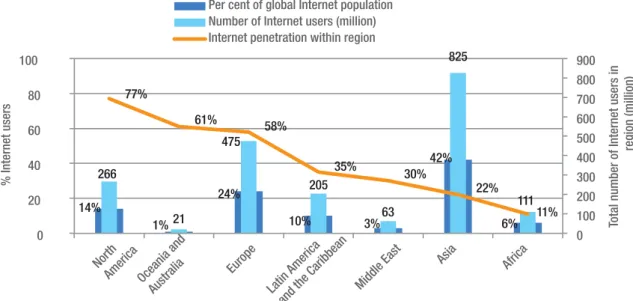
Internet diffusion has reached almost every region of the world with the exception of Africa, which has remained comparatively low in levels of Internet access at around 11per cent, giving it only about 6 per cent of the global Internet population (Figure 2). In general, Internet diffusion remains varied by region on at least two major dimensions, which might be called ‘penetration’ and ‘throw weight’.
Figure 2 lists major regions ranked by the proportion of the population that use the Internet – the levels of penetration in 2009. As shown in Figure 2, Africa has the lowest level of Internet penetration at about 11 per cent, followed by Asia, the Middle East, Latin America and the Caribbean, Europe, Oceania and Australia, and nally North America, which has the highest proportion of its population online at over three-quarters (77 per cent) of the population.
Figure 2 Regional Diffusion of the Internet: Number of Users
and Proportion of Users by World Regions
14%
1%
24%
10% 3%
42% 6% 266 21 475 205 63 825 111 77%
61% 58%
35% 30% 22% 11% 0 100 200 300 400 500 600 700 800 900 0 20 40 60 80 100
Total number of Internet users in
region (million)
% Internet users
Per cent of global Internet population Number of Internet users (million) Internet penetration within region
North
America Oceania and Australia
Europe
Latin America and the Caribbean
Middle East
Asia Africa
Source: Internet World Stats - www.internetworldstats.com/stats.htm. Penetration rates are based on a world population of 6,845,609,960 and 1,966,514,816 estimated Internet users for June 30, 2010.
Figure 2 also shows that while penetration rates are low in Asia, at around 22per cent, its Internet users make up the largest proportion of the total number of Internet users online, accounting for 42 per cent of the global Internet user population. By 2010, there were more Internet users in China than there were people (on or off the Internet) in the United States. Asia is clearly developing the greatest throw weight online of any region in the world.
Figure 3Total Number of Internet users within Regions
266 21 105 475 18 205 3 63 114 825 111 0 100 200 300 400 500 600 700 800 9002000 2002 2003 2004 2005 2008 2009 2010
Total number of Internet users (million)
North America Oceania/Australia
Europe Latin America/Caribbean
Middle East Asia
Africa
Source: Internet World Stats – www.internetworldstats.com/stats.htm. October 2010.
Figure 4Percentage of Internet users within Regions
25% 77% 42% 61% 23% 58% 0% 35% 3% 30% 5% 22% 11% 0 20 40 60 80 100
2002 2003 2004 2005 2008 2009 2010
% Internet users within region
North America Oceania/Australia
Europe Latin America/Caribbean
Middle East Asia
Africa
The impact of these regional changes in Internet adoption is best summarized by Figure 5, which shows North America declining from the largest plurality of the Internet population to a number below Europe and Asia. Europe is now also declining in its throw weight online, relative to Asia. These gures dramatically illustrate a global shift in the centre of the Internet’s gravity. Asia is replacing North America and Europe as the dominant presence on the Internet, constituting an increasingly large proportion of the world Internet population, and the implications of this development for freedom of expression online have yet to become clear.
Figure 5 Percentage of Worldwide Internet Population
37%
14%
29% 24%
4% 10%
30%
42%
1% 6%
0 20 40 60 80 100
2002 2003 2004 2005 2008 2009 2010
% of worldwide Internet population
North America Oceania/Australia Europe
Latin America/Caribbean Middle East Asia
Africa
Source: Internet World Stats – www.internetworldstats.com/stats.htm. October 2010.
Figure 6 Percentage of Worldwide Internet Usage by Number
of Active Websites
% of Internet Users
Total number of active websites (million)
6% 8% 9% 10%
13% 14% 17%
20% 25%
26% 29% 8 12
14 18
24 29 32 54 69 83 96 0 20 40 60 80 100 0 20 40 60 80 100 120
2000 2001 2002 2003 2004 2005 2006 2007 2008 2009 2010 World Internet population in %
Number of active websites (million)
Source: Internet World Stats – www.internetworldstats.com/stats.htm. October 2010. Netcraft: www.news.netcraft.com. October 2010.
Equality: Access to Skills and Technologies
Previously, skills and infrastructures necessary to produce and disseminate content for many media, such as the press, radio and television, were highly centralized. The potential of the Internet and the advances of related technologies such as video, Web2.0 applications and mobile devices have enabled a more decentralized production of content. However, access to the Internet does not automatically translate into its use for the production of new content. Most users are primarily consumers of Internet services, rather than producers of original content. The potential of the Internet, like other ICTs, to ‘recon gure access’, is not always realized.
This is one reason why many nations are aggressively pursuing initiatives designed to enhance the pro ciency and literacy of Internet users. This could not only enable more people to bene t from the vast array of information online, but also allow them to contribute original and local content to the World Wide Web. The MacBride Commission might have recognized the long-term potential of the new technologies to recon gure global information ows, but this potential has never before been as technically feasible as it is today; ensuring the appropriate skill levels remains a major challenge.
on the Internet.25 The key questions are whether or not the Internet is enabling a more
4.
TECHNOLOGIES OF
DISCONNECTION
The most extensive empirical research project that examines government ltering and website blocking suggests that these practices have increased since 2002, when this project began (Deibert et al 2008, 2010). These trends are supported by related research from organizations focused on freedom of expression, including Freedom House (2009) and Reporters without Borders (2010).
Filtering
Box 4.1The Locus of Filtering Technologies
The most common points at which ltering can be applied include:
• Internet Service Providers: ISPs are often mandated, encouraged, or incentivized to lter illegal or immoral content, or prevent search results from speci ed websites, by a regulator or other agency authorized by a government with jurisdiction over their activities. They also routinely lter spam and attempt to prevent infection by malware for reasons of stability and user protection.
• Gateways to the Internet backbone: State-directed implementation of national content ltering schemes and blocking technologies may be carried out at the backbone level, often with ltering systems set up at links to the Internet backbone, such as international gateways in order to eliminate access to content throughout an entire country.
• Institutions: Companies, schools, libraries and households can lter on the basis of their own criteria or on behalf of state authorities.
• Individual computers: Filtering software can be installed on individual computers, such as a personal computer, to restrict the ability to access certain sites or use certain applications.
• Law enforcement: Actions can be taken against users who engage in unlawful le sharing of music, malicious hacking, fraud, etc.
Adapted from: Zittrain (2006) and Callanan et al (2009).
Box 4.2Deep Packet Inspection (DPI)
Deep packet inspection is the use of computer systems that can inspect packets sent over networks using the Internet Protocol suite in ways that enable a third party, not the sender or receiver, to identify particular aspects of the communication. Inspection is done by a ‘middle-man’, not an endpoint of a communication, using the actual content of the message. For example, ISPs can apply this technology for the lawful intercept of messages on public networks to determine if customers are using the network for unlawful purposes or purposes that violate their user agreements. Governments in North America, Asia and Africa use DPI for various purposes such as surveillance (Nelson 2006) and censorship (Wagner 2009). DPI can serve as a ‘one for all’ solution to monitor or regulate traf c and communication elements: e.g. the interception and logging of Internet traf c, enforcement of copyright, prioritizing limited bandwidth, and tracking users’ behaviour. DPI thus can serve interests of many stakeholders:
• government agencies and content providers, who are interested in the monitoring and ltering of information ows (political control);
• network operating staff, who have to deal with malware and bandwidth-hungry applications (technological ef ciency);
• vertically integrated ISPs that want to create additional revenues or protect them, e.g. through preventing the Internet from cannibalizing their telephone- or video-on-demand revenues (economic interests).
See: Ralf Bendrath: DPI as an Integrated Technology of Control – Potential and Reality http://dpi.priv.gc.ca/index.php/essays/dpi-as-an-integrated-technology-of-control-%E2%80%93-potential-and-reality/
There are also a number of approaches to ltering, such as blocking an IP address, a domain name system (DNS) name, a Uniform Resource Identi er (URI), or keywords (Box 4.3). Each involves somewhat different technical methods. Keyword ltering requires more advanced techniques if they are to be well targeted, but it is being used by a growing number of countries.
Box 4.3Approaches to Blocking
• Internet Protocol (IP) blocking, by screening particular IP addresses;
• Blocking, or manipulating, DNS information, which involves falsifying the response that is returned by a DNS server;
• Uniform Resource Identi er (URI) blocking, which screens out speci c resources from a speci c website; and
• Keyword blocking, which denies access to websites based on the words found in pages or URIs, or blocks searches involving blacklisted terms. Advances are enabling increasingly dynamic, real-time analysis of content, but this is not yet in wide use.
Filtering methods often use some kind of blacklist (or ‘allow’ list) that is con gured to pass traf c by default unless it contains certain content, names, or keywords which are on the list. Filters are also often adjusted as information is passed on from law enforcement investigations or consumer complaints. If blocking takes place within a certain network, such as within a company, the network administrator is often the person who manually de nes the ltering. In contrast, many defence lters or virus scanners often use pre-de ned criteria to lter the content automatically.
Many contemporary ltering techniques are blunt instruments, often leading to some level of over- or under-blocking. For example, it is almost impossible to block only the content aimed for without unintentionally blocking other material.
Counter-Measures for Filtering
The Arrest of Journalists and Bloggers
Control is not limited to ltering or censorship. Recent years have seen an increase in a wide variety of threats to freedom on the Internet, such as an increase in arrests of bloggers and Internet users. The Committee to Protect Journalists found that in 2008, there were, for the rst time, more jailed ‘cyber-dissidents’, such as bloggers, than traditional media journalists.26 The arrest or detention of content producers, such as
journalists or bloggers, or users, such as those who are accessing or consuming unlawful or otherwise targeted material, is one of the most traditional forms of content control. In doing so, surveillance and monitoring methods are often used to identify users or producers (see Boxes 4.4, 4.5 and 4.6).
Box 4.4A Twitter-Based Arrest in the United States
During the Group of 20 summit in Pittsburgh, Pennsylvania, in October 2009, close to 200 arrests were made during demonstrations involving up to 5,000 protesters. One arrest made at a Pittsburgh motel by Pennsylvania State Police was of a 41 year old New York social worker, named Elliot Madison, for being part of a group that posted messages on the micro-blogging service Twitter that were designed to help protesters at the G-20 summit ‘avoid apprehension after a lawful order to disperse’. He was found with computers and police scanners while using Twitter. According to available accounts, FBI agents later executed a search warrant at his home in Jackson Heights, Queens, New York, for ‘evidence of federal anti-rioting law violations’.
Box 4.5Twitter in the Iranian 2009 Election Protests
In the midst of protests surrounding the contested 2009 election results in Iran, the Internet, and Twitter in particular, was claimed to have played an important role in organizing and supporting the protests on the streets of Tehran. Overall, there is little doubt that Twitter and videos posted on the Web played a signi cant role in providing a means for individuals in Iran to communicate with one another, but most often via the world outside Iran. The main role of Twitter was as a tool for the Iranian diaspora to relay protest news to the international media, which in turn became a signi cant factor in shaping and informing developments on the ground.27
That said, English-language Twitterers from the Iranian diaspora became bridges between events in Iran and the 24-hour English news cycle, which followed Twitter feeds during this period. A few weeks before the election CNN appointed its own ‘Twitter Correspondent’. Andrew Sullivan coined the term ‘Twitter revolution’ two days after the election and played a key role in promoting the ‘Tweeting for Iran’ campaign. Later, the State Department also fuelled the attention surrounding Twitter by asking Twitter to postpone its routine maintenance as there was a Twitter revolution going on in Iran.
Although Twitter might not have played a critical role in shaping the ow of information into Iran or being used as a tool by the opposition to organize themselves during the unrest, the episode introduced Twitter to many individuals inside Iran, and as a result there are many more users of Twitter inside Iran after than before the protests. Even so, ‘Citizen journalist’ videos played an important role. The more foreign media activities were restricted, the more these citizen videos lled the void. BBC Persian TV relied on these videos for its coverage of Iran. Satellite TV stations like BBC Persian and Voice of America played an important role in informing and effectively organizing people. Email was also very effective due to its low bandwidth and features that make its content easy to share. Most signi cant were human networks (there are videos of people on YouTube shouting in the Tehran metro promoting the upcoming protest gatherings). In Iran there was an alignment of old and new media, forming a cycle of technically enabled users publishing news online and uploading video footage, and outside media picking up these materials and sending them back to Iran for a larger audience, as users further disseminated through their own networks.
Box 4.6Freedom of Expression in Vietnam
28Dozens of dissident activists, bloggers and writers active online have been arrested by the Vietnamese government, most often for writing commentary, such as on Sino-Vietnamese relations.29 The International
PEN, Amnesty International, Asian Forum for Human Rights and Development, Reporters Without Borders, Human Rights Watch and the World Organization Against Torture have all reported severe restrictions on Internet freedom in Vietnam, with the Committee to Protect Journalists (CPJ) naming Vietnam as one of the 10 most dangerous countries to be a blogger.30
On its of cial website, the Vietnam Ministry of Information and Communications listed as its main functions to include: “manage all types of press… including electronic and information on the [I]nternet”.31 As of cial
media has been restricted under the Communist Party, many people have gone to the Internet to discuss controversial issues more freely (Pham 2009), leading to crackdowns utilizing Article 88 “Propaganda Against the State” and Article 258 “Abusing democratic freedoms to infringe upon the State interests” under the Vietnamese Penal Code.
In October 2009, eight Vietnamese bloggers received jail sentences, which ranged from two to six years. They were accused of disseminating anti-government propaganda under Article 88 of the Vietnamese Penal Code.32
Alternatives to Filtering
Government agencies have used a number of techniques to deny access or censor particular types of content that differ from content ltering. These include:
• Denial of service attacks, which produce the same end result as other technical blocking techniques – blocking access to certain websites – although only temporarily, and this is more often used by non-state actors seeking to disrupt services;
• Restricting access to domains or to the Internet, such as by installing high barriers (costs, personal requirements) to register a domain or even to get Internet access;
• Search result removals, by which search engine providers can lter web content and exclude unwanted websites and web pages from search results. By using blacklists, parsing content and keywords of web pages, search engines are able to hinder access. This method makes circumventing the denial of access more dif cult as search engines are not always transparent about the ltering of search results; and
• Take-down of websites, by removing illegal sites from servers, is one of the most effective ways of regulating content. To do so, regulators need to have direct access to content hosts, or legal jurisdiction over the content hosts, or an ability to force ISPs to take down particular sites. In several countries, where authorities have control of domain name servers, of cials can deregister a domain that is hosting restricted content (Deibert et al 2008).