S
UMMARYThe obstructive sleep apnea syndrome (OSAS) is a type of sleep disor-der that has called the attention of many researchers because of its widespread distribution among middle-aged subjects. The OSAS is a respiratory problem characterized by the existence of apneas, defined as 10 second minimum intervals during which no aerial flux exchange takes place through the upper airways and the hypopneas not characterized by an arrest, but by a reduction of aerial flux through the upper airways.
The most widespread index used in the diagnosis of the OSAS severity has been the apnea/hypopnea index (AHI). There is little consensus based on the apnea/hypopnea index regarding the clini-cal definition of the sleep apnea syndrome, as there is not a single criterion for the categorization of sleep apnea patients into sever-ity levels.
Nowadays, it is estimated that about 70% of the patients re-ferred to sleep laboratories suffer from snoring, and it is suspected that they might also suffer from sleep apnea. Obstructive sleep apnea patients may suffer from memory and cognitive problems, excessive daytime sleepiness, as well as mood disturbance, among other symptoms. Additionally, this disorder has severe medical and social consequences.
One of the most characteristic symptoms in sleep apnea is snor-ing. Although snoring is one of the symptoms of sleep apnea, it should be remembered it is a typical phenomenon among popula-tion in general. There is a primary kind of snoring, the most fre-quent type in less severe cases, which even occurs among the nor-mal population. In this case, the noise accompanying inspiration is made with almost every breath. Secondly, there is another kind of snoring that is either intermittent or cyclic, and snoring does not come with every breath but silent periods are also frequent. The latter indicates apnea.
A considerable number of epidemiological studies regarding snoring have been produced of late. Several of them have con-cluded that snoring may have severe clinical consequences. Most patients suffering from obstructive sleep apnea start having simple snores. In the last decade there has been a marked increase of patients who manifest respiratory disorders related to sleep who do not fall into the category of apnea patients. Nevertheless, the morbidity of these clinical disorders is not yet known, a circum-stance that makes treatment more difficult.
Only a reduced number of studies have tried to find out whether snorers show any kind of symptoms that could be used as a pre-ventive measure against the development of sleep apnea.
For all the previous reasons, the aim of this study is to assess whether there are any differences in daytime sleepiness, reaction time, short-term memory, depression, trait anxiety, state anxiety and neuroticism between a group of patients with obstructive sleep apnea and a group of snoring individuals who had not been diagnosed as suffering from OSAS.
Material and method
The sample was made up of 11 snorers (two women and nine men), in an age range between 29 and 58 (X= 43.82 and SD= 8.67), and 14 patients with OSAS (two women and 12 men), in the age range between 30 and 65 (X= 49.64 and SD= 10.67), who were selected from a clinical population. The AHI used for estab-lishing an OSAS diagnostic was of 10 apneas/hypopneas per sleep-ing hour. The patients were diagnosed to be snorers if they showed an apnea/hypopnea index <10.
The following instruments were used in the evaluation of snor-ing subjects and obstructive sleep apnea patients: 1. Cardio-respi-ratory polygraph of every hour of sleep for each one of the pa-tients. The procedure consists in night-time monitoring of the following parameters: a) electrocardiogram; b) respiratory move-ments (expansion and relaxation of the thorax and abdomen), which evaluate the respiratory force; c) oronasal flow and d) oxy-gen saturation. The snoring was measured through a tracheal mi-crophone. 2. To measure the subjective daytime sleepiness, the Epworth Sleepiness Scale was used. 3. A BASIC software pro-gram was used to measure the simple perceptual reaction times in milliseconds. 4. The digits test of WAIS was used in straight and inverse order to evaluate the capacity of short term memory. 5. To evaluate the depressive symptoms, the Beck’s Depression In-ventory was employed. 6. The State/Trait Anxiety InIn-ventory was used as a measurement of the state and trait anxiety levels. 7. As an index of neuroticism levels, the Eysenck Personality Inventory was used.
Subjects under clinical risk of an OSAS diagnosis were referred to a sleep unit by primary care physicians. Respiratory pathologies other than OSAS were ruled out before the subjects’ inclusion. Among these were, in particular, obesity hypoventilation syndrome, and chronic obstructive pulmonary disease. All the patients un-derwent a medical examination and a medical interview in which a detailed clinical history of each patient was compiled. Once the medical examination was over, each patient was given an appoint-ment to sleep one night in hospital. Subsequently, cardio-respira-tory poligraphy, registering height hours of sleep, was adminis-tered to each patient with the objective to establish a diagnosis. The morning after, a manual analysis was made of the following
A
SSESSMENT
OF
DAYTIME
SYMPTOMS
IN
SNORING
SUBJECTS
AND
OBSTRUCTIVE
SLEEP
APNEA
PATIENTS
Ana Isabel Sánchez*, Gualberto Buela-Casal
*Address: Ana Isabel Sánchez Gómez, Ph.D. Faculty of Psychology, University of Granada, 18071. Granada. Spain. Tf: 958-24-42-75. E-mail. [email protected], [email protected]
Recibido primera version: 5 de noviembre de 2005. Segunda versión: 15 de mayo de 2006. Aceptado: 20 de julio de 2006.
Artemisa
parameters which indicate the presence or absence of the distur-bance and its severity: total number of nocturnal obstructive ap-neas, total number of hypopap-neas, value of saturation during the night, mean and minimum levels of SaO2% and apnea/hypopnea index.
Afterwards, the sleep apnea diagnosis was established for those patients who showed an apnea/hypopnea index higher than 10. Snoring subjects with a lesser apnea/hypopnea index than 10 did not fit into the pathology of sleep apnea. Obstructive apneas were defined as the arrest of air flux during sleep along with the occur-rence of respiratory movements lasting more than 10 seconds. Hypopnea was defined as an episode during which the partial obstruction of the upper airways produced a significant reduc-tion of the air flux.
The following morning, the psychological variables were evalu-ated (daytime sleepiness, short-term memory, reaction time, de-pression, neuroticism, state and trait anxiety). This process was carried out in the same place and under the same conditions for every subject. The tests were completed between 8:30 and 11:30 in the morning. Additionally, an exclusion criterion was established as the suffering from any psychiatric illness past or present in any way that could influence the psychological functioning of the pa-tient.
As a method of analysis of the results, a non-parametric analysis technique was used: the U Mann-Whitney test. All statistical analy-ses were made with the statistics package SPSS, 8.0, Spanish ver-sion.
Results
Results from this study show that there are statistically significant differences between daytime sleepiness (p<0.05) and depressive symptoms (p<0.01) between both groups of subjects, whereas no statistically significant differences were found in terms of short term memory, reaction time, state anxiety levels, trait anxiety and neuroticism.
Conclusions
The analysis of the results obtained reveals that the levels of day-time sleepiness are much higher in patients with OSAS than those in the snoring group. Some studies note that the fragmentation of sleep is responsible for excessive sleepiness during the day. Nevertheless, in this study we observed greater levels of obesity in patients with OSAS than in snoring patients, which could also explain the greater levels of sleepiness. In relation to the depres-sion variable, the average scores show that depresdepres-sion levels are higher in apnea patients than in the snoring group. One of the possible explanations of this result is that the majority of apnea patients, due to the severity of the pathology, consequently present higher deficits in their daily social functioning, etc. Probably, the conditions previously described tend to influence an increase of depression levels.
Key words: Apnea, snoring, emotional state, sleepiness, memory, reaction time, neuroticism.
R
ESUMENEl síndrome de apnea obstructiva del sueño (SAOS) es un trastor-no de la respiración que se produce durante el sueño, caracteriza-do por episodios repeticaracteriza-dos de apnea (cese total del flujo aéreo) o hipopnea (cese parcial) con una duración mínima de 10 segundos. La sintomatología asociada al trastorno es muy variada. La mayoría de los pacientes se queja de problemas cognitivos,
difi-cultades de concentración, excesiva somnolencia diurna, desper-tares frecuentes y aumento de la actividad motora durante el sue-ño, así como de cambios en el estado de humor y en el carácter. De todos los síntomas observados en el trastorno, el ronquido es el rasgo más universal de la apnea del sueño y una de las causas más comunes de referencia para la evaluación del trastorno. Hoy en día se estima que aproximadamente 70% de los pacientes que acude a los laboratorios de sueño padece ronquido, siendo en este grupo además bastante alta la sospecha de un posible diagnóstico de SAOS.
Algunos estudios han centrado su interés en evaluar si las per-sonas que manifiestan ronquido crónico muestran algún tipo de sintomatología que pueda utilizarse como medida preventiva para el posterior desarrollo de la apnea del sueño. Aunque los resulta-dos de estos estudios no son muy concluyentes, lo que sí parece confirmarse es que en muchos casos el ronquido puede llegar a producir consecuencias clínicas importantes. Por ello, y con base en la bibliografía revisada, el objetivo de la presente investigación es evaluar si hay o no diferencias en somnolencia diurna, tiempo de reacción, memoria a corto plazo, depresión, ansiedad estado-rasgo y neuroticismo entre un grupo de pacientes con SAOS y un grupo de pacientes roncadores crónicos.
Material y método
Se utilizó una muestra compuesta por 11 roncadores crónicos (tres mujeres y ocho hombres), con un rango de edad que oscilaba en-tre los 29 y 58 años (X=43,82 y DT=8,67), y 14 pacientes con SAOS (dos mujeres y 12 hombres), cuyo rango de edad se encon-traba entre los 30 y 65 años (X= 49,64 y DT=10,67). Todos los sujetos fueron seleccionados en un centro hospitalario. Como puede observarse, en los datos se ponen de manifiesto las diferen-cias en cuanto a la distribución por sexos del trastorno, informa-das en la bibliografía revisada.
La poligrafía cardiorrespiratoria fue la técnica utilizada para establecer el diagnóstico de SAOS. El procedimiento incluye un registro del electrocardiograma, movimientos torácicos y abdo-minales, flujo aéreo a través de nariz y boca, y nivel de saturación de oxígeno en la sangre. El ronquido se midió mediante un micró-fono traqueal. Como medida de la somnolencia diurna, se utilizó la Escala de Somnolencia de Epworth. Se utilizó un programa en leguaje BASIC para evaluar el tiempo de reacción perceptivo mo-tor simple. Para evaluar la sintomatología depresiva, se utilizó la adaptación al castellano del Inventario de Depresión de Beck (BDI). El Cuestionario de Ansiedad Estado/Rasgo (STAI) fue utilizado para evaluar los dos niveles de ansiedad. Las puntuaciones en neu-roticismo se obtuvieron por medio del Inventario de Personali-dad de Eysenck. La prueba de dígitos del WAIS en orden directo e inverso se utilizó para evaluar la memoria a corto plazo.
Todos los pacientes con SAOS seleccionados tenían un índice de apneas-hipopneas mayor a 10 (IAH>10), en tanto que los suje-tos roncadores crónicos, que no entraban dentro de esta patolo-gía del sueño, tenían un IAH<10. Los sujetos eran remitidos por el médico de cabecera al centro hospitalario por sospecha clínica de SAOS, aunque también era necesario descartar otras patolo-gías respiratorias, como síndrome de hipoventilación-obesidad o enfermedad pulmonar obstructiva crónica (EPOC).
máxi-ma e índice de apneas; b) número total de hipopneas, duración mínima y máxima e índice de hipopneas; c) número de desatura-ciones a lo largo de la noche y la caída media; d) nivel medio y mínimo de SAO2%, y e) índice de apneas-hipopneas.
Finalizada la noche de sueño, se analizaban los resultados obte-nidos en la poligrafía respiratoria para decidir si el paciente pre-sentaba o no apnea de sueño. Una vez realizado el diagnóstico, se procedía a la evaluación psicológica de cada uno de ellos. Todas las pruebas psicológicas se realizaron en el mismo lugar y en las mismas condiciones para cada uno de los sujetos. Las pruebas se aplicaron de forma individual.
Resultados
Como técnica para el análisis de los resultados, se utilizó una téc-nica no paramétrica; concretamente la prueba U de Mann-Whit-ney. Los resultados de este estudio indican que existen diferencias estadísticamente significativas en somnolencia diurna (p<0,05) y en sintomatología depresiva (p<0,01) entre ambos grupos de su-jetos. Por otra parte, no se observaron diferencias entre ambos grupos en el resto de variables evaluadas.
Conclusiones
Los resultados obtenidos en el estudio muestran que los pacientes con SAOS presentan mayores niveles de somnolencia diurna así como puntuaciones más elevadas en depresión en comparación con el grupo de roncadores crónicos. En el resto de variables eva-luadas las diferencias entre ambos grupos de sujetos no fueron estadísticamente significativas.
Palabras clave: Apnea, ronquido, estado emocional, somnolen-cia, memoria, tiempo de reacción, neuroticismo.
I
NTRODUCTIONObstructive sleep apnea syndrome (OSAS) is a
respi-ratory problem characterized by a recurrent
obstruc-tion of the upper airway during sleep. Although
vari-ous definitions have been given of sleep apnea, it is a
disorder characterized by the existence of two
breath-ing episodes that occur durbreath-ing night-time restbreath-ing hours.
First, the existence of apneas, defined as 10 second
minimum intervals during which no aerial flux exchange
takes place through the upper airways; and second, there
are hypopneas not characterized by an arrest, but by a
reduction of aerial flux through the upper airways (9).
In recent years, there has been a growing interest in
this sleep pathology due to its incidence among the
middle-aged population and the significant medical and
social consequences it entails. Nowadays, it is estimated
that about 70% of the patients referred to sleep
labo-ratories suffer from snoring; and it is suspected that
they might also suffer from sleep apnea (24).
Obstructive sleep apnea patients may suffer from
memory and cognitive problems (20, 22) and
exces-sive daytime sleepiness (30, 31, 32), as well as from
mood disturbance (2), among other symptoms.
One of the most characteristic symptoms in sleep
apnea is snoring (4). Although snoring is a symptom
of sleep apnea, it should be remembered that it is a
typical phenomenon among population in general.
There is a primary kind of snoring, the most frequent
type in less severe cases, which even occurs among the
normal population. In this case, the noise
accompany-ing inspiration is made with almost every breath. There
is another kind of snoring that is either intermittent or
cyclic, and snoring does not come with every breath
but silent periods are also frequent. The latter
indi-cates apnea (19).
A considerable number of epidemiological studies
regarding snoring have been produced of late. Several
of them have concluded that snoring may have severe
clinical consequences (24). Most patients suffering from
OSAS show simple snores. In the last decade there has
been a marked increase of patients who manifest
res-piratory disorders related to sleep who do not fall into
the category of apnea patients. Nevertheless, the
mor-bidity of these clinical disorders is not yet known, a
circumstance that makes treatment more difficult (18).
Only a reduced number of studies have tried to find
out whether snorers show any kind of symptoms that
could be used as a preventive measure against the
de-velopment of sleep apnea. One of these assessed the
symptomatology of a group of apnea patients
com-pared to that of a group of simple snorers, reaching
the conclusion that it was very difficult to differentiate
between these two disorders by taking symptoms as
the only reference. Simple snorers and apnea patients
show some deterioration both in their social and
pro-fessional life, which in turn increases their anxiety
lev-els (15). Sforza et al. (33)
used the Hospital Anxiety
and Depression Scale with no significant difference
between snorers and OSAS patients.
On the other hand, some difference have also been
found between snoring and the presence of
post-trau-matic anxiety dreams, something that is totally
inde-pendent from the use of sedatives or antidepressant
drugs, or from alcohol, tobacco or coffee consumption.
Besides, the incidence of anxiety dreams seems higher
in snorers who do show respiratory pauses (13).
M
ETHODSubjects
The sample was made up of 11 snorers (two women
and nine men), in an age range between 29 and 58 (X=
43.82 and SD= 8.67), and 14 patients with OSAS (two
women and 12 men), in the age range between 30 and
65 (X= 49.64 and SD= 10.67), all of whom were
se-lected from a clinical population. As it can be
appreci-ated, the facts clearly show the differences regarding the
distribution between the sexes already reported in the
literature. The sample was selected from a hospital center.
The apnea/hypopnea index (AHI) used for
estab-lishing an OSAS diagnostic was of 10 apneas/
hypopneas per sleeping hour (8, 10, 12). The patients
were diagnosed to be snorers if they showed an
ap-nea/hypopnea index <10.
Instruments
All tests used in the evaluation of snoring subjects and
obstructive sleep apnea patients were carried out in a
sleep laboratory. The following instruments were used:
- Cardio-respiratory polygraph of every hour of sleep
for each one of the patients (MODELS SEFAM
U-280). The polysomnograph is the most recommended
method of evaluation. However, due to the high
fre-quency of the disorder and the high cost of this
di-agnostic procedure, new alternatives just as effective
in diagnosing the disorder have been suggested (1,
10); among these is the cardio-respiratory polygraph
(12, 35). It is also important to point out that the
advantage of using these new simplified techniques
is not only reflected in the diagnosis, but also in
mak-ing it possible for the disorder to be treated in a greater
number of patients. The cardio-respiratory polygraph
consists in the night-time monitoring of the
follow-ing parameters: a) electrocardiogram; b) respiratory
movements (expansion and relaxation of the thorax
and abdomen), which evaluate the respiratory force;
c) oronasal flow, and d) oxygen saturation (12). The
snoring was measured through a tracheal microphone.
Candela et al. (6) reported that the cardio-respiratory
polygraph showed a good agreement with
polysomno-graphy for the measurement of respiratory events and
provided a high diagnostic yield.
- For the measurement of subjective daytime sleepiness,
the Epworth Sleepiness Scale (ESS) was used (16). The
ESS is a validated eight-question survey asking the
perceived likelihood of falling asleep in various
situa-tions (sitting and reading, watching TV, etc.).
- Reaction Time Task (3). The task consisted of
push-ing a key as fast as possible followpush-ing the appearance
of a white letter A on a black background in the
cen-ter of the compucen-ter monitor. The stimulus was
pre-sented 50 times in each test in an aleatory form with
a time interval that oscillated between 0,5 and 3
mil-liseconds. The program also detected and eliminated
any anticipated responses (those produced before the
presentation of the stimulus until 130 ms after the
stimulus appearance). Eliminated trials were repeated
later in the stimulus sequence.
- The WAIS digits test was used in straight and inverse
order to evaluate the capacity of short-term memory
(37, 38).
- To evaluate depressive symptoms, the Beck’s
Depres-sion Inventory (7) was employed.
- The State/Trait Anxiety Inventory was used as a
measurement of the state and trait anxiety levels (34).
- As an index of neuroticism levels, the Eysenck
Per-sonality Inventory was used (11).
P
ROCEDURESubjects under clinical risk of an OSAS diagnosis were
referred to a sleep unit by primary care physicians.
Respiratory pathologies other than OSAS were ruled
out before the subjects’ inclusion; in particular,
obe-sity hypoventilation syndrome, and chronic
obstruc-tive pulmonary disease. All the patients underwent a
medical examination and a medical interview in which
a detailed clinical history of each one was compiled.
The clinical history recorded information concerning
the patient’s symptomatology, family and personal
back-grounds, use of alcohol and tobacco, time when
symp-toms such as snoring and sleepiness began to appear,
and information related to other associated disorders.
Once the medical examination was over, every
pa-tient was given an appointment to sleep one night in
hospital. Subsequently cardio-respiratory poligraphy,
registering eight hours of sleep, was administered to
each patient to establish a diagnosis. The morning
af-ter, a manual analysis was made of the following
pa-rameters which indicate the presence or absence of
the disturbance and its severity: total number of
noc-turnal obstructive apneas, total number of hypopneas,
value of saturation during the night, mean and
mini-mum levels of SaO
2% and apnea/hypopnea index.
The following morning, the psychological variables
were evaluated (daytime sleepiness, short-term memory,
reaction time, depression state, trait anxiety, state
anxi-ety and neuroticism). The tests were completed between
8:30 and 11:30 in the morning. In the experimental
procedure, all the recordings were carried out in the
same place and in the same conditions for all of the
subjects, controlling variables such as light,
tempera-ture, noise in the room from the recordings, food
in-gestion, and time at which each evaluation was
com-pleted. Additionally, an exclusion criterion was
estab-lished regardind the suffering from any psychiatric
ill-ness past or present in any way that could influence
the psychological functioning of the patient.
As a method of analysis of the results, a
non-para-metric analysis technique was used: the U
Mann-Whitney test. The aim was to compare average scores
in daytime sleepiness, reaction time, short-term
memory, depression, trait anxiety, state anxiety and
neuroticism among snoring subjects and obstructive
sleep apnea patients. All statistical analyses were made
with the statistics package SPSS, 8.0, Spanish version.
R
ESULTSTable 1 shows the mean and standard deviations, the
apnea/hypopnea index, the SaO
2level, and the body
mass index (BMI) of the snoring group and the
ob-structive sleep apnea group.
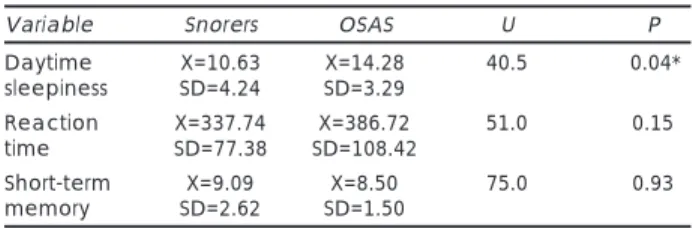
Results in daytime sleepiness, reaction time
and short term memory
The dates were analysed by the Mann-Whitney U-test.
In relation to the daytime sleepiness variable, results
indicate there are statistically significant differences
(p<0.05) between snorers and obstructive sleep apnea
patients. As it can be seen in table 2, daytime
sleepi-ness for obstructive sleep apnea patients is higher than
that observed in the sample of snoring subjects.
With respect to the reaction time and short-term
memory variables (table 2), the results indicate there were
no statistically significant differences between the group
of snorers and the apnea subjects in both variables.
Results of depression, state-trait anxiety and
neu-roticism variables
As table 3 shows, there were statistically significant
dif-ferences in depressive symptoms (p<0.01) between
snorers and apnea patients. The average scores show
that depression levels are higher in apnea patients than
in the snoring group.
Regarding the state-trait anxiety levels (table 3), the
results show that there were no statistically significant
differences, either in state anxiety levels or in trait
anxi-ety levels. By looking the average scores for each of the
variables analyzed, we may find that scores, both
regard-ing the state anxiety and the trait anxiety variables, are
smaller in the snoring group, though these differences
are not statistically significant. Finally, in relation to the
personality variable (neuroticism), results show there
were no statistically significant differences in terms of
neuroticism between both groups of subjects.
D
ISCUSSIONThe analysis of the results obtained reveals that the
levels of daytime sleepiness are much higher in OSAS
patients, mainly due to the higher amount of
awaken-ing they show durawaken-ing the night (14). The fundamental
causes of interrupted sleep are found in repeated
ap-neas during the night and intermittent nightly
desaturations
(22). Nevertheless, apart from
discon-TABLE 2. Summary of the Mann-Whitney analysis of the ave-rage scores reached by chronic snoring subjects and OSAS subjects for the variables: sleepiness, reaction time and short-term memory.
Variable Snorers OSAS U P
Daytime X=10.63 X=14.28 40.5 0.04*
sleepiness SD=4.24 SD=3.29
Reaction X=337.74 X=386.72 51.0 0.15
time SD=77.38 SD=108.42
Short-term X=9.09 X=8.50 75.0 0.93
memory SD=2.62 SD=1.50
X= Mean and SD= standard deviation. *p<0.05; ** p<0.01
TABLE 3. Summary of the Mann-Whitney analysis of the ave-rage scores reached by chronic snoring subjects and OSAS subjects for the variables: depression state-trait anxiety, and neuroticism.
Variable Snorers OSAS U P
Depression X=8.18 X=13.35 29.00 0.007**
SD=3.45 SD=5.04
State X=17.72 X=20.14 67.00 0.60
anxiety SD=6.60 SD=9.33
Trait X=21.54 X=25.07 62.50 0.43
anxiety SD=9.02 SD=10.11
Neuroticism X=13.27 X=13.28 77.00 1.00
SD=3.16 SD=4.90
X= Mean and SD= standard deviation. *p<0.05; ** p<0.01
TABLE 1. Mean scores and Standard Deviations (SD) of
ap-nea/hypopnea index (AHI), SaO2 level and body mass
in-dex (BMI) of the snoring group and obstructive sleep ap-nea patients.
Snorers OSAS
Mean SD Mean SD
AHI 3.79 1.51 68.46 18.28
SaO2 94.86 0.43 89.50 4.37
tinuous sleep, certain changes in sleep patterns have
been found in OSAS patients. In fact, a smaller amount
of REM sleep and a decrease in the proportion of
slow deep sleep, were found, specially regarding sleep
phase IV, something that cannot be found in snoring
subjects (8). This may explain the higher levels of
day-time sleepiness.
These facts cannot be corroborated with our study
given that the polygraph recording does not permit to
establish the number of awakenings per hour of sleep,
nor the states of sleep. Nevertheless, an important
as-pect to take into account is the greater level of obesity
observed in patients with OSAS (BMI= 33.74) in
com-parison with the sample of snoring subjects (BMI=
28.95). Orr et al. (25) carried out a study which
com-pares the differences between patients with OSAS who
present hypersomnia and those who do not. In the study,
both groups significantly differed only in the severity of
the hypoxia during sleep and in body weight. Later studies
have observed that patients with morbid obesity have a
greater risk of suffering hypersomnolence (26).
Several studies have pointed out that subjects with
excessive sleepiness show a deficit in their cognitive
and psychomotrix functions (28). Some authors have
also indicated that, among sleep disorders, apnea is the
one that deteriorates the most cognitive performance
of subjects (20, 21). Another variable involved has been
the presence of hypoxia during sleep (17).
In contrast to what these data might suggest, results
of the study show no differences in short-term memory
levels between sleep apnea subjects and snoring
sub-jects, despite higher daytime sleepiness levels and the
higher oxygen reduction level that the first group shows.
One plausible explanation for this can be that, in
cer-tain cases such as sleep apnea, it is very difficult to
differentiate the effect the sleep disorder has by itself
from the effects caused by the associated pathology
(27). A second possibility which has been suggested
makes reference to the evaluation instrument used.
Certain studies have demonstrated that short-term
memory is one of the most sensitive variables to
par-tial or total sleep deprivation. However, it has also been
observed that these deficits are found in greater
de-gree in tasks which require a bigger effort and not in
tasks performed in a relatively automatic manner.
Apart from the cognitive function, the daytime
sleepi-ness affects the psychosocial adaptation of patients.
Both disorders affect the patient’s quality of life,
al-though the deterioration is higher in apnea patients
due to the higher degree of severity of this syndrome.
In the case of apnea, depression has been one of the
symptoms more readily associated with the sleep
dis-order, although marked disagreement is noticed among
authors regarding the real prevalence of the symptom.
Watson et al. (36)
correlated Beck’s Depression
Inven-tory and the sleep apnea syndrome. These authors
obtained significant correlations among depression
symptomatology, the total number of obstructive
ap-neas and the frequency of apnea/hypopnea per
sleep-ing hour. Regardsleep-ing the prevalence of depression in
snoring subjects, Pillar and Lavie (23) found that
snor-ing women have higher levels of depression and
anxi-ety than those suffering from light OSA.
Changes in personality and character have been found
to be other symptoms associated with this sleep
disor-der (9). Nevertheless, studies carried out in this line
have not been conclusive. Some authors have found
that apnea patients show significantly higher levels of
neuroticism and anxiety compared with a control group
(29), whereas others have found that apnea patients
obtain normal scores in all personality scales (5). The
fact that results are sometimes so controversial might
be due to variations in the notions of disorder and
personality change. In many cases, the results of the
study are biased by the personality trait assessed and
the personality instrument used. On the other hand, it
should be remembered that in many cases daytime
sleepiness by itself, together with the tiredness that
the patient shows during the day, may lead to
confu-sion and be misinterpreted as personality variations.
Finally, according to these results, it is difficult to
establish differences between snoring subjects and
sub-jects suffering from apnea with respect to some
vari-ables, which underscores the need of assessing this
population in terms of symptomatology. This
prelimi-nary diagnosis, together with the set of hygiene
mea-sures such as quitting alcohol and tobacco, weight
re-duction, etc. could be used as a preventive measure for
the development of sleep apnea.
C
ONCLUSIONS1. The analysis of the results obtained reveals that the
levels of daytime sleepiness are much higher in
pa-tients with OSAS than in the snoring group. Some
studies note that the fragmentation of sleep is
re-sponsible for excessive sleepiness during the day (14).
Nevertheless, in this study we have observed greater
levels of obesity in patients with OSAS than in
snor-ing patients, which could also explain the greater
lev-els of sleepiness. Previous investigations have
ob-served that patients with greater obesity presented a
greater risk of suffering hypersomnolence (26).
2. In relation to the depression variable, the average
ap-nea patients, due to the severity of the pathology,
consequently present higher deficits in their daily
social functioning, etc. It is very likely that
condi-tions previously described tend to influence an
in-crease of depression levels.
R
EFERENCES1. BALLESTER E, SOLANS M, VILA X: Evaluation of a por-table respiratory recording device for detecting apnoeas and hypopnoeas in subjects from a general population. Eur Respir J, 16:123-127, 2000.
2. BARDWELL WA, BERRY CC, ANCOLI-ISRAEL S, DIMS-DALE JD: Psychological correlates of sleep apnea. J Psycho-som Res, 47:583–596, 1999.
3. BUELA-CASAL G, CABALLO VE, GARCIA-CUETO E: Differences between morning and evening types in perfor-mance. Pers Ind Diff, 11:447-450, 1990.
4. CALLOP N, CASSEL DK: Snoring and sleep disordered breath-ing. In: Lee-Chiong T, Sateia M, Carskadon M (eds). Sleep Medicine. Hanley & Belfus, 349-355, Philadelphia, 2002. 5. CASSEL W: Sleep apnea and personality. Sleep, 16:56-58, 1993. 6. CANDELA A, HERNANDEZ L, ASENSIO S, SANCHEZ-PAYA J et al.: Validation of a respiratory polygraphy system in the diagnosis of sleep apnea syndrome. Arch Bronconeumol, 41:71-77, 2005.
7. CONDE V, FRANCH JI: Behavioral Evaluation Scales for the Quantification of Symptomatology for Distress and Depression Disor-ders. UP-JOHN F. Valencia, 1984.
8. DE LA CALZADA MD, SAGALES T, GIMENO V, BAR-TOLOME M, PLANELLA MJ: Differences of the structure of the sleep between a group of patients obese with obstruc-tive sleep apnea syndrome (OSAS) and a group of patients obese snoring without OSAS. Revista Neurofisiología Clínica, 5:91-95, 1992.
9. DOMINGUEZ L, DIAZ E: Sleep apnea syndrome. Psicología Conductual, 2:297-310, 1994.
10. ESNAOLA S, DURAN J, INFANTE-RIVARD C, RUBIO R, FERNANDEZ A: Diagnostic accuracy of a portable re-cording device (MESAM IV) in suspected obstructive sleep apnoea. Eur Respir J, 12:2597-2605, 1996.
11. EYSENCK HJ, EYSENCK SBG: Eysenck Personality Invento-ry. TEA, Madrid, 1994.
12. GARCIA DEM, CAPOTE GF, CANO GS, SANCHEZ AA et al.: The respiratory polygraphy in the diagnosis of obstruc-tive apnea syndrome during sleep. Arch Bronconeumol, 33:69-73, 1997.
13. GROEN JH, OP DEN VELDE W, HOVENS JE, FALGER PR et al.: Snoring and anxiety dreams. Sleep, 16:35-36, 1993. 14. GUILLEMINAULT C: Clinical features and evaluation of
obstructive sleep apnea. In: Kryger MH, Roth T, Dement W (eds.). Principles and Practice of Sleep Medicine. Saunders, 559-570, Philadelphia, 1989.
15. HILLERDAL G, HETTA J, LINDHOLM CE, HULT-CRANTZ E, BOMAN G: Symptoms in heavy snorers with and without obstructive sleep apnea. Acta Otolaryngolol, 111:574-581, 1991.
16. JOHNS MW: A new method for measuring daytime sleepi-ness: The Epworth Sleepiness Scale. Sleep, 14:540-545, 1991. 17. KELLY DA, CLAYPOOLE KH, COPPEL DB: Sleep ap-nea syndrome: Symptomatology, associated features, and neurocognitive correlates. Neuropsychol Rev, 1:223-242, 1990. 18. LEVY P, PEPIN JL, MAYER P, WUYAM B, VEALE D: Man-agement of simple snoring, upper airway resistance syndrome, and moderate sleep apnea syndrome. Sleep, 19:101-110, 1996.
19. LUGARESI E, CIRIGNOTTA F, MONTAGNA P: Snor-ing: Pathogenic, clinical and therapeutic aspects. In: Kryger MH, Roth T, Dement W (eds.). Principles and Practice of Sleep Medicine. Saunders, 494-500, Philadelphia, 1989.
20. MITLER M: Daytime sleepiness and cognitive functioning in sleep apnea. Sleep, 16:68-70, 1993.
21. MITLER M, HAHDUKOVIC R: Evaluación de la somnolen-cia excesiva. In: Buela-Casal G, Navarro JF (eds.). Avances en la Investigación del Sueño y sus Trastornos. Siglo XXI, 241-256, 1990. 22. NAËGELE B, THOUVARD V, PEPIN JL, LEVY P, BON-NET C et al.: Deficits of cognitive executive functions in patients with sleep apnea syndrome. Sleep, 18:43-52, 1995. 23. PILLAR G, LAVIE P: Psychiatric symptoms in sleep apnea
syndrome: effects of gender and respiratory disturbance in-dex. Chest, 114:697-703, 1998.
24. OKSENBERG A: Ronquidos y apneas obstructivas del sueño: Aspectos sociales y clínicos- tratamientos no quirúrgicos. In: Velázquez Montezuma J (eds.). Medicina del Sueño: Aspectos Básicos y Clínicos. Universidad Autónoma Metropolitana, 335-357, México, 1997.
25. ORR WC, MARTIN RJ, IMES NK, ROGERS RM, STALL ML: Hypersomnolent and nonhypersomnolent patients with upper airway obstruction during sleep. Chest, 75:418-422, 1979. 26. PUNJABI NM, O’HEARN DJ, NEUBAUER DN, NIETO FJ et al.: Modelling hypersomnolence in sleep-disordered breathing. A novel approach using survival analysis. Am J Respir Crit Care Med, 159:1703-1709, 1999.
27. RAMOS-PLATON MJ: Neuropsychological Alterations in Disor-ders of Excessive Daytime Sleepiness. Report presented in the VI Reunión Científica de la Asociación Ibérica de Patología del Sueño. Sevilla, 1997.
28. ROSENTHAL L: La somnolencia: Manifestación de la ho-meostasis sueño/vigilia o síntoma clínico-patológico? In: Velázquez Montezuma J (eds.). Medicina del Sueño: Aspectos Básicos y Clínicos. Universidad Autónoma Metropolitana, 325-334, México, 1997.
29. SACHS C, LEVANDER S: Personality dimensions in patients with sleep-apnea syndrome: comparison with narcolepsy. Pers Ind Diff, 4:563-567, 1983.
30. SANCHEZ AI, BUELA-CASAL G, BERMUDEZ MªP, CABELLO-SALAS R: Effects of nCPAP treatment over re-action time and sleepiness levels during vigilance. Clin Neu-ropsychol, 18:277-283, 2004.
31. SAUTER C, ASENBAUM S, POPOVIC R, BAUER H et al.: Excessive daytime sleepiness in patients suffering from dif-ferent levels of obstructive sleep apnoea syndrome. J Sleep Res, 9:293-301, 2000.
32. SENEVIRATNE U, PUVANENDRAN K: Excessive day-time sleepiness in obstructive sleep apnea: prevalence, sever-ity, and predictors. Sleep Med, 5:339-343, 2004.
33. SFORZA E, HILAIRE Z, PELISSOLO A, ROCHAT T, IBANEZ V: Personality, anxiety and mood traits in patients with sleep-related breathing disorders: effect of reduced day-time alertness. Sleep Med, 3:139-145, 2002.
34. SPIELBERGER CD, GORSUCH RL, LUSHENE TE: State-Trait Anxiety Inventory. TEA, Madrid, 1994.
35. TERAN SJ, FERNANDEZ GC, CORDERO GJ: Situation in Spain of the diagnostic resources and of the treatment with continuous positive pressure respiration in sleep obstruc-tive apnea-hypoapnea syndrome. Arch Bronconeumol, 36:494-499, 2000.
36. WATSON R, GREENBERG G, BAKOS L: Sleep apnea and depression. Sleep Research 16:293, 1987.
37. WECHSLER D: Manual for the Wechsler Adult Intelligence Scale. The Psychological Corporation, New York, 1955.