doi: 10.17711/SM.0185-3325.2019.028
Psychometric properties of the Scale of Attitudes
towards Pregnancy and Weight Gain
in Mexican population
ElizabethGuzman-Ortiz,1Velia MargaritaCárdenas-Villarreal,2JoséMoral de la Rubia,3CeciliaMeza Peña3
1 Departamento en Ciencias de la Salud, Universidad de las Américas Puebla, Puebla, México. 2 Facultad de Enfermería,
Universi-dad Autónoma de Nuevo León, México.
3 Facultad de Psicología, Universi-dad Autónoma de Nuevo León, México.
Correspondence: Elizabeth Guzman-Ortiz
Departamento en Ciencias de la Salud, Universidad de las Américas Puebla.
Ex-Hacienda Santa Catarina Mártir S/N,
72810, San Andrés, Cholula, Puebla, México.
Phone: (+52-222) 229 - 2000 Ext. 3245
Email: elizabethguzmanortiz08@ gmail.com
Received: 21 December 2018 Accepted: 25 September 2019 Citation:
Guzman-Ortiz, E., Cárdenas-Villarre-al, V. M., Moral de la Rubia, J., & Meza Peña, C. (2019). Psychometric properties of the Scale of Attitudes To-wards Pregnancy and Weight Gain in Mexican population. Salud Men-tal, 42(5), 217-225.
DOI: 10.17711/SM.0185-3325.2019.028
ABSTRACT
Introduction. Physical changes during pregnancy trigger a positive or negative emotional response to the body image of the future mother. Since this response can affect the health of the mother and the fetus, it is necessary to have valid instruments to evaluate body image in pregnant women. Objective.
To validate in Spanish the Scale of Attitudes towards Pregnancy and Weight Gain in Mexican population.
Method. The study was conducted in two phases: it was culturally adapted to determine the linguistic validity and then its psychometric properties were verified through confirmatory exploratory factor anal-ysis. Results. Participants included 520 pregnant women over 18 attending prenatal consultation, with a mean age of 23.56 ± 5.89 and with a mean of 33.20 ± 6.69 gestation weeks. The exploratory analysis defined five components that explain 56.04% of the total variance of the 18 items with acceptable internal consistency (α = 78). Factor analysis confirmed five factors (negative attitude towards the increase of gestational weight, positive body image, control of gestational weight, concern over gestational weight and restrictive behavior in response to gestational weight) with adequate fit indices (χ2/gl = 2.57, IFI = .90, CFI = .90, RMSEA = .05 (90% CI [.048, .062], p =.12), SRMR = .05) Discussion and conclusion. The instrument has good psychometric properties and is recommended as a valid tool for assessing attitudes toward body image in Mexican women during the period of pregnancy.
Keywords: Body image, pregnant women, weight gain, questionnaires.
RESUMEN
Introducción. Los cambios físicos del embarazo propician una respuesta emocional positiva o negativa hacia la imagen corporal de la futura madre. Como esta respuesta puede afectar tanto la salud de ella como la del producto, es necesario contar con instrumentos válidos para evaluar la imagen corporal en mujeres embarazadas. Objetivo. Validar en español la Escala de Actitudes hacia el Embarazo y el Aumento de Peso en población mexicana. Método. El estudio se llevó a cabo en dos fases: una adaptación transcultural para determinar la validez lingüística y después una verificación de las propiedades psicométricas por medio de un análisis factorial exploratorio y confirmatorio. Resultados. Participaron 520 mujeres embarazadas mayores de 18 años que asistieron a consulta prenatal, con una media de edad de 23.56 ± 5.89 años y con un prome-dio de 33.20 ± 6.69 semanas de gestación. El análisis exploratorio definió cinco componentes que explican el 56.04% de la varianza total de los 18 reactivos y una consistencia interna aceptable (α = .78). El análisis factorial confirmó cinco factores (actitud negativa hacia el aumento del peso gestacional, imagen corporal po-sitiva, control de peso gestacional, preocupación por el peso gestacional y conducta restrictiva hacia el peso gestacional) con índices de ajuste adecuados (χ2/gl = 2.57, IFI = .90, CFI = .90, RMSEA = .05 (IC 90% [.048, .062], p =.12), SRMR = .05). Discusión y conclusión. El instrumento tiene buenas propiedades psicométri-cas y se recomienda como herramienta válida para evaluar las actitudes hacia la imagen corporal en mujeres mexicanas durante el periodo del embarazo.
INTRODUCTION
The stage of pregnancy in women is characterized by phys-ical and psychologphys-ical changes that lead to the development of positive or negative emotional responses towards the
body image of the future mother. Body image is defined
as the internal representation a person has of her body, re-gardless of what it really looks like, and consists of three
components: 1. cognitive-affective, defined as the thoughts,
beliefs, and feelings that a person may have regarding her body or a part of it, 2. perception, regarded as the accuracy with which the size and shape of the body is perceived in its entirety or a part of it, and 3. behavioral, meaning the actions people perform in order to check, alter, or conceal their bodies (Cash & Smolak, 2011).
There is increasing evidence that pregnant women wor-ry about issues related to their body image and weight gain throughout the entire pregnancy process (Fahami, Ami-ni-Abchuyeh, & Aghaei, 2018; Meireles, Neves, de Carval-ho, & Ferreira, 2015a). It is estimated that approximately
50% of pregnant women report feeling dissatisfied with their
bodies and their weight (Shloim, Hetherington, Rudolf, & Feltbower, 2015; Sui, Turnbull, & Dodd, 2013). Qualitative studies report that body image is a complex process and not fully understood, especially during the period of pregnancy,
in which it has been noticed that pregnant women reflect
a series of feelings and perceptions about body shape and
size, including complete satisfaction, conflict, or a mixture
of feelings of joy, lack of appreciation, and dislike of their bodies (Hodgkinson, Smith, & Wittkowski, 2014; Watson, Fuller-Tyszkiewicz, Broadbent, & Skouteris, 2015).
Likewise, it has been observed that dissatisfaction with the body image during pregnancy is related to adverse ef-fects on the mother’s health such as depression and anx-iety (Lee, Williams, & Burke, 2019; Roomruangwong, Kanchanatawan, Sirivichayakul, & Maes, 2017), including unhealthy eating behaviors such as binge eating, or inter-mittent fasting (Vartanian & Porter, 2016), and inadequate control of gestational weight gain (Hartley, McPhie, Sk-outeris, Fuller-Tyszkiewicz, & Hill, 2015). All these
as-sociated problems can affect the health of the fetus in the
short- and long-term (Hartley, Hill, Bailey, Fuller-Tysz-kiewicz, & Skouteris, 2018; Meireles, Neves, de Carvalho, & Ferreira, 2015a, 2015b). Moreover, this dissatisfaction with one’s body image can cause concern about recovering
an adequate figure after childbirth, while failure to achieve
this could trigger or aggravate the symptoms of anxiety and depression in the postpartum period (Silveira, Ertel, Dole, & Chasan-Taber, 2015). It is therefore important to have a tool to detect this body image disorder in this population.
Most studies that have evaluated body image in pregnant women have used body image scales designed for non-preg-nant women (Bagheri et al., 2013; Hartley, McPhie, Full-er-Tyszkiewicz, Hill, & Skouteris, 2016; Shloim et al., 2015).
However, since major changes occur in different parts of the
body (such as the stomach, breasts and skin) during
preg-nancy, body image in pregnant women may differ from that
of non-pregnant populations (Fuller-Tyszkiewicz, Skouteris, Watson, & Hill, 2013; Watson et al., 2015).
An instrument developed to evaluate negative and pos-itive attitudes towards body weight gain in pregnant women
has been identified: the “Pregnancy and Weight Gain Atti
-tude Scale” (PWAS), which considers the evaluation of
cog-nitive-affective and behavioral components of body image,
and has acceptable reliability (Palmer, Jennings, & Massey, 1985), and construct validity (Kendall, Olson, & Frongillo Jr., 2001). In 2013, DiPietro, Millet, Costigan, Gurewitsch,
and Caulfield (2003) evaluated the psychometric properties of PWAS in North American pregnant women, and Rous-seau, Bouillon, Lefebvre, Séjourné, and Denis (2016) did so
with pregnant women from France. The first study reported
a reliability of .84, and the second a reliability of .70. It is worth mentioning that there is no version of the PWAS in Spanish nor has it been used in Latin American populations. It is therefore considered necessary to have a reliable, val-id tool able to val-identify and measure attitudes towards body image in these populations.
In short, more research based on reliable measures is required to explore the body image component during preg-nancy so that we can improve our knowledge of possible adaptation mechanisms. Although evidence exists that body image distortion problems are common in the Mexican pop-ulation (Bobadilla-Suárez & López-Avila, 2014; Meza Peña
& Pompa Guajardo, 2018), most of our knowledge about body image during pregnancy is drawn from studies con-ducted in other countries mainly developing ones. Accord-ingly, in order to improve the comparability of studies, it
would be beneficial to evaluate body image with the PWAS
in the Mexican population. The objectives of this study were therefore as follows: to adapt the Scale of Attitudes
towards Pregnancy and Weight Gain to Spanish (referred
from now on as PWAS-S); analyze its factor structure; ver-ify the internal consistency of the factors; determine their second order factors and corroborate the proposed factor structure model in the Mexican population.
METHOD
Study design
A cross-sectional design was used.
Participants
in northeastern Mexico participated. Convenience sampling was used and the sample size was considered adequate ac-cording to the scale items and Likert format for exploratory factor analysis (Costello & Osborne, 2003).
Pregnant women with threatened miscarriages and those who had had cardiometabolic diseases (gestational diabetes, preeclampsia, hyperthyroidism, bulimia, or an-orexia) were excluded.
Measurements
Personal data card
A registration card was used which included the sociode-mographic (age, schooling) and obstetric data (weeks of gestation) of the participants.
Pregnancy and Weight Gain Attitude Scale (PWAS) by
Palmer et al (1985). This scale was designed to assess the at-titude of women in relation to weight gain during pregnancy in North American women. This scale consists of 18 items, 15 of which are related to attitudes and three to behavior.
Answers to the items are formulated on a Likert scale with
five response options (from 1 = strongly disagree, to 5 =
strongly agree).
The total score is calculated by inverting nine negative items (1,3,4,9,12-17). Scores range from 18 to 90 points, with higher scores indicating a more positive attitude to weight gain. The PWAS has shown psychometric proper-ties and indices with acceptable internal reliability for the
Spearman Brown coefficient with a value of .67 (Palmer
et al., 1985), as well as in the North American population, with Cronbach’s alpha from .75 to .84 (DiPietro et al., 2003) whereas in the French population, an alpha of .70 has been reported (Rousseau et al., 2016).
The English version (DiPietro et al., 2003) proposes a four-factor structure with 16 items: positive image of pregnancy (items 6,7 and 11), negative image of pregnancy
(items 1,9,12,13,14 and 15), indifference towards weight
gain (items 5,8,10 and 18), and restrictive behaviors in re-sponse to weight gain (items 3.16 and 17). Items 2 and 4 were excluded.
Table 1
Adaptation and validation of the Pregnancy and Weight Gain Attitude Scale
Original item in English Spanish translation
1. I worry that I may get fat during this pregnancy. 1. Me preocupa engordar durante este embarazo.
2. I would like to gain between 21 and 30 pounds during this preg-nancy.
2. Me gustaría aumentar entre 10 y 13 kg durante este embarazo.
3. I trying to keep my weight down so I don’t look so pregnant. 3. Estoy tratando de no aumentar peso para no parecer embarazada.
4. I would like to gain between 11 and 20 pounds during this preg-nancy.
4. Me gustaría aumentar entre 5 y 9 kg durante este embarazo.
5. As long as I’m eating a well-balanced diet, I don’t care how much I gain during this pregnancy.
5. Mientras llevo una dieta balanceada, no me preocupa el peso que pueda aumentar durante este embarazo.
6. I think a pregnant woman is beautiful. 6. Creo que una mujer embarazada es hermosa.
7. I am proud of looking pregnant. 7. Estoy orgullosa de cómo me veo embarazada.
8. I like being able to gain weight for a change. 8. Me agrada el hecho de que aumentaré de peso por el embarazo.
9. I am embarrassed at how big I have gotten during this pregnancy. 9. He aumentado mucho de peso en este embarazo y eso me avergüenza.
10. I would gain 40 pounds if it meant my baby would be healthier. 10. Me gustaría aumentar 18 kg, si eso significa que mi bebé será saludable.
11. I like wearing maternity clothes. 11. Me gusta usar ropa de maternidad.
12. The weight I gain during my pregnancy makes me feel unat-tractive.
12. El peso que he aumentado durante el embarazo me hace sentir no atractiva.
13. I’m embarrassed whenever the nurse weighs me. 13. Me da vergüenza cuando me pesan.
14. It bothers me that I can’t wear what’s in style while I’m pregnant. 14. Me molesta no poder usar la ropa de moda porque estoy em-barazada.
15. I feel that women have to be especially careful about getting fat during pregnancy.
15. Pienso que las mujeres tienen que ser muy cuidadosas para no engordar durante el embarazo.
16. If I gain too much weight one month, I will try to keep from gaining the next month.
16. Si aumento mucho peso en un mes, trato de no aumentar de peso en el mes siguiente.
17. Just before I go to the doctor, I try not to eat. 17. Justo antes de ir al médico, trato de no comer.
Procedures
This study was conducted in the period from April 2016 to July 2017, in two stages: cross-cultural adaptation to
deter-mine the linguistic validity of the scale, and verification of
psychometric properties. In order to carry out the
cross-cul-tural adaptation, five steps were followed: initial translation,
translation synthesis, retranslation, review by a committee of experts and preliminary test (Beaton, Bombardier, Guil -lemin, & Ferraz, 2000). Before conducting the preliminary test on 45 pregnant women, experts evaluated each item in the translated versions using four criteria (semantic, idiom-atic, experiential, and conceptual equivalence).
Lastly, the internal validity and construct validity of the scale in the Spanish version was explored; the scale was self-administered by 520 pregnant women. Data collection was undertaken by previously trained health personnel, the average response time by participants being 12 minutes.
Statistical analysis
The dimensional structure was first determined by explor
-atory factor analysis of the main components using the Varimax rotation method. Using the scores of the factors calculated by the simple addition of items, a second order exploratory factor analysis was performed. The same
meth-ods and number of fixed factors were used according to
Kaiser’s criteria. Internal consistency was estimated using
Cronbach’s alpha coefficient. High ≥ .70, adequate ≥ .60
and low values < .60 (Cronbach & Shavelson, 2004) were considered.
Secondly, the models of factors correlated and ranked
by confirmatory factor analysis were contrasted. The Gen
-eralized Least Squares method was used to estimate the
dis-crepancy function, parameters, and fit indices. Seven fit rates
were considered: discrepancy function (DF); chi-square test
(χ2); coefficient between chi-square and its degrees of free
-dom (χ2/gl); population non-centrality parameter (PNCP),
Steiger and Lind’s root mean square error of approximation
(RMSEA); Jöreskog and Sörbom’s goodness of fit index
(GFI); and its adjusted version (AGFI). The following val
-ues are considered to have a good fit: p of χ2 > .05, fd and χ2/
gl < 2, PNCP < 1, RMSEA < .05, GFI > .95 and AGFI > .90;
while those given below are regarded as having an adequate
fit: p of χ2 > .05, DF and χ2/gl < 2, PNCP < 2, RMSEA < .08,
GFI > .85 and AGFI > .80 (Landero Hernández & González
Ramírez, 2006). Statistical calculations were performed in the SPSS and AMOS 7 program.
Ethical considerations
The procedures used in this study adhered to the principles of the Declaration of Helsinki (World Medical Association,
2001) and the regulations of the General Health Law on
T
able 2
Item correlation matrix Items
Item 1 Item 2 Item 3 Item 4 Item 5 Item 6 Item 7 Item 8 Item 9 Item 10 Item 1 1 Item 12 Item 13 Item 14 Item 15 Item 16 Item 17 Item 18 Item 1 1 Item 2 .122 * 1 Item 3 .264 ** .105 * 1 Item 4 .078 * .143 * .174 ** 1 Item 5 .000 .061 .051 .194 ** 1 Item 6 .001 .101 * -.170 ** .124 * .140 * 1 Item 7 .067 .087 * -.1 15 * .167 ** .087 * .694 ** 1 Item 8 -.085 * .234 ** -.069 * .169 ** .144 ** .308 ** .389 ** 1 Item 9 .258 ** .047 .379 ** .071 * .040 -.166 ** -.135 * -.058 1 Item 10 -.035 .202 ** .108 * .056 .069 .080 * .091 * .261 ** .064 1 Item 1 1 -.122 * .079 * -.061 .042 .041 .296 ** .350 ** .286 ** -.122 * .201 ** 1 Item 12 .184 ** .106 * .357 ** .180 ** .019 -.1 17 ** -.048 -.023 .349 ** .045 .006 1 Item 13 .252 ** .087 * .352 ** .135 * .092 * -.108 * -.075 * .008 .489 ** .038 -.078 * .412 ** 1 Item 14 .200 ** .019 .296 ** .058 .057 -.097 * -.073 * -.035 .332 ** .018 -.194 ** .344 ** .525 ** 1 Item 15 .231 ** -.037 .195 ** .082 * .042 .020 .071 * -.226 ** .226 ** -.105 * -.067 .178 ** .237 ** .260 ** 1 Item 16 .308 ** .1 10 * .350 ** .096 * .030 -.028 .032 -.088 * .305 ** .013 -.006 .219 ** .299 ** .302 ** .423 ** 1 Item 17 .157 ** .153 ** .413 ** .1 12 * -.021 -.175 ** -.084 * -.012 .381 ** .071 * -.1 12 * .316 ** .429 ** .313 ** .217 ** .372 ** 1 Item 18 .027 .239 ** .095 * .054 .105 * .088 * .1 13 * .175 ** .016 .614 ** .204 ** .041 .043 -.036 -.078 * .073 * .123 * 1 Note : * p
< .05. **
p
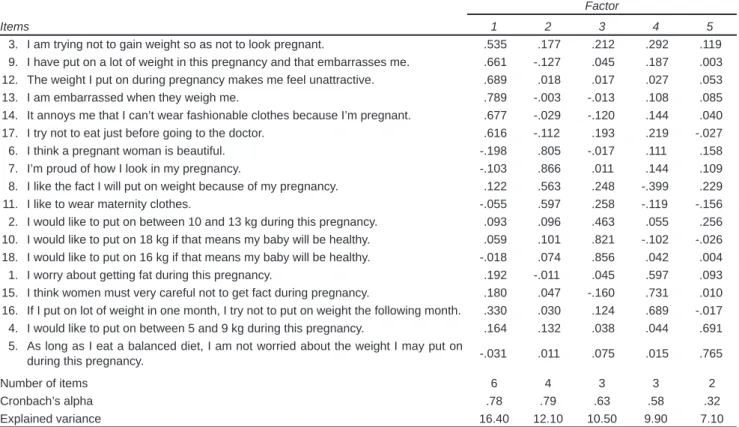
the total variance of the 18 items. After rotating the
compo-nent matrix by the Varimax method, five factors were con
-firmed: 1. factor one “Negative attitude towards the increase
of gestational weight,” comprising six items; 2. factor two
“Positive body image,” consisting of four items; 3. factor
three “Gestational weight control,” with three items; 4. fac
-tor four “Concern over the increase in gestational weight,”
consisting of three items; and 5. factor five “Restrictive be
-havior in response to gestational weight,” consisting of two items. Most items show loads over .50.
The assignment of the names of the factors followed the dimensions proposed by Cash and Smolak (2011), and the coincidence of the items grouped together in the English and French version (Table 3). Four factors were explored
in the English version, whereas in the French version, five
factors were examined, as in the Spanish version.
The total internal consistency of the scale was .78 and factors one and two had the greatest internal consistency (Table 4).
The five-factor model produced by the exploratory fac
-tor analysis was contrasted in the confirma-tory fac-tor analy
-Health Research Matters (Secretaría de Salud, 1987).
Par-ticipants signed an informed consent form and the confi
-dentiality and security of the information and privacy of the participants were protected at all times.
RESULTS
The mean age of the participants was 23.56 ± 5.89 years, with an average of 33.20 ± 6.69 weeks of gestation, and an average monthly income of 4448.57 ± 4958.370.
The adaptation and translation of the PWAS-S was carried out by a group of experts. Changes included the following adaptations: weight was converted from pounds to kilograms, and weight gain was translated as weight in-crease (Table 1).
As observed in Table 2, both positive and negative correlations were found, which were usually statistically
significant between the items. Regarding the results of the exploratory factor and internal consistency analysis, five components were defined and these explained 56.04% of
Table 3
Position of items in the Pregnancy and Weight Gain Attitude Scale
Factors in the Pregnancy and Weight Gain Attitude Scale VI VF
Factor 1 Negative attitude towards body image
3. I am trying not to gain weight so as not to look pregnant. F4 F5
9. I have put on a lot of weight in this pregnancy and that embarrasses me. F2 F4
12. The weight I put on during pregnancy makes me feel unattractive. F2 F3
13. I am embarrassed when they weigh me. F2 Excluded
14. It annoys me that I can’t wear fashionable clothes because I’m pregnant. F2 F3
17. I try not to eat just before going to the doctor. F4 F4
Factor 2 Positive body image
6. I think a pregnant woman is beautiful. F1 Excluded
7. I’m proud of how I look in my pregnancy. F1 F4
8. I like the fact that I will gain weight because of my pregnancy. F3 F3
11. I like to wear maternity clothes. F1 F3
Factor 3 Weight Control
2. I would like to put on between 10 and 13 kg during this pregnancy. Excluded F5 10. I would like to put on 18 kg if that means my baby will be healthy. F3 F2 18. I would like to put on 16 kg if that means my baby will be healthy. F3 F2
Factor 4 Concern over weight gain
1. I worry about getting fat during this pregnancy. F2 F1
15. I think women must very careful not to get fact during pregnancy. F2 F1 16. If I put on lot of weight in one month, I try not to put on weight the following month. F4 F1
Factor 5 Restrictive behavior in response to weight gain
4. I would like to put on between 5 and 9 kg during this pregnancy. Excluded F5 5. As long as I eat a balanced diet, I am not worried about the weight I may put on
during this pregnancy. F3 F1
Notes: VI = English version; VF = French version. The factors in the English version are: F1 = Positive image of pregnancy;
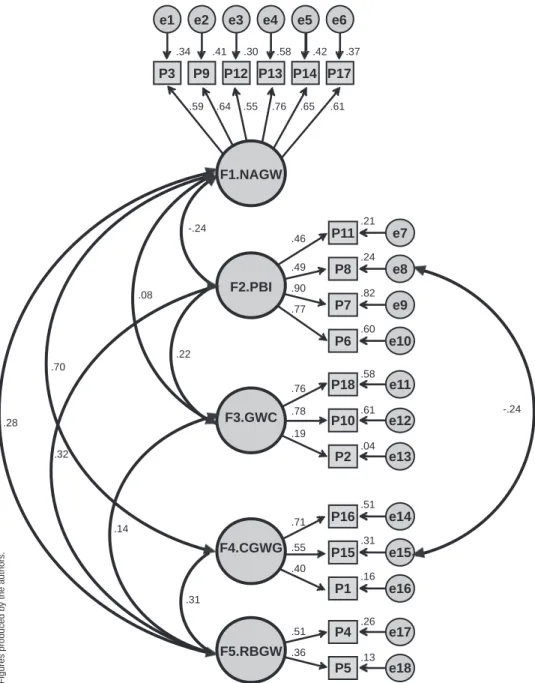
sis. Model two showed adequate fit rates: χ2/gl = 2.57, IFI =
.90, CFI = .90, RMSEA = .05 (90% CI [.048, .062], p = .12), SRMR = .05 (Table 5) with 18 items and nine correlations.
Figure 1 shows the standardized regression coefficients
between the factors, which ranged from -.22 to .88, as well as the correlations of the factors and items which ranged from .17 to .88.
DISCUSSION AND CONCLUSION
The results indicated that this instrument has good psycho-metric properties and can be recommended as a simple, val-id tool for assessing attitudes towards body image in Mexi-can women during the period of pregnancy in health centers or primary care clinics.
Factor analysis confirmed five factors (negative atti
-tude towards the increase of gestational weight, positive body image, control of gestational weight, concern about gestational weight, and restrictive behavior in response to gestational weight) through 18 items. The aforementioned dimensions explain 56% with adjustable indices, which is higher than the values in the model proposed by DiPietro et al. (2003) and Rousseau et al. (2016).
Table 4
Exploratory factor and internal consistency analysis of Pregnancy and Weight Gain Attitude Scale
Factor
Items 1 2 3 4 5
3. I am trying not to gain weight so as not to look pregnant. .535 .177 .212 .292 .119
9. I have put on a lot of weight in this pregnancy and that embarrasses me. .661 -.127 .045 .187 .003
12. The weight I put on during pregnancy makes me feel unattractive. .689 .018 .017 .027 .053
13. I am embarrassed when they weigh me. .789 -.003 -.013 .108 .085
14. It annoys me that I can’t wear fashionable clothes because I’m pregnant. .677 -.029 -.120 .144 .040
17. I try not to eat just before going to the doctor. .616 -.112 .193 .219 -.027
6. I think a pregnant woman is beautiful. -.198 .805 -.017 .111 .158
7. I’m proud of how I look in my pregnancy. -.103 .866 .011 .144 .109
8. I like the fact I will put on weight because of my pregnancy. .122 .563 .248 -.399 .229
11. I like to wear maternity clothes. -.055 .597 .258 -.119 -.156
2. I would like to put on between 10 and 13 kg during this pregnancy. .093 .096 .463 .055 .256
10. I would like to put on 18 kg if that means my baby will be healthy. .059 .101 .821 -.102 -.026 18. I would like to put on 16 kg if that means my baby will be healthy. -.018 .074 .856 .042 .004
1. I worry about getting fat during this pregnancy. .192 -.011 .045 .597 .093
15. I think women must very careful not to get fact during pregnancy. .180 .047 -.160 .731 .010
16. If I put on lot of weight in one month, I try not to put on weight the following month. .330 .030 .124 .689 -.017
4. I would like to put on between 5 and 9 kg during this pregnancy. .164 .132 .038 .044 .691
5. As long as I eat a balanced diet, I am not worried about the weight I may put on
during this pregnancy. -.031 .011 .075 .015 .765
Number of items 6 4 3 3 2
Cronbach’s alpha .78 .79 .63 .58 .32
Explained variance 16.40 12.10 10.50 9.90 7.10
Notes: n = 520; Matrix with 18-item patterns. Extraction Method: main components. Varimax rotation. Total variance 56%.
Table 5
Goodness of fit indexes and model comparison
Interpretation Models Indices Good Acceptable 1 2
Model fit
χ2/gl ≤ 2 ≤ 3 2.846 2.570
IFI ≥ .95 ≥ .90 .890 .907
CFI ≥ .95 ≥ .90 .899 .906
RMSEA ≤ .05 ≤ .075 .060 .055
[90% CI] [.052, .067] [.048, .062]
RMSEA p > .10 > .05 .014 .129
SRMR ≤ .05 ≤ .09 .057 .054
Model comparison
Δ χ2 37.664
p de Δ χ2 ≤ .05 < .001
ΔIFI ≥ .01 .018
ΔCFI ≥ .01 .007
Note: χ2/gl = Chi square; IFI = Bollen’s Incremental Fit Index due to the delta 2 coefficient; CFI = Bentler’s Comparative Fit Index; RMSEA = Steiger and Lind’s Root Mean Square Error of Approximation; CI = confidence interval; RMSEA p = unilateral probability on the right hand for the null hypothesis
that RMSEA will be ≤ .05; Δ χ2 = difference between χ2 statistics of the two
three of which coincide with the sphere of positive body image of pregnancy of the model proposed by DiPietro et al. (2003). These two dimensions coincide with the
cogni-tive-affective component of the body image concept pro
-posed by Cash and Smolak (2011). It is worth mentioning that these two aspects of body image attitudes can impair
The dimension called “negative attitude towards in
-creased gestational weight” reported further explanation of the variance. This dimension includes six items, four of which coincide with the negative body image dimension of pregnancy proposed by DiPietro et al. (2003). Dimension
two, called “positive body image,” includes four items,
.34 .41 .30 .58 .42 .37
e1 e2 e3 e4 e5 e6
P3 P9 P12 P13 P14 P17
e7
e8
e9
e10
e11
e12
e13
e14
e15
e16
e17
e18 P11
P8
P7
P6
P18
P10
P2
P16
P15
P1
P4
P5 F1.NAGW
F2.PBI
F3.GWC
F4.CGWG
F5.RBGW
.59 .64 .55 .76 .65 .61
.21
.24
.82
.60
.58
.61
.04
.51
.31
.16
.26
.13 .46
.49
.90
.77
.76
.78
.19
.71
.55
.40
.51
.36 -.24
-.24 .08
.22 .70
.28
.32
.14
.31
Figure 1. Standardized model estimated by generalized least squares of the Pregnancy and Weight Gain Attitude Scale.
Notes
F1 NAGW = negative attitude towards gestational weight gain. F2 PBI = positive body image.
F3 GWC = gestational weight control.
F4 CGWG = concern over gestational weight gain. F5.RBGW = restrictive behavior to control gestational weight.
The squares represent the item number, large circles the dimensions of the scale and small circles the error values of each item.
postpartum weight control and that negative attitudes can continue during the postpartum period (Phillips, King, & Skouteris, 2014; Silveira et al., 2015).
Regarding dimension three, called “gestational weight
control,” which includes three items, two items coincide
with the sphere of indifference towards weight gain in the
model proposed by DiPietro et al. (2003) and the item “I
would like to gain between 10 and 13 kg during this preg-nancy” was excluded in the analysis of the model designed by DiPietro et al. (2003). However, this item was included
in the sphere “lack of concern about weight gain” in the
model proposed by Rousseau et al. (2016). Weight control during pregnancy may be adequate or inappropriate, and will depend on the perception, attitudes, or dissatisfaction with the body image of the pregnant woman (Meireles et al., 2015b; Shloim et al., 2015).
Continuing with the description of the dimensions of
this study, dimension four, called “concern about weight
gain” includes three items, coinciding with the sphere of fear of weight gain in the model proposed by Rousseau et al. (2016). This dimension coincides with the concern over appearance in pregnancy scale, given that one of the items asked whether women had restricted the amount of food they ate during pregnancy in order to feel thinner (Nagl, Jepsen, Linde, & Kersting, 2019).
In dimension five, called “restrictive behavior towards gestational weight,” which includes two items, item four “I
would like to put on between 5 and 9 kg during this preg-nancy” was not contemplated in the analysis of the model proposed by DiPietro et al. (2003), although it was included in the weight gain control sphere in the model proposed by
Rousseau et al. (2016). Item five, “as long as I eat a bal -anced diet, I am not worried about any weight I might gain during this pregnancy,” was included in the dimension of
indifference towards weight gain in the model proposed
by DiPietro et al. (2003) and in the dimension of fear over weight gain proposed by Rousseau et al. (2016). These di-mensions coincide with the behavioral component of the concept of body image, in other words, the actions people perform with the aim of checking, altering, or concealing their bodies (Cash & Smolak, 2011). These statements co-incide with other scales, where women engage in certain eating behaviors to enhance their physical appearance ( Wat-son, Fuller-Tyszkiewicz, Broadbent, & Skouteris, 2017).
The model used in this study shows that item eight “I
like the fact I will gain weight during pregnancy” has a
neg-ative relationship with item 15 “I think women should be
very careful not to gain weight during pregnancy.” This re-lationship illustrates the idea that pregnant women can have a positive attitude towards weight gain during pregnancy and at the same time take care not to increase more than the recommended weight. These positive feelings are
mani-fested in first-time mothers (Bergbom, Modh, Lundgren, &
Lindwall, 2017).
As regards internal consistency, the pregnancy and weight gain attitude scale is considered a reliable tool for measuring the construct, because internal consistency
val-ues and fit rates were adequate, and similar to those in the
study proposed by DiPietro et al. (2003) and Rousseau et al. (2016). The dimensions of the scales report acceptable val-ues of internal consistency, with the exception of dimension
four and five. These dimensions report low values from .32
to .58, which can be attributed to the number of correspond-ing items in each dimension.
Limitations of this study include failure to perform criterion validity, which indicates the degree to which questionnaire scores correlate with other questionnaires measuring the same trait or variable. At present, a standard instrument has yet to be established to measure body image distortions (Meireles et al., 2015a).
From the statistical point of view, it is concluded that
the Scale of Attitudes towards Pregnancy and Weight Gain
(PWAS-S) in its Spanish version reports acceptable con-struct validity and reliability, indicating that it can be used in Mexican pregnant women over 18.
It is important for health professionals involved in prenatal care and trained in mental health to consider the assessment of body image during pregnancy, in order to im-prove prenatal care in relation to the body changes that nor-mally occur during this period. This will enable pregnant women to accept changes in their appearance.
The above is proposed, because in recent years, there have been reports that most women react negatively to the changes in body appearance characteristic of pregnancy (Lee et al., 2019; Meireles et al., 2015a), although a mi-nority of pregnant women perceive changes in the body’s appearance during pregnancy as being positive (Erkaya, Karabulutlu, & Calik, 2018; Harrison, Obeid, Haslett, Mc-Lean, & Clarkin, 2019). This dissatisfaction with their bod-ies may lead women to adopt eating behaviors and emotion-al states that can create problems with the recommended weight gain during pregnancy (Hartley et al., 2018; Room-ruangwong et al., 2017) and jeopardize the health of the mother and the fetus in the short- and long-term. The con-sequences of failing to achieve the recommended weight, coupled with the eating and emotional disorders that may occur during pregnancy, show the importance for primary health care professionals of having reliable tools to detect attitudes towards body image.
Funding None.
Conflicts of interest
REFERENCES
Bagheri, M., Dorosty, A., Sadrzadeh-Yeganeh, H., Eshraghian, M., Amiri, E., & Khamoush-Cheshm, N. (2013). Pre-pregnancy body size dissatisfaction and excessive gestational weight gain. Maternal and Child Health Journal, 17(4), 699-707. doi: 10.1007/s10995-012-1051-6
Beaton, D. E., Bombardier, C., Guillemin, F., & Ferraz, M. B. (2000). Guidelines for
the process of cross-cultural adaptation of self-report measures. Spine, 25(24), 3186-3191. doi: 10.1097/00007632-200012150-00014
Bergbom, I., Modh, C., Lundgren, I., & Lindwall, L. (2017). First-time pregnant women’s experiences of their body in early pregnancy. Scandinavian Journal of Caring Sciences, 31(3), 579-586. doi: 10.1111/scs.12372
Bobadilla-Suárez, S., & López-Avila, A. (2014). Distorsión de imagen corporal percibida e imaginada. Un posible factor para la obesidad y el sobrepeso en mexicanos. Revista Médica del Instituto Mexicano del Seguro Social, 52(4), 408-414.
Cash, T. F., & Smolak, L. (2011). Body image: A handbook of science, practice, and prevention. (2nd. Ed). NY: The Guilford Press.
Costello, A. B., & Osborne, J. W. (2003). Exploring best practices in factor analysis: Four mistakes applied researchers make. Paper presented at the Annual Meeting of the American Educational Research Association, Chicago, IL.
Cronbach, L. J., & Shavelson, R. J (2004). My current thoughts on coefficient alpha
and successor procedures. Educational and Psychological Measurement, 64(3), 391-418. doi: 10.1177/0013164404266386
DiPietro, J. A., Millet, S., Costigan, K. A., Gurewitsch, E., & Caulfield, L. E. (2003). Psychosocial influences on weight gain attitudes and behaviors during
pregnancy. Jornual American Dietetic Association, 103(10), 1314-1319. doi: 10.1016/S0002-8223(03)01070-8
Erkaya, R., Karabulutlu, Ö., & Calik, K. Y. (2018). The effect of maternal obesity on
self-esteem and body image. Saudi Journal of Biological Sciences, 25(6), 1079-1084. doi: 10.1016/j.sjbs.2018.02.003
Fahami, F., Amini-Abchuyeh, M., & Aghaei, A. (2018). The relationship between psychological wellbeing and body image in pregnant women. Iranian Journal of Nursing and Midwifery Research, 23(3), 167-171. doi: 10.4103/ijnmr. IJNMR_178_16
Fuller-Tyszkiewicz, M., Skouteris, H., Watson, B. E., & Hill, B. (2013). Body dissatisfaction during pregnancy: A systematic review of cross-sectional and prospective correlates. Journal of Health Psychology, 18(11), 1411-1421. doi: 10.1177/1359105312462437
Harrison, M. E., Obeid, N., Haslett, K., McLean, N., & Clarkin, C. (2019). Embodied motherhood: Exploring body image in pregnant and parenting youth. Journal of Pediatric and Adolescent Gynecology, 32(1), 44-50. doi: 10.1016/j. jpag.2018.08.007
Hartley, E., Hill, B., Bailey, C., Fuller-Tyszkiewicz, M., & Skouteris, H. (2018). The associations of weight status and body attitudes with depressive and anxiety
symptoms across the first year postpartum. Women´s Health Issues, 28(6),
530-538. doi: 10.1016/j.whi.2018.07.002
Hartley, E., McPhie, S., Fuller-Tyszkiewicz, M., Hill, B., & Skouteris, H. (2016).
Psychosocial factors and excessive gestational weight gain: The effect of parity
in an Australian cohort. Midwifery, 32, 30-37. doi: 10.1016/j.midw.2015.09.009 Hartley, E., McPhie, S., Skouteris, H., Fuller-Tyszkiewicz, M., & Hill, B. (2015).
Psychosocial risk factors for excessive gestational weight gain: A systematic review. Women and Birth, 28(4), e99-e109. doi: 10.1016/j.wombi.2015.04.004 Hodgkinson, E. L., Smith, D. M., & Wittkowski, A. (2014). Women’s experiences
of their pregnancy and postpartum body image: a systematic review and meta-synthesis. BMC Pregnancy and Childbirth, 14(1), 330. doi: 10.1186/1471-2393-14-330
Kendall, A., Olson, C. M., & Frongillo Jr, E. A. (2001). Evaluation of psychosocial measures for understanding weight-related behaviors in pregnant women. Annals of Behavioral Medicine, 23(1), 50-58. doi: 10.1207/S15324796ABM2301_8
Landero Hernández, R., & González Ramírez, M. T. (2006). Estadística con SPSS y
metodología de la investigación. México: Trillas. ISBN: 968-24-7551-1 978-968-24-7551-1
Lee, M. F., Williams, S. L., & Burke, K. J. (2019). Striving for the thin ideal post-pregnancy: a cross-sectional study of intuitive eating in postpartum women. Journal of Reproductive and Infant Psychology, 1-12. doi: 10.1080/02646838.2019.1607968
Meireles, J. F. F., Neves, C. M., de Carvalho, P. H. B., & Ferreira, M. E. C. (2015a). Body dissatisfaction among pregnant women: an integrative review of the literature. Ciencia & Saude Coletiva, 20(7), 2091-2103. doi: 10.1590/1413-81232015207.05502014
Meireles, J. F. F., Neves, C. M., de Carvalho, P. H. B., & Ferreira, M. E. C. (2015b). Body image of pregnant women: association with sociodemographic, anthropometric, and obstetric variables. Revista Brasileira de Ginecologia e Obstetrícia, 37(7), 319-324. doi: 10.1590/S0100-720320150005388
Meza Peña, C., & Pompa Guajardo, E. (2018). Distorsión e insatisfacción con la
imagen corporal en una muestra de mexicanos. Revista de Psicología y Ciencias del Comportamiento de la Unidad Académica de Ciencias Jurídicas y Sociales,
9(2), 120-131. doi: 10.29365/rpcc.20181207-75
Nagl, M., Jepsen, L., Linde, K., & Kersting, A. (2019). Measuring body image during
pregnancy: psychometric properties and validity of a German translation of the
Body Image in Pregnancy Scale (BIPS-G). BMC Pregnancy and Childbirth,
19(1), 244. doi: 10.1186/s12884-019-2386-4
Palmer, J. L., Jennings, G. E., & Massey, L. (1985). Development of an assessment
form: attitude toward weight gain during pregnancy. Journal of the American Dietetic Association, 85(8), 946-949.
Phillips, J., King, R., & Skouteris, H. (2014). The influence of psychological distress
during pregnancy on early postpartum weight retention. Journal of Reproductive and Infant Psychology, 32(1), 25-40. doi: 10.1080/02646838.2013.845873 Roomruangwong, C., Kanchanatawan, B., Sirivichayakul, S., & Maes, M. (2017).
High incidence of body image dissatisfaction in pregnancy and the postnatal period: Associations with depression, anxiety, body mass index and weight gain during pregnancy. Sexual & Reproductive Healthcare, 13, 103-109. doi: 10.1016/j.srhc.2017.08.002
Rousseau, A., Bouillon, A., Lefebvre, L., Séjourné, N., & Denis, A. (2016). Corporal image and pregnancy: A look at psychometric properties of the French
translation of the Pregnancy and Weight Gain Attitude Scale. L’Encephale,
42(4), 333-339. doi: 10.1016/j.encep.2015.08.002
Secretaría de Salud (1987). Reglamento de la ley general de salud en materia de investigación para la Salud. México, D. F.: Editorial SSA.
Shloim, N., Hetherington, M. M., Rudolf, M., & Feltbower, R. G. (2015). Relationship
between body mass index and women’s body image, self-esteem and eating behaviours in pregnancy: A cross-cultural study. Journal Health Psychology,
20(4), 413-426. doi: 10.1177/1359105313502568
Silveira, M. L., Ertel, K. A., Dole, N., & Chasan-Taber, L. (2015). The role of body image in prenatal and postpartum depression: A critical review of the literature.
Archives Women´s Mental Health, 18(3), 409-421. doi: 10.1007/s00737-015-0525-0
Sui, Z., Turnbull, D., & Dodd, J. (2013). Effect of body image on gestational weight
gain in overweight and obese women. Women and Birth, 26(4), 267-272. doi: 10.1016/j.wombi.2013.07.001
Vartanian, L. R., & Porter, A. M. (2016). Weight stigma and eating behavior: A review
of the literature. Appetite, 102, 3-14. doi: 10.1016/j.appet.2016.01.034 Watson, B., Fuller-Tyszkiewicz, M., Broadbent, J., & Skouteris, H. (2015). The
meaning of body image experiences during the perinatal period: A systematic review of the qualitative literature. Body Image, 14(3), 102-113. doi: 10.1016/j. bodyim.2015.04.005
Watson, B., Fuller-Tyszkiewicz, M., Broadbent, J., & Skouteris, H. (2017). Development and validation of a tailored measure of body image for pregnant women. Psychological Assessment, 29(11), 1363-1375. doi: 10.1037/ pas0000441
World Medical Association. (2001). World Medical Association Declaration of Helsinki. Ethical principles for medical research involving human subjects.