Chapter 4
Legislation and the General Registry
of Cultural Interest Asset in Spain, 1985-2016
José luis garcía cuesta
Basilio calderón calderón
University of Valladolid
UMMARy:
S I. THE REGULATION OF BICS IN THE LEGISLATION ON SPAIN’S HISTORIC HERITAGE. 1. State and regional legislation on historic heritage in Spain: 1985-2016. 2. Heritage space: the environment of Heritage of Cultural Interest (BIC). II. SPATIAL DISTRIBUTION OF THE BICS IN SPAIN. 1. BICs in Spain: nineteen sources of information, a single registry. 2. Spatial distribution of BICs in Spain: a combination of tradition and communication strategies. III. REFERENCES. IV. SOURCES.
With the exception of some pioneering, but incomplete, dispositions concerning Spain’s historical heritage approved in the 19th century,
most of the legislation concerning this question was passed in the 20th
century. Worth noting, among many other dispositions, is the Law of May 13th 1933 on the defence, conservation and growth of the national
historic-artistic heritage and, in particular, the Law 16/1985, of June 25th, concerning Spain’s Historic Heritage. This latter law was to have
an enormous transcendence, for at least three reasons: it grouped together a large part of the historical legislation; it included all Spain’s international commitments in this matter; and finally, it began a territorially decentralised stage in the recognition and protection of heritage assets, especially those denominated in Spain as BIC (Bien de Interés Cultural or Cultural Interest Asset).
competences to the regional governments which, through specific legislation on cultural or historical heritage, has allowed political singularity to be associated with some of the most relevant attributes of each particular territory, whether of a historical or heritage nature, or both.
In addition, we have the incorporation of heritage to regional development strategies (Landel, 2009), for which the following is normally necessary: first, the creation of a territorial trademark based on the exceptionality of the heritage assets or the uses and customs of the said territory (Harvey 2001; Ivanc & Gomes 2015; Lorenzini et al. 2011; Smith 2006); this is followed by the construction of new infrastructures and facilities as instruments of territorial qualification and revitalization (Ciambrone 2013; Simeon & Martone 2014); finally comes the creation and sale of the original heritage, or its recreation, as a touristic resource (Ashworth 2003; Biernacka & Kocwin 2010; Gogolou & Dimopoulou 2015; Kirshenblatt 1998).
As we shall analyse later, the recognition process of the assets upon which these strategies are based, the so-called BICs, attributed for the most part to the Autonomous Regions, has been decidedly irregular. What is true is that, in order to face the new challenges in taking advantage of heritage, the number of assets that have been declared of cultural interest has undergone spectacular growth. However, it is no less true that the number and location has no relation whatsoever to the history, tradition or heritage wealth of the territories, but to the opportunity or political need to highlight them.
I. THE REGULATION OF BICs IN THE LEGISLATION ON SPAIN’S HISTORIC HERITAGE
the expense of a growing degradation of the surrounding landscape; something which is incompatible with the unique, exceptional nature of the original heritage resource.
The legal concept of historic heritage was defined in the Law 16/1985 on Spain’s Historic Heritage and in the Royal Decree 111/1986 on the partial development of the same. The Law sets out the concept of Spain’s Historic Heritage in the first article, stating that it will be made up of «the properties and moveable objects of artistic, historic, paleontological, archaeological, ethnographic, scientific or technical interest. Also forming part of the aforementioned will be the bibliographic and documental heritage, the archaeological areas and sites, as well as the natural sites, gardens and parks with an artistic, historic or anthropological value».
In all cases, the law makes it mandatory for the most relevant heritage assets to be «inventoried or declared of cultural interest». Responsibility for this lies with the Autonomous Regions, through article 148.1 of the Spanish Constitution, which recognises the right of the Autonomous Regions to assume jurisdiction concerning the monumental heritage of interest to the region or concerning the promotion of culture. On the other hand, as set out in article 149.1.28, the defence of Spain’s cultural, artistic and monumental heritage against its exportation and despoilment is the exclusive responsibility of the State. The State also maintains jurisdiction over the museums, libraries and archives it owns, even though they may be managed by the Autonomous Regions.
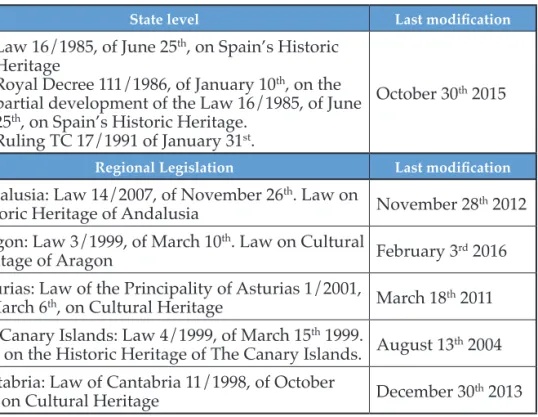
Similarly, the protection of cultural heritage has been the object of concurrent dispositions with unequal scope and effectiveness among those of an eminently urban nature and those that, with a specific nature, face the complex task of defining and protecting the cultural heritage (Fariña, 2000). This function lies not only with the law on Historic Heritage of 1985 and the diverse generations of the law on City Planning & the Land Regime, but also with an endless set of rules of a regional nature (see Table 1), approved in the also endless deployment process of regional competences in both areas: city planning and culture.
1. STATE AND REGIONAL LEGISLATION ON HISTORIC
HERITAGE IN SPAIN: 1985-2016
Constitutional Court, leaves historic heritage, except for its defence against despoilment and exportation, in the hands of the Autonomous Regions that have legally assumed them. They are empowered to establish the general regime for Spain’s historic heritage located in their territory. Thus, the assets which are not assigned to a state service (Museums, Archives, Libraries, etc. (STC, 17/1991)) should be declared BIC (heritage of cultural interest) by the Autonomous Region in which they are located.
Developing this mandate of the law 16/1985, of June 25th, on Spain’s
Historic Heritage, confirmed by several sentences of the Supreme Court (STC 17/1991 of January 31st, STC 122/2014, of July 17th), the
Autonomous Regions have, since then, been issuing their own laws on heritage (Tapia, 2011, López, 1999), in which they detail the process for declaring BICs, protection and access, or the legal and inventory regime. The explanation for this responsibility is very simple: the legal category of heritage of cultural interest (BIC) within Spain’s Historic Heritage is made up of the most relevant assets «normally located in one of the Autonomous Regions». Therefore, once responsibility has been assumed legally, the Autonomous Region then has the competence to issue a formal declaration, in accordance with the ruling 122/2014 of the Constitutional Court.
A complex legal structure has been created over the last thirty years to develop this territorially decentralised responsibility (the recognition of assets). The Autonomous Regions have promulgated at least three generations of laws on historic or cultural heritage, besides an endless number of modifications that have, at times, made the system for recognising and protecting these assets extraordinarily complex. This process of a periodic revision of the laws is due to the confluence of three elements: the reform of the Regional Statutes, the need to simplify the laws, and the interest in decentralising part of the responsibility, attributing a prominent participation to the Town Councils in the management of the said assets, particularly the properties. It should not be forgotten that it is the properties that suffer the greatest pressure and the most conflicts concerning the right of ownership, city planning or both.
high capacity to this variable for cementing, as they say in Andalusia, «the awareness of identity and of the Andalusian culture through knowledge of, research into and diffusion of the historic heritage»; or because the heritage is considered so unique and exceptional that it requires «a more complete Law to itself», which is the case of Castile La Mancha1; or to stress, as is done in the law in Aragon, that
«the heritage is the common property of all the citizens of Aragon, and its elements have contributed, and continue to contribute, to the configuration of the Spanish culture and to the Mediterranean countries as a whole. Without the preservation and reinforcement of our culture, uniformity would take over, a uniformity that encourages forms of social development based on a single model (sic)», as set out in the law 3/1999, of March 10th, on the Cultural Heritage of Aragon.
Table 1. Legislation on Cultural Heritage
State level Last modification
– Law 16/1985, of June 25th, on Spain’s Historic Heritage
– Royal Decree 111/1986, of January 10th, on the partial development of the Law 16/1985, of June 25th, on Spain’s Historic Heritage.
– Ruling TC 17/1991 of January 31st.
October 30th 2015
Regional Legislation Last modification Andalusia: Law 14/2007, of November 26th. Law on
Historic Heritage of Andalusia November 28th 2012 Aragon: Law 3/1999, of March 10th. Law on Cultural
Heritage of Aragon February 3rd 2016
Asturias: Law of the Principality of Asturias 1/2001,
of March 6th, on Cultural Heritage March 18th 2011 The Canary Islands: Law 4/1999, of March 15th 1999.
Law on the Historic Heritage of The Canary Islands. August 13th 2004 Cantabria: Law of Cantabria 11/1998, of October
13th, on Cultural Heritage December 30th 2013
1. Law 14/2007, of November 26th, on the Historic Heritage of Andalusia. Law
5/2016, of May 4th, on the Cultural Heritage of Galicia. Law 4/2013, of May 16th,
on the Cultural Heritage of Castile La Mancha. Law 3/2013, of June 18th, on the
Regional Legislation Last modification Castile-La Mancha: Law 4/2013, of May 16th.
Cultural Heritage of Castile-La Mancha May 11th 2016 Castile & Leon: Law 12/2002, of July 11th 2002. Law
on the Cultural Heritage of Castile & Leon July 2nd 2013 Catalonia: Law 9/1993, of September 30th, on the
Cultural Heritage of Catalonia. March 23rd 2012 Extremadura: Law 2/1999, of March 29th. Law on the
Historic and Cultural Heritage. February 21st 2011 Galicia: Law 5/2016, of May 4th, on the Cultural
Heritage of Galicia. No modifications
Balearic Islands: Law 12/1998, of December 21st, on
the Historic Heritage of the Balearic Islands. June 23rd 2012 La Rioja: Law 7/2004, of October 18th, on the
Cultural, Historic and Artistic Heritage of La Rioja. October 22nd 2014 Madrid: Law 3/2013, of June 18th, on the Historic
Heritage of the Region of Madrid. December 30th 2015 Murcia: Law 4/2007, of March 16th, on the Cultural
Heritage of the Autonomous Region of Murcia. No modifications Navarre: Regional Law 14/2005, of November 22nd,
on the Cultural Heritage of Navarre. April 18th 2007 Basque Country: Law 7/1990, of July 3rd, on the
Basque Cultural Heritage. December 27th 2007
Valencia: Law 4/1998, of June 11th, on the Cultural
Heritage of the Autonomous Region of Valencia. December 31st 2015 Source: BOE. Consolidated legislation of the Autonomous Regions. Consultation: February 2017. Own elaboration.
In the remaining Autonomous Regions, the original legislation of the 1990s has been maintained, or at least that of the first years of the 21st century, but regularly modified to attend to the legislative changes
that have occurred in other areas of the legislation linked to cultural heritage. There has also been a simplification of the administrative procedures related with the declaration, management, conservation and regime of sanctions in each one. New BIC categories have also been introduced on top of the five contemplated in the law 16/1985, of June 25th, on Spain’s Historic Heritage: Monuments, Gardens, Historic
Sites and Ensembles, as well as Archaeological Sites.
Table 2 shows the types of BIC specifically recognised by each autonomous region. Most of them add, in addition to the five basic types from the Law 16/1985, all or some of these four new categories: Places of Ethnological or Ethnographic Interest, the so-called Paleontological Sites, the Cultural or Historical Routes, and the Cultural Landscape. Some exceptions are the Region of Andalusia, which adds two new types: Historical Territory and Sites of Industrial Interest; the Region of Cantabria, which introduces the figure of the Natural Site; and the Region of Extremadura, which incorporates Archaeological Reserves and Archaeological Protected Areas.
Paradoxically, the sites of ethnographic interest, defined in article 46 of the Law 16/1985 as «the moveable and immoveable assets, the knowledge and activities that are or have been a relevant expression of the traditional culture of the Spanish people in their material, social or spiritual aspects», do not figure in Spain’s catalogue of heritage assets (article 14) as Heritage of Cultural Interest (BIC). Some of the characteristics of this definition are collected in article 15.4 of the said law, on referring to Historic Sites, in spite of which, most of the autonomous regions have incorporated sites of ethnological or ethnographic interest as a specific BIC category, with their own catalogue (see Table 2).
Table 2. Singular elements in the regional catalogue of Heritage of
Cultural Interest
Site of ethnological- ethnographic interest Paleontological Area Cultural-historical routes Cultural Landscape. Historical
T
erritory
Heritage Site Site of industrial interest Natural environment Archaeological Reserve Archaeological protected area Total
new
assets
Andalusia 3
Aragon 2
Asturias 1
Canary Islands 2
Cantabria 4
Castile La Mancha 1
Castile & León 2
Catalonia 2
Extremadura 4
Galicia 4
Balearic Islands 2
La Rioja 4
Madrid 2
Murcia 2
Navarre 2
Basque Country 0
Valencia 3
N.º regions 13 9 6 6 1 1 1 1 1 1
Source: BOE. Consolidated regional legislation. Consultation: February 2017. Own elaboration.
effects of such a decision. Article 14 points out that «any person may solicit the initiation of the process to declare a heritage asset of cultural interest (BIC)», although the normal process is for the owner to do so if the property has the necessary qualities (or attributes), or the administration (councils, provincial authorities, etc…), or even other entities or associations with some historical or cultural interest in general.
It can be deduced from all the above, following the approval of the law 16/1985 on Spain’s Historic Heritage, that the national and regional legislation has not only the aim of protecting the heritage and avoiding the exportation and despoilment of the cultural assets, which are historic responsibilities; but it now also has a different, additional destiny and purpose. In fact, each autonomous region now has control over its assets and their surroundings, setting up a framework of plans through which to give added value to a heritage resource, after first being freed from inappropriate historic adhesions (Calderón & García, 2016-b), and then reinventing it with new elements that will serve its programmed touristic exploitation (Kockel 2002).
The forms of management that each region has for achieving this aim are its own unique ones, so the typology of spatial aggregates is almost unlimited, since they can be called heritage parks, cultural parks, eco-museums, heritage corridors, heritage enclaves, cultural routes and landscapes, among others. All this helps the rebirth of the territory, not based on the uses it had in the past, but on the transfer of the memory of such uses or customs to the present, in a peculiar exercise of historical sustainability of a cyclical nature, as each second or successive period of exploitation of a resource springs from the exhaustion, through overuse, of the previous ones (Ashworh 2003).
However, this process of identification and inventory of assets is not neutral; the beginning of the declaration proceedings for a territorial resource (Monument, Historic garden, Site, Archaeological Area or Ensemble) as a BIC involves «the suspension of the corresponding municipal licences for parcelling, building or demolition in the affected areas, as well as of the effects of those already granted». Similarly, the declaration as a BIC requires compliance with the protective demands set out in article 19 of the abovementioned law. Finally, the resolution of the proceedings declaring a property or site to be a BIC also sets the limits of the surroundings affected by the declaration, which are in turn affected by those very limitations and demands.
assets, etc.), since the territorial heritage does not consist solely and exclusively of exceptional resources. Together with those elements that have been awarded the status of heritage resource, the territory also contains many other resources of varying formal quality and high symbolic value. Such assets are often the basis of the individual formation of the territorial image, yet they pass unnoticed as they are not linked to a particular story and lack formal, administrative, academic or legal recognition (Calderón & García, 2016-b). As chance would have it, some resources in this heritage universe that are not tagged as cultural, and which make up a kind of invisible, diffuse heritage, are given a story with a plot that rescues them from anonymity (Smith 2006), managing to make them visible so they can have a new existence, living a new cycle of exploitation after reproducing the stages that go from their discovery to consumption.
2. HERITAGE SPACE: THE ENVIRONMENT OF HERITAGE OF CULTURAL INTEREST (BIC)
The protective regime for BICs included in the state and regional laws has positive effects on the integrity of the heritage, but negative ones concerning the use of those other properties within the protected perimeter or in the surrounding area. In general, these assets are limited both by the typology of work that can be carried out and the permitted uses. They also need the regional and municipal administration’s planning authorisation, vigilance and discipline. So, it is inevitable that, in order to be able to overcome these requirements and limitations, a great part of the development expectations generated by a BIC are realised outside the protected area, where there are fewer prohibitions. Thus, the effects on the economy and landscape that this protection entails occur not in the immediate surroundings, but beyond its limits.
The surroundings may include buildings or sets of buildings, plots of land, estates (in all cases with their corresponding subsoil), urban and rural fabric, geographical accidents and natural or landscape elements; irrespective of whether they are close to or far from the asset itself or whether they make up a continuous or discontinuous area».
This definition contains most of the basic elements that shape the area of protection: buildings or open spaces, whether adjacent or not, aesthetic singularity, geographical accidents, homogeneity of the landscape; although, in this case, as in most of Spain’s regional legislation, the distance from the BIC is not included.
Exceptionally, this criterion is included in the Law 2/1999 on the Historical and Cultural Heritage of Extremadura, which, in its article 39 indicates that «the protective context, from the outer extremes of the asset will, in general, be at least to the order of: a) 100 metres for elements of an ethnological nature; b) 100 metres for architectural elements; c) 200 metres for elements of an archaeological nature; d) 100 metres on both sides of historic routes». More generally, the fourth additional provision of the Law 14/2007, of November 26th, the Law
on the Historical Heritage of Andalusia, introduces the criterion of the classification of the land, on establishing that «the monuments declared as historical-artistic according to the legislation prior to the entry into force of the Law 16/1985, will have a protective area made up of those plots and spaces that surround them up to the following distances: fifty metres in urban contexts and two hundred metres for land that can become urban, or rural land».
We find the same exceptional character in the Law 5/2016, of May 4th, on the Cultural Heritage of Galicia, which, in article 13, contemplates
the declaration, not only of the BIC and its protected surroundings, but also of a so-called Buffer Zone, that is, an area around the properties declared as being BIC or catalogued as such and, where pertinent, of the corresponding protective areas, in order to reinforce its protection and the conditions of its implementation in the territory.
This is also usually a reinforced process: on top of the protection given to the surroundings contained in the laws on heritage, the protection of the planning catalogues are added in order to prevent installations and building work in the immediate area which could lead to their deterioration or which could substantially modify their visual perspective and their integration in the rest of the urban fabric, as stated in article 30.4 of the law 7/2004, of October 18th, on the
Due to all this, since the promulgation of the law 16/1985 on Spain’s Historical Heritage and the regional laws on the same subject, the setting has become a very controversial space. It is true that, on the one hand, there has been an imperceptible process of appropriation, on the part of the setting, of the heritage values of the BIC situated there. However, on the other hand, it is no less true that, following official recognition, the setting has become an implicitly protected area, in which certain uses are prohibited, and upon which limitations are imposed concerning commercial publicity, antennas, posters and other elements, or on the type of work that can be done and the materials that can be used. It is also a space subjected to a regime where authorisation is needed for building work; where licences have to be obtained for buildings to be declared in ruins, or for demolition; with the participation of the regional administration (Departments of Culture or Heritage), thus invading municipal planning competences.
This ambivalent situation has had, and is still having, perverse effects. Faced with the difficulties of remodelling or replacing buildings because of the protective conditions imposed on the surroundings in the heritage legislation, or in the catalogues of the General Plans, the owners and developers have concentrated their interventions on the buildings, plots of land or suburbs which are not protected (Eguiluz, 2014).
Consequently, the setting of the BICs becomes the stage, at least for some time, of processes and pathologies associated with the suburbs or vulnerable areas of the city centres, such as: an increase in empty shops and houses, the appearance of squatters, a change in the profile of tertiary activities, or even the appearance of phenomena linked to the so-called degrading tertiary sector (prostitution, drug trafficking, etc.). The effect on rural settings can be similar, since the limits of land around the BICs in which building is prohibited, or in which the landscape cannot be altered, reduces the possibilities of improvement in many agricultural farms, sacrificed to a better view of the protected assets.
This registry is thus a source of enormous interest for discovering a part of the potential heritage of a territory defined on the basis of the five BIC categories contemplated in the law 16/1985 on Spain’s Historic Heritage. The other part corresponds both to those assets that are assigned to singular protection categories, recognised only by the Autonomous Regions, and also to those other assets (moveable or immoveable) that are simply in an inventory or those that are integrated into the Intangible Cultural Heritage.
II. SPATIAL DISTRIBUTION OF THE BICs IN SPAIN
A territory’s heritage should be analysed from an integrating perspective that considers the close relationship between all the cultural, social and historical components present in the nature of each asset. At the same time, heritage should be treated taking into account the plural nature of the aspects that contribute to identifying the singularity and cultural diversity of the different territorial spheres in which it is situated. Parting from this premise, and having recognised the strategic importance of all the BICs that have been declared so, and which are included in the General Registry of BICs, it is necessary to show the different treatment of heritage by the State and the Autonomous Regions over the last few decades, something that is justified by the ample diversity of typologies forced to coexist and be managed.
It is of interest to analyse the importance of the presence, or existence, of heritage assets in the contribution to the development of public policies for their protection and conservation, in the articulation of territories where similar signs of cultural identity come together, and in the definition of strategies for a better evaluation and use of the said assets. It is also necessary to evaluate the participation of these assets in the creation of «Territorial Heritage»: a concept that includes not only the inherited assets and objects, the landscape characteristics of a territorial scope, the transmission of uses, customs and traditions, and the way to occupy and use a space (Calderón & García, 2016-a); but also all those tangible and intangible elements that make them different and unique, while also contributing, as a whole, to the construction of the identity of a people or community and to the generation of a feeling of social cohesion and attachment to a particular territory.
contribute to the cultural, social and economic development of a particular territory, over the last few years, the Autonomous Regions have been carrying out a series of projects and proposals to evaluate their heritage assets. Most of them are aimed, on the one hand, at the preservation and conservation of the recognised or catalogued assets, and on the other, to encourage their use and thus profit from a greater social return from these same assets and from the public investment carried out.
Detailed knowledge of the characteristics and singularities of the spatial distribution of BICs in Spain would explain, at least in part, the different treatment that the Autonomous Regions grant them, in both their definition and the diversity of political activity and regulations designed to develop their competences in the field of cultural policies.
1. BICs IN SPAIN: NINETEEN SOURCES OF INFORMATION, A SINGLE REGISTRy
The Ministry of Education, Culture and Sport, on its website, offers the possibility of consulting a database with those assets that the Autonomous Regions and the State have decided to catalogue as BICs. There, the basic file showing the identification, description and legal-administrative situation of these BICs can be accessed2. This
database refers to two instruments for protection: the General Registry of BICs and the General Inventory of Moveable Assets. The former, which has real territorial significance, is mainly made up of properties, in accordance with what was established in the Law 16/1985, article 14.1, where they are classified into five main categories: Monuments, Historic gardens, Historic ensembles, Historic sites and Archaeological Zones, and additionally Museums, State Libraries and Archives.
However, the information concerning BICs contained in the Ministry’s database does not coincide, in either number or types or classes of assets, with those offered by the Autonomous Regions. This is principally due to the introduction of new typological and protective criteria not contemplated in the state law. In other words, while the State respects the five classes of assets included in the Law of 1985, the Autonomous Regions have incorporated new types of assets or they have modified the classification of some of them. For instance, the BIC category known as Historic sites is very interesting, as in some regions these are known as
2.
«Site of ethnological-ethnographic interest», or «Paleontological Zone», or «Historic routes», among others (see Table 2).
On the other hand, consulting the information of each Autonomous Region has its difficulties: not only because of the lack of unity in the criteria for classifying the assets or the need to deal with nineteen different sources of information, but also in accessing the databases themselves. While some Autonomous Regions offer files on their websites with detailed information concerning the assets in formats that can be spatially analysed using Geographical Information Systems, others provide closed lists that make the task more difficult. In some cases, they do not even allow the assets to be georeferenced, as no location identifier, such as the municipal code of the National Institute of Statistics, appears (Carve et al., 2010; Torres et al., 2012). Finally, it is also frequent for the information on assets not to be directly accessible to citizens and they have to solicit the information from the corresponding administrative services.
Considering these limitations, we have chosen to use the only complete, homogeneous source available to us, that provided by the Sub-directorate General for the Protection of the Historical Heritage of the Ministry of Education, Culture and Sport. The use of this registry allows us to demonstrate the enormous territorial diversity and complexity of this heritage resource, while also revealing the unequal legal treatment from the different Autonomous Regions.
Table 3. Territory, population and BICs in Spain
Number of Municipalities . . . 8,125 Number of Municipalities with BICs . . . 3,766 Percentage of Municipalities with BICs over the total number
of municipalities . . . 46.4% Number of BICs . . . 17,724 Average number of BICs per municipality . . . 2.2 Average number of BICs per municipality with BICs . . . 4.7 Total population of Spain . . . 46,557,008 Municipality with the largest population (n.º inhab.) . . . 3,165,541 Municipality with the smallest population (n.º inhab.) . . . 5 Average population per municipality . . . 5,730.1 Population of the municipalities with BICs . . . 40,300,283 Percentage of population in municipalities with BICs . . . 86.6% Average population per municipality with BICs . . . 10,701.1 Number of Provinces in Spain (1) . . . 52 Average number of Municipalities per Province (1) . . . 156.3 Minimum number of Municipalities per Province (2) . . . 34 Maximum number of Municipalities per Province (2) . . . 371 Number of Autonomous Regions in Spain (2) . . . 17 Average number of Municipalities per Autonomous Region . 477.9 Minimum number of Municipalities per Autonomous Region . . 45 Maximum number of Municipalities per Autonomous Region . 2,248 Total Surface area of Spain (in Km2) . . . 505,970.9 Average surface area per Municipality (in Km2) . . . 61.7 Largest Municipal surface area (in Km2) . . . 1,752.7 Smallest Municipal surface area (in Km2) . . . 0.026
(1) Including Ceuta and Melilla. (2) Except Ceuta and Melilla
If we look at the values for the municipalities that have at least one catalogued BIC, it can be seen that, although they are under half the total number of municipalities (46.4%), they have 86.6% of the total population. These values demonstrate an aspect that we shall set out in detail in the next section, which indicates that the BICs are mostly situated in the municipalities with the largest populations.
Table 4. Distribution of the BICs by typology and size of the
municipalities according to the population in 2016
Type of BIC
Number of Assets per municipality according to population size
<100 -500100 -1000500 -50001000 -200005000 -50000 >50000 Total20000 Monument 251 1,534 1,031 3,261 3,614 2,168 2,867 14,726
Historic Garden 0 6 2 14 13 23 52 110
Historic Ensemble 22 109 82 214 211 100 254 992
Historic Site 16 69 33 69 92 70 115 464
Archaeological Zone 32 191 83 269 262 205 230 1,272
Museums 0 1 0 3 4 4 30 42
Libraries 0 0 0 0 0 3 53 56
Archives 0 0 0 0 2 4 54 60
Total BIC 321 1,910 1,231 3,830 4,198 2,577 3,655 17,724 Source: Ministry of Education, Culture and Sport. National Institute of Statistics. Own elaboration.
So, while Spain’s average is 5,730 inhabitants per municipality, in the case of the municipalities with at least one BIC, this average rises to 10,701. This aspect can also be seen in Table 4, which shows the assets according to the classification of the Law 16/1985, but distributed with respect to the size of the municipalities in terms of population. It is clear that the greatest presence of assets of any type is in the most populated municipalities and those that are above the average population per municipality in Spain. They also have practically all the State Museums, Archives and Libraries.
Heritage of Cultural Interest, responds rather to the strategic interest in highlighting those assets or ensembles that may have greater visibility, and thus greater economic-touristic use, than their real, objective importance.
2. SPATIAL DISTRIBUTION OF BICs IN SPAIN: A COMBINATION OF TRADITION AND COMMUNICATION STRATEGIES
In order to understand the importance that BICs can have in the formation of the territorial heritage, we must take into account not only the number and typology, but also the cultural strategies and policies linked to them. In a first approximation, we should at least consider the following: their degree of protection or dereliction, as the pressure exercised by other activities (such as tourism or real estate development) may endanger their integrity and character. Secondly, it is necessary to consider the importance they may have in sustaining or securing a touristic modality (cultural), in many cases as a complement to the traditional tourism of sun and beach. Finally, it cannot be forgotten that, in recent years, the modality of cultural tourism has been very highly valued and exploited in different public policies, as a means of support in times of economic crisis such as this one, especially in those provinces and regions with a weak and scarce productive fabric.
Taking the above into account, but focusing our study on the analysis of the BICs present in the two territorial units we have used for this analysis (the municipalities and the provinces), we can put forward three highly significant and relevant conclusions. The first is that most BICs are to be found in municipalities and areas where there is a larger population. Some of these areas have been very populated throughout their history, but others have undergone a more intense occupation from the beginnings of the 20th century, generally coinciding with coastal
areas, large cities, the main urban and economic areas of the interior, and the islands (see Figures 1 and 2 and Tables 5 and 6). There is a positive correlation between the number of BICs in each municipality and its registered population, this value being 0.55 in Pearson’s correlation coefficient between the two quantitative variables used.
and cataloguing. Everything would seem to indicate that both factors are closely related: there are areas with many BICs because they have maintained their population and occupation over the centuries; while there are others in which the presence of population has demanded a recuperation and protection of the assets, making good the statement that the best conservation measure is the knowledge and valuation of an asset.
The protection and cataloguing criteria and policies carried out by the different public administrations are extremely antagonistic. While some Autonomous Regions (such as the Balearic Islands) have included all their heritage assets in the BIC category and all their municipalities have at least one catalogued asset, there are other provinces that have a reduced number of assets, or those where the assets are concentrated in only a few of their municipalities3 (Table 5).
The second is, and without considering the importance that two different assets within the same category may have4, that the
quantitative analysis leads us to the conclusion that, while some areas have a significant presence of assets, in other cases, there are great empty areas, as can be seen in six interior provinces of Western Spain, and to a lesser extent, in Ciudad Real, Albacete and Cuenca (Figure 1). On the other hand, some municipalities have an important number of assets, which reflects an ample cultural splendour in the past, as can be seen in most of the Andalusian provinces and Murcia; while in other cases, there are many municipalities with an asset in the Regions of Catalonia, Valencia and some provinces of Castile & Leon and Galicia.
Thirdly, all this only goes to demonstrate that the criteria for the initiation of protection and cataloguing proceedings respond to very different reasons. As pointed out above, there are assets that had been declared heritage prior to the Law 16/1985 and which were assimilated by the law. Others have been added in the last three decades upon the proposal of their owners and the Autonomous Regions.
3. The Balearic Islands have at least one BIC in each municipality since, besides having an exhaustive catalogue of their assets, there is an important presence of ‘talayots’, which have all been declared as heritage. Other Autonomous Regions that have a high number of municipalities with a BIC are The Canary Islands (90%) and Asturias (87%). At the other extreme we have Castile & Leon (25%) and Castile La Mancha (27%).
Table 5. Territory, population and BICs by provinces
Province N.º Munic. /Province N.º BIC /Prov. N.º Munic. with BIC % BIC /Spain Population Province Surface (Km2)
Almeria 103 323 74 1.8 704,297 8,767.2
Cadiz 44 453 39 2.6 1,239,889 7,440.9
Cordoba 75 565 61 3.2 791,610 13,769.0
Granada 172 596 129 3.4 915,392 12,637.4
Huelva 79 246 66 1.4 519,596 10,148.3
Jaen 97 551 82 3.1 648,250 13,486.3
Malaga 103 352 64 2.0 1,629,298 7,307.1
Seville 105 383 66 2.2 1,939,775 14,044.5
Huesca 202 240 73 1.4 221,079 15,647.5
Teruel 236 269 89 1.5 136,977 14,810.6
Zaragoza 293 318 109 1.8 950,507 17,272.7
Asturias 78 398 68 2.2 1,042,608 10,609.0
Balearic Islands 67 3087 67 17.4 1,107,220 5,019.0
Las Palmas 34 374 33 2.1 1,097,800 4,194.4
Sta. Cruz de Tenerife 54 342 46 1.9 1,004,124 3,536.9
Cantabria 102 343 84 1.9 582,206 5,326.2
Avila 248 104 35 0.6 162,514 8,048.7
Burgos 371 218 102 1.2 360,995 14,280.8
Leon 211 133 55 0.7 473,604 15,591.1
Palencia 191 204 76 1.1 164,644 8,049.5
Salamanca 362 142 56 0.8 335,985 12,360.8
Segovia 209 156 61 0.9 155,652 6,918.7
Soria 183 170 56 1.0 90,040 10,299.5
Valladolid 225 181 69 1.0 523,679 8,108.9
Zamora 248 111 46 0.6 180,406 10,569.2
Albacete 87 187 44 1.1 392,118 14,917.3
Ciudad Real 102 129 41 0.7 506,888 19,801.1
Province N.º Munic. /Province N.º BIC /Prov. N.º Munic. with BIC % BIC /Spain Population Province Surface (Km2)
Guadalajara 288 121 55 0.7 252,882 12,202.9
Toledo 204 261 64 1.5 688,672 15,360.1
Barcelona 311 722 240 4.1 5.542,680 7,758.0
Gerona 221 621 185 3.5 753,576 5,935.6
Lerida 231 607 188 3.4 434,041 12,193.2
Tarragona 184 471 129 2.7 792,299 6,315.7
Alicante 141 470 92 2.7 1,836,459 5,820.0
Castellon 135 350 85 2.0 579,245 6,636.7
Valencia 266 497 135 2.8 2,544,264 10,810.0
Badajoz 165 130 59 0.7 684,113 21,790.2
Caceres 223 162 71 0.9 403,665 19,889.0
La Corunna 93 167 65 0.9 1,122,799 7,996.2
Lugo 67 156 49 0.9 336,527 9,880.4
Orense 92 95 49 0.5 314,853 7,293.4
Pontevedra 62 357 51 2.0 944,346 4,511.9
Madrid 179 503 104 2.8 6,466,996 8,025.4
Murcia 45 546 37 3.1 1,464,847 11,313.2
Navarre 272 199 100 1.1 640,647 10,385.9
Alava 51 55 21 0.3 324,126 3,035.1
Guipuzcoa 88 185 42 1.0 717,832 1,980.9
Vizcaya 112 50 20 0.3 1,147,576 2,213.4
La Rioja 174 187 85 1.1 315,794 5,041.2
Ceuta 1 96 1 0.5 84,519 19.8
Melilla 1 11 1 0.1 86,026 14.0
Total Spain 8,125 17,724 3,766 100% 46,557,008 505,970.9
Source: Ministry of Education, Culture and Sport. National Institute of Statistics. Own elaboration.
protecting all those things that could secure their singularity. Others have, from the very beginning, chosen to appraise their heritage assets as part of a cultural policy in which some economic development strategies have been set down (especially those based on tourism). In this way, they have tried: to attract a greater number of visitors with a higher cultural and economic level, to increase average time spent daily, to diversify their traditional offer based on the sun and beach model and to create unseasonal offers throughout the year. They opted for encouraging urban and cultural tourism, especially in the provincial capitals and the large urban centres, since, besides having an important number of BICs, they also had an ample complementary offer, as well as all the necessary services and infrastructures to attend to the touristic demand (Silva & Fernández, 2008).
It is possible to find different reasons to explain the quantitative differences in the number of BICs between one province and another. These reasons have, to a greater or lesser extent, or even sometimes in combination, produced very different results in different cases. There are municipalities, provincial authorities or Autonomous Regions that are more dynamic or proactive in declaring heritage assets, while others, for very different reasons, have not encouraged so many proceedings. Similarly, in some municipalities and districts, a greater social pressure, articulated through cultural collectives, associations, foundations, etc., have generated a demand for conservation and protection that has led to a greater number of catalogued assets.
Table 6. Territory, population and BICs by Autonomous Regions
Autonomous
Region ProvincesN.º de N.º Munic. /Province
N.º BICs /Auton. Region
N.º Munic.
with BIC % BICs /Spain
Population Auton.
Region Surface (Km2)
Andalusia 8 778 3469 581 19.6 8,388,107 87,600.7
Aragon 3 731 827 271 4.7 1,308,563 47,730.8
Asturias 1 78 398 68 2.2 1,042,608 10,609.0
Balearic Islands 1 67 3087 67 17.4 1,107,220 5,019.0
Canary Islands 2 88 716 79 4.0 2,101,924 7,731.4
Cantabria 1 102 343 84 1.9 582,206 5,326.2
Castile & Leon 9 2248 1419 556 8.0 2,447,519 94,227.3 Castile-La Mancha 5 919 828 251 4.7 2,041,631 79,410.3
Autonomous
Region ProvincesN.º de N.º Munic. /Province
N.º BICs /Auton. Region
N.º Munic.
with BIC % BICs /Spain
Population Auton.
Region Surface (Km2)
Valencia 3 542 1317 312 7.4 4,959,968 23,266.7
Extremadura 2 388 292 130 1.6 1,087,778 41,679.2
Galicia 4 314 775 214 4.4 2,718,525 29,681.9
Madrid 1 179 503 104 2.8 6,466,996 8,025.4
Murcia 1 45 546 37 3.1 1,464,847 11,313.2
Navarre 1 272 199 100 1.1 640,647 10,385.9
Basque Country 3 251 290 83 1.6 2,189,534 7,229.4
La Rioja 1 174 187 85 1.1 315,794 5,041.2
Auton. City
of Ceuta 1 1 96 1 0.5 84,519 19.8
Auton. City
of Melilla 1 1 11 1 0.1 86,026 14.0
Total Spain 52 8,125 17,724 3,766 100% 46,557,008 505,970.9 Source: Ministry of Education, Culture and Sport. National Institute of Statistics. Own elaboration.
In other cases, the concentration of assets in certain municipalities and provinces may be motivated by the presence of cultural routes or itineraries that contributed in the past to an accumulation of heritage within that space, and which has now been recuperated and recognised internationally. This would be the case of the Way of St. James, where there is an important collection of properties throughout all the municipalities and provinces through which it passes. Another example is the Canal of Castile, built during Spain’s ‘illustration’, where numerous properties have been conserved that were dedicated in times past to various activities (flour mills, mills, paper, leather or weapons factories and even shipyards), feats of civil engineering such as bridges and aqueducts, docks, reservoirs and dams, as well as numerous locks. All this makes up an important collection of industrial heritage assets that they are trying to recuperate for new purposes, giving them a new life and utility, having lost their original use.
in the country (50.7%), and that, together with Asturias, the Canary Islands, Cantabria and Murcia, more than 75% of the municipalities of each region has at least one BIC. On a lower level with respect to the percentage of BICs per region when compared with the national total, we have Castile & Leon (8.0%) and Valencia (7.4%), while the two Castiles, Extremadura and the Basque Country are the regions with the lowest number of municipalities with BICs.
Finally, it is necessary to point out that the differences in the number and distribution of the assets do not only stem from the political will, but that it is related with the economic commitment assumed through the administrative act of recognising an asset as part of the heritage. As one has no relation with the other, there are many assets that are in danger of disappearing because they cannot be maintained by their owners. A good example of this is the denunciation made by the Association Hispania Nostra, which elaborated a Red Heritage List that includes those elements of Spain’s Cultural Heritage that are at risk of disappearing, being destroyed or having alterations made to their essential values; this association thus hopes to make society aware of them and thus achieve their consolidation or restoration5.
The economic load that this entails, for both owners and administrations, means that it is those regions and provinces with the highest populations, and those that have carried through economic valorisation and utility policies for their assets (mainly through cultural tourism or as a diversifying element of the sun and beach model), which have a lower number of assets at risk in the entire country. This is true not only in terms of the total number of assets in the region in question, but also in absolute terms.
The case of the Balearic Islands is worth mentioning, since, as we have already seen, it is the only Autonomous Region in which all its municipalities have at least one BIC and it has the second highest total number of catalogued assets, yet there is only one element in danger (the Casal de Can Fàbregas building from the 15th century). This
demonstrates the commitment of both owners and administration to the conservation of their assets. In the same line, it is clear from the data
5. The Red List elaborated by the Association Hispania Nostra aims to be a wakeup call to civil society, so that people may know, become aware of and act in favour of the heritage elements that are at risk. The criteria for inclusion in the list are based on the historical and architectural importance of the said heritage elements, on the state in which they are to be found and the risk they are under. http://
provided by Table 7 concerning assets at risk of dereliction and those that appear in Table 6, for us to be able to see that the Canary Islands, Catalonia and Valencia once more appear as the regions that have a clear relation between population density, number of municipalities with a BIC, number of protected assets and low proportion of heritage elements at risk. This demonstrates the clear relation between these variables and the safeguarding of assets. At the other extreme, we have Extremadura, with a high percentage of assets at risk and Castile & Leon with a high total number of elements in danger of dereliction.
Table 7. BICs in danger of dereliction
Autonomous Region N.º of assets affected in the Auton. RegionPercentage of BICs
Andalusia 90 2.6%
Aragon 69 8.3%
Asturias 22 5.5%
Balearic Islands 1 0.0%
Canary Islands 5 0.7%
Cantabria 22 6.4%
Castile & Leon 236 16.6%
Castile-La Mancha 72 8.7%
Catalonia 12 0.5%
Valencia 34 2.6%
Extremadura 57 19.5%
Galicia 24 3.1%
Madrid 21 4.2%
Murcia 25 4.6%
Navarre 23 11.6%
Basque Country 12 4.1%
La Rioja 11 5.9%
Auton. City of Ceuta 2 2.1%
Auton. City of Melilla 1 9.1%
Total Spain 739 4.2%
The spatial analysis of BICs allows us to determine various facts: first, the large quantity and diversity of existing assets in Spain; second, their irregular distribution in the territory, not so much as a consequence of differences in the origin of the heritage, but of the diverse political strategies affecting their discovery, cataloguing and registration; and third, the presence of a greater number of assets in those areas with the most population. The interventions carried out by the public authorities concerning the care or protection of heritage assets have changed over the last few years, with a tendency to expand and adapt to the ever growing social demands for the protection, knowledge and enjoyment of heritage.
We are currently doing away with the traditional attitudes mainly aimed at researching, cataloguing and conserving heritage elements. We now find ourselves facing proposals that, in addition to maintaining the preservation and protection of the assets, also encourage their use and enjoyment by the citizens, integrating them into local and regional development strategies. For these proposals to be successful, flexible and open policies have to be designed that can combine the classic objectives of protection and conservation with the new heritage functions that must be adapted to the new context and the new social demands. All the proposed interventions should follow clearly defined approaches and criteria, in which protection and conservation measures are established, as well as fomenting social awareness.
Figure 1. Number of BICs by municipality
Figure 2. Percentage of BICs by province with respect to the national
total
III. REFERENCES
ashworth, g.J.: «Heritage, identity and places: For tourists and host
communities», In Tourism in destination communities, edited by S.
singh, d.J. tiMothyand r.k. sowling, 79-97. 2003. Wallingford:
CABI. doi:10.1079/9780851996110.0079
Biernacka-ligeza, i, and leslaw, k.: «Cultural Heritage as a Region’s
Promotional Product», In Proceedings of The 6th European Conference
on Management Leadership and Governance, edited by e. Panka and
a. kwiatkowska, 47-55. Wroclaw, Poland. 2010.
calderón, B. and garcía, J. l. (a): «Patrimonio y territorio en España:
fundamentos y estrategias para la gestión de la cultura territorial»,
In Manero Miguel, F. y garcía cuesta, J.l.: Patrimonio cultural y
desarrollo territorial – Cultural heritage & territorial Development. Ed.
Thomsom Reuters-Aranzadi, Navarra. 2016. 416 págs., pp. 51-105. ISBN– 978-84-9098-100-9
– (B): «Sources and forms of territorial heritage» International Journal
of Humanities and Cultural Studies, Volume 3 Issue 1. June 2016, pp.
2141-2157. http://www.ijhcs.com/index.php/ijhcs/article/view/2905
carve, F., FÁBrega-Álvarez, P., Parcero-ouBiña, c., and
garcía, c. g.: «Integración del Patrimonio Cultural en las
Infraestructuras de Datos Espaciales». In 1er Congreso Uruguayo de
Infraestructura de Datos Espaciales (vol. 25). 2010. http://digital.csic.
es/handle/10261/28999
ciaMBrone, a.: «Promotion of cultural heritage as an engine for
territorial development in France», In Heritage, Architecture, Land
Design: Focus on Conservation, Regeneration, Innovation, edited by c.
gaMBardella, 557-566. Italia. La scuola di Pitagora editrice. Col.
Fabbrica della Conoscenza 2013.
gogolou, ch., and eFi d.: «Land Administration Standardization for
the integration of cultural heritage in land use policies». Land Use
Policy. 2015, 49: 617-625.
harvey, d.: «Heritage Pasts and Heritage Presents: Temporality,
Meaning and the Scope of Heritage Studies». International Journal of
Heritage Studies, 2001, 7 (4): 319-338.
kirshenBlatt-giMBlett, B.: Destination Culture: Tourism, Museums and
Heritage. Berkeley: University of California Press. 1998.
kockel, u.: Regional Culture and Regional Development. Explorations
in European Ethnology. Aldershot: Ashgate Publishing. 2002.
landel, P. a., and senil, n.: «Patrimoine et territoire, les nouvelles
ressources du développement» [Heritage and territory, new development resources], Développement durable et territoires [En ligne], Dossier 12: mis en ligne le 20 janvier 2009.
lóPez Bravo, c.: «Interrelación de las categorías legales de protección
del Patrimonio Cultural en España». PH. Boletín del Instituto Andaluz
de Patrimonio Histórico. Año n.º 7, n.º 27, 1999, págs. 83-90
lorenzini, e.; calzati, v.and giudici, P.: «Territorial Brands for
Tourism Development. A Statistical Analysis of the Marche Region».
Annals of Tourism Research, 2011, 38 (2): 540-560.
Pérez v.: «El patrimonio urbano y la planificación. interpretación
de los conjuntos históricos de Castilla y León y sus instrumentos urbanísticos» Revista Ciudades n.º 17 (1) 2014, págs. 221-242
sMith, l.: Uses of Heritage. London: Routledge. 2006.
ISBN-9780415318303
silva Pérez, r. and FernÁndez salinas, v.: «El patrimonio y el
territorio como activos para el desarrollo desde la perspectiva del ocio y del turismo». Investigaciones Geográficas, N.º 46, 2008, págs. 69-88
siMeon, M., and assunta Martone, a. «Relationships between
Heritage, Intangible Capital and Cultural and Creative Industries in Italy: A Framework Analysis for Urban Regeneration and Territorial Development», Advanced Engineering Forum, 2014, 11: 149-156.
taPia, M. c.: «Un lugar para el patrimonio. La conservación del
patrimonio cultural en la red» Ar@cne. Revista electrónica de recursos
en Internet sobre Geografía y Ciencias Sociales. Barcelona: Universidad
de Barcelona, n.º 153, 1 de noviembre de 2011. http://www.ub.es/
geocrit/aracne/aracne-153.htm.
torres, J.c.; soler, F.; cano, P.; león, a.; luzón, v. and Martín,
d.: «Sistema de Información para Patrimonio Histórico». Virtual
Archaeology Review, 2012, Vol. 3, N.º. 5: 53-57.
IV. SOURCES
Instituto Nacional de Estadística. Cifras Oficiales de Población de los
Municipios Españoles: Revisión del Padrón Municipal. Población a 1 de
Ministerio de Educación, Cultura y Deportes. Registro de Bienes de
Interés Cultural. Listado de Bienes de Interés Cultural, Inmuebles.
Año 2016
Nomenclátor Geográfico de Municipios y Entidades de Población, elaborado