THE CONTRIBUTION OF MEDIA CONSUMPTION IN THE POLITICAL
EDUCATION OF YOUNG PEOPLE AS PART OF THEIR CITIZEN
TRAINING: COMPARATIVE STUDY BETWEEN AREAS OF
KNOWLEDGE OF HIGHER EDUCATION IN MEXICO.
Oswaldo Leyva Cordero
Universidad Autónoma de Nuevo León/México/ [email protected]
PhD in Management and Political Education. Profile PROMEP. Leader of the academiccorps “Educational Politics and Management”. Research on: Political science and Citizenship.
Gerardo Tamez González
Universidad Autónoma de NuevoLeón/México/[email protected] PhD in Management and Political Education belongs to the National System of Researchers of CONACYT, Profile PROMEP. Belongs to the academic corps“EducationalPolitics and Management”. Research on: Mexican Political System.
Francisco Ganga Contreras
Universidad de los Lagos/Chile/[email protected]
Public Administrator, Degree in Administration, Master in Business Administration, PhD in Business Administration and Post Doctorate in Human Sciences. Currently part of the Research Program on Governance and Organizational and Aacademic Inclusion of the Development Science Department from Universidad de Los Lagos-Chile. Mail to: República Nº 517, Universidad
de Los Lagos, Chile. Email:[email protected]
Felipe de Jesús Marañón Lazcano
Universidad Autónoma de Nuevo León/México/ [email protected]
PhD in Philosophy and Political Sciences, belongs to the National System of Researchers of CONACYT, belongs to the academic corps “Political Communication, Public Opinion and Social Capital”. Research on: Political Marketing and Political
Communication.
ABSTRACT
One of the challenges the Mexican education system faces is the building of capacities to foster civic and political participation in young people, a fundamental task in citizen formation. In such a way that political education promotes the transformation of individuals to develop comprehensive thinking skills, which generates the exercise of a full and active society. Sotirovic and McLeod (2004) approach the perspective of political socialization as a process of community learning, through which citizens acquire beliefs, feelings and information for the purpose of achieving maturity and political identity. This system addresses exposure to the media and its effects on the individual, that is, cognitive ones such as consciousness, knowledge and the image of politicians; the affective ones like interests, attitudes towards leaders, subjects and attachment to the political system; and, finally, those of behavior as interpersonal discussion and political participation. In that sense, a comparative analysis of the six areas of knowledge established by the National Institute of Statistics and Geography (INEGI, 2014) is established, with the objective of evaluating the political learning of young people, which is strengthened through media consumption and its link with democratic participation, because it is considered a relevant context of vulnerability in civic and political life.
INTRODUCTION
Education is the most important basis for a democratic government, to work the population needs
to have an adequate academic level to strengthen its citizenship by improving its capacity in the
interpretation of political phenomena, in addition to carrying out collective actions through
dialogue, conversation, deliberation and the power of political judgment. In addition, previous
studies shown in different countries have found that better-informed citizens clearly show a
positive association with political activism (Delli, 2005, p. 43).
For this reason, in order to build and maintain democracy, defined as a form of social organization
with certain rules and policies, a certain number of people engaged in political activity, sufficiently
enlightened, committed and militant in their activity are required (García, 2007, p.125).
From this perspective, Del Pino and Colino (2003) conceptualize citizenship not only as a legal
issue related to the exercise of political-electoral rights, but also as a secure link between the State
and the Individual, where they are taken as reference all areas of action of the latter: civil, political,
socio-economic and cultural.
Pattie, Seyd and Whiteley (2004) summarize the factors that strengthen the development of active
citizenship in five models, drawing a distinction between election theories, describing models of
cognitive engagement as well as general incentives to act, trying to explain why Individuals seek
civic and political information, since they refer that education, knowledge and motivation are
crucial to social norms of group or personal participation. They divide the structural models into
civic voluntarism, equity, and social capital.
Consequently, the actions carried out by the citizen define the following dimensions: Civil
citizenship, which is associated with the rights of individual freedom; Political citizenship based
on the principles of liberal democracy and presumes the right to participate as elector and elect,
through universal suffrage; Social citizenship, addressing the rights to health, education, social
security, housing, guaranteed by the state on par with society, being implemented at the local level
convictions with different behavior patterns promoting various ideals and social demands
(Peschard, 2010).
In the context of the development of a democratic culture in Mexico, it is observed that 80% of
citizens perceive politics as a very complicated issue, and also agree that the exercise of voting is
the only mechanism with which they have to argue whether government does right or wrong things
(ENCUP, 2012).
The democratic coexistence of young people will depend on the development of values, attitudes
and skills that support social coexistence, where everyone participates, shares, and fully develops,
so that they can influence the decision making processes in the political field. Hence, the
importance of observing, whether different resources can contribute to create a greater political
participation in young people and to know how they can achieve this, although it is likely that the
effect is opposite, distancing them from the political sphere.
From these considerations, it can be mentioned that the young people restrict their participation in
the electoral processes by maintaining high rates of distrust, ignorance and disinterest in
politics. Based on these aspects, it is pertinent to analyze exhaustively the relationship between
politics and age segment, according to the wide diversity within it and the contexts in which it is
situated.
LITERATURE REVIEW
The conception of Political Education
In recent years, democratic societies have increased the need for a political education of citizenship,
which requires forming the habit of comprehensive thought, that is, an act of reconciliation with
reality and search for meaning, as well as an activity of thought and skillful judgment (Lopez, 2005,
p.11). It is not only the information or knowledge learned about politics, but that which is stored
in the long term and that is willing to leave during the decision making proving the value of their
training (Milner, 2002).
Also, education is one of the aspects in the transformation of young people that substantially
interact with each other, allowing them to achieve experiences that contribute to their training to
participate in society (SEP, 2014).
On the other hand, it is possible to differentiate education in the general with respect to the political
education, the first as the formation and development of the person in all its senses, while the
second guides the formation and development of the person as a citizen. The formation and
development of the person has as a condition a social context, in which he is welcomed and
integrated as a member of a political community within the framework of institutions that make
civilized life possible.
That is why political education seeks the formation and development of the person as a citizen, not
as an aggregate of his personal being, but acquiring the ability to relate politically with others. The
social dimension supports the formation of the basis of education and the political dimension helps
the extension of that education (Aguilar, 2000, p.37).
However, the ways of knowing the political context will depend on the disciplines and the
knowledge that they use to approach it, so one could consider a political reality and a variety of
methods to study it. In this sense, the disagreement of young people with political institutions and
the educational factor are very important factors in the issue that addresses the lack of
political-electoral participation in young people (Orellana and Minte, 2011, p.10).
Delli Carpini and Keeter (1989) emphasize the role of political knowledge, considering it as a
central resource for participation in a democracy, and emphasize that less informed people are less
likely to participate politically in society, and therefore their participation results from low
effectiveness. For Vargas (2005) one of the variables that provide the greatest explanation on
political participation is political knowledge.
Part of the assumptions of the traditional scheme of representative democracy is the presence of
citizens with sufficient capacity to evaluate, compare and decide on the main issues of the public
agenda and the political options in the electoral processes. To the extent that this dimension of
political culture is not strengthened, citizens' perceptions and attitudes tend to be based on
Bartels (1993) emphasizes that the penetration of mass media on the presentation of varied types
of information has enormous political and social consequences. When citizens are exposed to the
media, the first thing to develop is known as consideration, this is defined as the reason to induce
an individual to decide one way or another on a political issue. This focuses on media consumption
as the integration of a set of social, cultural and economic elements; linked to the formation of
identity, which can function as a means to establish relationships between individuals and society,
between subjects and social structures, understood as social actors, in so far as each means of
communication offers a different form of informational message (De Pablos, 2003).
On the other hand, Granberg and Brown (1992) approach the subject of the political perception
from the perspective of the subjective judgment that implies three processes, the first one indicates
that in a rational model of democracy, people choose a party or candidate based on the proximity,
which he calls rational selection. In second term, people can develop an affiliation over time to a
political party, since it seems to act for the interests of groups or social strata with which the person
identifies; this is derived from the influence of the candidate or party of the person. The third term
initiates from the motivation that the person has when perceiving similarity between itself and its
preferred candidate or party and its opposites. This third term is irrational in nature and is
distinguished from the first two in this regard. These three processes form the subjective judgment.
The political action allows the exercise of citizenship in its different dimensions: civil citizenship
associated with the rights of individual liberty, political citizenship based on the principles of
liberal democracy which entails the right to participate as a voter and elected through universal
suffrage, and social citizenship referred to the rights of health, education, social security and
housing; guaranteed by the State as a whole of citizenship (Marshall, 1998).
However, citizens who are interested in politics or who converse informally about politics are more
involved in the political process than those who are not involved (Milbrath and Goel, 1977). This
participation relationship allows for an increase in the governance of the political system, and
provokes an increase in the legitimacy of the actions that it performs, achieving a better relationship
is achieved and lower levels of tension between government and society.
In as all forms of participation have advantages and disadvantages, it is difficult to decide which
one is the most appropriate, however, democracy works better with well-informed citizens. In the
case of political participation, this is an important factor in the consolidation of democratic
lost, observed there is a high level of distrust in the Political actors (IFE, 2009, p.77). This is
observed in the abandonment of traditional forms of political and electoral participation, creating
new spaces, forms and practices of participation and youth associations.
Young people propose new ways to interact in a society where more and more electronic media
are consumed, which impact on the development of their knowledge and culture. In addition, this
segment of the population is characterized by the use of a variety of media tools to express their
thoughts, points of view, and opinions (Perez, Rumoroso and Torres, 2010).
In this regard, the following characteristics of young people (UNDP, 2014) are mentioned:
96.50% of young people in Mexico do not participate in political parties, or unions.
About 50% reported that the main reasons for not voting are lack of interest or good choices.
Just the 6% of Mexican youth manifest trust in political parties.
This trend has been accompanied by a disrepute of the political system but specially the political parties, who have been unable to generate representativeness and
confidence in citizens
52% of citizens between 18-29 years olddon’t feel represented by apolitical party.
It also describes the consumption of media that you have young people, in which it is compared
between traditional media and digital media in Nuevo Leon. It should be mentioned that the
consumption of media is the degree of exposure or attention to contents, from that, it can be
observed that the degree of exposure to digital media is higher than in traditional ones (see figure
1). New times have innovated information habits, one of them is the exposure of young people to
more information in Digital Media, although in different studies it is established that the degree of
attention to content has a greater effect on political and electoral participation (ENCUP, 2012; SEP,
Fig. 1 Media for information on the policy of Young University Students in Nuevo Leon
Source: Self elaboration
With respect to the trend of the decline of traditional consumption, young people move away from
television, radio, and the press, and opt for digital consumption; this is the case of the Internet in
media such as social networks digital press. Even so, the official websites of candidates, political
parties and governments are rarely seen by young people (see figure 2 and 3)
Fig. 2 Level of media consumption on policy of Young University students in Nuevo León Source: Self elaboration
Note: The theoretical ranges of variation of the scales were between 1 (minimum) and 5 (maximum) 32%
68%
Traditional Media Digital Media
2.1 2.22
1.81
3.05
4.6
Fig. 3 Level of consumption on the Internet about politics of the Young University students of NuevoLeón
Source: Self elaboration
Note: The theoretical ranges of variation of the scales were between 1 (minimum) and 5 (maximum)
Concerning the place where young people hear about politics, the first place is the family, which
is the center of reference for its members, their interference in these aspects is the result of family
group participation. Friends are in second place, and the Educational Institutions in third (See table
1).
Table 1. Place where young people talk about politics
Mínimum Maximum Average Standar Dev.
School 1 5 2.77 1,146
Work 1 5 2.09 1,188
Family 1 5 3.11 1.100
Friends 1 5 2.93 1,142
Source: Self elaboration
Note: The theoretical ranges of variation of the scales were between 1 (minimum) and 5 (maximum)
From this perspective it is also important to consider the proportion of young people who are
studying at the higher level in Mexico, which represent only 10% of the population at national level
and 12% in the State of Nuevo León (SEP, 2014 ).
3.1
2.06 1.95
2.53 2.78
2.27
1.74 1.64 1.71
Facebook Twitter Blogs Youtube Press Digital Newspaper
online websites ofcandidate websites ofpolitical parties
Research Hypothesis
Due to the above and taking into account the studies of SEP (2014), UNDP (2014), Perez,
Rumoroso and Torres (2010), and INEGI (2014) we can establish for the present study, the
following hypothesis:
There are significant differences between the areas of knowledge regarding the relationship of the
development of their political learning strengthened through media consumption and the interest
of students in the level of political and civic participation.
Which sought to be accepted through a comparative analysis of the 6 areas of knowledge
considered from the INEGI study (2014), and which will be addressed later, as well as the
description of the quantitative research that was done for the research.
METHODOLOGY
Participants in the study
In order to carry out the research, a stratified sampling was designed; proportional to the population
of each of the 26 faculties of the Universidad Autonoma de Nuevo Leon; the selection of
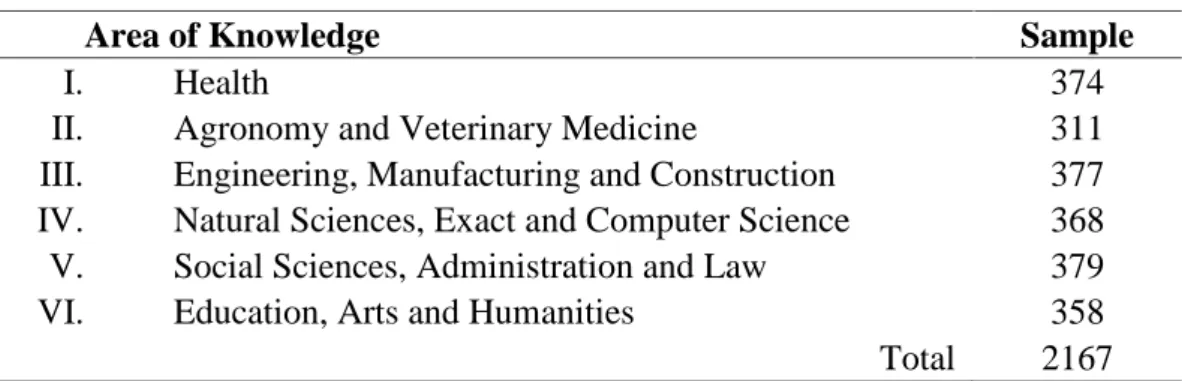
participants was random. Likewise, the six areas of knowledge are considered taking the structure
of the National Institute of Statistics, Geography and Informatics (See Table 2).
It was estimated a representative sample of 2167 students, out of a total of 91,141 students enrolled
in 2014, this percentage allowed to establish a 95% confidence level and a maximum sample error
of 2.08%. The registration information was obtained from the activity report "UANL 2014". Data
collection was performed from January 27th to March 5th 2015 and a previously designed questionnaire was applied with a non-response rate of 22%.
Table 2. Sample of the participants by areas of knowledge considered from INEGI (2014)
Area of Knowledge Sample
I. Health 374
Characteristics of the Sample
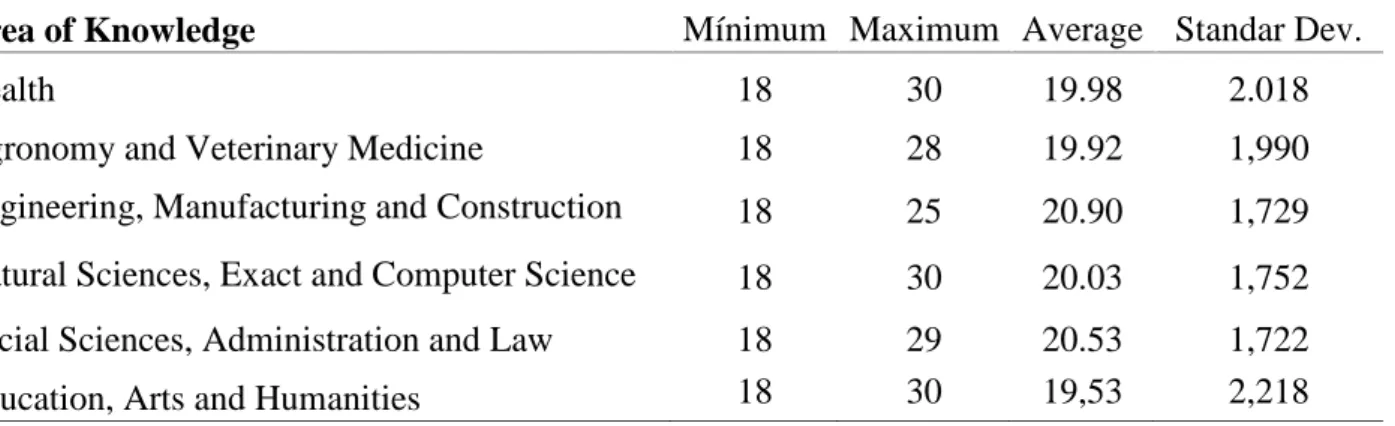
The age of participants in the study ranged from 18 to 30 years, the general average being for 20
(SD = 1.94). The age of the students according to the area of knowledge studied is homogeneous
in all cases (See Table 3).
Table 3. Characteristics of the sample with respect to the variant age by area of knowledge
Area of Knowledge Mínimum Maximum Average Standar Dev.
Health 18 30 19.98 2.018
Agronomy and Veterinary Medicine 18 28 19.92 1,990
Engineering, Manufacturing and Construction 18 25 20.90 1,729
Natural Sciences, Exact and Computer Science 18 30 20.03 1,752
Social Sciences, Administration and Law 18 29 20.53 1,722
Education, Arts and Humanities 18 30 19,53 2,218
With regard to gender, 52% of the samples were women and 48% men. However, there are levels
of differences between the gender ratios observed in the areas of knowledge. For example, in
education, arts, and humanities 61% of women participated, while only 36% in exact sciences,
compared to 64% of men in this area, and only 33% in health.
39% 42%
64% 63% 52% 33%
61% 58% 36%
37% 48%
57%
Education, Arts and Humanities Social Sciences, Administration…
Natural Sciences, Exact and… Engineering, Manufacturing and… Agronomy and Veterinary… Health
Gender by knowledge area
Questionnaire
In order to perform field work and data collection for analysis, a questionnaire was designed, which
incorporated the following variables:
Political Participation: Refers to activities where there is an established order (vote, work for
a candidate or party, learn and discuss political issues, attend a political rally, convince a person to
vote for a particular party), it refers not only to the action itself, but the attempt to achieve an end
that can be influence or support a government or political representatives (Milbrath and Goel, 1997;
Merino, 2001). The concept was measured with a 5-point Likert scale, ranging from nothing (1) to
quite (5). The internal consistency of the scale was (α= .89).
Civic Participation: It can be individual or collective, it seeks to develop civic activities in
social or community, such as non - profit organizations, social welfare, and environmental
protection areas; (Orellana Fonseca and Minte Münzenmayer, 2011, Peschard, 2010, Pattie, Seyd,
& Whiteley, 2004). It was measured with a Likert scale of 5 points, which ranged from nothing (1)
to quite (5). The internal consistency of the scale was (α= .82).
Political Knowledge: Learning characterized sought consciously considers elements such as
branches and levels of government, political groups, duration of government mandates, among
other related topics to the political arena (Gutiérrez 2007; Delli Carpini, 2005). Correct knowledge
responses were assessed with a likert scale from 1 (low) to 10 (high).
Knowledge about Leaders: Refers tocitizens’ knowledge oftheir representatives or political
actors (Lopez Zamarripa, 2005; Merino, 2001; Marshall, 1998). The correct answers of the
knowledge of political actors were evaluated, with a Likert scale of 1 (low) to 10 (high).
Interest in Politics: Refers to the interest that has a subject or group on political issues
(Brussino, S., Rabbia, H, and Sorribas, P., 2009). It was measured with a 5-point Likert scale,
ranging from nothing (1) to quite (5). The internal consistency of the scale was (α= .89).
Exposure to media: Refers to the time in which an individual receives information spaces
messages via electronic means. A Likert scale on exposure time to the electronic media, of 5 points,
where (1) is never and (5) enough, will be developed. The consistency of the scale was (α= .71).
Attention to the Programs: Refers to the selection of space in electronic media and the
to policy information on these supports. Five points were assigned, where (1) is Never and (5)
Enough. The consistency of the scale was (α= .75).
Procedure
The questionnaire was self-applied, consisted in explaining to the participants the objectives of the
study and proceeded to socialize the form of filling the questionnaire. Students were asked to
answer each of the items and the questionnaires were then captured in the SPSS V20 statistical
program, through which the corresponding studies, frequencies and regressions were performed,
shown below.
RESULTS
Searching of information about politics by young people
First, the search for policy information in each area of knowledge is described. As can be seen, the
area of knowledge of the Social Sciences Administration and Law has a higher level of exposure
to political content, but is below theoretical Average (M=3). These disciplines are naturally
characterized by the study of the human being as a social entity, as well as contributing to the
understanding of economic, political and social life and the consolidation of democratic systems
(see Figure 5).
2.34 2.29 2.33 2.23
2.76
2.41
Health Agronomy and
An analysis of the degree of knowledge about politics by young people
In the second place, the knowledge about the political actors was evaluated; the questions were
focused on the political actors of the State of Nuevo Leon (Governor, mayors of the metropolitan
area, presidents of parties). According to the data collected, most of the students do not know the
political actors, nor the positions of representation. The average knowledge was M=2.5 well below
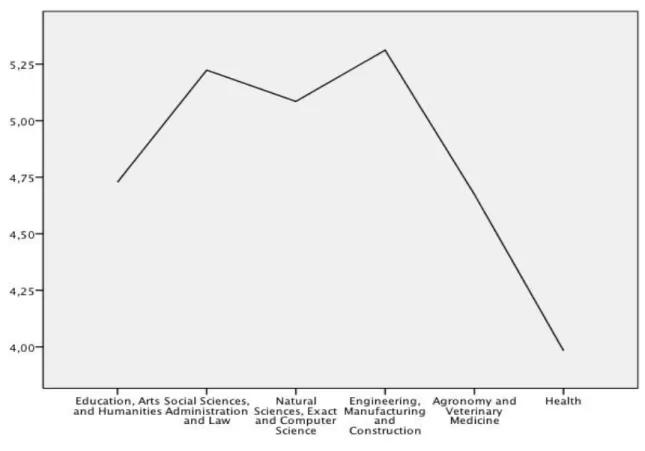
the theoretical average (M = 5). However, it is observed that the areas of Engineering and Social
Sciences have greater knowledge about political leaders, on the contrary, medicine presented the
lowest results (see figure 6).
Fig. 6 Knowledge of political leaders based on the youth knowledge area
Note: The theoretical ranges of variation of the scales were between 0 (lowest) to 10 (maximum)
Another of the relevant points in the research was the evaluation of knowledge about politics;
questions were focused on elements such as branches and levels of government, political groups,
length of government mandates, among other questions that gave a clear picture whether the
student possessed a certain level of political awareness or stayed away from such content. Based
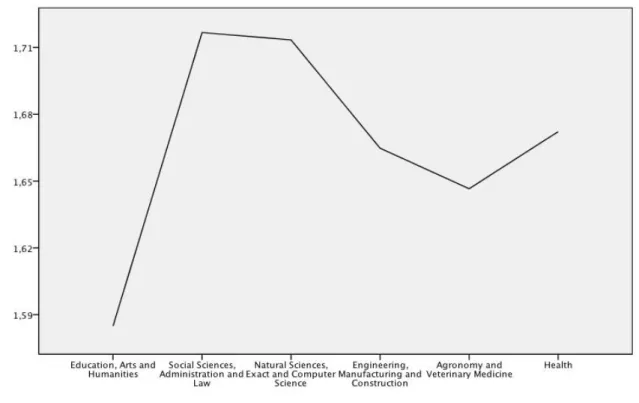
on the application of the instrument, we noticed that there is more knowledge about policy issues
than in political actors, where the average political knowledge was M = 4.8 very little below the
theoretical average (M = 5). In the case of the evaluation by area of knowledge the most
Fig. 7 Policy knowledge
Note: The theoretical ranges of variation of the scales were between 0 (lowest) to 10 (maximum)
An analysis of the civic participation.
The following element evaluated the level of civic participation, where the social commitment of
students with voluntary work and support to social causes is manifested in a very low form (M
<3). Participation must be an integral part of all local development initiatives and are essential to
improving government capacity. However, the level of political participation is still less than civic
engagement as shown in Figure 8. In this sense, the first step to strengthen civic development is
for governments to formalize a greater commitment to improve participation, with political and /
Or public policies that seek to empower citizens in a meaningful way in order to generate a greater
Fig. 8 Civic Participation
Note: The theoretical ranges of variation of the scales were between 1 (minimum) and 5 (maximum)
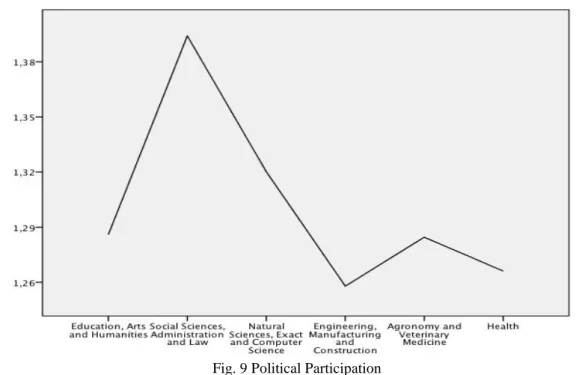
The lack of interest in political participation by young people is one of the main problems in
society, precisely the great part of this problem has to do with the bad ways of doing politics, in
addition to the cultural backwardness we have today. In this sense, this is reflected in the following
graph, where the formation and disenchantment of citizens by politics is increasing, where
education is an important factor as a catalyst in the development of the citizen, as well as the
socialization of the effects that Entails this passivity of democratic participation in our country. It
is also observed that there is a need to strengthen the political education of students in most areas
Fig. 9 Political Participation
Note: The theoretical ranges of variation of the scales were between 1 (minimum) and 5 (maximum)
An analysis of the political interests.
Among other factors, political disaffection manifests itself in the low levels of political interest in young. However, the results obtained in the following figure 10, where the majority is below the theoretical average (M = 3), is not surprising has the great lack of trust that exists both in institutions and political actors, but the interest has constituted Integrative UN principle of social cohesion and Democratic Development, for this reason it is important to recover.
2.56
3.01
2.52 2.61 2.65 2.43
An analysis of the explanatory variables of the political education by the knowledge area.
Table 4. Explanatory variables Political Education by knowledge area
coefficientsto
Knowledge Area explanatory variables Unstandardized standardized oefficients Sig
B Error typ. β
Education, Arts and Humanities
(Constant) 2,677 , 904 003
Media exposure , 167 352 , 029 635
Media Attention , 823 317 180 * 010
Interest , 937 , 204 , 295 *** , 000
r .429
R2 .184
Law and Social Sciences, Management
(Constant) 2,656 846 , 002
Media exposure , 804 325 132 ** 014
Media Attention , 351 267 , 078 , 190
Interest , 857 186 240 *** , 000
r .347
R2 .120
natural, accurate and Computer Sciences
(Constant) 1,788 794 , 025
Media exposure 1,197 331 208 *** , 000
Media Attention - 143 272 - 032 , 601
Interest 1,146 195 327 *** , 000
r .416
R2 .173
Engineering, manufacturing and construction
(Constant) 3,541 1,639 033
Media exposure 1,408 725 203 , 054
Media Attention - 276 , 545 - 057 , 613
I nterest , 670 , 413 159 , 108
r .262
R2 .069
Agriculture and veterinary
(Constant) , 946 888 288
Media exposure 832 , 388 140 * 033
Media Attention , 721 333 148 * , 031
Interest , 904 , 219 254 *** , 000
r .429
R2 .184
Health
(Constant) 2,391 1,000 018
Media exposure 333 , 368 , 064 , 366
Media Attention , 037 , 363 008 920
Interest 1,184 , 248 344 *** , 000
r .359
R2 .129
Subsequently the explanatory variables were analyzed in the political education:
1. The variables in the equation obtained in the area of Education, Arts and Humanities got together account for 18% of the variance, where those who have a greater interest in politics (β = .295, p <0.001) and Mayor attention to political content (β= .180, p <0.05) will strengthen their political learning.
2. The variables obtained in the equation of Social Sciences, Administration and Law got together account for 12% of the variance, where those with greater exposure to media on policy issues (β=.132, p <0 05) and greater interest in politics (β= .240, p <0.001) will strengthen their political learning.
3. The variables in the equation obtained in the area of Natural, Exact Sciences and Computer got together account for 17% of the variance in where those who have greater exposure to media on policy issues (β= .208, p < 0.001) and greater interest in politics (β=.327, p <0.001) will strengthen their political learning.
4. The variables obtained in the equation of the Engineering, Manufacturing and Construction got together account for 7% of the variance, however no variable explained political learning.
5. The variables obtained in the equation the area of Agronomy and Veterinary got together account for 18% of the variance, where those with greater exposure, attention and interest on policy issues (β= .140, p <0, 05), (β= .148 p <0.05) and (β= .254, p <0.001) respectively, their political learning is strengthened.
6. The variables obtained in the equation of Health area got together account for 18% of the variance, where those who have more interest on political issues (β= .344, p <0.001) are those that increase their participation.
An analysis of the explanatory variables of the political and civical participation by the knowledge area.
Finally, the explanatory variables of participation, as media consumption, knowledge on politics and interest were analyzed.
3. The variables in the equation obtained in the area of Natural, Exact Sciences and Computer got together account for 13% of the variance, where those who are more media attention on policy issues (β= .237, p <0.001) and a high interest in politics (β= .167, p <0.01) are those that increase their participation.
4. The variables obtained in the equation of the Engineering, Manufacturing and Construction together explain 17% of variance, where those with the greatest interest in politics (β = .294, p <0.01) are those that increase your participation.
5. The variables obtained in the equation the area of Agronomy and Veterinary got together account for 25% of the variance, where those who have more attention and interest in politics (β= .314, p <0.001) and (β= .298, p <0.001) respectively are those that increase their participation.
6. The variables obtained in the equation of Health area got together account for 18% of the variance, where those with greater attention to policy information (β = .394, p <0.001) are those that increase their participation.
Table 5. Explanatory variables of traditional political participation by knowledge area
coefficientsto
Knowledge Area explanatory variables Unstandardized standardized coefficients
Sig
B Error typ. β
Education, Arts and Humanities
(Constant) , 747 115 , 000
Media exposure , 050 , 044 , 070 263 Media Attention , 059 , 040 , 107 139
Knowledge - 004 011 -, 022 720
Interest 113 027 292 *** , 000
r .379
R2 .144
Law and Social Sciences, Management
(Constant) , 543 151 , 000
Media exposure - 040 , 058 - 035 , 493
Media Attention 305 , 047 372 *** , 000
Knowledge - 026 013 - 089 , 055
Interest , 124 033 191 *** , 000
r .460
R2 .211
natural, accurate and Computer Sciences
(Constant) , 679 127 , 000
Media exposure , 041 , 054 , 047 447
Media Attention 163 043 237 *** , 000
Knowledge - 008 014 - 032 591
Interest , 090 033 167 ** 007
r .354
Engineering, manufacturing and construction
(Constant) , 625 , 178 001
Media exposure 018 , 077 023 , 819
Media Attention , 051 , 057 , 096 , 370
Knowledge , 025 015 , 140 , 106
Interest , 134 , 044 , 294 ** 003
r .414
R2 .172
Agriculture and veterinary
(Constant) , 497 , 128 , 000
Media exposure -, 011 , 056 -, 012 843
Media Attention 223 , 047 314 *** , 000
Knowledge -, 012 013 - 054 349
Interest 158 , 032 , 298 *** , 000
r .501
R2 .251
Health
(Constant) 722 139 , 000
Media exposure -, 006 , 050 - 008 908
Media Attention , 258 , 050 , 394 *** , 000
Knowledge - 015 014 - 074 274
Interest , 035 , 035 , 073 324
r .418
R2 .175
to. Dependent Variable: Political Participation + P <0.06 p <0.05; ** P <0.01, *** p <0.001
CONCLUSIONS
The results of this research allow us to visualize the low level of knowledge that young people have
on political issues. However, part of the functions of educational institutions should be the political
formation of citizenship through the development of competent young people capable to actively
participate in the construction of the political community. To form an active and responsible young
person, able to contribute to the development and social welfare of the country, it is fundamental
to contribute to the development of democratic participation in our country element, considered
the political education for Almond and Verba (1970) as the main part of the civic education.
With regard to the hypothesis of whether there are significant differences between areas of
There are important differences in the explanatory variables of political education related
knowledge areas are observed, as shown in the following table:
Knowledge Area Factors that may explain the political education of university students
1. Education, Arts and Humanities Attention to Political Content
2. Social Sciences, Administration and Law Information exposure Political interest
3. Natural, Exact and Computer Science Information exposure Political interest
4. Engineering, Manufacturing and
Construction no Variable
5. Agriculture and veterinary
Information exposure
Attention to Political Content Political interest
6. Health Political interest
These differences are important because they can’t exist without full social responsibility of
learning of freedom, responsibility and citizenship.
Additionally, explanatory variables of political and civic participation were analyzed, as shown in
the table below. However, no significant relationship between knowledge obtained on politics and
Knowledge Area Factors that may explain the political and civic participation of young University
Education, Arts and Humanities Political interest
Social Sciences, Administration and Law Attention to Political Content Political interest
Natural, Exact and Computer Science Attention to Political Content Political interest
Engineering, Manufacturing and
Construction Political interest
Agriculture and veterinary Attention to Political Content Political interest
Health Attention to Political Content
Therefore, to strengthen the educational formation in politics, strategies and institutional spaces
should be created in all areas of knowledge of universities. Young people should understand their
government, how they can participate, and why they should be an informed participation. When
young people have the knowledge and capabilities to get involved in public affairs, we will have a
stronger democracy.
With respect to the interest and attention on political issues with young people, encouraging a
positive association greatly to the growth potential of citizen participation is observed.
BIBLIOGRAPHICAL REFERENCES
Aguilar, LA (2000). Ways of political education. Synectics, 37-44.
Almond, G. & S. Verba (1970), "The obligation to participate" in the civic culture. Democratic study of the political
participation in five nations, foundation FOESSA. Spain, original Edition: The Civic Culture: Political Attitudes and
Democracy in Five Nations, Princeton University Press, 1963, 195-214.
Bartels, L. (1993). Messages received the political impact of Media Exposure. American Political Science Review, 87
Del Pino, E., & Colino, C. (2003). Local governments and democratic impulse: new forms of citizen participation in
European local governments. Alternatives Foundation.
Delli Carpini, MX & Keeter, S. (1989). What Americans Know About Politics and Why It Matters. New Haven and
London: Yale University Press.
Delli Carpini, MX (2005). The importance of political knowledge for democracy and its construction in the US and
Mexico. Demonstration in the mirror: Analysis of culture and citizenship practices in Mexico: Analysis of the
memories of the seminar on political culture and citizen practices, IIJ-SEGOB. 15-43.
De Pablos, J. (2003). A sociological (and comprehensive) concept of consumption, Consumer Studies. Dialnet
electronic magazine, (65), 21-35.
ENCUP. (2012). National Survey on Political Culture and Citizen Practices. Mexico.
García Jurado, R. (2007). Four fundamental factors in the theory of political culture Seymour M. Lipset. Arguments,
20 (53), 119-139.
Gutiérrez, R. (2007). Citizen knowledge about democracy in Mexico through ENCUP. Political culture and citizen
participation in Mexico before and after 2006, Mexico: Secretary of the Interior, 36-59.
Granberg and Brown (1992). The Perception of Ideological Distance. Western political quarterly, 45 (3). pp. 727-750.
IFE. (2009). Youth Agenda. Effective Citizen and Civil Participation Project. DF: Federal Electoral Institute.
INEGI. (2014). National Institute of Statistic and Geography. Retrieved from INEGI:www.inegi.org.mx
Lopez Z., N. (2005). Education Policy, Citizenship and Democracy. Mexico: Paidos. 16- 19.
Marshall, T. (1998), Citizenship and social class, Madrid: Alliance.
Merino, M. (2001). Citizen participation in democracy. Disclosure notebooks political culture.
Milbrath, LW. & Goel, MI. (1977). Political participation (2a Ed.). Rand McNally College Publishing Company,
Chicago, USA
Milner, H. (2002). Civic Literacy: How Informed Citizens Make Democracy Work. United States of America: Tufts
Orellana Fonseca, C., & Minte Münzenmayer, A. (2011). Civic knowledge and intent of electoral registration of high
school students in the district of conception. Educational Horizons, 43 (2), 9-16.
Pattie, CJ, Seyd, P., & Whiteley, P. (2004). Citizenship in Britain: Values, participation and Democracy, Cambridge
University Press.
Pérez, R., Rumoroso, A. & Torres, D. (2010). Self-assessment of skills and media use in Costa Rican children. The
particular case of the Internet. Global Media Journal México, 7 (14), 24-38.
Peschard, J. (2010). Civic education for the consolidation of democracy, Federal Electoral Institute 20, 340-371.
UNDP (2014). United Nations Development Programme in Mexico from 2014 to 2015.
SEP (2014). Secretary of Public Education. Higher Education Statistics. Mexico.
Sotirovic, M. & McLeod, J. (2004). as understanding Knowledge: The information processing approach to political
learning, LL Kaid In Handbook of Political Communication Research, Hillsdale, New Jersey, Lawrence
Erlbaum Associates, 357-394.
UANL (2008). Educational Model of the Universidad Autonoma de Nuevo Leon. Cd Universitaria. UANL
Vargas, C. (2005). Gender and political participation in Puerto Rico. Caribbean Studies, 33 (1), 205-248.
Ziccardi, A. (1998). Governance and citizen participation in the capital city. Mexican Journal of Sociology, 60 (3),