
Local development and competitive soccer teams location The portuguese case
9
0
0
Texto completo
(2) 06b Reis. 30/5/08. 136. 08:58. Página 136. ~ P. Mourao,. Clasificación JEL: R11; R33; L83. Palabras clave: Desarrollo regional, deportes; BTSCS, modelos logit.. 1.. Introduction. Over time, professional soccer teams have faced significantly higher costs in Portugal and have become significantly more likely to remain in richer areas. The issue that is addressed in this paper, which is the first attempt using Portuguese data, is whether a causal relationship exists between the presence of a local professional soccer team that plays in the most demanding Portuguese League (the Super Liga) and municipal economic development level. A particular focus is given to the effects of a larger population size on the presence of a local CST (Competitive Soccer Team, playing the Super Liga) in all of the Portuguese municipalities from 1970 to 1999. One of the reasons for the focus on the population size is that the most successful sport teams with high costs levels tend to be located in the densest areas (Dobson and Goddard, 1996; Downward and Dawson, 1999). As Mourao (2005) demonstrated, this kind of problem can be modelled as a rational-type problem. In this case, the collectivity, i, will develop the core of the activity in the space, m (and not in space, j), whenever the condition (1.1) is verified (assuming that the utility derived from working in m is greater than working in j). Uim > Uij, ∀j, j ≠ m. [1.1]. Other studies suggested various reasons why more developed areas might house the head-offices of a CST. Hoffman et al. (2003) showed that large metropolitan areas are more likely to have modern sportive infrastructures because of the availability of more financial incentives. An increase in schooling increases the preference for public investments because more highly educated individuals consume more public goods (Bird, 1982; Coates and Humphrey, 2003; Gartner and Pommerehne, 1978). Glaeser and Mare (2001) showed that, although workers earn more in urban areas, they do not necessarily increase their attendance to sporting events. These urban areas promote the persistence of all cultural consumptions, with sports as only one example. Thus, urbanization does not necessarily have a positive effect on sportive consumption per se because of the higher persistence of the cultural habits of the residents. Furthermore, although nominal wages and salaries are higher in urban areas, the cost of living is also higher. Glaeser (1998) showed that the higher wages found in cities are completely offset by the higher cost of living in these areas. Dobson and Goddard (1996) showed that box-office revenues are positively related to other determinants, such as teams’ performance, members’ loyalty, the proportion of resident males, and the proportion of employed resident males. Although the market-related amenities are also available in some less developed areas, these communities often do not have the population density to support certain types of sportive activities that tend to be more readily available in big cities (Simmons, 1996). Howe-.
(3) 06b Reis. 30/5/08. 08:58. Página 137. Local development and competitive soccer teams location. The Portuguese case. 137. ver, sportive infrastructures tend to generate more returns in the most developed areas (Johnson, Groothuis, and Whitehead, 2001). Although sportive infrastructures might affect the probability of the presence of a local CST, these infrastructures could be endogenous to the urban location as well. Previous evidence suggested that less developed areas were at a disadvantage in attracting the head offices of a CST (Berument et al., 2003). The concern in recent years has been the substitute cultural consumption in big cities due to higher levels of development that have been achieved over time and the availability of a more diversified cultural supply. Local per capita income could be endogenous with a CST location for other reasons as well. For example, Johnson et al. (2001) noted that the presence of sportive teams increases positive externalities within the evolving area. Further, they suggested that a CST is a very selective group in terms of regional dispersion.. 2.. Data and Models. The main data source for this study is the research of Cónim (2002). Cónim (2002) has undertaken an examination of several ranges of well-cited socio-economic indexes for Portuguese municipalities since 1970. I used the data from this report for the following three main socio-economic indexes: Index of Comfort2 (IC), Index of Life Expectancy3 (ILE), and Index of Weighted Local Incomes4 (IWLI). Other indices are excluded because they simply reflect combined values of the previously mentioned three indices. More recent data from this governmental source is not used because they are still being properly reviewed and are not yet edited. In addition to the previous indices, the other right-hand side variable in the estimates includes the logarithm of population size (LPOP) (INE, 2004). This variable is used because it relates to the potential market for each team. The data set is useful for studying a CST location because this data is uniquely available for the period from 1970 to 1999 and is a condensation of a large range of socio-economic dimensions5. The definition of the dependent variable (CAMP) is the local presence of at least one head-office of a CST6. The data source for the dependent variable is a report that covers all Portuguese Premier League editions and is published by the daily newspaper A Bola (2004). Portuguese municipalities were observed whether they housed the head-office of a CST or not. 2. Related to the proportion of the population that has access to potable water, basic sanitation amenities, and electricity. 3 Related to the municipal expectancy of life. 4 Related to the weighted difference between the local per capita income and the United Nations standard value ($40,000 using Purchase Power Parity units) 5 Cónim (2002) estimated many of the base variables due to their previous absence or misconstruction from alternative attempts. 6 Competitive Soccer Team playing in the Super Liga, Portuguese’s most demanding soccer competition, whose highest-positioned teams (at the end of a regular season) have access to the European competitions of the following season..
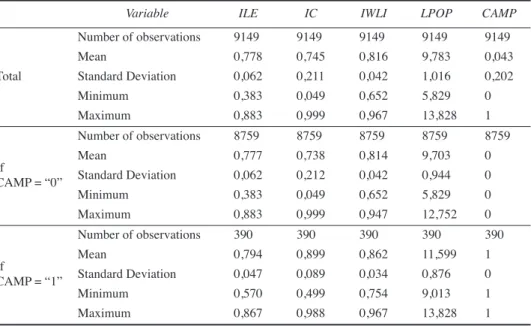
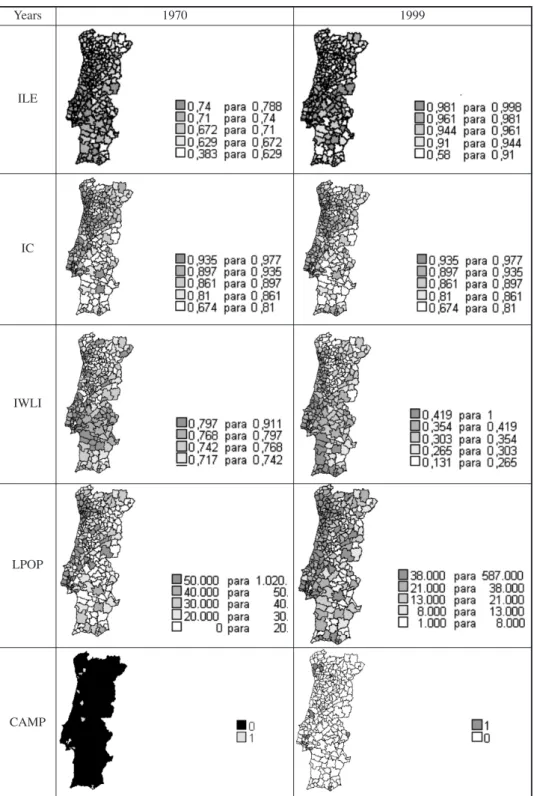
(4) 06b Reis. 30/5/08. 138. 08:58. Página 138. ~ P. Mourao,. Table 2.1 shows the descriptive statistics of the variables and Figure 2.1 reveals the distribution of the introduced variables in Portugal for 1970 and for 1999. Tabla 2.1. Descriptive Statistics (Portugal, 1970-1999). Variable. Total. If CAMP = “0”. If CAMP = “1”. ILE. IC. IWLI. LPOP. CAMP. Number of observations. 9149. 9149. 9149. 9149. 9149. Mean. 0,778. 0,745. 0,816. 9,783. 0,043. Standard Deviation. 0,062. 0,211. 0,042. 1,016. 0,202. Minimum. 0,383. 0,049. 0,652. 5,829. 0. Maximum. 0,883. 0,999. 0,967. 13,828. 1. Number of observations. 8759. 8759. 8759. 8759. 8759. Mean. 0,777. 0,738. 0,814. 9,703. 0. Standard Deviation. 0,062. 0,212. 0,042. 0,944. 0. Minimum. 0,383. 0,049. 0,652. 5,829. 0. Maximum. 0,883. 0,999. 0,947. 12,752. 0. Number of observations. 390. 390. 390. 390. 390. Mean. 0,794. 0,899. 0,862. 11,599. 1. Standard Deviation. 0,047. 0,089. 0,034. 0,876. 0. Minimum. 0,570. 0,499. 0,754. 9,013. 1. Maximum. 0,867. 0,988. 0,967. 13,828. 1. Logit, logit with temporal dummies, and cloglog7 models of a CST location are estimated. Logit is used because the dependent variable takes on values of either 0 or 1. Logit with temporal dummies and cloglog are used because the data could suffer from temporal dependence. This data clearly defines a model of time-series-crosssectional data with a binary dependent variable (BTSCS) according to Beck, Katz, and Tucker (1998). The key issue in estimating logit models is in identifying the effects of each one of the independent variables on a CST location. In this case, additional procedures that are strongly correlated with the suspected temporal dependence of the variables in the estimate of the CST location are needed. Firstly, I used dummies that identified the length of time in which a municipality housed no head-office of a CST. Alternatively, I returned to a cloglog, whose results should evidence similar values to those obtained by the logit regression with temporal dummies. Many previous studies have shown these procedures are suitable for the correction of the temporal dependence of the variables (Beck et al., 1998; O’Neal and Russett, 2003; Soysa and Neumayer, 2004).. 7. Complimentary log-log link function..
(5) 06b Reis. 30/5/08. 08:58. Página 139. Local development and competitive soccer teams location. The Portuguese case. Figure 2.1 Geographical distribution of the variables, 1970 and 1999 Years. ILE. IC. IWLI. LPOP. CAMP. 1970. 1999. 139.
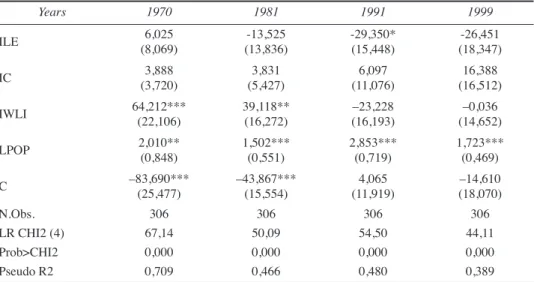
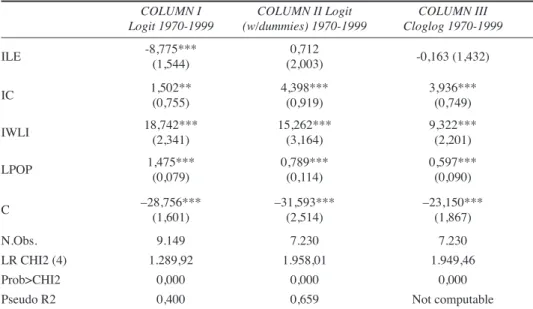
(6) 06b Reis. 30/5/08. 08:58. Página 140. 140. ~ P. Mourao,. 3.. Empirical results. Following is a summary of the logit model that I estimated. In the first stage, a logit estimate of a CST location is undertaken as a function of the right-hand side variables that are used to estimate a CST location for the beginnings of the decades 1970, 1980, and 1990 (respectively, 1970, 1981 and 1991, due to data availability) and for the end of this last decade (1999) as detailed in Table 3.1. Table 3.1. Estimations of the logit model (dependent variable = 1, if the municipality in the reported year hosted the head office of a Portuguese team that played in the main league) Years. 1970. 1981. 1991. 1999. ILE. 6,025 (8,069). -13,525 (13,836). -29,350* (15,448). -26,451 (18,347). IC. 3,888 (3,720). 3,831 (5,427). 6,097 (11,076). 16,388 (16,512). IWLI. 64,212*** (22,106). 39,118** (16,272). –23,228 (16,193). –0,036 (14,652). LPOP. 2,010** (0,848). 1,502*** (0,551). 2,853*** (0,719). 1,723*** (0,469). –83,690*** (25,477). –43,867*** (15,554). 4,065 (11,919). –14,610 (18,070). C N.Obs.. 306. 306. 306. 306. LR CHI2 (4). 67,14. 50,09. 54,50. 44,11. Prob>CHI2. 0,000. 0,000. 0,000. 0,000. Pseudo R2. 0,709. 0,466. 0,480. 0,389. Note: Standard errors are between parentheses. Significance level: *, 10%; **, 5%; ***, 1%.. In the second stage, a logit estimate of a CST location is estimated as a function of the right-hand side variables while considering the full range of available years (first column of Table 3.2). In the third stage, estimates of a CST location are provided with the correction for temporal dependence (second and third columns of Table 3.2). Estimates of a CST location indicate that population size, per capita income, and the number of infrastructures have significant positive effects on the location of a CST (Tables 3.1 and 3.2), although local per capita income is loosing significance throughout the years (Table 3.1). Additionally, the number of infrastructures can not be characterized by significant coefficients if we restrict our analysis to an individualized year (Table 3.1). A possible explanation for the diminishing significance of the income variable is provided by Mourao (2007), who found that cultural agents often place more value on other kinds of resources (the tradition size or the associative practices) than the simple endowment per se..
(7) 06b Reis. 30/5/08. 08:58. Página 141. Local development and competitive soccer teams location. The Portuguese case. 141. Table 3.2. Estimations of the models (dependent variable = 1, if the municipality in a year hosted the head office of a Portuguese team that played in the main league) COLUMN I Logit 1970-1999. COLUMN II Logit (w/dummies) 1970-1999. COLUMN III Cloglog 1970-1999. ILE. -8,775*** (1,544). 0,712 (2,003). -0,163 (1,432). IC. 1,502** (0,755). 4,398*** (0,919). 3,936*** (0,749). IWLI. 18,742*** (2,341). 15,262*** (3,164). 9,322*** (2,201). LPOP. 1,475*** (0,079). 0,789*** (0,114). 0,597*** (0,090). –28,756*** (1,601). –31,593*** (2,514). –23,150*** (1,867). C N.Obs.. 9.149. 7.230. 7.230. LR CHI2 (4). 1.289,92. 1.958,01. 1.949,46. Prob>CHI2. 0,000. 0,000. 0,000. Pseudo R2. 0,400. 0,659. Not computable. Note: Standard errors are between parentheses. Significance level: *, 10%; **, 5%; ***, 1%.. In summary, the results confirm the importance of the demographic dimension, the relevance of high per capita income, and good comfort levels available to the population, thereby elevating the probability that a municipality houses the head office of a team that plays in major competitions. The other dimension –life expectancy– does not return a relevant influence in the regressions when the problem of temporal dependence was corrected8. This evidence can be interpreted as a reflection of the substitutability of cultural consumptions for the oldest residents (living in the areas with a higher life expectancy) and soccer supporters, which corroborates the research of Burgess and Steenkamp (1998) or Zavisca (2005). Similar results for the British were found by Dobson and Goddard (1996) and by Downward and Dawson (1999). A report from the National Institute of Statistics, INE (2005), entitled “Study on the municipal purchase power”, stressed the significant correlation between demographic agglomeration and considerable regional per capita income. As widely noticed, this research requires further investigation. For instance, as soon as data becomes more actualised, the results shall be revised. Additionally, as soon as data becomes available, the income variable shall be depurated by analyzing different regional aggregates or average values. However, as this work has clearly stated, the utilized data is the most actualised in the case of Portugal as this effort is a 8. An anonymous referee of Investigaciones Regionales provided a reasonable explanation for this lack of significance by noticing that ILE is the variable that exhibits the smallest differences among the cases (smallest difference between the average value of camp=0 and the average value of camp=1)..
(8) 06b Reis. 30/5/08. 142. 08:58. Página 142. ~ P. Mourao,. pioneer attempt for the case of Portugal. Another issue is related to eventual forthcoming works that are derived from this one, such as the possibility of investigating the relationship among the number of CSTs in some cities (and not primarily focusing on the probability of having at least one CST) and the considered independent variables.. 4.. Conclusion. The results indicate that population size, per capita income, and the number of infrastructures have positive effects on the probability of the presence of a CST in the municipalities of Portugal. If a bias is introduced in estimating the effects of these dimensions on a CST location, it appears to be on the downward side due to the temporary dependence of primary data. The results agree with that of Dobson and Goddard (1996), which stated that large metropolitan areas supply more cultural infrastructures that are usable by soccer teams with ambitious sportive objectives. While they show that a CST acquires more amenities in richer areas, the previous results suggest that other dimensions related to the most developed Portuguese areas explain why they are able to retain the head-offices of a CST. The results also support Downward and Dawson’s (1999) research, which indicated that more developed areas are more likely to house a CST due to the market size factor.. References Bola, A. (2004): Sport Lisboa e Benfica 100 anos gloriosos – As provas nacionais; Quidnovi; Lisboa. Beck, N., Katz, J. and Tucker, R.: (1998): “Taking time seriously: time-series-cross-section analysis with a binary dependent variable”; American Journal of Political Science; 42; 4:1260-1288. Berument, H., Imanlik, A. and Yucel, E. (2003): “The effect of football on productivity”, Iktisat Isletme ve Finans; 212:51-62. Bird, P. (1982): “The Demand for League Football”, Applied Economics; 14, 6:637-649. Burgess, S. and Steenkamp, J. (1998): “Value Priorities and Consumer Behavior in a Transitional Economy: The Case of South Africa”, William Davidson Institute Working Papers Series 166; William Davidson Institute at the University of Michigan Stephen M. Ross Business School. Coates, D. and Humphreys, B. (2003): “Voting on Stadiums and arena subsidies”, UMBC Economics Department Working Papers; 03-105. Cónim, C. (2002): “População e Desenvolvimento Humano: Uma Perspectiva de Quantificação. 19701999”; Estudos sobre a Economia; Departamento de Prospectiva e Planeamento; Lisboa. Dobson, S. and Goddard, J. (1996): “The Demand for Professional League Football in England and Wales”; Regional Studies; 30:443-453. Downward, P. and Dawson. A. (1999): “The demand for professional team sports: traditional findings and new developments”; Staffordshire University; Business School Working Paper 997. Gartner, M. and Pommerehene, W. (1978): “Der Fussballzuschauer – ein Homo Oeconomicus?”, Jahrbuch fur Sozial Wissenschaft; 29:88-107. Glaeser, E. (1998): “Are cities dying?”, Journal of Economic Perspectives; 12:139-160. Glaeser, E. and Mare, D. (2001): “Cities and skills”, Journal of Labor Economics, 316-342 (April). Hoffman, R., Ging, L., Ramasamy, B. and Matheson, V. (2003): “Comparing the Socio-Economic Determinants of Men’s and Women’s International Soccer Performance”, Centre for Europe-Asia Business Research; CEABUR Working Paper 1/2003..
(9) 06b Reis. 30/5/08. 08:58. Página 143. Local development and competitive soccer teams location. The Portuguese case. 143. INE, Instituto Nacional de Estatística (2004): Série para a população residente em Portugal; available from http://www.ine.pt/prodserv/nseries/dado.asp. INE, Instituto Nacional de Estatística (2005): Estudo sobre o poder de compra concelhio - Destaque; Lisboa. Johnson, B., Groothuis, P. and Whitehead, J. (2001): “The value of public goods generated by a major league sports team: the CVM approach”; Journal of Sports Economics, 2, 1:6-21. Mourao, P. (2005): “A importância do desenvolvimento regional na localização de equipas de futebol profissionais. O caso português 1970-1999.”, Revista Portuguesa de Estudos Regionais; vol. 8, 3145. Mourao, P. (2007): “Contributo para uma visao economica do associativismo religioso – o caso das confrarias activas de Lisboa”; Revista de Economia del Rosário, 10, 1:55-74. Oneal, J. and Russett, B. (2003): “Modelling Conflict While Studying Dynamics: A Response to Nathaniel Beck”; in Schneider, G., Barbieri, K. e N. Gleditsch, editores, (2003): Globalization & Armed Conflict; Rowman & Littlefield; G. Lanham. Simmons, R. (1996): “The demand for English league football: a club-level analysis”, Applied Economics; 28, 2:139-155. Soysa, I. and Neumayer, E. (2004): “Natural resources and civil war: another look with new data”; General meeting EU PAC Project; paper available from http://www.polarizationandconflict.org/ oslopub/Natural%20Resourc%85d%20Civil%20War.doc. Zavisca, J. (2005): “The Status of Cultural Omnivorism: A Case Study of Reading in Russia”, Social Forces, 84, 2:1233-1255..
(10)
Figure
Documento similar