
Synthesis of optical standard frequencies in the S, C and L telecommunication bands by use of four wave mixing in semiconductor optical amplifiers
5
0
0
Texto completo
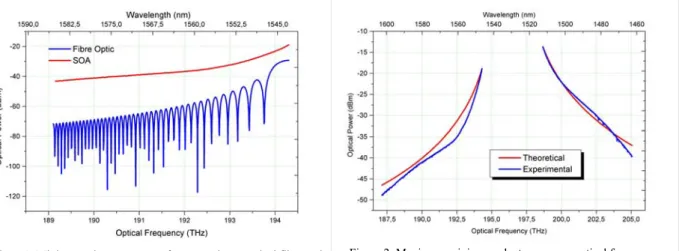
(2) Synthesis of optical standard frequencies in the S, C and L telecommunication bands by use of four-wave mixing in semiconductor optical amplifiers. Ana Carrasco-Sanz(1), Sonia Martín-López(1), Miguel González-Herráez(1,2), Pedro Corredera Guillén(1) and María Luisa Hernanz(1) (2) Dept.. (1) Dept. de Metrología, Instituto de Física Aplicada, CSIC. Serrano 144, 28006, Madrid de Electrónica, Escuela Politécnica Superior, Universidad de Alcalá. Campus Universitario, 28871, Alcalá de Henares, Madrid.. Abstract: The generation of standard reference frequencies close to the ITU channels is essential for the calibration and maintenance of DWDM systems. This work describes a method to synthesize frequency references in the range from 187.1 to 205.1 THz (1462-1602 nm). The method is based on the generation of four equispaced frequencies (by four-wave mixing in a semiconductor amplifier) of which two are locked to absorption lines of the acetylene 12C2H2 (1511-1542 nm).. 1.- Introduction Wavelength-Division Multiplexing (WDM) demands standard frequency references along the spectral range of the C and L-bands (1510-1625 nm). The stabilization of lasers in the atomic or molecular transitions of some specific gases is an interesting method to generate reference frequencies in these transmission bands [1, 2 and 3], but due to the limitation in the number of absorption lines and suitable gas specimens, other procedures are necessary to complete the full frequency range. We developed a method to synthesize frequency references in the range from 187.1 to 205.1 THz based on the generation of four equispaced frequencies of which two are locked to absorption lines of the acetylene 12C2H2. The novelty of this method is the employment of a semiconductor optical amplifier, SOA, instead of a fibre as a medium to generate the non-linear process. One of the advantages of this method is the unaffected mixing product by polarization since the active area of the SOA is too small to produce polarization mode dispersion. In this paper we show a theoretical and an experimental analysis of a method to generate additional references lines that extend the wavelength ranging define in [2, 3]. 2.- Theoretical Analysis In the degenerate case of the four-wave mixing process, two frequencies (fi, fk) launched in a nonlinear medium generate two new waves at frequencies: f fwm = 2 ∗ f i − f k and f fwm = 2 ∗ f k − f i (1) If we can stabilize fi and fk in an adequately chosen absorption lines of our reference material, we can generate through this process a new two waves in frequency regions lying relatively far from the absorption bands of the selected reference material. In order to obtain an expression for the mixing product wave, Afwm, inside the SOA, we followed the development given by [4, 5 and 6] and by considering that the intensity of the mixing product is much lower than the intensity of the probe and the pump at output, we found that 1. i A fwm ( z ) = exp − αFα ( z ) GG 2 A2∗ (0) (2) 2 where α is Henry’s linewidth enhancement factor, G is the saturated gain at position z, A*2(0) is the probe amplitude at z = 0 and G , Fα, are parameters defined in [6]. Figure 1 shows the comparison between the efficiency corresponding to the four-wave mixing product generated in a SOA obtained by (2) and the one obtained in a fibre optic with zero-dispersion at 1550 nm given by [2, 3]. As it is possible to see, the FWM generated in the SOA is more efficient than the one generated in the fibre since the SOA is a medium with an amplifier behaviour instead of absorbent like the fibre, a high nonlinearity and the distance inside the semiconductor is very small (~300-500 µm), so any interaction between the pump and the probe waves with cross polarizations can be produced as in the fibre case.. 3.- Experimental Results The experimental setup used is shown in Figure 3. With the two tuneable laser, TL1 and TL2 (Photonetics Tunics-Plus, with a linewidth of 150 kHz) we could cover a frequency range from 182.9 to 208.3 THz. Three polarization controls and a polarizer were introduced to assure parallel polarization between the injected waves at amplifier input. The bias current and the voltage supplied to the SOA OPA-20-N-C-FA (Kamelian) were I=250 mA and v = 5 V respectively. In order to lock both.
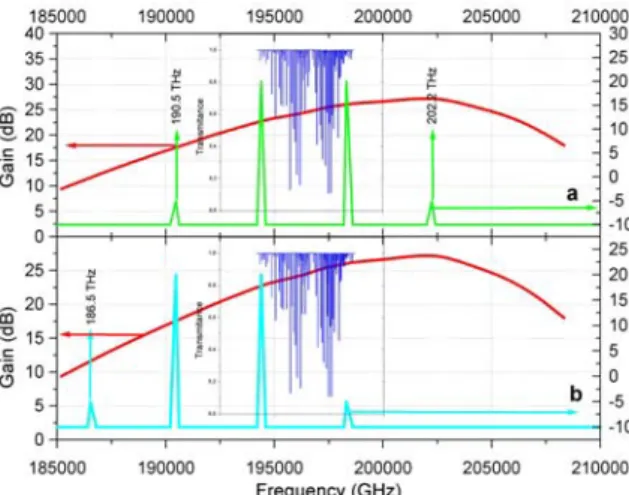
(3) lasers to the absorption lines of the acetylene we modulated them in frequency with a sinusoidal signal of 0.1 V at 1 KHz. The peak to peak amplitude of this signal produces a change of 30 MHz in the frequency of the lasers. The signals emitted by the both lasers were detected by two detectors and two lock-in amplifiers.. Figure1: Mixing product power vs. frequency in an optical fibre and a SOA.. Figure 2: Maximum mixing product power vs. optical frequency. Theoretical and experimental results.. The acetylene 12C2H2 cell employed in this work was made and calibrated by the NIST (SMR 2517a [8]). In order to avoid possible interferences between the signals detected by the lock-ins, the lasers were introduced in the absorption cell in opposite directions by an isolator. Figure 4b shows the P11 absorption line of the acetylene and its corresponding signal detected by the lock-in (Figure 4a). It is possible to see the change in the sign of the detected signal as the absorption line reaches its deepest point. The stabilization of the emission frequencies was carried out by the employment of the signal detected by the lock-in as frequency modulation feedback.. Fig.3.-Experimental setup used. We present two methods to generate frequency references. With the first method (Figure 5a) we generate frequency references in a range between 190.5 THz and 202.2 THz by locking the two injected lasers to the absorption lines. With the second method (Figure 5b) we generate frequency reference in a range between 186.5 THz y 206.2 THz by the stabilization of an injected laser and the Stokes or anti-Stokes wave respectively. We locked the FWM signal on the acetylene line absorption P25. In order to get an effective stabilization we replaced the dotted box from Figure 2 by the design shown in Figure 6 since the mixing product power obtained with the previous design were not enough (~ -33 dBm ) to lock the signal. The new design consists in a tuneable fibre Bragg grating with a spectral width of 0.770 nm, a SOA BOA-1004 (Covega) and an isolator. This system amplifies (32 dB bigger than the one obtained by the previous system) and filters every FWM signal before its stabilization..
(4) Figure 4: Acetylene absorption line P11 (b) and its corresponding signal detected by the lock- in (a) for a frequency modulation of 30 MHz.. Figure 5: Representation of the frequencies generation by the first method (a) and the second method (b).. We studied the product power generated. Figure 2 shows the theoretical (obtained by (2)) and experimental evolution of the product power. Initially, TL1 was locked on the absorption line R29 of the acetylene 12C2H2 centred in 198.310 THz while TL2 was sweeping the frequencies range from 198.3 THz to 201.5 THz. The power of both laser TLS1 and TLS2 were fixed to P1=1.5mW and P2=5mW respectively. The next swept TL1 was locked on the absorption line P27 of the acetylene 12 C2H2 centred in 194.386 THz. TL2 was sweeping the frequencies range delimited by 194.4 THz and 190.8.5 THz. As Figure 2 shows, it is possible to generate mixing product frequencies which power is over -50 dBm between 187.0 and 205 THz with our system.. Figure 6:amplification and filtering system. Figure 7. - Amplification and filtering system. 4.- Uncertainty The uncertainty of the frequencies generated depends on the uncertainty due to the absorption references (values given by NIST [7]), the width of the emission lines from the laser stabilized in the absorption lines of the acetylene and the stability of the process. The calculation of the uncertainty is different depending on if the generation was carried out with the both lasers locked in the acetylene cell (first method) or a laser and the mixing (second method). The difference between both cases lies on the linewidth of the lasers that synthesize the new frequency. In the first case the linewidth is that one generated by the frequency modulation (30 MHz), while in the second case the linewidth is the result of the combination of the linewidth over the mixing (between 30 and 3*30 MHz, depending on the frequency modulation relative phase in the lasers). In our system has been observed experimentally that the enhancement of linewidth of the mixing is √2 *30 MHz. In our system has been observed experimentally that the enhancement of linewidth of the mixing is √2 *30 MHz..
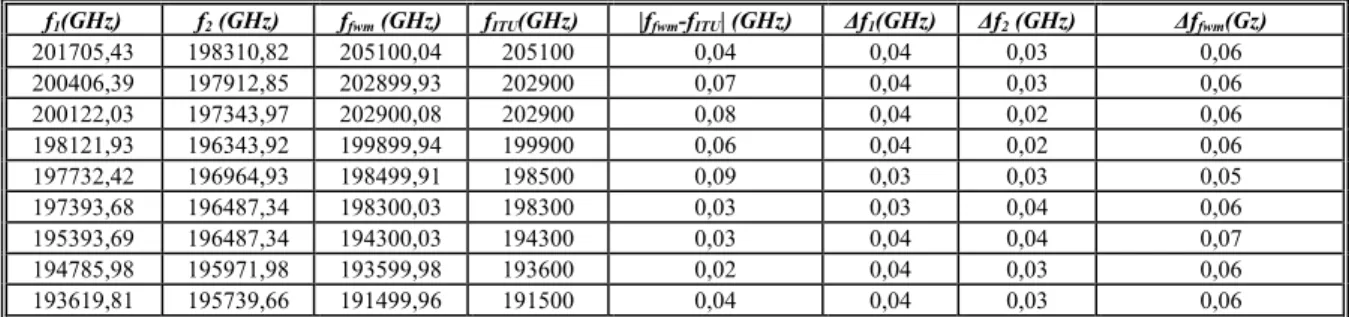
(5) 5.- Application to ITU’s frequencies. It is possible the generation of 3080 new frequency references between 187.1 and 205.1 THz by using the 56 absorption lines of the acetylene 12C2H2 and the method of stabilization described in this work. The most interesting frequencies generated by the second method are those that approximate to ITU’s frequencies less than 0.1 GHz (Table I). The frequencies generated by the first method can be seen in [2, 3]. Table I.- Frequencies generated next to the ITU’s frequencies by the stabilization of one of the laser and the four-wave mixing product on 12C2H2 absorptions(k=1) and its uncertainties. f1(GHz) 201705,43 200406,39 200122,03 198121,93 197732,42 197393,68 195393,69 194785,98 193619,81. f2 (GHz) 198310,82 197912,85 197343,97 196343,92 196964,93 196487,34 196487,34 195971,98 195739,66. ffwm (GHz) 205100,04 202899,93 202900,08 199899,94 198499,91 198300,03 194300,03 193599,98 191499,96. fITU(GHz) 205100 202900 202900 199900 198500 198300 194300 193600 191500. |ffwm-fITU| (GHz) 0,04 0,07 0,08 0,06 0,09 0,03 0,03 0,02 0,04. ∆f1(GHz) 0,04 0,04 0,04 0,04 0,03 0,03 0,04 0,04 0,04. ∆f2 (GHz) 0,03 0,03 0,02 0,02 0,03 0,04 0,04 0,03 0,03. ∆ffwm(Gz) 0,06 0,06 0,06 0,06 0,05 0,06 0,07 0,06 0,06. 6.- Conclusions We have described an easy method to synthesize new frequency references between 187.1 and 205.1 THZ (1602-1462 nm). We have shown the possibility of the stabilization of a FWM signal in the acetylene absorption line P25 with a SNR (∆P in Figure 7) of 3 dB, the possibility of synthesizing frequencies with reference in the acetylene 12C2H2 spectrum between 187.1 and 205.1 THz and the utility of this method in the calibration of WDM’s system measurement based on the stabilization of two lasers in an acetylene reference cell and the process of four-wave mixing in a semiconductor optical amplifier. Acknowledgements We acknowledge the financial support from the Ministerio de Educación y Ciencia through the project TIC2003-01869 and the grant associate FPI, and the support from Social European Fund through the program of grants I3P of the CSIC. References [1] David A Humphreys, “Synthesis of optical reference frequencies by four-wave mixing in optical fibre”. in 6th Optical Fibre Measurement Conference (OFMC’01) Proceedings. National Physical Laboratory, Teddington, Middlesex, UK, 2001, pp. 69-73. [2] Sonia Martín López, Miguel González-Herráez, Pedro Corredera, Maria Luisa Hernanz y Antonio Corróns Rodríguez,” Reference-frequency generation by Raman-enhanced four-photon mixing”, App.Opt., 43 3185-3190 (2004). [3] A. Carrasco-Sanz, S. Martín-López, M. González-Herráez, P. Corredera and M. L. Hernanz, “Generation of standard frequency references over the C and L bands using an acetylene cell and four-wave mixing enhanced by Raman amplification”, Symposium on Optical Fibre Measurements, National Institute of Standard and Technology, Boulder CO. Sep.2004. [4] Mark A. Summerfield and Rodney S. Tucker, “Frequency-Domain Model of Multiwave Mixing in Bulk Semiconductor Optical Amplifiers”. IEEE J. Select. Topics Quantum Electron, 5, 1999. pp 839-850. [5] G.P.Agrawal, "Population Pulsations and Nondegenerate Four-Wave Mixing in Semiconductor Lasers and Amplifiers," J. Opt. Soc. Am. B, 5 (1), 1988, pp. 147-159. [6] A. Mecozzi, S. Scotti, A. D’Ottavi, E. Iannone and P. Spano, “Four-Wave Mixing in Travelling-Wave Semiconductor Amplifiers”, IEEE J.Quantum Electron.,vol.31. 1995, pp. 689-699. [7] W.C. Swann and S. L. Gilbert “Pressure-induced shift and broadening of 1510-1540-nm acetylene wavelength calibration lines” J. Opt. Soc. Am. B, 17, 1263-1270 (2000)..
(6)
Figure
Documento similar
Although some public journalism schools aim for greater social diversity in their student selection, as in the case of the Institute of Journalism of Bordeaux, it should be
In the “big picture” perspective of the recent years that we have described in Brazil, Spain, Portugal and Puerto Rico there are some similarities and important differences,
Keywords: Metal mining conflicts, political ecology, politics of scale, environmental justice movement, social multi-criteria evaluation, consultations, Latin
For instance, (i) in finite unified theories the universality predicts that the lightest supersymmetric particle is a charged particle, namely the superpartner of the τ -lepton,
Given the much higher efficiencies for solar H 2 -generation from water achieved at tandem PEC/PV devices ( > 10% solar-to-H 2 energy efficiency under simulated sunlight) compared
Parameters of linear regression of turbulent energy fluxes (i.e. the sum of latent and sensible heat flux against available energy).. Scatter diagrams and regression lines
It is generally believed the recitation of the seven or the ten reciters of the first, second and third century of Islam are valid and the Muslims are allowed to adopt either of
In the preparation of this report, the Venice Commission has relied on the comments of its rapporteurs; its recently adopted Report on Respect for Democracy, Human Rights and the Rule
