Optimization of a Mechanical Design Problem
with the Modified Bacterial Foraging Algorithm
Efr´en Mezura-Montes⋆, Edgar A. Portilla-Flores⋄, and
Betania Hern´andez-Oca˜na⋆
⋆Laboratorio Nacional de Inform´atica Avanzada (LANIA) A.C. R´ebsamen 80, Centro, Xalapa, Veracruz, 91000, MEXICO.
⋄Centro de Innovaci´on y Desarrollo Tecnol´ogico en C´omputo (CIDETEC-IPN)
U. Adolfo L´opez Mateos, M´exico D.F., 07700, MEXICO.
[email protected],[email protected],[email protected]
Abstract. This paper presents the solution of a real-world constrained bi-objective mechanical design problem in presence of a dynamic cons-traint by using the Modified Bacterial Foraging Optimization Algorithm. This algorithm, originally designed to solve single-objective optimization problems, is adapted to include in its processes Pareto dominance as selection criterion, an external archive for elitism, and crowding distance as a diversity mechanism. The results obtained are compared with those provided by two evolutionary algorithms. The bacterial-based approach is able to provide a highly competitive performance and the type of solutions found are more suitable, based on the opinion of the expert mechanical designer.
Keywords: Engineering design, swarm intelligence, constraint-handling
1
Introduction
Nowadays, modern mechanical engineering designs are usually proposed as op-timization problems [10, 14]. One common method to define such opop-timization problem, where the best possible combination of values to a set of parameters that describe the system are seek, requires a kinematic analysis as a first step. This kinematic analysis is used to fulfill positions and velocities of the mechani-cal system and allows it to be described by a set of parameters. In such analysis, performance functions and constraints to quantify the system behavior are con-sidered. Once the set of parameters is defined, the designer can propose several potential solutions by himself. Otherwise, optimization algorithms can be used for that solution search [11].
alternative option. Those algorithms can be roughly divided in two main classes [6]: (1) Evolutionary algorithms (EAs) and (2) swarm intelligence algorithms (SIAs).
Among SIAs, one of the still scarcely employed to solve mechanical design prob-lems is the bacterial foraging optimization algorithm (BFOA), originally pro-posed to solve unconstrained single-objective optimization problems [12]. In BFOA, three steps based on the foraging behavior of E. Coli are emulated: chemotaxis (tumble and swimming), reproduction, and elimination-dispersal. In this paper, a simplified version proposed to solve single-objective constrained engineering design problems called Modified Bacterial Foraging Optimization Algorithm (MBFOA) [9] is further adapted to solve a bi-objective constrained mechanical design problem in presence of a dynamic constraint. Therefore, the contribution of the paper is two-fold: (1) to propose the first attempt to adapt MBFOA to solve multi-objective optimization problems and (2) to present a mechanism, based on a widely-used constraint-handling technique to deal with dynamic constraints in a real-world bi-objective optimization problem.
The paper is organized as follows: Section 2 describes the continuously vari-able transmission (CVT) system i.e., the problem tackled. Section 3 presents MBFOA. Thereafter, Section 4 introduces the modifications made to MBFOA so as to solve the CVT problem. Section 5 includes the obtained results and their corresponding discussion. Finally, Section 6 draws some conclusions and provides the future work.
2
CVT system
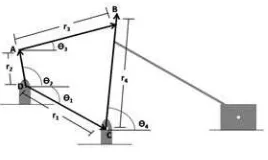
The mechanical design problem tackled in this paper is a crank-rocker-slider CVT system, which consists on a set of bar mechanisms carried out to perform simultaneously, amplifying or reducing the input speed. A chain system receives the motion from a input bar so as to keep a rotational movement in the same way the whole time. The CVT system is depicted in Figure 1 where the five design parameters are the following: r1 is the ground bar, r2 is the crank bar length,
r3 is the coupling bar length, r4 is the rocker bar length and θ1, is the angle between the reference bar and the horizontal axis.θ2,θ3, andθ4 are calculated from the values of the five design parameters.
Considering that x1 = r1, x2 = r2, x3 = r3, x4 = r4, and x5 = θ1 the constrained bi-objective optimization problem is defined as:
Minimize [f1(x), f2(x)] (1)
where f1 represents the output of the system which aims to be maximized (it appears as a negative value because it is then considered for minimization):
Fig. 1.CVT system
and f2 minimizes the deviation of the transmission angle, i.e., it improves the quality of the performance of the CVT system:
f2(x) = (γmax−
π
2) 2+ (γ
min−
π
2)
2 (3)
Furthermore, the inequality constraints related with the system dimensions, are the following:
g1(x) =x2+x3−x1−x4≤0 (4)
g2(x) =x1−x3≤0 (5)
g3(x) =x4−x3≤0 (6)
g4(x) =x1−0.5≤0 (7)
g5(x) = 0.05−x1≤0 (8)
g6(x) =x2−0.5≤0 (9)
g7(x) = 0.05−x2≤0 (10)
g8(x) =x3−0.5≤0 (11)
g9(x) = 0.05−x3≤0 (12)
g10(x) =x4−0.05≤0 (13)
g11(x) = 0.05−x4≤0 (14)
g12(x) =x5−π
4 ≤0 (15)
g13(x) =−π
4 −x5≤0 (16)
There is also one equality constraint defined as follows:
h1(x) =π−θ4max−θ4min= 0 (17)
Finally, there is an inequality constraint related with the trajectory of the four bar mechanism where the transmission angle (determined by the values of
θ2andθ3) does not take a value below 45◦ in any single time.
g14(x, t) = π
The limits for each design parameter are defined as follows: 0.05≤x1, x2, x3, x4 ≤0.5 and−45◦ ≤x
5 ≤45◦.
3
Modified Bacterial Foraging Optimization Algorithm
(MBFOA)
The Bacterial Foraging Optimization (BFOA) is based on social and cooperative behaviors bacteria have when looking for regions with high nutrient levels [1]. The basis of the bacterial foraging behavior consists on that each bacterium tries to maximize its obtained energy per each unit of time spent on the foraging process while avoiding noxious substances. Moreover, bacteria can communicate among them. Due to space restrictions BFOA details are not included in this paper. However, they can be found in [12]
MBFOA was later proposed with the aim of adapting BFOA for solving con-strained numerical single-objective optimization problems. This algorithm has a generational loop (G) where three inner processes are carried out: chemotaxis, reproduction and elimination-dispersal. MBFOA also adopted a parameter-free constraint-handling technique to bias the search to the feasible region of the search space to make it easier to use in engineering design problems [9]. The four main features of MBFOA are detailed as follows:
1. The constraint handling mechanism modifies the selection criteria used in the tumble-swim operator and in the sorting carried out in the reproduction process (comparisons originally based only on objective function values). In MBOFA a set of three rules proposed in [3] are employed. They are the following: (1) Between two feasible bacteria, the bacterium with the best objective function value is preferred. (2) Between a feasible bacterium and infeasible bacterium, the feasible one is preferred. (3) Between two infeasible bacteria, the one with the lowest sum of constraint violation is preferred. The sum of constraint violation is computed as: mi=1max(0, gi(x)), where m is the number of constraints of
the problem. Each equality constraint is converted into an inequality constraint: hi(x) -∈ ≤0, where∈is the tolerance allowed (a very small value).
2. The chemotactic process consists on tumble-swim movements carried out by bacteria in the current swarm. The tumble movement (i.e., search direction cho-sen at random) is precho-sented in Equation 19.
φ(i) = ∆(i)
∆(i)T∆(i) (19)
where ∆(i) is a randomly generated vector of size nwith elements within the following interval: [−1,1]. After that, each bacteriumimodifies its positions by a swimming step as indicated in Equation 20.
θi(j+ 1, G) =θi(j, G) +C(i)φ(i) (20) whereθi(j+1,G)is the new position of bacteriumi(new solution) at chemotactic
Unlike considering them as user-defined parameters as in BFOA, in MBFOA the stepsize values in vectorC(i)are calculated by considering the valid limits per each design variablek[9] as indicated in Equation 21.
C(i)k=R∗(
∆xk
√
n), k= 1, ..., n (21)
where∆xkis the difference between upper and lower limits for design parameter
xk:Uk−Lk,nis the number of design variables andRis a user-defined percentage
of the value used by the bacteria as stepsize.
MBFOA implements an attractor movement so as to let each bacterium in the swarm to follow the bacterium located in the most promising region of the search space. The attractor movement is presented in Equation 22.
θi(j+ 1, G) =θi(j, G) +β(θB(G)−θi(j, G)) (22)
whereθi(j+ 1, G) is the new position of bacteriumi,θi(j, G) is the current
po-sition of bacteriumi,θB(G) is the current position of the best bacterium in the
swarm so far at generationG, and β defines the closeness of the new position of bacterium i with respect to the position of the best bacterium θB(G). The
attractor movement applies twice in a chemotactic loop, while in the remaining steps the tumble-swim movement is carried out. The aim is to promote a balance between exploration and exploitation in the search.
3. The reproduction process consists on sorting the swarm according to the rules of the constraint-handling technique. The first half survives while the second half is eliminated and the first half is duplicated to maintain a fixed swarm size.
4. The elimination-dispersal process eliminates only the worst bacterium, based on the three criteria defined in the constraint-handling technique, and a new randomly generated bacterium is inserted as its replacement.
4
Multi-Objective Modified Bacterial Foraging
Optimization Algorithm (MOMBFOA)
MBFOA is modified in this section to solve the mechanical design problem pre-sented in Section 2. following:
4.1 Evolutionary multi-objective optimization concepts
Based on the fact that the most suitable criterion to be added to a SIA so as to solve either two or three-objective optimization problem isPareto dominance, it is considered in MOMBFOA. Pareto dominance is defined as follows: a vector of objectivesf = [f1, . . . , fK] is said to Pareto dominatef′= [f1′, . . . , fK′ ] (denoted
by f f′) if and only if f is partially less than f′, i.e.∀i ∈ {1, . . . , K}, fi ≤
f′
called the Pareto optimal set. The objective function values of those solutions contained in the Pareto optimal set constitute thePareto frontof the problem. The solution of a multi-objective problem can be defined as follows: If the feasible region of the search space is named asF, the search algorithm will look for the Pareto optimal set:P∗:= {v ∈ F | ¬∃s∈ F f(s)f(v)}. Considering that
in this paper a real-world problem is solved, thenP∗is unknown, a sub-optimal Pareto set, including sub-optimal trade-off solutions for the mechanical design problem, is the solution sought.
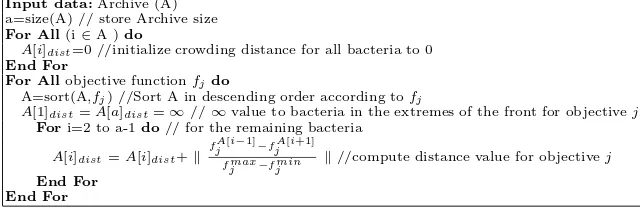
Another mechanism adopted from multi-objective optimization in this paper [4, 2], is thecrowding distance[4].Crowding distancevalues are higher for those more isolated solutions in the objective function space. Hence, with the goal to extend the Pareto front, bacteria with higher crowding distance values in the Archive will be preferred. Figure 2 details the computing of such distance.
Input data:Archive (A) a=size(A) // store Archive size For All(i∈A )do
A[i]dist=0 //initialize crowding distance for all bacteria to 0
End For
For Allobjective functionfj do
A=sort(A,fj) //Sort A in descending order according tofj
A[1]dist=A[a]dist=∞//∞value to bacteria in the extremes of the front for objectivej
Fori=2 to a-1do// for the remaining bacteria
A[i]dist=A[i]dist+ fA[i−1]
j −fjA[i+1]
f maxj −f minj
//compute distance value for objectivej
[image:6.595.138.458.324.428.2]End For End For
Fig. 2.Crowding distance pseudocode.
4.2 Modifications to MBFOA
The modifications are the following:
1. Selection criteria. Based on its similarity with the constraint-handling tech-nique used in MBFOA, the feasibility rules described with Pareto dominance [5] is adopted in MOMBFOA. This criteria apply in the tumble-swim movements and in the sorting of the swarm. The set of criteria are defined as follows: (1) Between two feasible bacteria, the one which dominates the other is preferred. (2) Between one feasible bacterium and one infeasible bacterium, the feasible one is preferred. (3) Between two infeasible bacteria, the one with the lowest sum of constraint violation is preferred. If both bacteria are feasible and non-dominated each other, one is chosen randomly. To deal with the dynamic constraint, it was discretized in 911 constraints and each one was evaluated and its corresponding violation (if any) was added to the sum of constraint violation.
bacteria is employed in MOMBFOA. The Archive, empty at the beginning of the process, is updated at each MOMBFOA cycle by inserting a copy of those feasible bacteria from the swarm after the chemotactic process. Each time a set of bacteria enters the Archive, a non-dominance checking is carried out in the archive to keep feasible non-dominated bacteria only.
3. Attractor Operator. In MOMBFOA the leader will be chosen from the archive and it is the bacterium with the highest crowding distance value, i.e., the solution located in the most isolated region of the current Pareto front. The idea is promoting the sampling of more solutions in that region and extending the front. The new attractor operator is shown in Figure 23.
θi(j+ 1, G) =θi(j, G) +β(θBCr(G)−θi(j, G)) (23)
whereθi(j+ 1, G) is the new position of the bacteriumi,θi(j, G) is the current
position of bacteriumi, and θBCr(G) is the current position of the bacterium
with the best crowding distance in generationGtaken from the external Archive.
β is the stepsize of the attractor movement. If the Archive is empty, i.e., no feasible non-dominated solutions have been found, the leader is chosen from the current swarm and based on the criteria defined in Section 4.2, i.e., the bacterium with the lowest sum of constraint violation.
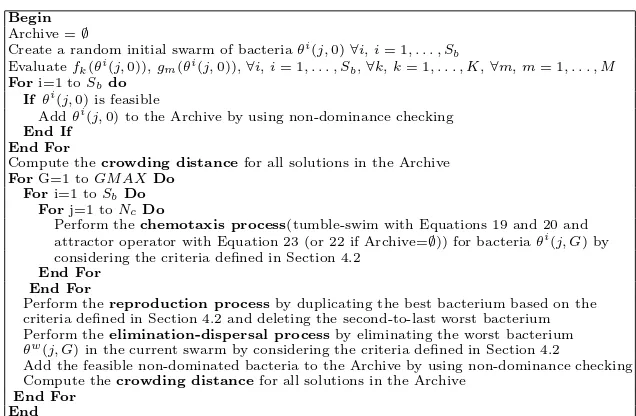
4. Reproduction. In MOMBFOA only the best bacterium in the swarm will reproduce with one clon which will replace the second worst bacterium, based on a sorting process computed by considering the criteria defined in Section 4.2. The complete MOMBFOA pseudocode is presented in Figure 3.
5
Experiments and results
Two experiments were designed to test MOMBFOA in the real-world mechani-cal problem stated in Section 2. Such results are compared with two well-known evolutionary multi-objective optimization algorithms: (1) NSGA-II [5] and (2) the differential evolution for mechanical design (DE) [13]. NSGA-II was cho-sen because it is the most popular EA to solve multi-objective problems. DE in [13] was precisely proposed to solve multi-objective mechanical design prob-lems. Both algorithms chosen for comparison use crowding distance as diversity mechanism. DE uses an external archive for elitism purposes as in MOMBFOA. The first experiment consists on a graphical comparison of the accumulated Pareto fronts obtained in a set of independent runs. The accumulated Pareto front is obtained by merging all non-dominated solutions for all independent runs and compute non-dominance checking. At the end, the set of non-dominated solutions from all the independent runs are showed in a single accumulated Pareto front. This way to visualize the results is useful in real-world multi-objective optimization problems where the Pareto optimal set is unknown.
The second experiment considers the usage of a binary performance metric to analyze the performance of the algorithms compared.
Begin Archive =∅
Create a random initial swarm of bacteriaθi(j,0)
∀i,i= 1, . . . , Sb
Evaluatefk(θi(j,0)),gm(θi(j,0)),∀i,i= 1, . . . , Sb,∀k,k= 1, . . . , K,∀m,m= 1, . . . , M
Fori=1 toSbdo
Ifθi(j,0) is feasible
Addθi(j,0) to the Archive by using non-dominance checking
End If End For
Compute thecrowding distancefor all solutions in the Archive ForG=1 toGM AXDo
Fori=1 toSbDo
Forj=1 toNcDo
Perform thechemotaxis process(tumble-swim with Equations 19 and 20 and attractor operator with Equation 23 (or 22 if Archive=∅)) for bacteriaθi(j, G) by
considering the criteria defined in Section 4.2 End For
End For
Perform thereproduction processby duplicating the best bacterium based on the criteria defined in Section 4.2 and deleting the second-to-last worst bacterium Perform theelimination-dispersal processby eliminating the worst bacterium
θw(j, G) in the current swarm by considering the criteria defined in Section 4.2
Add the feasible non-dominated bacteria to the Archive by using non-dominance checking Compute thecrowding distancefor all solutions in the Archive
[image:8.595.139.457.145.353.2]End For End
Fig. 3.MOMBFOA pseudocode. Input parameters are number of bacteriaSb,
chemo-tactic loop limitNc, scaling factorβ, percentage of initial stepsize Rand number of
generationsGM AX.
trial-and-error process based on preliminary sets or runs. They are the following:
Sb= 200,GMAX = 125,Nc= 20,F = 1.7 andR= 1.8E-3. 500, 000 evaluations
are performed in each independent run. The tumble-swim operator works in all chemotactic steps for each bacterium with the exception of steps 15 and 20, where the attraction operator is used. The results obtained by NSGA-II and DE were obtained from 10 independent runs with 500,000 evaluations as well.
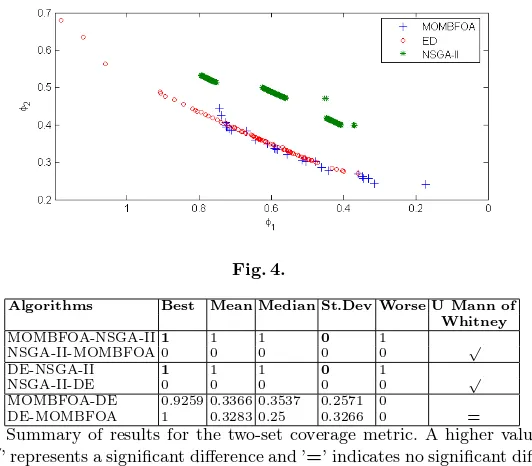
The accumulated Pareto fronts for the first experiment are presented in Fig-ure 4, where it can be clearly observed that the accumulated front obtained by MOMBFOA dominates those obtained by NSGA-II and DE. However, DE has a larger front than that of MOMBFOA. However, from the mechanical engineer’s point of view, the lower right part of the objective space has more suitable so-lutions and precisely that region was found by MOMBFOA. Another significant finding was that all compared algorithms could find the feasible region of the search space despite the presence of the dynamic constraint showed in Section 2.
The two-set coverage metric [15] was used to compare each one of the single Pareto fronts obtained by each algorithm and the statistical summary of such results, besides the statistical tests to verify significance of differences, are showed in Table 1.
Fig. 4.
Algorithms Best Mean Median St.Dev Worse U Mann of Whitney MOMBFOA-NSGA-II1 1 1 0 1
NSGA-II-MOMBFOA 0 0 0 0 0 √ DE-NSGA-II 1 1 1 0 1
NSGA-II-DE 0 0 0 0 0 √
MOMBFOA-DE 0.9259 0.3366 0.3537 0.2571 0
[image:9.595.168.434.153.386.2]DE-MOMBFOA 1 0.3283 0.25 0.3266 0 =
Table 1.Summary of results for the two-set coverage metric. A higher value is pre-ferred. ’√’ represents a significant difference and ’=’ indicates no significant differences. Mann-Whitney U non-parametric test was used.
6
Conclusions and future work
In this work the MBFOA algorithm was implemented in order to carry out the mechanical design of a bi-objective optimization problem of a four-bar mecha-nism. Such design considered two objective functions and structural constraints, where one of them is a dynamic constraint. The results obtained by MOMBFOA were compared with two algorithms: NSGA-II and DE, in two experiments, one with a visual comparison of the accumulated Pareto fronts and another with the usage of the two-set coverage metric and the Mann Whitney U test to ver-ify significance of results. Two interesting conclusions are established from the discussed results: (1) MOMBFOA was able to find a region of the objective function space while the two other algorithms could not reach it and such region reflects a more suitable design of the mechanism, and (2) the performance metric was unable to measure such user-preference. The future work consists on using MOMBFOA to resolve other multi-objective optimization problems. Moreover, a performance metric which can be able to measure user-preferences in mechanical design must be defined.
Acknowledgments
re-spectively. The second author acknowledges support from IPN’s programs CO-FAA and EDI, and from SIP through project numbers 20101360 and 20111027.
References
1. H. Bremermann. Chemotaxis and optimization. J. Franklin Inst., 297:397–404, 1974.
2. C. A. Coello Coello, D. A. Van Veldhuizen, and G. B. Lamont. Evolutionary Algorithms for Solving Multi-Objective Problems. Kluwer Academic Publishers, June 2002.
3. K. Deb. An Efficient Constraint Handling Method for Genetic Algorithms. Com-puter Methods in Applied Mechanics and Engineering, 186(2/4):311–338, 2000. 4. K. Deb. Multi-Objetive Optimization using Evolutionary Algorithms. John Wiley
Sons, LTD, 2002.
5. K. Deb, A. Pratap, S. Agarwal, and T. Meyarivan. A Fast and Elitist Multiobjec-tive Genetic Algorithm: NSGA–II.IEEE Transactions on Evolutionary Computa-tion, 6(2):182–197, April 2002.
6. A. P. Engelbrecht. Computational Intelligence. An Introduction. John Wiley & Sons, 2nd edition, 2007.
7. J. D. Knowles and D. W. Corne. Approximating the Nondominated Front Using the Pareto Archived Evolution Strategy.Evolutionary Computation, 8(2):149–172, 2000.
8. V. Mermetas. Optimal design of manipulator with four-bar mechanism.Mechanism and Machine Theory, 1(39):545–554, April 2004.
9. E. Mezura-Montes and B. Hern´andez-Oca˜na. Modified bacterial foraging opti-mization for engineering design. In C. H. Dagli and et al., editors,Proceedings of the Artificial Neural Networks in Enginnering Conference (ANNIE’2009), pages 357–364, St. Louis, MO, USA, November 2009. ASME Press.
10. N. Nariman-Zadeh, M. Felezi, A. Jamali, and M. Ganji. Pareto optimal synthesisof four-bar for path generation. Mechanism and Machine Theory, 1(44):180–191, March 2009.
11. R. Norton. Dise˜no de Maquinaria, una introducci´on a la s´ıntesis y al an´alisis de mecanismos y m´aquinas. McGraw Hill, Mxico, 1997.
12. K. Passino. Biomimicry of bacterial foraging for distributed optimization and control. IEEE Control Systems Magazine, 22(3):52–67, 2002.
13. E. A. Portilla-Flores, E. Mezura-Montes, J. ´Alvarez Gallegos, C. A. C. Coello, C. A. Cruz-Villar, and M. G. Villareal-Cervantes. Parametric reconfiguration improve-ment in non-iterative concurrent mechatronic design using an evolutionary-based approach.Engineering Optimization of Artificial Intelligence, 24(5):757–771, 2011. 14. R. Radovan and R. Stevan. On the optimum synthesis of a four-bar linkage us-ingdifferential evolution and method of variable controlled deviations. Mechanism and Machine Theory, 1(44):235–246, March 2009.
15. E. Zitzler, K. Deb, and L. Thiele. Comparison of multiobjective evolutionary algo-rithms: Empirical results. evolutionary computation. Evolutionary Computation, 8(2):173–195, 2000.