Computer Science & Technology Series
Computer Science & Technology Series
XVII A
RGENTINEC
ONGRESSOFC
OMPUTERS
CIENCES
ELECTEDP
APERSA
RMANDOD
EG
IUSTI| J
AVIERD
ÍAZComputer Science & Technology Series XVII ARGENTINE CONGRESSOF COMPUTER SCIENCE SELECTED PAPERS
Diagramación: Andrea López Osornio
Editorial de la Universidad Nacional de La Plata (Edulp)
Calle 47 N.º 380 / La Plata B1900AJP / Buenos Aires, Argentina + 54 221 4273992 / 427 4898
[email protected] www.editorial.unlp.edu.ar
EDULP integra la Red de Editoriales Universitarias Nacionales (REUN) Primera edición - 2012
ISBN Nº 978-950-34-0885-8
Queda hecho el depósito que marca la Ley 11.723 © 2012 - Edulp
Impreso en Argentina
De Giusti, Armando
Computer science & technology series: XVII Argentine Congress of Computer Science Selected Papers / Armando De Giusti y Javier Díaz; edición literaria a cargo de Armando De Giusti y Javier Díaz. - 1a ed. - La Plata: Universidad Nacional de La Plata, 2012.
316 p.; 24x16 cm.
ISBN 978-950-34-0885-8
T
OPICSXII IntelligentAgents and SystemsWorkshop
Chairs Guillermo Leguizamón (UNSL) Alejandro García (UNS) Ana Casali (UNR)
XI Distributed and Parallel ProcessingWorkshop
Chairs Armando De Giusti (UNLP) Jorge Ardenghi (UNS) Maria Fabiana Piccoli (UNSL)
X InformationTechnologyApplied to EducationWorkshop
Chairs Cristina Madoz (UNLP) Sonia Rueda (UNS) Marcela Chiarani (UNSL) UrielCukierman (UTN)
IX Graphic Computation, Imagery andVisualizationWorkshop
Chairs Silvia Castro (UNS) Oscar Bría (INVAP) María Jose Abásolo (CIC-UNLP)
VIII Software EngineeringWorkshop
Chairs Patricia Pesado (UNLP) Elsa Estévez (United Nations)Alejandra Cechich (UNCOMA) Horacio Kuna (UNM)
VIII Database and Data MiningWorkshop
Chairs Hugo Alfonso (UNLPam) Rodolfo Bertone (UNLP) Olinda Gagliardi (UNSL)
VIArchitecture, Nets and Operating SystemsWorkshop
Chairs Javier Díaz (UNLP) Antonio Castro Lechtaller (IESE) Hugo Padovani (UM) Nelson Acosta (UNCPBA)
III Innovation in Software SystemsWorkshop
Chairs Pablo Fillottrani (UNS) Carlos Neil (UAI) Marcelo Estayno (UNLZ)
II Computer Science Theoretical Aspects Warkshop
Chairs Susana Esquivel (UNSL) Marcelo Falappa (UNS)
II Signal Processing and Real-Time Systems Workshop
Chairs DanielPandolfi (UNPA) Horacio Villagarcía Wanza (UNLP) Hugo Ramón (UNNOBA)
I ETHICOMP Latinoamérica
HONOUR COMMITEE
Secretary of University Policies Dr. Alberto Dibbern
UNLP President Dr. Fernando Tauber
CONICET President Dra. Marta Rovira
CIC President
Ing. Agr. Carlos Gerónimo Gianella
School of Computer Sciences (UNLP) Dean Lic. Javier Díaz
SCIENTIFIC COMMITTEE
Abásolo, María José (Argentina) Acosta, Nelson (Argentina) Alba Torres, Enrique (España) Alfonso, Hugo (Argentina) Ardenghi, Jorge (Argentina) Arias Oliva, Mario (España) Bertone, Rodolfo (Argentina) Bría, Oscar (Argentina) Brisaboa, Nieves (España) Bynum, Terrell Ward (EEUU) Cabero, Julio (España) Cancela, Héctor (Uruguay) Casali, Ana (Argentina)
Castro Lechtaller, Antonio (Argentina) Castro, Silvia (Argentina)
Cechich, Alejandra (Argentina) Chiarani, Marcela (Argentina) Coello Coello, Carlos (México)
Collazos Ordóñez, César Alberto (Colombia)
Cukierman, Uriel (Argentina) Diaz, Javier ( Argentina) Dix,Juerguen (Alemania) Doallo, Ramón (España) Esquivel, Susana (Argentina) Estayno, Marcelo (Argentina) Estevez, Elsa (Naciones Unidas) Falappa, Marcelo (Argentina) Fillottrani, Pablo (Argentina) Fleischman, William (EEUU) Gagliardi, Olinda (Argentina) García, Alejandro (Argentina) Gröller, Eduard (Austria) Hernández, Gregorio (España) Janowski, Tomasz (Naciones Unidas) Kuna, Horacio (Argentina)
Leguizamón, Guillermo(Argentina) Loui, Ronald Prescott (EEUU) Luque, Emilio (España) Madoz, Cristina (Argentina) Manresa-Yee, Cristina (España) Marín, Mauricio (Chile)
Marquez, María Eugenia (Argentina) Naiouf, Marcelo (Argentina) Navarro Martín, Antonio (España) Neil, Carlos (Argentina)
Olivas Varela, José Ángel (España) Padovani, Hugo (Argentina) Pandolfi, Daniel (Argentina) Pesado, Patricia (Argentina) Piattini, Mario (España)
Sanz, Cecilia (Argentina) Steinmetz, Ralf (Alemania) Suppi, Remo (España) Tarouco, Liane (Brasil) Tirado, Francisco (España) Utreras, Florencio (Chile) Vendrell, Eduardo (España)
Villagarcia Wanza, Horacio (Argentina) Vizcaino, Aurora (España)
Zamarro, Jose Miguel (España)
ORGANIZING COMMITEE
UNIVERSIDAD NACIONALDE LA PLATA-FACULTADDE INFORMÁTICA
ARGENTINA President Pesado, Patricia Naiouf, Marcelo Lanzarini, Laura Tinetti, Fernando Sanz, Cecilia Bertone, Rodolfo Madoz, Cristina Gorga, Gladys Boracchia, Marcos Villagarcía Wanza, Horacio Thomas, Pablo
De Giusti, Laura Esponda, Silvia Romero, Fernando Chichizola, Franco González, Alejandro Giacomantone, Javier Pasini, Ariel Corbalán, Leonardo Cristina, Federico Ibañez, Edurado Marrero, Luciano Dapoto, Sebastián Delia, Lisandro Montezanti, Diego Pousa, Adrián Iglesias, Luciano Hasperué, Waldo Encinas, Diego Galdámez, Nicolás Artola, Verónica Rodríguez, Ismael Pablo Estrebou, César Martorelli, Sabrina Pettoruti, José Enrique Moralejo, Lucrecia Sanz, Victoria
Frati, Fernando Emmanuel Guisen, Andrea
Leibovich, Fabiana Albanesi, Bernarda Caseres, Germán Villa Monte, Augusto Maulini, Juan Rucci, Enzo Ronchetti,Franco
PREFACE
CACIC Congress
CACIC is an annual Congress dedicated to the promotion and advancement of all aspects of Computer Science. The major topics can be divided into the broad categories included as Workshops (Intelligent Agents and Systems, Distributed and Parallel Processing, Software Engineering, Architecture, Nets and Operating Systems, Graphic Computation, Imagery and Visualization, Information Technology applied to Education, Databases and Data Mining, Innovation in Software Systems, Theory, Signal Processing, Real time Systems and Ethics in Computer Science).
The objective of CACIC is to provide a forum within which to promote the development of Computer Science as an academic discipline with industrial applications, trying to extend the frontier of both the state of the art and the state of the practice.
The main audience for, and participants in, CACIC are seen as researchers in academic departments, laboratories and industrial software organizations. CACIC started in 1995 as a Congress organized by the Network of National Universities with courses of study in Computer Science (RedUNCI), and each year it is hosted by one of these Universities. RedUNCI has a permanent Web site where its history and organization are described: http:// redunci.info.unlp.edu.ar.
CACIC 2011 in La Plata
CACIC’11 was the seventeenth Congress in the CACIC series. It was organized by the School of Computer Science of the University of La Plata.
The Congress included 11 Workshops with 148 accepted papers, 3 main Conference, 4 invited tutorials, different meetings related with Computer Science Education (Professors, PhD students, Curricula) and an International School with 5 courses. (http://www.cacic2011.edu.ar/).
Each topic was supervised by a committee of three chairs of different Universities.
The call for papers attracted a total of 281 submissions. An average of 2.5 review reports were collected for each paper, for a grand total of 702 review reports that involved about 400 different reviewers.
A total of 148 full papers, involving 393 authors and 77 Universities, were accepted and 25 of them were selected for this book.
Acknowledgments
CACIC 2011 was made possible due to the support of many individuals and organizations. The School of Computer Science of the University of La Plata, RedUNCI, the Secretary of University Policies, the University of La Plata, the National Agency of Scientific and Technological Advancement, CIC and CONICET were the main institutional sponsors.
This book is a very careful selection of best qualified papers. Special thanks are due to the authors, the members of the workshop committees, and all reviewers, for their contributions to the success of this book.
T
ABLEOFC
ONTENTS17
55
95
129
XII IntelligentAgents and SystemsWorkshop
Using Possibilistic Defeasible Logic Programming for Reasoning with Inconsistent Ontologies
Sergio A. Gómez, Carlos I. Chesñevar, Guillermo R. Simari An Argumentation Framework with Backing and Undercutting Andrea Cohen, Alejandro J. García, Guillermo R. Simari
Face Recognition using SIFT descriptors and Binary PSO with velocity control
Juan Andrés Maulini, Laura Lanzarini
XI Distributed and Parallel Processing Workshop
Performance Analysis of a Symmetric Cryptographic Algorithm on Multicore Architectures
Adrián Pousa, Victoria Sanz, Armando De Giusti
Efficiency Evaluation of the Input/Output System on Computer Clusters Sandra Mendez, Dolores Rexachs del Rosario, Emilio Luque Fadón Implementing Sub Steps in a Parallel Automata Cellular Model Pablo C. Tissera, Marcela Printista, Emilio Luque Fadón
X Information TechnologyApplied to Education Workshop
A Conversational Agent for the Improvement of Problem-Solving Skills Eliane Vigneron, Liane Tarouco, Eliseo Reategui, Michelle Leonhardt, Álan Gularte, Andrea Capra
ECALEAD-Quality Assessment in Distance Education. Analysis of the proposed model
Gladys Gorga, Cecilia Sanz, Maria C. Madoz
Interactive multi-sensory environment to control stereotypy behaviours Cristina Manresa-Yee, Ramón Mas, Gabriel Moyá, María J. Abásolo, Javier Giacomantone
IX Graphic Computation, Imagery and Visualization Workshop
Unrestricted multivariate medians for adaptive filtering of color images Ezequiel Lopéz-Rubio, María N. Florentín-Núñez
155
205
227
251
273
287
VIII Software Engineering Workshop
Exploring Software Engineering Techniques for Developing Robotic Systems
Claudia F. Pons, Roxana S. Giandini, Gabriela Arévalo, Dimitris Karagiannis ReqGIS Classifier: A Tool for Geographic Requirements Normalization Viviana E. Saldaño, Agustina Buccella, Alejandra Cechich
Assessment Scheme-based Service Selection for SOC-based Applications Martín Garriga, Andrés P. Flores, Alejandra Cechich, Alejandro Zunino Adaptation of ISO/IEC 15504 Standard to SMBs Needs. Analysis of Required Roles to Meet Work Product Requirements
Ariel Pasini, José R. Zubizarreta Aizpuru, Patricia Pesado
VIII Database and Data Mining Workshop
Combining Methods for Searches in Nested Metric Spaces
Hugo Guercek, Nora Reyes, Claudia Deco, Cristina Bender, Mariano Salvetti Center Selection Techniques Based on Distance Histograms
Ariel Lucero, Carina M. Ruano, Norma E. Herrera
VI Architecture, Nets and Operating Systems Workshop
Modifying the Behaviour of Minix System Calls through the Redirection of Messages
Pablo Pessolani
On the Road to a Global Wireless Sensor Network Eduardo O. Sosa, Stefan Fischer, Francisco Javier Díaz
III Innovation in Software Systems Workshop
Cohesion among Ontologies: a Technique for Measuring Semantic Integration
María Mercedes Vitturini, Pablo Rubén Fillottrani An Audio File Tagging Mobile Game, mTagATune
Francisco Javier Díaz, Claudia Alejandra Queiruga, Alejandro Ferraresso, José Ignacio Larghi
II Computer Science Theoretical Aspects Workshop
DeLP marking procedure for dialectical trees is PSPACE-complete Laura A. Cecchi , Guillermo R. Simari
II Signal Processing and Real-Time Systems Workshop
Abstract Data Type for Real-Time Database Systems
I ETHICOMP Latinoamérica
Advantages and Trade-Offs of Introducing Ethical Issues in Computing through a Dedicated Course or through Modules in Relevant Content Courses in the Curriculum
William M. Fleischman, Daniel T. Joyce
Some Ethical Reflections on Relations between Human Beings and Social Robots
Anne Gerdes
XII
Using Possibilistic Defeasible Logic Programming
for Reasoning with Inconsistent Ontologies
SERGIO A.GÓMEZ1,CARLOS I.CHESÑEVAR1,2,GUILLERMO R.SIMARI1
1 Artificial Intelligence Research and Development Laboratory, Department of Computer Science
and Engineering, Universidad Nacional del Sur, Av. Alem 1253, (8000) Bahía Blanca, Argentina, Email: {sag,cic,grs}@cs.uns.edu.ar
2 Consejo Nacional de Investigaciones Científicas y Técnicas (CONICET), Argentina
Abstract. In this paper we present a preliminary framework for reasoning with possibly inconsistent Description Logic ontologies using Possibilistic Defeasible Logic Programming. We present a case study where it is showed how the proposed approach works. We contend that the proposal presented is apt for being used in the context of Semantic Web ontologies as it can be applied to the Web Ontology Language OWL, which is the current standard.
1.
Introduction
The Semantic Web (SW) [1] is a vision of the Web where resources have precise meaning defined in terms of ontologies. The Web Ontology Language (OWL) [2] whose semantics is based on Description Logics [3] is the de facto standard for the SW. Agents in the SW are supposed to reason over web resources by using standard reasoning systems, thus being able to compute an implicit hierarchy of concepts defined in an ontology and then checking the membership of individuals to those concepts. Over the last few years an alternative approach to reasoning with ontologies called Description Logic Programming (DLP) [4] has gained interest. The DLP approach relies on translating DL ontologies into the language of logic programming, so standard Prolog environments can be used to reason on them.
Defeasible Logic Programming [8] to reason with possibly inconsistent ontologies.
Possibilistic Defeasible Logic Programming (P_DeLP) [9] is a logic programming language which combines features from argumentation theory and logic programming, incorporating as well the treatment of possibilistic uncertainty and fuzzy knowledge at object-language level. In this article, we show a preliminary approach to reason with possibly inconsistent DL ontologies in P-DeLP. For this we define the concept of weighted DL ontology which is an ontology whose axioms have given numerical weights indicating their degree of certainty, then the ontology can be interpreted as a P-DeLP program.
Outline: In Section 2, we present the fundamentals of Description Logics. Section 3 reviews the fundamentals of Possibilistic Defeasible Logic Programming. In Section 4, we introduce a framework for reasoning with possibly inconsistent weighted ontologies in PDeLP. Finally, Section 5 concludes.
2.
Fundamentals of Description Logics
Description Logics (DL) [3] are a family of knowledge representation formalisms based on the notions of concepts (unary predicates, classes) and roles (binary relations) that allow building complex concepts and roles from atomic ones. Let C, D stand for concepts, R for a role and a,b for individuals. Concept descriptions are built from concept names using the constructors conjunction , disjunction , complement , existential restriction , and value restriction . To define the semantics of concept descriptions, concepts are interpreted as subsets of a domain of interest, and roles as binary relations over this domain. Further extensions are possible including inverse (P-) and transitive (P+) roles. A DL ontology consists of two finite and mutually disjoint sets: a Tbox which introduces the terminology and an Abox which contains facts about particular objects in the application domain. Tbox statements have the form (inclusions) and (equalities), where C and D are (possibly complex) concept descriptions. Objects in the Abox are referred to by a finite number of individual names and these names may be used in two types of assertional statements: concept assertions of the type a:C and role assertions of the type <a,b>:R.
A knowledge representation system based on DL is able to perform specific kinds of reasoning, its purpose goes beyond storing concept definitions and assertions. As a DL ontology has a semantics that makes it equivalent to a set of axioms of first-order logic, it contains implicit knowledge that can be made explicit through inferences. Inferences in DL systems are usually divided into Tbox reasoning and Abox reasoning. In this paper we are concerned only with Abox reasoning, more precisely with
instance checking [3]. Instance checking consists of determining if an assertion is entailed from an Abox. For instance, T U A |= a:C indicates that the individual a is a member of the concept C w.r.t. the Abox A and the Tbox T.
3.
Possibilistic Defeasible Logic Programming
The P-DeLP [9] language L is defined from a set of ground fuzzy atoms (fuzzy propositional variables) {p, q, ... } together with the conectives {~,^,}. The symbol ~ stands for negation. A literal L L is a ground (fuzzy) atom ~q, where q is a ground (fuzzy) propositional variable. A rule in
L is a formula of the form QL1 ^ ... ^ Ln, where Q, L1, ...,Ln are literals in
L. When n=0, the formula Q is called a fact. The term goal will refer to any literal Q L. Facts, rules and goals are the well-formed formulas in L.
Definition 1 (Certainty-weighted clause) A certainty-weighted clause, or simply weighted clause, is a pair (,), where is a w.f.f. in L and [0,1] expresses a lower bound for the certainty of in terms of a necessity measure.
The original P-DeLP language is based on Possibilistic Gödel Logic or PGL, which is able to model both uncertainty and fuzziness and allows for a partial matching mechanism between fuzzy propositional variables. For simplicity, Chesñevar et al. [9] restrict themselves to the fragment of P-DeLP built on non-fuzzy propositions, and hence based on the necessity-valued classical propositional Possibilistic logic. As a consequence, possibilistic models are defined by possibility distributions on the set of classical interpretations and the proof method for P-DeLP formulas, written |-, is defined based on the generalized modus ponens rule:
(L0 L1 ^ ... ^ Lk, ) (L1, 1), ..., (Lk, k) _________________________
(L0, min(,1, ..., k)
which is a particular instance of the possibilistic resolution rule, and which provides the non-fuzzy fragment of P-DeLP with a complete calculus for determining the maximum degree of possibilistic entailment for weighted literals.
In P-DeLP certain and uncertain clauses can be distinguished. A clause (,) is referred as certain if =1 and uncertain otherwise. A set of clauses
is deemed as contradictory, denoted |-, whenever |- (q,) |-(~q,), with
Definition 2 (Program) A P-DeLP programP (or just programP) is a pair (,), where is a non-contradictory finite set of certain clauses, and is a finite set of uncertain clauses.
Definition 3 (Argument. Subargument) Given a program P=(,), a set A
of uncertain clauses is an argument for a goal Q with necessity degree
>0, denoted <A,Q,>, iff: (i) U A |- (Q, ); (ii) U A is non-contradictory, and (iii) there is no A1A such that U A1 |- (Q,), >0. Let <A,Q,> and <S,R,> be two arguments, <S,R,> is a subargument of <A,Q,> iff SA.
Conflict among arguments is formalized by the notions of counterargument and defeat.
Definition 4 (Counterargument) Let P be a program, and let <A1,Q1,1> and <A2,Q2,2> be two arguments in P. We say that <A1,Q1,1> counterargues <A2,Q2,2> iff there exists a subargument (called disagreement subargument) <S,Q,> of <A2,Q2,2> such that PU {(Q1, 1), (Q, )} is contradictory. The literal (Q, ) is called disagreement literal.
Defeat among arguments involves a preference criterion on conflicting arguments, defined on the basis of necessity measures associated with arguments.
Definition 5 (Defeat) Let P be a P-DeLP program, and let <A1,Q1,1> and <A2,Q2,2> be two arguments in P. We will say that <A1,Q1,1> is a defeater for <A2,Q2,2> iff <A1,Q1,1> counterargues argument <A2,Q2,2> with disagreement subargument <A,Q,>, with If > then <A1,Q1,1> is called a proper defeater, otherwise ( = it is called a blocking defeater.
Definition 6 (Argumentation line) An argumentation line starting in an argument <A0,Q0,0> is a finite sequence of arguments [<A0,Q0,0>, <A1,Q1,1>, ..., <An,Qn,n>, ...] such that every <Ai,Qi,i> defeats <Ai-1,Q i-1,i-1>, for 0<i n, satisfying certain dialectical constraints (see below). Every argument <Ai,Qi,i> in has level i. We will distinguish the sets
i0,2,...,2k/2 i, i, ik A Q
S and
i1,3,...,2k/21
i, i, i
k A Q
I associated with
even-level (resp. odd-level) arguments in up to the k-th level (k n). An argumentation line can be thought of as an exchange of arguments between two parties, a proponent (evenly-indexed arguments) and an opponent (oddly-indexed arguments). In order to avoid fallacious reasoning, argumentation theory imposes additional constraints on such an argument exchange to be considered rationally acceptable w.r.t. a P-DeLP program P, namely:
1.Non-contradiction: given an argumentation line of length n the set associated with the proponent (resp. for the opponent) should be non-contradictory w.r.t. P.
n
S
n
I
2.No circular argumentation: no argument <Aj,Qj,j> in is a sub-argument of an argument <Ai,Qi,i> in , i<j.
3.Progressive argumentation: every blocking defeater <Ai,Qi,i> in is defeated by a proper defeater <Ai+1,Qi+1,i+1> in .
To determine whether a given argument is ultimately undefeated (or warranted) w.r.t. a program P, the P-DeLP framework relies on an exhaustive dialectical analysis. Such analysis is modeled in terms of a dialectical tree:
Definition 7 (Dialectical tree). Let P be a program, and let <A0,Q0,0> be an argument w.r.t. P. A dialectical tree for <A0,Q0,0>, denoted T<A0,Q0,0>, is a tree structure defined as follows:
1.The root node of T<A0,Q0,0> is <A0,Q0,0>.
2.<B’,H’,’> is an immediate child of <B,H,> iff there exists an argumentation line =[<A0,Q0,0>, <A1,Q1,1>, ..., <An,Qn,n>, ...] such that there are two elements <Ai+1,Qi+1,i+1>=<B’,H’,’> and <Ai,Qi,i>=<B,H,>, for some i=0,...,n-1.
Nodes in a dialectical tree can be marked as undefeated and defeated nodes (U-nodes and D-nodes, resp.). A dialectical tree will be marked as an AND-OR
tree: all the leaves will be marked U-nodes (as they have no defeaters), and every inner node is to be marked as D-node iff it has at least one U-node as a child, and as U-node otherwise.
Definition 8 (Warrant). An argument <A0,Q0,0> is ultimately accepted as valid (or warranted) with a necessity degree 0 w.r.t. a program P iff the root of the tree T<A0,Q0,0> is marked as a U-node.
4.
Reasoning with DL Ontologies as P-DeLP Programs
Our proposal is based in part in the work of [4] who show that the processing of ontologies can be improved by the use of techniques from the area of logic programming. In particular they have identified a subset of DL languages that can be effectively mapped into a Horn-clause logics.
Definition 9 (Weighted axiom. Weighted assertion). Let C, D stand for concept names, P, Q for role names, and a, b for individual names. Let A be
an axiom of the form , , , , ,
, or . Let be a real number such that 0 1. A weighted axiom is pair (A, ). Let B be an assertion of the form a:C or <a,b>:P. A weighted assertion is a pair (B, ).
Definition 10 (Weighted ontology). Let T be a set of weighted axioms and A be a set of weighted assertions. A weighted ontology is a pair (T,A). The set T is called weighted terminology (or just weighted Tbox) and A is called weighted assertional box (or weighted Abox for short).
Example 1. In Fig. 1, we present a weighted ontology = (T,A) based on the fictional universe of the Highlander movies. The meaning of weighted terminology T is as follows: Axiom (1) says that a man is apparently a mortal; axiom (2) expresses that men from the Highlands that keep their heads on are supposed to be immortals; axiom (3) implies that every beheaded man does not keep his head on, and (4) says that immortals that still are known to be in the game have their heads on. The weighted assertional box A expresses that Joe, Duncan and Connor are men; Duncan and Connor are Highlanders, Connor has been beheaded, and it is known that Connor and Duncan have been in the game.
Fig. 1. A weighted ontology =(T,A)
As noted by Grosof et al. [4], for DL sentences to be mapped into Horn-logic rules, they must satisfy certain constraints. Conjunction and universal restrictions appearing in the right-hand side of inclusion axioms can be mapped to heads of rules (called Lh-classes). In contrast, conjunction,
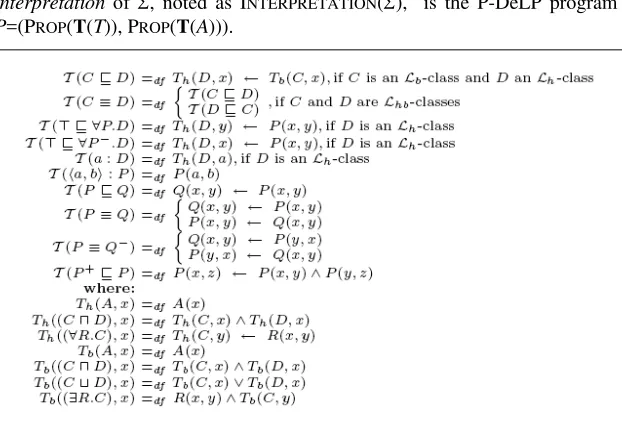
disjunction and existential restriction can be mapped to rule bodies whenever they occur in the left-hand side of inclusion axioms (called Lb-classes). As
equality axioms “ ” are interpreted as two inclusion axioms “ ” and “ ”', they must belong to the intersection of Lh and Lb (called Lhb
classes).
Definition 11 (Lh, Lb and Lhb classes (adapted from [4])). Let A be an atomic class name, C and D class expressions, and R a property. In the Lh language,
is a class, and is also a class. Class expressions in Lh are called Lh
-classes. In the Lb language, is a class, and is a class too. Class
expressions in Lb are called Lb-classes. The Lhb language is defined as the
intersection of Lh and Lb. Class expressions in Lhb are called Lhb–classes.
Definition 12 (T mapping from DL sentences to logic programming rules (adapted from [4])). Let A, C, D be concepts, X, Y variables, P, Q properties. The T mapping from the language of DL to the language of P-DeLP is defined in Fig. 2. Besides, intermediate transformations of the form “H1 ^ H2 B” will be rewritten as two rules “H1B”and “H2B”. Similarly
transformations of the form “H1H2B” will be rewritten as “H1 B ^
H2”, and rules of the form “HB1 v B2” will be rewritten as two rules “H B1” and “HB2”.
Definition 13 (Interpretation of a weighted ontology). Let =(T,A) be a weighted ontology such that T={(s1,1), ..., (sn,n)} and A={(a1,1), ..., (am,m)}, then:
TRAD(T) = {(T(s1), 1), ..., (T(sn,n))} TRAD(A) = {(T(a1), 1), ..., (T(am,m))}
[image:26.439.74.385.371.584.2]Besides, if the cardinal k of T(si)={f1, ..., fk} is greater than 1, then the translation of (si,i) is (fi,i), ..., (fk,i). Let PROP be the propositionalization operator for a first-order theory (each propositional term “p(a)” generated from a predicate “p(x)” and a constant “a” will be noted as “p_a”). The interpretation of , noted as INTERPRETATION(), is the P-DeLP program P=(PROP(T(T)), PROP(T(A))).
Example 2. Consider again the weighted ontology =(T,A) presented in Ex. 1. In Fig. 3 we present a logical program TRAD(T) U TRAD (A). And in Fig. 4,
we present the P-DeLP program P=INTERPRETATION(). Notice that as there are three constants (viz., joe, duncan and connor), and three first-order rules (viz., (1)-(4)), twelve rules are generated in the propositional program, i.e. four for every instantiation of each rule with each one of the three constants.
Definition 14 (Instance checking). Let =(T,A) be a weighted ontology. Let C be a concept name, a an individual name. Let be real number such that 0 1. The individual a is a member of the concept C with strength
iff there is a warranted argument <A,C(a),> w.r.t. INTERPRETATION().
Example 3. Consider the program P in Ex. 4 that corresponds to the interpretation of the ontology from Ex. 1. We will show how the operation of instance checking works in P-DeLP for deciding the membership of the individuals Joe, Duncan and Connor to the concept Mortal. First, consider the case of Joe:An argument <A, mortal_joe, 0.6> can be obtained, where A = {(mortal_joeman_joe, 0.6)}. This argument has no defeaters and is thus warranted, therefore we conclude that JOE is a member of the concept Man with strength $0.6$ (see Fig. 5.(a)). Second, consider the case of Duncan: As in the case of Joe, there is an argument <B1, mortal_duncan, 0.6>, with B1= {(mortal_duncan man_duncan, 0.6)}. But this argument is defeated by <B2, ~mortal_duncan, 0.8>, where
B2 = {(~mortal_duncanman_duncan ^ highlander_duncan ^ keeps_head_duncan, 0.8),
(keeps_head_duncanin_the_game_duncan, 0.9)}.
As this argument B2 is undefeated, we reach the conclusion that Duncan is a member of the concept Mortal with strength 0.8 (see Fig. 5.(b)). Last, consider the case of Connor: Yet again there is an argument expressing that Connor is mortal since he is a man: <C1, mortal_connor, 0.6>, with
C1 = { (mortal_connorman_connor, 0.6) };
as in the case of Duncan, this argument is defeated by another that says that Connor in immortal because he is a Highlander, i.e. <C2, ~mortal_connor, 0.8> where
C2 ={(~mortal_connorman_connor ^ highlander_connor ^ keeps_head_connor, 0.8),
(keeps_head_connorin_the_game_connor, 0.9)}.
However, in this case there is another (undefeated) argument $\Ca_3$ that defeats C2, namely <C3, ~keeps_head_connor, 1>, where
C3 = {(~keeps_head_connorbeheaded_connor, 1)}.
In this way, the argument C1 gets undefeated again, and we conclude that Connor is a member of the concept Mortal with strength 0.6 (see Fig. 5.(c)).
5.
Conclusions and Future Work
We have presented a preliminary framework for reasoning with inconsistent ontologies by using the Possibilistic Defeasible Logic Programming machinery. The proposed approach allows for determining the degree of tentativeness for the membership of an individual to a class in the potential presence of inconsistency w.r.t. a Description Logic ontology. Axioms and assertions in an ontology are qualified with degrees of certainty which are used to determine the degree of membership of individuals to concepts. This approach continues previous work of ours [7] that translates DL ontologies into Defeasible Logic Programming and uses generalized specificity to compare arguments. One advantage of the approach presented in this paper is that it allows characterizing the preference criterion between axioms and thus arguments that are built when considering them, since the comparison criterion is no longer syntactically determined by the form of the underlying program that represents the ontology. One drawback of our approach is that the propositionalization of a first-order theory produces lots of facts that are irrelevant (notice that given a knowledge base with pk-ary predicates and n constants, there are possible pnk instantiations, see Ex. 2), impacting the
computational efficiency of the method. As part of our current research work, we are interested in applying this proposal to ontology integration and studying what the intrinsic logical properties of the approach are.
References
1. Berners-Lee, T., Hendler, J., Lassila, O.: The Semantic Web. Scient. American (2001).
2. McGuinnes, D.L., van Harmelen, F.: OWL Web Ontology Language Overview
(2004).
3. Baader, F., Calvanese, D., McGuinness, D., Nardi, D., Patel-Schneider, P., eds.: The Description Logic Handbook-Theory, Implementation and Applications. Cambridge University Press (2003).
4. Grosof, B.N., Horrocks, I., Volz, R., Decker, S.: Description Logic Programs: Combining Logic Programs with Description Logics. WWW2003, May 20-24, Budapest, Hungary (2003).
5. Ribeiro, M.M., Wassermann, R.: Base Revision for Ontology Debugging, J. Log. Comput. 19 (5) 2009, 721-743.
6. Huang, Z., van Harmelen, F., ten Teije, A.: Reasoning with Inconsistent
Ontologies. In Kaelbling, L.P., Safiotti, A. eds.: Proceedings of the Nineteenth International Joint Conference on Artificial Intelligence (IJCAI’05), Edinburgh, Scotland (August 2005) 454-459.
7. Gómez, S.A., Chesñevar, C.I., Simari, G.R.: Reasoning with Inconsistent
8. García, A., Simari, G.: Defeasible Logic Programming an Argumentative Approach. Theory and Practice of Logic Programmming 4(1) (2004) 95-138. 9. Alsinet, T., Chesñevar, C.I., Godo, L.: \newblock A level-based approach to
[image:29.439.68.394.316.524.2]computing warranted arguments in possibilistic defeasible logic programming. In Besnard, P., Doutre, S., Hunter, A., eds.: COMMA. Volume 172 of Frontiers in Artificial Intelligence and Applications., IOS Press (2008) 1-12.
Fig. 3. First order P-DeLP program that interprets ontology =(T,A)
Fig. 4. Propositionalization of the program presented in Fig. 3
An Argumentation Framework with
Backing and Undercutting
ANDREA COHEN,ALEJANDRO J.GARCÍA,GUILLERMO R.SIMARI
Consejo Nacional de Investigaciones Científicas y Técnicas (CONICET) Artificial Intelligence Research and Development Laboratory (LIDIA)
Department of Computer Science and Engineering (DCIC) Universidad Nacional del Sur (UNS), Bahía Blanca, Argentina
{ac, ajg, grs}@cs.uns.edu.ar
Abstract. In this work we will combine two important notions for the argumentation community into Abstract Argumentation Frameworks (AFs). These notions correspond to Toulmin's backings and Pollock's undercutting defeaters. We will define Backing-Undercutting Argumentation Frameworks (BUAFs), an extension of AFs that includes a specialized support relation, a distinction between different attack types, and a preference relation among arguments. Thus, BUAFs will provide a more concrete approach to represent argumentative or non-monotonic scenarios where information can be attacked and supported.
1. Introduction
The study of argumentation within the field of Artificial Intelligence has grown lately [3]. Briefly, argumentation is a form of reasoning where a claim is accepted or rejected according to the analysis of the arguments for and against it. Then, argumentation provides a reasoning mechanism where contradictory, incomplete and uncertain information may appear. In the last decade several approaches were proposed to model argumentation on an abstract basis [7], using classical logics [4], or using logic programming [8].
Argumentation models usually consider an argument as a piece of reasoning that provides a connection between some premises and a conclusion. Notwithstanding, in [13] Toulmin argued that arguments had to be analyzed using a richer format than the traditional one of formal logic. Whereas a formal logic analysis uses the dichotomy of premises and conclusion, Toulmin proposed a model for the layout of arguments that in addition to data and claim distinguishes four elements: warrant, backing, rebuttal and qualifier. However, Toulmin did not elaborate much on the nature of rebuttals, but simply stated that they provide conditions of exception for the argument. That is, without loss of generality, the notion of rebuttal can be paired to the notion of defeater for an argument, as proposed in the literature [12].
defeasible reasons (which can be assembled to comprise arguments) have defeaters and that there are two kinds of defeaters: rebutting defeaters and undercutting defeaters. The former attack the conclusion of an inference by supporting the opposite one (i.e., they are reasons for denying the conclusion), while the latter attack the connection between the premises and conclusion without attacking the conclusion directly.
In this work, we will combine the notions presented by Toulmin and Pollock into an abstract argumentation framework. We will incorporate Pollock's categorization of defeaters and the modeling of Toulmin's scheme elements, in particular, focusing in undercutting defeaters and backings. We will follow the approach of [6] in which Pollock's undercutting defeaters can be regarded as attacking Toulmin's warrants. Thus, Toulmin's backings can be regarded as aiming to defend their associated warrants against undercutting attacks, by providing support for them. In that way, we will be able to capture both attack and support for an inference, that is, for Toulmin's warrants.
We will extend Abstract Argumentation Frameworks (AFs) [7] to incorporate a specialized type of support and preference relation among arguments, as well as distinguishing between different types of attacks. In particular, the support relation will correspond to the support that Toulmin's backings provide for their associated warrants. On the other hand, we will distinguish three different types of attack within Dung's original attack relation, more specifically, rebutting attacks, undermining attacks and undercutting attacks; the former and the latter being related to rebutting and undercutting defeaters, as proposed by Pollock. The remaining type of attack we will consider corresponds to undermining defeaters, which are widely considered in the literature (see e.g. [11]) and originate from attacks to an argument's premise.
The rest of this work is organized as follows. Section 2 briefly reviews Dung's Abstract Argumentation Frameworks (AFs). In Section 3 we present the Backing-Undercutting Argumentation Frameworks (BUAFs), an extension of AFs that incorporates attack and support for inferences, as well as a preference relation to decide between conflicting arguments. In Section 4 we introduce the different types of defeat that can be obtained from a BUAF by applying preferences to the conflicting arguments as indicated by the attack relation. Later we define the requirements for conflict-free sets of arguments in a BUAF. Section 5 introduces some semantic notions, followed by the formal definitions of the acceptability semantics for BUAFs. Finally, in Section 6 some conclusions and related work are discussed.
2. Dung’s Abstract Argumentation Frameworks
In this section we will briefly review Dung’s Abstract Argumentation Frameworks, as defined in [7].
Definition 1. An Abstract Argumentation Framework (AF) is a pair Args,
, where Args is a set of arguments andArgsArgsis an attack relation. Here, arguments are abstract entities that will be denoted using calligraphic uppercase letters. No reference to the underlying logic is needed since we are abstracting from argument's structure. The attack relation between two arguments and denotes the fact that these arguments cannot be accepted simultaneously since they contradict each other. We say that an argument attacks an argument iff (,) , and it is noted as . For instance, in the AF of Figure 1 and attack each other, attacks , and so on.
Fig. 1. A Dung’s Abstract Argumentation Framework
Dung then defines the acceptability of arguments and the admissible sets of the framework.
Definition 2.Let AF = Args, and S Args a set of arguments. Then:
S is conflict-free iff , S s.t. (,) .
is acceptable w.r.t. S iff Args: if (,) then S s.t .(,) .
If S is conflict-free, then S is an admissible set of AF iff each argument in S is acceptable w.r.t. S.
Intuitively, an argument is acceptable w.r.t. S if for any argument that attacks there is an argument in S that attacks , in which case is said to defend . An admissible set S can then be interpreted as a coherent defendable position. For instance, in the AF of Figure 1, argument is acceptable w.r.t. the sets {}, {} and {, }; however, only the first two of these sets are admissible.
Taking into account the notion of admissibility Dung then defines the acceptability semantics of the framework.
Definition 3. Let AF = Args, be an argumentation framework and S
Args a conflict-free set of arguments. Then:
S is a complete extension of AF iff all arguments acceptable w.r.t. S belong to S.
S is a preferred extension of AF iff it is a maximal (w.r.t. set-inclusion) admissible set (i.e., a maximal complete extension).
S is the grounded extension of AF iff it is the smallest (w.r.t. set-inclusion) complete extension.
The complete extensions of the framework in Figure 1 are , {, } and {,}; the preferred and stable extensions are {, } and {,}; and the grounded extension is .
3. Backing-Undercutting Argumentation Frameworks
A classical abstract argumentation framework is characterized by a set of arguments and an attack relation among them. In this section, we will introduce an extension of Dung's argumentation frameworks called Backing-Undercutting Argumentation Frameworks (BUAFs). In the extended framework we will: distinguish between different types of attack, incorporate a special kind of support relation, and include a preference relation among arguments. Thus, the BUAF will provide the means for representing both attack and support for an argument's inference, allowing to express Pollock's undercutting defeaters and Toulmin's backings.
Definition 4. (Backing-Undercutting Argumentation Framework). A Backing-Undercutting Argumentation Framework (BUAF) is a tuple , ,
k , where:
is a set of arguments,
is a set of attacks,
k is a backing relation, and is a preference relation.
We will distinguish the three different types of attack in , where the set of rebutting attacks is denoted as b, the set of undercutting attacks is denoted as c,
and the set of undermining attacks is denoted as m ( = bcm). In
addition, when two arguments and are related by the preference relation (i.e. (, ) ) it means that argument is at least as preferred as argument
, denoting it as . Furthermore, following the usual convention,
means and .
From hereon, we may use the following notation:
denotes (, ) .
denotes (, ) k.
In order to illustrate, let us consider one of Toulmin’s famous examples which discusses whether Harry is a British subject or not [13], as shown in Figure 2.
Fig. 2. Toulmin’s example about Harry
The following arguments can represent the situation depicted in Toulmin’s example:
: “Harry was born in Bermuda. A man born in Bermuda will generally be a British subject. So, Harry is a British subject”
: “On account of the following statutes and other legal provisions…”
: “Both Harry’s parents are aliens”
Example 1. A possible representation for Toulmin’s example about Harry is given by the BUAF 1= 1, 1, k1,1, where
1 = {, , } k1 = {(, )}
c1 = {(, )} 1 = {(, )}
Here, that the statutes and other legal provisions provide support for the warrant is expressed by the pair (, ) in the backing relation. In addition, the fact that Harry’s parents were aliens is considered as an undercut for the inference, as expressed by the pair (, ) in the attack relation.
Fig. 3. The BUAF of Example 1
4. Defeat and Conflict-Freenes
Before defining any semantics-related notion, we must first consider the concept of defeat. Intuitively, given that in a BUAF there is a preference relation among arguments, an argument would defeat an argument iff
we will distinguish between two types of defeat. Then, we will define the basic restriction that an acceptable set of arguments in a BUAF must satisfy, that is, the notion of conflict-freenes for a set of arguments.
The first type of defeat we will distinguish is called primary defeat and is obtained directly by resolving the attacks given on the attack relation through the use of preferences. It is important to note that, in the case of undercutting attacks, the attacks will always succeed as defeats, like in [11]. On the other hand, for rebutting and undermining attacks we must compare the attacking and the attacked arguments in order to determine the existence of a defeat.
Definition 5 (Primary Defeat).Let , , k ,be a BUAF and , .
We will say that primary defeats iff one of the following conditions hold:
(, ) (bm) and , or (, ) c.
Observe that in the above definition rebutting and undermining attacks are grouped together. This is because, given the abstract nature of arguments, we cannot distinguish an attack an argument's premise from an attack to its conclusion. Thus, the only way to determine the existence of a defeat in the presence of an undermining attack or a rebutting attack is to compare the attacking and attacked arguments. In contrast, for instance, if we had considered a notion of sub-argument the analysis for rebutting and undermining attacks would be different.
Example 2 In the AF of Example 1, argument primary defeats argument
.
As stated before, likewise [11], an undercutting attack will always result in defeat; however, in that approach the existence of arguments supporting an inference is not considered. Hence, following [6]'s approach, we will consider that backings are intended to defend their associated warrants against undercutting attacks. Therefore, it will be necessary to establish the relation between backing and undercutting arguments.
It is clear that backing and undercutting arguments are conflicting: while the latter attacks the connection between premises and conclusion of an argument, the former provides support for it. Thus, they should not be jointly accepted. Moreover, given that the conflict between backing and undercutting arguments may not always be explicit in the attack relation of a BUAF, it is necessary to ensure this acceptability restriction. To achieve this, we will define a new type of defeat called implicit defeat.
Definition 6 (Implicit Defeat).Let , , k ,be a BUAF and , , . We will say that implicitly defeats iff one of the following conditions hold:
(, ) cand (, ) k, and , or (, ) kand (, ) c , and .
Example 3 Given the AF of Example 1, argument implicitly defeats argument .
Then, an argument will be defeated in a BUAF if it is primary or implicitly defeated.
Definition 7 (Defeat).Let , , k ,be a BUAF and , . Then
defeats , noted as ,iff primary defeats or implicitly defeats . From a BUAF we can construct a directed graph called the defeat graph. The nodes in the graph are the arguments in and the edges correspond the defeat relation obtained by Definition 7.
Example 4 Consider the BUAF 2= 2, 2, k2,2, where
2 = {, , , , , , , } m2 = {(, )}
b2 = {(, ), (, )} k2 = {(, ), (, )}
c2 = {(, ), (, )} 2 = {(, ), (, ), (, ), (,
)}
A graphical representation of 2 is shown below on the left and its corresponding defeat graph is shown on the right:
The primary defeats obtained from 2 are, , and; and the implicit defeats are , and.
Note that in Example 4 argument is a backing for argument , thus defending it against the undercut of . In addition, argument defeats argument , becoming a defender for . Notwithstanding, the nature of the defenses provided by and is different. The former is a backing for argument , having the support between these two arguments explicitly determined by the backing relation; on the other hand, the latter merely defeats one of ’s defeaters, in particular, the undercutting defeater .
Definition 8 (Conflict-free Set).Let , , k ,be a BUAF. A set S is
conflict-free iff , Ss.t..
Example 5 Given the BUAF of Example 4, some conflict-free sets of arguments are, {} and {, , , }.
5. Acceptability Semantics
Since arguments in a BUAF can defeat each other, conflicting arguments should not be accepted simultaneously. Therefore, arguments in a BUAF will be subject to a status evaluation in which an argument will be accepted if it somehow “survives” the defeats it receives, or rejected otherwise. This evaluation process will be determined by the acceptability semantics.
In this section, we will define the basic semantic notions required for obtaining the set of acceptable arguments. Then, we will formally define the acceptability semantics for BUAFs. Finally, a characterization of BUAFs as Dung's AFs is presented, establishing the relation between these two frameworks.
Definition 9 (Acceptability).Let , , k ,be a BUAF. An argument is acceptable w.r.t. S iff s.t. , S s.t..
Intuitively, an argument will be acceptable with respect to a set of arguments S iff S defends against all its defeaters.
Example 6 In the BUAF of Example 4, the argument is acceptable w.r.t. the sets {},{, }, {, , } and {, , , } among others.
In the literature, a usual requirement when defining the set of acceptable arguments of an AF is the conflict-freenes of the set (see e.g., [7, 2]). This implies that the set of collectively acceptable arguments must be internally coherent, in the sense that no pair of arguments in the set defeats each other. Thus, it is reasonable to accept only those arguments that are acceptable. We will follow this approach and therefore, the set of accepted arguments in a BUAF will be the set of arguments that defends itself against all defeats on it, leading to a classical definition of admissibility for BUAFs.
Definition 10 (Admissibility).Let , , k ,be a BUAF. A set S is
admissible iff it is conflict-free and all elements of S are acceptable w.r.t. S.
Example 7 From the sets of arguments listed in Example 6, only the sets {} and {, , , } are admissible.
Recall that acceptability semantics identify a set of extensions of an argumentation framework, namely sets of arguments which are collectively
acceptable. The complete, preferred, stable and grounded extensions of a BUAF are now defined in the same way as for Dung's frameworks.
Definition 11 (Extensions).Let = , , k ,be a BUAF and S a
conflict-free set of arguments. Then:
S is a complete extension of iff all arguments acceptable w.r.t. S belong to S.
S is a preferred extension of iff it is a maximal (w.r.t. set-inclusion) admissible set of (i.e., a maximal complete extension).
S is a stable extension of iff it is a preferred extension that defeats all arguments in \S.
S is the grounded extension of iff it is the smallest (w.r.t. set-inclusion) complete extension.
Given a BUAF and a semantics s, an argument is skeptically accepted if it belongs to all s-extensions; is credulously accepted if it belongs to some (not all) s-extensions; and is rejected if it does not belong to any s-extension.
Example 8 From the BUAF of Example 4, we can obtain the following sets of extensions:
- the complete extensions {, , }, {, , , }, {, , , }, {, , ,
, } and {, , , , };
- the preferred and stable extensions {, , , , } and {, , , ,
}; and
- the grounded extension {, , }.
Definitions 9, 10 and 11 correspond to those presented for Dung's argumentation frameworks. Recall that a classical argumentation framework is characterized by a set of arguments and an attack relation among them. Thus, using the defeat relation from Definition 7 and the set of arguments of a BUAF we can characterize an abstract argumentation framework which accepts exactly the same arguments as the BUAF under a given semantics.
Proposition 1. Let = , , k , be a BUAF. There exists an abstract
argumentation framework AF = , such that the sets of extensions of
andAF under a given semantics are equal.
Proof. Straightforward from definitions 2, 3, 9, 10 and 11.
6. Conclusions and Related Work
In this work, an extension of Abstract Argumentation Frameworks called Backing-Undercutting Argumentation Frameworks (BUAFs) was proposed, inspired by the work of Pollock [10] and Toulmin [13]. This extension allows to express attack and support for an inference by distinguishing different types of attacks and incorporating a specialized support relation among arguments. In that way, the extended framework enables the representation of Toulmin's backings and Pollock's undercutting defeaters, two important notions in the argumentation community. Several approaches address these two notions separately, yet they were not widely considered together in the formalizations provided so far. For instance, in [11] an extension of AFs is presented, where arguments are partly provided of an internal structure and a categorization of defeaters is also given; however, in that work there is no consideration for support among arguments.
Likewise [1], our approach incorporates a preference relation among arguments in order to determine the success of attacks. Other works that consider preferences among arguments include [9] and [2], but the difference between those approaches and ours is that they express preferences in the object level, by incorporating attacks to attacks.
Among other approaches that address support between arguments, in addition to the attack relation, are the Bipolar Argumentation Frameworks (BAFs) [5]. A Bipolar Argumentation Framework extends Dung's framework to incorporate a support relation between arguments. The main difference between BAFs and BUAFs is that the support relation in a BAF is general, while the backing relation proposed in this work corresponds to the specific support relation between Toulmin's backings and warrants. Therefore, the implicit defeats as presented in Definition 6 could not be modeled in BAFs. On the other hand, some additional requirements for an admissible set of arguments are considered in [5], such as external coherence or consistency. Although for BUAFs we have only considered the conflict-freenes (internal consistency) of the set, those requirements are also satisfied by the notion of admissibility given in Definition 10; however, a detailed explanation is left for future work.
Finally, it was shown that BUAFs can be mapped to AFs by considering the set of arguments and the corresponding defeat relation. Thus, it is clear that the examples and applications shown for BUAFs can also be modeled with Dung's abstract frameworks. Notwithstanding, besides formalizing the backing relation and different types of attack, BUAFs will provide a more concrete approach to represent argumentative or non-monotonic scenarios where inferences can be attacked and supported.
References
1. Amgoud, L., Cayrol, C.: A reasoning model based on the production of
acceptable arguments. Ann. Math. Artif. Intell. 34(1-3), 197-215 (2002).
2. Baroni, P., Cerutti, F., Giacomin, M., Guida, G.: AFRA: Argumentation
framework with recursive attacks. International Journal of Approximate Reasoning 52(1), 19-37 (2011).
3. Bench-Capon T.J.M., Dunne, P.E.: Argumentation in artificial intelligence. Artificial Intelligence 171(10-15), 619-641 (2007).
4. Besnard, P., Hunter, A.: A logic-based theory of deductive arguments. Artificial Intelligence 128(1-2), 203-235 (2001).
5. Cayrol, C., Lagasquie-Schiex, M.C.: Bipolar abstract argumentation systems. In: Simari, G.R., Rahwan, I. (eds.) Argumentation in Artificial Intelligence, pp. 65-84. Springer US (2009).
6. Cohen, A., García, A.J., Simari, G.R.: Backing and undercutting in defeasible logic programming. In: ECSQARU. pp. 50-61 (2011).
7. Dung, P.M: On the acceptability of arguments and its fundamental role in
nonmonotonic reasoning, logic programming and n-person games. Artif. Intell. 77(2), 321-358 (1995).
8. García, A.J., Simari, G.R.: Defeasible logic programming: An argumentative approach. Theory and Practice of Logic Programming 4(1-2), 95-138 (2004).
9. Modgil, S.: Reasoning about preferences in argumentation frameworks.
Artificial Intelligence 173(9-10), 901-934 (2009).
10. Pollock, J.L.: Defeasible reasoning. Cognitive Science 11(4), 481-518 (1987).
11. Prakken, H.: An abstract framework for argumentation with structured
arguments. Argument and Computation 1, 93-124 (2009).
12. Prakken, H., Vreeswijk, G.: Logics for defeasible argumentation. In: Gabbay, D., Guenthner, F. (eds.) Handbook of Philosophical Logic, vol. 4, pp. 218-319. Kluwer Academic Pub. (2002).
Face Recognition using SIFT descriptors and
Binary PSO with velocity control
JUAN ANDRÉS MAULINI,LAURA LANZARINI
III-LIDI (Institute of Research in Computer Science LIDI) Faculty of Computer Science, National University of La Plata
La Plata, Buenos Aires, Argentina { jmaulini, laural }@lidi.info.unlp.edu.ar
Abstract. In this paper, a strategy for face recognition based on SIFT
descriptors of the images involved is presented. In order to reduce the number of false positives and computation time, a selection of the most representative feature descriptors is carried out by applying a variation of the binary PSO method. This version improves its operation by a suitable positioning of the velocity vector. To achieve this, a new modified version of the continuous gBest PSO algorithm is used. The results obtained allow stating that the descriptors can be successfully selected through the strategy proposed solving the problems initially mentioned.
Keywords. Face Recognition, SIFT descriptors, Swarm Intelligence, Binary PSO, Velocity Control.
1. Introduction
Face recognition is a biometric technique that is widely used in various areas such as security and access control, forensic medicine, and police controls. It involves determining if the image of the face of any given person matches any of the face images stored in a database. This problem is hard to solve automatically due to the changes that various factors, such as facial expression, aging and even lighting, can cause on the image.
In this paper, a method using only those SIFT descriptors that best represent the image is proposed, and good recognition results are achieved while solving the two major problems of this characterization method: false positive detection and the time required for the recognition process. The selection of SIFT descriptors is carried out by means of a variation of binary PSO (Particle Swarm Optimization), and it is applied only to database image descriptors; therefore, SIFT descriptors processing is done before the recognition stage of the process.
implementation details are provided, and in Section 7 the results obtained are described. Finally, in Section 8 the conclusions obtained are presented.
2. Related work
There are currently various solutions to this problem that use SIFT descriptors. It has been shown [1] that using SIFT descriptors for the face recognition process is better than Eigenfaces and Fisherfaces algorithms. Training datasets were of various sizes, which allowed establishing that performance decreases as dataset size decreases. As regards the significant number of SIFT descriptors required for a reliable comparison, it was observed that, with a lower number of descriptors, performance is better than that obtained with Eigenfaces and Fisherfaces.
In order to tackle the issue of comparing very long feature vectors for all images in a database, a biased classification of the features that make SIFT descriptors, is proposed and used to reduce the length of SIFT descriptors used for face recognition [2]. Thus, the number of comparisons is reduced and the recognition process is faster. This process also filters out those descriptors that are irrelevant for face recognition, thus increasing recognition accuracy.
On the other hand, a face recognition algorithm that uses the binary PSO algorithm to explore the solution space for an optimum subset of features in order to increase recognition rate and class separation is presented in [3]. This algorithm is applied to feature vectors extracted using the Discrete Cosine Transform (DCT) and the Discrete Wavelet Transform (DWT).
3. Particle swarm optimization
3.1 Continuous particle swarm optimization
In PSO, each individual represents a possible solution to the problem and adapts following three factors: its knowledge of the environment (its fitness value), its previous experiences (its memory), and the previous experiences of the individuals in its neighborhood [4]. In this type of technique, each individual is in continuous movement within the search space and never dies.
Each particle is composed by three vectors and two fitness values:
• Vector xi=(xi1,xi2,…,xin) stores the current position of the particle
• Vector pBesti=(pi
1,pi2,…,pin) stores the best solution found for the
particle
• Velocity vector vi=(vi1,vi2,…,vin) stores the gradient (direction)
based on which the particle will move.
• The fitness value fitness_xi stores the suitability value of the current
solution.
XVIIARGENTINE CONGRESS OF COMPUTER SCIENCE