NBER WORKING PAPER SERIES
THE INTERNATIONAL MONETARY SYSTEM: LIVING WITH ASYMMETRY
Maurice Obstfeld Working Paper 17641
http://www.nber.org/papers/w17641
NATIONAL BUREAU OF ECONOMIC RESEARCH 1050 Massachusetts Avenue
Cambridge, MA 02138 December 2011
Vladimir Asriyan provided expert research assistance. The International Growth Centre (London School of Economics) and the Center for Equitable Growth (UC Berkeley) provided essential financial support. This paper will be a chapter in an NBER conference volume to be entitled Globalization in an Age of Crisis: Multilateral Economic Cooperation in the Twenty-First Century, edited by Robert C. Feenstra and Alan M. Taylor. I am grateful for comments from participants at the Bank of England/NBER conference, as well as my discussants, Takatoshi Ito and Adam Posen The views expressed herein are those of the author and do not necessarily reflect the views of the National Bureau of Economic Research. NBER working papers are circulated for discussion and comment purposes. They have not been peer-reviewed or been subject to the review by the NBER Board of Directors that accompanies official NBER publications.
The International Monetary System: Living with Asymmetry Maurice Obstfeld
NBER Working Paper No. 17641 December 2011
JEL No. F32,F33,F36,F42,G15
ABSTRACT
This paper analyzes current stresses in the two key areas that concerned the architects of the original Bretton Woods system: international liquidity and exchange rate management. Despite radical changes since World War II in the market context for liquidity and exchange rate concerns, they remain central to discussions of international macroeconomic policy coordination. To take two prominent examples of specific (and related) coordination problems, liquidity issues are paramount in strategies of national self-insurance through foreign reserve accumulation, while recent attempts by emerging market economies (EMEs) to limit real currency appreciation have relied heavily on nominal exchange rate management. A central message is that a diverse set of potential asymmetries among sovereign member states provides fertile ground for a variety of coordination failures. The paper goes on to discuss institutions and policies that might mitigate some of these inefficiencies.
Maurice Obstfeld
Department of Economics
University of California, Berkeley 530 Evans Hall #3880
Berkeley, CA 94720-3880 and NBER
The global economic crisis of 2007-09 generated calls to re-think the international monetary system, and indeed, the entire institutional framework within which international financial integration has advanced since the fall of the Bretton Woods regime four decades ago. Gaps in national and international structures of financial regulation were an obvious factor in causing the most severe global crisis since the Great Depression; another chapter of this book addresses that topic. Interactions between national macroeconomic policies also played a role, however, and have continued to generate rancor between countries as a geographically uneven recovery from the crisis has unfolded. The crisis and its aftermath exposed stresses in the world’s monetary system, stresses that continue to be felt.1
This chapter analyzes current stresses in the two critical areas that concerned the architects of the original Bretton Woods system: international liquidity and exchange rate management.2 Despite radical changes since World War II in the market context for liquidity and exchange rate concerns, they remain central to discussions of international macroeconomic policy coordination. To take two prominent examples of specific (and related) coordination problems, liquidity issues are paramount in strategies of national self-insurance through foreign reserve accumulation, while recent attempts by emerging market economies (EMEs) to limit real currency appreciation have relied heavily on nominal exchange rate management. A key message – an obvious point, but one that nonetheless is a basic starting place for predicting a range of tensions in any system of
1 The crisis brought home vividly the strong two-way interaction between macroeconomic policies and
financial-sector stability, demonstrating the adverse consequences of viewing macro and prudential policy as somehow orthogonal to each other. While my discussion thus will focus on macroeconomic policies, I will inevitably touch upon financial-stability considerations at several points.
2 In the present context, the relevant concept of “liquidity” is funding liquidity, in the sense of
international monetary arrangements – is that a diverse set of potential asymmetries among sovereign member states provides fertile ground for a variety of coordination failures.
Despite the progress of technology, financial innovation, globalization, and development, sharp international asymmetries remain and so coordination failures with recognizable analogs in earlier historical eras have emerged. Earlier efforts at
international monetary reform attempted to reconcile individual nations’ demands for domestic economic stability with a smooth international adjustment mechanism. Those attempts had limited success and even the most ambitious and successful of them – the Bretton Woods system – crumbled after a quarter century under the weight of its internal contradictions. The recent global crisis has highlighted once again the twenty-first century incarnations of a range of time-honored systemic strains. Some of the problems have become more severe, or problematic in new ways. The resulting pressures on international economic relations define the current reform agenda.
The plan of this chapter is as follows. Section I sets out some dilemmas, old and new, relating to the supply of international liquidity in settings where the demand for safe foreign exchange reserves grows faster than the supply over the long term. The
I. International Liquidity and Triffin Dilemmas
Like households and firms, governments need access to liquidity – readily salable assets (including cash, of course) that may be spent on goods or (particularly in crisis situations) on other assets. In a closed economy, the government (through its central bank) is always capable, in principle, of providing for all liquidity needs. In the open economy this is no longer the case. When the need is for a foreign currency, which the central bank cannot print, gross holdings (reserves) and available foreign-currency credits constrain the government’s powers, whether to provide liquidity to markets (as in a foreign exchange intervention) or directly to market actors (as in an emergency loan to a bank).
desirable for a country to hold liquidity in all of those currencies, regardless of moderate changes in their relative values – a theme I explore further below.
Changes in value, moreover, can arise in different ways (again depending on the numeraire against which value is reckoned). Exchange rate and inflation risk are obvious possibilities, but so are default risk, sovereign or private, and political risk. Foreign-currency U.S. bonds issued by the Carter Administration inherited the minimal (at the time) default risk of conventional dollar-denominated Treasury obligations. On the other hand, liquid dollar liabilities of London eurobanks (typically counted in reserve measures if owned by monetary authorities) carry counterparty risk (absent an official bailout) but not currency risk vis-à-vis the dollar. Again, safety is in the eye of the beholder.
Countries experiencing or contemplating political tensions with the U.S. – think of cases involving Iran, Iraq, Russia, Libya, or Syria – might prefer the counterparty risk intrinsic to a lightly regulated offshore center to the risk of a retaliatory freeze on assets held in the United States.3
In the early post-World War II economy, with global capital markets dormant and much of the industrial world in ruins, the main forms of international liquidity were gross holdings of gold and U.S. dollars (and, to a lesser extent, sterling). Eichengreen (2011) paints a vivid picture of this period of virtually unrivaled dollar dominance as a reserve asset in the 1950s. That dominance persisted through the demise of the Bretton Woods system in the early 1970s (and indeed far beyond), but not without increasing tensions.
3 The possibility of holding dollar reserves in banks outside the U.S. shows that it is not necessarily correct
Those tensions arose from one of a class of problems to which any reserve-asset system is potentially susceptible: what may be called a Triffin dilemma. A Triffin dilemma arises any time increasing demand for a reserve asset strains the ability of the issuer to supply sufficient amounts while still credibly guaranteeing or stabilizing the asset’s value in terms of an acceptable numeraire.
The Classic Triffin Dilemma: It’s Mostly Fiscal
Under the Bretton Woods arrangements, countries pegged their currencies to the U.S. dollar, while the U.S. Treasury continued a longstanding commitment (dating from January 31, 1934) to redeem dollars held by non-U.S. central banks and governments for gold “for legitimate monetary purposes” at a price of $35 per ounce.4 While the Treasury guarantee of the dollar gold link reassured foreign official dollar holders that their
reserves were “as good as gold,” it also led to at least two potential inconsistencies. The first inconsistency was familiar from the classical gold standard. If world output growth outpaced world gold production, the relative price of gold would likely have to rise, implying secular deflation assuming a fixed market gold price of $35 per ounce. Countries outside the U.S. could maintain their internal price levels by devaluing against the dollar, but the U.S. itself did not have this option. For a time in the 1950s and 1960s, various fortuitous developments held off the deflationary threat; for example, the development of new South African mining capacity, along with Russian gold sales
4 This commitment followed from the Gold Reserve Act of January 30, 1934 (Yeager 1976, p. 352). The
Act also gave licensed users in industry and the arts the right to buy gold at the official price. (The Treasury added a ¼ percent transaction fee to the official price, and applied an identical discount to its gold
(which ended in 1966). Eventually, though, the conundrum was resolved in March 1968 through the two-tier gold market, which allowed the nonofficial gold price to float. It was then that the U.S. currency, and currencies pegged to it, became fiat monies.5
The second inconsistency persisted even after the start of the two-tier market. The official tier (by design) left intact the U.S. obligation to redeem foreign dollar
reserves for gold at the old official price. Once again, however, world output growth, and the concomitant growth in world dollar reserves, seemed likely to outpace world gold production. Were the U.S. Treasury to maintain a $35 buying price for an ounce of gold, therefore, U.S. monetary gold stocks could not possibly increase. As famously observed by Triffin (1960), the United States eventually would not have enough gold to redeem all the official dollar reserves at par, even if it used up the entirety of its holdings. The reserve currency issuer would become vulnerable to a run by central banks. The problem might have bee manageable had countries not expected their own currencies to appreciate against the dollar – it may be easier for a central bank to forgo a gain than to take a loss – but by the late 1960s the feeling was growing that the dollar would need to be realigned downward, as eventually happened in the August 1971 Smithsonian accord.
Figure 1 illustrates the trends. In 1948, the United States held most of the world’s gold reserves. Through 1960, U.S. gold stocks shrank but remained above the growing stock of dollar foreign reserves. And then the lines cross, seemingly making the U.S. vulnerable to a Triffinesque run. (That event was marked by speculation in the
5 This stratagem did not, by itself, resolve the (more serious) problem that the dollar itself could be
London gold market, causing the formation of the gold pool; see Eichengreen 2011.) The preceding trends continue as world monetary gold stocks fail to keep pace with growing global foreign exchange reserves. Figure 2 shows that in 1966 – the year that Russian gold sales ceased (Cooper 1969, p. 580) – world gold production leveled off. In retrospect, the abandonment of the single-tier gold market soon thereafter is not surprising. World dollar reserves began a steep upward ascent in 1970 as heavy
speculation against the dollar set in. To defend the dollar parities of stronger currencies such as the deutsche mark and Swiss franc, the issuing central banks undertook massive dollar purchases. Global dollar reserves exploded – without reducing U.S. reserves, absent gold redemptions.
On the surface, Triffin’s point seems obvious. But deeper reflection suggests that the classic form of the Triffin dilemma was really a fiscal problem. After all, why couldn’t the U.S. government have purchased more gold on the market, if need be, to pay off foreign central banks? And what strain on the U.S. fiscal position would have
resulted?
At the end of 1970, the year before U.S. President Richard Nixon suspended official gold convertibility (August 1971), U.S. gold reserves stood at $11 billion dollars, while world nongold reserves outside the U.S. stood at $53 billion, leaving the U.S. with $42 billion in potential official claims that it could not cover with its existing gold
The preceding calculation, however, assumes that the Treasury could have purchased the gold it needed in the world market at $35 per ounce. But this is surely not the case. World gold production in 1970 (at the $35 price) amounted to $1.8 billion, whereas total world monetary gold stocks outside the U.S. were $29 billion. The sum of the new flow and the existing stock, roughly $31 billion, falls far short of what the U.S. needed to cover its total $53 billion obligation (an obligation that exploded in the succeeding years). Even if the U.S. Treasury had been able to purchase all the world’s monetary gold and all current production without bidding up the world price – an impossibility – it still would have been $11 billion short. It is clearly unlikely that the Treasury would have been able to buy all the necessary gold at any finite price. Any Treasury attempt to buy gold in private markets on any substantial scale would likely have resulted in a gold price so high as to make the resulting fiscal burden unbearable.
This potential fiscal insolvency was the key danger inherent in the Triffin problem. As Figure 1 shows, of course, the problem became even worse after 1970 as speculative switches out of dollars into foreign currencies accelerated, and as even some central banks exchanged dollars for U.S. gold. The result was the Nixon-Connally policy package of August 1971, leading directly to the Smithsonian realignments in December 1971.
The Modern Triffin Dilemma
nominal dollar terms) in all but three of the years after 1971. Starting in 2002, and powered by the demand and growth of emerging economies, global reserves have grown at double digit rates in every year but one (2008, when the yearly growth rate was 9.7 percent). But between 1972 and 1980, global reserves likewise grew at double-digit rates in all but one year. Motivations for this continuing global demand for international liquidity have been widely discussed in the academic literature. As I take up in the next section, one can make a strong case that the evolution of world capital markets over recent decades has made the potential need for swift and perhaps massive key currency liquidity support – whether from reserves or some other source – much more pressing today than it was even in the days of generalized fixed exchange rates.
Nor has the basic Triffin paradox disappeared. The emergence of a modern species of Triffin dilemma has been diagnosed most clearly by Farhi, Gourinchas, and Rey (2011). It is a subtler problem than the Bretton Woods version, because there is no longer a reserve-center promise to redeem liabilities at a fixed price in terms of some scarce numeraire. It is a Triffin problem nonetheless because the underlying asymmetric dynamics of global growth guarantee that eventually, the reserve system will become unsustainable. Moreover, the problem remains even in a multipolar world with several reserve currencies.6
The problem is not simply that, under floating exchange rates, reserves are subject to depreciation risk: reserve holders have proved willing to tolerate exchange-rate
fluctuations, provided there is not a continuing trend of sudden depreciations. Thus, for example, foreign accumulation of dollar reserve claims on the U.S. does not inherently
6 The general problem had already been discerned by some policymakers in connection with the
require large U.S. current account deficits, which might predict significant future dollar devaluation. Dollar reserve growth may be primarily a result of gross capital outflows from the U.S., as was true during the mid-1960s (when the U.S. had a sizable trade surplus with trading partners and was still a net foreign creditor).
The modern-day Triffin problem resides instead in the nature of the securities central banks hold as reserves. A key feature of a reserve asset is that it is liquid and predictable in value. True, exchange rate fluctuations are not predictable – but for a country experiencing a localized crisis, any movement of the domestic currency against major foreign reserve currencies is likely to be downward. And the dollar, at least, has shown a safe-haven tendency to appreciate in global crises, which helps explain its attractiveness as a reserve asset (Gourinchas, Rey, and Govillot 2010).7
Thus, central banks have gravitated toward the government liabilities of highly creditworthy countries – or other assets, such as U.S. agency securities, believed likely to come under the protection of a government guarantee. Such assets could include certain liabilities of systemically important financial institutions in the creditworthy advanced countries.
So global reserve growth requires the ongoing issuance of gross government debt. This requires, in turn, that the government run continuing deficits, or that it issue debt to acquire assets likely to be inherently riskier than the corresponding liabilities. Just as in the classic Triffin dilemma, global reserve growth is largely driven by deficits – not national balance of payments deficits, but government deficits.8
7 For alternative models of the dollar’s international role, see Canzoneri, Cumby, Diba, and López-Salido
(2010) and Maggiori (2011).
8 An analogous problem confronted Federal Reserve policymakers in 2000-01 as they contemplated the
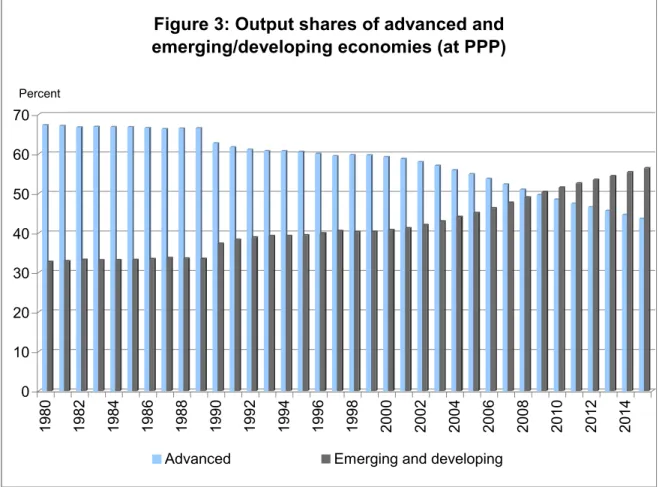
The additional dynamic element driving the modern-day dilemma is based on two asymmetries. First, the emerging and developing world is growing more quickly than the more credit-worthy industrial world. As Figure 3 shows, in 2009 the total GDP of the emerging and developing world (measured at PPP, and including newly-industrialized Asia) overtook that of the advanced economies, and the IMF predicts that the advanced economies will fall farther behind over time. The second asymmetry is that the main advanced countries remain more creditworthy on average than the poorer countries. The traditionally rich countries have been able to borrow more easily on world capital markets, and have therefore have had less need for international reserves than countries that are vulnerable to sudden stops.9 Furthermore, they are less prone to undertake foreign exchange intervention, and have less capacity to sterilize. Together, these asymmetries imply that that the demand for rich-country government debt is likely to outstrip what can be supplied in the way of safe government debt without bringing the
My colleagues at the FOMC seemed a bit disoriented too. In our late-January meeting, we spent hours trying to imagine how the Fed would operate in a brave new world of minimal federal debt. Of course, shedding the debt burden would be a happy development for our country, but it would nevertheless pose a big dilemma for the Fed. Our primary lever of monetary policy was buying and selling treasury securities -- Uncle Sam’s IOUs. But as the debt was paid down, those securities would grow scarce, leaving the Fed in need of a new set of assets to effect monetary policy. For nearly a year, senior Fed economists and traders had been exploring the issue of what other assets we might buy and sell.
A result was a dense 380-page study that plopped on our desks in January [of 2001]. The good news was that we weren’t going out of business; the bad news was that nothing could really match the treasuries market in size, liquidity, and freedom from risk. To conduct monetary policy, the report concluded, the Fed would have to learn to manage a complex portfolio of municipal bonds, bonds issued by foreign governments, mortgage-backed securities, auctioned discount-window credits, and other debt instruments. It was a daunting prospect. “I feel kind of like Alice in Wonderland,” Cathy Minehan, the president of the Federal Reserve Bank of Boston, had said when the issue first came up, and we all knew what she meant. The very fact of the discussion showed how profoundly and rapidly we thought the economic landscape might change.
Alas, “the economic landscape” did “profoundly and rapidly” change, but in a way that produced the worst of both worlds: huge U.S. deficits and debt, coupled with big holdings of exotic securities on the Fed’s balance sheet.
9 Of course, recent sovereign debt problems in some of the richer countries show the strains on even
safety of that debt into question. Figure 4 gives a rough indication of the trend to date. How will the demand for reserves be satisfied if the richer countries actually succeed in the fiscal consolidation to which they currently aspire?10
A number of developments could head off this unstable dynamic, but might not come into effect soon enough. First, countries’ demand for reserves might level off, with some national wealth shunted into sovereign wealth funds willing to invest in riskier assets. To the extent that reserve demand is driven by the size of the financial system and the latter’s growth rate is high, however, strong reserve growth is likely to continue. Second, growth could decelerate in the emerging and developing world or accelerate in the currently rich countries. That development seems unlikely in view of the fiscal and other burdens that currently afflict much of the industrial world. Finally, some major and swiftly growing emerging markets could graduate in terms of their creditworthiness, reducing their demand for reserves and, potentially, making them suppliers of reserve assets. China (currently lacking a fully convertible currency) is the most likely candidate, but this very observation highlights the significant obstacles to such a development. Thus, the new incarnation of the Triffin dilemma is likely to bedevil the current system of international liquidity provision for some time, absent reforms. Danger signs are already appearing. As the sovereign debts of richer countries have come under pressure, it is no surprise to see the central banks of emerging economies increasing their gold purchases.
10 Figure 4 graphs general gross government debt growth in the U.S. and euro area against world nongold
The problem is still mostly fiscal. But then, so are the broader questions concerning the adequacy of international liquidity in a world without a true outside reserve asset such as gold. I now turn to those questions.
II. Reforming the Liquidity System
The demise of generalized fixed exchange rates in 1973 allowed a solution to the open-economy macroeconomic trilemma based on flexible exchange rates, domestic monetary autonomy, and financial-account liberalization (Obstfeld and Taylor 2004). The process started in the 1970s in the industrial countries. With a lag, and with considerable
individual heterogeneity, the emerging market economies have started to follow down this path. Domestic financial liberalization has gone hand in hand with the process of external opening, with strong channels of two-way causation driving the overall freeing of finance, domestic and international alike. Whether and how this process will continue in light of the recent global crisis is a major open question.
The main trend raising the level of financial fragility in the world economy, and thereby liquidity needs, has been financial globalization, which has brought with it a rapid expansion of gross international asset positions. The latter expansion has been driven by a range of factors, including expanded risk sharing, financial deepening, and, less benignly, regulatory and tax arbitrage. At a point in time, a country’s net
individual economic actors. Moreover, given the current magnitude of gross external asset and liability positions, asymmetric valuation changes can easily imply changes in net assets that overwhelm the smaller flow increments due to the current account balance.
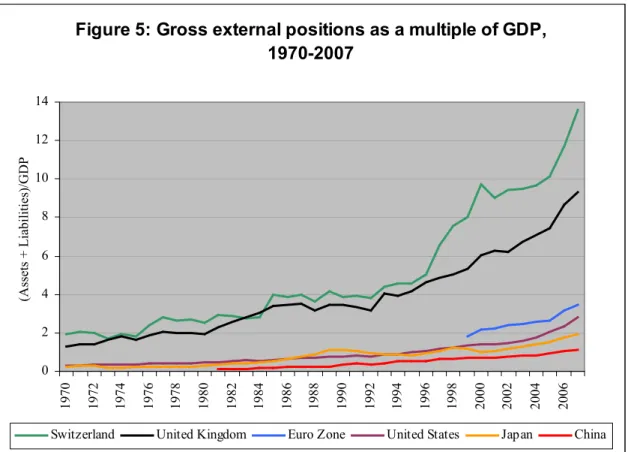
Figure 5 illustrates the trend in gross external assets for selected countries, plotting the ratio (Assets + Liabilities)/GDP through 2007 (with data from the update of Lane and Milesi-Ferretti 2007). Particularly for relatively open industrial countries that are also financial centers, the multiplication of gross external positions has been extreme. In such cases, a current account deficit may be a consequence of financial excess, being associated with a domestic credit boom, but it is not itself the prime locus of financial vulnerability. The main threat is that of a balance-sheet crisis. Thus, while Ireland had an external deficit in the run-up to the crisis, banks in surplus countries like Switzerland and Germany landed in trouble – dragging their governments along with them – because of toxic foreign assets on their balance sheets.
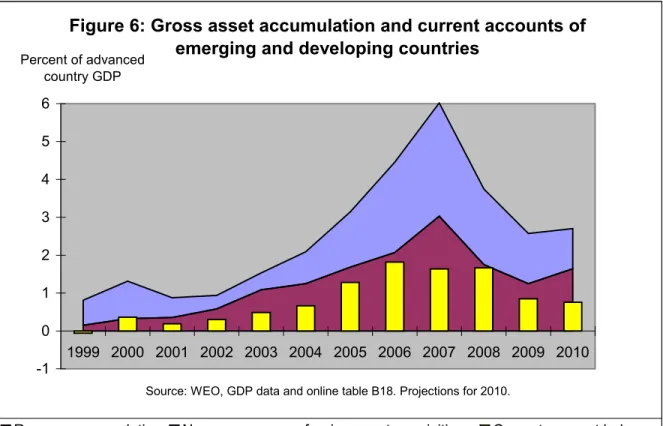
growing, and doing so relative to the shrinking relative scale of the advanced economies.11
Through their growing gross asset positions, emerging and developing countries, especially the EMEs, are increasingly important players in financial globalization, and their financial stability is becoming increasingly tied to that of the global financial
system. Yet they remain more vulnerable to sudden stops in foreign lending than are most of the advanced countries – notwithstanding the sudden emergence of sovereign debt problems in some of the latter. All the while, financial channels of contagious
transmission have expanded along with gross positions. If policymakers wish to restructure the international liquidity system so as to enhance financial stability, these facts are central considerations.
The Role of Global Last Resort Lending
In the late 1970s, the United Kingdom, Italy, Spain, and Portugal all negotiated standby arrangements with the IMF. Between Portugal’s last approach to the Fund in 1983 and Iceland’s in 2008, no industrial country requested Fund resources for balance of
payments support – the Fund’s client base came to be viewed as consisting exclusively of developing and emerging economies. By the 1990s and 2000s, the high-income countries appeared to be quite creditworthy, unlikely ever to need Fund resources or even to need to use large volumes of international reserves. At the same time, the central banks of
11 The figure understates the trend, because the IMF definition of “advanced economies” includes Taiwan,
high-income countries were perceived to be well equipped, and willing, to act as last-resort lenders if their home financial systems got into trouble.
Events after August 2007 have changed the picture, highlighting the more complex and in some respects more dangerous landscape that financial globalization has produced. Banks throughout the world, and especially in rich Europe, faced urgent needs for foreign-currency liquidity – liquidity that their home central banks could not create by the stroke of a pen (or click of a mouse). The result was the creation of a complex
network of central bank swap lines, starting with the U.S. Federal Reserve’s lines to the ECB and SNB in December 2007.12 Eventually that facility became unlimited in size. Furthermore, following Iceland’s collapse, the Greek, Irish, and Portuguese governments suffered funding crises that have been managed so far only with financial support from the EU, ECB, and IMF. Both Spain and Italy are on the verge of needing such external support as of this writing, and even France is under pressure. These advanced-country crises reflected various prior problems, such as garden-variety fiscal improvidence (the Greek scenario) and government bailout of a collapsed banking system (the primary culprit for Ireland). But in all cases, globalized financial markets fueled easier access to large volumes of foreign credit. Furthermore, globalization allowed the sovereign risks to spread through the European and global banking and shadow banking networks, in some cases increasing bailout risks and thereby weakening sovereigns further.
What have we learned? There are at least two major lessons.
12The precedent for such arrangements is the network of reciprocal central bank credits set up in the early
First, IMF facilities alone, even after being augmented in 2009, remain far below the magnitudes that rich countries with large public debts might need to fend of self-fulfilling bond-market attacks. Furthermore, the speed and flexibility of IMF remains limited, given the openness of advanced countries to high-speed global financial markets. The large gross asset liability positions of the advanced countries – think of the external debts of Ireland, Iceland, or Switzerland, even though the last is a huge international creditor – have the potential to infect the government balance sheet, resulting in fiscal crisis. The assets of these countries’ banking systems are in a substantial number of cases substantial multiples of GDP. While the Irish crisis has been called a crisis of the euro zone – and adherence to a fixed exchange rate is indeed problematic for Ireland – the Irish crisis is even more a crisis of globalized finance. Even in cases where sovereign debt problems arise from garden-variety government profligacy, as in Greece, globalized finance promotes a potentially wide exposure of financial institutions to the problem, as noted earlier.
dollars out of reserves was much more limited (although some national central banks did so). The ECB itself could have borrowed dollars and intervened in spot and forward exchange markets, at the risk of quasi-fiscal costs – costs that would be higher today, now that the finances of even some larger euro zone governments are being questioned by the bond markets. In the circumstances, it was much more expedient to be able to borrow dollars directly from the Fed, which in any case needed to expand its balance sheet to meet a heightened global demand for dollar liquidity.13 Effectively, the Fed became an international last-resort lender in dollars – in the absence of which, European banks might have had to unload hard-to-sell assets, worsening fire-sale dynamics and weakening their own capital. Of course, the Fed also lent heavily, and directly, to the U.S. affiliates of foreign banks when they had eligible collateral. At the same time, other central banks – including the ECB, SNB, BOJ, Sveriges Riksbank – eventually stepped up as global last-resort lenders in their own currencies.
As of the start of the global crisis in 2007, the usefulness of foreign-currency last-resort lending to financial institutions was familiar from the EME experience – see Jeanne and Wyplosz (2003) and Calvo (2006) for insightful analyses. But it was less obviously a first-order issue for mature economies, where the main use of foreign exchange reserves (if any) was widely considered to be in cases of foreign exchange intervention. The Fed has maintained swap facilities throughout the euro zone debt crisis starting in the spring of 2010.
13 The Fed was conveniently able to shift any credit risk of direct last-resort lending onto the ECB. On the
The expansion of gross currency-denominated asset positions, given the inevitable gaps in global as well as domestic prudential oversight, suggests a demand for global lenders – to governments as well as central banks and, through them, to the private financial sector – that is greater than ever before.
Self-Insurance through Reserve Accumulation
Of course, growing financial vulnerability is part of the reason that the emerging and developing nations have accumulated high volumes of precautionary, hard-currency foreign exchange reserves – a trend I noted above, and which shows no sign of abating. Figure 7 illustrates that the resulting aggregate reserve stock, mostly U.S. dollars and euros, has now reached the neighborhood of one-third of the holders’ collective GDP, having risen from about 10 percent in 1990, when group GDP was much smaller than it is today.
Beyond these individual costs, however, national self-insurance through holdings of gross foreign reserves carries significant potential systemic costs. Reserve
accumulation may influence interest rates in reserve centers – helping to fuel
international resentments about “exorbitant privilege” that often fail to recognize the root of the problem in systemic congestion. Moreover, such interest-rate effects can
complicate the task of monetary policy in the reserve-center country. Similarly, official portfolio shifts between different currencies, or between asset classes within currency areas (think of Chinese transactions in euro zone sovereign debt), alter exchange rates and bond prices, possibly in destabilizing ways.
Individual countries’ reserve gains may be strategic complements, in the sense that one country’s gains lower the relative perceived financial stability of its neighbors, in turn raising their marginal benefit from reserve accumulation. In that case, a
non-cooperative equilibrium will entail excessive accumulation by all. A further coordination problem arises when countries compete to keep their currencies weak and limit domestic demand, so as to generate current account surpluses.14 Finally, in a global crisis, a country may exacerbate problems elsewhere when it draws on its reserves. For example, withdrawals of bank deposits in a foreign center may worsen liquidity problems there.
A final negative systemic externality is related to the modern-day Triffin dilemma of Farhi, Gourinchas, and Rey, which was described above. Each country’s purchase of more reserves may push other demanders into purchasing marginally riskier assets, or render their existing reserve holdings marginally more risky.
14 Note, however, that countries need not have current account surpluses to gain reserves if they can attract
The basic point is that actions that enhance the apparent financial resilience of the individual country may well, at the same time, undermine that of the international
financial system as a whole. The fallacy of composition applies in the domain of international liquidity, just as it does in discussions of the macroprudential approach to domestic financial supervision.
Notwithstanding these drawbacks, emerging and developing economies are likely to continue accumulating reserves. And there is no doubt, despite the seeming ambiguity of formal econometric evidence, that these countries found reserves to be useful in the crisis.15 Yet the crisis also illustrated systemic problems of reserve accumulation, as described earlier. Many countries were unwilling to run down their reserves sharply, precisely because smaller reserves might signal financial weakness compared with neighboring economies (see the related discussion of Aizenman and Sun 2009). Korea, for example, was reluctant to let its reserves to fall too low, and thus drew on its $30 billion swap line from the Fed (which itself may have had an important signaling effect) despite substantially larger remaining reserve holdings.
To avoid losing too many reserves, EMEs found creative ways to stretch them. Several engaged in nonstandard foreign exchange operations, which effectively targeted specific financial vulnerabilities implied by private foreign exchange positions, while allowing the general demand for foreign exchange by relatively nonsystemic agents to go unsatisfied (see Ishi, Stone, and Yehoue 2009 and, on Brazil, Stone, Walker, and Yasui 2009). For example, rather than injecting reserves generally into the market to counteract domestic capital flight and the resulting currency depreciation, some authorities provided foreign exchange at bargain rates to strategic banks and corporations with short-term
foreign-currency debts. To return to the Korean example once again, the country was able to tolerate extensive won depreciation during the global crisis without the widespread financial distress characteristic of earlier crashes.16
The IMF and Global Liquidity
In principle, a world central bank, as envisioned by Keynes in his original blueprint for an international “Clearing Union,” would be in a position to provide liquidity on a global basis to troubled financial institutions throughout the world – as well as directly to troubled sovereigns, were it not bound by statutory prohibitions against such lending, as the ECB is. Indeed, there is no logical reason why a world central bank would be limited to the issuance and management of a single currency. In an ideal world, an omniscient and benevolent central bank could deal in a multiplicity of different national currencies, allowing exchange rates to float or managing them to whatever degree was optimal. From a political standpoint, of course, the idea is completely infeasible.
The IMF is the version of Keynes’s ambitious plan that proved politically feasible, and its capacities, while quite useful and arguably essential (see Fischer 1999 and Goodhart 1999), remain severely limited. Historically, the Fund has truly been the last resort for sovereigns, typically when it is too late to fend off a crisis, and subject to conditionality that sometimes strengthens a government’s hand against domestic opposition, but that also may contribute to political and social unrest. The Fund lends
16 The practice has an analog in the classic debate over whether lenders of last resort should lend into the
exclusively to governments, and not directly to central banks or financial institutions, so as currently designed, it is completely unsuitable for undertaking the type of crisis lending to banks and other financial actors that proved so important during the global crisis. Nor can it mimic the ECB’s role in lending to euro zone banks during that currency area’s crisis.
True, the Fund’s resources increased significantly in 2009. Its flexibility to lend them quickly based on ex ante qualification, and with relaxed conditionality, was extended through the Flexible and Precautionary Credit Lines. But the FCL and PCL have been little more successful than earlier related initiatives. Among other problems, countries seem to fear stigmatization, both from approaching the Fund to request a credit line and from the possibility that the IMF Executive Board fails to renew it down the road. Thus, the uptake on these facilities has been very limited: Mexico, Poland, and Colombia for the FCL, and only Macedonia for the PCL. In November 2011 the Fund announced replacement of the PCL by a new facility, the Precautionary and Liquidity Line (PLL), which extends the PCL in allowing a Fund member to apply for assistance even if it has an actual crisis at the time the line is approved (rather than just a potential crisis as the PCL required).
seems likely to survive. An obvious problem area concerns the precise criteria under which the Fund would call a systemic event, and the response of markets in anticipation of such a declaration.
A prominent mode through which the IMF can augment global liquidity is through the issuance of the Special Drawing Right (SDR). But the SDR is not currently used for private transactions, and considerable obstacles impede development of a private SDR market (Eichengreen 2011). Notwithstanding the SDR’s non-currency status, some (for example, Zhou 2009) have argued for an international reserve system centered primarily on the SDR rather than the U.S. dollar. Such recent calls echo the Second Amendment to the IMF’s Articles of Agreement, which in 1978 set the ambitious goal of making the SDR the “principal reserve asset in the international monetary system.”
The SDR was launched on January 1, 1970 after long international negotiations motivated by two main concerns. First, policymakers feared that U.S. balance of
payments deficits might not, in the long run, provide sufficient international liquidity to meet the demands of a growing world economy. Second, policymakers feared that the dollar-based gold exchange standard would experience increasing instability because of the Triffin dilemma. The SDR, characterized at the time as “paper gold,” was designed as a limited form of unconditional liquidity, which governments could trade to other
governments in exchange for hard-currency reserves.17
Until the recent big allocation of August and September 2009 following the onset of the global crisis, SDR allocations were infrequent, taking place only over 1970-72 and 1979-81. None of these allocations, not even the most recent one, has pushed the total
17 For accounts of the thinking behind the SDR’s birth, and its early history, see Cumby (1983), Solomon
stock of SDRs to be a large fraction of global foreign exchange reserves. Figure 8 illustrates the numbers, based on data in the IMF’s International Financial Statistics.
The stock of SDRs has never exceeded about 6 percent of global reserves, and that global figure declined steadily until 2009 following the 1979-81 allocation. On the eve of the crisis SDRs were less than 0.5 percent of global reserves, and an even smaller percentage of emerging and developing country reserves. In April 2009 the IMF allocated USD 250 billion worth of SDRs as a response to the global crisis, and a further USD 34 billion in a September 2009 special allocation to endow members that had never received allocations. Except for such extraordinary allocations, SDR allocations are proportional to IMF quotas, so as to achieve an internationally balanced increase in world reserves. Thus, the bulk goes to the advanced economies (which also hold much lower stocks of foreign exchange reserves). Even the nominally large 2009 allocations restored the SDR share in global and poorer-country reserves only to the levels of the late 1980s (about 2 percent for the latter group).
The SDR framework is in principle a form of reserve pooling. Thus, the prospects of replacing actual reserve currencies such as the dollar and euro with SDRs are
inherently limited: Because SDRs have no private use and function only as claims on the reserve pool, they cannot themselves supplant the reserve pool. 18
While the SDR therefore could not become the world’s principal reserve asset under current arrangements, proposals for a “substitution account” are designed to
18 As a technical matter, SDRs can be exchanged for dollars not only with non-U.S. dollar holders, but also
replace currency reserves with SDRs on a large scale. Such ideas were debated in 1979-80, ultimately to no avail, but they have resurfaced recently (for example, Kenen 2010). Figure 8 shows that substitution would have to be on a huge scale to displace a
substantial portion of currency reserves.
Under a substitution scheme, a country such as China might transfer some of its dollar reserves to the IMF, receiving SDRs of equal current value in return. (These SDRs would have to be created outside the usual allocation process, of course.) Two portfolio shifts occur as a result. China is now long SDRS, and might (or might not) want to readjust its portfolio in private markets. Presumably, its degree of participation in the scheme will already reflect its diversification goals. More importantly, the IMF is short SDRs and long on U.S. dollars, and the substitution account’s solvency is at risk if the dollar depreciates. China has passed some of its substantial currency risk to the IMF.
Which countries will compensate the IMF for portfolio losses if the dollar
declines against the SDR? How will the IMF finance “exorbitant privilege” discrepancies between the interest earned on its dollars and that paid on its new SDR liabilities? In the last discussions of 1979-80, some countries involved thought the U.S. should bear the bulk of the costs, but the U.S. was unwilling and others refused to step in. Poorer
countries were reluctant to see the IMF use its gold holdings to support the account – they hoped gold sales might instead subsidize borrowing by poorer countries. So the
Once again, the fiscal dimension is central. The absence of a fiscal authority at the global level creates a difficult coordination problem for a centralized and coordinated move to an SDR-based system, even though that system might confer some stability advantages (for example, by discouraging large official portfolio shifts).19
Globalized Last-Resort Lending
The IMF’s traditional function of lending to sovereign governments leaves it ill equipped for the more direct financial-market interventions traditionally associated with domestic lenders of last resort. Even the newer more flexible lending facilities, which could
channel the needed resources through governments in principle, are likely to involve time delays and informational frictions. Furthermore, the known quantitative limits of such facilities can be an obstacle to reassuring markets that the authorities are capable of intervening with overwhelming force. It is no accident that the Federal Reserve found it useful to remove the quantitative limits on some of its swap lines as the 2007-09 crisis unfolded.
A different approach would institutionalize the network of swap lines between central banks that arose in an ad hoc way during the 2007-09 crisis Operationally,
national central banks could extend the swap lines to a central international institution such as the IMF or (as some central bankers might prefer) the Bank for International Settlements (BIS). Other central banks, when in need of foreign currency to support stressed financial sectors, would then be able to draw on the swaps, just as the ECB obtained dollars from the Fed under the recent arrangements. Such a system could be
based on the SDR, though it need not be. Truman (2008, 2010) has proposed modifying existing rules to allow countries directly to present SDRs to central banks in return for the currencies the banks issue. Obstfeld (2009) and Farhi, Gourinchas, and Rey (2011) suggest systems based on explicit credit lines.
Unlike the recent improvised swap network, a permanent system would be predictable rather than ad hoc and all countries, not just a select few, would have access. But the system would avoid the externalities inherent in large-scale self-insurance
through reserve accumulation. For example, there would be no scope for official switches between reserve currencies in order to manage currency risk. Nor would reserve demands depress the interest rates of reserve issuers.
The terms of access to the credit network could be conditional. For example, participating central banks might be required to satisfy criteria of independence and supervisory diligence. A variable participation fee might cover potential financial losses, in analogy to the charge Prasad (2011) has suggested for his proposed liquidity insurance pool. The fee could be structured so as to encourage sound macroeconomic and financial policies – for example, rising in the face of an unusual and apparently unjustified credit boom. Staff from the IMF, the BIS, or even from participating central banks could be deployed to carry out the necessary surveillance. Credit limits might also be structured so as to alter incentives.
safety net. But moral hazard could be limited further by complementary reforms that target government incentives.
There are two main ways in which enhanced international liquidity could encourage governments toward actions with negative global externalities: by promoting excessive fiscal deficits (even outside of currency unions) and lax prudential oversight of domestic private-sector finance. Governments would be better motivated to limit deficits if any swap network participation fee depended on fiscal variables, as in Prasad’s (2011) proposal. But more generally, and regardless of the state of international liquidity
arrangements, predictable means of restructuring sovereign debts, even the debts of mature economies, can push private incentives into better alignment with society’s interests. Such mechanisms can limit excessive government borrowing through rising marginal costs, but, as Charles Goodhart stresses in his chapter, they also may improve the incentives of the creditor-country governments whose financial institutions may be bankrolling profligate governments (as well as those of the institutions themselves).
If governments wish for institutionalized sovereign restructuring mechanisms to be credible, however, they should complement them with limits on the banking sector’s unhedged exposure to risky sovereign debts. Such limits remain difficult to conceive in the euro zone in the absence of a common “safe” euro area bond, simply because of the big role sovereign bonds play as collateral.
problem – as well as predictable and credible resolution procedures for systemically important financial institutions, including resolutions involving multiple governments. As noted above, implementation of these undertakings could be subject to international surveillance, with transgressions resulting in higher participation fees.
A general lesson of recent experience is that a system for counteracting
illiquidity needs to account for the possibility that the underlying cause of market panic is
insolvency. There is no uniquely defined dividing line between the two – in no small part
because market perceptions are a key driver of borrowing costs and, thus, of the ability to service debt – but there will clearly be cases in which state or institutional bankruptcy becomes inevitable.
The possibility of insolvencies raises the potential fiscal cost any international arrangements to enhance global liquidity. As Goodhart (1999) has stressed, the backing for the lender of last resort in cases of insolvency comes from the fiscal authorities. Thus, as has been painfully evident during the euro zone’s debt crisis, collective action to promote financial stability must be financed through collective action in the fiscal sphere.20 Unfortunately, in today’s world of huge banking sectors there also can come a point at which insolvency problems become so big that they bring the creditworthiness even of governments into question – at which point it may well be that the only
remaining resort is again the central bank’s printing press.
III. Exchange Rates and Global Imbalances
The final demise of the Bretton Woods system in 1973 took the form of a disorderly retreat to floating exchange rates among the main industrial countries. Despite the unplanned and indeed initially unintended nature of the regime change, a number of eminent economists such as Milton Friedman and Harry G. Johnson had long espoused floating rates as a means of reconciling national policy sovereignty with the benefits of global economic integration. To a considerable degree floating exchange rates have been successful, which explains why, in this century, even a growing number of EMEs have been opting for greater exchange rate flexibility. Yet, most of the Friedman-Johnson claims have not been borne out fully, and it is increasingly clear that floating rate have left ample room for politically contentious spillovers in economic policy.
Predictions that floating rates would remove the need for international liquidity have clearly proven wrong, and the earlier part of this chapter discussed the reasons why. As a group, the EMEs conducted massive foreign reserve accumulation even as many of them were moving to more flexible exchange rate regimes.
Also problematic, in light of experience, have been the claims that floating or flexible exchange rates would painlessly facilitate the adjustment to real (output-market) shocks or ensure the rapid adjustment of current account imbalances. Most
fundamentally, two countries share every bilateral exchange rate, and there is no guarantee in general that both will take the same view of its optimal level. Due to
wars” and renewed policy attention to capital controls as a means of exchange-rate management.
Exchange Rates, Resource Allocation, and Coordination in the Short Run
Sharp exchange rate movements driven by financial-market changes can have unwelcome effects on resource allocation, effects that are especially painful for poorer countries. These effects lead to “fear of floating” behavior in the mode of Calvo and Reinhart (2002), and lie behind the recent attacks of some EME governments on the Federal Reserve’s accommodative monetary response to recession.
Figure 9 illustrates a configuration typical of many EMEs in the post-crisis period. Assume that domestic nominal wages and nontraded goods prices are sticky, whereas traded goods’ prices show a full pass-through to the exchange rate. Assume also that traded goods are priced in world markets, and that the tradables sector is competitive. Finally, imagine that capital and labor are sector-specific in the short run, that is, unable to migrate between traded and nontraded goods industries.
combinations of spending and the exchange rate at which the current account is in balance (however defined).
The economy is initially at point A, with output above potential in nontradables and a current account surplus. Because product wages are low in tradables, output is also above potential there. There is upward cost pressure in both sectors and upward price pressure in nontradables.
Consider the impact, at a constant spending level, of a sharp nominal appreciation that moves the economy to point B. Perhaps a large foreign country has loosened monetary policy; perhaps markets are looking forward to and speculating on tighter domestic monetary policy. In either case, output falls in both sectors and the tradables sector experiences a particularly sharp decline in capital income. In the case shown, inflationary pressures subside but at the cost of underemployment in both sectors. The current account surplus shrinks as the economy moves closer to XX.
These impacts are painful, so much so that many EMEs in positions like point A have preferred to resist appreciation, accumulating substantial additional foreign
reserves in the process and sterilizing them in an attempt to avoid feeding domestic inflation. Figure 10 illustrates the experience of a sample of EMEs with respect to real appreciation (bilateral, against the U.S. dollar) and reserve accumulation in 2010. As exchange market pressure rises, countries generally have allowed more appreciation but also have intervened more heavily, and in some cases massively.
When EMEs as a group face an expansionary global monetary shock
unlike the currency competition of the Great Depression, more recent rounds have been adding fuel to inflationary fires. The problem has gained quantitative importance through the growth of intra-EME trade. How does the coordination failure come about?
The Chinese yuan’s relative weakness against the U.S. dollar, for example, makes Brazil even less willing to appreciate the real (and vice versa); so both countries intervene more, and accumulate more dollar reserve claims, the latter being feasible in unlimited amounts. To the extent that sterilization is imperfect, the latter process fuels asset-price appreciation and inflation, in a manner reminiscent of the Bretton Woods system’s collapse in the early 1970s. (Figure 1 showed the explosive growth in foreign exchange reserves during those few years.)
The problem can conveniently be formalized as a Prisoner’s Dilemma in a stylized world with three currencies, the real (R), yuan (Y), and U.S. dollar (U).21 If α is the share of intra-EME trade, then using triangular arbitrage in the foreign exchange market we may express the (log) nominal effective exchange rates of the real and yuan in terms of bilateral nominal exchange rates as:
The payoffs in the game are determined as follows. Both countries face medium-term inflationary pressures, which do not affect the price level adjusted exchange rate in the short run but are counted as costs with present value –0.9 in both
21 In a related strategic analysis, Ogawa and Ito (2002) analyze the interdependence of two neighboring
countries’ choices of optimal basket pegs for their respective currencies.
/ $ $ /
/ $ $ /
,
.
e ffR R Y
e ff
Y Y R
e
e
e
e
e
e
α
α
=
+
countries. Figure 11 shows the game between Brazil and China in normal form, and it includes the information (upper left corner) that if both countries fix to the U.S. dollar, the payoffs are –0.9 for Brazil (first entry) and –0.9 for China (second entry). I will assume that if a country appreciates by 1 payoff unit, its payoff from that action is the change in the (log) nominal effective exchange rate (given by the equations above), but domestic inflation pressures are eliminated. Thus, in the lower left corner of the payoff matrix, where Brazil appreciates but China continues to peg the yuan, Brazil pays an effective appreciation cost of –1 (as the cost of future inflation drops to 0) but China pays a cost of only –(0.9–α), since its inflation cost (equal to –0.9) is partially offset by an effective nominal depreciation due to the real’s nominal appreciation against the dollar (a gain equal to α as a result of the rise in e$/R by 1 unit). Critical to the example, of course,
is my assumption that policymakers view appreciation today as being more costly than inflation tomorrow.
Assuming further that α > 0.1, we see that the efficient solution is for both countries to appreciate jointly against the dollar, thereby reducing their losses from inflation as shown in the lower right corner of Figure 11. But this is not a Nash equilibrium: each country has an incentive to defect so as to free ride on the other’s appreciation. The sole Nash equilibrium – the noncooperative solution – is where both countries fix to the dollar and suffer inflation later as a result.
roughly measured by α in the example above. As a coordination mechanism, the IMF could deploy its staff’s analytical firepower so as to quantify and advertise the
availability to such cooperation gains among EMEs. If policymakers want the Fund to be more effective in promoting global cooperation, they should encourage it to provide very concrete illustrations of the gains such cooperation would provide for individual member countries. The Fund is ideally positioned to explain how the pieces of the global economy fit together.
The costs of allowing currency appreciation (and larger currency fluctuations in general) appear somewhat lower for the mature industrial economies (with Japan a possible exception). These economies have larger domestic markets for their tradable goods and more ability to price to market so as to cushion exchange-rate effects on domestic prices.
Capital Inflow Controls
In the example just discussed, countries face a tradeoff: appreciation would lower domestic inflation pressure, but at the cost of lower employment. Domestic monetary tightening would dampen inflation, but at the cost of even sharper currency appreciation. This is a classic instance of the trilemma.
Some EMEs have turned increasingly to capital inflow controls as a way out, with apparently limited success. (For the moment no mature economy – not even the ultimate safe haven, Switzerland – appears likely to embrace controls, although
acceptance that capital inflow controls are a legitimate policy tool in some circumstances, turning from what once was fairly monolithic opposition to discussions of the appropriate use of controls (see Ostry and others, 2010, 2011).
In principle there are two (often correlated in practice but conceptually
distinct) motivations for inflow controls. First, there is the macroeconomic motivation of reducing exchange market pressure in the form of the volume of capital inflows –
basically, escape from the trilemma. Second, there is the macroprudential motivation, which certainly includes changing the composition of capital flows but might also target the volume if the capacity of the financial sector safely to intermediate funds is limited. Available evidence suggests that controls have been more successful in influencing the composition of flows – for example, inducing a lengthening of debt maturities (Chile) or a shift from external debt to equity (India) – than in moderating volumes or real
appreciation pressures.22
From a macroprudential standpoint, however, capital inflow controls would often appear to be a second-best tool, the first best being a response that more directly targets the relevant financial distortion. For example, a country concerned about banks’ currency mismatch should restrict or tax all foreign-currency liabilities, not just those contracted with nonresidents. In theory, however, one can certainly devise cases in which the optimal feasible policy intervention, from a nationalistic or even global welfare standpoint (Korinek 2011), is to tax foreign borrowing or debt.23 Ostry and others (2011) suggest that capital inflow controls be deployed in preference to macroprudential
22 See Magud, Reinhart, and Rogoff (2011) for a recent survey.
23 I would conjecture that in cases where global rather than just national efficiency is impaired, the
instruments mainly when financial inflows enter the economy through nonbank entities such as large nonfinancial corporations. Some countries, of course, have used putative macroprudential tools in attempts to escape the constraints of the trilemma.
If capital inflow controls were to become generally accepted as part of the policy toolkit, however, transparency would be enhanced if the international community were to develop guidelines as to which instruments are admissible and the circumstances in which they will be used. A regime based on rules, rather than discretion, seems more likely to enhance predictability and thereby avoid financial-market volatility. It should also be recognized that inflow controls entail possible negative international spillovers. A country imposing them unilaterally may simply divert financial inflows to neighboring economies. Capital inflow controls, as in China’s case, give a country more latitude to maintain an artificially competitive exchange rate and thereby contribute to larger global imbalances. Thus, if policymakers wish to reduce global externalities from the use of controls, internationally coordinated surveillance, most plausibly conducted by the IMF, is likely to be helpful.
Global Imbalances
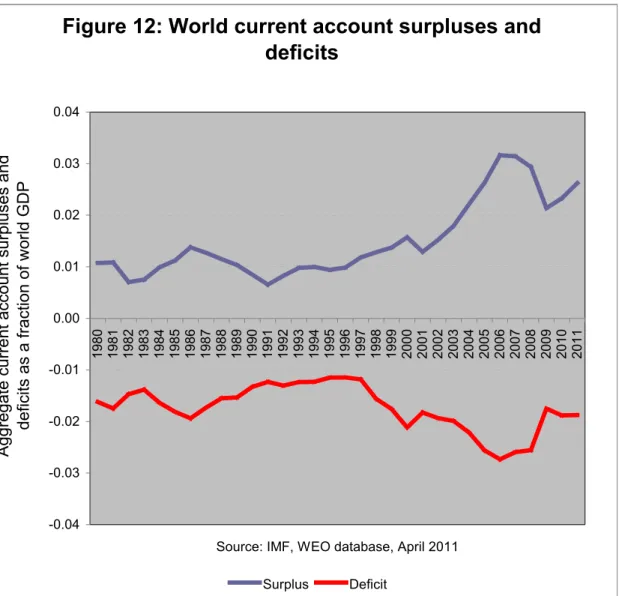
has become considerably more distant. (Figure 12 shows the aggregates of measured world current account surpluses and deficits after 1980, which both peaked at about 3 percent of world output just before the crisis broke in 2006.) The time-honored problem of asymmetric adjustment pressure on surplus and deficit countries remains as intractable as ever, as Charles Goodhart emphasizes in his chapter.
In the mid-2000s, Dooley, Folkerts-Landau, and Garber (2008, 2009) advanced a “Bretton Woods II” paradigm according to which the big global imbalances of the period, driven in part by the Chinese authorities’ desire and capacity to industrialize on the back of exports, might be sustainable for a decade or more. That hypothesis led to a lively debate. For examples of the critiques see Roubini (2006), Obstfeld and Rogoff (2007), Wolf (2008), and Hall and Tavlas (2011).
The global imbalance configuration of the mid-2000s appears in retrospect to have been problematic, which should not be too surprising because it bears a resemblance to several other episodes that ended in tears (and perhaps also to the current configuration of imbalances). Asia in general (outside of Japan) was growing at a rate exceeding that of the mature economies, with China in particular pursuing a “vent for surplus” growth model (Caves 1965).24 Several mature economies, but most notably the United States, were absorbing Asian exports through growing consumption and indebtedness (not through growing productive investment, much of which was taking place anyway in residential housing).
While a soft landing is theoretically possible in this scenario, the rapid increase in U.S. household debt that made America the world’s spending locomotive relied on the
24 There are analogies in the early postwar experiences in Western Europe and Japan. On Europe, see
collateral of rising and inflated home values, which were bound to collapse and did starting in 2006. Given actual and prospective U.S. income growth in the middle 2000s, there was no way that China could maintain its own more rapid export-led growth for much longer on the back of growing U.S. household debt, without U.S. households becoming insolvent. The virulence of the resulting financial meltdown, of course, reflected the gross positions that financial actors in the U.S. and Europe had unwisely assumed prior to the start of the U.S. housing collapse.
In analyzing potential perils due to global imbalances, it is once again important to ask how the pieces fit together. When large surplus countries grow more rapidly than deficit countries, consumption growth in the latter is necessarily increasing faster than income, a process that is very likely to end in crisis unless the debtor’s income growth catches up. Indeed, just this problem underlies the sovereign debt crisis within the euro zone; see the insightful analysis by Giavazzi and Spaventa (2010). Similarly, the current account deficit of the U.S. in the early 2010s, while diminished compared to 2006, is underpinned by large fiscal deficits that are unsustainable over the longer term.
In such situations, a main brake on the behavior of surplus countries is the fear that the assets they are accumulating (whether held by the public sector – Chinese dollar reserves – or the private sector – German banks’ holdings of Greek sovereign debt) might be devalued. (Another is the threat of protection.) If policymakers wish international lenders to be cognizant of risks they are running, then it is important that the international financial system be structured so as to make such fears rational, as Goodhart stresses in his chapter.25 But we should not expect such a system substantially to reduce the
25 Keynes (1924) may have been the first to observe that the risk of default on foreign investments might
adjustment burdens of deficit countries, which will still suffer more tightly constrained or more expensive credit as they appear riskier.
The IMF has the standing to speak out when, in its view, large and persistent external imbalances threaten to result in a solvency crisis, whether in the public or private sectors. The IMF also is in a position to urge cooperative policy scenarios that can make the process of reducing global imbalances easier for all participants. If policymakers wish to raise the weight of the IMF’s advice in the international community, they should support reforms of IMF governance that make such pronouncements politically feasible and credible regardless of the countries involved.
A system of liquidity credit lines, as described in the last section, could discourage precautionary reserve accumulation, although the latter can occur even in the absence of current account surpluses.26 Proposals to formally tax large reserve holders, either in an SDR-based reserve system or one based on currencies, are unlikely to gain any traction, just as Keynes’s similar proposal failed in the 1940s.
IV. Conclusion
Problems of international liquidity and exchange rate management – staple fare in the international monetary reform literature over many decades – remain painfully relevant today, but in forms that sometimes differ from past incarnations. At bottom, many of the
may imperil entire domestic financial systems greatly reinforces Keynes’s insight. Subsequent literature has reiterated the point (for example, Kemp 1962 and Krugman and Obstfeld 1988, p. 504) but perhaps not often enough. In today’s world of large two-way capital flows, which may be highly unbalanced between bilateral partners even when overall current account imbalances are small, one must recognize that the issue really concerns gross rather than net international investment flows per se. In practice, however, current account surplus countries can reduce their exposure over time by reducing their surpluses.
26 Recall the much discussed “capital inflows problem” of disinflating developing countries. See Borio and
coordination problems that arise stem from asymmetries in the structures, growth rates, and cyclical positions of the mature economies and the developing world. These two segments of the global economy are fast approaching (and on some measures have reached) equal size, as measured by real GDP.
Many years ago, Richard Cooper (1969, p. 600) drew an intriguing connection between the extent of policy cooperation over macroeconomic policies and the need for international liquidity. I believe that his point remains valid:
The degree of … international cooperation … influences the amount of liquidity needed to finance imbalances in the face of temporarily divergent and conflicting national policies. The more cooperation, the more carefully coordinated national policies are in timing and nature, the lower the need for international liquidity to finance imbalances.
I have argued that, in addition, there is considerable scope for a cooperative approach to global liquidity provision today. A collateral benefit of such cooperation is that it can mitigate other coordination failures in national economic policies.